

Few aspects of Renaissance composition have occasioned more vigorous or prolonged attention than the tradition of masses built upon the L'homme armé melody. Over the second half of the fifteenth century, this tune was transformed from a simple monophonic melody to a polyphonic juggernaut, anchoring some forty masses by most of this half-century's elite composers and many of the sixteenth century as well. As a tradition of unparalleled magnitude, the L'homme armé mass offered composers a prominent stage upon which to display their ingenuity, inviting (overtly or otherwise) comparisons to the practices of their predecessors and peers.Footnote 1
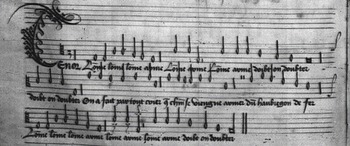
Though the reasons behind L'homme armé's unusual prevalence remain imperfectly understood, the tune's clearly segmented melodic and formal divisions make it inherently suitable for supporting a polyphonic mass. L'homme armé divides easily into three clear sections, designated as ABA for analytical purposes throughout this article. Its melody consists of several brief motifs, easily amenable to varied manipulation in a polyphonic context. Figure 1 presents this melody as it appears in Naples MS VI. E. 40.Footnote 2 Clear ambitus differentiations accentuate the sectional construction; based on G, the tune alternates between the A section's lower fifth (g′ to d′) and the B section's upper fifth (d′ to a′). The tune as it appears in Naples is in the Mixolydian mode, though in polyphonic masses composers usually choose either Mixolydian or G Dorian, depending on the melodic variants employed (that is, the use of a B versus a B♭ in the tune). Its text, meanwhile, connotes images of power, strength and righteous nobility well suited to the Mass, the ‘highest’ of musical genres according to Johannes Tinctoris's well-known commentary.Footnote 3
The L'homme armé melody, from Naples MS VI. E. 40

Scholars have found in the L'homme armé mass tradition a wellspring for intensive scrutiny, and critical study of these pieces has embraced an extraordinary range of topics.Footnote 4 Theories on the monophonic melody address its approximate date of composition, its authorship and its status as either an independent tune or as forming part of a polyphonic chanson.Footnote 5 Questions of the armed man's identity have prompted associations with such figures as Philip the Good, Charles the Bold, St George, St Michael the Archangel and Christ himself.Footnote 6 Symbolic identifications between L'homme armé and aspects of church and court life centre on the realm of number symbolism, particularly exploiting correlations between the thirty-one knights in the Order of the Golden Fleece and the purported length of the melody (which may or may not amount to thirty-one breves, depending on how one interprets certain notational matters).Footnote 7 Finally, theories on dating early masses by Guillaume Du Fay, Johannes Ockeghem and Antoine Busnoys have prompted impassioned debate about the polyphonic tradition's origins – who came first, and byextension, who influenced whom.Footnote 8
Underscoring these historical details are some more foundational issues on the nature of compositional influence. In seeking to identify the where, when and how of a given L'homme armé composition, scholars invariably move towards the more elusive question of why – that is, why a given composer crafted his L'homme armé mass (or masses) the way he did, in view of the tradition as it was known to him at the time. Responses to this question have spanned a range of concerns. In some cases, composers are viewed as imitating or emulating an earlier model, paying a sort of homage to some discrete figure or compositional practice. Other theories propose a sense of competition between different L'homme armé masses, with composers striving to ‘one-up’ a pre-existing practice and take the tradition to new heights. These terms have found wide usage in describing allusions between compositions of varied length and substance.Footnote 9
Amid this prolific study, one key L'homme armé mass composer has so far remained stubbornly under the radar. Cristóbal de Morales is usually referenced only tangentially as a member of this tradition, despite having composed two separate L'homme armé masses.Footnote 10 This lacuna may be due in part to chronology, as Morales first published his masses in the early 1540s, well after the tradition's heyday.Footnote 11 Still, in view of efforts to ascertain Morales's influence on later L'homme armé composers like Francisco Guerrero and Giovanni Pierluigi da Palestrina, the relatively limited attention granted to these pieces, and particularly the lack of any substantial effort to relate his pieces to earlier models, is surprising.Footnote 12
Focusing attention on Morales is not simply an attempt to compensate for previous neglect. Detailed study of these works has uncovered valuable insights into Morales's contributions to this tradition, including a central engagement with the works of Josquin des Prez. To date, studies of Morales's L'homme armé masses have yielded only surface relationships to Josquin. Both composers wrote two separate masses on this tune, a feat no other composers achieved except Pierre de la Rue and, later, Palestrina.Footnote 13 Morales also used the sixth mode in his five-voice mass, echoing the Josquin Missa sexti toni, while in the four-voice mass his interpolations of plainsong excerpts from Credo I and presentation of the L'homme armé tune in the cantus during the Agnus Dei II find a precedent in the Missa L'homme armé super voces musicales.Footnote 14
These links, while important enough to posit a legitimate juncture between these composers, merely hint at the true extent of their relationship. The connections between Morales's two masses and Josquin's Missa L'homme armé super voces musicales and Missa L'homme armé sexti toni are more thoroughgoing than has previously been recognised; comparison in fact reveals a more transformative engagement in which Morales emerges as both adopter and adapter of Josquin's music. The connections encompass at least three spheres of influence: the use of motivic and structural repetition, issues of mode and treatment of the source tune. Not only does Morales directly respond to Josquin's practice in each of these areas, he also models each of his masses on one of Josquin's. In particular, his four-voice mass evokes practices from Josquin's super voces musicales mass, while his five-voice mass recalls gestures from Josquin's sexti toni mass.
These correlations prompt important reconsiderations of how to interpret compositional influence in the L'homme armé tradition, particularly as this tradition entered its latter stages. In using Josquin's works as a foundation for his own masses, Morales adopts techniques alien to his style but characteristic of Josquin's processes. Rather than copy these older devices, Morales carefully integrates these elements into the refined imitative polyphonic language of his time. Within the context of L'homme armé, this is a pioneering manoeuvre. Unlike the composers before him, Morales does not precisely imitate, emulate or compete with other works in the tradition. By adapting techniques from a distinctive older compositional model and framing them within a modern musical language, Morales single-handedly reanimated what had become a declining L'homme armé tradition.Footnote 15
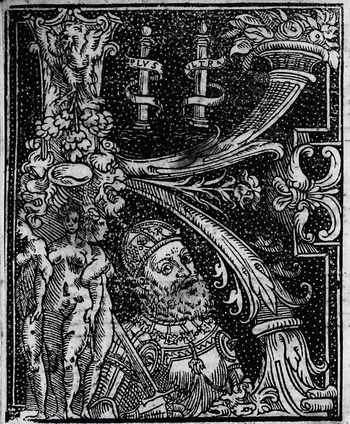
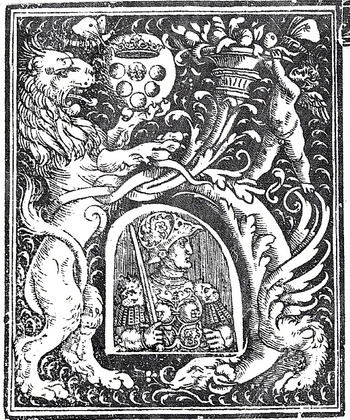
Before assessing Morales's place in the L'homme armé tradition, the immediate circumstances of their composition merit some attention. When, and where, did he compose his two masses? Questions of dating and context for Morales's music are notoriously difficult given the lack of surviving sources from his early career in Spain and can therefore often be addressed only indirectly. The woodcuts accompanying these masses in printed sources, for instance, have been used to make suppositions about both chronology and patronage. In Morales's two mass collections published by Valerio Dorico in 1544 under his personal supervision (Christophori Moralis Hyspalensis missarum liber primus and liber secundus), the historiated ‘K’ initials that begin each Kyrie contain illustrations reflecting the particular mass's features.Footnote 16 The woodcuts in both masses portray an armed knight, and the one for the four-voice mass particularly references the Holy Roman Emperor Charles V (r. 1519–56) with the imperial crown and the personal motto of the emperor, ‘Plus ultra’, entwined around the pillars of Hercules.Footnote 17 (See Figures 2a and 2b.) Some type of association with Charles V therefore seems indicated at least for the four-voice mass, and possibly for the five-voice mass as well. The differing ages of these knights have been further interpreted as clues for the relative dating of these masses, the ‘younger’ knight of the five-voice mass a sign of this work being more youthful than the ‘older’ knighted four-voice mass.Footnote 18
Woodcut accompanying Morales, Missa L'homme armé (4v). Source: Christophori Moralis Hyspalensis missarum liber secundus (Rome: Valerio and Luigi Dorico, 1544)

Woodcut accompanying Morales, Missa L'homme armé (5v). Source: Christophori Moralis Hyspalensis missarum liber primus (Rome: Valerio and Luigi Dorico, 1544)

With the earliest known versions appearing in printed volumes, discerning a particular occasion for which either was first composed proves challenging. Alison McFarland has suggested the five-voice mass may have been written for the 10 March 1526 wedding of Charles V to Isabella ofPortugal, making it an early work, though this wedding took place during Lent, when only plainsong accompaniment would normally be permitted.Footnote 19 A connection to the 1526 wedding also seems unlikely in the light of both Morales's debts to Josquin's practice and his probable reliance on Josquin's mass as it appeared in Vatican rather than Spanish sources, though there may well be some other unknown connection between this work and the emperor.Footnote 20 Robert Stevenson opines that the four-voice mass may have been composed for some occasion honouring Charles V, while James Haar reasonably observes that the thicker-textured five-voice mass could just as easily fulfil a similar function.Footnote 21
The L'homme armé melody has long been associated with the chivalric Order of the Golden Fleece, established in Burgundy in 1433. Charles V, who inherited the Burgundian lands when his father died in 1506, was head of this order during Morales's lifetime, making the likelihood of an imperial connection for these masses even stronger. Additionally, Morales himself apparently cultivated relationships with several members of the emperor's circle, including Pedro Álvarez de Torres, viceroy of Naples and distant cousin of the emperor, as well as Ferdinando de Silva, count of Cifuentes and the emperor's courtier and ambassador to Rome.Footnote 22 Morales also dedicated his Missarum liber primus (containing his five-voice mass) to Cosimo I de' Medici, the youthful duke of Florence and personal friend of Charles V, who three years earlier had acknowledged the emperor as head of the Florentine state in exchange for military assistance battling the French during the Italian wars.Footnote 23
As for where these works were composed, the most probable answer is the Sistine Chapel, where Morales served as singer and composer during the heart of his career (1535–45). This institution maintained a strong devotion to L'homme armé masses from at least the 1480s through the time of Palestrina's nine-month tenure in 1555, evidenced particularly by an unrivalled collection which encompasses nearly the entire known corpus of L'homme armé masses, and by elements such as the recopying of Josquin's mass during the years 1550–5 and of a L'homme armé mass by Marbrianus de Orto in the 1560s.Footnote 24 Indeed, even Palestrina evidently composed both of his L'homme armé masses under the Sistine Chapel's sway despite his very brief tenure.Footnote 25
Morales surely sang a great deal of L'homme armé repertory in his ten years in the Cappella Sistina, and it seems most likely he composed his L'homme armé masses while in Rome. Several further points offer indirect evidence of a Sistine connection. Both masses were first published after Morales was well established in the chapel, suggesting at least an initial proximate connection. Even if new L'homme armé masses were not being composed with the same zeal as half a century earlier, the Sistine Chapel's obvious taste for these pieces, and its penchant for cultivating conservative repertory more generally, suggests an ideal performance context.Footnote 26 And if Morales's contemporaries Costanzo Festa and Elzéar Genet (Carpentras) did not also compose L'homme armé masses while serving at the chapel, it should be remembered that Morales was more heavily inclined towards mass composition than most of his peers, including Festa, Carpentras, Adrian Willaert and Nicolas Gombert.Footnote 27
Both the Sistine Chapel and Charles V, then, probably motivated the composition of Morales's two L'homme armé masses. In aligning himself with such august company, Morales also chose for his musical model the one composer whose reputation surpassed all others. As the following analysis illustrates, Morales references Josquin's music with great frequency and subtlety, drawing on an array of techniques particular to Josquin while couching them in his own musical language.
MORALES, MISSA L'HOMME ARMÉ (4V) AND JOSQUIN, MISSA L'HOMME ARMÉ SUPER VOCES MUSICALES
Morales's four-voice Missa L'homme armé evidently lagged behind his five-voice work in popularity, since it was reprinted only once and currently survives in only two manuscript sources, housed in Toledo and Mallorca.Footnote 28 It is a cantus firmus mass presenting the source tune in the Phrygian mode, a highly unusual gesture which yields a dramatically altered variant of the L'homme armé melody, most strikingly with the half-step interval E–F at the top and bottom of its range.Footnote 29
This tune anchors the mass and appears mostly in the tenor, excepting a distinctive altus presentation during the Benedictus and other isolated moments when the tune is absent. Its consistent cantus firmus disposition in slower rhythms contrasts with great variety in rhythmic devices among the other voices and an irregular distribution of the tune's ABA sections across the mass. McFarland recognised this latter element as one of the mass's novelties, but cited the source tune's clear presentation in the tenor and Morales's retention of its basic rhythmic shape as evidence that the tune held little structural interest compared to the surrounding polyphony, terming the piece ‘an old-fashioned scaffolding cantus firmus mass’.Footnote 30 In fact, Morales's creativity in this mass is anything but old-fashioned. Though basing his mass on a tried-and-tested compositional technique, Morales does not simply compose in an older style. He instead refashions several distinctive elements from Josquin's super voces musicales mass, three of which – the use of motivic repetition, modal manipulations and treatment of the source tune – will be discussed here.
In his frequent repetition of motifs, Morales invokes both a large-scale practice of systematic treatment of musical ideas pioneered by Josquin and a specific motif from his super voces musicales mass. More than any other Renaissance composer, Josquin engages in habitual repetitions of musical gestures – literal repetitions, repetitions by means of sequence or what Jesse Rodin has termed ‘conspicuous repetition’, involving a single voice, in many cases the superius, moving towards a single pitch in its upper range at least three times in rapid succession.Footnote 31 Such motivically based melodies do not often feature in Morales's masses, but they lie at the very core of the four-voice L'homme armé mass.Footnote 32 Morales grounds this piece in repeated iterations of a short rhythmic idea, not especially distinctive on its own but used conspicuously in Josquin's super voces musicales mass.Footnote 33 In its basic form this motif comprises the three-note rhythmic pattern of dotted minim, semiminim, minim, its melody ascending upward or downward in a few characteristic intervallic patterns, usually but not always in stepwise motion. The motif is not static, but rather can be embellished melodically or rhythmically without straying too far from its essential form. Various versions of the motif also combine to form longer melodic lines by means of literal repetitions, melodic elaborations or sequential disposition, within a single voice or spread out among a larger complex.
The Kyrie illustrates how itinerant repetitions of a single idea are strung together into flowing melodic lines around the cantus firmus. In the opening bars of Kyrie I, Morales builds an expansive arch in the altus by placing the motif in a series of first ascending and then descending figurations, set against a cantus firmus statement of the first L'homme armé phrase in the cantus in fore-imitation. (See Example 1.) Upon reaching the first cadence on A in the fifth bar, the tenor having introduced its cantus firmus declamation of the tune, cantus and bassus now take up the motif in earnest, the former concentrating on descending presentations while the latter makes a series of melodic ascents. Blending independent motivic strings with homophonic declamation in multiple voices, Morales spins an intricate web of textures out of this single three-note phrase.
Morales, Missa L'homme arme 4v, Kyrie I

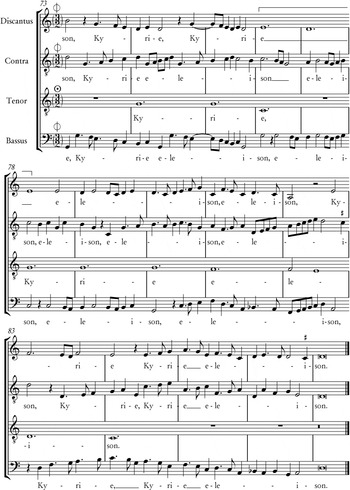
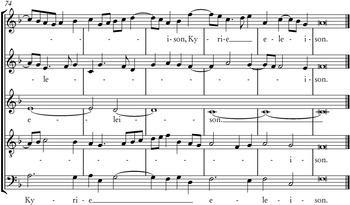
Morales's choice of motif is not random; it features prominently in the Kyrie of Josquin's super voces musicales mass, to some degree in Kyrie I but most notably at the end of Kyrie II. (See Example 2.) This section encompasses multitudinous repetitions of a series of separate but related motifs. It begins with the superius and altus voices loosely declaiming an ascending motif spanning the range of a sixth. The two lower voices present the L'homme armé tune in a mensuration canon, while the superius proceeds with variations on this motif. Beginning in bar 73 the superius, altus and bassus engage in conspicuous repetition of variations on the initial motif, now both ascending and descending but with similar rhythmic character and stepwise motion. Towards the Kyrie's very end, Josquin distils these figurations into the simple, three-note motif identified by Morales. This motif becomes especially audible once the tenor has finished declaiming the cantus firmus, with superius, altus and bassus all presenting the motif multiple times in homorhythmic, sequential declamation. Josquin's motivic usage in this final Kyrie progresses from an elaborated form into a shorter, more essential cell, which Morales then uses as the foundation for the florid polyphony of his entire mass.
Josquin, Missa L'homme armé super voces musicales, Kyrie II, bb. 73–87

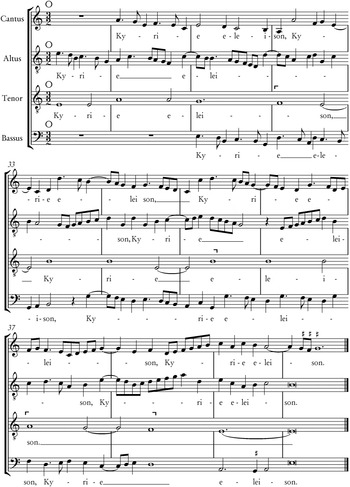
Further repetitions of this motivic idea appear throughout Morales's four-voice mass, in a manner as distinctly reminiscent of Josquin as it is differentiated from his own customary melodic style. In the Christe, for instance, the motif is first used in parallel tenth motion between cantus and bassus, creating brief arches; it then appears in sequential repetition between altus and bassus, in imitation between altus and bassus, and a final sequential repetition within the altus. For the Kyrie II Morales employs the motif primarily in sequential chains, longer and more pervasive than before, perhaps a nod to Josquin's own more prominent use of this motif at the same point in his mass. (See Example 3.) The opening bars find the cantus, altus and bassus all presenting the motif in sequential repetition. The contrasting tenor declaims the source tune's A section as a cantus firmus, with Morales's considerable use of coloration a probable nod to Josquin's elaborate mensural practices. The altus incorporates a Josquinian gesture of conspicuous repetition in bars 30–1, declaiming a five-note descending motif (c′–b–a–g–f) and then repeating it, with slight variations, and extending the lower range down to d. In bar 33, cantus and bassus expand upon this initial descending motif with sequential repetitions of their own elaborated versions of the motif. Indeed, the entire bassus line of this final section consists essentially of motivic repetitions, either sequential or (as in bars 35–6) exact reiterations.
Morales, Missa L'homme arme 4v, Kyrie II

More than simply borrowing this motif from Josquin, Morales also reconceives more generally the nature of motivic construction. Josquin's closing Kyrie displays great technical sophistication with its intricate motivic manipulations, accentuated by bold harmonic gestures, rhythmic excitement and a dramatic contrast between cantus firmus and its surrounding voices. Morales is not so daring in his own Kyrie II; his innovation is rather to temper Josquin's multitudinous variations by crafting a more consistent motivic language, preserving the idea of textural and melodic variations but adhering more rigorously to the essential motivic cell. In Josquin's mass, this motif is the seed from which a dazzling series of manipulations emerges; indeed, the motif appears in its ‘strict’ form only at the endings of Kyrie I and II. Morales, in contrast, varies this motif with far greater restraint, relying primarily on two closely related versions (for ascending and descending motion, respectively). His achievements in motivic repetition are simultaneously reductive and expansive, isolating a single idea from Josquin's broad mosaic and then enhancing its singular presence in his own mass.
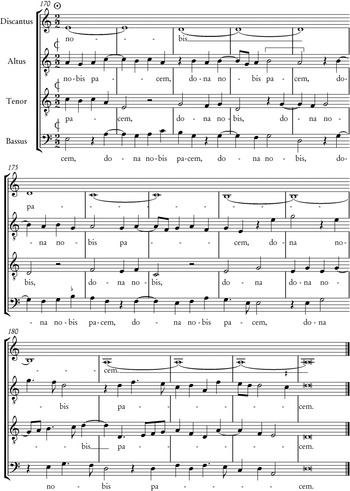
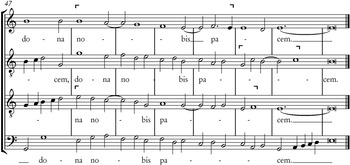
Another instance of adaptation occurs in the final Agnus of each mass. In the super voces musicales mass Josquin presents an astonishing array of sequential repetitions in the lower three voices as the superius declaims the cantus firmus source tune on A. These motifs, frequently exploiting the fourth and fifth intervals characteristic of the source tune, embrace great variety in their rhythmic and melodic configurations. Especially prominent in the latter part of this movement are a series of repetitions, involving repeated stepwise motion and regular rhythms, on the text ‘dona nobis pacem’. Here Josquin subtly shifts the nature of his motivic writing; whereas earlier motifs were more rhythmically varied and spanned wider melodic contours, the motif here is stark and simple, replacing the more florid earlier style. (See Example 4.)
Josquin, Missa L'homme armé super voces musicales, Agnus III, bb. 170–84

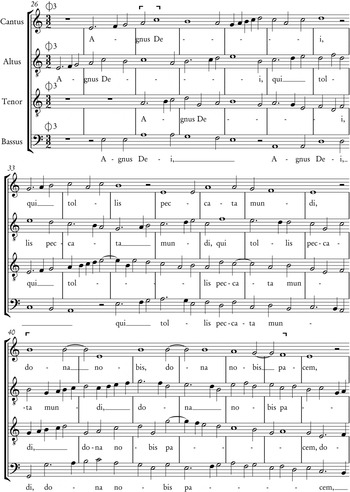
Though Morales's closing Agnus lacks the expansiveness and variety of super voces musicales, it nevertheless owes clear debts to Josquin, drawing particularly on the endpoint of his movement and reworking other motifs in more subtle fashion. Morales begins this section with a brief set of imitative lines in the three upper voices, presenting an ascending motif reminiscent of the opening motif of Josquin's final Agnus against two statements of the L'homme armé tune's opening phrase in the bassus. (See Example 5.) In bar 36 the cantus voice picks up the tune, declaiming the entire A section – the only time in the entire mass the melody appears in this top voice, and a distinct parallel to a similar practice in Josquin's final Agnus.Footnote 34 Against the cantus, the lower voices contain frequent inversions of the initial opening motif, now in a downward fourth descent, plus a more rapid ascending fifth motif presented imitatively in the altus and tenor. This latter motif, while obviously connecting with the characteristic fifth interval of the source tune, also resembles a motif in Josquin's mass at a similar middle point in his setting (e.g., bars 179–81 in the tenor voice of Example 4).
Morales, Missa L'homme arme 4v, Agnus II


As the cantus presents the descending fifth B to E that closes the tune's A section, beginning in bar 44, in distinctive syncopated hemiola rhythms, the altus and bassus engage in downward sequential repetitions on a short, two-note motif of interlocking thirds. This motif, and its sequential disposition, is a condensed variation of larger-scale, sequentially descending motifs across bars 170–8 (see Example 4), which also coincided with a statement of the cantus's closing descent. Morales uses this gesture not once but twice; indeed, the second iteration is even longer than the first, and separating these two sequential statements is another statement in the altus and tenor of the earlier ascending fifth motif (bb. 46–7).Footnote 35 Each instance appears while the cantus declaims the ending fifth descent of the source tune's A section, creating a metrical juxtaposition of the prevailing triple rhythm of the tactus with duple rhythms created by a syncopated L'homme armé tune presentation and the repeated two-note motifs.
Morales's disposition of these motifs underneath a cantus declamation of the cantus firmus is redolent of Josquin's practice. While motivic repetition and sequential development certainly feature elsewhere in the mass, particularly in the Kyrie and Sanctus, the final Agnus stands out for its unusual convergence of multiple figures derived from Josquin. Indeed, Morales deliberately spotlights these moments by aligning these repetitions with a syncopated presentation of the source tune's distinctive closing fifth descent, yielding a palpable rhythmic tension amidst rapid harmonic shifts.
Here it should again be stressed that Morales does not imitate, emulate or ‘out-do’ the technically sophisticated devices of Josquin's music, as composers from Josquin's own generation might have attempted. Conceptually, Morales shares with Josquin an interest in mensural play, motivic construction and exploitation of telltale features of the L'homme armé melody (e.g., downward fifth leaps) in contexts outside the cantus firmus. His genius involves transforming these concepts into the language of his own time and place. In this manner Morales's process may be deemed historicist, though certainly not in the sense of endeavouring to revive a specific older practice. Drawing inspiration especially from the endings of Josquin's mass movements, Morales seems metaphorically to be picking up where Josquin left off, weaving the older composer's ideas into his own distinctive polyphonic web.
Mode provides a second area of connection between Morales and Josquin, with both composers complicating the ordinarily straightforward profile of the L'homme armé tune. Normally set in either Mixolydian or G Dorian, this melody contains clear ambitus differentiations between its A and B sections, filling out the span of an octave plus one step that fully encompasses a mode. Most L'homme armé mass composers treat mode in an uncomplicated fashion, planning cadences on modally appropriate pitches and quoting the L'homme armé tune largely (if not always) on the same pitch as the mode.Footnote 36
Josquin's well-known modal novelties are revealed in the titles of his two masses. In sexti toni he casts the tune unusually in Hypolydian, while in super voces musicales he centres the tune on a different note for each movement, a continuous upward progression from c to a, set against the prevailing Dorian mode of the piece overall.Footnote 37 In view of the spirit of competition among L'homme armé composers of his generation, Josquin's use of mode strikes the observer as a gesture of one-upmanship, turning a seemingly uncomplicated musical feature into a vehicle for highly distinctive treatment.
Morales, following Josquin's example, similarly alters L'homme armé's typical modal profile. By setting his four-voice mass in the Phrygian mode, and placing the melody on E for all its appearances, Morales reveals his own streak of boldness. Having undoubtedly sung other L'homme armé masses at the Sistine Chapel, Morales must have known that his Phrygian version of the melody was a dramatic departure from most of the existing repertory. And in combining an unusual modal configuration with rigorous usage of cantus firmus technique (as Josquin did also), Morales blends radical and conservative approaches towards this tune.
The source melody's rigid presentation allows Morales to fashion some pointed modal clashes between cadence points of the polyphony and the traditional cadential points of the Phrygian mode. A particularly powerful example appears in the Christe, which presents the L'homme armé tune's B section. At the tune's climactic point on its highest pitch (an f′ in this configuration), in bar 25, Morales creates a full cadence on D – a pitch outside the customary orbit for a Phrygian-mode piece – before quickly receding to a plagal E cadence for the movement's close. (See Example 6.) Several factors accentuate the drama of this moment. Because the tune's ascent to this highest pitch normally occurs by means of a whole step, Morales's Phrygian half-step motion from e′ to f′ creates a stunning effect in and of itself. Sustained breves in the bassus and tenor, a forceful altus entrance at the top of its range (the first time within the mass it achieves this highest note) and the topmost cantus cadence all focus attention on this moment. This tension between a climactic D cadence and the prevailing mode of E appears again in the Osanna, in a configuration virtually identical to the Christe aside from some voice reconfigurations.
Morales, Missa L'homme armé 4v, Christe

These devices recall the central conceit of Josquin's super voces musicales mass: the recurring disparities between the mass's prevailing Dorian mode and the source tune's varying pitch centres across each movement. Josquin employs devices both showy and subtle in expressing these conflicts, evidently expanding on techniques previously espoused by Marbrianus de Orto, in what Rodin calls ‘a means of showing off – of boldly entering the competitive fray of the L’homme armé tradition'.Footnote 38 Morales's ‘out of mode’ cadences, while less intricately wrought, nevertheless respond to Josquin's modal treatment. Placing them prominently at points where the L'homme armé melody reaches its peak, Morales does not engage with Josquin's technical sophistication on the older composer's terms, but rather identifies an innovative feature of the Josquin model and references it within the parameters of mid-sixteenth-century style.
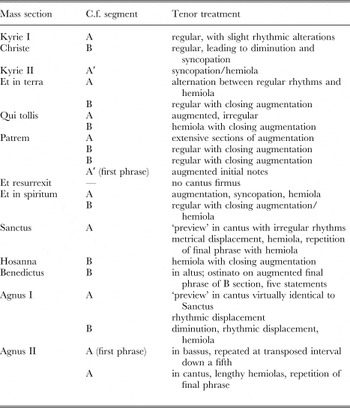
Pervasive alterations of source-tune rhythms further link these masses. Unlike many other cantus firmus L'homme armé masses, where special rhythmic devices like canon, inversion and retrograde are reserved for isolated movements, each movement of Josquin's super voces musicales and Morales's four-voice mass holds some sort of rhythmic interest in the cantus firmus, from Josquin's mensuration canons and notational manoeuvres to Morales's hemiolas, syncopations, ostinatos, augmentations and diminutions. For Morales especially, these manipulations are an important point of differentiation from his other cantus firmus masses.Footnote 39 No other Morales mass can claim such an irregular disposition of the source tune's melodic segments across each movement and such exhaustive rhythmic manipulations of a cantus firmus.Footnote 40 Table 1 illustrates the composer's treatment of the cantus firmus in each section of the mass. Never is any full tune segment presented rhythmically exactly as it appears in an original source, though it comes close at moments like the opening Kyrie and in sections of the Gloria and Credo. Rather, Morales habitually alters motifs or entire segments of the tune through augmented or diminished rhythmic values (though usually not in a strict proportional relationship), syncopations, hemiolas and other rhythmic displacements.
Disposition of the cantus firmus in Morales's Missa L'homme armé (4v)

Why would Morales bring such an abundance of rhythmic devices into this particular mass? For an answer we can again turn to Josquin, whose super voces musicales ranks supreme in the L'homme armé tradition for its rhythmic intricacies. Remarkably, many of his complexities derive from just a few simple notational signs, allowing him to vary the speed and alteration/imperfection patterns of a source tune otherwise notated in similar fashion across all the mass's movements. Mensuration canons, retrograde, augmentation and the use of different mensuration signs between the cantus firmus and its surrounding polyphony yield an extraordinary level of rhythmic sophistication to this mass. Josquin's contrapuntal brilliance was certainly not lost on sixteenth-century figures, who indeed were captivated more by these intricacies of rhythm and notation than the mass's modal complexities.Footnote 41
The remarkable three-in-one mensuration canon of Josquin's Agnus II may rank as the most flashy example of this ingenuity, yet other movements better illustrate the diversity and subtlety of Josquin's practice. In the Kyrie, for instance, the tune-bearing tenor participates in mensuration canons with the superius, contra and bassus voice across the three sections. For the Kyrie I, the tenor entrance as the comes of a 2:1 mensuration canon is almost inaudible, despite its entrance on C rather than the overall mode of D, as no cadence marks this voice's entrance.Footnote 42 The Christe expands the level of augmentation to 4:1 ( versus
 ), yielding a lengthier cantus firmus whose entrance now coincides with a cadence on A. In the Kyrie II, Josquin creates a rhythmic tension in the 2:1 mensuration canon between bassus (in
 ) and the tenor (in
 ), producing a duple-against-triple effect. All this occurs within a polyphonic sheath permeated with motivic repetition and sequential disposition, further emphasising the primacy of rhythm even outside the cantus firmus.Footnote 43
Morales doubtless understood the extraordinary rhythmic achievement of Josquin's mass, but with Josquin's notation-based techniques not part of his mid-century musical language, he cultivated a different sort of rhythmic palette. His opening Kyrie presentation, like Josquin's, deals in subtlety; apart from a couple rhythmic alternations, there is little hint in the source-tune rhythms of the complexities to come. Matters become more complicated in the Christe, now with a mensuration (see above, Example 6). Here Morales begins the tune's B section with an implied triple rhythm in the tenor, contrasting with the duple rhythms of the surrounding polyphony. This leads immediately, however, to a hemiola within the tenor voice, the first phrase's final three notes in equal imperfect breves against the previously established triple mensuration. This first phrase is then repeated exactly but in diminution, now on the order of semibreves and minims. The final phrase begins with a breve and then, from the top note f′, presents a syncopation in which each note is presented as a dotted semibreve. A reversal of this process characterises the
second Kyrie, now in triple mensuration, in which the tune's A-section reprise begins traditionally before new syncopations are introduced. (See above, Example 3.) After presenting the opening melodic gesture in ternary rhythm, Morales introduces a series of hemiolas between the tenor and other voices by placing nearly every succeeding note in coloured imperfect breves, forming a large-scale duple-against-triple pattern.Footnote 44
These intricate rhythmic manipulations of a tune whose melody ordinarily falls so clearly within the compass of ternary rhythm evoke the spirit, if not the letter, of Josquin's extraordinary mensural practice. Of course other L'homme armé composers also employed intricate source-tune rhythmic manipulations; the famous ‘crab canon’ in Du Fay's Missa L'homme armé, for one, suggests that such configurations featured very early in this tradition's history. Why, then, should we presume that Morales looked to Josquin rather than one of these other composers in crafting his most rhythmically intricate mass? The primary reason, in my view, is because Josquin foregrounded rhythm (through the vehicle of notation) more thoroughly than any of these other composers. Whenever the L'homme armé tune appears, a straightforward presentation is accompanied by some modified form, whether by a simultaneous mensuration canon (Kyrie), statements in forward motion followed by retrograde/diminution (Gloria/Credo), use of differing mensuration signs between sections (Sanctus) or a modal shift across different sections (Agnus I/III). In also using rhythmic variety to anchor his source-tune treatment, Morales very likely took Josquin's practice as a model – not of imitation or emulation, but more to achieve a conceptual refashioning of rhythmic variety as it might have related to his own time. And whereas Josquin's super voces musicales mass addresses his peers in a competitive vein, Morales seems to be in dialogue with the tradition itself, positioning himself as the rightful heir to Josquin.
MORALES, MISSA L'HOMME ARMÉ (5V) AND JOSQUIN, MISSA L'HOMME ARMÉ SEXTI TONI
In composing two separate L'homme armé masses, Morales and Josquin both carefully differentiated the stylistic palettes of their respective works. Josquin's Missa L'homme armé sexti toni, probably composed a few years following the super voces musicales mass, differs from its predecessor in such fundamental features as mode, ambitus, use of textural variation and the source tune's melodic shape.Footnote 45 Morales, in contrast, crafted his five-voice mass using paraphrase rather than cantus firmus technique, treating the source melody with great freedom and employing a unifying head motif for all movements. He also employs a varied form of the source-tune melody, a different mode and heightened textural variety relative to his four-voice mass.
Already these factors suggest a unifying preoccupation with exploring divergent approaches to masses based on the same source melody. That the connections between Morales's five-voice Missa L'homme armé and Josquin's Missa L'homme armé sexti toni encompass some of the same areas as those between Morales's four-voice mass and Josquin's super voces musicales further strengthens this alliance.Footnote 46 Source-tune treatment and mode provide important links between these two masses, just as they did with Morales's four-voice mass and Josquin's super voces musicales. Here, however, these two issues are more intimately intertwined. Unusually, both composers set these masses in an F mode rather than Mixolydian or G Dorian. Within this F mode the tune's melodic shape requires a simple adjustment: a half-step descending interval in the B segment's first two phrases between the top F and the adjoining E, rather than the customary whole-step interval. Both composers make the additional melodic alteration of filling in the falling fourth by substituting a D for a repetition of the F in each phrase's ending, a common variant within this tradition.
Observing this varied presentation here as well as in Du Fay's Missa L'homme armé, McFarland speculated that Morales sought to reproduce in his L'homme armé masses the two versions of the source tune found in L'homme armé's earliest settings by Du Fay and Ockeghem.Footnote 47 This supposition has its difficulties. The implied connection between Morales's four-voice mass and Ockeghem's mass, for one, seems untenable given Morales's pointed concern with adjusting this tune to the Phrygian mode. The variant version of the tune was used by many other composers besides Du Fay, including Antoine Brumel, Ockeghem, Philippe Basiron and Tinctoris. Rather than looking to the tradition's origins for inspiration, Morales probably borrowed from the more proximate example of Josquin, in view of his more exact replication of this composer's other practices.
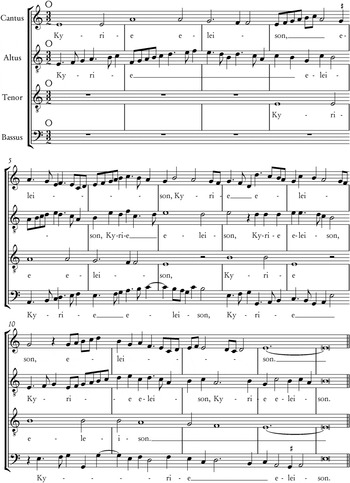
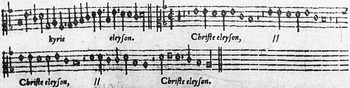
Composing a L'homme armé mass in a plagal mode (or, in Morales's case, an ambiguous F mode) presents an immediate challenge: how does one construct such a piece using the authentic-mode L'homme armé melody as a foundation? Tellingly, both Josquin and Morales devise similar solutions to this problem. Josquin takes a free approach to the tune's melodic shape and free disposition of its motifs throughout all voices, distributing the tune's B section in other voices besides the tenor and on different pitch levels to preserve the piece's overall plagal range. Having treated the source melody with exceeding rigour in his super voces musicales mass, Josquin's exceedingly liberated approach in sexti toni could hardly be a greater contrast.Footnote 48 The opening Kyrie gives little hint of what is to come, containing a modally straightforward presentation of the tune on f, in all voices with imitative entries. But as the L'homme armé tune ascends to its authentic range in the ensuing Christe, Josquin exchanges four clear tune statements on f with a single, cantus firmus declamation of the B section – on c, in the bassus voice – before transposing upward to f for the final phrase. (See Figure 3). Outlines of the tune's B section appear in other voices as well, most clearly in the tenor, centred variously around the pitches of C, F and G. For the Kyrie II, Josquin returns to a tune statement on f, this time as a cantus firmus in the tenor, with a prominent melodic sequence on the tune's closing descent of a fifth, shortly before the section ends with an added statement of this closing fifth in mostly homophonic declamation.
Josquin, Missa L'homme arme sexti toni, Christe (excerpt), Chigi Codex

Morales's Kyrie–Christe pair, while not as sharply differentiated in pitch as in Josquin's, shows the same concern with progressive modal complication as the source tune moves to its authentic range. At the outset, the situation appears simple: his Kyrie presents the tune's A section as a cantus firmus on f in the tenor, with imitative statements on both c and f. But this modal fabric is ruptured in the Christe, as the altus I declaims the B segment's first phrase as an ostinato on g′, with three statements separated by rests of three semibreves duration. The melody is then transposed to f′, the first phrase now proclaimed with slightly modified rhythm, before closing with the B section's final phrase. (See Figure 4.) Layered underneath is a statement of the first phrase on the ‘correct’ pitch of f′ in the altus II, followed by further iterations of this phrase in altus II and tenor variously employing transpositions of tune segments on the pitches of f, g and c.Footnote 49 Tune fragments on c′ in the bassus, meanwhile, distinctly recall Josquin's own prominent bassus cantus firmus on c in the sexti toni mass.
Morales, Missa L'homme armé 5v, Christe, altus II, from Quinque missae Moralis Hyspani, ac Jacheti musici excellentissimi: Liber primus, cum quinque vocibus (Venice: Girolamo Scotto, 1540)

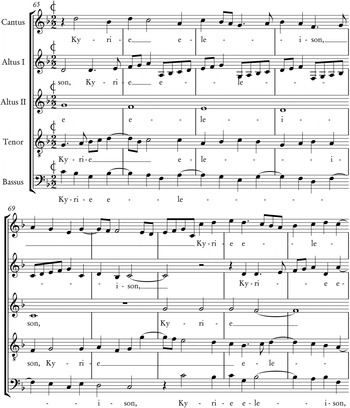
Morales's Kyrie II, like Josquin's, returns to the pitch pattern found in the composer's first Kyrie – in this case, imitative tune motifs on f alongside a cantus firmus statement on c′ in the altus II. Morales also introduces a sequential motivic pattern at the tune's final melodic descending fifth (see Example 7). Indeed, he takes this latter device even further than Josquin, proclaiming the L'homme armé tune's closing descent twice as Josquin does but introducing sequence on both statements rather than the first statement only – a deliberate extension of the elder master's practice, especially sharpened by an avoided cadence at the end of the first sequence. Enriching his modal profile through tune statements on three different pitches, including a prominent bassus statement on c′, Morales simultaneously invokes and expands upon Josquin's pioneering conception of source-tune treatment.
Morales, Missa L'homme armé 5v, Kyrie II, bb. 65–79


Another instance of modelling occurs in the Agnus Dei. Foundationally, both masses use the same textural configuration for the three sections: a regular four-voice texture for Agnus I, a reduction to superius, altus and tenor for Agnus II and a six-voice expansion for Agnus III. A focus on literal repetition by both composers further links these movements, particularly in the Agnus II, where Morales repeats a series of motifs bearing surface melodic correlations to Josquin's melodies. But the most intriguing parallel occurs in the final Agnus. Josquin's music at this point is a tour-de-force, pitting two pairs of duos in canonic pairs against cantus firmus lower lines, where segments of the L'homme armé tune are presented in forward and retrograde motion by the tenor and bassus respectively. Borrowing ideas from peer composers like Busnoys and Basiron, including the use of retrograde canon and a sudden pause in the middle of the movement, Josquin vastly expounds on these techniques, presenting a construct of unparalleled sophistication in a seeming gesture of one-upmanship towards his peers.Footnote 50
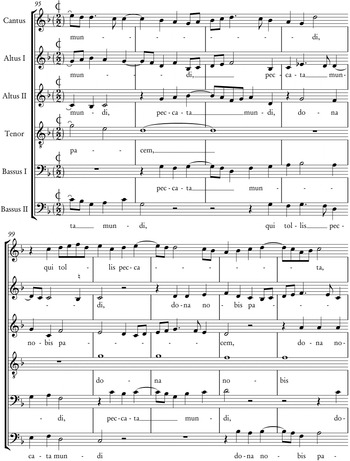
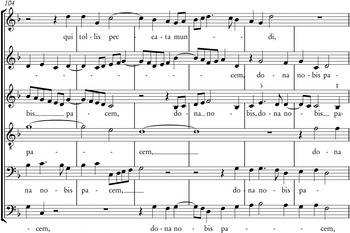
As an adapter of techniques rather than a strict borrower or competitor, literal copying of these devices is not Morales's concern. But while Morales's Agnus III music bears little surface relation to Josquin's, he does borrow one very prominent idea from the sexti toni mass: the use of block repetition. This type of repetition is pervasive in Josquin's final Agnus, where pairs of voices, first an altus pair and then a superius pair, present a repeating series of melodies using such intricate devices as stretto imitation, motivic reiterations and sequential motion. Morales's repetition, though markedly different from Josquin's, is equally striking: a block of four bars is reused almost verbatim, with some voice exchanges, six bars later. (Compare bars 96–9 and 106–9 in Example 8.) Adding to its distinctiveness is a startling accented dissonance created by the cantus and altus I (altus II in the block's repetition), a suspended e♭′ in the altus clashing on a strong beat against a d″ in the cantus.
Morales, Missa L'homme armé 5v, Agnus III, bb. 95–109


For Morales, a block repetition of this type is extraordinarily unusual. Indeed, as far as I am aware the gesture is sui generis; never in any other composition does Morales employ such a large-scale reuse of musical material. The obvious question then follows: why would Morales insert a large-scale block repetition in this mass, during this closing movement? One possibility is that it has a climactic function, emerging from an expanded texture during the mass's final movement, but this idea is weakened by the music's seamless integration with its surrounding polyphony. Distinctive as the gesture is, it simply does not sound like a climax. A more likely possibility is that it pays tribute to the extended pattern of repetition in Josquin's sexti toni mass. Like Josquin, Morales introduces layers of repetition throughout his mass but brings this technique to new heights in its closing moments.Footnote 51 Rather than simply imitate the older master, however, Morales creates a less ostentatious sense of climax, folding the repeated block within his dense, imitative polyphony. In doing so, he shows both the influence of an older practice and an impulse to transform that practice into something more suitable to mid-sixteenth-century style.
As a mass tradition, L'homme armé carried a pedigree unlike anything else in the entire Renaissance, from the sheer quantity of masses on this melody to the powerful symbolic significance of a noble, even Christological, ideal. In studying the vast fifteenth-century L'homme armé tradition, with its multitude of masses in close chronological proximity, the dominant comparative analytical paradigm has been to consider how one composer's setting might have competed with, imitated or emulated another exemplar. For a mid-sixteenth-century composer like Morales, however, these ideas have markedly less currency. A L'homme armé mass published around 1540 carries distinct historicist connotations absent from the flourishing of masses preceding it by some half-century or more.Footnote 52 Considerations of imitation, emulation and competition lose some of their relevance, and a different set of questions needs to be asked about a composer's motivation for journeying back into the past.
Morales hardly endeavoured to ‘out-do’ the complex learned devices and mensuration manipulations of Josquin, though he clearly references these telltale features of Josquin's style. And while some reliance on Josquinian models may be perceived in his having composed two L'homme armé masses with unusual modal choices and source-tune treatments, Morales is not trying to ‘emulate’ Josquin in the sense of equalling or excelling his achievement – particularly since, by the time of Morales's compositions, parody technique would have offered a more suitable means of emulation than cantus firmus or paraphrase. For Morales, composing two L'homme armé masses probably represented several things at once: a keen appreciation of this mass tradition, a desire to occupy a prominent position within it, an identification of Josquin as a masterful composer upon whose shoulders he could stand and even perhaps a desire to himself become a figure of influence upon later composers – a wish that would be realised in subsequent mass pairs by Guerrero and Palestrina. And if the pieces were written at the Sistine Chapel, as seems likely to be the case, they also participate in this institution's known penchant for traditionalism and musical borrowing.Footnote 53 Morales's greatest achievement in his L'homme armé masses was to reanimate a hallowed tradition, taking select musical features from its most accomplished fifteenth-century practitioner and adapting them to a contemporary musical language. The conspicuous motivic repetitions of Josquin's masses are combined into longer melodic statements, and Josquin's strict learned devices are softened in the service of a smoother polyphonic language. Through a meticulous engagement with Josquin's music, Morales self-consciously positioned himself as the composer's rightful successor.