1. Introduction
Starting in 1993, the Water Economics Project (WEP) in which we participated (with Fisher as Chair) developed economics-based methods for optimal water management, especially for resolving water disputes. Those methods are described most fully in the Project's book (Fisher et al., Reference Fisher, Huber-Lee, Arlosoroff, Eckstein, Haddadin, Hamati, Jarrar, Jayyousi, Shamir, Wesseling, Salman and Al-Karablieh2005), and are summarized below.Footnote 1 It is shown that an agreement to trade in water-permits (permits to use each other's water in specified amounts) sold at the shadow values generated by the WAS (Water Allocation System) model is never inferior and usually superior to the standard agreement as to a fixed division of water quantities among countries.
Of course, the realization that water can (and should) be treated as an economic commodity – with special properties – is not new. It goes back at least as far as the Harvard Water Program of the 1950s and 1960s (see Eckstein, Reference Eckstein1958; Maass et al., Reference Maass, Hufschmidt, Dorfman, Thomas and Marglin1962; see also Hirshleifer et al., Reference Hirshleifer, DeHaven and Milliman1960). That realization has led to a large literature on water markets, to policy recommendations for water markets, particularly by the World Bank, and, in some cases, to the adoption of such recommendations (see for example Saliba and Bush, Reference Saliba and Bush1987).
But, for reasons discussed below, actual water markets will often, indeed generally, not lead to efficient or optimal results. There are several reasons for this, but perhaps the most important is because, in allocating water, there are social benefits and costs that are not simply private benefits and costs. While some of these ‘externalities’ are recognized in the literature (environmental issues, for example), others are not. In particular, the fact that subsidization of water for a particular use (usually agriculture) implies a policy decision that there are social benefits from such use above and beyond those realized by the direct users is typically ignored. But private markets will fail to handle this, and, where such views are held by policymakers, such failure will properly make them unwilling to institute actual market mechanisms.Footnote 2
The analysis discussed here overcomes such difficulties by the use of WAS, an explicit optimizing model that allows the policymaker to impose his or her own views as to water values or, equivalently, to impose certain water policies and also to take other externalities into account. This is a form of systems analysis. The application of systems analysis to water management is also not new (see, for example, Rogers and Fiering, Reference Rogers and Fiering1986, and the papers cited in footnote 3). But such applications fall short because they do not reflect the true concerns of decision makers. The WAS tool solves this problem by permitting the user to impose his or her own values.
In addition, there are other differences between the present work and its predecessors. First, much previous work concerns the cost–benefit analysis of particular projects, whereas the present work provides a tool for the overall management of water and water projects taking into account countrywide (or regionwide) effects while using a model that is geographically quite disaggregated.
Second, most models minimize cost in connection with fixed demand quantities.Footnote 3 The WAS model goes beyond that in more than one respect:
• WAS takes account of demand considerations and the benefits to be derived from water use rather than fixing water quantities to be delivered.
• WAS permits the user to impose social values that differ from private ones and to impose policies that the optimization must respect.
• Beyond mere optimization, WAS can be used in conflict resolution, an area highly important in water issues, as it can be used to value disputed water, thus effectively monetizing and de-emotionalizing the dispute. Moreover, for international disputes, the water systems of each party can be analyzed separately, testing options of links to other parties, or of analyzing the combined territory of two or more parties as one. This provides estimates of the benefits of WAS-guided cooperation.
While the methods developed are applicable to water disputes around the globe, Fisher et al. (Reference Fisher, Huber-Lee, Arlosoroff, Eckstein, Haddadin, Hamati, Jarrar, Jayyousi, Shamir, Wesseling, Salman and Al-Karablieh2005) applied them to Israel, Jordan, and Palestine, which have a long history of water disputes, and examined the gains to such cooperation compared to the much lower values of fairly large changes in ownership of the water in dispute. Most of the discussion concerned two-way cooperation between Israel and PalestineFootnote 4 and Israel and Jordan. Cooperation among all three countries was considered, giving results on particular aspects of the water flows that would occur, but the analysis did not exhibit fully the gains from three-way cooperation.
This paper considers the benefits of different coalitions, especially trilateral cooperation. Before this is done, however, a related question is considered:
Suppose that there are n countries. Is the ‘grand coalition’ – that is, WAS-guided cooperation among all countries involved – stable? In game-theoretic terms, is the grand coalition at the core or can there exist a subset of countries that, by cooperating among themselves, can all do better than they can in the grand coalition and therefore block the latter?
It is shown that the answer to this question is in the negativeFootnote 5 – an important fact with an easy demonstration, once one understands how WAS-guided cooperation works. Since this is essential, that mechanism is first summarized.
2. Water ownership and the value of water
There are two basic questions involved in thinking about water agreements. These are:
• the question of water ownership and
• the question of water usage.
We must be careful to distinguish these questions.
All water users are effectively buyers irrespective of whether they own the water themselves or purchase water from another. An entity that owns its water resources and uses them itself incurs an opportunity cost equal to the amount of money it could otherwise have earned through selling the water. An owner will thus use a given amount of its water if and only if it values that use at least as much as the money to be gained from selling. The decision of such an owner does not differ from that of an entity that does not own its water and must consider buying needed quantities of water: the non-owner will decide to buy if and only if it values the water at least as much as the money involved in the purchase. Ownership only determines who receives the money (or the equivalent compensation) that the water represents.
Water ownership is a property right entitling the owner to the economic value of the water. Hence a dispute over water ownership is effectively a dispute over the right to monetary compensation for the water involved, taking into account social and environmental values.
The property rights issue of water ownership and the issue of water usage are analytically independent. For example, resolving the question of where water should be efficiently pumped does not depend on who owns the water. While both ownership and usage issues must be properly addressed in an agreement, they should be analyzed separately (Coase, Reference Coase1960).
The fact that water ownership is a matter of money can be brought home in a different way. It is common for countries to regard water as essential to their security because water is essential for agriculture and countries wish to be self-sufficient in their food supply. This may or may not be a sensible goal, but the possibility of desalination implies the following:
Every country with a seacoast can have as much water as it wants if it chooses to spend the money to do so. Hence, so far as water is concerned, every country with a seacoast can be self-sufficient in its food supply if it is willing to incur the costs. Disputes over water among such countries are merely disputes over costs, not over life and death.
Note that, in valuing water, we must consider the following:
1. Unless water is very abundant, the value of water does not simply consist of the costs of extraction, treatment, and conveyance. In general, water value also includes a scarcity rent, reflecting the opportunity cost of its use – the value of using or selling it elsewhere.
2. When we speak of ‘the value of water’, we are speaking of the value of molecules of H2O. That is not the only value of importance, however. There may be religious or historical values placed on particular water sources. Further, water in certain uses (agriculture, for example), may be considered as more valuable to society than is reflected in the private valuations of the users. And water in secure sources may be considered more valuable than water in less secure sources. In WAS we permit the user to take such things into account; our analysis is not confined to narrowly defined economic considerations.
3. Why actual water markets will not work
In the case of many scarce resources, free markets can be used to secure efficient allocations. This does not always work, however; the important propositions about the efficiency of markets require the following conditions:
1. The markets involved must be competitive consisting only of very many, very small buyers and sellers, so that individual participants cannot affect prices.
2. All social benefits and costs associated with the resource must coincide with private benefits and costs, respectively, so that they will be taken into account in the profit-and-loss calculus of market participants.
Neither of these conditions is generally satisfied when it comes to water (in the Middle East or elsewhere). First, water markets will not generally be competitive with many small sellers and buyers. Second, water in certain uses – for example, agricultural or environmental uses – is often considered to have social value in addition to the private value placed on it by its users. The common use of subsidies for agricultural water, for example, implies that the subsidizing government believes that water used by agriculture is more valuable than the farmers, themselves, consider it to be.Footnote 6 This does not mean, however, that economic analysis has no role to play in water management or the design of water agreements. We can build a tool (WAS) that explicitly optimizes the benefits to be obtained from water, taking into account the issues mentioned above. Its solution, in effect, provides an answer in which the optimal nature of competitive markets is restored and serves as a tool to guide policymakers.Footnote 7
WAS does not itself make water policy. Rather it enables the user to express his or her priorities and then shows how to implement them while maximizing the net benefits to be obtained from the available water. While WAS can be used to examine the costs and benefits of different policies, it is not a substitute for, but an aid to the policymaker.
It would be a mistake to suppose that WAS only takes economic considerations (narrowly conceived) into account. WAS leaves room for the user to express social values and policies through the provision of low (or high) prices for water in certain uses, the reservation of water for certain purposes, and the assessment of penalties for environmental damage. These are, in fact, the ways that social values are usually expressed in the real world.
4. The WAS tool
As here discussed, WAS is a single-year, annual model, although the conditions of the year can be varied and different situations evaluated.Footnote 8 The objective function maximizes net water benefits for a given region, subject to constraints. These include:
• The capacity of various pieces of infrastructure (e.g. water treatment plants, desalination plants, and conveyance lines or canals)
• The constraints represented by social policies due to environmental or other factors, including constraints restricting the water taken from any natural source to be no greater than the annual renewable flow available from that source (although that maximum can be adjusted according to climatic conditions)
• The price policies (such as subsidization of water for agriculture) that are prescribed by the model user
• Most important of all, the constraint that the quantity of water consumed in a particular location cannot exceed the quantity produced there plus the quantity imported into less the quantity exported from that location.
The country or region to be studied is divided into districts. Within each district, demand curves for water are defined for household, industrial, and agricultural use of water. Extraction from each water source is limited to the annual renewable amount. Allowance is made for treatment and reuse of wastewater and for inter-district conveyance. This procedure is followed using actual data for a recent year and projections for future years.Footnote 9
Environmental issues are handled in several ways. Water extraction is restricted to annual renewable amounts, an effluent charge can be imposed, the use of treated wastewater can be restricted, and water can be set aside for environmental (or other) purposes. Other environmental restrictions can also be introduced.
WAS permits experimentation with different assumptions as to future infrastructure. For example, the user can install wastewater treatment plants, expand or install conveyance systems, and create seawater desalination plants.
Finally, the user specifies policies toward water. Such policies can include specifying particular price structures for particular users such as agriculture, reserving water for certain uses, and imposing ecological or environmental restrictions.
Given the choices made by the user, the model allocates the available water so as to maximize total net benefits from water. These are defined as the total amount that consumers are willing to payFootnote 10 for the amount of water provided less the cost of providing it.Footnote 11
5. Shadow values and scarcity rents
Under very general conditions, when an objective function is maximized under constraints, the solution generates a set of non-negative numbers, usually called ‘shadow prices’, but here called ‘shadow values’ to emphasize that these are not necessarily the prices charged to water users. Such shadow values (Lagrange multipliers) show the amount by which the value of the objective function would increase if the corresponding constraints were to be relaxed a little.
In WAS, for example, where a pipeline is limited in capacity, the associated shadow value shows the amount by which benefits would increase per unit of pipeline capacity if that capacity were slightly increased. This is the amount that those benefiting would just be willing to pay for more capacity.
The central shadow values in the WAS model, however, are those of water itself. The shadow value of water at a given location corresponds to the constraint that the quantity of water consumed in that location cannot exceed the quantity produced there plus the quantity imported less the quantity exported. That shadow value is thus the amount by which the benefits to water users (in the system as a whole) would increase were there an additional cubic meter per year available free at that location. It reflects both water costs and the value of water to buyers.Footnote 12
Shadow values are not necessarily the prices that water consumers are charged. That would be true in a purely private, free market system. But in the WAS model, as in reality, the prices charged to some or all consumers can (and often will) be a matter of social or national policy. When such policy-driven prices are charged, the shadow values of water will reflect the net benefits of additional water, given the policies adopted.
Related to this is the fact that shadow values are outputs of the model solution, not inputs specified a priori. They depend on the policies and values put in by the user of the model.
It is important to note that the shadow value of water in a given location does not generally equal the direct cost of providing it there. Consider a limited water source whose pumping costs are zero. If demand for water from that source is sufficiently high, the shadow value of that water will not be zero; benefits to water users would be increased if the capacity of the source were greater. Equivalently, buyers will be willing to pay a non-zero price for water in short supply, even though its direct costs are zero.
A proper view of costs accommodates this phenomenon. When demand at the source exceeds capacity, it is not costless to provide a particular user with an additional unit of water. That water can only be provided by depriving some other user of the benefits of the water; that loss of benefits represents an opportunity cost. In other words, scarce resources have positive values and positive prices even if their direct cost of production is zero. Such a positive value – the shadow value of the water in situ – is called a ‘scarcity rent’.
Where direct costs are zero, the shadow value of the resource involved consists entirely of scarcity rent. More generally, the scarcity rent of water at a particular location equals the shadow value at that location less the direct marginal cost of providing the water there.Footnote 13 Just as in a competitive market, a positive scarcity rent is a signal that more water from that source would be beneficial were it available.
Water shadow values and, accordingly, water scarcity rents depend upon the infrastructure assumed to be in place.
When water is efficiently allocated, as in the solution of the WAS model, the following relationships must hold (all values are per unit of water):
• The shadow value of water used in any location equals the direct marginal cost plus the scarcity rent. For water in situ, the shadow value is the scarcity rent.
• Water will be produced at a given location only if the shadow value of water at that location equals or exceeds the marginal cost of production. Equivalently, water will only be produced from sources whose scarcity rents are non-negative.
• If water can be conveyed from location a to location b, then the shadow value of water at b can never exceed the shadow value at a by more than the cost of such conveyance. Water will actually be transported from a to b only if the shadow value at b exactly equals the shadow value at a plus the transportation cost. Equivalently, if water is transported from a to b, then the scarcity rent of that water is the same in both locations.
Note that shadow values play a guiding role in the same way that actual market prices do in competitive markets. An activity that is profitable at the margin when evaluated at shadow values is one that should be increased. An activity that loses money at the margin when so evaluated is one that should be decreased.
Of course, where social values do not coincide with private ones, the shadow value of water at a given location is the price at which the user of the model would just be willing to buy or sell an additional unit of water there. That payment is calculated in terms of net benefits measured according to the user's own standards and values.
This immediately implies how the water in question should be valued. Water in situ should be valued at its scarcity rent. That value is the price at which additional water is valued at any location at which it is used, less the direct costs involved in conveying it there.
Note that the propositions about profitable and unprofitable activities involve water being so valued. Those propositions take full account of the fact that using or processing water in one activity can reduce the amount of water available for other activities. The shadow values accompanying the maximizing solution include such opportunity costs, taking into account systemwide effects. (This is particularly important in using WAS for cost–benefit analysis.)
We should not be confused by the use of marginal valuation in all this (the value of an additional unit of water). The fact that people would be willing to pay much larger amounts for the amount of water necessary for human life is important. It is taken into account in the optimizing model by assigning correspondingly large benefits to the first relatively small quantities of water allocated. But the fact that the benefits derived from the first units are greater than the marginal value does not distinguish water from any other economic good. It merely reflects the fact that water would be (even) more valuable if it were scarcer.
It is the scarcity of water and not merely its importance for existence that gives it its value. Where water is not scarce, it is not valuable.
6. Cost–benefit analysis of infrastructure and the treatment of capital costs
There are two ways of incorporating capital costs into the analysis of WAS results. One option is to impute an appropriate charge for capital costs to each cubic meter of water processed by the proposed facility.
The second option is more direct. We run the WAS model with and without the proposed infrastructure.Footnote 14 This generates an estimate of the annual increase in benefits that would result from having such infrastructure in place. Given the estimated life of the projected infrastructure, we can repeat the exercise for the expected conditions of the various years of that life. Then, choosing a discount rate, we calculate the present value of such benefits and compare that with the capital costs.
In MYWAS, the multiyear version of WAS mentioned in footnote 8 above, the treatment of capital costs is more straightforward. We treat them as cash outlays incurred at various times when the project in question is begun or expanded. MYWAS then takes them directly into account in the calculation of the present value of total net benefits being maximized.
7. Conflict resolution: negotiations and the gains from trade in water permits
By using the WAS model to value water in dispute, water disputes can be monetized, and this may be of some assistance in resolving them. Consider bilateral negotiations between two countries, A and B. Each of the two countries can use its WAS tool to investigate the consequences to it (and, if data permit, to the other) of each proposed water allocation. This should help in deciding on what terms to settle, possibly trading off water for other, non-water concessions. Indeed, if, at a particular proposed allocation, A would value additional water more highly than B, then both countries could benefit by having A get more water and B get other things which it values more. (Note that this does not mean that the richer country gets more water. That only happens if it is to the poorer country's benefit to agree.)Footnote 15
Of course, the positions of the parties will be expressed in terms of ownership rights and international law, often using different principles to justify their respective claims. The use of the methods described here in no way limits such positions. Indeed, WAS is silent as to the proper allocation of water ownership rights. But WAS shows how water can be traded off for non-water concessions, with the trade-offs measured by WAS.
In addition to monetizing water disputes, WAS can facilitate water negotiations by permitting each party, using its own WAS model, to evaluate the effects on it of different proposed water arrangements. As we now exemplify, this can show that the trade-offs just discussed need not be large.
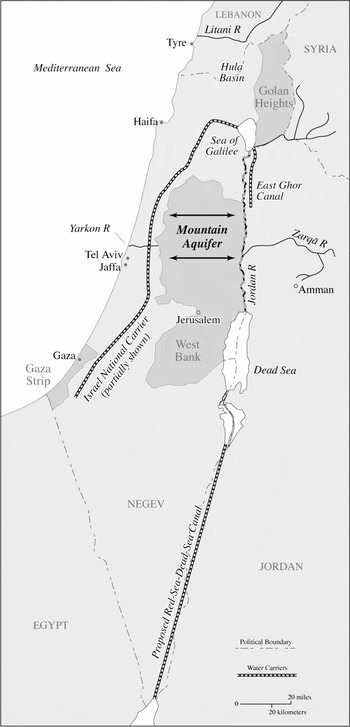
Water on the Golan Heights (see figure 1)Footnote 16 is sometimes said to be a major problem in negotiations between Israel and Syria, because the Banias River that flows from the mountains of the Golan is one of the three principal sources of the Jordan River (JR).Footnote 17 By running the Israeli WAS model with different amounts of water, we have evaluated this question.
Partial regional map with water systems

In 2010, the loss of an amount of water roughly equivalent to the entire flow of the Banias springs (125 million cubic meters annually) would be worth no more than $5 million per year to Israel in a year of normal water supply and less than $40 million per year in the event of a reduction of 30 per cent in naturally occurring water sources. These results take into account Israeli fixed-price policies towards agriculture.
Note that it is not suggested that giving up so large an amount of water is an appropriate negotiating outcome, but water is not an issue that should hold up a peace agreement. These are trivial sums compared to the Israeli GDP (gross domestic product) of approximately $100 billion per year or to the cost of fighter planes.
Similarly, a few years ago, Lebanon announced plans to pump water from the Hasbani River – another source of the Jordan. Israel called this a casus belli and international efforts to resolve the dispute were undertaken. But whatever we think about Lebanon's right to take such an action, it should be understood that our results for the Banias apply equally well to the Hasbani. The effects on Israel would be fairly trivial.Footnote 18
Water is not worth war!
Monetization of water disputes, however, is neither the only nor, perhaps, the most powerful way in which the use of WAS can promote agreement. Indeed, WAS can assist in guiding water cooperation in such a way that all parties gain.
The simple allocation of water quantities after which each party then uses what it ‘owns’ is not an optimal design for a water agreement. Suppose that property rights issues have been resolved. Since the question of water ownership and the question of water usage are analytically independent, it will generally not be the case that it is optimal for each party to use its own water.
Instead, consider a system of trade in water permits – short-term licenses to use each other's water. The purchase and sale of such permits would be in quantities and at prices (shadow values) given by an agreed-on version of the WAS model run jointly for the two (or more) countries together. (The fact that such trades would take place at WAS-produced prices would prevent monopolistic exploitation.) There would be mutual advantages from such a system, and the economic gains would be a natural source of funding for water-related infrastructure.
Both parties would gain from such a voluntary trade. The seller would receive money it values more than the water given up (else, it would not agree); the buyer would receive water it values more than the money paid (else, it would not pay it). While one party might gain more than the other, such a trade would not be a zero-sum game but a win–win opportunity.
We illustrate such gains for Israel, Jordan, and Palestine below. First, however, we consider the stability of the grand coalition.
8. The stability of the grand coalition
Consider a group of n countries all in the same river basin, aquifer, or otherwise connected water. Let G denote the grand coalition – where, by ‘coalition’ is meant a WAS-guided cooperation arrangement as described above. It will be shown that G is stable – that is, that there exists no non-empty proper subset, S, of the countries such that a coalition of the members of S, using their own water resources, can lead to all such members being better off than they would be in G. (Of course, this applies to single-member subsets where a single country optimizes the use of its own water.)
Proposition.The grand coalition is stable.
Proof. The proof begins with:
Lemma. The proposition is true for n = 2.
Proof of lemma. Let the two countries be denoted by X and Y respectively. Suppose that the joint WAS solution calls for a transfer of water from some district of X to some district of Y. (For simplicity of notation, assume that each country has only one district.) Then it must be the case that, without such transfer, PX < PY + t*XY, where PX denotes the (pre-transfer) shadow value of water at X, PY denotes the (pre-transfer) shadow value of water at Y, and t*XY denotes the per-cubic-meter conveyance cost – this time including the appropriate capital charge.Footnote 19 Then, after the transfer from X to Y, the shadow value at X will be higher than PX, and the shadow value at Y will be lower than PY, the respective pre-transfer shadow values. But then both X and Y must have total benefits higher than they would be without the transfer – X because it has received money that it values more than the water given up, and Y because it has received water that it values more than the money it has paid.Footnote 20
Proof of proposition. Now, consider any nonempty proper subset, S, whose members form a coalition. Let T be the set of all countries that are not in S. Consider a coalition formed by the members of T. Then the water resources of the members of S are being used optimally as though S were a single country, and similarly for T. But the grand coalition, G, is nothing but a coalition formed by S and T. This is a bilateral agreement. Hence, by the lemma, both S and T must be at least as well off as they were alone. It follows that it cannot be true that the members of S (or the members of T) can all be better off than they would be in G.
Some comments need adding. First, note that the user-specified water valuations of each of the countries are respected in any WAS-guided arrangement in which they participate.
Second, because the use of WAS shadow values, given those valuations, essentially restores the properties of a competitive market, the result just given is not surprising. It essentially mirrors the well-known result that the competitive equilibrium is always in the core of the economy.
Third, as already remarked, the result does not imply that every country does better in the grand coalition than it would in other coalitions. For example, in the case of Israel, Jordan, and Palestine, for plausible (but not inevitable) distributions of water ownership, Israel is a net seller and the other two countries are net buyers of water under WAS-guided arrangements.Footnote 21 It is therefore not surprising that Israel does better in the grand coalition than in bilateral ones, while the other two countries do (slightly) better in bilateral coalitions with Israel than in the grand coalition. Note, however, that, as should be expected from the proposition under discussion, if side-payments are allowed, then all three countries can be made better off when a third one joins an existing bilateral coalition.Footnote 22
Finally, we comment below on why the use of the WAS mechanism rather than some direct bargaining mechanism is to be preferred.
9. The gains from WAS-guided cooperation: Israel, Jordan, and Palestine
We now present results for Israel, Jordan, and Palestine, illustrating the gains from cooperation – and especially those from participation in the grand coalition. We discuss results for predicted situations in 2010 and, especially, 2020.
We concentrate on two sources of water that are the subjects of conflicting claims. These are (see figure 1) the JR (claimed by all three countries) and the so-called Mountain Aquifer (MA) (claimed by Israel and Palestine). Both of these are (very roughly) of equal size, each yielding about 650 million cubic meters a year. Since the gains from cooperation are a function of the water ownership assumptions made, we obtain results for selected varying assumptions about such ownership. It must be emphasized that such assumptions are not meant as a political statement. They are illustrative only.
For the Jordan River, we examine ownership cases as follows:
(A) Israel 92%; Jordan 8%; Palestine 0. (This is approximately the existing situation.)
(B) Israel 66%; Jordan 17%; Palestine 17%.
(C) Israel 33.3%; Jordan 33.3; Palestine 33.3%.
For the MA, we examine ownership cases varying from Israel 80 per cent–Palestine 20 per cent (close to the existing situation) to Israel 20 per cent–Palestine 80 per cent by shifts of 20 per cent at a time.Footnote 23
We first present results on two-way cooperation. These differ from those in Fisher et al. (Reference Fisher, Huber-Lee, Arlosoroff, Eckstein, Haddadin, Hamati, Jarrar, Jayyousi, Shamir, Wesseling, Salman and Al-Karablieh2005) primarily because of the expanded set of ownership assumptions.Footnote 24 We assume that, both for Israel and for Jordan, the fixed-price policies of the late 1990s are in place. For both countries, this means subsidies for agriculture and, for Israel, higher fixed prices for the other sectors. The Palestinian water price is assumed to equal the corresponding shadow value.
Israel–Palestine bilateral cooperation
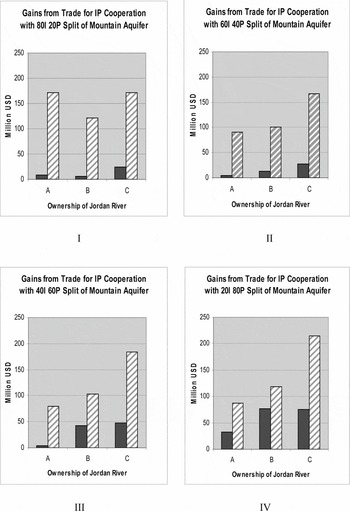
We begin with bilateral Israeli–Palestinian cooperation. Figure 2 shows the gains from such cooperation in 2010 as a function of the different ownership assumptions. (Note that cooperation here is not merely cooperation on the MA but full cooperation in water including new water infrastructure.) Effectively, this and the similar figures that follow represent slices of multi-dimensional diagrams. (In the figures starting with figure 2, Israel is represented by black, Jordan by white, and Palestine by white with diagonal stripes.)
Gains from bilateral cooperation between Israel and Palestine in 2010

Look first at figure 2(I) – the case of an 80–20 Israel–Palestinian division of the MA. As we should expect, in Case A of JR ownership, where Israel has most of the river and Palestine has none, it is Palestine that benefits most from cooperation – far more than relatively water-rich Israel. Further, the same is true for the other cases of JR ownership. But an interesting phenomenon appears. As expected, Palestine gains more from cooperation in Case A in which it owns no JR water than it does in Case B, in which it has 17 per cent of the river. When we move to Case C, however, where Palestine has 34 per cent of the river, the gains to Palestine once again increase to approximately the same height as in Case A even though Palestine has considerably more water in case C than in Case A.
The reason for this is not hard to find. Palestine has considerably more water in Case C than in Case A, but Israel has considerably less. Both buyer and seller gain from WAS-guided cooperation, and, in Case C, despite its low share of the MA, Palestine gains by selling water to Israel. Correspondingly, Israel, whose gains as a seller decrease slightly from Case A to Case B has increased gains as a buyer in Case C.
This phenomenon becomes even more pronounced in the other panels of figure 2, in which Palestine has increased shares of the MA. In each of those panels, Palestinian's gain from cooperation increases as it owns more and more JR water; that is because it gains as a seller. Correspondingly, Israel gains as a buyer.
The results for 2020 (no figure, but see table 1) are similar except that gains are larger.
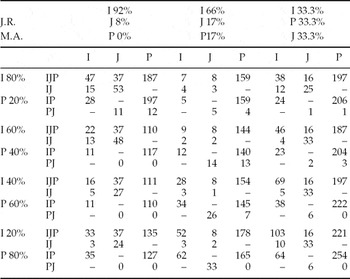
Gains for all coalitions, 2020 (millions of 1995 dollars)

Note: The occasional appearance of gains of 0 for one party and positive gains for another in cases of bilateral cooperation is due to rounding error.
Israel–Jordan bilateral cooperation
The gains from bilateral cooperation between Israel and Jordan for 2010 (not shown) are generally lower than in the Israel–Palestine case. The interesting phenomenon is as follows:
Where Israel has the lion's share of the MA and also 92 per cent of the JR (Case A), there are no gains from cooperation at all. Neither Israel nor Jordan gains from trading JR water – despite Jordan's small share thereof. When we stay with the same shares of the MA and move to Case B for the JR, small gains do appear and the gains are quite a bit larger in Case C. Where Israel has 40 per cent and 20 per cent of the MA, respectively, there are larger gains for Jordan, the increase being most noticeable in Case B (although the gains remain largest in Case C).
What is going on here is that, as Jordan owns more of the river, it pays both parties for Jordan to transfer water to Israel by selling water permits. This is true when Israel owns 92 per cent and Jordan only 8 per cent of the river, but is more pronounced in Cases B and C as Israel's share of the river goes down and Jordan's goes up. This reflects the finding in Fisher et al. (Reference Fisher, Huber-Lee, Arlosoroff, Eckstein, Haddadin, Hamati, Jarrar, Jayyousi, Shamir, Wesseling, Salman and Al-Karablieh2005) that Jordan has a major problem of conveyance infrastructure in using JR water.
It is also interesting to note that Israel's gains from such purchases in Case C are greatest when it owns 92 per cent of the MA and hence presumably needs the JR water less than it does when it has less MA water. The explanation is that Israel has sufficient water to make the shadow value of the JR water lower than in the other cases. Hence the price that Israel pays for such water is also lower, and this benefits Israel (while correspondingly reducing Jordan's gains as a seller).
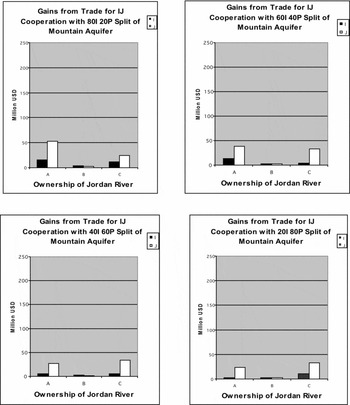
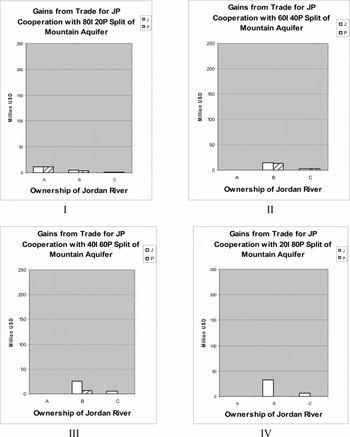
By 2020, a somewhat different picture emerges (figure 3). By that year, Jordan's water situation worsens. As a result, when it owns only 8 per cent of the river and Israel owns 92 per cent (Case A), Jordan always buys water permits from Israel, gaining from so doing. When Jordan and Israel each own 33 per cent of the river (Case C), Jordan always sells water permits to Israel, again gaining from so doing. In the middle case of Jordanian ownership of 17 per cent and Israeli ownership of 66 per cent (Case B), very little trade in water permits takes place. This pattern is qualitatively independent of the ownership of the MA, although the quantitative amount of the gains is not.
Gains from bilateral cooperation between Israel and Jordan in 2020

Jordan–Palestine bilateral cooperation
The case of bilateral cooperation between Jordan and Palestine can be handled quickly and does not require diagrams for 2010. Here the only possible beneficial trades are those that involve JR water – and both countries have relatively little water to trade. As a result, for 2010, the only case in which gains from cooperation are not negligible is that where Palestine owns only 20 per cent of the MA and none of the JR (Case A). There, even though Jordan only owns 8 per cent of the river, it gains $10 million per year by selling a permit to Palestine to use river water, and Palestine has a net gain of $12 million per year from buying it.
By 2020, however, the situation becomes more interesting and is shown in figure 4. Here there are gains in all of the panels. Consider figure 4(I). As in 2010, when Palestine owns only 20 per cent of the MA, and none of the Jordan (Case A), the two parties gain by Jordan selling JR water to Palestine. As Palestine's share of the JR rises (Cases B and C), those gains decrease and almost disappear, but, unlike the result for 2010, there are still some visible gains in Case B. This is surely due to the predicted increase of the Palestinian population between 2010 and 2020.
Gains from bilateral cooperation between Jordan and Palestine in 2020

Moreover, when Palestine owns 40 per cent or more of the MA (figures 4(II)–4(IV)), gains from cooperation no longer occur when Palestine owns no JR water, but do appear when it does. Here, Palestine gains by selling additional JR water to Jordan (which it can afford to do because of the additional MA water it owns). By the case pictured in figure 4(IV), in which Palestine owns 80 per cent of the MA, it owns enough water that it sells to Jordan very cheaply, so that the pictured gains are all Jordanian (and are quite substantial in Case B).Footnote 25 (Note that this does not occur in the parallel ownership situation under trilateral cooperation.)
Trilateral cooperation (grand coalition)
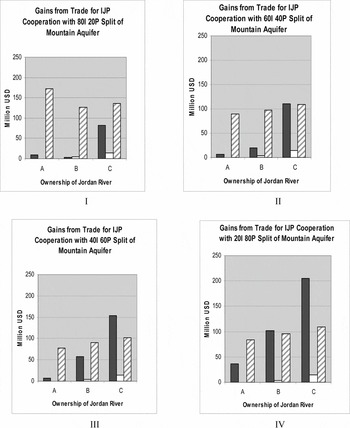
Figure 5 gives the results for trilateral cooperation for 2020. The gains to all three parties are greater than they are in 2010 (not shown).
Gains from trilateral cooperation (grand coalition) in 2020

What stands out is that, in general, the smallest gains are Jordanian. Not surprisingly, generally the less water Israel owns, the more it has to gain from cooperation. On the other hand, Jordan gains more from cooperation the more water it owns – selling permits to Israel.
Like Jordan, Palestine presents a mixed picture. It also tends to benefit more from cooperation the larger is its share of the Jordan, selling permits to use river water to Israel. On the other hand, when Palestine owns relatively little MA water, it also benefits as a buyer.
For 2020, table 1 shows numerically the gains for each party from trilateral cooperation and for each case of bilateral cooperation.Footnote 26 The following points appear:
• As shown in the Proposition proved above, there is no bilateral coalition in which the two members both do better than they do in the corresponding grand coalition.
• On the other hand, as already remarked, it is not generally true that both members of a bilateral coalition do better in the grand coalition. However, the total increase in gains to the two members achieved in the grand coalition are always positive.
This reflects the fact that, where there are two countries in the grand coalition that are net buyers and one that is a net seller of water permits, it can easily happen that each of the net buyers would be better off without the presence of the other in the coalition competing to buy. The single net seller, however, is always better off in such circumstances and so much better off that (if the bilateral coalition is already operating), the seller could profitably pay its existing partner to permit the new entry. A similar phenomenon can arise when there is a single net buyer and two net sellers.
It should be recalled that Israel is not always a seller in the cases portrayed. Nor is it invariably the case that the country owning the least water has the most to gain from cooperation. Sellers benefit also.
The most important general conclusion is that WAS-guided cooperation in water would benefit all parties – Israel and Palestine the most. As we shall now see, the gains from such cooperation generally exceed those that would be obtained from moderately large ownership shifts. This is particularly true under cooperation.
We measure the gains from ownership shifts as follows. Holding constant the distribution of ownership in one of the two water sources being studied, we look at the change in benefits that accrue to each of the parties as a result of moving from one of the ownership cases examined above to the next. (For example, in the case of the MA, we hold ownership in the JR constant and examine the gains – or losses – to Israel and Palestine from an ownership shift of the aquifer from 80 per cent Israel–20 per cent Palestine to 60 per cent Israel–40 per cent Palestine and from there to 40 per cent Israel–60 per cent Palestine, and so on, repeating the exercise for each case of ownership of the JR.) We then normalize the results by expressing them as the gain from a 10 per cent ownership shift.
The gains from such shifts under trilateral cooperation are constant for each of the two resources. The reason for this is that, under cooperation, the optimal water flows in the WAS solution are independent of the ownership assumptions.Footnote 27 Hence, the only gains from changes in ownership are the changes in the money that ownership represents. But all water permit trades take place at the shadow values for the optimal solution. These are the scarcity rents of the water resources involved and also do not depend on ownership. Hence the value of a 10 per cent shift in the ownership of a given resource is independent of the initial ownership assumptions.Footnote 28
Under trilateral cooperation, the gains from such shifts in 2010 would be only about $5 million per year for a shift in ownership of 10 per cent of the MA and about $7.5 million per year for 10 per cent of the JR. In 2020, where the gains from cooperation are also larger, the corresponding gains from 10 per cent ownership shifts would be about $15 million per year for the MA and $25 million per year for the JR.
It should come as no surprise, however, that the value of ownership shifts would be considerably different (and usually higher) when there is no cooperation. Moreover, in that case, the value would be quite different for different parties (reflecting the fact that there are gains to be had from trading) and also widely different for different ownership circumstances.
For 2010, the value of a 10 per cent shift in MA ownership ranges from $3 million per year to $34 million per year. The low figure occurs for Palestine when it already owns 33.3 per cent of the JR and moves from 60 per cent to 80 per cent ownership of the MA. The high figure also comes for Palestine when it owns none of the JR and moves from 20 per cent to 40 per cent ownership of the MA. With a more equal division of both water sources, the value of a 10 per cent shift in MA ownership ranges from $8 million per year to $24 million per year. For 2020, the corresponding figures are a bit higher.
For the JR, there are more extreme cases. For 2010, without cooperation, the value of a 10 per cent ownership shift in JR ownership ranges from $0 per year to $38 million per year. Again the low point occurs for Palestine when it owns at least 60 per cent of the MA,Footnote 29 but the higher values occur for Israel. Most of the values for Jordan and Palestine are below $2 million per year, the principal exception being a value of $34 million per year starting from an ownership level of no JR water and 20 per cent of the MA.
For 2020, however, the picture changes. Here the lowest value of a 10 per cent shift in JR ownership is still $0 per year (occurring for Palestine when it owns 60 per cent or more of the MA), but the highest value is now $58 million per year and occurs when Jordan goes from 8 per cent to 17 per cent ownership of the river. Note, then, that one value of WAS-guided cooperation is that it reduces the value of ownership shifts, making them easier to negotiate.
Note that it is not the case (see table 1 and figure 5) that the gains from cooperation are high only when the party receiving those gains has little water and the value of ownership shifts are high to it. That phenomenon naturally tends to occur when the big gainer is a buyer of water permits. But large gains also occur when the party receiving those gains has a large amount of water and the value of ownership shifts are low to it. In such cases, the big gainer is a seller of water permits. A good example of this can be seen in table 1, where the largest Palestinian gains from trilateral cooperation occur both in the upper left-hand corner where Palestine has very little water and in the lower right-hand corner where it has a good deal. Indeed, the Palestinian gains in the lower left-hand corner are greater than those in the upper left-hand corner.
Moving onward, the gains from WAS-guided cooperation would be greater in other ways than are shown above. In particular, as populations and other factors change, a quantity agreement that is adequate when signed can easily become out of date and a source of new tension. WAS-guided cooperation provides a flexible means of readjusting water usage in a way that all parties benefit.Footnote 30
In addition, WAS results show clearly that Israel and Palestine would both benefit from the creation of a sewage treatment plant in Gaza, with the treated effluent sold to Israel for use in agriculture in the Negev. This means that Israel has a positive economic incentive to assist in the construction of such a plant. That would be a confidence-building measure that does not impinge on the core values of either party.
10. Possible objections
Of course, there are possible objections to such a plan, however. Some of those are without merit, but others need to be more carefully considered. We begin with the less meritorious ones.
Forced sales
Throughout the history of the Water Economics Project, some have raised the objection that ‘You are going to force us to sell our water’, or ‘Why should we give water to our neighbors?’Footnote 31 This is simply a misunderstanding of what is being proposed.
In the first place, with a finite number of countries involved and no outside trades, it is literally impossible for all of them to be net sellers. But put that aside. The more important point is that WAS-guided permit sales are never ‘forced’. The selling country sells only when it is to its advantage to do so. Both parties gain.
‘The richest country will buy all the water’
A related objection is that the richest country will end up buying all the water or that the disparity in the economies involved makes water-permit trading either somehow impossible or, at least, unfair.
The primary reason that this is not valid is as before. The poorer countries only sell when it benefits them. If they do that, then they gain from the sale. Naturally, as they sell more and more water, the remaining water becomes more valuable to them, and, sooner or later, they will stop selling.
The other reason is the mirror image of this. The rich country may have a lot of money, but why should it want to buy all the water in sight. Water is valuable when it is scarce and needed for essential uses (drinking, for example). But it becomes less valuable as its scarcity decreases and additional water is used for less important uses (washing cars several times a week, for example). Just as the price at which poor countries gain from sales goes higher and higher the more is sold, so the price at which the rich country gains from purchases goes lower and lower the more that is bought. Once these two prices pass each other, nothing further is to be gained from the transactions and the sales stop.
We now turn to more cogent objections.
Other bargaining methods: why WAS?
One referee of this paper, observing (correctly) that the optimal water allocations are independent of the water-ownership assumptions, asks why the WAS division of gains in moving to those allocations are not completely arbitrary. He or she points out that various bargaining models would lead to different results and asks ‘Why does the division of gains from trade [cooperation] presented here have relevance?’
1. Bargaining over water ownership is a difficult process. Different principles of international law point to different answers. As shown above, while WAS-guided trade in water permits does not resolve the ownership question, it greatly reduces the gains to be had from ownership shifts. Under those circumstances, bargaining about ownership becomes bargaining over relatively small sums of money. This can be a way out of the impasse.
2. The WAS-guided process automatically adapts water allocations to changing circumstances to the benefit of all parties. Methods that fail to do this make repeated bargaining necessary.
3. The parties must be induced to play the game. WAS-guided cooperation has the merit that each party can see the win-win nature of the trades. This is particularly so if each party has already used its own WAS model and studied the shadow values that emerge from it – concentrating on water values rather than on water quantities.
Deception
What about the possibility that the parties to an arrangement such as that being proposed would deliberately misrepresent their demands for or policies toward water so as to gain an advantage? A party acting in this way would run some risk. If a buyer were to overstate its demands, it would end up paying prices higher than its true value of the water obtained. Similarly, if a seller were to understate its demand, then it would end up selling water at prices below its true value.
This does not end the matter, however. Since water demand is likely to be inelastic at reasonable prices, a party that is a seller might gain by overstating its demand. In such a case, the selling party would retain some water that it values less than the price, but it might succeed in earning sufficiently greater revenue from the water it does sell to leave it better off. In effect, such a seller would be exercising market power by withholding water from the market and exploiting the fact that it faces a declining (and inelastic) demand curve. (An analogous statement holds for a buying party understating its demand.)Footnote 32 The fact that trade leads to gains shows that there is a surplus to be split among the parties; behavior of the sort described could affect the way in which that surplus is divided.
How important this phenomenon is likely to be may depend in part on the overall atmosphere in which trading in water permits takes place. But such misrepresentation is not likely to be easy or long repeated. We are talking here about misrepresentation either of objective demand data or of policies to be applied. (Misrepresentation of costs can also matter.) These are issues of checkable facts, rather than projections of events long in the future, and parties should be able to agree on how to check them. That includes checking actual water consumption and checking whether announced water policies are actually carried out.
Two more observations are worth making. First, even if such misrepresentations are successful, there will still be a surplus to be divided and both sides will gain relative to a fixed quantity agreement.
Second, altering debates about water rights to discussions of facts and data would itself be a gain in settling water issues.
Security considerations: hostages to fortune
The major objection to trade in water permits among previously hostile neighbors, however, is likely to be one of security. When an agreement is reached among long-term adversaries, is it wise to rely for water on a promise of trade? What if the water were cut off?
There are several points to be made here. First, the geographic situation does not change with an agreement to trade in water permits. Thus, if an upstream riparian could cut off a downstream user's water in the presence of an agreement, it could equally do so in its absence. A system of trade in water permits, however, makes this less likely to happen, because it is a system in which continued cooperation is in the interest of all parties. When joint infrastructure has been constructed and gains from water-permit trade are large, withdrawal from the trade scheme will hurt the withdrawing party.
Nevertheless, where a cooperative agreement leads either to the construction of infrastructure that would become useless if trade were cut off or to the failure to construct infrastructure that would be needed in such an eventuality, reliance on trade may involve some risk. In effect, in such cases, one or another of the parties may be giving hostages to fortune.
Are such cases likely in the Israel–Palestine case?Footnote 33 We begin with the case of Israel. If there were to be an agreement with Palestine along the lines we have suggested, it would make sense for Israel to invest in trade-facilitating infrastructure. Were trade to cease, that investment would largely be lost. This does not seem a major problem, however. The reverse problem – failure to build infrastructure that would become vital in the absence of trade in water permits – does not seem at all serious for Israel. Israel now has a well-developed infrastructure. There does not appear to be any project that would be both unnecessary in the case of an agreement on water-permit trade and vital if such trade were suddenly to cease.
Palestine, by contrast, may have more exposure in the form of hostages to fortune. Without water-permit trade, and with an unfavorable agreement on West-Bank water property rights, Palestine would soon be forced to build desalination plants in Gaza. In the presence of trade, such plants would be unnecessary for a long time to come. Hence, if an Israel–Palestine agreement takes the form of water-permit trade and cooperation, the Palestinians will have to consider whether they should build such desalination plants in any case. If they do, they will lose a good deal of the economic benefits from trade. If they do not, then there may be a problem should trade cease.
What that choice should be depends on how likely it is that Israel would abrogate such an agreement and on the situation that one believes would then arise. For example, in such an event, presumably the Palestinians would feel justified in extensively pumping the MA, even if that were not the regionally efficient or agreed-on thing to do. Surprisingly, however, we have foundFootnote 34 that, in the absence of cooperation, the Palestinian need for desalination would stem not directly from the need to use desalinated water in Gaza itself but from the need to (inefficiently) supply the Southern West Bank from the Gazan desalination plants by piping it uphill to the area of Hebron (see figure 1). Hence, the apparent crisis caused by an Israeli abrogation of a cooperative water treaty could be overcome by Palestinian pumping of MA water beyond the amounts permitted by the water treaty, until the needed desalination facilities can be built.Footnote 35
11. Conclusion
We believe that WAS and its extensions are powerful tools for domestic planning of water infrastructure and policy. Beyond that, WAS-guided cooperation can provide a resolution of international water disputes, turning them from apparent zero-sum games to win-win situations for the benefit of all.
But, of course, such cooperation requires a generally peaceful atmosphere and a willingness to cooperate. We have said that water is not worth war, but – apart from the misconception that it is – it can be used as a tool with which to weaken or harm one's adversaries. In the case of Israel, Jordan, and Palestine, the required atmosphere and willingness does not yet exist. We await the day when it will. Perhaps the removal of water as a major issue will help to bring that day closer.