Introduction
The overlap between obsessive-compulsive disorder (OCD) and eating disorders (ED) is well studied. Epidemiological studies have confirmed a positive association, with an estimated lifetime prevalence of ED in subjects with OCD of between 11 and 42% (Rubenstein et al. Reference Rubenstein, Pigott, L'heureux, Hill and Murphy1992; Rasmussen & Eisen, Reference Rasmussen and Eisen1994; Sallet et al. Reference Sallet, de Alvarenga, Ferrao, de Mathis, Torres, Marques, Hounie, Fossaluza, do Rosario, Fontenelle, Petribu and Fleitlich-Bilyk2010). In contrast, the lifetime prevalence of ED in adults is about 0.6% for anorexia nervosa (AN), 1% for bulimia nervosa (BN) and 3% for binge eating disorder (BED) (Jacobi et al. Reference Jacobi, Hayward, de Zwaan, Kraemer and Agras2004; Hudson et al. Reference Hudson, Hiripi, Pope and Kessler2007).
OCD occurs at rates of 1–4% in community surveys, whereas estimates of the prevalence of lifetime OCD in subjects with ED are of the order of 10–40% for AN and between 0% and 40% for BN (for reviews, see Godart et al. Reference Godart, Flament, Perdereau and Jeammet2002; Swinbourne & Touyz, Reference Swinbourne and Touyz2007; Altman & Shankman, Reference Altman and Shankman2009). Genetic, neuropsychological and personality links have been suggested as underlying these associations (Serpell et al. Reference Serpell, Livingstone, Neiderman and Lask2002; Anderluh et al. Reference Anderluh, Tchanturia, Rabe-Hesketh and Treasure2003; Halmi et al. Reference Halmi, Tozzi, Thornton, Crow, Fichter, Kaplan, Keel, Klump, Lilenfeld, Mitchell, Plotnicov, Pollice, Rotondo, Strober, Woodside, Berrettini, Kaye and Bulik2005; Silberg & Bulik, Reference Silberg and Bulik2005).
Recent research has postulated a possible causal relationship between childhood OCD and ED onset. Research on clinical samples of individuals with ED has retrospectively identified the presence of OCD before the onset of the ED. The prevalence of retrospectively reported OCD with onset prior to the ED varies between studies, ranging from 33% to 86% of cases (Speranza et al. Reference Speranza, Corcos, Godart, Loas, Guilbaud, Jeammet and Flament2001; Godart et al. Reference Godart, Flament, Perdereau and Jeammet2002; Kaye et al. Reference Kaye, Bulik, Thornton, Barbarich and Masters2004). This wide range is likely to be due to the fact that most studies relied on clinical and/or convenience samples, often small samples, and therefore probably accounted for by selection bias. Recall bias might also partly explain the high percentages.
A recent longitudinal study by Buckner et al. (Reference Buckner, Silgado and Lewinsohn2010) investigated the relationship between OCD and ED onset in a sample of adolescents recruited for a study on adolescent depression. Results revealed that OCD in adolescence predicted AN in adulthood, in the absence of an ED in adolescence. Unfortunately, although the study included 1709 subjects the prevalence of both OCD at baseline and AN at follow-up was very low in this study (0.5% for each disorder), with a large odds ratio (OR) and very wide 95% confidence intervals (CI). This study did not show a relationship between OCD at baseline and BN.
The aim of the current study was to build on the existing literature and investigate the temporal relationship between childhood OCD and later ED from a longitudinal perspective. In order to overcome some of the problems encountered by previous studies, such as recall bias or sample size limitations due to the low prevalence of both OCD and ED in the general population, we followed up a cohort of adolescents/young adults with OCD onset during childhood or adolescence. We aimed: (1) to determine the prevalence of ED at follow-up; (2) to investigate possible risk factors for ED at follow-up in this selective sample.
Method
Participants
All young people seen at the National & Specialist OCD Clinic for Young People at the Maudsley Hospital, London, UK, between July 1996 and June 2005, who received a diagnosis of OCD at assessment, were included in the study. This clinic provides specialist assessment and treatment for young people with OCD from across the UK (for details, see Micali et al. Reference Micali, Heyman, Perez, Hilton, Nakatani, Turner and Mataix-Cols2010). The sample consisted of 276 young people. After ethical approval was obtained from the South London and Maudsley (LRECs no. 04/Q0705/7) and Institute of Psychiatry (no. 117/04) research ethics committees, the families of all participants were contacted by letter, followed by a telephone call, and invited to participate. Of the 276 families, 45 (16%) were not contactable, despite using multiple tracing methods. A total of 231 were therefore eligible, contacted and invited to participate. Of these, 89 (38.5%) declined participation. The methodology for this follow-up study is detailed in Micali et al. (Reference Micali, Heyman, Perez, Hilton, Nakatani, Turner and Mataix-Cols2010) .
Baseline data
Initial clinical assessment was carried out by experienced clinicians specializing in the diagnosis and management of OCD and DSM-IV criteria were used to make psychiatric diagnoses. The Children's Yale–Brown Obsessive Compulsive Scale (C-YBOCS; Goodman et al. Reference Goodman, Price, Rasmussen, Mazure, Delgado, Heninger and Charney1989) was used to measure impact and severity of the disorder. The Strengths and Difficulties Questionnaire was administered as a general measure of childhood emotional and behavioural symptoms (Goodman et al. Reference Goodman, Ford, Simmons, Gatward and Meltzer2003). Demographic and other relevant clinical data were obtained during clinical assessment and ongoing treatment in the clinic. These data were collected as part of routine clinical practice and ongoing clinical audit. All patient records were of a high standard.
Follow-up data
The main outcome variable was presence of ED. Participants and their parents were asked to complete the computerized version of the Developmental and Well-Being Assessment (DAWBA; Goodman et al. Reference Goodman, Ford, Richards, Gatward and Meltzer2000) to establish the presence/absence of DSM-IV ED diagnoses at follow-up. The DAWBA is a well-validated interview (face-to-face or web-based) for parents and young people, used across the world, that generates IDC-10 and DSM-IV diagnoses algorithmically, which are then cross-validated by trained clinicians after review of the responses. The DAWBA has been used for young adults as well as adolescents (Meltzer et al. Reference Meltzer, Gatward, Corbin, Goodman and Ford2005). We have previously shown that the ED section of the DAWBA was better at diagnosing ED in young people aged 13–18 years compared with other instruments considered ‘gold-standard’ (House et al. Reference House, Eisler, Simic and Micali2008).
For parents who had difficulties using the web-based DAWBA, a trained researcher facilitated completion of the assessment over the telephone. All participants who had fully completed the DAWBA (either parent or young person version or both) were included. Anonymized computer ratings were reviewed by a clinical trained rater (N.M.) to generate final DSM-IV diagnoses.
Data analyses
Group comparisons used parametric (one-way analysis of variance) and non-parametric tests as appropriate, after testing for normality. Bivariate linear regression models tested for predictors of continuous outcomes. Binary logistic regression models examined predictors of binary outcomes. Potential covariates likely to influence outcomes were first tested in bivariate models and included in multivariate models when significant. All analyses were performed using SPSS (version 15) for Windows (SPSS Inc., USA) and Stata (version 9 for Windows; StataCorp, USA). All statistical tests presented are two-tailed. Statistical significance was defined as a p value <0.05.
Results
In total, 142 (61.5%) of the young people who were eligible participated in the follow-up study and 126 (88.7%) DAWBAs were completed. Of these, 17 had been completed by young people only, 68 by parents only and 41 by both young people and their parents.
Sociodemographic characteristics and length of follow-up
The mean length of follow-up was 5.1 (s.d.=2.7, range 1–11) years. Mean age at follow-up was 18.6 (s.d.=3.5, range 11–28) years. As detailed in Micali et al. (Reference Micali, Heyman, Perez, Hilton, Nakatani, Turner and Mataix-Cols2010), the majority of young people who participated in the follow-up were boys (n=88, 62%). The mean duration of OCD at first assessment in the clinic was 3.7 (s.d.=2.8) years and the mean C-YBOCS score at baseline was 21.6 (s.d.=8.1), indicating moderately severe OCD.
Prevalence of ED at baseline
Two participants had a diagnosis of ED at baseline (1.4%); one AN and one eating disorder not otherwise specified (EDNOS).
ED at follow-up
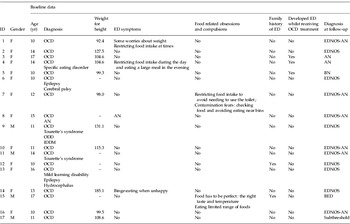
Altogether, 16 participants (12.7%) had a diagnosis of ED at follow-up [13 females (81%) and three males (19%)]. Two had a diagnosis of AN (1.6%), one of BN (0.8%), five of EDNOS-AN (3.5%), seven of EDNOS (4.9%) and one of BED (0.8%). One participant had symptoms of ED that did not amount to a full or partial diagnosis (See Table 1).
Characteristics of participants with an eating disorder (ED) diagnosis at follow-up

F, Female; M, male; OCD, obsessive-compulsive disorder; EDNOS, eating disorder not otherwise specified; AN, anorexia nervosa; BN, bulimia nervosa; IDDM, insulin-dependent diabetes mellitus; BED, binge eating disorder.
Altogether, 13 of the 16 participants (81%) who had an ED at follow-up were female. Of note, one of the participants who had an ED at baseline did not have an ED at follow-up.
OCD and ED symptoms at baseline
We were particularly interested in determining whether participants who had a diagnosis of ED at follow-up had any ED-related symptoms at baseline. As highlighted in Table 1, three (18.7%) of the 16 who had an ED at follow-up had some ED symptoms at baseline.
Moreover, two (6.2%) developed ED in the year following the OCD assessment, i.e. during treatment for OCD.
In relation to food-related obsessions and compulsions, only two participants had these at baseline (6.2%) in the absence of any baseline ED psychopathology. In relation to age, there was no difference between groups in terms of age at baseline, duration of follow-up and age of onset of OCD.
Predictors for a diagnosis of ED at follow-up
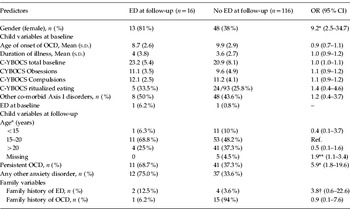
Age at follow-up did not differ amongst participants who developed an ED and those who did not (see Table 2).
Predictors for eating disorders (ED) at follow-up: odds ratios (OR) and 95% confidence intervals (CI)

OCD, Obsessive-compulsive disorder; C-YBOCS, Children's Yale–Brown Obsessive Compulsive Scale.
* p<0.01, ** p<0.05, † p=0.1.
a Results are risk ratios from multinomial logistic regression.
We were particularly interested in identifying possible predictors amongst baseline and demographic characteristics that might predict an ED diagnosis at follow-up. The strongest predictor of ED at follow-up was female gender (OR 9.2, 95% CI 2.5–34.7, p<0.05). A family history of ED was more common in participants who had an ED at follow-up compared with those who did not (12.5% v. 3.6%); there was a trend towards statistical significance. Age of onset of OCD, duration of OCD, C-YBOCS total score and subscores at baseline did not predict ED diagnosis at follow-up and nor did the ritualized eating item of the C-YBOCS at baseline. We also investigated whether specific obsessions (symmetry, aggressive and hoarding/saving obsessions) and compulsions (symmetry and aggressive) predicted the onset of an ED (data not shown). Persistent OCD (i.e. having a diagnosis of OCD at follow-up, as detailed in Micali et al. Reference Micali, Heyman, Perez, Hilton, Nakatani, Turner and Mataix-Cols2010) was associated with a diagnosis of ED at follow-up (OR 1.9, 95% CI 1.1–3.4, p<0.05) (see Table 2).
Specificity of predictors for ED at follow-up
In order to explore whether factors identified as predictors of ED at follow-up were specific for ED, we also compared participants who developed any anxiety disorder (AD) other than OCD at follow-up (n=49) with participants who did not develop any AD other than OCD at follow-up (n=77). Young adults who developed an AD at follow-up had statistically significant scores on the baseline total CYBOCS scale (OR 1.1, 95% CI 1.01–1.2, p<0.05) and marginally on the C-YBOCS obsessions subscale (OR 1.1, 95% CI 1.0–1.2, p=0.05) compared with participants who did not develop an AD. There was a trend for gender differences (OR 2.1, 95% CI 1.0–4.4, p=0.05). Age of onset, duration of OCD, ritualized eating on the baseline C-YBOCS and family predictors were all comparable. Persistent OCD was associated with the presence of an AD at follow-up (OR 1.6, 95% CI 1.1–2.3, p=0.01).
Discussion
This study confirms the existing studies on the relationship between childhood onset OCD and the development of ED and adds new evidence to these (Kaye et al. Reference Kaye, Bulik, Thornton, Barbarich and Masters2004; Buckner et al. Reference Buckner, Silgado and Lewinsohn2010; Sallet et al. Reference Sallet, de Alvarenga, Ferrao, de Mathis, Torres, Marques, Hounie, Fossaluza, do Rosario, Fontenelle, Petribu and Fleitlich-Bilyk2010). This is the first study to show that amongst children and adolescents with OCD (n=126), followed up after about 5 years, 13% (n=16) had a diagnosis of ED at follow-up. Although one had an ED and three had some ED symptoms at baseline, the majority had developed an ED during the follow-up period for the first time since their initial presentation with OCD. Very few had eating-related obsessions or compulsions. Female gender was a strong predictor, consistent with the epidemiology of ED. It was found that 12% of participants who developed an ED had a family history of ED v. 3.6% of participants who did not develop an ED. Although numbers in each group were small, this trend suggests that a family history of ED might partly explain a higher risk for the development of ED. A diagnosis of ED at baseline was associated with an almost doubled risk for persistent OCD.
The relationship between childhood onset OCD and later ED has been suggested previously in the literature. Due to the biases in the existing literature (i.e. investigating this relationship retrospectively or in samples that had originally been collected for other purposes) (Micali and Heyman, Reference Micali and Heyman2006), we specifically designed this study to determine whether a temporal relationship could be established between childhood onset OCD and a later ED. More research is needed to understand the mechanisms of this relationship. The difficulty in researching this topic in general population longitudinal studies lies in the large numbers needed due to the relatively low prevalence of both OCD and ED. Only one study to date has investigated this in a prospective sample of adolescents (Buckner et al. Reference Buckner, Silgado and Lewinsohn2010), confirming a temporal link between OCD in adolescence and adult AN. Our study confirms this finding, with a slight preponderance at follow-up of full and partial syndrome AN (eight participants) compared with other ED. One subject had developed BN and one BED, although the prevalence of both disorders was not higher in this sample compared with findings in the general population, it is of note that participants also developed ED other than AN at follow-up.
We were also interested in testing the hypothesis that specific obsessions and/or compulsions (in particular eating-related obsessions/compulsions) might explain the development of later ED by priming children and adolescents to have a ritualized eating pattern. Moreover, some authors have identified an association between contamination obsessions and cleaning rituals and ED (Hasler et al. Reference Hasler, Lasalle-Ricci, Ronquillo, Crawley, Cochran, Kazuba, Greenberg and Murphy2005); whereas others highlighted a high co-morbidity of aggressive and symmetry obsessions/compulsions in ED (Halmi et al. Reference Halmi, Sunday, Klump, Strober, Leckman, Fichter, Kaplan, Woodside, Treasure, Berrettini, Al Shabboat, Bulik and Kaye2003). We did not find any relationship between specific obsessions/compulsions in childhood and later ED. This might be explained by low numbers in our study and the lack of power in rejecting the null hypothesis.
We further sought to identify possible predictors that might allow early intervention and/or prevention of ED. Gender certainly plays a prime role in the risk for ED and female gender is a well-known and fixed risk factor for ED (Jacobi et al. Reference Jacobi, Hayward, de Zwaan, Kraemer and Agras2004). However, it remains to be understood whether gender is an additional risk factor or whether it moderates the relationship between OCD and later ED.
Of the 15 participants with an ED at follow-up who did not have baseline ED, five (30%) had either disordered eating (i.e. some behaviours characteristic of ED) or food-related obsessions and compulsions. This finding suggests that these symptoms might be relevant in identifying a child/adolescent at increased risk for ED and who is potentially a target for prevention or early intervention for ED.
Despite small numbers, there was a slight increase in the percentage of a family history of ED in participants who had an ED at follow-up. The exact relationship between family ED history and childhood onset OCD in increasing the risk for ED needs further elucidation and is beyond the scope of this study. However, family ED history might also be used to identify young people who present with OCD who might benefit from targeted prevention/early intervention.
We attempted to address the specificity of predictors for ED at follow-up in an exploratory fashion by investigating differences between participants who developed an AD at follow-up and those who did not. Predictors for AD at follow-up seemed to differ compared with those identified for ED: in particular, gender was a very marginal predictor for AD. C-YBOCS score at baseline was a stronger predictor. Family history of ED and gender showed a stronger association with ED. These are known risk factors for ED; therefore, it remains to be established whether childhood OCD is a mediator of effect or acts in an additive fashion to other known risk factors. These findings require confirmation and extension in larger studies.
This study has several strengths. First, it is the first study to follow up young adults with childhood onset OCD in order to establish the temporal relationship between the latter and ED. Second, it is the largest follow-up to date of children and adolescents with OCD, using a sample with different levels of severity. It is important to note relevant limitations, in particular the relatively small number of participants who had an ED at follow-up, which might have affected the power to determine relevant associations. Although attrition did not relate to sociodemographic variables or illness (OCD) characteristics (see Micali et al. Reference Micali, Heyman, Perez, Hilton, Nakatani, Turner and Mataix-Cols2010), we cannot exclude the possibility of selection bias. A total of 10 participants were <15 years amongst those who did not develop an ED at follow-up; therefore, below the peak age of onset for ED. However, this would lead to an underestimation of the risk for developing an ED after OCD rather than an overestimation.
In summary, our study confirms previous reports of childhood onset OCD increasing the risk for later onset ED. Further elucidation of the mechanisms and possible mediators is needed. The preliminary evidence that, in the context of a child/adolescent presenting to services with OCD, girls, those with a family history of ED and children presenting with disordered eating or food-related obsessions and compulsions might be at particular risk for developing a later ED is of relevance to clinicians in the field. The role of prevention/early intervention for this subcategory of children might need evaluating.
Acknowledgements
We thank all participants and their families for taking part in the study and Professor R. Goodman for providing advice. Thanks to Christine Tang and Hala Ali for help in carrying out the study. This study was funded by the R&D Fund, South London & Maudsley NHS Foundation Trust. Dr Nadia Micali is supported by an NIHR Clinician Scientist Award.
Declaration of Interest
None.