INTRODUCTION
Teeth provide a permanent record of cyclic and metabolic events throughout the life of the individual and they can easily be recovered from dead (and occasionally from living) animals (Hohn et al., Reference Hohn, Scott, Wells, Sweeney and Irvine1989; Langvatan, Reference Langvatan, Bjørge and Donovan1995; Lockyer, Reference Lockyer1999).
The examination of tooth structures is routinely used in long-lived species such as marine mammals for age determination. The most obvious use of age is for estimating age-related parameters used in population dynamics models (Hohn, Reference Hohn, Perrin, Würsig and Thewissen2002). The questions explored here relate to additional information that can be obtained from cetacean teeth. In essence, the annual increments themselves are recording structures that reflect the physiology of an individual at the time of deposition (Klevezal, Reference Klevezal1996). Several studies have shown that examination of the pattern of these incremental layers in dentine and/or cementum can provide information regarding general health, life history events (e.g. parturition, pregnancy, weaning and achievement of sexual maturation), environmental conditions and other forms of stress (e.g. the possible effects of exposure to increased contaminant levels) (Klevezal & Myrick, Reference Klevezal and Myrick1984; Bengtson, Reference Bengtson and Sahrhage1988; Myrick, Reference Myrick, Pryor and Norris1991; Lockyer, Reference Lockyer, Bjørge and Donovan1995a).
Age is estimated by counting growth layer groups (GLGs) (Perrin & Myrick, Reference Perrin, Myrick, Perrin and Myrick1980), which are thought to be laid down annually in the teeth of most odontocetes and formed as a result of seasonal changes in the growth rate of the tooth, correlated with seasonal changes in the individual's growth (Klevezal, Reference Klevezal, Perrin and Myrick1980). The annual layers comprise more than simply a pair of adjacent light (broad) and dark (fine) staining bands: they can also contain daily layers or accessory layers as well as other alterations in the normal regular deposition rate of dentine and cement formed during an animal's life (Lockyer, Reference Lockyer, Bjørge and Donovan1995a; Klevezal, Reference Klevezal1996; Hohn, Reference Hohn, Perrin, Würsig and Thewissen2002). In cetaceans (odontocetes) and sirenians, such disturbances or tooth-tissue alterations are termed mineralization anomalies.
Five different types of mineralization anomalies have been identified: accessory lines, marker lines, cemental disturbance, dentinal resorption and pulp stones (Myrick, Reference Myrick and Davidovitch1988; Lockyer, Reference Lockyer, Donovan, Lockyer and Martin1993). Accessory lines are defined as additional distinct layers within a GLG which may stain light or dark. Pulp stones or osteodentine are discrete nodules, often containing concentric rings of secondary dentine. Generally these form in the region of the pulp cavity (Lockyer, Reference Lockyer, Bjørge and Donovan1995c). Marker lines or lines of Owen are found in both dentine and cementum. They are discrete regular lines noticeably different in appearance (e.g. staining deeply or not staining) from the boundary layers of the GLG (Lockyer, Reference Lockyer, Bjørge and Donovan1995c). Dentinal resorption refers to erosion and repair of existing regular laminated dentinal tissue, resulting in an amorphous and/or globular appearance, very often with holes, cutting across and into regular tissue, including mineralization interference that disrupts the usual patterns yet does not prevent continuous lamina formation (Myrick, Reference Myrick and Davidovitch1988). Finally, cemental disturbance is defined as any anomalous appearance of the usual laminated cemental tissue, including mineralization interference and resorption (Myrick, Reference Myrick and Davidovitch1988). Similar types of disturbance have been revealed in teeth of other mammals such as black bears (Ursus americanus), red deer (Cervus elaphus) and humans (Homo sapiens) (Myrick, Reference Myrick and Davidovitch1988; Lockyer, Reference Lockyer1999).
Several factors, including life history events (e.g. pregnancy, giving birth, being born, lactation, weaning and achievement of sexual maturity), sexual activity, prey availability, poor nutritional state and adverse environmental conditions, have been proposed as being responsible for the development of mineralization anomalies, since they have the potential to influence the growth of an individual. The mechanism could involve hormonal variations as well as effects on endogenous rhythms that, in turn, induce biochemical and physiological actions affecting the deposition of laminae in mammalian teeth. The pattern of dentine and cementum deposition could be affected since it depends on systemic calcium regulation (Myrick, Reference Myrick and Davidovitch1988).
The presence of unusual layers within GLGs, indicating a link with life history events, has been reported in sperm whales (Physeter macrocephalus) (Klevezal et al., Reference Klevezal, Sukhovskaya and Vilenkin1987), spotted dolphins (Stenella attenuata), spinner dolphins (Stenella longirostris) (Klevezal & Myrick, Reference Klevezal and Myrick1984), and long-finned (Globicephala melas) and short-finned pilot whales (Globicephala macrorhynchus) (Lockyer, Reference Lockyer, Donovan, Lockyer and Martin1993). An association between mineralization anomalies in teeth and other causative factors (e.g. environmental factors) has been reported in dusky dolphins (Lagenorhynchus obscurus) (Manzanilla, Reference Manzanilla1989) and long-finned pilot whales (Lockyer, Reference Lockyer, Donovan, Lockyer and Martin1993). Other studies have suggested an association between anomalies and the concentration of organochlorine pollutants (PCB and DDTs) in body tissues (Stede & Stede, Reference Stede and Stede1990; Bergman et al., Reference Bergman, Olsson and Reiland1992).
In the present study we examined the tooth ultra-structure of harbour porpoises (Phocoena phocoena) from Scottish waters. The porpoise is the most common cetacean species in the region and therefore the species for which most samples were available. The objectives were: (a) to describe the time-course of accumulation of mineralization anomalies; and (b) to determine whether these anomalies could be related to life history events, particularly the achievement of sexual maturation, or to effects of bioaccumulation of organic pollutants. We scored teeth for the presence of five types of anomaly, focusing particularly on dentinal resorption and cemental disturbance, since it is thought that anomalies involving the resorption and transformation of existing dentinal tissues are caused by changes in physiological state, such as the hormone imbalance that occurs during sexual maturation.
MATERIALS AND METHODS
Sampling
Post-mortem examinations of stranded animals were conducted by the local strandings schemes. The Scottish Agricultural College (SAC) Veterinary Services at Inverness collected samples of harbour porpoises (Phocoena phocoena) stranded around the Scottish coastline between 2001 and 2005. The animals sampled included a range of age-classes from both sexes. Other data including date of stranding, sex and total body length were also recorded during examinations.
Tooth preparation
During post-mortem examination of each animal, at least 2–3 teeth were removed from the middle of the lower jaw and preserved in 10% neutral buffered formalin (Kuiken & Hartmann, Reference Kuiken and Hartmann1991). Teeth were prepared using a method adapted from Hohn & Lockyer (Reference Hohn, Lockyer, Bjørge and Donovan1995). Firstly, the teeth were cleaned and then decalcified using a commercial decalcifying agent (RDO®). The length of time required for decalcification varied between samples in relation to tooth size and age, with longer times required for larger and older individuals. Decalcification time ranged from 4–20 hours with shorter time for those teeth from juveniles and longer for teeth of adults. Once teeth were flexible and rubbery in texture, they were rinsed in running tap water for several hours. Then teeth were sectioned at 23–25 µm and mounted on freezing blocks with OCT (®Sakura Finetek) compound in a freezing (−10°C) microtome (TE Electronic Cryostat). The teeth of harbour porpoise are spatulate in shape; therefore to ensure that optimum sections were obtained, two teeth were used for each individual and sectioned in two different orientations, one parallel to the mandible (porpoise cut) and one perpendicular (dolphin cut).
Multiple sections were obtained and only those that were the most central and complete, which included the crown and the maximum area of pulp cavity, were selected and stained using Mayer's haematoxylin (acidic). Stained sections were ‘blued’ in a weak ammonia solution and rinsed in distilled water. They were then mounted onto microscope slides pre-coated with 5% gelatine solution and dried on a warm hot plate (approximately 30°C). Permanent slides were prepared using DPX-mountant surmounted by a glass cover slip.
Age determination and identification of anomalies
Decalcified and stained tooth sections were examined under a binocular microscope at ×40 to ×100 magnification. Age was estimated by counting GLGs in the dentine. The reading was done ‘blind’ (with no reference to biological data), by two readers (P.L.L. and J.A.L.), to avoid any possible biases in the estimation. The final estimated age was achieved by consensus between the two readers. In case of no consensus, an extra tooth was prepared and read. If no consensus was possible, the animal in question was excluded from further analysis.
Anomalies were classified following the criteria used by Myrick (Reference Myrick and Davidovitch1988) and Lockyer (Reference Lockyer, Donovan, Lockyer and Martin1993, Reference Lockyer, Bjørge and Donovan1995c). In this study, up to 3 teeth were available from each individual and each tooth was examined for the presence of five types of anomalies: accessory lines, marker lines, dentinal resorption, cemental disturbance and pulp stones. In addition, we noted the growth layer groups (GLGs) in which accessory lines and marker lines appeared and the position of pulp stones in relation to the boundary of the GLGs in which they appeared.
Analysis of reproductive status
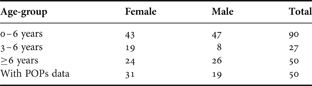
Reproductive organs (ovaries and testes) were collected during post-mortem examination for a total of 167 harbour porpoises for which age could also be determined (see Table 1). Both ovaries and testes were removed and preserved in 10% neutral buffered formalin. Reproductive organs were examined using methods adapted from Perrin & Reilly (Reference Perrin, Donovan, Perrin, Brownell and De master1984).
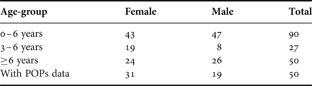
Sample sizes for harbour porpoise teeth used for mineralization anomaly analysis displayed by sex and age-group. The table also gives sample sizes for animals for which measurements of persistent organic pollutants (POPs) in blubber were available.
Before gross examination, the ovaries were rinsed in water for 24 hours and transferred to 70% ethanol. Both ovaries were examined externally to record the presence and number of corpora lutea (CL), corpora albicantia (CA) and any other features. Both ovaries were then hand-sectioned into 0.5–2 mm slices and examined internally under binocular microscope for the presence of CA and follicles. Females were considered to be sexually mature if the ovaries contained at least one CL or CA.
For histological processing of testes, a 1 cm3 block was dissected from the middle of each testis, with its associated epididydmis. The tissue was dehydrated using 30%, 50%, 70%, 80% and 95% graded ethanol solutions, absolute ethanol and butanol. The samples were embedded in paraffin wax and 7 µm sections cut. The sections were stained with haematoxylin and eosin and mounted on a glass slide using DPX. The slides were examined microscopically and individuals were categorized into maturity stages based on the methodology of Collet & Saint-Girons (Reference Collet, Saint-Girons, Perrin, Brownell and DeMaster1984). Categorization was based on the relative proportion (low, medium and high) of Sertoli cells (which serve to nurture the germ cells through their cycles of development), interstitial tissue (between the tubules, where Leydig cells are found singly or in groups), germinal cells such as spermatogonia (the first phase and the most immature cells), spermatocytes (the second phase), spermatids (formed from secondary spermatocytes during meiosis) and spermatozoa (formed from spermatids during spermateliosis) (Wheater et al., Reference Wheater, Burkitt and Daniels1987; Campbell, Reference Campbell1990; Hess, Reference Hess, Knobil and Neill1999), and the activity of the epididymis (the major site of storage of newly formed spermatozoa) (Wheater et al., Reference Wheater, Burkitt and Daniels1987).
Samples for persistent organic pollutant analysis
As part of another project (BIOCET EVK3-2000-00027), blubber biopsies from selected animals that were classed as extremely fresh or only slightly decomposed (as defined by Kuiken & Hartmann, Reference Kuiken and Hartmann1991) were collected for contaminant analysis during 2001–2003. Most analysis of persistent organic pollutant (POP) concentrations was carried out at the Royal Netherlands Institute for Sea Research (NIOZ), with additional samples being analysed at The Centre for Environment, Fisheries and Aquaculture Science (CEFAS).
Organochlorine (DDT and PCB) concentrations were determined based on methods from Allchin et al. (Reference Allchin, Kelly and Portmann1989) and incorporating improvements validated within an inter-comparison and method improvement programme conducted under the auspices of the International Council for the Exploration of the Sea.
During processing, lipids were extracted from the blubber samples using a mixture of pentane, dichloromethane and water. Lipid content was determined gravimetrically. Samples were cleaned by sulphuric acid treatment and elution over silica columns to separate the contaminants of interest from the lipids. Organochlorines (OCs) were determined by gas chromatography with electron capture detection (GC-ECD). The external standard mixture for the PCBs contained 39 congeners. Both NIOZ and CEFAS participated in ‘round-robin’ tests of analytical protocols in which both laboratories performed up to the current standard. Results from duplicate samples from the same animals analysed by both laboratories were similar.
The PCB concentrations used here for harbour porpoises are sums for concentrations of 16 compounds that were measured in both participating laboratories: CB28, CB49, CB52, CB101, CB118, CB128, CB138; CB141, CB149, CB151, CB153, CB170, CB180, CB183, CB187 and CB194, excluding compounds that were often below the limit of detection. Other OCs analysed included p,p'-DDE, which is the most persistent metabolite and the major representative of the insecticide DDT-group. At regular intervals, certified reference materials were analysed for PCBs and DDE. The values obtained all fell within the accepted normal ranges. For this study, measurements of POPs (DDT and PCBs) concentrations in blubber were available for 50 harbour porpoises for which teeth preparations were also available (see Table 1).
Statistical analysis
For some analyses, individuals were assigned to one of three age-classes: (i) class 1 which consisted of harbour porpoises from 0 to 3 years; (ii) class 2, which included animals from 3 to 6 years; and (iii) class 3, which consisted of harbour porpoises aged older than 6 years.
Generalized linear modelling (McCullagh & Nelder, Reference McCullagh and Nelder1989; Kleinbaum & Klein, Reference Kleinbaum and Klein2002) and generalized additive modelling (Hastie & Tibshirani, Reference Hastie and Tibshirani1990; Faraway, Reference Faraway2004; Wood, Reference Wood2006; Zuur et al., Reference Zuur, Ieno and Smith2007) using a binomial distribution and logit link function, were used to determine whether the incidence of each type of anomaly (response variables) could be linked with maturity state, age, total body length, sex and organochlorine contaminant concentrations in blubber (explanatory variables).
Initial data exploration indicated that age, total body length and maturity state are highly correlated with one another. According to Montgomery & Peck (Reference Montgomery and Peck1992), high collinearity results in large variances for the regression coefficients. Therefore, separate models were fitted for each of the three main explanatory variables (i.e. age, length and maturity state).
Optimal models were selected on the basis of the lowest Akaike information criterion (AIC) provided that there were no serious patterns in residuals and all remaining explanatory variables had a significant effect. Where two models had very similar AIC values the more parsimonious model was preferred. Initially, GAMs were fitted, using cross-validation to determine the optimal degrees of freedom for smoothers. If all fitted smoothers had 1 degree of freedom (or close to 1), i.e. they were straight lines on the predictor scale, or all relationships with explanatory variables were non-significant, GLMs were also fitted and the optimal GLM identified. Data exploration, GLM and GAM were performed using Brodgar 2.5.2 (www.brodgar.com) and Minitab.
Since most final models were GLMs and did not include a significant effect of sex (except for marker lines), for visual presentation of ‘anomaly ogives’, we used the output from the GLMs relating anomaly incidence to age. Expected probabilities of anomaly occurrence-at-age (p i) for each of the N porpoises were obtained using coefficients for intercept (α) and age (b), and applying the inverse logit transformation:

We fitted similar models using length as a predictor. For visual comparison, a binary GLM was also fitted to maturity using age (or length) as an explanatory variable to create a maturity ogive.
RESULTS
Age distribution and occurrence of anomalies
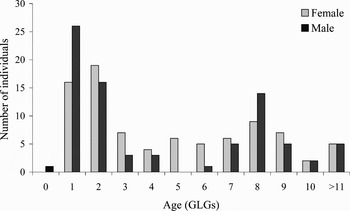
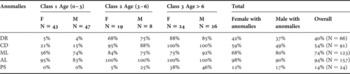
Ages for both male and female porpoises ranged from less than one year up to 14 years old. The majority of the sample (approximately 60%) was composed of porpoises aged 5 years old or less, with only 15% aged 10 years old and older (Figure 1). Thus not all age-classes were equally represented in the samples (see Table 2).
Age–frequency distribution of male and female harbour porpoises from Scottish waters (2001–2005) (N = 167). In each class, e.g. 2–3, the age ranges from just above the lower value up to the higher value.

The occurrence of anomalies (%) in 167 harbour porpoises (N = 86 females and N = 81 males) displayed by age-class and sex (F, female; M, male; AL, accessory lines; CD, cemental disturbance; DR, dentinal resorption; ML, marker lines; PS, pulp stones). Number of teeth with anomaly in parentheses.

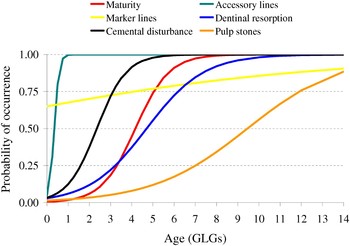
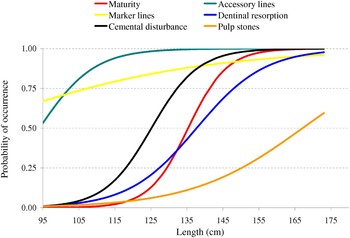
The presence of anomalies was high and generally increased with age in harbour porpoises. Furthermore, more than one tooth from the same individual was examined for the presence of mineralization anomalies and all the teeth showed the same type of alteration. Fitted binomial GLMs with age or length as the sole explanatory variable are illustrated for all anomaly types (Figures 2 & 3). It can be seen that, of all the anomalies, the time courses of appearance of dentinal anomalies and cemental disturbance were closest to the maturity ogive.
Fitted logistic curves for the incidence of anomalies in harbour porpoise teeth in relation to age (data both sexes combined). Also shown is the fitted maturity ogive.

Fitted logistic curves for the incidence of anomalies in harbour porpoise teeth in relation to length (data both sexes combined). Also shown is the fitted maturity ogive.

Accessory lines and marker lines were the most prevalent recorded anomalies in harbour porpoise. Approximately 94% of harbour porpoise teeth had accessory lines. The occurrence tended to increase with age in both sexes, although it was slightly higher in males. Accessory lines were seen in all animals over 3 years old. Accessory lines were most commonly seen within the first GLG, indicating that they begin to appear very early in life—and most animals already have accessory lines in their teeth prior to maturation.
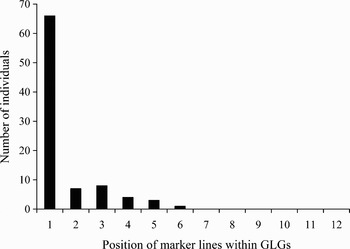
Marker lines were recorded in 74% of harbour porpoise teeth examined. The incidence of marker lines increased with age and was slightly higher in males than in females. Marker lines appeared frequently within the first GLG, close to the neonatal line, and the third GLG (Figure 4).
Position of marker lines within annual or growth layer groups (GLGs) harbour porpoise teeth (data both sexes combined).

Dentinal resorption and cemental disturbance were recorded in approximately 40% and 54% of harbour porpoise teeth examined, respectively. Overall, the incidence of these two anomalies tended to increase with age and was slightly higher in females than in males. Fitted GLMS indicated that the occurrence of dentinal resorption lagged slightly behind maturation although cemental disturbance tended to appear slightly ahead of maturation (Figure 2), being present in some immature animals (Table 2).
Pulp stones generally had a low frequency of occurrence, around 14%, and were only seen in mature animals older than 6 years old. The incidence was higher in male than in female porpoises. The majority of porpoises with evidence of pulp stones had a pulp cavity that was almost closed and the pulp stones appeared either within the most recent GLGs or they remained free in the pulp cavity.
Associations between anomalies, age, body size, sex and attainment of sexual maturity
Modelling results confirmed that age, body length and maturity state were all significantly related to the presence of dentinal resorption, cemental disturbance and marker lines in teeth of Scottish porpoises.
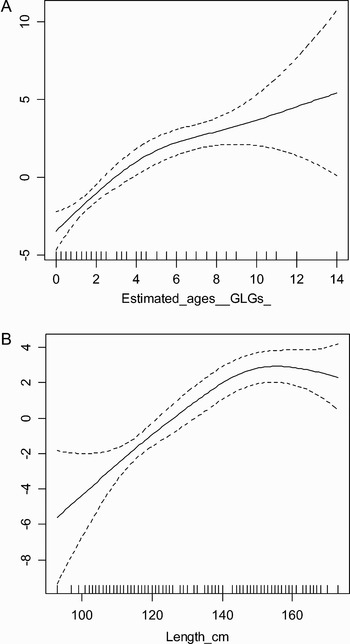
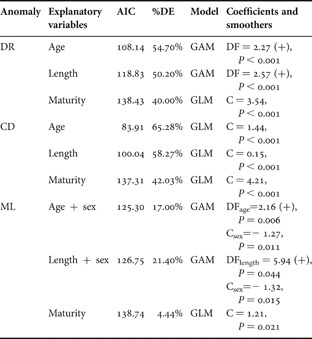
The optimal model to explain the incidence of dentinal resorption used age as the sole predictor and explained 55% of deviance. The best models using length or maturity as the predictor had higher AIC values and explained 50% and 40% of deviance, respectively (see Table 3 for details). Smoothers for the effects of age and length are illustrated in Figure 5.
Generalized additive models for occurrence of dentinal resorption in harbour porpoise teeth. Fitted smoothers (solid line) and 95% confidence limits (broken lines) of the smooth term are shown for models based on: (A) age and (B) length.

Generalized linear (GLM) and additive models (GAM) for the presence of anomalies (DR, dentinal resorption; CD, cemental disturbance; ML, marker lines) in Scottish harbour porpoises (N = 167). The table shows the best models based on age, length and maturity as predictors and gives the AIC values, % deviance explained (%DE) and parameter estimates (C, regression coefficient for linear relationships; DF, degrees of freedom for smoothers; P, probability; + or − indicates whether the smoother shows a generally positive or generally negative tendency).

For cemental disturbance, again the best model contained age alone and explained 65% of deviance. The best models using length or maturity as the predictor explained 58% and 42% of deviance, respectively (Table 3).
For the incidence of marker lines, the optimal model included effects of both age and sex and explained 17% of deviance. Males displayed marker lines more frequently than females. The best model using length also contained an effect of sex and explained 22% of deviance whereas the best model using maturity did not include sex and explained only 4% of deviance (Table 3).
In all cases, models confirmed that relationships between the incidence of these anomalies and age, body length or maturity were generally positive. Five of the nine best models summarized in Table 3 were GLMs (i.e. linear models) while in three out of four GAMs, the smoothers had around 2 degrees of freedom indicating relatively simple, monotonic curves. Note that a (linear) fit in a binomial GLM implies that the underlying relationship fits a logistic curve.
No satisfactory models could be fitted to data on the incidence of pulp stones or accessory lines due to the very unbalanced data sets (low incidence of pulp stones and high incidence of accessory lines).
Association between anomalies and POP concentrations in blubber
Measurements of DDE and PCB (the sum of 16 PCB congeners) concentrations in blubber were available for 50 harbour porpoises (31 females and 19 males) in the age-range 0 to 12 years old, with a higher representation of immature animals (approximately 64%, N = 32) than mature. Application of GLM and GAM showed that neither PCB nor DDE concentrations contributed significantly to explaining the incidence of dentinal resorption or cemental disturbance in harbour porpoises. None of the previously fitted models were improved by adding DDE or PCB concentrations as explanatory variables and neither PCB nor DDE concentrations alone explained a significant part of the variation in incidence of any anomaly type.
DISCUSSION
Dentinal resorption and cemental disturbance
Overall, the occurrence of dentinal resorption and cemental disturbance tended to increase with age and the fitted GLMs showed that, at the population level, the time course of appearance of these anomalies was similar to the time course of maturation (see Figure 2). This might suggest a link between anomaly occurrence and the age at which the animals become sexually mature. Lockyer (Reference Lockyer, Donovan, Lockyer and Martin1993) reported that, in long-finned (Globicephala melas) and short-finned pilot whales (Globicephala macrorhynchus) from Iceland and the Faroes, dentinal resorption appeared in the teeth of all mature animals regardless of age, suggesting that it may be associated with hormonal changes that take place at the transition to adulthood.
In this study, fitted statistical models confirmed that the three co-varying life history variables (i.e. age, length or maturity) were all significantly related to the presence of dentinal resorption and cemental disturbance in Scottish harbour porpoises, although in both cases the best predictor for the incidence of anomalies was age. In addition, the fact that the relationships between anomaly incidence and age or length tended to be logistic curves rather than straight lines implies that there are certain ages and sizes at which anomalies have a higher probability of occurring. The youngest mature animals with evidence of dentinal resorption and cemental disturbance were aged around 4.5 and 4 years old respectively. Sexual maturity of harbour porpoises has been generally estimated to occur at between 3 and 4 years of age for both sexes (Lockyer, Reference Lockyer2003).
The fact that age is the best predictor of anomaly occurrence may indicate that maturation is responsible for the physiological conditions under which anomalies can arise but that the likelihood that an anomaly will occur continues to increase with age after maturation. The occurrence of dentinal resorption and cemental disturbance was slightly (but not significantly) more common in females than in males indicating that it could be related to the stresses associated with pregnancy, parturition or lactation. However, this requires further investigation.
Dentinal resorption and cemental disturbance were also recorded in a few immature animals. The youngest animal with evidence of anomalies was aged around 2 years old. This perhaps indicates the influence of other stressful factors (e.g. differences in feeding habits) that could affect the growth of the animal and in turn affect the growth of teeth (Lockyer, Reference Lockyer, Bjørge and Donovan1995c) or simply varying degrees of susceptibility to the same or different causative factors (Lockyer, Reference Lockyer, Donovan, Lockyer and Martin1993, Reference Lockyer, Bjørge and Donovan1995c). It is logical to suppose that mineral compounds in teeth as well as vitamins involved in the mineralization process derive from the mineral composition of food ingested (Klevezal, Reference Klevezal1996). There is evidence that in Scottish waters, porpoises less than 1 year old feed more on gobies and shrimps than do older animals (Santos et al., Reference Santos, Pierce, Learmonth, Reid, Ross, Patterson, Reid and Beare2004). A higher incidence of dentinal transformation (named sclerotic dentine) is reported in those species that feed more on fish than squid (Kleinenberg et al., Reference Kleinenberg, Yablokov, Bel'Kovich, Tarasevish and Nauka.1964; Klevezal & Phillips, Reference Klevezal and Phillips1986). Furthermore, experimental studies on the domestic goat (Capra hircus) (Lieberman, Reference Lieberman1993) indicated that changes in diet or food composition determine changes in the rhythms of dentine formation, resulting in different degrees of mineralization. To date, there is insufficient information available for cetaceans to indicate whether differences in feeding habits and/or diet composition lead to variations in tooth structure. However, this topic merits further investigation, particularly working with animals in captivity, where diet is controlled.
Information available regarding the effects of stress on hard tissues in marine mammals is rare and generally open to some debate. Boschma (Reference Boshma1950) investigated the possibility that resorption in sperm whale teeth was caused by physical external pressure from adjacent or opposing teeth. Boyde (Reference Boyde1984) suggested that such physical pressure can create resorption and that the rate of erosion depends on the orientation and density of the mineralized tissue. He also demonstrated that resorption could be experimentally created in vitro using sperm whale dentine and osteoclasts from rabbit foetus. In his study, the frequency of occurrence of cemental disturbance was low in comparison to other recorded anomalies. In contrast, Lockyer (Reference Lockyer, Bjørge and Donovan1995c) found a high incidence of cemental disturbance compared to other recorded anomalies, in all age-groups, suggesting that these anomalies may be a response to physical pressure and abrasion of the teeth as well as other causes. In the present study, when more than one tooth (up to 3 teeth) was available from an individual, each tooth usually showed the same forms and stages of alteration indicating that these features of tissue alteration observed were products of a systemic cause rather than local physical control (Myrick, Reference Myrick and Davidovitch1988).
Accessory lines
Accessory lines were the most commonly recorded anomaly in harbour porpoise teeth and their incidence increased with age in both sexes, with females displaying accessory lines more frequently than males.
Accessory lines are considered to be ‘false’ incremental layers (but not annual) that occur within GLGs and which can be confused with the boundary of the annual layer leading to incorrect interpretations of age (Klevezal, Reference Klevezal, Perrin and Myrick1980; Hohn et al., Reference Hohn, Scott, Wells, Sweeney and Irvine1989). Therefore, for reliable age determination, it is essential to identify them (Hohn, Reference Hohn, Leatherwood and Reeves1990). In this study, several accessory lines were seen within different GLGs although they were more easily identified within the first GLG, as expected given that GLGs become narrower with increasing age, as they fill the pulp cavity, making it more difficult to identify them. Other studies have suggested that these incremental layers simply represent monthly records (Hohn, Reference Hohn1980; Klevezal, Reference Klevezal, Perrin and Myrick1980; Myrick et al., Reference Myrick, Shallenberger, Kang and Mackay1984).
It has been suggested that the events that could cause the formation of accessory lines include maturation, pregnancy, weaning, as well as changes in diet or feeding (Hohn, Reference Hohn, Perrin, Würsig and Thewissen2002), which affect the animal's growth and in turn, influence the deposition of the collagen matrix or minerals in teeth. The presence of accessory lines within the first GLG might be associated with weaning, which takes place when porpoises are aged 8 and 11 months (Lockyer, Reference Lockyer2003; Learmonth, Reference Learmonth2006). However, the high frequency of occurrence of accessory lines in all age-classes of harbour porpoises might indicate that accessory lines represent intra-seasonal growth rate changes, as was suggested by Klevezal (Reference Klevezal, Perrin and Myrick1980). Rogan et al. (Reference Rogan, Murphy, Learmonth, Gonzalez and Dabin2004) found that harbour porpoises were more difficult to age in comparison to other species such as common dolphin (Delphinus delphis), striped (Stenella coeruleoalba) and bottlenose dolphins (Tursiops truncatus) from the north-east Atlantic, due to differences in banding pattern and presence of accessory lines. Differences in growth layer characteristics have also been observed in harbour porpoises from the Bay of Fundy, which have very distinct growth layer groups, in comparison to harbour porpoises from California (Hohn, Reference Hohn, Perrin, Würsig and Thewissen2002).
Another interpretation of the high incidence of accessory lines in all age-groups is that these anomalies may be responses to discrete short-term or recurrent problems from which recovery is prompt (e.g. changes in feeding habits) (e.g. Lockyer, Reference Lockyer, Donovan, Lockyer and Martin1993, 1995). Myrick (Reference Myrick, Pryor and Norris1991) examined dentinal and cemental layers in bottlenose dolphin teeth that were deposited during periods of sudden environmental fluctuations, for example, abrupt changes in water temperature, expecting to find alterations in the regular layering patterns. However, results showed that changes in water temperature had no perceptible effect on dentine deposition and no tooth alteration was detected. Further investigation is required to confirm this.
Marker lines
The incidence of marker lines was high and tended to increase with age. The optimal model for the incidence of marker lines included effects of age and sex, with males displaying marker lines more frequently than females. In most of the harbour porpoise teeth examined, marker lines were frequently identified within the first GLG, sometimes close to the neonatal line, although they also appeared within GLGs 2 and 3. A similar pattern of occurrence, in this case in GLGs for year one and years three to five, was reported by Lockyer (Reference Lockyer, Bjørge and Donovan1995c) for harbour porpoises from different countries, suggesting that marker lines may be associated with life history events such as weaning and sexual maturity. This has also been suggested for the bottlenose dolphin (Hohn, Reference Hohn1980). From the literature, other life history events that have been associated with the presence of marker lines include ‘parturition layers’ linked to calving events in captive bottlenose dolphins (Myrick, Reference Myrick, Pryor and Norris1991), as well as in spinner (Stenella longirostris) and spotted dolphins (Stenella attenuata) (Klevezal & Myrick, Reference Klevezal and Myrick1984).
Other factors (e.g. environmental factors) may account for both the high incidence of marker lines and the lack of a clear relationship to maturity. The first convincing evidence of a connection between marker lines (or tooth anomalies) and environmental factors was reported by Manzanilla (Reference Manzanilla1989). She observed the appearance of a hypocalcified layer within the 1983 GLG in adult female dusky dolphins (Lagenorhynchus obscurus), which she ascribed to dietary deficiencies due to the collapse of stocks of anchoveta (Engraulis ringens) during an El Niño period. Lockyer (Reference Lockyer, Donovan, Lockyer and Martin1993) also reported the appearance of marker lines in teeth of long-finned pilot whale (Lockyer, Reference Lockyer, Donovan, Lockyer and Martin1993) in particular years. Lockyer (Reference Lockyer, Donovan, Lockyer and Martin1993, Reference Lockyer, Bjørge and Donovan1995c) also stated that the formation of marker lines may be influenced by a repetitive combination of internally generated and/or external environmental ‘crises’. However, further examination is required to test these hypotheses.
Pulp stones
The incidence of pulp stones was generally low and no statistical models could be fitted to pulp stone data. Pulp stones were seen only in mature animals aged 6 years old and older. This might suggest a link with age at which the animal becomes sexually mature. Lockyer (Reference Lockyer, Donovan, Lockyer and Martin1993) reported pulp stones in teeth of short-finned and long-finned pilot whales and she noted that the occurrence of pulp stones tended to be associated with the age at which puberty usually occurs, although no strong relationship with age was detected. The occurrence of pulp stones in older and mature individuals is also documented for the Boutu (Inia geoffrensis) (Silva, Reference Silva, Bjørge and Donovan1995), harbour porpoises (Lockyer, Reference Lockyer, Bjørge and Donovan1995c) and sperm whales (Physeter macrocephalus) (Evans et al., Reference Evans, Hindall, Bobertson, Lockyer and Rice2002). However, very little information is available on what factors might be responsible for their formation.
In the present study, the irregular incidence of pulp stones could indicate that they are not useful indicators of stress or other events. It was very difficult to estimate the age at which pulp stones occur because, in some porpoises, pulp stones were not yet embedded in the dentine and remained free in the pulp cavity. Lockyer (Reference Lockyer, Bjørge and Donovan1995c) noted that pulp stones may remain free in the pulp cavity for a long period of time before becoming embedded in the dentine and perhaps the age at which pulp stones are formed may be earlier than they are identified in the dentine.
The irregularity and low incidence of pulp stones in teeth of Scottish porpoises is consistent with findings of Lockyer (Reference Lockyer, Bjørge and Donovan1995c). She examined harbour porpoise teeth from different countries (i.e. the British Isles, Denmark, Canada, Norway and the USA (California)) and found that the pattern of increase in the incidence of pulp stones with age was not regular, suggesting that their occurrence might be an uncommon and spontaneous phenomenon.
Effects of bioaccumulation of organic pollutants on the occurrence of mineralization anomalies
In addition to those described above, other factors that might contribute to the incidence of dentinal resorption and/or cemental disturbance include the bioaccumulation of POPs (e.g. PCB and DDT) in cetacean tissues. In the present study, blubber POP concentrations were not related to the incidence of anomalies in harbour porpoise teeth, although the sample size available for analysis was small. Moreover, the sexes were not equally represented and most of the specimens were immature. In general POP concentrations are expected to be lower in mature females than mature males, who become increasingly contaminated as they grow older while females off-load contaminants to their offspring during pregnancy and lactation. This might explain the absence of a significant relationship between POP concentrations and the incidence of anomalies.
Persistent organic pollutants have been associated with pathological changes in the bones of harbour seals (Phoca vitulina) and the skulls of grey seals (Halichoerus grypus) (Stede & Stede, Reference Stede and Stede1990; Bergman et al., Reference Bergman, Olsson and Reiland1992). In porpoises, high PCB concentrations have been linked to disease- and parasite-related mortality (Hall et al., 2005; Jepson et al., Reference Jepson, Bennett, Deaville, Allchin, Baker and Law2005; Bull et al., Reference Bull, Jepson, Ssuna, Deaville, Allchin, Law and Fenton2006). Furthermore, among harbour porpoises from the British Isles, Denmark, Canada, Norway and California, the level of incidence of dentinal resorption was highest in porpoises from the areas where organochlorine levels were moderate, while in the areas where levels were low to moderate, there was a low incidence of resorption (Lockyer, Reference Lockyer, Bjørge and Donovan1995c).
Overall incidence of anomalies
The incidence of anomalies in porpoise teeth in the present study was generally high and tended to increase with age. Rogan et al. (Reference Rogan, Murphy, Learmonth, Gonzalez and Dabin2004) found a significantly higher incidence of tooth anomalies in harbour porpoises than in common, striped and bottlenose dolphins. It has been suggested that harbour porpoises may have a higher incidence of anomalies due to the structure of their teeth (spatulate compared to conical dolphin teeth) or it could relate to their more coastal habitat compared to the other species, which is perhaps exposing them to increased stress, greater environmental fluctuations or events and contaminants, which may influence the formation of anomalies (Rogan et al., Reference Rogan, Murphy, Learmonth, Gonzalez and Dabin2004).
ACKNOWLEDGEMENTS
We are grateful to members of CEMMA (Coordinadora para o Estudio dos Mamíferos Mariños) in Galicia (north-west Spain) for the collection of material used for this study. Sample collection in Scotland and the POP analyses carried out at CEFAS were funded by DEFRA. Analysis of age, reproductive status and most analysis of POP concentrations were carried out as part of the EC-funded BIOCET project (EVK3-2000-00027). We thank Bill Edwards (School of Biological Sciences, University of Aberdeen) for technical support and advice.