Introduction
Caring for a relative with dementia is a stressful experience that has been associated with negative consequences for caregivers’ physical health such as higher levels of blood pressure (Kim and Knight, Reference Kim and Knight2008), greater risk of developing hypertension (Shaw et al., Reference Shaw, Patterson, Ziegler, Dimsdale, Semple and Grant1999), and a twofold increased risk of developing cardiovascular disease (Capistrant et al., Reference Capistrant, Moon, Berkman and Glymour2012). Among the stressors that caregivers of persons with dementia may have to face, a higher frequency of behavioral and psychological symptoms of dementia displayed by the relatives associated with a higher level of distress (van der Lee, Reference van der Lee, Bakker, Duivenvoorden and Dröes2014) and worse physical health (Pinquart and Sörensen, Reference Pinquart and Sörensen2007).
Different models have been proposed to explain the association of caregiving stressors with negative physical health consequences for caregivers, among which the stress and coping model has received strong empirical support (Haley et al., Reference Haley, Levine, Brown and Bartolucci1987; Knight and Sayegh, Reference Knight and Sayegh2010). This model, based on Lazarus and Folkman’s original work (Lazarus and Folkman, Reference Lazarus and Folkman1984), proposes that the association between caregiving stressors and health outcomes is not direct, but modulated through other variables, most notably caregivers’ resources such as coping strategies (see Figure 1). As shown in previous studies (e.g., Kim et al., Reference Kim, Knight and Flynn-Longmire2007), these resources modulate the effects of stress on caregivers’ health outcomes (e.g., blood pressure).
Hypothesized model for this study, by combining variables extracted from the stress and coping model (Knight and Sayegh, Reference Knight and Sayegh2010), the pleasant events and activity restriction model (Mausbach et al., Reference Mausbach, Roepke, Depp, Moore, Patterson and Grant2011, Chattillion et al., Reference Chattillion2013), and the path model of chronic stress, the metabolic syndrome, and coronary heart disease (Vitaliano et al., Reference Vitaliano, Scanlan, Zhang, Savage, Hirsch and Siegler2002).

In addition to coping strategies, several sociodemographic factors and health habits have also been considered as key covariates and important predictors of caregivers’ physical health (Kiecolt-Glaser et al., Reference Kiecolt-Glaser, McChire, Robles and Glaser2002; Vitaliano et al., Reference Vitaliano, Scanlan, Zhang, Savage, Hirsch and Siegler2002). Specifically, risk factors such as age (Shaw et al., Reference Shaw, Patterson, Semple, Dimsdale, Ziegler and Grant2003), gender (Atienza et al., Reference Atienza, Henderson, Wilcox and King2001), body mass index (Mausbach et al., Reference Mausbach2017), and physical exercise (von Känel et al., Reference von Känel2011) are among those most strongly associated with cardiovascular risk. For understanding the role of these predictors in the caregiving stress process, Vitaliano et al. (Reference Vitaliano, Scanlan, Zhang, Savage, Hirsch and Siegler2002) developed the path model of chronic stress, the metabolic syndrome, and coronary heart disease. In this model, caregiver distress is believed to be a path to developing metabolic syndrome, which in turn raises the risk of the onset of chronic heart disease. This model also highlights the influence on caregivers’ health of chronic stressors and caregivers’ personal resources (e.g., coping). What the model adds to the stress and coping model is the proposal that this chronic stress may influence health habits (e.g., physical exercise), and at the same time, these health habits can affect the metabolic syndrome (e.g., blood pressure levels, see Figure 1), which could finally determine the appearance of coronary artery disease.
Potential pathways by which caregiver stress and resource variables affect caregivers’ blood pressure are underexplored. Low engagement in pleasant leisure activities is one behavioral resource variable that has been associated with increased blood pressure in caregivers of persons with dementia (Chattillion et al., Reference Chattillion2013; Mausbach et al., Reference Mausbach2017). Pleasant activities have been described as those activities, which individuals consider to be rewarding, reinforced by others, or even activities that can act as reinforcers for other behaviors (Lewinsohn, Reference Lewinsohn1975). In addition, several studies have shown a negative impact of caregiver stress on caregivers’ engagement in leisure activities (e.g., Losada et al., Reference Losada2010).
The importance of identifying psychological variables that serve as potential barriers to engaging in pleasant activities has been noted (Ross and Carrol, Reference Ross and Carroll2017). For this purpose, Mausbach and colleagues (Reference Mausbach, Roepke, Depp, Moore, Patterson and Grant2011) developed the pleasant events and activity restriction model, derived from the pleasant events (Lewinsohn, Reference Lewinsohn and Graf1973) and activity restriction (Williamson and Schulz, Reference Williamson and Schulz1992) models, to highlight the importance of considering both cognitive factors (i.e., perceived activity restriction) and behavioral factors (engagement in pleasant activities) for a better understanding of dementia family caregivers’ depressive symptoms. While these concepts are similar, engagement in pleasant events represents active engagement in social or leisure activities, whereas activity restriction represents perceived restriction in one’s ability to pursue leisure (Williamson and Shaffer, Reference Williamson, Shaffer, Williamson, Shaffer and Parmelee2000).
While increase in pleasant events have been related to decrease in markers of cardiovascular risk in caregivers, including interleukin-6 (Moore et al., Reference Moore2013), other studies have shown an association between increased activity restriction and cardiovascular risk (Ho et al., Reference Ho2013). The pleasant events and activity restriction model proposes that the consideration of both frequency of pleasant events and activity restriction contributes to a better understanding of consequences for caregivers’ physical health than the consideration of each of these variables alone. Mausbach et al. (Reference Mausbach, Roepke, Depp, Moore, Patterson and Grant2011) found support for this theoretical model by showing that a combination of low engagement in pleasant events and high levels of activity restriction was associated with greater vulnerability to negative health outcomes (e.g., blood pressure) and a higher use of maladaptive coping strategies as compared with caregivers showing different profiles (e.g., low engagement in pleasant activities and low activity restriction; Chattillion et al., Reference Chattillion2013).
However, despite direct support for the pleasant events and activity restriction model’s links to a higher use of maladaptive coping strategies and cardiovascular health, this model has never been analyzed in the framework of a stress process model, making it unclear how stress, activity restriction, pleasant events, and physical health outcomes are related. Caregiving stressors may be associated with increased activity restriction (Nieboer et al., Reference Nieboer, Schulz, Matthews, Scheier, Ormel and Lindenberg1998), and the perception of this limitation may reduce the frequency of caregiver engagement in pleasant activities, with an adverse effect on caregivers’ physical health. However, this has not been tested yet.
As shown in Figure 1, the pleasant events and activity restriction model is compatible with the stress and coping model adapted to caregiving (Knight and Sayegh, Reference Knight and Sayegh2010) and path model of chronic stress, the metabolic syndrome, and coronary heart disease (Vitaliano et al., Reference Vitaliano, Scanlan, Zhang, Savage, Hirsch and Siegler2002). Drawing upon the stress and coping model, high frequency of pleasant events and reduced activity restriction may be acting as resources that may modulate the effects of caregiving stressors on caregivers’ physical health (Chattillion et al., Reference Chattillion2013). However, previous research has not yet analyzed the joint role of engagement in pleasant events and activity restriction in the association between stressors and caregivers’ cardiovascular health. Advancing our knowledge of the role of pleasant events and activity restriction in this association can have important clinical implications. Targeting activity restriction and/or engagement in pleasant events through psychological interventions on highly stressed caregivers may be especially helpful for buffering the impact of stress on caregivers’ cardiovascular health.
In summary, previous studies have shown the negative impact stressors have on caregivers’ reported frequency of pleasant events and on caregivers’ physical health. Previous research in family caregivers of persons with dementia shows the negative associations between frequency of pleasant events and activity restriction on cardiovascular health. As a novelty, this study aims to fill an important gap in the literature, which is the joint analysis of the abovementioned variables in the context of the caregiving stress and coping model. Specifically, this study aims to explore (a) the role of activity restriction in the relationship between stressors (frequency of and reaction to behavioral and psychological symptoms) and frequency of pleasant events and (b) how activity restriction and frequency of pleasant events contribute to the understanding of the association between caregiving stressors and blood pressure. We specifically drew upon the stress and coping model (Knight and Sayegh, Reference Knight and Sayegh2010) and propose a stress process model incorporating caregiving stressors to the variables considered in the pleasant events and activity restriction model, while also adding health behavior variables as suggested by Vitaliano’s path model of chronic stress in caregivers of persons with dementia (Vitaliano et al., Reference Vitaliano, Scanlan, Zhang, Savage, Hirsch and Siegler2002). We hypothesized that (1) higher levels of behavioral and psychological symptoms of dementia will be associated with increased activity restriction and reduced engagement in pleasant events and (2) there will be an indirect association of behavioral and psychological symptoms of dementia with blood pressure explained by the direct association between behavioral and psychological symptoms of dementia and caregivers’ higher activity restriction and lower engagement in pleasant events.
Methods
Participants and procedure
Participants of this study were family caregivers caring for a relative who has been diagnosed with any kind of dementia by a physician. These potential participants were contacted through social services, healthcare centers, and adult day services. Those caregivers who wished to participate were scheduled at their contact centers for a face-to-face interview with a psychologist lasting approximately 90 min and signed an informed consent. No economic compensation was offered for their participation. All participants received a brochure that included useful information about caregiving and the dementias (e.g. how to manage disruptive behaviors). Inclusion criteria were: (a) being the main caregiver of a parent or spouse with dementia; (b) being 18 years or older; (c) devoting at least one daily hour to caregiving tasks; and (d) having provided care for at least 3 consecutive months prior to enrollment. Consistent with previous studies (Harmell et al., Reference Harmell, Chattillion, Roepke and Mausbach2011; von Känel et al., Reference von Känel2011, von Känel et al., Reference von Känel2012), caregivers with severe hypertension (>200/120 mmHg) were excluded from the study to avoid major effects on study outcomes when including people with overt cardiovascular problems. Of the 123 caregivers that were screened for potential participation in this study, 8 rejected participation and were not interviewed, 9 were interviewed but were not caring for a parent or a spouse with dementia, and 4 did not meet other inclusion criteria. The final sample was composed of 102 family caregivers of a parent or spouse with dementia. The Ethics Committee of Rey Juan Carlos University and the Spanish Ministry of Economy and Competitiveness approved the study protocol.
Measures and analyses
Demographic data and health characteristics
Collected demographic information included self-reported caregiver’s age, gender, kinship with the care recipient, care recipient diagnosis, daily hours devoted to care, and months since being a caregiver. Body mass index (computed as the ratio between participants’ self-reported weight in kilograms and the square of their height in meters) was also collected as an indicator of health habits. Finally, the number of days performing physical exercise per week was collected as a health habit indicator with a single item (i.e. “During how many days per week do you usually conduct physical exercise activities (e.g. doing some kind of sport, dancing, etc.)?”), with the following possible answers: 0 (“not a single day”), 1 (1 or 2 days per week), 2 (2 or 3 days per week), 3 (4 or 5 days per week), and 4 (6 or 7 days per week), similar to what has been done in previous studies regarding cardiovascular health in caregivers of persons with dementia (von Känel et al., Reference von Känel2006, Reference von Känel2010).
Blood pressure
An electronic sphygmomanometer OMROM M7 (HEM-780-E) was used to measure resting blood pressure. Specifically, three systolic and diastolic blood pressure measures were taken throughout the individual interview, which lasted approximately one and a half hour. The first blood pressure measure was tested at the beginning of the interview (after the informed consent was signed), the second blood pressure measure was taken in the middle of the interview (approximately 45 min after the first assessment), and the third blood pressure assessment was conducted approximately one and a half hours after the first assessment (at the end of the interview). Mean arterial pressure was then calculated for each of the three blood pressure assessments with the following formula: (Systolic Blood Pressure+2*Diastolic Blood Pressure)/3.
Cognitive status of the care-recipient
The Global Deterioration Scale (Reisberg et al., Reference Reisberg, Ferris, de Leon and Crook1982) was used. This is a 7-point rating instrument, in which each of them corresponds to different levels of cognitive and functional impairment in healthy controls and patients with dementia. The corresponding levels are: 1 (“No cognitive decline”); 2 (“Very mild cognitive decline”); 3 (“Mild cognitive decline”); 4 (“Moderate cognitive decline”); 5 (“Moderately severe cognitive decline”); 6 (“Severe cognitive decline”); and 7 (“Very severe cognitive decline”).
Frequency of behavioral and psychological symptoms of dementia
The Spanish validation (Nogales-González et al., Reference Nogales-González, Losada and Romero-Moreno2015) of the frequency scale from the Revised Memory and Behavior Problems Checklist (Teri et al., Reference Teri, Truax, Logsdon, Uomoto, Zarit and Vitaliano1992) was used. Twenty-four items reflecting behavioral, depressive, or memory problems in persons with dementia (e.g. “destroying property”) are rated on a 5-point scale between 0 (“never occurs”) and 4 (“occurs daily or more often”), with all items summed to create an overall score. Cronbach’s alpha for this scale was .83 in the present study.
Reaction to behavioral and psychological symptoms of dementia
The Spanish validation (Nogales-González et al., Reference Nogales-González, Losada and Romero-Moreno2015) of the reaction scale from the Revised Memory and Behavior Problems Checklist (Teri et al., Reference Teri, Truax, Logsdon, Uomoto, Zarit and Vitaliano1992) was used. Twenty-four items (e.g. “destroying property”) are rated on a 5-point scale between 0 (“it doesn’t bother or upset me at all”) and 4 (“it bothers or upsets me extremely”) and summed to create an overall reaction score. A score of 0 was assigned to those items that never occur, as reported in the frequency scale. Cronbach’s alpha for this scale was .91 in the present study.
Frequency of pleasant events
This variable was measured through the Pleasant Events Scale – AD (Logsdon and Teri, Reference Logsdon and Teri1997), the same measure that was used in the development of the pleasant events and activity restriction model (Mausbach et al., Reference Mausbach, Roepke, Depp, Moore, Patterson and Grant2011). Participants were asked to rate how often they participated in 20 different activities (e.g. “go shopping”), and were rated on a 3-point scale ranging between 0 (“hasn’t done it in the past month”) and 2 (“has done it often (more than 7 times) in the past month”). A total score was created by summing the 20 items. Cronbach’s alpha for this scale was .73 in the present study.
Activity Restriction
This variable was measured through the Activity Restriction Scale (Williamson and Schulz, Reference Williamson and Schulz1992), the same measure that was used in the development of the pleasant events and activity restriction model (Mausbach et al., Reference Mausbach, Roepke, Depp, Moore, Patterson and Grant2011). This 9-item scale measures how restricted participants felt in doing certain activities (e.g. “visiting friends”) on a 5-point scale between 0 (“never or seldom did this”) and 4 (“greatly restricted”). All items were summed to create a total score. Cronbach’s alpha for this scale was .86 in the present study.
Data analyses
First, and following Tabachnick and Fidell (Reference Tabachnick and Fidell2001) criteria, analyses for sample normality and outliers (univariate and multivariate) were conducted. Then, to control for potential variability in blood pressure derived from the potentially stressful situation of the interview with caregivers, in which discussions of difficult circumstances occurred, we tested whether changes in mean arterial pressure over the interview (at three different time) were significant. With this objective, a mixed-model analysis considering blood pressure as dependent variable and time as predictor was conducted.
Correlation analyses were conducted for analyzing the association between the assessed variables.
For testing the hypothesized model, path analysis was used. As mentioned in the introduction, the path model was developed drawing upon the stress and coping model (Knight and Sayegh, Reference Knight and Sayegh2010), the pleasant events and activity restriction model (Mausbach et al., Reference Mausbach, Roepke, Depp, Moore, Patterson and Grant2011), and the path model of chronic stress, the metabolic syndrome, and coronary heart disease (Vitaliano et al., Reference Vitaliano, Scanlan, Zhang, Savage, Hirsch and Siegler2002). The path model considered caregivers’ age and gender as context variables, and body mass index and physical exercise as indicators of health habits. These variables were included as key covariates in the model, as they have been established in the literature as important predictors of the main outcome variable of the study (mean arterial pressure). Cognitive function of the relative and frequency of behavioral and psychological symptoms of dementia was included as indicators of caregiving stressors, and reaction to behavioral and psychological symptoms of dementia was included as an appraisal of the stressors. Activity restriction and frequency of pleasant events were entered as resource variables. Finally, mean arterial pressure was included as a health outcome.
The path model was tested using the AMOS software (v.23). First, all the correlations that were shown to be significant in the correlation analyses were established as paths in the model. Then, following the suggestions from Jöreskog and Sörbom (Reference Jöreskog and Sörbom1993), only those associations that remained significant after the first path analysis were included in the final model (this is a common procedure used in previous papers, Fernández-Fernández et al., Reference Fernández-Fernández, Losada-Baltar, Márquez-González, Paniagua-Granados, Vara-García and Luque-Reca2020). For analyzing the fit of the model to the data, and in addition to the χ 2 statistic, the χ2 value divided by the degrees of freedom (χ 2/df) was considered, with values under or near 3 indicating a good model fit (Bollen, Reference Bollen1989). The root mean square error of approximation (RMSEA), the comparative fit index (CFI), and the Tucker–Lewis index (TLI) were utilized, as additional indicators of model fit, indicating levels close to .06 in the first case and close to .95 in the second and third cases, a good fit to the data (Hu and Bentler, Reference Hu and Bentler1999). Direct and indirect associations were analyzed following Preacher and Hayes (Reference Preacher and Hayes2004) recommended bootstrapping approach, using 1000 bootstrap samples, with a bias-corrected confidence interval (CI) of .95. Following the suggestions made by Byrne (Reference Byrne2016) and Kim and Millsap (Reference Kim and Millsap2014), a Bollen–Stine Bootstrap (Bollen and Stine, Reference Bollen and Stine1992) was conducted to test the null hypothesis that the specified model was correct.
Results
Characteristics of study participants and measurement of blood pressure
No univariate or multivariate (Mahalanobis’ distance of p < .001) outliers were found. Regarding changes in blood pressure during the assessment process (three measurements of blood pressure were made throughout the interview), the results of the mixed-model analysis showed no significant effects of time from the first to the second blood pressure measure (Intercept = 97.46; Estimate = −.53; standard error [SE] =. 50; df = 101; t = −1.06; p = .29; 95% CI, lower bound = −1.52 and upper bound= −.465) nor from the first to the last measure of blood pressure (Intercept = 95.41; Estimate = .50; SE = .48; df = 101; t = 1.05; p = .30; 95% [CI] lower bound = −.45 and upper bound −1.44).
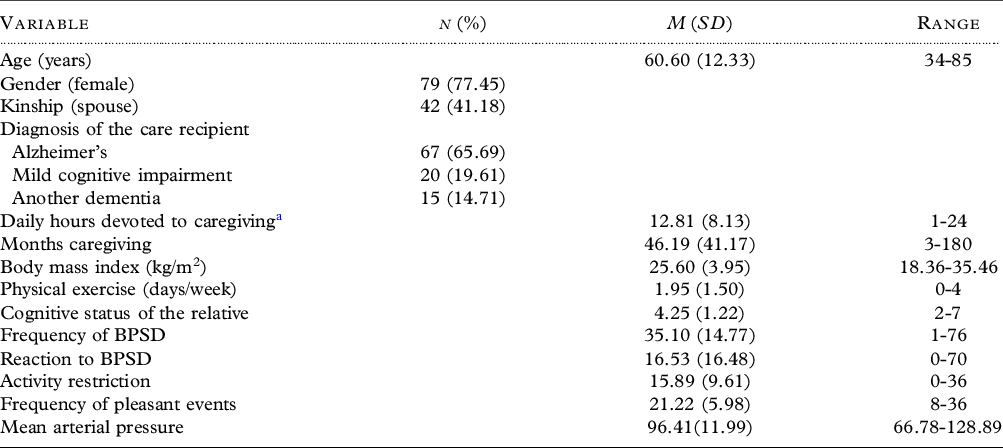
Characteristics of the study sample are shown in Table 1.
Demographic and health data

a N = 95. BPSD = Behavioral and psychological symptoms of dementia.
Associations between variables of interest
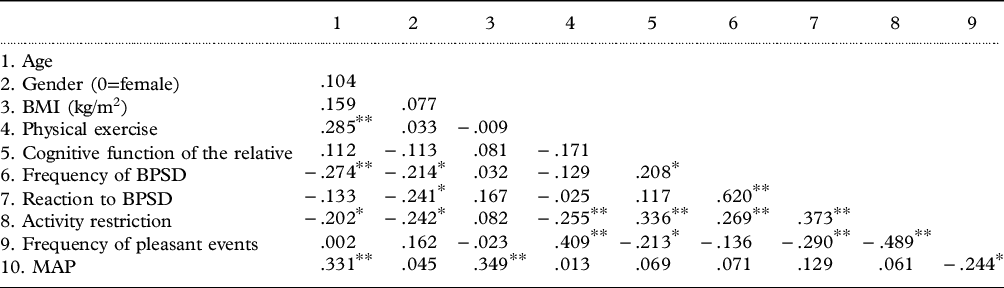
Correlations between the assessed variables are shown in Table 2. Mean arterial pressure was significantly and positively associated with age and body mass index, and negatively with the frequency of pleasant activities. There was no significant association between activity restriction and mean arterial pressure.
Correlation matrix

BMI = Body Mass Index; BPSD = Behavioral and psychological symptoms of dementia, MAP = Mean Arterial Pressure
*p < .05. **p < .01.
Frequency of behavioral and psychological symptoms of dementia was significantly and positively associated with activity restriction, but not with the frequency of pleasant events. Reaction to behavioral and psychological symptoms of dementia was significantly and positively associated with activity restriction, but showed a negative association with the frequency of pleasant events.
Path model for mean arterial pressure
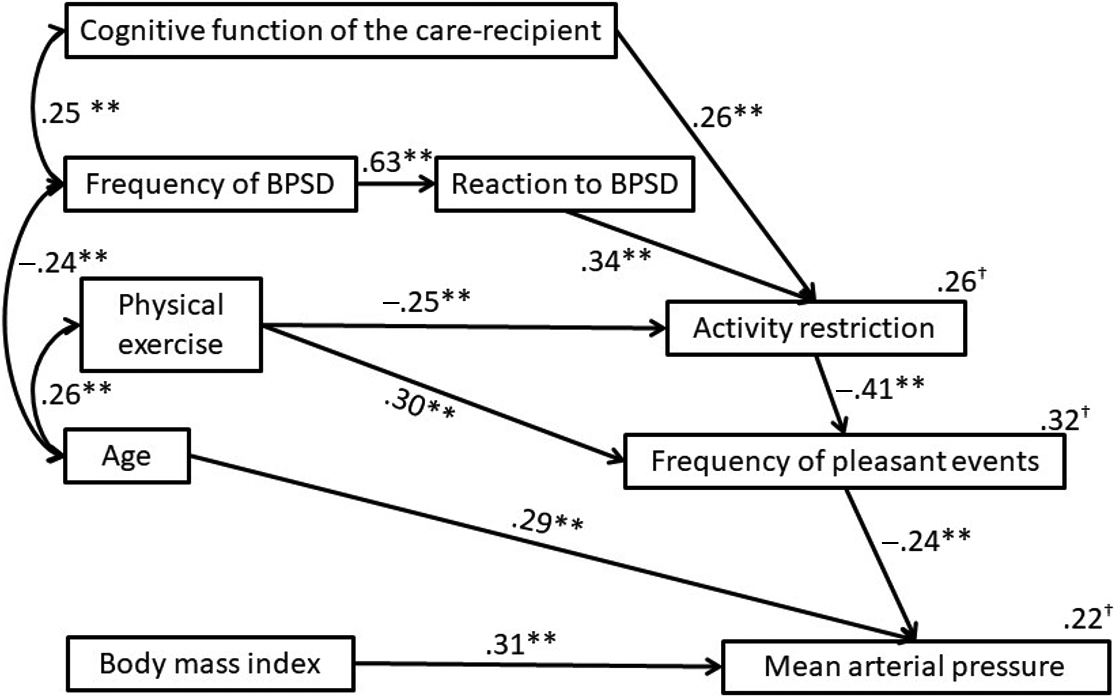
Caregiver gender showed no significant associations in the path model, so it was not included at the final model described below. As shown in Figure 2, higher age (standardized direct effect: .289, p < .001, SE = .082, CI = .130 - .465), higher body mass index (standardized direct effect: .306, p < .001, SE = .079, CI = .139 - .451), and lower frequency of pleasant events (standardized direct effect: −.243, p < .01, SE = .083, CI = −.395 - −.075) were directly associated with higher levels of mean arterial pressure. Also, a significant indirect effect was found between activity restriction and mean arterial pressure (standardized indirect effect: .100, p < .01, SE = .042, CI= −.194 - −.031).
Path diagram for mean arterial pressure (MAP). **p < .01; †Variance explained by the model. BPSD = Behavioral and psychological symptoms of dementia.

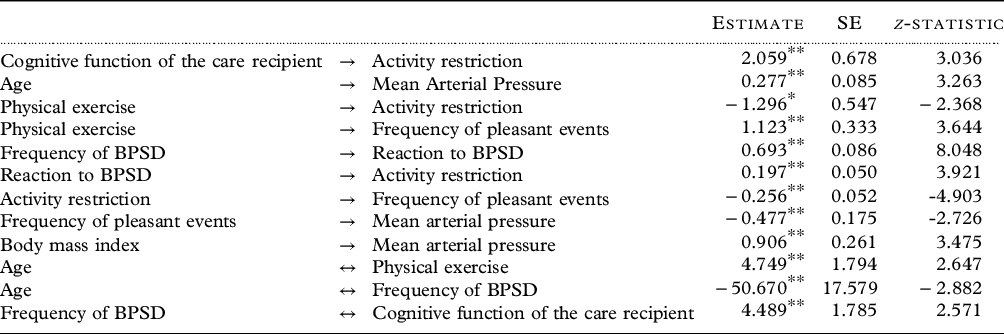
The association between frequency of behavioral and psychological symptoms of dementia and activity restriction was no longer significant when all the variables were considered together, suggesting that the association between these two variables is indirect (standardized indirect effect: .228, p < .01, SE = .063, CI = .114 - .355), potentially through their associations with reaction to behavioral and psychological symptoms of dementia. In addition to this, the direct association between reaction to behavioral and psychological symptoms of dementia and frequency of pleasant events found in the correlation analysis was no longer significant when all variables were considered together in the model, suggesting that the relationship between these two variables is indirect, potentially through their associations with activity restriction (standardized indirect effect: −.151, p < .001, SE = .051, CI = −.262 - −.061). Also, a significant indirect association was found on path analyses between frequency of behavioral and psychological symptoms of dementia and mean arterial pressure (standardized indirect effect: .023, p < .01, SE= .013, CI= .006 - .060) and between reaction to behavioral and psychological symptoms of dementia and mean arterial pressure (standardized indirect effect: .037, p < .01, SE = .019, CI = .009 - .088.), potentially through their associations with activity restriction and frequency of pleasant events. Finally, a significant direct association was found between cognitive status of the care recipient and activity restriction (standardized direct effect: .264, p < .01, SE = .081, CI = .115 - 430), along with an indirect association of cognitive status with frequency of leisure activities (standardized indirect effect: −.109, p < .01, SE = .041, CI = −.213 - −.046) and mean arterial pressure (standardized indirect effect: .026, p < .01, SE = .013, .007 - .065). Unstandardized regression weights as well as the SE obtained are shown in Table 3.
Unstandardized regression weights

BPSD = Behavioral and psychological symptoms of dementia; SE = Standard error
*p < .05. **p < .01.
The final model explained 26% of the variance in activity restriction, 32% of the variance in frequency of pleasant events, and 22% of the variance in mean arterial pressure. The obtained fit indices suggested a good fit of the model to the data (χ 2 (18) = 23.459; p = .174; χ 2/df = 1.303; RMSEA = .055; CFI = .964, and TLI = .944). In addition, the Bollen–Stripe Bootstrap showed a good fit of the model, testing the null hypothesis that the model is correct with p = .214.
Using the non-standardized effects from the analyses of mean arterial pressure, for each standard deviation decrease in the frequency of pleasant events, mean arterial pressure increased by 2.85 units. In addition, regarding the indirect effect of activity restriction on mean arterial pressure, for each standard deviation increase in activity restriction, mean arterial pressure increased by 0.961 units.
Discussion
The aim of this study was to analyze the associations between activity restriction, frequency of pleasant events, caregiving stressors, and caregivers’ physical health, specifically blood pressure. We drew upon the stress and coping model adapted to caregiving (Knight and Sayegh, Reference Knight and Sayegh2010), the pleasant events and activity restriction model (Mausbach et al., Reference Mausbach, Roepke, Depp, Moore, Patterson and Grant2011), and considered health behaviors variables as suggested in the model proposed by Vitaliano et al. (Reference Vitaliano, Scanlan, Zhang, Savage, Hirsch and Siegler2002).
The findings suggest that the relationship between caregiving stressors (cognitive status and behavioral and psychological symptoms of dementia) and frequency of pleasant events was indirect, potentially due to the association of these variables with activity restriction. Moreover, the findings suggest that both higher levels of activity restriction and lower frequency of pleasant events are associated with negative caregiving outcomes, in this case with higher blood pressure, after controlling for stressors. Thus, the relationship between activity restriction and blood pressure seems to be indirect, potentially through a negative association with the frequency of pleasant events. Specifically, the results suggest that behavioral and psychological symptoms of dementia impact caregivers’ health by increasing caregivers’ activity restrictions and decreasing their engagement in pleasant activities. The results of our study provide additional support to the findings obtained by Mausbach et al. (Reference Mausbach, Roepke, Depp, Moore, Patterson and Grant2011) and Chattillion et al. (Reference Chattillion2013), who showed the importance of assessing the joint effects of activity restriction and pleasant events in explaining caregivers’ health. Specifically, the results suggest that greater reaction to behavioral and psychological symptoms of dementia may be related to higher perceived activity restriction, which in turn is associated with a lower frequency of pleasant events. In addition, the data suggest a potential indirect association between higher levels of behavioral and psychological symptoms of dementia and a lower frequency of pleasant events, potentially through the association of these two variables with higher levels of activity restriction. In addition, the findings suggest that frequency and reaction to behavioral and psychological symptoms of dementia, along with the cognitive status of the care recipient, may have an indirect association with blood pressure, potentially through associations with the variables activity restriction and frequency of pleasant events. This finding provides support for the previously stated hypothesis that the stress of caregiving may predict a higher perception of activity restriction, which may then lead to a decrease in pursuing leisure activities. Moreover, our findings also lend support to the stress and coping model by showing that, in addition to other resource variables like active coping (Kim et al., Reference Kim, Knight and Flynn-Longmire2007), activity restriction and pleasant events are variables that play a significant role in the explanation of caregivers’ physical health.
Finally, although the variance of mean arterial pressure explained by the model was low, and caution is necessary due to the small size of the sample, the obtained effects may contribute significantly to the risk of developing cardiovascular diseases. A one standard deviation decrease in the frequency of pleasant events was associated with an increase of 2.85 units of mean arterial pressure. Similarly, a one standard deviation increase in activity restriction was associated with an increase of 0.987 units of mean arterial pressure. These associations, although small, could have an important clinical impact on caregivers’ cardiovascular risk. As suggested by Lewington and colleagues (Prospective Studies Collaboration, 2002), increase in 10 mmHg of diastolic blood pressure or 20mmHg of systolic blood pressure over usual blood pressure (115/75 mmHg) are associated with more than a twofold increase in mortality risk from a stroke. Following the calculation formula for mean arterial pressure, this could mean that an increase of 13.33 mmHg over 88.33 mmHg in mean arterial pressure could be associated with a similarly increased risk. Therefore, according to these calculations, a one standard deviation decrease in the frequency of pleasant events could be associated with a 21.38% increased mortality risk from stroke, while a one standard deviation increase in activity restriction would be associated with a 7.40% greater risk. Even though other variables such as body mass index have a more substantial magnitude or effect size on cardiovascular risk, these findings suggest that activity restriction and frequency of pleasant events should be considered among the factors that may act as predictors of cardiovascular morbidity in family caregivers of people with dementia
Several limitations of our study are noteworthy. First, the cross-sectional nature of the study prevents us from making any causal inferences, and the direction of the associations between variables may be different from those hypothesized in the model. Another potential limitation may relate to the size and convenience nature of our sample, as all participants were volunteers, preventing us from generalizing the results to the whole caregiver population. In addition, as per study exclusion criteria, none of the participants was suffering from severe hypertension, which may limit the generalizability of the results to caregivers with this condition or other relevant cardiovascular problems. An additional limitation of this study is that resting blood pressure was not assessed prior to initiating the caregiver interviews. Instead, the three blood pressure assessments were conducted prior to, during, and after completing the assessment interviews. For some caregivers, this may have caused variation in blood pressure due to the potentially stressful nature of the questions being asked. Even though we found no significant changes in blood pressure over the interview, we still encourage caution when interpreting the obtained findings, and suggest that future studies assessing blood pressure at rest do so prior to conducting any psychosocial assessments. Finally, although we controlled health characteristics or habits like body mass index or physical exercise, other health behaviors like smoking or alcohol consumption, or use of medication like statins or antihypertensives, suggested to be predictors of cardiovascular risk as well (Harmell et al., Reference Harmell, Chattillion, Roepke and Mausbach2011; Mausbach et al., Reference Mausbach2017; Vara-García et al., Reference Vara-García2019; von Känel et al., Reference von Känel2008), were not controlled and could have increased the variance of mean arterial pressure explained by the model. Future studies should try to advance our knowledge in terms of factors contributing to the understanding of caregivers’ activity restriction and engagement in pleasant events, as well as other dimensions that may contribute to their blood pressure and the interplay between these variables and caregivers’ distress or mental health. Longitudinal and experimental studies done with a larger sample size are needed to achieve these aims.
Despite the abovementioned limitations, to our knowledge, this is the first study testing the role of activity restriction and pleasant events as resource variables in the caregiving stress process, as described through the stress and coping model (Knight and Sayegh, Reference Knight and Sayegh2010). These findings highlight the need to take into consideration the interplay of activity restriction and engagement with pleasant events with other relevant variables highlighted in the stress and coping model, including stressors. If the results of this study were confirmed, targeting sources of activity restriction in highly stressed caregivers could help to raise their engagement in pleasant activities and ultimately decrease cardiovascular risk.
Conflict of interest
None.
Source of funding
The preparation of this paper was supported in part by grants from the Spanish Ministry of Economy and Competitiveness under grants PSI2012-31239 and PSI2015-65152-C2-1-R, and the Comunidad Autónoma de Madrid, through a predoctoral scholarship for the first author of this work.
Description of authors’ roles
Carlos Vara-García designed the study, collected the data, carried out the statistical analyses, and wrote the paper. Rosa Romero-Moreno supervised the data collection and assisted with writing the article. Brent Mausbach and Roland von Känel assisted with the design and writing the article. Javier Olazarán supervised the design and carried out the recruitment of the participants. María del Sequeros Pedroso-Chaparro collected the data and assisted with the statistical analysis and writing the article. Maria Márquez-González assisted with writing the article. Andrés Losada-Baltar assisted with the design, supervised the statistical analyses, and assisted with writing the article.
Acknowledgments
The authors would like to thank all the caregivers for their participation in the study and also the following centers for collaborating with us in the project: Fundación Cien, Fundación María Wolff, Centro de Salud General Ricardos, Centro de Salud García Noblejas, Centro de Salud Benita de Ávila, Centro de Salud Vicente Muzas, Centro Reina Sofía de Cruz Roja, Centro de Psicología Aplicada de la Universidad Autónoma de Madrid, and Servicios Sociales de Getafe.