


Introduction
Hypochondriasis or illness anxiety disorder is characterized by persistent pre-occupation with or fear about the possibility of having one or more serious, progressive or life-threatening diseases. The pre-occupation is associated with catastrophic misinterpretation of bodily signs or symptoms, including normal or commonplace sensations (ICD 11; World Health Organization, 2018). This definition is consistent with the health anxiety concept, a cornerstone of the cognitive behavioural approach to the disorder (Salkovskis, Reference Salkovskis1985, Reference Salkovskis1989; Salkovskis and Warwick, Reference Salkovskis and Warwick1986; Warwick and Salkovskis, Reference Warwick and Salkovskis1990). Moreover, hypochondriasis, illness anxiety disorder – introduced by the DSM-5 (American Psychiatric Association, 2000) – and health anxiety are virtually identical concepts because they are both characterized by ‘the anxious preoccupation with either having, or in danger of having, a currently undiagnosed medical illness, in which the distress is created not by physical symptoms but by anxiety about their disease implications’ (Tyrer, Reference Tyrer2018, p. 49).
Health anxiety refers to a continuum of severity that ranges from normal concerns about health to severe and clinically significant hypochondriacal symptoms, and people who suffer from hypochondriasis and severe health anxiety hold dysfunctional illness-related beliefs that lead them to misinterpret their bodily changes and sensations as harmful. Research has generally confirmed the role of these beliefs in the development and maintenance of health anxiety, showing that there is a continuum of intensity of the attachment to these beliefs, ranging from non-clinical samples with higher scores on health anxiety to patients with hypochondriasis (e.g. Marcus et al., Reference Marcus, Gurley, Marchi and Bauer2007).
Two other more general maladaptive beliefs about thoughts that have received support in studies on hypochondriasis are the intolerance of uncertainty (i.e. Abramowitz et al., Reference Abramowitz, Schwartz and Whiteside2002; Boelen and Carleton, Reference Boelen and Carleton2012; Deacon and Abramowitz, Reference Deacon and Abramowitz2008; Fergus and Valentiner, Reference Fergus and Valentiner2011; Reuman et al., Reference Reuman, Jacoby, Blakey, Riemann, Leonard and Abramowitz2017), defined as the ‘belief that uncertainty, newness, and change are intolerable because they are potentially dangerous’ (OCCWG, 1997, p. 669), and the over-estimation of threat, namely a catastrophic estimation of a heightened probability and/or severity of harm (Fergus, Reference Fergus2014; Gellatly and Beck, Reference Gellatly and Beck2016; Marcus and Church, Reference Marcus and Church2003; Reuman et al., Reference Reuman, Jacoby, Blakey, Riemann, Leonard and Abramowitz2017; Scarella et al., Reference Scarella, Laferton, Ahern, Fallon and Barsky2016; Wheaton et al., Reference Wheaton, Berman, Franklin and Abramowitz2010).
The thought-action fusion-likelihood (TAF-L) belief (Shafran et al., Reference Shafran, Thordarson and Rachman1996) has received less attention in the research, although it has been a focus of interest in other disorders, such as obsessive compulsive disorder (OCD) and eating disorders, under the name of thought-shape fusion in the latter (Shafran et al., Reference Shafran, Teachman, Kerry and Rachman1999). Regarding hypochondriasis, some authors have suggested that experiencing intrusive images about illness and death could increase the estimation of the likelihood of these events occurring (Muse et al., Reference Muse, McManus, Hackmann, Williams and Williams2010). More recently, studies have proposed that a relevant belief associated with hypochondriasis is the belief that having thoughts about illness can cause illness (Bailey and Wells, Reference Bailey and Wells2015, Reference Bailey and Wells2016a, Reference Bailey and Wells2016b; Melli et al., Reference Melli, Bailey, Carraresi and Poli2018), and Fergus (Reference Fergus2015) found that cognitive fusion (CF) is associated with the cognitive and affective dimensions of health anxiety in non-clinical participants. These proposals are close to the meaning of the TAF-L belief. Nonetheless, whereas CF and the Bailey and Wells proposals refer to a degree of conviction close to delusional beliefs, TAF-L beliefs move into the realm of doubt, which better characterizes hypochondriasis. However, to the best of our knowledge, TAF-L has not been specifically investigated in hypochondriasis and health anxiety.
The above-mentioned beliefs can be activated by either external (e.g. a friend’s death) or internal (e.g. somatic sensations) triggers with health-related contents. The pioneering formulation of health anxiety (Salkovskis and Warwick, Reference Salkovskis and Warwick1986; Warwick and Salkovskis, Reference Warwick and Salkovskis1990) posited that patients with hypochondriasis or severe health anxiety might experience intrusive distressing thoughts about the possible causes of their symptoms and/or somatic sensations. Thus, these intrusive thoughts might be an additional internal trigger that activates the aforementioned maladaptive beliefs, namely intolerance of uncertainty about the actual meaning of perceived symptoms and sensations, the over-estimation of threat of these symptoms, and the over-estimation of the likelihood of having a severe disease on the basis of the perceived symptoms (i.e. TAF-L). Thus, similarly to what is proposed for OCD (Clark and Purdon, Reference Clark and Purdon1993; Purdon and Clark, Reference Purdon and Clark1999; Rachman, Reference Rachman1997, Reference Rachman1998; Salkovskis, Reference Salkovskis1985, Reference Salkovskis1989), intrusive cognitions with illness-related contents (illness-ITs) could be interpreted dysfunctionally, then giving rise to pre-occupation with having or acquiring an illness, which characterizes health anxiety. Nonetheless, this assumption must be empirically supported.
The main objective of the current study was to examine whether, as occurs in OCD, dysfunctional beliefs about thoughts mediate the relationships between illness-ITs and health anxiety symptoms. Specifically, we focus on three dysfunctional beliefs about thoughts: intolerance of uncertainty, over-estimation of threat, and TAF-L. We hypothesize, first, that there will be significant differences between the non-clinical and clinical samples in all the variables evaluated: the overall frequency of illness-ITs, dysfunctional beliefs about thoughts, and health anxiety. Second, we hypothesize that there will be significant associations between these three main variables in the two samples, with no significant differences in the correlation sizes between the two samples. Third, we hypothesize that the dysfunctional beliefs will mediate the relationship between thoughts about illness and anxiety about health.
Method
Participants
Two groups of subjects participated in the study. The first group consisted of 219 community adults. Ages ranged from 18 to 65 years (mean ± SD = 39.56 ± 15.20 years), and a slight majority were women (54.3%). Most participants reported a medium socioeconomic level, following the parameters of the Spanish National Statistics Institute (61.6%). Almost half (44.3%) of the participants were married and had university education (48.9%).
The second group included 31 (51.65% women) consecutively referred adult patients who received a main diagnosis of hypochondriasis without co-morbidity. The mean age of the sample was 32.74 years (SD = 9.69; range: 18 to 65 years). The majority of patients were married (61.5%), had medium socioeconomic level (80%) and had university education (64%). All the patients fulfilled the criteria of DSM-IV of hypochondriasis. At the time of the study, none of the patients met the criteria for a mental disorder other than hypochondriasis, and one of them had a lifetime history of generalized anxiety disorder. The majority of the patients scored low on depression (DASS-depression mean = 5.81 ± 3.27). Disorder severity was assessed with the Hypochondriasis-YBOCS-M (H-YBOCS-M; Skritskaya et al., Reference Skritskaya, Carson‐Wong, Moeller, Shen, Barsky and Fallon2012), with scores ranging from 15 to 50 (mean = 46.33, SD = 10.08).
Measures
Illness Intrusive Thoughts Inventory (INPIE; Arnáez et al., Reference Arnáez, García-Soriano and Belloch2017)
This is a self-report questionnaire based on the Obsessional Intrusive Thoughts Inventory (INPIOS; García-Soriano and Belloch, Reference García-Soriano and Belloch2013; García-Soriano et al., Reference García-Soriano, Belloch, Morillo and Clark2011). The INPIE was specifically designed to assess the frequency of unwanted and distressing illness-related intrusive thoughts, images and impulses (illness-ITs), as well as the appraisals and control strategies associated with each participant’s most upsetting illness-IT. The first part consists of a list of 42 unwanted intrusive thoughts about serious illnesses affecting the respondent or a close relative, suspicion about a medical explanation or test, illness-related information, and death. Respondents rate the frequency of each item from 0 (never) to 6 (always). The second part asks participants to select, from the first part of the INPIE, the most upsetting intrusion they had experienced during the past 3 months. Next, keeping this intrusion in mind, the person is asked to rate from 0 (not at all) to 4 (extreme) the emotional reactions linked to the intrusion, the difficulty in controlling the intrusion, the interference the intrusion produces, the dysfunctional appraisals associated with the intrusion, and how often s/he uses a set of neutralizing or control strategies to get rid of the intrusion. In this study, only the total score on the first part was used. The number and frequency of illness-ITs reported by participants were computed as the average frequency of the thoughts actually experienced by the subject at least once in his/her life; that is, the total score was divided by the number of items with a frequency ≥1. A sample copy of the INPIE, in English or in Spanish, is available upon request to authors. The instrument has shown good reliability and validity (Arnáez et al., Reference Arnáez, García-Soriano and Belloch2017). In the present study, the reliability of the first part of the INPIE in non-clinical participants (n = 219) was α = .96 and in the clinical sample (n = 31) it was α = .85.
Obsessive Beliefs Spanish Inventory-Revised (OBSI-R; Belloch et al., Reference Belloch, Morillo, Luciano, García-Soriano, Cabedo and Carrió2010)
This is a 50-item self-report questionnaire assessing dysfunctional beliefs about thoughts. It contains eight factor-derived scales: inflated responsibility; over-importance of thoughts; TAF-likelihood; TAF-moral; importance of thought control; over-estimation of threat; intolerance of uncertainty; and perfectionism. Subjects are asked to indicate their degree of agreement with each statement on a 7-point Likert scale (from 0 = ‘absolutely disagree’ to 7 = ‘absolutely agree’). This instrument has demonstrated good reliability and validity in both non-clinical and clinical samples (Belloch et al., Reference Belloch, Morillo, Luciano, García-Soriano, Cabedo and Carrió2010). In this study, participants in both samples only completed the TAF-L, over-estimation of threat, and intolerance of uncertainty subscales. In the non-clinical sample, reliability ranged from α = .80 (TAF-L) to α = .86 (intolerance of uncertainty); and in the clinical sample, from α = .77 (intolerance of uncertainty) to α = .85 (TAF-L).
Short Health Anxiety Inventory (SHAI; Salkovskis et al., Reference Salkovskis, Rimes, Warwick and Clark2002; Spanish version: Arnáez et al., Reference Arnáez, García-Soriano, López-Santiago and Belloch2019)
This 18-item self-report questionnaire evaluates health anxiety, regardless of the actual physical health status. Preliminary results of the SHAI Spanish version showed good psychometric properties (Arnáez et al., Reference Arnáez, García-Soriano, López-Santiago and Belloch2019). The SHAI demonstrated adequate internal consistency in the present study in both the non-clinical (α = .85) and clinical (α = .86) samples.
Hypochondriasis Yale-Brown Obsessive-Compulsive Scale-Modified version (H-YBOCS-M; Skritskaya et al., Reference Skritskaya, Carson‐Wong, Moeller, Shen, Barsky and Fallon2012; translated into Spanish by Belloch, Reference Belloch2014)
The H-YBOCS-M is a 19-item semi-structured, clinician-administered interview designed to evaluate the presence and severity of health anxiety symptoms during the previous 2 weeks. The interview contains three subscales: illness worries, illness-related behaviours, and unhealthy avoidance, with six items each ranging from ‘0’ (no symptoms) to ‘4’ (extreme symptoms), and larger numerical scores indicating higher symptom severity. The H-YBOCS-M was only completed by the clinical sample and demonstrated adequate internal consistency (total score: α = .90).
Procedure
Non-clinical participants were recruited by advanced psychology students from the University who received academic credits for their recruitment efforts. Seventy-nine students attended a 2-hour seminar in which they received information about the purpose of the study and training in administering the questionnaires to future potential community participants. These 79 students recruited 279 community participants by inviting other people in their social network to participate in a study. Before completing the assessment procedure, all the participants were informed about the purpose of the study and gave their explicit consent to participate. Once the informed consent had been signed, participants were provided with a booklet containing a socio-demographic data sheet and the self-report questionnaires described above. In all cases, the instruments were completed in a single session lasting approximately 60 minutes in the presence of the trained student. Inclusion criteria were as follows: age between 18 and 65 years, sufficient knowledge of written language to understand and complete the questionnaires, and no history of mental disorders or disabling medical diseases in the preceding year. Sixty participants who reported a current or past history of medical or psychological/psychiatric diagnoses were not included in the study.
The clinical sample was consecutively recruited during a period of 12 months (from September 2016 to August 2017) from patients attending an outpatient mental health clinic specializing in the treatment of somatoform disorders, included in the network of the public National Health System, and a University Research Unit for OCD and related disorders. From the total number of 255 patients attending those clinics during the study time, 44 patients (17.25%) had a main diagnosis of hypochondriasis. Thirteen of these patients (29.54%) had one or more co-morbid disorder, as follows: four patients (9%) had a co-morbid diagnosis of somatic symptom disorder, seven patients (15.9%) presented a major depressive disorder, one patient (2.27%) had a co-morbid generalized anxiety disorder, two patients (4.54%) had a panic disorder, and two (4.54%) had a co-morbid OCD. Patients were self-referrals or referred by other health professionals for psychological treatment (clinical psychologists, psychiatrists or GPs), following the usual procedures of the National Health System of our country. Before being included in the study, all potential participants were individually screened with a full history and examination by one of the authors with a doctoral level in clinical psychology (A.B. or J.L.-S.), who decided to include the patient in the study on the basis of the following criteria: (a) having a main diagnosis of hypochondriasis (DSM-IV) with no current co-morbid conditions; (b) age range from 18 to 65 years; (c) not having a past or current history of psychotic and/or alcohol/drug-related disorders; (d) having an adequate level of reading ability; (e) not being engaged in any form of psychological treatment for their disorder in the two preceding years. Diagnosis was confirmed with the Structured Diagnostic Interview for Hypochondriasis (SDIH; Barsky et al., Reference Barsky, Cleary, Wyshak, Spitzer, Williams and Klerman1992) in a session lasting between 60 and 120 minutes. The Mini International Neuropsychiatric Interview (MINI; Sheehan et al., Reference Sheehan, Lecrubier, Sheehan, Amorim, Janavs and Weiller1998) was administered to determine the presence of current co-morbid psychiatric disorders and confirm that the health anxiety symptoms were not a direct result of another disorder (especially major depression, generalized anxiety disorder, panic disorder, or a diagnosed medical condition). Once the hypochondriasis diagnosis had been established, the H-YBOCS was used to determine the disorder severity. Information about basic demographic data (age, gender, occupation, educational level, socio-economic status), medical conditions, and current/past psychological or pharmacological treatments was also recorded. If the patient was considered a likely candidate for the study, based on the inclusion criteria, s/he was then asked to participate in a research study. After giving his/her explicit signed consent, the patient was scheduled for a new assessment session (between 7 and 10 days later) where a booklet containing the self-report questionnaires described above was administered individually, face-to-face with the evaluator. All the patients invited to participate in the study agreed to do so. The study design was reviewed and approved by the local institutional ethics committee.
Statistical analyses
Statistical analyses were performed using the SPSS for Windows program (version 22.0, SPSS Inc., Chicago, Illinois, USA). A number of analyses were conducted. In a first step, we examined descriptive statistics for sociodemographic information and study variables. Cohen’s d values were calculated to estimate the effect size of comparisons. Second, differences between groups (clinical vs non-clinical; male vs female) were examined using t-tests for continuous variables. Differences among correlation coefficients were calculated using the Fisher r-to-z transformation. Third, to analyse the mediating variables between illness-ITs and health anxiety symptoms, mediation analyses were conducted using ‘model 4’ from the PROCESS macro for SPSS, version 2.15 (Hayes, Reference Hayes2013). PROCESS estimates direct effects, indirect effects, standard errors, and confidence intervals based on the distribution obtained with the bootstrap method. A significant indirect effect indicates that the effect of the independent variable on the outcome is mediated by other variables. Statistically significant results imply that the indirect effect is greater than zero with a 95% bias-corrected bootstrap confidence interval. The confidence intervals were based on 5000 bootstrapped samples. Different pairwise comparisons between specific indirect effects were conducted to assess whether one indirect effect was statistically different from another.
Results
Descriptive statistics and preliminary analyses
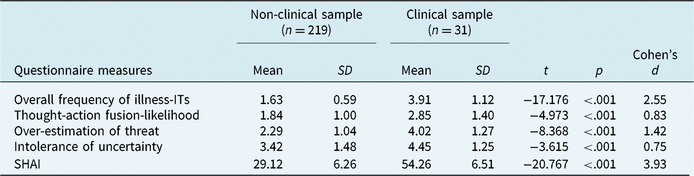
Means and standard deviations for all the study measures are given in Table 1. As expected, there were significant differences between the non-clinical and clinical samples in all the study measures, as patients with hypochondriasis had higher scores on the study measures compared with controls (p ≤ .001). No significant gender differences were observed in the non-clinical and clinical sample (p > .05).
Descriptive statistics and preliminary analyses

IT, Illness Intrusion; SHAI, Short Health Anxiety Inventory.
Associations between the frequency of illness-ITs, dysfunctional beliefs about thoughts, and health anxiety symptoms
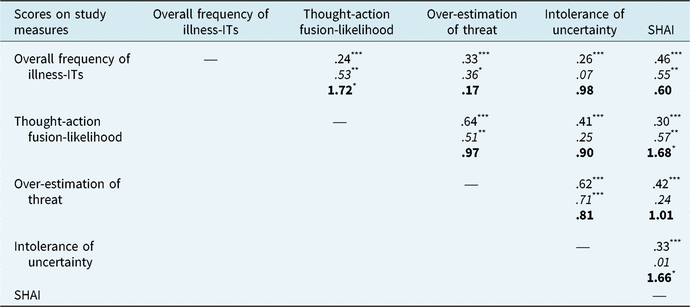
As shown in Table 2, in the non-clinical sample, there was a significant but low correlation between the frequency of illness-ITs and the scores on TAF-L and intolerance of uncertainty beliefs. The frequency of illness-ITs also showed a moderate correlation with over-estimation of threat, and health anxiety symptoms. Significant moderate correlations were found between health anxiety symptoms and the dysfunctional beliefs about thoughts assessed. In the clinical sample, there was a large correlation between the frequency of illness-ITs and TAF-L, and health anxiety symptoms. There was also a significant moderate correlation between the frequency of illness-ITs and over-estimation of threat. Health anxiety symptoms were highly correlated with TAF-L. The size of the correlations was similar in the two samples (all z values >.05), except for the associations between the frequency of TAF-L beliefs and illness-ITs (z = 1.72, p < .05), between the TAF-L and SHAI scores (z = 1.68, p < .05), which were higher in the clinical sample, and between the SHAI scores and intolerance of uncertainty (z = 1.86; p < .01), where the correlation coefficient was higher in the non-clinical sample.
Correlations between the frequency of illness-ITs, general dysfunctional beliefs about thoughts and health anxiety symptoms

IT, Illness Intrusion; SHAI, Short Health Anxiety Inventory. *p < .05; **p < .01; ***p < .001. The first row shows the coefficients observed in non-clinical sample (n = 219); the second row shows in italics the coefficients in the clinical sample (n = 31); the third row shows in bold the z-values.
Dysfunctional beliefs about thoughts as mediators of the relationship between the frequency of illness-ITs and health anxiety symptoms
To examine the relationship between illness-ITs, dysfunctional beliefs and health anxiety symptoms, a model was tested with the total frequency of illness-ITs as independent variable (IV), dysfunctional beliefs about thoughts (i.e. TAF-L, over-estimation of threat, and intolerance of uncertainty) as mediating variables, and health anxiety symptoms (SHAI total score) as the dependent variable (DV). The model was tested in the whole sample of participants, including non-clinical individuals and patients with hypochondriasis.
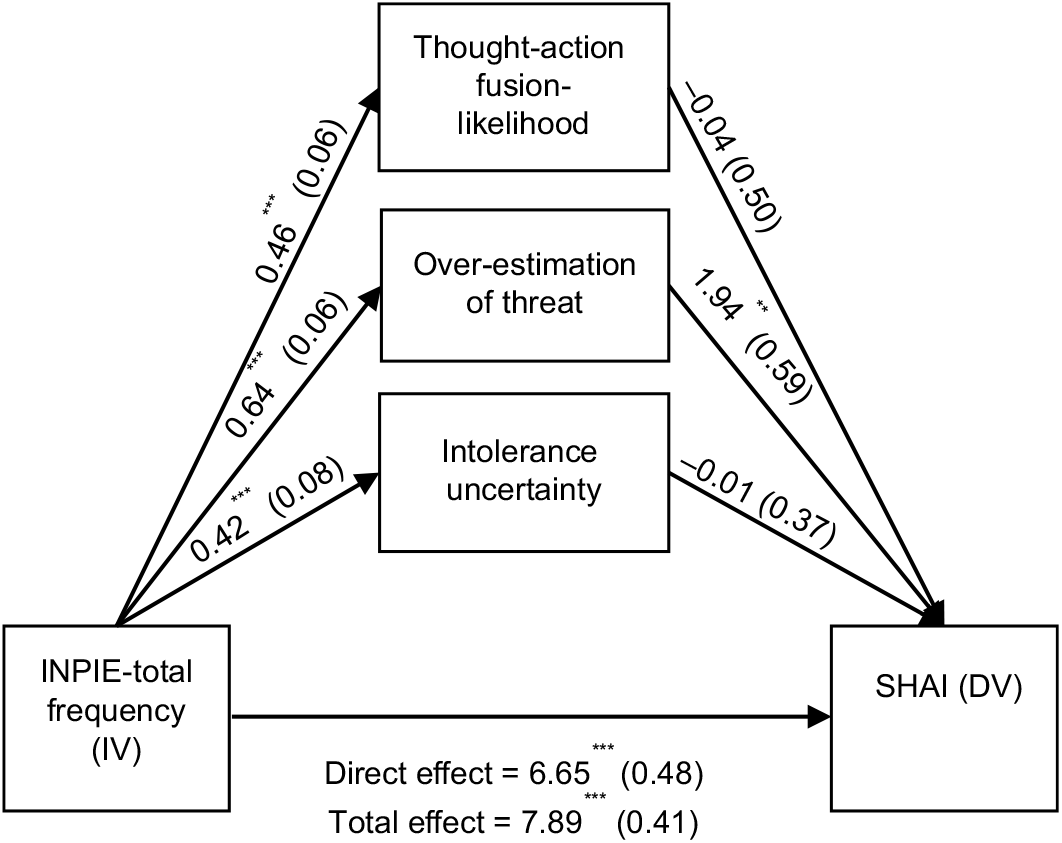
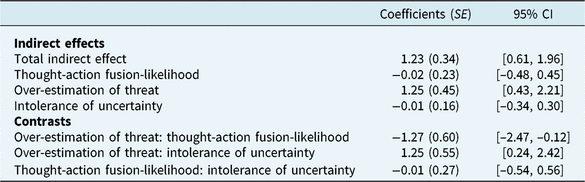
Results showed that the total indirect effect was significant, implying that the dysfunctional beliefs about thoughts on the whole (i.e. TAF-L, over-estimation of threat, and intolerance of uncertainty) mediate the relationship between the frequency of illness-ITs and health anxiety symptoms. However, an examination of the specific indirect effects indicates that only over-estimation of threat was a mediator of the effect of illness-ITs frequency on health anxiety symptoms, which suggest that participants with frequent illness-ITs are more likely to over-estimate the threat that the thought suggests, which in turn would contribute to increase health anxiety. The direct effect of the frequency of the illness-ITs on health anxiety symptoms was also significant, indicating that the over-estimation of threat was only partially mediating this relationship. Figure 1 and Table 3 show the results of the multiple parallel mediation in detail.
Dysfunctional beliefs about thoughts (OBSI-R) as mediators in the relationship between total frequency of illness-ITs and health anxiety symptoms (SHAI) in the whole sample (non-clinical and clinical samples). All coefficients represent unstandardized regression coefficients (and standard error in parenthesis). **p < .01; ***p < .001. Due to missing values in the non-clinical sample, mediation analyses were carried out with N = 224 (193 non-clinical and 31 clinical participants). INPIE, Illness Intrusive Thoughts Inventory; INPIE-total frequency, INPIE-total frequency of illness-ITs; SHAI, Short Health Anxiety Inventory.

Coefficients, standard errors (SE) and confidence intervals (CI) of the parallel multiple mediation analysis of the study variables (N = 224)

Due to missing values in the non-clinical sample, mediation analyses were carried out with N = 224 (193 non-clinical and 31 clinical participants).
Discussion
This study aimed to investigate whether the relationship between the frequency of illness-ITs and health anxiety symptoms is mediated by dysfunctional beliefs about thoughts, such as intolerance of uncertainty, over-estimation of threat, and TAF-L.
In order to reach this objective, we first conducted preliminary analyses by examining the differences between a community sample and a group of patients with hypochondriasis in the study variables, and then analysed the associations between these variables in each sample. As hypothesized, significant differences were found between the two samples in all the evaluated variables. Moreover, illness-IT frequency and health anxiety scores were associated with dysfunctional beliefs in both samples, with similar correlations. However, TAF-L scores showed higher associations with illness-ITs and with health anxiety symptoms in the clinical sample, whereas intolerance of uncertainty showed higher associations with health anxiety symptoms in the community sample. The higher relevance of TAF-L beliefs in the patients with hypochondriasis aligns well with the importance of these beliefs in the explanation of other clinical disorders, such as obsessive compulsive, anxiety, eating and depressive disorders (Abramowitz et al., Reference Abramowitz, Whiteside, Lynam and Kalsy2003; Belloch et al., Reference Belloch, Morillo, Luciano, García-Soriano, Cabedo and Carrió2010; Berle and Starcevic, Reference Berle and Starcevic2005; Rassin et al., Reference Rassin, Merckelbach, Muris and Schmidt2001). These results highlight the potentially transdiagnostic nature of TAF-L beliefs, especially when they are activated and/or associated with misinterpretations of distressing intrusive thoughts and images that have been found to be relevant in disorders such as the aforementioned.
In the patients group, the absence of relationships between intolerance of uncertainty and the two main variables of interest, the frequency of intrusive cognitions about illness and health anxiety symptoms, was unexpected because there is considerable empirical support in the literature for the relationship between intolerance of uncertainty and health anxiety or hypochondriasis. For example, Deacon and Abramowitz (Reference Deacon and Abramowitz2008) found that patients with hypochondriasis showed elevated levels of intolerance of uncertainty about cardiovascular symptoms, and Boelen and Carleton (Reference Boelen and Carleton2012) also found an association between intolerance of uncertainty and hypochondriacal concerns in non-clinical samples. Moreover, research has shown that this construct was relevant in explaining symptoms of generalized anxiety disorder and OCD (i.e. Dugas et al., Reference Dugas, Buhr, Ladouceur, Heimberg, Turk and Mennin2004a; Holaway et al., Reference Holaway, Heimberg and Coles2006; Tolin et al., Reference Tolin, Abramowitz, Brigidi and Foa2003), two disorders that share some phenomenological characteristics with hypochondriasis. However, our findings coincide with those reported in other studies. For example, intolerance of uncertainty predicted worry and symptoms of generalized anxiety disorder, but not health anxiety symptoms, in non-clinical samples (Sexton et al., Reference Sexton, Norton, Walker and Norton2003), and it was a specific risk factor for worry and depression in clinical samples (Norton et al., Reference Norton, Sexton, Walker and Norton2005). Nonetheless, in our community sample, intolerance of uncertainty was associated with health anxiety symptoms, although the size of the coefficients was small. Inconsistencies regarding the role of intolerance of uncertainty in health anxiety symptoms could be due to the different measures used to assess intolerance of uncertainty, or to the different conceptualizations of intolerance of uncertainty, namely, as a specific thought-related belief (OCCWG, 1997) – as conceptualized in this study – or as a cognitive bias (Dugas et al., Reference Dugas, Schwartz and Francis2004b).
Regarding the mediational analysis, the results partially supported our third hypothesis because we only found a mediating effect of the over-estimation of threat beliefs. Results provided evidence of both direct and total indirect effects of the frequency of illness-ITs on health anxiety symptoms through dysfunctional beliefs. These results suggest that although the three beliefs analysed seem to be relevant in explaining how a distressing illness-related intrusive thought could escalate to a health anxiety symptom, only over-estimation of threat beliefs had indirect effects, which indicates that patients with frequent illness-ITs were more likely to have heightened threat expectancy, which (at least in part) contributed to high scores on health anxiety. This result is coherent with findings that point out the role played by over-estimation of threat in the catastrophic misinterpretation of symptoms (Fergus, Reference Fergus2014; Gellatly and Beck, Reference Gellatly and Beck2016; Reuman et al., Reference Reuman, Jacoby, Blakey, Riemann, Leonard and Abramowitz2017; Scarella et al., Reference Scarella, Laferton, Ahern, Fallon and Barsky2016; Wheaton et al., Reference Wheaton, Berman, Franklin and Abramowitz2010). Nonetheless, we cannot ignore that other potential variables might operate alongside over-estimation of threat, because only partial mediation was found.
The present study has limitations. First, this is a retrospective study with self-report measures, and so the absence of biases in the participants’ responses cannot be guaranteed. Nonetheless, the measures used have shown adequate psychometric properties. Mediational studies with cross-sectional designs (atemporal mediation) do not allow causality relationships between the variables to be established (Winer et al., Reference Winer, Cervone, Bryant, McKinney, Liu and Nadorff2016), and so future studies should replicate these study findings using a longitudinal design. Patients were diagnosed following the DSM-IV criteria, which coincide with the CIE-10 criteria and the CIE-11 proposal. These criteria are not exactly the same as the DSM-5 criteria for illness anxiety disorder, although all these criteria coincide in that, from our point of view, a key rule-of-thumb is to differentiate illness anxiety disorder (DSM-5) from somatic symptom disorder (or the former DSM-IV-somatization disorder): the pre-occupation (i.e. ruminative thinking) with having or acquiring a serious illness (DSM-IV and DSM-5), based on a misinterpretation of bodily symptoms (DSM-IV), which if present, are only mild in intensity (DSM-5). Thus, we think our results are also generalizable to illness anxiety disorder as described in the DSM-5. The fact that patients did not present co-morbidities with other disorders at the time of the study limits the generalization of the results to other clinical samples in which co-morbidity is common. In summary, although our findings are innovative, they are also exploratory in nature, and more stringent mediational analyses are needed with a larger sample of patients with co-morbidities to test the generalizability of these results. Finally, we evaluated the role played by a series of variables as mediators of hypochondriasis, but future studies should develop a broader model that includes other variables potentially involved in the cognitive behavioural approach to health anxiety, such as maladaptive primary appraisals and/or other relevant beliefs such as perfectionism and responsibility (Melli et al., Reference Melli, Rustici, Micheli, Stopani, Carraresi and Bulli2014; Wheaton et al., Reference Wheaton, Berman, Franklin and Abramowitz2010), or variables such as anxiety sensitivity (Raines et al., Reference Raines, Oglesby, Capron and Schmidt2014; Wheaton et al., Reference Wheaton, Mahaffey, Timpano, Berman and Abramowitz2012).
To conclude, our results are relevant because, to the best of our knowledge, this is the first study to explore concurrently the associations between illness-ITs, dysfunctional beliefs about these thoughts, and health anxiety symptoms. Our mediation findings shed light on key dysfunctional beliefs that could be responsible for the relationship between the frequency of illness-ITs and hypochondriasis, suggesting that over-estimation of threat is partially involved in the prediction of hypochondriasis.
Acknowledgements
None.
Financial support
This work was supported by the Ministry of Science, Innovation and Universities of Spain (grant FPU 14/02795) and (grant RTI2018-098349-B-I00).
Conflicts of interest
The authors declare they that have no conflicts of interest with respect to this publication. The funding agency played no role in the study design; data collection, analysis or interpretation; the writing of the report; or the decision to submit this paper for publication.
Ethical statement
The authors have abided by the Ethical Principles of Psychologists and the Code of Ethics.



Comments
No Comments have been published for this article.