INTRODUCTION
Cetaceans are usually exposed to a considerable number of human-induced threats. Proximity to urban areas increases vulnerability, since individuals are more likely to interact with fisheries, boat traffic, pollution and others (Reeves et al., Reference Reeves, Smith, Crespo and Notarbartolo di Sciara2003). Direct and indirect effects of anthropogenic action may cause death or become obstacles to the health of individuals and populations.
The marine tucuxi dolphin (Sotalia guianensis) occurs exclusively in coastal waters of the western Atlantic along South and Central America, from southern Brazil (27°35′S 48°34′W) to Nicaragua (14°35′N 83°14′W), with possible records from Honduras (15°58′N 79°54′W) (Flores, Reference Flores and Perrin2002; Cunha et al., Reference Cunha, Silva, Lailson-Brito, Santos, Flores, Martin, Azevedo, Fragoso, Zanelatto and Solé-Cava2005). This small delphinid inhabits shallow waters and is often found year-round in bays and estuaries (da Silva & Best, Reference Silva and Best1996). The species is listed as ‘Data Deficient’ by the World Conservation Union (IUCN) due to lack of information on the ecology, biology and abundance of this species in several sites (Reeves et al., Reference Reeves, Smith, Crespo and Notarbartolo di Sciara2003).
The development of Brazilian coastal zones has been followed by chaotic occupation without previous planning or sustainable management. The south-eastern Brazilian region, historically, had turned into an important industrial centre of Brazil. Hence, many coastal ecosystems, including estuaries and bays, have been receiving discharges of chemical contaminants from domestic, industrial and agricultural wastewaters (Dorneles et al., Reference Dorneles, Lailson-Brito, Santos, Costa, Malm, Azevedo and Torres2007). Among these areas, Guanabara Bay is the most dramatic example of man-made degradation. A massive metropolitan complex surrounds Guanabara Bay and the area is degraded by over-fishing, harbour activities and inputs of chemical pollutants, such as heavy metals and organohalogen compounds. Guanabara Bay is bordered by 6000 industries, with more than 6000 additional industries in its drainage basin (Kjerve et al., 1997). In addition, sewage discharges from industrial and domestic activities as well as solid trash constitute an important source of pollution in that area (Perin et al., Reference Perin, Fabris, Manente, Rabello-Wagener, Hamacher and Scotto1997).
Guanabara Bay is the most degraded area along S. guianensis distribution (Lailson-Brito, Reference Lailson-Brito2007). Despite this, the bay supplies food and breeding grounds for marine tucuxi dolphins which are found year-round in this site (Azevedo et al., Reference Azevedo, Lailson-Brito, Cunha and Van Sluys2004, Reference Azevedo, Oliveira, Viana and Van Sluys2007). Some individuals have been seen for ten years and calves have remained in the area beyond sexual maturity (Azevedo et al., Reference Azevedo, Lailson-Brito, Cunha and Van Sluys2004). They have been seen in aggregations of up to 50 dolphins, but groups that vary from two to ten members are more frequently observed (Azevedo et al., Reference Azevedo, Viana, Oliveira and Van Sluys2005).
Since 1995 a systematic population study of S. guianensis has been carried out in Guanabara Bay using photo-identification techniques. Here we present several human-induced injuries to marine tucuxi dolphins recorded while carrying out the population investigation mentioned.
MATERIALS AND METHODS
Study site
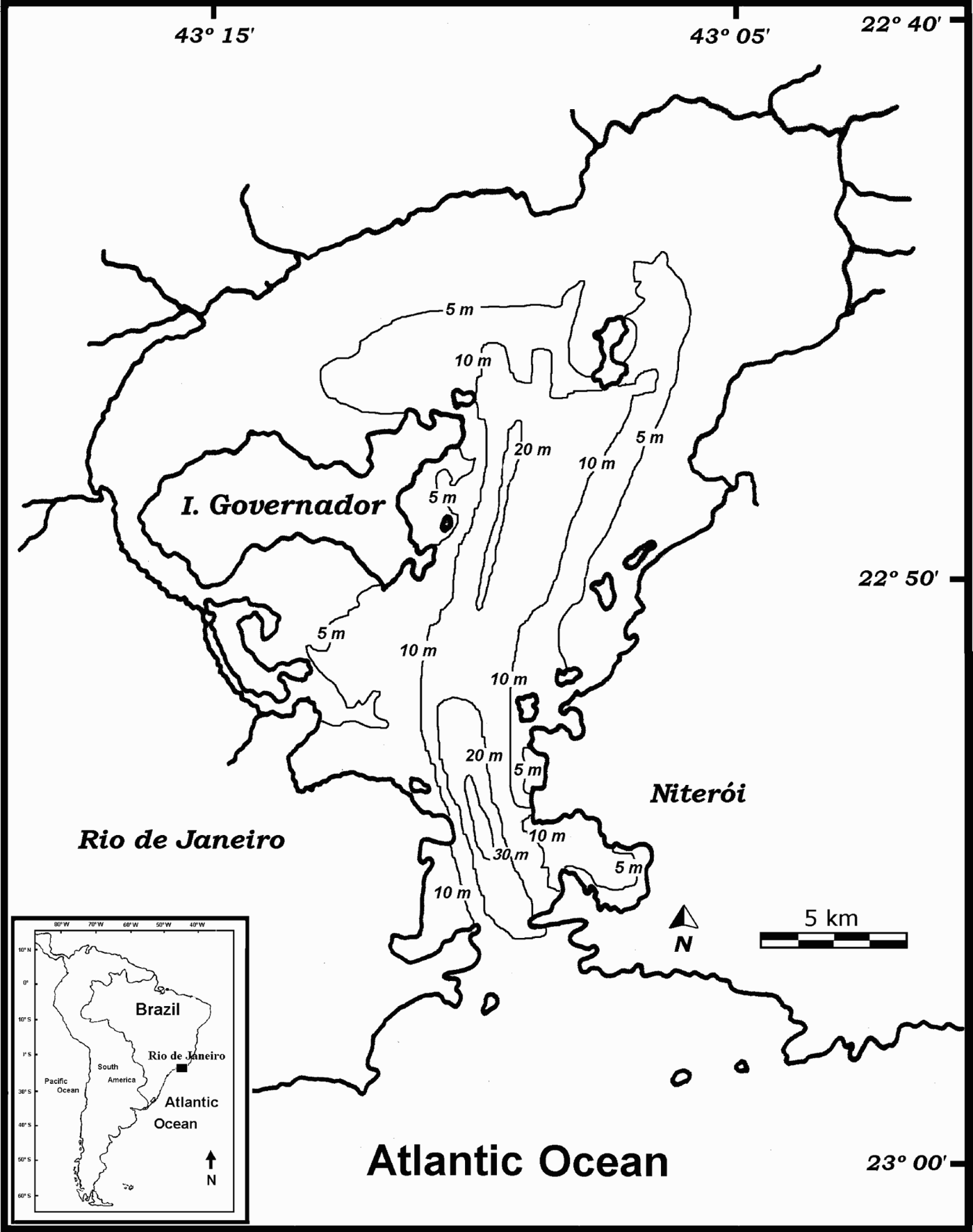
Guanabara Bay (22°50′S 43°10′W) is located in Rio de Janeiro State, south-eastern Brazil (Figure 1). The bay has a total area of 384 km2, with an entrance 1.8 km wide. Although the mean depth of the bay as a whole is 5.7 m, along the main channel, which follows the central south–north axis of the bay, the average depth is 20 m (Kjerfve et al., Reference Kjerfve, Ribeiro, Dias, Filippo and Quaresma1997). The bay possesses some features of an estuarine system. The freshwater contribution is derived from 35 rivers that flow into the bay and also from the waste input (Kjerfve et al., Reference Kjerfve, Ribeiro, Dias, Filippo and Quaresma1997).
Map of Guanabara Bay (22°50′S 43°10′W), south-eastern Brazilian coast, where marine tucuxi photo-identification surveys were conducted between 1995 and 2005.

Pollution in Guanabara Bay may be summarized by the statement that 10.9 kg of heavy metals and 343 kg of oils are released daily into the bay. Concerning the oxygen biochemical demand (OBD) and the oxygen chemical demand (OCD), the features are 4763 kg d−1 and 12,752 kg d−1, respectively (Kjerfve et al., Reference Kjerfve, Ribeiro, Dias, Filippo and Quaresma1997; Perin et al., Reference Perin, Fabris, Manente, Rabello-Wagener, Hamacher and Scotto1997). With reference to the organic burden and the domestic waste water received by Guanabara Bay, there are also remarkable features since the numbers are 465 tn d−1 and 17 m3 s–1, respectively. In addition, a daily production of 13,000 tons of solid waste is reported; however, it is assumed that 4000 tn d−1are not collected and also that 1000 tn d−1are disposed on a sanitary embankment that can spill into Guanabara Bay (Kjerfve et al., Reference Kjerfve, Ribeiro, Dias, Filippo and Quaresma1997).
Sampling
Data on injuries to marine tucuxi dolphins were obtained while carrying out photo-identification and behavioural activity surveys. From May 1995 to May 2005, 74 photo-identification surveys were conducted in Guanabara Bay. The effort was not equally distributed and the intervals between consecutive surveys ranged from one to 360 days. All surveys were carried out in Beaufort sea states <3, using small (4.5–6.6 m) outboard-powered boats. Photographs were taken at close range (usually <10 m). An auto-focus camera with a variable length (70–300 mm) lens was used. Most photographs were taken using ASA 400 colour and black-and-white film. Dorsal fin pictures were examined by negative projection. Nicks and notches along dorsal fins were the main features to distinguish individual dolphins, but scars and injuries along dolphin bodies were used as auxiliary marks.
RESULTS
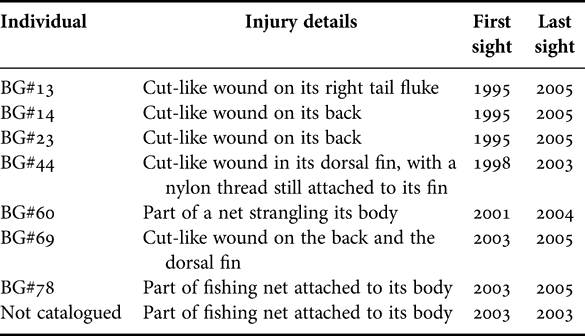
Seventy-eight dolphins were photo-identified between 1995 and 2005, of which seven (9.0%) and one calf (not catalogued) had noticeable injuries on their bodies (Table 1; Figure 2). Individuals catalogued as BG#44, BG#60, BG#78 and one calf (not catalogued) had their injuries caused by entanglement in fishing gear. The calf had part of a net with nylon and styrofoam fragments attached from the middle of its body to the flukes. BG#44 had a cut-like wound on its dorsal fin. In this case, pictures revealed that a nylon thread, still attached to its dorsal fin was the reason for the injury. The most impressive dolphin entanglement case, however; involved BG#60. The specimen had been seen in early 2001 when a rope was entangled on its body. At that time, apparently, BG#60 had only part of its dorsal fin injured (Figure 2A). The individual was constantly seen until 2004 and the mentioned rope was still present (Figure 2B). BG#78 was identified in 2003 and had a net fragment around its body and dorsal fin, which seemed to be deepening the wound in this latter anatomical region. In 2007 July, BG#78 was found dead with recent fishing net marks; however, the mentioned net fragment was not attached to its body. Carcass examination revealed that BG#78 was a juvenile male that presented additional scarred injuries. Other scars were observed in its mouth and a large part of its dorsal and right pectoral fin had been cut off. In 1995, a calf was seen with its tail fluke cut off (Figure 2C). This dolphin was catalogued as BG#13 and was seen in Guanabara Bay until 2005. BG#13 was a female that had her first calf in 2001 and a second one in 2004. We hypothesized that the dolphin concerned had become entangled in fishing net and a fishermen ended up cutting off its tail fluke while trying to release the animal, in order to avoid greater damage to his fishing gear.
Individual injuries observed in Sotalia guianensis, in Guanabara Bay, from 1995 to 2005. (A) BG#60: part of a fishing net attached to its body in 2001; (B) BG#60: part of a net attached to its body in 2004; (C) BG#13: cut-like wound on its right tail fluke, picture taken in 2004; (D) BG#69: cut-like wound on the back and the dorsal fin, picture taken in 2004.

Individual injuries observed in Sotalia guianensis, in Guanabara Bay, from 1995 to 2005.

Another kind of conspicuous lesion observed was a large healed cut-like wound on the back. Three photo-identified individuals (BG#14, BG#23 and BG#69) had this kind of injury (Figure 2D).
DISCUSSION
In Guanabara Bay, at least eight Sotalia guianensis individuals had serious injuries caused by human activities. We believe that most of the interactions occurred inside the bay, because dolphins spent a lot of time in the study area (Azevedo et al., Reference Azevedo, Lailson-Brito, Cunha and Van Sluys2004) and human activities are intense within the bay, including fisheries and disposal of marine debris. Entanglements in fishing gear have been reported worldwide for several marine taxa, including turtles, seabirds, cetaceans and seals (Chan et al., Reference Chan, Liew and Mazlan1988; Norman, Reference Norman2000; López et al., Reference López, Pierce, Santos, Gracia and Guerra2003; Baker & Wise, Reference Baker and Wise2005). It represents a serious threat to dolphins (Reeves et al., Reference Reeves, Smith, Crespo and Notarbartolo di Sciara2003) and marine tucuxis have been incidentally captured in nets set for fish all over their distribution (Flores, Reference Flores and Perrin2002). Dolphin entanglement in fishing gear does not always result in death, as sometimes the animal can free itself or can be released from the entanglement by the fishermen (Perrin et al., Reference Perrin, Donovan and Barlow1994). However, the incident can cause injury and deep wounds that take a long time to heal. This kind of injury may become life threatening, since animals may suffer impaired ability to catch food or avoid predators, acquire infections, or exhibit altered behaviour patterns that place them at a survival disadvantage (Laist, Reference Laist1987). In Guanabara Bay, fishing activity is intense year-round and about 1400 fishing boats operate in that area (Jablonski et al., Reference Jablonski, Azevedo and Moreira2006). Among these boats, approximately 860 vessels use gill-nets and, a smaller number of boats use purse seines, trawl and hand-line apparatus (Jablonski et al., Reference Jablonski, Azevedo and Moreira2006). These fisheries overlap a large part of the dolphin home range in Guanabara Bay (Azevedo et al., Reference Azevedo, Lailson-Brito, Cunha and Van Sluys2004) and approximately one individual per year has been found dead due to incidental catch in gill-nets.
As mentioned above, it is well-known that cetaceans may entangle in fishing gear such as trap lines and nets; however, it is not possible to determine whether such animals become entangled in debris or active gear. Floating net fragments and derelict fishing gear in general have been reported to entangle and kill marine animals (Laist, Reference Laist1987). Besides the fishing gear discharged directly at sea, Guanabara Bay waters receive a great amount of solid waste discharge as well (Kjerfve et al., Reference Kjerfve, Ribeiro, Dias, Filippo and Quaresma1997). Hence the possibility of entangling in floating trash cannot be discarded. The amount of floating solid trash is so substantial in Guanabara Bay that marine tucuxis were regularly seen playing with it, most of the time with plastic bags.
The concern raised by the injuries reported herewith is amplified if it is considered that this cetacean population is highly exposed to organochlorine, organotin and perfluoroalkyl compounds. High concentrations of these pollutants have been recently reported for marine tucuxis from Guanabara Bay and the levels are comparable to those observed in highly industrialized regions of the northern hemisphere (Torres et al., Reference Torres, Lailson-Brito, Dorneles, Azevedo e Silva, Azeredo, Meire, Vidal, Lozinski, Azevedo and Malm2006; Dorneles et al., Reference Dorneles, Lailson-Brito, Fernandez, Vidal, Barbosa, Azevedo, Fragoso, Torres and Malm2008a,b). Exposure to the contaminants mentioned may increase the possibility of infection through skin wounds, since the three pollutant classes constitute endocrine-disrupting chemicals with a number of different pathological effects attributed to them (World Health Organization, 2002), including immunosuppressive action (Whalen et al., Reference Whalen, Green and Loganathan2002; Beineke et al., Reference Beineke, Siebert, McLachlan, Bruhn, Thron, Failing, Müller and Baumgartner2005; Peden-Adams et al., Reference Peden-Adams, EuDaly, Dabra, EuDaly, Heesemann, Smythe and Keil2007), which constitutes an obvious obstacle to the healing process. Therefore, the synergistic effect of injuries and contaminant exposure should not be ruled out when the conservation of such a small dolphin population is considered.
From a purely academic point of view, further research on abundance, biological parameters, habitat use and environmental disturbance is not only recommended but also required to assess and monitor the status of these resident dolphins. Potential threats that require monitoring and possible mitigation include those related to chemical pollution, intense vessel traffic (disturbance and strikes), and fishing activities (by-catches and over-fishing). Such threats may have long-term effects and may operate cumulatively and synergistically (Azevedo et al., Reference Azevedo, Lailson-Brito, Cunha and Van Sluys2004).
The interactions with human activities faced by S. guianensis in Guanabara Bay are of even greater concern when the problems observed in the entire distribution of the species are taken into account. The species occurs in coastal waters, occupying bays and estuaries, where the greatest demographic concentration on the Atlantic coast of countries from South and Central America can be found. On the Brazilian coast, for example, the unplanned growth of the cities as well as the uncontrolled fishery threatens the conservation of a number of coastal species, both marine and terrestrial. Artisanal fishing activities are widely carried out along the Brazilian coast and have killed several cetacean species (Perrin et al., Reference Perrin, Donovan and Barlow1994). Bearing in mind the seriousness of the situation faced by the small dolphin population present in Guanabara Bay, even though all cetaceans are protected in Brazilian waters under Federal Law, the perspectives in a near future can be better only with the implementation of law enforcement, educational programmes and the development of research efforts conducted by multidisciplinary specialists, working together with federal and state governments.
ACKNOWLEDGEMENTS
This study was funded by Cetacean Society International, The Humane Society of the United States, Instituto BIOMAS and IDEA WILD. We thank two anonymous referees who made useful suggestions for improving the manuscript. We also thank Tatiana Bisi who provided useful comments on the manuscript. We particularly thank the Departamento de Oceanografia Biológica (FAOC, UERJ), the Departamento de Ecologia (IBRAG, UERJ), and the Iate Clube Jardim Guanabara for their logistic support. We are grateful to Wagner B.P. Cavalcante, Álvaro M. Oliveira and Simone Viana for field assistance. The Ministry of Education of Brazil—CAPES granted a PhD fellowship to P.R.D. A research grant from CNPq (grant no. 301401/04-7) was awarded to M.V.S.