

Introduction
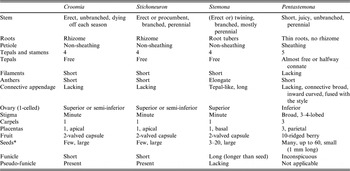
Stemonaceae is a small (three genera, c.23 spp.) monocotyledonous family of perennial herbs; without or with a rhizome; with 4-merous flowers; superior or half-inferior, unilocular, unicarpellate ovary; 2-valved fruit; funicular seeds with a conspicuous aril composed of finger-like appendages; and leaves with thin but conspicuous transverse veinlets between the main veins (Rudall et al., Reference Rudall, Cunniff, Wilkin and Caddick2005; Rudall & Bateman, Reference Rudall and Bateman2006). The three genera are (Rogers, Reference Rogers1982): (i) Stemona Lour. (c.15 spp.), widespread in tropical SE Asia, distinct from the other two genera in having an essentially twining habit, rhizome lacking, but with swollen roots and basally inserted ovules; (ii) Stichoneuron Hook.f. (5 spp.), in SE Asia; and (iii) Croomia Torr. (3 spp.), with two species in Japan (Ohwi, Reference Ohwi1965) and one in North America (Tomlinson & Ayensu, Reference Tomlinson and Ayensu1968). Stichoneuron and Croomia are closely related and share an erect, non-twining leafy stem, a rhizome with non-tuberous roots, and apically inserted ovules. A fourth genus, Pentastemona Steenis (2 spp.), from Sumatra, is sometimes placed in Stemonaceae but we maintain it in a segregate monotypic family Pentastemonaceae (Duyfjes, 1992). Pentastemona has been included in Stemonaceae based on both morphology (van Steenis, 1982) and DNA sequence data (Caddick et al., Reference Caddick, Rudall, Wilkin, Hedderson and Chase2002). However, in Caddick et al. (Reference Caddick, Rudall, Wilkin, Hedderson and Chase2002) Pentastemona was placed as sister to the other genera so a two family solution would have been equally as valid a conclusion. Rudall et al. (Reference Rudall, Cunniff, Wilkin and Caddick2005) and Rudall & Bateman (Reference Rudall and Bateman2006) also suggest the situation is not clear cut. Van der Ham (1991) argued that pollen morphology supports family rank for Pentastemona. Bouman & Devente (Reference Bouman and Devente1992) and Bouman (Reference Bouman, Rudall, Cribb, Cutler and Humphries1995) also placed Stemona and Pentastemona in separate families, based on ovule and seed characters. Pentastemona are juicy herbs; a rhizome is absent; the leaf bases are sheathing; the flowers are 5-merous (and altogether very different from those of Stemonaceae); the ovary is 3-carpellate and inferior, with 3 parietal placentas; and the seeds have a very short funicle or not. Nakai (Reference Nakai1937) found the genera Croomia and Stichoneuron sufficiently different from Stemona to establish a separate family Croomiaceae but we have not followed this position. Morphological differences between the four genera are summarised in Table 1.
Comparison of Croomia, Stichoneuron and Stemona (Stemonaceae) and Pentastemona (Pentastemonaceae)
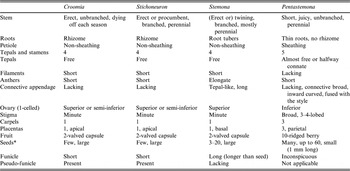
* Large = 5 mm long or more.
Recent fieldwork and cultivation in the greenhouse have revealed three new species of Stichoneuron from Peninsular Thailand and Peninsular Malaysia. These are described here.
Croomia versus Stichoneuron
Croomia and Stichoneuron have historically been maintained as separate genera. They have also been maintained, sister to one another, in three recent phylogenetic papers (Caddick et al., Reference Caddick, Rudall, Wilkin, Hedderson and Chase2002; Rudall et al., Reference Rudall, Cunniff, Wilkin and Caddick2005; Rudall & Bateman, Reference Rudall and Bateman2006). However, they are hardly separable based on morphology. It seems that the only difference is in the growth habit. Croomia has a long rhizome, at the apex of which an erect, herbaceous, unbranched shoot is produced each year which then dies off at the end of the season (Rogers, Reference Rogers1982). Stichoneuron has a short rhizome, similarly producing erect somewhat branched shoots, lasting two or three years at most. In Stichoneuron calcicola the shoots of the plants may grow older and branches are rather prostrate, possibly an adaptation to its specialised habitat, crevices in (vertical) limestone rock. Both Croomia and Stichoneuron have few ovules attached to the apex of the ovary. According to van Heel (1992) Stichoneuron and Croomia have a similar floral morphology and could be merged. In Croomia the funicled seeds dangle outside the open mature fruit below the valves on a conspicuous long ‘pseudo-funicle’ formed by the detached vessel-bundle. This was noted by Gray (Reference Gray1859) and Takhtajan (Reference Takhtajan1982) in Croomia pauciflora Torr., from North America, and also clearly depicted by Makino (Reference Makino1961) for C. heterosepala (Baker) Okuyama from Japan. However, the ‘pseudo-funicle’ is present in Stichoneuron as well, at least in S. calcicola.
Stichoneuron was described in 1883 by J. D. Hooker, who cited a single specimen but did not name it. This was done, however, in 1888 and 1892 with one species, Stichoneuron membranaceum. The material, lacking fruit, was from India. Although it was noted that the fruit was lacking it was considered as distinct from Croomia by its few-branched habit, many-flowered inflorescences, and three minute stigmas. Ridley (1911) described a second species, Stichoneuron caudatum, also lacking fruit, from Malaya. Since then only a few collections of the Indian species have been made, all without fruit. The Malaysian Stichoneuron species are somewhat better collected (about 15 specimens), seldom with fruit, and not clearly showing the mode of attachment of the mature seed. Only in recent times, with more material available and the description of three new species, has it become known that the Thai–Malaysian species all have few-flowered inflorescences (i.e. when the inflorescences are young and start flowering), and also a minute single stigma. Therefore, the branched subperennial habit of the stem remains the only character to distinguish Stichoneuron and Croomia.
Other characters used to separate Stichoneuron and Croomia (van Steenis, 1982; Kubitzki, Reference Kubitzki and Kubitzki1998) also appear invalid. For example, curvinerved leaves in Croomia are also found in Stichoneuron calcicola; the distichous leaves of Croomia can also be seen in Stichoneuron; the disposition of the anther cells and the condition of the connectivum are essentially the same in both genera; the character of the tepals – valvate in Stichoneuron versus imbricate in Croomia – appears to be arbitrary.
In the present study we refrain from uniting these genera as, despite their clear similarity, there is no current evidence to suggest either genus is not monophyletic. The extra-tropical genus Croomia is the older name. Pending further research we maintain the SE Asian genus Stichoneuron and herewith propose new species names necessary for the forthcoming family treatment for the Flora of Thailand and the Flora of Peninsular Malaysia.
Flower Dimorphism in Stichoneuron
Stemonaceae usually have perfect flowers. Dahlgren et al. (Reference Dahlgren, Clifford and Yeo1985) mentioned the rare occurrence of unisexual flowers in the family. The flowers of Stichoneuron are (probably) rarely functionally unisexual with some dimorphism (Duyfjes, Reference Duyfjes1991; Kubitzki, Reference Kubitzki and Kubitzki1998). In Stichoneuron the fruit are scarce on specimens, and in S. membranaceum still unknown. This species, from the Khasia Hills in India and northern Burma, is only known from a few collections although Hooker (Reference Hooker1888) provided a good description and a drawing of the small flowers taken from the collection Hooker f. & Thomson s.n. from the Khasia Mountains. However, recently we discovered a single fully open flower on the L duplicate of the collection Native Collector for Koelz 5835 (6 vi 1952), which differs from the flowers depicted by Hooker (Reference Hooker1888). Photographs in Tanaka et al. (Reference Tanaka, Tanaka, Ohi-Toma and Murata2007) are apparently of male flowering plants from northern Burma collected by Murata et al. (MBK and TI, not investigated by us). Our supposition is that Hooker described and figured a (largely) functionally female flower with a large ovary and spreading reduced stamens and that the flower in Koelz 5835 (in L) is a male flower, with a reduced ovary. The male flower of Stichoneuron membranaceum is much smaller than those of the other Stichoneuron species. Even with the small number of flowers seen of the other species it would appear that these have less pronounced functionally male and female dimorphism. It may also be that the flowers are protandrous, in which they initially have conspicuously forward-directed and protruding stamens presenting orange-yellow pollen, and a minute ovary; the ovary possibly then develops later when the stamens (with empty anthers) are pushed away laterally. Duyfjes (Reference Duyfjes1993) postulated that the hermaphroditic-looking flowers of Stichoneuron caudatum (at the time including material of S. halabalensis and S. bognerianum) might be either functionally female or male, partly explaining the observed variation. However, available herbarium material is too scanty to affirm this.
Small insects may be involved in cross-pollination. The flowers of Stichoneuron membranaceum and S. caudatum are subglabrous, but the adaxial side of the tepals of S. calcicola, S. halabalensis and S. bognerianum is conspicuously hairy and purplish green or reddish tinged, reminiscent of carrion fly pollinated flowers. The odour of the flowers is unknown.
Systematic Treatment
Stichoneuron Hook.f. in Benth. & Hook.f., Gen. Pl. 3: 747 (1883); Hooker, Hooker's Icon. Pl. 8: t.1776 (1888); Hooker, Fl. Brit. India 6: 299 (1892); Ridley, Fl. Malay. Penin. 4: 320 (1924); Duyfjes, Fl. Males., Ser. 1, Spermat. 11(2): 408 (1993). – Type species: Stichoneuron membranaceum Hook.f.
Erect or decumbent branched herbs with short crowded rootstock, leafy shoots several years of age; roots lacking tubers; lower part of stem with sheathing cataphylls often with fimbriate margins; prophyllum present at point of ramification; in erect plants the upper branches often leaning over. Leaves alternate, subdistichous; petiole slightly sheathing at base or not; blade simple, ovate-oblong or elliptic, margin entire, apex acute-acuminate, lateral veins 2–4 pairs, curved, one pair basal, venation finely trabeculate. Inflorescences axillary, pedunculate, with flowers arranged in clusters or raceme-like with only 1 or 2 flowers at apex in anthesis; buds (depressed) globose. Flowers small, perfect or functionally unisexual with some reduction of one sex and some dimorphism; pedicel filiform, stiff, articulate, persistent below articulation; bracts narrow, margins fringed, acute, persistent; perianth of 4 tepals, imbricate, almost free, often recurved; stamens 4, free, filaments at base shortly adnate to tepals; anther comprising 2 dorsifixed thecae, horizontal or curved over the apex of the filament, connective broad or narrow, without appendages; ovary superior or half-inferior, green, ovoid, minute, c.0.5 mm diam., 1-celled, ovules 2–4, placentation apical, style lacking, stigma minute, sessile, 1 (but see the note under Stichoneuron membranaceum). Fruit elongate, apex acute or beaked, green, capsular with 1–4 seeds; pericarp thin; perianth persistent. Seeds large, brown or reddish-brown, broad-ellipsoid, (irregularly) longitudinally ridged, aril (elaiosome) of 5–8 finger-like hyaline appendages or irregularly shaped, surrounding seed to about halfway; funicle shorter than the seed, pseudo-funicle (always present?) as long as the fruit.
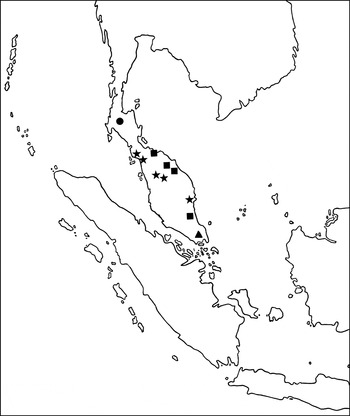
Distribution. Stichoneuron membranaceum in NE India and northern Burma, S. bognerianum, S. calcicola, S. caudatum and S. halabalensis in Peninsular Thailand and Peninsular Malaysia (Fig. 1).
Distribution of Stichoneuron in Peninsular Thailand and Peninsular Malaysia: S. bognerianum (▲); S. calcicola (•); S. caudatum (★); S. halabalensis (■).

Key to the species
1a. Plant decumbent; leaves suborbicular or heart-shaped, all veins basal; flowers red; on limestone rocks; Peninsular Thailand 2. S. calcicola
1b. Plant erect; leaves ovate, elliptic or narrowly elliptic, pinnately veined, one pair basal; flowers pink-purplish, green, whitish or pale yellowish; terrestrial; India, Burma, Thailand, Malaysia 2
2a. Corolla c.3 mm diam., pale yellowish; petiole 1–4 mm long; NE India, northern Burma 5. S. membranaceum
2b. Corolla 5–10 mm diam., reddish, whitish-purplish, purple or green; petiole (4–)5–10 mm long; Peninsular Thailand, Peninsular Malaysia 3
3a. Tepals reflexed, acute and with c.7 mm long apical appendage, adaxial surface pink-purplish, with papillose hairs to 0.5 mm long; peduncle somewhat curved, 3–7(–10) cm long 3. S. caudatum
3b. Tepals somewhat reflexed or laterally patent, acute or acute-acuminate, with apical appendage to 1 mm long, adaxial surface green or whitish, densely or sparsely hairy; peduncle stiff, up to 2 cm long 4
4a. Peduncle 1–2 cm long; flower c.5 mm diam. (c.4 mm when dry); tepals adaxially green, with sparse purplish hairs c.1 mm long 4. S. halabalensis
4b. Peduncle c.0.5 cm long; flower c.10 mm diam. (c.7 mm when dry); tepals whitish, with dense white or reddish hairs c.0.5 mm long 1. S. bognerianum
1. Stichoneuron bognerianum Duyfjes, sp. nov.Fig. 2.
A Stichoneuro caudato pedunculo brevi c.0.5 cm longo, floribus magnis c.10 mm diam., tepalis adaxialiter albescentibus dense breviter albo-pilosis, pilis c.0.5 mm longis differt. – Type: Cultivated at Münich Botanic Garden 1993, originating from Peninsular Malaysia, Johor, Bogner 1789 (holo M; iso K, L).
Stichoneuron caudatum auct. non Ridl.: Duyfjes, Fl. Males., Ser. 1, Spermat. 11(2): 408, p.p., f. 3, 4 (1993); Bouman, Blumea 36: f. 36 (1995); Rudall et al., Taxon 54(3): f. 4 (2005); Rudall & Bateman, Syst. Bot. 31(2): f. 1A (2006).
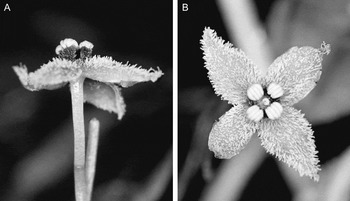
Stichoneuron bognerianum Duyfjes. A, flower, side view; B, flower, top view. Photos: J. Bogner, from Bogner 1789 (K, L, M).

Erect herb, 20–40 cm tall, short-hairy. Leaves: petiole c.5 mm long, non-sheathing to barely sheathing; blade narrowly elliptic, 5–7 × 2.5–4 cm, base short-cuneate, lateral veins 3(or 4) pairs; prophyll 3–4 mm long. Inflorescences glabrous; peduncle c.5 mm long, straight, 1–5-flowered, bracts 1–2 mm long, ± fringed. Flowers: corolla pale greenish, 10–12 mm diam.; pedicel 10–15 mm long, persistent part 5(–10) mm long; tepals spreading or faintly recurved, elliptic, 6–7 × c.3 mm, margin ± recurved, apex acute, lacking appendix, abaxially greenish and glabrous, adaxially pale green and densely somewhat papillose white-hairy, hairs c.0.5 mm long; stamens c.1.5 mm long, filaments purple-red, white-hairy; anthers curved over apex of filaments, 1(–1.5) mm long, yellow; ovules 3 or 4. Fruit 15–20 mm long, 6–8 mm diam., shortly beaked. Seeds 1 or 2, ellipsoid, 5–6 mm long, ridges sinuate, aril irregularly lobed; funicle short (see Bouman, Reference Bouman, Rudall, Cribb, Cutler and Humphries1995); pseudo-funicle not seen.
Distribution. Southern Peninsular Malaysia (Johor); known from few collections and from flowering plants cultivated in the Münich Botanic Garden (see note).
Ecology. In or near swamp forest; sea level to 30 m.
Additional specimens examined. Peninsular Malaysia.Johor: Kota Tinggi-Mawai Road, 4 ii 1935, Corner SF 28716 (K); Sungai Kaya, 11 iii 1937, Corner SF 3271 (K); 5 viii 1939, Corner SF 37056 (K).
The species is named after Josef Bogner (M) who received living material from the greenhouses of the biology department at Amherst (USA) in 1993 and successfully cultivated it to the present day in the botanic gardens at Münich. The material was collected by Dr Conover near a sawmill near Sg. Kayu, a tributary of the Sidili River, near Mawai, beside the Kota Tinggi Road (see Corner, Reference Corner1978: f. 1 for map).
2. Stichoneuron calcicola Inthachub, sp. nov.Fig. 3.
Stichoneuro caudato in habitu decumbenti, foliis cordiformibus, 3-, 5- vel 7-plinervibus differt. – Type: Peninsular Thailand, Surat Thani, Khlong Phanom National Park, 21 ii 2001, Middleton 544 (holo BKF; iso A, E, L).
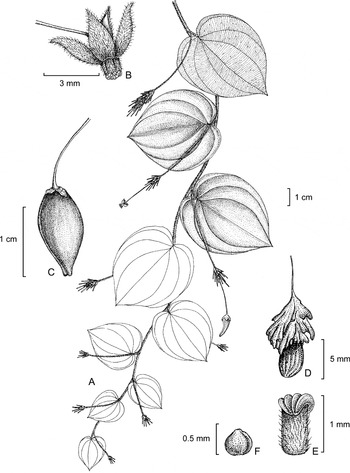
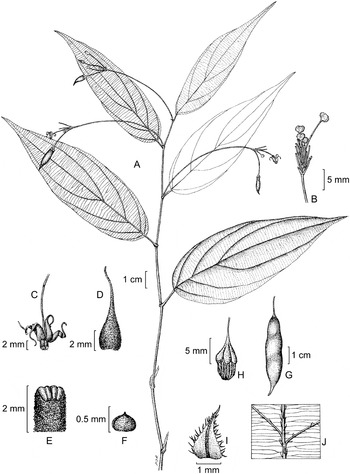
Stichoneuron calcicola Inthachub. A, flowering and fruiting stem; B, flower; C, stamen; D, ovary; E, fruit; F, seed with irregularly lobed aril. Drawn from Inthachub 155 (BKF, L).
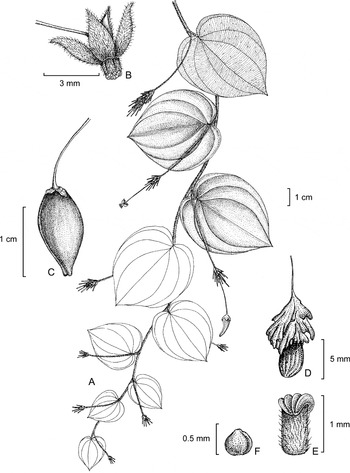
Several-branched low herb with the branches ± woody at base, 20–50(–100) cm long, decumbent or trailing or hanging, growing on vertical limestone rock; most parts (except upper leaf surface, pedicels and flowers) finely hairy, hairs 0.5–1 mm long. Leaves: petiole 2–5(–10) mm long, not sheathing at base; blade ovate or subcircular in outline, 1.5–6 × 1.5–5 cm, base cordate, veins 4(–7) broadly arching from (near) the base to near the apex; prophyll 1–2 mm long. Inflorescences: peduncle glabrescent, 1.5–3.5 cm long, flowers up to 40, in short, dense raceme, to 15 mm long, sometimes ramified and producing secondary peduncles to 2 cm long; bracts ovate-oblong, acute-acuminate, 1.5–2 × 1–1.5 mm. Flowers: corolla red, 4–5 mm diam.; pedicel 10–15(–20) mm long, persistent part 5–10 mm long, glabrous; tepals ovate-elliptic, 2–3 × 1.5–2 mm, acute(-acuminate), abaxially glabrous, adaxially sparsely or densely set with red hairs < 0.5 mm long; filaments reddish or purplish, closely adhering, forward directed, stout, 1–1.5 × c.0.5 mm, hairy; anthers yellow or orange, c.0.5 mm diam. Fruit narrowly ovoid, (5–)10–12 mm long, 5(–7) mm diam., glabrous, apex narrowed and ± 2-lobed; fruiting pedicel c.15 mm long. Seeds 1 or 2, reddish or purple-brown, c.5 × 3 mm, ridges straight, aril wide, irregularly lobed, reaching over halfway up the seed; funicle short; pseudo-funicle distinct, nearly as long as fruit.
Field notes. Flowers red; fruit green.
Distribution. Peninsular Thailand; known only from a restricted area in Surat Thani (Khlong Phanom National Park and Khlong Saeng Wildlife Sanctuary).
Ecology. Secondary forest on limestone; hanging from fissures in rock; 50–300 m.
Additional specimens examined. Thailand.Surat Thani: Khlong Phanom National Park: 16 vii 2000, Chamchumroon 865 (BKF); 21 ii 2006, Greger & Vajrodaya HG 1026 (WU); 24 iii 2006, Inthachub 155 (BKF, L); 11 iv 2003, Middleton et al. 2142 (BKF, K, L); 24 iv 2005, Pooma et al. 5198 (BKF, L); 16 ii 2005, Williams & Pooma 1545 (BKF, L); Khlong Saeng Wildlife Sanctuary: Middleton et al. 4304 (BK, BKF, E).
Stichoneuron calcicola is distinct by its procumbent habit and ecology (growing on limestone). The leaves are subplinerved, somewhat similar to those of Croomia and Stemona. All collections are from limestone rock.
3. Stichoneuron caudatum Ridl., J. Straits Branch Roy. Asiat. Soc. 57: 107 (1911); Ridley, Fl. Malay. Penin. 4: 321 (1924); Grey-Wilson, Kew Bull. 26: 150 (1971); Steenis, Blumea 28: 151 (1982); Duyfjes, Fl. Males., Ser. 1, Spermat. 11(2): 408 (1993). – Type: Peninsular Malaysia, Perak, Temango, vii 1909, Ridley 14582 (holo SING; iso K). Fig. 4.
Stichoneuron membranaceum auct. non Hook.f.: Prain, J. Asiat. Soc. Bengal, Pt. 2, Nat. Hist. 73: 43 (1904).
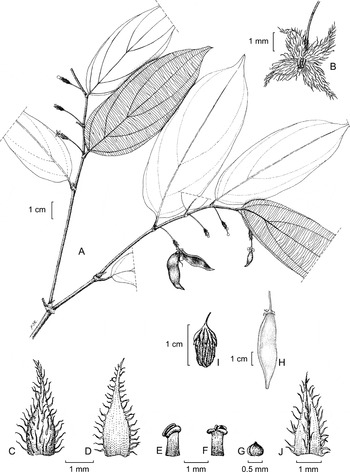
Stichoneuron caudatum Ridl. A, flowering and fruiting stem; B, inflorescence with buds; C, flower; D, tepal, seen from inside; E, stamen; F, ovary; G, fruit; H, seed with finger-like aril lobes; I, bract; J, detail of lower leaf surface. Drawn from Inthachub 103 (BKF, L).

Slender erect herb (20–)30–80 cm tall, with few branches; stem, petiole and leaves thinly hairy or glabrous. Leaves: petiole 5–10 mm long, sparsely hairy, slightly sheathing at base; blade (ob)ovate or narrowly elliptic, 9–10(–12) × 3–4(–5) cm, base obtuse or shortly cuneate, lateral veins 3(or 4) pairs; prophyll c.5 mm long. Inflorescences: subglabrous, peduncle slender, somewhat curved downward, 3–7(–10) cm long, few to densely (c.40) flowered, raceme to 3 cm long; bracts with ± fimbriate margin, c.2 mm long. Flowers: corolla pinkish brown or reddish purple, 6–8 mm diam.; pedicel 10–15 mm long, persistent part 5–8 mm long; tepals lanceolate, strongly reflexed, 3–4 × c.2 mm, at apex with a slender appendage 4–7 mm long, abaxially glabrous, adaxially papillose, papillae up to 0.5 mm high; stamens 1.5–2 mm long, filaments forward directed, stout, 1–1.5 mm long, reddish purple, glabrous or papillose; anthers yellow (or purple?). Fruit 20–45 mm long, 7–10 mm wide, 5(–10) mm beaked; fruiting pedicel c.15 mm long. Seeds 2–4, brown, c.7 × 4 mm, ridges straight, aril lobes straight, finger-like; funicle and pseudo-funicle not seen.
Distribution. Peninsular Thailand (Pattani, Yala, Narathiwat), Peninsular Malaysia (Perak, Terengganu, Kelantan).
Ecology. Wet habitats in lowland dipterocarp forests and rain forests, mostly near streams; granite bedrock, and sandy places; 30–600 m.
Additional specimens examined. Thailand. Pattani: Bachaw [Bacho], 13 vii 1923, Kerr 7172 (BK, K, L); Betong, 11 iii 1925, Kerr 10082 (BK, K, L); Toh Muh, Ban Kaluki, 23 iv 1931, Lakshnakara 775 (BK, K). Yala: Than To Waterfall, 27 ii 2003, Greger & Vajrodaya HG 898 (WU); Bang Lang National Park, 19 vii 2004, Pooma et al. 4440 (BKF, L); Ban Chulabhorn, 21 iv 2005, Pooma et al. 5075 (BKF, L); Betong, 2 iii 2001, Suksathan 2930 (QBG). Narathiwat: Hala-Bala Wildlife Sanctuary, 20 iv 2004, Chongko 305 (BKF, L); ibid., 10 ix 2004, Inthachub 103 (BKF, L).
PeninsularMalaysia. Kelantan: Gua Musang-Kuala Betis track, 14 vii 1935, Henderson SF 29662 (K, L); Gua Musang, Gua Cha, 9 x 1985, Latiff et al. ALM 1035 (K); Sungai Lebir, 28 iv 1976, Stone & Sidek 12514 (L); Kuala Aring, x 1899, Yap 108 (K). Perak: Temenggor Forest Reserve, 31 viii 1993, Latiff et al. 3970 (L); Chior Forest Reserve, 5 x 1967, Ng FRI 5740 (L). Terengganu: Ulu Telemong Forest Reserve, 25 vii 2006, Imin et al. FRI 50586 (L); ibid., 26 vii 2006, Lee SL 142 (L).
4. Stichoneuron halabalensis Inthachub, sp. nov.Fig. 5.
A Stichoneuro caudato pedunculo multo breviore c.1 cm longo, tepalis acuminatis differt. – Type: Thailand, Narathiwat, Hala-Bala Wildlife Sanctuary, 10 ix 2004, Inthachub 117 (holo BKF; iso L).
Stichoneuron halabalensis Inthachub. A, flowering and fruiting stem; B, flower; C–D, tepal, seen from inside and outside respectively; E–F, stamens; G, ovary; H, fruit; I, seed with finger-like aril lobes; J, bract. Drawn from Inthachub 117 (BKF, L).

Erect herb 30–60 cm tall, with few branches; stem, petiole and leaves sparsely hairy. Leaves: petiole 5(–7) mm long, inconspicuously sheathing at base, blade narrowly ovate-oblong or elliptic-oblong, glabrous, except veins on lower surface sparsely hairy, 6–12 × 1.5–5.5 cm, base broadly rounded or short cuneate, lateral veins 3(or 4) pairs; prophyll c.0.5 cm long. Inflorescences: subglabrous, peduncle straight, 0.5–1.5 cm long, with few hairs at base, flowers 5–25, in condensed raceme up to 1 cm long; bracts 1–2 mm long. Flowers: corolla greenish, c.6 mm diam.; pedicel (2–)5–7 mm long, persistent part 2–4 mm long; tepals oblong, patent and slightly reflexed, 3–4 × 1–1.5 mm, apex acuminate for c.1 mm, abaxially green, glabrous, adaxially yellowish green, sparsely or densely hairy with pale purplish hairs 0.5(–1) mm long; stamens c.1.5 mm long, filaments patent, erect, greenish or purple, 1(–1.2) mm long, glabrous or fine-papillose; anthers c.0.5 mm long, yellow or orange. Fruit c.30 mm long, 10 mm wide, with a 5 mm long beak; fruiting pedicel c.7 mm long. Seeds (1 or)2, (dark) brown, c.9 × 5–6 mm, ridges straight, aril lobes straight, finger-like; funicle short, pseudo-funicle present.
Distribution. Peninsular Thailand (Narathiwat), Peninsular Malaysia (Terengganu, Pahang).
Ecology. In rain forest along streams; 30–160 m.
Additional specimens examined. Thailand. Narathiwat: Hala-Bala Wildlife Sanctuary, 10 iii 2005, Poopath 213 (BKF); Waeng, 26 viii 2006, Poopath s.n. (BKF).
Peninsular Malaysia. Terengganu: Ulu Kajang, Bukit Haliya, Kemaman, 17 xi 1935, Corner SF 30503 (K); Ulu Ayam, Bukit Kajang, Kemaman, 5 xi 1935, Corner SF 30242 (K, L); near 36th mile Jerangau Road, 22 ix 1955, Sinclair & Kiah 40942 (K, L). Pahang: Lesong Forest Reserve, 7 iii 1980, Maxwell 80-85 (L).
The habit of Stichoneuron halabalensis is similar to S. caudatum, the latter differing chiefly in its longer peduncles, longer pedicels (5–15 mm long), red or purplish flowers, and in its strongly reflexed long-caudate tepals which are adaxially glabrous or papillose rather than long-hairy. Both species grow in the same area in Narathiwat.
5. Stichoneuron membranaceum Hook.f., Hooker's Icon. Pl. 8: t.1776 (1888); Hooker, Fl. Brit. India 6: 299 (1892); Tanaka et al., J. Jap. Bot. 82(5): 272, f. 4: A–B, 5 (2007). – Type: India, Silhet [but probably Khasia Hills above Silhet], De Silva in Wallich 9110 (holo K-W).
Stem erect, 50–80 cm tall; all parts subglabrous. Leaves: petiole 1–5 mm long, slightly sheathing at base, blade narrowly ovate-elliptic or narrowly elliptic, 5–12 × 2–5 cm, base (broadly) rounded or short cuneate, lateral veins (2 or)3 pairs; prophyll 1(–1.5) cm long. Inflorescences: subglabrous, peduncle 1.5–2 cm long, flowers 5–10, crowded; bracts 2–4 mm long. Flowers: pale, subglabrous. Hermaphroditic flowers: pedicel c.10 mm long, hypanthium enlarged, corolla c.4 mm diam.; tepals subtriangular, c.1.5 mm long, adaxially glabrous, abaxially sparsely hairy; filaments c.1 mm long, thecae c.0.5 mm long. Male flowers: pedicel 3–6 mm long, corolla c.3 mm diam. Fruit and seeds unknown.
Distribution. India (Meghalaya: Khasia Hills), Burma.
Ecology. Forests; 200–1000 m; flowering in June (Khasia) and February (Burma).
Additional specimens examined. India. Assam: Khasia, 1850?, Hooker f. & Thomson s.n. (K, L); Cherrapunjee, Khasia Hills, 6 vi 1952, Koelz 5835 (L); photo and distribution map in Tanaka et al. (Reference Tanaka, Tanaka, Ohi-Toma and Murata2007).
The inflorescences are situated above the leaf blade, with the peduncle closely appressed to the basal part of the midvein (see Tanaka et al., Reference Tanaka, Tanaka, Ohi-Toma and Murata2007).
The ovary in Hooker's plate is c.1.5 mm across which is larger than is known in the other species which are c.0.5 mm across. Possibly the drawing is of a functionally female flower, with possibly two stigmas on top of conical styles. See also the discussion in the section on flower dimorphism above.
Acknowledgements
The first author is grateful to Kongkanda Chayamarit (BKF) and Siriporn Thong-aree of the staff of Hala-Bala Wildlife Research Station for their kind help and support on field trips. Herbarium specimens from BK, BKF, K, L, M, P, QBG and WU were studied for the present treatment. The first author also studied Stichoneuron calcicola, S. caudatum and S. halabalensis in the field. This work was supported by the Graduate School, Kasetsart University and the TRF/BIOTEC Special Program for Biodiversity Research and Training Grant BRT T-148020. We thank Teddi Bloniarz (Amherst) for help in tracing the original locality and collector of the type of Stichoneuron bognerianum. Pajaree Inthachub (BKF) prepared the line drawings, Josef Bogner (M) provided the photographs, Jan Frits Veldkamp (L) translated the diagnoses into Latin, and Ben Kieft (L) scanned the drawings.