INTRODUCTION
Exchange of ceramics and the cultural information they embody played an essential role in the formation of the Mesoamerican culture region from the Initial Ceramic through the Middle Formative period (ca. 1600–500 cal b.c.). During this time, Mesoamerica was united by common styles shared on pottery, figurines, and other materials. These “style horizons” shifted in tandem across Mesoamerica several times within this timeframe (Grove Reference Grove and Rice1993; Henderson Reference Henderson1979; Pool Reference Pool2007; Rosenswig Reference Rosenswig2010; Willey Reference Willey1991). We adapt Rosenswig's (Reference Rosenswig2010) horizon terminology based on their appearance and disappearance primarily in central Mexico, but we emphasize regional differences where important.
During the Early Formative (ca. 1400–1000 cal b.c.), Horizon I features the spread of highly decorated carved ceramics with abstract representations of deities and other repetitive symbols, typically on polished back bowls. This horizon marks the rise and spread of the Olmec artistic style. It has roots in the southern Gulf lowlands but was elaborated through time in other regions forming “islands” of emerging sociocultural complexity based on commonly held cultural ideals (de la Fuente Reference de la Fuente, Clark and Pye2000; Flannery and Marcus Reference Flannery and Marcus1994; Love Reference Love2002; Niederberger Reference Niederberger1976, Reference Niederberger, Clark and Pye2000; Rosenswig Reference Rosenswig2010, Reference Rosenswig and Hodos2016).
By the first half of the Middle Formative (1000–700 cal b.c.), Horizon II shifts to feature white-slipped pottery with double-line-break and “grater” motif incision. These are the most pervasive and numerous design elements to ever unite Mesoamerica stylistically, as new sites possessing this pottery fill in the gaps among the “archipelago of complexity” observed during Horizon I (Rosenswig Reference Rosenswig and Hodos2016). While the specific application of these motifs on white-slipped bowls did not originate in the Gulf lowlands, the double-line-break design may have derived from the earlier Olmec-inspired cleft motif. The Olmec cleft head indexes maize agriculture, which became more established at sites across Mesoamerica around 1000 cal b.c. (Rosenswig Reference Rosenswig2010:219; Rosenswig et al. Reference Rosenswig, VanDerwarker, Culleton and Kennett2015).
In central Mexico, Horizon II has two clear subphases that began earlier and lasted much longer than in other Mesoamerican regions. Horizon IIa refers here to the region's Manantial phase with the addition of Niederberger's Tetelpan transition (1150–800 cal b.c. [intentional overlap with Horizon I]). Together, these phases spanned the late Early to early Middle Formative periods, when white-slipped bowls typically displayed flat bases, straight outslanting vessel walls mostly with unbolstered lips, and pseudograter motifs on the interior base. By 900–600 cal b.c. (again, intentional overlap with Horizon IIa), white-ware forms in central Mexico shifted to curved bases with a greater variety of rim profiles and bolstered lips. We call this transition Horizon IIb.
Rosenswig (Reference Rosenswig2010) defines Horizon III based on decreased popularity of white wares accompanied by an increase of red and orange wares. For the coastal lowlands, this shift took place at least 200 years before the end of our Horizon IIb. In central Mexico, however, white wares persisted through the entire Zacatenco phase, ending around 400 cal b.c. Later white-slipped ceramics displayed a greater prevalence of red painted decoration relative to the earlier post-slip incision, and composite silhouette bowl forms became the norm. White wares even extended in minor percentages into the Late Formative Ticoman phase (400–100 cal b.c.). Red wares were also present as well as rare orange types, such as Peralta Orange and Lacquer Ware, both of which likely originated in Morelos (Cyphers Reference Cyphers and Grove1987; Ramírez et al. Reference Ramírez, Gámez and González2000). While we do not fully evaluate Horizon III here, comparisons of ceramics in the Basin of Mexico to the coastal lowlands, or even to neighboring Morelos, demonstrate style drift suggesting that the mechanisms fostering the prior style horizons had broken down. The process of cultural divergence reaches its peak during the Late Formative, when we see Mesoamerica's Classic period identities develop.
Explanations for the formation and dissolution of these style horizons have typically relied on tracking the influence of a few culture regions through time. That approach relies largely on diffusion of ideas and people with consumers outside the source of innovation adopting the trait for the purpose of prestige or its performance characteristics (sensu Schiffer and Skibo Reference Schiffer and Skibo1997). In the Olmec case, the object of interaction focused on a developed set of iconography and religion that aspiring elites mobilized within their local social contexts (Blomster Reference Blomster1998; Clark Reference Clark1997; Helms Reference Helms1993; Neff Reference Neff and Martinón-Torres2014; Stark Reference Stark, Scarborough and Clark2007, Reference Stark, Blomster and Cheetham2017). These approaches successfully identify some motivations for the initial adoption of a foreign trait, but understanding the fundamental process of horizon formation urges us to explore multiscalar networks of cultural transmission, social learning, and agency pertaining to the ceramics production sequence.
Style horizons develop for many reasons through multiple mechanisms of communication over long distances: down-the-line interaction, migration, and trade (Jennings Reference Jennings2011; Rosenswig Reference Rosenswig2010, Reference Rosenswig and Hodos2016; Willey Reference Willey1991). Conquest is a fourth mechanism that we do not entertain here. Attempts to copy pottery styles using only casual observation of a neighbor's material culture propagates errors in transmission affected by a number of factors (Eerkens and Lipo Reference Eerkens and Lipo2005, Reference Eerkens, Lipo, Stark, Bowser and Horne2008; Shennan Reference Shennan, Preucel and Hodder1994). Down-the-line communication—interaction with nearest neighbors in a sequence across space—is ubiquitous but cannot alone account for horizon formation. In the absence of a physical template to copy (trade ware) or direct instruction (potter migration) the errors, biases, and intentional modifications that take place at each sequential copy node produces a pattern of cultural divergence when examined across space at the interregional scale. Both trade and migration of the potter provide a horizontal bridge linking multiple local communities of practice into larger communities that transcend geographic boundaries (Stark et al. Reference Stark, Bowser, Horne, Stark, Bowser and Horne2008). The formation of style horizons therefore has its foundation in the linking of local, regional, and interregional communities of practice through information spread on pottery imports or by the potter herself (Kohring Reference Kohring, Kienlin and Zimmermann2012; Peelo Reference Peelo2011).
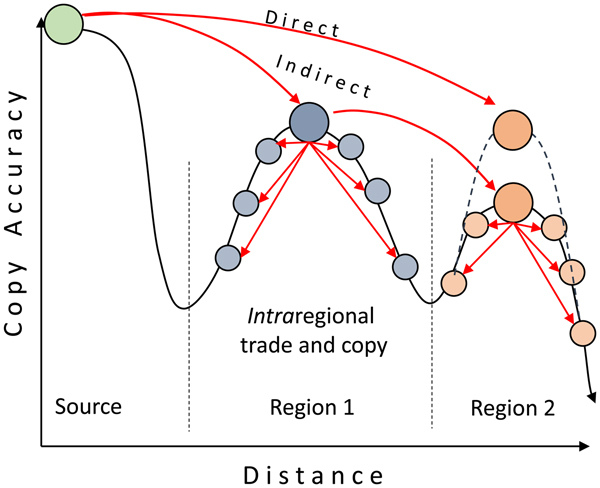
We believe that future aDNA and isotope analyses will reveal patterns of population movement, including long-distance migration, during the early part of this time frame. Given the dearth of such research on the Formative periods, we focus instead on the role of trade and emulation of foreign pottery styles (Figures 1 and 2). The only way to confidently identify trade among regions is through sourcing analysis. Chemical and mineralogical techniques have been used for decades to reveal the choices potters make at each step along the production sequence, particularly the material selection, its properties, and how the potter processes and mixes a paste recipe (Arnold et al. Reference Arnold, Neff and Glascock2000; Eckert et al. Reference Eckert, Schleher and James2015; Stark et al. Reference Stark, Bishop and Miksa2000). These are proximate-level decisions made by the potter as negotiated within the local community of practice. Whether or not the potter applies foreign designs to the local paste recipes is the fundamental negotiation that drives the formation or dissolution of horizons. Further, we expect the compositional analysis to reveal evidence of pottery trade at major nodes of interaction that participate in the horizon's stylistic canons. Conversely, during times of regional style divergence, we would expect to identify few trade wares and little migration. Because vertical transmission of potting knowledge tends to reproduce the previous generation's styles, contrasting the rapid style shifts of horizontal interaction (Guglielmino et al. Reference Guglielmino, Viganotti, Hewlett and Cavalli-Sforza1995), we argue that the slow process of stylistic drift begins long before one can readily see major differences in ceramic styles.
Hypothetical model of the role of trade in spreading style horizons within a region, demonstrating the links among interregional, regional, and local nodes of trade and replication. Disclaimer: reality is much more complicated with two-way interaction, differently positioned agents, and feedback loops influencing the end result. Image by Stoner.

Hypothetical model of the decay of pottery style similarities with distance from the source. The model features pottery trade as the mechanism of sharing across space, with scenarios for both direct trade and indirect copy-and-trade among three hypothetical regions. Disclaimer: reality is much more complicated with two-way interaction and feedback loops influencing the end result. Image by Stoner.

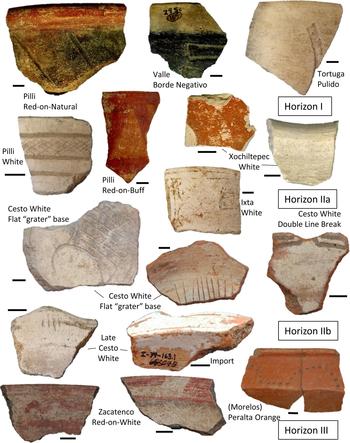
We employ neutron activation analysis (NAA) and petrography on a large sample (n = 1,194) of ceramics that date to the aforementioned horizons (Figure 3). We demonstrate through the remainder of this paper that exchange of ceramics featuring shared styles and motifs was quite common during the Early through early Middle Formative periods. During the Early Formative (Horizon I), trade activity was undertaken mostly over long distances. The focus of early trade, however, was fine-paste serving wares with relatively light paste colors that central Mexican potters could not imitate with local materials or technology of the time. Coarser-paste bowls of darker colors with carved Olmec-style designs were almost all locally produced (see also Blomster et al. Reference Blomster, Neff and Glascock2005:Supplement). Toward the end of the Early Formative and into the first half of the Middle Formative (Horizon IIa), the distance of ceramic trade decreased but may have actually intensified in frequency. By Horizon IIb, the number of trade wares decreased notably in our sample while a greater variety of ceramic types, decorations, and vessel forms appeared in central Mexico, differentiating it from other Mesoamerican regions. This trend accelerates from the second half of the Middle Formative into the Late Formative.
Sample of ceramics in this study arranged generally from early (top) to late (bottom). Bars are 1 cm long and scaled to their associated sherd. Note: These photographs are not meant to represent all typological variability in the region or even in our sample. Photographs by Stoner.

MULTISCALAR COMMUNITIES OF PRACTICE AND MECHANISMS OF HORIZON FORMATION IN CERAMIC MEDIA
Style horizons take form through a rapid process of horizontal cultural transmission that crosscuts local, regional, and interregional scales to form broad-scale communities of practice in the production of pottery (Cochrane Reference Cochrane2004, Reference Cochrane and O'Brien2008; Eckert et al. Reference Eckert, Schleher and James2015; Joyce Reference Joyce, Cordell and Habicht-Mauche2012; Kohring Reference Kohring2011, Reference Kohring, Kienlin and Zimmermann2012; Stark et al. Reference Stark, Bowser, Horne, Stark, Bowser and Horne2008; Willey Reference Willey1991; Worth Reference Worth, Waselkov and Smith2017). Communities of practice are bounded not by geography, but by shared knowledge in the production and reproduction of any cultural activity. All pottery production occurs through an operational sequence negotiated within a local cultural and environmental context (Duistermaat Reference Duistermaat and Hunt2017; Gosselain Reference Gosselain2000; Roux Reference Roux and Hunt2017; Sillar and Tite Reference Sillar and Tite2000). Like the formation of regional dialects within a language, relatively isolated groups develop their own distinctive pottery traditions, producing style zones across space.
With no outside influence, ceramic style is mostly determined through vertical transmission enacted through social learning processes over generations (parent to child, master to student; Eerkens and Lipo Reference Eerkens and Lipo2005; Shennan Reference Shennan, Preucel and Hodder1994). Modes of social learning range from casual observation to hands-on instruction (Crown Reference Crown2014). Depending on the scaffold of direct learning opportunities and instruction in the local community of practice (i.e., the production site), the result of generational transmission may range on a continuum between perfect reproductions of the previous generation's style to subtle change. Potting communities rarely decide to radically change their pottery styles in the absence of some external influence. Variables that determine the resulting appearance of pottery are many (Eerkens and Lipo Reference Eerkens and Lipo2005, Reference Eerkens, Lipo, Stark, Bowser and Horne2008; Gandon et al. Reference Gandon, Roux and Coyle2014). Assuming unbiased transmission, the more information available for each step of the production sequence, the more closely a student replicates the original. Errors in transmission always occur and will produce mutations in the style, but at local potting sites where direct learning opportunities are high, unintentional changes in style reproduction are relatively low. Pottery styles change much more slowly in a community of practice exclusively oriented toward in situ generational transmission than in larger communities that share information across regions.
At the regional scale, such as the Basin of Mexico, frequency of interaction among neighboring production sites lead to a cohesive expression of a regional style. Closely-situated settlements tend to be more socially and geographically accessible to one another than more distant settlements. They are more likely to intermarry, exchange goods, share social/political affiliations, use the same material sources, or simply communicate than groups separated by longer social or geographic distances. Sharing of pottery knowledge at this scale forms a regional community of practice. Assuming only down-the-line interaction (sites interacting only with their nearest neighbors), we would predict an isomorphic pattern of ceramic variability that radiates out from each site equally in all directions. If this were the case in the Basin of Mexico, ceramics from the Teotihuacan Valley might differ considerably in appearance from Tlapacoya in the southeastern Basin. The reality is that Altica in the Teotihuacan Valley displays very close style associations with Manantial and Tetelpan phase pottery at Tlapacoya in the southern Basin. These close stylistic links suggest a more direct mechanism of interaction was in place, and in this paper we highlight possible pottery imports linking the two Basin subregions. At the same time, however, there are different spheres of interaction identified within the Basin of Mexico based on ceramic style variation that form an east-west pattern of style drift (Grove Reference Grove2007; Niederberger Reference Niederberger1976; Patricia Ochoa, personal communication 2018; Ochoa Reference Ochoa Castillo, Carrión and Cook2005; Plunket and Uruñuela Reference Plunket and Uruñuela2012; Ramírez et al. Reference Ramírez, Gámez and González2000).
At the interregional scale, long-distance exchange of pottery or the migration of the potter is essential for horizon formation. Learning a foreign style based on a stored mental image is very difficult. Virtually all information of the production sequence is missing, leading to errors in learning and execution that may compound as they are applied sequentially across space (Eerkens and Lipo Reference Eerkens, Lipo, Stark, Bowser and Horne2008). An imported pot provides an immutable template to be copied by a master potter. While overt style is easily imitated, the deeply internalized mechanical elements of production and material processing during the early stages of the operational sequence are not (Gosselain Reference Gosselain2000). The potter will therefore attempt to impose the foreign style upon their own production sequence, creating some variation due to differing mechanical processes, technology, and use of different materials.
Total and intimate knowledge of the entire production sequence comes only with guided learning and direct instruction over many years (Crown Reference Crown2014). The migration of the potter herself to a new region will create the greatest potential for close replication of foreign pottery styles (Cheetham and Coe Reference Cheetham, Coe, Blomster and Cheetham2017:258). We must, however, use measures independent from ceramic style variability to infer migration (Cochrane Reference Cochrane and O'Brien2008). Some variation is introduced as she adapts to a new set of raw materials and negotiates local cultural preferences. Ceramic ethnoarchaeology has fostered examples of in-marrying potters forced to relearn the operational sequence of the host community (DeBoer Reference DeBoer, Conkey and Hastorf1990; Herbich and Dietler Reference Herbich, Dietler, Stark, Bowser and Horne2008). Such “reprogramming” favors reproduction of the local style and would resist horizon formation. During the Early and Middle Formative, however, biased transmission generated a series of rapid changes when local communities of practice were eager to adopt symbols from the interregional community (Stark Reference Stark, Blomster and Cheetham2017).
During Horizon I, the bias may have been prestige based, in which cooperating elites and political aspirants drew on a new set of foreign iconography and religion, providing a basis to distance themselves from the general population at early settled villages across Mesoamerica (Clark Reference Clark1997; Helms Reference Helms1993; Neff Reference Neff and Martinón-Torres2014; Stark Reference Stark, Blomster and Cheetham2017). We believe this explains the import of fine-paste Xochiltepec White and some Atoyac Fine Gray ware ceramics into central Mexico. Moving these visibly-nonlocal pots over long distances is an element of costly signaling due to the effort involved in obtaining the objects (Neff Reference Neff and Martinón-Torres2014). The coarser-paste carved ceramics and figurines of the types Volcán Pulido, Tortuga Pulido Temprano, Pilli, and Valle Borde Negativo, however, were almost all of local production (this study; Blomster et al. Reference Blomster, Neff and Glascock2005:Supplement). Of the fine-paste imports, Xochiltepec White typically does not bear Olmec carved designs, but Atoyac Fine Gray does. Imports of the latter likely provided the initial design template that was later copied onto the other wares mentioned above. Once they became widely copied into the general regional style repertoire, any prestige they might have had disappeared (Neff Reference Neff and Martinón-Torres2014; Stark Reference Stark, Scarborough and Clark2007). These serving vessels bearing Olmec-style designs occured alongside burials and within households of all statuses at Tlatilco and Coapexco, respectively (Tolstoy Reference Tolstoy and Diehl1989). This pattern strongly suggests to us that Olmec symbols constituted part of the social identity of the people rather than function only as prestige goods used to enhance status differences. Blomster (Reference Blomster1998) and Stark (Reference Stark, Blomster and Cheetham2017) suggest that use of Olmec symbols was part of a pan-Mesoamerican ritual cult. It is entirely possible that possession of carved Olmec pottery served prestige, identity, and ritual functions at different points through time.
If trade alone was the sole source of horizontal transmission, key mechanical links in the production chain would be missing, such as material procurement and processing, forming actions, firing program, and decorative techniques. While overt style may be similar across regions, variation based on adjustments to raw material differences and mechanical techniques to form and finish vessels should become apparent through application of the right mix of archaeological methods. We focus on materials and paste recipe here, but future analyses will look at form and decorative variation across regions. The recent volume The Early Olmec and Mesoamerica: The Material Record (Blomster and Cheetham Reference Blomster and Cheetham2017) sets criteria for comparison. The volume's chapters essentially exemplify different mechanisms of cultural transmission from replication of pottery by San Lorenzo-trained potters in the Soconusco (Cheetham and Coe Reference Cheetham, Coe, Blomster and Cheetham2017), trade of figurines into Tres Zapotes (Pool et al. Reference Pool, Ceballos, del Carmen Rodríguez, Sears, Bishop, Blackman, Blomster and Cheetham2017), and pottery into Etlatongo (Blomster Reference Blomster, Blomster and Cheetham2017), to relatively indirect or possibly independent development of common styles in Honduras (Joyce and Henderson Reference Joyce, Henderson, Blomster and Cheetham2017).
For Horizon II, we argue that the mechanism of horizon formation was primarily imitation of trade wares that circulated among neighboring regions. Horizon II was a time of increased trade intensity for goods, such as greenstone, shell, iron ore, and especially obsidian (Hirth et al. Reference Hirth, Cyphers, Cobean, De León and Glascock2013; Jaime-Riveron Reference Jaime-Riveron2010; Johnson and Hirth Reference Johnson and Hirth2019; Pires-Ferreira Reference Pires-Ferreira1975; Stoner et al. Reference Stoner, Nichols, Alex and Crider2015). Chalcatzingo, located in Morelos just south of the Basin of Mexico, emerged as a gateway center facilitating trade of basic goods and prestige items across Mesoamerica (Charlton Reference Charlton and Hirth1984; Grove Reference Grove1984; Hirth Reference Hirth1978). The Olmec style also generally disappeared from the Basin of Mexico, demonstrating a shift away from the Gulf lowlands for stylistic emulation. Certain Olmec-related legacy traits were inherited through generational transmission, but in general a new style horizon developed in its place. Central Mexico was among the earliest to develop the tradition of white-slipped pottery with double-line-breaks and “grater” motifs. While we do not evaluate export from the Basin in this study, others have noted central Mexican imports in Tehuacán and Oaxaca (Flannery and Marcus Reference Flannery and Marcus1994; MacNeish et al. Reference MacNeish, Peterson and Flannery1970). We demonstrate below that import of white-ware pottery was common in central Mexico during Horizon IIa, but took place over a more restricted geographic range than exchange of Horizon I pottery.
Contrasting trade and migration, simple down-the-line communication is the least efficient mode of cultural information exchange over long distances. The process of regional divergence in material culture styles accelerates when social learning takes place over generations at the local scale without continuous exchange of cultural information across regions. Without that horizontal link across space, cultures will drift the way language does in the formation of regional dialects. The beginning of this process is visible during our Horizon IIb with greater regional style variation among white wares and a decreased level of pottery trade exemplified in this study.
The following Horizon III identified by Rosenswig (Reference Rosenswig2010) connects to central Mexico in a marginal way and mostly to the south of the Basin of Mexico in Morelos (Cyphers Reference Cyphers and Grove1987, Reference Cyphers, Carrión and Cook2005). By about 700 cal b.c., a broad macroregional division appears to separate highlands from coastal lowlands with subregional variants within each. The marked regional cultural distinctions that appear in the Late Formative are the result of a process of style drift that begins centuries earlier in Horizon IIb.
Finally, the link among interregional, regional, and local communities of practice develops in cycles. Horizontal transmission through trade or migration potentially causes rapid change in the local ceramic repertoire, depending on how the local potting community evaluates incoming messages. As interregional interaction becomes more restricted, the slow change of in situ vertical transmission takes over inheritance of the ceramic production sequence. The resultant disconnected regions slowly change along disparate trajectories, producing the effect of cultural divergence at the interregional scale. This expansion/contraction pattern of horizontal integration/regionalization repeats as new biases that affect local communities of practice surface every few centuries in Mesoamerica (Marcus 1998).
THE ROLE OF COMPOSITIONAL SOURCING IN STUDYING HORIZONS
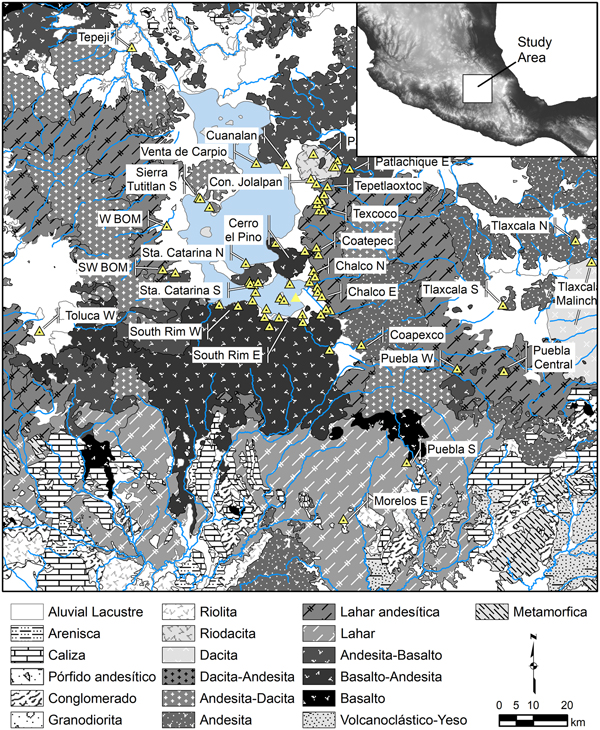
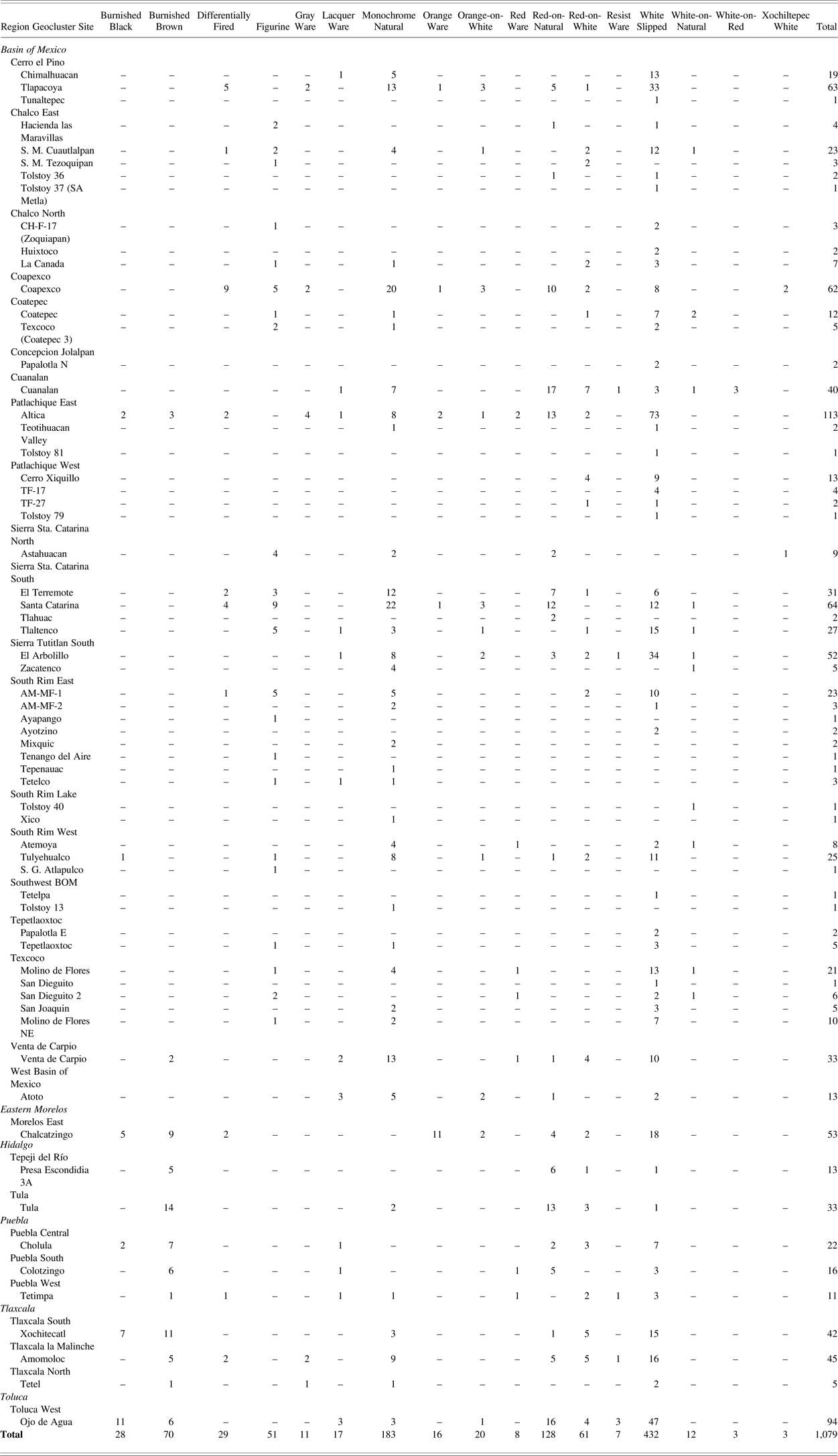
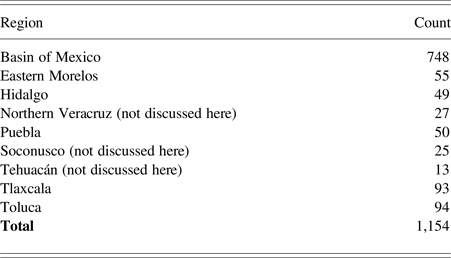
The Basin of Mexico has lacked compositional reference data for the region's earliest ceramics. Paste recipes changed significantly from the Formative through the Epiclassic and Postclassic (Stoner Reference Stoner2016), when most pottery that has been analyzed for the region dates to (Brumfiel and Hodge Reference Brumfiel, Hodge, Mastache, Parsons, Santley and Puche1996; Crider Reference Crider2011; Garraty Reference Garraty2006; Hodge et al. Reference Hodge, Blackman, Minc, Neff and Neff1992; Nichols et al. Reference Nichols, Brumfiel, Neff, Hodge, Charlton and Glascock2002, Reference Nichols, Elson, Cecil, Neivens de Estrada, Glascock and Mikkelsen2009, Reference Nichols, Neff and Cowgill2013). To rectify these issues, we collected and analyzed a large sample of Early and Middle Formative ceramics from central Mexico (Figure 4; Table 1). We also opportunistically sampled reference materials of similar ceramic types from regions farther away, including coastal Chiapas, northern Veracruz, and Tehuacán (Table 2).
Map showing the locations of sampled geoclusters with a geological basemap (courtesy of Servicio Geológico Mexicano).

The current sample (excluding regions outside central Mexico), showing sample numbers, locations, and ceramic type.

Broader sample by region of archaeological recovery.

At the heart of the analysis is the comparison of interregional styles to location of production. Most of the ceramics sampled in this study display the pan-Mesoamerican styles for each corresponding horizon. While almost all Mesoamerican communities produced most of their own ceramics, local copying of a pan-Mesoamerican style is the fundamental process through which horizons form. We expect higher percentages of pottery imports during peak horizon phases. Conversely, a high percentage of local copies combined with very low percentage of imports signals that the horizontal bridge has given way to in situ vertical transmission of pottery knowledge, which initiates the long process of cultural divergence at the interregional scale. This divergence may not appear in the archaeological record for many generations after long-distance interaction declines.
NAA was undertaken at the University of Missouri Research Reactor (MURR) following their standard procedures (Glascock Reference Glascock and Neff1992; Neff Reference Neff, Ciliberto and Spoto2000). Petrographic thin sections were prepared both by National Petrographic and by the lead author at the University of Arkansas Thin Section Lab. All thin-section petrography was performed by the lead author and is still underway. Qualitative petrographic results are presented here as an interpretive tool to understand and explain the chemical variation in the sample (Stoner Reference Stoner2016).
We interpret the data based on a multiscalar analysis that maps onto the discussion of multiscalar communities of practice above. To highlight subregional variation within central Mexico, we build groups from the bottom (local) up. Sites are grouped into geoclusters using geological information from the Servício Geológico Mexicano. Geoclusters are contiguous subregions with a common geological context that should result in similar ceramic composition. These are most akin to local communities of practice that may contain many neighboring sites of production which likely overlap in their resource procurement catchments. The compositional profiles of ceramics for those clusters are then explored using frequency distributions and elemental plots within each cluster. A normal distribution with a single mode likely indicates that potters within the geocluster had a single paste recipe with random variation about the mean. Multimodal elemental distributions may either indicate that multiple local paste recipes were employed by potters within that geological cluster or there may be a prevalence of imported ceramics. Our sample from Altica, for example, is trimodal. We have demonstrated that one non-local mode is due to a high percentage of white wares imported from outside the region (Stoner et al. Reference Stoner, Nichols, Alex and Crider2015). The other non-local mode we identify here is likely imported from the southeastern Basin of Mexico (see section Regional Scale Interaction). Outliers, isolated specimens with a chemistry that is outside the normal range for the geological cluster (i.e., low-frequency import), are easily isolated using this procedure. Skewed distributions with a single mode and an elongated tail in either the positive or negative direction likely reflect local variance in production recipe or post-depositional chemical alteration. All outliers and divergent modes are separated for further analysis.
We eschew the practice of employing the “typical” paste recipe for each subregion as a reference group to differentiate local production from import. That approach tends to treat all divergent recipes as imports. We allow for several local paste recipes within each geocluster, which credits local potters with agency to select different materials within a reasonable catchment (<7 km; Arnold Reference Arnold1985) and mix clays and temper in different proportions. This bottom-up approach characterizes the variability within each geocluster and looks for explanations for each paste recipe within the local environment or according to vessel function or ceramic type. When all plausible cases for local production are exhausted, we marked those ceramics as non-local (meaning produced outside the geocluster) and search the broader database for a source.
PASTE RECIPE VARIATION ACROSS CENTRAL MEXICO
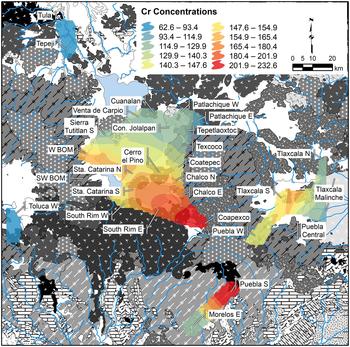
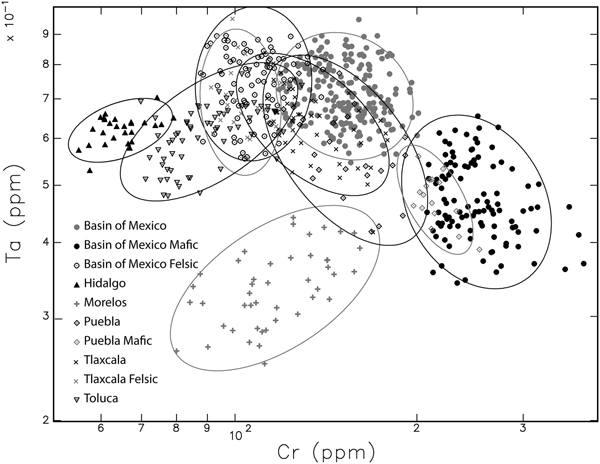
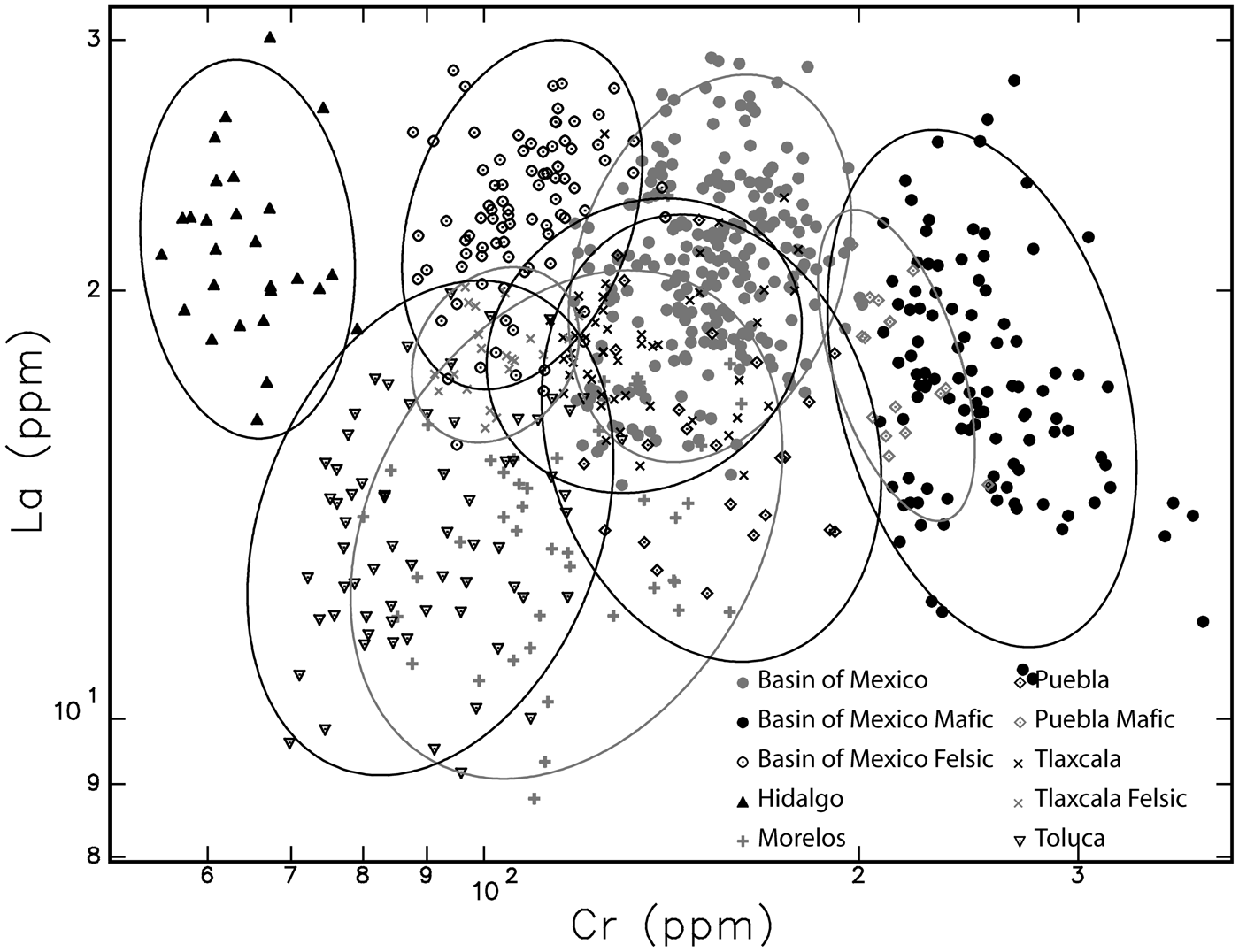
Figure 5 depicts chromium variation across space. This is one of the most useful elements in the region, as it is more highly concentrated in the more mafic rocks and less concentrated in felsic rocks. Despite the clean appearance of this map, there is tremendous overlap in the regional ceramic chemistry, which is apparent in Figures 6 and 7. We could groom these data to allow complete separation of “source groups”; to do so, however, may lead to an overly simplistic notion of ceramic production. Chemical overlap represents an inconvenience for sourcing, but is the reality of messy data and human strategies of resource procurement. In other words, it is part of the community of practice featured in this paper.
Chromium (Cr) distribution interpolated across the sample area using a large neighborhood of 14 km (courtesy of Servicio Geológico Mexicano).

Scatterplot of chromium and tantalum, showing a coarse clustering of sampled regions. Ellipses represent 90 percent confidence in membership within the regional compositional group, but these are not “reference groups” used for source assignments. Image by Stoner.

Scatterplot of chromium and lanthanum showing a coarse clustering of sampled regions. Ellipses represent 90 percent confidence in membership within the regional compositional group, but these are not “reference groups” used for source assignments. Image by Stoner.

Most of the sample comes from volcanic terranes, ranging from felsic to mafic in composition. Felsic rocks, like rhyolite and dacite, possess more quartz and sodium-rich feldspars and typically have lower transition metal concentrations (e.g., chromium, cobalt, scandium, iron, manganese, and titanium) but are elevated in alkali metals (e.g., potassium, sodium, cesium, and rubidium). Mafic rocks, like basalts and andesitic basalts, are typically high in light transition metals that are found in volcanic glass and pyroxene and olivine minerals. Intermediate composition rocks, like andesite, contain high proportions of plagioclase feldspar, amphibole, and biotite.
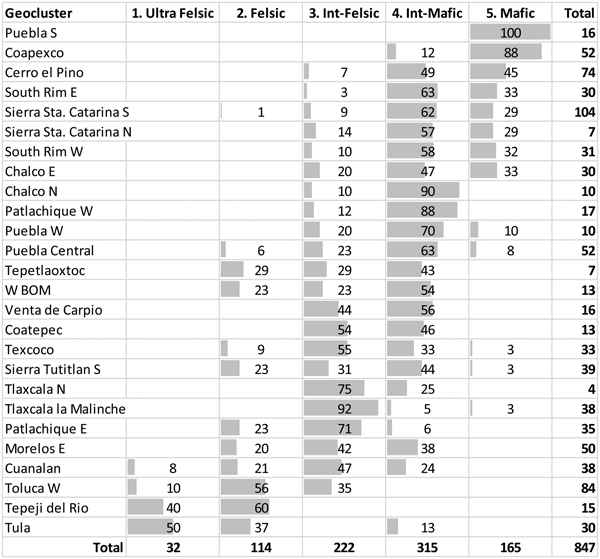
The Basin of Mexico as a whole displays the greatest range of ceramic chemistry in the sample. This is partly due to the size of the sample and its geographic coverage relative to other regions, but the full range of volcanic rock compositions, from felsic to mafic, are found there (Figure 8). Ceramics from the north generally fall within the felsic end of the compositional range, especially the Teotihuacan Valley. We emphasize, however, that relatively mafic rocks bound the valley to the north and east. The felsic composition of ceramics in the region likely derives from weathered rhyodacite in the western Patlachique Range. The southeastern portion of the Basin of Mexico is among the most mafic (basalt and andesitic basalts), which translates to high concentrations of the light transition metals, especially chromium and cobalt. Heavier transition metals of hafnium and tantalum, and the actinide thorium display the inverse geospatial correlation to the lighter transition metals. The mineral assemblages of these basalts and basaltic andesites include greater abundances of pyroxene and olivine (Stoner Reference Stoner2016). The areas with the highest average transition metal concentrations are Coapexco in the mountains of the southeast Basin and Colotzingo just outside the Basin to the southeast.
Division of sampled geoclusters based on the compositional continuum between felsic to mafic. Numbers in the chart body represent percent of the whole sample for that geocluster. Imports are excluded from this chart. Chart by Stoner.

The increase in mafic-composition rocks continues to the south into Morelos, but not in eastern Morelos where Chalcatzingo is located. Chalcatzingo is situated near a broad field of lahar that derives from the andesitic basalts to the north, but the site is nestled within an intrusive andesitic porphyry and there are rhyolite (felsic) outcrops a short distance to the east. Chalcatzingo ceramics are thus low in transition metal concentration as the ceramics contain among the highest frequencies of quartz (SiO2) minerals observed in thin section. High silicon concentration from quartz dilutes the concentrations of other elements. One way to measure this is to sum all 33 elements produced via NAA at MURR. Relatively low sums are likely higher in silicon, a primary component of quartz that is not routinely measured via NAA.
Ceramics from the Toluca and Tula regions display the lowest transition metal concentrations, owing to the relatively felsic materials used in pottery production there. The Tula region ceramics possess high concentrations of rare earth elements and sodium and potassium, suggesting that felsic materials were used to produce those ceramics. Thin sections reinforce this interpretation through the presence of large quartz grains, plagioclase, biotite, and some potassium-feldspar. Even more important is the absence of pyroxene and olivine, and only rare inclusions of amphibole. Toluca ceramics, however, typically display low-to-average composition in most elements. Similar to eastern Morelos, a low sum of the 33 elements measured by NAA suggests high concentration of silicon from large quartz grains.
The central Puebla and Tlaxcala subregions also show relatively felsic compositions, particularly those close to Cerro Malinche, which marks the border between the two states. Cholula and Xochitécatl, though, are more in the intermediate compositional range for volcanic materials. While ceramic chemistry from the Basin of Mexico, Tlaxcala, and central Puebla overlap greatly, lanthanum, samarium, and cerium serve to tease them apart with concentrations from high to low in the order listed above.
This cursory overview displays a two-dimensional picture of compositional variability among the sampled sites. In truth, the ceramic compositional profiles of each site are greatly variable. Most geoclusters display more than one paste recipe for making ceramics, which may result from potters within the local community of practice choosing different material sources, mixing temper at varying ratios to clay, or import of a significant portion of consumed ceramics. In total, we identified 95 paste recipes divided among 29 geoclusters.
MULTIPLICITY OF LOCAL POTTING RECIPES
Most geoclusters yielded multiple recipes for making pottery for reasons that range from availability of multiple different materials within proximity to the site or mixing clay and temper differently. We cannot detail all the production variability at each geocluster here, so we highlight specific cases that demonstrate alternative behavioral approaches to making pottery within the local communities of practice.
First, most figurines possess lower transition metal concentrations than ceramics from the same site. Stoner (Reference Stoner2016) has previously demonstrated that the rock fragments and volcanic ash used to temper pottery in the Basin of Mexico tend to contain higher concentrations of transition metals than the clay matrix. The logical conclusion is that potters are not tempering clays used to make figurines. Because of the reluctance to damage figurine heads, we have only one thin section of the figurines in the sample. PTO244 is a Type C figurine with an aplastic fraction mostly in the silt to very-fine-sand range on the Wentworth scale. Though not a coarse texture in terms of grain sizes, the aplastic fraction does make up about 15–20 percent of the fabric. This is low compared to pottery, which often displays a modal aplastic fraction around 40 percent or more relative to the clay fraction (Stoner Reference Stoner2016). This specimen was recovered in the Eastern South Rim geocluster that is dominated by paste recipes of the mafic composition, but this particular specimen displays bulk chemistry more like ceramics found further north. Rather than interpret this as exchange, we assert that figurines were typically made with untempered silty clays, which contrasts with the coarse-paste operational sequence applied to pottery. There are no utilitarian reasons for figurines to be heavily tempered, in fact the large rock fragments interfere with modeling the intricate facial features. Among the pottery, jars and serving wares are not reliably different in their composition, as they are during later time periods (Stoner Reference Stoner2016). Basin potters had not yet mastered technologies later employed to make the bright colors and compact fine-paste of Postclassic serving bowls.
Second, some geoclusters reveal alternate resource procurement practices at the same site. This could reflect multiple potters with different preferred material sources, change of resource selection over time, or possibly import. Perhaps the best example of local material procurement variability is the Tula sample. Ceramics from excavations in the central historic district of Tula and from Presa Escondida further south around Tepexi del Río are among the most felsic in composition in the sample (Luis M. Gamboa, personal communication 2015). Thin sections show that they are heavily tempered (some more than 50 percent) primarily with quartz and feldspar grains between 0.5–2 millimeters in size. Biotite is common, but amphibole is rare and pyroxene and olivine are absent. Presa Escondida is most directly proximate to andesitic dacites (intermediate-felsic), but the Tula ceramics were recovered equidistant between outcrops of felsic rhyolite (Cerro Grande) and mafic basalt (Cerro Mogoni). While the Tula ceramics mostly reflect a rhyolitic composition, six specimens are of a more mafic composition with mineral assemblages in thin section that are basically identical to ceramics made in the southeastern Basin of Mexico. Given the close proximity of the site to both rhyolite and basalt, we conclude that these paste recipes represent different local resource procurement strategies employed by potters in the same community, rather than import from outside.
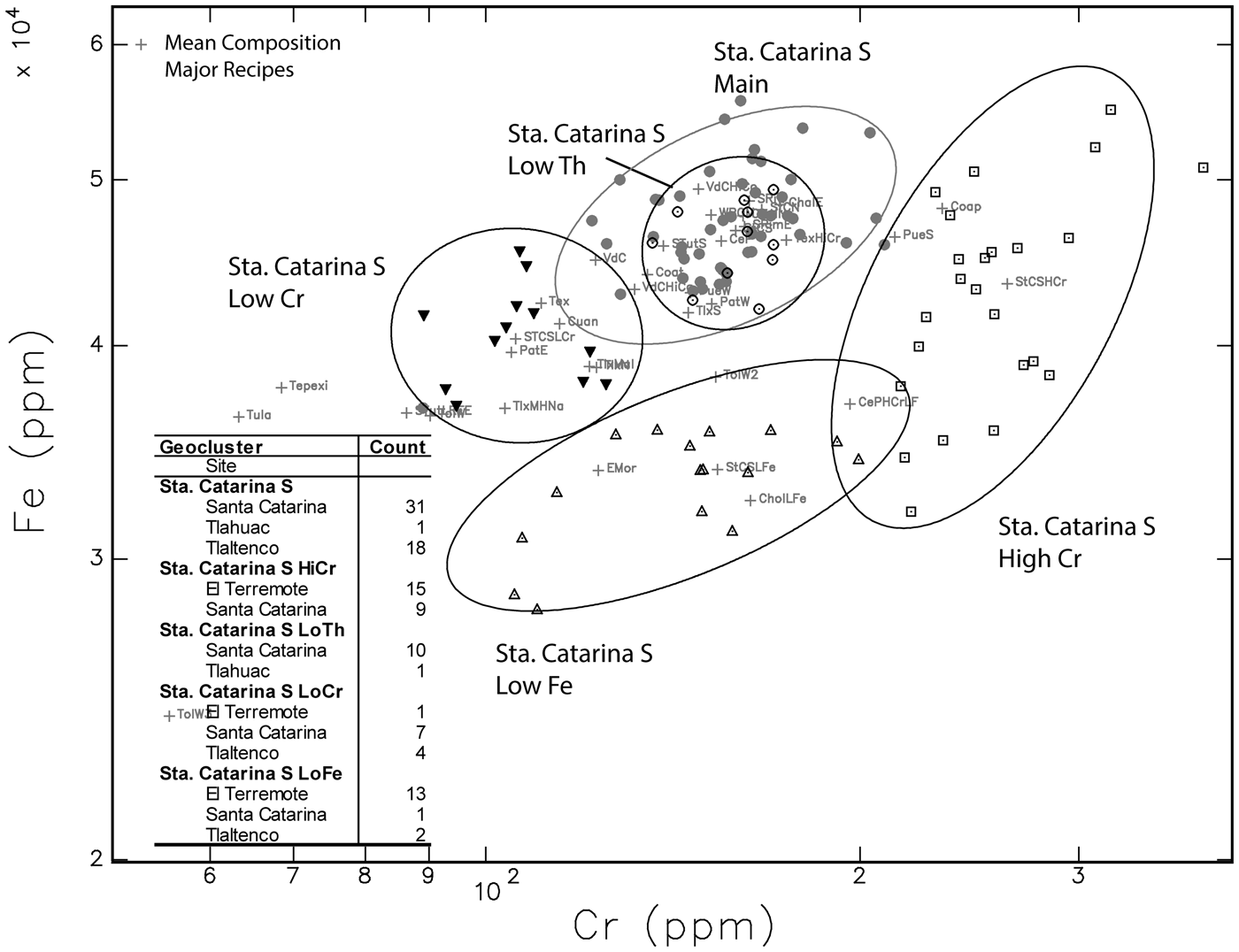
Our third example involves the Sierra de Santa Catarina South geocluster, which contains five sites grouped over a small area. The sierra is dominated by basaltic andesites with andesitic basalt located just south of the lake and to the east at Cerro el Pino. This geocluster displays among the most variable paste recipes in the sample (Figure 9). Neither vessel form nor vessel type explains the variation, but there are multiple modes both within and between sites. The site of Santa Catarina possesses all sub-recipes, but the high-chromium and low-iron recipes are minorities. Those same paste recipes are the most common ones appearing at El Terremote located 2 km to the west. Conversely, El Terremote does not possess the dominant paste recipe of the geocluster. It is tempting to suggest that El Terremote produced the low-iron recipe and traded it in minor quantities to both Santa Catarina and Tlatenco. Confounding this potential interpretation is that all sites would have had direct access to the same resources due to their proximity (Arnold Reference Arnold1985).
Scatter plot of chromium and iron showing the separation of ceramics from the Sierra de Santa Catarina South geocluster into sub-recipes. Image by Stoner.

REGIONAL SCALE INTERACTION
As exemplified by the variation in paste recipes at the local scale, determining intraregional exchange can be tenuous. We present here those samples that appear non-local even after thorough evaluation as to whether they were plausibly made from locally available materials (Table 4). We identify 45 specimens that most clearly represent exchange within the sampled region.
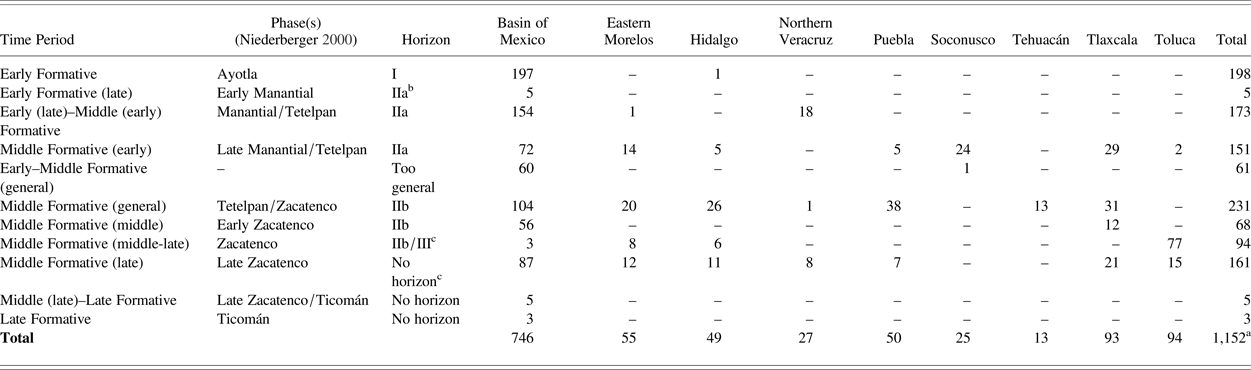
Current sample sorted by time period. Excavated ceramics are dated by stratigraphic position and absolute dates, if available. Surface ceramics are placed in time based on stylistic markers, but often are assigned to general categories such as Early–Middle Formative (general).

a Two samples were not remotely datable.
b We see Horizon II, as defined by white-ware ceramics with double-line-break incision, start much earlier and last a lot longer in central Mexico than most other regions of Mesoamerica.
c This is towards the end of Rosenswig's (Reference Rosenswig2010) Horizon III, but we sampled only a minority of wares that actively participate in the horizon (Peralta Orange from Chalcatzingo and Lacquer Ware from a few sites). Central Mexico experiences a continuation of white-slipped wares during this time period, which are rapidly disappearing from assemblages in other regions of Mesoamerica. Continuation of white-wares late in this sequence while it disappears elsewhere is part of the trend of regional divergence at the interregional scale.
Tabulation of ceramic specimens that circulated through intraregional exchanges. Types are simplified. All forms are bowls or dishes. No jars are among the imports.

Only three geoclusters demonstrate more than a few imports. The first is the southern exposure of the Guadalupe Range of the Sierra Tutitlan geocluster at the site of El Arbolillo. Multiple white-slipped incised bowls with a production source in the southeastern Basin of Mexico were recovered by Tolstoy's excavations there, including two bowls with “Olmecoid” decoration: both are carved through a heavy white slip, and one features “music brackets.” Interestingly, these ceramics date after the general decline of Olmec style in the Basin and appear to be legacy expressions.
Altica is the second site to demonstrate relatively high levels of economic import from sites within the region; however, this interpretation needs caution. Altica possesses a chemically distinct mode of relatively mafic-composition ceramics that differs from the dominant felsic paste recipe made there. Tantalum and chromium provide a clean separation of local Altica ceramics from 13 specimens that chemically match the southeastern Basin of Mexico, specifically ceramics from Tlapacoya. The high barium content, an element notorious for post-depositional chemical alteration (Golitko et al. Reference Golitko, Dudgeon, Neff and Terrell2012), of these ceramics is the only condition that prevents secure assignment to the southeastern Basin groups. All ceramics from Altica (excluding the clear interregional imports discussed below), possess high barium levels. Laser ablation inductively coupled plasma mass spectrometry scans spanning the cross-sections of these chemically atypical ceramics found at Altica show concentrations of barium at the surfaces, suggesting postdepositional uptake of the element. We therefore argue that those 13 specimens were made in the southeast Basin of Mexico and imported into Altica, but this is a hypothesis that we continue to evaluate.
The third site deemed to have possessed a relatively high proportion of regional imports is the ojo de agua (natural spring) near San Antonio la Isla, Toluca (Sugiura Reference Sugiura2005). This is a ritual site in which thousands of well-made, decorated bowls were deposited into the spring as offerings. Offerings into natural springs were not uncommon during the Formative period in Mesoamerica (see Rodríguez and Ortíz Ceballos Reference Rodríguez, Ceballos, Stark and Arnold III1997), and such a ritual site may have drawn regional pilgrimages from around the Toluca Valley.
One subregion was more influential for exportin g ceramics than the others: the southeast Basin of Mexico. This subregion accounts for production of 58 percent of all trade pots found outside their geocluster of production but within the sampled area of central Mexico. Tlapacoya/Zohapilco and Coapexco are both important sites situated within this segment of the Basin, but the latter was likely abandoned by the time most of these trade wares were produced (Tolstoy et al. Reference Tolstoy, Fish, Boksenbaum, Vaughn and Smith1977). Tlapacoya is among the earliest and probably the largest site in the region. It therefore follows that it might have been a center of ceramic innovation, whether through foreign adoption or local invention, and disseminated this knowledge at least partly through regional pottery exchange. Tlapacoya might have traded ceramics to Altica in order to secure access to Otumba obsidian nodules (Healan Reference Healan2019; Johnson and Hirth Reference Johnson and Hirth2019).
The sample is sufficient to suggest that regional ceramics trade fostered the intraregional spread of interregional styles throughout the Basin. This regional adoption of horizon ceramics initiated with the largest and most active exchange nodes, such as Tlapacoya. Regional exchanges subsequently bridge the pan-Mesoamerican styles to local communities of practice within the Basin of Mexico, which otherwise may not have been directly linked to foreign regions.
INTERREGIONAL SCALE INTERACTION
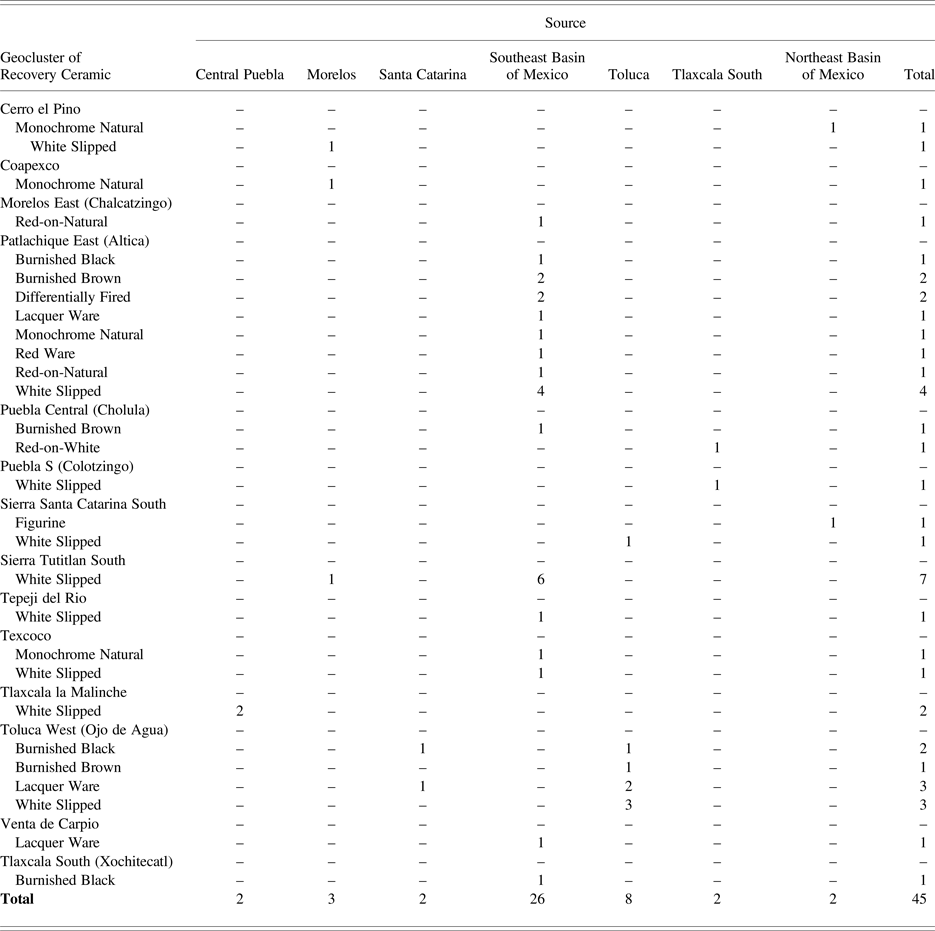
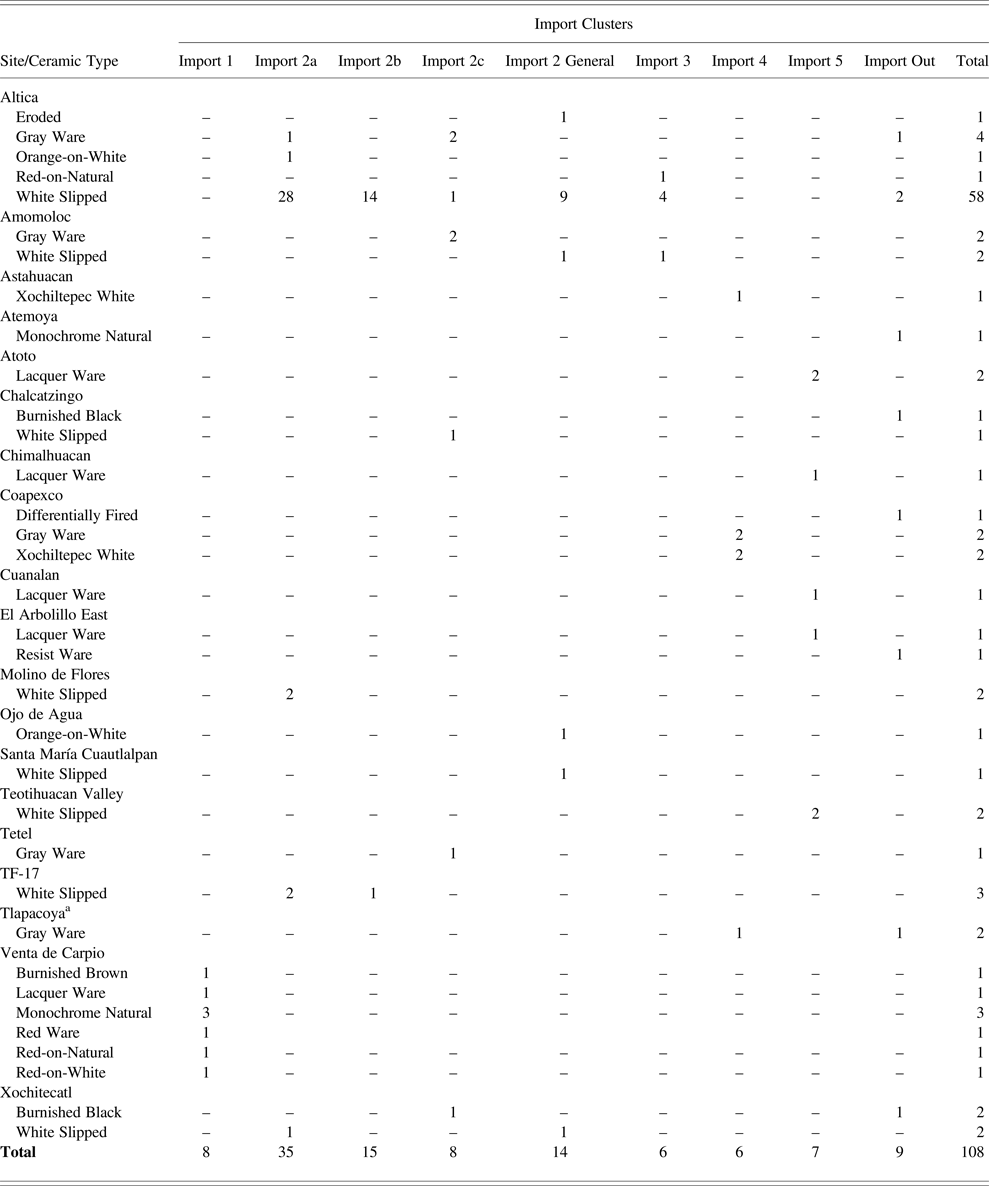
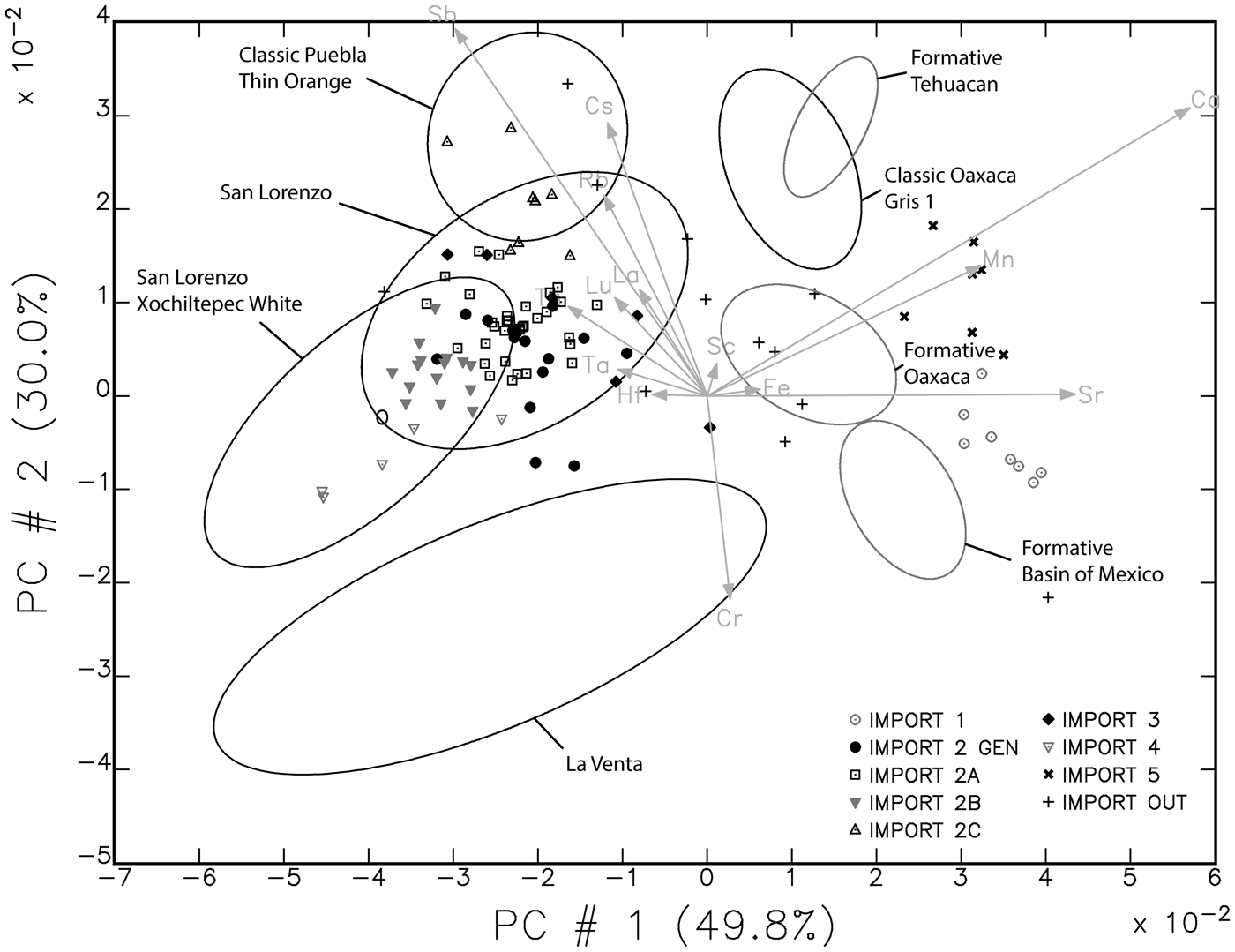
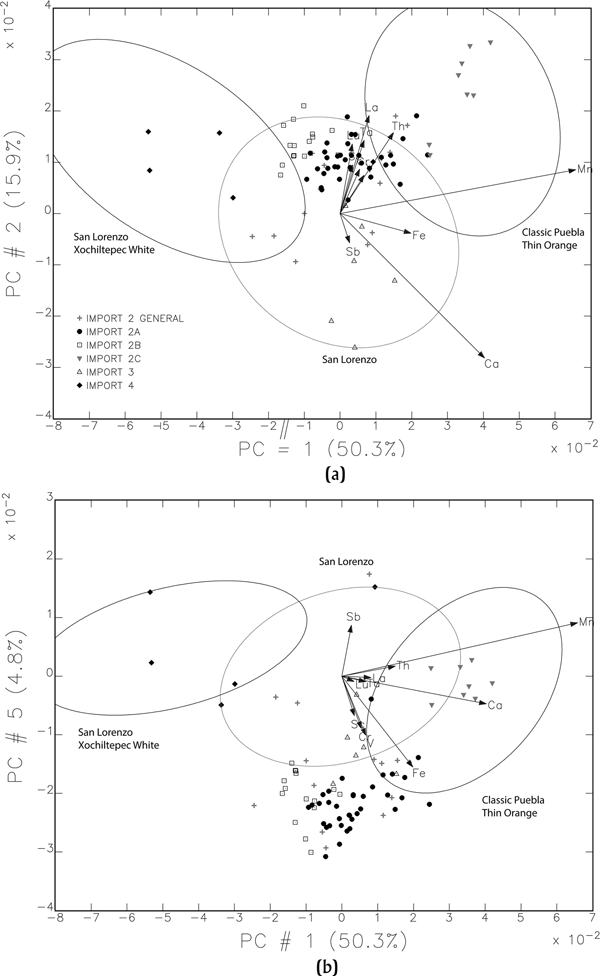
We cluster imported specimens into groups that each represent a single geographic source of production (Table 5). To obtain an initial idea of the production source for each group of imports, we conduct a Euclidean distance search with reference to the entire MURR dataset (with the current sample removed). The second stage of source assignment is comparison to regional reference data in bivariate scatterplots, cluster analysis (to see with what samples the imports cluster), and petrographic mineral inventories compared to basic geological information (Figures 10 and 11).
Tabulation of ceramics that circulated through interregional exchanges (outside the sampled area).

aBlomster et al. (Reference Blomster, Neff and Glascock2005) identify another 16 ceramics recovered at Tlapacoya that they attribute to import from San Lorenzo on the Gulf Coast and many more that are left unassigned that may be non-local.
Scatterplot of imported ceramic clusters on Principal Components 1 and 2. Comparison to regions mentioned in the text. For the sake of clarity, regions with no relation to the sample were removed. Image by Stoner.

Scatterplot of imported ceramic clusters on Principal Components (a) 1 and 2 and (b) 1 and 5. Comparison to regions that have some possibility of being the source region for Imports 2–4. Images by Stoner.

Despite a sampling bias that intentionally targeted clear interregional imports, Altica displays a rather high percentage of imports. At least seven percent of all excavated white-slipped ceramics were imported from outside the Basin of Mexico (34/482; another three white-ware sherds were imported from the southeastern Basin, likely Tlapacoya). This ratio of imports to local products would not be considered high in a commercialized economy, but for an Early–Middle Formative village it is notably higher than we expected. It indicates that Altica was well-connected though both regional and interregional exchange systems and that potters there may have learned how to produce white-slipped ceramics and other wares from other peoples in the broader community of practice. If Alticans had already mastered white-ware production, it makes little sense in terms of economy, prestige, or costly signaling to trade for ceramics that are visually similar to local products (Neff Reference Neff and Martinón-Torres2014). Altica may represent a rare glimpse into local processes responsible for the genesis of early style horizons writ large. Tlapacoya, with the addition of samples collected by Herrera (Herrera et al. Reference Herrera, Neff and Glascock1999) and Blomster (Blomster et al. Reference Blomster, Neff and Glascock2005; Niederberger Reference Niederberger1976), is another site that displays a high number of extra-regional imports.
Import 1 (Possible Local Production with Calcium Contamination at Venta de Carpio)
Import 1, recovered only from Sanders's (Sanders et al. Reference Sanders, West, Fletcher and Marino1975) collection from the site Venta de Carpio, exhibits about double the calcium concentration of any other production recipe in the sample. If one removes calcium from the analysis, this cluster fits well within the Basin of Mexico composition. Calcium can become elevated after deposition through a variety of ways, which may be easy to evaluate through thin sections and targeted chemical analysis of the ceramic cross section (Golitko et al. Reference Golitko, Dudgeon, Neff and Terrell2012). None of those data currently exist, so we provisionally maintain an “import” designation for this cluster of ceramics.
Imports 2 and 3 (Southwestern Puebla)
Unlike Import 1, the remainder of the import groups are all unambiguously produced outside the sampled region. Import 2a and 2b are subgroups that differ only in that the latter is slightly lower in calcium, cobalt, manganese, and strontium but higher in iron. Import 2 General are outliers of Import 2a. Import 2c is chemically similar to the others but with slightly higher concentrations of rare earth elements, manganese, cobalt, and hafnium and slightly lower concentrations of chromium, vanadium, and zinc. We treat all three subgroups of Import 2 and Import 3 as having the same general production source, likely in southwestern Puebla, and discuss them together to reduce redundancy.
There is no precise match for Import 2/3 (as a whole) in the MURR database. The closest reference group among Formative-period ceramics is San Lorenzo, the early Olmec capital in the southern Gulf lowlands, but Import 2/3 possesses higher chromium, scandium, and vanadium (Figure 11b). Furthermore, thin sections reveal metamorphic minerals in the fabric along with volcanoclastic rock fragments and volcanic ash, suggesting that the materials come from a diverse geological terrain (Stoner Reference Stoner2016; Stoner et al. Reference Stoner, Nichols, Alex and Crider2015).
Stoner and colleagues (Reference Stoner, Nichols, Alex and Crider2015) hypothesized that, based on the chemical similarity to San Lorenzo and the diversity of minerals seen in thin section, the southern Gulf Coast was the source of production, but closer to the Sierra Madre Oriental where that diversity of rock types occur. The large “source” polygon we drew included the eastern metamorphic region of Oaxaca, but all the Import 2 and 3 ceramics are chemically very different from either the Gris-1 group of Late Formative Gray wares in the Valley of Oaxaca or the Early and Middle Formative ceramics sampled from San José Mogote (Figure 10; Herrera et al. Reference Herrera, Neff and Glascock1999). At the time, we also posited a second source region in the metamorphic terranes of Puebla and a third less likely source in metamorphic areas of Guerrero.
As part of the current sample, we obtained from James Neely a small sample of Formative ceramics from the Tehuacán Valley of Puebla, a region that can now be ruled out as a source due to chemical dissimilarity to the imports (Figure 11). That leaves the metamorphic region of southwestern Puebla as the most likely source. Most of the subgroups discussed in this section best match the chemistry of Classic Thin Orange ceramics produced in that region (Rattray Reference Rattray1990; Rattray and Harbottle Reference Rattray, Harbottle and Neff1992). We tentatively identify the Tepexi de Rodríguez region of southwest Puebla as the source of Import 2 and Import 3 groups, with the subtle chemical and mineralogical variation seen among the ceramics resulting from variable resource procurement strategies within that geologically diverse terrane.
The most significant Early–Middle Formative site in the metamorphic region of southwestern Puebla is Las Bocas. Las Bocas has been identified as the producer of some of the most fantastic Early–Middle Formative ceramics discovered (Benson and de la Fuente Reference Benson and de la Fuente1996; Guthrie and Benson Reference Guthrie and Benson1995), but most of those ceramics have been donated or purchased from looters who might have generalized (or falsified) their provenance. Paillés Hernández (Reference Paillés Hernández2007, Reference Paillés Hernández2008) excavated there, confirming the presence of early ceramics, but the site was badly looted by pot hunters looking for “Olmec” vessels. Some ceramic types identified there display similar pink-to-orange paste colors with light gray cores that we see among the imported ceramics at Altica and other sites. We were unsuccessful in obtaining a sample of ceramics from Las Bocas and, until we do so, we must maintain this as a tentative source designation. Las Bocas (or southwest Puebla in general) has been identified as the probable source of Del Prado Pink and other ceramics at Chalcatzingo (Cyphers Reference Cyphers and Grove1987).
Ceramics of all the subvariants of Import 2 and Import 3 are present mostly at Altica, but also at TF-17 in the Teotihuacan Valley, Molino de Flores, and Santa María Cuauhtlalpan collected by Tolstoy in the Texcoco region (Tolstoy et al. Reference Tolstoy, Fish, Boksenbaum, Vaughn and Smith1977), and Amomolac (Lesure Reference Lesure2014) and Xochitécatl (Serra Puche et al. Reference Puche, Carmen, Arce and Mendoza2004) in Tlaxcala. It appears as though one arc of interaction might have traveled north into Puebla/Tlaxcala and then entered into the Basin through the Teotihuacan Corridor (Charlton Reference Charlton1978a, Reference Charlton1978b). Altica was the focus of this trade, though we again caution the reader of our sampling bias toward trade wares there. The three ceramics of this composition found in the Texcoco region could have been traded south from Altica. The one at Chalcatzingo, Morelos was likely directly imported along with others identified by Cyphers (Reference Cyphers and Grove1987). None of our Tlapacoya sample nor that made by Herrera and colleagues (Reference Herrera, Neff and Glascock1999) chemically resemble our Import 2 or 3 groups.
We have other evidence that potentially links Altica to southwestern Puebla. Burial 2 at Altica, a young male who was apparently killed and discarded into a cylindrical pit in a disgraceful position (Storey et al. Reference Storey, Buckley and Kennett2019), has non-local strontium isotopes values for the Teotihuacan baseline that are more in line with Las Bocas and the broader Tepexi de Rodríguez region (Price et al. Reference Price, Burton, Fullagar, Wright and Buikstra2008; Schaaf et al. Reference Schaaf, Solís, Manzanilla, Hernández, Lailson, Horn and Manzanilla2015:Figure XXII.9; Storey et al. Reference Storey, Buckley and Kennett2019). Strontium isotopes of Altica white-ware imports display a similar range of ratios (Alex et al. Reference Alex, Nichols and Glascock2012). That the majority of imported ceramics found at Altica were likely produced in the same region as one of four human burials found at the site potentially indicates a sustained period of interactions.
Import 4 (San Lorenzo Region)
Ceramics of Import 4 chemically resemble fine-paste ceramics and raw clays in the San Lorenzo region of the southern Gulf Coast. Unfortunately, we do not yet have thin sections of these ceramics. All the ceramics in Import 4 are of a very fine paste (three Atoyac Fine Gray and three Xochiltepec White), so chemical matches that we see to raw clays in the San Lorenzo region make sense. Kaolin clay, which is used to make Xochiltepec White, is found in many places in Mesoamerica, but has not yet been definitively identified in the central Mexican highlands. Grove (Reference Grove and Grove1987) speaks of a rumored kaolin exposure in Morelos (with Cerro de Caolín marking it on the map), but he was unable to visit the source. The three Xochiltepec White sherds in our database chemically match those of the same type at San Lorenzo (Herrera et al. Reference Herrera, Neff and Glascock1999). Flannery and Marcus (Reference Flannery and Marcus1994:262–263) think Atoyac Fine Gray found at Tlapacoya (Niederberger Reference Niederberger1976:Appendix A) is a Oaxaca import based on thin-section analysis and similarity to Delfina Fine Gray. None of the Atoyac Fine Gray in our sample is remotely similar to the chemistry of available Formative reference materials from Oaxaca (see Figure 10), but some of those in Herrera's Tlapacoya sample display a different chemistry than ours (Blomster et al. Reference Blomster, Neff and Glascock2005; Herrera et al. Reference Herrera, Neff and Glascock1999).
All six of the San Lorenzo region imports were recovered by Tolstoy from sites in the southern Basin of Mexico at Coapexco, Tlapacoya, and Astahuacan. Add to this number 16 San Lorenzo region imports previously identified at Tlapacoya by Blomster et al. (Reference Blomster, Neff and Glascock2005). We note, however, that among Blomster's sample from Tlapacoya almost all of the imports are of the visibly non-local fine-paste white and gray ceramics. By contrast, darker-colored, coarser-paste ceramics with carved Olmec motifs were overwhelmingly of local make but executed with a decorative style that closely resembles the Gulf originals (Blomster et al. Reference Blomster, Neff and Glascock2005:Supplement).
Import 5
Finally, Import 5 ceramics are mostly Lacquer Ware sherds: bowls with a yellow-to-orange colored paste and a thin translucent slip coating the surfaces. This group is extremely high in calcium, exhibiting concentrations of 10 percent or higher. It is also slightly higher in antimony and cesium than the other Basin of Mexico ceramics, but much lower in aluminum. In thin section, the Lacquer Ware sherds of this import group clearly show both a clay fraction and rock inclusions derived from calcium carbonate (probably limestone). Most Basin ceramics display a lamellar texture and high optical activity of the clay matrix, which denotes high-shrinkage clays fired at a low temperature. The clay matrix of Lacquer Ware sherds in the Import 5 category is much more compact and displays a grainy-textured clay with low optical activity.
While Lacquer Ware is found in small quantities across central Mexico, Cyphers (Reference Cyphers and Grove1987:223–226) notes that work at sites in Morelos has yielded a higher percentage of it than in other regions. Morelos has many limestone outcrops, two are within 10 kilometers to the east and west of Chalcatzingo. We do not suggest that Chalcatzingo itself produced Import 5, but Morelos as a whole is the most likely source. Lacquer Ware in Morelos enjoys a long popularity, but most of that found in the Basin of Mexico dates to our Horizon IIb or later.
DISCUSSION: TEMPORAL PATTERNS OF CERAMIC PRODUCTION AND EXCHANGE
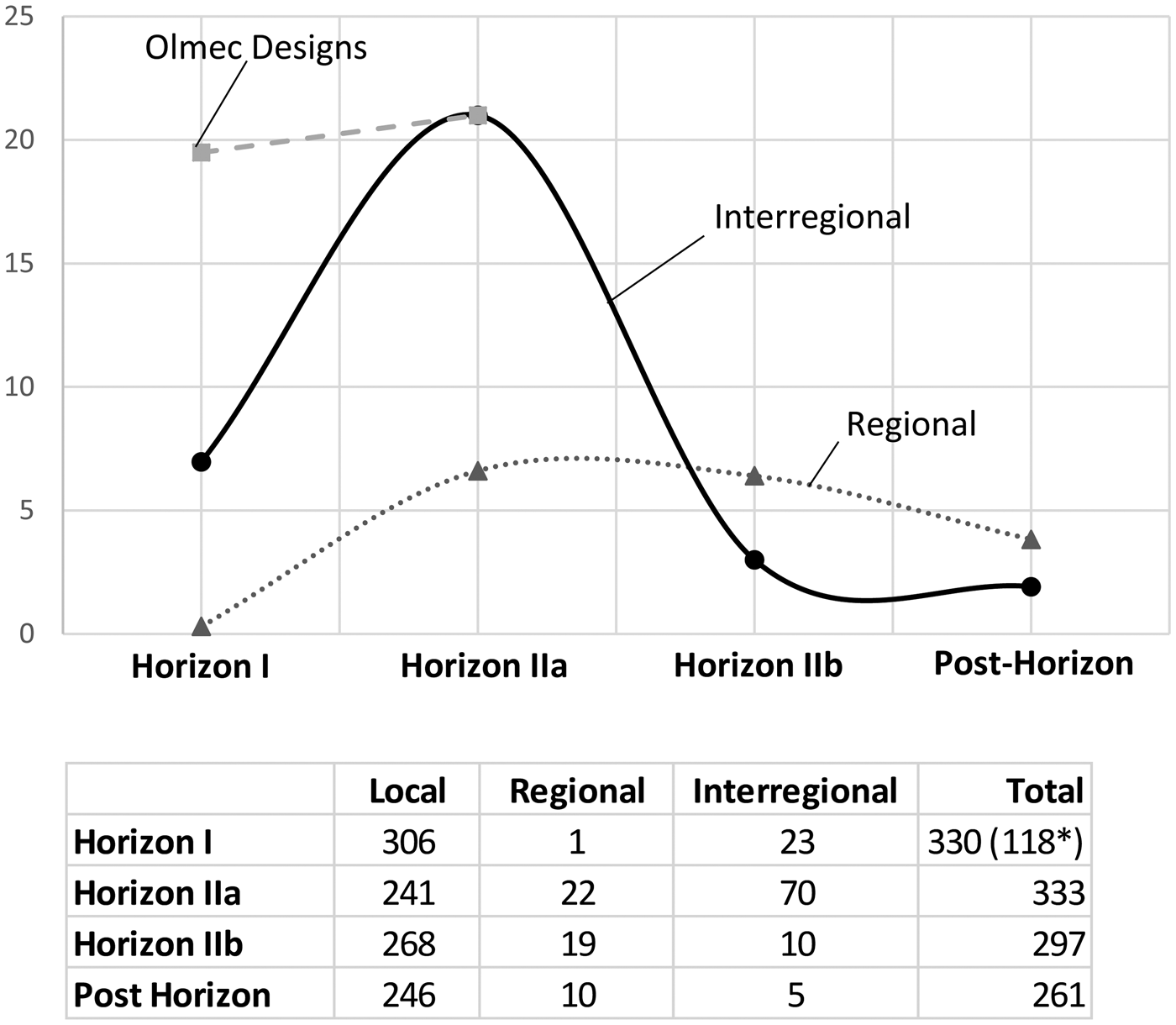
Temporal patterns of trade are presented here with the caution of biases in the sampling strategy already noted. While sampling ceramics from sites other than Altica, we did not intentionally target suspected trade wares. To obtain a statistically significant randomized sample of ceramics for compositional sourcing, many conditions would have to be met that are unrealistic considering cost, control over context in case of surface finds, and export restrictions of the Instituto Nacional de Antropología e Historia. Finally, statistical significance is a function of the variability in the sample, which is unknown prior to analysis. That said, we speak here in terms of the relative commonality of interregional and regional exchange compared to local reproductions of pan-Mesoamerican Formative ceramic styles (Figure 12).
Trends of interregional and regional ceramic trade over the major time periods discussed here. The y-axis is percent of specimens that are imported from either regional sources or from outside the sampled region (interregional). Horizon I interregional trade totals are a combination of those identified in this study and those collected by other projects (Blomster et al. Reference Blomster, Neff and Glascock2005; Herrera et al. Reference Herrera, Neff and Glascock1999). Graph and chart by Stoner. *The parenthetical total for Horizon I is the total of clear Olmec ceramic trade wares or those local copies with carved Olmec-style excision. The remainder of the 330 Horizon I specimens display general similarities at the ware level, but otherwise lack specific design motifs that resemble Olmec.

Horizon I
We have 306 ceramics in our Horizon I sample, and all of these generally possess stylistic similarities at the ware level to other regions of Mesoamerica. However, we also want to specifically feature ceramics with Olmec-style designs or that were imported from the southern Gulf lowlands. Three studies (including this one) have collectively analyzed 118 specimens with Olmec-style designs or pottery types from Horizon I in central Mexico (Blomster et al. Reference Blomster, Neff and Glascock2005; Herrera et al. Reference Herrera, Neff and Glascock1999; see also Cyphers Reference Cyphers and Grove1987; Flannery and Marcus Reference Flannery and Marcus1994; Niederberger Reference Niederberger1976; Paradis Reference Paradis, Blomster and Cheetham2017). A relatively high proportion (19.4 percent, 23/118) of those were actual imports over long distances, specifically from the southern Gulf lowlands, but also possibly from highland Oaxaca, and a minority of unknown sources (see Figure 12). None of the ceramics lacking a clear Olmec-style referent were imported from outside the region, and only one sherd appears to have been traded among sites within the region.
Types imported over long distances are almost entirely of fine-paste Xochiltepec White and Atoyac Fine Gray. We note that among the Xochiltepec White ceramics sampled from the Basin of Mexico there are at least two distinct recipes. Blomster and colleagues (Reference Blomster, Neff and Glascock2005) suggest that the Xochiltepec White ceramics were made using white-firing kaolin clays in the southern Gulf lowlands and that the huge chemical range of clays collected by Herrera and colleauges (Reference Herrera, Neff and Glascock1999) accounts for all the different recipes of Xochiltepec White.
The overwhelming majority of dark-colored, coarser-paste carved ceramics made to resemble Olmec styles was produced locally (3 percent, or 3/98; those three imports are included in the 23 imports above). Locally produced coarse wares made in an Olmec style are found mostly on the wares Volcán Pulido, Tortuga Pulido (temprano), Valle Borde Negativo (white-rimmed black ware), and Pilli-style ceramics and figurines. While three percent import may seem significant, we suggest that this is a relatively low percentage considering the bias toward suspected imports with Olmec-style decoration in Herrera's sample.
Clearly the Olmec style had been appropriated and widely copied by local communities of practice by the end of Horizon I. This process likely began with import of Atoyac Fine Gray ceramics featuring carved decoration (Niederberger Reference Niederberger1976:129–130, 179). Our examples of this ware are chemically very different from Formative Oaxaca ceramics (cf. Flannery and Marcus Reference Flannery and Marcus1994; Niederberger Reference Niederberger1976:Appendix A), but the chemical variation among Herrera's sample implies multiple production sources for this type that may include both Oaxaca and the Gulf lowlands. Both potential source regions would represent the longest-distance pottery import identified in this study.
Atoyac Fine Gray is an extremely rare type in the Basin of Mexico and Xochiltepec White does not bear Olmec carved motifs. The small number of imports compared to the ubiquity and accuracy of replicated Olmec designs on other types leads us to urge researchers to pursue the hypothesis that migration of people from the east may have served as a mechanism for the initial spread of the horizon. Such close replications suggest that the situated knowledge of foreign production sequences traveled with the people possessing it, rather than through the trade-and-copy of objects alone. A similar argument is made for the colonization of Canton Corralito (Cheetham Reference Cheetham2010; Cheetham and Coe Reference Cheetham, Coe, Blomster and Cheetham2017) to have led to the production of very close copies of San Lorenzo ceramics, allowing for some some minor adjustments for the adaptation to local materials. We do not suggest that the Basin of Mexico was colonized by peoples from the Gulf, but some migration is implied.
Olmec symbols carved onto dark-colored coarse-paste pottery do not appear to be restricted to elite contexts, as would be expected in a prestige exchange model. At Coapexco, the Olmec style does not favor any one household (Tolstoy Reference Tolstoy and Diehl1989:98; Paradis Reference Paradis, Blomster and Cheetham2017), which is similar to the distribution of the style among graves of different inferred statuses at Tlatilco (Tolstoy Reference Tolstoy and Diehl1989). As Neff (Reference Neff and Martinón-Torres2014) and Stark (Reference Stark, Scarborough and Clark2007) suggest, local copying of Olmec symbols becomes so widespread that it threatens the prestige status of long-distance ceramic imports. The pervasive adoption and local production of carved pottery and figurines of Olmec style signal that they were not prestige goods but instead may have been linked to social identity. Imported fine-paste gray and white wares may have retained their prestige value longer as they appeared visibly distinctive from local pottery assemblages. Locally-available materials and technology were not suited for the production of fine-paste, light-colored ceramics during the Early Formative. Because they could not be copied, fine-paste imports remained beyond the reach of the general population.
Stark (Reference Stark, Blomster and Cheetham2017) suspects that this horizon is marked by a relative openness of village communities and social networks across Mesoamerica. “Openness” here refers to ideas, goods, and people. Settlements were generally small and generously spaced relative to their neighbors. Rigid settlement hierarchies had not formed, and social differentiation had begun but was not yet cemented (Niederberger Reference Niederberger, Clark and Pye2000). All of these conditions encouraged the adoption of non-local peoples and ideas into local communities. Additionally, the generations that developed Horizon I ceramic styles were not far removed from a more mobile forager lifestyle, and were quite accustomed to traveling long distances (but Niederberger [Reference Niederberger, Clark and Pye2000] suggests Late Archaic foragers who lived among the southern lake environments may have been sedentary).
Stark (Reference Stark, Blomster and Cheetham2017) conceives of Olmec symbols as a form of non-verbal communication linking people who may speak different languages. Those pots and images bear religious information that fostered the formation of a pan-Mesoamerican religious cult (Blomster Reference Blomster1998; Stark Reference Stark, Blomster and Cheetham2017). We add that sharing of such standardized imagery among people in a multiethnic community, potentially represented by the burial population of Tlatilco (Tolstoy Reference Tolstoy and Diehl1989), would have provided the basis for a common identity.
Horizon IIa
Beginning at the end of the Early Formative and during the first half of the Middle Formative, Horizon IIa marks the general disappearance of direct references to the Olmec Heartland and the emergence of a more abstract set of iconography expressed on white-ware bowls. Niederberger (Reference Niederberger, Clark and Pye2000) suggest that her Tetelapan phase (900–800 cal b.c.) is when Olmec deculturation first appears. We have secure dates from Altica, however, that straddle the late Manantial and Tetelpan phases (with some Ayotla-phase dates that are likely secondary deposits from an older occupation of the landform) and completely lack any Olmec-style carved decoration. We therefore argue that Olmec deculturation began during the Manantial phase in parts of the Basin of Mexico (Stoner and Nichols Reference Stoner and Nichols2019), but that it extended into the Tetelpan (Niederberger Reference Niederberger, Clark and Pye2000) or El Arbolillo (Tolstoy Reference Tolstoy, Taylor and Meighan1978) phases at some southern Basin sites. These are likely legacy expressions passed down through vertical transmission after the mechanism (direct trade or migration) that brought the Olmec style to the region had ruptured.
About 21 percent of our Horizon IIa sample was imported from outside the sampled region (Figure 12). Like Horizon I, however, this was partly due to targeted sampling of suspected imports at the site of Altica, where most of the imports were recovered. A total of eight sites dating to this time frame possessed interregional imports.
Altica is a good representation of Horizon IIa because ceramic associations and 20 14C dates center the site after the disappearance of excised decoration of Horizon I and it was abandoned shortly after the emergence of Horizon IIb (Stoner and Nichols Reference Stoner and Nichols2019). While the imports associated with Altica are placed in Horizon IIa, it was occupied for the first half of Horizon IIb and some of the imports appear to stylistically fall into the latter period. With that caveat in mind, the precise dating of Altica imports is likely the transition between Horizon IIa and IIb. Regardless, Altica is the earliest dated site in the Teotihuacan Valley and represents the northward expansion of the southern Basin groups. Though not a driver of Horizon II interaction, Altica likely reflects the broader-scale processes of increasing trade intensity for basic goods. Altica might have exported relatively unmodified nodules of Otumba obsidian (Healan Reference Healan2019). We uncovered stored nodules of obsidian in two deep pit features, and obsidian outnumbers ceramics there by a ratio of 1.3:1 (cf. Stark et al. Reference Stark, Boxt, Gasco, Lauck, Balkin, Joyce, King, Knight, Kruger, Levine, Lesure, Mendelsohn, Navarro-Castillo, Neff, Ohnersorgen, Pool, Raab, Rosenswig, Venter, Voorhies, Williams and Workinger2016). Otumba obsidian was traded as far away as the Gulf and Pacific coasts during this time, and Altica is located only 10 km from the source.
Contrasting Horizon I imports from the Gulf lowlands, we have determined that almost all of the Horizon IIa ceramic imports likely came from a much closer source in the metamorphic region of southwest Puebla. Imported wares included White-Slipped Incised, Red-on-Natural, Orange-on-White, and Pavón Fine Gray (Cyphers Reference Cyphers and Grove1987). From Horizon I to Horizon IIa, pottery trade spheres shrank to more restricted geographic zones, which notably bypassed the Olmec Heartland. Intraregional exchanges of other goods, such as obsidian, greenstone, iron ore, and shell, generally intensified during Horizon II. This seemingly presents a paradox: ceramic trade constricted in range while basic materials and goods moved further and in greater numbers. We suggest that economic exchange systems became more efficient because of emerging gateway centers, like Chalcatzingo (Hirth Reference Hirth1978), and the formalization of trade routes, but cultural identities begin to take on a more restricted geographic foundation.
Ceramic style associations became more generalized without a single “culture” standing out as the referent. This shift likely took place because many regional centers had been established across Mesoamerica with their own elites. White-ware ceramics with common motifs shared across Horizon II likely derive from a cooperative network of elites interacting for the exchange of other commodities (Demarest Reference Demarest, Sharer and Grove1989; Love Reference Love2002:202–204; Rosenswig Reference Rosenswig2010:279–281).
During Horizon IIa, Altica also appears to have imported quite a few ceramics from the southeastern Basin of Mexico. We suggest, based on similarities between their ceramic assemblages, that Tlapacoya specifically may have been the source. This represents an intermediate, regional scale of ceramic style transmission crucial to the propagation of horizons.
Horizon IIb
Horizon IIb in the middle Middle Formative (also including “general” Middle Formative ceramics) experienced even more restriction of interregional trade. Only a small percentage of imports were detected (10 interregional imports; 19 regional trade wares; 297 total), and they come from the same region as Horizon IIa imports (southwest Puebla). Moreover, diverse ceramic styles decorative motifs, decorative techniques, and forms entered into regional ceramic assemblages. Intraregional exchange levels remained about the same as during the previous horizon. Lacquer Ware ceramics from Morelos are considered regional trade wares primarily dating to this period.
Post-Horizon Ceramics Trade
Following the collapse of the previous Horizons, the proportion of trade wares continued to decline. We consider the time periods middle-late Middle Formative, late Middle Formative, and Late Formative as part of our Post-Horizon category. While Rosenswig's (Reference Rosenswig2010) Horizon III generally overlaps with the beginning of this time frame, it is not well defined in this sample or the region as a whole. As argued at the beginning of this paper, we see this as a time when the process of cultural divergence among the regions of Mesoamerica was already firmly underway.
CONCLUSION: MULTISCALAR COMMUNITIES OF PRACTICE AND FORMATIVE STYLE HORIZONS
The style horizons executed in a ceramic medium that developed across Mesoamerica during the Early and Middle Formative period are a special kind of community of practice (Eckert et al. Reference Eckert, Schleher and James2015; Joyce Reference Joyce, Cordell and Habicht-Mauche2012; Joyce and Henderson Reference Joyce, Henderson, Blomster and Cheetham2017; Worth Reference Worth, Waselkov and Smith2017) that can be understood through a multiscalar perspective (Kohring Reference Kohring, Kienlin and Zimmermann2012). Ceramics are systems of knowledge transmitted vertically over generations and horizontally across space through communication, trade, and migration. Central to the argument we make here is the role of an immutable physical template in the form of ceramic trade wares for ensuring visual stability of the message regardless of distance or how many hands it passes through. Movement of the potter herself would bring an even higher level of situated knowledge of the production sequence to a new region (Cheetham and Coe Reference Cheetham, Coe, Blomster and Cheetham2017).
While we currently do not have a substantial database of isotope data for Formative burials, we follow Stark (Reference Stark, Blomster and Cheetham2017) in suggesting that relatively low population levels across Mesoamerica during the Early Formative would have fostered a certain openness to acceptance of foreign peoples into the local community, a setting that would encourage long-distance migration. These migrations likely included people moving from the coast to the highlands, but also may have involved the reverse pattern especially during Horizon IIa when the white ware styles developed in the Basin of Mexico began to appear in other regions. Movement of people need not be considered permanent, but for periods of time long enough to facilitate learning the pottery production sequence before moving back home or onto a new location. We also caution against seeing migration during these early time periods as necessarily involving the Gulf lowlands, as places like Tlatilco may indicate intermigration with west Mexico (Tolstoy Reference Tolstoy and Diehl1989).
Migration aside, applying compositional analysis is the primary method by which we can evaluate the role of pottery trade in horizon formation. In general, when horizontal interaction through migration or trade of culturally sensitive materials is relatively high, style horizons form. In times when interaction across long distances is diminished, localized vertical transmission from parent to offspring or teacher to student is the major force behind reproduction of ceramic systems. In the latter setting, regional pottery styles should gradually diverge across space and over time due to errors and biases propagated through each generation.
The local community of practice is overwhelmingly to be credited for the formation and dissolution of style horizons. In the Basin of Mexico, local copying of pan-Mesoamerican ceramic styles was the dominant mechanism for the spread of these early style horizons. Regardless of where those styles originated, or the mechanism for their spread, this exemplifies the ubiquitous force of generational learning for the transmission of ceramic production knowledge. Represented in this sample are some of the earliest potters to occupy the region. We demonstrate here a regional community of practice with intimate knowledge of its local environment, which manifests through variable material procurement and paste mixing strategies even within sites.
Levels of long-distance pottery trade (and likely migration) start high in Horizon I, but then gradually decrease and become more restricted geographically over time. During Horizon I, the Basin of Mexico imported a high percentage of trade wares bearing the pan-Mesoamerican style. Imports were of the visually distinctive fine-paste ceramics imported from the Olmec Heartland and possibly Oaxaca (see also Blomster et al. Reference Blomster, Neff and Glascock2005). While these likely functioned as prestige goods, imported Atoyac Fine Gray vessels carved with Olmec symbols provided a template which local potters applied to the darker-colored, coarser-paste local production sequence. Coarser-paste wares featuring Olmec designs were almost all locally made and they were not restricted to elite contexts. Rather than prestige goods, those were likely markers of social identity that had become ingrained into the cultural and religious consciousness of the local populace (Stark Reference Stark, Blomster and Cheetham2017).
During Horizon IIa, exchange of incised white wares was also surprisingly intense, but over a smaller geographic range. We also observe an increase of pottery exchange among sites within the region and suggest that this intermediate level of trade is essential to integrate sites that would otherwise not have been directly linked to long-distance trade networks that fostered the horizon (Kohring Reference Kohring, Kienlin and Zimmermann2012). As central Mexico was the potential origin for the white-slipped, double-line-break pottery of Horizon II, future studies should focus on sourcing this ware in other regions. If we are correct in our assumption that the Basin of Mexico was among the first to develop Horizon II white-ware bowls with double-line-break incision, we would expect to find exports of this ware dating to the beginning of the Middle Formative in Oaxaca, the Gulf Coast, Guerrero, Puebla, and the Pacific Coast. Mentions of central Mexican imports are presented in research by Flannery and Marcus (Reference Flannery and Marcus1994) and MacNeish and co-authors (Reference MacNeish, Peterson and Flannery1970), but a systematic compositional study is needed to evaluate that hypothesis.
Finally, by Horizon IIb interregional trade had greatly diminished. We lack a substantial sample for later periods in the Basin of Mexico, but other contextual information allows us anticipate that interregional exchange of culturally sensitive ceramic materials likely continued at low levels through the Late Formative. During the late Middle Formative and Late Formative periods, settlement hierarchies across Mesoamerica began to form around emerging cities, and polities focused more on regional consolidation and internal investment than external interaction (Nichols and Stoner Reference Nichols and Stoner2019). In the Basin of Mexico, Cuicuilco coopted regional exchange systems, potentially setting the stage for the regional market systems that have been proposed for the region during the Classic (Hirth Reference Hirth1998). Grove (Reference Grove1984:155) argued that the expanded use of irrigation increased crop productivity and reduced subsistence risk, so more of the local productive capacity may have shifted toward cooperative agricultural projects, rather than long-distance exchange (Nichols Reference Nichols1987, Reference Nichols2015). Investment in regional marketplaces and agricultural infrastructure are public goods that characterize more collective types of government, like Teotihuacan (Blanton et al. Reference Blanton, Feinman, Kowalewski and Peregrine1996; Carballo Reference Carballo, Roscoe and Feinman2014).
This phase of internally focused regional consolidation was necessary for the later expansion of Zapotec and Teotihuacan polities. Conquest abroad was not feasible with the threat of enemies at home, emerging polities refocused their attention toward intraregional development and political integration, which are necessary preconditions for territorial expansion (Smith and Montiel Reference Smith and Montiel2001; Spencer and Redmond Reference Spencer and Redmond2001). Along with this shift, regional culture styles solidify and may have intentionally diverged from neighboring regions to emphasize cultural differences, rather than their similarities as had been done in prior periods. We suggest due to the slow pace of change associated with in situ generational transmission that the Late Formative divergence seen among regional ceramic styles was a centuries-long process that began sometime after the end of Horizon IIa.
RESUMEN
En este trabajo exploramos la relación entre el intercambio de cerámica a larga distancia y la formación de horizontes de estilo del formativo temprano y medio en Mesoamérica. Una muestra de 1154 fragmentos cerámicos se irradió en el University of Missouri Research Reactor con una sub-muestra (n = 313) para análisis petrográficos. Los especímenes provienen de contextos del formativo temprano y medio de la Cuenca de México (n = 748), Morelos (n = 55), Hidalgo (n = 49), Puebla (n = 50), Tlaxcala (n = 93), Toluca (n = 94), Tehuacán (n = 13), el Norte de Veracruz (n = 27) y la región del Soconusco (n = 25). Concluimos que (1) la mayor parte de los sitios y regiones muestran más de un proceso de manufactura de cerámica; (2) hay poca interacción intrarregional entre los sitios del México central, siendo la región sureste de la Cuenca de México la que hizo la mayor proporción de cerámica destinada al intercambio dentro de la región; y (3) las importaciones interregionales que se encuentran en varios sitios del altiplano de México provienen de la región metamórfica del suroeste de Puebla con una importación menor proveniente del sur de la Costa del Golfo, Morelos y posiblemente Oaxaca. La tendencia a través del tiempo desde el formativo temprano hasta finales del formativo medio consiste en una disminución en la intensidad de la interacción a larga distancia y una disminución geográfica de intercambio. Estas dos tendencias contribuyen a la divergencia regional de estilos cerámicos que alcanza su máximo desarrollo hacia el formativo tardío de Mesoamérica.
ACKNOWLEDGMENTS
We thank the people of the Ejido of San Francisco Tlaltica for granting us permission to conduct the research. Particular thanks go to the individual landowners that permitted us to work on their lands. We also thank the people who worked on the project: Oralia Cabrera, Ivonne Pérez, Luz Escobedo, Nadia Johnson, Andrés Mejía, Alex Jurado, Eric Jurado, Aaron Watanabe, Vicente Aguirre, Refugio Aguilar Espinoza, Maximiliano Chávez, Brisio Ramos, Alejandro Aguilar, Faustino Aguilar, Ezequiel Aguilar, Antonio de Jesús López, Jovanis Zuluaga Vite, Rodrigo Zuluaga Charaga, and Francisco Chávez. Permission for the research was given by the Consejo de Arqueología, Instituto Nacional de Antropología y Historia (INAH), Centro del INAH Estado de México, and Municipio de Tepetlaoxtoc. We appreciate the assistance of Alejandro Sarabia (INAH-Teotihuacan) and the Arizona State University Teotihuacan Research Center. We thank Jennifer Carballo, Robert Cobean, Luis Gamboa, Richard Lesure, James Neely, Patricia Plunket, Mari Carmen Serra Puche, Yoko Sugiura, Paul Tolstoy, and Gabriela Uruñuela for permission to analyze samples of ceramics they collected. Funding was provided by the National Geographic Society, the National Science Foundation (NSF) No. 1424132-Nichols (Dartmouth), NSF No. 1451425, NSF No. 424184-Stoner (Arkansas), the Claire Garber Goodman Fund-Dartmouth, Rockefeller Center for the Social Sciences Urban Studies Grant-Dartmouth, Dickey Center for International Understanding-Dartmouth, Neukom Center for Computational Sciences-Dartmouth, and the William J. Bryant 1925 Professor of Anthropology-Dartmouth.