At In Platonis Timaeum Commentarii (= In Ti.) II, 1.393.31–394.5 Diehl (which is Atticus, fr. 28 in the edition of Des Places),Footnote 2 Proclus follows Porphyry's inferences against the theory of Atticus, focussing more precisely on the fact that the latter's account of the principles does not correspond to the views expounded by Plato himself. In Diehl's text, based on a limited selection of primary manuscript-witnesses, the introductory phrase to this criticism contains a reference to the maker (ποιητής), which cannot easily be explained within the context. On the basis of a new examination of the manuscript tradition, and of the context of the passage, we will present a new conjecture that allows one to avoid the problems involved in Diehl's reading of the text.
1. SOME PRELIMINARY REMARKS
This article is the result of research leading up to the publication of a new critical edition of Proclus’ Commentary on the Timaeus, which we are preparing. On the basis of recent research conducted by Mariella MenchelliFootnote 3 and Paola Megna,Footnote 4 and also on the basis of our own inquiry into the textual tradition and of our full collation of the independent textual witnesses, one may conclude that Ernst Diehl's knowledge of the manuscript tradition was very partial. Many manuscripts were not systematically explored, many were dismissed as unimportant, and Diehl started from an erroneous dating of the main witnesses.
Diehl's main mistake—reiterated by all subsequent scholarship—is the misunderstanding of the position of MS Paris. Coislin. 322 (siglum C). Diehl attributed this manuscript to the eleventh/twelfth century, but it is in fact a manuscript in the retro style of the Monastery τῶν ὁδηγῶν, dating from the thirteenth/fourteenth century.Footnote 5 However, even with the revision of its dating, this manuscript (which contains only Books I and II of Proclus’ commentary) has always been considered to be the only representative of a separate family in the transmission of Proclus’ In Timaeum, over against a ‘second family’ (that is, all the other manuscript-witnesses) that presents a deteriorated state of the text. On the basis of an examination of all the variants of C over against the ‘second family’, we have been able to establish that C is in fact a (very sloppy) copy of a Byzantine recension of the text, full of conjectural emendations, and thus to be treated with due care. It is by no means the representative of a separate family over against the other witnesses. It is true that the substrate (C’) on which the Byzantine scholar introduced his corrections was an independent witness, and hence, that the MS retains some value for the constitution of the text, but, at the same time, it has become impossible to distinguish correct readings, which would be uniquely attested by C, from conjectural corrections by the learned corrector.Footnote 6
Apart from this, Diehl's main omission is MS H (Chisianus R.VIII.58), which was known to him, but which he did not deem useful. A careful examination of this manuscript has revealed that it is the oldest extant witness to the text (dating back to the eleventh/twelfth century, but believed by Diehl to have been written in the thirteenth century),Footnote 7 and that it has been corrected and revised by a scholar, which we call H2 (M. Menchelli refers to him in her works as Chis2), whose corrections have been decisive for the text version in this branch of the tradition (the vast majority, that is, of the manuscripts up to the editio princeps by S. Grynaeus in 1534). H2 introduced a number of conjectural revisions into the text, but also corrected it on the basis of another manuscript.Footnote 8 Apart from the neglect of MS H and other witnesses (for instance MS Z = Marcianus gr. 194, thirteenth century, a direct copy of H), Diehl did not draw a reliable stemma codicum, and roughly divided the manuscript tradition into two families.
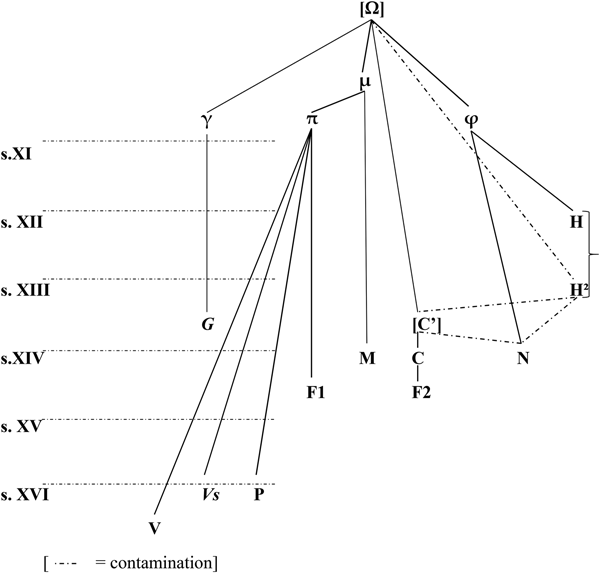
The stemmatic relations between all manuscript-witnesses can now be reconstructed with much more accuracy than was the case in Diehl. We discovered that MS M (Marcianus gr. 195, s. XIV in. [not XIV–XV as in Diehl])Footnote 9 and MS P (Parisinus BNF gr. 1840, s. XV ex.–XVI in.) belong to one branch (for which we use the siglum μ), whereby P is a representative of a group of three Greek manuscripts and a Latin translation, all derived from one single lost exemplar (which we call π).Footnote 10 N (Neapolitanus Borbonicus III.D.28, a. 1314) and the aforementioned H are independent witnesses of a second branch, which we call φ. The manuscripts belonging to this branch are contaminated. First, as indicated before, the corrections of H2 were partly taken over from another MS (close to the archetype of the entire tradition); second, the Byzantine scholar who wrote the recension of C took over a large number of corrections made by H2. Third, MS N has reproduced a number of the corrections introduced by H2 as well as by C.Footnote 11
Moreover, we have the Latin translation, by William of Moerbeke (thirteenth century), of a number of passages extracted from the second book of Proclus’ commentary (siglum G); the Greek model (which we call γ) of this partial translation was another independent witness.
On this basis, a stemma codicum can be drawn—at least for the independent witnesses of Books I and II—as follows:
Stemma codicum (II. I–II)

Conspectus siglorum
- M
Venetus Marcianus gr. 195, s. XIV in.
- P
Parisinus BNF gr. 1840, s. XV ex.–XVI in.
- V
Vaticanus Palatinus gr. 121, s. XVI
- F
Venetus Marcianus gr. Z.228, s. XIV; F1: fols. 189r-243v (l. I usque ad 1.139.4 Diehl … καὶ ὁρᾷς ὅπως |); F2: fols. 244r–297r (alia manus, l. I et II partim, 1.139.5–376.13 Diehl | ἐν τάξει προῆλθεν … τοῦ δημιουργοῦ πρόνοιαν |)
- N
Neapolitanus Borbonicus III.D.28, a. 1314
- H
Vaticanus Chisianus R.VIII.58, s. XI–XII
- C
Parisinus Coislinianus 322, s. XIII–XIV
- Vs
Leidensis Vossianus Lat. F.100, s. XVI
- G
Guilielmi de Moerbeke, excerpta de Commento Procli In Timaeum Platonis (ed. C. Steel, Proclus, Commentaire sur le Parménide de Platon, traduction de Guillaume de Moerbeke, vol. II [Leuven, 1985], 559–87).
2. THE MAKER IN DIEHL'S TEXT
A textual problem at Procl. In Ti. II, 1.393.31–394.5 Diehl has been bothering recent translators and commentators. The passage in question concerns the views of Atticus (οἱ περὶ Ἀττικόν, II, 1.391.7 Diehl), which Proclus discusses on the authority of Porphyry. The whole passage II, 1.391.4–396.26 Diehl contains an extensive summary of four points made by Porphyry regarding the status of, and the interplay between, the highest principle(s) and matter. First, Porphyry refutes Atticus’ dualism, which assumed that matter is an ungenerated principle, eternally opposed to the highest principles (II, 1.391.6–393.14 Diehl). Second, he argues that, according to Plato, everything must be reduced to one single principle (II, 1.393.14–31 Diehl). Third, that the principles Atticus discerns are not in accordance with Plato's views (II, 1.393.31–395.10 Diehl). Fourth (II, 1.395.10–396.26 Diehl), that the divine intellect creates just by being (αὐτῷ τῷ εἶναι).
The overall idea of the third section, which is the passage we want to focus on, is clear enough, namely that Porphyry reproaches Atticus for not being true to Plato's original views on the principles. Yet, the text of the passage does not really help to get this clear. In Diehl's version (with Diehl's apparatus criticus), it runs as follows:
It is to be pointed out that this passage is followed by a number of further elements (all introduced by οὔτε …) in which Atticus’ views differ from Plato's: after the first element, that the ideas do not exist on their own outside the intellect (οὔτε γὰρ αἱ ἰδέαι κεχωρισμέναι τοῦ νοῦ καθ’ αὑτὰς ὑφεστήκασιν, 1.394.2–3), Porphyry adds (2) that the Demiurge is not the first god (οὔτε ὁ δημιουργὸς ὁ πρώτιστός ἐστι θεός, 1.394.8), (3) that there is not some irrational soul that moves the discordantly and chaotically moving thing (οὔτε ψυχή τις ἄλογος κινεῖ τὸ πλημμελῶς καὶ ἀτάκτως φερόμενον, 1.394.9–10), (4) that the universe does not become orderly after having been disordered (οὔτε ὅλως ἐξ ἀτάκτου τεταγμένον γίνεται τὸ πᾶν, 1.394.11–12).
Within its context, the opening phrase strikes one as very odd. It is clear that the series of precise points on which Atticus deviates from Plato is supposed to start from οὔτε γὰρ … (1.394.2), introducing the first objection. But why then is the first phrase also referring to a specific point, namely the maker or creator whom they (Atticus cum suis) claim to be a principle? Would this not be included in the second objection (and if so, why does it figure separately in the opening line)? And how could the whole series of four objections be taken as an explanation or clarification (γάρ, 1.394.2) of the fact that the maker is not a principle? The remaining arguments— that the ideas do not exist outside the intellect, that there is no irrational soul and that a disorderly substrate could not exist before the demiurgy—can hardly be seen as confirmations of the fact that the maker is not a principle.
3. MORE TEXTUAL EVIDENCE
Textual criticism may help us to get a better picture of what is going on in this passage. As may appear from his apparatus criticus, Diehl's rendering of this passage relies on three manuscripts only: C, M and P. Incidentally, from line 5 onwards, C has a long lacuna (owing to the loss of two quires), which left Diehl with only two manuscript-witnesses. In cases like this, Diehl decided, rather haphazardly, to include a third manuscript, N, but he did not take it into account when C, M and P are extant (meaning that N was not used by Diehl for the first part of the passage we are discussing). As we now know, this choice led Diehl to neglect important independent witnesses, and prevented him from obtaining a clear view on the relations between the manuscripts. More in particular, as can be deduced from the stemma codicum, a critical edition should include manuscripts N and H. These two witnesses, both belonging to the φ branch of the tradition, have specific peculiarities. As indicated above, H is the oldest extant direct witness of Proclus’ text, but it is not the best one. It contains many errors and mistakes, many of which have, however, been corrected by a scholarly hand (H2). Though very often working on the basis of his own conjectures, H2 apparently had access to a manuscript on the basis of which he could restore the original reading of the archetype. N, on the other hand, is the better copy of φ, and often the only manuscript to have preserved the correct reading—although it should be added that, in many cases, the readings of N are intelligent conjectures on the part of the scribe (in scribendo, as the MS contains very few corrections) or of a corrector of his model.
When one includes all independent manuscript-witnesses, the apparatus criticus for the present passage looks as follows:
This renders it clear that the scribes and scholars have been having problems with the reference to the maker or creator in the first line. The text as transmitted by M and H must be the version of the archetype (considering all the variant readings as attempts at correcting the text). It runs as follows: ὅτι οὐδὲ εἰ ποιητής, ὧν παραλαμβάνουσιν ἀρχῶν, προσήκει τί τῷ Πλάτωνι, meaning, probably, something like ‘that, even if there were a maker, none of the principles they accept would correspond to Plato[’s views]’ (neglecting the accentuation of τί, which seems to have led the scribe of P to omit the word; the reading of Vs reveals that π did indeed have τί, probably with the accent). But this certainly does not make much sense in the context, as none of the Platonists would actually deny the existence of a maker. H2 and N have detected this problem, and changed the text accordingly.Footnote 12
H2 replaces εἰ by ὁ (which corresponds to the rendering of C, but which both redactors can have easily found out on their own, without having recourse to another manuscript):
τρίτον τοίνυν, ὅτι οὐδὲ ὁ ποιητὴς ὧν παραλαμβάνουσιν ἀρχῶν προσήκει τί τῷ Πλάτωνι.
Thirdly, that not even the maker of the principles they assume corresponds in any way with Plato[’s views] (again neglecting the accentuation of τί).
This version (correcting the text in H) elegantly avoids too many intrusions in the text. Yet, it does not solve the question of why the maker is mentioned here in the first place. Again, the sequence of four objections is not in accordance with this first general reference to the maker. The suggestion might be that, in fact, οὐδὲ ὁ ποιητής introduces the first objection, which is then further explained by οὔτε γὰρ αἱ ἰδέαι κ.τ.λ. But this breaks the flow of the argument, as the subsequent points introduced by οὔτε would then no longer be juxtaposed to this first οὔτε γάρ. They would rather be at the same level of the first οὐδέ. Moreover, it is not at all clear how the reference to ‘the maker of the principles Atticus assumes’ would be further clarified by adding ‘for neither do the ideas exist on their own outside the intellect’.
MS N intervenes in the text by omitting the reference to a maker, and replacing it by ἡ ποιότης. This version of the text runs as follows:
τρίτον τοίνυν, ὅτι οὐδὲ ἡ ποιότης ὧν παραλαμβάνουσιν ἀρχῶν προσήκει τί τῷ Πλάτωνι.
Thirdly, that not even the qualitative nature of the principles they accept corresponds in any way to Plato[’s views] (same remark on τί).
This reading reconstructs the text ad sensum, namely by introducing a general remark on the status of the principles in Atticus, over against Plato's theory. There can be no doubt that the intervention is conjectural on the part of the scribe of N or his model (that is to say, in the latter case, as a correction that was neglected by the scribe of H or that was introduced after H was copied). The conjecture was inspired by the need to make the passage fit within the context.
The redactor of MS C, on the other hand (followed by Diehl), adjusted the entire phrase in correspondence with ὁ ποιητής:
Thirdly, that not even the maker they accept as a principle corresponds with Plato[’s views].
Or in Festugière's translation:
‘Le troisième point est que le Créateur qu'Atticus assume comme principe ne correspond pas non plus à la pensée de Platon.’Footnote 13
But this version entails the oddities outlined before.
Of the solutions offered in the manuscripts, N (or its model) certainly has the better one, as it indicates what we need in the context: a general statement about Atticus’ failure to render Plato's theory of principles in the right way, which is then elaborated in four specific points.
4. MICHAEL SHARE'S SOLUTION TO THE PROBLEM
In the recently published English translation of Proclus’ Commentary on the Timaeus, Michael Share gives a very lucid analysis of the problems at stake in Diehl's (and Festugière's) rendering of this passage. He points out that, with the given text, ‘one would expect ὡς ἀρχήν rather than just ἀρχήν’, and that ‘Proclus goes on to discuss the Forms, the Demiurge (not the ποιητής, notice), irrational soul and matter (in that order), and not just the creator/Demiurge’.Footnote 14 The former point (on the oddity of having ἀρχήν instead of ὡς ἀρχήν) need not be a decisive argument, but the latter does address the core of the problem, and so does Michael Share's solution. He proposes to read the following:
τρίτον τοίνυν, ὅτι οὐδὲ εἴποι ἄν τις ὧν παραλαμβάνουσιν ἀρχῶν προσήκειν τι τῷ Πλάτωνι
and he translates accordingly:
Thirdly, one would go as far as to deny that any of the principles they assume is in Plato.Footnote 15
This is certainly expressing the right meaning of the passage, as MS N (which Share did not know) has also felt to be the case.
Yet, as argued by Lorenzo Ferroni,Footnote 16 this solution is fairly intrusive, especially since the optative Share introduces requires him to render the verb προσήκειν in the infinitive, a reading that is attested by none of the manuscript witnesses. The entire conjecture relies on the text as transmitted by MSS M and H, accepting εἰ ποιητής as a corrupt rendering of εἴποι ἄν τις (which is not too far-fetched), holding on to the genitive ὧν … ἀρχῶν and constructing it as a partitive genitive with τι (now deprived of its accent).
5. GETTING RID OF THE MAKER
The insights expressed by the conjectures of MS N and Michael Share have made it very clear that what we need at the beginning of this passage is a first introduction to the four objections, stating that, generally speaking, Atticus cum suis accepts principles that do not correspond to Plato's thought. The reference to the maker must, thus, be corrupt.
How to solve this textual problem, then? What we seem to need is an expression referring to ‘all of the principles Atticus and his followers assume’, introduced by the negation οὐδέ—an expression which has subsequently been corrupted into the mentioning of the ποιητής, and which one can reconstruct with as small an intervention in the text as possible. As indicated before, it is clear that the reading of M and H εἰ ποιητής combined with the genitive ὧν … ἀρχῶν (as a lectio difficilior) represents the older version of the text, which the different interventions have been trying to smoothen (including also the introduction of τι/τί in order to have ὧν … ἀρχῶν as a partitive genitive).
Starting from this version ὅτι οὐδὲ εἰ ποιητὴς ὧν παραλαμβάνουσιν ἀρχῶν προσήκει τῷ Πλάτωνι, I think that the easiest conjecture is to assume the existence of an indefinite pronoun to which the genitive is apposite, and which may have caused the confusion we encounter in the manuscripts. The solution may well consist in reading the following:
τρίτον τοίνυν ὅτι οὐδὲ ὁποία τις <οὖν> ὧν παραλαμβάνουσιν ἀρχῶν προσήκει τῷ Πλάτωνι· οὔτε γὰρ κ.τ.λ.
This conjecture of ὁποία τις <οὖν> ὧν can be easily derived from εἰ ποιητὴς ὧν …, whereby the juxtaposition of οὖν ὧν will have occasioned the omission of οὖν. The mistake of εἰ for ὁ is not too difficult to explain on palaeographical grounds. Moreover, ὁποία τις οὖν (or ὁποιατισοῦν) is not a very common version of the indefinite pronoun ὁποιοσοῦν, and the addition of τις in the nominative feminine form is needed in order to avoid a hiatus (*ὁποιαοῦν). It is attested, notably in Porphyry (De abstin. II 20.3: κἂν ὁποία τις οὖν αὕτη παρατεθῇ), in whose company we have been throughout this whole passage.
This conjecture renders the text easily readable, without having to change too much, and it restores the meaning one would expect to find at this place of the argument. It also allows one to explain how the corruption came to be, and how the various interventions in the manuscripts can be reduced to an initial misrendering.
This means that in this phrase the creator or maker leaves the stage, leaving his place to a more or less banal indefinite pronoun. But that is a price we are willing to pay in order to restore the creative expression of Proclus’ thought.