Children and adolescents who frequently exclude others, manipulate friendships, and spread malicious gossip may suffer emotional problems because of the interpersonal stress they create in their own social worlds, negative consequences they may face from peers, and the lack of trust that likely results from undermining others covertly. Because social and physical aggression are highly correlated (Card, Stucky, Sawalani, & Little, Reference Card, Stucky, Sawalani and Little2008), youth who harm others by disrupting their relationships may also be at risk for some of the same negative outcomes as children who are physically aggressive: delinquency, substance abuse, internalizing disorders, and dropping out of school (for a review, see Dodge, Coie, & Lynam, Reference Dodge, Coie, Lynam, Damon and Eisenberg2006). This research investigated whether childhood trajectories jointly estimated for social and physical aggression predict adolescent internalizing problems, rule-breaking behaviors, and features of borderline and narcissistic personality disorders.
Three overlapping constructs describe subtle forms of aggression that damage relationships: indirect aggression (Buss, Reference Buss1961; Feshbach, Reference Feshbach1969; Lagerspetz, Bjorkqvist, & Peltonen, Reference Lagerspetz, Bjorkqvist and Peltonen1988), social aggression (Cairns, Cairns, Neckerman, Ferguson, & Gariepy, Reference Cairns, Cairns, Neckerman, Ferguson and Gariepy1989; Galen & Underwood, Reference Galen and Underwood1997), and relational aggression (Crick & Grotpeter, Reference Crick and Grotpeter1995). The conceptualization of social aggression differs from related constructs in that it includes nonverbal as well as verbal forms of social exclusion (Coyne, Archer, & Eslea, Reference Coyne, Archer and Eslea2006; Underwood, Reference Underwood2004) and both direct and social forms of relationship harm (Archer & Coyne, Reference Archer and Coyne2005). No consensus has emerged as to the best term, and evidence to date suggests overlap among the competing constructs (Archer & Coyne, Reference Archer and Coyne2005). Because this study focused on behaviors conceptualized as social aggression, this term will be used throughout the paper.
Experts disagree about the role of social aggression in developmental psychopathology. Some claim that high levels of engaging in and being victimized by social aggression may relate to psychopathology (Crick et al., Reference Crick, Werner, Casas, O'Brien, Nelson, Grotpeter and Bernstein1999; Crick & Zahn-Waxler, Reference Crick and Zahn-Waxler2003). Others question the evidence for the link between social aggression and maladjustment (Chesney-Lind, Morash, & Irwin, 2008) and argue that social aggression may be a developmentally normative process, perhaps especially for girls (Remillard & Lamb, Reference Remillard and Lamb2005). Other evidence suggests that engaging in social aggression relates to centrality in social networks (Xie, Cairns, & Cairns, Reference Xie, Cairns and Cairns2002) and that perpetrating social aggression is positively related to popularity with peers (Rose, Swenson, & Waller, Reference Rose, Swenson and Waller2004), especially during adolescence (Cillessen & Mayeux, Reference Cillessen and Mayeux2004; Prinstein & Cillessen, Reference Prinstein and Cillessen2003). Few previous studies have examined whether social aggression relates to rule-breaking behaviors in adolescence and to features of borderline and narcissistic personality disorders.
Conflicting findings regarding social aggression and adjustment may result from the fact that these behaviors may be normative at low levels, but more predictive of psychopathology only at the highest frequency and intensity (Underwood, Galen, & Paquette, Reference Underwood, Galen and Paquette2001). Most previous analyses of the relation between social aggression and adjustment have been variable based, meaning that relations between scores on social aggression and ratings of adjustment are examined either concurrently or across a short time span.
Variable-Based Studies of Aggression and Maladjustment
Cross-sectional and short-term longitudinal studies suggest that physical and social aggression in childhood are both associated with myriad problems (for a review of adjustment problems associated with physical aggression, see Dodge et al., Reference Dodge, Coie, Lynam, Damon and Eisenberg2006; for reviews of adjustment problems related to social aggression, see Crick, Ostrov, & Kawabata, Reference Crick, Ostrov, Kawabata, Flannery, Vazsonyi and Waldman2007; Underwood, Reference Underwood2003). Physical and social aggression are highly correlated (r = .76 in a large meta-analysis; Card et al., Reference Card, Stucky, Sawalani and Little2008). One reason for this strong, consistent correlation is that both physical and social aggression may be linked with serious difficulties in regulating strong emotions: temperamental irritability and anger proneness (Degnan, Calkins, Keane, & Hill-Soderlund, Reference Degnan, Calkins, Keane and Hill-Soderlund2008; Lengua, West, & Sandler, Reference Lengua, West and Sandler1998; Park et al., Reference Park, Essex, Zahn-Waxler, Armstrong, Klein and Goldsmith2005), hostile attribution biases (Crick, Reference Crick1995; Crick, Grotpeter, & Bigbee, Reference Crick, Grotpeter and Bigbee2002; Dodge, Reference Dodge2006), and impulsivity (Dodge et al., Reference Dodge, Coie, Lynam, Damon and Eisenberg2006; Ohan & Johnston, Reference Ohan and Johnston2005; Zalecki & Hinshaw, Reference Zalecki and Hinshaw2004). Physical and social aggression may be childhood manifestations of severe emotional and behavioral dysregulation, which may develop into a range of adjustment problems as children mature into adolescence that also involve problems in managing strong affect. Problems with emotion regulation have been shown to be a nonspecific risk factor for both internalizing and externalizing problems in adolescence (Silk, Steinberg, & Sheffield Morris, Reference Silk, Steinberg and Sheffield Morris2003; Steinberg & Avenevoli, Reference Steinberg and Avenevoli2000).
Social and physical aggression have been shown to relate to internalizing problems (Crick, Reference Crick1996, Reference Crick1997; Crick & Grotpeter, Reference Crick and Grotpeter1995; Crick et al., 2006; Murray-Close, Ostrov, & Crick, Reference Murray-Close, Ostrov and Crick2007; Rose & Swenson, Reference Rose and Swenson2009). Internalizing symptoms in early adolescence may relate to difficulty in modulating emotions such as sadness and anxiety (Cole, Michel, & Teti, Reference Cole, Michel and Teti1994). Although the direction of the causal relationship is difficult to determine, engaging in aggression may relate to internalizing symptoms because aggressive children struggle academically and socially (Dodge et al., Reference Dodge, Coie, Lynam, Damon and Eisenberg2006) and because they may struggle to regulate sadness and anxiety when threatened. Aggressive children may be limited in their ability to address problems or seek reassurance, and may instead deny or ruminate over difficulties. A time-sampling study of adolescents' emotion regulation found that youth who responded to strong negative emotions with either disengagement (denial) or involuntary engagement (rumination) were higher on symptoms of depression and higher on externalizing problems (Silk et al., Reference Silk, Steinberg and Sheffield Morris2003).
Childhood physical aggression predicts the emergence of other forms of antisocial behavior (for a review of this large literature, see Dodge et al., Reference Dodge, Coie, Lynam, Damon and Eisenberg2006). Engaging in social aggression may also relate to other externalizing symptoms (Prinstein, Boergers, & Vernberg, Reference Prinstein, Boergers and Vernberg2001). Rule-breaking behaviors likely also relate to difficulties with emotion regulation: impulsivity, inability to inhibit responses, and lack of responsiveness to punishment (Calkins & Keane, Reference Calkins and Keane2009). Girls with attention problems are high on social aggression (Zalecki & Hinshaw, Reference Zalecki and Hinshaw2004), and girls' social aggression is correlated with symptoms of attention-deficit/hyperactivity disorder, oppositional defiant disorder, and conduct disorder (Ohan & Johnston, Reference Ohan and Johnston2005). Antisocial girls in therapeutic foster care programs report frequently engaging in social aggression (71% reported perpetrating social aggression in a single 24-hr period; Chamberlain & Moore, Reference Chamberlain, Moore, Geffner and Greenwald2002), and therapeutic foster care programs now seek to reduce social aggression (Leve, Chamberlain, & Reid, Reference Leve, Chamberlain and Reid2005). A Canadian study of adjudicated girls and boys found that self-reports of social aggression were correlated with having committed physical assault (r = .47; Moretti, Holland, & McKay, Reference Moretti, Holland and McKay2001).
Engaging in physical and social aggression in childhood may also relate to features of personality disorders characterized by difficulties with emotion regulation as well as an unstable sense of self, specifically, borderline and narcissistic personality disorders. The hallmark of borderline personality disorder is instability of affect and self-concept (Nolen-Hoeksema, Reference Nolen-Hoeksema2007). Several symptoms as outlined in the Diagnostic Criteria From DSM IV-TR (American Psychiatric Association, 2000) explicitly refer to problems in emotion regulation: affective instability, intense anger, and impulsivity (Crick, Woods, Murray-Close, & Han, Reference Crick, Woods, Murray-Close, Han, Freeman and Reinecke2007). Little research has examined middle childhood risk factors for borderline personality features (Beauchaine, Klein, Crowell, Derbridge, & Gatzke-Kopp, Reference Beauchaine, Klein, Crowell, Derbridge and Gatzke-Kopp2009), and developmental models of emerging borderline features that emphasize the role of emotion regulation are silent on the role of peer relations as predictors (Crowell, Beauchaine, & Linehan, Reference Crowell, Beauchaine and Linehan2009). Possible indicators of borderline personality in childhood may include intense, fluctuating emotions and impulsivity (Geiger & Crick, Reference Geiger, Crick, Ingram and Price2001). Because the manipulative behaviors involved in social aggression resemble symptoms of borderline personality disorder, engaging in high levels of social aggression persistently and intensely has also been proposed as a possible childhood expression of borderline personality disorder (Crick, Woods, et al., Reference Crick, Woods, Murray-Close, Han, Freeman and Reinecke2007). For a sample of fourth graders followed over a single school year, growth in social aggression was related to growth in borderline personality features (Crick, Murray-Close, & Woods, Reference Crick, Murray-Close and Woods2005). Similarly, for college women, being nominated as high on social aggression by sorority sisters was associated with borderline personality features (Werner & Crick, Reference Werner and Crick1999).
This will be one of the first prospective, longitudinal studies to examine whether growth in physical and social aggression during middle childhood predicts the emergence of borderline personality features in adolescence. The focus of this study is not the full-blown clinical syndrome of borderline personality disorder, which would be rare by age 14 and cannot be formally diagnosed until age 18 (American Psychiatric Association, 2000). Still, studying the emergence of subclinical symptoms in this age range could inform models of the development of the disorder as well as guide prevention and treatment (Cicchetti & Crick, Reference Cicchetti and Crick2009; Crick, Woods, et al., Reference Crick, Woods, Murray-Close, Han, Freeman and Reinecke2007). In addition, research with older adolescents has shown that even subclinical levels of borderline personality features are associated with adjustment problems (Bagge et al., Reference Bagge, Nickell, Stepp, Durrett, Jackson and Trull2004).
Social as well as physical aggression may relate to features of narcissistic personality disorder, another of the impulsive, emotionally dramatic personality disorders. Narcissism is characterized by an exaggerated but unstable sense of self-importance and emotion dysregulation in the form of extreme overreactions to negative feedback. Narcissism may be a defensive attempt to hide deep feelings of inadequacy, “an evaluative or motivational construct manifested as a desire to think well of oneself and to have others show the same high regard for one's self-worth” (Barry, Frick, & Killian, Reference Barry, Frick and Killian2003, p. 140). Longitudinal research is needed to examine possible developmental precursors of narcissism (Thomaes, Bushman, De Castro, & Stegge, Reference Thomaes, Bushman, De Castro and Stegge2009). Social and physical aggression in childhood may relate to narcissistic personality features because children who fight and manipulate others may have unstable self-regard coupled with problems with emotion regulation: high impulsivity and the tendency to lash out when they perceive that others have slighted them (Dodge, Reference Dodge2006; Zalecki & Hinshaw, Reference Zalecki and Hinshaw2004).
Experts have long debated the relation between self-esteem, narcissism, and aggression. Although conventional wisdom has held that low-self esteem relates to violence, the best predictor of violence may be a particular form of high self-esteem, “threatened egotism, particularly when it consists of favorable self-assessments that may be inflated or ill-founded and that are confronted with an external evaluation that disputes them” (Baumeister, Smart, & Boden, Reference Baumeister, Smart and Boden1996, p. 5). This type of threatened egotism is similar to symptoms of narcissistic personality disorder, and scores on narcissism scales are often strong predictors of violence in adults, especially the narcissism symptoms of grandiosity and exhibitionism (Baumeister et al., Reference Baumeister, Smart and Boden1996). Narcissism is not equivalent to high self-esteem; for children and adolescents, narcissism and self-esteem are uncorrelated (Barry et al., Reference Barry, Thompson, Barry, Lochman, Adler and Hill2007; Thomaes, Bushman, Stegge, & Olthof, Reference Thomaes, Bushman, Stegge and Olthof2008). For a sample of 11-year-olds, maladaptive narcissistic personality features (i.e., entitlement, explosiveness, and exhibitionism) positively related to conduct problems, and this relation was moderated by self-esteem such that children high on narcissism but low on self-esteem had the most conduct problems (Barry et al., Reference Barry, Frick and Killian2003). Narcissism in adolescence relates to aggression in several studies to self-reports of proactive and reactive aggression (Barry et al., Reference Barry, Thompson, Barry, Lochman, Adler and Hill2007; Marsee, Sliverthorne, & Frick, Reference Marsee, Silverthorn and Frick2005) and to laboratory aggression but only when participants experience shame (Thomaes et al., Reference Thomaes, Bushman, Stegge and Olthof2008). The stability of aggression in adolescence has been found to relate to narcissistic personality features, and social aggression was more clearly related to narcissism than physical aggression (Bukowski, Schwartzman, Santo, Bagwell, & Adams, Reference Bukowski, Schwartzman, Santo, Bagwell and Adams2009).
Most research to date has examined narcissistic traits as predictors of aggression rather than vice versa. However, given that aggression likely emerges earlier than the adult syndrome of narcissistic personality disorder (American Psychiatric Association, 2000), it also seems important to know whether childhood aggression may relate to the later emergence of narcissistic personality features. This will be the first prospective, longitudinal study to examine the relation between teacher-rated aggression across childhood and adolescence and the emergence of narcissistic personality features in adolescence.
Person-Based Studies of Aggression and Maladjustment
Many of the early studies of aggression and adjustment problems have examined relations between variables. As helpful as these variable-based studies have been, research examining relations among variables may be poorly suited for answering person-oriented questions (Bergman, Andershed, & Andershed, Reference Bergman, Andershed and Andershed2009). Another important approach for examining the relation between aggression and psychopathology is to investigate whether individuals who follow different developmental trajectories for aggression have varying degrees of adjustment problems. This person-based approach allows exploring whether those most extreme on aggressive behaviors across development suffer the worst emotional and behavioral problems, and whether those who are only moderately aggressive show better adjustment.
Research examining developmental trajectories for physical aggression has consistently shown that children who follow higher trajectories of physical aggression and disruptive behavior during childhood are at risk for poor adjustment (Broidy et al, Reference Broidy, Nagin, Tremblay, Bates, Brame and Dodge2003; Martino, Ellickson, Klein, McCaffrey, & Edelen, Reference Martino, Ellickson, Klein, McCaffrey and Edelen2008). However, Broidy et al. (Reference Broidy, Nagin, Tremblay, Bates, Brame and Dodge2003) found that childhood trajectories of disruptive behavior were less consistently predictive of adolescent maladjustment for girls than for boys, and other studies have only included boys (Martino et al., Reference Martino, Ellickson, Klein, McCaffrey and Edelen2008), perhaps because the focus was physical aggression and base rates of physical fighting are higher among boys (Dodge et al., Reference Dodge, Coie, Lynam, Damon and Eisenberg2006).
Fully understanding how aggression trajectories may predict maladjustment for both genders may require consideration of social aggression because this form of aggression may predict forms of psychopathology for which girls and women have higher base rates (Crick & Zahn-Waxler, Reference Crick and Zahn-Waxler2003). Some large-scale studies of physical aggression have begun to also include measures of social aggression (e.g., the Canadian National Longitudinal Survey of Children and Youth, Statistics Canada, Reference Statistics2008), thus, it has been possible to examine whether children might follow distinct developmental trajectories for social aggression. In a study with this Canadian sample that relied on maternal reports, Vaillancourt, Miller, Fagbemi, Cote, and Tremblay (Reference Vaillancourt, Miller, Fagbemi, Cote and Tremblay2007) found two trajectory groups for social aggression from ages 4 to 10: stable low (65%) and increasing (35%).
Another study with this same sample estimated a joint trajectory model for social and physical aggression (Cote, Vaillancourt, Barker, Nagin, & Tremblay, Reference Cote, Vaillancourt, Barker, Nagin and Tremblay2007). The joint trajectory model yielded eight joint trajectory groups: low physical and social aggression (5%), low physical aggression and rising social aggression (0.4%), low desisting physical aggression and low social aggression (32%), low desisting physical aggression and rising social aggression (0.4%), moderate desisting physical aggression and low social aggression (30%), moderate desisting physical aggression and high social aggression (14%), high physical aggression and low social aggression (1%), and high physical and social aggression (14%). Here it is important to note the very small size of the groups that increased on one form of aggression and decreased on the other (only 1.8% of this large sample). Because social and physical aggression are so highly correlated (Card et al., Reference Card, Stucky, Sawalani and Little2008) and most who follow rising trajectories for one form of aggression are also increasing on the other (Cote et al., Reference Cote, Vaillancourt, Barker, Nagin and Tremblay2007), examining trajectories jointly estimated for social and physical aggression may be important for best predicting who is at risk for psychopathology.
The Current Research
The current study examined how developmental trajectories estimated jointly for social and physical aggression across ages 9 to 13 predict adjustment at age 14. Teachers rated participants' social and physical aggression in Grades 3, 4, 5, 6, and 7. Parents, teachers, and participants reported on psychological adjustment during the summer before and during the adolescents' eighth-grade year.
The study examined aggression from ages 9 to 13 (Grades 3–7) for three reasons. First, this age range includes the preadolescent period when social aggression is hypothesized to peak in frequency (Bjorkqvist, Lagerspetz, & Kaukiainen, Reference Bjorkqvist, Lagerspetz and Kaukiainen1992; Cairns et al., Reference Cairns, Cairns, Neckerman, Ferguson and Gariepy1989). Second, this period is when individual differences in social aggression may have become stable (Vaillancourt et al., Reference Vaillancourt, Miller, Fagbemi, Cote and Tremblay2007). Third, this is the age when most children have desisted from physical aggression but some few continue to fight (Broidy et al., Reference Broidy, Nagin, Tremblay, Bates, Brame and Dodge2003).
This study examined the emergence of adjustment problems in a typically developing sample for several reasons. Understanding the development of psychopathology requires studying both normative and clinical samples so that research can examine trajectories toward or away from maladjustment over time (Crick, Ostrov, et al., Reference Crick, Woods, Murray-Close, Han, Freeman and Reinecke2007). In addition, studying normative samples is needed to examine the role of gender in the emergence of psychopathology because clinical samples are underrepresentative of girls (Crick, Ostrov, et al., Reference Crick, Woods, Murray-Close, Han, Freeman and Reinecke2007). This prospective, longitudinal study investigates a typically developing sample, and thus allows us to examine predictors of adjustment problems before they emerge. In addition, given that the upcoming Diagnostic and Statistical Manual of Mental Disorders—Fifth Edition is likely to have a dimensional component for diagnosing personality disorders (Tackett, Balsis, Oltmanns, & Krueger, Reference Tackett, Balsis, Oltmanns and Krueger2009), examining predictors of emergent personality disorder symptoms in typically developing samples could help to illuminate whether childhood personality disorder features are similar to or different from adult personality disorders (Cicchetti & Crick, Reference Cicchetti and Crick2009). Early evidence suggests that traits related to personality disorders seem to have similar stability in childhood and adulthood (De Clerq, Van Leeuwen, Van Den Noortgate, De Bolle, & De Fruyt, Reference De Clerq, Van Leeuwen, Van Den Noortgate, De Bolle and De Fruyt2009), and that personality disorders in adolescents appear to be as prevalent and stable as personality disorders in adults (Shiner, Reference Shiner2009).
Adjustment problems were examined at age 14 because at this age, rule-breaking behaviors are well underway for youth who may be early starters and also for some with adolescent onset antisocial behavior (Moffitt, Reference Moffitt1993), and depressive symptoms have begun to rise from childhood levels especially for girls (Twenge & Nolen-Hoeksema, Reference Twenge and Nolen-Hoeksema2002). Features of borderline (Crick et al., Reference Crick, Murray-Close and Woods2005) and narcissistic personality (Barry et al., Reference Barry, Frick and Killian2003) have been demonstrated to be evident in late childhood and may be increasing for those few who will develop the full-blown clinical syndromes not officially diagnosable until age 18 (American Psychiatric Association, 2000).
In a previous study with this same sample (Underwood, Beron, & Rosen, Reference Underwood, Beron and Rosen2009), joint trajectories were estimated for social and physical aggression, and family predictors of trajectory group membership were examined. These trajectories were estimated in the spirit of Nagin's (2005) general model. The terminology for these groups is derived from a combined assessment of both sets of trajectories for social and physical aggression. The issue of where a child is placed is based on a probabilistic assignment dependent on the person-centered estimation and so children are often partially in several groups, but assigned to the highest probability group. Trajectories were first estimated separately for social and physical aggression. Estimation of trajectory groups based on social aggression only resulted in two groups: stable low and medium decreasing. Estimation of trajectory groups based on physical aggression only yielded three groups: stable low, medium desisting, and high stable. Based on the two social and three physical groups that emerged in the separate analyses a new joint analysis of the data was conducted. Each of the social and physical groups was allowed to cross with each other creating six combinations, and for each of the six combinations both a social and physical joint developmental trajectory was estimated. Participants followed similar trajectories for physical and social aggression, which is consistent with Cote et al.'s (2007) results with a large, nationally representative sample and with a meta-analysis of over 100,000 children showing that social and physical aggression are highly correlated (Card et al., Reference Card, Stucky, Sawalani and Little2008). No participants followed a high social aggression but low physical aggression trajectory or vice versa, in keeping with previous research showing that only 1.8% of a much larger sample followed these patterns (Cote et al., Reference Cote, Vaillancourt, Barker, Nagin and Tremblay2007). The estimated trajectories of the six joint trajectory groups suggested that these could be characterized as stable low, low increasers, medium increasers, medium desisters, high desisters, and high increasers.
In the previous study with these data (Underwood et al., Reference Underwood, Beron and Rosen2009), predictors of membership in the high increaser group were male gender, having unmarried parents, African American ethnicity, and maternal authoritarian and permissive parenting. Membership in the medium increaser group was also predicted by maternal permissive parenting.
This investigation extends earlier research by examining how joint trajectories for childhood and early adolescent aggression predict a range of adjustment outcomes at age 14: internalizing symptoms, rule-breaking behaviors, and features of borderline and narcissistic personality disorders. All of these outcomes may be associated with childhood aggression because they are related to problems with emotional and behavioral regulation, which is a nonspecific risk factor for adolescent maladjustment (Silk et al., Reference Silk, Steinberg and Sheffield Morris2003; Steinberg & Aveneoli, 2000). On the basis of previous concurrent and short-term, longitudinal investigations of aggression and adjustment, we predict that that high increaser group and perhaps also the medium increaser group will have elevated levels of rule-breaking behaviors, internalizing symptoms, and features of borderline and narcissistic personality disorders because all of these could be different manifestations of underlying problems with emotion regulation. In keeping with the hypothesis that low levels of aggression may be somewhat typical at particular points in the life span and not bode poorly for long-term maladjustment if the behaviors do not persist (Underwood et al., Reference Underwood, Galen and Paquette2001), we also expect that the low increaser and desisting groups may not show adjustment problems at age 14, because their emotion regulation difficulties may be mild or because they learn to manage emotions with maturation and socialization.
Involvement in aggression may relate to maladjustment differently for girls and boys. Perpetrating social aggression may contribute to psychopathology more for girls (Crick & Zahn-Waxler, Reference Crick and Zahn-Waxler2003). Alternatively, social aggression may be more strongly associated with maladjustment for boys and physical aggression more problematic for girls' adjustment, if engaging in gender nonnormative aggressive behavior confers the greatest risk (Crick, Reference Crick1997). This study investigates whether gender moderates the relation between trajectory group membership and adolescent maladjustment.
Emotion regulation is a complex, multifaceted construct, and to examine its role in the emergence of borderline personality features as well as other adjustment problems will require much more fine-grained assessments of variables such as temporal dynamics and contextual fit (Cole, Llera, & Pemberton, Reference Cole, Llera and Pemberton2009) than were available in this longitudinal study of origins and outcomes of social and physical aggression. However, as a way of exploring whether problems with emotion regulation in middle childhood might account for relations between joint aggression trajectories and adjustment outcomes, this study examined fourth-grade teacher ratings of emotional problems as a possible predictor of adjustment outcomes at age 14, along with joint aggression trajectory groups (using a scale derived by Carlson, Egeland, & Sroufe, Reference Carlson, Egeland and Sroufe2009, from the Child Behavior Checklist for their study of childhood predictors of adult borderline personality features). Similarly, to examine whether baseline levels of internalizing and rule breaking accounted for later maladjustment, this study examined whether joint aggression trajectories predicted maladjustment, above and beyond parent ratings of baseline internalizing symptoms and rule-breaking behaviors (collected when students were in third grade).
This study extends earlier research in that it is one of the first investigations to examine whether childhood aggression trajectories jointly estimated for social and physical aggression predict adjustment in early adolescence. This study examines joint trajectory groups for an older age range than earlier studies (Cote et al., Reference Cote, Vaillancourt, Barker, Nagin and Tremblay2007) and, unlike previous trajectory studies of social aggression, does not rely on parent reports of aggression. This study examines a broad range of adjustment outcomes that have been hypothesized to relate to childhood aggression: internalizing problems, rule-breaking behaviors, borderline personality features, and narcissistic personality features.
Method
Participants
Participants included 131 girls and 124 boys enrolled in a 5-year longitudinal study on the origins and outcomes of social aggression. Children were recruited from third-grade public school classrooms in a diverse suburban school district. Parent-reported child ethnicity was 52% European American, 21% African American, 21% Mexican American, 5% Asian American, and 1% other ethnicities, which was representative of the city and county in which the study was conducted (United States Census Bureau, 2000).
The parent most knowledgeable (P.M.K.) about the child's social development also participated in this longitudinal study (similar to Cote et al., Reference Cote, Vaillancourt, Barker, Nagin and Tremblay2007). The mother was the reporting parent in 90% of cases. Baseline adjustment data were collected from parents when children were in third grade, and child and parent data collected between Grades 8 and 9 when the children were 14 years old were available for 172 participants (67% of the sample), and child and parent data collected between Grades 7 and 8 when the children were 13 were available for 207 participants (81%). There were no significant differences in trajectory group membership for those with and without eighth-grade parent data, χ2 (5, N = 255) = 6.50, p > .10.
Target children's third-, fourth-, fifth-, sixth-, seventh-, and eighth-grade teachers were invited to provide reports of children's social behaviors and adjustment. Teacher ratings were collected for 198 participants in third grade (78%), 215 participants in fourth grade (84%), 227 participants in fifth grade (89%), 222 participants in sixth grade (87%), 194 participants in seventh grade (76%), and 205 participants in eighth grade (81%). There were no significant differences in joint aggression trajectory group membership for participants with and without eighth-grade teacher data, χ2 (5, N = 255) = 6.95, p > .10.
Procedures
Active parental consent was obtained upon initial recruitment into the longitudinal study. Parental permission letters were distributed in third-grade public school classrooms. The initial consent rate for the 5-year study requiring yearly laboratory visits with a parent and a mutually nominated close friend was 55%. Although we wish this was higher, this consent rate is higher than is typical for studies that recruit normal samples from schools for one time assessments (Betan, Roberts, & McCluskey-Fawcett, Reference Betan, Roberts and McCluskey-Fawcett1995; Sifers, Puddy, Warren, & Roberts, Reference Sifers, Puddy, Warren and Roberts2002).
Children provided their own assent for all research procedures. No child declined to give assent at the family visits at age 13 and 14, perhaps because these children had been part of our longitudinal study for years. To make maximal use of available data, adjustment outcomes were assessed using child and parent data collected at age 14, but 13-year-old child and parent adjustment ratings were used when 14-year-old data were not available.
Children and parents participated in a family interview during the summer between seventh and eighth and eighth and ninth grades, when the children were ages 13 and 14, respectively. These visits were conducted either in the home or the laboratory depending upon family preferences. The child and the parent were both offered $50 compensation for the visit. During the visit, parents and children completed measures assessing the psychological adjustment of the child. We assured participating families that all responses would be kept confidential and when possible parents and children completed the measures in separate rooms. Of relevance to the current study, parents completed the Adolescent Symptom Inventory—Fourth Edition (ASI-4; Gadow & Sparfkin, Reference Feshbach1997) and children completed the Youth's Inventory, Fourth Edition Self-Report (YI-4; Gadow & Sparfkin, Reference Feshbach1997), the borderline personality subscale of the International Personality Disorder Examination (IPDE; Loranger, Reference Loranger1999), and the Narcissistic Personality Inventory for Children (NPIC; Barry et al., Reference Barry, Frick and Killian2003).
Target children's third-, fourth-, fifth-, sixth-, seventh-, and eighth-grade teachers were invited to participate via e-mail or the phone. Teachers were asked to complete measures assessing target children's social behaviors and psychological adjustment. Of relevance to the current study, teachers in Grades 3 to 7 completed the Children's Social Behavior Scale—Teacher Form (CSBS-T; Crick, Reference Crick1996) and eighth-grade teachers completed the Child Behavior Checklist—Teacher Report Form (CBCL-TRF; Achenbach & Rescorla, Reference Achenbach and Rescorla2001). Teachers were paid $25 per student for completing questionnaires when students where in third grade, and this amount was increased incrementally across years such that they were paid $50 per student when students were in eighth grade.
Measures
Child measures
YI-4
The items on the YI-4 are designed to assess symptoms of specific disorders outlined in the DSM and include depression and somatization subscales (Gadow & Sprafkin, Reference Gadow and Sprafkin1997). Children were presented with statements from each of the subscales (e.g., “I feel unhappy or sad”) and were asked to indicate how frequently these statements applied to their overall behavior using a 0–3 scale that ranged from never to very often. The reliability of the depression subscale was acceptable (α = 0.73) according to criteria outlined by George and Mallery (Reference George and Mallery2003); reliability could not be computed for the two-item somatization scale, but reliability of the depression and somatization scales together was good (α = 0.77). We also used a modified version of the conduct disorder subscale that omitted items pertaining to physical aggression, which was combined with the substance abuse subscale to create a rule-breaking subscale. The reliability of this modified scale with our sample (α = 0.87) was strong. Concurrent validity of the YI-4 (Keller, Reference Keller, Plake, Impara and Spies2003) was demonstrated through comparison with the Child Behavior Checklist—Self-Report (Achenbach & Rescorla, Reference Achenbach and Rescorla2001) and the Children's Depression Inventory (Kovacs, Reference Kovacs1992).
IPDE
Participants completed the borderline personality disorder subscale of the IPDE (Loranger, Reference Loranger1999). The IPDE uses a true/false format, which allows participants to indicate whether statements characteristic of borderline personality disorder are applicable to their personality (e.g., “I go to extremes to try to keep people from leaving me”). The borderline items were summed to create a total score; higher scores were indicative of more borderline personality features. The borderline personality subscale of the IPDE is similar to other common measures of borderline personality in screening outpatient youth (Chanen et al., 2008), and is considered acceptable for use with youth samples (Loranger, Janca, & Sartorius, Reference Loranger, Janca and Sartorius2008). The reliability of this set of items for our sample in this study was lower than we would have liked (α = 0.62, in the questionable range; George & Mallery, Reference George and Mallery2003), but similar to another study of outpatient youth (α = 0.61; Chanen et al., 2008).
NPIC
Participants completed the NPIC (Barry et al., Reference Barry, Frick and Killian2003), a modified version of the adult Narcissistic Personality Inventory (Raskin & Hall, Reference Raskin and Hall1979). Participants were presented with pairs of statements and identified which was more characteristic of them (e.g., “I like to show off the things I do well or I do not show off the things I do well.”). After selecting a statement, participants indicated whether this was “sort of true” or “really true” of them. Item responses were thus based on a 4-point scale, and a total score was calculated by summing across items; higher scores indicated greater narcissistic personality features. The NPIC demonstrates strong internal consistency (Barry et al., Reference Barry, Frick and Killian2003). For our sample in this study, reliability was strong (α = 0.87).
Parent measure
ASI-4
The ASI-4 is the parent report equivalent of the YI-4 (Gadow & Sprafkin, Reference Gadow and Sprafkin1997); the depression and somatization items were of interest to the current study (α = 0.71). We used a modified version of the conduct disorder subscale that omitted items pertaining to physical aggression. The modified conduct disorder subscale was combined with the antisocial personality and substance abuse subscales to create a rule-breaking subscale. The reliability of this modified rule-breaking subscale for our sample was acceptable (α = 0.74).
Parents were presented with statements and asked to indicate whether or not they applied to their children using a 4-point scale that ranged from never to very often. For instance, parents were asked to indicate how often their child shows little interest in pleasurable activities. Parents were also asked four yes/no questions such as whether their child had experienced a large change in sleeping habits. Higher scores for each subscale are indicative of greater symptomatalogy. Scores demonstrate high predictive validity with strong sensitivity for identifying children who meet criteria for emotional disorders (Gadow & Sprafkin, Reference Gadow and Sprafkin1997).
Teacher measures
CSBS-T
Target children's third-, fourth-, fifth-, sixth-, and seventh-grade teachers completed a modified version of the CSBS-T (Crick, Reference Crick1996). The CSBS-T consists of three subscales: social aggression, physical aggression, and prosocial behavior. The social aggression subscale of the modified version of the CSBS-T was expanded to include additional social aggression items (i.e., gossip and nonverbal social exclusion). Four items were used to assess social aggression: “ignores people or stops talking to them when he/she is mad at them,” “gossips or spreads rumors about people to make other students not like them,” “gives others dirty looks, rolls his/her eyes, or uses other gestures to hurt others' feelings, embarrass them, or make them feel left out,” and “tries to turn others against someone for revenge or exclusion.” Four items were also used to assess physical aggression: “hits or pushes others,” “gets into physical fights with peers,” “threatens others,” and “tries to dominate or bully other students.” Teachers rated whether these behaviors were characteristic of the target children using a 1–5 Likert scale (1 = never true of this student and 5 = almost always true of this student). For this sample, reliabilities of the social aggression subscale were in the adequate or good ranges at all time points (αs = 0.83, 0.86, 0.81, 0.86, and 0.75 for Grades 3, 4, 5, 6, and 7, respectively). Reliabilities of the physical aggression subscale were in the good or excellent ranges at all time points (αs = 0.87, 0.92, 0.95, 0.93, and 0.92 for Grades 3, 4, 5, 6, and 7, respectively).
Teacher reports were used to assess aggression because the school district prohibited the use of peer nominations and ratings. Teachers have the opportunity to observe children frequently throughout the school year. Teacher reports of social aggression and physical aggression on the CSBS-T are positively associated with peer nominations (for relational aggression, r = .63, p < .001 for girls and r = .57, p < .001 for boys; and for overt aggression, r = .74, p < .001 for girls and r = .69, p < .001 for boys; Crick, Reference Crick1996). In a careful review of ratings scales for children's aggression, the CSBS-T was judged to have strong psychometric properties, and to be particularly useful for assessing group differences and measuring change over time (Collett, Ohan, & Myers, Reference Collett, Ohan and Myers2003).
CBCL-TRF
Eighth-grade teachers completed the CBCL-TRF (Achenbach & Rescorla, Reference Achenbach and Rescorla2001), which consists of eight subscales: anxious/depressed, withdrawn/depressed, somatic complaints, social problems, thought problems, attention problems, rule-breaking behavior, and aggressive behavior. Teachers read descriptions of problem items from each of the subscales (e.g., “feels worthless and inferior” from the anxious/depression subscale and “smokes, chews, or sniffs tobacco” from rule-breaking subscale) and rated how characteristic each of these problem statements were of the target child's behavior over the past two month period using a 0–2 scale (0 = not true, 1 = somewhat or sometimes true, and 2 = very true or often true). Psychometric properties were tested with a nationally representative sample of clinically referred and nonreferred students and the subscales proved internally consistent with Cronbach alphas ranging from 0.72 to 0.95 (Achenbach & Rescorla, Reference Achenbach and Rescorla2001). For this sample, the reliabilities were adequate for all subscales used to assess outcomes: anxious depression (α = 0.77), withdrawn depression (α = 0.87), somatic complaints (α = 0.73), and rule breaking (α = 0.84).
To explore the hypothesis that aggression trajectory groups might predict adjustment outcomes because group membership is related to early problems in emotion regulation, an emotional problems subscale derived from the CBCL-TRF was examined. This emotional problems subscale was proposed by Carlson et al. (Reference Carlson, Egeland and Sroufe2009) and includes the following CBCL items: “cries a lot,” “nervous or high strung or tense,” “stubborn, sullen, or irritable,” “sudden changes in mood,” “sulks a lot,” “temper tantrums or hot temper,” and “unhappy, sad, or depressed.” This emotional problems subscale was found to be reliable for 12-year-olds in the Carlson et al. (Reference Carlson, Egeland and Sroufe2009) longitudinal sample (α = 0.77) and teacher ratings on this scale were positively correlated with borderline personality features at age 28. For the sample here, the emotional problems subscale was reliable for teacher ratings in Grades 4 (age 10, α = 0.80) and 5 (age 11, α = 0.85). To make maximal use of available information, teacher ratings of emotional problems in fourth grade were examined, but if those were not available, fifth-grade teacher ratings were included. Teacher ratings in Grade 4 or 5 were available for 175 participants (76% of the sample).
Estimation of joint trajectory groups
Joint trajectories were estimated for social and physical aggression based on third- to seventh-grade teacher ratings on the CSBS-T (Underwood et al., Reference Underwood, Beron and Rosen2009). Using mixture (group-based) modeling, joint aggression trajectories were identified around which participants clustered (Nagin, Reference Nagin1999). Trajectory analyses were conducted with a combination of the SAS Proc Traj (Jones & Nagin, Reference Jones and Nagin2007), Mplus (Muthén & Muthén, Reference Muthén and Muthén2006), and Stata (StataCorp, 2007) software to estimate the models. Both social and physical aggression were accounted for in this dual trajectory (parallel process) model, which simultaneously estimated the trajectories (Cote et al., Reference Cote, Vaillancourt, Barker, Nagin and Tremblay2007; Jones & Nagin, Reference Jones and Nagin2007).
Joint trajectories for two dependent variables (a dual process) can be developed from two processes that are allowed to interact with each other in certain ways. The mean trajectory for a population can be simultaneously estimated, but with the result being a single mean trajectory for one dependent variable and another mean trajectory for the second dependent variable, along with information about the joint relationship. In this case, there is a single group under investigation (the population) and two mean trajectories, one for each dependent variable.
To this formulation, a mixture component can be added, where for each dependent variable the population may be subdivided into subgroups. In this case, an initial investigation that used the lowest Bayesian information criterion for each process (Underwood et al., Reference Underwood, Beron and Rosen2009) led to the estimation of different numbers of subgroups for each process (Nagin, Reference Nagin2005). Thus, for one dependent variable (social aggression) there were two subgroups, whereas for the other dependent variable (physical aggression) there were three subgroups.
In this latter case with two subgroups for one dependent variable and three subgroups for the other there are six combined groups that an individual in the population might fall within. For example, an individual might be in Subgroup 1 for the first dependent variable and Subgroup 3 for the second. Or an individual might be in Subgroup 1 for the first and Subgroup 2 for the second. The joint probability of being in any of these six groups can be statistically determined.
In addition, it is possible to determine the mean trajectory for each of these six groups for both of the dependent variables. Note this is different than saying that there are two trajectories for the first dependent variable and three for the second, because now there are six groups that are linked. For example, if 15% of the population is in the group defined by the combination of dependent variable one's Subgroup 1 and dependent variable two's Subgroup 3 then we can determine the mean trajectory for this combined group for each dependent variable.
Note that the grouping of students comes not from prior examination of the data to see whether they should be in, say, combined Subgroup 1 or combined Subgroup 2, but comes out of the estimation process. The probabilistic assignment to a group is not based on a given time point but based on the entire trajectories of both dependent variables. By probabilistic assignment it is important to understand that individuals are placed into groups based on their probability of being in that group. In many cases an individual is actually placed partially in several groups and it is this partial placement that is used to determine the likely population percentage for the groups. Thus, an individual might be assigned a 20% chance of being in (combined) Group A, 20% in B, and 60% in C. All three of these percentages would be used to determine the population percentages for A, B, and C. However, for an assignment as to where the individual is most likely to be, the assignment would be to Group C. Although it would be preferable for a high percentage to be associated with the actual assignment and to the extent that a lower percentage is used, there is imprecision. This is addressed by using careful diagnostics such as the AvePP of assignment and the OCC, as outlined below.
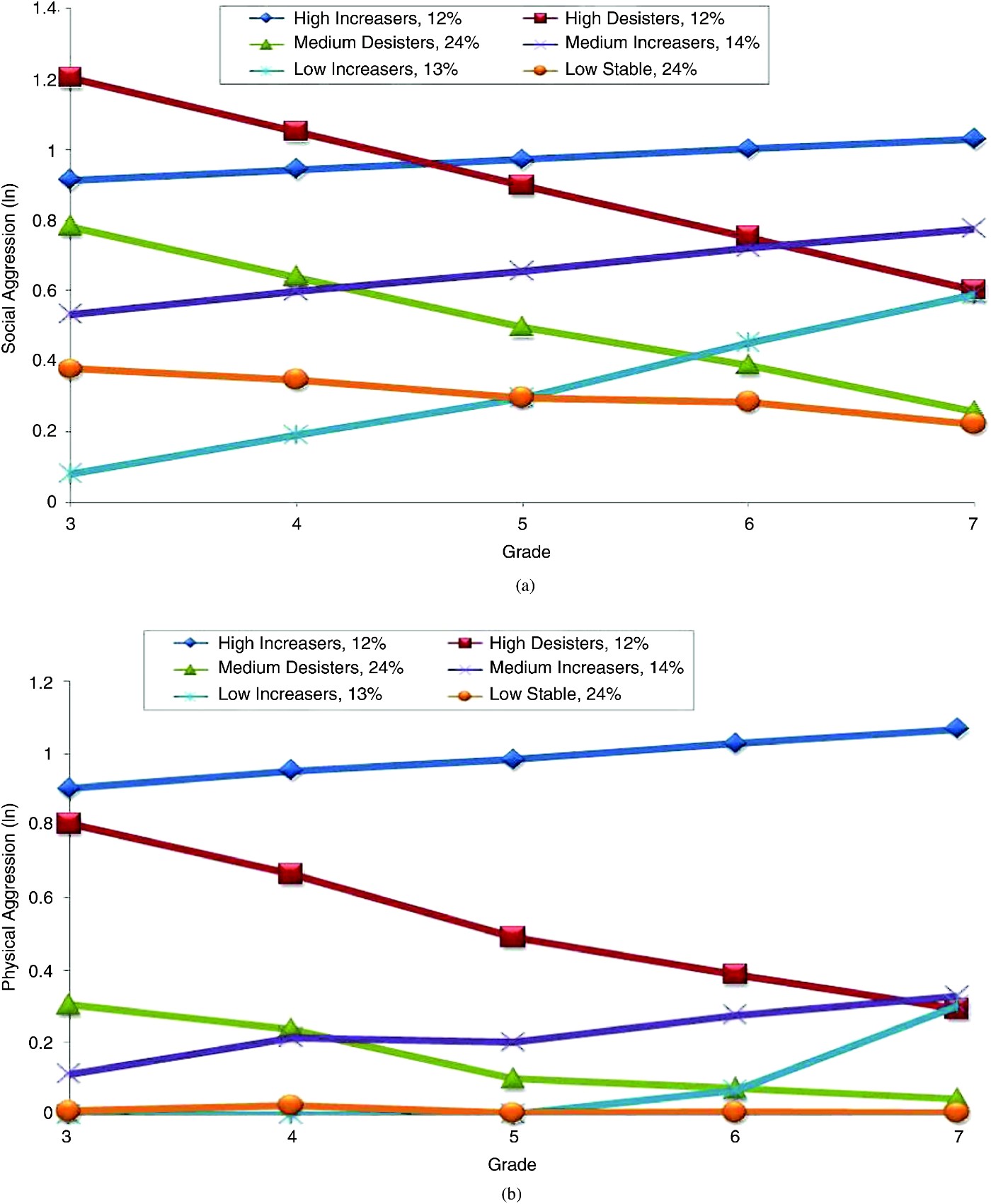
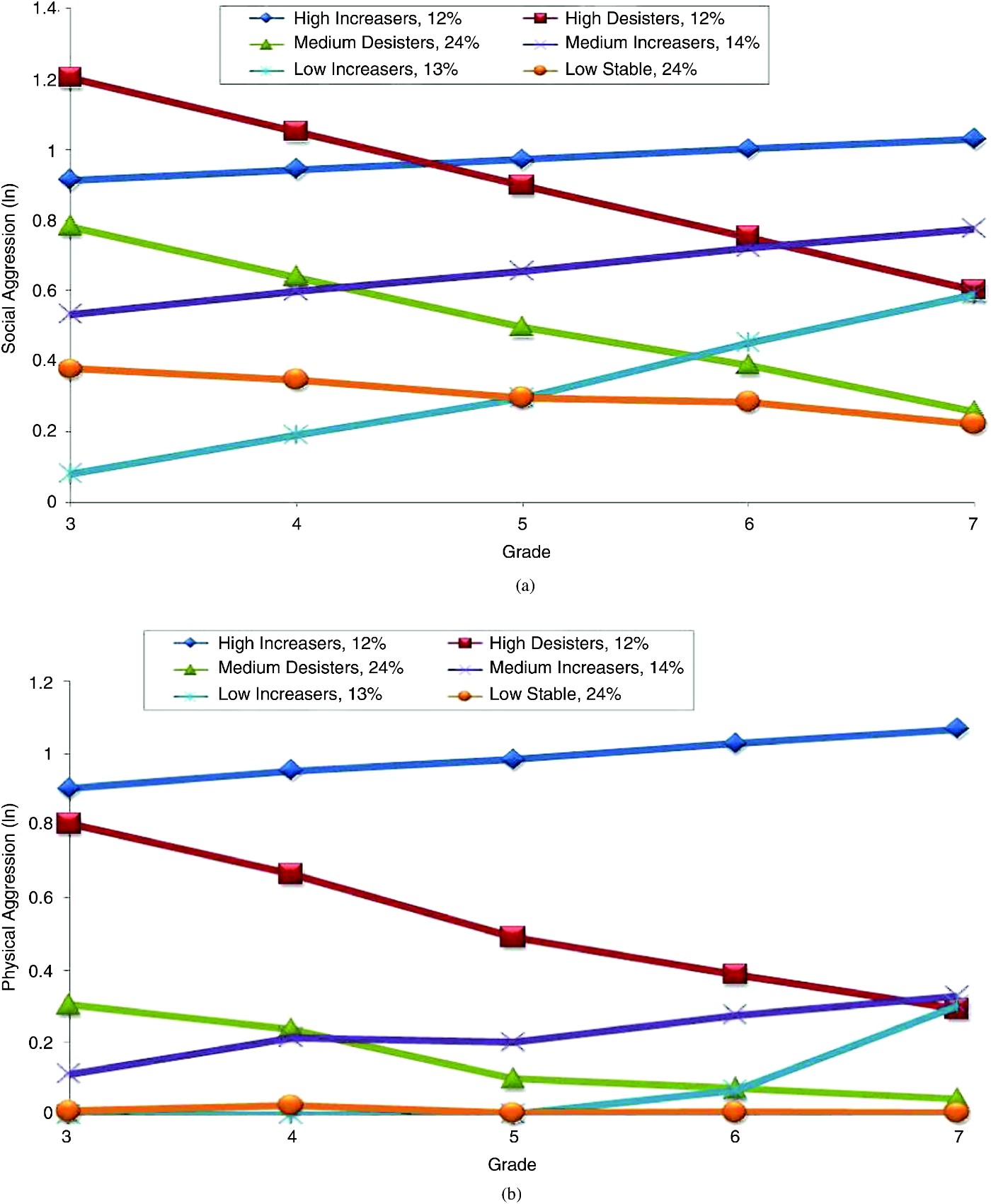
Using these procedures, six joint trajectory groups were identified for 255 participants. A mixture model was estimated that allowed separate trajectories to be estimated for social and physical aggression for each of the six trajectory groups using an unconstrained model to allow the data to fully inform the social and physical aggression trajectories for the six trajectory groups. Figure 1a illustrates change in social aggression across time for the joint trajectory groups and Figure 1b illustrates change in physical aggression across time for the joint trajectory groups. The low stable group was low on both forms of aggression (n = 62, 24% of the sample; 23 boys, 39 girls). The low increaser group was initially low on both forms of aggression but increased with development (n = 34, 13%; 20 boys, 14 girls). The medium increaser group was initially in the middle on both forms of aggression and increased with development (n = 36, 14%; 17 boys, 19 girls). The medium desister group was initially in the middle on both forms of aggression but decreased with development (n = 61, 24%; 26 boys, 35 girls). The high desister group was initially high on both forms of aggression and decreased with development (n = 31, 12%; 15 boys, 16 girls). The high increaser group was initially high on both forms of aggression and increased with development (n = 31, 12%; 22 boys, 9 girls).
The change in (a) social aggression for joint trajectory groups and (b) physical aggression for joint trajectory groups. Adapted from “Continuity and Change in Social and Physical Aggression From Middle Childhood Through Early Adolescence,” by M. K. Underwood, K. J. Beron, and L. H. Rosen, 2009, Aggressive Behavior, 35, 357–375. Copyright 2009 by Wiley–Liss. Adapted with permission. [A color version of this figure can be viewed online at journals.cambridge.org/dpp]
The reliability of the models was evaluated by computing the average posterior probability of assignment (AvePP) and the odds of correct classification (OCC; Nagin, Reference Nagin2005). The AvePP can be determined by averaging the actual (posterior) probability of being assigned to the class to which the student is actually assigned. For example, one student within the social aggression model may have a 0.45 probability of being in class one and 0.55 probability of being assigned to class two, whereas another student might have 0.2 probability of being assigned to class one and 0.8 probability of being assigned to class two. Both students would be assigned to Class 2, but the second student is more reliably placed. For this example, the AvePP for Class 2 would be AvePP2 = 0.675. Nagin (Reference Nagin1999, Reference Nagin2005) suggests that an AvePP of assignment of 0.70 or greater for each class is acceptable. The second reliability measure, the OCC for Class j, is computed by the following formulate (Nagin, Reference Nagin2005):

In this formula, the numerator is the odds of correct assignment based on the AvePP and the denominator uses the estimated population proportion of Class j,  , and provides an estimate of what the odds are of a student being classified in Class j if they were randomly assigned. Thus, a higher OCCj suggests better classification by the model compared to random assignment to classes. Nagin (Reference Nagin2005) proposes that the criterion for reliable assignment to groups is an OCCj greater than five for each group. For the joint trajectory model, the lowest AvePP for any of the six groups was 0.73 and the lowest OCC was 9.24. Thus, the model met both the AvePP and OCC criteria for reliable assignment to groups (Nagin, Reference Nagin1999, Reference Nagin2005). For more information on estimation of the mixture model and the trajectories see (Underwood et al., Reference Underwood, Beron and Rosen2009).
Results
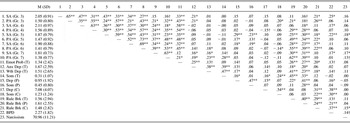
Teachers reported on target children's aggression in third, fourth, fifth, sixth, and seventh grades. Teachers, parents, and target children provided ratings of target children's adjustment in eighth grade. The means, standard deviations, and correlations among these variables are presented in Table 1. These descriptive statistics are from the sample data and are not those estimated within our full information maximum likelihood (FIML) analyses, although the results are very similar. Estimated means were within an average of 0.04 of actual means. None of the actual correlations differed significantly from the estimated correlations according to the Fisher r to z test (which we conducted just for diagnostic purposes, acknowledging that the two samples were not independent).
Descriptive statistics and correlations

Note: SA, social aggression; PA, physical aggression; T, teacher reported; P, parent reported; C, child reported; BPD, borderline personality disorder.
†p = .10.**p = l.05. **p = .01.
We used structural equation modeling to test the relationship between aggression trajectory groups and adjustment outcomes with multiple indicators (i.e., internalizing problems and rule-breaking behaviors). Analyses were conducted using Mplus (Muthén & Muthén, Reference Muthén and Muthén2006). We accounted for missing data using direct FIML implemented with numerical integration to account for our ordered, categorical indicators. FIML allows all observations that have data to contribute to the estimates, thus avoiding the widely documented problems related to dropping observations or imputing data. This method is appropriate under either the assumption of data missing completely at random or missing at random (Allison, Reference Allison2003). Under these conditions, results are unbiased and efficient. We first present results examining internalizing problems and then present results examining rule-breaking behaviors. We then present analyses examining the relationship between aggression trajectories and features of borderline and narcissistic personality disorders. Structural equation modeling was not necessary because borderline and narcissistic personality features were measured solely by self-reports.
Main effects of gender were tested in all models. Preliminary analyses examining interactions between gender and group membership yielded only three significant interactions between gender and membership in the low increaser group, and follow-up tests did not yield significant differences between gender by trajectory groups. For these reasons, interactions between gender and trajectory group membership were excluded from final models.
Internalizing problems
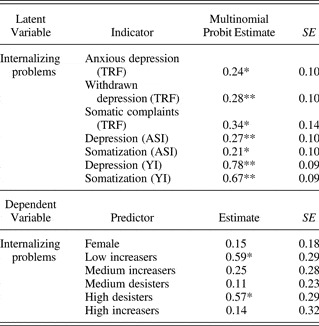
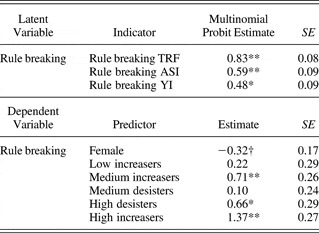
Teacher, parent, and child report measures were used to indicate the latent construct of internalizing problems measured at age 14. Specifically, we used teacher reported anxious depression, withdrawn depression, and somatic complaints from the CBCL-TRF (Achenbach & Rescorla, Reference Achenbach and Rescorla2001), parent reported depression and somatization from the ASI (Gadow & Sprafkin, Reference Gadow and Sprafkin1997), as well as self-reported depression and somatization from the YI-4 (Gadow & Sprafkin, Reference Gadow and Sprafkin1997). These variables were not normally distributed but rather were summative counts of behaviors that formed ordinal indicators. In our analysis we therefore treated each of the indicators as an ordered, categorical variable in order to account for the categorical nature of the data. (One exception was child-reported depression, which appeared normal and was treated as such.) Underlying these indicators was a latent construct of internalizing problems that was a continuous variable. Indicator loadings for the latent construct of internalizing problems were significant, ps < .05 (see Table 2).
Multinomial probit estimates for indicators and predictors of internalizing problems

Note: Multinomial probit estimates were based on ordinal data analysis using numerical integration. TRF, Teacher Report Form; ASI, Adolescent Symptom Inventory; YI, Youth's Inventory.
*p < .05. **p < .01.
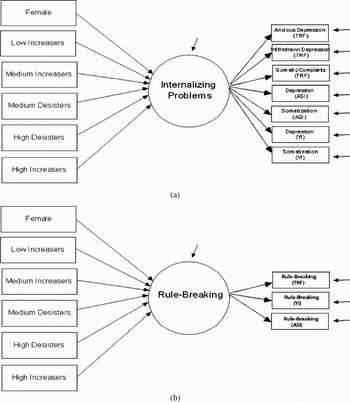
We tested a model in which aggression trajectory group and gender predicted the latent construct of internalizing problems (see Figure 2a). We used five dummy coded variables to represent the low increasers, medium increasers, medium desisters, high desisters, and high increasers; the reference group was the low stable group. Standardized parameter estimates are reported based on standardization of the dependent variable and did not involve standardization of the binary predictor variables to allow for proper interpretation of the estimates. Table 2 presents standardized parameter estimates and standard errors for this analysis. There was a significant effect of being in the low increaser (standardized parameter estimate = 0.59, p < .05) and high desister groups (standardized parameter estimate = 0.57, p < .05) on internalizing problems; the low increaser and high desister groups demonstrated greater internalizing problems than did the low stable group. Gender and membership in other groups did not significantly predict internalizing problems. Traditional fit indices (e.g., comparative fit index, root mean square error of approximation) were not available for this analysis because of the use of numerical integration in the estimation of the categorical indicators. In this situation, means, variances, and covariances are not sufficient statistics for model estimation. Therefore, chi-square and related fit measures are not available (Muthén, Reference Muthén and Muthén2006).
The conceptual model of the relationship between (a) aggression trajectories and internalizing problems and (b) aggression trajectories and rule breaking. Traditional fit indices (e.g., comparative fit index, root mean square error of approximation) were not available for this analysis because of the use of numerical integration in the estimation of the categorical indicators. In this situation, means, variances, and covariances are not sufficient statistics for model estimation. Therefore, chi-square and related fit measures are not available (Muthén, Reference Muthén and Muthén2006).

Rule-breaking behaviors
We conducted a parallel analysis to examine the relationship between aggression trajectory group and rule-breaking behaviors. The latent construct of rule-breaking behaviors was assessed at age 14 and was indicated by teacher reported rule breaking on the CBCL-TRF (Achenbach & Rescorla, Reference Achenbach and Rescorla2001), parent reported rule breaking on the the ASI (Gadow & Sprafkin, Reference Gadow and Sprafkin1997), and self-reported rule breaking on the YI-4 Self-Report (Gadow & Sprafkin, Reference Gadow and Sprafkin1997). As was the case for internalizing problems, we treated each of the indicators as an ordered, categorical variable in order to account for the categorical distribution of the data. Indicator loadings for the latent construct of rule-breaking behaviors were significant (ps < .05). Table 3 presents the results of these analyses.
Multinomial probit estimates for indicators and predictors of rule-breaking behaviors

Note: Multinomial probit estimates were based on ordinal data analysis using numerical integration. TRF, Teacher Report Form; ASI, Adolescent Symptom Inventory; YI, Youth's Inventory.
†p < .10. *p < .05. **p < .01.
We tested a model in which aggression trajectory group and gender predicted the latent construct of rule-breaking behaviors (see Figure 2b). We again used five dummy coded variables to represent the low increasers, medium increasers, medium desisters, high desisters, and high increasers; the reference group was the low stable group (see Table 3 for standardized parameter estimates, standardized as described previously). There was a trend for being female to negatively predict rule-breaking behaviors. There were significant effects of being in the medium increaser group (standardized parameter estimate = 0.71, p < .01), the high desister group (standardized parameter estimate = 0.66, p < .05), and the high increaser group on rule-breaking behaviors (standardized parameter estimate = 1.37, p < .01). Adolescents in the medium increaser, high desister, and high increaser groups demonstrated more rule-breaking behaviors than did those in the low stable group. As was the case for the analysis of internalizing problems, traditional fit indices (e.g., comparative fit index, root mean square error of approximation) could not be used because of the use of numerical integration in the estimation of the categorical indicators.
Features of borderline and narcissistic personality disorders
Adolescents provided reports on the borderline personality subscale of the IPDE (Loranger, Reference Loranger1999) and the NPIC (Barry et al., Reference Barry, Frick and Killian2003). We used regression analyses to examine the relationship between aggression trajectory groups and features of these personality disorders, estimated with maximum likelihood for a parallel treatment with our previous analyses. As was done for the structural equation modeling analyses, we used five dummy coded variables to represent group membership with the low stable group as the reference group.
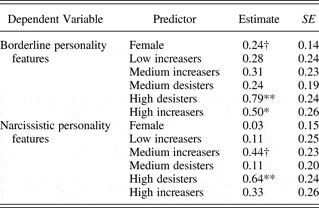
For features of borderline personality disorder, being in the high desister and high increaser groups were positive predictors (see Table 4 for coefficients). There was a trend for being female to positively predict borderline personality features.
Predictors of borderline and narcissistic personality features

†p < .10. *p < .05. **p < .01.
For features of narcissistic personality disorder, membership in the high desister group was the only significant predictor of features of narcissistic personality disorder, although there was a trend for membership in the medium increaser group (see Table 4 for coefficients). Adolescents in the high desister group demonstrated significantly more narcissistic tendencies than those in the low stable group.
Do emotion dysregulation and baseline adjustment account for relationships between joint trajectory groups and adjustment outcomes?
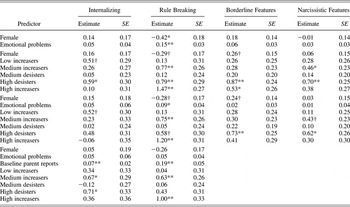
To explore whether emotional problems might account for the relations between aggression trajectory groups and adjustment outcomes, a series of regression analyses was conducted to investigate whether teacher-rated emotional problems predicted adjustment outcomes, and whether the predictive relations of aggression trajectory groups remained when emotional problems were included in the regression models (see Table 5). Gender was dummy coded so that 1 = female and 0 = male. Regression analyses with just female gender and aggression trajectory groups are also included here for comparison because these analyses include a slightly smaller sample than in Tables 2–4 because teacher ratings of emotional problems in fourth/fifth grade were not available for all members of the sample). When examined only with female gender, emotional problems in middle childhood significantly predicted rule breaking at age 14, but not internalizing, borderline, or narcissistic symptoms. When examined in the model along with female gender and aggression trajectory groups, emotional problems remained a significant predictor of rule breaking, but no predictive relations emerged for other outcomes. Most of the predictive relations between aggression trajectory groups and adjustment outcomes remained, even when earlier emotional problems were included in the model, except that membership in the high desister group no longer predicted internalizing symptoms.
Joint aggression trajectory groups, emotional problems, and baseline adjustment as predictors of adjustment

†p < .10. *p < .05. **p < .01.
Next, to examine whether joint aggression trajectories from Grades 3 to 7 predicted adolescent maladjustment above and beyond earlier levels of maladjustment, regression analyses were conducted for internalizing symptoms and rule breaking with parents' reports of children's third-grade symptoms included in the models (baseline data were not available for borderline and narcissistic features; last results in Table 5). For internalizing symptoms, although baseline parent reports were a highly significant predictor, membership in the high desister group remained predictive of adolescent maladjustment. The trend for membership in the low increasers group was no longer apparent, and a significant effect emerged for the medium increasers group (which may be an artifact of the slightly smaller sample available for these analyses, n = 177 instead of n = 195). For rule-breaking behaviors, although baseline parent reports were again a highly significant predictor, membership in the high increaser and medium increaser groups remained significant predictors. The trend for membership in the high desister group was no longer apparent when parents' reports of baseline rule-breaking behaviors were included in the model.
Do social and physical aggression trajectory groups uniquely predict adjustment outcomes?
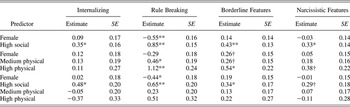
Although our primary goal was to examine the predictive utility of joint aggression trajectories because social and physical aggression are so highly correlated, we did explore whether membership in the separate social and physical aggression trajectories predicted adjustment. To do this, regression analyses were conducted with the only predictors being the separate aggression trajectory groups. Remember that for social aggression, two trajectory groups emerged, one stable low and one high but decreasing slightly. For physical aggression, three trajectory subgroups emerged: stable low, medium and decreasing, and stable high (see Underwood et al., Reference Underwood, Beron and Rosen2009). Regression analyses were first conducted with gender and high social aggression trajectory group membership as predictors, next with gender (dummy coded so that 1 = female and 0 = male) and medium and high physical aggression trajectory group membership as predictors, and last, with female gender, high social aggression, medium physical aggression, and high physical aggression trajectory group membership as predictors (all dummy coded for comparison with the low, stable group; see Table 6).
Social and physical aggression trajectory groups as unique predictors of adjustment

†p < .10. *p < .05. **p < .01.
For internalizing symptoms, membership in the high social aggression trajectory group was a significant predictor when examined with female gender, and remained a significant predictor with membership in the medium and high physical aggression trajectory groups included in the model. Neither female gender nor physical aggression trajectory groups were significant predictors in any of the analyses.
For rule-breaking behaviors, membership in the high social aggression trajectory group was a significant predictor when examined with female gender, and membership in the medium and high physical aggression trajectory groups were significant predictors when examined only with gender. When female gender, high social, medium physical, and high physical aggression trajectory group membership were all included in the model, only gender and high social aggression emerged as significant predictors.
For borderline personality features, membership in the high social aggression trajectory group was a significant predictor when examined with female gender, and membership in the high physical aggression trajectory group was a significant predictor (there were trends for female gender and membership in the medium physical aggression trajectory group). When social and physical aggression trajectory groups were included in the same model along with female gender, the only predictor that emerged as significant was membership in the high social aggression trajectory group.
For narcissistic personality features, membership in the high social aggression trajectory group was a significant predictor when examined with female gender, and there was a trend for membership in the high aggression trajectory group when examined with female gender. When the social and physical aggression trajectory groups were examined together in the same model with female gender, the only predictor that approached significance was a trend for membership in the high social aggression trajectory group.
Discussion
Overall, these results supported the hypothesis that developmental trajectories jointly estimated for social and physical aggression across middle childhood and early adolescence would predict maladjustment at age 14. As predicted, the joint trajectory group high and increasing on both social and physical aggression in middle childhood was at risk for adjustment problems at age 14: rule-breaking behaviors and borderline personality features. Contrary to hypotheses, those in the high desister group were higher on all adjustment problems at age 14 than the stable low group: internalizing, rule-breaking behaviors, borderline, and narcissistic symptoms.
Before discussing specific adjustment outcomes related to following high and rising and high and desisting trajectories for social and physical aggression, it is important to note that at all age levels in this study, social and physical aggression were highly correlated (0.60 and above at each grade level). No children in this study followed trajectories characterized by falling physical aggression and increasing social aggression, as had been proposed to be likely according to the theory of heterotypic continuity (Bjorkqvist, Reference Bjorkqvist1994). Our results are consistent with previous findings by Cote at al. (2007), who found that only 1.8% of their large sample was increasing in one form of aggression and decreasing in the other across development. Our results also confirm longitudinal analyses by Vaillancourt, Brendgen, Boivin, and Tremblay (Reference Vaillancourt, Brendgen, Boivin and Tremblay2003), which showed that children were fairly consistent across ages 4–11 in their use of forms of aggression; cross-lagged analyses did not support the theory of heterotypic continuity that children would decrease in physical aggression while increasing in social aggression.
Internalizing symptoms as rated by adolescents, parents, and teachers were predicted only by membership in the low increaser and high desister joint trajectory groups. High desisters were highest on both forms of aggression at age 9, but decreased slightly with development, so these results are consistent with research with middle-childhood samples showing that peer nominations for social aggression relate to self-reported depressive symptoms (Crick & Grotpeter, Reference Crick and Grotpeter1995), that social aggression and internalizing symptoms seem to change together over 1 calendar year (Murray-Close et al., Reference Murray-Close, Ostrov and Crick2007), and that across 1 school year, being high on both social and physical aggression predicted internalizing problems (Crick et al., Reference Crick, Ostrov and Werner2006). Low increasers were almost identical to high desisters in levels of social aggression in seventh grade (although far lower on physical aggression), which further suggests a relation between social aggression and internalizing symptoms. However, this result must be interpreted with caution, because the relation between membership in the low increaser joint trajectory group and adolescent internalizing symptoms was only a trend when emotion regulation was included in the model, and became nonsignificant when baseline levels of internalizing symptoms were included.
Membership in the high increasing and high desisting trajectory groups predicted rule-breaking behavior (although the finding for the high desister group must be viewed with caution because it became a trend when emotion regulation was added to the model, and nonsignificant when parents' reports of baseline rule-breaking behaviors were included in the model). These findings are consistent with previous research showing predictive relations between childhood physical aggression and adolescent antisocial behavior (see Dodge et al., Reference Dodge, Coie, Lynam, Damon and Eisenberg2006). Along with the findings that that the high social aggression trajectory predicted rule-breaking, these results also add to growing evidence that social aggression may be related to externalizing symptoms in childhood (Crick, Reference Crick1997), that children high on both social and physical aggression may be most at risk (Crick et al., Reference Crick, Ostrov and Werner2006), and that social aggression may be related to antisocial behavior in adolescence (Chamberlain & Moore, Reference Chamberlain, Moore, Geffner and Greenwald2002; Moretti et al., Reference Moretti, Holland and McKay2001; Prinstein et al., Reference Prinstein, Boergers and Vernberg2001). Of interest, the medium increaser joint trajectory group was also higher on rule-breaking behaviors than the low stable group. Children following the medium increaser joint aggression trajectory may be somewhat akin to “late starter” antisocial youth as described by Moffitt (Reference Moffitt1993), in that they do not show early risk factors or elevations in behavior problems, but begin to break rules in adolescence, perhaps due to affiliation with other deviant peers or perhaps out of a desire to demonstrate their maturity by engaging in illicit acts.
Membership in the high increasing and high desisting trajectory groups also predicted borderline personality features. These results fit with previous evidence suggesting that social aggression may be related to borderline features in childhood (Crick et al., Reference Crick, Murray-Close and Woods2005; Crick, Woods, et al., 2007) and in young adulthood (Werner & Crick, Reference Werner and Crick1999). That both groups initially high on both social and physical aggression, high increasers and high desisters, showed elevated borderline personality features at age 14 is consistent with the proposition that social aggression may be a childhood expression of borderline personality tendencies (Crick, Woods, et al., 2007). Although the high desisters may decrease in their social and physical aggression across childhood, or at least in the extent to which their teachers perceive them engaging in those behaviors, perhaps they are still elevated on borderline personality features because their early, high levels of social and physical aggression were reflective of underlying problems with emotion regulation that emerge later as borderline personality features.
Results did not support our hypothesis that the high increaser joint trajectory group would be significantly higher than the low stable group on narcissistic personality features. However, membership in the high desister group predicted narcissistic personality features in adolescence. It is interesting that the high desister group was substantially higher on social aggression and almost as high on physical aggression as the high increaser group in third grade. Perhaps narcissistic personality tendencies are related to high levels of aggression in childhood (Barry et al., Reference Barry, Frick and Killian2003), but as these children mature, they might become even more exaggerated in their sense of self-importance and increasingly concerned with making sure others regard them highly and avoiding shame. High desisters may engage in less aggressive behavior with development or at least in less aggressive behavior that teachers are able to see, in part because their fragile self-esteem could lead them to seek to avoid the humiliation of negative feedback. The high increaser group could continue to be so dysregulated that their aggressive behaviors increase, and they may be more prone to borderline than narcissistic personality features because their identities and affect are so unstable.
Although our investigation was not able to examine the mechanisms by which joint aggression trajectories would predict this broad range of adjustment problems, we had proposed that childhood aggression may be a marker for problems with emotional and behavioral regulation, which may be a nonspecific predictor of adjustment problems in adolescence (Silk et al., Reference Silk, Steinberg and Sheffield Morris2003; Steinberg & Avenevoli, Reference Steinberg and Avenevoli2000). Children high and increasing on both social and physical aggression across childhood likely struggle to regulate strong emotions that may manifest in internalizing problems, rule-breaking behaviors, and features of borderline and narcissistic personality disorders. Our study did not include the fine-grained assessments needed to do justice to this hypothesis. However, we were able to examine whether teacher ratings of emotional problems at age 10 accounted for some of the relations between membership in aggression trajectory groups and adjustment outcomes. For the most part, this hypothesis was not supported. Middle childhood emotional problems predicted only rule-breaking behaviors when examined alone with gender, and when emotional problems were included in regression models along with aggression trajectory groups, emotional problems were not a significant predictor and most relations between aggression trajectory groups and adjustment outcomes remained. Future research with more robust measures of emotion regulation, and other possible explanatory mechanisms, will be needed to understand fully how precisely these joint aggression trajectories predict adjustment outcomes. Our preliminary findings with a limited measure suggest that emotion dysregulation cannot fully explain the predictive relations between membership in aggression trajectory groups and adjustment outcomes.
Our primary goal in this study was to examine the predictive power of joint aggression trajectories, because social and physical aggression are so highly correlated in this and many other studies (Card et al., Reference Card, Stucky, Sawalani and Little2008). However, because we also determined developmental trajectories separately for social and physical aggression, we took the opportunity to explore whether trajectory groups estimated separately for social and physical aggression also predicted maladjustment. When membership in high social aggression and medium and high physical aggression trajectory groups were examined together as predictors of maladjustment, only membership in the high social aggression trajectory group emerged as a significant predictor of internalizing, rule-breaking, and borderline symptoms (with a trend for narcissistic features). These results confirm that persistently engaging in high levels of social aggression is a robust predictor of adjustment outcomes, even when taking into account physical aggression (Crick et al., Reference Crick, Ostrov and Werner2006).
Although gender and interactions between gender and trajectory groups were tested in all analyses, no significant effects of gender emerged. If engaging in social aggression increases girls' risk for disorders for which girls and women have higher base rates (Crick & Zahn-Waxler, Reference Crick and Zahn-Waxler2003), then it makes sense that gender differences in some of these disorders might be less evident when joint aggression trajectories are taken into account.
The lack of significant interactions of trajectory group membership and gender in predicting maladjustment suggests that joint aggression trajectories for social and physical aggression influence adjustment similarly for girls and boys. This is consistent with the fact that although base rates of physical aggression are lower for girls than boys (Dodge et al., Reference Dodge, Coie, Lynam, Damon and Eisenberg2006), physical aggression seems to be predictive of negative outcomes for both genders (Underwood & Coie, Reference Underwood, Coie, Putallaz and Bierman2004). This finding also fits with results of a recent, comprehensive meta-analysis showing that there are no significant gender differences in the relations between aggression (both social and physical) and adjustment (Card et al., Reference Card, Stucky, Sawalani and Little2008).
All of these results must be interpreted in light of methodological limitations. First, the initial consent rate for this longitudinal study involving yearly lab visits with a parent and a best friend was only 55%. Although this rate is typical or even higher than the average consent rates for school-based data collection with normative samples (Betan et al., Reference Betan, Roberts and McCluskey-Fawcett1995; Sifers et al., Reference Sifers, Puddy, Warren and Roberts2002), it is likely that some of the most aggressive children were not included in our sample. Still, that the hypothesized relations between joint trajectories and adjustment emerged suggests that these relations may be robust.
Second, because of parent and school district concerns, social and physical aggression were assessed by teacher reports and not with peer nominations. It may have been difficult for teachers to observe subtle forms of aggression, especially with older students. However, evidence suggests that peer and teacher reports of social and physical aggression are highly correlated (Crick, Reference Crick1996). Perhaps because teachers have the opportunity to observe students with peers daily and asking teachers to rate social behavior is more efficient and less disruptive than asking peers, many peer relations researchers rely on teacher ratings of aggression (Cillessen, Terry, Coie, & Lochman, Reference Cillessen, Terry, Coie and Lochman2002; Henry, Miller-Johnson, Simon, & Schoeny, Reference Henry, Miller-Johnson, Simon and Schoeny2006; Merrell, Buchanan, & Tran, Reference Merrell, Buchanan and Tran2006). Peer experts have argued that “teachers appear to be very sensitive observers of the social worlds of their students” (Putallaz et al., Reference Putallaz, Grimes, Foster, Kupersmidt, Coie and Dearing2007, p. 544).
Third, not all teachers were willing to provide ratings of aggression. However, the rate of teacher participation was high; those with teacher data did not differ from the rest of the sample, and imputation methods were used to deal with missing data.
Fourth, the reliability of the measure of borderline personality features was in the questionable range (not in the good range, but also not in the weak or poor ranges either; George & Mallery, Reference George and Mallery2003). However, this does not seem surprising given that experts have long struggled with how to define and measure borderline personality and that the hallmark of this disorder is instability in emotion, self-concept, and behavior (Nolen-Hoeksema, Reference Nolen-Hoeksema2007).
Fifth, some of our trajectory groups were small and thus our statistical power to detect main effects and interactions may have been limited. Still, that statistically significant findings emerged with small groups suggests that the relation between joint aggression trajectories and adjustment may be strong.
Sixth, although baseline measures were available for internalizing symptoms and rule-breaking behaviors, we did not have baseline assessments of borderline and narcissistic features. Thus, we cannot be sure that joint aggression trajectories predict adolescent borderline and narcissistic symptoms above and beyond third-grade levels. Still, it is encouraging that for the variables for which we did have baseline assessments, most of the significant relations were still evident between joint aggression trajectories and adolescent adjustment.
Seventh, although we had multiple informants for the internalizing and rule-breaking constructs, for borderline and narcissistic personality features, only self-reports were available. However, many of the cognitive and affective symptoms of these syndromes are not apparent to observers and must be assessed by self-report in some form.
However, the study had important strengths. Although social and physical aggression are highly correlated and previous evidence suggests that children high on both social and physical aggression are most at risk for maladjustment (Crick et al., Reference Crick, Ostrov and Werner2006), this is one of the first investigations to examine whether joint developmental trajectories for social and physical aggression in childhood predict adolescent maladjustment. The sample was reasonably large for a study that involved individually administered measures of adjustment. Our study included multiple informants for internalizing and rule-breaking behaviors. Given that trajectories were determined on the basis of different teachers rating each child each year, these results cannot be due to shared method variance, because the only teacher data included in the latent constructs for internalizing and rule-breaking behaviors were from eighth-grade teachers, who did not contribute to the data for establishing the trajectory groups. Many of the predictive relationships between membership in trajectory groups and adjustment remained even when emotion regulation and baseline measures (for internalizing and rule-breaking symptoms) were included in the model.
In conclusion, these results demonstrate that childhood aggression trajectories jointly estimated on the basis of social and physical aggression predict adolescent maladjustment. That children's trajectories for social and physical aggression together predict rule-breaking behaviors is in some ways unsurprising, almost an example of persistence forecasting. However, the mechanisms by which joint trajectories of childhood aggression also predict internalizing symptoms and borderline and narcissistic personality features are less than self-evident and should be explored in future research. Being high on social and physical aggression may predict a range of adjustment problems in adolescence because childhood aggression is a marker of serious problems with emotion regulation that may serve as a nonspecific risk for later maladjustment (Steinberg & Avenevoli, Reference Steinberg and Avenevoli2000). Although our examination of a seven-item teacher rating measure of middle childhood emotional problems provided only limited support for this proposition, future research should examine this hypothesis directly, and also explore which biological or contextual factors may predict which children with regulation problems develop which later disorder.
These findings are consistent with previous claims that the best predictor of adjustment problems may be comorbidity of social and physical aggression (Crick et al., Reference Crick, Ostrov and Werner2006). These person-centered analyses add to what is known from previous variable-centered analyses because these analyses confirm that children who follow high and rising as well as high and desisting joint aggression trajectories over time are most at risk. Overall, these results support the claim that social aggression, and perhaps physical aggression, as well, may be normative at low levels at some points in the life span and not predictive of maladjustment (Chesney-Lind et al., Reference Chesney-Lind, Morash and Irwin2007; Remillard & Lamb, Reference Remillard and Lamb2005; Underwood et al., Reference Underwood, Galen and Paquette2001). Although the low increaser and medium desister groups showed elevated levels of aggression at some time points, these groups were not consistently at risk for maladjustment at age 14 (the only exception being that low increasers were at greater risk of internalizing problems in analyses that did not include emotion regulation and the baseline measure of internalizing symptoms). However, both the high increaser and high desister groups were at risk for a range of adjustment problems, which suggests that children high on both and physical aggression in middle childhood are at risk for maladjustment whether their aggression decreases or increases slightly through early adolescence. These findings suggest that intervention programs to reduce risks associated with childhood aggression might be best focused on children who are high on both social and physical aggression during middle childhood, to help them develop more balanced views of themselves and more regulated responses to the world around them.