




No CrossRef data available.
Article contents
Fish population size, and not density, as the determining factor of parasite infection: a case study
Published online by Cambridge University Press: 03 March 2004
Abstract
The diversity and abundance of parasites vary widely among populations of the same host species. These infection parameters are, to some extent, determined by characteristics of the host population or of its habitat. Recent studies have supported predictions derived from epidemiological models regarding the influence of host population density: parasite abundance and parasite species richness are expected to increase with increasing host population density, at least for directly transmitted parasites. Here, we test this prediction using a natural system in which populations of the crucian carp, Carassius carassius (L.), occur alone, with no other fish species, in a series of 9 isolated ponds in Finland. The ectoparasite communities in these fish populations consist of only 4 species of monogeneans (Dactylogyrus formosus, D. wegeneri, D. intermedius and Gyrodactylus carassii); the total and relative abundance of these 4 species varies among ponds, with one or two of the species missing from certain ponds. Across ponds, only one factor, total fish population size, explained a significant portion of the variance in both the mean number of monogenean species per fish and the mean total abundance of monogenean individual per fish. In contrast, fish population density did not influence either monogenean abundance or species richness, and neither did any of the other variables investigated (mean fish length per pond, number of fish examined per pond, distance to the nearest lake, and several water quality measures). In our system, proximity among fish individuals (i.e. host population density) may not be relevant to the proliferation of monogeneans; instead, the overall availability of host individuals in the host population appeared to be the main constraint limiting parasite population growth.
Information
- Type
- Research Article
- Information
- Copyright
- 2004 Cambridge University Press
INTRODUCTION
One of the most prominent features of parasite infections in wild host populations is their variability among populations of the same host species. Both the diversity and abundance of parasites differ from one host population to the next. Certain habitat characteristics, either physical or chemical, may facilitate the establishment and proliferation of parasites in particular host populations. In fish hosts, for example, variables such as lake size, water pH or distance from other lakes have been associated with either the number of parasite species per host population, or with the mean abundance of given parasites (e.g. Kennedy, 1978; Marcogliese & Cone, 1991; Hartvigsen & Halvorsen, 1994; Karvonen et al. 2003). Features of the host population itself may also be important determinants of how many parasite species and parasite individuals occur in a host population. Epidemiological models predict that the number of hosts in a population influences the transmission success of parasites, by determining the contact rate between the parasites' infective stages and new hosts (see Hudson et al. 2002 for recent reviews). There is therefore a minimum, or threshold, number or density of hosts required for the establishment and spread of a parasite in a host population, and as the number or density of hosts in the population increases, so should the abundance of the parasite. The models use either host density (number of hosts per area or volume) or host population size as the key parameter influencing parasite transmission success. The inclusion of either host density or population size in a model is usually dependent on preliminary information from the study system (see McCallum, Barlow & Hone, 2001). There is empirical support suggesting that host population density is indeed an important predictor of both parasite abundance and parasite species diversity, in comparative studies across related host species (Morand & Poulin, 1998; Arneberg et al. 1998; Arneberg, 2001, 2002). To our knowledge, there is currently no empirical evidence that host numbers or density affects macroparasite infections among populations of the same host species in the wild. There is some evidence that host population size or density is important for microparasites, including several human diseases such as measles (Earn et al. 2000; Bjornstad, Finkenstadt & Grenfell, 2002). Studies on macroparasites are complicated by other variables also differing between host populations, in particular the diversity of other host species co-occurring with the host species investigated. Here, we take advantage of a natural system in which populations of the crucian carp, Carassius carassius (L.), occur alone, with no other fish species, in a series of isolated ponds. This system represents a natural laboratory in which carp populations of different sizes or densities have established naturally and on which parasites have established and proliferated independently; it provides a great opportunity to test the effects of host population features on parasite infections among populations of the same host species.
The retreat of the ice after the last glaciation left Finland pockmarked with thousands of small ponds (approx. 130000, size 0·05–1 ha) and lakes (approx. 56000>1 ha) (Raatikainen, 1987). Small ponds are often characterized by brown water, low pH, shallow depth and hypoxia during the long northern winter, making them uninhabitable for most other fish species but suitable habitats for crucian carp, because of its unique tolerance of anoxia (Holopainen, Hyvärinen & Piironen, 1986; Tonn et al. 1990). Often crucian carp is the only fish species present under these extreme conditions; in winter, more than 6 months in dark anoxic water near freezing temperatures, and in summer at temperatures up to 30 °C. It is in summer that the carps experience relatively brief periods of vigorous growth and repeated bouts of reproduction in almost continuous daylight (Holopainen, Tonn & Paszkowski, 1997). In all size-classes the food during summer consists mainly of planktonic (cladocerans) or benthic invertebrates, but plant material, phytoplankton and detritus are also commonly found in gut contents (Holopainen, Tonn & Paszkowski, 1992). In winter the metabolic rate is depressed and the fish hibernate just above freezing level. Crucian carps are extremely vulnerable to predation and have therefore adapted to two different kinds of life-styles: aided by its physiological adaptations to extreme conditions, crucian carp can be the sole fish inhabitant in dense monocultures of stunted individuals in the ponds (‘pond type’), but in lakes crucian carps grow much larger and display a deeper body shape to avoid predation (‘lake type’) (Holopainen et al. 1997). In the ponds, the fish are gregarious and found in shoals, and they occupy the entire water column.
This study focuses on the ectoparasite communities on ‘pond type’ crucian carps that live in dense monocultures in very similar extreme conditions, i.e. similar water quality and biotic factors, such as the composition of the flora and fauna in the ponds. They thus represent a perfect natural system of comparable populations. Our central question is: What characteristics of the host population determine the infection (or epidemiological) parameters of metazoan ectoparasites observed in these ponds?
Specifically, we focused on 5 characteristics of the ponds or of host populations that may influence infection parameters: (1) fish density per m3, since higher host densities should enhance the transmission success of directly transmitted parasites, such as monogeneans, resulting in higher infection levels; (2) mean fish length, since larger fish provide more attachment space for ectoparasites and can thus sustain more parasite individuals; (3) distance to the nearest lake, since this may determine the rate at which ponds are re-colonized by parasites or fish (note: this may affect the number of ectoparasite species in a pond, but not parasite abundance); (4) fish population size, because this may be actually more important than population density (if the observed densities are all high enough to ensure transmission, then it may be the number of available hosts that limits parasite population growth); and (5) the number of fish examined, a confounding variable that must be included as it may influence our estimates of parasite abundance and diversity. Assessing the effect of these 5 variables was our main objective; as a secondary objective, we also examined the potential influence of various measures of water quality on ectoparasite infections.
MATERIALS AND METHODS
Study areas and estimation of fish populations
The material was collected from 9 ponds in 2 watersheds, one flowing south to the Gulf of Finland (area I) and the other eastward to Lake Ladoga (area II) (Fig. 1). Hereafter we refer to the ponds either as I1 to I6, referring to ponds in the first watershed, or II7–II9, for ponds from the other watershed (see Fig. 1). The quality of water in the ponds was generally poor, which was indicated by a low concentration of oxygen (ponds I1, I5), low pH (pond I1), or high conductivity (ponds I3, I4, I5). Clear signs of eutrophication, indicated by a high concentration of chlorophyll-a, are seen in ponds I3 and I5, and a strong human impact (high density of faecal coliforms) in ponds I4 and I5 (see Table 1).

Fig. 1. Study ponds in the two lake and river systems in Finland.

During the summer of 1998 about 20 (range 12–28) crucian carp of approximately the same size (range 88–120 mm) were studied from each pond (Table 2). The samples were collected with a fish trap during the summer season, mainly between June to mid-August. The surface area, depth and distance of each pond to the nearest lake were determined (see Table 2). The size of crucian carp populations in the ponds was estimated by the capture and recapture method with a fish trap. The water volume of each pond was estimated based on its area and maximum depth, assuming that all ponds have the shape of a cone. The number of fish/m3 was then used as a measure of fish population density. The average mean lengths of 100 fish captured by traps in each pond were also measured (range 50–134 mm) (Table 2).

Parasitological analyses
The crucian carp were captured with a trap and killed in the laboratory immediately prior to examination. The length, weight and height of the fish were measured and metazoan parasites studied from the eyes, inner organs and gills. The gill-arches were dissected from the left side of the fish. A separate slide was prepared for each gill-arch, which were numbered 1 to 4 from the outermost to the innermost. All adult monogeneans were identified to the species level with a compound microscope at a magnification of 100–400× and all post-larvae were counted. Identification was based on the chitinized parts of the parasites (Gusev, 1985) and was performed on fresh slides. Terminology follows the recommendations of Bush et al. (1997), where the mean abundance is the total number of individuals of a parasite species in a sample of a host species divided by the total number of hosts studied, and prevalence is the number of hosts infected with a particular parasite species divided by the number of hosts examined. Because of the similar sizes of the monogenean species found in this study, they were pooled for the analyses of variation in total abundance across host populations.
Analysis
The effects of the 5 main predictor variables (fish population density, fish population size, mean fish length, number of fish examined for parasites, and distance to nearest lake) were analysed by stepwise regression analysis with a forward selection procedure and a F-to-enter=4 criterion (Sokal & Rohlf, 1995). This procedure selects the best subset of predictor variables from the set of 5 above, so that the final regression model includes only the predictor variables that explain a significant proportion of the variance in the dependent variable. This was done for each of the three infection parameters (dependent variables), i.e. the mean number of monogenean species per fish, the mean total abundance of parasites per fish, and the-variance-to-mean ratio.
The influence of water quality measures (oxygen concentration, pH, water colour, conductivity, chlorophyl-a concentration, and coliform counts) was also assessed using stepwise regressions for each of the 3 dependent variables above. We had to test the effects of water quality measures separately from those of the 5 main predictor variables above (fish population density, etc.) because combining them would result in more independent variables than we have ponds. In any event, this secondary analysis was only used to detect potential influences of abiotic factors, believed a priori to be less important than the host population features examined in the above analyses. Variables that did not meet the assumptions of parametric tests were log-transformed prior to analysis.
RESULTS
Except for 4 Argulus foliaceus specimens in one pond (I5), all metazoan parasites found were monogeneans. Altogether 4 monogenean species were found. Two of them, Dactylogyrus formosus and D. wegeneri, occurred in all ponds, D. intermedius was found in 6 ponds and Gyrodactylus carassii in 5 ponds, so that 2–4 species occurred in each pond (Table 3, Fig. 2). All monogeneans occurred in both watersheds studied. D. formosus dominated in 6 ponds, D. intermedius in 2 ponds and D. wegeneri in 1 pond (see Fig. 2). A fact worth noting is that D. formosus was the dominant species in the ponds of either 4, 3, or 2 species and in both watersheds. The prevalences of all dactylogyrids species were high, approximately 100% in most cases. The prevalence of G. carassii varied between 0 and 40% (Table 3).

Fig. 2. Percentage of monogenean individuals of each species from the total number of monogeneans in each pond on the gills of crucian carp when 4, 3 or 2 monogenean species were present. Mean number of monogenean specimens (X) per fish in each pond, and total number of worms found in the sample (n) are given.

The mean number of monogenean species per individual fish ranged from 1·9 to 3·4. Abundances were highest in ponds I3 and I4 where D. intermedius was very abundant (Tables 2 and 3). In pond I4 the maximum number of parasites in one fish (in the left side of the gills only) was 2802, the mean number being 941. The lowest numbers were observed in a tiny, very isolated pond I1. The highest mean number of species per fish were in ponds I3 and II7 (Table 2).
Results of the main stepwise regression analyses indicate that for each dependent variable there was at best only 1 important predictor variable. For the mean number of monogenean species per fish only log fish population size was included in the regression model (F1,7=12·524, r2=0·624, P=0·0095, see Fig. 3A); all 3 other predictor variables were excluded. For the mean total abundance per fish, again only log fish population size was included (F1,7=6·9, r2=0·496, P=0·0341, see Fig. 3B). For the variance to mean ratio, only log number of fish examined was included in the regression model (F1,7=10·664, r2=0·604, P=0·0138). In all the secondary stepwise regressions using water chemistry measures as predictor variables, only one relationship emerged as almost significant: log water conductivity tended to relate with the mean total abundance of monogeneans per fish (F1,5=5·614, r2=0·529, P=0·064).

Fig. 3. (A) Relationship between host population size and the mean number of monogenean species per fish in the crucian carp populations from 9 ponds in Finland. (B) Relationship between host population size and the mean abundance of monogeneans per fish in the crucian carp populations from 9 ponds in Finland.
DISCUSSION
Our study attempted to determine whether key parameters in epidemiological models can indeed explain the patterns of variation in parasite infections observed among populations of the same host species in nature. Overall, our results do provide some support for epidemiological predictions. The larger the fish population (i.e. the more fish there are in the pond), the more monogenean species and individuals occurred on the gills of fish on average; no other feature of the ponds or host populations influenced this pattern significantly. Also, the more fish that are examined, the higher the variance to mean ratio, which is a common result of parasite aggregation when sample sizes are relatively small (because the more fish are in a sample, the more likely it is that a heavily-infected fish will be included, which raises the ratio). The main result, however, remains the effect of host population size on parasite diversity and abundance. The fact that population size is important, and not population density, suggests that density (i.e. proximity among fish hosts) is not a barrier to effective transmission. Instead, the overall availability of hosts might constrain parasite population growth.
Monogeneans are directly transmitted from fish to fish. In such parasites, proximity among hosts might be very important for successful transmission. However, the ponds in our study form closed systems, with no water currents, and with high fish densities (almost 3 fish/m3 on average, see also Holopainen & Pitkänen, 1985 and Paszkowski et al. 1990); the densities in all ponds may well all be above the threshold host density necessary for the proliferation of monogenean populations. In this situation, the total number of fish available may become the real determinant of parasite population growth, with small host populations not capable of sustaining relatively high parasite abundances. The somewhat curvilinear pattern of points in Fig. 3 even suggests that the monogenean populations ‘explode’ beyond a host population size of 10000 individuals. In open, marine systems, things may be very different. Indeed, there is evidence that fish density matters: fish species that live in schools, i.e. in patches of high host densities, harbour more monogenean or other ectoparasite species than solitary fish species (Caro, Combes & Euzet, 1997; Sasal & Morand, 1998; Raibaut, Combes & Benoit, 1998). It must be pointed out that in our system, actual fish densities may have been underestimated. Because individual fish can aggregate in space for behavioural or other reasons, dividing fish numbers by pond volume ignores the possibility that the fish population only occupies a small part of that volume. Thus the potential importance of fish density for monogenean transmission cannot be excluded.
Crucian carp display considerable phenotypic plasticity, i.e. each population adjusting the mean length of fish in relation to the population density; this leads to a situation where the average length of the fishes varies greatly among different ponds (see Holopainen & Pitkänen, 1985 and Paszkowski et al. 1990). The larger the fish, the more parasites they generally harbour, as reported in most parasite studies (see e.g. Bagge & Valtonen, 1999 and Koskivaara, Valtonen & Prost, 1991). In the present system, however, it was clearly host population size that mattered, not host body size or density.
Monogenean species are among the most host specific parasites. The specificity of the present 4 species in crucian carp is very strict. Dactylogyrus formosus, D. wegeneri and D. intermedius were never recorded on any other cyprinid species except in Carassius auratus gibelio among the 132 reported cyprinid species or subspecies (Gusev, 1985). Similarly G. carassii was found in only 3 cyprinid species in additon to crucian carp. Compared to other reports in the literature, the component communities of the crucian carps in the present study is depauperate. Bykhovskaya-Pavlovskaya et al. (1962) and Gusev (1985), reported that the total number of species recorded in crucian carp was 69 species, from which 8 were dactylogyrids and 2 were gyrodactylids. Trematodes represent the dominant group with 19 species. This indicates that these earlier records are based on samples consisting of both lake and pond types of crucian carp.
Why were so few parasites found in this study? One of the most important factors influencing the parasite species richness in fish populations is the abiotic environment. In Northern and Eastern Europe, pond-type crucian carps spend one third of their life-time in anoxic conditions close to the freezing point. Here we show that a very small number of parasite species survives in these conditions. As far as we know, only Dzidziul (1973) and Kazubski (1982) have studied the parasites of the pond type crucial carps in Czechoslovakia and Poland, respectively. In our study, in addition to monogeneans, no other metazoan parasites were found except an accidental finding of Argulus foliaceus. The lack of many parasite groups might be also due to the very poor invertebrate fauna of the small lakes as assumed in the work of Petrushevski & Bykhovskaya (1935) and Bykhovskaya (1936), who studied the parasite fauna of fishes from the small, isolated lakes of Karelia (summarized in Dogiel, 1961, pp. 6–7).
It is difficult to explain why the dominant monogenean species varied among the ponds. It may be due to chance colonization events (Kennedy, 1990); alternatively, the number of monogenean individuals in the infracommunities may be high enough to induce competition between species and depress the population of some species (Hudson et al. 2002). In the present data set, D. intermedius is missing from 3 ponds and it is extremely rare in one more pond. However, interspecific competition is not thought to be important in ectoparasitic communities of fish (Anderson et al. (1993), Bagge & Valtonen (1996, 1999), Geets, Coene & Ollevier, (1997), Gutiérrez & Martorelli (1999), Hayward, Lakshmi Perera & Rohde (1998) and Rohde et al. (1994), among others). Only signs of competition have been reported to date, observed as a change of niche width by Koskivaara, Valtonen & Vuori (1992) and as negative interactions between 3 species by Gutiérrez (2001). In our system, stochastic events may be responsible for the substantial variation in the relative abundance of species among ponds.
Our ponds have been fragmented and isolated after the Ice Age (9000–8000 years ago) and the only fish that survived the extreme conditions of the ponds was crucian carp. Its ability to survive in these ponds has allowed it to avoid competition with other fish species (Paszkowski et al. 1990). These single-fish-species communities are likely to restrict the diversity of parasites in carp, preventing exchanges of parasites with related or non-related fish species (see Valtonen, Pulkkinen & Julkunen, 2003). These features of our system have made it ideal to determine which population parameter is most influential in determining infection levels by directly transmitted ectoparasites. In accordance with some epidemiological predictions, host population size, and not population density, has proved most important. These results suggest that beyond the minimum host density necessary for parasite transmission and maintenance, availability of new hosts may become the limiting factor regulating parasite populations.
We wish to thank Juha Ahonen, Tarmo Halinen, Arto Tolonen and Jussi Aho in samling the crucian carp. Professor Maria Prost kindly checked the identification of monogenean species. Professor John Holmes and Professor Pauli Bagge gave valuable comments on the manuscript. R. Poulin was supported by a James Cook Research Fellowship from the Royal Society of New Zealand and A.M. Bagge by a rectors grant in Jyväskylä University, Finland.
References
REFERENCES
ANDERSON, J. A.,
BLAZEK, K. J.,
PERCIVAL, T. J. &
JANOVY, J. jr.
(1993).
The niche of the gill parasite Dactylogyrus banghami (Monogenea: Dactylogyridae) on Notropis stramineus (Pisces: Cyprinidae). Journal of Parasitology 79, 435–437.CrossRefGoogle Scholar
ARNEBERG, P.
(2001).
An ecological law and its macroecological consequences as revealed by studies of relationships between host densities and parasite prevalence. Ecography 24, 352–358.CrossRefGoogle Scholar
ARNEBERG, P.
(2002).
Host population density and body mass as determinants of species richness in parasite communities: comparative analyses of directly transmitted nematodes of mammals. Ecography 25, 88–94.CrossRefGoogle Scholar
ARNEBERG, P.,
SKORPING, A.,
GRENFELL, B. T. &
READ, A. F.
(1998).
Host densities as determinants of abundance in parasite communities. Proceedings of the Royal Society of London B 265, 1283–1289.CrossRefGoogle Scholar
BAGGE, A. M. &
VALTONEN, E. T.
(1996).
Experimental study on the influence of paper and pulp mill effluent on the gillparasite communities of roach (Rutilus rutilus). Parasitology 112, 499–508.CrossRefGoogle Scholar
BAGGE, A. M. &
VALTONEN, E. T.
(1999).
Development of monogenean communities on the gills of roach fry (Rutilus rutilus). Parasitology 118, 479–487.CrossRefGoogle Scholar
BJORNSTAD, O. N.,
FINKENSTADT, B. F. &
GRENFELL, B. T.
(2002).
Dynamics of measles epidemics: estimating scaling of transmission rates using a time series SIR model. Ecological Monographs 72, 169–184.CrossRefGoogle Scholar
BUSH, A. O.,
LAFFERTY, K. D.,
LOTZ, J. M. &
SHOSTAK, A. W.
(1997).
Parasitology meets ecology on its own terms: Margolis et al. revisited. Journal of Parasitology 83, 575–583.CrossRefGoogle Scholar
BYKHOVSKAYA-PAVLOVSKAYA, I. E.,
GUSEV, A. V.,
DUBININA, M. N.,
IZYUMOVA, N. A.,
SMIRNOVA, T. S.,
SOKOLOVSKAYA, I. L.,
SHTEIN, G. A.,
SHULMAN, S. S. &
EPSHTEIN, V. M.
(1962).
Key to Parasites of Freshwater Fish of the USSR (ed. Pavlovskii, E. N.) Akademy of Sciences of the USSR, Moskva. (In Russian.)
CARO, A.,
COMBES, C. &
EUZET, L.
(1997).
What makes a fish a suitable host for Monogenea in the Mediterranean? Journal of Helminthology 71, 203–210.Google Scholar
DOGIEL, V. A.
(1961).
Ecology of the parasites of freshwater fish. In Parasitology of Fishes (ed. Dogiel, V. A.,
Petrushevski, G. K. &
Polyanski, YU. I.), pp. 1–47. Oliver & Boyd,
Edinburgh.
DZIDZIUL, A.
(1973).
The pathogenicity of Lernaea cyprinaceae (L.) in the cases of heavy infestation in Carassius carassius (L.). Acta Parasitologica Polonica XXI, 281–288.Google Scholar
EARN, D. J. D.,
ROHANI, P.,
BOLKER, B. M. &
GRENFELL, B. T.
(2000).
A simple model for complex dynamical transitions in epidemics. Science 287, 667–670.CrossRefGoogle Scholar
GEETS, A.,
COENE, H. &
OLLEVIER, F.
(1997).
Ectoparasites of the whitespotted rabbitfish, Siganus sutor (Valenciennes, 1835) of the Kenyan Coast: Distribution within the host population and site selection on the gills. Parasitology 115, 69–79.CrossRefGoogle Scholar
GUSEV, A. V.
(1985).
Keys to Parasites of Freshwater Fish of the USSR Vol. 2. Parasitic Metazoa, Leningrad, Nauka. (In Russian.)
GUTIÉRREZ, P. A.
(2001).
Monogenean community structure on the gills of Pimelodus albicans from Ri'o de la Plata (Argentina): a comparative approach. Parasitology 122, 465–470.Google Scholar
GUTIÉRREZ, P. A. &
MARTORELLI, S. R.
(1999).
The structure of the monogenean community on the gills of Pimelodus maculatus in Ri'o de la Plata (Argentina). Parasitology 119, 177–182.CrossRefGoogle Scholar
HARTVIGSEN, R. &
HALVORSEN, O.
(1994).
Spatial patterns in the abundance and distribution of parasites of freshwater fish. Parasitology Today 10, 28–31.CrossRefGoogle Scholar
HAYWARD, G. J.,
LAKSHMI PERERA, K. M. &
ROHDE, K.
(1998).
Assemblages of ectoparasites of a pelagic fish, slimy mackerel (Scomber australasicus), from south-eastern Australia. International Journal for Parasitology 28, 263–273.CrossRefGoogle Scholar
HOLOPAINEN, I. J.,
HYVÄRINEN, H. &
PIIRONEN, A. K.
(1986).
Anaerobic wintering of Crucian carp (Carassius carassius (L.)). II. Metabolic products. Comparative Biochemistry and Physiology 83A, 239–242.Google Scholar
HOLOPAINEN, I. J. &
PITKÄNEN, A. K.
(1985).
Population size and structure of Crucian carp (Carassius carassius (L.)) in two small natural ponds in Eastern Finland. Annales Zoologi Fennici 22, 397–406.Google Scholar
HOLOPAINEN, I. J.,
TONN, W. M. &
PASZKOWSKI, C. A.
(1992).
Effects of fish density on planctonic communities and water quality in a manipulated forest pond. Hydrobiologia 243/244, 311–321.CrossRefGoogle Scholar
HOLOPAINEN, I. J.,
TONN, W. M. &
PASZKOWSKI, C. A.
(1997).
Tales of two fish: the dichotomous biology of crucian carp (Carassius carassius (L.)) in northern Europe. Annales Zoologi Fennici 34, 1–22.Google Scholar
HUDSON, P. J.,
RIZZOLLI, A.,
GRENFELL, B. T.,
HEESTERBEEK, H. &
DOBSON, A. P.
(2002).
The Ecology of Wildlife Diseases.
Oxford University Press,
Oxford.
KARVONEN, A.,
PAUKKU, S.,
VALTONEN, E. T. &
HUDSON, P. J.
(2003).
Transmission, infectivity and survival of Diplostomum spathaceum cercariae. Parasitology 127, 217–224.CrossRefGoogle Scholar
KAZUBSKI, S. L.
(1982).
Morphological variability of Trichodina reticulata Hirschmann et Partsch, 1955 (Ciliata, Peritrichida), a parasite of Carassius carassius (L.) from small pond in Kortowo (Olsztyn). Acta Protozoologica 21, 1–6.Google Scholar
KENNEDY, C. R.
(1978).
An analysis of the metazoan parasitocoenoses of brown trout Salmo trutta from British lakes. Journal of Fish Biology 13, 255–263.CrossRefGoogle Scholar
KENNEDY, C. R.
(1990).
Helminth communities in freshwater fish: structured assemblages or stochastic assemblages? In Parasite Communities: Patterns and Processes (ed. Esch, G. W.,
Bush, A. O. &
Aho, J. M.), pp. 131–156. London.
KOSKIVAARA, M.,
VALTONEN, E. T. &
PROST, M.
(1991).
Dactylogyrids on the gills of roach in Central Finland: features of infection and species composition. International Journal for Parasitology 21, 47–55.CrossRefGoogle Scholar
KOSKIVAARA, M.,
VALTONEN, E. T. &
VUORI, K.-M.
(1992).
Microhabitat distribution and coexistence of Dactylogyrus species (Monogenea) on the gills of roach. Parasitology 104, 273–281.CrossRefGoogle Scholar
MARCOGLIESE, D. J. &
CONE, D. K.
(1991).
Importance of lake characteristics in structuring parasite communities of salmonids from insular Newfoundland. Canadian Journal of Zoology 69, 2962–2967.CrossRefGoogle Scholar
McCALLUM, H.,
BARLOW, N. &
HONE, J.
(2001).
How should pathogen transmission be modelled? Trends in Ecology and Evolution 16, 295–300.Google Scholar
MORAND, S. &
POULIN, R.
(1998).
Density, body mass and parasite species richness of terrestrial mammals. Evolutionary Ecology 12, 717–727.CrossRefGoogle Scholar
PASZKOWSKI, C. A.,
TONN, W. M.,
PIIRONEN, J. &
HOLOPAINEN, I. J.
(1990).
Behavioral and population-level aspects of intraspesific competition in crucian carp. Annales Zoologi Fennici 27, 77–85.Google Scholar
RAIBAUT, A.,
COMBES, C. &
BENOIT, F.
(1998).
Analysis of the parasitic copepod species richness among Mediterranean fish. Journal of Marine Systems 15, 185–206.CrossRefGoogle Scholar
ROHDE, K.,
HAYWARD, C.,
HEAP, M. &
GOSPER, D.
(1994).
A tropical assemblage of ectoparasites: gill and head parasites of Lethrinus miniatus (Teleostei, Lethrinidae). International Journal for Parasitology 24, 1031–1053.CrossRefGoogle Scholar
SASAL, P. &
MORAND, S.
(1998).
Comparative analysis: a tool for studying monogenean ecology and evolution. International Journal for Parasitology 28, 1637–1644.CrossRefGoogle Scholar
SOKAL, R. R. &
ROHLF, F. J.
(1995).
Biometry, 2nd Edn.
W. H. Freeman & Co., New York.
TONN, W. M.,
MAGNUSON, J. J.,
RASK, M. &
TOIVONEN, J.
(1990).
Intercontinental comparison of small-lake fish assemblages: the balance between local and regional processes. American Naturalist 136, 345–375.CrossRefGoogle Scholar
VALTONEN, E. T.,
PULKKINEN, K. &
JULKUNEN, M.
(2003).
Getting to the core of the parasite communities: revealing the exchange patterns among sympatric host species. In Taxonomy, Ecology and Evolution of Metazoan Parasites (ed. Combes, C.) (in the Press).
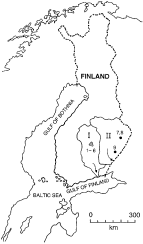
Fig. 1. Study ponds in the two lake and river systems in Finland.

Table 1. Physical environment of the nine ponds in the two watersheds
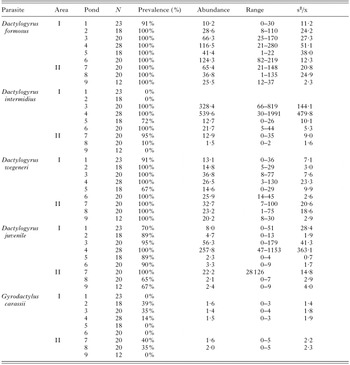
Table 2. Parameters examined
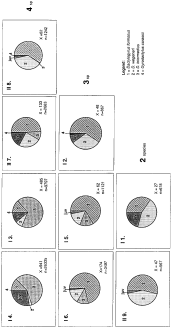
Fig. 2. Percentage of monogenean individuals of each species from the total number of monogeneans in each pond on the gills of crucian carp when 4, 3 or 2 monogenean species were present. Mean number of monogenean specimens (X) per fish in each pond, and total number of worms found in the sample (n) are given.

Table 3. Parameters examined in the nine ponds in the two watersheds
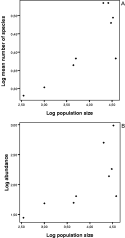
Fig. 3. (A) Relationship between host population size and the mean number of monogenean species per fish in the crucian carp populations from 9 ponds in Finland. (B) Relationship between host population size and the mean abundance of monogeneans per fish in the crucian carp populations from 9 ponds in Finland.
 You have
Access
- 75
- Cited by