The popularity of Bertha (the sewing machine girl) or Nellie (the beautiful cloak model) is explicable by the fact that neither of them is, in any precise sense, a character at all; and that therefore any woman in the audience can, without the slightest straining of imagination, set herself in the heroine’s place and experience vicariously the adventures that befall her.
— Clayton Hamilton (1911:312)More than 15 years ago I stumbled across a play title that made me laugh out loud: Bertha, the Sewing Machine Girl; or, Death at the Wheel (1871). The quintessentially domestic name coupled with the dire death threat prompted me to include this melodrama in my undergraduate American theatre survey course as an example of the noncanonical, everyday fare that audiences might have consumed in playhouses—in contrast to the “classic” melodramas such as The Drunkard (1844), Uncle Tom’s Cabin (1852), or Under the Gaslight (1867) that appear in so many anthologies. But what began as a joke developed into something of an obsession as I traced Bertha’s convoluted history, which began with a newspaper serial by Francis S. Smith that was adapted for the stage by Charles Foster. Was she a role model for working women hoping to better their lot? Was she a cipher of the white middle class, crafted to repress a rising community of working women in the United States? Did her “large lustrous azure eyes, straight nose, finely chiseled mouth [,…] broad white forehead” and “wealth of golden curls” offer a coded counterpoint to the nonwhite racial and ethnic groups populating urban sweatshops (Smith Reference Smith1871:1)? Did the repeated images of Bertha as persecuted by her male bosses (which appear in every iteration of the drama, even the satirical ones) speak to the vulnerability of working women—a vulnerability that many would recognize even today in the #MeToo era? And what can performance scholars deduce from the persistence of Bertha’s story, which, somewhat improbably, spanned more than a century after its debut?
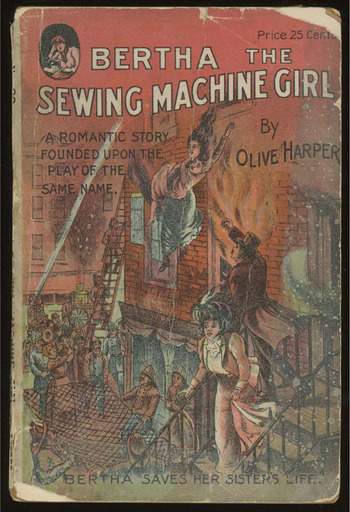
Within 35 years of her 1871 debut in Smith’s newspaper serial and onstage in Foster’s play, Bertha had been readapted numerous times, most notably by Theodore Kremer in 1906, who added Bertha’s blind sister, a leap from a burning building, and Bertha being tied to a conveyor belt. Kremer’s revised theatrical version provided the material for a dime novel iteration by freelance journalist Olive Harper.Footnote 1 In 1926, Bertha’s tale was transformed into a silent film starring flapper Madge Bellamy with a screenplay by Vassar-educated Gertrude Orr. In this version she emerged as a sexually liberated flapper on the silver screen, quickly shedding her sewing machine job for a position as a lingerie model.Footnote 2 George Damroth resurrected Foster’s original text and adapted it for Depression-era audiences for a week-long run in 1935.Footnote 3 And in 1985 Robert Emmett and Gordon Connell reinvented Bertha as an award-winning musical (the Seagram’s Award, Reference Foster, Meserve and Meserve1988), using Kremer’s and Harper’s 1906 adaptation as their source material.
Bertha also offered ample fodder for satire, and her transition to that genre suggests a parodic inversion of the power structure that often shaped traditional melodrama. She became a politically conscious worker in the 1930s musical revue Pins and Needles, fighting off the advances of a bigamous factory owner. In the 1950s she surfaced in a skit by Jewish comedian Sid Caesar, satirizing the exploitation of capitalist bosses. And in the 1970s she appeared in a musical number on The Dean Martin Show, chiming in about sexual harassment in the workplace during the heyday of the women’s rights movement.
This microhistory of Bertha, the Sewing Machine Girl reveals the transformations over time of the melodrama working-girl character in US American culture. Scholar Jeffrey Richards invites theatre historians to explore the genealogy of even their most familiar dramas, arguing that “each turn of the artifact reveals something else: a worn patch, a heretofore unseen thread, a fragment of something older and more distant” (Reference Richards2005:13). By examining genealogies of performance—including legacies of long-familiar genres such as melodrama—theatre scholars can imagine the interplay between genre and subject, and study the shifting power dynamics they convey. I focus particularly on Bertha’s early history and “backstory.” While modern readers may imagine melodrama as a genre of absolutes, investigating Bertha’s source material illuminates a far more nuanced perspective on how working girl melodramas might have been received by multiple audiences. As Clayton Hamilton argued in a 1911 essay on melodrama:
It is the fate of many amiable words to be debased by vulgar usage until they acquire a derogatory connotation […N]o word has suffered more from this iniquitous degeneration than the adjective melodramatic. Careless writers are now accustomed to call a play melodramatic when they wish to indicate that it is bad […] By melodrama—if we use the word nicely—is signified a serious play in which the incidents determine and control the characters […] It is the special grace of melodrama to represent not what a particular person would do in a given situation, but what anybody would do under such a stress of circumstance. (1911:309–11)
While Hamilton attributes a universal appeal to melodrama, I acknowledge that charting Bertha’s various iterations in the penny press, onstage, in dime novels, on-screen, and on radio and television leaves significant gaps in representation. Throughout her complicated history, Bertha retains certain defining characteristics: she is cisgender and heterosexual. She is often visibly Anglo-Saxon amidst a world of Italian, Jewish, Irish, and Eastern European immigrant workers whose claims to whiteness were up for debate at the end of the 19th century and into the first decades of the 20th. Indeed, ethnic otherness ghosts the text of the original serialized newspaper story by Francis S. Smith and the stage adaptation: Bertha’s nemesis, Lizette, is described in Smith’s serialized story as a “bold-looking, but not unhandsome girl […] with small but brilliant black eyes, a dark complexion, black hair (and) prominent features.” As Smith describes, “The most casual observer would have set her down at once as one not to be trusted. Deceit flashed from those dark orbs” (Smith Reference Smith1871:2). Bertha’s blond beauty suggests innocence and purity, while Lizette’s swarthiness hints at sensuality and invites the reader to imagine that she conceals a Jewish or Italian background. The description of her dark coloring and “prominent features” may particularly point to a coded Jewish identity, since Jews were often caricatured as “dark,” and with grotesquely out-sized noses.Footnote 4 And Bertha is also white in a factory world increasingly populated by waves of African Americans moving to northern urban centers from the rural South as part of the Great Migration beginning in the early 20th century.
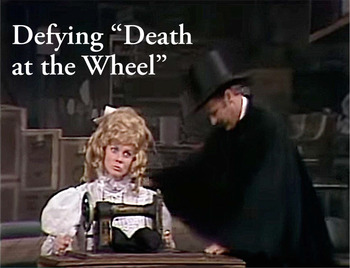
Ann-Margret, as Bertha, the sewing machine girl, and Bob Newhart singing “It’s Better with a Union Man” on The Dean Martin Show, 1970. (Screenshot by TDR)

Theatre performance of Theodore Kremer’s Bertha, The Sewing Machine Girl, New York, 1906. (Negative number: UW 41005, PH Coll 253.336a. Theater, Motion Picture and Entertainment photograph collection, University of Washington)

Bertha saves her sister’s life. Cover of novel by Olive Harper, 1906. (Public domain)

Thus, as I explore Bertha’s various iterations in US popular culture, I suggest that her presence can also illuminate the absences of other potential melodrama heroines (such as the gender-fluid figure, the African American worker, or the lesbian Jewish laborer). Nor would these kinds of heroines have been outside the realm of possibility in American melodrama at the time Bertha first appeared, since models in both fiction and real life were readily available. For example, The Hidden Hand by E.D.E.N. Southworth became one of the most popular serialized stories and stage pieces of the mid-19th century and featured a character named Capitola, who lived in the slums of New York disguised as a newsboy. Mid-19th-century African American newspapers featured exposés of corrupt factory bosses exploiting female workers and published moving accounts of the plight of African American women workers. In 1906, the same year that Bertha was readapted for the stage and published in dime novel form, Sholem Asch published God of Vengeance, which included a lesbian relationship in a working-class and middle-class Jewish setting (the play debuted in Yiddish on the New York stage in 1907). And in her discussion of transgender history in the US, Genny Beemyn (Reference Beemyn and Erickson-Schroth2014) describes the growing population of single trans individuals in the mid- to late-19th century who left their home communities for life in urban centers or on the frontier, where they might live more openly. Thus, among tales of labor unrest, women’s heroism, and other pressing social issues of the day, there might have been room to explore complex issues of racial, ethnic, and gender identity under the capacious tent that Bertha’s story constructed on the melodrama stage. Some of those identities would make their way into versions of the Bertha story eventually, but often in ways less visible to mainstream audiences (with adaptations created by college-educated women or Jewish artists, for example). Ultimately, as Bertha, the Sewing Machine Girl made its way through the 20th century, the once-revolutionary melodrama often found itself invoked as a punchline instead of a punch to the gut.
Amy Hughes’s Spectacles of Reform (Reference Hughes2012) traces the ways in which narratives of heroic women on the 19th-century melodrama stage transformed gradually into clichés of feminine helplessness in contemporary American popular culture. She begins her study with the image of the shrieking woman tied to the railroad tracks as the train bears down on her and the hero struggles to free her (exemplified in the video by pop singer Taylor Swift that Hughes cites). Hughes reminds readers that the original railroad tracks scene in Under the Gaslight (1867) reverses the gender roles, showing a one-armed Civil War veteran tied to the tracks, while a woman hews through his bonds with an axe. The scene concludes with the rescued man exclaiming, “And these are the women that ain’t to have a vote!” (Daly Reference Daly1867:86). That motif of a woman rescuing a man would be repeated in early silent film serials such as A Lass of the Lumberlands (1916),Footnote 5 The Girl with Nine Lives (1916), and Blue Jeans (1917), which varies the setting by having the heroine save the man from being decapitated in a sawmill. The hackneyed images of women tied to the tracks so familiar to modern-day audiences were initially popularized in the film comedies of Mack Sennett, including Teddy at the Throttle (1916) and Barney Oldfield’s Race for a Life (1913), suggesting that the male rescuing the female had become the comic inversion of a well-known scenario of female heroism.Footnote 6
Bertha experienced a similar fate in US popular culture. After years as a model of female heroism, Bertha became an object of parody. Sometimes those parodies highlighted the forward progress of women in the labor movement, and at other times they pointed to a dismissal of melodrama as a viable vehicle for social change. Jack Benny mocked Bertha in one of his 1932 radio shows. The 1937 labor musical Pins and Needles featured the song, “It’s Better with a Union Man, or Bertha, the Sewing Machine Girl” (see Rome Reference Rome1937). On 21 February 1938, the New York Daily News promised listeners a special treat, announcing “Al Barrie’s ‘Mellydrammers’ broadcast over WMCA tomorrow, ‘Bertha the Sewing Machine Girl or How She Kept Herself in Stitches.’” Journalists frequently invoked the play as an example of the saccharine melodramas of yesteryear. With all these adaptations of the original material, it becomes challenging to recall that Bertha, like her melodrama sisters before and after, might have served as a heroic female role model for new communities of working women.
The original melodrama images of women as heroines enshrined onstage and on the screen have gradually become obscured by the repetition of heteronormative comic narratives that relegate young cisgender white women to the roles of victims and cisgender white males to the roles of saviors. The now-familiar “fade-out” of the train track rescue scene ends with the woman gratefully embracing her putative romantic partner, exclaiming, “My hero.” Any suggestion of women’s rights or equality has disappeared, as has much of the satire that marked some of the earlier reinventions of Bertha’s narrative. How did audiences lose sight of these heroines able to free men from deadly traps or rescue children from burning buildings? How did they lose sight of the satirical inversions of the 1930s and ’40s that also unmasked the problematic power structures operating against women workers? Despite the changes the story underwent over time, did the original Bertha stories and others like them have more in common with today’s female action heroes than might at first appear?
All Fact and No Fiction
The original serialized version of Bertha tells of the trials and tribulations of a girl “as good as she was beautiful” (Smith Reference Smith1871:1).Footnote 7 Bertha labors in a factory until she is framed for theft by a fellow worker, unjustly imprisoned, and eventually vindicated, revealed to be an heiress, and married to the man she loves. By 1871, the year Bertha debuted, there were approximately 30,000 sewing girls in the city, working an average of 12 to 15 hours a day, and earning approximately five to eight dollars a week, from which three to four dollars went to food and lodging (Ellington [1869] Reference Ellington1972:583–84). When Bertha is questioned in the play about her earnings and her working hours, she confirms that she generally works 12 hours per day and receives eight dollars per week (Foster [1871] Reference Foster, Meserve and Meserve1998:185). The advertising tagline attached to the play, “all fact and no fiction,” would certainly have rung true with its working-class patrons, who would have seen a familiar cycle of long hours, low pay, and worker exploitation documented in Bertha’s opening pages. Without advocates, guardians, or legal protection, these women made easy targets for unscrupulous employers—often descending, as the sentimental literature of the period mourned, into poverty, starvation, or prostitution.
The story of the pathetic sewing girl appeared in numerous plays of the 1850s–1870s, including The Seamstress of New York (1851), The New York Factory Girls (1867), and The Match Girl of New York (1873). In his Mechanic Accents: Dime Novels and Working-Class Culture in America, Michael Denning suggests that the working-girl heroine emerged “in the wake of the public outcry about the plight of needlewomen in […] sweatshops” (1987:186). These sobering realities continued to circulate in American popular culture into the 1870s, gaining traction in a wide variety of publications. On 18 February 1871, Harper’s Bazaar featured an engraving of a pathetic character, entitled “Sewing Girl.” The character slumps alone in a cramped garret, the crowded rooftops of the city visible through the partly open window. Countless illustrations, stories, and descriptions of girls as “good as they are beautiful” conveyed the innocence and victimization of the “sewing machine girls.” By the 1870s, seamstresses had become popular figures in US culture; after Smith’s serialized story of Bertha in the New York Weekly inspired Foster’s 1871 play, “practically every story paper had a crop of Berthas or factory girls” by the end of the decade (Denning Reference Denning1987:186).
Two years before the publication and stage adaptation of Bertha, George Ellington published The Women of New York, or The Underworld of the Great City.Footnote 8 Chapter 52, entitled “The Working Women of New York,” poses the question: “What is the daily life of that numerous class of widows, mothers, wives, sisters, daughters in our midst, known as working women?” ([1869] Reference Ellington1972:577). Ellington painted a vivid picture of the working woman:
[She] starts up from her perturbed slumbers, puts on her well-worn garments with that benumbed sense of pain which most people have felt at least once in a life-time, partakes of breakfast with most undue haste, and hurries off at the top of her speed to work […] She goes forth and joins a crowd of her sisters on the various streets and avenues of the city. (578)
Ellington’s language may seem flowery to modern readers, but it remains striking in its attempts to humanize the factory girl and inspire pity for those women struggling against that “benumbed sense of pain” from the desperate routine and poverty of their daily lives.Footnote 9
Ellington underlines a sharp contrast between the city’s working women and the women who “promenade in and patronize” the city shops. He offers a vivid description of the barren existence of a sewing machine girl:
Fighting bravely the hard battle of life, as they bend mechanically over the sewing machine until its dull noise almost cheats them out of their seven senses, and they are little else than mere automata; as tapering fingers fashion buttonholes which others wear out. ([1869] 1972:579)
Ellington draws an even grimmer picture of the working girl’s home life, in a “rickety tenement house, with a newspaper for a window curtain (and) a soap box for a chair.” For the working girl, the concept of home is a “beautiful figment of the brain,” not a reality (580). Ellington also uses explicit language to describe the unsanitary conditions in which many of these women lived, describing latrines with no doors for the occupants of an overcrowded tenement. These open cesspools allow “the deadly miasmata [to] penetrate through the entire building and are a prolific source of obdurate and fatal maladies of a diarrhoeal [sic] and febrile nature” (569).
By the 1860s many Americans had realized that the factory system left large groups of young, single men and women stranded in urban centers, without networks of family, friends, or religion to sustain them. Middle-class employers feared the mischief that such unguided youths might inspire and the alliances they might forge. Throughout the 1860s and early 1870s, labor organizations gained ground across the United States, not only creating surrogate communities, but also demanding eight-hour workdays, an end to child labor, and equal pay for women. How could middle- and upper-class employers discourage their workers from joining labor groups, and what could they offer them instead? Some veins of melodrama would prove a useful tool in reinforcing the message that the problem facing workers was not an inherently flawed or corrupt capitalist system, but the more ambiguous target of urban vice. As Karen Halttunen notes, the image of a small-town youth, corrupted by hypocritical strangers in the “big city,” dominated American fiction during the middle of the 19th century and played a significant role in shaping popular melodrama narratives for decades ([1982] Reference Halttunen1986). Advice books like The Secrets of the Great City (1868) depicted a young man, lured into a life of drinking, gambling, and whor-ing, and finally winding up dead, floating in the harbor. Popular plays such as The Drunkard had presented similar fates of young men led astray by bad companions in the wicked city and women forced to work outside the home because urban vice threatened their domestic sanctuaries.
The first play adaptation of Bertha, Foster’s radically truncated version of Smith’s serialized story, debuted in New York in 1871Footnote 10 and was hailed in the New York Herald as a “great sensation” for presenting the “working girls of New York—all fact and no fiction.”Footnote 11 Foster’s play, in which he also starred as Bertha’s adoptive father, enjoyed a widespread success in its early days, rapidly making its way from New York to cities such as Providence, RI, Cleveland, OH, Harrisburg, PA, and Chicago, IL.Footnote 12 Foster drew liberally on Smith’s illustrated serial, and many of the stage directions and stage tableaux seem lifted directly from the publication.Footnote 13 Some viewers described the drama as “full of touching pathos, laughable situations, and eccentric wit and humor” (The Patriot 1871). Even as critics in papers such as the Hartford Daily Courant decried the play as an “exaggerated picture” and “artistically speaking […] not a suc-cess,” they were also forced to acknowledge that audiences responded enthusiastically to the drama, treating the play as though it represented “a scene from real life” (Hartford Daily Courant 1872). While audiences sustained an endless appetite for Bertha’s adventures, many critics pointed to the play’s shortcomings. Theatre historians such as George C.D. Odell note with wonder the play’s continued popularity, labeling it “ancient” and even an “epidemic” within 15 years of its debut (Reference Odell1937:254). The fact that the story also proved replete with highly useful, flexible, and easily pilfered material may explain part of its success, since before long, numerous versions of Bertha made their way to the stage. As Odell writes, “Bertha […] sewed as if she knew that for fifty years she was to be the type, the prototype, of melodramatic heroines of her kind” (194). Sometimes playwrights borrowed the popular title and substituted new storylines (such as adding a blind sister for Bertha or having the villains attempt to drown the luckless pair). Other dramas such as Bartley Campbell’s 1873 Bowery hit Little Sunshine, or The Working Girl’s Oath featured characters and plotlines strikingly similar to Bertha.Footnote 14 For example, just like Bertha, Lily Davis, the main character of Little Sunshine, is an abducted heiress laboring in a sweatshop. She leads a revolt of the sewing machine girls against the corrupt boss who is not only sexually harassing her but also extorting money from the women for a fake Benevolent Society (Campbell Reference Campbell1877). During her many adventures, she narrowly escapes death, not at the wheel, but by drowning, and is saved by her fiancé and father (who turns out to be a count) (Bordman Reference Bordman1994:64).
New York’s Bowery Theatre, where the stage version of Bertha played in the 1870s, was the most popular working-class playhouse in New York. Walt Whitman described it as a “low place where vulgarity and bad taste carries the day,” and the Bowery was generally home to sensational melodramas—or what some critics described as plays “teeming with awful combats […] exploded pistols, hairbreadth escapes (with) the cadaverous-countenanced, double mustached oppressors of female virtue” (in Witham Reference Witham1995:159–62). Yet the Bowery also fostered “moral reform melodramas,” plays that vaunted abstinence, thrift, and diligence as the keys to success. Heroes and heroines of these plays demonstrated their respectability by aping middle-class virtues and transcending the degradation of their environment. However, playwrights and managers had to be careful not to offend either their working-class patrons or their middle-class employers. The degradation that afflicts the characters of these “moral melodramas” frequently has its locus in specific, stereotyped villains, rather than in the factory or capitalist system as a whole (leaving it to the audience to infer whether the individual or the system is at fault).Footnote 15 Those inferences may be readily drawn however, since the indictments against the factory bosses are seldom subtle. As Lily Davis exclaims in Little Sunshine,
Your money is your own, and my labour is my own, and we both have a perfect right to do as we please with our own. If I am not satisfied here, I can leave your employment, and if you are not satisfied with my work you can discharge me. But I do deny your right to rob your unfortunate employees of money which they have honestly earned; and whether I remain in your service, or whether I leave you, I shall insist upon your dealing honestly by those who labour for you. (Campbell Reference Campbell1877:13)
Invariably in dramas such as Bertha, Little Sunshine, and others, the good workers triumph over the dishonest bosses. Yet the fairytale endings suggesting the ultimate triumph of the honest worker over the grasping factory owner should not obscure the fact that for most of the heroines of these melodramas, salvation lay not merely in victory over a corrupt employer, but in assimilation into a heteronormative domestic structure ultimately destined to remove the female activist from the workplace. Foster’s 1871 stage version of Bertha appears as both an outgrowth of the popular working-class heroine stories, as well as an attempt to find an acceptable dramatic formula for representing the plight of working women.
The over-supply of female labor created part of the problem facing New York working girls of the 1860s and 1870s. Bosses could take easy advantage of their female workers in many ways, such as docking their pay for imagined offenses, as in the first scene of Bertha, the Sewing Machine Girl. This scene reveals the factory boss, Caleb, plotting to rob his employees:
CALEB: Hester was five minutes late this morning; have you marked her down? Forfeit her, Miss Pinch, forfeit her. What excuse did she make?
MISS PINCH: Oh, that her mother was dying and that she was nursing an infant sister, or something quite as absurd.
CALEB: Absurd indeed. Her mother dying! Can I help it? I didn’t kill her. I’m just. I fulfill my contracts. All that work for me must do as I do. No work, no pay. (Foster [1871] 1998:2)Footnote 16
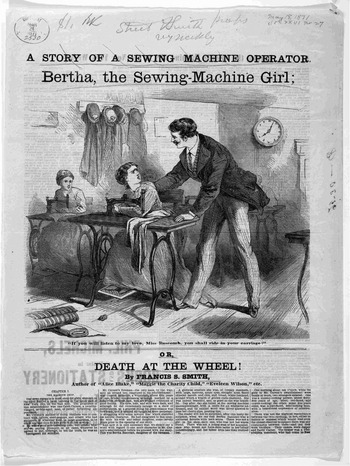
“Bertha, the Sewing-Machine Girl.” Chapter 1 of the serial by Francis S. Smith, 18 May 1871. (Courtesy of the Library of Congress)

These tricks to cheat working women of their pay were no dramatic invention. In 1868 the African American newspaper the Christian Recorder reported a scam in which a factory boss would set up a shop and advertise for up to 50 new employees. The boss would hire from among the hundreds of eager and starving applicants swarming to answer the ad, run the shop for a week, then shut it down and disappear without having paid any of the workers. The same boss would appear a few days later, under a different name, running a similar scheme in another part of the city (Christian Recorder 1868).
Sewing but Not Knowing that Danger Was Near Footnote 17
Some factory bosses also took sexual advantage of their female employees, harassing, seducing, or raping them, secure in the knowledge that few of the young women would have the resources to prosecute their attackers, and recognizing that the women risked being labeled as “fallen” (or worse) if they openly accused their employers. The harassment storyline appears in the original Bertha, in Little Sunshine, and in other working-girl dramas of the period as well. The very first illustration of the serialized version of Bertha shows her at her machine, looking up in fear as a dark, mustachioed man bends over her, with his hand placed possessively on her shoulder (fig. 3). The caption of the illustration reads, “If you will listen to my love Miss Bascomb, you shall ride in your carriage” (Smith Reference Smith1871:1).
As Rodney Hessinger argues, by the mid-19th century, some social reform organizations had begun to blame working-class women for being “seduced” by middle-class men, claiming that they participated in the “vice-ridden life of the lower classes,” and to some extent, deserved their harsh fate (Reference Hessinger2005:46).Footnote 18 Thus, another potential attraction of melodramas like Bertha and Little Sunshine became the heroine’s ability to fight off her would-be rapists and the implicit assumption that the heroine neither desired nor deserved unwanted male attention. As Hamilton argued, “At every moment she [the heroine] is chaperoned by destiny […V]irginity is its own defense and virtue shields itself with spiritual armor” (1911:309).
Intriguingly, the theme of the working girl as sexual prey persisted well into 20th-century adaptations of Bertha. In the 1926 silent film version, which was billed as a “love and lingerie edition of the great melodrama,” Bertha is exploited as a lingerie model when the manager, Mr. Morton, tries to kidnap and assault her on his yacht.Footnote 19 Additionally, one of the stills from the film shows a line of young women trying to capture the attention of a young male man-ager/boss by posing with their hands on their hips and raising their skirts to show their garters (WorthPoint Corporation n.d.).
Roughly a decade later, in 1937, the International Ladies Garment Workers Union (ILGWU) was featured in a satirical musical revue called Pins and Needles, written by Marc Blitzstein, Harold Rome, and others. The show included a song entitled “It’s Better with a Union Man, or Bertha, the Sewing Machine Girl.” In the song, Bertha, “a winsome and class-conscious lass,” stubbornly resists a boss who “fiendishly plied her with wine,” and who brings her back to his hotel and tries to assault her (Rome Reference Rome1937). Although the lyrics from the song are whimsical, the perceived danger from a man who has power over her and who gets her drunk, while promising her a better life in exchange for sexual favors was—and still is—very real.
Satirical versions of Bertha that championed labor rights and acknowledged the dangers women faced from workplace harassment even made their way onto Sid Caesar’s Your Show of Shows in the 1950s and The Dean Martin Show in season five (1969/70). The Sid Caesar version entitled “The Silent Screen—The Sewing Machine Girl” features many of the hallmarks of a classic melodrama, including a demure (and in this case, consumptive) sewing machine girl played by Imogene Coca who is clad in a dainty shirtwaist, complete with puffed sleeves and sweeping skirt. Coca’s Bertha flirts with Caesar who is sewing alongside her and their interaction offers a tacit acknowledgment of the presence of Jewish workers as sweatshop laborers. The cigar-chomping boss, played by Carl Reiner, comes in, bends over Coca, tickling her chin and fondling her shoulder as he tries to steal Coca from Caesar (who at one point jabs the boss in the behind with his needle). Coca faints and Reiner carries her into his office where he offers her furs and jewelry to try to seduce her. Caesar rushes in to defend her honor and Coca intervenes between the two men to pound Reiner on the chest. The exertion is too much for her and she collapses and dies. All the other workers storm the office and point their fingers at Reiner who cowers in the corner as Coca’s “ghost” ascends to heaven on angel wings. While the skit may not make a direct statement about women’s empower-ment (Coca’s sewing machine girl is prone to comical convulsions before each faint), it does focus on the inhuman conditions factory workers endure, including commands to speed up the pace of work that result in shirts flying around the space and no time for workers to rest or eat. Part of the comedy in the scene comes from watching Caesar and Coca try to pry open their lunch boxes and eat during their 30-second lunch break. It also highlights that women workers remained prey to predatory bosses (Sid Caesar 2016).
(From left) Sid Caesar, Carl Reiner, and Imogene Coca in “The Sewing Machine Girl,” a silent-movie spoof from Your Show of Shows, circa 1950s. (Screenshot by TDR)

A similar theme resonates in The Dean Martin Show skit in which Ann-Margret appeared as a blond-ringleted Bertha, sewing away and singing “It’s Better with a Union Man,” while a mustache-twisting villain played by Bob Newhart gropes and grabs her (littlemaths 2013). Intriguingly, in his initial contact with Ann-Margret, Newhart bends over her at her machine and grasps her shoulder. His curled black mustache and his pose echo the first image in the serialized story of Bertha that had appeared almost a century before. Yet it is clear in the 1970 version that Ann-Margret/Bertha has the power, unlike her counterpart of 1871. Even though she is dressed in an alluring costume with Victorian-era ruffles on the top and a short skirt and high heels on the bottom, and even though she is pawed by Newhart’s character and “saved” by Martin, she also winks at the audience to send up her demure and helpless image. She even mimes punching Newhart at one point when he tries to grab her. Her performance lands in an ambiguous space between acknowledging that she is still the sexualized object of the male char-acters’ desire (Martin and Newhart), while slyly hinting that the abuses visited on Bertha’s character are now as dated as the original melodrama. This impression is heightened by a stage setting that includes obviously painted backdrops, a painted wooden floor, footlights, and a traditional 19th-century drop curtain that comes down at the end of the skit.Footnote 20
Demand to See a Union Card
In the 1937 lyrics to “It’s Better with a Union Man, or Bertha, the Sewing Machine Girl,” Bertha cautions her fellow sewing machine girls that they should “demand to see a union card” from any prospective suitor. While this observation satirizes Bertha’s melodrama origins, it underscores how important unions had become in safeguarding women workers’ rights in the 66 years since Bertha’s debut. It also points to a potentially problematic gap between the qualities that would come to be prized by working girls and those of the middle-class patrons often associated with melodrama. The 1871 Bertha hints that women will not continue to tolerate exploitation by cruel employers. Foster’s adaptation features a scene in which Bertha confronts Carson, the factory boss, proclaiming:
Poor and underpaid as many of your working girls are, they inherit some of the old spirit of independence that has made our country great! And while they demand fair returns for a fair day’s work, they neither ask nor will they accept from you what you call charity. (Foster [1871] 1998:192)
Bertha’s refusal to accept “charity” from bosses or patronizing benefactors certainly echoed some of the political sentiments of the period. Smith’s serialized version of Bertha that ran in the New York Weekly from May through August of 1871 presented a politicized picture of working women’s lives. Indeed, Smith was an active supporter of the Working Women’s Protective Union, an organization created to defend the legal rights of working girls and promote their safety and equitable treatment in the workplace. As M.E.J. Kelley notes, the original character of Carson, the sewing shop manager, seems drawn from an actual individual in the New York sweatshop system with a reputation for unfairly withholding his employees’ wages. The Working Women’s Protective Union had run a successful campaign against this individual to force him to pay his workers what he had promised (Kelley Reference Kelley1898).
Founded in 1863, the Working Women’s Protective Union (WWPU) emerged as one means for working women to seek redress against unfair employers, or to seek financial assistance in times of trouble. Countless articles in newspapers of the 1860s chronicled the WWPU’s attempts to win an increase in their wages or more tolerable working conditions.Footnote 21 Incorporated in 1868, the WWPU marshaled the efforts of a large number of middle-class women and clergy. The Union had two goals: “to stand between the working woman who makes her own battle in life and those who seek her injury by fraud and imposition; to encourage and sustain her in the desire to maintain herself and her family or relatives by honest labor” (Talmage et al. Reference Talmage, Burchard, Field and Brady1879:2). While the WWPU may have envisioned its beneficiaries as predominantly white women, nevertheless, its model was also embraced by communities who saw in its legal campaigns a means to address the ongoing injustices that faced African American women as well. For example, on 19 November 1869, the African American newspaper The Elevator had published an essay entitled “Organization Among the Colored People,” which covered efforts to establish political and labor representation for both male and female African American workers, calling for the organization of a “Workingwomen’s Association,” and proclaiming that “We regard the labor of the country as the common property of the people” regardless of race or gender (Elevator Reference Elevator1869). In a 10 September 1870 article, The National Standard (also known as The National Anti-Slavery Standard) hailed the WWPU for its successful efforts to recoup funds owed to working women over the years (National Standard 1870).
However, despite the popularity of Bertha’s narrative and others like it among working-class women audiences, Susan Harris has suggested that “The lower-class woman [in drama] often stands as an unsung model for middle-class heroines,” and while Bertha’s story and others like it may have promoted social activism among white middle-class women, they also highlighted the gap between the experiences of those women and the objects of their pity (Harris Reference Harris1990:183; emphasis added). For example, one blurb in the New York Observer and Chronicle on behalf of the WWPU observed that “Benevolent ladies of wealth may help their poor sisters materially by aiding the funds of this union” (1865). And in 1879, the Union announced a “Musical Aid” Benefit to raise funds for its activities—a strategy that many of the working-class members of the organization found patronizing (since they were not included). In contrast to the whimsical middle-class images that patrons might have enjoyed as part of the “Musical Aid” performance to benefit female workers, Bertha struggled to document a more “realistic” image of factory girl life and in a way that seemed targeted towards working-class female audience members. An 1898 essay by M.E.J. Kelley in The North American Review chronicled the advent of “women of wealth or leisure culture” into the labor movement, and also pointed to the rise in college education for women as a contributing factor in their involvement (1898:408). Kelley also urged “ordinary women” to exercise their power as consumers to affect labor practices in ways that wealthy women, working women, and legislators had been unable to do.
Perhaps not surprisingly, the working women who were the objects of the WWPU’s charity had trouble reconciling the comfortable middle- and upper-class settings enjoyed by their benefactors with their own 15-hour a day, labor-driven lives. Thus, the means through which organizations such as the Working Women’s Protective Union garnered and demonstrated its support eventually began to rankle with some of the very women it hoped to assist.
By the 1880s, more than a decade after Bertha’s debut in popular fiction and on the popular stage and a few decades after the founding of the WWPU, attitudes towards working girls had begun to shift—primarily among the female working population. In 1884, a group of young female silk weavers from New York met to form the city’s first “Working Girl Society.” The society proudly proclaimed: “Our organization is truly the child of the daughters of labor. Our mothers and fathers worked; and we, too, work. Let us call ourselves the ‘Working Girls Society’ and show New York that we are not ashamed of work” (in Murolo Reference Murolo1997:1). As Priscilla Murolo suggests, these working girls “were bitterly aware of bourgeois culture’s contempt for the working girl,” and they resented efforts to oversee their morals, sexual practices, and domestic lives. In part, too, they rejected the victim status assigned them by the popular press and stage of the period (1). While their experiences might have paralleled those in Bertha, they might have come to reject the idea that they need only be “good” and “beautiful” to be saved.
In the Heroine’s Place
As working women began to assert their independence from bosses and would-be benefactors alike, perhaps it is not surprising that some of the original melodrama elements of Bertha’s story might be eclipsed by satirical reinterpretations of the story that reflected efforts to realign power structures. Yet even while they mock the melodramatic structure of Bertha, the satires evident in performances such as Pins and Needles, Your Show of Shows, and The Dean Martin Show still focus on the critical issues raised in the original sewing machine girl stories: horrific working and living conditions, sexual harassment, and inequality in the workplace. And, as I have noted, even though the initial production presented a predominantly white narrative, the performances of “sewing machine girl” dramas opened up spaces for necessary conversations about the plight of immigrant women and women of color as well. One might even imagine that Bertha’s excessive femininity (so well spoofed in Ann-Margret’s performance) could invite queries about gender identity and opportunities to read her performance against past and present gender stereotypes. Ultimately, whether performed as serious melodrama or over-the-top satire, Bertha simply refused to die at the wheel, and instead she continued to “invite every woman to set herself in the heroine’s place” (Hamilton Reference Hamilton1911:309).