The past decade has witnessed a shift in psycholinguistic research, characterized by increased interest in investigating interactive language use in authentic settings (see Trueswell & Tanenhaus, Reference Trueswell and Tanenhaus2005). Underlying this trend is the idea that language is not simply a cognitive system of mental representations and rules but, rather, a tool used by individuals to accomplish real goals or actions through interaction, or what Clark (Reference Clark1992) termed a language-as-action tradition in psychology and linguistics. The view of language as action, according to Clark, implies that language is used by real people who often have defined roles (such as a salesperson, client, or manager) in order to accomplish certain interactive social processes (real-world goals, such as signing a business contract, explaining a course of medical treatment) as part of collective actions (contextualized instances of language use). One example of recent research compatible with this tradition is the study of interactive alignment. Interactive alignment is a sociocognitive phenomenon whereby interlocutors’ language tends to converge, with speakers reusing each other's expressions, structures, and pronunciation patterns as interaction unfolds (Garrod & Pickering, Reference Garrod and Pickering2009; Pickering & Garrod, Reference Pickering and Garrod2004, Reference Pickering and Garrod2013). The overall goal of this study is to extend research on interactive alignment to non-native communication between bilingual interlocutors communicating in a shared second language (L2), focusing specifically on the nature and extent of interactive alignment in pronunciation during L2–L2 interaction. The term pronunciation, as applied to interactive alignment, refers here to a variety of dimensions that are associated with both linguistic (e.g., complexity) and social (e.g., attractiveness) attributes of spoken language (see Gambi & Pickering, Reference Gambi and Pickering2013).
That speakers reuse each other's language in dialogue has been shown both descriptively (e.g., Levelt & Kelter, Reference Levelt and Kelter1982; Schenkein, Reference Schenkein and Butterworth1980) and experimentally (e.g., Bock, Reference Bock1986; Garrod & Anderson, Reference Garrod and Anderson1987). For example, studying native speaker interaction in a cooperative maze game, Garrod and Anderson (Reference Garrod and Anderson1987) showed that interlocutors repeat each other's lexical content and phrasal structure across turns as they work to construct a common understanding of their location in the maze. This phenomenon is described by Pickering and Garrod (Reference Pickering and Garrod2004) in their interactive alignment model, which states that the goal of interaction is for speakers to achieve mutual understanding or “common ground” and that at least one way of doing so is to align or coordinate language at several linguistic levels (lexical, syntactic, and phonological). This coordination or alignment is manifested in dialogue when speakers recycle each other's language patterns, converging on common vocabulary (Brennan & Clark, Reference Brennan and Clark1996), syntactic structures (Branigan, Pickering, Pearson, McLean & Brown, Reference Branigan, Pickering, Pearson, McLean and Brown2011), and common pronunciation patterns, such as utterance length, speech rate, volume, and pausing (Giles, Coupland & Coupland, Reference Giles, Coupland, Coupland, Giles, Coupland and Coupland1991).
With respect to linguistic alignment at the level of pronunciation, researchers have shown that native-speaking interlocutors converge on common phonetic realizations of sounds in individual words, with such convergence occurring early on in the conversation and persisting for at least one week after the initial conversation (Pardo, Reference Pardo2006). Native-speaking interlocutors sharing the same dialect are also more likely to converge on common phonetic and prosodic speech patterns than interlocutors with distinct dialects, suggesting that convergence is facilitated when interlocutors share a common linguistic background (Kim, Horton & Bradlow, Reference Kim, Horton and Bradlow2011; Pardo, Jay & Krauss, Reference Pardo, Jay and Krauss2010). Alignment can occur even for speech that is only seen, with listeners showing convergence for words that they heard and for words that they lipread from a silent video recording of a speaker (Miller, Sanchez & Rosenblum, Reference Miller, Sanchez and Rosenblum2010). Alignment in native speakers thus seems to be a rapid interactional phenomenon, reflective of a human perceptual system which adapts readily to recent experience (Samuel & Kralijc, Reference Samuel and Kraljic2009).
However, linguistic alignment at the level of speech and pronunciation is not solely a cognitive phenomenon. For example, according to accommodation theory, interlocutors converge (or diverge) on shared linguistic behaviors during social interaction as a function of their beliefs, attitudes, and sociocultural conditions (Giles et al., Reference Giles, Coupland, Coupland, Giles, Coupland and Coupland1991; Giles & Ogay, Reference Giles, Ogay, Whaley and Santer2007). Evidence for this view comes from research showing that the extent of alignment in pronunciation is mediated by social factors, such as gender of the speaker and the listener (Namy, Nygaard & Sauerteig, Reference Namy, Nygaard and Sauerteig2002; Pardo, Reference Pardo2006) and perceived attractiveness of the speaker to the listener (Babel, Reference Babel2012). Thus, within accommodation theory, alignment in conversation can be interpreted as the interlocutors’ desire (whether overt or tacit) for social integration and identification, whereas an absence of alignment might reflect divergence in order to maintain distance, identity, or integrity. At least some of these phenomena are aspects of socially-mediated verbal, facial, emotional, and behavioral repetition, present in both children and adults (Chartrand & Dalton, Reference Chartrand, Dalton, Morsella, Bargh and Gollwitzer2008; Meltzoff, Reference Meltzoff, Hurley and Chater2005; Tomasello & Carpenter, Reference Tomasello, Carpenter, Hurley and Chater2005).
Gambi and Pickering (Reference Gambi and Pickering2013) recently outlined a conceptual framework which has the potential to integrate the cognitive and social influences on interactive alignment in speech. This framework, which is based on a tight coordination between the speaker's and the listener's language comprehension and production systems, assumes that speakers not only produce their own utterances but also predict the utterances in the speech of their listeners as they jointly construct understanding in dialogue (see also Pickering & Garrod, Reference Pickering and Garrod2013). Most importantly, interlocutor alignment in pronunciation, according to Gambi and Pickering, may proceed in two ways. It may be a cognitive psycholinguistic process, through what is termed a simulation route, by listeners engaging the production system in their comprehension of speakers’ utterances. Alternatively, interlocutor alignment in dialogue may occur as a context- and situation-specific, intentional, and inherently social process, via an association route, whereby listeners explicitly predict speakers’ intended meaning. Evaluating the theoretical and empirical merits of Gambi and Pickering's proposal falls outside the scope of this report. Nevertheless, their framework makes predictions which are directly relevant to this study and are compatible with the available research on interactive alignment in native speakers, namely, that extent of phonetic coordination or alignment in dialogue is associated with both psycholinguistic factors, such as frequency and phonotactic constraints (e.g., Goldinger, Reference Goldinger1998; Nye & Fowler, Reference Nye and Fowler2003) and social and contextual variables, such as speakers’ attitudes, beliefs, gender, or conversational role (Babel, Reference Babel2012; Branigan et al., Reference Branigan, Pickering, Pearson, McLean and Brown2011; Pardo, Reference Pardo2006; Pardo et al., Reference Pardo, Jay and Krauss2010, Reference Pardo, Jay, Hoshino, Hasbun, Sowemimo-Coker and Krauss2013).
Despite the overall interest in alignment as a conversational phenomenon, there is still a paucity of research investigating alignment in non-native communication. This is because existing studies of alignment in non-native speakers have predominantly involved interactions between native-speaking interlocutors and L2 learners, showing that extent of alignment may depend on L2 learners’ degree of accent (Kim et al., Reference Kim, Horton and Bradlow2011) and individual differences in their cognitive abilities (Lewandowski, Reference Lewandowski, Dogil and Reiterer2009). For instance, compared to learners with either strong or weak accents, only moderately-accented learners appear to show convergence in pronunciation with a native-speaking interlocutor (Kim et al., Reference Kim, Horton and Bradlow2011). Assuming that accent ratings capture some aspects of L2 speaking proficiency, phonetic convergence may depend on learners’ mastery of the L2 phonetic system and their perception of the interlocutor's communicative needs. Simply put, learners whose accent is particularly non-native may not have the linguistic means to align with their interlocutor, while those with nativelike accents may not perceive the need to align because communication is not compromised (see Kim et al., Reference Kim, Horton and Bradlow2011).
To sum up, interactive alignment appears to be a pervasive sociocognitive phenomenon in native-speaker interaction. In fact, in their interactive alignment model, Garrod and Pickering (Reference Garrod and Pickering2009) reasoned that alignment should occur in any conversation where there are similarities between interlocutors, due to their shared backgrounds and knowledge and similarities in language processing (see also Costa, Pickering & Sorace, Reference Costa, Pickering and Sorace2008). However, at least for English, most interactions in today's world occur between non-native speakers who might not share another language or whose social, educational, and life experiences might be quite distinct. Language classrooms are also increasingly diverse, composed of learners from different social, educational, and linguistic backgrounds. In other words, alignment may be less likely to occur because of the diversity which typifies many L2 interactions. This then questions the pervasiveness of alignment as a theoretical construct and its relevance, as a means of achieving mutual understanding, to L2–L2 communication.
The only studies known to us investigating alignment in L2–L2 communication examined alignment with respect to the time interlocutors spent on an interaction task and the number of unique word types exchanged (Van Engen, Baese-Berk, Baker, Kim & Bradlow, Reference Van Engen, Baese-Berk, Baker, Kim and Bradlow2010) as well as alignment in the use of complex sentences with nominal clauses in L2–L2 computer-mediated communication (Collentine & Collentine, Reference Collentine, Collentine, McDonough and Mackey2013; see also McDonough & Chaikitmongkol, Reference McDonough and Chaikitmongkol2010). For example, in Van Engen et al.'s study, L2–L2 interlocutors with mismatched native languages appeared to be the least efficient in the amount of time spent interacting and in the amount of information exchanged, compared to two native-speaking dialogue partners, native speakers conversing with L2 learners, and two L2 interlocutors sharing the same language background.
On the whole, then, there is presently little evidence of interactive alignment in pronunciation in bilingual and multilingual interlocutors in lingua franca contexts, where both non-native speakers interact in a shared L2. Therefore, the current study explored interactive alignment in non-native interlocutors in two information-exchange tasks, addressing the following research question: Does interactive alignment in pronunciation occur in L2–L2 communication? As its starting point, this study adopted Gambi and Pickering's (Reference Gambi and Pickering2013) hypothesis that the extent of alignment in pronunciation will be determined by perceived (and actual) similarity between interlocutors, with greatest alignment occurring when similarity is high. Presumably, such similarity is based on a variety of factors, including linguistic (e.g., differences in interlocutors’ language backgrounds), cognitive (e.g., fluency, as a reflection of automaticity of language production processes), and social (e.g., interlocutor perception of speaker's effectiveness). Thus, to address the question of whether interactive alignment in pronunciation occurs in L2–L2 communication, pairs of bilingual interlocutors from mismatched native language backgrounds were engaged in two information-exchange tasks in a shared L2 and their speech was evaluated perceptually through listener judgments for occurrence of interactive alignment in pronunciation (broadly defined) as well as for a wide range of speech variables spanning both linguistic and social dimensions. The overall objective was to document interactive alignment in L2 communication and to investigate its relevance to linguistic and social dimensions of speech, as judged perceptually through listener ratings.
Method
Participants
The participants were 30 bilingual speakers (14 women, 16 men), full-time undergraduate or graduate students in business (8), engineering (12), and social sciences (10) at an English-language university in Canada. As part of a language background questionnaire, the participants reported speaking several first languages, including Mandarin (14), Arabic (5), Farsi (3), Bengali (2), Cantonese, French, Russian, Tamil, Bulgarian, and Spanish. They grew up in unilingual households but were exposed to L2 English at a mean age of 10.4 years (4–19) through classroom-based instruction. Their ages ranged between 20 and 41 (M = 28.5 years), and they had resided in Canada for periods ranging from two months to ten years (M = 2.4 years). The participants were not recruited from particular courses or programs, but from the university community at large. Because different degree programs had different requirements for admission, some participants had been admitted to their programs without submitting English proficiency test scores and additionally were not required to take ESL courses. Prior to completing the study, the participants self-rated their English ability at a mean of 6.6 (4–8) in speaking and 7.0 (4–9) in listening using a 9-point Likert scale (1 = poor, 9 = excellent). The participants also indicated the extent of their daily interaction in English in academic and non-academic domains, reporting a mean of 41% of daily English use (0–100%). In this study, between-participant differences in L2 proficiency as well as in background characteristics such as age, length of residence, and amount of daily English use, were advantageous for investigating the extent of interlocutor alignment as a function of speaker speech characteristics, and the impact of these variables on interactive alignment will be discussed below. Each participant was randomly paired with a previously unknown partner from a different native language background (resulting in 15 interlocutor pairs), such that the only shared language between the two interlocutors was English.Footnote 1
Tasks
The current dataset comes from a larger project designed to investigate the nature of communication difficulties for bilingual interlocutors interacting in a shared L2. For this study, the interlocutors engaged in two interactive speaking tasks (shown in Appendix 1), administered in the same order for each interlocutor pair, with each task lasting a maximum of seven minutes. The tasks were two-way closed information-gap tasks, where interlocutors were required to transmit information that was unknown to their partner in order to achieve a specific, shared goal (Brown, Anderson, Yule & Shillcock, Reference Brown, Anderson, Yule and Shillcock1983; Yule, Reference Yule1997).
The first task was a picture story completion task. Each interlocutor had three different images from a six-panel picture story. They could not see each other's pictures and had to share descriptions of their pictures in order to arrive at a common understanding of the story. The picture story features a man discovering at a checkout counter in a store that his wallet is missing. The man then calls a store security guard and accuses the teenager standing in line behind him of stealing his wallet. When the man arrives home, to his great surprise he discovers the wallet inside his grocery bag. The second task was a map task (Anderson, Bader, Bard, Boyle, Doherty, Garrod, Isard, Kowtko, McAllister, Miller, Sotillo, Thompson & Weinert, Reference Anderson, Bader, Bard, Boyle, Doherty, Garrod, Isard, Kowtko, McAllister, Miller, Sotillo, Thompson and Weinert1991; Brown et al., Reference Brown, Anderson, Yule and Shillcock1983). Each interlocutor had a different version of a map, including six landmarks common to both versions. However, one version of the map contained a route drawn on it, while the other version had no route but pictured four additional landmarks absent from the first version. The interlocutors had to describe their versions to each other in order to accurately add the information missing in their original versions, thus converging on the final map with the complete route and all ten landmarks included.
Thus, the two tasks targeted in this study were highly comparable in that they both required speakers to identify, convey, and make sense of missing information in order to jointly complete a clearly-defined goal (a shared story or a complete map). However, the tasks differed in the kind and extent of interaction they promote. The map task typically elicits information specific to individual lexical items (i.e., landmarks, location/direction of the route), with interlocutors taking turns to act as “givers” and “receivers” of information (Anderson et al., Reference Anderson, Bader, Bard, Boyle, Doherty, Garrod, Isard, Kowtko, McAllister, Miller, Sotillo, Thompson and Weinert1991). In contrast, the picture story generally provides for a balanced division of communicative load between interlocutors, with each speaker contributing equally or nearly equally to the story they co-construct (Kim et al., Reference Kim, Horton and Bradlow2011; Van Engen et al., Reference Van Engen, Baese-Berk, Baker, Kim and Bradlow2010).
Procedure
Each pair of interlocutors was tested individually in a quiet location, with the entire testing session recorded directly onto a laptop computer using a digital video camera (Canon Vixia HV30) and two lapel-worn wireless microphones (Sennheiser EK-100). At the beginning of the session, both interlocutors read and completed the consent form and a questionnaire targeting their biographical information and language learning history. The interlocutors were then given three minutes to perform an introductory task, with the goal of discovering three things they had in common (e.g., a dislike of spicy food), as a way of helping the interlocutors become more familiar with each other. After reviewing the materials and instructions about each task, they then completed the picture story and the map tasks, in that order, with a maximum of seven minutes to interact in each task. The interlocutors were seated at a desk with a barrier between them, which prevented them from seeing each other's materials but allowed them to have unobstructed face-to-face communication. Immediately afterwards, the interlocutors completed another interactive activity followed by a video-prompted stimulated recall session; these were analyzed as part of an unrelated study.
Listener judgments
To determine whether interactive alignment in L2–L2 communication occurred, short video excerpts from each task were presented for judgment to ten native English listeners, students (seven women, three men) at the same university. The listeners, who were on average 27.2 years old (24–32), had grown up in English-speaking households in Canada (8), the UK (1), or the US (1) and reported using English daily on average 87.3% of the time (60–100%). They also reported extensive exposure to L2 English and some proficiency in another language (French, German, Spanish, Ukrainian, Japanese).Footnote 2
The excerpts, which were on average 50 s long (Mpicture = 49.3 s, range = 40–57 s; Mmap = 49.6 s, range = 41–60 s), were extracted from the beginning (first minute) and end of each interaction (sixth minute). Because three interlocutor pairs in the picture task and one pair in the map task completed their interaction within five minutes, no excerpts from the end of interaction for these pairs were available, so only the excerpts from the beginning of the interaction were analyzed for these pairs. Altogether, there were 27 excerpts for the picture task and 29 for the map task. An additional 15 video excerpts from the first minute of the introductory task (which was performed by the same interlocutors at the outset of the testing session, and prior to both target tasks) were used as fillers (Mfiller = 51.1 s, range = 41–59 s). The 71 video excerpts were then organized into lists, with the order of the beginning and end excerpts randomized and counterbalanced across listeners and with listeners randomly assigned to these lists.
All scales used for rating were continuous semantic differential scales (a 50-millimeter line) printed next to each rated construct (Osgood, Suci & Tannenbaum, Reference Osgood, Suci and Tannenbaum1957), with the left and right endpoints marked by a frowning and a smiling face, respectively. The listeners were asked to mark a cross or checkmark at the point on the line which reflected their judgment. The scales targeted the individual and combined performance of the interlocutors in each pair. In evaluating each pair as a team, the listeners rated each team for mutual understanding (how well both speakers achieve common understanding), teamwork (how much collaboration occurs in the interaction between both speakers), and alignment, which was labeled for the listeners as “sounding similar”. This measure was defined as the perceived degree to which both speakers approach each other in their ways of speaking. The listeners were invited to provide written comments, in a blank space next to the alignment scale, to clarify which dimensions they used in making their judgment.
The listeners also rated each interlocutor separately, using eight dimensions: comprehensibility (listener effort in understanding a speaker), accent (extent of native language influences in a speaker's speech), fluency (smoothness and flow of speech, without undue pauses and hesitations), linguistic complexity (sophistication of a speaker's language), language competence (a speaker's global language ability), communicative effectiveness (a speaker's clarity and efficiency in communicating ideas to the interlocutor), attractiveness (desirability and pleasantness of a speaker as a potential interaction partner), and interpersonal anxiety (degree of a speaker's uneasiness and discomfort during interaction). Most of these constructs (accent, comprehensibility, fluency, linguistic competence, and complexity) came from previous L2 speech research, which has shown that these dimensions distinguish L2 speakers of different ability (e.g., Isaacs & Trofimovich, Reference Isaacs and Trofimovich2012) and may thus determine the extent of interactive alignment (Costa et al., Reference Costa, Pickering and Sorace2008). The remaining constructs (attractiveness, communicative effectiveness, anxiety) were derived from sociolinguistic research, which suggests that the extent of speech convergence in dialogue is mediated by interlocutors’ perceptions of each other's affective and personal characteristics (Babel, Reference Babel2012; Giles et al., Reference Giles, Coupland, Coupland, Giles, Coupland and Coupland1991; Pardo, Reference Pardo2006).
The listeners were tested in individual listening sessions, using a Koss R/80 headset and a personal computer for playback of video files. The listeners first read the instruction sheet with definitions and examples of all constructs targeted in the rating scales (shown in Appendix 2, along with a sample rating sheet) and discussed any remaining questions with a trained research assistant. They then received a rating booklet and rated several practice videos. After all further questions were clarified, the listeners proceeded to rate the 71 target video excerpts, working at their own pace. Their task was to watch the entire excerpt, with an unlimited number of replays permitted, then to record their ratings in the booklet.
Data analysis
Given the paucity of research on interactive alignment in L2–L2 communication, the current study was conceptualized as an initial attempt to develop and test a listener-based, rated measure of interactive alignment, carried out within a correlational design (Chen & Popovich, Reference Chen and Popovich2002). Therefore, the goal of all data analyses was to investigate possible relationships between a rated measure of interactive alignment and several other rated speech and personal/affective characteristics, rather than to manipulate variables to establish causality. A correlational approach to the study of interactive alignment is supported theoretically through Gambi and Pickering's (Reference Gambi and Pickering2013) framework of interactive alignment in speech, which proposes associative, mediated links between several social factors (i.e., speaker attitudes) and alignment in interaction. A correlational approach is also motivated empirically through prior research which used correlational analyses to establish links between speech alignment and speakers’ rated characteristics (e.g., self-reported closeness in Pardo, Gibbons, Suppes & Krauss, Reference Pardo, Gibbons, Suppes and Krauss2012).
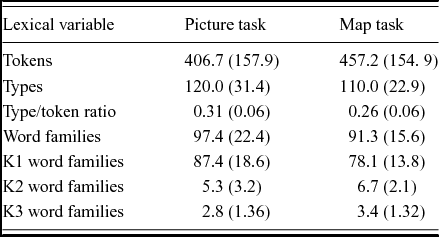
Each listener rating was defined as the distance (in millimeters) between the left endpoint of the scale and the raters’ mark (cross or checkmark) on the semantic differential scale. Cronbach's alpha, a measure of rater consistency, was computed across the ten listeners’ ratings for each rated measure to determine if a given listener's behavior was consistent with the other listeners. The resulting coefficients of reliability reached reasonably high values for all rated measures (ɑ = .78–.90), suggesting that each rating was consistent across the sample of ten listeners. The data were first analyzed by treating speakers as a random effect, with average ratings across all ten listeners derived for each rated construct, separately for every speaker/pair. The data were then computed with listeners treated as a random effect, resulting in listener-based ratings, such that average scores across all speakers/pairs were computed for each rated construct, separately for every listener. A preliminary analysis also examined all speech output from the two tasks, to determine if it was comparable in lexical coverage. This analysis involved creating a lexical profile analysis of all speech output (Cobb, Reference Cobb2000), which was transcribed and verified by trained research assistants. The profile included a count of all word tokens and types used by the two interlocutors, type–token ratio as a measure of lexical diversity, the number of distinct word families (lemmas), as well as the number of word families from the first three most frequent one-thousand frequency bands in English, based on the British National Corpus (2007). This profile analysis revealed that the two tasks elicited comparable amounts of language, in terms of lexical quantity and diversity, suggesting that the listeners were exposed to similar lexical content across the tasks (see Table 1).
Means and standard deviations of lexical characteristics of speech output in L2–L2 interlocutor communication.

Results
Ratings of interlocutor pairs
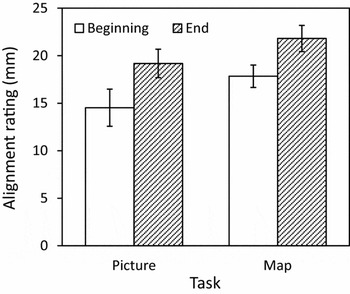
The first set of analyses targeted the three ratings given by the listeners to each pair of interlocutors. These ratings were designed to measure the extent to which the two interlocutors sounded similar (alignment), the degree to which they achieved common understanding (mutual understanding), and the amount of their collaboration during interaction (teamwork). With respect to the alignment ratings – a measure of primary interest here – the goal was to determine whether the listeners perceived each pair of interlocutors as sounding more similar at the end than at the beginning of each task. The alignment ratings were analyzed using paired-samples t-tests comparing the ratings for excerpts from the beginning and end in each task. For the picture task, these analyses yielded a statistically significant difference by speakers, t(11) = 2.80, p = .009, Cohen's d = 1.69, and by listeners, t(9) = 3.34, p = .005, d = 2.23. For the map task, they revealed a similar pattern of statistically significant differences by speakers, t(13) = 3.17, p = .004, d = 1.76, and by listeners, t(9) = 1.96, p = .04, d = 1.31. These findings suggested that the interlocutors at the end of the interaction in each task were rated by the listeners as sounding more similar than the same interlocutors communicating early on in their conversation. And although no comparison between tasks was possible because task order effects were not controlled for, the ratings overall tended to be numerically higher in the second of the two tasks performed consecutively by each pair of interlocutors. These findings are illustrated in Figure 1, with speaker-based alignment scores plotted as a function of task (picture, map) and excerpt location (beginning, end).
Listeners’ alignment ratings for excerpts from the beginning (first minute) and end of the interaction (about five minutes later). For all interlocutor pairs, the picture task was immediately followed by the map task. Error bars enclose ±1SE.

For the ratings of mutual understanding and teamwork, the goal was to investigate any possible links to the alignment ratings. Such a relationship would be predicted by both cognitive and social perspectives on alignment as a means for interlocutors to achieve common understanding and to promote social integration in dialogue. To address this goal, correlational analyses were carried out using the data from each task, comparing listeners’ alignment ratings, on the one hand, and their perception of L2 interlocutors’ teamwork and mutual understanding, on the other. The alignment ratings had positive associations with perceived teamwork in the picture task, r = .80, p = .001, and in the map task, r = .67, p = .001, and were associated positively with perceived degree of interlocutor understanding in the picture task, r = .46, p = .015, and in the map task, r = .53, p = .003. In essence, interactive alignment appeared to be linked to listener perception of joint interlocutor action and understanding in dialogue, which is consistent with the view of interactive alignment as a means of achieving understanding in dialogue.
Lexical repetition
One way to explain the alignment effect shown in Figure 1 would be to hypothesize that the listeners essentially reacted to lexical repetition in the speech of both interlocutors. An analysis of lexical characteristics of each interaction in fact yielded a substantial lexical overlap, with interlocutors on average sharing 308 (117–529) word tokens and 63 (36–97) word types in the picture task, and 363 (99–566) word tokens and 64 (31–78) word types in the map task. However, lexical repetition was linked to alignment ratings only in the map task, as shown by a positive correlation between the proportion of word types shared by the two interlocutors and the alignment ratings given to them, r = .54, p = .05. From the perspective of the listener, then, interactive alignment was indeed associated with lexical repetition, but only in the map task.
Ratings of individual interlocutors
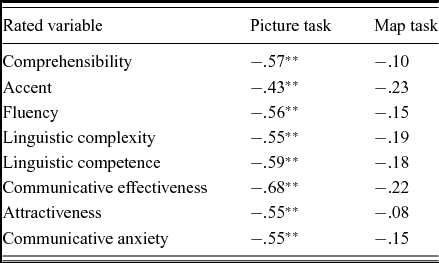
The next analyses targeted individual ratings given to the two interlocutors in each task, on the assumption that alignment ratings reflected at least some interlocutor characteristics (as perceived by the listeners). The intent here was to determine if the alignment ratings were associated with one or more of the eight individual ratings given to each interlocutor in each task. It was hoped that these eight variables would capture at least some dimensions of interlocutor speech behavior that listeners relied on in assigning their alignment (“sounding similar”) ratings. Indeed, when the video excerpts from the beginning and end of each task were considered together, the absolute difference between Interlocutor A and Interlocutor B ratings for all eight individually rated constructs was negatively associated with the alignment rating, but only in the picture task (see Table 2). Simply put, in the picture task, higher alignment scores were associated with smaller differences in speech ratings (e.g., comprehensibility, accent, fluency) and in affective/personal characteristics (e.g., attractiveness, anxiety) between the two interlocutors. From the perspective of the listener, then, the interlocutors were rated as more similar to each other in terms of a number of characteristics as the picture task progressed.
Correlation coefficients between interlocutor A–B rating differences (expressed as absolute values) for each rated variable and alignment ratings in each task.

**p < .01.
The preceding analysis suggested that the L2 interlocutors appeared to converge to each other on several linguistic and non-linguistic dimensions in the picture task. However, it was still unclear whether certain interlocutor pairs were likely to demonstrate convergence because of the particular background, language proficiency, or language use characteristics of the two interacting partners. The next analysis therefore examined how various interlocutor characteristics (including background profiles collected as part of a participant questionnaire as well as listener-rated variables from early on in the interaction) related to the changes in alignment over the course of each task. With respect to interlocutor background characteristics, such as their age, length of residence, self-rated speaking and listening ability, age of first exposure to English, or amount of daily English use, there were no significant associations between Interlocutor A and B “distance” (difference scores) on any of these characteristics and the extent of alignment (here, the change in alignment ratings between the beginning and end of the interaction). In other words, the degree to which the two interlocutors differed in their age, length of stay in Canada, self-rated speaking and listening ability, or amount of daily English use bore no obvious relationship to the extent of alignment in either task.
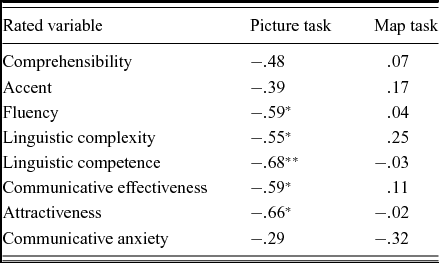
In contrast, several listener-rated variables from early on in the interaction – notably, from the first minute of the introductory task, performed by all speakers at the outset of the testing session and rated by the listeners as part of filler files – appeared to be linked to changes in alignment. More specifically, the absolute difference between Interlocutor A and B ratings for five of the eight individually rated constructs was negatively associated with the change in alignment rating but, again, only in the picture task (see Table 3). Put simply, the more similar the two interlocutors sounded in terms of their fluency, linguistic skill, communicative effectiveness, attractiveness, and communicative anxiety at the outset of their interactive experience, the greater the increase in alignment, at least in the picture task. It appears, then, that a greater initial similarity between L2 interlocutors corresponds to a more substantial convergence in dialogue.
Correlation coefficients between change in alignment ratings and interlocutor A–B rating differences from the introductory task (expressed as absolute values) for each rated variable.

*p < .05, **p < .01.
Listeners’ written comments about alignment
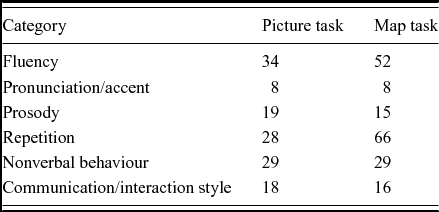
The preceding analyses suggested that, at least in the picture task, the alignment rating given to each pair of interlocutors was linked to interlocutor distance in terms of eight speech and affective/personal characteristics. However, no such associations emerged in the map task, suggesting that the listeners may have based their alignment ratings in this task on other dimensions of interlocutor speech behavior which were not captured by the eight rated characteristics. Therefore, in order to probe the listeners’ decisions further, an analysis of their written comments was carried out. The listeners overall provided 239 comments (2–36 per listener) illustrating how interlocutors approached each other in speaking. The entries were analyzed using thematic categories empirically derived from iterative reading of the comments (Gibson & Brown, Reference Gibson and Brown2009). After the initial analysis, the comments were re-coded using a reduced set of categories in order to eliminate overlap (e.g., “word length”, “pausing”, and “pace” were subsumed under “fluency”). The resulting categories included fluency, which encompassed comments about pace, speed, pausing, and word length; pronunciation/accent; targeting clarity of enunciation, pronunciation of certain words, and mention of strong/thick accents; prosody, focusing on tone, rhythm, and intonation; lexical repetition, which included repetition of words, expressions, and phrases, as well as mimicry; nonverbal behaviour, which involved smiling, hand gestures, nodding, eye contact, posture (leaning), voice volume, and eyegaze/looking, as well as handling of objects (such as papers and pencils); and communication/interaction style, which included attitude towards activity, interrupting, backchanneling, use of comprehension checks and interjections/affirmative words. As Table 4 shows, in the picture task, the listeners based their alignment ratings on several factors, spanning relatively evenly the dimensions of speech (fluency, prosody), lexicon (repetition), and nonverbal behaviors and communication styles. In contrast, in the map task, alignment ratings were based largely on lexical repetition and fluency phenomena, with other factors contributing less prominently to perception of alignment.
Number of coded categories in listener comments accompanying alignment ratings.

Discussion
This study was conceptualized as an investigation of interactive alignment in bilinguals interacting in a shared L2. Overall, results revealed interactive alignment in both information-exchange tasks, with a significant increase in degree of alignment within five minutes of interaction, as rated by native-speaking listeners observing the communication. It is plausible, of course, that through instructions to evaluate similarities in speech patterns, the listeners were “primed” to detect commonalities in speaker behavior, compared to listeners given less explicit instructions. However, if this were the case, then such a bias would extend to all video excerpts evaluated by the listeners. Instead, the listeners reliably distinguished between the excerpts from the beginning of each task and those extracted from the end, rating L2 interlocutor speech as being more similar later on in the interaction than at its outset. Therefore, the current dataset can be taken as one of the first demonstrations of interactive alignment occurring in L2–L2 communication, as shown through global listener ratings. From a theoretical perspective, this finding suggests that alignment is indeed a pervasive sociocognitive phenomenon that can be detected in L2–L2 communication and that may be linked to interlocutor understanding in dialogue (Costa et al., Reference Costa, Pickering and Sorace2008; Garrod & Pickering, Reference Garrod and Pickering2009; Pickering & Garrod, Reference Pickering and Garrod2004). And from a methodological perspective, this result adds global listener ratings to the stock of research tools available to researchers to study alignment, in addition to acoustic measurements (Babel, Reference Babel2012), AXB perceptual discrimination tests (Kim et al., Reference Kim, Horton and Bradlow2011; Pardo, Reference Pardo2006), and lexical frequency profiles (Van Engen et al., Reference Van Engen, Baese-Berk, Baker, Kim and Bradlow2010).
The findings of this study also showed that the nature of interactive alignment may vary depending on task demands. The two tasks targeted here were comparable as two-way information-gap tasks, yet they differed in the interaction demands placed on interlocutors. The picture task allows for a balanced division of communicative load, with interlocutors co-constructing their understanding of the story, while the map task mostly elicits exchange of individual lexical items, with interlocutors taking turns acting as information “givers” and “receivers” (Anderson et al., Reference Anderson, Bader, Bard, Boyle, Doherty, Garrod, Isard, Kowtko, McAllister, Miller, Sotillo, Thompson and Weinert1991; Van Engen et al., Reference Van Engen, Baese-Berk, Baker, Kim and Bradlow2010). The interactive alignment shown in this study was consistent with task demands. In the picture task, which elicited extensive information (e.g., setting, scene, actors, and actions and their causes/consequences), interactive alignment involved various dimensions. In line with Gambi and Pickering's (Reference Gambi and Pickering2013) proposal that interlocutors’ perceived or actual similarity determines the extent of alignment in speech, those L2 interlocutors who were initially more similar in their speech characteristics (e.g., fluency, complexity of language) and in their affective/personal qualities (e.g., attractiveness, communicative effectiveness) were those that received higher alignment ratings from the listeners and showed greater change in alignment as they progressed through the task. From the listeners’ perspective, during this task, the L2 interlocutors appeared to converge in several speech and affective/personal characteristics, such that either one of the two speakers adapted to the other or both speakers accommodated each other, with the consequence of increased alignment as detected by the listeners. Listener comments also revealed that L2 speaker alignment in this task involved not only linguistic dimensions but also non-verbal behaviors, such as smiling, gesturing, eye contact, body posture, and eyegaze, as well as communication patterns, including the use of interruptions, confirmations, and comprehension checks. In contrast, in the map task, which elicited discrete factual detail (i.e., landmarks, route direction), interactive alignment, as perceived by the listener, was largely restricted to interlocutors recycling individual lexical items. Taken together, these results support an intuitive idea that the communicative requirements of the interaction will shape the range of linguistic and nonlinguistic behaviors involved in interactive alignment.
Returning to the broad view of alignment as a phenomenon of interlocutor adaptation at both social and cognitive levels (Pickering & Garrod, Reference Pickering and Garrod2004, Reference Pickering and Garrod2013), as discussed in the introduction, the involvement of interactive alignment in L2–L2 communication opens up interesting perspectives on language learning and use for native-speaking interlocutors and, more importantly, for the vast numbers of the world's bilinguals and multilinguals, including L2 learners, interacting in a shared lingua franca. One view encompassing both social and cognitive dimensions of alignment is the sociocognitive approach to language learning and use (Atkinson, Reference Atkinson and Atkinson2011). This approach is based on the idea that language development is determined by a dynamic interaction between mind, body, and world. This implies that people's cognitive states, such as person-specific individual variables and mental representations (i.e., the mind), are instantiated in overt behaviors, such as bodily actions, orientations, or emotions (i.e., the body), which are in turn fully embedded in particular social contexts (i.e., the world). As in the language-as-action tradition (Clark, Reference Clark1992), language is seen here as an instrument of social action, as a flexible and adaptable tool of effecting change in a social environment (e.g., ordering a meal or persuading a listener). And language development is conceptualized as a gradual, interactive adaptivity or alignment of the speaker with a sociocognitive learning environment. For example, a learner might align with the teacher within a social interaction in a classroom in terms of the complexity of utterances, body gestures, voice volume, and rate of speech (Atkinson, Churchill, Nishino & Okada Reference Atkinson, Churchill, Nishino and Okada2007; Churchill, Nishino, Okada & Atkinson Reference Churchill, Nishino, Okada and Atkinson2010). This view of learning as social and cognitive alignment, which is compatible with both cognitive research on interactive alignment (Garrod & Pickering, Reference Garrod and Pickering2009; Pickering & Garrod, Reference Pickering and Garrod2004) and social psychological research on social accommodation (Giles & Ogay, Reference Giles, Ogay, Whaley and Santer2007; Giles et al., Reference Giles, Coupland, Coupland, Giles, Coupland and Coupland1991), appears to be very promising for conceptualizing L2 learning, especially the development of L2 pronunciation (see Trofimovich, published online October 14, Reference Trofimovich2013, and Trofimovich, McDonough & Foote, published online January 4, Reference Trofimovich, McDonough and Foote2014, for an initial attempt).
Theoretical conceptualizations aside, the finding that interactive alignment occurs in L2–L2 communication points to interesting lines of future research into its practical implications and applications, especially for language teaching and intercultural communication. For example, future research might investigate interactive alignment as a function of various typological differences between L2 interlocutors’ languages, interlocutor linguistic skill, or degree of linguistic experience, with the idea of using alignment as a vehicle to promote cross-cultural and cross-linguistic understanding in dialogue. Interactive alignment (and repetition in general) can be studied as common ways of addressing intelligibility problems in L2 interaction; this would be consistent with previous findings in intercultural communication, where repetition is often used as a means for interlocutors to resolve communication breakdowns (Bremer & Simonot, Reference Bremer, Simonot, Bremer, Roberts, Vasseur, Simonot and Broeder1996; Watterson, Reference Watterson2008). In fact, if the goal of interlocutors is to achieve understanding, then intelligibility problems can be viewed as failure to align at the level of phonetic/prosodic perception and production. Interactive alignment thus becomes one way for interlocutors to resolve and avoid communication breakdowns, particularly when lack of intelligibility compromises smooth and efficient communication. Studies of interactive alignment as an overt or tacit strategy of dealing with communication breakdowns could add to our understanding of how alignment contributes to communicative success and how lingua franca speakers can be aided in achieving mutual understanding.
Future research might also target social dimensions of alignment, probing non-native interlocutors’ attitudes and identities, on the assumption that multilingual and multicultural speakers communicating in a shared L2 would differ vastly in how they construe their identities and how these identities might impact their speech behaviors (e.g., Lippi-Green, Reference Lippi-Green2011; Rindal, Reference Rindal2010; Zuengler, Reference Zuengler1988). Last but not least, interactive alignment could be studied with a view of real-world implications of achieving (or failing to attain) understanding in dialogue. It is possible to imagine that lack of alignment in dialogue (whether in a cognitive or social domain) may have real-world consequences for a speaker: for instance, in terms of employment opportunities, high-stakes assessment outcomes, or judgments of speaker credibility (e.g., see Lev-Ari & Keysar, Reference Lev-Ari and Keysar2010, for related evidence). This research, which fits well within Clark's (Reference Clark1992) language-as-action view of language learning and use, would help researchers advance theoretical understanding of alignment as a social and cognitive phenomenon while clarifying its consequences for L2–L2 communication.
Appendix 1. Complete map and picture story images used in the map and picture tasks

Appendix 2. Listener instructions and the accompanying rating sheet
You are going to be rating speech samples on several different aspects of speech. To help you with these ratings, we have included some basic definitions of the terms we are using for our rating scales.