Child maltreatment confers considerable risk for maladaptation across a wide range of developmental domains (Cicchetti & Toth, Reference Cicchetti and Toth2005). Exposed to a pathogenic relational environment, maltreated children are deprived of many of the experiences that are postulated to promote adaptive functioning across the lifespan. Instead, the experiences of maltreated children place them on a probabilistic pathway for future maladaptation and psychopathology (Cicchetti & Toth, Reference Cicchetti, Toth, Cicchetti and Cohen1995; Koenen, Moffitt, Poulton, Martin, & Caspi, Reference Koenen, Moffitt, Poulton, Martin and Caspi2007; Macmillan et al., Reference Macmillan, Fleming, Streiner, Lin, Boyle and Jamieson2001; Manly, Kim, Rogosch, & Cicchetti, Reference Manly, Kim, Rogosch and Cicchetti2001), characterized by an increased likelihood for compromised resolution of stage-salient developmental tasks (Cicchetti & Lynch, Reference Cicchetti, Lynch, Cicchetti and Cohen1995; Cicchetti & Valentino, Reference Cicchetti, Valentino, Cicchetti and Cohen2006; Trickett & McBride-Chang, Reference Trickett and McBride-Chang1995). Failure to achieve developmentally relevant goals, in turn, may increase maltreated children's vulnerability to depression (Toth, Manly, & Cicchetti, Reference Toth, Manly and Cicchetti1992; Widom, DuMont, & Czaja, Reference Widom, DuMont and Czaja2007).
Numerous studies have established a link between childhood maltreatment and the development of depressive symptomatology and disorder (Cicchetti & Rogosch, Reference Cicchetti and Rogosch2001; Kaufman, Reference Kaufman1991; Kim & Cicchetti, Reference Kim and Cicchetti2006; Manly et al., Reference Manly, Kim, Rogosch and Cicchetti2001; Scott, Smith, & Ellis, Reference Scott, Smith and Ellis2010; Toth et al., Reference Toth, Manly and Cicchetti1992; Widom et al., Reference Widom, DuMont and Czaja2007). Although this effect has been well established, it is important to investigate psychological, as well as biological, mediators and moderators, in order to better understand the mechanisms by which maltreated children either traverse or avert trajectories to psychopathology (Cicchetti & Toth, Reference Cicchetti and Toth2005).
The current study examines the complex pathways by which maltreatment affects psychological adjustment in middle childhood by investigating multiple levels of risk. Because establishing peer relationships is an important developmental task during middle childhood (Waters & Sroufe, Reference Waters and Sroufe1983), poor peer group functioning may heighten risk for depression and depressive symptomatology. Therefore, we evaluate a mediation model in which peer victimization is a mediator of the relationship between maltreatment and depressive symptoms. In addition, we examine the moderating role of genotype in this model. Although maltreatment and peer victimization have been studied independently as stressors that contribute to depressive outcomes, dependent on genetic variation, no study to date has jointly examined these two salient environmental risk factors in a process-oriented fashion.
Maltreatment and Peer Relations
According to an organizational perspective, development may be conceptualized as a series of reorganizations, during which previously developed structures become incorporated into subsequently emerging ones via a process of hierarchical integration (Cicchetti, Reference Cicchetti1993; Cicchetti & Schneider-Rosen, Reference Cicchetti, Schneider-Rosen, Rutter, Izard and Read1986; Sroufe & Rutter, Reference Sroufe and Rutter1984). In this way, competence at one stage prepares a child for adaptive functioning at the next stage (Sroufe & Rutter, Reference Sroufe and Rutter1984). Conversely, maladaptation may be carried forward, disrupting the development of later competencies (Cicchetti & Schneider-Rosen, Reference Cicchetti, Schneider-Rosen, Rutter, Izard and Read1986). Consistent with this approach, it has been theorized that the negative relational patterns acquired in a maltreating environment become incorporated into the structures that are pertinent for successful peer relations (Cicchetti, Lynch, Shonk, & Manly, Reference Cicchetti, Lynch, Shonk, Manly, Parke and Ladd1992).
Continuity and coherence in relational patterns are thought to be derived from early relationship experiences. Within the context of the parent–child relationship, children develop attitudes and expectations regarding the self and others, which are subsequently applied to later social interactions (Sroufe & Fleeson, Reference Sroufe, Fleeson, Hartup and Rubin1986, Reference Sroufe, Fleeson, Hinde and Stevenson-Hinde1988). Exposed to insensitive and pathological care, maltreated children may develop negative expectations regarding the availability and trustworthiness of others, as well as mental representations of the self as incompetent and unworthy (Cicchetti et al., Reference Cicchetti, Lynch, Shonk, Manly, Parke and Ladd1992; Cicchetti & Toth, Reference Cicchetti, Toth, Damon, Sigel and Renninger1998). In addition, they may expect that violence, coercion, and exploitation are fundamental to all relationships (Cicchetti & Lynch, Reference Cicchetti, Lynch, Cicchetti and Cohen1995). These internalizations lead to the selection and structuring of later social interactions, such that familiar relationship patterns are recreated and validated (Sroufe & Fleeson, Reference Sroufe, Fleeson, Hartup and Rubin1986, Reference Sroufe, Fleeson, Hinde and Stevenson-Hinde1988). Individuals with a history of abuse, rejection, and parental insensitivity may continue to seek out relationships that confirm their relational expectations, revisiting patterns of victimization. Consistent with this conceptualization, research shows that adults with a history of child maltreatment are more likely to abuse their own children, as well as become victims and perpetrators of domestic violence (Browne & Finkelhor, Reference Browne and Finkelhor1986; Dutton, Van Ginkel, & Starzomski, Reference Dutton, Van Ginkel and Starzomski1995; Egeland, Jacobvitz, & Papatola, Reference Egeland, Jacobvitz, Papatola, Gelles and Lancaster1987).
Continuity in relational functioning is evident even earlier in development, as children navigate the peer domain. Maltreated children experience a variety of peer difficulties, including peer rejection, aggressiveness, and withdrawal from peer interactions (Cullerton-Sen et al., Reference Cullerton-Sen, Cassidy, Murray-Close, Cicchetti, Crick and Rogosch2008; Dodge, Pettit, & Bates, Reference Dodge, Pettit and Bates1994; Mueller & Silverman, Reference Mueller, Silverman, Cicchetti and Carlson1989; Murray-Close, Han, Cicchetti, Crick, & Rogosch, Reference Murray-Close, Han, Cicchetti, Crick and Rogosch2008; Rogosch & Cicchetti, Reference Rogosch and Cicchetti1994; Shields & Cicchetti, Reference Shields and Cicchetti2001). However, research on the peer relations of maltreated children has predominately focused on maltreated children's heightened tendency to engage in aggressive behavior (Cullerton-Sen et al., Reference Cullerton-Sen, Cassidy, Murray-Close, Cicchetti, Crick and Rogosch2008; Haskett & Kistner, Reference Haskett and Kistner1991; Murray-Close et al., Reference Murray-Close, Han, Cicchetti, Crick and Rogosch2008; Salzinger, Feldman, Hammer, & Rosario, Reference Salzinger, Feldman, Hammer and Rosario1993; Shields & Cicchetti, Reference Shields and Cicchetti1998), with little attention to their victimization status. This reflects a large oversight, given the deleterious implications of peer victimization on psychosocial adjustment (see Crick & Bigbee, Reference Crick and Bigbee1998; Crick & Grotpeter, Reference Crick and Grotpeter1996; Cullerton-Sen & Crick, Reference Cullerton-Sen and Crick2005; Prinstein, Boergers, & Vernberg, Reference Prinstein, Boergers and Vernberg2001; Putallaz et al., Reference Putallaz, Grimes, Foster, Kupersmidt, Coie and Dearing2007).
Two studies have identified child maltreatment as a risk factor for peer victimization. In the first study, Schwartz, Dodge, Pettit, and Bates (Reference Schwartz, Dodge, Pettit and Bates1997) demonstrated that abusive family treatment predicted boys’ status as aggressive victims. Shields and Cicchetti (Reference Shields and Cicchetti2001) expanded upon these findings by including girls in their investigation of bullying and peer victimization in a maltreated sample. Results indicated that maltreatment placed children at considerable risk for being victimized by their peers. Moreover, gender did not act as a moderator, suggesting that maltreated boys and girls experienced similar levels of victimization (Shields & Cicchetti, Reference Shields and Cicchetti2001).
Although these studies have broadened our understanding of maltreated children's experiences in the peer group, no study of peer victimization among maltreated children has included both boys and girls, in addition to forms of victimization that are most salient for girls (i.e., relational victimization). Whereas overt victimization inflicts harm via verbal threats and physically aggressive behavior (e.g., name calling, hitting, or pushing), relational victimization damages relationships and threatens feelings of inclusion (e.g., exclusion, rumor spreading, or threats to withdraw friendship; Crick & Grotpeter, Reference Crick and Grotpeter1996; Crick et al., Reference Crick, Nelson, Morales, Cullerton-Sen, Casas, Hickman, Juvonen and Graham2001). A number of studies have demonstrated that girls are more likely to experience relational victimization, whereas boys are more likely to experience overt victimization (Crick & Bigbee, Reference Crick and Bigbee1998; Cullerton-Sen & Crick, Reference Cullerton-Sen and Crick2005; Putallaz et al., Reference Putallaz, Grimes, Foster, Kupersmidt, Coie and Dearing2007; Schäfer, Werner, & Crick, Reference Schäfer, Werner and Crick2002). However, other studies have not detected gender differences (Crick & Grotpeter, Reference Crick and Grotpeter1996; Paquette & Underwood, Reference Paquette and Underwood1999; Prinstein et al., Reference Prinstein, Boergers and Vernberg2001). Despite discrepant findings on gender differences in exposure to relational victimization, research is consistent in showing that assessment of relational victimization results in the identification of significantly more victimized girls than does focusing on overt victimization alone (Crick & Bigbee, Reference Crick and Bigbee1998; Crick, Casas, & Nelson, Reference Crick, Casas and Nelson2002). Therefore, the current study aims to more fully capture the implications of peer victimization in a maltreated sample by including boys and girls, as well as assessments of both relational and overt forms of victimization.
Peer Victimization and Adjustment
Once the effects of maltreatment are carried forward into the peer realm, disruption in peer relationships may place a child at risk for the development of depression. Research has demonstrated that both overt and relational forms of peer victimization are concurrently and longitudinally associated with depressive symptoms (Boivin, Hymel, & Bukowski, Reference Boivin, Hymel and Bukowski1995; Crick & Bigbee, Reference Crick and Bigbee1998; Crick & Grotpeter, Reference Crick and Grotpeter1996; Cullerton-Sen & Crick, Reference Cullerton-Sen and Crick2005; Hodges, Boivin, Vitaro, & Bukowski, Reference Hodges, Boivin, Vitaro and Bukowski1999; La Greca & Harrison, Reference La Greca and Harrison2005; Olweus, Reference Olweus, Rubin and Asendorph1993; Prinstein et al., Reference Prinstein, Boergers and Vernberg2001; Putallaz et al., Reference Putallaz, Grimes, Foster, Kupersmidt, Coie and Dearing2007; Rosen et al., Reference Rosen, Underwood, Beron, Gentsch, Wharton and Rahdar2009; Storch, Nock, Masia-Warner, & Barlas, Reference Storch, Nock, Masia-Warner and Barlas2003; Vernberg, Reference Vernberg1990). Given maltreated children's increased likelihood to be victimized by their peers (Schwartz et al., Reference Schwartz, Dodge, Pettit and Bates1997; Shields & Cicchetti, Reference Shields and Cicchetti2001), peer victimization may be an important factor in understanding the link between maltreatment and psychological maladjustment. Therefore, the current study examines relational and overt victimization as potential mediators of the association between maltreatment and depressive symptoms.
Genetic Moderation of Environmental Stress
Despite robust findings that have linked parental maltreatment and peer victimization with depression, not all of the children who experience these stressors develop depression or depressive symptomatology. The concept of multifinality stresses the possibility that diverse outcomes may emerge from a single risk factor, including healthy adaptation (Cicchetti & Rogosch, Reference Cicchetti and Rogosch1996). Such variability in children's response to the environment suggests that genes may play a role in this observed heterogeneity (Rutter, Reference Rutter2006; Rutter, Moffitt, & Caspi, Reference Rutter, Moffitt and Caspi2006).
Molecular genetics studies have identified a functional polymorphism, serotonin transporter linked polymorphic region (5-HTTLPR), in the promoter region of the 5-HTT gene that is involved in the development of depression. The genotype has two allelic forms: long and short variants. The presence of the short allele is associated with reduced transcriptional activity of serotonin, whereas the long allelic variant has two to three times the basal level of transcriptional activity of the short variant (Lesch et al., Reference Lesch, Bengel, Heils, Sabol, Greenberg and Petri1996; Lesch & Heils, Reference Lesch and Heils2000). Moreover, the short variant appears to have a dominant influence, such that 5-HTT expression and uptake are similar for homozygous short and heterozygous genotypes (Greenberg et al., Reference Greenberg, Tolliver, Huang, Li, Bengal and Murphy1999; Lesch et al., Reference Lesch, Bengel, Heils, Sabol, Greenberg and Petri1996). However, evidence for a genotype to phenotype association has been inconsistent, suggesting that there may not be a direct effect of 5-HTT on depression (Lasky-Su, Faraone, Glatt, & Tsuang, Reference Lasky-Su, Faraone, Glatt and Tsuang2005; Lesch, Reference Lesch, Plomin, DeFries, Craig and McGuffin2003; Rutter, Thapar, & Pickles, Reference Rutter, Thapar and Pickles2009).
Rather than conceptualize environmental stress or genetic makeup as deterministic predictors of psychopathology, several studies have demonstrated gene by environment interactions (G × E) in the development of depression. In a landmark epidemiological study, Caspi and colleagues (Reference Caspi, Sugden, Moffitt, Taylor, Craig and Harrington2003) found that the 5-HTTLPR genotype moderated the effects of stressful life events in the development of depression in adulthood. In particular, adults carrying the short allele exhibited more depressive symptoms, diagnosable depression, and suicidality in response to stressful life events than did individuals homozygous for the long allele (Caspi et al., Reference Caspi, Sugden, Moffitt, Taylor, Craig and Harrington2003). Moreover, an examination of early life stress showed that a history of child maltreatment longitudinally predicted depression in adulthood but only among short carriers. These results were instrumental in providing evidence that an individual's response to the environment may be moderated by genes.
Efforts to replicate Caspi's initial findings have yielded both positive and negative findings. Among these studies, the majority of supporting findings show that the short allele heightens risk for depression in the context of stress (e.g., Jacobs et al., Reference Jacobs, Kenis, Peeters, Derom, Vlietinck and van Os2006; Kendler, Kuhn, Vittum, Prescott, & Riley, Reference Kendler, Kuhn, Vittum, Prescott and Riley2005); however, some show that the long/long (l/l) genotype confers vulnerability for depression (e.g., Chipman et al., Reference Chipman, Jorm, Prior, Sanson, Smart and Tan2007; Cicchetti, Rogosch, & Oshri, Reference Cicchetti, Rogosch and Oshri2011; Laucht et al., Reference Laucht, Treutlein, Blomeyer, Buchmann, Schmid and Becker2009). Conversely, other investigative attempts have not resulted in an interaction effect (e.g., Coventry et al., Reference Coventry, James, Eaves, Gordon, Gillespie and Ryan2010; Wichers et al., Reference Wichers, Kenis, Jacobs, Mengelers, Derom and Vlietinck2008).
In recent years, a series of meta-analyses have been conducted examining G × E effects involving 5-HTTLPR, generating controversy and discussion. Of these, Munafo, Durrant, Lewis, and Flint (Reference Munafo, Durrant, Lewis and Flint2009) and Risch et al. (Reference Risch, Herrell, Lehner, Liang, Eaves and Hob2009) concluded that there is no evidence supporting an interaction between 5-HTTLPR and stressful life events predicting depression; however, they have been met with serious criticism. Rebuttals have largely focused on study selection, because these meta-analyses included only 5 and 14 of the 34 relevant studies. In particular, only investigations examining interactions between 5-HTTLPR and stressful life events in the development of depression were included, even though the original Caspi et al. (Reference Caspi, Sugden, Moffitt, Taylor, Craig and Harrington2003) study demonstrated an interaction between 5-HTTLPR and maltreatment, in addition to the interaction with stressful life events. By focusing on only a subset of available studies, these meta-analyses have been criticized for ignoring the methodological heterogeneity inherent within this body of research.
Subsequent meta-analyses have demonstrated that there is a systematic relationship between the methods used to assess stressful life events and the outcomes of research examining interactions with 5-HTTLPR (Karg, Burmeister, Shedden, & Sen, Reference Karg, Burmeister, Shedden and Sen2011; Uher & McGuffin, Reference Uher and McGuffin2010). In particular, studies of broadly defined “stressful life events” typically produce mixed results (Caspi, Hariri, Holmes, Uher, & Moffitt, Reference Caspi, Hariri, Holmes, Uher and Moffitt2010). Such variability in findings may be attributed to the fact that the measurement of stressful life events varies from study to study, such that stress measures are not comparable. In addition, a count of stressful life events produces a heterogeneous high-stress group consisting of individuals who may be experiencing qualitatively different forms of stress. Moreover, these studies generally use self-reports of stress, which are prone to reporter biases and inaccuracies in retrospective recall. In contrast, studies of objectively measured, specific stressors, such as maltreatment, often generate positive findings. In their meta-analysis, Karg and colleagues (Reference Karg, Burmeister, Shedden and Sen2011) showed that when studies are stratified by stressor type (i.e., stressful life events, maltreatment, and specific medical conditions), the most robust findings occur when a specific stressor is identified, as opposed to broadly defined stress. Such a pattern of replication emphasizes the importance of a well-defined environmental stressor in the examination of G × E effects.
Child maltreatment is a clearly operationalized, depression-inducing stressor that has been shown to be moderated by the 5-HTTLPR genotype (Aguilera et al., Reference Aguilera, Arias, Wichers, Barrantes-Vidal, Moya and Villa2009; Åslund et al., Reference Åslund, Leppert, Comasco, Nordquist, Oreland and Nilsson2009; Caspi et al., Reference Caspi, Sugden, Moffitt, Taylor, Craig and Harrington2003; Cicchetti et al., Reference Cicchetti, Rogosch and Oshri2011; Cicchetti, Rogosch, & Sturge-Apple, Reference Cicchetti, Rogosch and Sturge-Apple2007; Kaufman et al., Reference Kaufman, Yang, Douglas-Palumberi, Houshyar, Lipschitz and Krystal2004, Reference Kaufman, Yang, Douglas-Palumberi, Grasso, Lipschitz and Houshyar2006). Moreover, researchers examining child maltreatment have been successful in demonstrating that the interaction effect may be generalized to child and adolescent populations (Åslund et al., Reference Åslund, Leppert, Comasco, Nordquist, Oreland and Nilsson2009; Cicchetti et al., Reference Cicchetti, Rogosch and Sturge-Apple2007, Reference Cicchetti, Rogosch and Oshri2011; Kaufman et al., Reference Kaufman, Yang, Douglas-Palumberi, Houshyar, Lipschitz and Krystal2004, Reference Kaufman, Yang, Douglas-Palumberi, Grasso, Lipschitz and Houshyar2006). In the first of such investigations, Kaufman et al. (Reference Kaufman, Yang, Douglas-Palumberi, Houshyar, Lipschitz and Krystal2004) found that maltreated children (M age = 9 years) with the short/short (s/s) genotype experienced depression scores that were almost twice as high as the depression scores of maltreated children with the s/l and l/l genotypes. Kaufman et al. (Reference Kaufman, Yang, Douglas-Palumberi, Grasso, Lipschitz and Houshyar2006) replicated these findings in a subsequent study (M age = 9 years), the results of which revealed a significant three-way interaction among brain-derived neurotrophic factor (BDNF) genotype, 5-HTTLPR, and maltreatment in predicting heightened levels of depression. In another instance of G × G × E, Cicchetti et al. (Reference Cicchetti, Rogosch and Oshri2011) demonstrated that maltreated children (M age = 10 years) with two copies of the TAT haplotype of CRHR1 and the l/l genotype of 5-HTTLPR had higher levels of internalizing symptoms than did nonmaltreated children with the same combination of gene variants. Among adolescents, Cicchetti and colleagues (Reference Cicchetti and Curtis2007) showed a G × G × E effect indicating that individuals with a history of sexual abuse (M age = 16.7 years) who carried both the s/s genotype and the low monoamine oxidase A activity genotype evinced higher levels of depression symptomatology compared to sexually abused adolescents with alternative combinations of the variants of the 5-HTT and monoamine oxidase A genes. Åslund et al. (Reference Åslund, Leppert, Comasco, Nordquist, Oreland and Nilsson2009) also demonstrated a positive Maltreatment × 5-HTTLPR effect for depression among adolescents (M age = 17 years); however, results were only significant for females.
Although the reviewed literature has been instrumental in demonstrating the utility in specifying a well-defined environmental stressor, most studies focus on family-level stress, to the exclusion of other developmentally relevant stressors. As children progress into middle childhood, stress that originates from the peer group may become especially salient. This period is characterized by an increase in the quantity of peer interaction, as well as a marked change in the developmental significance of peers for psychological health (Hartup, Reference Hartup1996). Therefore, the inclusion of peer-related stressors in G × E designs may be particularly helpful in elucidating the developmental pathways to childhood depression.
Two molecular genetic studies have shown that peer victimization is a salient source of stress for children. In the first study, Benjet, Thompson, and Gotlib (Reference Benjet, Thompson and Gotlib2010) examined 5-HTTLPR as a moderator of the effect of relational peer victimization on depression in adolescent girls (M age = 12 years). Relational victimization significantly predicted increased depressive symptoms for girls in the s/s group but not for girls in the s/l or l/l group.
In another study, Sugden et al. (Reference Sugden, Arseneault, Harrington, Moffitt, Williams and Caspi2010) utilized an assessment of bully victimization that measured both relational and overt forms of victimization. Relational and overt victimization experiences were aggregated and children were classified as not bullied, occasionally bullied, or frequently bullied. They found that 5-HTTLPR moderated the association between bully victimization and emotional problems (i.e., withdrawn or anxious/depressed), such that frequently bullied children were at an increased risk for emotional problems at age 12 if they possessed the s/s but not the s/l or l/l genotype. Moreover, genetic moderation persisted even after controlling for the effects of family risk factors, as measured by within-family comparisons in a twin study design.
Sugden et al. (Reference Sugden, Arseneault, Harrington, Moffitt, Williams and Caspi2010) expanded upon the Benjet et al. (Reference Benjet, Thompson and Gotlib2010) study by including males and females and by utilizing a measure of bully victimization that incorporated both relational and overt forms of victimization. Because of the composite nature of their assessment, however, it was not possible to independently determine the effects of relational and overt victimization. Given that relational and overt victimization are distinct behaviors with unique effects on adjustment (Crick & Grotpeter, Reference Crick and Grotpeter1996; Cullerton-Sen & Crick, Reference Cullerton-Sen and Crick2005; Prinstein et al., Reference Prinstein, Boergers and Vernberg2001; Storch et al., Reference Storch, Nock, Masia-Warner and Barlas2003), it is important to distinguish between the two when assessing developmental outcomes.
Hypotheses and Research Questions
The current study investigates the development of depressive symptoms in a preadolescent sample of maltreated and nonmaltreated comparison children. We propose a moderated mediation model, whereby peer victimization mediates the association between maltreatment and depressive symptoms among children who are genetically predisposed to developing depression. Research indicates that maltreated children experience disruptions in the peer domain, including an increased likelihood of being victimized by their peers, compared to nonmaltreated children. We hypothesize that compromised resolution of this stage-salient developmental task subsequently increases risk for depression. In addition, we believe that maltreated children carrying a short allele are more likely to traverse this pathway from maltreatment to peer victimization to depressive symptoms, compared to maltreated children homozygous for the long allele.
To our knowledge, this is the first G × E study to independently examine the effects of both relational and overt forms of victimization on depressive symptomatology. Moreover, the current study is unique in its approach of examining potential genetic moderation, by allelic variation of 5-HTTLPR, of a process model whereby maltreatment contributes to child depression via maltreatment's contribution to peer victimization.
We posit the following hypotheses and research questions:
1. We do not expect to observe significant between-group differences in the distribution of the 5-HTTLPR genotype for maltreated and nonmaltreated children, suggesting a lack of an evocative gene–environment correlation as an explanation for maltreatment.
2. We do not expect to observe significant differences between genotype groups on scores of overt and relational victimization, suggesting a lack of an evocative gene–environment correlation as an explanation for peer victimization.
3. We hypothesize that there will be a significant G × E between maltreatment status and 5-HTTLPR genotypes, such that maltreated children with a short allele (s/s or s/l) will have higher levels of depressive symptoms than those with the l/l genotype, whereas depressive symptoms will not vary by genotype among nonmaltreated children.
4. Maltreatment will be positively related to depressive symptoms, as well as relational and overt victimization. In turn, relational and overt peer victimization will mediate the association between child maltreatment and depressive symptomatology.
5. Within the mediational process model, the paths (b 1) from relational victimization and from overt victimization to depressive symptoms will be moderated by 5-HTTLPR genotypes, such that extremely victimized children carrying a short allele will have higher levels of depressive symptoms compared to extremely victimized children homozygous for the long allele.
Method
Participants
Participants included 301 children aged 8–13 years (M = 11.26, SD = 1.65, Mdn = 11.48) who attended a summer day camp research program designed for school-aged, low-income children. The sample was composed of both maltreated children (n = 156) and nonmaltreated children (n = 145). Among the participants, 62.1% were boys. In terms of racial/ethnic characteristics, 59.3% of the sample was African American, 23.7% was Caucasian, 15.3% was Hispanic, and 1.7% was from other racial/ethnic groups. The Add Health system for coding race/ethnicity was used (http://www.cpc.unc.edu/projects/addhealth/data/code/race). The families of the children were low income, with 95.35% of the families having a history of receiving public assistance.
Recruitment and classification procedures
Parents of all children provided informed consent for their child's participation, as well as for examination of Department of Human Services (DHS) records pertaining to the family. Children in the maltreated group had been identified by the county DHS as having experienced child abuse or neglect, and the sample was representative of the children in families receiving services from the DHS. A recruitment liaison from the DHS contacted eligible maltreating families and explained the study. If parents were interested, then they signed a name release form allowing the project team to contact them for recruitment. Families were free to choose whether or not to participate. Comprehensive searches of DHS records were completed, and maltreatment information was coded utilizing operational criteria from the maltreatment nosology specified in the Maltreatment Classification System (MCS; Barnett, Manly, & Cicchetti, Reference Barnett, Manly, Cicchetti, Cicchetti and Toth1993).
Consistent with national demographics characteristic of maltreating families (Fourth National Incidence Study of Child Abuse and Neglect; Sedlak et al., Reference Sedlak, Mettenburg, Basena, Petta, McPherson and Greene2010), the maltreated children were predominantly from low socioeconomic status families. Consequently, demographically comparable nonmaltreated children were recruited from families receiving Temporary Assistance for Needy Families. Prior to contacting potential participants, a liaison screened DHS records to verify any record of child maltreatment. The DHS recruitment liaison then contacted eligible nonmaltreating families and described the project, and if interested, parents signed a release for their names to be given to the project for recruitment. Trained research assistants subsequently interviewed mothers of children recruited for the nonmaltreatment group to confirm a lack of DHS involvement and prior maltreatment experiences utilizing the Maternal Maltreatment Classification Interview (Cicchetti, Toth, & Manly, Reference Cicchetti, Toth and Manly2003). Record searches were conducted in the year following camp attendance to verify that all available information had been accessed. Only children from families without any history of documented abuse or neglect were retained in the nonmaltreatment group. In addition, families who had received preventive services through the DHS because of concerns over risk for maltreatment were excluded from the sample to reduce the potential for unidentified maltreatment existing within this group.
Classification of maltreatment experiences children had been subjected to was accomplished through use of the MCS (Barnett et al., Reference Barnett, Manly, Cicchetti, Cicchetti and Toth1993). The MCS is a reliable and valid method for classifying maltreatment (Bolger, Patterson, & Kupersmidt, Reference Bolger, Patterson and Kupersmidt1998; English et al., Reference English, Upadhyaya, Litrownik, Marshall, Runyan and Graham2005; Manly, Cicchetti, & Barnett, Reference Manly, Cicchetti and Barnett1994) that utilizes DHS records detailing investigations and findings involving maltreatment in identified families over time. Rather than relying on official designations and case dispositions, the MCS codes all available information from DHS records, making independent determinations of maltreatment experiences.
Coding of the DHS records was conducted by trained research assistants, doctoral students, and clinical psychologists. Coders were required to meet acceptable reliability with criterion standards before coding actual records for the study. Adequate reliability has been obtained (weighted κs = 0.86–0.98; Manly, Reference Manly2005). Other investigators also have demonstrated that the MCS is reliable and valid in classifying maltreatment (e.g., Bolger & Patterson, Reference Bolger and Patterson2001; English et al., Reference English, Upadhyaya, Litrownik, Marshall, Runyan and Graham2005; Stouthamer-Loeber, Loeber, Homish, & Wei, Reference Stouthamer-Loeber, Loeber, Homish and Wei2001). In the current study, reliability was established for each subtype of maltreatment: emotional maltreatment, κ = 0.91; neglect, κ = 0.93; physical abuse, κ = 0.89; and sexual abuse, κ = 1.00.
In terms of the subtypes of maltreatment, neglect involves failure to provide for the child's basic physical needs for adequate food, clothing, shelter, and medical treatment. Emotional maltreatment involves extreme thwarting of children's basic emotional needs for psychological safety and security, acceptance and self-esteem, and age-appropriate autonomy. Physical abuse involves the nonaccidental infliction of physical injury on the child (e.g., bruises, welts, burns, choking, or broken bones). Finally, sexual abuse involves attempted or actual sexual contact between the child and a family member or person caring for the child for purposes of that person's sexual satisfaction or financial benefit.
Children in the maltreatment group all had histories of abuse, neglect, or both (i.e., emotional: 21.79%; physical: 31.41%; sexual: 16.03%; and neglect: 30.77%). The majority of children had experienced multiple subtypes of maltreatment. Specifically, 29.7% experienced one subtype; 33.3% experienced two; 28.3% experienced three; and 8.7% experienced four.
Procedures
Children attended a week-long day camp program and participated in research assessments (see Cicchetti & Manly, Reference Cicchetti, Manly, Brody and Sigel1990, for detailed descriptions of camp procedures). Children were transported by bus to the camp each day, with travel time averaging 45 min. At the camp, children were assigned to groups of eight (four maltreatment and four comparison) same-age and same-sex peers. Each group was led by three trained camp counselors, who were unaware of the maltreatment status of the children and the hypotheses of the study. Camp lasted 7 hr a day for 5 days, providing 35 hr of interaction between children and counselors. In addition to the recreational activities, after providing assent, children participated in various research assessments. Trained research assistants, who also were unaware of the research hypotheses and maltreatment status, conducted individual research sessions with children, in which questionnaires and other research measures were administered. In an effort to reduce potential negative cognitive biases, questionnaires that assessed depressive symptoms and peer victimization were administered 3 days apart in the camp week. Clinical consultation and intervention occurred if any concerns over danger to self or others emerged during the research sessions. DNA samples also were obtained from children, as described below.
Measures
Children's Depression Inventory (CDI)
The CDI is a widely used self-report questionnaire that assesses depressive symptomatology in school-age children (Kovacs, Reference Kovacs1992, Reference Kovacs2004). For each item, children chose from among three option statements, depicting increasing levels of depressive symptoms, in order to characterize their experiences in the past 2 weeks. Kovacs (Reference Kovacs2004) reports that internal consistency for the total scale has ranged from 0.71 to 0.89 and that validity has been well established. In the current investigation, internal consistency was α = 0.81.
Children's Social Experiences Questionnaire—Self-Report (CSEQ-S)
The CSEQ-S assesses peer victimization experiences (Crick & Grotpeter, Reference Crick and Grotpeter1996). The CSEQ-S includes two five-item victimization subscales: overt (e.g., “How often do you get hit by another kid?”) and relational (e.g., “How often do other kids leave you out on purpose when it is time to play or do an activity?”). Children were introduced to the measure with the following prompt: “Here is a list of things that sometimes happen to kids your age. How often do they happen to you?” Therefore, assessment of peer victimization was not limited to experiences at camp. Children indicated the frequency of being victimized by their peers by answering these questions on a 5-point Likert scale, with a score of 1 corresponding to never and a score of 5 corresponding to all the time. Crick and Grotpeter (Reference Crick and Grotpeter1996) report adequate internal consistency, reliability, and construct validity for the CSEQ-S. In the current sample, internal consistency was α = 0.86 for the overt victimization subscale and α = 0.80 for the relational victimization subscale. Consistent with previous research using the SEQ (e.g., Benjet et al., Reference Benjet, Thompson and Gotlib2010; Crick & Bigbee, Reference Crick and Bigbee1998; Crick & Grotpeter, Reference Crick and Grotpeter1996; Prinstein et al., Reference Prinstein, Boergers and Vernberg2001), a child was categorized as extremely victimized based on a cutoff score of 1 SD above the mean on each of the victimization scales. Because a certain degree of peer victimization is considered to be normative, children who are targeted at extreme levels are expected to be at the greatest risk for negative developmental outcomes (Crick et al., Reference Crick, Casas and Nelson2002).
DNA collection, extraction, and genotyping
Using an established protocol, trained research assistants obtained DNA samples from participants by collecting buccal cells with the Epicentre Catch-All Collection Swabs. Subsequently, using the conventional method, DNA was extracted with the Epicentre BuccalAmp DNA Extraction Kit (Epicentre, Cat. No. BQ090155C) and whole-genome amplified using the Repli-g kit (Qiagen, Cat. No. 150043) according to the kit instructions. Amplified samples were then diluted to a working concentration.
Genotyping was conducted following previously published protocols. For 5-HTT, we used the methods of Gelernter, Kranzler, and Cubells (Reference Gelernter, Kranzler and Cubells1997). Representative genotypes were identified and sequenced with a Beckman–Coulter CEQ8000 semiautomated fluorescent sequencing system, utilizing the Fragment Analysis Application and associated software.
The 5-HTT gene has a polymorphism in the linked promoter region (5-HTTLPR) in the 5′ regulatory region because of a 44 base pair deletion that eventuates in either the short or long allele (Lesch et al., Reference Lesch, Bengel, Heils, Sabol, Greenberg and Petri1996). The presence of the short allele is associated with reduced transcriptional activity of serotonin and lower level of the gene expression (Lesch et al., Reference Lesch, Bengel, Heils, Sabol, Greenberg and Petri1996; Lesch & Heils, Reference Lesch and Heils2000).
If a genotype was unable to be determined after the first run, then it was repeated up to four times. If the null result persisted, then the whole genome amplification reaction was repeated along with subsequent genotyping until a genotype could be confidently assigned to a participant. The resultant genotyping data were subjected to quadratic discriminant analysis using JMP software from SAS. Samples with a predicted probability of .95 or less were repeated. The call rate for 5-HTTLPR was 100%. There were no missing results. The distribution of the three 5-HTTLPR genotypes did not differ significantly from Hardy–Weinberg equilibrium, χ2 (1, N = 301) = 3.1, p = .08.
Control samples were identified for the 5-HTTLPR polymorphisms using dye terminator cycle sequence chemistry on an ABI 3130x1. Results were confirmed using the TaqMan SNP genotyping reagents and run with each sample set as positive and negative controls for each allele. All DNA samples were genotyped in duplicate for quality control. In addition, human DNA from cell lines was purchased from Coriell Cell Repositories for all representative genotypes in duplicate and genotypes confirmed by sequencing using dye terminator cycle sequence chemistry on an ABI 3130x1.
The frequency distribution of the 5-HTTLPR genotype for the full sample was as follows: s/s: n = 40 (13.3%); s/l: n = 120 (39.9%); l/l: n = 141 (46.8%). Frequency distributions by racial/ethnic group were as follows: African American s/s: n = 16 (9.0%), s/l: n = 64 (36.0%), l/l: n = 98 (55.0%); Caucasian s/s: n = 14 (19.7%), s/l: n = 35 (49.3%), l/l: n = 22 (31.0%), Hispanic s/s: n = 10 (21.7%), s/l: n = 19 (41.3), l/l: n = 17 (37.0%). Chi-square analyses showed that the distributions of the s/s, s/l, and l/l variants differed significantly across racial/ethnic groups, χ2 (6, N = 301) = 17.62, p = .007. Consistent with prior investigations (Gelernter et al., Reference Gelernter, Kranzler and Cubells1997), African American children were more likely to have the l/l genotype than were Caucasian or Hispanic children. However, the genotype distribution did not differ by maltreatment status within the race/ethnicity groups, African American: χ2 (2, N = 188) = 1.55, p = .46; Caucasian: χ2 (2, N = 71) = 2.38, p = .30; Hispanic: χ2 (2, N = 36) = 5.58, p = .06.
Analytic plan
All structural equation modeling analyses were performed using Mplus Version 6.00 (Muthén & Muthén, Reference Muthén and Muthén1998). To account for nonnormality presented in the CDI and overt victimization variables (kurtosis = 2.31 and 1.72, respectively), all structural relations were assessed using bootstrapping with 5,000 sample replicates. Traditional maximum-likelihood methods assume the distributions of the continuous variables in the model are multivariate normal. In mediation models, the normal distribution assumption is an important concern because the product coefficients used to evaluate mediation rarely meet this assumption (Preacher & Hayes, Reference Preacher and Hayes2008; Shrout & Bolger, Reference Shrout and Bolger2002). Thus, in the current study, the significance of mediation (i.e., indirect effects), as well as moderated mediation, was determined via bootstrapping techniques (Preacher & Hayes, Reference Preacher and Hayes2008).
The full information at maximum likelihood procedure was used to estimate missing data in the model. The rates of missing data were minimal and ranged from 0% to 6.6% (CDI). There were no missing data on maltreatment status. Missing data were modeled under the assumption that missingness was related to variables that were observed but unrelated to the missing values themselves (i.e., missing at random; Schafer & Graham, Reference Schafer and Graham2002) and were analyzed under missing data theory using all available data (Schafer & Graham, Reference Schafer and Graham2002). To account for potential influence of gender, race/ethnicity, and age, we used these variables as covariates in all of the analyses across all of the examined endogenous variables.
Results
Preliminary analyses
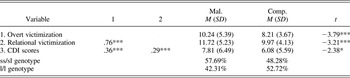
Table 1 summarizes Pearson bivariate correlations among variables included in the structural models, as well as means and standard deviations for the maltreated and nonmaltreated groups. The t tests showed that maltreated children reported significantly higher levels of overt victimization (M = 10.24, SD = 5.39), compared to nonmaltreated children (M = 8.21, SD = 3.67), t (299) = −3.79, p < .001, d = 0.44. Maltreated children also reported significantly higher levels of relational victimization (M = 11.72, SD = 5.23), compared to nonmaltreated children (M = 9.97, SD = 4.13), t (299) = −3.21, p = .001, d = 0.37. CDI scores were significantly higher among maltreated children (M = 7.81, SD = 6.49), compared to nonmaltreated children (M = 6.08, SD = 5.59), t (279) = −2.38, p = .018, d = 0.28.
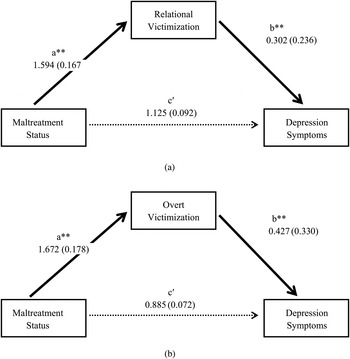
Mediation of the association between maltreatment and depression symptoms by (a) relational victimization and (b) overt victimization. The values in the figure are unstandardized (standardized) path coefficients. **p < .01.

Intercorrelations, means (standard deviations), and genotype frequencies

Note: Mal., maltreated; Comp., comparison; CDI, Child Depression Inventory; s, short allele; l, long allele.
*p < .05. ***p < .001.
In order to test the first research question, differences between maltreated and nonmaltreated children on frequency distributions of the 5-HTTLPR genotype were examined. Chi-square analyses revealed that for the 5-HTTLPR genotype, the distributions of the s/s, s/l, and l/l variants did not differ between maltreated and nonmaltreated children, χ2 (2, N = 301) = 5.38, p = .068. For the maltreated versus nonmaltreated groups, respectively, the percentages were as follows: s/s, 17.3% versus 9.0%; s/l, 40.4% versus 39.3%; and l/l, 42.3% versus 51.7%. These findings indicated that maltreatment status was not differentially associated with polymorphic variation in the 5-HTTLPR gene, thereby providing evidence against the existence of an evocative gene–environment correlation. Consistent with previous research strategies, as well as data indicating that the short allele has a dominant influence marked by lower transcriptional activity among s/s and s/l carriers compared to l/l carriers (Greenberg et al., Reference Greenberg, Tolliver, Huang, Li, Bengal and Murphy1999; Lesch et al., Reference Lesch, Bengel, Heils, Sabol, Greenberg and Petri1996; Lesch & Heils, Reference Lesch and Heils2000), participants with the s/s and s/l genotypes were combined and compared to children with the l/l genotype in all study analyses in order to address power concerns (e.g., Caspi et al., Reference Caspi, Sugden, Moffitt, Taylor, Craig and Harrington2003; Cicchetti, Rogosch, Sturge-Apple, & Toth, Reference Cicchetti, Rogosch, Sturge-Apple and Toth2010; Hariri et al., Reference Hariri, Drabant, Munoz, Kolachana, Mattay and Egan2005). Follow-up chi-square analyses of the distributions of the s/s or s/l and the l/l variants among the maltreated versus nonmaltreated children were not significant, χ2 (1, N = 301) = 2.68, p = .102. Similarly, differences between 5-HTTLPR genotypes and scores on overt and relational victimization also were examined. Analyses revealed no significant differences between genotype group (i.e., s/s or s/l and l/l) and scores on either overt victimization, t (299) = 1.57, p = .117, or relational victimization, t (299) = 1.18, p = .24, indicating that there was not an evocative gene–environment correlation.
Next we evaluated the second hypothesis that 5-HTTLPR would moderate the association between maltreatment and depressive symptoms. After covarying for gender, race/ethnicity, and age, there was no main effect for the association between 5-HTTLPR genotype and depression symptoms, F (1, 274) = 0.178; p = .178, whereas the main effect of maltreatment was significant, F (1, 274) = 4.565; p = .034. Furthermore, analyses indicated there was no significant interaction effect between 5-HTTLPR genotype group and maltreatment status in the prediction of child depression symptoms, F (1, 274) = 2.723; p = .100.
Mediation models
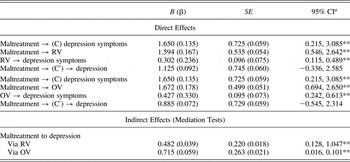
We evaluated two path analytic models to test relational victimization and overt victimization, respectively, as mediators for the relation between child maltreatment and child depression symptoms. Race/ethnicity, gender, and age were included as covariates in the two path analytic models and for all of the endogenous variables (i.e., mediator and outcome variables). Standardized and unstandardized path coefficients of the direct and indirect effects tested at 95% bias corrected confidence intervals are presented in Table 2 and in Figure 1. Maltreatment status significantly predicted increased depressive symptoms, as well as higher levels of relational and overt victimization. In addition, relational and overt victimization were significantly positively associated with child depression. In both models, the effect of maltreatment status on depression symptoms became nonsignificant once peer victimization (i.e., relational, overt) was taken into account. The indirect paths of the two models from child maltreatment to child depression via relational victimization and overt victimization, respectively, were both statistically significant (ps < .01), as shown in Table 2. Following the recommendations of Preacher and Kelly (Reference Preacher and Kelley2011), multiple effect size estimates are reported below. In the overt victimization model, R 2 = .100, indicating that the model explains 10% of the variance. Another effect size estimate for the indirect effect of overt victimization is R M = 1.15, the ratio of the indirect effect to the direct effect (Sobel, Reference Sobel and Leinhardt1982), which indicates that the indirect effect of overt victimization on depression is approximately 1.15 times the size of the direct effect. In addition, κ2 = 0.07, which represents the proportion of the maximum possible indirect effect that could have occurred within the examined model, given the characteristics of the data (Preacher & Kelly, Reference Preacher and Kelley2011). In the relational victimization model, R 2 = .128. For the indirect effect of relational victimization, the effect sizes were R M = .54 and κ2 = 0.05. These results supported the fourth hypothesis that the relations between child maltreatment status and increased depression symptoms in childhood are mediated by both relational and overt victimization.
Unstandardized and standardized path coefficients of direct and indirect effects
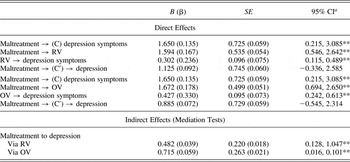
Note: C, direct effect of maltreatment on depression; RV, relational victimization; C′, indirect effect of maltreatment on depression adjusted for the mediator; OV, overt victimization.
aBootstrapping based confidence intervals.
**p < .01.
Moderated mediation
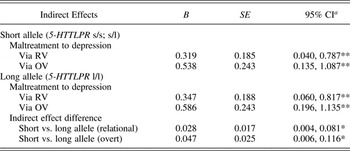
Subsequently, we tested for moderated mediation using a bootstrapping procedure following Preacher, Rucker, and Hayes’ (Reference Preacher, Rucker and Hayes2007) Model 3, in which moderation of the path between the mediator and the outcome (i.e., path b) is evaluated. Specifically, we wanted to test Hypothesis 5, that is, whether the association between victimization (i.e., relational and overt) and depression symptoms is moderated by genetic variation of 5-HTTLPR within the mediational path models. The findings showed that the associations between high relational victimization and high overt victimization and child depression symptoms are moderated by 5-HTTLPR genotype groups (Table 3). Specifically, the indirect effects from child maltreatment to depression symptoms via high relational victimization and high overt victimization were significant (ps < .01) for both the homozygous long and short allele groups. However, the indirect effect coefficient for children with the l/l variation (β = 0.347) was significantly larger (p < .05) for high relational victimization than the indirect coefficient for children with a short allele (β = 0.319). Similarly, for high overt victimization, the indirect effect coefficient for the l/l variation (β = 0.586) was significantly larger (p < .05) than the coefficient for the short allele group (β = 0.538). These findings indicate statistically significant moderated mediation effects, such that within the mediational models, the association of high victimization (i.e., relational or overt) and depression was stronger among children with the l/l genotype than among children with the s/s or s/l variations. These findings support the prediction of moderated mediation in Hypothesis 5, albeit in the opposite direction.Footnote 1
Test of moderated mediation

Note: 5-HTTLPR, serotonin transporter linked polymorphic region; s, short allele; l, long allele; RV, high relational victimization; OV, high overt victimization.
aBootstrapping based confidence intervals.
*p < .05. **p < .01.
Discussion
Previous research has established a robust association between child maltreatment and depression (Cicchetti & Rogosch, Reference Cicchetti and Rogosch2001; Kim & Cicchetti, Reference Kim and Cicchetti2006; Manly et al., Reference Manly, Kim, Rogosch and Cicchetti2001; Scott et al., Reference Scott, Smith and Ellis2010; Toth et al., Reference Toth, Manly and Cicchetti1992; Widom et al., Reference Widom, DuMont and Czaja2007). However, a developmental psychopathology approach emphasizes that maltreated children may traverse various pathways that lead to a diverse array of adaptive, as well as maladaptive, outcomes (Cicchetti & Rogosch, Reference Cicchetti and Rogosch1996). Rather than conceptualizing the relationship between child maltreatment and depression as direct and deterministic, the current study investigated underlying psychological and biological processes that may account for variation in the developmental sequelae of child maltreatment. Our goal was to examine whether peer victimization accounted for the association between maltreatment and depressive symptoms in middle childhood. We were also interested in whether genetic variation in 5-HTTLPR moderated mediational pathways.
Maltreated children and nonmaltreated comparisons were not found to differ in their distributions of the 5-HTTLPR genotype. Similarly, genotypic variation also did not account for the extent of overt or relational victimization experienced. These findings rule out the possibility of evocative gene–environment correlations (Rende & Waldman, Reference Rende, Waldman, Cicchetti and Cohen2006; Rutter, Reference Rutter2006; Scarr & McCartney, Reference Scarr and McCartney1983), which would suggest that genetic variation accounts for maltreatment and victimization by peers. Moreover, these results support the current study's first two hypotheses, positing that maltreatment and victimization are not elicited as a function of children's particular genetic characteristics. In addition, 5-HTTLPR did not directly predict differences in depressive symptoms. This finding corroborates results from previous research studies that have demonstrated the absence of a main effect of genes on depression (e.g., Benjet et al., Reference Benjet, Thompson and Gotlib2010; Caspi et al., Reference Caspi, Sugden, Moffitt, Taylor, Craig and Harrington2003; Cicchetti et al., Reference Cicchetti, Rogosch and Sturge-Apple2007).
Next, we tested for a G × E effect on depressive symptoms. Contrary to our second hypothesis, 5-HTTLPR did not moderate the association between maltreatment and depressive symptomatology. This finding corroborates research by Cicchetti et al. (Reference Cicchetti, Rogosch and Sturge-Apple2007) and Cicchetti et al. (Reference Cicchetti, Rogosch and Oshri2011), which similarly did not show G × E effects among maltreated adolescents (M age = 16.7 years) and children (M age = 10 years), respectively. It is possible that cross-study heterogeneity in the measurement of maltreatment contributes to discrepant results. Many G × E studies rely on retrospective self-reports of child maltreatment, whereas the current study used a well-defined and operationalized nosological system to code DHS records of maltreatment (MCS; Barnett et al., Reference Barnett, Manly, Cicchetti, Cicchetti and Toth1993). Stage of illness factors may also account for failure to replicate G × E effects among younger populations. Recent research suggests that the 5-HTTLPR × Child Maltreatment effect on depression may be specific to depression that runs a persistent course in adulthood, as opposed to single-episode depression (Uher et al., Reference Uher, Caspi, Houts, Sugden, Williams and Poulton2011). Longitudinal research is needed in order to distinguish G × E effects on chronic versus single-episode depression.
Consistent with previous research, maltreatment was positively associated with depressive symptoms; however, results from the current study revealed that this association was mediated by overt and relational peer victimization. Analyses indicated that the effect of maltreatment on depressive symptomatology became nonsignificant when peer victimization was taken into account, demonstrating full versus partial mediation (Baron & Kenny, Reference Baron and Kenny1986). In other words, maltreatment increased the risk for relational and overt victimization, which in turn predicted elevated levels of depressive symptoms. Although other mechanisms beyond the scope of the present study are likely involved in the development of depressive symptomatology, these results indicated that peer victimization experiences may be a significant factor in explaining the association between maltreatment and depressive symptoms.
The present investigation's mediational findings are congruent with organizational theories of development that suggest continuity in relationships (Main, Kaplan, & Cassidy, Reference Main, Kaplan and Cassidy1985; Sroufe & Fleeson, Reference Sroufe, Fleeson, Hartup and Rubin1986, Reference Sroufe, Fleeson, Hinde and Stevenson-Hinde1988). Exposed to a pathogenic rearing environment, maltreated children may develop negative expectations regarding the self and others, as well as a concept of relationships as involving victimization and coercion (Cicchetti et al., Reference Cicchetti, Lynch, Shonk, Manly, Parke and Ladd1992; Cicchetti & Lynch, Reference Cicchetti, Lynch, Cicchetti and Cohen1995; Cicchetti & Toth, Reference Cicchetti, Toth, Damon, Sigel and Renninger1998). Maltreated children may maintain a coherent sense of self by recreating familiar social environments that validate their relational expectations (Sroufe & Fleeson, Reference Sroufe, Fleeson, Hartup and Rubin1986, Reference Sroufe, Fleeson, Hinde and Stevenson-Hinde1988). Drawing from a repertoire of limited social skills, maltreated children may be more vulnerable to victimization from their peers as a result of engaging in behaviors such as hypervigilance to threatening cues, submissiveness, and withdrawal (Pollak, Cicchetti, Hornung, & Reed, Reference Pollak, Cicchetti, Hornung and Reed2000; Rieder & Cicchetti, Reference Rieder and Cicchetti1989; Shields & Cicchetti, Reference Shields and Cicchetti2001; Shields, Ryan, & Cicchetti, Reference Shields, Ryan and Cicchetti2001; Teisl & Cicchetti, Reference Teisl and Cicchetti2008; Troy & Sroufe, Reference Troy and Sroufe1987). Paradoxically, these behaviors may have been adaptive for them in abusive and chaotic homes (Sroufe, Reference Sroufe1997). Once identified as vulnerable, maltreated children may be less likely to avoid their bullies if exploitation and violence do not violate their relational expectations (Dean, Malik, Richards, & Stringer, Reference Dean, Malik, Richards and Stringer1986; Troy & Sroufe, Reference Troy and Sroufe1987).
Within the context of the moderated mediation model, analyses showed that 5-HTTLPR moderated associations between overt and relational victimization and depressive symptoms; however, interaction effects were not in the anticipated direction. Specifically, we found that children with the l/l genotype displayed heightened levels of depressive symptoms when exposed to relational and overt peer victimization, compared to children with a short allele. Moreover, our study differs from prior G × E investigations of victimization (i.e., Benjet et al., Reference Benjet, Thompson and Gotlib2010; Sugden et al., Reference Sugden, Arseneault, Harrington, Moffitt, Williams and Caspi2010) in that we evaluated the moderational effect of genetic variation within the context of a process model linking child maltreatment to depression via the experience of relational and overt victimization. The l/l genotype moderated the mediational pathway from victimization to depressive symptoms. Although the effect of consequent high victimization on depression was stronger among children with the l/l genotype, that is not to say that there was no effect among children with a short allele; rather, the effect was not as strong.
It is important to note that our results were not accounted for by population stratification. Upon inspecting individual cases, there was no evidence that the relatively higher l/l frequency among African American participants accounted for our finding that the l/l genotype increased the risk for depression symptomatology among overtly and relationally victimized children. In addition, analyses indicated that maltreated children did not differ from nonmaltreated children in terms of their genotype distributions within race/ethnicity groups.
Although our pattern of results is at variance with previous studies demonstrating that the effects of stress on depression are more robust among individuals with a short allele, our findings are in agreement with other studies showing increased risk for depression among individuals homozygous for the long form (Brummet et al., Reference Brummet, Boyle, Siegler, Kuhn, Ashley-Koch and Jonassaint2008; Chipman et al., Reference Chipman, Jorm, Prior, Sanson, Smart and Tan2007; Chorbov et al., Reference Chorbov, Lobos, Todorov, Heath, Botteron and Todd2007; Cicchetti et al., Reference Cicchetti, Rogosch and Oshri2011; Laucht et al., Reference Laucht, Treutlein, Blomeyer, Buchmann, Schmid and Becker2009; Ritchie et al., Reference Ritchie, Jaussent, Stewart, Dupuy, Courtet and Ancelin2009; Sjoberg et al., Reference Sjoberg, Nilsson, Nordquist, Ohrvik, Leppert and Lindstrom2006; Zhang et al., Reference Zhang, Xu, Xu, Yang, Luo and Sun2009). A number of reasons may account for this observed heterogeneity in G × E research. A meta-analysis by Uher and McGuffin (Reference Uher and McGuffin2010) suggests that age is a significant factor, because opposite findings often have occurred in studies with adolescent samples (e.g., Chipman et al., Reference Chipman, Jorm, Prior, Sanson, Smart and Tan2007; Chorbov et al., Reference Chorbov, Lobos, Todorov, Heath, Botteron and Todd2007; Laucht et al., Reference Laucht, Treutlein, Blomeyer, Buchmann, Schmid and Becker2009; Sjoberg et al., Reference Sjoberg, Nilsson, Nordquist, Ohrvik, Leppert and Lindstrom2006). For example, Laucht and colleagues (Reference Laucht, Treutlein, Blomeyer, Buchmann, Schmid and Becker2009) found that the l/l genotype moderated the association between family adversity and depressive symptoms among adolescents (M age = 19 years). Similarly, in a study by Chipman et al. (Reference Chipman, Jorm, Prior, Sanson, Smart and Tan2007), adolescents ages 17 and 18 who had experienced chronic family adversity were at a heightened risk for depression if they carried the l/l genotype. Research by Cicchetti and colleagues (Reference Cicchetti, Rogosch and Oshri2011) suggests that this pattern of results may extend to even younger children. In a three-way interaction among CRHR1 genotype, 5-HTTLPR genotype, and maltreatment, it was revealed that the l/l genotype conferred risk for depression among maltreated children (M age = 10 years) who also carried two copies of the TAT haplotype (Cicchetti et al., Reference Cicchetti, Rogosch and Oshri2011). Laucht et al. (Reference Laucht, Treutlein, Blomeyer, Buchmann, Schmid and Becker2009) suggest that developmental differences in the manifestation of depression may explain this variation in the impact of genetic factors. In fact, some researchers have raised the question of whether child-, adolescent-, and adult-onset depression represent one homogeneous disorder. Depressed children, adolescents, and adults have been found to differ with respect to various neurobiological correlates, treatment responses, and psychosocial risk profiles (Duggal, Carlson, Sroufe, & Egeland, Reference Duggal, Carlson, Sroufe and Egeland2001; Harrington et al., Reference Harrington, Rutter, Weissman, Fudge, Groothues and Brekenkamp1997; Jaffee et al., Reference Jaffee, Moffitt, Caspi, Fombonne, Poulton and Martin2002; Kaufman, Martin, King, & Charney, Reference Kaufman, Martin, King and Charney2001). Given that the etiology and correlates of depression appear to vary by developmental period, researchers should continue to explore whether the pattern of G × E results observed among adults generalizes to other age groups.
Another developmental consideration concerns potential changes in G × E effects across the life span (Casey et al., Reference Casey, Glatt, Tottenham, Soliman, Bath and Amso2009; Lenroot & Giedd, Reference Lenroot and Giedd2011). For example, research examining the influence of the BDNF gene suggests that the BDNF MET allele predicts functional deficits in learning early in development when BDNF levels are low but acts as a protective factor in adolescence when BDNF levels peak (Casey et al., Reference Casey, Glatt, Tottenham, Soliman, Bath and Amso2009). Future research should examine potential Developmental Period × Gene × Environment interactions to explore whether 5-HTTLPR operates in a similar fashion, such that a particular genotype confers risk during one period of development and serves as a protective factor during another.
Gender moderation may be an additional contributing factor. For example, Brummet et al. (Reference Brummet, Boyle, Siegler, Kuhn, Ashley-Koch and Jonassaint2008) and Sjoberg et al. (Reference Sjoberg, Nilsson, Nordquist, Ohrvik, Leppert and Lindstrom2006) found that the short allele, combined with stress, was associated with depression among women, whereas the l/l genotype conferred heightened risk among men. Similarly, Surtees et al. (Reference Surtees, Wainwright, Willis-Owen, Luben, Day and Flint2006) found that adverse childhood experiences predicted depression in men with the l/l genotype but not in women. Among adolescents (M age = 16 years), Eley et al. (Reference Eley, Sugden, Corsico, Gregory, Sham and McGuffin2004) showed that the short allele moderated the association between stress and depression but only among the girls in their sample. In the present investigation, exploratory analyses supported this pattern of results, suggesting that maltreated boys with the l/l genotype who have been exposed to peer victimization may experience a heightened risk for depression.
The results of the present study build upon the growing body of research indicating that 5-HTTLPR moderates the effect of stressful life events on the development of depression. This investigation illustrates how genetic differences may contribute to variation in unfolding developmental processes through demonstrating genetic moderation of the linkage of child maltreatment to depression via peer victimization experiences. The results also underscore the importance of investigating biological, in addition to psychological, resilient processes (Charney, Reference Charney2004; Cicchetti & Curtis, Reference Cicchetti and Curtis2007; Cicchetti et al., Reference Cicchetti, Rogosch and Oshri2011; Curtis & Cicchetti, Reference Curtis and Cicchetti2003; Kim-Cohen & Gold, Reference Kim-Cohen and Gold2009). Although maltreatment is a potent environmental hazard, maltreated children are not destined to follow pathways to maladaptation, and genetic differences may influence the pathways that unfold.
The present investigation also contributes to our understanding of the peer relations of maltreated children. No other study to date has assessed the occurrence of both overt and relational victimization in a maltreated sample. Consistent with previous research, maltreated children were more likely to be overtly victimized compared to nonmaltreated children (Schwartz et al., Reference Schwartz, Dodge, Pettit and Bates1997; Shields & Cicchetti, Reference Shields and Cicchetti2001). However, the current study is unique in demonstrating that maltreated children are also at an increased risk for relational victimization. Although research has identified maltreated children as relational aggressors (Cullerton-Sen et al., Reference Cullerton-Sen, Cassidy, Murray-Close, Cicchetti, Crick and Rogosch2008; Murray-Close et al., Reference Murray-Close, Han, Cicchetti, Crick and Rogosch2008), no studies to date have investigated the occurrence of relational victimization among maltreated children. Unfortunately, assessment of solely overt forms of victimization likely overlooks a substantial group of children who are relationally victimized and, therefore, at risk for depression and other adjustment problems.
Limitations and future directions
Although this study offers new information about biological and social processes involved in the pathways from child maltreatment to depressive symptomatology, limitations exist that should be addressed in future research. Self-reports were used to assess both peer victimization and depressive symptoms; therefore, the association between victimization and maladjustment may be partially due to shared method variance. For example, negative cognitive biases may lead children who are reporting high levels of depressive symptoms to perceive that they are more victimized than their peers. However, by administering these questionnaires on different days, potential negative biases may have been minimized. Although external validation of peer victimization would have been preferable, research has shown high levels of agreement between self-reports and peer reports (Crick & Bigbee, Reference Crick and Bigbee1998), as well as between self-reports and teacher reports, of victimization (Cullerton-Sen & Crick, Reference Cullerton-Sen and Crick2005; Putallaz et al., Reference Putallaz, Grimes, Foster, Kupersmidt, Coie and Dearing2007). In addition, research supports the value of assessing children's own perceptions of their internal states, which may be difficult for external reporters to observe (Loeber, Green, & Lahey, Reference Loeber, Green and Lahey1990; Youngstrom, Loeber, & Stouthamer-Loeber, Reference Youngstrom, Loeber and Stouthamer-Loeber2000).
Future research should examine the role of gender in predicting maltreated children's peer experiences and psychological adjustment. Some studies have suggested that girls are more often the targets of relational victimization, whereas boys more often experience overt victimization. In addition, girls report significantly higher levels of distress compared to boys in response to relational victimization (Paquette & Underwood, Reference Paquette and Underwood1999). Cullerton-Sen and colleagues (Reference Cullerton-Sen, Cassidy, Murray-Close, Cicchetti, Crick and Rogosch2008) have already demonstrated the utility of examining gender-specific pathways to overtly and relationally aggressive behavior among maltreated children. Similarly, we could expect that it is possible that girls may be more likely to traverse a pathway from maltreatment to relational victimization to depression. Alternatively, perhaps maltreated boys are more likely to experience overt forms of victimization, which subsequently increases their risk for depressive symptoms. In addition, previous research indicates that sex may be an important factor influencing G × E results (Brummet et al., Reference Brummet, Boyle, Siegler, Kuhn, Ashley-Koch and Jonassaint2008; Eley et al., Reference Eley, Sugden, Corsico, Gregory, Sham and McGuffin2004; Sjoberg et al., Reference Sjoberg, Nilsson, Nordquist, Ohrvik, Leppert and Lindstrom2006; Surtees et al., Reference Surtees, Wainwright, Willis-Owen, Luben, Day and Flint2006). Despite having a sample of 301 children in the current study, exploration of gender moderation would have yielded cells with limited size, thereby raising power concerns. Future research that explores the effects of gender may help to determine whether boys and girls follow distinct, yet converging, pathways from maltreatment to depression (Kim & Cicchetti, Reference Kim and Cicchetti2006).
Finally, we were interested in testing a complex model with multiple levels of analysis that included both psychological and biological factors; therefore, it is possible that our power was limited in detecting all hypothesized effects. Although the power of our design was strengthened by objective measurement of maltreatment experiences, in future research, these findings should be replicated with larger sample sizes (Duncan & Keller, Reference Duncan and Keller2011).
In conclusion, the findings from the present investigation indicate that maltreated children are at an increased risk for being relationally and overtly victimized by their peers, which in turn contributes to the development of depressive symptoms. The results also demonstrated that not all maltreated children are destined to follow this pathway to peer victimization and depression. Rather, 5-HTTLPR moderates the mediational pathway from peer victimization to depressive symptoms, such that victimized children homozygous for the long allele are at a heightened risk for depressive symptomatology compared to their victimized peers carrying a short allele. These findings underscore the multifactorial nature of childhood depression and resilient processes. Knowledge that particular genotypes may confer protection to vulnerable children provides further support that biological and psychological factors may promote competent functioning in the face of adversity.
Longitudinal studies that incorporate multiple levels of analysis are needed in order to elucidate the developmental sequelae of child maltreatment (Cicchetti, Reference Cicchetti2010). Such investigations will contribute to the creation of prevention and intervention programs aimed to mitigate the impact of early life stress and to promote adaptive functioning at multiple levels of influence. Moreover, genetically informed research may help to identify which programs lead to maximal outcomes for different children (Howe, Beach, & Brody, Reference Howe, Beach and Brody2010). Results of the present study suggest that, in middle childhood, enhancing maltreated children's peer group functioning may be a promising target for intervention and prevention of depressive symptomatology. In addition, intervention strategies aimed at modifying internal representations of the self and others may help to develop competence in stage-salient domains (Cicchetti, Rogosch, & Toth, Reference Cicchetti, Rogosch and Toth2006; Toth, Maughan, Manly, Spagnola, & Cicchetti, Reference Toth, Maughan, Manly, Spagnola and Cicchetti2002). Early interventions that target representational systems may prevent developmental cascades leading to costlier interventions, such as special education services, residential treatment, and incarceration (Cicchetti & Toth, Reference Cicchetti, Toth, Lester and Sparrow2010). Basic research that elucidates the various pathways by which maltreated children develop or avert maladaptation can inform translational efforts that have the potential to reduce the burden of mental illness on society.