1. INTRODUCTION
Design curricula in most design (and art) disciplinesFootnote 1 are centered on the studio. The studio is a working space, but also a group of students who undertake design exercises, or projects as they are usually called, typically during one semester at a time, under the guidance of teachers (also referred to as tutors, studio masters, or simply instructors) who are experienced designers but only rarely expert educators. A studio class typically meets two or three times a week for a number of hours, during which students present and discuss their work in progress with their teachers and sometimes also with classmates and guests. The discussions are at times formal (in which case they are referred to as reviews or juries) but most of the time rather informal. The most prevalent format is the one-on-one critique (crit), or desk crit, which typically lasts between 15 and 30 min and takes place at the student's desk in the studio.Footnote 2 The student begins by reporting the state of the project and describes its development since the previous crit. The teacher may ask for clarifications, and the ensuing discussion is meant to help the student make progress in the desirable direction. In this way students are meant to “learn by doing.”
Crits are of great importance to students who are eager to be positively assessed by their teachers and therefore listen carefully to their comments and suggestions. The teachers are a resource for various types of knowledge that the students wish to tap, and they may also be seen as role models. At the same time many students find it difficult to submit their work to what is perceived as criticism so frequently, and often misinterpret a critique of their work as waged against them in person, which may result in anger, hurt feelings, or resistance. Most students, like full-fledged designers, have a strong sense of possession of their projects and may therefore dread the possibility that too much input by the teacher may lead to a compromised ownership of their projects. At the same time, many students, especially in the early stages of their studies, are quite dependent on their teachers, and feel insecure until they receive from the teacher both approval and explicit guidance for the advancement of their projects. Teacher–student communications, especially the crit, are therefore sensitive and sometimes even charged settings, and teachers must exert much care to ensure their effectiveness as a learning opportunity for students. However, they are not trained as teachers and rarely receive thorough, relevant feedback regarding their teaching performance.
The design research literature acknowledges the centrality of the studio in design education. Published research treats a large number of topics, of which we shall mention but a few: studio curriculum (e.g., Wilkin, Reference Wilkin, Nicol and Pilling2000), studio style and format (e.g., Salama, Reference Salama1995), knowledge and its transfer in the studio (e.g., Heylighen et al., Reference Heylighen, Bouwen and Neuckermans1999; Uluoğlu, Reference Uluoğlu2000), studio activities (e.g., Wendler & Rogers, Reference Wendler and Rogers1995), teaching strategies (e.g., Quayle, Reference Quayle1985), formal reviews (e.g., Dinham, Reference Dinham1987a; Anthony, Reference Anthony1991; Doidge et al., Reference Doidge, Sara and Parnell2000), emotional and psychological issues (e.g., Ochsner, Reference Ochsner2000; Austerlitz & Aravot, Reference Austerlitz, Aravot, Salama and Wilkinson2007), and a variety of specific and general topics (e.g., Sachs, Reference Sachs1999; Nicole & Piling, 2000; Salama & Wilkinson, Reference Salama and Wilkinson2007; Austerlitz, Reference Austerlitz2008). Most of these sources do not go into an in-depth analysis of teacher–student exchanges in crits (with the exception of specifically focused studies such as Austerlitz and Aravot's Reference Austerlitz, Aravot, Salama and Wilkinson2007 study on emotions, or Sachs' Reference Sachs1999 study of “stuckness,” or fixation, in the design studio). Two exceptions are studies by Schön (e.g., Reference Schön1985, Reference Schön1987) and Dinham (Reference Dinham1987b); both are qualitative studies that offer detailed analyses of student–teacher exchanges during the crit.
In this paper we take the investigation of the one-on-one crit a step further. We are particularly interested in teachers' performance in the studio: what is their teaching profile, how do they manage crits, what are their priorities, and how responsive are they to students' concerns. Following a brief overview of the studio's state of the art and the teachers who run it, we use case studies collected in an architecture studio to describe and analyze various aspects of the crit. In contrast to most previous studies we introduce a quantitative dimension into the analysis, which allows fine-tuned observations that are not otherwise possible. Our goal is to devise a dense representation of the studio teaching activity that will enable to unveil its complexity and may suggest a direction in which to develop design pedagogy theory and practice.
2. ONE-ON-ONE CRITS
2.1. Background
The one-on-one crit in the studio, which every student “gets” from a design teacher two to three times a week throughout the study program, is (and has been for over a century) the predominant practical design–learning format employed in design education throughout the world. A rough calculation shows that in a 5-year program a diligent student who does not miss classes is likely to participate in some 250 to 350 one-on-one crits throughout his or her degree program. The teachers who “give” the crits are experienced designers who, for the most part, practice design as their major occupation and teach it as adjunct faculty. The studio tradition was launched in the Ecole des Beaux Arts in France in 1819 (under the French name atelier); it was the first formal architectural education framework (in the Western world), which later spread to other European countries and to North America as well (for a brief history of the studio, see Salama, Reference Salama1995). In many ways this was just a step forward from the medieval apprenticeship system, in which aspiring designers worked in a Master's workshop for several years, until they were considered qualified to work on their own, having acquired sufficient knowledge and skills, and the Master's design approach and methods. At the Ecole des Beaux Arts a student was admitted to the atelier of one Master, and stayed there throughout his or her (women were admitted only toward the middle of the 20th century) education. In today's studio a student is exposed to a different teacher every semester, and in that sense architectural education is more diversified and better equipped to allow students to eventually define their own professional agenda, based on exposure to many design philosophies and methods. There is no universal design practice theory, and there is definitely no theory of design pedagogy or design education in general. Given the central part the studio still plays in design education,Footnote 3 it is surprising that the extent of writings on the studio is so limited. Furthermore, design teachers, like other educators in academic institutions, are appointed on the basis of their professional knowledge and skills and receive all but no training as teachers. The studio setting with its one-on-one crits is particularly contingent on teachers' pedagogical skills, which differ from classroom lecturing skills. With the assumption that the studio will remain a cornerstone of design education in the foreseeable future, and with the goal of increasing its effectiveness as a learning environment, more research is needed on various topics, not the least of them being the nature of the crit.
2.2. Teaching roles and teacher profiles
Teachers, like everybody else, bring to their practice not only knowledge, professional skills and a “theory in use,”Footnote 4 but also their personalities, their values, and their understanding of their role. Because they receive no pedagogical training they, like their students, “learn by doing”; the quality of their teaching is contingent on their experience, awareness, and talent. Taxonomies of design teacher profiles were proposed by, for example, Dinham (Reference Dinham1987b) and Quayle (Reference Quayle1985). Quayle's taxonomy includes six different profiles that we consolidated into three major profiles (Goldschmidt, Reference Goldschmidt2002):
• Instructor as source of expertise or authority: The instructor knows something that the student is trying to learn; he or she is expected to transmit this knowledge and know-how to the student who, in turn, is expected to know how to “extract” it from the instructor.
• Instructor as coach or facilitator: The student has potential abilities and tacit knowledge and the instructor is expected to help develop and maximize this potential through guidance and opportunities for the acquisition of experience. Schön (e.g., 1987), among others, insists on describing the design instructor as a coach.
• Instructor as “buddy”: The instructor provides positive reinforcement and encouragement, and helps in the socialization process into the professional community and its culture.
No design teacher has traits of a single profile only, but the classification is viable on the basis of the teacher's predominant traits. It is interesting that there is not necessarily a perfect match between a self-classification of teachers by these profiles and their actual performance as observed in the studio. The teacher's profile is one of the factors that determine the nature of the communication between him or herself and the student during a crit. Evidence-based profile categorization could help teachers arrive at better assessments of their critiquing behavior.
3. METHODOLOGY
To analyze crits we use protocol analysis. Crits are recorded and transcribed and then parsed into sequential verbalization units. In our case, a unit comprises the spoken output, or verbalization, of each of the participants (teacher and student), until the other party takes a turn in speaking. Units vary in length from a few words to many dozens of words. (The longest unit in our case studies comprises 239 words. On average, teachers' verbalizations are much longer than students' verbalizations.) We analyze the protocol using two methods: coding of verbalizations according to a category scheme (Section 3.1) and linkography.
Linkography is a notation and analysis system that treats links among protocol units (or similarly parsed texts). It is based on the premise that the proportion and distribution of links among units, and in particular, units that are highly interlinked with other units, are indicative of the quality of important charectaristics of the situation under scrutiny (Section 3.2).
3.1. Coding by category scheme
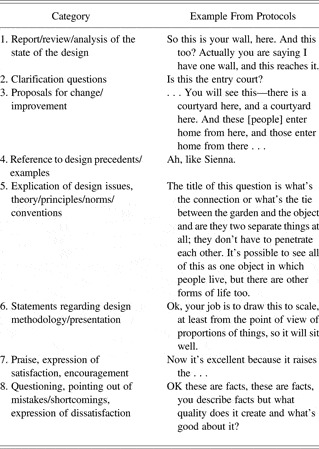
Communication during a desk crit may be conceptualized and analyzed in terms of various types of category schemes. For our purpose here we have devised a scheme pertaining to teacher priorities in dealing with students' work during the crit. These categories apply across project level (e.g., complex vs. simple) and contents (e.g., urban vs. detailed architectural design), and are listed in Table 1, with examples from our case studies. We use these categories because they reflect the teacher's pedagogical theory in use, even if he or she is not aware of it.
Category scheme: Teachers' verbalizations in a design crit

Coding a protocol allows us to track the amount of attention paid to different aspects of the student's work, expressed in terms of category frequencies. Many factors may impact the balance among categories in a crit: the nature of the project and the phase in which it is, particular needs or interests of the student, the teacher's interests, and his or her pedagogical agenda, explicit or implicit (embedded in his or her profile). As we will see in the case studies, crits vary significantly in their foci regarding categorical emphases. Of particular interest to us is the way issues are raised; what gets most attention; and the level of awareness of both teachers and students to the nature of their common work during the crit.
3.2. Linkography
Our basic premise is that in a problem-solving process in which a search is conducted, typically when the problem is ill defined and/or ill structured, a rich web of links among the moves made by the problem solver is indicative of a productive process. This is particularly true for design processes, wherein every solution and partial solution must cater concurrently to several design considerations. It is therefore relevant to study networks of links within records of processes, such as protocols and lists of ideas or decisions. Links are determined by common sense, on the basis of the contents of analysis units. (When monitoring design processes, these units are usually called moves; some of the literature related to linkography uses this term for all types of units.) Links are notated in a linkograph.
3.2.1. Backlinks
The procedure of establishing a network of links is simple: starting with the second unit in a sequence, we ask, is there a link between this unit and every one of the previous units in the segment that is being analyzed? This is a binary system and the answer is yes or no. Links thus determined are termed backlinks, because they pertain to links among a unit and preceding units. For n moves, the number of checks, and therefore of potential links, is n × (n – 1)/2. When n is large, the number of checks is very high; because the process of determining links is based on human (expert) judgment that cannot be automated, the method is viable only for relatively limited sequences of units. The motivation for the creation of linkography was to inspect cognitive aspects of design processes, and therefore short sequences of verbalization are targeted, and the length limitation does not represent a methodological predicament. The following is an example of a short sequence from our case studies; next to each verbalization, which is sthe unit of analysis in this case, are listed the numbers of previous verbalizations in the sequence, to which they have backlinks:
10 Student: I was trying to think what the landscape would look like to people who are here, let's say here they would have gardens they look at, like [they] look beyond the small gardens in fact
11 Teacher: No I say here in this place physically you intend to have a garden
Backlink to: 10
12 Student: No, outside of, if these are the houses then this is what it looks like in a section
Backlink to: 11
13 Teacher: So here, don't look at this, here the idea is to have that garden; and here too?
Backlinks to: 11, 12
14 Student: I first thought in one direction but it seems to me that I want in both directions
Backlinks to: 11, 13
15 Teacher: Here I see you made in both directions, and here you stopped, in one direction
Backlinks to: 13, 14
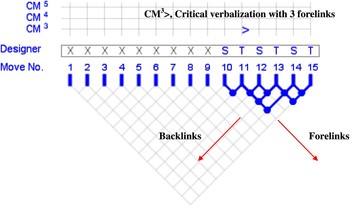
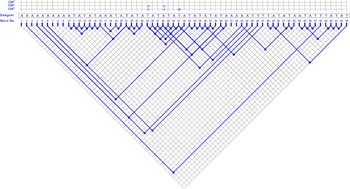
A linkograph is built on a simple matrix, but its appearance is different, to provide a better and more readable visualization of the data we are interested in emphasizing. Figure 1 is a linkograph depicting the units above and the links among them.
Links among verbalizations 10–15 by student and teacher during a crit. [A color version of this figure can be viewed online at journals.cambridge.org/aie]

3.2.2. Forelinks
We have named backlinks the links among verbalizations and preceding verbalizations. Those are the links we determine when we produce a linkograph. Once the graph is completed, we can infer forelinks as well; those are links among verbalizations and subsequent verbalizations. Forelinks are virtual: at the time a verbalization is uttered, we have no way of knowing what links it would have, if any, to yet unuttered, tentative verbalizations. It is therefore possible to infer (and not to determine) forelinks only post factum, when the linkograph is complete. A backlink of unit n to unit i is a forelink of unit i to unit n. The total number of backlinks and forelinks is, of course, the same: it is the number of links in the web of links. In a linkograph, backlinks are represented as dots strung on diagonal lines starting at the numbered unit and darting leftward (northeast to southwest); forelinks are aligned on diagonals starting at the unit and running rightward (northwest to southeast).
We differentiate between backlinks and forelinks because they have different roles in the process of designing or problem solving in general, and also in a goal-oriented communication. A unit backlinks to stress points already made, evaluate previous assertions, or reflect on them. A unit that has forelinks, on the other hand, tends to propose something, ask a new question, raise an issue that is later referred to by further verbalizations that backlink to it. In the vignette above (Fig. 1) unit 11 brings up the issue of gardens; it has forelinks to units 12, 13 and 14, which in turn have backlinks to it. Forelinks are of particular interest when we wish to study the generation of ideas and, by extension, innovation and creativity, as well as when we merely want to look at the raising of issues in a setting like a crit as in this case. Many units have both backlinks and forelinks.
3.2.3. Critical moves (CMs)
If links are indicative of process properties, then we should pay special attention to those units that have a large number of backlinks or forelinks (and in rare occasions, both back- and forelinks). Those units are considered critical. Studies have found a correlation between the level of creativity of a process, as assessed by grading the ensuing product, and the proportion of critical ideas in the process, extracted from process protocols (van der Lugt, Reference van der Lugt, Folkeson, Gralén, Norell and Sellgren2003; Goldschmidt & Tatsa, Reference Goldschmidt and Tatsa2005). How is criticality established? We determine a threshold number of links that designates the level of criticality: the higher the number, the more critical the unit, and the fewer such units exist in the protocol. Choosing the threshold is a function of the nature and purpose of the investigation (too many or too few critical units yield no clear picture). The linkography literature uses the term move so we replace critical units with CMs, followed by the selected threshold number of links in superscript, for example, CM3, which is a CM with at least three links. We also differentiate between CMs attributable to a large number of backlinks (<CM) and CMs by virtue of a large number of forelinks (CM>). In our case studies we are interested in CM3s>. For further details on linkography and its application in various studies, see Cai et al. (Reference Cai, Do and Zimring2010), Goldschmidt (Reference Goldschmidt1995, Reference Goldschmidt and Lindemann2003), Goldschmidt and Tatsa (Reference Goldschmidt and Tatsa2005), Kan and Gero (Reference Kan and Gero2008), Kvan and Gao (Reference Kvan, Gao and Gero2006), and van der Lugt (Reference van der Lugt2001, 2003).
We now inspect our case studies and look at a number of parameters that shed light on crit dynamics.
4. CASE STUDIES
The crits we looked at took place in second-year studios of a school of architecture, 5 weeks into the fall semester, which is at the one-third point of a semester-long project. An interim review had taken place the previous week and students already have preliminary concepts, which they try to solidify while making changes as seems fit. The assignment was the design of students' dormitories near a small college in an urban context. The second-year students are divided into several parallel studios (working on the same assignment), with approximately 12 students who work with one teacher in each studio. Our cases were recorded on the same day in three of these studios. The participants are the students Mani, Alona, and Yoav (fictitious names), and their respective teachers, whom we refer to as Mani's teacher, Alona's, teacher, and Yoav's teacher. We coded the teachers' verbalization according to the scheme in Table 1, and produced linkographs with which to analyze the student–teacher interaction in each crit. There are two types of linkographs: full linkographs, recording links among all verbalizations in each crit, and partial linkographs, recording interparty links only. An interparty link connects two verbalizations, one by the student and the other by the teacher (with no concern for whose verbalization is earlier). In other words, where a verbalization links to another by the same party, it is omitted in this linkograph. This allows us to take a closer look at teacher–student interactions as they occur in our crits.
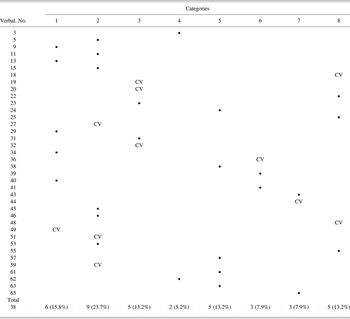
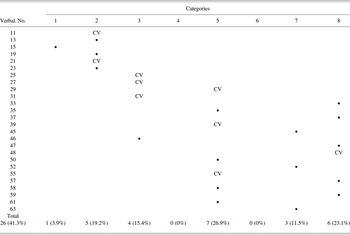
The analysis unit in all cases is a full verbalization, be it short or very long (here equal to a move). For the coding, each verbalization got a single code. This raises a difficulty, as some of the verbalizations, especially long ones, cover several topics and could have easily been assigned more than one code. We chose to avoid multicoding for the sake of methodological clarity. However, we realize that this somewhat skews the picture, and for that reason the contents of some verbalizations are not entirely accurately represented. In the tables describing the category distribution (Tables 2, 3, and 4), we also marked those verbalizations that, according to the linkographs, were found to be critical at the level of three forelinks (CM3>). We also asked the participants about the interaction during the crit, notably about the raising of issues, and compared their responses to the findings from the protocol data. We present the qualitative and quantitative results for each of the cases before we turn to a comparative analysis.
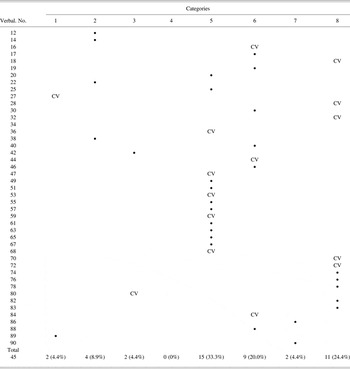
Mani's crit: Verbalizations by Mani's teacher by category

Note: Verbal. No., verbalization number; categories: 1, report/review/analysis of the state of the design; 2, clarification questions; 3, proposals for change/improvement; 4, reference to design precedents/examples; 5, explication of design issues, theory/principles/norms/conventions (implications for the student's project); 6, statements regarding design methodology/presentation; 7, praise, expression of satisfaction, encouragement; 8, questioning, pointing out of mistakes/shortcomings, expression of dissatisfaction; CV, a critical verbalization at a level of three forelinks.
Alona's crit: Verbalizations by Alona's teacher by category

Note: Verbal. No., verbalization number; categories: 1, report/review/analysis of the state of the design; 2, clarification questions; 3, proposals for change/improvement; 4, reference to design precedents/examples; 5, explication of design issues, theory/principles/norms/conventions (implications for the student's project); 6, statements regarding design methodology/presentation; 7, praise, expression of satisfaction, encouragement; 8, questioning, pointing out of mistakes/shortcomings, expression of dissatisfaction; CV, a critical verbalization at a level of three forelinks.
Yoav's crit: Verbalizations by Yoav's teacher by category

Note: Verbal. No., verbalization number; categories: 1, report/review/analysis of the state of the design; 2, clarification questions; 3, proposals for change/improvement; 4, reference to design precedents/examples; 5, explication of design issues, theory/principles/norms/conventions (implications for the student's project); 6, statements regarding design methodology/presentation; 7, praise, expression of satisfaction, encouragement; 8, questioning, pointing out of mistakes/shortcomings, expression of dissatisfaction; CV, a critical verbalization at a level of three forelinks.
4.1. Mani
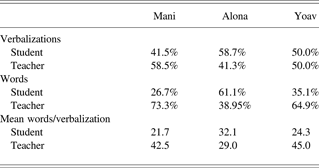
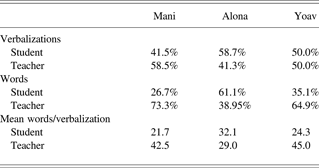
Mani's protocol consists of 65 verbalizations (2202 words): 27 (41.5%) of the verbalizations are by Mani (587 words, 26.7%) and 38 (58.5%) of the verbalizations are by Mani's teacher (1615 words, 73.3%).
Mani presents a few drawings, and before he can say much his teacher brings up a precedent regarding the relationship between the proposed buildings in the scheme and an urban square in front of them (this precedent, which the teacher refers to once again later in the crit, is the only example of the “precedent” category in our case studies). The teacher talks a lot; she has the highest proportion of verbalizations and even more so of words in our sample. She asks for paper and draws what she thinks Mani should do:
Teacher: Where have you got some paper? On the lower level it is clear. You have a courtyard here. I call it a courtyard. Here you have an element that admits light. Here you've got a passage, right? Here we walk, we've got … and here the apartment. For the moment I ignore the … Here the apartment. Now upstairs, all this. Now if I omit this square, it means that the apartment is only up to here, right? So all of this, it becomes … the passage is only up to here. You've got an element that can also be … We have open space here. So in terms of the section, you'll bring more light into here, and also you'll have some principle, you enter the apartment through a very convenient space which is kind of, it's like an entry court which is actually inside a building.
The teacher is actually designing, and similar vignettes in which she shows Mani what can (should?) be done can be found throughout the crit, often incorporated into clarification questions or reviews of the scheme: “Is this how it is? Well, this is how it could/should be. … ” However, when explicitly asked by the student for help where he encounters a problem, she seems to remember and adopt a principle that prohibits “hands on” assistance:
Mani: Now … what do I do here with this interval.
Teacher: This is a beginning (laughter).
The teacher tells Mani to adhere to an accurate scale, to draw a section, and explains why this is important. Her verbalizations include little praise or expressions of encouragement, but she is positive all the same, and ends the crit with a very positive statement:
Mani: There are enough problems.
Teacher: Not problems. Issues … challenges … always positive thinking. Always think what fun this is, and how beautiful. But only—scale. Very important. OK?
How would we classify this teacher's profile? She is definitely a source of expertise and authority, but also a coach who models for the student what can be done and what he should aspire to achieve. Table 2 is an overview of her verbalization categories.
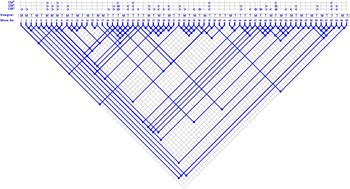
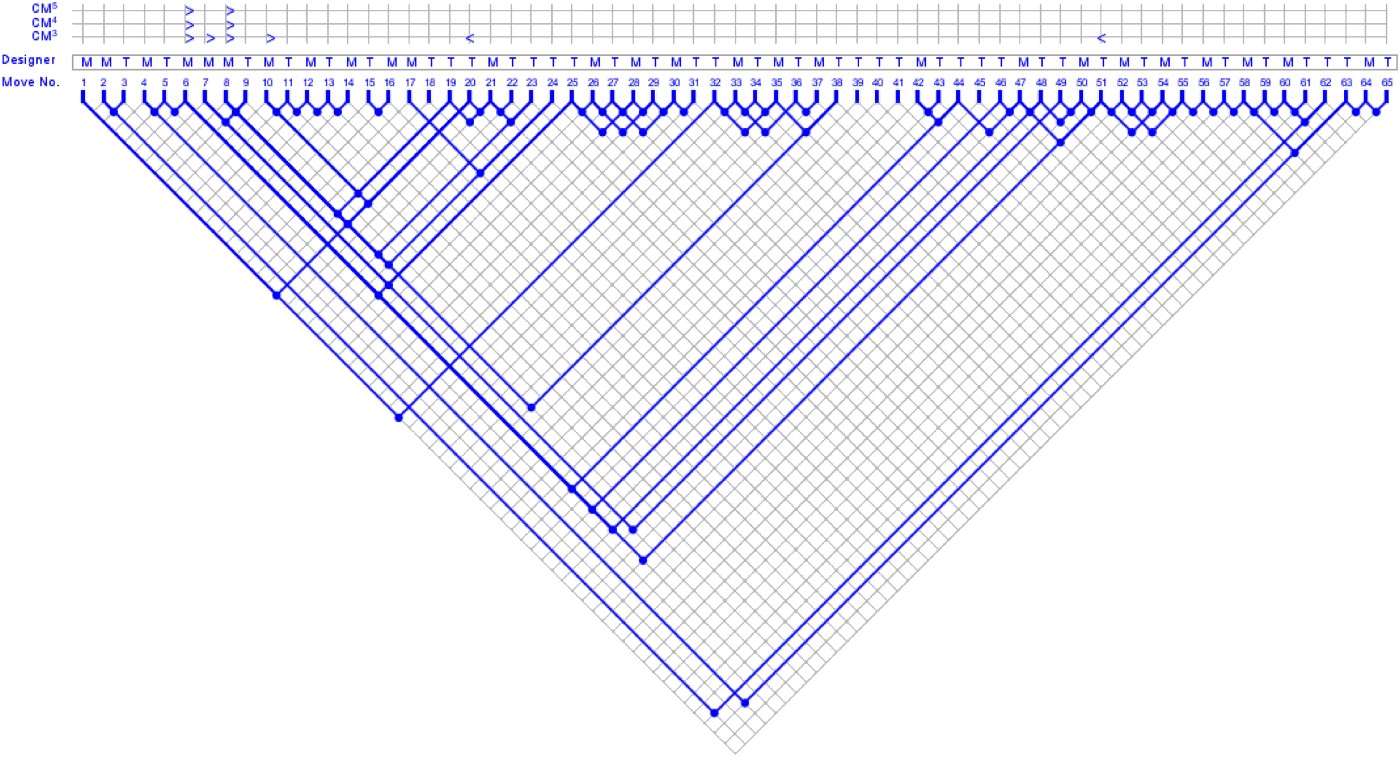
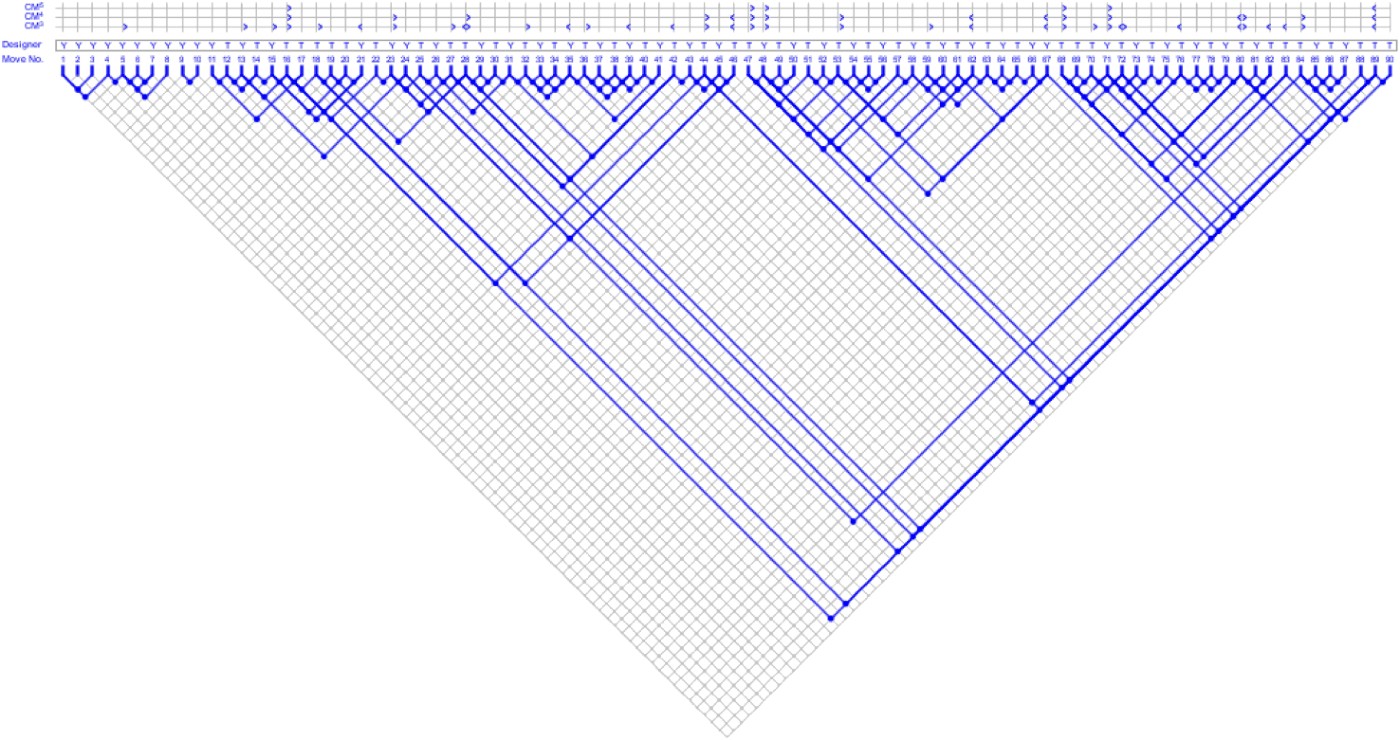
We now look at links among verbalizations in Mani's crit. Figure 2 is the full linkograph, and Figure 3 is the partial linkograph.
Mani's crit full linkograph: all links (Mani ↔ teacher, teacher ↔ teacher, Mani ↔ Mani). [A color version of this figure can be viewed online at journals.cambridge.org/aie]

Mani's crit partial linkograph: interparty links only (Mani ↔ teacher). [A color version of this figure can be viewed online at journals.cambridge.org/aie]
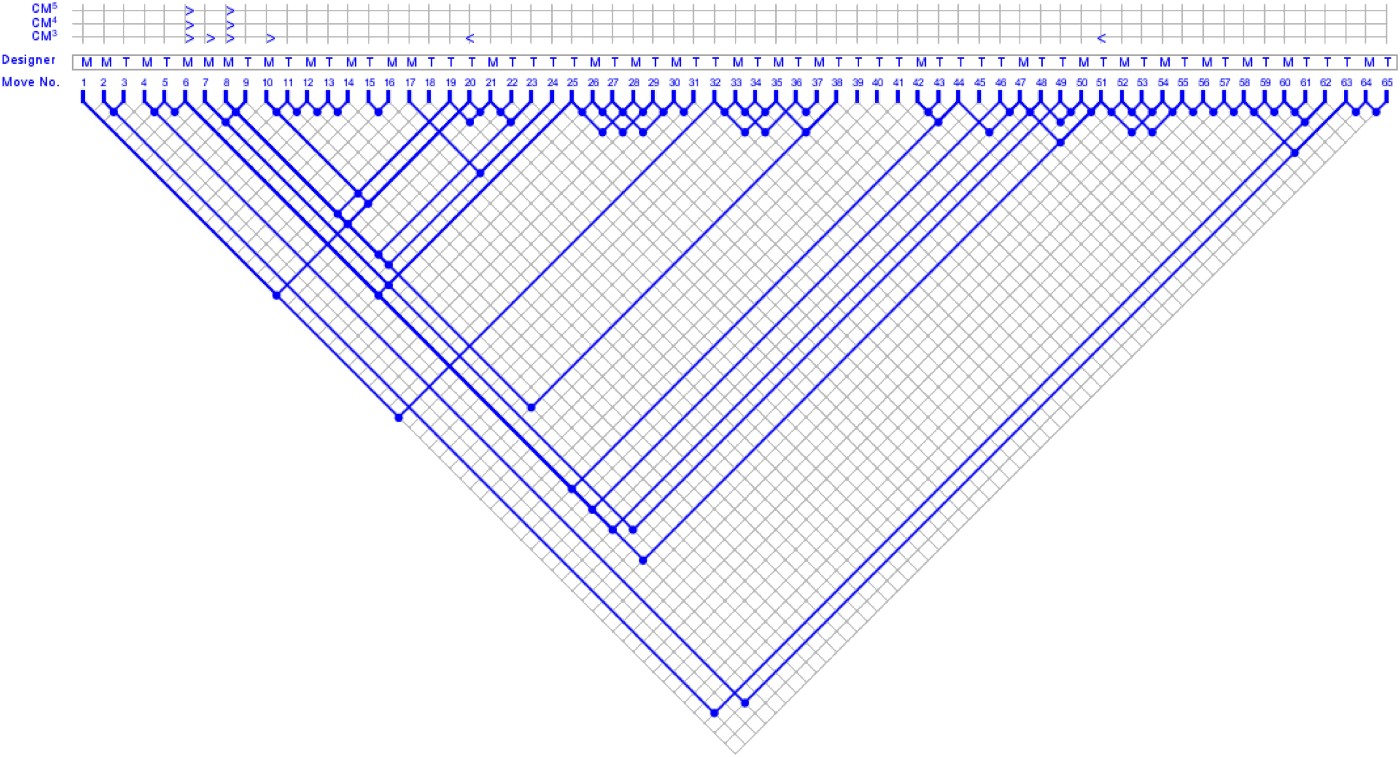
What do we learn from these linkographs? We see that in the full linkograph verbalizations are well interlinked. The link index (LI = proportion of links per verbalizations) is 2.0 (131 links among 65 verbalizations); that is, on average, every verbalization has two links, which is quite high. Over one-third of the links (37.4%) are between adjacent verbalizations. The full linkograph is reasonably well structured, in the sense that we identify several chunks of link concentrations among a relatively small number of verbalizations (the graph displays triangles composed of densely mashed dots). This indicates that each issue is thoroughly discussed before the conversation moves on to the next issue. In addition, beyond the short-span links among adjacent verbalizations there is a fair number of long-span links, that is, between verbalizations quite far apart in the sequence. This means that there is not only continuity but also an attempt to synthesize and bring together various issues.
The partial linkograph yields a different picture. There are 73 links in this linkograph, which represent 55.7% of all links; the other links are among verbalizations by same-party verbalizations, Mani linking to his own verbalizations, but mostly the teacher linking to her previous verbalizations. Long-span backlinks are predominant; for the most part they record verbalizations by the teacher, referring to points raised by Mani in the first few minutes of the crit. Almost two-thirds of the backlinking verbalizations (62.7%) are by the teacher, who refers to a previous verbalization by Mani; the balance of backlinking verbalizations are between Mani's verbalizations in response to the teacher's questions or assertions. All of these are short-span links. Only five verbalizations are unlinked in the partial linkograph; all of them have links to same-party verbalizations in the full linkograph. Notably, all of these verbalizations are by the teacher. As we will see, by comparison, these linkographs reflect an animated dialogue between Mani and his teacher, and although the teacher is the main speaker by far, Mani is not left out of the conversation.
4.2. Alona
Alona's protocol consists of 63 verbalizations (1941 words): 37 (58.7%) of the verbalizations are by Alona (1186 words, 61.1%) and 26 (41.3%) of the verbalizations are by Alona's teacher (755 words, 38.9%).
Alona is the most “talkative” of our three students; the proportion of her verbalizations in the crit (compared to her teacher) is the exact inverse of Mani's case. She also utters far more words than her teacher, and her verbalizations are longer than those of her peers. At the outset of the crit Alona presents small models and a few drawings; the teacher listens patiently to her rather long description of the project's state of the art, then asks several clarification questions, and only one-third into the crit the commentary moves to a critical discussion of the project, during which no further questions are asked by the teacher. This teacher does not draw during the crit, and the majority of his comments pertain to design principles; he raises issues directly or by questioning some of Alona's design decisions. For example,
Teacher: One thing I would raise as a thought, as a question, is how correct is it to create something so different from its surroundings? This is something that was brought up already, this building has a lot of charm and it is really also possible, it has been done before—someone already dared and did [it], this should be researched and there are also attempts to create unconventional forms in residential buildings and you should be, feel, comfortable housing 12 families in something that is an icon.
When Alona asks a question she gets an answer, but not necessarily one that directs her toward an explicit solution:
Alona: Will it not reduce their [two connected buildings] power if they are taken apart?
Teacher: So it is a dilemma, what is that power? I think I know what you feel but maybe I have to debate it with myself, I ask myself what is more correct, what is more important, the power you want to broadcast …
Alona's teacher does not dwell on any methodological questions (such as scale or a need to produce this or that drawing type). Like Mani's teacher he does not praise his student frequently but he too ends with a positive note, in line with his style of commentary throughout the crit:
Teacher: These drawings are nice and they really call to embark on such an act which is very significant and maybe if it happens then in the end it could be a miracle, it is maybe, but I am obliged to ask these simple questions of what is right for those who live here whether it is possible to make such a sculpture that is also the right place to live in, that's probably this building's function.
This teacher does not fall easily into any teaching profile definition. More than anything else he is probably a facilitator who pushes his student to rethink certain design concepts, to further investigate their implications for the project's future inhabitants and users. He distances himself from the student's design much more than does Mani's teacher; he prefers to introduce design issues and to express concern for some of the design decisions the student has made. Table 3 shows the distribution of categories in the teacher's verbalizations.
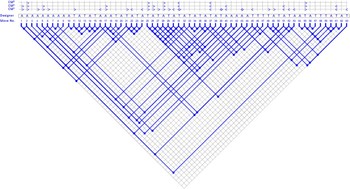
Let us now look at links among verbalizations in Alona's crit. Figure 4 is the full linkograph, and Figure 5 is the partial linkograph. The pattern of links among verbalizations in Alona's crit is different from that of Mani's crit. With a single exception, Alona's introductory statements are left with no response from the teacher (see the partial linkograph in Fig. 5). There are, of course, many short-span links, as in all cits, which represent a “ping-pong” interaction among verbalizations, many of them between Alona and the teacher. There are, however, also what we may call “medium-span” links, that is, among verbalizations that are somewhat remote in the time line, at various lengths. The LI in the full linkograph is 1.76 (113 links among 63 verbalizations). As in Mani's linkograph, over one-third of the links (34.5%) are between adjacent verbalizations. Compared to Mani's full linkograph there are fewer chunks of densely interlinked groups of verbalizations, but in revenge they tend to be somewhat larger and denser.
Alona's crit full linkograph: all links (Alona ↔ teacher, teacher ↔ teacher, Alona ↔ Alona). [A color version of this figure can be viewed online at journals.cambridge.org/aie]

Alona's crit partial linkograph: interparty links only (Alona ↔ teacher). [A color version of this figure can be viewed online at journals.cambridge.org/aie]

The partial linkograph, with 57 links (50.4% of the links in the full linkograph), drives home that Alona's introductory statements (10 of them) receive a single response from the teacher toward the end of the crit. The interparty exchange centers on issues that are brought up later by both parties. Notably, Alona seems to be very alert and actively responds to many of her teacher's verbalizations: 47.7% of the backlinking verbalizations in the interparty linkograph are by Alona (compare to 37.3% by Mani in his crit). The proportion of “orphan” (unlinked) verbalizations in the partial linkograph is somewhat higher than in Mani's case: 8 verbalizations have no links at all, all of them by Alona, including 5 at the introductory phase. In the full linkograph all verbalizations have at least 1 link, backward or forward. This crit seems to be dominated by Alona, but her teacher has his own agenda; he responds only to what he deems worthwhile and his approach is much more general and centered on “big issues” and less centered on concrete design issues that may preoccupy the student who is happy with her design and strives to develop and resolve its remaining problems.
4.3. Yoav
Yoav's protocol is the longest in our sample: it consists of 90 verbalizations (3116 words). Forty-five (50%) of the verbalizations are by Yoav (1093 words, 35.1%) and 45 (50%) by Yoav's teacher (2023 words, 64.9%).
In terms of his input in the crit, Yoav is situated between Mani and Alona. It is interesting that he generates exactly half of the verbalizations, although they comprise only a little over one-third of the total word count in the crit. Like Mani, his phrases are much shorter than those of his teacher. The crit is based on models and diagrams he presents at the outset, with no concrete plans or sections (with the exception of one schematic axonometric view).
As in Alona's case, the crit begins with a relatively long review of the work by Yoav (11 uninterrupted verbalizations). This seems to clarify the picture, as the teacher asks very few clarification questions later on. The student is not entirely happy with the state of his project and the teacher talks about the design process:
Yoav: I wanted to say that I am not successful in arriving at complexity, at the required complexity maybe, because of all kinds of reasons.
Teacher: Let's introduce some order into the terms Ok? Your response to my question, too, reflects the quality of the phase you are in. You turned this object [model] very fast, this object which is part of the project, this partial object, into a spatial concreteness that can be seen and felt, and you can say concrete things about it. … Despite the fact that you say, and rightly so, [that] it is not final, of course it is not final and not detailed, we don't really know whether each of these spaces contains with decency and quality the programmatic contents and also the values they should carry with them. … But it floats, all of a sudden the basic questions you have presented and your basic assumptions, including the basic assumption that appears here in the sketch where you do not succeed in explaining what it was; namely, we are challenging the concepts you have dealt with and the basic assumptions.
What the teacher is actually saying is that the student advanced certain concepts early on but fell short of translating them into design acts that could be adequately represented and therefore inspected and assessed. He repeats this message several times along the crit, in different variations. He points out many shortcomings of the present state of the project, and he tries to get Yoav to recognize some of them through repeated rhetorical questions about a particular issue. For example, he tries to talk about the issue of public versus private spaces and the features that contribute to privacy. When Yoav's answers do not indicate that he really understands the question, the teacher asks again and again (11 of the teacher's verbalizations, 49–68; see Table 4). A short vignette from this dialogue reads as follows:
Teacher: Private public, right?
Yoav: Exposure yes
Teacher: There are more things, what other things does this proximity create?
Yoav: Oh, the proximity to here? OK that's again these things but maybe
Teacher: No, let's think for a moment. What does such a proximity, which parameters in the design of the system of relationships among neighbors need to be taken into account?
…
Teacher: What issues emerge in this story of proximity between our project and neighboring buildings? One is the privacy of both sides, right
Yoav: From the story of sight lines and generally
Teacher: Yes but what design parameters, position of openings, right, what else?
…
The “quiz” strategy does not seem to be very effective, and the teacher ends up pointing out himself what the issues are and what design problems that need to be resolved emanate from them. He brings up a few more issues, mostly related to the public–private overarching theme, such as movement within the project, and Yoav, who pays close attention, reacts so the teacher can estimate whether his point was understood. The crit ends with the teacher summarizing three major issues that were discussed, and finally finds it in him to say something positive and encouraging to his student:
Teacher: But by the way the work on the model here is of very good quality and allows us to have this conversation, very sharp and good and I'll tell you something these spaces are created here, you haven't told me precisely about the program of these things, but my gut feeling is and my practical eye tells, looks and tells me, wow, this is a possible space, interesting, that produces many qualities and also the relationship among the four clusters, which we don't see yet, will create different courtyard types, this place we are talking about, this quality place that is connected to the square, beautiful thing, quite a number of issues.
Yoav's teacher's profile is located somewhere between Mani's teacher and Alona's teacher's profiles. He is a coach of sorts, but also a source of authority and expertise. He does not draw and does not design for the student; rather, he brings up questions of principle, but he does so in a way that is more connected to the student's actual proposal than in the case of Alona's teacher. Table 4 is an overview of her verbalization categories.
We now look at links among verbalizations in Yoav's crit. Figure 6 is the full linkograph, and Figure 7 is the partial linkograph. The most conspicuous characteristic of Yoav's full linkograph is the fact that it contains almost no chunks of densely interlinked verbalizations (the ones that exist are so small that they are hardly worthy of the title “chunk”). Although the LI is not low (163 links among 90 verbalizations, LI = 1.81), most links are very short span, and the rest are widely distributed. The proportion of links among adjacent verbalizations is the highest in our sample at 42.9%. This is an indication of the nature of the crit, in which Yoav and his teacher take frequent turns in speaking. Although the teacher's verbalizations are much longer and contain 64.9% of the words in the crit, the number of verbalization is equal: each utter 45 verbalizations, half the total number.
Yoav's crit full linkograph: all links (Yoav ↔ teacher; teacher ↔ teacher; Yoav ↔ Yoav). [A color version of this figure can be viewed online at journals.cambridge.org/aie]
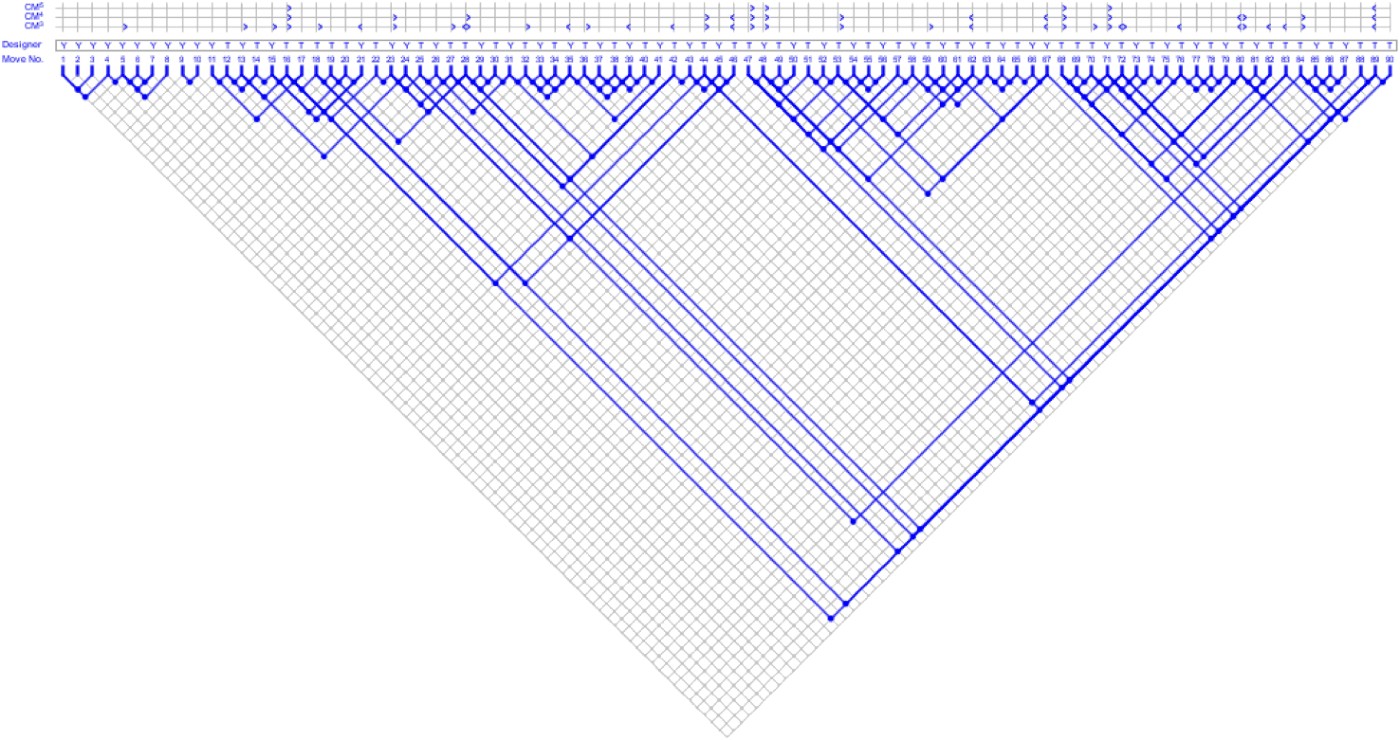
Yoav's crit partial linkograph: interparty links only (Yoav ↔ teacher). [A color version of this figure can be viewed online at journals.cambridge.org/aie]

The partial linkograph is striking. Although it contains roughly the same proportion of links as in Alona's partial linkograph (49.1% of all links or 80 out of 163 links), the distribution is much more sharply divided between an absolute majority of links among adjacent verbalizations and a small number of long- or medium-span links. We found that 51.4% of these links go back from a verbalization by the teacher to a verbalization by Yoav and the other 48.6% link in the inverse direction from Yoav's verbalization to a verbalization by the teacher. As in Alona's case, Yoav's introductory statements are not addressed by the teacher and remain “orphan” verbalizations. All in all, there are 14 unlinked verbalizations in this linkograph: 10 by Yoav and 4 by the teacher. Only 1 of them (an early verbalization by Yoav) is also unlinked in the full linkograph. The pattern of links in the partial linkograph tells us that although the teacher, by his own evidence, chose to concentrate on three major topics, he did not develop any of them with Yoav in a meaningful dialogue, which per force would have produced at least a few small chunks of interlinked verbalizations. As we have seen, his strategy was to quiz Yoav and when the latter did not know the answer, the teacher developed it himself without Yoav taking part in the development. However, he does respond very “locally” to questions or issues brought up by Yoav.
5. COMPARATIVE ANALYSIS
The individual case studies point to three quite different crit processes. The students and their projects are different, and the teachers' profiles and crit styles and strategies are different as well. In this section we summarize the quantitative differences among the crits. We begin with a brief summary of the verbal output during the crits, which is presented in Table 5 (for reference purposes only).
Verbal output by teachers and students during the crit
5.1. Category distribution
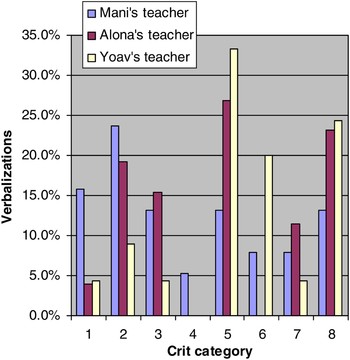
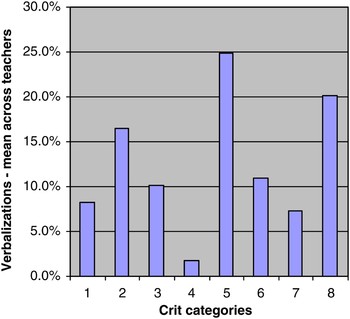
We start with the categories of teacher verbalizations in the three crits. Figure 8 summarizes the distribution per crit and Figure 9 presents the average distribution for all crits together.
Category distribution in teachers' verbalizations for three crits. [A color version of this figure can be viewed online at journals.cambridge.org/aie]

Category distribution in teachers' verbalizations as a mean across teachers. [A color version of this figure can be viewed online at journals.cambridge.org/aie]

Figure 8 shows partial similarities in category distribution between pairs of teachers. Mani and Alona's teachers have similar proportions of verbalizations in categories 2 and 3, clarification questions, and proposals for change/improvement, respectively. They are also quite similarly inclined to praise their students (category 7). Alona and Yoav's teachers display similar preferences for categories 1 (low preference), 5, and 8: report, review, and analysis of the state of the design; explication of design issues, and so forth; and questioning and pointing out mistakes, respectively. As pointed out earlier, category 4, references to design precedents, is nearly missing from these crits; only Mani's teacher mentions a single precedent (twice).
Figure 9 shows the mean distribution; it proves the predominance of category 5: 24.8% of all teachers' verbalizations in the crits are concerned with explication of design issues, theory, norms, or conventions. A close contender is category 8, with 20.2% of all verbalizations. Category 8 includes those verbalizations that question what the student has done, the concepts used. It is complimentary to category 5, because when teachers question something they are called for to present a rationale for such questioning, which is best done by explicating the principles and concepts that suggest a different approach or solution. Together, these two categories come to almost one-half of the total (45%). They are also the dominant teachers' verbalization categories in Alona and Yoav's crits. These results are limited to the three case studies, of course, but if they are in any way indicative of a general tendency, then we note that at least as concerns crits in an early stage of architectural education (third semester), close to the middle of the semester, most issues that are being discussed are rather general, in response to perceived weaknesses of students' early schemes. Mistakes are being pointed out, and sometimes the teacher demonstrates possible solutions. We shall have more to say about this in the next section. Precedents are curiously almost entirely absent from these crits. It is possible that other architectural education approaches would yield a very different distribution, but we do not have data from other studio settings.
5.2. Raising issues
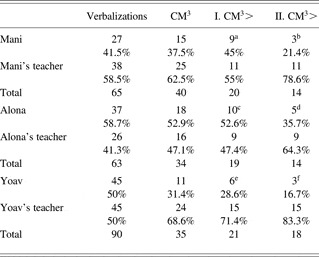
We now turn our attention to an important aspect of teacher–student interaction in general, and the crit in particular: the raising of significant design issues relating to a student's project. For our purposes here we equate significance with criticality, that is, issues are of importance if they are referred to several times, and we can easily detect such references in linkographs. Theoretically issues may be raised using any of the verbalization categories (but see below), and of course, they are raised by both students and teachers. We have used our linkographs to identify critical verbalizations, set at a threshold of three: a verbalization with three or more backlinks or forelinks is considered critical. We are more interested in criticality because of forelinks, because the verbalizations that generate them raise issues (as opposed to referring to previously raised issues, which is typical of verbalizations with backlinks). Table 6 summarizes the count of CMs (= critical verbalizations) in our three crits.
Critical verbalizations (CMs) across crits

Note: CMs, critical moves.
aIncluding 6 CM3> at the outset.
bExcluding 6 CM3> by Mani at the outset.
cIncluding 5 CM3> at the outset.
dExcluding 5 CM3> by Alona at the outset.
eIncluding 3 CM3> at the outset.
fExcluding 3 CM3> by Yoav at the outset.
We notice differences among the crits in the proportion of critical verbalizations contributed by teachers and students. Where the teacher is responsible for many more verbalizations he or she also generates many more critical verbalizations; the percentage of teacher-generated critical verbalizations is higher than his or her share in the overall number of verbalizations. This is particularly noticeable in Yoav's crit, where the proportion increases from 50 to 68.6%, respectively. A little over half of the critical verbalizations are those with a high number of forelinks (see Table 6, I. CM3>). We note that in Alona's case, the balance of CM3s between her and her teacher remains stable when we compare CM3s with CM3s>; in the other two cases the pattern changes between all CM3s and the CM3s>. Mani increases his share of critical verbalizations in the CM3> count, but Yoav decreases his portion. This count is inclusive, that is, it includes all verbalizations in the full linkographs.
It may be argued that the introductory statements by the students should be omitted from the count because the issues raised in them were developed prior to the crit; therefore, we added another count where they have been omitted (see Table 6, II. CM3>). Under these conditions the picture changes dramatically and in all cases the teachers generate a significantly higher proportion of forelinking critical verbalizations, some 75% on average. This is an interesting finding that appears to suggest that design teachers are responsible for raising the majority of issues during the crit, excluding the issues the student initially brings to the table.
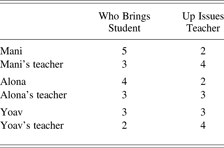
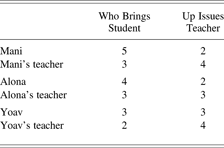
We know from previous research that students often appropriate ideas proposed by their teachers and treat them as their own (Goldschmidt & Tatsa, Reference Goldschmidt and Tatsa2005). This is not done consciously: the students believe in their ownership of such ideas. A teacher who “allows” such idea appropriation is arguably a good educator because the student is likely to embrace the idea and invest in developing it with more willingness if he/she believes it is his/her own. It is therefore interesting to find out what the students and the teachers in our three cases thought about issues raised in the crit and who raises them. We simply asked them (a few weeks after the crit) to mark on a scale of 1 (low) to 5 (high) the degree to which both parties raise issues during the crit. Their responses are recorded in Table 7.
Self-assessment of issue raising during the crit
Note: Scale = 1 to 5.
Mani and Alona think it is they who bring up most issues, as opposed to the teacher who, in their view, is less dominant in bringing up issues. Yoav thinks he and his teacher are equally active in bringing up design issues. Among the teachers, only Alona's teacher thinks that he and Alona are a par in raising issues; the other two teachers believe it is they who make the more significant contribution in terms of raising issues. As it were, Table 6 proves that the teachers' perception is accurate, and the students' view is a bit skewed. This is not surprising, as the students' sense of ownership of the ideas that shape their work and, by extension, the issues raised in relation to their schemes, is a key to their motivation and satisfaction in working on their projects.
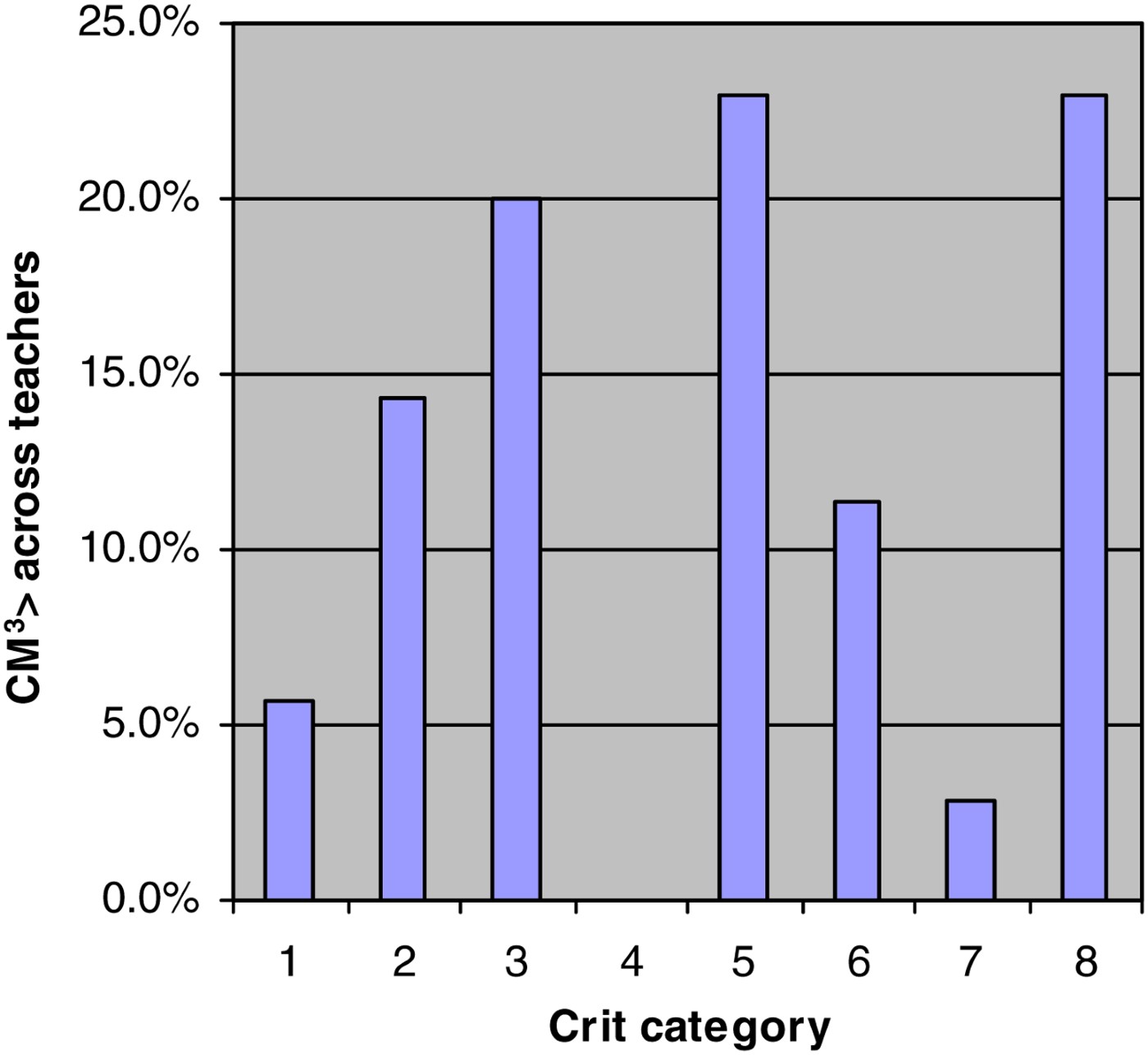
Finally, given the significant contribution of teachers' critical verbalizations in the crit, let us return to the verbalization categories and look at the distribution of CM3s> among the eight verbalization categories. Figure 10 gives us the picture.
Category distribution in teachers' critical verbalizations as a mean across teachers. [A color version of this figure can be viewed online at journals.cambridge.org/aie]
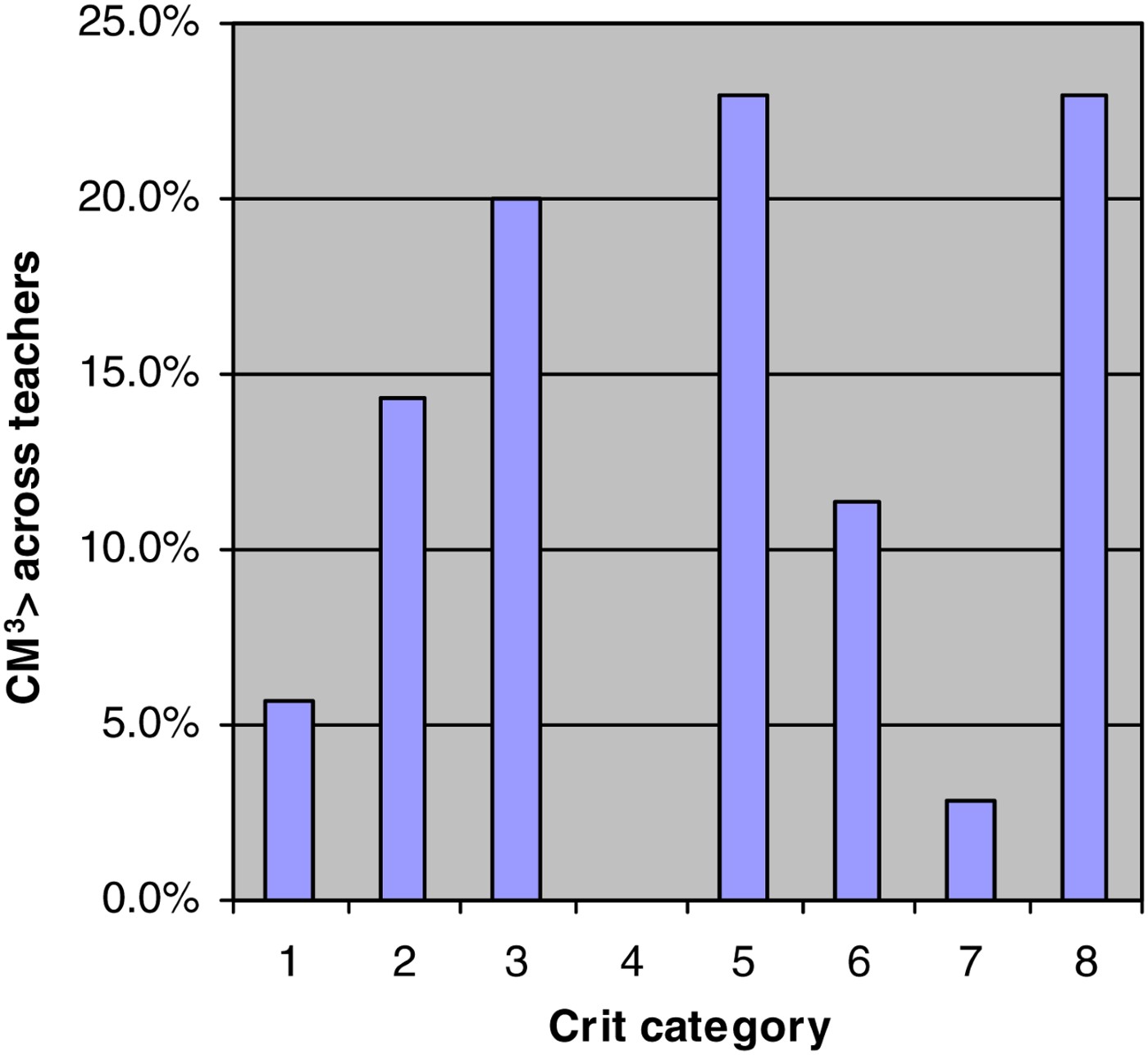
The distribution is not dramatically different from that of all verbalizations (Fig. 9); nevertheless, we detect some important variances. The three leading categories 8, 5, and 3, make up two-thirds of the critical verbalizations (65.8%). We have already explained why a combination of verbalizations of categories 5 (explication of design issues) and 8 (questioning concepts) complement one another and are important in crits wherein the teacher wishes to equip the student with more general design principles, and often does so by questioning concepts and design decisions proposed by the student. Category 3 comprises actual design proposals, of the sort we have seen explicitly in Mani's crit. This is an important addition to the leading categories to which critical verbalizations belong. Surely design expertise does not dwell solely in design theories and principles, but is demonstrated in actual design acts; by demonstrating those to a student the teacher helps the student understand the practical implications of more abstract concepts. Clarification questions (category 2) are also highly visible among the critical verbalizations in our sample (14.3%). This may suggest that some of those questions help surface issues of relevance that later on may be treated under other categories.
6. CONCLUSIONS
This study demonstrates the many facets of teachers' performance during a crit. Far beyond sharing knowledge with students regarding the subject matter of the project, the teacher must navigate among categorical action priorities that suit the student's needs and his or her own tendencies. He or she must be careful to raise issues and sustain ideas at a general level as well as by referring to specifics of the project in hand, preferably while demonstrating and modeling for the student what can be done and how (with or without sketches). Moreover, this must be done without the student feeling that the teacher is designing the project for him or her. Issues raised must be made relevant to students by tying them to topics raised by the student's own design concepts and proposals, by questioning them and pointing out shortcomings, if spotted. Giving examples, such as citing precedents, is usually very helpful. If, instead, the teacher interrogates the student and tries to get him or her to come up with the “correct” notions by him or herself, he or she may not only fail to achieve satisfactory results, but also produce frustration and a feeling of inadequacy in the student, which is not conducive to effective learning. A teacher who lets the student feel that he knows something to which the student has apparently no access, comes dangerously close to the “mystery–mastery” syndrome, described by Schön (Reference Schön1987) in a negative tone, as mystery in the teacher's messages increases the student's lack of self-confidence and awe of the teacher, but it certainly does not assist in learning through what is supposed to be an open instructional conversation.
We can offer a careful, but not a conclusive, observation of teachers' profiles. The most assertive, authority profile was that of Mani's teacher. She was the only one to cite a precedent; she drew for the student, and she dominated the crit by talking most of its duration. She was also the teacher who least “felt” the student and apparently failed to notice the discrepancy between her and his assessment of raising issues. The least assertive teacher, who saw himself as a facilitator, was Alona's teacher. He had the most accurate assessment of his and the student's shares in raising issues. Yoav's teacher, who was somewhere in between the two other teachers and tried to act as a coach, contributed the largest proportion of issues to the conversation with his student, but he did so in a way that allowed the student to see the two of them as equal partners. Coaching seems to be the most fruitful strategy in this sample, although a tamed demonstration of authority and expertise seems to be of value. Obviously, investigating the impact of a teacher's profile on his or her “critiquing” behavior necessitates not only a much larger sample but also precise metrics for profiles, which no one has developed thus far. Uluoğlu (Reference Uluoğlu2000) reports that 47% of the design teachers in several schools of architecture she studied consider their educational (pedagogic) capacity to be the single most important factor in their work (vs. 33% who prioritize personality traits and 16% who think their design expertise is the primary factor to be considered). Pedagogic capacity is by and large the teacher's behavior during the crit. Schön (Reference Schön1985, pp. 63–64) describes it at its best:
The studio master, when he works well, tries to figure out what the student understands, what his problems are about, what he needs to know, all of this from the main evidence of observation of the student's designing … Studio master and student construct a dialogue in the media of words and performance. The student performs and presents the results of his performance; the master “reads” what he observes and tries to make interventions matched to the student's understanding and problems.
Did our teachers “work well”? How constructive were their interventions, that is, their verbalizations? We may point to the following questions that were raised in analyzing the case studies, some which may be extended to more general matters. Answers to these questions are representations of the educational process embedded in the crit:
• To what extent does the teacher listen to the student, at the outset of the crit and later on?
And by extension: Do teachers make sure the student's intentions are clear to them?
• How much of a dialogue exists between teacher and student? Does the teacher monopolize the conversation by talking most of the time? Are students made comfortable asking questions?
• Does the teacher model and demonstrate designing via sketching or verbally?
And by extension: Is he or she inclined to “design for the student”?
• Are examples given? Precedents introduced and discussed?
• Does the teacher remain in the realm of theories and general design principles? Does he or she relate to the student's project at the nitty-gritty level?
And by extension: What knowledge is being transferred?
• When raising issues and putting forth ideas, does the teacher allow the student to at least share in their ownership?
• Does the teacher build on the student's own ideas and design concepts? Does he or she question them if not appropriate?
And by extension: Are odds with acceptable practice clearly explained?
• Is methodological instruction provided? Are students exposed to appropriate procedures and their sequences, and are they taught to use various representational means and shown when and why it is wise to use each?
• Does the teacher make sure the student understands his or her messages? Is there a dialogue or does the teacher quiz the student?
And by extension: How can the teacher ensure that his or her intentions “get through” to the student?
• How encouraging is the teacher? Are achievements acknowledged and praised?
Despite the quantitative nature of part of our investigation we are obviously unable to offer quantitative answers to the questions above. The purpose of providing quantitative data and analyses is to enhance comparison, which we feel is the key to understanding the nature of the crits we observed. Quantitative data may help in creating yardsticks, against which every teacher's critiquing behavior may be measured, thus allowing an individual assessment. Because every teacher is different, students gain different things from different types of crits. It should be made clear what is to be gained from every teacher's crits, and what is missing or superfluous and requires a conscious effort toward improvement. We wish to stress that we do not mean to propose a single, uniform model of a “good crit.” Instead, we propose a “best practice” open model that is useful in providing detailed feedback to design teachers, with the aim of improving the effectiveness of design crits. Such a model is built on research that explicates what does and what does not “work,” and why, in studio crits. We strongly believe that feedback to teachers, based on such a model (which does not exist today), is necessary as part of developing a design teaching pedagogy. If the design studio is to serve its purpose for the years to come, the development of a sound pedagogical base for what we do in the studio is the order of the day.
ACKNOWLEDGMENTS
The writing of this paper was partially supported by a grant from the Fund for the Promotion of Research at Technion (to G.G.).
Gabriela Goldschmidt is a Professor of architecture at the Technion–Israel Institute of Technology. She is a graduate of the Yale University School of Architecture and was in practice for years before she joined academe. Prof. Goldschmidt has been a Visiting Professor at several universities in Europe and the United States. She has lectured widely and is the author of numerous papers and Co-Editor of the book Design Representation. Her research focuses on design cognition, with an emphasis on design reasoning, visual design, design representation, and design education.
Hagay Hochman is a recent graduate of the Faculty of Architecture and Town Planning at the Technion–Israel Institute of Technology. Hagay practices architecture in Germany. When the research reported in this paper was conducted, Hagay was a final year student in the degree course.
Itay Dafni is a recent graduate of the Faculty of Architecture and Town Planning at the Technion–Israel Institute of Technology. Itay practices architecture in Israel. When the research reported in this paper was conducted, Itay was a final year student in the degree course.