Introduction
Researchers in western countries have recently devoted considerable effort to the study of religion. Some have been concerned with the sharp decline in church attendance and the rapid process of secularisation in a number of European nations (Halman and Draulans Reference Halman and Draulans2006; Pollack and Pickel Reference Pollack and Pickel2007), and others have explored the nature and distribution of religious beliefs in several European countries (Kunovich Reference Kunovich2006), including Slovenia (Flere, Edwards and Klanjsek Reference Flere, Edwards and Klanjsek2008), Eastern Germany, Hungary and Poland (Gautier Reference Gautier1997). A good deal of this literature has focused on the relationship between religion and health. For example, studies have been conducted on the relationship between prayer and depressive symptoms in The Netherlands (Braam et al. Reference Braam, Deeg, Poppelaars, Beekman and van Tilbrug2007), on religious affiliation and mortality in Northern Ireland (O'Reilly and Rosato Reference O'Reilly and Rosato2008), and on the use of religious and spiritual practices by German patients to cope with the effects of chronic illness (Bussing, Ostermann and Koenig Reference Bussing, Ostermann and Koenig2007). In addition, many studies on religion and health have been conducted in the United States of America (USA) (Koenig, McCullough and Larson Reference Koenig, McCullough and Larson2001). It is important to note that a good deal of the work on religion in western countries has focused specifically on older people (Coleman et al. Reference Coleman, McKiernan, Mills and Speck2007; Hank and Schaan Reference Hank and Schaan2008; Krause Reference Krause2008a; Wilkinson and Coleman Reference Wilkinson and Coleman2010). Although this literature has provided many valuable insights, far fewer studies have been conducted with older adults who live outside the West. Moreover, as Hill and Hood (Reference Hill and Hood1999) observed, the great majority of the studies focus on members of the Christian faith. Clearly, more quantitative research is needed on religion in cultural settings outside the West, and more work is needed on religions other than Christianity.Footnote 1 There are at least three reasons why it is important to expand the scope of research on religion in this way.
First, researchers in western countries need to know if the insights they have gleaned from their quantitative studies are specific to their own cultural context, or whether the findings reflect deeper and more fundamental aspects of religion that are invariant across cultural settings. This type of research is important because differences in particular dimensions of religion across cultures highlight points where unique cultural and historic forces may be at work, whereas cross-cultural similarities in religion help identify more universal factors, such as the need to find meaning in life, that may be the key driving force (for a discussion of the universal functions of religion seeSpilka et al. Reference Spilka, Hood, Hunsberger and Gorsuch2003).
Second, research in the West suggests that religion is a complex multidimensional phenomenon (Fetzer Institute/National Institute on Aging Working Group 1999), but the content domain of religion has yet to be fully illuminated and carefully described. Examining religion in different cultural settings contributes to this important task by helping investigators more clearly define the boundaries of this unwieldy conceptual domain. Uncovering ways in which religious practices and beliefs vary across cultures helps to identify new dimensions of religion that must be taken into consideration, whereas discovering similar aspects of religion across cultures promotes greater confidence in the conceptual domain that has been staked out.
Third, quantitative researchers in the West have devoted a good deal of effort to identify the various functions of religion (Spilka et al. Reference Spilka, Hood, Hunsberger and Gorsuch2003). This work is important because deriving a better understanding of the social and psychological functions of religion helps investigators explain why some form of religion is found in virtually every culture in the world (Smith Reference Smith1991), and why various forms of religion have been practised for thousands of years (Eliade Reference Eliade1978). Identifying and exploring different dimensions of religion in different cultural contexts provides a way for researchers to identify more clearly the universal functions of religion. This type of research may reveal, for example, that dimensions of religion that are similar across cultures perform more universal functions, whereas those that are unique may speak to needs that emerge only in specific cultural settings.
The purpose of this study is to contribute to the literature by conducting a descriptive analysis of the multiple dimensions of religion in a diverse cultural context, namely Japan. A descriptive analysis is performed because we believe that before a phenomenon can be explained, and before it can be associated with key outcomes such as health, it must first be described. It should be emphasised at the outset that we are by no means the first to study religion in Japan, for a great deal of research has been accomplished in Japan. Even in the English-language literature, at least one journal is devoted entirely to the study of Japanese religious practices and beliefs, the Japanese Journal of Religious Studies. Even so, there are four ways in which research on religion in Japan may be developed further.
First, a good deal of research on religion in Japan has been done by anthropologists and others using primarily ethnographic methods. For example, Reader and Tanabe (Reference Reader and Tanabe1998) wrote an illuminating volume on religion in Japan, but their research was based primarily on interviews with religious leaders in select shrines and temples, as well as convenience samples of worshippers in them. Consequently, it is difficult to tell whether the observations made by these investigators can be generalised to the wider Japanese population (see also Nelson Reference Nelson2000; Traphagan Reference Traphagan2004). Supplementing the insights from ethnographic studies with findings from quantitative studies based upon national probability samples will supplement the extant literature, because when the two methodological approaches are brought to bear on an issue, the weaknesses of one approach are offset by the strengths of the other. Combining the findings produced by quantitative and qualitative methods is consistent with the time-honoured traditions of triangulation and synthesis (i.e. converging operations; seeGarner, Hake and Eriksen Reference Garner, Hake and Eriksen1956).
Second, even when quantitative surveys have been conducted on religion in Japan, the data have often been gathered in geographically circumscribed areas and, as a result, issues involving the generalisation of study findings remain unresolved. For example, Miller (Reference Miller1992) conducted a survey of religious behaviour in the Tokyo area, but it is impossible to tell if the findings he observed in this densely populated world city apply to older Japanese living in smaller cities or rural areas. Third, even when more representative quantitative studies have been conducted on religion in Japan, they are rarely available in a European language. This makes it difficult for most western investigators to take advantage of the understanding achieved by Japanese researchers. For example, Sugiyama (Reference Sugiyama2001) published a comprehensive review of research on religion in Japan in the Japanese Psychological Review, but only the abstracts were translated into English.
Fourth, a good deal of the quantitative research in Japan has involved adults of all ages (e.g. Stark, Hamberg and Miller Reference Stark, Hamberg and Miller2005), and few studies have been conducted specifically with older people. There are two closely related reasons why it is important to focus on older adults in Japan. First, US studies have consistently revealed that older people tend to be more deeply involved in religion than younger adults (seeKrause Reference Krause, Birren and Schaie2006 for a review of this research). There is some evidence that this is also true in Japan. For example, in his recent book, Reader (Reference Reader2007) speculated on the future of Shinto. He observed that this religious tradition now faces ‘the problem of attracting the support of the younger generation who, while they may occasionally attend a shrine before their examinations, may be less interested in the ritual aspects of Shinto and religion in general’ (2007: 136). Second, research conducted primarily in the West suggests that, as people grow older and approach death, their priorities shift (Carstensen Reference Carstensen1992), which may explain why religion becomes increasingly important in late life.
The discussion that follows has three main sections. We begin by providing a brief overview of research on religion in Japan. In the process, we discuss five dimensions of religion that have been the focus of our research. Following this, we introduce the sample and the measures that were used. Next, we review the plan for conducting a descriptive analysis of our data, and discuss why it is important to assess variations in the key dimensions of religion by age, sex, marital status and urban or rural residence. Then we present the empirical findings from a large, national probability sample of older adults in Japan.
Religion among older people in Japan
Religion in Japan is very different from religion in the West and several western scholars have found it puzzling. For example, Stark, Hamberg and Miller (Reference Stark, Hamberg and Miller2005: 16) recently observed that, ‘At first glance, Japanese religion is a muddle’. Similar views were expressed by Reischauer and Jansen (Reference Reischauer and Jansen1995: 215), who maintained that ‘religion in Japan offers a confused and indistinct picture’. There are at least three reasons why religion in Japan baffles some western scholars. First, with the exception of the few Japanese who are Christians or members of ‘New Religions’, worship typically does not take place in groups of co-religionists that meet regularly one or more times during the week. Instead, except on a few major holidays, Japanese people go to temples and shrines only when they feel the need to do so, and when they do go, frequently they worship alone. Second, the research evidence suggests that many Japanese claim to be affiliated with more than one religion (Miller Reference Miller1992; Traphagan Reference Traphagan2005), while a substantial number claim not to be religious at all (Stark, Hambert and Miller Reference Stark, Hamberg and Miller2005).
The third source of bafflement is that many Japanese people engage in religious rituals without endorsing the underlying belief structures that support them or that the ritual emerged to confirm (Traphagan Reference Traphagan2005). Yet, despite the often dramatic cultural differences in religion in Japan, Stark and his associates concluded that, ‘The Japanese turn out to be deeply and very actively religious’ (Stark, Hambert and Miller Reference Stark, Hamberg and Miller2005: 17, emphasis in the original). These observations are consistent with Reader and Tanabe's conclusion that ‘Japanese religion is less a matter of belief than it is of activity, ritual, and custom’ (1998: 7). Simply put, research to date suggests that religion in Japan involves ‘doing’ more than ‘believing’. Viewed more broadly, the available evidence suggests that various dimensions of religiousness in Japan vary in distinctive ways, and that a clear picture of religion in the country requires the simultaneous evaluation of its multiple dimensions. In the analyses that follow, the paper focuses on five dimensions: religious affiliation, organisational religiousness, private religious practices, prayer, and select religious beliefs, especially beliefs in an afterlife.
Religious affiliation
Measures of religious affiliation assess whether individuals identify with the beliefs and practise the observances of a particular religion. In the West, measures of affiliation serve as basic markers of social integration and help investigators understand the social forces that shape people's religious beliefs and the religious practices in which they engage. Knowing if a person is affiliated with a particular religion is also important because it indicates the level of commitment to one or more religions. As discussed above, in Japan some people affiliate with more than one religion and others identify with none. Even so, it is important to emphasise that these insights emerge from studies of the general population, not specifically of older people. If older people in Japan are more deeply involved in religion than younger adults, as some investigators claim (e.g. Reader Reference Reader2007), then perhaps their patterns of religious affiliation differ from those of younger adults.
Organisational religiousness and private religious practices
Mindel and Vaughan (Reference Mindel and Vaughan1978) made a useful distinction between two basic dimensions of religious involvement: organisational and non-organisational religiousness. In the current study, organisational religiousness reflects participation in formal religious organisations and has been assessed by, for example, asking the participants how often they go to temples or religious shrines to pray. In contrast, non-organisational religiousness has to do with religious activities that typically take place at home. This facet of religion is commonly assessed by asking people how often they pray or read religious literature at home.
In his classic treatise on religion, William James (1902/Reference James1997: 486) argued that prayer is ‘the very soul and essence of religion’. Describing prayer as ‘religion in action’, James believed that prayer is the arena in which the work of religion is done. Assessing how often people pray and determining where they pray is important but does not go far enough; researchers also need to understand what people pray for. Three foci of prayers appear especially important in Japan. First, as Kawano (Reference Kawano2005) reported, one of the primary functions of prayer in Japan is to express gratitude. This reinforces the notion that the individual is intimately tied with other people as well as the deities. In fact, Kawano pointed out that failure to express gratitude in prayer would be a sign of self-centredness, which is eschewed in Japanese culture. Second, research consistently reveals that one of the primary functions of religion is to help people deal with adversity (e.g. Pargament Reference Pargament1997). If prayer is the essence of religion, as James (1902/Reference James1997) claimed, then one of the primary goals of prayer should be to help people deal with the effects of stress. As Reader and Tanabe (Reference Reader and Tanabe1998) discussed in detail, in Japan many people in adversity pray for help. In fact, as Musick and his colleagues reported, a common Japanese expression is kurushii toku no kamikanomi [turn to the gods in time of distress] (Musick et al. Reference Musick, Traphagan, Koenig and Larson2000: 83). In addition to asking the gods for help with adversity, people in Japan also rely on prayer to attain material goals. According to Reader and Tanabe (Reference Reader and Tanabe1998: 69), a prime function of prayer in Japan is to help people make ‘wishes’ become a reality, including continued good health, success in business, and children's and grandchildren's success in college entrance examinations.
Religious beliefs
In their classic discussion of the basic dimensions of religion, Stark and Glock (Reference Stark and Glock1968) placed a special emphasis on religious beliefs, and these were the first dimension that they discussed. There are, however, two reasons why it is difficult to study religious beliefs. First, there are so many different beliefs that it is difficult to know which are most important in people's daily lives. Second, as mentioned some Japanese people affiliate with more than one religion, and some engage in religious rituals without subscribing to the underlying beliefs they confirm. Nevertheless, we believe that it is possible to study religious beliefs among older people in Japan if careful attention is given to the aspects of religion that are important to them. Consistent with this goal, we focus on two areas of belief that appear especially relevant for older Japanese people.
To this point the discussion has concentrated on the potentially beneficial aspects of religion, but a more balanced view requires that attention is also given to potentially negative aspects. One such is a fear of punishment by supernatural powers, such as the gods or one's own deceased ancestors. Many temples and shrines in Japan are dedicated primarily to the worship of a particular deity. For example, Reader and Tanabe (Reference Reader and Tanabe1998) discussed Kankiten, a deity that is worshipped in a temple on the outskirts of Osaka. They note that even though Kankiten can be a powerful ally, ‘the deity contained potentially dark sides as a ferocious and demanding deity associated [with] … angry spirits and capable of divine wrath’ (1998: 37). The same may be true of deceased ancestors. In his insightful discussion of ancestor worship in Japan, Klass (Reference Klass1996: 287) pointed out that, ‘if the survivor does not perform the prescribed rituals, the dead will turn into harmful spirits, causing bad things to happen in the world of the living’. Support for this view may be found in Reader's (Reference Reader2007) work on Shinto in Japan. He reported that, ‘the spirits of the recent dead are thus highly dangerous and, because of their loneliness and sense of abandonment by the living, also potentially malevolent’ (2007: 54). This suggests that, for at least some people in Japan, beliefs surrounding punishment by supernatural forces for bad behaviour are salient (see also Kawano Reference Kawano2005).
The second cluster of religious beliefs examined here concern the afterlife. The Japanese appear ambivalent about issues associated with death. On the one hand, the fact that ancestor worship is so widespread suggests that end-of-life issues are often on the minds of many Japanese, but the situation may be more complex. Shinto is a long-established religious tradition in Japan. The pronounced tendency to avoid death is evident in Reader's (Reference Reader2007) assertion of ‘Shinto's abhorrence of, and where possible, avoidance of, the impurities of death’ (2007: 60) and that ‘the dissociation between Shinto and death remains one of the religion's most marked features’ (2007: 77). Given the ambiguity in the literature on Japanese views of death, it is important to understand the beliefs that surround it.
Methods
Study samples
The data for this study are drawn from a seven-wave panel survey of older people in Japan. The baseline survey was of a national sample of 2,200 Japanese aged 60 or more years in 1987. The response rate was 69 per cent. Preliminary analysis revealed that the sample was representative of the total elderly population of Japan (Jay et al. Reference Jay, Liang, Liu and Sugisawa1993). Follow-up surveys with the older people who participated in the baseline interviews were conducted in 1990, 1993, 1996, 1999 and 2002, with the response rates ranging from 85 to 93 per cent. The sample was supplemented in 1990 and 1996 to ensure that the survey was representative of the Japanese non-institutionalised population aged 60 or more years. The sample was further supplemented by including a national sample of those aged 70 or more years in 1999. Only the data involving the Japanese respondents aged 65 or more years in the 1996 (Wave 4) and 2002 (Wave 6) surveys are analysed for the current study, because the most extensive measures of religion were included in the question schedules. Appropriate weights were used with the 2002 data to ensure national representativeness.
Measures
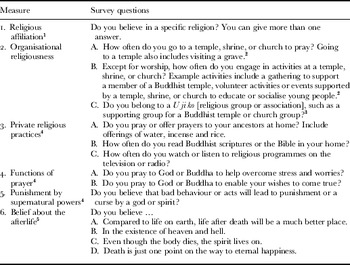
The measures of religiousness that are evaluated in our study are listed in Table 1 and explicated further below. The procedures used to code these indicators are identified in the footnotes of the table.
The core study measures

Notes: 1. Scored: Buddhist (1); Shinto (2); Christian (3); ancestor worship (4); other (5); no specific religion (6). 2. Scored: never (1); less than once a year (2); 1–2 times a year (3); several times a year (4); about once a month (5); about 2–3 times a month (6); more than once a week (7). 3. Scored: no (0); yes (1). 4. Scored: never (1); seldom (2); sometimes (3); always (4). 5. Scored: definitely don't think so (1); don't really think so (2); somewhat think so (3); I think so (4).
Source: Authors' seven-wave panel survey of Japanese older people's religious views and observance, 1987–2002. For details see text.
Religious affiliation
The participants were asked if they identified with a specific religion. It is important to emphasise that the respondents were explicitly told to select more than one religion if they wished to do so. A series of binary variables were created from the responses to these questions. These indicators reflect the particular religions that older Japanese identify with, including Buddhism, Shinto, Christianity, ancestor worship, and other religions, such as the ‘New Religions’. These data were subsequently used to create measures that assess whether the study participants identified with more than one religion.
Organisational religiousness
As shown in Table 1, organisational religiousness was measured with the responses to three items. One asked the participant to report how often they typically went to a temple, shrine or church to pray. Another asked how often they went to a temple, shrine or church to participate in formal social activities, including both religious festivals and the practice of hatsumiyamairi [the first visit of a newborn infant to a shrine]. A final item asked study participants if they were a member of a ko [religious association]. These are official groups at a temple or shrine that are formed to encourage group pilgrimages, such as organised bus tours to sacred sites. Often whole families join a ko together (Traphagan Reference Traphagan2004). A high score on any of these items denotes more frequent organisational religious activity.
Private religious practices
The third set of items assessed private religious practices, and specifically how often the respondent prayed at home, how often they read Buddhist scriptures or other religious literature at home, and how often they watched or listened to religious programmes on the television or radio. A high score on these indicators reflects more frequent private religious practices.
Functions of prayer
Two items captured the functions of prayer. The first asked the participant how often he or she prayed to overcome stress or worry, whereas the second asked how often the respondent prayed to obtain positive material benefits or wishes. A high score on either item identified older people who prayed relatively often for relief from stress, and who prayed more frequently for material benefits.
Punishment by supernatural powers
The fifth dimension of religiousness reflects beliefs about punishment for bad behaviour by supernatural powers, such as deities or deceased ancestors. Such beliefs imply that punishment will follow bad behaviour even when not detected by other individuals. The item used to assess this construct did not refer to any specific deity, but its phrasing in Japanese implied that punishment would come from a bachi ga ataru, that is a supernatural or non-human source. A high score on this item indicated a strong belief in this type of spiritual retribution.
Beliefs about the afterlife
The final examined dimension of religion concerns beliefs about the afterlife. The survey items elicited whether the respondent believed that the spirit lives on after death, whether they believed in heaven and hell, and whether they believed in the possibility of eternal happiness. As discussed above, the items dealing with beliefs about the afterlife were the only indicators that were taken from the Wave 4 survey. A high score on any of these four indicators stands for greater belief in the specified aspect of the afterlife.
Socio-demographic correlates of religiousness
In addition to describing levels of religious involvement, we also conducted closer analyses of whether the dimensions of religion varied by age, sex, marital status, education, and urban or rural residence. The influence of age was evaluated by comparing and contrasting older people in three ordinal age groups: the ‘young-old’ (aged 65–74 years); ‘old-old’ (aged 75–84), and the ‘oldest-old’ (aged 85 and over). Sex (men versus women) and marital status (currently married versus not currently married) were evaluated. Education was assessed with three ordinal categories of number of years of education: eight or fewer, 9–12, and more than 12. Finally, the population density of the area of residence was assessed with a variable that contrasted rural areas of no more than 25,000 inhabitants with medium and large population urban areas.
Data analysis strategy
The goal was to provide a descriptive analysis of religiousness in Japan. As Friis and Sellers (Reference Friis and Sellers2009) point out, research designs fall into two broad categories, descriptive and analytic. Descriptive studies are designed to characterise the amount and distribution of a phenomenon, such as religious involvement, in a population. In contrast, analytic studies are developed to uncover the determinants (i.e. the causes) of a phenomenon, such as the reasons why religious involvement is either higher or lower in specific population subgroups. Descriptive studies generally precede analytic studies because their findings can help frame hypotheses that are tested in analytic studies (Friedman Reference Friedman1994). However, it is important to emphasise that hypotheses are not developed or tested in descriptive studies and, as Koepsell and Weiss (Reference Koepsell and Weiss2003: 95) argued, ‘the hallmark of a descriptive study is that it is undertaken without a specific hypothesis’. Two descriptive statistics are used in the analyses presented below. First, we review the frequency distributions of all study measures for the entire sample. Second, using t-tests of differences in percentages or means, we assess whether the various facets of religious belief and observances differed by age, gender, marital status, education, and urban and rural residence.
Age
The participants were aged between 65 and 99 years of age, a span of 34 years that represents a substantial portion of the lifecourse. When researchers study age differences in religion in the West, typically they pool all participants aged 65 or more years, which in effect presumes that religious development ceases at 65 years of age. This is an untested assumption, especially for Japan. Consequently, we believe that it was important to examine if religious practices and beliefs vary through late life. Because the data are cross-sectional, however, it is not possible to tell if the variations we observed reflect age or cohort differences, or both. Even so, exploring the data in this way is important because the findings provide indications of whether more fine-grained studies should be conducted to differentiate between age and cohort effects.
Gender
Research in the West has consistently shown that older women are more deeply involved in religion than older men (e.g. Hank and Schaan Reference Hank and Schaan2008; Levin, Taylor and Chatters Reference Levin, Taylor and Chatters1994), and we wished to establish if the same is true in Japan. There is some evidence that there are gender differences in Japan; for example, Musick et al. (Reference Musick, Traphagan, Koenig and Larson2000) reported that the care of religious altars in the home, whether a butsudan [Buddhist altar] or kamidana [Shinto altar], is typically left to older women. Moreover, as Reader (Reference Reader2007) pointed out, priests at Shinto temples are typically if not exclusively men, whereas many women take on the role of miko [shrine maiden]. Miko typically perform important shrine activities, such as selling amulets and talismans, as well as looking after people who visit the shrine. Although there appear to be significant gender differences in select organisational aspects of religion in Japan, it is less clear whether there are gender differences in other facets of religion during late life, as with religious beliefs or the frequency of private prayer.
Marital status
Research with adults of all ages in the West suggests that married people are more deeply involved in religion than those who are not married (for a review seeWilcox Reference Wilcox and Ebaugh2005), but equivalent findings for older adults are less consistent (e.g. Levin and Chatters Reference Levin and Chatters1998). If there is an age difference, it might be explained by the fact that married young adults tend to be more deeply involved in religion because they are raising children, and their heightened religious activities reflect a wish to inculcate religious beliefs and practices. Even so, less is known about whether older people in Japan who are married are more involved in religion than older adults in Japan who are not married.
Educational attainment
Research on the relationship between education and religious activities in Japan suggests that adults of all ages who are more highly educated are more likely than less educated counterparts to possess religious amulets and to believe in ancestral spirits (Miller Reference Miller1992). Miller also reported, however, that educational differences in other facets of religion, such as belief in the gods and the frequency of prayer, were not found. Viewed more broadly, it appears that the relationship between educational attainment and involvement in religion depends upon the dimension or facet of religion that is considered. Unfortunately, the research published to date has been conducted with people of all ages. We aim to contribute to the literature by evaluating the interface between education and multiple dimensions of religion among older people in Japan.
Urban and rural residence
The secularisation hypothesis is one of the more widely debated theoretical perspectives in the sociology of religion (Gorski Reference Gorski and Dillon2003). Simply stated, it predicts that as societies modernise, they tend to become more complex, more rational, more individualistic and less religious. Although modernisation is a complex process, one key facet, urbanisation, has been examined in our analysis. Adherents of the secularisation hypothesis predict that as a region becomes more urban, the population becomes more heterogeneous and the social and psychological distance between people increases. In the process, the social integration role that religious institutions previously held and the pressure on local residents to conform begin to loosen. In the context of our study, this suggests that older people in rural areas of Japan are more deeply involved in religion than older people who live in urban and metropolitan areas. Although some researchers have conducted studies on religion in rural areas of Japan (e.g. Traphagan Reference Traphagan2004), and others have focused on urban areas (e.g. Miller Reference Miller1992), we have not found any quantitative study that compares and contrasts levels of religious involvement among older adults in urban and rural settings.
Results
Religion among older people in Japan
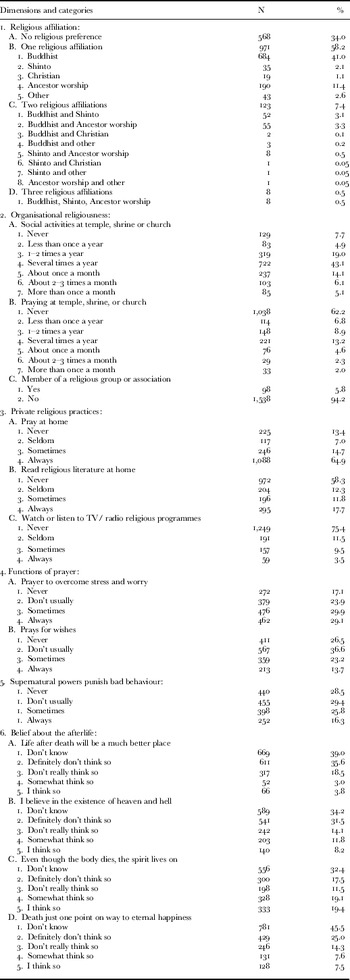
Table 2 presents the frequency distributions of the measured items and provides an overview of religious involvement among the entire sample of older Japanese people. The data are primarily from the responses to the 2002 survey wave, although a few items were collected in earlier years. It is shown that a substantial proportion (34%) of the sample did not claim to be affiliated with any religion, which is consistent with other studies (e.g. Stark, Hamberg and Miller Reference Stark, Hamberg and Miller2005). This relatively large share suggests that a large minority of older people in Japan have a rather tenuous affiliation with religion, in marked contradiction with the findings of two earlier studies. First, our data suggest that relatively few older people in Japan identify with more than one religion. Specifically, only 7.4 per cent reported an affiliation with two religious traditions, and only 0.5 per cent associated with three. Second, few (2.1%) of the respondents claimed to be affiliated with Shinto, and the majority (41%) were Buddhist. In contrast, Traphagan (Reference Traphagan2005) reported that nearly one-half of all-age adults in Japan identified with Shinto and he argued that many more than two per cent identified with more than one religion.
Religious involvement among older people in Japan, circa 2002

Notes: N: sample size. Overall sample size 1,670. Mean scores and [standard deviations]: for 2A (Social activities at temple, shrine or church) 3.90 [1.38]; for 2B, 2.06 [1.58]; for 2C, 0.06 [0.24]; for 3A, 3.31 [1.08]; for 3B, 1.89 [1.18]; for 3C, 1.41 [0.80]; for 4A, 2.71 [1.06]; for 4B, 2.24 [0.99]; for 5, 2.30 [1.05]; for 6A, 1.59 [0.85]; for 6B, 1.95 [1.08]; for 6C, 2.60 [1.16]; for 6D, 1.96 [1.07].
Source: Authors' seven-wave panel survey of Japanese older people's religiousness, 1987–2002. For details see text.
There are two ways to reconcile the discrepancies. First, Traphagan's data were collated by the Japanese Ministry of Cultural Affairs and supplied by religious organisations, i.e. they were not collected directly from the population. In contrast, our data are the direct responses of older men and women in Japan. Second, we consulted the 2000 Japanese General Social Survey (JGSS) to find data that would confirm or refute our results. The JGSS is a random probability survey of 2,893 people of all ages in Japan (Tanioka et al. Reference Tanioka, Iwai, Nitta and Sato2000). Its data reveal that, as in our study, only 2.7 per cent of the Japanese people identified with the Shinto religion. Unfortunately, the JGSS did not provide data on the prevalence of identifying with more than one religion. Perhaps the prudent conclusion is that estimates of religious affiliation in Japan vary substantially and that more research is needed to resolve this issue.
Table 2 also shows that the level of organisational religious involvement among older people in Japan around 2002 was fairly low. Many older adults did not go often to temples, shrines or churches for social activities. More specifically, only about one-quarter (25.3%) attended social activities once a month or more frequently, and even fewer went to temples, shrines and churches to pray. In fact, nearly two-thirds (62.2%) reported that they never went to a religious institution to pray. Finally, only 5.8 per cent of the participants were members of a religious association. In contrast, some forms of private religious activity at home were fairly common. For instance, nearly two-thirds (64.9%) of the participants said that they ‘always’ prayed at home, although only 29.5 per cent said they read religious material at home ‘always’ or ‘sometimes’. This finding is consistent with Kawano's (Reference Kawano2005) observation that most people in Japan neither read nor try to understand sacred Buddhist texts. It was also found that only 13 per cent of the sample ‘sometimes’ or ‘always’ watched or listened to religious programmes on the television or radio.
Consistent with studies that have been conducted in the West (e.g. Pargament Reference Pargament1997), the survey data suggest that over one-half (59%) of older people in Japan sometimes or always pray to relieve stress. As Reader and Tanabe (Reference Reader and Tanabe1998) reported, we found that a substantial minority pray to achieve practical things either ‘sometimes’ (23.2%) or ‘always’ (13.7%), although the majority said they did this either ‘never’ (26.5%) or ‘not usually’ (36.6%). This finding indicates that the practice of praying for practical benefits may not be as widely endorsed in Japan as Reader and Tanabe (Reference Reader and Tanabe1998) suggested. They also argued that religious beliefs are less important in Japan than religious behaviours and rituals, but our data suggest that this depends upon the beliefs in question. More specifically, almost one-half (42.1%) of the participants believed that supernatural powers punish bad behaviour either ‘sometimes’ or ‘always’.
The results involving beliefs about the afterlife point to other ways in which religious beliefs factor into the lives of older people in Japan. Two major trends may be seen in the responses to the four indicators that assessed this facet of religion. First, when asked the afterlife questions, between 32.4 and 45.5 per cent of the participants indicated ‘don't know’. Second, the items that assessed belief in the afterlife addressed two issues. One asked whether people believe the spirit lives on after death, and the other concerned the overall quality of the next life. The findings reveal that over one-third (38.5%) believed that the spirit lives on after death, but that few (6.8%) believed that the next life is a better place than the present one, that death is just one point on the way to eternal happiness (15.1%), or that there is a heaven and a hell (20%). There is a possible explanation of these results. As discussed earlier, Reader (Reference Reader2007) argued that one of the most distinguishing features of the Shinto religion is avoidance of and dissociation from death, which may explain why the participants did not subscribe to a positive view of life after death. As our data show, however, relatively few older people in Japan identify with Shinto. Even so, it is important to recall that many older people in Japan selectively adopt aspects of a religious tradition without formally aligning themselves with it (Traphagan Reference Traphagan2004).
Variations by age
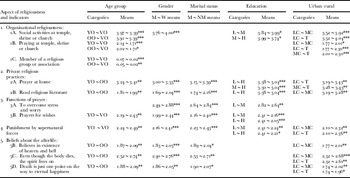
Table 3 presents the results of the difference of means (or percentages) tests that were conducted to see whether levels of religious involvement differed among the young-old, old-old and oldest-old in Japan. Three general trends are evident. First, organisational religious involvement appears to decline through late life. More specifically, rates of participation in social activities at temples and shrines, the frequency of praying at temples and shrines, and participation in ko [religious associations] declined steadily with increasing age. This may reflect the fact that levels of functional disability increase with age, thereby making it difficult for the oldest-old to leave their homes and participate in activities at temples, shrines and churches. Second, even though the oldest-old had lower rates of organisational religious involvement, they appeared to engage in private religious practices more frequently than younger age groups. Moreover, the age differences in private religious practices are especially evident when the oldest-old are contrasted with the young-old. Compared to the young-old, the oldest-old were more likely to pray at home, and the oldest-old were most likely to read religious literature at home. Third, there was a tendency, although it was not consistent, for the young-old age group to hold least firmly to the religious beliefs that we evaluated. Compared to the oldest-old, the young-old were less likely to believe that supernatural powers punish the living for bad or undesirable behaviour, and there was a similar pattern for the indicators that assessed belief in the afterlife. Compared to the old-old, the young-old were less likely to believe in the existence of heaven and hell, less likely to believe that the spirit lives on after death, and less likely to believe that death is just one point on the way to eternal happiness.
Statistically significant differences in mean scores of religiousness by socio-demographic attributes, Japan

Notes: ∼ joins compared categories or means. Key to categories: Age groups: YO, ‘young old’ (65–74 years); OO, ‘old-old’ (75–84 years); VO, ‘oldest old’ (75+ years). Gender: M, men; W, women. Marital status: M, married; NM, not married. Level of education: L, low (less than or equal to 8 years); M, medium (9–12 years); H, high (more than 12 years). Urban–rural: LC, large cities; MC, medium-sized cities; T, towns and rural areas. No significant differences in means were identified for: 2C ‘Watch or listen to religious programmes on TV or radio’ and 5A ‘Compared with life on earth, life after death will be a much better place’. For more details of the variables and categories see text. A table giving all the category means is available from the authors.
Significance levels: * p<0.05, ** p<0.01, *** p<0.001.
Variations by gender
Table 3 also presents the findings on gender differences in the religious activities and beliefs of older men and women in Japan. Consistent with studies in the West, older women in Japan appeared to be more deeply immersed in religion than older men. Older women attended social activities at religious institutions more often, prayed more often at home, and read religious literature at home more frequently. The same pattern emerged with respect to the functions of prayer. The results suggest that compared to older men, older women in Japan pray more often both for relief from stress and to achieve wishes and practical benefits. Fairly pronounced gender differences also emerged for religious beliefs. Older women were more likely than older men to believe that the gods or deceased ancestors punish the living for bad behaviour, and there were statistically significant gender differences in acceptance of three of the four afterlife beliefs. In particular, women were more likely than men to believe in the existence of heaven and hell, were more likely to believe that the spirit lives on after death, and more likely to believe that death is just one point on the way to eternal happiness.
Variations by marital status
A number of statistically significant differences in religious involvement were found between married and not married older people, although none involved organisational religiousness (Table 3). In other dimensions of religion, where significant differences were found, the non-married were more deeply involved in religion than those who were married. Compared to married older people, the unmarried were more likely to pray at home, to read religious literature at home, and to pray both for relief from stress and to achieve wishes and practical benefits. Differences in religious beliefs between married and non-married people were also found. The not married were more likely than married individuals to believe that deities or dead ancestors punish the living and, to a lesser extent, to believe in the afterlife; that is, to believe in the existence of heaven and hell, to believe that the spirit lives on after death, and to believe that death is just one point on the way to eternal happiness.
Variations by educational attainment
The participants' responses suggested that level of education was not associated with substantial differences in organisational religiousness (Table 3). Older people with moderate levels of education (i.e. 9–12 years of schooling) were slightly more likely to attend social activities at religious institutions than those with low education (i.e. eight or fewer years of schooling). In addition, those with a high level of education (i.e. more than 12 years) appeared to attend social activities at shrines, temples and churches less often than those with low education, although in both cases the magnitude of these differences was fairly modest. Level of education was not significantly associated with praying in religious institutions, membership of religious associations, or private religious practices. Older people with either low or moderate levels of education tended to pray less often when at home than those with more education, but no significant differences by education emerged with respect to reading religious literature at home or watching or listening to religious television or radio programmes. Contrary with some of the findings reported earlier, those with low education were more likely to pray for relief from stress than those with moderate education, and those with low schooling were more likely than those with moderate or high education attainment to pray for wishes or practical benefits. There is some indication that a belief in punishment by the gods and in deceased ancestors varied by education. Compared to older people with moderate or high education, those with fewer years of schooling were more likely to believe that bad behaviour may be punished by supernatural powers, but there were no statistically significant variations by education in any of the items that assessed belief in the afterlife.
Variations by rural and urban residence
The survey data indicate that older people living in Japan's rural areas (or small towns and villages) were more deeply involved in religion than those living in more densely populated areas. Those living in urban areas were less likely to attend social activities in religious institutions than those living in medium-sized cities or towns, and there was a clear residential gradient in the frequency of praying at temples, shrines and churches (Table 3). The residents of urban areas prayed less often in religious institutions than those living in medium-sized cities, and those living in medium-sized cities were less likely to pray in temples, shrines and churches than the residents of towns and villages. Similar although less consistent differences were evident for prayer at home. Those living in either large or medium-sized cities prayed less often when at home than those living in towns and villages, and rather similar differentials applied to prayers for wishes and practical benefits. Some significant differences in religious beliefs between urban and rural residents were found. Those living in large cities were less likely than the residents of either medium-sized cities or towns to believe that supernatural powers punish bad behaviour, and significant differences emerged for three of the four afterlife beliefs: those living in large cities were less likely than residents of less densely populated areas to believe in the existence of heaven and hell, that the spirit lives on after death, and that death is just one point on the way to eternal happiness. These findings are consistent with the basic tenets of the secularisation hypothesis. Higher population density associated with decreased involvement in religion. It appears as though this facet of modernisation (i.e. higher population density) is associated with the level of older people's integration with religion in Japan.
Discussion
The presented findings illuminate the broad landscape of religious involvement among older adults in Japan. They suggest that religious involvement is more a matter of private practice than affiliation with formal religious institutions, as several ethnographic studies have concluded (e.g. Reader and Tanabe Reference Reader and Tanabe1998), and thereby underscore one of the key ways in which religion in Japan differs from religion in the West. Private prayer appears to be the way in which religious involvement is most likely to manifest among older people in Japan, and the content or function of prayer reveal both culturally unique and universal practices. As in the West, the findings from the current study suggest that older people in Japan often pray for relief from stress (seePargament Reference Pargament1997), but unlike in many other cultural settings, they also pray to achieve their wishes. The literature on religion in Japan gives the impression that religious beliefs are relatively unimportant, but our results suggest this is too simple a conclusion and that it depends upon specific beliefs. For example, relatively few older Japanese believe in eternal happiness following death, yet nearly one-half believe that supernatural powers (i.e. the gods or deceased ancestors) punish people for otherwise unobserved bad behaviour. This finding alone shows the value of conducting studies of religion in later life in non-western settings, because they may reveal dimensions of prayer that have not previously been recognised in gerontology.
The second goal of this study was to specify the key socio-demographic variations in religiousness. Fairly pronounced differences emerged and suggest that religion may not mean the same thing or be practised in the same way by all older adults in Japan. The greatest differentials were by gender. Taken as a whole, older women in Japan appeared to be much more deeply involved in religion than older men, replicating a finding of studies of older people in the West (e.g. Levin, Taylor and Chatters Reference Levin, Taylor and Chatters1994). The reasons for these gender differences remain unclear, however, although part of the explanation may be found in Traphagan's (Reference Traphagan2004) research. As he pointed out, older women are responsible in the family for performing primary ritual duties, such as those of ancestor veneration, and this is one way in which they continue care-giving activities, which for many was their role earlier in life. A closer examination of our findings finds support for Traphagan's observations. We found that some of the strongest gender differences were in praying during stressful times and to achieve wishes. Although we do not have data on the precise nature of the prayers, perhaps their subjects were family members in stress or in need.
Rural and urban differences were the second strongest socio-demographic differentials. Levels of religious involvement were higher in rural areas than in more densely populated areas. Such findings recall the work of the classic social theorists, especially the seminal work of Ferdinand Tönnies (Reference Tönnies1887), Community and Association. This distinguished two types of social organisation, Gemeinschaft (i.e. rural, agrarian settings) and Gesselshaft (i.e. urban, industrial settings) (Cahnman and Heberle Reference Cahnman and Heberle1971). Presaging the secularisation hypothesis, Tönnies argued that social relationships in Gesselshaft settings are driven by rational scientific thought, whereas Gemeinschaft forms of social organisation are shaped by ‘supernatural ruling and norm-giving powers’ and ‘pious devoutness’ to religious principles (Cahnman and Heberle Reference Cahnman and Heberle1971: 137, 332).
With respect to age, the results suggest that compared to the young-old, the oldest-old are less involved in formal activities at religious institutions but more involved in private religious practices at home. This differentiation is consistent with the notion that mobility limitations hamper the ability of the oldest-old to participate in formal religious activities outside the home, but as noted earlier, we cannot determine whether these findings represent age or cohort effects. Even so, the fact that there are age-related variations indicates that more research on this issue would be informative. Relatively little variation in religious inclination emerged by level of education, which in the West is widely used as a marker of social class standing. As Christopher (Reference Christopher1983) pointed out, however, in Japan wealth is more evenly distributed than in the West, and relatively well-to-do Japanese do not segregate themselves from their less-prosperous countrymen to the same extent as in western countries. Older people in different social classes in Japan may be relatively homogeneous, and if they are, they may practise religion in similar ways. Only slight differences were found by marital status, but where they emerged the non-married always appeared to be more deeply involved in religion than those who were married. One possible explanation is found in the literature on living arrangements. Research in Japan consistently reveals that older people who are not married (i.e. widowed) are more likely to live with their children than those who are married (e.g. Takagi, Silverstein and Crimmins Reference Takagi, Silverstein and Crimmins2007). Perhaps living with children and grandchildren reawakens interest in, and provides greater opportunity for, the practice of religion among widowed elders in Japan.
At the broadest level, the findings of our analyses suggest that religion does not mean the same thing to all older people in Japan and not all practise it in the same way. The task now is to determine why these variations exist. In doing this, it will be important to move beyond the enumeration of religious differences and to research the question of the impact that the greater involvement in religion of older people in Japan than in the West has on their lives. As noted earlier, many Western studies have revealed that greater involvement in religion is associated with better physical and mental health (Koenig, McCullough and Larson Reference Koenig, McCullough and Larson2001). Researchers need to know if the same is true in Japan. Few quantitative studies have examined this issue, however, especially using nationally-representative samples of older adults. Although multiple dimensions of religious involvement were assessed in this study, it is unlikely that the entire domain of religion in Japan has been fully specified. To tackle this problem, more studies are needed that use both qualitative and quantitative methodologies (seeKrause Reference Krause2002 for an example of how this recommendation has been implemented in the West).
This study has focused on the socio-demographic correlates of religious involvement in Japan, but the variables we have used are proxy measures for the experiences that older men and women encounter in their social positions. More research is needed, for example, to uncover why older women in Japan are more involved in religion than older men. Should this work be taken forward by others, it is important that two limitations of our work are understood. First, although several key dimensions of religion in Japan were examined, many other facets have not been evaluated. For example, research in the West suggests that an important function of religion is to help older people find a deeper sense of meaning in life (Krause Reference Krause2008b), but we are not aware of any assessment of religious meaning among older people in Japan. The second limitation is that the data are cross-sectional. So it was not possible to detect whether the various facets of religion had changed over time or how. The study of change in religion over the lifecourse is becoming an increasingly important issue in the West (seeGeorge et al. Reference George, Hays, Flint, Meador, Schaie, Krause and Booth2004), but we have not found any quantitative studies of change in the dimensions of religion among older people in Japan. Because we do not assess change in the current study, our description of religion in Japan is incomplete.
Despite the limitations, we hope that the broader message from this study is not overlooked. Much empirical research on religion is based on studies in the West, especially the United States, but the historical forces that have shaped the way that religion is practised in the West are quite different from those in Asia. The only way to be sure that this is not so is to study religion in diverse cultural settings. We hope that this contribution is useful step in the right direction, and we emphasise the need to delve more deeply into these exciting issues.
Acknowledgements
This research was supported by grants from the United States National Institute on Aging: RO1 AG014749 (Neal Krause, Principal Investigator); RO1 AG026259 (Neal Krause, PI); RO1 AG015124 (Jersey Liang, PI); and from the John Templeton Foundation through the Duke University Center for Spirituality, Theology, and Health.