Around 1000 CE, Europe was uniformly poor, with incomes per capita ranging from a minimum of $400 to a maximum of $468 (in 1990 International Geary-Khamis dollars).Footnote 1 Five hundred years later, however, it had a relatively richer core—the areas stretching mainly along the London-Milan axis—with a per capita income over $1,000 or twice the size of the income in the poorest areas of the continent. By 1850, the English per capita income had risen to almost $2,500—the result of an industrial revolution that would have extraordinary consequences around the globe. Meanwhile, average income in the Balkans had hardly changed from its levels at the turn of the first millennium.
Among the wide variety of theories developed to explain how parts of Europe managed to escape from a pre-industrial, Malthusian system into our contemporary world of sustained growth, two families of models stand out. On the one hand, institutionalism, which has become the predominant explanation of economic development, traces growth back to a particular configuration of institutions. In this view, formal limits on the executive's ability to behave capriciously, expropriate wealth, and unilaterally abrogate contractual agreements result in the protection of property rights and the reduction of transaction costs among economic agents—fostering trade, promoting a greater division of labor, yielding efficiency gains and, ultimately, economic development.Footnote 2 On the other hand, endogenous growth models explain economic development as a function of technological innovation, which (especially in medieval and modern Europe) happened on the shop floor through a process of learning by doing.
In this article, we propose a model of endogenous economic and political development that integrates both perspectives. Combining existing data on urban population density with novel, fine-grained data on both the presence of proto-industrial centers and parliamentary constraints that cover the whole continent from 1200 to 1900, we show that very early productive advantages led, through a process of agglomeration, to the emergence of urban centers in which a population of artisans maintained and generated new technical know-how. That, in turn, resulted in further growth, which was accompanied by but not causally related to the introduction of institutional constraints upon governments’ actions. In providing evidence about the mechanisms of European development, we also show that two broad systemic factors, war and (Atlantic) trade, had a seemingly marginal effect on growth and parliamentary life.
Our results suggest that, instead of being a true underlying cause of development, parliamentary constraints were themselves outcomes determined by the same factors that catalyzed an endogenous process of growth. We flesh this out in two steps. First, we show that the economic take-off and development of parts of Europe should be understood as a process of endogenous growth (within which the development of political and social institutions was embedded). We provide evidence that very early advantages, emerging after 1000 CE, that is, at the end of the “long period of migration, invasion, and conquest,”Footnote 3 resulted in some regions of Europe, mostly clustered in the north-south corridor that broadly runs from southern England to northern Italy, in faster population growth, higher population density, and growing urban clusters. Early differences in urban density then spurred the development of a network of artisan manufactures which, in turn, fostered incremental technological innovations through a learning-by-doing process. Because urbanized proto-industrial regions benefited from increasing returns to scale because of sector- and location-specific positive agglomeration externalities,Footnote 4 the European areas that urbanized earlier grew into much larger towns than the regions that were mainly rural in the Middle Ages.Footnote 5
In a second step, we show that those factors that started those processes of urbanization and proto-industrialization also generated social actors capable of forcing parliamentary checks (in the form of city councils or territorial assemblies with stronger urban representation) on would-be absolutists. After finding that the existing correlation between levels of development and parliamentary constraints is just a statistical artifact of a historically rooted common cause, we show that correlation to be driven by very early economic advantages. That is, both the process of economic agglomeration and the emergence of executive constraints shared a common cause: the initial conditions of urban development.
In the process of estimating that endogenous growth path, we examine the potential role that international factors may have played in the development of the European core. Although proximity to sea routes increased the likelihood of economic development, exposure to Atlantic trade brought no additional economic advantage (with respect to the Mediterranean Sea), either unconditionally or in interaction with political institutions, before 1800. Likewise, interstate warfare, whose effects on parliaments were limited, had mixed effect on growth.Footnote 6
To describe the joint evolution of political institutions and economic development in Europe from around 1200 (or the onset of the commercial and technological innovations that transformed that continent) to 1900 (a time at which the industrial revolution had been in place for about a century), we compile a new and wide-ranging data set. We construct a comprehensive data set for the European continent that includes geographic and climatic features (1200–1800), urban population data (1200–1800), per capita income data in the second half of the nineteenth century, location of proto-industrial (textile and metal) centers, political borders, and political institutions. In addition, we collect data on the intensity of conflict and the survival of all the political entities in our data. All the data are calculated at 225 kilometer by 225 kilometer grid-square units as well as for sovereign and semisovereign political units (such as Genoa, Venice, France, or Sicily). We then estimate the geographic, economic, and political covariates of urban density (commonly used as a proxy for per capita income) and nineteenth-century per capita income. We also assess statistical relationships between urban development and our political-economic outcomes of interest using both a sensitivity analysis procedure and an instrumental variables approach that exploits random climatic variation across time and space in the propensity of territory to support urban populations.
Our data set and estimates represent a significant improvement over previous mainly institutionalist explorations of the covariates of premodern growth. From a statistical point of view, assertions of a relationship between parliaments and development have generally relied upon cross-sectional comparisons or panel data that do not extend sufficiently far into the past. For example, estimating the effect of parliamentary constraints in a given cross-section, even after conditioning upon contemporaneous levels of development, will yield confounded estimates if the deep past has a persistent direct effect on both present-day political and economic outcomes.Footnote 7 Similarly, relying upon “short” panels that do not reach far into the past to estimate patterns of political-economic divergence may mask true underlying causes. Take as an example the claim that executive constraints in the fifteenth century (in conjunction with access to the Atlantic trade) caused divergent patterns of growth in Europe.Footnote 8 Focusing upon institutions and subsequent growth at this one point in time potentially misses a process of political-economic divergence that, in fact, started much earlier.
The paper is organized as follows. We first weave the dominant theories of development into an integrated explanation of the sources of Europe's development. Next we describe the data and examine our main empirical implications by proceeding in a piecemeal fashion. We characterize economic growth in Europe as following an endogenous process—with early urban density leading to subsequent urban growth, reinforced by agglomeration effects. Then we uncover the technological dynamics that fed (and were fed by) that process of urban growth to show how high urban populations stimulated a process of proto-industrialization (in the textile and metal sectors). We then identify how the latter in turn acted as a key engine of urban growth. Although parliaments multiplied along with urban growth, they did not operate as a precondition of economic growth: institutions did not trigger the process of economic development but rather were embedded within it. Having evaluated the role of domestic factors, in the next two sections we examine the impact of international factors, war and trade. Then we evaluate the role of interstate conflict on parliamentary life, showing that the immediate pressures of warfare resulted in a modest increase in the frequency with which parliaments met, but that, as conflict escalated and resulted in the emergence of hegemonic states, the latter extinguished parliamentary life in their client or conquered states. Finally we reassess and find little empirical support for the conjecture that the Atlantic trade, alone or in interaction with institutions, explained the divergent growth path between Western and Eastern Europe.
Theory
The gradual rise of the European core (an area that approximately corresponds to the geographical belt that runs from central England to northern Italy) best fits an endogenous (or self-sustained) development process characterized by the following components.Footnote 9 First, its growth was a function of the creation and accumulation of knowledge that determined the uses to which capital and labor would be put as well as the efficiency with which those production inputs would be employed. Second, the generation and transmission of knowledge took place in a population of innovators and problem-solving producers—fundamentally, craftsmen in the European pre-industrial economy. Working in artisanal shops or “ateliers,” masters transmitted their know-how to apprentices. Reacting to what they had been “learning on the shopfloor,”Footnote 10 they arguably developed new ideas and new instructions on how to reorganize and improve production. Those ideas and best practices would then be gradually disseminated through local networks. Over relatively long periods of time, that process of learning by doing resulted in some technological progress and in a cumulative drift in the stock of what Kelly, Mokyr, and Ó Gráda refer to as “competence,” or the capacity of particular individuals (artisans, engineers, etc.) to “build the new devices from blueprints, install, operate, and maintain them.”Footnote 11
Third, the size of that class of inventors, problem solvers, and artisans depended on the size and growth rate of population. As population grew, and provided there was some (agricultural) surplus that freed a fraction of the population from working the land, crafts and shop floors would be set up, spurring the generation of new ideas, the accumulation of know-how, and some increase in average productivity over time.Footnote 12 Finally, the temporal and spatial variation in initial population growth, which, on average, defined each region's particular growth path, was probably shaped by biogeographical factors, mainly, the quality of soils and their effect on food availability.Footnote 13
In the European context, endogenous economic (and, as we discuss shortly, institutional) change adopted the following structure. With the end of the waves of wars and massive migrations that had started with the penetration of Barbarian populations in the late Roman empire and lasted until the Hungarian invasion and the Viking raids of the ninth and tenth centuries—and that had resulted in the collapse of urban life and the absence of any significant interregional trade—Western and Central Europe stabilized politically and growth resumed.Footnote 14 Across the continent, at that point completely rural and autarkic, the introduction of new agricultural techniques such as the heavy mould plough and the three-field rotation system boosted yields and population growth.Footnote 15 However, population growth varied with biogeographical conditions. European regions endowed with rich soils and optimal temperatures generated a large crop yield per hectare, which allowed them to support high population densities and the formation of urban agglomerations.
Those urban clusters were, in turn, conducive to the formation of a class of traders, artisans, and craftsmen who learned by doing on the shop floor and transmitted the existing know-how through a master-apprentice relationship. Once exposed to the existing technological and ideational stock, the next generation of artisans picked the best practice techniques and, stimulated by their professional interaction, developed new ideas to solve the production problems they encountered. Over time, that process of technical learning, sorting, and innovating resulted in a faster rate of technological change relative to less urbanized populations and territoriesFootnote 16—in other words, the initial advantage of early urbanizers gave them a persistent lead over time. In the presence of increasing returns to scale to knowledge and positive agglomeration externalities, whatever initial (probably modest) variation in soil fertility and transportation costs that may have existed across European regions resulted both in much faster growth in the better-endowed territories and in a process of economic divergence between the European corridor running from England to Northern Italy and the rest of the continent.
That process of economic development triggered (or at least co-evolved with) key institutional transformations and sustained them. The new economic actors created mechanisms to secure the enforcement of commercial contracts (from guarantorships and bills of exchange to notarial systems of registration and municipal certification offices) and had the capacity to establish institutions to protect property rights and resist abusive taxes from feudal lords and monarchs. As a long institutional literature emphasizes, the development of those pro-growth institutions was ultimately underpinned by a structure of constitutional checks and balances, generally in the form of town councils and parliamentary bodies, that constrained the state and curbed its incentives to exploit individual agents.Footnote 17
Current institutional theories of growth grant institutions a primary causal role in economic development: a stable political order guaranteed by the state jointly with parliamentary institutions constraining the executive resulted in well-defined property rights and low transaction costs, fostering private investment, economic specialization, trade, and innovation.Footnote 18 Here we do not deny that one or more of these institutions performed the functions attributed by the institutionalist literature. Our claim is, instead, that those political institutions were embedded in a broader process of economic and technological change.Footnote 19
Data
We explore the covariates associated with economic growth by employing two types of units as our observations: 225 square kilometer grid-scale units or quadrants that have some mass of land; and political units that were either sovereign or semisovereign polities. Sovereign units were fully independent territories with their own executive (monarchical or not). Semisovereign units were those territories that, although under the control of a different state, retained some measure of political autonomy (defined by the existence of their own governing institutions or special “colonial” institutions such as having a permanent viceroy) generally in the context of composite monarchies. Examples of sovereign units are Portugal before 1580 and after 1640 or Venice until 1798. Examples of semisovereign units are Naples (after passing to the Catalan Crown in 1444) or Valencia (member of the Catalan confederation and later of Spain) until 1707. Because many, if not most, of the larger political entities of this period were “composite states”—agglomerations of political units that even after unification maintained distinct political institutions with varying prerogatives and rights, removing these subsidiary “semisovereign” units from our analysis would disregard substantial variation in the actual political institutions that (potentially) constrained executives.
Two facts are worth noting about our units of analysis. First, coding our data at either the quadrant level or according to old borders minimizes a fundamental problem in studies that employ current sovereign countries as their main unit of analysis: the fact that political boundaries are endogenous to territorial economic conditions and factor endowments.Footnote 20 Second, our data coverage for political institutions is broader than existing studies: we include Scandinavia and most of Eastern Europe and we code our observations going back to 1200 whereas most current studies employ instead historical panels that start at a moment in time when economic divergence had already taken place.
Economic Development
Following the current literature, we rely on urban population data to proxy for economic development.Footnote 21 Employing data from Bairoch, Batou, and Chèvre,Footnote 22 who provide a comprehensive data set with information on about 2,200 towns that had 5,000 or more inhabitants at some time between 800 and 1800, we construct a measure of urban density as the ratio of urban population over geographical size of the unit.Footnote 23
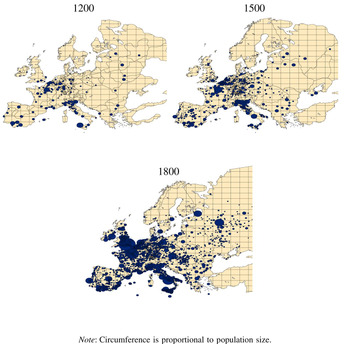
Figure 1 represents the location of all the cities in the Bairoch data set for 1200, 1500, and 1800. The diameter of each dot is proportional to population size. The maps also include the grid we use to define our observations. The three maps capture a continuous process of urban expansion over time. By 1200 an urbanized axis had emerged in the old Lotharingian kingdom, with cities mostly clustered in today's Benelux and in Northern Italy. The map also records the existence of a set of (by that time declining) towns in the southern half of the Iberian Peninsula. Three hundred years later urban population had grown quite rapidly. According to Bairoch, Batou, and Chèvre the number of Europeans living in towns rose from 8.4 million in 1300 to 23 million in 1800.Footnote 24 Urban growth did not simply track total population growth. It resulted in a higher proportion of the population living in cities. In Western Europe, the urbanization rate went up from 2.1 percent in 1000 to 8.1 percent in 1500 and 21.2 percent in 1800.Footnote 25 Urbanization rates also varied across countries—for example, in 1500 they ranged from 29.5 percent in the Netherlands to 2.2 percent in Scandinavia.
Urban populations in Europe in 1200, 1500, and 1800

Besides Bairoch's urban population data, we employ regional per capita income in 1870 and 1900 across Europe. To construct this measure at the regional level, we rely on a growing number of new estimates of GDP per capita done at the subnational level by several economic historians, harmonized across countries using Maddison's per capita income data at the national level as a benchmark.Footnote 26
Urban Development and Proto-Industrialization
Towns may embody a process of economic specialization and technological innovation leading to higher incomes. However, they may just be urban agglomerations where a rent-seeking clique (served by a class of servants) lives out of the surplus it extracts from its particularly productive agricultural hinterland. Aware of that possibility, Weber distinguished between towns featuring a core of craftsmen, tradesmen, and financiers and cities built around a royalty, its court, and its tax and military bureaucracy.Footnote 27 Both cities may be located in rich agricultural lands. But only the former could have fostered the kind of technological innovation that ended up breeding the industrial breakthrough of the eighteenth and nineteenth centuries.
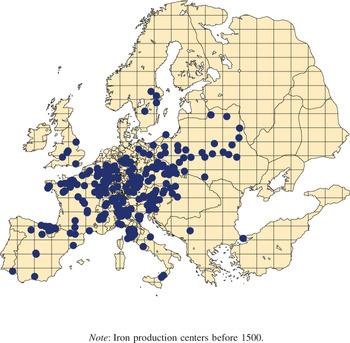
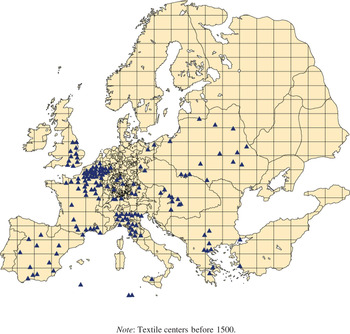
To measure the commercial and industrial dimension of cities and to proxy for the learning-by-doing process embodied in the artisanal network, we have collected data on the geographical location of textile and metal production centers before 1500 in Europe. For the textile industry, we plot the location of wool, linen, and silk manufacturing centers reported by Gutmann, who in turn follows Carus-Wilson. For the metal industry we employ the exhaustive data set built by Rolf Sprandel on the location of iron forges between 1200 and 1500.Footnote 28
Political Institutions
We examine the evolution and role of executive constraints (potentially acting as a guarantor of property rights and as the foundation of the rule of law) by looking at the presence of parliamentary institutions.Footnote 29 Our index of parliamentary strength, coded at the level of politically sovereign (and semisovereign) units, is the fraction of years with parliamentary meetings in each given century. The frequency of parliamentary meetings is an indirect but plausible measure of institutional strength for two reasons. On the one hand, there are very few historical records about the exact powers of parliaments (vis-à-vis the executive) for all (or even a reasonable fraction) of all polities and over the whole time period under analysis. On the other hand, the number of parliamentary sessions is, on average, a good proxy for parliamentary powers in light of our historical evidence and more recent work on authoritarian institutions in political science. First, we know from historiographical research that the main source of conflict between parliamentary forces and absolutist monarchs in modern Europe revolved around the monarchs’ capacity to first domesticate and then suppress parliaments.Footnote 30 Second, recent literature on authoritarian regimes shows that working legislatures (and other plural institutions such as party committees) have been crucial to sustain power-sharing agreements among governing elites and to curb dictators’ power and have been generally related to slightly more certain legal environments and less repressive political contexts.Footnote 31
Our parliamentary bodies include traditional territorial assemblies (like the British parliament or the French General Estates) and permanent local councils (like Genoa's Maggiore Consiglio or Florence's executive committee). More precisely, to be defined as having a parliament, the political unit under analysis has to have a non-executive body (i.e., a body that fulfills legislative and sometimes judicial functions as opposed to or in addition to strict executive tasks) formed by a plurality of members. This non-executive body must be chosen through procedures (elections or lottery) not directly controlled by the executive.Footnote 32 The coding, done annually, is then converted to century averages that range from 0 (Spain in the second half of the eighteenth century) to 1 (with a meeting every year, like Venice through 1798).
The coding partly follows the databases collected by Van Zanden, Buringh, and Bosker and Stasavage, corrected and complemented using secondary sources and historical collections of parliamentary sessions.Footnote 33 However, our database differs from previous studies in two ways. In the first place, we also code as parliamentary bodies those parliaments that did not include third estate representatives. Requiring urban representatives to code legislative bodies as parliaments conflates a purely institutional effect (i.e., a body capable of constraining the executive) with the presence of a particular social sector that was in fact endogenous to (proto-industrial) growth.Footnote 34 In the second place, our data are more exhaustive than the existing data sets: they include parliaments from territories that were members of political confederations (such as Catalan or Valencian Corts, which were fully autonomous until the early eighteenth century) and imperial structures (such as the parliament of Sicily, which continued to meet under Catalan, Spanish, and Austrian control). Our data also incorporate the governance structures of city republics (as well as small duchies and principalities) such as Genoa, Lucca, Modena, Verona, etc. As a result, institutions are coded at a much lower level of aggregation than previous studies, which by using contemporary borders throws away key regional variation. The number of political units coded reaches over three hundred or about ten times the universe of observations employed by Van Zanden, Buringh, and Bosker and twice as many as in Stasavage.
In Figure 2 we present our data describing the evolution of parliamentary institutions, plotting the “meeting rate,” calculated as a five-year moving average of annual meetings of parliaments (or town councils in city-states) against time for several key subsets of our data. In the left-hand panel we plot these rates for all states (solid) and then two subsets: independent states (thick dashed) and non-independent states (thin dashed). The overall trend is flat from the thirteenth through fifteenth centuries, with roughly 55 percent of countries in each year holding a meeting. However, between 1500 and the onset of the French Revolution there was a sharp decline, reaching an average of just over 33 percent at the end of the eighteenth century.
Proportion of units with parliaments

In the right-hand panel we divide Europe into four regions: Southern Europe (Iberian Peninsula, France), Northwestern Europe (British Isles, Low Countries), Central Europe (roughly the area comprising West Germany, Austria, Switzerland, and Italy), and Eastern Europe and Scandinavia. Parliaments met often in Atlantic Europe: the frequency rate fluctuated at around 0.75 or more since the early fifteenth century. Even after the rise of absolutism, English and Dutch parliamentarianism remained in place—arguably sustained by the wealth of the cities and the strength of their navies. Most German towns and territories between the Rhine and the Elbe preserved their autonomy and representative institutions until the French Revolution. However, parliamentary life in central Europe declined in overall terms following the entry of French and Spanish troops in Italy and the growing influence of Prussia in eastern Germany. Parliaments became even weaker in the rest of the continent. They ceased to exist in France after the Fronde in the middle of the seventeenth century and in the Catalan-Aragonese Crown after the victory of the Bourbons in the early eighteenth century. In Eastern Europe, where parliaments met less often than in the European core even before the rise of the absolutist monarchy, diets end up meeting between two and three times every ten years by the end of the eighteenth century. Diets that included urban representatives met even less frequently.
The Role of War
We obtain a measure of exposure to conflict from Dincecco and Onorato who catalogue battle locations in Europe between 1000 and 1800. We take each battle, c, in the Dincecco and Onorato data and measure the distance between its location and each of the units in our data set.Footnote 35 We then weight each battle by this distance, measured in kilometers, plus unity so that distance weighted conflict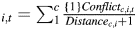 $_{i,t} = \mathop \sum \nolimits_1^c {{\lcub 1 \rcub} Conflict_{c,i,t} \over{Distance_{c,i} + 1}}$ . Thus, it assigns a value of 1 to conflicts within the territory of each state and weights other conflicts by the distance from each unit, giving spatially proximate conflicts more weight than distant conflicts.Footnote 36 Our second measure of international conflict, mean sovereignty, is the fraction of years in a given period a state was independent. That is, it reflects the number of years in a given period during which a given unit was free from foreign domination. At one extreme a value of 1 indicates a unit was independent in each year in a particular century interval and, at the other extreme, a value of 0 indicates that a state was not independent in any year of that interval. Higher values in this range indicate a greater proportion of years that a state was independent.
Controls: Climate, Agricultural Suitability, and Urban Population
The growth of cities and proto-industrial centers and the development of quasi-representative political institutions was arguably the product of a self-sustained process of population growth, which was sustained by an agricultural surplus,Footnote 37 and technological innovation through hands-on learning. Now, to disentangle the relationship between biogeographical conditions, economic development, proto-industrialization, and parliamentary constraints, we implement two empirical strategies. First, because the biogeographical conditions that promote early urban development may also affect the later economic and political outcomes we are interested in, we control for a large number of possible confounders. Of course, given the absence of readily available historical data on a large number of plausible confounders, we adopt Oster's sensitivity analysis procedure,Footnote 38 and show that the impact of early urban development on subsequent patterns of economic growth are robust to substantively large violations of the assumption of exogeneity conditional on observable covariates.Footnote 39 Second, we employ an instrumental variables approach where we exploit random climatic shocks to the ability of some areas to grow cereals as a driver of urban growth that arguably had no direct effect on our variable of interest in later periods.
As controls, we include, first, the rain-fed suitability to produce agricultural output. This variable, which measures the capacity for a given piece of territory to produce agricultural output without extensive irrigation, is derived from the United Nations Food and Agriculture Organization's (FAO) GAEZ combined land suitability data set.Footnote 40 Second, we control for how mountainous an area is using the spatial data on terrain ruggedness collected by Shaver, Carter, and Shawa.Footnote 41 Third, since the ability to trade may have affected both the development of cities and our outcomes of interest, we account for access to trade routes by controlling for river density, distance to coasts, and the total length of coastline. Fourth, we include measures of latitude and longitude for the centroid of each unit. Finally, we add unit fixed effects whenever we have repeated observations over time allowing us to control for qualities specific to each territory and identifying any effects through within-unit variation.
Our results rely upon the standard assumption that, conditional upon observable variables, our independent variable of interest, urban density, is exogenous. Because we cannot be certain to have conditioned upon all potential confounders, we assess the validity of this assumption with the test that Oster developed.Footnote 42 To place bounds on the bias in regression estimates caused by the presence of unobserved omitted variables, this method uses information from changes in both point estimates and R 2 values derived from comparing the unconditional estimated impact of our main independent variable of interest, early urban density, to this variable's estimated effect after conditioning on all other observable covariates. The procedure allows us to evaluate the degree to which unobservable factors are likely to bias our results. Under the assumption of a proportional impact of unobservables relative to observables, Oster considers to be robust those results that survive the presence of hypothetical unobservables explaining variation in the outcome of interest equal to 1.3 times the R 2 associated with the regression containing the full set of observed controls. As we detail later, all of our results relating the presence of early urban clusters to proto-industrial skills, future urban density, and future incomes survive at or beyond this level, suggesting the correlative relationships we describe in these sets of regressions persist even in the face of unobserved confounders.
Recognizing that the presence of cities was contingent upon the capacity to feed large populations, we also employ an instrumental variable approach where we use climatic perturbations in the capacity of some places to produce cereals like wheat. We do this for two reasons. First, across all social classes, the European diet of the premodern era was centered on the consumption of complex carbohydrates derived from cereals.Footnote 43 Second, the ability to grow cereals has been directly linked to the support of large populations. Cereals like wheat (and unlike other plants) are most capable of feeding large populations with minimal effort because they are extremely fast growing, high in calories from carbohydrates, and have extremely high yields per hectare.Footnote 44 Moreover, unlike other crops, cereals can be stored for long periods of time so they enable communities to smooth consumption over extended periods.
Agricultural suitability (measured as deviation from optimal temperature) arguably meets the assumptions needed to be an instrumental variable for urban population. First, deviations from this temperature seem to be a strong encouragement of urban growth: throughout, these shocks prove to satisfy all tests against weak instrumentation. Second, the instrument is randomly assigned because, at least until the nineteenth century, there was no direct human effect on climate. Finally, our instrument satisfies the exclusion restriction. Climate shocks to the ability to sustain large populations in period t appear to have had no effect on political or economic outcomes like the development of proto-industry or parliaments in period t + 1 other than through its effect on urban populations at the time: using the sensitivity analysis proposed by Conley, Hansen, and Rossi,Footnote 45 we show that it would take a substantively large violation of the exclusion restriction to nullify the causal interpretation of our findings. We report Oster's sensitivity analysis estimates in the main text and then present results from the instrumental variables strategy in Appendix A.
Endogenous Growth and the Persistence of Initial Advantages
Economic Development
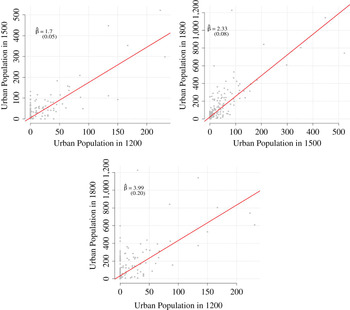
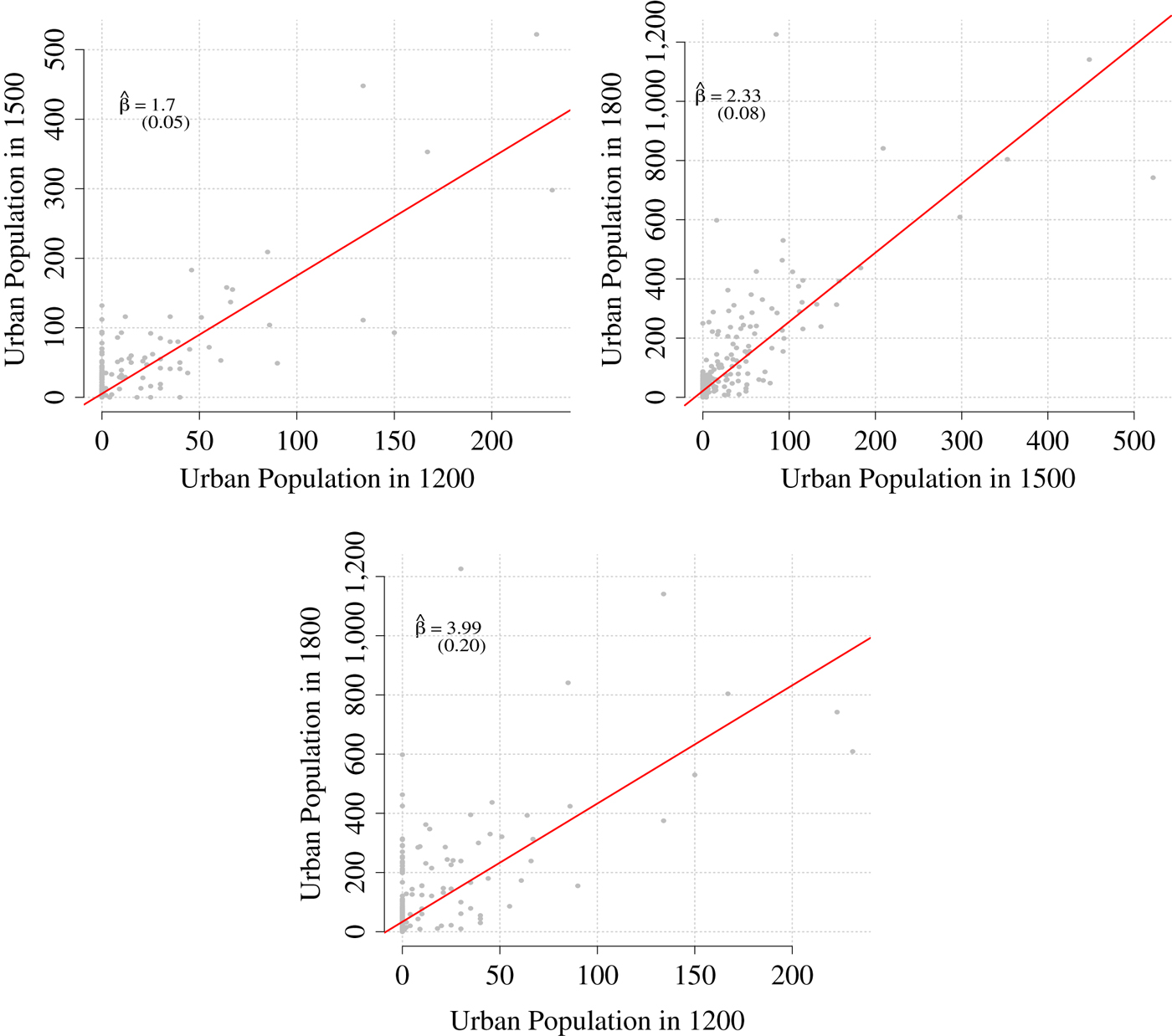
Figure 3 plots the bivariate relationship between total urban population in each geographical quadrant in 1200 and 1500 and total urban population at a later time. It also reports bivariate regressions looking at the relationship between urban population in 1200, 1500, and 1800. The units of analysis are 225 square kilometer quadrants. Urban population is defined as population living in cities of 1,000 inhabitants or more. Figure 3 shows that there is a strong, persistent, and statistically significant relationship between early urban densities in 1200 and later urban densities in 1500 and 1800, respectively. For every one thousand individuals living on a 225 kilometer by 225 kilometer grid in 1200, approximately four times this number are expected to be living there six centuries later, implying a century-on-century effect of approximately 1.26. This effect is smaller in the first half of the series than in the second. Total urban population on a given unit increased 1.7 times between 1200 and 1500 and then approximately 2.3 times in the following three centuries. This differential rate of growth suggests a widening gap between early and laggard urbanizers.
Bivariate relationship between urban population and future urban population across time
Since we have data covering more than three points in time we can exploit the full series to estimate the dynamic effect of past urban population (both from the immediately preceding century as well as from more distant times). We begin by estimating autoregressive models of the following form:
 $$\mu _{i,t} = \alpha + \phi _{t-1}\mu _{i,t-1} + \phi _{t-2}\mu _{i,t-2} +... + \phi _{t-k}\mu _{i,t-k} + \delta _t + \eta _i + \epsilon _{it}$$
Where μ it is total urban population (or its logged value) on a given geographical unit i in period t, η i is a grid-square specific effect, δ t is a period-specific constant, and ε it is an error term. The unit-specific effect η i captures the existence of other determinants of a geographical unit's steady state. The period-specific effects, δ t, capture common shocks affecting urban populations across the continent such as the plague of the fourteenth century.Footnote 46
Table 1 reports estimates of ϕ.Footnote 47 We present models that include one, two, and three lags sequentially. Columns 1 to 3 present pooled OLS estimates not accounting for unit-specific heterogeneity. Since, as Nickell shows,Footnote 48 estimating equation 1 in a standard fixed effects framework will yield biased parameter estimates, we follow a now conventional approach and report in columns 4 to 6 a system GMM estimator to consistently estimate equation 1.Footnote 49 The estimates of ϕ t−1 in the first six columns of Table 1 are close to 1, indicating that the panel has a unit-root and that the data-generating process contains an exploding trend across time. Recognizing this, in columns 7 to 12 we conduct the same exercise, estimating the same set of models but with the data log transformed. Once this transformation is taken into account, all estimates of ϕ t−1 fall between -1 and 1. However, when second-order lags are included, the sum of their coefficients, ϕ t−1 + ϕ t−2, either exceed the bounds of stationarity or come very close to doing so.Footnote 50
The pre-industrial structure of urban growth (autoregressive models)

Notes: The unit of observation is the 225 km × 225 km grid-square. This table presents the estimates of the autoregressive relationship between past and present urban development. The left panel measures total urban population and the right takes the logarithm of this number. Heteroskedaticity robust standard errors clustered by unit in parentheses; p-value for the Arellano-Bond test of second-order serial correlation in the errors denoted as m 2. Table A3 in the appendix reproduces these results for units approximately one half the size. *p < .10; **p < .05; ***p < .01.
To further evaluate whether the time-series component of urban population, either in logs or levels, is nonstationary, we conduct two unit-root tests, the results of which appear in the lower panel of Table 1. The first, proposed by Breitung,Footnote 51 takes as the null hypothesis that all panels contain unit roots. Using it, we are unable to reject the null that geographical units in all panels have a unit root. The second test, developed by Hadri,Footnote 52 takes as the null hypothesis that all panels are stationary. In this case we can reject the null hypothesis that all panels are stationary with a high degree of confidence. In short, both tests suggest that the development of urban population was a nonstationary process.
From a substantive point of view, these results indicate that small—even random—perturbations to urban population have an increasing impact over time, such that small differences grow in magnitude. As such, our results imply that very early differences in urban population had a persistent effect on present outcomes greater than those in later periods. In other words, the “great divergence” between the European core and its peripheries cannot be pinned down to a structural break (at a given point in time) but was rather the result of a slow and continuous effect of early advantages: those places that urbanized early in time continued to do so, growing faster than places that were not urbanized early on again as a result of the persistent and cumulative effects of past advantages.Footnote 53
To better understand the distributional impact of these early advantages, that is, to show that the early advantages indeed resulted in a growing inequality between initially poorly endowed and initially advantaged regions, we run the same autoregression as before but now model the quantile response instead of the mean response (as we would obtain via OLS).
 $$\hat{\beta} _\tau = \mathop {\rm arg \,\,max} \limits_{\beta \in {\rm {\open R}}^k} \mathop \sum \limits^{n}_{i = 1} \rho _\tau \lpar {\mu_{i,t}-\eta_t + \beta_\tau \mu_{i,t-1}} \rpar$$
That is, for a sample quantile τ we find the β that minimizes ρ τ(μ i,t − η t + β τμ i,t−1).Footnote 54 We obtain an estimate of β τ for each sample decile, regressing our measures of urban population, μ i,t, on its one period lag and, in order to absorb temporally common shocks across units, a full set of time effects.
These results are plotted for the first through ninth deciles in Figure 4. As we can see, the greatest impact of a change in past levels of urban population is on the upper tail of the subsequent period's distribution of urban population. The coefficient recovered on the lagged outcome when predicting the first decile response is equal to .6. At the other extreme, the coefficient recovered when predicting the ninth decile is equal to 2.15, more than three times the magnitude. Similarly, when we consider the outcome in logs where (β τ-1) gives a convergence rate, we again see the impact of past urban population is greatest on the upper tail of outcomes. At the first decile in outcomes the expected rate of convergence is about 0.10. Symmetrically, at the ninth decile we find that there is no convergence and estimate a rate of expansion of about .06. In sum, these results suggest that changes in past urban population produce future inequality in outcomes by increasing both levels and rates of growth at the high end of the distribution and retarding them at the low end.
Quantile regression results

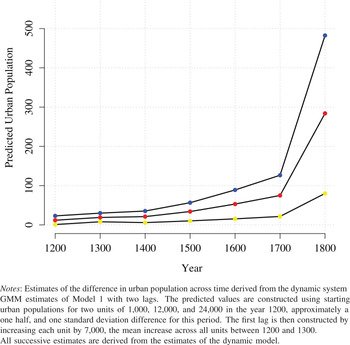
To give a sense of the magnitude of that divergence, Figure 5 plots the estimated difference in logged urban population between three areas from 1200 until 1800 that had an initial urban population of 1,000, 12,000, and 24,000 respectively. The 23,000 difference between the two extreme values represents approximately one standard deviation for the year 1200.Footnote 55 Figure 5 makes apparent that an initial advantage has a cumulative effect over time. Six hundred years later the estimated difference is predicted to become about 470,000.Footnote 56
Initial conditions and urban population over time

From Urbanization to Per Capita Income
Because urbanization is only a proxy for development we proceed by regressing per capita income in 1870 and 1900, that is, at the height of the industrial revolution, on urban density in 1800 (i.e., right before the process of takeoff occurred). The unit of analysis is the current NUTS-2 region (as defined by the European Union). The data cover eleven countries of western and central Europe.Footnote 57 The upper panel of Table 2 reports the results.
The relationship between urban density in 1800 and per capita income in the nineteenth and twentieth centuries

Notes: The unit of observation is the contemporary NUTS-2 region. The top panel of this table describes the relationship between urban density in 1800 and per capita income in 1870 and 1900, respectively. The lower panel of this table describes the relationship between urban density in 1800 and per capita income in 2008. In the lower panel the first six columns use all NUTS-2 regions for which there is income data. The last six columns use only those in Western Europe. Heteroskedasticity robust standard errors clustered by country are in parentheses. Controls are: terrain ruggedness, agricultural suitability, distance to coast, coast length, latitude, and longitude. Following Oster Reference Oster2013 we provide sensitivity estimates of the effects under the hypothetical condition when unobservables account for 1.3 × the R2 from the controlled regressions. *p < .10; **p < .05; ***p < .01.
The relationship is both statistically significant and strong from a substantive point of view. Taking the model from the first column of Table 2 and manipulating urban density across its interquartile range, we get predicted incomes of $1,714 and $2,213 in 1870—extremely close to the true interquartile values in 1870 of $1,312 and $2,429. These results are robust to the log transformation of income, the inclusion of country fixed effects,Footnote 58 and the addition of geographic controls. Moreover, a sensitivity analysis (following the procedure that Oster proposed)Footnote 59 indicates that these results are robust to the presence of unobservable factors.
The relationship between urban density in 1800 and income per capita persisted into the twentieth century. Per capita income for all NUTS-2 regions in 2008 has a positive and statistically significant relationship with urban density in 1800 (lower panel of Table 2). The size of the point estimate is substantial—a 100 percent change in urban density in 1800 is predicted to yield between a $2,583 and $3,060 increase in per capita income in 2008. To make the results directly comparable to the analysis for the nineteenth century, columns 7 to 12 in the lower panel exclude regions from countries not employed in the upper panel. The results remain qualitatively unchanged. When we conduct Oster's sensitivity analysis,Footnote 60 the relationship between urban density in 1800 and incomes in the nineteenth century and early twentieth centuries is robust to the presence of unobservables.
To sum up our results so far, very early random shocks to levels of early urban development explain later differences in urban density across Europe. Moreover, the growth of cities before the industrialization revolution was a nonstationary process where very early differences across location compounded upon each other, leading to the wide divergence in urban density observed in 1800. Finally, those differences in urban density just prior to the industrial revolution were correlated with both late nineteenth- and twentieth-century incomes.
The Backbone of Endogenous Growth: The Emergence of a Proto-Industrial Core
To examine the claim that economic growth was ultimately a function of technological innovation embodied in a class or sector of society, namely artisans and craftsmen, we turn to our data on the existence of protoindustrial centers that, as Figures 6 and 7 make apparent, matched the distribution of European urban population.
Metallurgic centers

Centers of textile production

We model that process in two steps. In the first place, Table 3 regresses the number of textile or metallurgic centers in each geographical quadrant between 1200 and 1500 on the level of urban population on the same unit in the year 1200. Columns 1 to 4 treat the number of textile centers separately. Columns 5 to 8 do so for iron centers. Columns 9 to 12 examine the sum of both types of protoindustry as the outcome. The unit of observation is the geographical quadrant. Employing OLS (the first two columns for each dependent variable) and negative binomial regression (the last two columns), early urban density is positively associated with the presence of proto-industry. The magnitude of this relationship is substantively large: the OLS estimates indicate that a 100 percent change in urban population in the year 1200 corresponds with between .28 and .45 of a new industrial center. Our findings survive the inclusion of the full set of controls and are robust well beyond rule-of-thumb levels of significance proposed in Oster's method for detecting bias based on the presence of confounding unobservables.Footnote 61
The effect of early urban density on the development of protoindustry by 1500

Notes: The unit of observation is the 225 km × 225 km grid square. This table presents estimates of the effect of early urban development (in the year 1200) on the number of proto-industrial centers in existence on a given 225 km × 225 km unit. Heteroscedasticity robust standard errors in parentheses. Controls are: terrain ruggedness, agricultural suitability, distance to coast, river length, coast length, latitude, and longitude. Following Oster Reference Oster2013 we provide sensitivity estimates of the effects under the hypothetical condition when unobservables account for 1.3 × the R 2 from the controlled regressions. Table A5 in the appendix reproduces these results for units approximately one half the size. *p < .10; **p < .05; ***p < .01.
In Appendix A we provide further evidence of the relationship between early urban density and the development of proto-industrial skills (Table A2). There, we exploit climatic shocks in the ability to feed large populations in order to identify this effect in an instrumental variables framework. The 2SLS estimates are larger, indicating a .85 predicted increase (in total proto-industry centers) following a 100 percent change in initial urban population. Assessing the robustness of these instrumental variables estimates through the more conservative union-of-confidence-intervals sensitivity analysis, we find that there would need to be a substantively large direct effect of our instrument (between 76% and 81% the magnitude of each of our estimated effects) to violate the exclusion restriction and make our results statistically insignificant.
In the second place, Table 4 turns to assess the impact of proto-industrial centers (in place before 1500) on urban density in 1500 controlling for the effect of urban density in 1200. The relationship between proto-industrial activity (measured through the number of proto-industrial centers in a particular unit before 1500) and urban density in 1500 is positive and statistically significant. The introduction of a full set of geographical controls (in the odd columns) does not substantively alter the relationship between the presence of these skills and density in 1500 even though it reduces the magnitude of the independent effect of proto-industry in some cases. Measuring the outcome in logs, the addition of a single center of proto-industrial activity is estimated to be between over one quarter and about one half of the magnitude associated with past urban development. For example, depending on the set of controls included, the addition of a single industrial center before 1500 corresponds with between a 14 percent and 39 percent increase in urban density in 1500. In comparison, a 100 percent change in urban population in 1200 is predicted to yield between a 44 and 65 percent change over the same period (columns 11 and 12).
The effect of proto-industry on urban development in 1500

Notes: The unit of observation is the 225 km × 225 km grid square. This table presents results giving the relationship between the existence of proto-industrial centers on future urban development in the year 1500 after conditioning on earlier levels of urban development (in the year 1200). Heteroscedasticity robust standard errors in parentheses. Controls are: terrain ruggedness, agricultural suitability, distance to coast, coast length, latitude, and longitude. *p < .10; **p < .05; ***p < .01.
We interpret these results as corroborating endogenous growth theories—where growth comes from a rising stock of ideas that are generated through a process of learning by doing—as well as geographic concentration models that emphasize increasing return to scale and positive externalities derived from the agglomeration of individuals.Footnote 62 As Table 3 shows, urban or economic clusters fostered a process of economic specialization and technological innovation: a specialized artisanal class worked in a network of proto-industrial centers where it generated and transmitted new techniques and devices to solve production bottlenecks. That process of incremental innovation then resulted in efficiency gains, economic growth, and, arguably, larger urban agglomerations. That is, as Table 4 indicates, those regions that had an initial advantage of urbanizing and specializing in some proto-manufacturing sectors experienced ever-faster growth rates than the rest.
Urban Development and Political Institutions
Were parliaments, that is, institutions imposing checks and balances on rulers, related to development? And if so, in what ways? Did they lead to the development of commercial groups and economic growth or did they just reflect the economic needs of and distribution of power across social groups—typically urban commercial elites versus landed interests? We answer this question in three steps.
First, we estimate urban growth's impact on parliamentary life, exploiting century-on-century within-unit changes in urban population to assess how changes in urban density were related with the frequency of parliamentary meetings (Table 5, columns 1–4). Column 1 reports pooled OLS estimates, regressing our index of parliamentary institutions (the fraction of years with parliamentary meetings in a given century) on the logged value of urban density (total urban population divided by square kilometers of a given political unit) measured at the beginning of the century. Throughout this section the units of analysis are sovereign and semisovereign territories. In column 2 we introduce region and year fixed effects and the result remains substantively unchanged.Footnote 63 These models, where we are making comparisons across the entire pooled sample, demonstrate a statistically significant and positive relationship. However, when we successively introduce political unit fixed effects (e.g., fixed effects for each sovereign or semisovereign state) and year fixed effects in columns 3 and 4, the relationship between urban growth and the frequency of future parliamentary meetings disappears.
The coevolution of urban density and parliamentary constraints

Notes: The unit of observation is the sovereign/semisovereign political unit. The first four columns of this table present the estimated effect of urban density in period t on the frequency with which parliaments met in periods t to t + 1. Columns 5–10 present results of the relationship between the frequency of past parliamentary meetings and urban density in the subsequent century. Heteroscedasticity robust standard errors clustered by sovereign/semisovereign unit in parentheses. *p < .10; **p < .05; ***p < .01.
Second, we evaluate institutionalist theories of growth by regressing urban density on the frequency of parliamentary meetings (conditional on lagged urban density) for all states between 1200 and 1800 (Table 5, columns 5 to 10).Footnote 64 Columns 5 to 7 report pooled OLS estimates. Column 5 reports the unconditional relationship between urban density and past parliamentary life, showing a positive and statistically significant effect of past parliamentary life on urban development. This effect remains nearly identical after including region and year effects (column 6). However, once we control for past levels of urban density (column 7), the magnitude of the estimate falls by over two thirds. After including political unit fixed effects (column 8), that is, after identifying the relationship between city growth and parliamentary institutions from within political unit changes, the relationship becomes negative and statistically significant. Finally, the effect becomes null with time fixed effects (column 9) and this null result persists after controlling for past value of urban density as well as unit and time effects (column 10).Footnote 65
To sum up, Table 5 reveals two things. On the one hand, there appears to be a robust cross-sectional relationship between urban growth and parliamentary constraints (in both columns 1 and 2, where the lagged variable is urban density, and columns 5 and 6, where the independent variable is parliamentary life). On the other hand, that relationship becomes null once we consider the possible impact of parliamentary institutions on urban growth (in each century) within each unit of analysis (through the introduction of fixed effects).
To reconcile these apparently conflicting results—and to shed light on the underlying factors that may explain both of them, we turn to Table 6. There we show, in the first place, that initial economic conditions (urban density in 1200) were a consistently strong predictor of parliamentary meeting frequency in each century (in separate columns) even after controlling for overall changes in urban population across each period. Table 6 shows, in the second place, that once we control for initial urban conditions the change in urban population in each century stops having a regular positive effect on the frequency of parliamentary meetings. We model these effects of urban growth in two ways. In columns 1 to 5, we include initial urban density (in 1200) and the change over the interval between the initial period and the period of observation. Urban growth has a positive and statistically significant effect on parliamentary life only during the fourteenth century. In columns 6 to 9, we include initial urban density (in 1200) and urban density change in all previous centuries. Urban growth has now a cyclical relationship with parliamentary growth. Higher urban growth is associated with more parliamentary meetings in the five-, three-, and one-century differences, and with stronger parliaments in four- and two-century differences.
Initial urban conditions and parliamentary life across time

Notes: The unit of observation is the sovereign/semisovereign political unit. This table provides estimates of elasticity of initial urban density and parliamentary meeting frequency. Each column regresses the fraction of years in a given century on the logged value of urban density in the year 1200. We account for the overall change between any set of periods, such that δt represents the change in urban density over t centuries. Heteroskedasticity robust standard errors in parentheses. *p < .10; **p < .05; ***p < .01.
Taking stock of the findings of Tables 5 and 6, three main facts become apparent. First of all, the initial geographical distribution of parliamentary institution covaried strongly with initial economic (urban) conditions. Second, and more crucially, those initial economic conditions also covaried with parliamentary institutions in the medium to long run. Notice again that those two findings parallel the results we obtained in Table 1, according to which the initial patterns of urban development in 1200 determined the subsequent path of urban growth across Europe until 1800 (and beyond). Last but not least, the results presented in Table 6 (rows 2 to 6) corroborate and complement the results in Table 5, according to which, urban density changes did not covary with parliamentary frequency within each political unit. In short, the economy appears to follow an endogenous growth path—through urbanization, the formation of proto-industrial centers, and a class of competent artisans and technicians. Embedded within that general process of endogenous development that started around the twelfth and thirteenth centuries, political institutions rose and persisted. Still, these institutions did not explain growth on their own. That is, they did not lead to more development beyond the institutional persistence effect of parliaments born with the urban revolution of the later medieval and early modern periods.
War and Its Consequence(s) for Parliaments
If initial conditions best explain the distribution of parliamentary life over our period of inquiry, what then accounts for the observed temporal variation in parliamentary meetings? Here we provide evidence suggesting that patterns of conflict between states explain, in two cross-cutting ways, the continuity or failure of parliaments.
Initially, pressures of war generated an increased demand for parliaments. To obtain revenue, most often to finance military endeavors, leaders frequently granted the right to hold parliaments, trading constraints upon their behavior for resources to wage war.Footnote 66 As such, exposure to intense military conflict increased demand for parliamentary bodies. In the case of Europe, once towns had grown in size and wealth, their dwellers had the numbers and money to defeat the heavy cavalry of the old feudal class and to introduce pluralistic institutions in autonomous or semi-autonomous city-states in the thirteenth and fourteenth centuries.Footnote 67 Nevertheless, the modern “military revolution,” which began, roughly, in 1500 and accelerated after 1650, had negative consequences for the survival of representative bodies. The introduction of gunpowder and the deployment of large standing armies raised the financial cost of war and resulted in the emergence of several large continental monarchies that vied for continental hegemony.Footnote 68 The expansion of those large territorial states led to the formation of subservient client states or the outright loss of sovereignty, resulting in the collapse of parliamentary life in these conquered territories.
Accordingly, we first consider the direct impact of war, operationalized using the distance-weighted measure of conflict intensity derived from Dincecco and Onorato’s battles data set.Footnote 69 Second, we estimate the impact of foreign domination, operationalized as the average number of years a political unit remained independent in a given period. We then regress our parliamentary frequency measure on our two conflict measures in addition to our urban density measure as well as the full set of country and time effects.
Estimates are given in Table 7. Column 1, which includes the distance-weighted conflict measure, estimates a positive and statistically significant relationship between conflict intensity and parliamentary meeting frequency. A 100 percent increase in this measure of conflict intensity is correlated with 4.8 more years in meetings. In column 2 we regress our parliamentary meeting index on our measure of sovereign independence and find that states that remained sovereign were considerably more likely to also maintain independent parliaments, holding them for on average 25.5 more years in a given century. Column 3 includes both measures. Coefficients derived from this model are near identical to those when our conflict measures are included separately.
The effect of conflict on parliamentary meeting frequency

Notes: The unit of observation is the sovereign/semisovereign political unit. This table presents the estimated effect of conflict (derived from Dincecco and Onorato Reference Dincecco and Onorato2016) and the loss of sovereignty, respectively, in period t on the frequency with which parliaments met in periods t to t + 1. Heteroscedasticity robust standard errors clustered by semisovereign unit in parentheses. *p < .10; **p < .05; ***p < .01.
Finally, in the last three columns we repeat this exercise including the lag of our dependent variable. As before, to avoid Nickel bias we estimate each of these models via the Arellano-Bond system GMM estimator. From this, we find that the frequency of parliamentary meetings is rather “sticky,” with coefficient estimates on the lagged value ranging from .923 to .935. Our variable on conflict becomes substantially and statistically indistinguishable from 0. By contrast, the loss of sovereignty remains statistically significant. Although our estimates indicate that the “short run” impact of the loss of sovereignty drops by half, now equaling a reduction of about 12.5 years in which a parliament met, the “long run” effect implies a complete absence of parliamentary meetings after a permanent loss of sovereignty.Footnote 70
In sum, competition between states had two opposing effects on parliamentary life. On the one hand, the need to raise armies was correlated with a higher frequency of parliamentary meetings. However, whenever warfare resulted in the loss of sovereignty, conquered states lost their parliaments as well. As in our previous analysis, across specification estimates of our measure of urban density's impact on parliamentary constraint turned out to be small and indistinguishable from 0.
In Tables A14–15 in the supplementary appendix we additionally consider the relationship between conflict and development, using past experience with war to predict future urban density. We find no statistically significant relationship between our measures of sovereignty or parliaments and future measures of urban density. However, we find mixed results with respect to our measure of conflict intensity and future urban development. When the outcome is taken in levels, we establish a consistently null statistical relationship. In contrast, when taken in logs, we find a statistically significant relationship between our measure of conflict intensity and future urban development. In sum, we might take this as some potentially corroborative evidence for Dincecco and Onorato’s results indicating that warfare was in fact a boon for city growth rates.Footnote 71
Trade
Easy access to transportation means, such as the sea, has been associated with the rise of trade, the expansion of urban life, and growth.Footnote 72 Within this general interpretation of geography's effects on the economy, several authors link the rise of incomes in the European northwest to the rise of the Atlantic trade (and the closing of Mediterranean routes after the fall of Constantinople).Footnote 73
To examine the effect of having access to both the Atlantic and the Mediterranean, we estimate the following model:
 $$\mu _{it} = \alpha + {\mathop \sum \limits^{T}_{t}} \beta _t\lpar {\delta_t \times {\rm Atlanti}{\rm c}_i} \rpar + {\mathop \sum \limits^{T}_{t}} \gamma _t\lpar {\delta_t \times {\rm Mediterranea}{\rm n}_i} \rpar + \eta _i + \delta _t + \epsilon _{it}$$
where μ it is total urban population living on grid square i in period t, η i is grid-square fixed effect, δ t is a set of time effects, and ε it an error term. The parameters β t and γ t capture the time-varying effect of access to the Atlantic and Mediterranean seas respectively, in interaction with the set of time dummies, δ t.
We operationalize access to the sea in two ways: as a dummy for whether or not a given grid square contains the Atlantic coastFootnote 74 or the Mediterranean coast, and employing distance in kilometers from the geometrical center of the quadrant to the coast. To compare the change in urban growth associated with Mediterranean versus Atlantic coasts, we test the restriction that Atlantic-exposed units grew at the same rate as those on the Mediterranean for each period (β t − γ t = 0). The top panel of Table 8 presents the results. While access to both the Atlantic and Mediterranean were associated with increases in urban population, we cannot reject the null that the access to the Mediterranean gave the same advantage as access to the Atlantic for any period.
Coast access and urban development before the industrial revolution

Notes: The unit of observation is the 225 km × 225 km grid square. The top panel presents results comparing access to the Atlantic to access to the Mediterranean. The lower panel estimates the relationship between access to the Atlantic and urban population after controlling for past values of urban population. All models contain grid-square and time fixed effects. When the lagged dependent variable is included we use a system GMM estimator. Heteroskedasticty robust standard errors in parentheses. The unit of analysis is the 225 km × 225 km grid square. *p < .10; **p < .05; ***p < .01.
The bottom panel of Table 8 examines the impact of having access to the Atlantic conditioned by level of urban density. The estimation includes a lagged dependent variable and allows the effect of the Atlantic to vary by period. In the specification that employs a dichotomous measure of access, the relationship is negative for 1300 and statistically insignificant for the years 1400 to 1700. It becomes positive and statistically significant only for 1800. When we use distance to the Atlantic as our measure of access, territories closer to the Atlantic were, on average, less developed than those far away.
Moving beyond a standard story stressing the unconditional effect of trade access on growth, Acemoglu, Johnson, and Robinson claim that the rise of Western Europe after 1500 can be traced back to the combination of constraining political institutions, for example, parliaments, and access to the Atlantic trade.Footnote 75 We revisit their analysis here using our political unit time-varying measures of parliamentary constraints—instead of their time-invariant measure (for the year 1415) coded at a much higher level of spatial aggregation.
To begin, we follow Acemoglu, Johnson, and RobinsonFootnote 76 in estimating the following baseline model:
 $$\eqalign{\mu _{it} & = \alpha _i + {\mathop \sum \limits^T_{t \ge 1500}} \beta _{1t} \times \delta _t \times {\rm Atlanti}{\rm c}_i + \beta _{2t} \times \delta _t \times {\rm Atlanti}{\rm c}_i \times {\rm P-Inde}{\rm x}_{it-1}\cr & \quad\quad \quad\quad \quad + {\mathop \sum \limits^T_{t \ge 1500}} \gamma _t \times \delta _t \times {\rm W}{\rm. \; Europ}{\rm e}_i + \delta _t + \theta \times {\rm P-Inde}{\rm x}_{it-1} + \epsilon _{it}}$$
where β 1t captures the effect of access to the Atlantic in period t, β 2t captures how this effect varies with the frequency of parliamentary constraints, θ captures the direct effect of parliamentary constraints, and δ t are a set of time dummies. As in Acemoglu, Johnson, and RobinsonFootnote 77 we estimate these parameters after having controlled for the broader trend of urban growth in Western Europe, given by the parameters γ t, and political unit fixed effects, α i. Our unit of observation is political unit as defined in each century.
Table 9 presents our results. Columns 1 to 4 use a dichotomous, time-invariant measure of potential for Atlantic trade. Column 1 reproduces the main result of Acemoglu, Johnson, and RobinsonFootnote 78 and confirms that, after the seventeenth century, access to the Atlantic was positively associated with changes in urban development. However, in column 2, where we condition on the previous century's level of urban density, the relationship between access to the Atlantic and urban growth is null except for 1800 or 300 years after the discovery of the New World. The next two columns estimate the interactive relationship between the existence of parliamentary constraints and the Atlantic trade access dummy (column 3) and between parliamentary constraints and the full set of Atlantic access and post-fifteenth-century time dummies (column 4). Both models provide no evidence of a statistically significant relationship among parliaments, trade, and growth.
The effect of Atlantic trade and parliamentary activity on urban density

Notes: The unit of observation is the sovereign/semisovereign political unit. This table estimates the relationship between access to the Atlantic and urban development as well as the interactive effect between Atlantic access and the existence of parliamentary constraints on the same outcome. The unit is the polity. Heteroskedasticty robust standard errors in parentheses. When the lagged dependent variable is included we use the system GMM estimator. *p < .10; **p < .05; ***p < .01.
In columns 5 to 9 of Table 9, we use Acemoglu, Johnson, and Robinson’s second measure of potential for Atlantic trade: the ratio of Atlantic coastline to the total area of the state. However, instead of using the boundaries of twentieth-century states to measure access to the Atlantic, we measure the ratio contemporaneously with urban density and parliamentary constraints, which gives us a time-varying measure of coast access. Because of this we can include it directly as a covariate instead of only estimating changes in its century-on-century effect via interactions with a series of time dummies, yielding the total effect of access to the Atlantic across time rather than just how access to the Atlantic changed across time.
Column 5 estimates the average effect across time, finding a statistically significant relationship between Atlantic access and urban growth. The next two columns repeat the same exercise as in columns 1 and 2, estimating the effect of access to the Atlantic across time. The time-varying components are each statistically significant but the direct effect is null when we condition on past values of urban population. The last two columns, which report the interactive effect of access to the Atlantic and parliaments, find no significant relationship between them and urban density. To sum up, while the time-varying effect of the Atlantic trade as estimated by Acemoglu, Johnson, and Robinson is significant and positive, the total effect of access to the Atlantic, which in their models is absorbed by unit-fixed effects, is indistinguishable from 0 across time periods when we control for past levels of urban density. There is no positive interaction of Atlantic trade and institutional set-up on growth.
Conclusion
Employing fine-grained geographic, economic, and political data covering 700 years of history and all sovereign and semisovereign units during that period, we have shown that the long-run rise of the core of Europe (from an economic and political backwater around 1000 CE to a flourishing urban economy that eventually housed the industrial revolution) conformed to an endogenous economic and institutional developmental process.
In a nutshell, after political conditions stabilized around the turn of the millennium, the introduction of new techniques such as the heavy plow and the three-field rotation led to larger crop yields in those regions endowed with rich soils and suitable climate conditions. Areas with a substantial cereal surplus sustained a growing nonfarming population that joined in urban agglomerations and specialized in a variety of artisanal and proto-industrial activities. In turn, those urban clusters made up of traders and artisans fostered an incremental process of technological innovation and of (mainly, human) capital accumulation. In addition, these productive classes designed a complex set of institutional rules to enable contract enforcement between ordinary individuals.Footnote 79 Generally speaking, they also gave rise to political institutions (mainly, parliamentary structures) that constrained the exercise of power (by the executive).
Our results provide strong support for current endogenous growth models that emphasize how development depends crucially on a process of learning by doing. In late medieval and modern Europe, that process mostly happened on artisanal shop floors: in the application of their techniques and know-how to production, craftsmen developed new solutions that resulted in some incremental productivity gains. The strong role of technological continuity (and accumulation) in fostering growth would also explain why, in line with a growth model with increasing returns to scale and positive intrasectoral externalities, urban growth exhibited a divergent pattern across the continent. Cities that were relatively larger at the beginning of the period kept adding population at a faster rate than smaller towns, eventually generating a highly urbanized core extending from Barcelona–Lyon–Naples in the south to Liverpool–Manchester in the northwest and Hamburg–Dresden–Prague in the east. Finally, it would explain why urban life and the distribution of proto-industries in medieval and early modern Europe predict cross-regional variation in per capita income in the late nineteenth century and at the turn of the twenty-first century quite strongly. As Mokyr pointed out, the success of the industrial revolution depended on the presence of a class of producers and technicians that had λ-knowledge, that is, useful or technical knowledge that allowed them to transfer new general (scientific) knowledge to the production floor (or, simply, to copy novel techniques invented somewhere else).Footnote 80
By specifying the domestic processes that led to different economic trajectories and spatial divergence within Europe, we are in a position to evaluate the impact of international factors on development. Interstate conflicts and wars had a variable effect on political institutions: they increased the demand for parliamentary institutions in late medieval Europe (probably institutionalizing a quid pro quo deal between monarchs and wealthy elites). But, as big territorial states formed in the early modern period, they suffocated parliamentary sovereignty. By contrast, war and urban development appeared to have been at most marginally correlated. As expected, lower transportation costs (proxied through closeness to sea routes) had a positive effect on urban growth. However, access to the Atlantic Ocean (relative to the Mediterranean Sea) gave no additional advantage — either unconditionally or in interaction with the presence of strong parliamentary institutions.
Our findings also qualify our current understanding of the evolution and role of parliamentary institutions. In the neoinstitutionalist literature, parliamentary institutions appear as a necessary condition for growth. By constraining the executive, they foster investment. By reducing transaction costs in the measurement and enforcement of contracts, they encourage trade and the division of labor, which, in a Smithian growth model, results in productivity gains.Footnote 81 We find, instead, that institutions were endogenous to the structure of economic and commercial life. Pluralistic governance structures both emerged and remained in place in those areas that had a sufficiently wealthy and cohesive class of “burghers” who could block the landed and monarchical elites and sustain the process of endogenous growth that eventually led to the industrial revolution. The wealth and population of Italian and Flemish towns allowed them to defeat their ecclesiastical or feudal lords over the twelfth and thirteenth centuries.Footnote 82 Likewise, in modern Europe, parliamentary institutions persisted in only those proto-capitalist enclaves where a wealthy urban class had the means to oppose absolutism. Dutch cities joined in a military league and then a republic that eventually defeated Spain. In England, the parliamentary forces and the pro-trade party won over the royal forces in 1640 and again in 1688. As Pincus writes in his landmark study of the Glorious Revolution, England in the second half of the seventeenth century was already becoming a modern society with a booming economy, growing cities, and expanding trade.Footnote 83 Inspired by the Dutch example, the opponents of James II supported the principle of limited government, rejected James II's political-economic program based on land interests at home and territorial acquisition abroad, and embraced urban culture, manufacturing, and economic imperialism—understood as commercial hegemony.Footnote 84
It was arguably that unbroken economic dynamism that, at some point, brought Britain to the doorstep of the Industrial Revolution. Likewise, it was probably the reservoir of artisanal know-how in the rest of the core of Europe, such as northern Italy, parts of France, or the northern Iberian peninsula, that made it possible for those regions to catch up with Britain throughout the nineteenth and early twenty centuries even though they had lost their parliamentary institutions and political sovereignty many years ago—to the point that, today, per capita income is uniformly high in most of the geographical belt that extends from London through Frankfurt to Milan.
Supplementary Material
Supplementary material for this article is available at <https://doi.org/10.1017/S0020818319000286>.
Acknowledgments
For their research assistance we thank Ella Cheng, Kathy Chow, Dylan Czanercki, Britta Emmrich, Eric Falcon, Ravonne Nevels, Margo Nostein, and Jennifer Zhao. For comments, we thank the participants at NBER's Political Economy Meeting, the Comparative Politics Seminar in Harvard University, the Comparative Politics Seminar at Columbia University, the Politics Seminar in New York University, the CSDP seminar at Princeton University, the Political Economy Workshop at Stanford University, the Comparative Politics Workshop in University of Rochester, the Conference on Empirical Methods in Economic History, CIDE, Mexico City, and Bocconi University.