Annual bluegrass is a cosmopolitan weed of golf courses and is arguably responsible for greater economic losses to the industry and impact on the game compared to other weeds (Holm et al. Reference Holm, Doll, Holm, Pancho and Herberger1997; Webster Reference Webster2012). On creeping bentgrass golf greens, annual bluegrass infestations cause erratic color and texture that decrease turf aesthetic value (Beard et al. Reference Beard, Rieke, Turgeon and Vargas1978). More importantly, preliminary reports suggest that annual bluegrass can lead to erratic ball trajectory following a golf putt (Rana et al. Reference Rana, Askew and Brewer2016). Annual bluegrass is a prolific seed producer in spring, with inflorescences borne on virtually every tiller (Cooper et al. Reference Cooper, Karnok, Henderlong and Street1988; Ong and Marshall Reference Ong and Marshall1975). These seedheads are potentially damaging to golf greens for three primary reasons: they are believed to negatively impact trueness of golf putts (Cooper et al. Reference Cooper, Henderlong, Street and Karnok1987; McCullough et al. Reference McCullough, Liu and McCarty2005b), they disrupt uniformity of turfgrass color and texture (Cooper et al. Reference Cooper, Henderlong, Street and Karnok1987), and they deplete carbohydrate in annual bluegrass roots (Cooper et al. Reference Cooper, Karnok, Henderlong and Street1988; Ong and Marshall Reference Ong and Marshall1975) leading to mortality from abiotic and biotic stress (Vargas and Turgeon Reference Vargas and Turgeon2004).
Golf course superintendents typically employ chemical or mechanical treatments to reduce annual bluegrass seedhead density on greens (Haguewood et al. Reference Haguewood, Song, Smeda, Moss and Xiong2013; Inguagiato et al. Reference Inguagiato, Murphy and Clark2010). Ethephon and mefluidide have been the most commonly used chemicals to suppress annual bluegrass seedheads on golf greens in the past few decades (Eggens et al. Reference Eggens, Wright, Murr and Carey1989; Haguewood et al. Reference Haguewood, Song, Smeda, Moss and Xiong2013; Inguagiato et al. Reference Inguagiato, Murphy and Clark2010). These plant growth regulators, however, have had widely variable effects on annual bluegrass seedhead suppression in different trials. In an analysis of 195 observations from mostly trade publication reports, a standard two-application ethephon program in spring suppressed seedheads 56% with a standard deviation of 28% across several treatments and observation dates in 11 northeastern or northcentral US trials (Askew Reference Askew2016). In peer-reviewed research, standard ethephon programs consisting of two spring treatments suppressed annual bluegrass seedheads 12% to 47% (Inguagiato et al. Reference Inguagiato, Murphy and Clark2010) and 45% to 95% (Haguewood et al. Reference Haguewood, Song, Smeda, Moss and Xiong2013) at peak seedhead production. These results varied with study location. To reduce this variable seedhead suppression by ethephon, researchers at Virginia Tech have tried several approaches in 21 replicated research trials conducted in Virginia in the past 15 years. Virginia Tech researchers and others have demonstrated the value of proper application timing and use of growing degree day (GDD) application thresholds based on both 32 and 50 F (0 and 10 C) base temperatures (Danneberger et al. Reference Danneberger, Branham and Vargas1987; Haguewood et al. Reference Haguewood, Song, Smeda, Moss and Xiong2013; Inguagiato et al. Reference Inguagiato, Murphy and Clark2010). Applying ethephon at 50 GDD50 or 400 GDD32 typically maximizes efficacy (Haguewood et al. Reference Haguewood, Song, Smeda, Moss and Xiong2013; Inguagiato et al. Reference Inguagiato, Murphy and Clark2010). Regardless of proper application timing or even preliminary work that used black sand to heat greens and stimulate annual bluegrass seedhead production in order to optimize ethephon timing (Askew et al. Reference Askew, Willis, Ricker and McCall2006), the result has been variable seedhead suppression in the first 4 wk of the season.
The method by which ethephon and mefluidide inhibit seedhead production is not well understood. Field observations suggest that mefluidide can control seedheads when applied before or soon after floral initiation (Cooper et al. Reference Cooper, Karnok, Henderlong and Street1988) but ethephon must be applied prior to floral initiation (Haguewood et al. Reference Haguewood, Song, Smeda, Moss and Xiong2013; Inguagiato et al. Reference Inguagiato, Murphy and Clark2010; McCullough and Sidhu Reference McCullough and Sidhu2015). When applied after floral initiation, ethephon slightly stunts peduncle elongation (McCullough and Sidhu Reference McCullough and Sidhu2015) but does not effectively reduce seedhead cover on greens and fairways (Bigelow and Hardebeck Reference Bigelow and Hardebeck2006). The mechanism of ethephon action for annual bluegrass seedhead inhibition is unknown but likely involves impact on the hormone-mediated floral induction, evocation, or differentiation process.
Environmental influence on the floral induction process is fairly well studied in broadleaf plants (Corbesier et al. Reference Corbesier, Vincent, Jang, Fornara, Fan, Searle, Giakountis, Farrona, Gissot, Turnbull and Coupland2007), but the inductive signal and process of evocation and differentiation in grasses is far less understood (Colasanti and Coneva Reference Colasanti and Coneva2009). Some annual bluegrass biotypes require vernalization for induction, while others do not (Johnson and White Reference Johnson and White1997; Lush Reference Lush1989). Yet-to-be-discovered chemical compounds called florigenic stimuli or florigens are believed to travel through the plant using nutrient-conducting tissue to kick-start floral evocation at the growing point (Corbesier et al. Reference Corbesier, Vincent, Jang, Fornara, Fan, Searle, Giakountis, Farrona, Gissot, Turnbull and Coupland2007). Hormones like ethylene, which are similarly translocated, play a role in the floral differentiation stage (Amagasa and Suge Reference Amagasa and Suge1987; Wilmowicz et al. Reference Wilmowicz, Kęsy and Kopcewicz2008). Ethephon is converted to ethylene upon entering the plant (Zhang and Wen Reference Zhang and Wen2010) and likely inhibits floral induction through ethylene escalation, which has been observed in other plants (Amagasa and Suge Reference Amagasa and Suge1987; Wilmowicz et al. Reference Wilmowicz, Kęsy and Kopcewicz2008).
Because the production and translocation of chemical stimuli for floral initiation are influenced by environmental conditions, a high percentage of annual bluegrass plants may initiate seedhead formation during warm periods in winter. Spring-applied ethephon will not prevent seedheads on these plants if floral differentiation has already begun. If variable annual bluegrass seedhead suppression resulting from spring ethephon applications is due to floral tissue initiated during warm days in winter, then applying ethephon or mefluidide in winter may improve seedhead suppression the following spring. With this hypothesis in mind, studies were conducted on four golf greens and one fairway in Virginia to compare the influence of early ethephon or mefluidide applications to a normal spring program on annual bluegrass seedhead suppression.
Demethylation inhibiting (DMI) fungicides have plant growth regulating effects (Buchenauer and Rohner Reference Buchenauer and Röhner1981) and are often applied for early dollar spot [Sclerotinia homoeocarpa (F. T. Bennett)] control in spring, the same time that seedhead suppression chemicals are applied (Ryan et al. Reference Ryan, Dernoeden and Grybauskas2012). These fungicides may interact with seedhead suppressors to increase turfgrass injury. Therefore, a second objective of this trial was to evaluate seedhead suppression programs that included winter ethephon or mefluidide treatments in addition to DMI fungicides and normal spring seedhead suppression treatments for effects on creeping bentgrass and annual bluegrass injury and seedhead suppression. Methiozolin is a new herbicide under evaluation for annual bluegrass control on golf putting greens and other turfgrass areas (Askew and McNulty Reference Askew and McNulty2014; Brosnan et al. Reference Brosnan, Henry, Breeden, Cooper and Serensits2013; Koo et al. Reference Koo, Hwang, Jeon, Kim, Lim, Lee and Cho2014; Rana and Askew Reference Rana and Askew2016). Methiozolin has also been shown to suppress annual bluegrass seedheads (Askew and McNulty Reference Askew and McNulty2014), but there has been no comparison of methiozolin to ethephon and mefluidide for seedhead suppression. Our third objective was to compare methiozolin to ethephon and mefluidide in programs that included winter applications, spring applications, or both winter and spring applications.
Materials and Methods
Five field studies were initiated on March 2, 2011; March 4, 2011; January 29, 2012; and February 16, 2012 on four golf greens and one research fairway in Virginia. Two trials were established on adjacent sides of a practice putting green at the Virginia Tech Golf Course, Blacksburg VA (VT) separately in 2011 and 2012, two other trials were conducted on holes 8 (SW8) and 13 (SW13) at Spotswood Country Club in Harrisonburg, VA in 2012, and one study was conducted on a research fairway at the Turfgrass Research Center of Virginia Tech in 2011 (TRC). Greens for four of the trials were constructed of native soil in 1957, 1961, and 1961 at VT, SW8, and SW13, respectively. At all greens sites, repeated topdressing with United States Golf Association-specification sand over several years has produced a root zone in the upper six inches of 65% to 76% sand, 16% to 20% silt, and 5% to 9% clay. The pH and CEC were 6.9 and 9.5, respectively, at VT, 6.8 and 8.8, respectively, at SW8, and 7.2 and 10, respectively, at SW13. The green at VT was originally seeded to ‘Pennlu’ and ‘C-19 Congressional’ creeping bentgrass and overseeded with ‘Penncross’ and ‘L-93’ in recent years. Creeping bentgrass on SW8 and SW13 was reported as Penncross overseeded in recent years with L-93. All greens were mowed at between 3.0 and 4.0 mm depending on time of the season. The research fairway site at TRC consisted of a Groseclose-Urban land complex loam (clayey, mixed, mesic Typic Hapludults) with a pH of 6.3 and 3.9% organic matter. This site comprised a 6-year old stand of L-93 creeping bentgrass maintained at 9.5 mm. Nutrients were supplied at all locations based on soil-test recommendations and were administered by the golf course superintendent or station manager, who used normal maintenance practices. Nitrogen was supplied annually at 122, 122, 150, and 250 kg N ha−1 at SW8, SW13, TRC, and VT, respectively. Annual bluegrass infestation was 42%, 45%, 48%, and 68% at SW8, SW13, TRC, and VT, respectively, with less than 5% of the plants exhibiting the perennial phenotype (La Mantia and Huff Reference La Mantia and Huff2011).
Timing of Winter Ethephon Applications
Two studies were conducted at VT and SW13 in 2012. Studies were arranged as randomized complete block designs with four replications. Plots were 0.9 by 2.7 m. Treatments consisted of four ethephon-based programs, a standard mefluidide program, and a nontreated check (Table 1). All ethephon programs included a standard spring treatment sequence of ethephon (Proxy®, 3,812 g ai ha−1, Bayer Environmental Science, Division of Bayer CropScience LP, 2 T.W. Alexander Drive, Research Triangle Park, NC 27709) plus trinexapac-ethyl (Primo Maxx®, 48 g ai ha−1, Syngenta Crop Protection, P.O. Box 18300, Greensboro, NC 27419-8300) applied twice at a 3-wk interval with the initial spring application occurring on March 19, 2012, after an accumulation of 50 GDD at base 50 F (10 C). In addition to the two applications of ethephon plus trinexapac-ethyl in spring, the ethephon programs also included early application of ethephon alone at 3,812 g ai ha−1 on January 29, 2012, February 16, 2012, or March 12, 2012, or no application of ethephon. Mefluidide (Embark® T&O, 70 g ai ha−1, PBI Gordon Corporation, 1217 West 12th Street, Kansas City, MO 64101) plus chelated iron (Ferromec AC, 920 g Fe ha−1, PBI Gordon 1217 West 12th Street, Kansas City, MO 64101) was applied twice in spring at the same timings as ethephon plus trinexapac-ethyl. Chelated iron was added to the spray solution within 10 minutes of treatment, and the solution was constantly agitated. All treatments were applied using a CO2-powered hooded sprayer calibrated to deliver 280 L ha−1 spray solution at 262 kPa using two TeeJet 6502 flat-fan spray tips (TeeJet, Spraying Systems Co., P.O. Box 7900, Wheaton, IL 60187, USA). The nozzles delivered a spray swath that was 0.7 m wide and 2.7 m long in the center of each treated plot.
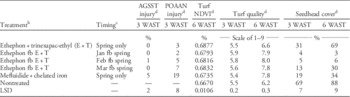
Influence of ethephon winter application timing preceding a normal spring, two-treatment ethephon plus trinexapac-ethyl program versus spring programs of ethephon plus trinexapac-ethyl or mefluidide plus chelated iron alone on creeping bentgrass (AGSST) and annual bluegrass (POAAN) injury, turf normalized difference vegetation index (NDVI), turf quality, and POAAN seedhead cover averaged over two trials conducted in 2012 at Blacksburg and Harrisonburg, VA.Footnote a

a Abbreviations: AGSST, Agrostis stolonifera (creeping bentgrass cultivar ‘Penncross’ overseeded in recent years with ‘L-93’) mowed at 3.0 to 3.4 mm; E+T, ethephon plus trinexapac-ethyl; fb, followed by; LSD, least significant difference (P<0.05); NDVI, normalized difference vegetation index; POAAN, Poa annua (annual bluegrass, predominately annual phenotype); WAST, wk after the first spring treatment (March 19, 2012) based on 50 growing degree days at a base temperature of 50 F (10 C).
b Chemical rates: Ethephon at 3,812 g ai ha−1, trinexapac-ethyl at 48 g ai ha−1, mefluidide at 70 g ai ha−1, and chelated iron at 920 g Fe ha−1.
c Application timings for spring-only treatments: March 19, 2012, fb April 9, 2012; Jan, January 29, 2012; Feb, February 16, 2012; Mar, and March 12, 2012.
d All data were assessed at 0, 3, and 6 wk after the first spring treatment and only significant effects are shown. Injury was a visually assessed percent reduction in apparent healthy tissue relative to the nontreated check, where 0 is no injury and 100 is complete loss of all green tissue. NDVI was assessed with a multispectral radiometer. Turf quality was visually assessed on a 1 to 9 scale, where 1 is apparent dead turf; 6 is minimally acceptable color, texture, and density; and 9 is optimal turf quality. Plant density and seedhead cover was assessed by line-intersect counts that included 516 intersects at 6-cm increments within the treated portion of each plot. Each intersect was scored as annual bluegrass without seedhead, annual bluegrass with seedhead, creeping bentgrass, or other, and seedhead cover indicates the percentage of annual bluegrass plants displaying seedheads.
Data were collected for creeping bentgrass and annual bluegrass injury, turf normalized difference vegetation index (NDVI), turf quality, creeping bentgrass and annual bluegrass density, and annual bluegrass seedhead cover at 0, 3, and 6 wk after the first spring treatment. Injury was a visually assessed percent reduction in healthy tissue relative to the nontreated check, on a scale where 0 is no injury and 100 is complete loss of all green tissue (Frans et al. Reference Frans, Talbert, Marx and Crowley1986). NDVI was assessed with a multispectral radiometer (Crop Circle™ Model ACS-210, Holland Scientific Inc., 6001 South 58th Street, Lincoln, NE 68516) mounted to a rolling cart. The device scanned 35 assessments along the center of each plot in a swath 0.5 m wide and 2.7 m long. Turf quality was visually assessed on a scale of 1 to 9, where 1 was dead turf; 6 was minimally acceptable color, texture, and density; and 9 was optimal turf quality. Plant density and seedhead cover were assessed by line-intersect counts that included 516 intersects at 6-cm increments within the treated portion of each plot. Each intersect was scored as annual bluegrass without seedhead, annual bluegrass with seedhead, creeping bentgrass, or other. Annual bluegrass seedhead cover assessments were based on the percentage of annual bluegrass plants that were displaying seedheads. Annual bluegrass and creeping bentgrass cover assessments were based on the percentage of plot area covered by each species as indicated by line intersection counts.
Injury data from the nontreated check were omitted from the analysis to stabilize variance. All data were tested for normality and homogeneity as previously described (Rana and Askew Reference Rana and Askew2016). When needed, data were log or arcsin square-root transformed to meet assumptions. In cases where transformation was needed, original data were used for presentation if mean rank and separation was not affected by transformation. All measured responses were subjected to a combined ANOVA using PROC GLM in SAS with the sum of squares partitioned to reflect the effects of block, trial, treatment, and the interaction of trial by treatment. Main effects and interactions were tested using mean square error associated with the trial by treatment interaction. Trial was considered a random effect (McIntosh Reference McIntosh1983). Appropriate means were separated using Fisher’s protected LSD at the 5% level of significance.
Programs with Early Plant Growth Regulator Application and DMI Fungicides
Three studies were conducted with randomized complete block designs and three replications at VT and TRC in 2011 and at SW8 in 2012. Plot sizes were 0.9 by 1.8 m at VT and SW8 and 1.8 by 1.8 m at TRC. A total of 14 treatments included four ethephon programs, five mefluidide programs, three methiozolin programs, and two comparisons (Table 2). For both ethephon and mefluidide programs, applications included a winter treatment of the plant growth regulator (PGR) alone, a winter treatment followed by a standard two-application spring treatment sequence of the PGR or appropriate tank mixture, a winter treatment followed by the spring treatment sequence and a DMI fungicide, and the standard spring treatment sequence alone. The winter treatments included only ethephon or mefluidide, while the spring treatment sequence included ethephon plus trinexapac-ethyl or mefluidide alone applied twice at a 3-wk interval. An additional program for mefluidide evaluated lower spring treatment rates in an attempt to reduce turf injury. Methiozolin was applied alone once in winter, once in spring, or in both winter and spring. The two comparison treatments included the DMI fungicide triademifon applied alone and a nontreated control.
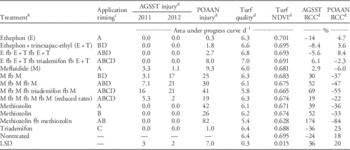
Influence of plant growth regulator and herbicide programs on creeping bentgrass (AGSST) and annual bluegrass (POAAN) injury, turf quality, turf normalized difference vegetation index (NDVI), and AGSST and POAAN relative cover change (RCC) from putting green and fairway trials conducted at Blacksburg, VA in 2011 and a putting green trial at Harrisonburg, VA in 2012.Footnote a

a Abbreviations: AGSST, Agrostis stolonifera (creeping bentgrass cultivar ‘Penncross’ overseeded in recent years with ‘L-93’), mowed at 3.0 to 3.4 mm on greens and 9 mm on the fairway; AUPC d−1, standardized daily area under the progress curve; E, ethephon; E+T, ethephon plus trinexapac-ethyl tank mixture; fb, followed by; GDD, growing degree day; LSD, least significant difference (P<0.05); M, mefluidide; POAAN, Poa annua (annual bluegrass, predominately annual phenotype); RCC, relative cover change.
b Chemical rates: Ethephon at 3,812 g ai ha−1, trinexapac-ethyl at 48 g ai ha−1, mefluidide at 70 g ai ha−1, methiozolin at 1120 g ai ha−1, and triademifon at 1582 g ai ha−1. The mefluidide reduced rate program consisted of 70 fb 18 fb 18 fb 35 g ai ha−1 at application timings A, B, C, and D, respectively.
c Treatments were applied relative to a growing degree day (GDD) threshold of 50 at a base temperature of 50 F (10 C). Application timings included A, February 21, 2011, and February 16, 2012, the winter treatment that was more than 1 month early; B, March 23, 2011, and March 19, 2012, the spring 50 GDD50 treatment; C, April 19, 2011, and March 31, 2012, DMI fungicide at 140 GDD50; and D, April 23, 2011, and April 19, 2012, 1 month after 50 GDD50 treatment.
d All data were assessed at the following times plus or minus 2 days: −31, 0, 11, 22, 32, 41, 52, and 72 d relative to application B. AGSST and POAAN injury were visually estimated percentages based on the reduction of perceived healthy tissue in treated plots compared to nontreated checks. Turf quality was visually assessed on a scale of 1 to 9, where 1 is dead turf, 6 is minimally acceptable turf quality, and 9 is dark green, uniform, optimal turf quality. NDVI was assessed with a multispectral radiometer. Observed injury, turf quality, and NDVI data over time where converted to the AUPC and divided by the 103-d duration of the study. RCC was based on line-intersect–assessed cover of each species at study initiation (application A) subtracted from cover of each species at study conclusion, 76 d after application B.
With the exception of the mefluidide reduced rate program, chemical rates included ethephon at 3,812 g ai ha−1, trinexapac-ethyl at 48 g ai ha−1, mefluidide at 70 g ai ha−1, methiozolin at 1,120 g ai ha−1, and triademifon at 1,582 g ai ha−1. The mefluidide reduced rate program consisted of 70 followed by (fb) 18 fb 18 fb 35 g ai ha−1 at application timings A, B, C, and D, respectively. Treatments were applied relative to a GDD threshold of 50 units at a base temperature of 50 F (10 C). Application timings included A, February 21, 2011, and February 16, 2012, referred to as the winter treatment more than one month early; B, March 23, 2011, and March 19, 2012, referred to as the spring 50 GDD50 treatment; C, April 19, 2011, and March 31, 2012, referred to as the DMI fungicide at 140 GDD50 treatment; and D, April 23, 2011, and April 19, 2012, referred to as the 1 month after 50 GDD50 treatment. Treatments at VT and SW8 were applied using a CO2-powered hooded sprayer calibrated as previously described for the ethephon timing study. At TRC, treatments were applied using a CO2-powered boom sprayer calibrated to deliver 280 L ha−1 spray solution at 262 kPa using four Turbo Teejet Induction 11004 flat-spray tips. The nozzles delivered a spray swath that covered the entire plot.
All data were assessed at the following times, plus or minus 2 days: −31, 0, 11, 22, 32, 41, 52, and 72 d relative to application B. Data were collected for injury, NDVI, and turf quality as previously described. NDVI data were collected on a 0.5 by 1.8 m swath in the center of each plot, with approximately 22 assessments per plot. Plant density and annual bluegrass seedhead cover was assessed by line-intersect counts as previously described on three of eight assessment dates including initial, peak seedhead production, and final assessment and by visual estimation on the remaining five assessment dates. Because of differences in plot size, line-intersect counts included 324 intersects per plot at VT and SW8 and 729 intersects per plot at TRC. To control for variable annual bluegrass populations between plots (Rana and Askew Reference Rana and Askew2016), relative cover change (RCC) was calculated for each treated plot as follows:
 $${\rm RCC}_{{\rm f}} {\equals}{\rm }\left[ {\left( {C_{f} -{\rm }C_{i} } \right)/C_{i} } \right]{\asterisk}{\rm 1}00$$
where RCCf is the relative cover change of a treated plot at the final assessment 72 d after application B, C f is the observed percent annual bluegrass cover from a given plot at the final assessment, and C i is the observed percent annual bluegrass cover from the same plot at the initial assessment (at application A).
Observed seedhead cover over time for all combinations of year, treatment, and replicate were subjected to the Gaussian function (Figure 1, Cox et al. Reference Cox, Rana, Brewer and Askew2017):
 $$y\,{\equals}\,ae^{{\minus({{(x{\minus}b)^{2} } \over {2c^{2} }})}} $$
where a is the maximum seedhead cover, b is the number of days after GDD-timed treatment at which maximum seedhead cover occurred, and c is one standard deviation from b. The parameter c can be multiplied by 6 to determine the number of days comprising 3 standard deviations, an approximation of the duration of seedhead infestation (Figure 1). To control for variance structure in repeated measures over time, creeping bentgrass and annual bluegrass injury, turf quality, and turf NDVI data were transformed to the daily area under the progress curve (AUPC) (Askew et al. Reference Askew, Goatley, Askew, Hensler and McKissack2013). The AUPC data transformation is often used for summary of data over longer time periods or where variability in measured responses is periodic (e.g., disease incidence) (Campbell and Madden Reference Campbell and Madden1990). The area under the resulting curves was calculated by the equation:
 $${\rm AUPC{\equals}}\mathop{\sum}\limits_{i{\equals}1}^{n_{i} {\minus}1} {{{(y_{i} {\plus}y_{{i{\plus}1}} )} \over 2}} \left( {t_{{i{\plus}1}} {\minus}t_{i} } \right)$$
where y i is response variable y at the ith observation, t i is days after initial application at the ith observation, and n is the number of observations. The resulting AUPC was then converted to AUPC d−1 by dividing AUPC by the total number of days spanned by assessments. Daily AUPC is more biologically relevant than AUPC, but the numbers should not be taken literally. For example, a turfgrass injury AUPC d−1 of 10 is equivalent to 10% injury for each day of the experiment but does not necessarily indicate that turfgrass injury followed such a static pattern. An irregular pattern where injury over time starts at 0%, increases to 30%, and diminishes back to 0% could also result in an AUPC d−1 of 10. Thus, AUPC d−1 is most reliable as a relative comparison between treatments that includes both persistence and magnitude of injury.
Illustration and description of estimated parameters (Table 3) of the Gaussian equation applied to percentage of annual bluegrass plants displaying seedheads over time on golf greens treated with ethephon plus trinexapac-ethyl twice in spring (Spring Only), treated with ethephon in February followed by ethephon plus trinexapac-ethyl twice in spring (Winter + Spring), or not treated (Nontreated).

Injury data from the nontreated check were omitted from the analysis and data were tested for normality and homogeneity of variance as previously described. Data for AUPC d−1, RCC, and estimated parameters a, b, and c from the Gaussian equation were subjected to ANOVA as previously described, with sums of squares partitioned to reflect replication, trial, treatment, and the interaction of trial by treatment. If trial interactions were detected, data were presented separately by trial, otherwise, data were pooled over trial. Appropriate means were separated using Fisher’s protected LSD at the 5% level of significance.
Results and Discussion
Timing of Winter Ethephon Applications
The effect of treatment on creeping bentgrass and annual bluegrass injury 3 wk after the initial spring treatment (WAST) was significant (P<0.0001) but trial interactions were insignificant (P>0.05). Creeping bentgrass was not significantly injured by any ethephon-containing program, but the mefluidide program injured creeping bentgrass 5% at 3 WAST (Table 1). Likewise, annual bluegrass was injured 19% by the mefluidide program, significantly more than it was injured by the ethephon programs (Table 1). Mefluidide has injured both annual bluegrass (Cooper et al. Reference Cooper, Karnok, Henderlong and Street1988; Danneberger et al. Reference Danneberger, Branham and Vargas1987) and creeping bentgrass (Haguewood et al. Reference Haguewood, Song, Smeda, Moss and Xiong2013) in previous research. The lack of creeping bentgrass injury from ethephon in our study is consistent with work by Haguewood et al. (Reference Haguewood, Song, Smeda, Moss and Xiong2013) but contrasts with work done by McCullough et al. (Reference McCullough, Liu and McCarty2005a; Reference McCullough, Liu and McCarty2005b) and Dernoeden and Pigati (Reference Dernoeden and Pigati2009). Our environment, and that of research conducted in Missouri (Haguewood et al. Reference Haguewood, Song, Smeda, Moss and Xiong2013), was considerably cooler than that of the McCullough et al. (Reference McCullough, Liu and McCarty2005b) study that reported creeping bentgrass injury following ethephon applications during mid to late May in South Carolina. Likewise, our creeping bentgrass was more mature than the 3-wk old creeping bentgrass seedlings injured by ethephon in other studies (McCullough et al. Reference McCullough, Liu and McCarty2005a). The study by Dernoeden and Pigati (Reference Dernoeden and Pigati2009) at College Park, Maryland, was located at approximately the same latitude as our study at SW13 and the Haguewood et al. (Reference Haguewood, Song, Smeda, Moss and Xiong2013) studies in Columbia, Missouri, but researchers in Maryland reported that ethephon caused creeping bentgrass scalping issues, a problem that did not occur in Virginia or Missouri. The ethephon treatments in the study by Dernoeden and Pigati (Reference Dernoeden and Pigati2009) were applied at least one month later than final treatments in the current study and the study by Haguewood et al. (Reference Haguewood, Song, Smeda, Moss and Xiong2013), despite similar growing degree day accumulation in all cases. The increased temperatures during and following May 7 ethephon treatments by Dernoeden and Pigati (Reference Dernoeden and Pigati2009) likely exacerbated the influence of ethephon on creeping bentgrass stem elongation and associated turf scalping. It has been demonstrated that ethephon in warm temperatures decreases creeping bentgrass quality and causes root loss (McCullough et al. Reference McCullough, Liu and McCarty2005a), and recent preliminary work suggests that ethephon may also interact with mechanical stress to increase root loss and associated injury caused by methiozolin (Askew Reference Askew2016). On in-play golf greens, ethephon-associated scalping has generally been limited to warmer climates (transition zone and further south), when ethephon is applied during or just before hot weather, and on greens with thatch layers greater than 1.5-cm (SD Askew, personal observation). Results of the current study suggest that annual bluegrass may be more injured by ethephon than creeping bentgrass, as was reported by Eggens et al. (Reference Eggens, Wright, Murr and Carey1989). Generally, ethephon caused yellow to orange discoloration of annual bluegrass foliage, especially during intermittent frost events in spring, and these symptoms led to the low levels of injury reported (Table 1).
The interaction of trial by treatment was insignificant for NDVI at 3 WAST (P=0.1881) and 6 WAST (P=0.9122). The effect of PGR treatment for NDVI was insignificant at 3 WAST (P=0.8738) but significant at 6 WAST (P<0.0001). The average NDVI at 3 WAST was 0.6202 (data not shown), which is considerably less than it was at 6 WAST (Table 1) due to core aeration and topdressing that occurred on both greens within 1 wk of the assessment. At 6 WAST, NDVI values for all ethephon treatments were higher than those for the nontreated check, presumably due to improved seedhead suppression with minimal or no turfgrass injury (Table 1). Haguewood et al. (Reference Haguewood, Song, Smeda, Moss and Xiong2013) also observed improved NDVI with ethephon programs versus nontreated controls at selected locations but not between various ethephon treatments that were applied alone or in mixture with trinexapac-ethyl.
Visually estimated turf quality exhibited significant treatment effects at 3 WAST (P=0.0245) and 6 WAST (P=0.0143) and no trial by treatment interaction (P>0.05). Although a few significant differences were noted at 3 WAST (Table 1), overall turf quality was below acceptable levels due to recent core aeration, and differences between treatments were small and likely influenced by seedhead suppression. At 6 WAST, trends became more evident and strongly mirrored trends in seedhead cover (Table 1). When spring-only programs of ethephon or mefluidide were applied, turf quality was 6.2 to 6.6 and at least 1.2 points lower than when winter treatments of ethephon at any timing were fb an ethephon spring treatment sequence. The idea that improved visual turf quality can result from reduced seedhead density is supported by some currently available peer-reviewed literature (Cooper et al. Reference Cooper, Karnok, Henderlong and Street1988; Haguewood et al. Reference Haguewood, Song, Smeda, Moss and Xiong2013). In older studies, PGRs that effectively reduced annual bluegrass seedheads often caused unacceptable turfgrass phytotoxicity (Watschke et al. Reference Watschke, Long and Duich1979), but proper rates of mefluidide were shown to improve turfgrass quality as a result of seedhead suppression once turfgrass recovered from initial discoloration (Cooper et al. Reference Cooper, Karnok, Henderlong and Street1988). Annual bluegrass seedhead suppression by spring ethephon programs on mixed creeping bentgrass and annual bluegrass greens led to improved turf quality based on spectral reflectance (Haguewood et al. Reference Haguewood, Song, Smeda, Moss and Xiong2013) and reference to unreported visually estimated data (Inguagiato et al. Reference Inguagiato, Murphy and Clark2010).
Trial interactions were insignificant for annual bluegrass seedhead cover at 3 and 6 WAST (P>0.05), while treatment effects were strongly significant (P<0.0001). At 3 WAST, 69% of annual bluegrass plants in nontreated plots contained seedheads, and these were reduced approximately half, to 31% seedhead cover, when only the spring treatment sequence of ethephon plus trinexapac-ethyl was applied (Table 1). When winter treatments were applied in January or February, annual bluegrass seedhead cover was 4% and 5% and reduced by 93% to 95% when compared to the nontreated check (Table 1). The mefluidide spring-only program had 19% annual bluegrass cover and represents a 72% reduction compared to the nontreated check (Table 1). At 6 WAST, trends were similar. Adding winter treatments in January or February resulted in annual bluegrass seedhead cover of 3% to 6%, which can be compared to 88% in the nontreated check and 69% in the ethephon spring-only program. Adding an early application in March improved annual bluegrass seedhead suppression less than January or February applications did (Table 1). These data demonstrate that winter ethephon treatments applied prior to a conventional GDD-timed spring treatment sequence substantially decrease seedhead cover versus using the conventional spring treatment sequence alone. These data represent the first report of improved seedhead suppression via winter ethephon applications on greens. Only one previous report could be found presenting preliminary data of seedhead suppression by ethephon treatments applied in advance of conventional spring treatments on greens (Bigelow and Hardebeck Reference Bigelow and Hardebeck2006). In this work, seedhead suppression was highly variable between treatments, possibly because spring treatments of ethephon were initiated on greens or fairways with 5.1% to 60.4% of annual bluegrass plants already displaying seedheads. In a few instances on the putting green site, however, programs that included ethephon applied on November 30 followed by applications on April 5 and April 26 suppressed annual bluegrass seedheads more than the two April treatments alone did (Bigelow and Hardebeck Reference Bigelow and Hardebeck2006). Fall ethephon treatment has also led to increased plant tillers and delayed spring floral initiation of Kentucky bluegrass (Buettner et al. Reference Buettner, Ensign and Boe1976). In another study, Cooper et al. (Reference Cooper, Karnok, Henderlong and Street1988) applied mefluidide in October or in April. The authors noted that fall treatment of mefluidide effectively controlled seedheads the following spring, but indicated annual bluegrass was mostly killed by the mefluidide rates evaluated which were 2 to 4 times higher than the highest rate used in the current study (Cooper et al. Reference Cooper, Karnok, Henderlong and Street1988).
Programs with Early PGR Application and DMI Fungicides
The trial by treatment interaction for creeping bentgrass injury was significant (P=0.0154). When data from SW8 in 2012 was removed from the analysis, creeping bentgrass injury had no significant trial interaction (P=0.0921). Therefore, data from the two sites in 2011 were pooled and presented separately from data collected at SW8 in 2012 (Table 2). Mefluidide was the only chemical to cause creeping bentgrass injury at all three locations. The reason for the year interaction is probably related to changes in mean rank and magnitude of creeping bentgrass injury AUPC d−1 each year (Table 2). These results are consistent with those of other studies where mefluidide has injured creeping bentgrass (Haguewood et al. Reference Haguewood, Song, Smeda, Moss and Xiong2013) and where ethephon (Haguewood et al. Reference Haguewood, Song, Smeda, Moss and Xiong2013; Inguagiato et al. Reference Inguagiato, Murphy and Clark2010) and methiozolin (Askew and McNulty Reference Askew and McNulty2014; Brosnan et al. Reference Brosnan, Henry, Breeden, Cooper and Serensits2013) did not injure creeping bentgrass.
Annual bluegrass injury AUPC d−1 had only a significant treatment main effect (P<0.0001), and data were pooled over the three locations. Ethephon programs injured annual bluegrass less than mefluidide or methiozolin programs did, with the exception of mefluidide applied once in winter (Table 2). Two treatments of methiozolin resulted in annual bluegrass injury AUPC d−1 of 82% and substantial population reduction (Table 2). Because of concerns over rapid annual bluegrass control on greens, winter treatment of methiozolin on greens will likely not be recommended in northern climates (S J Koo, personal communication). Addition of triademifon, a fungicide with PGR effects on turfgrass (Buchenauer and Rohner Reference Buchenauer and Röhner1981), did not significantly change creeping bentgrass or annual bluegrass response to a similar ethephon program without triademifon (Table 2). The addition of triademifon to a mefluidide program increased annual bluegrass injury and creeping bentgrass injury in one of two years (Table 2). These data are the first to evaluate the potential impact of early season dollar spot suppression programs with DMI fungicides in conjunction with seedhead suppression PGRs on turf response. In other studies, fungicides were chosen specifically to avoid any potential PGR effects on research sites where seedhead suppression chemicals were evaluated (Dernoeden and Pigati Reference Dernoeden and Pigati2009; Inguagiato et al. Reference Inguagiato, Murphy and Clark2010).
Both visually estimated turf quality and turf NDVI had significant treatment effects (P<0.01) but insignificant trial by treatment interactions (P>0.05). Generally, turf quality and NDVI AUPC d−1 were reduced in treatment programs that injured creeping bentgrass or annual bluegrass (Table 2). For example, NDVI and turf quality were lower in programs that included three treatments of mefluidide than they were in those that contained three treatments of ethephon (Table 2). The lowest NDVI AUPC d−1 was observed when methiozolin was applied twice; this treatment caused severe injury to annual bluegrass although creeping bentgrass was not injured. Turf quality appeared to be more impacted by annual bluegrass seedheads than NDVI. For example, ethephon applied once in winter suppressed seedheads less than other ethephon programs did (Table 3) and had lower turf quality but equivalent NDVI to other ethephon programs (Table 2).
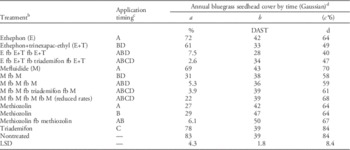
Influence of plant growth regulator and herbicide programs on visually estimated percentage of annual bluegrass displaying seedheads over time, explained by the Gaussian function, where a is maximum seedhead cover, b is time in days after the first spring treatment at which maximum seedhead cover occurred, and c is one standard deviation from b, and c*6 estimates the duration of seedhead infestation in days (Figure 1). Data from putting green and fairway trials conducted at Blacksburg, VA in 2011 and putting green trials conducted in Harrisonburg, VA in 2012 are averaged due to insignificant trial by treatment interaction.Footnote a

a Abbreviations: DAST, d after spring treatment at 50 GDD50; E, ethephon; E+T, ethephon plus trinexapac-ethyl tank mixture; fb, followed by; GDD, growing degree day; LSD, least significant difference (P<0.05); M, mefluidide.
b Chemical rates: Ethephon at 3,812 g ai ha−1, trinexapac-ethyl at 48 g ai ha−1, mefluidide at 70 g ai ha−1, methiozolin at 1120 g ai ha−1, and triademifon at 1,582 g ai ha−1. The mefluidide reduced rate program consisted of 70 fb 18 fb 18 fb 35 g ai ha−1 at application timings 1, 2, 3, and 4, respectively.
c Treatments were applied relative to a growing degree day (GDD) threshold of 50 at a base temperature of 50 F (10 C). Application timings included A, February 21, 2011, and February 16, 2012, winter treatment that was more than 1 month early; B, March 23, 2011, and March 19, 2012, spring 50 GDD50 treatment; C, April 19, 2011, and March 31, 2012, DMI fungicide at 140 GDD50 treatment; and D, April 23, 2011, and April 19, 2012, 1 month after 50 GDD50 treatment.
d
Percentage of annual bluegrass covered with seedheads in a mixed annual bluegrass and creeping bentgrass turf was visually estimated at the following times plus or minus 2 days: −31, 0, 11, 22, 32, 41, 52, and 72 d relative to application B. Observed data over time for all combinations of year, treatment, and replicate were subjected to the Gaussian function:
 $y\,{\equals}\,ae^{{{\minus}({{(x{\minus}b)^{2} } \over {2c^{2} }})}}$
, where a is maximum seedhead cover, b is the number of d after GDD-timed treatment at which maximum seedhead cover occurred, and c is one standard deviation from b. The parameter c can be multiplied by 6 to approximate duration of seedhead infestation (see Figure 1).
Creeping bentgrass and annual bluegrass RCC had only significant treatment main effects (P<0.02), and data were pooled over the three trial locations. Over the trial duration, nontreated turf expanded the annual bluegrass population by 18% and decreased the creeping bentgrass population by 24% (Table 2). These changes were equivalent to those of triademifon alone and all ethephon programs except the ethephon program that included triademifon, which had a slight decrease in annual bluegrass population (Table 2). It is normal for annual bluegrass populations to expand in spring (Askew and McNulty Reference Askew and McNulty2014; Lycan and Hart Reference Lycan and Hart2006), as occurred in the current study (Table 2). The expansion of creeping bentgrass and loss of annual bluegrass in all multiple-application mefluidide programs and methiozolin programs (Table 2) are likely due to annual bluegrass injury by these chemicals (Table 2).
Based on parameter estimates of equation 3 (Figure 1), maximum seedhead cover (a), timing of seedhead cover maxima (b), and duration of seedhead infestation (c multiplied by 6) were averaged over trials due to insignificant trial by treatment interactions for each parameter (P>0.05). The treatment main effects were significant (P<0.0001) in all cases. Maximum seedhead cover in nontreated turf and turf treated once with triademifon, ethephon, or mefluidide was 69% to 83% and at least twice that of any other treatment (Table 3). When winter treatments of ethephon or mefluidide were added to the conventional two-treatment sequence in spring, maximum seedhead cover was 6 times lower in both cases (Table 3). The addition of triademifon to a three-application ethephon program also substantially decreased maximum seedhead cover, but the same was not true when triademifon was added to a similar mefluidide program (Table 3).
The days to seedhead cover maxima, parameter b, ranged from 33 to 50. Mefluidide- and methiozolin-treated plots generally required more days to reach seedhead cover maxima than ethephon treated plots did (Table 3). This delay in reaching seedhead cover maxima could have been because of annual bluegrass injury caused by these treatments (Table 2). The total duration of seedhead infestation was estimated by multiplying parameter c in equation 3 by 6, which accounts for 6 standard deviations of parameter b and approximately the total duration of seedhead cover (Pukelsheim Reference Pukelsheim1994). The duration of seedhead infestation ranged from 35 to 84 d, with the nontreated check and triademifon treatments having the highest and the three-application ethephon programs having among the lowest (Table 3). These data suggest that better-performing PGR programs don’t eradicate seedheads but rather keep them at a lower and more tolerable level throughout the season.
The levels of seedhead cover following spring, two-treatment programs of ethephon plus trinexapac-ethyl compared to associated nontreated checks in these experiments represent 22% to 55% seedhead cover reduction (Tables 1 and 3) and are similar to seedhead reduction levels reported by others using the same spring treatment program (Haguewood et al. Reference Haguewood, Song, Smeda, Moss and Xiong2013; Inguagiato et al. Reference Inguagiato, Murphy and Clark2010). Applying an early application of ethephon in January or February prior to the spring treatment program resulted in 5 to 7 times less seedhead cover at cover maxima than the spring treatment program alone did (Tables 1 and 3). Ethephon safety to putting greens when used during cool weather, as traditionally recommended, has been demonstrated by the current study and other recent studies (Haguewood et al. Reference Haguewood, Song, Smeda, Moss and Xiong2013; Inguagiato et al. Reference Inguagiato, Murphy and Clark2010). Addition of both an early application of ethephon and a DMI fungicide known to impart PGR effects on turfgrass to the traditional ethephon spring program had a slight but significant effect on both annual bluegrass injury and seedhead suppression but not on creeping bentgrass injury. Overall, turfgrass quality was among the highest in these two treatments due to minimal turf injury and excellent seedhead suppression. The reduction in annual bluegrass seedhead cover by methiozolin was generally less than that achieved by three treatments of ethephon or mefluidide. Methiozolin suppressed annual bluegrass seedheads primarily through severe injury to annual bluegrass, which led to a decline in turfgrass quality and turf NDVI but substantial increase in creeping bentgrass cover. This technique of applying winter applications of PGRs on greens is novel and may substantially improve consistency and performance of ethephon for annual bluegrass seedhead suppression.
Acknowledgments
The author would like to thank Kip Fitzgerald, Jeff Miller, and staff at Spotswood Country Club and Jason Ratcliff at the Virginia Tech Golf Course for allowing use of the facility and technical support. Gratitude is also extended to Adam Smith, Angela Post, Kate Venner, Michael Cox, and Sandeep Rana for technical support.