Introduction
Solena amplexicaulis (Lam.) Gandhi (syn: Melothria heterophylla) (Cucurbitaceae), commonly known as creeping cucumber, is cultivated for production of fruits, although the young leaves are also consumed as a vegetable in India, Sri Lanka, China and Taiwan (Parameshwar et al., Reference Parameshwar, Narsimha Reddy, Ravi Kumar and Krishna Mohan2010). The tubers, leaves and seeds of this plant have been found to serve as a potential source of natural medicines to treat hepatosplenomegaly, spermatorrhoea, haemorrhoids, appetite loss, and for use as a diuretic (Warriar et al., Reference Warriar, Nambiar and Ramankutty1993; Karthika and Paulsamy, Reference Karthika and Paulsamy2014). Moreover, the whole plant is a source of antioxidants, and has potential for the treatment of diabetes; as well, it has some other pharmacological activities such as bactericidal, antihepatotoxicity and anti-inflammatory (Parameshwar et al., Reference Parameshwar, Narsimha Reddy, Ravi Kumar and Krishna Mohan2010; Venkateshwarlu et al., Reference Venkateshwarlu, Raghuram Reddy, Goverdhan, Swapna Rani and Jayapal Reddy2011; Karthika and Paulsamy, Reference Karthika and Paulsamy2012; Karthika et al., Reference Karthika, Paulsamy and Jamuna2012). Aulacophora foveicollis Lucas (Coleoptera: Chrysomelidae), a generalist herbivore, is widely distributed in South-East Asia, and together with S. amplexicaulis, feeds on leaves and flowers of pumpkin, bottle gourd, sponge gourd and gac fruit (Singh and Gill, Reference Singh and Gill1979; Rahaman and Prodhan, Reference Rahaman and Prodhan2007; Khan et al., Reference Khan, Alam and Rahaman2011). The larvae of A. foveicollis feed on young roots through four instars to complete larval development within 12–13 days in the soil, and adults voraciously consume leaves and flowers for 8–9 weeks until death (Singh and Gill, Reference Singh and Gill1979). Heavy infestation causes death of branches and shoots of S. amplexicaulis plants, which reduces crop production (Singh and Gill, Reference Singh and Gill1979). Insecticides (such as pyrethroids and organophosphates) are used to control the insect (Sinha and Chakrabarti, Reference Sinha and Chakrabarti1983); however, they have the capacity to negatively impact nontarget organisms, including humans; thus, it is necessary to develop alternate control strategies such as baited traps for inclusion in integrated pest management (IPM) schemes for this pest.
The epicuticular wax of every plant consists of alkanes, alkyl esters, fatty acids, and primary and secondary alcohols (Baker, Reference Baker, Cutler, Alvin and Price1982; Jetter et al., Reference Jetter, Schaffer and Riederer2000). Long-chain alkanes and fatty acids, major components of epicuticular waxes, play an important role as short-range volatile cues for herbivorous insects to find hosts in their microhabitat (Schoonhoven et al., Reference Schoonhoven, Van Loon and Dicke2005; Rostảs and Wölfling, Reference Rostás and Wölfling2009; Sarkar and Barik, Reference Sarkar and Barik2014, Reference Sarkar and Barik2015; Malik and Barik, Reference Malik and Barik2015). Schiestl et al. (Reference Schiestl, Ayasse, Paulus, Lofstedt, Hansson, Ibarra and Francke1999) demonstrated that long-chain n-alkanes from labellum extracts of an orchid flower, Ophrys sphegodes Miller, could attract the solitary bee, Andrena nigroaenea (Kirby). Individual synthetic lauric, palmitic, stearic and oleic acids, and their blend, such as the clover root extract, attracted the female clover root borer Hylastinus obscurus Marsham in an olfactometric bioassay (Manosalva et al., Reference Manosalva, Pardo, Perich, Mutis, Parra, Ortega, Isaacs and Quiroz2011). A synthetic blend of hydrocarbons and fatty acids mimicking Momordica charantia L. flower surface extracts was found to be attractive to the epilachna beetle, Epilachna dodecastigma (Wied.) (Sarkar and Barik, Reference Sarkar and Barik2014; Reference Sarkar and Barik2015). Long-chain fatty acids (such as palmitic, oleic and linoleic acids, alone or blended with crude almond oil) showed attraction of navel orangeworm Amyelois transitella Walker in wind tunnel bioassays (Youngman and Baker, Reference Youngman and Baker1989). However, to date, no studies have established whether alkanes and free fatty acids present in the epicuticular waxes of S. amplexicaulis flowers can provide clues to attract A. foveicollis. It is of considerable interest to study the n-alkane and free fatty acid profile in S. amplexicaulis flowers, and see if they play any role in host recognition by the insect pest, A. foveicollis. Here, we report n-alkane and free fatty acid profile in S. amplexicaulis flowers and role of these as attractants to A. foveicollis. We also studied the role of individual synthetic n-alkanes and fatty acids mimicking the epicuticular waxes of S. amplexicaulis flowers followed by a combination of synthetic alkanes and fatty acids that elicited response of insects as an olfactory cue for A. foveicollis.
Materials and methods
Plant materials
Solena amplexicaulis seeds were germinated on moist filter paper and each seed with cotyledon was planted in a pot (2000 cm3) containing 1500 cm3 of soil [organic matter 5.3 ± 0.2 % (± Standard Error), pH 7.7] and placed in the field of the Crop Research Farm (CRF), The University of Burdwan (23°16′ N, 87°54′ E), West Bengal, India. Seedlings were grown in natural condition during May–September 2014 under a photoperiod of 13L: 11D at 30–35 °C and relative humidity (RH) 80–90 %. Seedlings were provided with water on alternate days. One hundred and fifty grams of flowers were collected at a time from 50 S. amplexicaulis plants at six weeks old. One hundred fifty grams of flowers were separately collected on three occasions (dates of 1st, 2nd and 3rd collections were 18th June, 4th August and 22nd September, respectively).
Insects
Aulacophora foveicollis insects were collected by light trap from bottle gourd [Lagenaria siceraria (Molina) Standl.] plants growing in the CRF, and maintained in 1-litre glass jars, containing bottle gourd leaves covered with fine-mesh nylon nets at 27 ± 1 °C temperature, 65 ± 10 % RH and 12 h:12 h light:dark photoperiod in a ‘BOD’ incubator (ADS Instruments and Tech., Calcutta, India). To maintain natural condition of leaves, a moist piece of cotton was placed around cut ends of bottle gourd leaves, then wrapped with aluminium foil to prevent moisture loss. Fresh leaves were given to the insects daily.
Extraction of flower surface waxes
Fresh flowers (approximately 500 flowers; total weight 150 g) were dipped in 3 litres of n-hexane for 30 s at room temperature to extract surface waxes, which yielded a straw coloured substance without trace of chlorophyll (Sarkar et al., Reference Sarkar, Mukherjee and Barik2013a; Reference Sarkar and Barik2014; Sarkar and Barik, Reference Sarkar and Barik2014). Total crude extract was passed through Whatman No. 41 filter paper (Maidstone, UK), and the solvent evaporated at room temperature (27 °C) to obtain dried crude extract. Three crude extracts were collected separately from three batches of 150 g flowers. Yields of dried extracts were 88.0, 84.3 and 92.2 mg, respectively. Each dried crude extract was dissolved in 30 ml n-hexane and divided into three equal fractions (each equivalent to 50 g of flowers), which were used, respectively for: (i) olfactory bioassay, (ii) identifying and quantifying the alkanes and (iii) identifying and quantifying the free fatty acids.
Identification and quantification of alkanes
The second portion of each crude extract was passed through a column of F-20 grade aluminium oxide (Alcoa, Frankfurt, Germany) and eluted with petroleum ether. The eluent was fractioned by thin layer chromatography (TLC) on silica gel G (Sigma St. Louis, MO, USA) layers (thickness 0.5 mm), which had been prepared using a Unoplan coating apparatus (Shandon, London), with carbon tetrachloride as the mobile phase. A faint yellowish band appeared on the TLC plate, and the plate was air-dried under laboratory conditions. The plate was then placed in an iodine chamber for 1 min, which produced a deep yellowish band with R f (Retardation factor) value of 0.86. The R f value (0.86) was compared with the R f value of a mixture of synthetic alkanes between n-C15 and n-C34. The single hydrocarbon band produced in each TLC plate was eluted from the silica gel layer with chloroform, which showed no absorption of detectable functional groups by infrared (IR) spectroscopy. The purified alkane samples were used for gas chromatography-mass spectrometry (GC-MS) and gas chromatography-flame ionization detector (GC-FID) for identification and quantification, respectively. One portion of each sample was used for identification by GC-MS and the remainder for quantification of alkane compounds by GC-FID. All solvents used were of GR grade and purchased from E. Merck, India Pvt. Ltd.
For identification of alkane compounds, extracts were analysed with an Agilent 6890 GC coupled to a 5973 Mass Selective Detector using an HP-5 column (Agilent, USA; column length 30 m × 0.25 mm × 0.25 μm film thickness). The oven temperature programme was initially 170 °C held for 1 min, then raised at 4 °C/min to 300 °C and finally held for 15 min (Sarkar et al., Reference Sarkar, Mukherjee and Barik2013a; Sarkar and Barik, Reference Sarkar and Barik2014). The volume of the sample injected was 1 µl and the carrier gas was helium at a column flow rate of 1.4 ml/min. The MS parameters were 280 °C at the interface, ionization energy 70 eV, scan speed approximately 1 s, and scanned over the mass range 40–600 mass units. Identifications were made by comparison of mass spectra with library databases and also confirmed from spectra by injection of mixture of synthetic n-alkanes (n-C15 to n-C34) including retention time with those of authentic standards.
For quantification of compounds, three separate extracts were analysed by a Techcomp GC model 7900 (Em Macau, Rua De Pequim, Nos. 202A-246, Centro Financeiro F7, Hong Kong) fitted with an HP-5 capillary column (Agilent, USA; column length 30 m × 0.25 mm × 0.25 μm film thickness) and a flame ionization detector, which was run under same temperature conditions as in GC-MS analysis. The carrier gas was nitrogen with a flow rate of 18.5 ml/min. The volume of the sample injected was 1 µl with a split ratio of 1:10. The peaks were identified by comparison of their retention times with those of standard n-alkanes from n-C15 through n-C34, and the area of each peak was converted into quantities of n-alkanes based on internal standard heneicosane (n-C21 at 1 µg/µl). All n-alkanes (>99 % purity) between n-C15 and n-C34 were purchased from Sigma Aldrich.
Identification and quantification of free fatty acids
The third portion of each crude extract was mixed with diethyl ether and filtered through Whatman No. 41 filter paper. The extract was purified by TLC on silica gel G layers (thickness 0.5 mm), which had been prepared using a Unoplan coating apparatus (Shandon, London), with n-butanol: acetic acid: water (4:1:5; this mixture was shaken and water was separated from this mixture by a separating funnel and discarded) as the mobile phase. The band was eluted from the silica gel layer with diethyl ether, and diethyl ether was removed under reduced pressure to get purified free fatty acids. The purified free fatty acids were esterified with 3 ml BF3-Methanol followed by warming for 5 min in a hot water bath at 50–60 °C temperature, and cooled (Morrison and Smith, Reference Morrison and Smith1964). Hexane (30 ml) was added to this mixture followed by washing with saturated NaCl twice in a separating funnel. The aqueous layer of each sample was discarded and the hexane fraction passed through 50 g anhydrous Na2SO4 twice. One portion of each esterified sample (hexane fraction) was used for GC-MS and another for GC-FID. The extraction of free fatty acids from each crude extract was separately repeated thrice followed by esterification.
One portion of the esterified fatty acids was analysed with an Agilent 6890 GC coupled to a 5973 Mass Selective Detector with an HP-5 column (Agilent, USA; column length 30 m × 0.25 mm × 0.25 μm film thickness). The oven temperature programme was initially held at 160 °C for 2 min, then raised at the rate of 3 °C/min to 220 °C and finally held at 220 °C for 18 min (Malik and Barik, Reference Malik and Barik2015; Sarkar and Barik, Reference Sarkar and Barik2015). The carrier gas was helium at a column flow rate of 1.4 ml/min. The MS temperature parameter was 180 °C at the interface, ionization energy 70 eV, scan speed approximately 1 s, and scanned over the mass range 40–600 mass units. The fatty acid compounds were identified by comparison of mass spectra library data and also confirmed from spectra by injection of mixture of synthetic standard esterified fatty acids [methyl decanoate (C10:0), methyl undecanoate (C11:0), methyl laurate (C12:0), methyl tridecanoate (C13:0), methyl myristate (C14:0), methyl pentadecanoate (C15:0), methyl palmitate (C16:0), methyl heptadecanoate (C17:0), methyl stearate (C18:0), methyl oleate (C18:1), methyl linoleate (C18:2), methyl α-linolenate (C18:3), methyl nonadecanoate (C19:0), methyl arachidate (C20:0), methyl heneicosanoate (C21:0) and methyl docosanoate (C22:0)]. All standard esterified fatty acids (fatty acid methyl esters) were purchased from Sigma-Aldrich, Germany.
The remaining portion of the esterified fatty acids (three separate samples from flowers) were analysed using a Techcomp Gas Chromatograph model 7900 fitted with an HP-5 capillary column (Agilent, USA; length: 30 m × 0.25 mm × 0.25 μm film thickness) and a flame ionization detector, which was run under same temperature conditions as described for GC-MS analysis. The injector port temperature was 280 °C. The carrier gas was nitrogen with a flow rate of 20 ml/min (Malik and Barik, Reference Malik and Barik2015; Sarkar and Barik, Reference Sarkar and Barik2015). The volume of the sample injected was 1 µl with a split ratio of 1:10. The peaks were identified by comparison of their retention times with those of standard esterified fatty acids. The percentage composition of free fatty acids was computed from the GC peak area and the area of each peak converted into quantities of fatty acids based on reference standard methyl tricosanoate (C23:0 at 1 µg/µl). All solvents used were of analytical grade and purchased from E. Merck (Mumbai, India).
Olfactometer bioassays
Aulacophora foveicollis males or females of 3–4 weeks old were provisioned with water and starved for 10 h prior to use in olfactory bioassays. The behavioural responses of A. foveicollis were investigated in a Y-shaped glass tube olfactometer (7 cm stem and arms, 0.6 cm radius, 45 ° Y angle). The stem of the olfactometer was connected to a porous glass vial (1 cm radius × 3 cm long) in which test insects were released. Each arm of the olfactometer was connected to a glass-made micro kit adapter fitted into a glass vial (1 cm radius × 3 cm long). One glass vial contained a piece (2 × 2 cm2) of Whatman No. 41 filter paper moistened with 1 ml of volatiles, while the other glass vial contained a filter paper of same size moistened with 1 ml of the control solvent (petroleum ether). Each membrane pump producing an air-flow of 450 ml/min and the flow of purified air was adjusted to 150 ml/min with a calibrated soap-bubble air flow meter and stopwatch. Charcoal-filtered air (each arm of the olfactometer at 150 ml/min) was delivered through silicon tubes (12 cm long and 0.6 cm radius) that are attached with a glass-made micro kit adapter fitted into a glass vial (1 cm radius × 3 cm long). All the connections between different parts of the set-up consisted of silicon tubing.
The effectiveness of volatiles as attractant was evaluated in the following manner in the laboratory at 27 ± 1 ºC, 70 ± 3 % RH, and light intensity 150 lux. Sample (1 ml) and the control solvent were applied to the filter paper pieces and allowed to evaporate the solvent in open space under laboratory condition, and these filter papers were introduced into the glass vials before the first insect was released into the olfactometer, for each experiment. One adult female A. foveicollis was introduced into the porous glass vial which was then attached with the stem of the olfactometer and exposed to a particular odour, consisting of 1 ml of the control solvent (petroleum ether) in one glass vial, and 1 ml of one of the different odours (flower surface waxes, individual synthetic alkanes and fatty acids, blends of synthetic alkanes and fatty acids compounds) in another glass vial. This insect was not attracted by the control solvent (petroleum ether) in preliminary assays. The behaviour of each female was observed for 2 min such as wandering in the Y-tube. An insect was considered to have made a choice by reaching the end of one arm. The insect was then removed from the Y-tube, and the choice of the insect recorded. In contrast, an insect was considered not having made a choice within 2 min, i.e. ‘non-responding’, if it remained in the main arm of the Y-tube until the end of the observation period (Magalhães et al., Reference Magalhães, Borges, Laumann, Sujii, Mayon, Caulfield, Midega, Khan, Pickett, Birkett and Blassioli-Moraes2012; Adhikary et al., Reference Adhikary, Mukherjee and Barik2014; Sarkar et al., Reference Sarkar, Mukherjee and Barik2015). Each experiment with one volatile sample was conducted until a total of 90 insects had responded (each insect was used once throughout olfactory bioassays); and after testing five insects the olfactometer set-up was cleaned with petroleum ether followed by acetone, and the position of the two arms systematically changed to avoid positional bias.
Dual choice bioassays with A. foveicollis
-
(1) Surface waxes from flowers tested against control solvent.
Epicuticular waxes (2 mg) from flowers were dissolved in 20 ml petroleum ether at four concentrations (2, 4, 6 and 8 μg/ml) for olfactory bioassays. The concentrations were chosen by preliminary olfactometer trials, where it was found that the insect did not produce any response below 2 μg/ml concentration. Responses of male or female A. foveicollis to different concentrations of flower surface waxes (2, 4, 6 and 8 μg/ml) were tested against control solvent (petroleum ether).
-
(2) Individual synthetic compounds or synthetic blends of compounds (equivalent to the proportions of surface wax compounds of flowers) tested against control solvent.
The standard synthetic fatty acids [decanoic (C10:0), undecanoic (C11:0), lauric (C12:0), tridecanoic (C13:0), myristic (C14:0), pentadecanoic (C15:0), palmitic (C16:0), heptadecanoic (C17:0), stearic (C18:0), oleic (C18:1), linoleic (C18:2), alpha-linolenic (C18:3), nonadecanoic (C19:0), arachidic acid (C20:0), heneicosanoic acid (C21:0) and docosanoic acid (C22:0)], that were identified in natural flowers, were all purchased from Sigma Aldrich, Germany.
The individual synthetic compounds, equivalent to the amounts present in 2, 4, 6 and 8 µg flower surface waxes (Table S1A and S1B) were separately dissolved in l ml petroleum ether and were tested against 1 ml control solvent to find a response in the insect. The individual synthetic compounds that produced a response in the insect were combined to be equivalent to the proportions and combinations of 4, 6 and 8 µg flower surface waxes, and were also assayed against control solvent: 0.31 µg heptacosane was dissolved in 1 ml petroleum ether (equivalent to 2 µg surface waxes); or 0.35 µg pentadecane + 0.62 µg heptacosane + 0.38 µg nonacosane (equivalent to 4 µg surface waxes); or 0.53 µg pentadecane + 0.92 µg heptacosane + 0.58 µg nonacosane (equivalent to 6 µg surface waxes); or 0.70 µg pentadecane + 1.23 µg heptacosane + 0.77 µg nonacosane + 0.84 µg undecanoic acid + 0.94 µg lauric acid + 0.74 µg nonadecanoic acid were dissolved in 1 ml petroleum ether (equivalent to 8 µg epicuticular waxes).
-
(3) 8 µg flower surface waxes (most attractive stimulus) vs. individual synthetic compounds or synthetic blend of compounds.
Responses of female A. foveicollis to 8 µg surface waxes extracted from flowers were compared with individual compounds or combination of six synthetic compounds (equivalent to the proportions of 8 µg flower surface waxes).
-
(4) Dose response of synthetic volatile compounds against control solvent.
Six individual compounds that displayed responses to the insect were also tested at different doses (pentadecane or heptacosane: 0.35, 0.70 and 1.40 µg were separately dissolved in 1 ml petroleum ether, respectively; nonacosane: 0.30, 0.60, 1.20 and 2.40 µg were separately dissolved in 1 ml petroleum ether, respectively; undecanoic acid: 0.80, 1.60, 3.20 and 6.40 µg were separately dissolved in 1 ml petroleum ether, respectively; lauric acid: 0.90, 1.80 and 3.60 µg were separately dissolved in 1 ml petroleum ether, respectively; nonadecanoic acid: 0.70, 1.40 and 2.80 µg were separately dissolved in 1 ml petroleum ether, respectively).
Statistical analyses
The data obtained on responses of A. foveicollis to surface waxes, individual compounds and combination of synthetic compounds were analysed based on the null hypothesis whether the ratio of beetles differed significantly from 1:1, i.e. chi-square goodness-of-fit analysis by using Minitab software (Sarkar et al., Reference Sarkar, Mukherjee and Barik2015). Insects that did not respond by selection of either arm of the olfactometer were excluded from the analyses (Bahlai et al., Reference Bahlai, Welsman, Macleod, Schaafsma, Hallett and Sears2008; Addesso et al., Reference Addesso, McAuslane and Alborn2011; Megalhães et al., Reference Magalhães, Borges, Laumann, Sujii, Mayon, Caulfield, Midega, Khan, Pickett, Birkett and Blassioli-Moraes2012; Adhikary et al., Reference Adhikary, Mukherjee and Barik2014; Silk et al., Reference Silk, Ryall, Mayo, MaGee, Leclair, Fidgen, Lavallee, Price and McConaghy2015).
Results
Surface waxes from flowers
The n-hexane extracts of 50 g S. amplexicaulis flowers yielded 29.6 ± 1.02 mg surface waxes. Within the surface waxes, the total amounts of alkanes and free fatty acids were 17.9 ± 0.3 mg and 3.1 ± 0.1 mg, respectively, with the balance consisting of unidentified surface wax compounds.
Alkanes in flower surface waxes
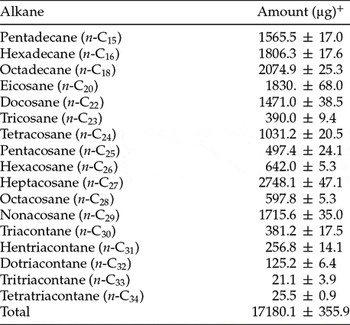
The identified hydrocarbons of the flowers represented 17.1 ± 0.3 mg n-alkanes with the balance consisting of unidentified branched-chain alkanes (Table 1). Seventeen n-alkanes were identified between n-C15 and n-C34 alkanes. Heptacosane (n-C27) was the predominant followed by octadecane (n-C18), accounting for 2748.1 ± 47.1 and 2074.9 ± 25.3 µg, respectively. Tritriacontane (n-C33) was detected in the lowest amount (21.1 ± 3.9 µg). Heptadecane (n-C17), nonadecane (n-C19) and heneicosane (n-C21) were absent. The remaining alkanes were present in varying quantities in the flower surface waxes.
Alkane composition in 50 g of Solena amplexicaulis flowers

+Mean ± SE of three measurements.
Free fatty acids in flower surface waxes
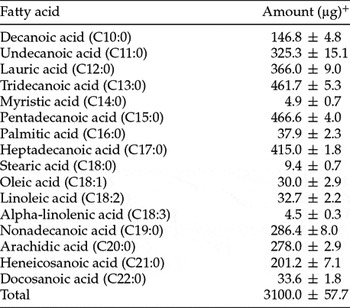
Sixteen free fatty acids between C10:0 and C22:0 fatty acids were detected in S. amplexicaulis flowers (Table 2). Pentadecanoic acid (C15:0) was the predominant followed by tridecanoic acid (C13:0), accounting for 466.6 ± 4.0 and 461.7 ± 5.3 µg, respectively; whereas, alpha-linolenic acid (C18:3) was the least abundant (4.5 ± 0.3 µg). The remaining fatty acids were present in varying quantities.
Free fatty acid composition in 50 g of Solena amplexicaulis flowers

+Mean ± SE of three measurements.
Dual choice bioassays with A. foveicollis
-
(1) Surface waxes from flowers tested against control solvent.
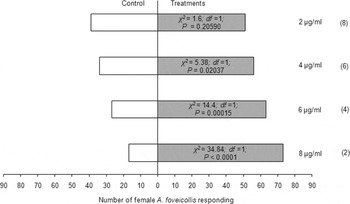
Aulocophora foveicollis females displayed attraction to flower surface waxes at 4 μg/ml (χ 2= 5.38, df = 1; P = 0.02037), 6 μg/ml (χ 2= 14.4, df = 1, P = 0.00015) and 8 μg/ml (χ 2= 34.84, df = 1, P < 0.0001), but no clear responses was observed at 2 μg/ml (χ 2= 1.6, df = 1, P = 0.20590) (Fig. 1). Adult males showed attraction at 4 μg/ml (χ 2= 5.38, df = 1, P = 0.02037), 6 μg/ml (χ 2= 14.4, df = 1, P = 0.00015) and 8 μg/ml (χ 2= 32.4, df = 1, P < 0.0001), but no clear positive or negative responses was observed at 2 μg/ml (χ 2= 1.11, df = 1, P = 0.29184). These bioassay results implied that the olfactory responses of males or females to flower surface waxes odour were similar. Therefore, the subsequent bioassays were done with females only, as olfactory cues guide females for both adult feeding and location of suitable larval hosts.
-
(2) Individual synthetic compounds or synthetic blends of compounds (equivalent to the proportions of flower surface waxes) tested against control solvent.
Female Aulacophora foveicollis responses to the surface waxes of Solena amplexicaulis flowers compared to solvent control (petroleum ether) in a Y-tube olfactometer bioassay. Numbers in brackets are the number of insects that did not respond to either treatment.

A. foveicollis produced responses to 1, 3, 3 and 6 individual components present in 2, 4, 6 and 8 µg flower surface waxes, respectively; whereas, the remaining identified compounds of flower surface waxes did not provoke any response to the test insect.
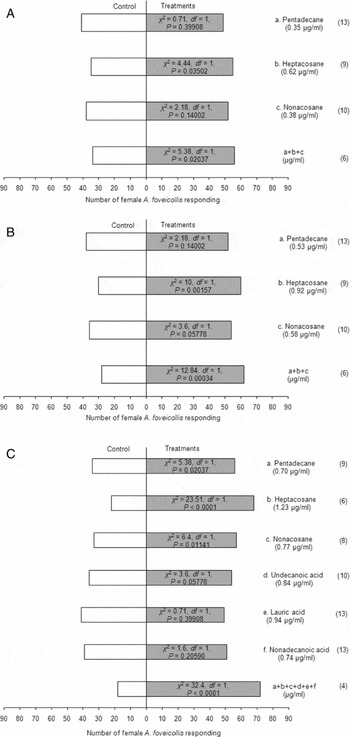
The insect did not show any clear positive or negative responses to n-C27 (χ 2 = 0.71, df = 1, P = 0.39908) at the proportions equivalent to 2 µg flowers surface waxes when compared to a solvent control, and the insect did not show any responses to the individual synthetic compounds at the proportions equivalent to 2 µg flower surface waxes. The insect did not specify any clear positive or negative responses to n-C15 (χ 2 = 0.71, df = 1, P = 0.39908) and n-C29 (χ 2 = 2.18, df = 1, P = 0.14002) while the insect showed attraction to n-C27 (χ 2 = 4.44, df = 1, P = 0.03502) at the proportion equivalent to 4 µg flower surface waxes when compared to a solvent control (Fig. 2A). The insect did not show any response to the rest of the individual compounds at the proportions equivalent to 4 µg flower surface waxes. The insects were attracted to a synthetic blend of three synthetic components equivalent to the proportions of three components present at 4 µg flower surface waxes when compared to a solvent control (χ 2 = 5.38, df = 1, P = 0.02037) (Fig. 2A).
Female Aulacophora foveicollis responses to individual synthetic compounds and their combinations equivalent to the amounts present in 4 µg (Fig. 2A), 6 µg (Fig. 2B) and 8 µg (Fig. 2C) surface waxes of Solena amplexicaulis flowers compared to solvent control (petroleum ether) in a Y-tube olfactometer bioassay. Numbers in brackets are the number of insects that did not respond to either treatment.

The insect indicated clear attraction to n-C27 (χ 2 = 10, df = 1, P = 0.00157) at the proportions equivalent to 6 µg flowers surface waxes when compared to a solvent control; whereas, the insect failed to show any clear positive or negative responses to n-C15 (χ 2 = 2.18, df = 1, P = 0.14002) or n-C29 (χ 2 = 3.6, df = 1, P = 0.05778) at the proportions equivalent to 6 µg flowers surface waxes when compared to a solvent control (Fig. 2B). The insects were attracted to a synthetic blend of three synthetic components equivalent to the proportions of three components present at 6 µg flowers surface waxes when compared to a solvent control (χ 2 = 12.84, df = 1, P = 0.00034) (Fig. 2B).
The insect displayed attraction to pentadecane (χ 2 = 5.38, df = 1, P = 0.02037), heptacosane (n-C27) (χ 2 = 23.51, df = 1, P < 0.0001) and nonacosane (χ 2 = 6.4, df = 1, P = 0.01141) at the proportions equivalent to 8 µg flower surface waxes when compared to a solvent control; whereas, the insect did not indicate clear positive or negative reactions to undecanoic acid (χ 2 = 3.6, df = 1, P = 0.05778), lauric acid (χ 2 = 0.71, df = 1, P = 0.39908) and nonadecanoic acid (χ 2 = 1.6, df = 1, P = 0.20590) when compared to a solvent control (Fig. 2C). The insects were attracted to a synthetic blend of six components equivalent to the proportions of six components present in 8 µg flower surface waxes when compared to a solvent control (χ 2 = 32.4, df = 1, P < 0.0001) (Fig. 2C).
-
(3) 8 µg surface waxes from flowers (most attractive stimulus) vs. individual synthetic compounds or synthetic blend of compounds.
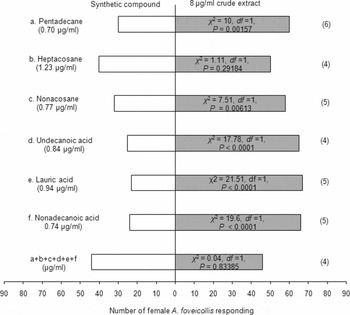
The insects were attracted to 8 µg flower surface waxes against five individual synthetic compounds in the proportions found in 8 µg flower surface waxes [flower surface waxes (χ 2 = 10, df = 1, P = 0.00157) vs. pentadecane, surface waxes (χ 2 = 7.51, df = 1, P = 0.00613) vs. nonacosane, surface waxes (χ 2 = 17.78, df = 1, P < 0.0001) vs. undecanoic acid, surface waxes (χ 2 = 21.51, df = 1, P < 0.0001) vs. lauric acid, surface waxes (χ 2 = 19.6, df = 1, P < 0.0001) vs. nonadecanoic acid]; whereas, the insect did not indicate clear positive or negative responses to the flower surface waxes (χ 2 = 1.11, df = 1, P = 0.29184) vs. heptacosane (Fig. 3). The insect also did not display clear positive or negative responses to the flower surface waxes (χ 2 = 0.04, df = 1, P = 0.83385) against a combination of six synthetic compounds equivalent to the proportions present in 8 µg flower surface waxes (Fig. 3).
-
(4) Dose-dependent responses to six synthetic compounds.
Female Aulacophora foveicollis response to 8 µg surface waxes from Solena amplexicaulis flowers compared to individual synthetic compounds or a combination of synthetic compounds in the proportions present in Solena amplexicaulis flowers. Numbers in brackets are the number of insects that did not respond to either treatment.

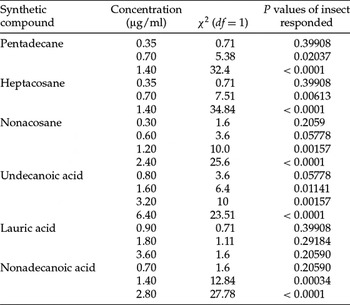
In Y-tube olfactory bioassays, the insect showed attraction to pentadecane, heptacosane, nonacosane, undecanoic acid and nonadecanoic acid against solvent control (Table 3). The insect displayed attraction to pentadecane at 0.70 µg/ml (χ 2 = 5.38, df = 1, P = 0.02037) and 1.40 µg/ml (χ 2 = 32.4, df = 1, P < 0.0001) (Table 3). The insect showed attraction to heptacosane at 0.70 µg/ml (χ 2 = 7.51, df = 1, P = 0.00613) and 1.40 µg/ml (χ 2 = 34.84, df = 1, P < 0.0001) (Table 3). The insect was attracted to nonacosane at 1.20 (χ 2 = 10, df = 1, P = 0.00157) and 2.40 µg/ml (χ 2 = 25.6, df = 1, P < 0.0001) (Table 3). Undecanoic acid was attractive at 1.60 µg/ml (χ 2 = 6.4, df = 1, P = 0.01141), 3.20 µg/ml (χ 2 = 10, df = 1, P = 0.00157) and 6.40 µg/ml (χ 2 = 23.51, df = 1, P < 0.0001) (Table 3). The insect was attracted to nonadecanoic acid at 1.40 µg/ml (χ 2 = 12.84, df = 1, P = 0.00034) and 2.80 µg/ml (χ 2 = 27.78, df = 1, P < 0.0001) (Table 3). But, the insect did not indicate any clear positive or negative responses to lauric acid between the range 0.90 and 3.60 µg/ml (Table 3).
Female Aulacophora foveicollis responses to individual synthetic component vs. control solvent (petroleum ether) in Y-tube olfactometer bioassay (N = 90 in each concentration bioassay)

Discussion
The surface wax of a plant is a hydrophobic layer, which serves many physiological functions such as protecting plants from physical damage, especially from transpiration and protection against UV light (Schoonhoven et al., Reference Schoonhoven, Van Loon and Dicke2005). Alkanes, the main component of epicuticular wax, have been used as markers for estimating forage intake in nutrition studies of ruminants (Laredo et al. Reference Laredo, Simpson, Minson and Orpin1991; Malossini et al., Reference Malossini, Bovolenta, Piasentier and Valentinotti1994), indicators of taxonomic relations between plant species (Maffei et al., Reference Maffei, Badino and Bossi2004; Santos et al., Reference Santos, Dokkedal, Sannomiya, Soares and Vilegas2005; Medina et al., Reference Medina, Aguiar, Gomez, Aranda, Medina and Winter2006), and play an important role in plant–insect interaction studies (Schoonhoven et al., Reference Schoonhoven, Van Loon and Dicke2005; Müller Reference Muller, Riederer and Muller2006; Sarkar et al., Reference Sarkar, Mukherjee and Barik2013a; Sarkar and Barik, Reference Sarkar and Barik2014). Fatty acids act a source of energy during the nonfeeding stages (Downer Reference Downer, Kerkut and Gilbert1985), forming structures of biological membranes (Stanley-Samuelson et al., Reference Stanley-Samuelson, Jurenka, Cripps, Blomquist and de Renobales1988) and plant–insect interactions (Espelie et al., Reference Espelie, Bernays and Brown1991; Sarkar et al., Reference Sarkar, Mukherjee and Barik2013b; Malik and Barik, Reference Malik and Barik2015). In the present study, 17 n-alkanes and 16 free fatty acids were found between n-C15 and n-C34 and C10:0 to C22:0 respectively, in S. amplexicaulis flowers, and alkanes are the major component of the flower surface wax. By comparison, n-alkanes with chain lengths from n-C17 to n-C36 and 14 free fatty acids from C10:0 to C22:0 were present in M. charantia flower surface waxes (Sarkar and Barik, Reference Sarkar and Barik2014; Reference Sarkar and Barik2015). Nonacosane (n-C29) and palmitoleic acid were the predominant n-alkane and fatty acid in the surface waxes of M. charantia flowers, respectively (Sarkar and Barik, Reference Sarkar and Barik2014). However, in the present investigation, heptacosane and pentadecanoic acid were the predominant alkane and fatty acids in S. amplexicaulis flowers, respectively. n-C27 was the predominant alkane in the epicuticular wax of beech leaves (Piasentier et al., Reference Piasentier, Bovolenta and Malossini2000). Saturated fatty acids were higher in the Abies pindrow (Burdi et al., Reference Burdi, Samejo, Bhanger and Khan2007; Demir and Cakmak, Reference Demir and Cakmak2007) plants belonging to the Pineceae family, and this study also indicated higher amount of saturated fatty acids in S. amplexicaulis flowers.
Alkanes and free fatty acids play important roles in plant–insect interactions such as an attractant for the insect (Dutton et al., Reference Dutton, Mattiacci and Dorn2000; Schoonhoven et al., Reference Schoonhoven, Van Loon and Dicke2005; Roy and Barik, Reference Roy and Barik2012; Sarkar et al., Reference Sarkar, Mukherjee and Barik2013a , Reference Sarkar, Mukherjee and Barik2013b ; Manosalva et al. Reference Manosalva, Pardo, Perich, Mutis, Parra, Ortega, Isaacs and Quiroz2011; Sarkar and Barik, Reference Sarkar and Barik2014, Reference Sarkar and Barik2015) or as attractant for oviposition (Eigenbrode and Espelie, Reference Eigenbrode and Espelie1995; Li and Ishikawa, Reference Li and Ishikawa2006). Long-chain alkanes and fatty acids act as low volatile cues for insects to locate their hosts in their microhabitat. The present olfactometric bioassay results clearly revealed that the generalist herbivore, A. foveicollis was attracted to surface waxes extracted from flowers at concentrations between 4 and 8 µg/ml, and the insect showed highest attraction to 8 µg flower surface waxes due to synergistic effect of pentadecane, heptacosane, nonacosane, undecanoic acid, lauric acid and nonadecanoic acid in the surface waxes. The importance of alkanes and fatty acids as allelochemicals has been demonstrated in different insects (Schiestl et al., Reference Schiestl, Ayasse, Paulus, Lofstedt, Hansson, Ibarra and Francke1999; Tasin et al., Reference Tasin, Anfora, Ioriatti, Carlin, De Cristofaro, Schmidt, Bengtsson, Versini and Witzgall2005; Sarkar and Barik, Reference Sarkar and Barik2014, Reference Sarkar and Barik2015; Adhikary et al., Reference Adhikary, Mukherjee and Barik2014; Malik and Barik, Reference Malik and Barik2015). Insects employ between three to ten compounds as host location cues (Bruce et al., Reference Bruce, Wadhams and Woodcock2005; Bruce and Pickett, Reference Bruce and Pickett2011). Aulacophora foveicollis showed attraction to pentadecane, heptacosane and nonacosane at the amounts of 0.70, 1.23 and 0.77 µg/ml in initial bioassays at the proportions detected in 8 µg flower surface waxes, respectively; whereas, the insect did not produce any positive or negative responses to undecanoic acid, lauric acid and nonadecanoic acid at 0.84, 0.94 and 0.74 µg/ml, respectively. However, the insect showed attraction to undecanoic acid and nonadecanoic acid at the minimal amounts of 1.60 and 1.40 µg/ml in dose response bioassays, respectively. Hence, the ratio of n-alkanes and free fatty acids present at 8 µg flower surface waxes are vital components, which act as olfactory cue for A. foveicollis. Visual cues from the S. amplexicaulis plants might also play a role in the attraction, but these cues were not tested in the present study.
The present study documents that the generalist herbivore, A. foveicollis were most attracted to 8 µg surface waxes from S. amplexicaulis flowers, and also to a synthetic blend of 0.70, 1.23, 0.77, 0.84, 0.94 and 0.74 µg/ml of pentadecane, heptacosane, nonacosane, undecanoic acid, lauric acid and nonadecanoic acid, respectively, which might be used for the development of eco-friendly trapping tools for this insect pest. Bioassays in a greenhouse to evaluate responses of A. foveicollis to the combinations of these six synthetic compounds present in 8 µg flower surface waxes are necessary to validate the attractiveness demonstrated in the present study.
Supplementary material
To view supplementary material for this paper, please visit http://dx.doi.org/S1742758416000059.
Acknowledgements
We thank anonymous reviewers for helpful suggestions of earlier versions of the manuscript. We are thankful to Dr Poorani Janakiraman, National Bureau of Agriculturally Important Insects (formerly PDBC), Karnataka, India for identifying the insect and Prof. Ambarish Mukherjee, Department of Botany of this University for identifying the plant. The financial assistance from West Bengal Department of Science and Technology (WB-DST) [Sanction No. 889 (Sanc.)/ST/P/S&T/2G-6/2013], India is gratefully acknowledged.