Body decorations and clothing reflect a person's identity related to age, ethnicity, gender roles, status, religion, and more (Hansen Reference Hansen2004). Clothing also reflects a culture's “style.” Archaeologically definable styles often change quickly, but our analysis of Casas Grandes human effigies identifies aspects of fashion that continue for at least 1,000 years into the present. Innovation is easily introduced into cultural systems through accidents, experimentation, or unintentional alterations (Eerkens and Lipo Reference Eerkens and Lipo2005). In virtually every context of human learning, imperfect copying (i.e., invention of cultural traits) is the norm, which leads to increased variation unless some sorting mechanism reduces it (Brantingham and Perreault Reference Brantingham and Perreault2010; Eerkens and Lipo Reference Eerkens and Lipo2005; Hurt et al. Reference Hurt, VanPool, Rakita, Leonard, Hurt and Rakita2001; VanPool et al. Reference VanPool, O'Brien, Lyman, Goodale and Andrefsky2015). The fact that aspects of dress remain consistent for over 1,000 years in the North American Southwest indicates that they are linked with broad cultural traditions, which in turn makes them an avenue through which archaeologists can gain insight into past social identity and related aspects of southwestern culture. Here we discuss the relationships among Medio-period (A.D. 1200 to 1450) Casas Grandes dress, gender, and cosmology as they are portrayed in effigies and painted human images. Building on previous research, we identify persistent types of clothing and body decorations in the North American Southwest, which indicate broad, long-lived cultural traditions about how males and females should dress. In particular, we identify feminine and masculine characteristics of dress that reflect associations of women with fertility, the Upper World, and birds, on the one hand, and men with serpents, the Underworld, and ritual, on the other. We also identify clothing that appears unique to the Medio period, in particular a subset of smoking male effigies associated with facial decorations, sandals, and other symbolism that indicate a distinct group of ritual specialists.
The Link between Identity and Dress
Clothing and body decorations are part of the larger category of dress, which Roach-Higgins and Eicher (Reference Roach-Higgins and Eicher1992:1) describe:
[The] dress of an individual is an assemblage of modifications of the body and/or supplements to the body. Dress, so defined, includes a long list of possible direct modifications of the body such as coiffed hair, colored skin, pierced ears, and scented breath, as well as an equally long list of garments, jewelry, accessories, and other categories of items added to the body as supplemental.
Cross-cultural analysis indicates that dress is socially meaningful in that it “calls out to others with the ‘same’ identifications of the wearer” (Stone Reference Stone, Stone and Farberman1981:193). As such, it is fundamental to both creating and reflecting an individual's identity. Archaeologists define identity in various ways (Jenkins Reference Jenkins2014; Mills Reference Mills and Mills2004), but we use the term inclusively here to refer to one's perceived associations within the larger social system, acknowledging that those associations occur at various scales. Social identity in this context helps people distinguish certain social groups from others, and is multifaceted and situationally constructed to include aspects of age, class, ethnicity, gender, religion, etc. (Mills Reference Mills and Mills2004:4). For example, Kroeber (Reference Kroeber1917) found that the Zuni, a southwestern Puebloan people, constructed their identities based on family units and clans, as well as on membership in fraternities and kiva societies. Furthermore, the Zuni share an identity as members of the Zuni Tribe, as southwestern Pueblo people, and even more broadly as Native Americans (Ferguson Reference Ferguson and Mills2004). According to Ferguson (Reference Ferguson and Mills2004:29), “individual Zuni people use all of these identities to define themselves in various social contexts.” This pattern of hierarchically organized and context-flexible identity is typical for humans (Jenkins Reference Jenkins2014). An individual will have many identities based on gender, kinship, age, faction, ethnicity, occupation, skill, education, and so forth. Identities are consequently malleable, context specific, and change over an individual's life.
Individuals use dress to send visual clues about their identities and to make suppositions about other people's identities (Crane Reference Crane2012; Hansen Reference Hansen2004; Stone Reference Stone, Stone and Farberman1981; Voss and Young Reference Voss, Young, Carr and Neitzel1995). This communication requires that the individual wearing clothing/body decorations has experienced a cultural framework (called a “program”) that at least in part dictates the appropriate dress reflecting the applicable identities and that also allows him or her to “review” the information that others project through dress (McElvian Reference McElvain2008:8–9; Stone Reference Stone, Stone and Farberman1981:187). While the wearer's program and the viewer's review can correspond well, there can also be disconnects caused by inconsistencies in dress (e.g., wearing a PETA T-shirt and a fur coat) or differences between the viewer's and the wearer's programs. Still, as a practical matter, humans do use dress to indicate and differentiate social identity (Crane Reference Crane2012; Johnson et al. Reference Johnson, Yoo, Kim and Lennon2008; McElvain Reference McElvain2008).
Medio-Period Casas Grandes Effigies and Identity
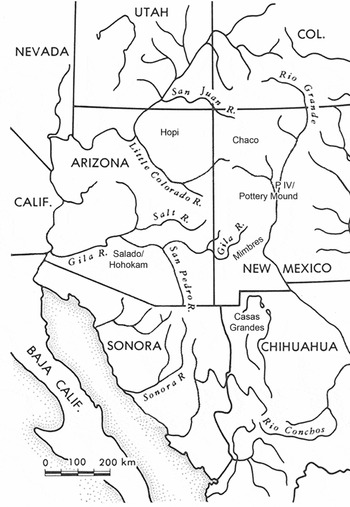
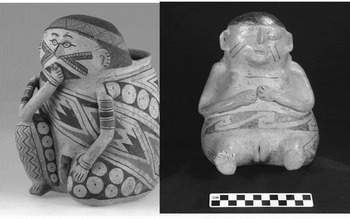
The Casas Grandes Medio period reflects one of the most politically complex prehistoric cultures north of Mesoamerica (Di Peso et al. Reference Di Peso, Rinaldo and Fenner1974). It is characterized by Casas Grandes polychromes (red and black painted ceramics on a light-colored paste or slip) and large pueblo-like communities built on river floodplains (Whalen and Pitezel Reference Whalen, Pitezel, Minnis and Whalen2015). The heart of the Medio-period world was Paquimé, a community that likely housed between 2,000 and 5,000 people on the Rio Casas Grandes floodplain (Figure 1). It was the center of religious and economic power, displaying monumental architecture, specialized production of pottery and ground stone metates, substantial amounts of imported ocean shell and copper items, and ritual macaw and turkey burials (Phillips and Gamboa Reference Phillips, Gamboa, Minnis and Whalen2015; Rakita and Cruz Reference Rakita, Antillón, Minnis and Whalen2015). One of the most distinctive ceramic forms is human effigies, which retain the roughly globular form of the non-effigy Casas Grandes jars with the addition of molded arms, legs, and faces (Figure 2). Similar human effigies come from other southwestern cultures, but they are rare.
Map of the North American Southwest. Adapted from Riley (Reference Riley1987:Map 2).

Male and female human effigy jars with the molded heads, arms, and legs. Male Effigy (left) courtesy of the Natural History Museum of Los Angeles County. Photograph by Chris Coleman. Female Effigy (right) courtesy of the El Paso Museum of Archaeology.

Previous analyses identified patterns in the effigies related to gender, status, and religious activities:
Body Posture
Females sit with their legs straight out, whereas males sit with their knees drawn up and sometimes with one leg tucked under them (Figure 2; VanPool and VanPool Reference VanPool, VanPool, Phillips, VanPool, VanPool and Phillips2006). Some seated males have both forearms resting on their knees, while others smoke pipes similar to stone pipes recovered at Paquimé. Women are shown holding bowls, sometimes on their heads or on their stomachs. One vessel portrays a breastfeeding mother.
Tattoos
Sprehn (Reference Sprehn and Johnson2001) suggests that the designs on female effigies’ chins are tattoos, based on ethnographic reports from North American groups in which women received chin tattoos during puberty rites. After examining 11 female and 12 male effigies, Sprehn (Reference Sprehn and Johnson2001) found that females and males in her sample both have chin markings, but that females have only black lines, whereas men have black and red lines. She suggests that red lines indicate paint rather than tattoos, and concluded that females received permanent tattoos, whereas males were painted. She further concluded that female effigies without marked chins depicted prepubescent females.
Hair Style
King (Reference King, Di Peso, Rinaldo and Fenner1974:82) suggested that human effigies show similar dress and hair styles to the historically documented Rarámuri. In her words, “both men and women wore their hair loose, with bangs and a straight, chin-length cut the general rule” (King Reference King, Di Peso, Rinaldo and Fenner1974:82). Neitzel (Reference Neitzel2017) found that Casas Grandes women are portrayed with hair in front of their ears, whereas men are not.
Jewelry
King (Reference King, Di Peso, Rinaldo and Fenner1974) found that both male and female effigies are depicted with necklaces, earrings, and bracelets, without notable differences between the sexes. Neitzel (Reference Neitzel2017) suggests that jewelry in Casas Grandes mortuary contexts generally displays social status and cultural affiliation, but that both sexes were buried with jewelry and “costly items” such as turquoise mosaics. This contrasts with Shafer's (Reference Shafer2003:207) finding that only males were buried with inlay items, copper, and Glycymeris shells during the preceding Classic Mimbres period (A.D. 1000–1150).
Clothing
King (Reference King, Di Peso, Rinaldo and Fenner1974) suggests that designs on human effigies reflect clothing, but did not identify differences between male and female clothing based on Mesoamerican and southwestern textiles. VanPool (Reference VanPool2003a) questioned her conclusion, given that the proposed clothing does not cover the genitalia, which are typically covered even in societies with limited clothing. She proposed that the genitalia were emphasized for symbolic reasons, suggesting, in turn, that other aspects of body decoration were possibly symbolic, as opposed to literal, representations. However, the consistent placement of designs reported here has caused C. VanPool to revise her position and agree with King that human effigies do show aspects of clothing (see also Phillips and VanPool Reference Phillips and VanPool2009:11, which concludes that headbands are common on effigies, but their designs are “mostly if not entirely random”).
Tie-Dyed Textiles, Maize, and Bird Symbolism
Casas Grandes ceramics are decorated with “a square with a center dot motif” (often forming a net-like design) that southwestern textile researchers interpret as a Mesoamerican tie-dye pattern (Hays-Gilpin et al. Reference Hays-Gilpin, Webster and Schaafsma2004; Teague Reference Teague1998:141–142, 150; Webster Reference Webster and Schaafsma2007:175). The “square with dot” also symbolizes maize and green/blue stones throughout Mesoamerica and the Southwest (Taube Reference Taube, Clark and Pye2000; Webster Reference Webster and Schaafsma2007:175), which, in turn, is associated with birds and feathers, especially quetzal feathers that were interchangeable with corn leaves and corn silk (Taube Reference Taube, Clark and Pye2000:309). Based on these links, Taube (Reference Taube, Clark and Pye2000:328) proposes that Mesoamerican and southwestern feathered serpents had a rich metaphoric association with maize (see also Mathiowetz Reference Mathiowetz2011; Schaafsma Reference Schaafsma1980), although he suggests that groups such as the Zuni used turkey instead of quetzal feathers.
Who Is Being Represented?
VanPool (Reference VanPool2003a) and VanPool and VanPool (Reference VanPool and VanPool2006, Reference VanPool and VanPool2007) conclude that the effigies focus largely, perhaps exclusively, on a specific subset of religiously (and consequently socially) powerful people. These individuals include smoking/masturbating males involved in shamanism and females who may have worked as their helpers. Additional female effigies may reflect high-status women holding large Carretas or Huerigos polychrome bowls, perhaps engaged in feasting.
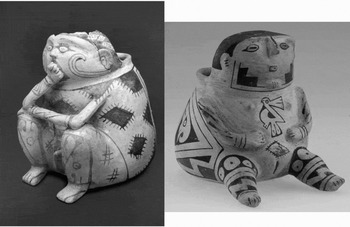
Here we build on the previous analyses using an expanded data set of human effigies to determine whether there are statistical differences in dress. We find notable differences between the sexes in the way that clothing and facial decorations are placed on the body. Our findings indicate that the Casas Grandes Medio–period sandal style and female sternal decorations are unique (Figures 2 and 3), but other aspects of dress (e.g., headbands) are similar to those worn by other southwestern people. We also find a gender-based distinction between two closely related designs that resemble pound signs.
Elaborate male and female effigy jars. Male effigy (left) courtesy of the American Foundation. Female effigy jar (right) courtesy of Natural History Museum of Los Angeles County. Photography by Chris Coleman.

Analysis
Our analysis is based on 98 complete effigies (53 males and 45 females), including most of those analyzed by King Reference King, Di Peso, Rinaldo and Fenner1974:81–92), and additional effigies recorded by VanPool (Reference VanPool2003b) or published elsewhere (Supplemental Table 1). A few of the published images obscured body designs (e.g., off-centered pictures that obscure leg designs); in these cases, we recorded the information that was visible. Recorded attributes included the form and orientation of face and body decorations, as discussed below. These designs likely represent body paint, clothing, and perhaps tattoos, all of which are part of the general category of dress. King (Reference King, Di Peso, Rinaldo and Fenner1974:81–92) was a textile expert and based her analysis on a priori defined woven garment types (e.g., skirts, breechcloths, shirts, etc.), but we chose to record design placement, form, orientation, and color without assigning them to a priori defined garment/dress categories. Why? First, we wish to avoid the potential difficulties inherent in classification systems with built-in interpretation: (1) conclusions cannot be evaluated separately from the classification process, (2) variation is artificially constrained into predefined classes that may not be appropriate, and (3) confirmation bias is likely as the data collection process is organized to produce desired outcomes (Dunnell Reference Dunnell, Raffery and Peacock2008; Sullivan and Rozen Reference Sullivan and Rozen1985). For example, starting with categories such as “shirts,” “blankets,” and “trousers” necessarily causes the analyst to “search” for them. As a result, we sought to identify patterns before interpreting them as specific garments to reduce the possibility of unacknowledged biases. Second, we were concerned with our ability to differentiate some garments, given that the backs of the effigies are separated from the fronts by a framing line and are decorated as a standard polychrome pot. This makes it difficult to determine whether the effigy is portrayed wearing a shirt, poncho, skirt, or other garment. As a result, we wanted to identify the variation in design before assigning specific clothing forms, and then use this information to make interpretations regarding the nature of the represented dress.
Head Decorations
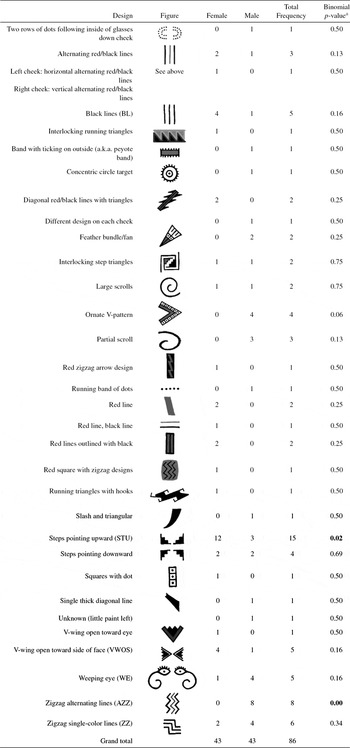
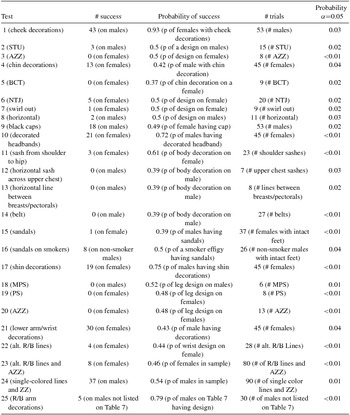
Forty-three male effigies and 42 female effigies have facial markings (Table 1). Decorations are generally limited to the cheeks and chins, although five females have steps ascending toward the ears (STU) on the side of their faces, as opposed to their cheeks. One of these female effigies (CVP-66) also has single-color zigzags (ZZ) running vertically across the cheek, causing her to be counted twice in Table 1. More females than males have cheek decorations (42 [93 percent] of the 45 females compared to 43 [81 percent] of the 53 males). We used the binomial distribution to evaluate the null hypothesis that males are as likely to have cheek decorations as females (VanPool and Leonard Reference VanPool and Leonard2011:74–76). For the test, success (s) is defined as a male having a cheek decoration (n = 43), failure (q) is defined as a male without cheek decoration (n = 10), the probability of a success (p) is 0.93 (the probability of a female having cheek decorations), the number of trials is 53 (the number of male effigies), and alpha (α) is set at 0.05. The probability of 43 or fewer successes out of 53 trials is 0.003 (Table 1 and Test 1 on Table 2; see Supplemental Text for justification of binomial distribution). Given that the binomial test's probability of 0.003 is less than alpha, we reject the null hypothesis and conclude that male effigies are less likely to be adorned with cheek decorations than females in our sample. All binomial tests below follow this general format with the relevant information summarized in Table 2.
Frequency of Facial Decorations.

a Bolded values reflect significant associations.
Binomial Tests.

We measure variation in cheek decorations, both within and between the sexes, using the Index of Qualitative Variation (IQV). The IQV is a measure of the percentage of the observed variation compared to the maximum possible variation in a dataset (i.e., a value of 100 percent reflects maximum diversity whereas 0 percent reflects complete homogeneity; VanPool and Leonard Reference VanPool and Leonard2011:61–62). The IQV for females is 93 percent and for males, 97 percent, indicating that the facial decorations for both sexes contain nearly as much variation as is possible given their sample sizes. In our discussion, we suggest this variation indicates that actual people are depicted. Still, STU is the most common female facial embellishment and alternating red and black zigzags (AZZ) are the most common for males (Table 1). Binomial tests indicate that the associations between STU and AZZ designs and effigy sex are statistically significant (Tests 2 and 3 on Table 2). None of the other designs are statistically associated with either sex.
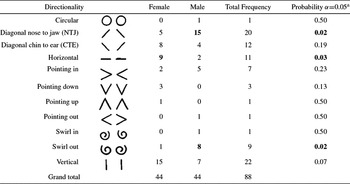
Chin decorations also reveal gender-based differences with males (22 [42 percent] of the 53 males) being statistically more likely to have chin decorations than females (13 [29 percent] of the 45 females) (Test 4 on Table 2). Further, black triangles covering the chin (BCT) are associated with males (Test 5 on Table 2). We also evaluated the directionality of facial designs on the cheeks and the sides of the face. A horizontal design stretches across the face, vertical designs are oriented from the lower to the upper face, and diagonal designs cross the cheek from the nose to the lower jaw (Table 3). Face decorations are typically vertical (n = 22) or diagonal from nose to jaw (NTJ; n = 20) (Table 3). Four vessels reflect two directions: one male and one female effigy have vertical and diagonal NTJ directionality, one female has horizontal alternating red and black lines on her left cheek and vertical alternating red and black lines on her right cheek, and one female has vertical and diagonal Chin-to-Ear (CTE) decorations. These four vessels are counted twice in Table 3, once in each of their direction categories.
Frequency of Face Directions.

a Bolded values reflect significant associations.
Binomial tests indicate that three design directions are differentiated by sex. Both the diagonal NTJ design direction and the swirl-out design direction are associated with males (Tests 6 and 7 on Table 2). The diagonal NTJ direction is most common on males with the AZZ design (5 out of 14 males). Most of the swirl-out directions are created by either weeping eyes (3 males) or partial scrolls down the jaw line (3 males). Horizontal directionality is most common on females, especially females with STU. We hasten to emphasize that, even though these designs are predominantly associated with a particular sex, it is not the case that most males or females have the designs (Table 3); only 21 percent of the females have horizontally oriented facial designs and only 35 percent and 19 percent of the males are associated with diagonal NTJ or swirl-outs. In fact, vertically oriented designs are the most common on female effigies (35 percent), despite their lack of a statistically significant association.
Finally, 27 (60 percent) of the 45 female effigies and 33 (62 percent) of the male effigies have ear decorations. These are almost exclusively ticking around the ear (n = 21 females and n = 32 males). Exceptions include black ears, alternating red and black ticking, ears pierced with small holes, red outlining, and a red line outlined with black. In head effigies (jars without the molded body), the molded ears are sometimes pierced with wear marks indicating the use of actual earrings. The molded ears on human effigies are often too small to be literally pierced (although they are pierced in two cases), but it is plausible that the ticking marks on the human effigies portray multiple piercings. However, the ticking might also reflect cutting on the ears for bloodletting as practiced by Mesoamerican elites, or tattooing (Evans Reference Evans2004; Phillips and VanPool Reference Phillips and VanPool2009).
Headgear. Headgear is differentiated from facial designs by the design placement above the forehead. The most common embellishment is simple, black “caps” that King (Reference King, Di Peso, Rinaldo and Fenner1974:82–83) suggested represent hair. A binomial test demonstrates that these caps are more common on female effigies (22 [49 percent] of 45) than male effigies (18 [34 percent] of 53) (Test 9 on Table 2). Decorated headbands are also common, especially on male effigies, which also possess more elaborate headbands than females (Figures 2 and 3; 38 [72 percent] of the 53 males had headbands compared to only 21 [47 percent] of the 45 females). A binomial test reveals this association is statistically significant (Test 10 on Table 2).
Body Decorations
We again subdivide our discussion by location and how the designs are oriented on the body.
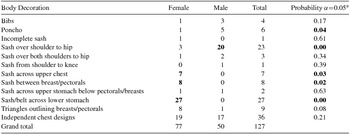
Sashes and Belts. Forty-three (96 percent) of the 45 females and 46 (87 percent) of the 53 males have some form of linear designs that resemble sashes or belts (Table 4). We labeled the diagonal bands that run from shoulder to hip as a bandolier-style sash and the band that goes from hip to hip as a belt. Twenty-three females have multiple sashes and belts, typically both a sash and a belt. Further, belts depicted low across the hips are limited only to females (19 [44 percent] of the 43 females). As a result, females are not only more likely to have decorative elements on their torsos, but have more decorative elements when present (Table 4). This increased variation is evident in the IQV values, which are 86 percent for females, compared to 81 percent for males. However, female belts tend to be narrower and less elaborate. Binomal tests indicate that males are more likely to have bandolier-style sashes extending from the shoulder (diagonally) to the hip (Test 11 on Table 2). Females are more likely to have (horizontal) sashes/belts across the lower stomach, across the upper chest, and between the breasts/pectorals (Tests 12–14 on Table 2).
Frequency of Body Decorations.

a Bolded values reflect significant associations.
Sandals. Males are far more likely to be depicted with sandals/footwear (13 [36 percent] of the 36 males with clearly depicted feet) compared to females (1 [3 percent] of the 37 females with clearly depicted feet; Figure 3). This association is statistically significant (Test 15 on Table 2). Further, a binomial test indicates that male smoker effigies are more likely to be represented wearing sandals compared to other males (5 [50 percent] of 10 smoker effigies with feet are wearing sandals compared to 8 [31 percent] of 26 non-smoker effigies with feet; Test 16 on Table 2).
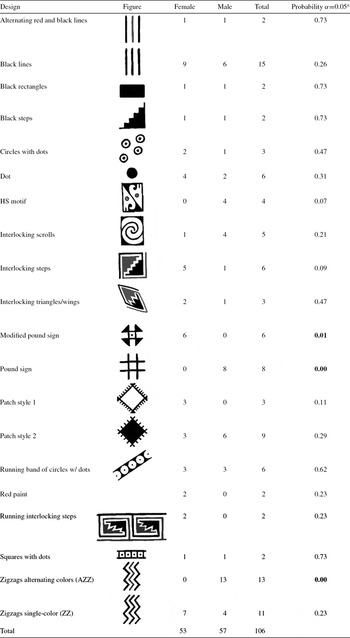
Leggings. King (Reference King, Di Peso, Rinaldo and Fenner1974:89) found that most effigies had footless leggings she interpreted as woven textiles or, perhaps, painted “leggings” similar to those worn by male dancers at Jemez Pueblo. In our sample, 41 (91 percent) of the 45 females and 48 (91 percent) of the 53 males have leg decorations, with 24 (53 percent) females and 33 (62 percent) males having multiple decorations, typically separate elements on their shins and upper thighs. As a result, 53 and 57 decorative elements are associated with females and males, respectively (Table 5). A binomial test indicates that males are more likely to have decorations on their shins; 40 (75 percent) of the 53 male effigies have shin decorations whereas only 19 (42 percent) of the 45 female effigies do (Test 17 on Table 2). The design variation reflected in the IQV is even greater than with face decorations (97 percent for females and 94 percent for males).
Frequency of Leg Decorations.

a Bolded values reflect significant associations.
Binomial analysis of the leg designs indicates that females are more likely to have modified pound signs (MPS) (Test 18 on Table 2), and males are more likely to have pound signs (PS) and alternating red-and-black zigzags (AZZ) (Tests 19 and 20 on Table 2). The association between females and MPS is further strengthened by a MPS on the arm of another female effigy (CVP 80). Horned serpent (HS) motifs appear more commonly on males, and interlocking steps are found more commonly with females, although these associations are not statistically significant. Furthermore, all AZZ are on the shins, as opposed to the upper legs. Only three of the males have both AZZ and PS decorations, suggesting that they are not tightly linked to one another, although both are limited to males in our sample.
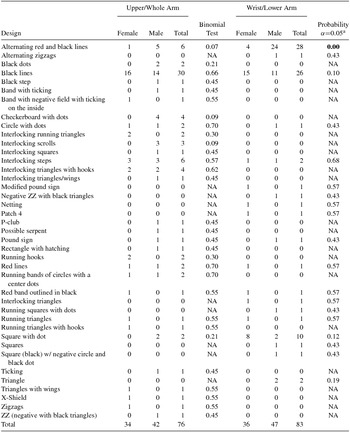
Arms. Arm designs include those on the upper arm, the lower arm/wrist area, and the hand (Table 6). These designs likely represent bracelets/rings, cloth armbands, or body painting. Thirty-nine (87 percent) of the 45 females and 50 (94 percent) of the 53 males have arm decorations with upper arm and wrist designs being the most common. This suggests that both women and men could wear a variety of jewelry. Binomial tests indicate that males and females are statistically equally likely to have upper arm/whole arm decorations (34 designs on 29 [66 percent] females; 42 designs on 38 [72 percent] males), but males are more likely to have lower arm/wrist decorations (36 designs on 30 [67 percent] females; 47 designs on 42 [79 percent] males) (Test 21 on Table 2). Aside from this, there is only a single significant difference: males have alternating red and black lines (Alt. R/B Lines) on their wrists (Test 22 on Table 2).
Frequency of Arm Decorations.

a Bolded values reflect significant associations.
Co-occurrence of Designs. We also identified two patterns of co-occurring designs. First, 52 (87 percent) of the 60 alternating red/black lines and zigzags on the face, arms, and legs are associated with males (Tables 1, 5, and 6), whereas 53 (59 percent) of the 90 single color lines and zigzag patterns are associated with females. These differences are statistically significant (Tests 23 and 24 on Table 2). We hasten to note that this trend does not apply to all alternating color and/or red colored designs. Many female effigies have alternating red and black step designs or solid red bands or red bands outlined in black (see Tables 1 and 6), but the colored line and zigzag patterns differ based on sex.
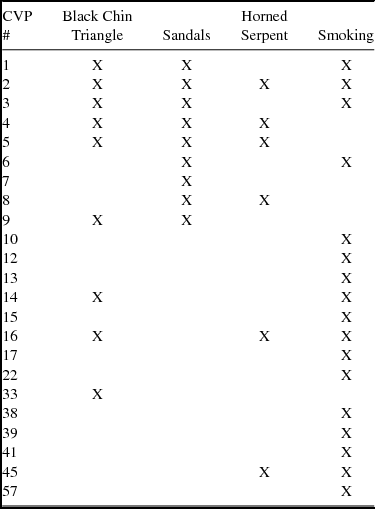
Second, we identified an association among smoking male effigies with chin triangles, sandals, and horned serpents (HS) (Table 7). One effigy (CVP-2) has all four of these traits, but five effigies have three of the four. Eight of nine male effigies with the distinctive sandals possess at least one of these other attributes, eight of nine effigies with chin triangles possess at least one of these other attributes, and all six effigies with HS have at least one of the other attributes (Table 7). This contrasts with the 30 non-smoker male effigies that possess none of these attributes. These individuals are also disproportionately associated with the alternating R/B arm decorations likely representing bracelets/arm bands (19 [79 percent] of the 24 effigies also have at least one of the previously mentioned designs, which is statistically significant; Test 25 on Table 2). There might also be a weak association among the co-occurring attributes and bandolier-style sashes. Eight of the nine effigies depicted with sandals and three additional smoker effigies have these sashes, but eight other effigies without any of the traits listed in Table 7 have bandolier-style sashes.
Presence of Co-occurring Traits on Males.

Discussion
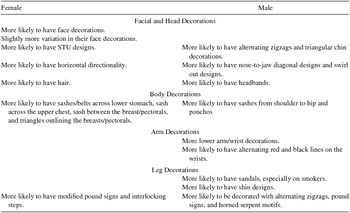
The Medio-period effigy tradition emphasizes literal representations (e.g., animal effigies reflect animal species; VanPool and VanPool Reference VanPool and VanPool2009). In cases where humans and animals do not appear to be naturalistic representations, the depictions are painted, as opposed to molded into effigy. Non-naturalistic painted anthropomorphs and creatures include horned/plumed serpents and macaw-headed anthropomorphs (VanPool and VanPool Reference VanPool and VanPool2007, Reference VanPool and VanPool2009). The human effigies have enough details to indicate that they represent different individuals. Except for the exposed genitals, the consistency in design placement indicates that dress is depicted in a literal, naturalistic manner, as King (Reference King, Di Peso, Rinaldo and Fenner1974) argued. Our analysis identified significant differences between the sexes, as well as some consistencies (Table 8). Shared designs include black ticking around the ear and leg designs such as black lines, dots, running bands with circles, and an apparent textile design (Patch Style 2) (Table 5).
Identified Differences in the Effigy Vessels.

Females are more likely to have facial decorations, but our analysis is inconsistent with Sprehn's interpretation regarding female facial tattoos for two reasons. First, several females have alternating red and black chin lines, suggesting that they are painted, assuming that red designs are painted, not tattooed as Sprehn (Reference Sprehn and Johnson2001) suggests. Further, the black chin ticking that, Sprehn (Reference Sprehn and Johnson2001) proposed, reflects tattoos created during female puberty rites is more common among males than females in our sample. This does not necessarily mean that these marks are not tattoos, but, if so, their use was broader than female coming-of-age ceremonies. All told, the chin ticking is only one kind of chin decoration, which in turn is only one area of the face that is decorated. It seems to us most parsimonious to conclude that the facial designs were painted as needed to create and reinforce social identities within a changing social context. Di Peso (Reference Peso and Charles1974:2:482) concluded that Casas Grandes people used cosmetics, based on the recovery of six pigments “packaged in the form of hand-molded and reed filled crayons, perforated cakes, powder, and chunks in ceramic, stone, and shell receptacles” (found mostly in the House of the Walk-in Well). While the Medio-period polychrome tradition is limited to black/red designs on a white paste, one can only imagine how colorful people might have been using the six pigments (gray/black, yellow, white, red, blue, and green).
Variation in facial decorations reflects their use to create and reinforce gendered identities. Female step motifs are typically associated with clouds, water, and fertility (Dutton Reference Dutton1963; Parsons Reference Parsons1996; Schaafsma Reference Schaafsma2009), and the red and black zigzags of males might reflect lightning and/or snakes, two concepts that are linked during the Medio period and elsewhere in the Southwest (Hays-Gilpin et al. Reference Hays-Gilpin, Webster and Schaafsma2004; Miller and Taube Reference Miller and Taube1993:103; VanPool Reference VanPool2003a). These associations suggest a complementary gender connection to rain/fertility symbolism that likely parallels the previously identified association between females and birds/Upper World and between males and serpents/Lower World (VanPool and VanPool Reference VanPool and VanPool2006, Reference VanPool and VanPool2007). Such duality is further reflected in the common male NTJ facial decoration, the AZZ designs, and swirl-out direction designs, which are roughly the opposite of straight horizontal lines common on females.
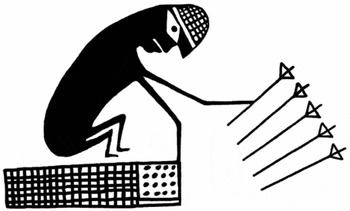
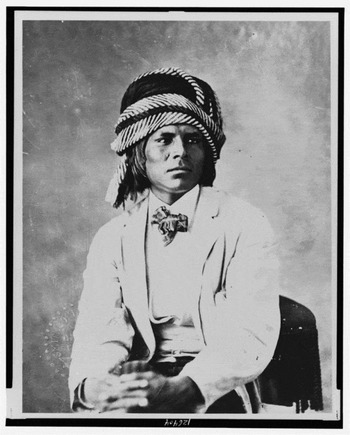
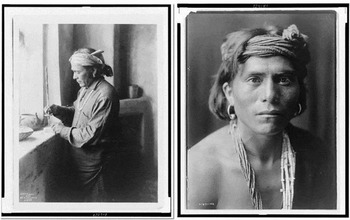
Females are more likely to have depicted hair, but males more often have more elaborate headbands. This association between males and headbands appears long-lived, stretching from the Mimbres Classic tradition to historic Southwestern groups (Figures 4–6). Classic Mimbres pottery includes depictions of people without female's stringed aprons (therefore, likely males) wearing similar headbands (Munson Reference Munson2000). Women in many historic southwestern groups clipped their hair short to make string, but some southwestern and west Mexican men wore woven cotton “belts/sashes” around their heads (Figure 5). Ezell (Reference Ezell, Ortiz and Sturtevant1983:158) states that the headbands were woven on a horizontal loom, which is similar to the looms that King (Reference King, Di Peso, Rinaldo and Fenner1974:78–79) postulated were used by the Casas Grandes people. Lumholtz (Reference Lumholtz1973) discussed similar Rarámuri textiles (he called them girdles) that are woven to contain symbolic prayers for good fortune. Historic Hopi and Zuni men also wore headbands similar to those on the male effigies (Figures 2, 3, and 6).
Close-up drawing of a male with arrows sitting on a blanket holding an arrow. The Mimbres bowl has four males sitting on each side of the blanket, and all are similar to this image. (Drawn from Brody et al. Reference Brody, Scott and LeBlanc1983:Figure 124).

Luig Moraque, an Akimel O'odham with rolled headband, photographed by Alexander Gardner between 1909 and 1932. Library of Congress Control Number 00650884, Prints and Photographs Division.

Men wearing headbands. A Zuni bead Worker and Ṇö
 a—Walpi (Hopi), photographed by Edward S. Curtis. Library of Congress control numbers 93501145 and 99471736 (respectively), Prints and Photographs Division.

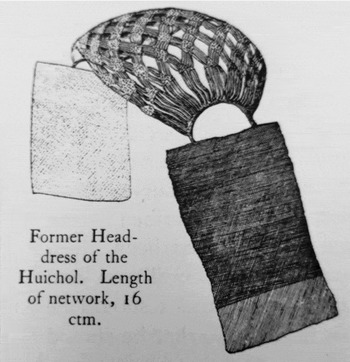
The variation of the designs found within the headband suggests that specific designs were individualized, as opposed to standardized, and might represent aspects of individual identity. Comparatively plain headbands on the few women who had them might reveal that women did not express identity in the same way as their male counterparts, although the bands could be status markers, perhaps indicating that these women performed some atypical ritual role or did not cut their hair as short as others. Additionally, head decorations associated with smokers resemble a wīpí, an uncommon cap Lumholtz (Reference Lumholtz1973:60) suggested was worn by prehispanic Huichol (Figure 7). According to Lumholtz (Reference Lumholtz1973:60), “it is an oval network of fiber adorned at each end with a modern attachment of a rectangular piece of red flannel. It was put on the head lengthwise, a headband passing over the two ends to keep it in place,” thereby forming a triangular net similar to the netted caps on Casas Grandes smoker effigies (e.g., Townsend Reference Townsend and Townsend2005:Plate 46).
The wīpí (headdress) that Lumholtz (Reference Lumholtz1973:60) collected while visiting the Huichol in west Mexico.

Bandolier-style sashes and ponchos are most common on male effigies, and might reflect male status. This clothing is not associated with a particular activity (e.g., smoking) but is associated with particularly ornate male effigies painted by highly skilled painters, perhaps even a single master (Phillips and VanPool Reference Phillips and VanPool2009:11), who used more detailed line work than is seen in the narrower belts on female effigies. Bandolier-style sashes also tend to occur on the males with elaborate headgear and other body markings, including eight of the nine effigies with the unique sandals discussed below. Throughout central Mexico, the shoulder blanket (called the tilmatli) was the most significant piece of male clothing because it immediately conveyed information about a man's social class and rank (Anawalt Reference Anawalt1981:30; Webster Reference Webster and Schaafsma2007:175–177). The variation in the effigies’ bandolier-style sashes suggests that they might have been tilmatlis or at least were used to convey aspects of a male's identity. The care taken to represent them on the best-formed, most elaborate (elite male) effigies suggests that these sashes were likely a significant part of the program used to convey who the effigy represented.
Females are more likely to have sashes across the lower stomach, across the upper chest, and designs in and around the breasts, especially on the sternal area. Both males and females frequently have clearly molded nipples/breasts/pectorals, so the placement of the designs reflects artist choice as opposed to mechanical constraints (i.e., the same designs including triangles around the breasts/pectorals could be placed on either males or females without other changes to the effigy form). We did not find similar Mesoamerican and southwestern sternal adornments, although this may reflect Spanish influence on concepts of modesty. Still, our failure to find similar cases of sternal decorations suggest that such elaboration may be unique to the Casas Grandes region, perhaps reflecting status, faction, or other aspect of female identity, beyond personal preference.
Belts on Casas Grandes female effigies are similar to string aprons illustrated on Classic Mimbres pottery, but it is impossible to tell if they are the same because the effigies’ bottoms typically are not painted and the backsides have standard Ramos polychrome designs/layouts. Neitzel (Reference Neitzel2017) reports that string aprons went out of vogue in the 1300s, when elite influence at Paquimé peaked (Phillips and Gamboa Reference Phillips, Gamboa, Minnis and Whalen2015), but we suspect that string aprons were used at least initially during the Medio period, given the evidence of Classic Mimbres/Medio–period continuity (Moulard Reference Moulard and Townsend2005; VanPool and VanPool Reference VanPool, VanPool and Stuhr2002). Aspects of this tradition might be reproduced in Pueblo IV-period (A.D. 1400–1540) kiva murals from Pottery Mound that show females wearing a ceremonial dress called a manta dress among the historic Pueblos, formed by a blanket hung over the right shoulder and fastened in place by a waist belt (Webster Reference Webster and Schaafsma2007:168). Some of these belts in the Pottery Mound murals are low on the hips, possibly reflecting a historical holdover from the string apron.
Males show greater variation than females in leg designs, especially shin decorations. King (Reference King, Di Peso, Rinaldo and Fenner1974:89) suggested that these designs could represent painted designs like those worn by Jemez dancers and Di Peso et al. (Reference Di Peso, Rinaldo and Fenner1974:7:7) suggested that the yellow pigments could have been used to paint leggings like Rarámuri runners use today. We find this unlikely, given their ubiquity on both male and female effigies.
Webster (Reference Webster and Schaafsma2007) identified Mesoamerican-style kilts on males in the Pottery Mound kiva murals. Anawalt (Reference Anawalt1981) and Webster (Reference Webster and Schaafsma2007) demonstrated that only deity impersonators wear kilts among Mesoamerican groups. There are only a few Casas Grandes depictions of kilts, which are all on painted anthropomorphic figures in scenes that VanPool (Reference VanPool2003a) found represent other worldly scenes that included plumed serpents and transformed shamans. The textile designs found on the painted kilts are present on both male and female effigies (Patch Styles 1 and 2 on Table 5). This could indicate that members of both sexes wore kilts or that similar textiles were used for different types of clothing.
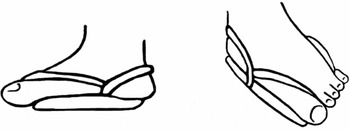
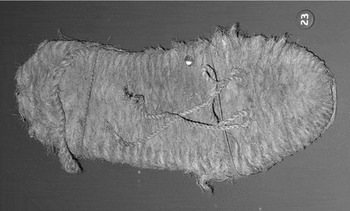
Finally, King (Reference King, Di Peso, Rinaldo and Fenner1974:89–91) noted that the effigies had a sandal type that she did not observe in the ethnographic record (Figures 3 and 8). A detailed foot effigy shows that the sandal is open on the top and the sole does not protect the toes (Catalogue No. 12-1-198, National Museum of Anthropology in Mexico City; for a side view, see Narez Reference Narez1991:243). The sandals are attached by red straps going from the heel to the primary (big) toe and from the heel to the pinky toe, prompting Phillips and VanPool (Reference Phillips and VanPool2009:13) to call them “red strap sandals” (Figure 8). We are not sure how such a sandal would stay on the foot, but it is impractical in the harsh southwestern landscape compared to the more rugged southwestern sandals that extended under the toes and had straps crisscrossing the foot, which are also present in the Casas Grandes region (Figure 9). Like King, we failed to find possible southwestern and Mesoamerican analogues to the red strap sandal. Given its association with males involved in ritual smoking, we suggest that these sandals were designed for ritual display and likely served as symbols of male status/identity.
Drawing of Casas Grandes–style sandals as they might look on the feet.

Southwestern sandal that crosses the top of the foot from Turkey House, northern Arizona. Image under public domain. Natural History Museum of Utah, accession number 1602.

Further, black chin triangles and horned serpent imagery correspond closely with smokers and sandals, suggesting a suite of dress linked with ritual activity and religious symbolism. This suite of traits supports the presence of religious specialists proposed by Rakita (Reference Rakita2009) and VanPool (Reference VanPool2003a), but the relationship between these shaman/priest effigies and other male effigies is unclear. Two or more groups of males (elite religious specialists alongside other elite or non-elite males) could be represented, or all of the males may be religious specialists, with some wearing their ceremonial attire (Table 7). Given the variation in the other effigies, though, it is more parsimonious to propose that two or more groups of males are present. The weak association with shoulder-to-hip sashes and the stronger association with alternating red and black arm decorations likely reflect high status as discussed above. Further, variation in the depiction of the religious specialists might reflect differences in status and training. The Rarámuri, for example, distinguish different “ranks” of shamans based on training and specialty (Lumholtz Reference Lumholtz1973). It may be that the smokers with black chin triangles, horned serpent images, armbands, and/or wearing red strap sandals represent an upper echelon of elite specialists.
North American/Mesoamerican ethnographies demonstrate gender flexibility and the presence of transgendered and third-gendered individuals (Bonvillain Reference Bonvillain2001; Roscoe Reference Roscoe1991). Third-gendered individuals often take the form of two-spirits, who combine “man” and “woman” in a transformative manner (Roscoe Reference Roscoe1991) and are accorded religious authority (Bonvillain Reference Bonvillain2001:5–6). One female effigy (CVP-78) might reflect a transgendered or third-gendered individual. This effigy portrays a female in a sitting position, and who has a vagina, but the figure lacks breasts and has a male's barrel-chest. She wears red strap sandals, a poncho, and elaborate headgear typical of the males. Although speculative, her dress suggests that she participated in male rituals, perhaps as a two-spirit, which again emphasizes the variable nature of identity in the Medio-period world.
A Brief Summary of Southwestern Dress
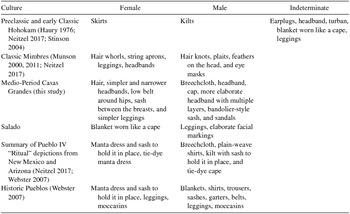
We briefly compare Casas Grandes dress with other southwestern traditions (Table 9). Archaeologists have recovered archaic sandals and sashes in rock shelters throughout the Southwest, but our knowledge of other aspects of dress is limited before they are depicted on pottery.
Summary of Clothing Cultural Trends by Gender.

Classic Mimbres (A.D. 1000–1150). Munson (Reference Munson2000, Reference Munson2011) found that Mimbres males had hair knots, plaits, feathers on the head, and markings around the eyes. Females wore hair whorls, string aprons, headbands, and leggings. In our survey of Mimbres bowls, we found that women's headbands do not completely cover the top of their heads, which are painted black. Some Mimbres figures have caps or turbans, similar to those seen on Hohokam figurines and Casas Grandes male effigies. Unfortunately, individuals with the most elaborate caps lack the sexual or gender markers identified by Munson (Reference Munson2000:130–134), but in Plate 7 of Moulard (Reference Moulard1984) five individuals are depicted with upper arm bracelets and netted/woven caps. The armbands are similar to cut Glycymeris shell bracelets/arm bands that Shafer (Reference Shafer2003:207) found only in male burials. If these are indeed Glycymeris bands, these five individuals may be males, suggesting that Mimbres males might have worn caps.
Hohokam (A.D. 1150–1450). Aragon (Reference Aragon2013) and Stinson (Reference Stinson2004) examined dress on Hohokam figurines and effigy vases, most of which date to the Early Preclassic to Classic Hohokam periods (A.D. 1150–1450). Primary sexual characteristics were rarely depicted; eight percent (n = 96) of Aragon's sample had breasts and only 1 percent (n = 16) had a penis. Interestingly, “in almost all cases where jewelry or embellishments were recorded on a figurine with sex characteristics, they were males” (Aragon Reference Aragon2013:39). Neitzel (Reference Neitzel2017) found that wraparound skirts are associated with women, whereas kilts and breechcloths appear with men. She also suggests that human and anthropomorphic effigies published in Haury (Reference Haury1976) indicate that headbands and turbans similar to those seen among the historic Akimel O'Odham men were worn. Many of these effigies are likely shown with blankets (tilmatli), which Neitzel (Reference Neitzel2017) suggests were status markers.
Chaco (A.D. 1000–1150). Franklin and Reed (Reference Franklin and Reed2016) found that most effigies with genitals from Pueblo Bonito and other Chacoan sites are males. Perhaps the best-known Chaco human effigy vessel is a hunchback male with his knees drawn to his chest (Pepper Reference Pepper1906). The lower edge of his elbows and lower arms rest on his knees, and his forearms and wrists crisscross on his upper chest under his neck. Casas Grandes male effigies are also shown with knees drawn to their chest and lower arms resting on their knees, but we have not seen a male (or a female) effigy with their arms crisscrossing. Although most Chacoan effigies are males, Hurst (Reference Hurst1994) reported two notable female effigies from Alkali Ridge and Pepper (Reference Pepper1906) found a third fragment of a female torso at Pueblo Bonito's Room 38. One of the Alkali Ridge female is “obese” and has a “skirt” that wraps around her lower stomach. From the published image, it appears that the skirt does not cover her genitals.
Salado (A.D. 1250–1450). Salado polychromes started in the Tonto Basin in the mid-thirteenth century and then spread throughout the Southwest (Crown Reference Crown1994). Bowls were the primary medium for the iconography, but a few human effigies were reported. We were able to find only two female effigies (one published in Fewkes [Reference Fewkes1898] and the other on the Princeton University Art Museum webpage [2017]), and a male effigy published in Moulard (Reference Moulard1984). The two female effigies sit with their legs drawn to their chest, and the male effigy sits with legs straight out. This is opposite the postures portrayed in Casas Grandes iconography, in which females sit with their legs straight out and men have their legs flexed to their chest (VanPool and VanPool Reference VanPool and VanPool2006). Salado polychromes are contemporaneous with Casas Grandes polychromes and show similar opposition to Casas Grandes imagery in horned/plumed serpent imagery; Salado serpents are black with backward pointing horns compared to Casas Grandes horned serpents that are red or white and have forward pointing horns. VanPool et al. (Reference VanPool, VanPool, Phillips, VanPool, VanPool and Phillips2006) suggested that the differences in horned serpent imagery intentionally highlighted a schism between Casas Grandes and Salado cultures. Although the sample size of Salado human effigies is small, the differences in posture may further demonstrate their intentional distinctiveness. However, the two traditions do share the fact that both males and females display pierced ears.
Pueblo IV (A.D. 1350–1600). We could not find any Pueblo IV ceramic human effigies, but clothing is depicted in kiva murals in New Mexico and Arizona. As previously mentioned, Webster (Reference Webster and Schaafsma2007) found that string aprons were discontinued by the mid-1300s, but that some women were depicted in manta dresses held in place by a waist sash. The manta dress is a single piece of cloth and images from Pottery Mound show that sometimes the Mesoamerican tie-dye was used. Men appear with breechcloths, plain-weave shirts, and kilts that a sash held in place. Occasionally they appear with a tie-dye cape. The tie-dye pattern likely came from Mesoamerica and was associated with maize and turquoise (Hays-Gilpin et al. Reference Hays-Gilpin, Webster and Schaafsma2004). Kiva murals rarely portray people sitting as is common in effigies, but instead typically portray them actively engaged in activities such as women holding macaws or men holding shields. The association between women and macaws can be clearly seen in the earlier Classic Mimbres bowls and continued into the Casas Grandes tradition (A.D. 1250–1450), as macaw images are found on female effigies.
Historic Pueblos. Puebloan people adopted Spanish and later American clothing styles (e.g., men and women wearing blue jeans), but continue to wear traditional clothing during ceremonies (Webster Reference Webster and Schaafsma2007). Women wear blouses under manta dresses and sashes, as well as leggings and moccasins. Men still wear moccasins, shirts, leggings, sashes, garters, and belts to hold various garments in place, in addition to kachina masks.
Trends in Dress
Gendered differences in dress are reflected throughout the Southwest, and some cultural traditions such as the Hohokam rarely depict primary or secondary sexual characteristics. However, a few trends are evident.
-
• Leggings are well represented by A.D. 1000, but their uses differ by culture; only Mimbres women appear with leggings, whereas a contemporaneous Chacoan male effigy has leggings. By the mid-fourteenth century most groups (Classic Hohokam, Casas Grandes, Salado, and Pueblo IV) portrayed leggings on both sexes, a trend that continues into the historic period.
-
• Headbands, caps, and turbans are depicted by A.D. 1000. Mimbres bowls depict women and perhaps a few men with headbands. Classic Hohokam effigies depict turbans but their associated gender(s) cannot be determined. Casas Grandes effigies, which are contemporaneous with Classic Hohokam, show women with simpler headbands and men with elaborate headbands and caps. Pueblo IV kiva murals portray men with headbands and headdresses. Historic photographs from various southwestern groups show men in headbands and turbans.
-
• Tilmatli, the blanket, was the most significant piece of male clothing throughout Mesoamerica and the Southwest and was part of a pan-southwestern program that conveyed precise information regarding males and their status and accomplishments (Anawalt Reference Anawalt1981:30; Webster Reference Webster and Schaafsma2007:175–177). Tilmatli appear on Hokokam human vases and on Casas Grandes males as a bandolier-style sash. Many of the Casas Grandes smokers have elaborate tilmatlis with feather designs suggesting feather textiles.
-
• String aprons appear on Mimbres vessels but were no longer used by the fourteenth century. Chaco and Hohokam effigies depict women with wraparound skirts, but such skirts are not on Casas Grandes effigies. By the Pueblo IV period in New Mexico and Arizona, women in kiva murals wear manta dresses, which continue to be used today during ceremonies. However, historic photographs of the O'odham groups show women in wraparound skirts similar to those seen on Chaco and on Hohokam effigies.
Conclusions
Our study of Casas Grandes human effigies demonstrates that dress was used to reflect specific individuals, with highly individualized dress indicating personal and flexible identities. Despite the variation in dress, masculine and feminine identities, as well as possible third-gendered identities, are evident too. Female identity was reinforced using facial decorations, clothing or body painting in the sternum area, modified pound signs, and belts across the lower stomach. Female chest designs often emphasize the breast, perhaps reflecting fertility or accentuating sexuality. Male identity is likewise reflected in dress. A subgroup of elaborately decorated male effigies is associated with a suite of religious/ritual paraphernalia and elite symbols, including distinctive sandals and headgear, pound signs, horned serpents imagery, pipes, and large, black chin triangles. They also wear ponchos or elaborate bandolier-style tilmatli, which reflect the tilmatli’s ubiquitous role in conveying a man's social class and rank (Anawalt Reference Anawalt1981:30; Evans Reference Evans2004; Webster Reference Webster and Schaafsma2007:175–177), but which also distinguish the Casas Grandes men from the contemporaneous Salado people who apparently wore their tilmatli as capes. This indicates that these effigies illustrate prestigious and religiously important men whose identity was shown using distinctive dress. Further, kilts, males, and the supernatural are associated in painted images. Male effigies not associated with the ritual dress may have also represented high-status males, but their prestige is not as clearly tied to the Medio-period ritual system.
Our analysis supports previous studies identifying substantial social differentiation during the Medio period. Status was likely reflected in the elaborateness of the depicted dress, portrayed activities (especially smoking), and distinctive elements of dress such as the ritually important but otherwise impractical red strap sandals. In general, the males are depicted with more elaborate dress, perhaps reflecting a greater emphasis on male status and activity, relative to females. Male hairstyles and headgear, in particular, appear more elaborate and are symbolically emphasized. This pattern fits a continent-wide program that emphasizes males focusing on hair and other aspects of personal beauty in a manner that was not characteristic of women (Bonvillain Reference Bonvillain2001).
When placed in the larger context of Casas Grandes archaeology and indeed the archaeology of the North American Southwest, we gain additional insights regarding the region's cultural tradition. Our analysis indicates that there was a distinction in masculine and feminine cosmological and religious associations. Previous analysis indicated that women were associated with birds/the Upper World, children, and nursing (VanPool and VanPool Reference VanPool and VanPool2006). Our results here support these associations and further indicate an emphasis on rain and rebirth/fertility. This parallels the Earth Fertility focus that Crown (Reference Crown1994) identified as part of the Salado “Southwest Cult” to the north and the trends in other southwestern cultures such as the Mimbres that reflect long-term continuity in regard to the association between females and macaws (e.g., Munson Reference Munson2000). The association between males, the Horned Serpent/the Underworld, smoking, and ritual was likewise supported, suggesting that a general gendered division (starting in the Mimbres, continuing through the Casas Grandes and Salado, and extending into the modern southwestern groups) is part of a region-wide tradition.
Our research also provides the foundations for future studies. While there are clearly observable male and female aspects of dress, there is also a lot of variation beyond gender. We have linked some of this variation to status/ritual roles, but there could be additional aspects of shared identity that we have not identified here (e.g., clan/sodality markers). Some of this variation likely reflects personal, as opposed to shared, identity. Future research focused on this variation, as opposed to the commonalities we sought to identify, will provide information about how personal identity was reflected. Our research also lays the foundation for comparative studies across the Southwest and potentially the entire New World. We have started this process, when we identified both commonalities and differences with other southwestern groups. For example, the low belts characteristic of Medio-period women are similar to the string aprons depicted in Mimbres iconography. Yet additional insights will develop as our knowledge of dress in other cultures improves and our understanding of Medio-period dress deepens. Based on our research, we have no doubt that further study will provide insights into social status, religion, cosmology, and cultural transmission that will be otherwise unavailable. This work consequently provides one of the many stepping-stones required to understand variation in the past more completely. Ultimately, our results should help map gender ideology and status emblems across the North American Southwest and will in turn further clarify the relationships within communities (e.g., gender and status), among broader archaeologically defined cultures (e.g., the religion and ritual associated with southwestern groups), and even between southwestern and Mesoamerica cultures (e.g., shared religious and iconographic traits). We note, however, that the gender-significant distinctions are often subtle (e.g., the placement and elaboration of belts), so subtle, in fact, that they are easily overlooked if scholars focus on identifying stark binary oppositions (e.g., men having red designs while women have black designs). Future comparative analyses, whether they deal with the North American Southwest or with any other area of the world, will likely provide more interesting results if they employ a statistical framework such as that applied here.
Acknowledgments
The authors gratefully thank Laurie Webster, David Phillips, Kelly Hays-Gilpin, Gordon Rakita, Liz Lynch, and Robert Kelly for their insightful comments and suggestions. We thank Andrew Fernandez for translating the abstract into Spanish. We also appreciate the advice provided by two anonymous reviewers, as well as other colleagues who have patiently listened and commented on aspects of this research. Elizabeth Black King was kind to allow us access to her photography collection, and we appreciate the generosity of the El Paso Museum of Archaeology, the Centennial Museum at UTEP, the Maxwell Museum of Anthropology at UNM, and the Laboratory of Anthropology, Museum of New Mexico, which allowed the senior author to photograph their collections.
Supplemental Materials
Supplemental materials are linked to the online version of this paper, which is accessible via the SAA member login at http://dx.doi.org/10.1017/aaq.2017.4.
Supplemental Text. Discussion of statistical procedures used.
Supplemental Table 1. List of effigy vessels used in the analysis.