Introduction
The numbers and proportions of elderly people are increasing in most countries in the world. Depression and dementia are among the most common causes of disability and reduced life satisfaction in the elderly (Skoog, Reference Skoog, Heggenhougen and Quah2008).
Large changes have occurred during the 20th century in areas such as perinatal care, urbanization and secularization, education, social circumstances, work-related conditions, retirement conditions, housing, hygiene, dietary habits, gender roles, health care, survival and general health. For example, between 1963 and 2003 the prevalence of cardiovascular risk factors in midlife, such as smoking, hypertension and hypercholesterolemia, decreased whereas the proportion with overweight and diabetes increased (Wilhelmsen et al. Reference Wilhelmsen, Welin, Svardsudd, Wedel, Eriksson, Hansson and Rosengren2008). We recently reported that 70-year-olds examined during 2000–2001 had better cognitive function (Sacuiu et al. Reference Sacuiu, Gustafson, Sjögren, Guo, Ostling, Johansson and Skoog2010), higher educational level (Beckman et al. Reference Beckman, Waern, Gustafson and Skoog2008), were healthier (Wilhelmson et al. Reference Wilhelmson, Allebeck and Steen2002), more often happily married (Beckman et al. Reference Beckman, Waern, Gustafson and Skoog2008) and more sexually active (Beckman et al. Reference Beckman, Waern, Gustafson and Skoog2008) than 70-year-olds examined in 1971–1972. Many factors related to dementia (Skoog, Reference Skoog, Heggenhougen and Quah2008) and depression (Palsson & Skoog, Reference Palsson and Skoog1997) in the elderly have thus changed dramatically in frequency during the past decades. It is not clear whether this has changed the frequency of the disorders. A study from Zaragoza, Spain reported that the prevalence of dementia decreased in men but not in women between 1988–1989 and 1994–1996 (Lobo et al. Reference Lobo, Saz, Marcos, Dia, De-la-Camara, Ventura, Montanes, Lobo-Escolar and Aznar2007), whereas a study from Indianapolis reported no change in the prevalence of dementia from 1992 to 2001 (Hall et al. Reference Hall, Gao, Baiyewu, Lane, Gureje, Shen, Ogunniyi, Murrell, Unverzagt, Dickens, Smith-Gamble and Hendrie2009).
It has been suggested that the frequency of depression has increased (Klerman & Weissman, Reference Klerman and Weissman1989; Kasen et al. Reference Kasen, Cohen, Chen and Castille2003; Kessler et al. Reference Kessler, Demler, Frank, Olfson, Pincus, Walters, Wang, Wells and Zaslavsky2005; Compton et al. Reference Compton, Conway, Stinson and Grant2006) and the age of onset decreased (Klerman & Weissman, Reference Klerman and Weissman1989; Kasen et al. Reference Kasen, Cohen, Chen and Castille2003) in later-born birth cohorts during the 20th century, whereas others report no consistent trend in the prevalence of depression between birth cohorts born between 1929 and 1991 (Spiers et al. Reference Spiers, Brugha, Bebbington, McManus, Jenkins and Meltzer2012). However, changes reported may be influenced by changes in diagnostic criteria, the level of care of psychiatric patients and participants' willingness to admit psychiatric symptoms. Epidemiological studies using similar methods in different birth cohorts to study secular trends in the frequency of psychiatric disorders are rare, at least in the elderly.
The aim of this study was to examine secular trends in the prevalence of dementia and depression among samples representative of the general population of 70- and 75-year-olds from Gothenburg, Sweden, who were examined with identical methods in 1976–1977, 2000–2001 and 2005–2006.
Method
Samples
The multidisciplinary H70 studies were started in the 1970s and were aimed at studying the health and health-related factors of an elderly population in Gothenburg, Sweden. Samples of 70- and 75-year-olds examined within these studies are described in the following sections. All samples were obtained systematically, based on birth dates, from the Swedish Population Register, which covers names and addresses of all people living in Sweden. The studies included persons living in private households and in institutions. Data from each examination year are cross-sectional.
70-year-olds
The 1906–1907 cohort
All 70-year-olds living in Gothenburg and born between 1 July 1906 and 30 June 1907 on dates ending with 2, 5 or 8 were invited to a health examination in 1976–1977. All individuals were numbered consecutively from 1 to 5. Those with numbers 1 and 2 (n = 513) were invited to take part in a psychiatric examination. Among those, 404 (177 men and 227 women) were examined (response rate 78.8%). The sample has been described previously in detail (Nilsson, Reference Nilsson1983).
The 1930 cohort
All 70-year-olds living in Gothenburg and born during 1930 on days 3, 6, 12, 18, 21, 24 or 30 of each month were invited to a health examination in 2000–2001 (n = 758). Four persons could not be found and seven could not speak Swedish, leaving an effective sample of 747. Among these, 579 individuals (229 men and 350 women) agreed to participate in the psychiatric examination (response rate 66.4%). The sample has been described previously (Beckman et al. Reference Beckman, Waern, Gustafson and Skoog2008).
75-year-olds
The 1901–1902 cohort
All 75-year-olds living in Gothenburg and born between 1 July 1901 and 30 June 1902 on dates ending with 2, 5 or 8 were invited to a health examination in 1976–1977. All individuals were numbered consecutively from 1 to 5. Those with numbers 1 and 2 (n = 388) were invited to take part in a psychiatric examination. Among those, 303 (117 men and 186 women) were examined (response rate 78%). The sample has been described previously in detail (Nilsson & Persson, Reference Nilsson and Persson1984).
The 1930 cohort
All 75-year-olds living in Gothenburg and born during 1930 on days 2, 3, 5, 6, 11, 12, 16, 18, 20, 21, 24, 27 or 30 of each month were invited to a health examination in 2005–2006 (n = 1250). Ten died before they could be examined, two had emigrated, 32 could not speak Swedish and 18 could not be traced, leaving an effective sample of 1188 individuals. Among those, 753 (321 men, 432 women) agreed to take part in the psychiatric examination (response rate 63.4%). Among those, 371 (49.3%) had also taken part in the examination at age 70 years.
Measures
Responders and non-responders in each of the samples (1976–1977, 2000–2001 and 2005–2006) were similar regarding gender and marital status. In 1976–1977, responders and non-responders born 1901–1902 and 1906–1907 were further compared with regard to income, municipal rent allowance, previous out-patient or in-patient psychiatric care, registration with the Temperance Board for alcohol abuse, and 3-year mortality rate based on information from the Swedish Population Register. There were no significant differences between responders and non-responders regarding these factors (Nilsson, Reference Nilsson1983; Nilsson & Persson, Reference Nilsson and Persson1984; Beckman et al. Reference Beckman, Waern, Gustafson and Skoog2008). Responders and non-responders born in 1930 were further compared with regard to in-patient psychiatric care during the past 2 years according to the Swedish Hospital Discharge Register, and 3-year mortality rate. No differences were found between participants and non-participants among 70-year-olds in 2000–2001 regarding these factors (Beckman et al. Reference Beckman, Waern, Gustafson and Skoog2008). Among 75-year-olds in 2005–2006, non-participants more often died before age 78 compared to participants (14.9% v. 5.2%; Fisher's exact test: p < 0.001, df = 1). There were no significant differences between the groups regarding the prevalence of psychiatric diagnoses (5.7% v. 4.4%, p < 0.328, df = 1), depression (3.2% v. 2.0%; Fisher's exact test: p = 0.241, df = 1) and dementia (4.1% v. 2.7%; Fisher's exact test: p = 0.173, df = 1) in the Swedish Hospital Discharge Register.
After complete description of the study to the subjects, written informed consent was obtained. The study was approved by the Ethics Committee for Medical Research at the University of Gothenburg.
The general examinations included a home visit by a nurse, psychiatric examinations by psychiatrists (psychiatric nurses for those born in 1930), physical, neuropsychological and dental examinations and examinations of social factors, functional ability and somatic disorders. Laboratory tests included an electrocardiogram (ECG) and extensive biochemical evaluations.
The psychiatric examination included psychiatric signs and symptoms rated according to the Comprehensive Psychopathological Rating Scale (CPRS; Asberg et al. Reference Asberg, Montgomery, Perris, Schalling and Sedvall1978) and ratings of cognitive functions, such as memory, language, visuospatial and executive abilities. It was performed by psychiatrists at the examinations in 1976–1977, and by experienced psychiatric nurses at the examinations in 2000–2001 and 2005–2006. Questions were identical at each examination.
The psychiatric nurses were supervised and trained by a psychiatrist (I. Skoog) who, in turn, was trained by the psychiatrists who performed the examinations in 1976–1977. Before data collection began, inter-rater reliability was investigated among 50 individuals who had concomitant dual ratings by either psychiatric research nurses or psychiatrists. κ values for the presence versus absence of signs and symptoms necessary to diagnose depression were between 0.62 and 1.00 indicating ‘good’ (reference range κ = 0.61–0.80) or ‘excellent’ (κ = 0.81–1.00) agreement. Inter-rater agreement for the signs and symptoms used to diagnose dementia was between 89.4% and 100.0% (κ values between 0.74 and 1.00) (Wancata et al. Reference Wancata, Börjesson-Hansson, Ostling, Sjögren and Skoog2007).
We were not able to diagnose dementia according to DSM criteria in 1976–1977. To make comparisons possible between the birth cohorts, we therefore had to diagnose dementia according to the historical criteria described by Kay et al. (Reference Kay, Roth and Beamish1964), which were widely used in the 1970s. These criteria required the presence of severe disorientation for time or place or severe memory impairment as assessed during the psychiatric examination. In 2000–2001 we were able to diagnose dementia according to both the historical and the DSM-III-R criteria (APA, 1987; Skoog et al. Reference Skoog, Nilsson, Palmertz, Andreasson and Svanborg1993b). As described previously (Wancata et al. Reference Wancata, Börjesson-Hansson, Ostling, Sjögren and Skoog2007), the observed agreement for a diagnosis of dementia between the historical and the DSM-III-R criteria was high (κ = 0.807).
Major depression was diagnosed according to DSM-IV (APA, 1994) using a symptom algorithm as described previously (Skoog et al. Reference Skoog, Nilsson, Landahl and Steen1993a). The diagnosis of major depression required the presence of at least five out of nine prespecified symptom clusters, according to DSM-IV. Minor depression was diagnosed according to Criteria Sets and Axes Provided for Further Study in DSM-IV-TR (APA, 2000). The diagnosis of minor depression required the presence of two to four of the same prespecified symptom clusters as in major depression. Thus, major depression and minor depression were mutually exclusive. The diagnoses were based on symptoms during the month preceding the examination.
Statistical methods
We used a general linear model (GLM) and generalized estimating equations (GEEs) to account for correlations between repeated assessments on the same individuals in the 1930 cohort at ages 70 and 75. The GLM is considered a suitable model for unbalanced data, to test differences between the groups (Ghisletta & Spini, Reference Ghisletta and Spini2004). The first analysis included all participants and had dementia as the dependent variable and sex, age and birth cohort as independent variables. The next set of analyses tested interaction effects and had dementia as the dependent variable and sex, age, birth cohort, sex × age (i.e. interaction effect of sex and age), sex × birth cohort and age × birth cohort as independent variables. The same analytic procedure was repeated for major depression and minor depression. All p values were two-tailed and p values < 0.05 were considered statistically significant. Non-significant results are not reported in the Results section.
The statistical software used was SPSS for Windows version 18 (SPSS Inc., USA). The GEE models were calculated by the GENLIN procedure using the robust estimator of the parameter estimate covariance matrix (COVB = ROBUST).
The Wilson Score method was used to calculate 95% confidence intervals for binomial proportions.
Results
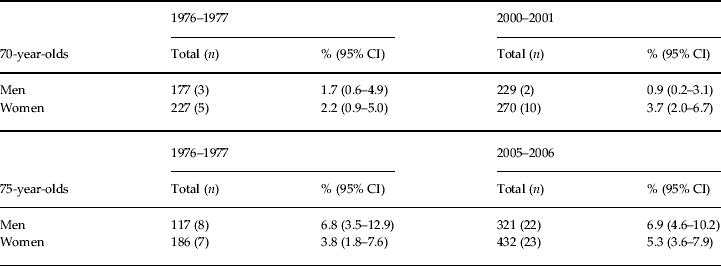
The prevalence of dementia in 70- and 75-year-olds in relation to age, sex and examination year is given in Table 1. The prevalence of dementia was 2.0% in 1976–1977 and 2.4% in 2000–2001 among 70-year-olds, and 5.0% in 1976–1977 and 6.0% in 2005–2006 among 75-year-olds. The first GLM showed that dementia was related to age (p < 0.001) but not to birth cohort or sex. The second GLM showed that there was an interaction effect between sex and age (p = 0.17); that is the prevalence of dementia increased more with age in men than in women in both birth cohorts.
Prevalence of dementia in 70-year-olds examined in 1976–1977 and 2000–2001 and 75-year-olds examined in 1976–1977 and 2005–2006
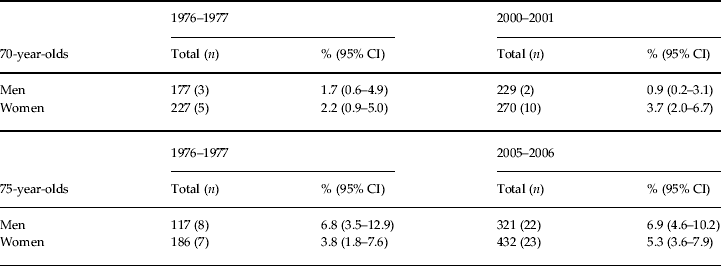
CI, Confidence interval.
General Linear Model 1: Age difference in the prevalence of dementia p < 0.001; sex difference not significant; birth cohort difference not significant.
General Linear Model 2: Interaction age × sex p = 0.17.
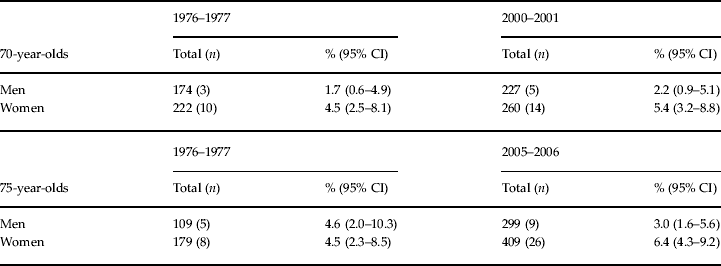
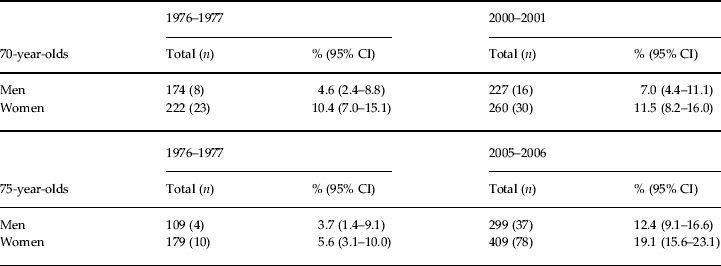
The prevalence of major and minor depression in 70- and 75-year-olds in relation to age, sex and examination year is given in Tables 2 and 3. Those with dementia were excluded from the sample in the analyses of the prevalence of depression. The first GLM showed that major depression was related to sex (p = 0.007) but not to birth cohort or age (Table 2). The second GLM analyses showed no interaction effects between sex, age and birth cohorts for major depression. We then repeated the analyses with minor depression as the dependent variable (Table 3). The first GLM showed that minor depression was related to birth cohort (p < 0.01), sex (p = 0.001) and age (p = 0.026). The second GLM analyses showed that minor depression was related to birth cohort (p < 0.01), sex (p = 0.020), age (p = 0.009) and the interaction effect of birth cohort × age (p = 0.004); that is the prevalence of minor depression increased with age in the 2000s but not in the 1970s and the birth cohort difference was only observed among 75-year-olds.
Prevalence of major depression in 70-year-olds examined in 1976–1977 and 2000–2001 and 75-year-olds examined in 1976–1977 and 2005–2006
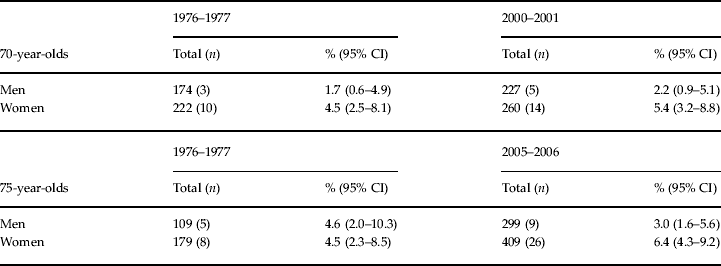
CI, Confidence interval.
General Linear Model 1: Sex difference p < 0.001; birth cohort difference not significant; age difference not significant.
General Linear Model 2: No interaction effects.
Prevalence of minor depression in 70-year-olds examined in 1976–1977 and 2000–2001 and 75-yearolds examined in 1976–1977 and 2005–2006
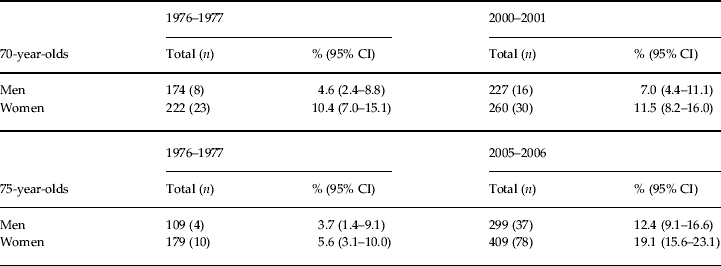
CI, Confidence interval.
General Linear Model 1: Birth cohort difference p < 0.001; sex difference p = 0.001; age difference p = 0.026.
General Linear Model 2: Birth cohort difference p < 0.001; sex difference p = 0.020; age difference p = 0.009; birth cohort × age p = 0.004.
Discussion
To our knowledge, this is the first study reporting on secular trends in the prevalence of dementia and depression in later life using identical methods in population samples examined over three decades. We found no support for birth cohort differences in the prevalence of dementia at age 70 and 75 years. Similarly, no differences could be shown regarding the prevalence of major depression. The prevalence of minor depression, however, increased with age in the later-born cohort but not in those examined in the 1970s. Minor depression was thus more prevalent in the later-born cohort among 75-year-olds.
The prevalence of dementia did not change during the 30-year period, despite higher educational level, better results on cognitive tests, better socio-economic status, better treatment of vascular risk factors and better general physical health in the later-born cohort (Beckman et al. Reference Beckman, Waern, Gustafson and Skoog2008; Sacuiu et al. Reference Sacuiu, Gustafson, Sjögren, Guo, Ostling, Johansson and Skoog2010). Given these large secular changes, a decrease in the prevalence of dementia might have been expected. However, increased survival might result in more people with risk factors for dementia surviving into old age. Previous studies on secular changes in the prevalence of dementia have examined much shorter time intervals. A study from Indianapolis found no difference in the prevalence of dementia between 1992 and 2001 (Hall et al. Reference Hall, Gao, Baiyewu, Lane, Gureje, Shen, Ogunniyi, Murrell, Unverzagt, Dickens, Smith-Gamble and Hendrie2009) whereas a study from Spain reported a decrease among men between 1988–1989 and 1994–1996 (Lobo et al. Reference Lobo, Saz, Marcos, Dia, De-la-Camara, Ventura, Montanes, Lobo-Escolar and Aznar2007). Considering the low prevalence of dementia at ages 70 and 75, it is possible that our study did not have the power to detect small changes in the frequency of dementia. However, we note that our prevalence figures for dementia are similar to those reported in other studies in this age group (Lobo et al. Reference Lobo, Saz, Marcos, Dia, De-la-Camara, Ventura, Montanes, Lobo-Escolar and Aznar2007; Skoog, Reference Skoog, Heggenhougen and Quah2008; Hall et al. Reference Hall, Gao, Baiyewu, Lane, Gureje, Shen, Ogunniyi, Murrell, Unverzagt, Dickens, Smith-Gamble and Hendrie2009), and are in line with the suggestion that the prevalence of dementia doubles for every 5-year increase in age (Jorm et al. Reference Jorm, Korten and Henderson1987).
Our finding of no change in the prevalence of major depression between birth cohorts should be seen in the light of previous birth cohort studies. We could not confirm previous reports from the USA of an increased frequency of major depression during the later part of the 20th century (Klerman & Weissman, Reference Klerman and Weissman1989; Compton et al. Reference Compton, Conway, Stinson and Grant2006). It has been suggested that people born in the early part of the last century had lower rates of major depression than those born after World War II (Klerman et al. Reference Klerman, Lavori, Rice, Reich, Endicott, Andreasen, Keller and Hirschfield1985; Lavori et al. Reference Lavori, Klerman, Keller, Reich, Rice and Endicott1987; Wickramaratne et al. Reference Wickramaratne, Weissman, Leaf and Holford1989; Weissman et al. Reference Weissman, Wickramaratne, Greenwald, Hsu, Ouellette, Robins, Escobar, Bland, Newman, Orn, Canino, Rubiostipec, Wittchen, Essau, Faravelli, Incerpi, Deglinnocenti, Aiazzi, Pallanti, Lepine, Pariente, Lellouch, Karam, Wells, Joyce, Oakleybrowne, Bushnell, Hwu, Yeh, Chang, Klerman, Leon, Lavori, Warshaw, Maier, Marx, Lichtermann, Minges, Heun and Hallmayer1992). As both our cohorts were born before World War II, we cannot comment on this hypothesis. Our findings are, however, in line with several studies in the elderly reporting that the prevalence of major depression does not increase with age (Steffens et al. Reference Steffens, Skoog, Norton, Hart, Tschanz, Plassman, Wyse, Welsh-Bohmer and Breitner2000; Eaton et al. Reference Eaton, Kalaydjian, Scharfstein, Mezuk and Ding2007; McDougall et al. Reference McDougall, Kvaal, Matthews, Paykel, Jones, Dewey and Brayne2007; Byers et al. Reference Byers, Yaffe, Covinsky, Friedman and Bruce2010; Spiers et al. Reference Spiers, Brugha, Bebbington, McManus, Jenkins and Meltzer2012).
We found that the prevalence of minor depression increased substantially among 75-year-old men and women from 1976–1977 to 2005–2006. The very high prevalence of minor depression among 75-year-olds in 2005–2006 may seem surprising. This finding is similar to a study from Indianapolis where the prevalence of overall depression in the elderly increased between 1992 and 2001 (Hall et al. Reference Hall, Gao, Baiyewu, Lane, Gureje, Shen, Ogunniyi, Murrell, Unverzagt, Dickens, Smith-Gamble and Hendrie2009), and another Swedish study reporting that the prevalence of milder forms of depression increased during the 20th century (Hagnell et al. Reference Hagnell, Lanke, Rorsman and Ojesjo1982). Minor depression is thought to be more closely related to psychosocial factors whereas major depression is thought to be more biologically and genetically determined (Beekman et al. Reference Beekman, Deeg, van Tilburg, Smit, Hooijer and van Tilburg1995). Socio-economic context may thus be more important for minor than for major depression. The finding that the prevalence of minor depression increased in 75-year-olds may be related to period effects (i.e. factors occurring around 2005–2006) or birth cohort effects (i.e. factors occurring during the lifespan of the two birth cohorts). We are not aware of any period effects potentially related to the prevalence of mild depression occurring around 2005–2006. However, as mentioned earlier, large secular changes in socio-economic factors occurred over the 30 years of study. It may be that later-born cohorts, not faced with an everyday struggle to fulfill basic needs, may demand more of life and thus feel more depressed despite objectively having a higher standard of living. The elderly today may also be more emotionally sensitive to changes occurring with aging in a time that is highly youth oriented. Age-related changes in, for example, functional ability, self-images and somatic health are probably more common at age 75 than at age 70. If so, the prevalence of minor depression should increase more with age in later-born cohorts. Indeed, in the first cohort born in the early 20th century, there was no increase in the prevalence of minor depression from age 70 to 75, whereas the prevalence of minor depression increased from age 70 to 75 years in those born in 1930. This is consistent with a study suggesting that depressive symptoms increased with age among women born during 1928–1944 but decreased with age in those born during 1945–1958 (Kasen et al. Reference Kasen, Cohen, Chen and Castille2003).
Another partial explanation for the increase in minor depression among 75-year-olds may be that a healthy survivor effect was more influential in the 1970s than in the 2000s. The average life expectancy increased in Sweden during the study period from 72 to 77 years in men and from 78 to 82 years in women (Statistics Sweden, 2011). Thus, it can be assumed that more people with depression survived into old age in the 2000s compared to the 1970s. However, this should also have influenced the prevalence of major depression. A further explanation may be a survey effect, but the assessors were to a large extent the same as those in 2000–2001; they had the same training, questions were asked in the same order and inter-rater reliability was high. We note that our prevalence figures of depression are similar to those in most cross-sectional studies in the elderly, which report a prevalence of depression of around 10% and a prevalence of major depression of around 3% (Skoog et al. Reference Skoog, Nilsson, Landahl and Steen1993a; Beekman et al. Reference Beekman, Deeg, van Tilburg, Smit, Hooijer and van Tilburg1995; Ernst & Angst, Reference Ernst and Angst1995; Palsson & Skoog, Reference Palsson and Skoog1997; Jorm, Reference Jorm2000; Steffens et al. Reference Steffens, Skoog, Norton, Hart, Tschanz, Plassman, Wyse, Welsh-Bohmer and Breitner2000; Ritchie et al. Reference Ritchie, Artero, Beluche, Ancelin, Mann, Dupuy, Malafosse and Boulenger2004; Riedel-Heller et al. Reference Riedel-Heller, Busse and Angermeyer2006; McDougall et al. Reference McDougall, Kvaal, Matthews, Paykel, Jones, Dewey and Brayne2007).
Although depression is generally reported to be more common among women than among men (Culbertson, Reference Culbertson1997; Grigoriadis & Robinson, Reference Grigoriadis and Robinson2007), it has been suggested that this gender difference decreases with increasing age (Jorm, Reference Jorm1987). Our findings from 1976–1977 support the latter hypothesis, as minor depression was more common in women among 70-year-olds whereas there was no gender difference at age 75. However, three decades later, both minor depression and major depression were more common among women than among men at that age. Others have reported that the frequency of major depression increased in subsequent birth cohorts of women born before World War II (born 1915–1925), whereas an increase in men was not observed until birth cohorts born after 1955 (Wickramaratne et al. Reference Wickramaratne, Weissman, Leaf and Holford1989; Weissman et al. Reference Weissman, Bland, Joyce, Newman, Wells and Wittchen1993). The finding that sex differences remained between birth cohorts, despite large changes in gender roles (Kasen et al. Reference Kasen, Cohen, Chen and Castille2003), has also been reported by others (Kessler et al. Reference Kessler, Demler, Frank, Olfson, Pincus, Walters, Wang, Wells and Zaslavsky2005).
Major strengths of our study include the study design, with general population samples examined with identical methods over a 30-year period, and the fact that the interviews were part of a comprehensive investigation of aging. Furthermore, the interviews were performed by psychiatrists and psychiatric nurses.
There are also possible limitations and sources of error that need to be addressed. First, although the response rate in this study is relatively high, it declined from 79% in 1976–1977 to 66% in 2000–2001 and 63% in 2005–2006. In addition, although there were no differences between responders and non-responders in 2000–2001 and 2005–2006 regarding psychiatric disorders, depression and dementia in the Swedish Hospital Discharge Register, we cannot exclude the possibility that dementia and depression were more prevalent among those who declined to participate. Participants might thus be healthier than non-participants, which might have led to an underestimation of dementia and depression in our sample. Second, all studies in the elderly include a survival bias, that is we only examined those who reached the age of 70. Thus, we cannot make any conclusions regarding previous or lifetime occurrence of depression in the cohorts. Third, mental symptoms are sensitive to report to a stranger. However, all interviews were conducted by psychiatrists or experienced psychiatric research nurses using a semi-structured interview. It might also be easier to report mental symptoms to a professional within the context of an examination on different aspects of aging. Fourth, the cohorts were examined by psychiatrists in 1976–1977 and by psychiatric research nurses in 2000–2001 and 2005–2006. I. Skoog was trained by those who conducted the examinations in the 1970s, and in turn trained those who conducted the examinations in 2000–2001 and 2005–2006. Inter-rater reliability between I. Skoog and the examiners in the 1970s and 2000s was high, which suggests consistency in the interviews over time. Fifth, we were limited to those questions used in the 1970s and could thus not diagnose dementia according to more modern criteria. However, agreement for a dementia diagnosis between the historical and the DSM-III-R criteria was high (Wancata et al. Reference Wancata, Börjesson-Hansson, Ostling, Sjögren and Skoog2007). Sixth, it should be emphasized that some of the subgroups (e.g. men and women) might have been too small to yield statistical power. This might have led to some false-negative results.
Acknowledgments
This study was supported by grants from the Swedish Council for Working Life and Social Research (nos 2001-2835, 2001-2646, 2003-0234, 2004-0150, 2004-0145, 2006-0596, 2006-0020, 2008-1111, 2008-1229, 2010-0870, Epilife 2006-1506), the Alzheimer's Association Stephanie B. Overstreet Scholars (IIRG-00-2159), the Swedish Research Council (no. 11267, 2005-8460, 825-2007-7462), Swedish Brain Power, The Bank of Sweden Tercentenary Foundation, Stiftelsen för Gamla Tjänarinnor, and Handlanden Hjalmar Svenssons Forskningsfond.
Declaration of Interest
None.