Introduction
Cancer is a life-threatening disease that profoundly affects individuals, disrupting various aspects of their lives (Nooripour et al. Reference Nooripour, Hosseinian and Ghanbari2021). In Iran, the incidence and mortality rates of cancer are alarmingly high. According to the Global Cancer Observatory (GLOBALCAN) project, approximately 110,115 new cancer cases were registered in Iran in 2018, with 55,785 reported deaths (IRo-GCO 2018). In 2020, there were 131,191 newly diagnosed cancer patients, and 79,136 individuals succumbed to the disease (Izadi et al. Reference Izadi, Etemad and Mohseni2022). The most prevalent types of cancer in Iran include stomach, breast, prostate, lung, and colorectal cancers (Mohammadian et al. Reference Mohammadian, Salehiniya and Mohammadian-Hafshejani2017). Cancer-related deaths rank second only to cardiovascular diseases and accidents in the country (Farhood et al. Reference Farhood, Geraily and Alizadeh2018).
The experience of cancer and its treatment process is known to contribute to physical and psychological challenges for individuals (Aryankhesal et al. Reference Aryankhesal, Ghashghaee and Sardari2022). Identifying psychological factors that affect cancer patients is crucial because timely recognition and appropriate psychological treatments can lead to improved outcomes (Faller et al. Reference Faller, Schuler and Richard2013). Psychological disorders such as anxiety, depression, psychological distress, and fear of cancer are commonly reported among cancer patients (Mitchell et al. Reference Mitchell, Chan and Bhatti2011). Individuals with cancer who experience psychological and psychiatric problems tend to use more psychological interventions, medical visits, and hospitalizations, while those with fewer psychological issues adhere better to treatment, resulting in improved effectiveness (Jack et al. Reference Jack, McLean and Moffett2010). Individuals with cancer and comorbid mental disorders may have a higher risk of developing other health conditions such as diabetes and cardiovascular diseases (Proctor et al. Reference Proctor, Morrow-Howell and Doré2003). Given the significant impact of psychological factors on cancer patients, investigating and addressing these aspects is crucial for their overall well-being and treatment outcomes.
Demoralization is one of the significant psychological issues observed in cancer patients, with studies indicating that 1 in 5 individuals diagnosed with cancer experiences demoralization (Robinson et al. Reference Robinson, Kissane and Brooker2015; Tecuta et al. Reference Tecuta, Tomba and Grandi2015). Demoralization can be defined as psychological distress commonly observed in terminally ill patients (Robinson et al. Reference Robinson, Kissane and Brooker2016a). It is characterized by a decrease in morale, an inability to cope with challenging life situations, and is associated with feelings of failure, helplessness, hopelessness, loss of meaning in life, and diminished self-worth (De Figueiredo Reference De Figueiredo1993). Importantly, demoralization has been identified as a contributing factor to suicidal thoughts, with research demonstrating a link between demoralization and a desire for early death (Fang et al. Reference Fang, Chang and Chen2014). There are some differences between demoralization and depression; depression is distinguished by the presence of anhedonia, which is the inability to derive pleasure from both anticipatory aspects of life. In contrast, individuals experiencing demoralization are still capable of experiencing consummatory pleasure. It is important to note that anhedonia, along with other depressive symptoms, should endure for a minimum duration of 2 weeks, and it is necessary to rule out the presence of a major depressive disorder or any other primary psychiatric condition in these cases (Tang et al. Reference Tang, Li and Pang2020).
Grassi et al. in 2004 found that 28.8% of the patients experienced demoralization (Grassi et al. Reference Grassi, Rossi and Sabato2004). Demoralization can be seen as a precursor to depression, and the symptoms associated with cancer, such as fatigue, sleep disturbances and appetite loss resulting from chemotherapy, and can often be mistaken for signs of depression. Therefore, timely identification of demoralization and depression, along with appropriate interventions, is crucial (Kissane Reference Kissane2004).
Several assessment tools have been developed to measure demoralization, one of which is the modified 16-item Demoralization Scale, a shortened version of the original 24-item questionnaire developed by Robinson et al. (Reference Robinson, Kissane and Brooker2016a). This questionnaire, which was validated on 211 patients with advanced cancer and other incurable diseases (e.g., neurological and cardiac conditions), consists of 2 components: meaning and purpose (8 items, mean score: 3.75 ± 3.67) and distress and coping ability (8 items, mean score: 3.89 ± 3.7) (Robinson et al. Reference Robinson, Kissane and Brooker2016a).
Demoralization Scale-II (DS-II) has been translated into various languages, including Spanish, German, and Korean, and its validity and reliability have been evaluated in different populations. In a study conducted in Spain with 155 patients, confirmatory factor analysis (CFA) indicated an acceptable fit, and all items were positively related to the components and the overall scale (Belar et al. Reference Belar, Arantzamendi and Rodríguez-Núñez2019). In a study involving 620 cancer patients in Germany, the following results were obtained: meaning and purpose, distress and coping ability, and total scale (Koranyi et al. Reference Koranyi, Hinz and Hufeld2021a).
In the Iranian context, the assessment of demoralization among cancer patients has traditionally relied on general psychological instruments, with a notable absence of culturally tailored tools specifically designed for measuring demoralization. Previous studies in Iran have often utilized broad-spectrum tools like the Hospital Anxiety and Depression Scale (HADS) for psychological assessment, which, while useful, may not fully capture the nuanced aspects of demoralization (Montazeri et al. Reference Montazeri, Vahdaninia and Ebrahimi2003). The DS-II, with its focused approach, presents a significant advancement in this regard. It specifically addresses the unique components of demoralization, such as a sense of hopelessness and a lack of meaning, which are not distinctly measured by more general psychological scales. The cultural relevance of demoralization in the Iranian context is particularly crucial given the societal and familial dynamics that can influence a patient’s experience with cancer. Iran’s strong emphasis on family and social networks means that the psychological impact of cancer extends beyond the individual, affecting a broader community, which the DS-II can more precisely evaluate. This cultural-specific approach is essential for developing appropriate interventions and support mechanisms tailored to the Iranian population, thereby enhancing the efficacy of psychological care for cancer patients in Iran.
Given the significance of demoralization in cancer patients and the need to differentiate it from depression, as well as the suitability of the DS-II in measuring demoralization, this study aims to translate and assess the validity of this instrument among cancer patients in the Iranian community, where no appropriate tool currently exists.
Methods
This study was descriptive-analytical cross-sectional research.
Participants
The statistical population was cancer patients who sought treatment at Imam Khomeini Hospital in Tehran throughout the 2021–2022. In the initial phase of the study, a preliminary sample comprising 200 patients was carefully selected through convenience sampling. After applying these criteria, 160 patients satisfactorily completed the questionnaires, forming the final study sample. This method was chosen for its practicality in efficiently accessing a representative segment of the statistical population. The selection process was governed by well-defined inclusion and exclusion criteria to ensure a homogenous and relevant sample. The inclusion criteria mandated that participants voluntarily provide written informed consent, possess a fundamental level of literacy, defined as the ability to read and write, and be adults aged 18 years or above. In line with these criteria, the study further refined its participant pool by excluding certain individuals. Those with diagnosed psychological or neurological disorders were excluded, as their conditions could potentially confound the research findings. Additionally, any patient expressing unwillingness to participate in the study was also excluded. This meticulous selection process ensured the collection of data that would accurately reflect the experiences and needs of the target demographic. This careful and systematic approach to sampling was crucial in maintaining the study’s integrity and validity. By employing stringent inclusion and exclusion criteria, the research was able to collect data that was both reliable and applicable to the broader population of cancer patients at Imam Khomeini Hospital. This methodology not only reinforced the study’s scientific rigor but also enhanced the generalizability and applicability of its findings in the field of psychometric research.
Procedure
To validate the adequacy of the sample size used in this study, a comprehensive power analysis was performed in line with the standard methodologies (Cohen Reference Cohen2013). This critical step was undertaken to determine the optimal sample size necessary for reliably detecting the expected effect within the study, thus ensuring statistical rigor and precision. The power analysis, factoring in the effect size, alpha level, and power, revealed that the chosen sample size, approximately 10 times the number of items in the DS-II, effectively achieves the desired statistical power of 0.80, under an alpha level of 0.05. Adherence to these guidelines not only reinforces the validity of the sample size selection but also significantly enhances overall reliability and credibility of the study’s findings. Such diligent alignment of the research design with recognized statistical standards strengthens methodological foundation of study, thereby augmenting its contribution to field. In the translation of the DS-II to Farsi, a methodologically robust forward-backward translation approach was employed, ensuring both linguistic accuracy and cultural relevance. This method, widely recognized for its effectiveness in cross-cultural research, involves translating the original text (English in this case) into the target language (Farsi), and then independently translating this version back into the original language. A bilingual expert, proficient in psychological terminologies, to maintain the conceptual integrity of the scale, carried out the initial translation. An independent expert to identify and rectify any discrepancies performed the subsequent reverse translation. This step was critical in addressing the challenges posed by idiomatic expressions and cultural nuances, which are common in psychological assessments. Discrepancies were resolved through discussions with a panel of experts, comprising psychologists and linguists, ensuring the final Farsi version accurately reflected the original scale’s intent while being appropriately adapted to the Iranian cultural context. Such a comprehensive approach to translation is supported by (Brislin Reference Brislin1970), who emphasizes the importance of involving multiple translators and experts to ensure the fidelity of the translated material in cross-cultural research. This meticulous process underscores our commitment to maintaining the psychometric properties of the DS-II in its Farsi version, making it a reliable and valid tool for assessing demoralization in Iranian cancer patients.
Measures
Demoralization Scale-II
In this study, we employed a questionnaire developed by Robinson et al., in 2016. The DS-II is comprised of 16 items rated on a 3-point Likert scale, including 0 (never), 1 (sometimes), and 2 (often), with higher scores indicative of higher levels of demoralization (score range, 0–32).1 It contains two 8-item factors: Meaning and purpose and Distress and coping ability. The authors of the original DS-II scale (Robinson et al. Reference Robinson, Kissane and Brooker2016a), defined the following cutoff criteria for the total score: low (0–3), moderate (4–10), and high (≥11) demoralization. The current questionnaire comprises 16 questions, designed to evaluate 2 subscales: “Meaning and purpose” and “Distress and coping ability.” Participants provide their responses to each item using a 3-point Likert scale, where “never” is represented by 0 and “often” by 2 (Robinson et al. Reference Robinson, Kissane and Brooker2016a).
Scale of Happiness of the Memorial University of Newfoundland
Kuzma and Stones originally developed this scale in 1980. The scale consists of 24 questions, with 14 items assessing long-term dimensions (traits) and 10 items assessing short-term dimensions (state). Participants provide responses to each question using a 3-point Likert scale, where “yes” is coded as 2, “don’t know” as 1, and “no” as 0. The reliability of the test in the Iranian population was reported to be 0.88 using Cronbach’s alpha coefficient (Ghahremani et al. Reference Ghahremani, Tehrani and Rajabi2020).
Beck Depression Inventory (BDI-II)
The BDI-II has 21 items and was developed to measure the level of depression in adults and adolescents. The measure uses a 4-point Likert scale ranging from 0 to 3, with a score of 0–13 considered minimal, 14–19 mild, 20–28 moderate, and 29–63 severe. This scale has been appropriately standardized in Iran, and its reliability was evaluated using the Cronbach’s alpha coefficient, yielding a recorded value of 0.84 in Iran. This high alpha coefficient indicates a strong level of internal consistency for the scale (Emad and Hadianfard Reference Emad and Hadianfard2019).
Statistical analysis
Our research methodology was structured in 2 phases to rigorously validate the questionnaire. In the first phase, we utilized Exploratory Factor Analysis (EFA) on half of the sample to investigate the underlying factor structure of the questionnaire. In the second phase, we performed the CFA on remaining half of the sample to further confirm the questionnaire’s factor structure. For CFA, we employed IBM SPSS Statistics 22.0 and LISREL 8.8 to analyze the data. The use of SPSS was particularly beneficial for examining demographic characteristics and conducting Pearson correlations between the Persian version of the DS-II and other psychological measures such as the MUNSH Happiness Scale and Beck’s Depression Scale. Meanwhile, LISREL 8.8 was instrumental in confirming the internal structure of the questionnaire, particularly in assessing the 2-factor structure of the DS-II. The Chi-Square (χ2) test was used as a primary measure to assess the overall fit, with a lower χ2 value indicating a better fit between the model and the observed data. However, due to its sensitivity to sample size, this test was complemented by other indices. The Root Mean Square Error of Approximation (RMSEA) was selected for its effectiveness in evaluating the model fit per degree of freedom, accounting for the complexity of the model. Values below 0.08 typically suggest a good fit. The Standardized Root Mean Square Residual (SRMR) and the Comparative Fit Index (CFI) were utilized to measure the average discrepancy and the relative improvement in fit of the model compared to a baseline model, respectively. Both SRMR and CFI are less sensitive to sample size, making them robust measures for our analysis. Additionally, we used the Goodness-of-Fit Index (GFI) and the Adjusted Goodness-of-Fit Index (AGFI) to examine the proportion of variance explained by the model, with higher values (above 0.90) indicating a better fit.
Results
This sample was 160 Iranian cancer patients. As Table 1, the majority of the participants were female (n = 112, 70%), classified as housewives (n = 98, 61.3%), married (n = 130, 81.3%), aged 50 years and older (N = 104, 65.0%), possessing primary education (n = 91, 56.9%), and diagnosed with breast cancer (n = 43, 26.9%).
Participant sociodemographic features

As Table 1, we divided our sample into several subgroups based on gender, age, marital status, occupation, type of cancer, and education level. For each of these subgroups, we calculated the Cronbach’s alpha coefficient for the DS-II to evaluate its internal consistency within these distinct groups. Our findings revealed that the DS-II maintained a high level of internal consistency across all demographic subgroups. The Cronbach’s alpha values for each subgroup were as follows: gender (females α = 0.92, males α = 0.91), age categories (18–30 years α = 0.90, 31–50 years α = 0.89, over 50 years α = 0.93), marital status (single α = 0.88, married α = 0.92), occupation (unemployed α = 0.90, housewife α = 0.91, self-employed α = 0.89, employee α = 0.92, teacher α = 0.93, retired α = 0.90), type of cancer (stomach α = 0.89, womb α = 0.90, liver α = 0.91, chest α = 0.92, intestine α = 0.90, lung α = 0.88, ovary α = 0.89, leg α = 0.87, lymphoma α = 0.91, eye α = 0.90, sarcoma α = 0.88, melanoma α = 0.89, brain α = 0.87, blood α = 0.88), and education level (primary α = 0.91, diploma α = 0.90, bachelor α = 0.92, master α = 0.93). These results indicate that the DS-II is a reliable instrument for assessing demoralization across a diverse range of demographic groups, thus reinforcing its applicability in our research context. This robustness in internal consistency across various demographic segments ensures that the DS-II can be effectively used in clinical and research settings with diverse populations.
Factor structure
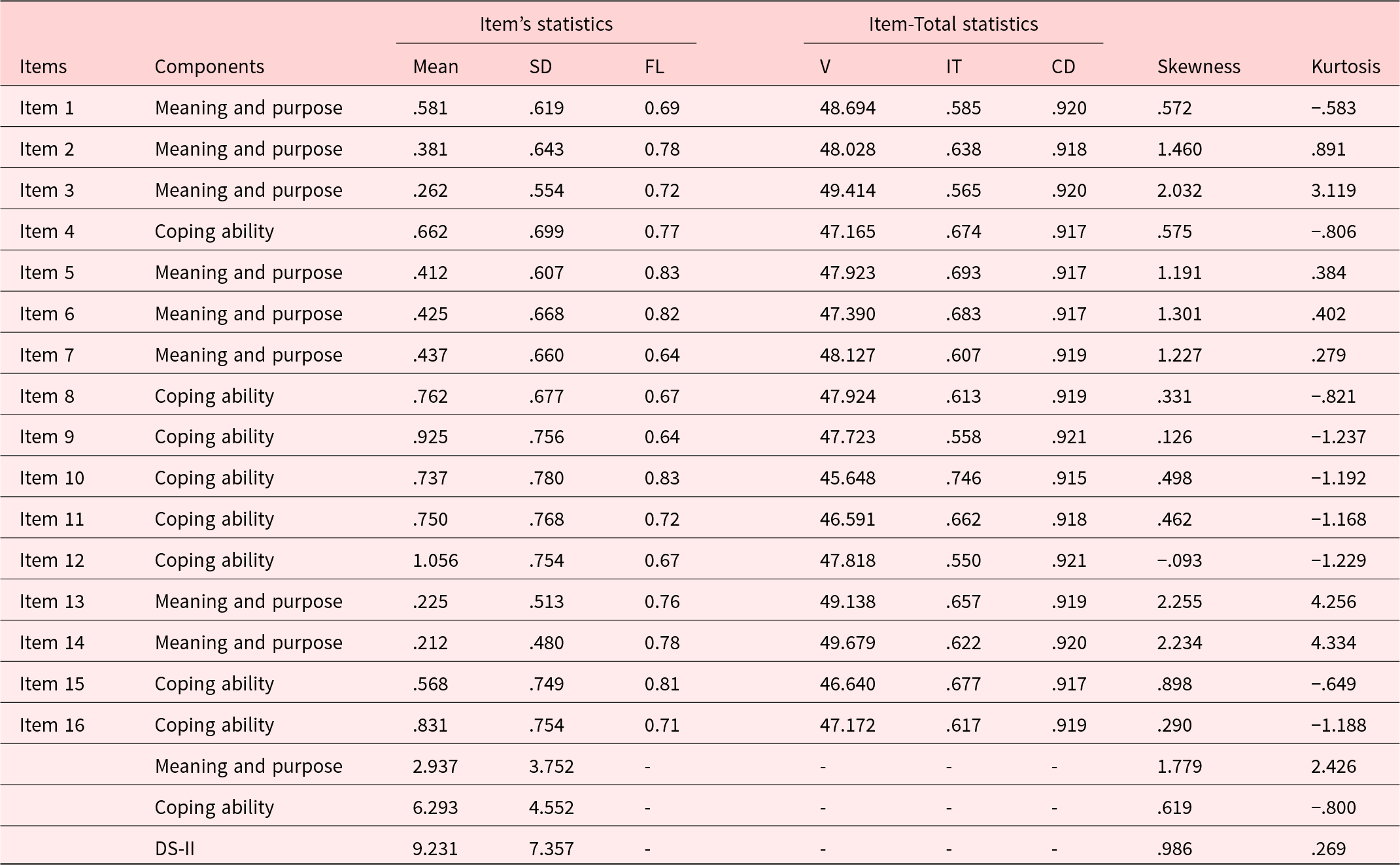
All items exhibited statistically significant factor loadings (p < 0.001). The findings indicate that the standardized estimates for all items on the DS-II exceeded 0.60. An examination of the model’s fitness demonstrated a strong fit with the data, with the findings supporting the 2-factor model (Table 2 and Figure 1).
Model fit indexs off Demoralization scale.

Descriptive statistic indices for the items of the DS-II

V = scale variance if item deleted, FL = factor loading, IT = corrected item-total correlations, CD = Cronbach’s alpha if item deleted, DS-II = Demoralization Scale-II.
Table 2 displays the descriptive statistics for the 16 DS-II-related items. The mean score obtained was 0.576 (SD = 0.459), with all 16 items falling within the range of 0.–1.05. Additionally, all corrected item-total correlations exceeded 0.55.
Figure 1 shows the existing literature, a 2-factor model was examined using CFA, which demonstrated a marginal fit with the data. The Kaiser–Meyer–Olkin (KMO) coefficient, measuring sample adequacy for factor analysis, was 0.931. Figure 1 demonstrates that all item loadings exhibit significance, with standardized factor loadings exceeding 0.60.
Internal consistency reliability
The internal consistency reliability of the Persian Version of the DS-II was assessed using data from the main study. Cronbach’s alpha, McDonald’s omega, and Guttman’s lambda coefficient tests were employed for this purpose, yielding values of 0.92, 0.92, and 0.7, respectively. These results indicate a high level of internal reliability for the DS-II, demonstrating its consistency.
Convergent, divergent, and discriminant validity
The Pearson correlations obtained between the Persian Version of the DS-II and measures of demoralization, MUNSH happiness, and Beck’s Depression indicate strong convergent validity (Table 5). Table 3 shows the CFA for the DS-II, offering a comprehensive statistical evaluation of the model’s fitness. The results of the CFA indicated a good fit for the 2-factor structure with the following indices: χ2 = 144.32 (p < 0.01); SRMR = 0.051; RMR = 0.023; CFI = 0.99; Normed Fit Index = 0.96; Incremental Fit Index = 0.99; GFI = 0.99; AGFI = 0.90; RMSEA = 0.051. These findings reveal that all standardized factor loadings for the items were statistically significant (p < 0.01), supporting the suitability of each item for its respective component. Factor loadings for the DS-II items ranged from 0.64 to 0.83.
Confirmatory factor analysis (CFA) and model’s fitness indexes

BM = before modification, AM = after modification, RMSEA = Root Mean Square Error of Approximation; RMR = Root Mean Square Residual; SRMR = Standardized RMR; CFI = Comparative Fit Index; NFI = Normed Fit Index; IFI = Incremental Fit Index; RFI: Relative Fit Index; AGFI = Adjusted Goodness-of-Fit Index; GFI: Goodness-of-Fit Index.
The results of this study elucidate the intricate relationships existing between the DS-II and various psychological parameters. Notably, a significant positive correlation was established between the cumulative DS-II score and Beck’s Depression (r = 0.459, p < 0.01). This correlation also extends to the individual components constituting demoralization, further substantiated by a p-value falling below the 0.01 threshold. Concurrently, a significant negative correlation was discerned between the aggregate DS-II score and the Memorial University of Newfoundland Scale of Happiness (MUNSH) (r = −0.357, p < 0.01) (Table 5).
Discussion
This research was primarily focused on evaluating the psychometric characteristics of the Farsi version of the DS-II among Iranian cancer patients. The comprehensive statistical analysis conducted offers substantial evidence supporting the appropriateness, validity, and reliability of the questionnaire. Significantly, this version of the DS-II has been meticulously translated and examined across a variety of linguistic and cultural environments in multiple countries, reinforcing its global applicability and relevance. This cross-cultural assessment underscores the adaptability and accuracy of the DS-II in capturing the nuances of demoralization among diverse patient populations, thereby solidifying its standing as a valuable instrument in the field of psycho-oncology (Alazne et al. Reference Alazne, Arantzamendi and Nuñez2019; Belar et al. Reference Belar, Arantzamendi and Rodríguez-Núñez2019; Elmasian et al. Reference Elmasian, Nikoloudi and Tsilika2023; Koranyi et al. Reference Koranyi, Hinz and Hufeld2021b; Palacios-Espinosa et al. Reference Palacios-Espinosa, Sánchez-Pedraza and Rodríguez2020; Ramm et al. Reference Ramm, Jedamzik and Lenz2023).
Table 4 provides in-depth analysis of internal consistency reliability of the DS-II, a critical indicator of the scale’s measurement stability and precision. The table reveals that the Cronbach’s alpha coefficient for the total scale is impressively high at 0.92, significantly exceeding the commonly recommended benchmark of 0.70 for psychological scales, indicating excellent internal consistency. Similarly, the subscales of “Meaning and purpose” and “Coping ability” exhibit alpha coefficients of 0.91 and 0.89, respectively, further validating reliability of these individual components. Additionally, the table reports McDonald’s omega and Guttman’s lambda-6 (G6) both mirror high reliability of the scale with omega values at 0.92 and lambda-6 at 0.87.
Internal consistency reliability the DS-II (DS-II)

α = Cronbach’s alpha; ω = McDonald’s omega; λ6 = Guttman’s lambda-6; DS-II = Demoralization Scale-II.
Correlations between demoralization, MUNSH happiness, and BDI-21 with the DS-II

* Correlation is significant at the 0.05 level.
**Correlation is significant at the 0.01 level.
The EFA conducted in this study elucidated 2 distinct factors within the DS-II: “Loss of meaning and purpose” and “Inability.” These components reflect the complex psychological landscape experienced by individuals grappling with cancer. The “Loss of meaning and purpose” factor encapsulates feelings of existential void and a perceived lack of significance in life, while the “Inability” component represents the perceived deficits in coping mechanisms and resilience. The CFA reinforced the bifurcation of these components, exhibiting an acceptable fit for the 2-factor model. This bifactor model’s structural validity is crucial for understanding and measuring the multifaceted nature of demoralization in clinical settings. The alignment of these findings with existing literature further validates the robustness and applicability of the DS-II in diverse contexts (Koranyi et al. Reference Koranyi, Hinz and Hufeld2021b; Mehnert et al. Reference Mehnert, Vehling and Höcker2011; Robinson et al. Reference Robinson, Kissane and Brooker2016b). It underscores the tool’s effectiveness in capturing the essence of demoralization, which is a critical aspect of psychological assessment in oncology. This alignment with previous literature indicates a consistent understanding of the construct of demoralization across different study populations, enhancing the credibility and utility of the DS-II in psycho-oncological research and practice.
The findings of this study reported a Cronbach’s alpha coefficient of 0.923 for the total score of DS-II, signifying the questionnaire’s validity within the Iranian societal context. This corresponds with the findings of research that Cronbach’s alpha for the DS-II was reported as 0.88 (Belar et al. Reference Belar, Arantzamendi and Rodríguez-Núñez2019). The results of this study demonstrate a high level of internal consistency for the DS-II as indicated by a Cronbach’s alpha coefficient of 0.923 for the total score. This robust alpha value not only attests to the scale’s reliability within the Iranian context but also aligns well with findings from various international studies, highlighting its cross-cultural applicability. For instance, a study reported a Cronbach’s alpha of 0.93 for the DS-II (Koranyi et al. Reference Koranyi, Hinz and Hufeld2021b), and another study reported alpha coefficient of 0.94 for the total scale (Ramm et al. Reference Ramm, Jedamzik and Lenz2023). These varying yet consistently high alpha values across different studies underscore the DS-II’s strong internal consistency and validity in measuring demoralization across diverse patient populations. Such consistency in results across different cultural and linguistic contexts reinforces the DS-II’s utility as a reliable psychometric tool for assessing demoralization in cancer patients. This consistency also suggests that the core construct of demoralization captured by the DS-II is universally relevant and can be effectively applied in various cultural settings, thus broadening the scope of its application in psycho-oncological research and practice.
The concurrent validity analysis and divergent validity assessment of this study revealed insightful correlations between demoralization, as measured by the DS-II, and other psychological states. Notably, there was significant positive correlation between demoralization scores and levels of depression. This finding indicates that as an individual’s score on depression scales increases, so too does their level of demoralization. This relationship underscores interconnectedness of depression and demoralization, suggesting that these conditions may share common emotional and psychological underpinnings or could be mutually reinforcing. There was a significant negative correlation between demoralization and happiness. This inverse relationship implies that individuals who report higher levels of happiness tend to have lower scores of demoralization. This finding is crucial as it highlights the potential protective role of positive emotional states against feelings of demoralization. In practical terms, it suggests that interventions aimed at enhancing positive affect and happiness could be beneficial in reducing demoralization among individuals, particularly those dealing with chronic or severe illnesses like cancer. These correlations between demoralization, depression, and happiness are critical for understanding the complex emotional landscape of individuals facing challenging health conditions. They provide a nuanced perspective on how various emotional states interact and influence each other, offering valuable insights for both clinical practice and future research in psycho-oncology.
In the concurrent and divergent validity assessments, a multitude of studies have employed various questionnaires to yield statistically significant and insightful results. The research revealed moderate-to-strong negative correlations between the total scores of the DS-II and various crucial aspects of patient’s life and well-being (Robinson et al. Reference Robinson, Kissane and Brooker2016b). These aspects include the overall quality of life, the level of social support received, existential well-being, and the will to live. Such correlations underscore the profound impact that demoralization, as measured by the DS-II, can have on a patient’s holistic experience of their condition. The negative correlation indicates that higher levels of demoralization are associated with lower quality of life, reduced social support, diminished existential well-being, and a weakened desire to continue living. These correlations are significant as they highlight the multifaceted nature of demoralization in patients, especially those dealing with severe illnesses like cancer. The relationship between demoralization and these various aspects of a patient’s life points to the need for comprehensive care approaches that address not just the physical symptoms of an illness but also its psychological and existential impacts. Another research employed the Edmonton Symptom Assessment System – revised 12 and the HADS in their study, and the results revealed a relationship between demoralization and anxiety (Belar et al. Reference Belar, Arantzamendi and Rodríguez-Núñez2019). Their findings indicated the correlations between the DS-II subscale “Distress and coping ability” and the other scales were stronger than those involving the subscale “Meaning and purpose” (Koranyi et al. Reference Koranyi, Hinz and Hufeld2021b). It can be asserted that cancer is one of the most debilitating illnesses, profoundly affecting the psychological well-being and overall quality of life for those affected. In these cases, demoralization often intensifies considerably. Thus, having a dependable instrument for evaluating depression in these patients holds paramount importance in alleviating psychological distress. One notably effective tool for this purpose is the Kissane Demoralization Questionnaire, which has undergone translation and validation within the Iranian societal framework in this research, yielding commendable results in terms of both validity and reliability.
Cultural aspects play a significant role in the psychological experiences of cancer patients, and Iran is no exception. Iranian society has its unique cultural beliefs, norms, and values that influence how individuals cope with cancer. Several recent studies have highlighted the importance of considering these cultural factors. For instance, a study showed the impact of spirituality and religious beliefs on the Iranian cancer patients (Shirinabadi Farahani et al. Reference Shirinabadi Farahani, Ashrafizadeh and Akbari2022). Family plays a pivotal role in the lives of many Iranians, and understanding the dynamics of familial support is crucial in comprehending the psychological experiences of cancer patients in Iran (Nooripour et al. Reference Nooripour, Ghanbari and Hassani-Abharian2022). In the context of this study, it is important to acknowledge that demoralization among cancer patients in Iran may be influenced by cultural factors, including the importance of social support, spirituality, and the significance of preserving one’s dignity in the face of illness. These cultural nuances may influence how patients perceive and respond to demoralization, and they should be taken into account in clinical practice.
This study emphasized on unique cultural nuances that can influence the psychological well-being of individuals facing this challenging diagnosis. Cultural factors, such as spirituality, family dynamics, and societal norms, play a pivotal role in how cancer patients in Iran perceive and cope with demoralization. It is evident from the literature that these cultural elements can have a substantial impact on adherence to treatment, coping strategies, and the overall quality of life for Iranian cancer patients. Therefore, the validation of the DS-II questionnaire within the Iranian context is a significant step toward tailoring more interventions that are effective and support systems that are culturally sensitive and relevant. The study’s findings have direct implications for clinical practice in Iran. Health-care professionals working with cancer patients can now utilize the validated DS-II questionnaire as a valuable tool for screening and assessing demoralization. Early identification of demoralization can facilitate timely interventions and the development of personalized treatment plans. Understanding the specific factors contributing to demoralization, such as the loss of meaning and purpose or feelings of inability, can guide health-care providers in offering more targeted and effective support to improve the psychological well-being of cancer patients. It is essential to acknowledge the limitations of this study, including gender-based imbalances, limited representation of socioeconomic backgrounds, and the single cultural context. Future research should aim to address these limitations by incorporating more samples that are diverse, utilizing robust sampling strategies, and conducting cross-cultural comparisons to enhance our understanding of demoralization among cancer patients worldwide. By doing so, we can advance the field of psycho-oncology and provide more comprehensive care to individuals facing the challenges of cancer within various cultural contexts. These findings have important practical implications for clinical practice in Iran. The validated DS-II questionnaire can be a valuable tool for health-care professionals working with cancer patients in the Screening and Assessment of demoralization among cancer patients. Early identification of demoralization can help in providing timely interventions and support, and the questionnaire can assist in tailoring treatment plans for cancer patients.
Limitations
In this study, several limitations warrant consideration and require further elaboration. First, the study faced a notable gender imbalance among participants, with a majority of female respondents and fewer male participants. This gender disparity may have arisen due to potential reluctance among male patients to participate in research activities, possibly introducing gender-related biases and subsequently limiting the generalizability of the research findings. The research lacked comprehensive representation of diverse socioeconomic backgrounds among cancer patients. This limitation implies that the study may not have adequately accounted for the potential influence of economic status on the experiences of demoralization among the participants, thereby restricting the broader applicability of the study’s results to a more diverse population. The study’s specific focus on a particular age range, predominantly adults, raises concerns about its ability to fully encompass the nuances of demoralization experienced by pediatric or elderly patients. This narrow age demographic may constrain the study’s generalizability to a broader age range of cancer patients. The research was primarily conducted within the Iranian cultural context, which may not have sufficiently considered regional and cultural variations within Iran. This limitation potentially hinders the broader applicability of the study’s findings to different cultural groups, and a more extensive exploration of cultural diversity could enhance the study’s insights. The study’s reliance on a cross-sectional design also limits its ability to explore how demoralization may evolve over time among cancer patients. Longitudinal studies would provide a more comprehensive understanding of the dynamics of demoralization. The reliance on self-report measures introduces the possibility of response bias, which could affect the accuracy and reliability of the collected data. Future research could consider incorporating objective measures to complement self-report data. The use of convenience sampling, while practical, has inherent limitations such as selection bias, self-report bias, and potential variations across different cultural groups. Future research efforts may benefit from adopting more robust sampling strategies, such as randomized sampling methods, to enhance the methodological rigor and generalizability of the study’s findings.
These expanded and refined limitations should be acknowledged to guide future research endeavors aimed at advancing the understanding of demoralization among Iranian cancer patients without offering specific recommendations.
Implications for future research
The comprehensive research on the psychometric properties of the Farsi version of the DS-II in Iranian cancer patients lays a solid groundwork for a multifaceted exploration in psycho-oncology. Future research should prioritize longitudinal studies to track the progression and dynamics of demoralization over time, shedding light on the effectiveness of various interventions at different illness stages. Addressing the notable gender imbalance in current research, future studies must delve into gender-specific aspects of demoralization, with an emphasis on male cancer patients to provide a balanced perspective. Crucially, expanding the research to encompass diverse cultural groups within Iran, and comparing these findings with other regions, will illuminate the influence of cultural nuances on demoralization. This expansion should also consider the socioeconomic impact, exploring how financial stressors and health-care resource accessibility affect psychological well-being. Research must also extend to cover different age demographics, including pediatric and elderly cancer patients, to capture a broader spectrum of experiences. Methodologically, diversifying sampling methods, such as randomized sampling, and incorporating objective psychological assessments alongside self-report measures will enhance the robustness and reliability of future findings. Cross-cultural comparisons will further enrich our understanding, revealing both universal and culture-specific aspects of demoralization in cancer patients. These future endeavors should also focus on a wider range of demographic profiles, including different age-groups, genders, and cultural backgrounds, to understand how these factors interact with and influence the experience of demoralization. This is especially important in a culturally diverse nation like Iran, where regional differences could significantly impact psychological experiences. Incorporating both qualitative and quantitative analyses will yield richer, more nuanced insights, with qualitative studies offering deeper perspectives on the emotional and psychological challenges faced by cancer patients. The implications of this research are far-reaching, extending to clinical practice where understanding the nuanced aspects of demoralization in different population segments can aid health-care professionals in developing more targeted, effective, and culturally sensitive interventions. This approach is paramount in a clinical setting where personalized care is increasingly vital for patient well-being. Future research should build upon the current study’s findings, exploring new dimensions and addressing its limitations. This approach will not only deepen our understanding of demoralization in cancer patients but also contribute significantly to the development of more effective psychological support and interventions tailored to the diverse needs of patients.
Conclusion
This study’s meticulous evaluation of the Farsi version of the DS-II among Iranian cancer patients marks a pivotal advancement in psycho-oncology, particularly within the context of Iran’s diverse cultural landscape. The findings confirm the DS-II’s reliability and validity, underscoring its effectiveness as a tool for assessing demoralization in this specific patient population. This study offers valuable guidance for clinical practice, emphasizing the importance of culturally attuned and personalized interventions to better support the psychological well-being of cancer patients. In conclusion, this research makes a substantial contribution to the field of psycho-oncology, enhancing our understanding of demoralization among cancer patients and advocating for tailored approaches to patient care that respect and respond to diverse cultural backgrounds.
Data availability statement
If the editor request data are available.
Acknowledgments
We extend our sincere gratitude to all individuals who participated in this study. Their willingness to contribute has been essential in advancing our research. We are particularly indebted to the director of the Oncology Department at Imam Khomeini Hospital for his invaluable assistance in providing access to vital data. The generosity of these individuals in sharing their experiences and insights has been crucial in enhancing the quality and depth of our research. Their contributions have not only facilitated our work but also enriched the broader scientific community’s understanding of this important field.
Author contributions
Design the Research: NM, RN, DK, ZH, ME
Data Collection: NM, MP, RN, ZH, ME
Statistical Analysis: NGH, RN
Revise Manuscript: NM, RN, DK
Funding
This research received no specific grant from any funding agency in the public, commercial, or not-for-profit sectors.
Competing interests
The authors declare no competing interests.
Ethical approval
All research procedures involving human participants were meticulously aligned with the ethical standards set forth by the National Research Committee, adhering to the principles of the 1964 Helsinki Declaration and its subsequent amendments, as well as corresponding ethical guidelines. This commitment ensured the highest level of ethical integrity and respect for human dignity throughout the study.