I. INTRODUCTION
Rhenium diboride (ReB2) is a boron-rich ceramic that has been receiving a lot of attention in the scientific community because of its unusual properties. It has been reported as a superhard materialReference Chung, Weinberger, Levine, Cumberland, Kavner, Yang, Tolbert and Kaner1–Reference Levine, Nguyen, Rasool, Wright, Brown and Kaner3 with a hardness of 48 GPa measured at a small applied load (0.5 N). It was also reported that it exhibits strong and highly covalent bonding, while a strong hybridization between the Re 5d and B 2p states indicates that Re–B bonds have also prevalent covalent character with some degree of ionic bonding present.Reference Zhou, Wu and Yildirim4–Reference Liang and Zhang6 Covalent boron–boron bonds are significantly stronger than the covalent Re–B bonds,Reference Chen, Fu, Krčmar and Painter7 and such difference between the B–B and Re–B bonds, as well as between nonequivalent Re–B bonds, is responsible for anisotropic compressibility and rigidity of the structure.Reference Pellicer-Porres, Segural, Munoz, Polian and Congeduti8 The strong directional B–B bonding complimented by Re–B covalent bonds are responsible for the high resistance to elastic and plastic deformations resulting in high shear, bulk, and Young’s moduli, which are indicative of high hardness of the compound.Reference Koehler, Keppens, Sales, Jin and Mandrus9 It was also reported that both Re 5d and B 2p states are at the Fermi level and, hence, ReB2 exhibits metallic behavior.Reference Levine, Nguyen, Rasool, Wright, Brown and Kaner3, Reference Zhang, Veprek and Argon10 There have been numerous discussions in regard to the actual hardness of ReB2, which was reported in Science.Reference Chung, Weinberger, Levine, Cumberland, Kavner, Yang, Tolbert and Kaner1 Several reportsReference Dubrovinskaia, Dubrovinsky and Solozhenko11–Reference Qin, He, Wang, Fang, Lei, Li, Hu, Kou and Bi13 suggest that the hardness of ReB2 was overestimated since it was measured in the region where the indentation size effect is known to exist. According to different studies,Reference Dubrovinskaia, Dubrovinsky and Solozhenko11–Reference Qin, He, Wang, Fang, Lei, Li, Hu, Kou and Bi13 the hardness value for ReB2 lies well below the threshold of 40 GPa, and claims of ReB2 being a superhard material cannot be justified. However, evidence was producedReference Levine, Betts, Garrett, Guo, Eng, Miglion and Kaner14 that the measured mechanical properties are strongly compositional dependent, where Re to B stoichiometry and morphology of the grains play important roles in the mechanical behavior of ReB2. In particular, the presence of excess of amorphous boron along the grain boundaries of spark plasma sintered (SPS) ReB2, where 1:2.5 Re to B stoichiometric ratio was used to synthesize polycrystalline material, was responsible for the measured lower hardness and Young’s modulus values.Reference Levine, Betts, Garrett, Guo, Eng, Miglion and Kaner14 Another problem, which makes ReB2 very difficult material to work with, is that it slowly degrades in the presence of moist air. When ReB2 interacts with water in air it becomes covered with a viscous solution within a few months. This property becomes especially serious when high surface area powders are exposed to water vapors in air, which may complicate ReB2 implementation in industrial applications.
Although the stoichiometric compound is ReB2, a phase of highest boron content in the Re–B phase diagram,Reference McAlister, Massalski, Okamoto, Subramanian and Kacprzak15 it is difficult to synthesize a stoichiometric phase, and excess boron is usually required to ensure the formation of ReB2 due to boron loss during the synthesis. Several approaches are reported on the synthesis of ReB2.Reference Chung, Weinberger, Levine, Cumberland, Kavner, Yang, Tolbert and Kaner1–Reference Levine, Nguyen, Rasool, Wright, Brown and Kaner3, Reference Pellicer-Porres, Segural, Munoz, Polian and Congeduti8, Reference Koehler, Keppens, Sales, Jin and Mandrus9, Reference Otani, Korsukova and Aizawa12–Reference Locci, Licheri, Orru and Cao20 In Ref. Reference Pellicer-Porres, Segural, Munoz, Polian and Congeduti8, ReB2 was prepared using the solid state synthesis in an alumina crucible at 1300 K for 4 h in vacuum from elemental B and Re taken in a molar ratio of 2.5:1. It was reported that the synthesized material contained 5% impurity. Hexagonal platelets of ReB2 crystals were synthesized using (B3H8)Re(CO)4 molecular precursor through the confined-plume chemical deposition technique.Reference Ivanov, Wellons and Lukehart16 The precursor has a 1:3 Re/B stoichiometry, which mitigated the loss of boron during synthesis. Arc melting of the 1:2.5 ratio of elemental Re and Reference Dubrovinskaia, Dubrovinsky and Solozhenko11B in Ar atmosphere was used in Ref. Reference Koehler, Keppens, Sales, Jin and Mandrus9 to synthesize a composition of ReB2. Three different techniques, all with some excess of B, were reported to be used for the synthesis of ReB2. SPS, tri-arc crystal growing technique, and arc melting are reported as techniques of choice to produce dense ReB2.Reference Levine, Betts, Garrett, Guo, Eng, Miglion and Kaner14 Solid state synthesis from Re and B powders in Re/B molar ratio of 1:2.5 under pressure of 5 GPa and high temperature 1600 °C for 60 min, followed by quenching to the room temperature at 100 °C/s was reported in Ref. 13. ReB2 crystals have also been synthesized by arc melting,Reference Chung, Weinberger, Levine, Cumberland, Kavner, Yang, Tolbert and Kaner1 zone melting,Reference Lyashchenko, Paderno, Filippov and Borshchevskii17 and optical floating zone furnace synthesisReference Otani, Korsukova and Aizawa12 techniques. Thin ReB2 films were produced by pulsed laser deposition technique using ReB2 target, which was prepared by electron beam melting of the mixture of 1:2.5 Re to B powders.Reference Latini, Rau, Ferro, Teghil, Albertini and Barinov2 Although most of the techniques used to synthesize ReB2 used excess boron, a few worksReference Levine, Nguyen, Rasool, Wright, Brown and Kaner3, Reference LaPlaca and Post18–Reference Locci, Licheri, Orru and Cao20 utilize a 1:2 stoichiometric ratio for ReB2 synthesis. In Ref. Reference LaPlaca and Post18 two methods are reported, where one part of spectroscopically pure Re was heated with two parts of amorphous B. One method was by heating the powder mixture in sealed evacuated silica tubes at 1200 °C for 12 h, and another method was by induction heating under the atmosphere of helium in vitrified alumina crucibles at 1500 °C. Both methods yielded ReB2 structure.Reference LaPlaca and Post18 In Ref. Reference Frotscher, Holzel and Albert19, the 1:2 mixture of Re to crystalline Reference Dubrovinskaia, Dubrovinsky and Solozhenko11B powders were pressed into pellets, which were heated in an induction furnace under Ar atmosphere. The pellets were melted at 2600 K for 1 h. After synthesis, ReB2 samples were ground down using a ball mill with tungsten carbide (WC) milling cups and balls. The 1:2 Re to B ratio was also used for synthesis of ReB2, but with the significant presence of aluminum as the growth medium.Reference Levine, Nguyen, Rasool, Wright, Brown and Kaner3 The mixture was heated to 1400 °C and held at temperature for 5 h, it was slowly cooled to 700 °C and then quickly cooled to room temperature. After synthesis, the aluminum flux was dissolved in NaOH, and ReB2 crystals were washed with deionized water and dried in air.Reference Levine, Nguyen, Rasool, Wright, Brown and Kaner3 SPS technique was also used to sinter dense ReB2 pellets by using 1:2 Re to B powder mixture,Reference Locci, Licheri, Orru and Cao20 but besides the ReB2 phase, Re7B3 phase along with C impurity was also obtained during sintering. All the described techniques, used for the synthesis of ReB2, involved using of high temperatures, sometimes as high as 2600 K. Since the vapor pressure of boron is much higher than that of rhenium, it created a problem with the stoichiometry of the ReB2 compound. A technique for ReB2 synthesis at nominally room temperature would represent a major advance in the material’s manufacture. The discussion in the literature inspired us to examine a new synthetic route to ReB2 powders. These powders, as well as those of other boron-rich solids, are typically not commercially available; therefore, techniques that allow synthesis of boron-rich solids are of high interest, especially if synthesis is performed at room or near room temperatures.
One technique that is highly suitable for producing different powdered materials is through mechanochemical methods.Reference Suryanarayana21, Reference Suryanarayana22 This approach allows synthesis of numerous novel materials and very complex compounds by applying mechanical force to mixtures of elemental powders.Reference Boldyrev and Tkacova23 It involves repeated cold welding, fracturing, and rewelding of powder particles due to heavy deformation. As a result, the microstructure gets refined and the increased diffusivity (due to creation of a high density of crystalline defects) and reduced diffusion distances (due to refinement of microstructure) allow synthesis to take place at or near room temperatures. In a mechanochemical synthesis, attrition results in the reduction of particle size. This effectively creates microreaction regimes where frictional heating can supply the activation energy for the production of line compounds from the elements. At this point, the heat of reaction can drive the reaction forward and even result in a self-propagating reaction.Reference Takacs24 This method has been used to produce intermetallic phases, metallic glasses and composites, and different borides.Reference Suryanarayana21, Reference Suryanarayana22, Reference Haessler, Herrmann, Birajdar, Rodig, Schubert, Holzapfel, Eibl and Schultz25–Reference Varin and Chiu30 Here, we report the mechanochemical synthesis of ReB2 powders.
II. EXPERIMENTAL SECTION
Rhenium metal powder (99.99% pure, −325 mesh; Cerac, Inc., Milwaukee, WI) and boron powder (99% pure, −325 mesh, amorphous; Alfa Aesar, Ward Hill, MA) were used as received. A total of 20 g of a stoichiometric amount of rhenium and boron powders were loaded into a SPEX WC vial with two 12.7-mm-diameter WC balls. The grinding was done by a SPEX 8000 mixer mill for a total of 80 h.
A. Phase analysis
Every 5 h, a small sample was removed for phase analysis by x-ray diffraction (XRD) method. No protective atmosphere was present during the vial opening and collection of small amount of ground powders. A Rigaku D/MAX x-ray diffractometer (Rigaku, Tokyo, Japan) was used to record XRD patterns of the powder.
B. Microscopy
The morphology and grain size of the powders were examined using a scanning electron microscope (Zeiss ULTRA-55 FEG SEM, Zeiss, Oberkochen, Germany). A transmission electron microscope (FEI Technai F30 TEM, FEI, Amsterdam, Netherlands) was used to get finer resolution images of the synthesized particles and to produce an area map distribution of Re, B, and W elements in the material.
C. Compositional analysis
Adept-1010 Dynamic SIMS System (Physical Electronics USA, ULVAC-PHI, Kanagawa, Japan) has been used to collect mass spectra for the samples. Cs primary beam of 3 kV and 25 or 50 nA was rastered over an area of 1000 × 1000 μm2. Both negative and positive secondary ions were collected. An auxiliary e-gun was used for charge neutralization.
D. Micro-Raman spectroscopy
A Renishaw inVia Raman spectrometer was used to study the vibrational spectra of ReB2 powders. The Raman spectrometer system comprised two lasers (532 and 785 nm) to excite the sample, a single spectrograph fitted with holographic notch filters and a Leica optical microscope (Leica, Wetzlar, Germany) rigidly mounted and optically coupled to the spectrometer. The generated laser power was 25 mW. Before collecting spectra of ReB2, the spectrometer was calibrated with a Si standard using a Si band position at 520.3 cm−1. The average collection time for a single spectrum was 300 s. Five measurements were performed from different locations of the powder to obtain the repeatable data. The 50× objective was used for illumination of the spot of 3–4 μm in diameter.
III. RESULTS AND DISCUSSION
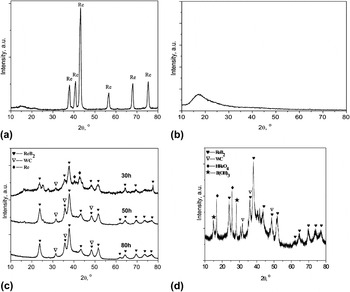
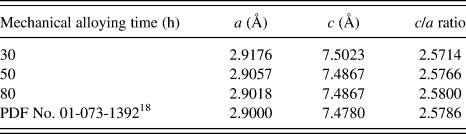
The synthesis of the desired ReB2 phase out of elemental Re and B was monitored by powder XRD. The XRD patterns of metallic Re and B amorphous powders used for mechanochemical synthesis of ReB2 are shown in Figs. 1(a) and 1(b). Figure 1(c) shows the XRD patterns of ReB2 powders after different milling times. The quantity of ReB2 increased with increased milling time. After 5, 10, 15, or even 20 h of milling, significant amounts of Re metal were still present. After 30 h of milling, a small amount of Re was still evident with the ReB2 formed. After 50 h of ball milling, no Re was detected by XRD. The peaks of (002), (100), and (103) ReB2 planes are sharper and have an increased intensity after 50 h in comparison with 30 h of milling, which indicates the presence of a more crystalline product. The WC phase was also present due to degradation of the milling media and vial upon contact with the abrasive product. Table I lists the lattice parameters of the synthesized ReB2 after mechanical alloying for 30, 50, and 80 h, and lattice parameters of ReB2 reported in the literature (PDF card No. 01-073-1392) are also given for comparison.Reference LaPlaca and Post18 As one can see from the Table I, the measured lattice parameters match closely to the reported values. It is also noted that the lattice parameters slightly decrease with increase in mechanical alloying time, whereas the c/a ratio increases with longer mechanical alloying time approaching the reported value.
X-ray diffraction patterns of (a) Re powder, (b) B powder, (c) ReB2 mechanically alloyed powders after 30, 50, and 80 h of milling, and (d) ReB2 powder after 1-year storage in the plastic bag without any protective atmosphere. The observed broad peak at ∼18° 2θ in (b) is a common peak seen for amorphous materials.

Lattice parameters of the synthesized ReB2 after mechanical alloying for 30, 50, and 80 h.

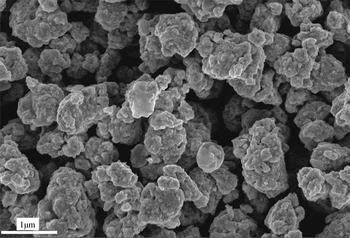
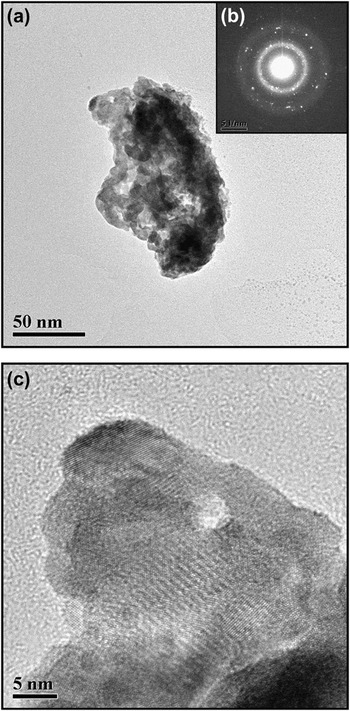
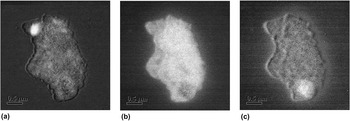
Figure 2 presents SEM micrograph of the ReB2 powders after 80 h of milling. It can be seen that a wide particle size distribution is observed. The size of the largest agglomerates is about 1 μm. Along with morphology study of agglomerates by SEM, high-resolution characterization of selected particles was performed using TEM. A typical particle of mechanochemically synthesized ReB2 and its electron diffraction are shown in Fig. 3. The particle size is about 60-nm wide and 150-nm long. It consists of a number of crystallites of 5–10 nm in diameter agglomerated together. The selected area electron diffraction pattern of the particle shows clearly defined diffraction spots, indicating that the particle is crystalline in nature. The maps of the distribution of Re, B, and W (Fig. 4) show that the distribution of B is not homogeneous, and a high concentration of boron can be seen in a location at one side of the particle under study. Tungsten was also located on the opposite side of the particle, thus confirming the XRD data of contamination of the ReB2 by the material used to make the vial and milling media.
Scanning electron microscopy micrograph of ReB2 powders after ball milling for 80 h.

(a) Transmission electron microscopy (TEM) micrograph of a particle of ReB2 powder after 80 h of milling; (b) electron diffraction of ReB2 particle; and (c) TEM micrograph of ReB2 lattice fringes.

Distribution maps of (a) boron, (b) rhenium, and (c) tungsten in ReB2 particle obtained.

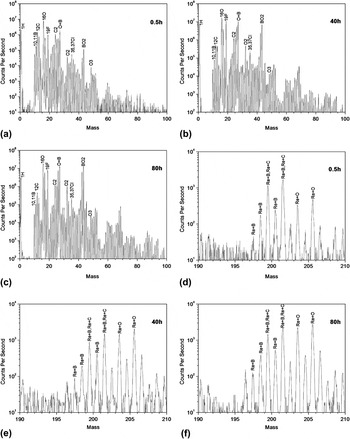
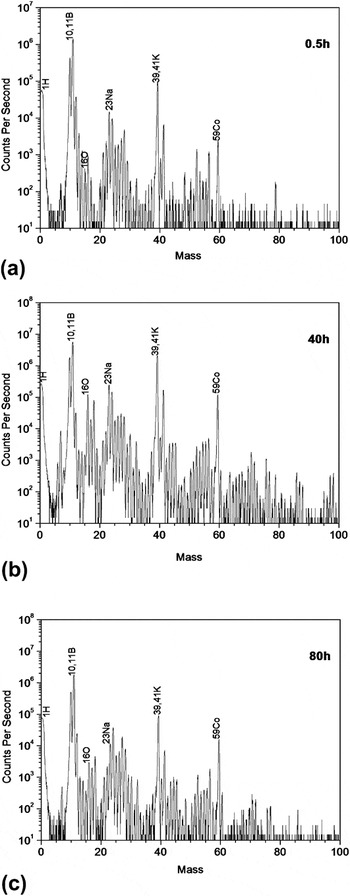
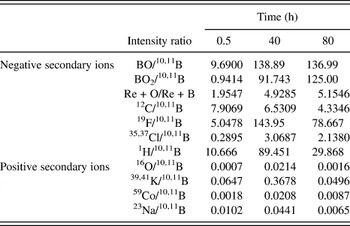
The presence of a number of impurities was also confirmed by secondary ion mass spectrometry. It can be seen from Fig. 5(a) that oxygen was detected in the mixture after milling for 0.5 h since the Reference Ivanov, Wellons and Lukehart16O peak was present along with other oxygen-containing peaks such as O + B, O2, and BO2. The intensity of the Reference Ivanov, Wellons and Lukehart16O peak increased relative to the intensity of Reference Zhang, Veprek and Argon10, Reference Dubrovinskaia, Dubrovinsky and Solozhenko11B peak as milling time was increased indicating the further O contamination of the powders. The relative intensity of O, BO, and BO2 peaks over the Reference Zhang, Veprek and Argon10, Reference Dubrovinskaia, Dubrovinsky and Solozhenko11B peak is shown in Table II, and one can see that the oxygen content increased as milling time increased from 0.5 to 40 h reaching a saturation point since the oxygen content did not increase significantly from 40 to 80 h of milling. The Re + O peak intensity was also compared to the Re + B peak intensity for all three milling times. The intensity ratios of these peaks are presented in Table II, and it is consistent with the increase in oxygen content after milling. Prominent among the other impurities were C, F, and Cl. Although it was detected that the carbon content decreased with increased milling time, the F and Cl content increased upon milling for 40 h but decreased after 80-h milling. This indicates that the impurities were not distributed homogeneously in the powder, and the probes that were taken for analysis were not homogeneous; otherwise we should see the increase of the impurities content as time of milling increased. Interestingly, hydrogen was detected in the powder after 30 min and after prolonged milling. The relative intensity of the H peak was the lowest after 30 min of milling and increased after longer milling. This could indicate the presence of water in the batch during milling. Positive secondary ions are more sensitive to detect metallic contaminations, and they were used to detect metallic impurities as shown in Fig. 6. Both Na and K were detected and their quantity increased upon increase in the milling time. However, their quantity was small after 80 h of milling in comparison with 40 h of milling time, which could be explained by the nonhomogeneous distribution of the elements in the batch. Co was also detected as WC alloy contains Co as a soft binder in WC–Co cement composite.
Negative secondary ion mass spectrometry (SIMS) of ReB2 powders after (a, d) 0.5 h, (b, e) 40 h, and (c, f) 80 h of milling time.

Positive SIMS of ReB2 powders after (a) 0.5 h, (b) 40 h, and (c) 80 h of milling time.

Intensity ratio of impurities to boron secondary ion mass spectrometry peaks.

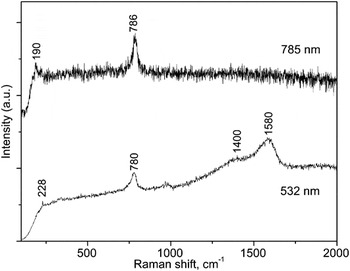
Raman spectra of ReB2 powders were acquired using two 532- and 785-nm lasers (Fig. 7). Factor group analysis of ReB2 hexagonal structure results in 2 E1g and 2 E2g Raman active phonon modes, where E1g and E2g modes are reported as B–B pair atom vibrations in a–b plane of the unit cell as an “out-of-phase” vibrations with a calculated phonon energy of 85.2 MeV for E1g mode and 90.4 MeV for E2g mode.Reference Zhou, Wu and Yildirim4 In the spectrum collected with infrared frequencies, two bands are detected: one at 190 cm−1 and another at ∼786 cm−1. In the spectrum collected using visible laser, two peaks at ∼228 and 780 cm−1 wave numbers are also detected, but in addition two ∼1400 and 1580 cm−1 broad bands are present. These 1400 and 1580 cm−1 bands indicate the presence of carbon, which is explained by contamination of the ReB2 powders by milling. Due to the current experimental setup of the notch filter in the inVia spectrometer, only bands with wave numbers higher than 180 cm−1 could be detected.
Raman spectra of mechanically alloyed ReB2 powders after 80 h of ball milling.

Upon storing ReB2 powder in air, packed in the plastic bag, it was found that the powders formed hard agglomerates. This may be due to a sequential attack by oxygen and water. Initially oxygen may react with the surface of ReB2 to form Re2O7 and B2O3 [Eq. (1)].

This reaction is thermodynamically favored with a heat of reaction of −1235.3 kJ/mol of ReB2. Not only is there a severe lattice mismatch between these oxides and the ReB2 compound but they quickly react with atmospheric water to form boric acid [Eq. (2), −629.3 kJ/mol] and perrhenic acid [Eq. (3), −55.812 kJ/mol].


The net reaction [Eq. (4)] is enthalpically favored by −7.592 kJ/mol.Reference Boyd, Cobble and Smith31, Reference Meschel and Kleppa32

These acids are hygroscopic and create a liquid layer that allows further degradation of the bulk material. In fact, storage of this material in air while in contact with nylon 6,6 results in holes in the nylon due to acidic degradation. Equations (1) through (4) suggest that applications of ReB2 will require exclusion of oxygen or water vapors since the reaction sequence cannot proceed without both. High surface area powders are more susceptible than solid billets.
IV. CONCLUSIONS
We have shown that ReB2 powders can be synthesized mechanochemically from elemental crystalline Re and amorphous B powders in the stoichiometric 1:2 ratio. A complete reaction was realized after 70–80 h of milling in a SPEX-8000 high-energy ball mill. By using this approach, we have eliminated the need for excess boron reported by others. The synthesized powders were agglomerates of small crystallites as evidenced by SEM. High-resolution TEM showed that the material had a clear crystalline structure. The batch became contaminated both with WC–Co milling media during milling and with oxygen and hydrogen coming from the environment during selection of the intermediate samples for analysis. It is our expectation that powders free of excess boron will facilitate a thorough understanding of the role composition on the hardness and elastic moduli of ReB2 ceramics. This is also a scalable solution that will ultimately allow larger quantities of this potentially useful material to be prepared.
ACKNOWLEDGMENT
This work was supported by National Science Foundation projects DMR-0748364 “CAREER: Hard and tough boron rich ceramic laminates designed to contain thermal residual stresses.”