Introduction
Globally, the incidence of dementia is rising to 10 million new cases each year, with around 885,000 diagnosed in the United Kingdom (UK) (World Health Organization, 2017; Office for National Statistics (ONS), 2018; Public Health England, 2019). Dementia has now been recognised as the biggest health crisis of our time in terms of the high personal and social care impact, and remains strongly correlated with inequalities in care compared to other progressive illnesses (Cooper et al., Reference Cooper, Lodwick, Walters, Raine, Manthorpe, llife and Petersen2017). Many older people with dementia prefer to live at home and represent 60 per cent of home-care recipients (Alzheimer's Society, 2016; Clarkson et al., Reference Clarkson, Hughes, Roe, Giebel, Jolley, Poland and Challis2017). Multi-morbidity poses further critical challenges at local and national levels. There is an almost exponential relationship between the number of health conditions, health-care resources and supports required (Barnett et al., Reference Barnett, Mercer, Norbury, Watt, Wyke and Guthrie2012; McWilliams et al., Reference McWilliams, Farrell, Grande, Keady, Swarbrick and Yorke2017, Reference McWilliams, Swarbrick, Yorke, Burgess, Farrell, Grande, Bellhouse and Keady2020; ONS, 2018; Lawrence, Reference Lawrence2019). Multi-morbidity has been variably defined and often used interchangeably, or conflated with, comorbidity (Nicholson et al., Reference Nicholson, Makovski, Griffith, Raina, Stranges and van den Akker2019). For our purposes, multi-morbidity refers to where an individual has two or more long-term health conditions and the consequences of this (National Institute for Health and Care Excellence, 2016). People with dementia over 65 are more likely to have a higher incidence of multi-morbidities compared to those without dementia (Bunn et al., Reference Bunn, Burn, Robinson, Poole, Rait, Brayne, Schoeman, Norton and Goodman2017). Some multi-morbidities may be preventable and specific conditions may also exacerbate the progression of dementia, yet early diagnosis for older people with dementia adds complexity (Public Health England, 2019). Older people with dementia and cancer, for example, are less likely to undergo advanced care-planning, diagnostic testing or aggressive treatment than those with cancer but without dementia (Huang et al., Reference Huang, Hsieh, Hsieh and Wang2017; van der Willik et al., Reference van der Willik, Schagen and Ikram2018).
Dementia is already a proxy for loss of independent living, discrimination and unequal care (Alzheimer's Society, 2016; Care Quality Commission, 2016, 2017; Bennet et al., Reference Bennett, Honeyman and Bottery2018). It is clear that there will be increasing numbers of older people experiencing the challenge of living with dementia and multi-morbidities (Hopkinson et al., Reference Hopkinson, Milton and King2016; McWilliams et al., Reference McWilliams, Farrell, Grande, Keady, Swarbrick and Yorke2017; Blytt et al., Reference Blytt, Selbaek, Drageset, Natvig and Husebo2018). This may enhance inequalities in clinical outcomes, health care and survival rates already associated with dementia (Scrutton and Brancati, Reference Scrutton and Brancati2016; Cooper et al., Reference Cooper, Lodwick, Walters, Raine, Manthorpe, llife and Petersen2017; Witham et al., Reference Witham, Haigh, Mitchell and Beddow2017; Martin et al., Reference Martin, Shrestha, Burton, Collins and Wyld2019; Nelis et al., Reference Nelis, Wu, Matthews, Martyr, Quinn, Rippon, Rusted and Thom2019). Much evidence has focused on dementia alone or on direct-care experiences in nursing and care homes (Lawrence, Reference Lawrence2019). There is a dearth of evidence considering the challenges of living with dementia and multi-morbidities at home and the more complex care and skills required. Similarly, the experiences of the home-care workforce providing supportive care to people with dementia and multi-morbidities has received limited attention (Abrams et al., Reference Abrams, Vandrevala, Samsi and Manthorpe2019). The first contribution of this paper is to explore the experiences and expectations of home care from the multiple perspectives of people living with dementia and multi-morbidities and home-care workers providing support. Our second contribution is to appraise our findings alongside disability and rights-based agendas. We consider the implications for people with dementia and multi-morbidities living at home.
Ageing-in-place: policy, preference and barriers
Home support partly alleviates the need for long-term residential or hospital care (Department of Health, 2015; Dawson et al., Reference Dawson, Bowes, Kelly, Velzke and Ward2015; Alzheimer's Society, 2016). Rising incidence is expected to lead to a greater reliance on home-care support services across developed countries (Public Health England, 2019; Wittenberg et al., Reference Wittenberg, Hu, Barraza-Araiza and Renhill2019) and on partners and family carers (La Fontaine and Oyebode, Reference La Fontaine and Oyebode2014; Rondon-Sulbaran et al., Reference Rondon-Sulbaran, Daly-Lynn, McCormack, Ryan and Martin2021). However, being at home depends on capacity, affordability, availability, knowledge and connection between partners, family carers and home-care staff (Bunn et al., Reference Bunn, Burn, Robinson, Poole, Rait, Brayne, Schoeman, Norton and Goodman2017; Witham et al., Reference Witham, Haigh, Mitchell and Beddow2017). The reality in the UK is that there is already lack of choice and inadequate social care provision available to enable supportive care at home (D'Astous et al., Reference D'Astous, Abrams, Vandrevala, Samsi and Manthorpe2017; Burger et al., Reference Burger, Hayt, Comabella, Poots and Perris2018; Cahill, Reference Cahill2018). Poor-quality care is partly due to lack of knowledge. Home-care staff have little time and restricted access to advanced training (Alzheimer's Society, 2016; Burger et al., Reference Burger, Hayt, Comabella, Poots and Perris2018). Work has been under way ostensibly affirming national commitments to improving quality of care. In the UK, this includes the introduction of mandatory national education. Despite this, knowledge weaknesses remain, and policy and practice continue to proceed on a limited evidence basis (Dawson et al., Reference Dawson, Bowes, Kelly, Velzke and Ward2015; Cunningham et al., Reference Cunningham, Cowie, Watchman and Methven2019b). Worldwide, health and social care systems configured towards individual diseases rather than multi-morbidity present further challenges. Multi-morbidity is common in dementia yet it is a complex phenomenon and often poorly managed (Barnett et al., Reference Barnett, Mercer, Norbury, Watt, Wyke and Guthrie2012; Ilinca et al., Reference Ilinca, Leichsenring and Rodrigues2015; Salisbury et al., Reference Salisbury, Guthrie, Bower and Mercer2018). Nonetheless, the concept of ageing-in-place continues to ground ageing policy and remains a key guiding strategy in addressing demand and meeting needs (Sixsmith and Sixsmith, Reference Sixsmith and Sixsmith2008; Rowles and Bernard, Reference Rowles and Bernard2013). An underlying assumption is that being at home, in the community, is beneficial in terms of health, wellbeing and quality of life. Optimisation of housing and the home environments, support for dementia-friendly communities and reduction in environmental stressors has informed current support for autonomous, independent living (Vernooij-Dassen and Jeon, Reference Vernooij-Dassen and Jeon2016; Ward et al., Reference Ward, Clark, Campbell, Graham, Kullberg, Manji, Rummery and Keady2018; Li et al., Reference Li, Keady and Ward2021).
Providing or receiving care at home continues to be associated with high levels of unmet needs, distress and associated burden (McCabe et al., Reference McCabe, You and Tatangelo2016; Abreu et al., Reference Abreu, Tolson, Jackson and Costa2020). Partners and family carers suffer from a range of health issues, including depression and anxiety, alongside increased social isolation, financial strain, and poor quality of life and wellbeing (McCabe et al., Reference McCabe, You and Tatangelo2016; Cunningham et al., Reference Cunningham, Cunningham and Robertson2019a; Abreu et al., Reference Abreu, Tolson, Jackson and Costa2020). For the home-care workforce in the comparably resource-rich UK, optimal care requirements remain constrained within resource-poor mixed public/private health and social care commissioning systems. Four in ten home-care workers leave their role every year. More than half are on zero-hours contracts, at least partly the result of outsourcing (Lee et al., Reference Lee, Bamford, Poole, McLellan, Exley and Robinson2017). Home-care workers are often at risk of being unlawfully low paid and government action in the sector has been slow to materialise. Overall, these represent just some of the issues that reflect a care sector in crisis (Bennett et al., Reference Bennett, Honeyman and Bottery2018; Jefferson et al., Reference Jefferson, Bennett, Hall, Cream, Dale, Honeyman and Murray2018; Abrams et al., Reference Abrams, Vandrevala, Samsi and Manthorpe2019).
A rights-based conceptual framework
It is instructive to consider dementia as a condition resulting in impairments which can lead to disability (Alzheimer Europe, 2017). This entails both rights and, by virtue of rights, protections. In 2009, the UK ratified the United Nations Convention on the Rights of People with Disabilities (CRPD). Article 19 asserts the right to live independently and in the community. It could be reasonably assumed disability status gives rise to eligibility for anti-discriminatory human rights together with legal protections. The United Nations’ (2016) progress inquiry evidenced grave, systematic violations in the UK. This inquiry highlighted shortcomings in the care and treatment of older persons with disabilities, including those with dementia, and poor support and resourcing for independent living. While a robust response to these findings has been presented (Department for Work and Pensions, 2018), more concrete steps to address fully the United Nations’ recommendations have yet to be taken. In June 2019, the UK All-Party Parliamentary Group on Dementia (2019) highlighted the need for action to provide high-quality dementia care at home. Despite this persuasive evidence, needs remain unmet and many people with dementia continue to move into care homes (Rondon-Sulbaran et al., Reference Rondon-Sulbaran, Daly-Lynn, McCormack, Ryan and Martin2021). Further dialogue is required to explore how people with dementia – and current or future multi-morbidities – should be helped to live independently and flourish at home (Kelly and Innes, Reference Kelly and Innes2013; Cahill, Reference Cahill2018).
Shifts in dementia care towards autonomy, capabilities and social rights, rather than symptoms and care requirements, is informative (Vernooij-Dassen and Jeon, Reference Vernooij-Dassen and Jeon2016; Cahill, Reference Cahill2018; Forsund et al., Reference Forsund, Grov, Helvik, Juvet, Skovdahl and Eriksen2018). If ageing-in-place is to remain a guiding welfare strategy, then resource-intensive social rights, including the right to independent living, must receive further provocation. Recent philosophical work has focused on the importance of social rights and provides instruction. Within the category of social human rights, there is one particularly fundamental but neglected human right. The right in question is the human right against social deprivation. This refers to the lack of minimally adequate opportunities for supportive human contact, including independent care, interpersonal interaction and associative inclusion, irrespective of economic condition (Brownlee, Reference Brownlee2013). While it may seem injudicious to introduce this new right to current frameworks, we argue this right is fundamental and presents many possibilities for people living with dementia and multi-morbidities at home.
We provide an important contribution to the current literature around care-giving and the challenges of living well with dementia (La Fontaine and Oyebode, Reference La Fontaine and Oyebode2014; Tatangelo et al., Reference Tatangelo, McCabe, Macleod and You2018; Cunningham et al., Reference Cunningham, Cunningham and Robertson2019a; Li et al., Reference Li, Keady and Ward2021; Abreu et al., Reference Abreu, Tolson, Jackson and Costa2020; Collins and Kishita, Reference Collins and Kishita2020). We consider this further against disability and rights-based agendas (Shakespeare et al., Reference Shakespeare, Zeilig and Mittler2017; Cahill, Reference Cahill2018). Given the richness of these data, the research team considered this invaluable. To our knowledge, this study is one of the first to consider these complex experiences and connections together.
Study design and methods
Given limited research literature on the topic, this was an exploratory study, conducted in Scotland between May and October 2018 with a range of key stakeholders (N = 36: home-care workers (N = 26), people with dementia (N = 2), their partners (N = 2), or other partners or family carers (N = 6)). Our study is guided by a relational approach that considers partners, family carers and home-care workers as positioned within connective networks of giving and receiving care (Andrews et al., Reference Andrews, Evans and Wiles2013). Qualitative research is well suited for investigating these views and experiences, and to help explain processes at work (Cohen and Crabtree, Reference Cohen and Crabtree2008). Three research questions were framed to facilitate data-gathering:
(1) What are the expectations and experiences of people with dementia and multi-morbidities, and their partners or family carers, of home-care support?
(2) What are the experiences of home-care workers providing support to people with dementia and multi-morbidities?
(3) What information or education would help to support people with dementia and multi-morbidities?
Recruitment and sampling
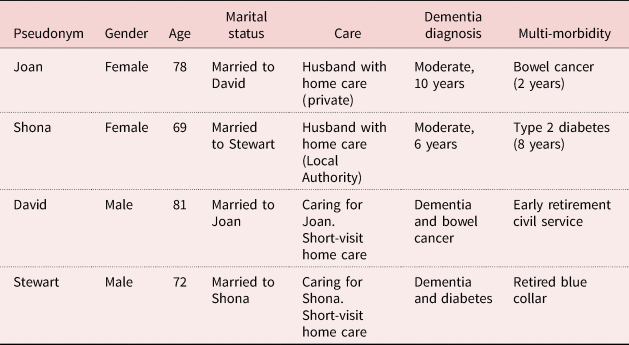
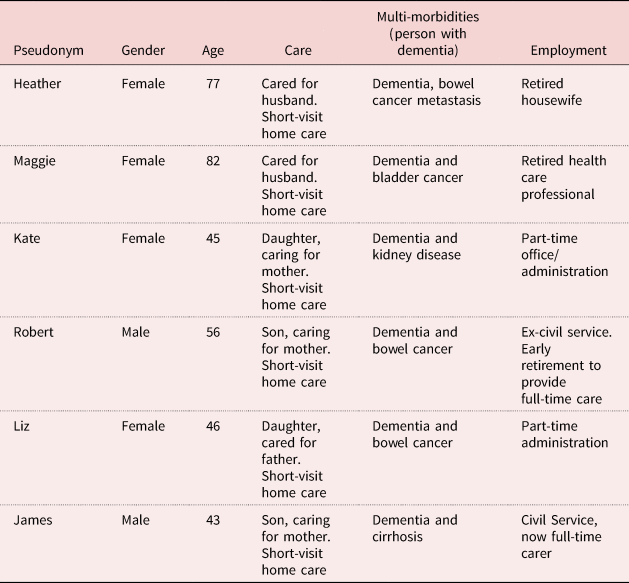
People with dementia and their partners or family carers were purposefully recruited (Patton, Reference Patton1990) via our collaborating patient and carer support networks. A partner or family carer is defined as an individual with informal and unpaid care-giving experience. Dementia and a wide range of multi-morbidities are represented. Two people with dementia and their partners engaged with this study. Table 1 presents their participant characteristics. Several interviews with people with dementia and cancer and their partners or family carers were cancelled at late notice, due to sudden, rapid health deterioration. We discuss this further below. Table 2 presents the participant characteristics of a further six partners or family carers of people with dementia.
Participant characteristics: people with dementia and their partners

Participant characteristics: other partners and family carers

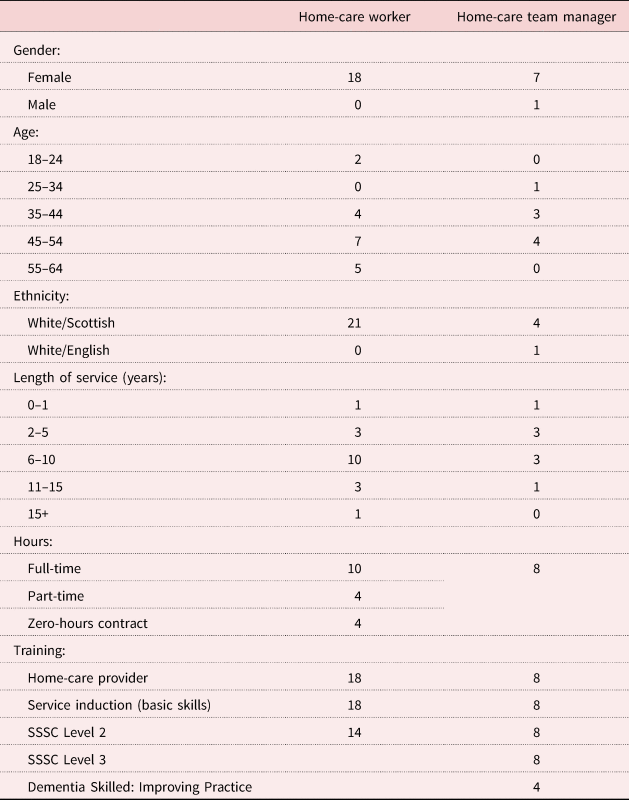
Sixteen home-care agencies registered with the Care Inspectorate (Scotland) and advertising dementia care were invited to participate. Ten responded and agreed to follow-up telephone contact. Of these, six declined advising no capacity and/or limited dementia care provision. Two failed to respond and two agreed. Follow-up meetings outlined the study in more detail. The first large-size third-sector agency offered services that included: respite/short breaks, Local Authority-approved home care, end-of-life care and domestic support across all conditions via 23 managed services. The second medium-size private agency offered services that included: home care for dementia, Alzheimer's disease, Parkinson's disease, cancer care, advanced palliative care, and Local Authority-approved and private home care. Senior managers liaised with the research team to arrange meetings with interested staff. Table 3 presents the participant characteristics of home-care workers involved in this study, 25 women and one man. These characteristics are reasonably congruent with the typical make-up of the home-care workforce (Abrams et al., Reference Abrams, Vandrevala, Samsi and Manthorpe2019). Overall, two people with dementia and their partners, six other family carers or partners, and 26 home-care workers participated in 36 interviews. Prior to interview, all participants received written information about the study. All were fully assured of confidentiality, the right to withdraw and advised any retained data would be deleted. All participants provided informed consent.
Participant characteristics: home-care workers

Data collection
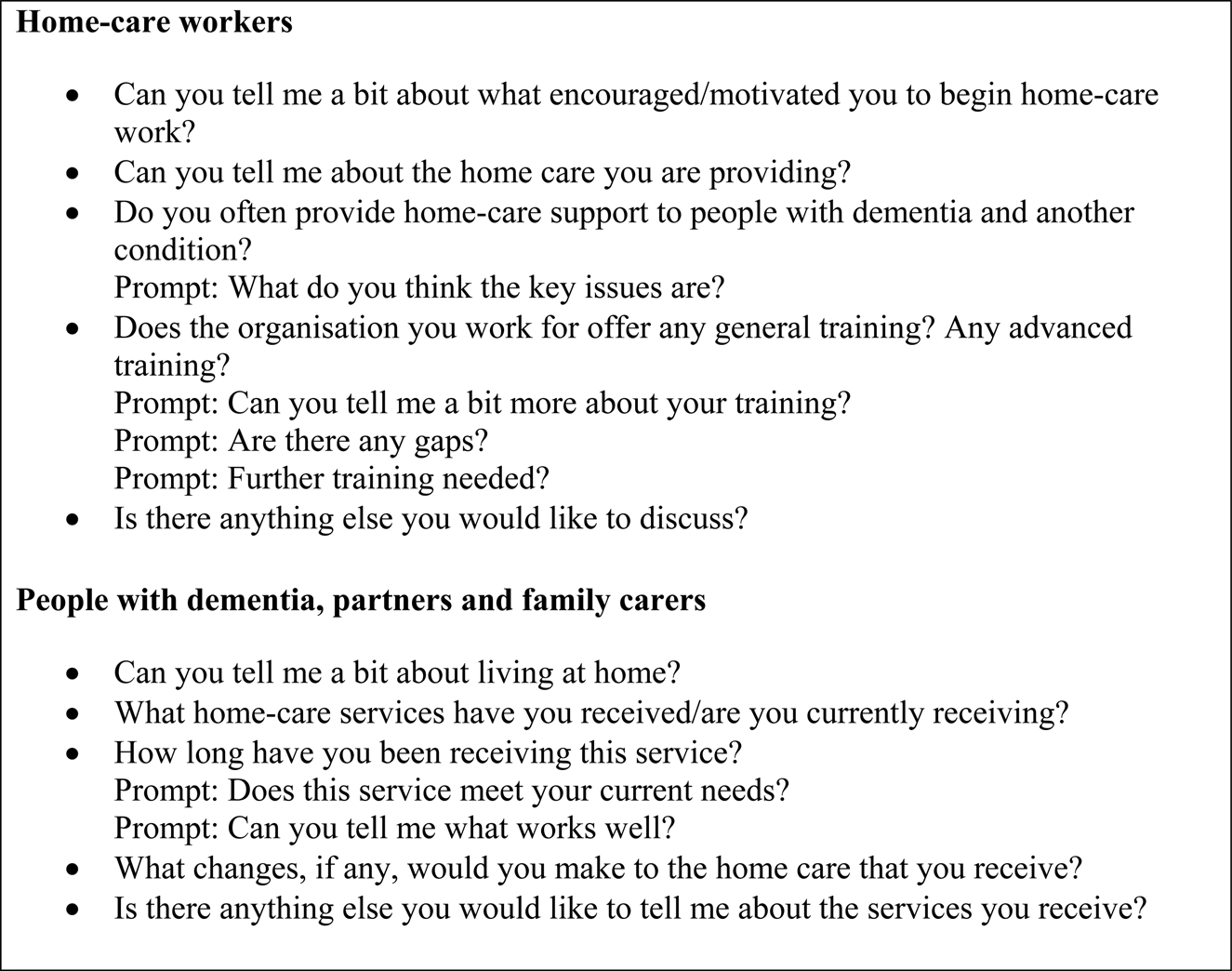
Semi-structured interviews were conducted by the first author and project researcher (third author), both experienced qualitative researchers. These were conducted in a flexible and conversational style, digitally recorded and ranged from 30 to 90 minutes. Each interview began with rapport-building questions to put participants at ease (Quinn, Reference Quinn2017). Open-ended questions with prompts were used to elicit views and enabled participants to answer more freely (Figure 1) (Silverman, Reference Silverman2011).
Interview schedule.

Appraisal of sample size sufficiency for home-care workers was guided by early analysis taking place alongside continuing data collection until no new themes emerged and data saturation could be confirmed. Particular attention was paid to code saturation, data evidence, monitoring for anomalous codes, positive and negative cases, and resonance with existing literature (Vasileiou et al., Reference Vasileiou, Barnett, Thorpe and Young2018). Sample robustness is more limited for people with dementia and multi-morbidities yet also indicative of these complex experiences. This is considered in our findings. Clear meta-themes (Gale et al., Reference Gale, Bunce and Johnson2006) emerged from these narratives that were sufficient for the purpose of this exploratory study.
Data analysis
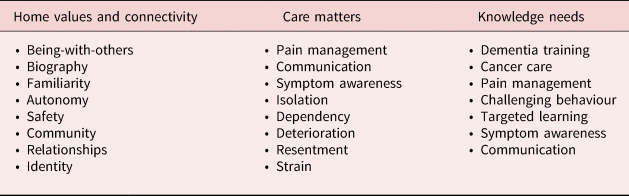
Data were analysed using thematic analysis (Braun and Clarke, Reference Braun and Clarke2006) to identify, interpret and report patterns and themes. The combined perspectives of people with dementia, partners, family carers and home-care workers are presented together. This multi-level perspective provides a more nuanced understanding (Andrews et al., Reference Andrews, Evans and Wiles2013). Interview audio files were transcribed and cross-checked by the lead and third author. An initial coding framework was developed to provide a fair representation of participant range. A constant comparative process compared the relative frequencies of theme and topic, and enabled initial coding of data. The first and third authors undertook this procedure simultaneously. Similarities and consistencies ensured reliability and trustworthiness of the analytical process. The second author, not involved in fieldwork or transcribing, reviewed coding and thematic development. Co-conduction of analysis added robustness to interpretations and findings. The next analytic stage focused on searching for meta-themes, themes, sub-themes and combined different (and sometimes similar) codes to represent data aspects. Visual thematic mapping enabled consideration of relationships between themes to support the interpretive process. This reflected a process of clustering, collapsing and combining codes that shared unifying data features. This ensured movement beyond surface meanings to latent themes whereby underlying ideas, meaningful assumptions and conceptualisations were examined (Braun and Clarke, Reference Braun and Clarke2006). Table 4 presents themes and sub-themes. These typify the most important elements of the data. Pseudonyms have been used to preserve anonymity.
Themes and sub-themes

Results
The following themes respond directly to the research questions. The over-arching theme identified related to the expectation of home as the preferred place and space for receiving and giving care. Living well at home with dementia may be achieved through informed, seamless and co-ordinated care, characterised by flexibility, communication and attention to needs. For people with dementia, partners and family carers, findings revealed a gulf between these expectations and the reality of their experiences of home care. The first theme extends understanding of the value of home as a locus of care. Remaining at home depended on a balance of informal and home-care support to manage complex care needs. The second theme addresses the challenge of providing complex care in the home environment. The third theme discusses concerns about limited knowledge and a lack of tailored education and training. These themes are described in more detail below.
Home values and connectivity
For all participants, home was valued as much more than a physical space. Commonalities noted included home as a social space and a safe, familiar and biographical place. Home represented relationships in the past, present and expected for the future. For David and Joan (husband and wife), home optimised wellbeing and reflected self and identify. Joan had lived with dementia for several years and had been diagnosed with bowel cancer two years previously. Home remained the locus of choice and family and social connection:
I don't want to be anywhere else. We have our dog. This is where our friends can come, isn't it? This is my home. I know it here. Yes (pause) I know here. I like to be able to see my family. (Joan)
Home comprised connections, moments and memories. Although each caring experience is potentially unique, uniformly participants expressed preference to avoid institutionalisation and remain connected to their social lives in the spaces they knew. Despite incapacity and felt isolation at home, Joan refused temporary respite or permanent residential care: ‘I don't want to go into a home. I'll lose my independence, which is very important to me’ (Joan). Home represented autonomy and relationship continuity. Many participants felt they coped better at home. Interaction and connectivity in a known environment were considered to optimise functioning levels and reduced confusion: ‘If she's in her own house she knows where she is and she'll be alright’ (Robert, son). For Shona, home functioned as a space to maintain capabilities: ‘I can still do all my work, the cleaning and everything’ (Shona). This also caused tension:
The two of us disagree. She wants to do everything. You can see where she's coming from too. She doesn't want to give up cooking, things like that. But she can't do it now. (Stewart, husband of Shona)
Shona resisted suggestions that she should discontinue domestic chores. These represented her capabilities at home, in the course of everyday living: ‘He [Stewart] seems to think I cannae [can't] do this or that and it really annoys me’ (Shona).
Joan had recently undergone major bowel surgery followed by radiotherapy. David described their (only) experience of temporary, short-term respite care:
She does better here. It's home. You've seen these places? Nothing wrong with it, not really. But she just wasn't herself. Not happy. I could see that. She gets to choose her neighbours, who she does or doesn't speak to here (pause). I'm not sure they ever understood her. (David, husband of Joan)
David's sentiments underlined the value of supportive home care. Home represented a space where a form of adaptive and social wellbeing can be achieved, balanced between ability and limitation. Home-care workers also considered home as a meaningful space and place and underlined the importance of home connections:
Seeing the relief on people's faces that they can stay in their own bed if they wished to stay in their own bed, they don't have to go … and I love that. (Home-care Worker, aged 45–54)
It's the silly things that people want. It's the cuddle at the end of the night, being in the same marital bed. We had one gentleman who actually said I won't speak to her again if she doesn't keep coming into the bed with me because I've not slept without her for 63 years. (Home-care Worker, aged 45–54)
Home facilitated private and personal relationships and being-with-others:
It's more about this is somebody's home, we're the guest in their home. So, this is your home, you have the rights and the choice. (Home-care Worker, aged 45–54)
Some home-care workers held strong views concerning the right to, and respect for, home and family life:
If somebody has dementia, and cancer or any other kind of disease, they have the same rights, responsibilities and the right to quality of life, the choices, and family life, as anybody else and it's the right to family life is the big one for me. (Home-care Team Manager, aged 35–44)
Several home-care workers believed that the home environment enabled people to manage deteriorating health: ‘The vast majority of patients, or clients that we look after, because they're in their own home, they cope well’ (Home-care Worker, aged 55–64). Some considered home as offering greater protection against a shortened lifespan:
I can see the changes in people from a hospital setting to a home setting and it's large. It's like they look half-dead in the hospital and then they come home, colour and everything within them. (Home-care Worker, aged 35–44)
We've had quite a few hospital discharges where people seem to be very end of life but when they've got home, they've started to eat, or drink and they've plateaued. (Home-care Team Manager, aged 55–64)
While at times experiences of home support caused tension – ‘He didn't like people invading his privacy in his home. He wouldn't accept the fact that he needed care’ (Maggie, wife) – overall, being at home was being-in-place. For people with dementia and multi-morbidities, remaining at home depended on a fragile balance between informal care and home-care support.
Care matters
There is no easy accommodation for caring. Home-care support is often considered as accessible, sometimes over-romanticised ‘help’, available when a crisis point is reached. In this study, many participants critically relied on home-care support yet described sub-optimal care. Some participants explained they felt unable to leave the house while home-care services were being provided. Obtaining care was also costly and frequently challenging:
We did get people in. We paid for a good company. Don't get me wrong, they were good people. They did care. Yes, I think they did. Perhaps some care more than others but they weren't horrid people. But I didn't feel comfortable often. Something not quite right. I often decided not to go out. (Robert, son)
Several participants raised concerns that home-care workers focused only on the completion of practical tasks in the short time allocated and missed indicative symptoms:
The carers were coming in and out regularly but not for long. She was managing herself in between times, with personal things. I know there could have been indicators. But she didn't tell me anything. Maybe things got lost in the mist … Might she have more time if it had been treated earlier? Perhaps. (Robert, son)
Participants reported multiple problems managing treatment at home and the action required to support safe medication management in particular:
We've got issues already with people with dementia refusing to take their medication. They would not be aware that this is to help save their life, it's for cancer. That's definitely going to be a problem. (Home-care Worker, aged 45–54)
Maggie described key difficulties:
Well he could still wash and dress himself, but he flatly refused to have anything to do with catheters or anything which was his big problem. (Maggie)
James's mother remained in denial of care needs. James considered increased home care would be more difficult to arrange:
She's in denial, yes. She acknowledges that she has done considerable damage to her brain through substance abuse, but I don't think she accepts that she's going to deteriorate. (James, son)
Supporting people with dementia while managing complexities such as the escalation of pain or discomfort was demanding. For some participants, the demarcation between condition management and new symptom recognition was challenging: ‘She didn't seem to be experiencing pain but I'm not sure. She had some medication, to help her sleep at night’ (Robert, son).
The ideals of caring at home often emphasise the value of caring relationships without acknowledging actual caring work required:
There's a lot of the [formal] carers who really struggle, I think, to sort of grasp the behaviour consequences of my mother's [cancer] diagnosis, y'know behavioural changes of somebody even in their early stages. They seem to believe that (pause) well they certainly act like they're not aware. (Robert, son)
Home care that helps sustain partner or family caring is characterised by flexibility, communication and attention to needs. In this study, increased dependency for people with dementia was considered to be the outcome of ill-informed and transient care, rather than changing physical difficulties. Robert's concerns informed his decision to consider residential care, against his mother's noted wishes. Kate ended her mother's care package comprising four short daily visits, often with different home-care workers. Limited knowledge and lack of carer continuity had enhanced her mother's distress:
We tried to have carers in but eventually just asked for them to not come back. She was really struggling with her communication. She used to get quite agitated with all the home-care workers. We just decided to do it ourselves. They didn't allow for her dementia. According to them her behaviour was unacceptable. There was no acknowledgement that she has dementia. (Kate, daughter)
Kate described dissatisfaction with short visits and limited continuity of care. Poor communication and lack of knowledge impacted negatively on the care relationship. For David and Joan, home care stopped with little explanation:
I can't really remember how that [provision of home care] came about. And that was great, great but now it has been stopped. They never really said why. Just that we had it, but we didn't qualify anymore. (David, husband)
Some participants expressed concern over late-stage cancer diagnoses in particular and subsequent swift deterioration. For one family carer, cancer had first been mentioned only three weeks before death: ‘The last three weeks he went downhill very rapidly. The doctor came in ’cos he had bleeding and that and he mentioned cancer’ (Liz, daughter). Robert disclosed: ‘She was diagnosed with [Stage 4] bowel cancer. They told me straight away it was terminal’ (Robert, son). Heather had cared for her husband Douglas for several years. Much earlier cancer had been successfully treated. Heather reflected on later physical changes:
He just wasn't right. It was something to do with his bowel or something, so the doctor said. And they took him into hospital for about ten days and that was it. He died. (Heather, wife)
Heather recalled her disbelief at his bowel cancer diagnosis as her husband had had regular check-ups: ‘I couldn't believe. Why did they not see anything in there?’ (Heather). When his mother received a Stage 4 cancer diagnosis, Robert described being told: ‘Look, we can give you chemotherapy, radiotherapy but it's not going to do anything, y'know so…’ (Robert, son). Advocacy around restorative treatment, decision making and coming-to-terms with diagnoses such as cancer was not an option.
The complex interplay between dementia and multi-morbidities restricted independence and the activities of everyday living at home: ‘I would like to get up and out now and then but I'm too difficult. It causes problems’ (Joan). Limited participation in family, neighbourhood and social activities had detrimental effects: ‘He stops me going out and doing what I want. I feel hellish if I don't get out’ (Shona). Joan believed David could not manage her cancer diagnosis at home: ‘He doesn't get it, dear. He panics, doesn't know how to deal with it all, or what to do’ (Joan). Joan valued outside activities, yet these had been curtailed. Social restriction also affected partners and family carers. Liz remembered feeling guilty being unable to take her father outside: ‘I felt like his jailor’ (Liz, daughter). For Robert, time off was impossible, despite wider family insistence: ‘My daughter says Dad will you go to the golf club or something? Just have time to yourself. Time off? No’ (Robert, son). One home-care worker related difficulty around the home management of dementia with diabetes: ‘She's actually taking mini-hypos during the night. He [husband] just makes sure she has a Twix and a coke’ (Home-care Worker, aged 45–54). Poor supervision of finely balanced blood-sugar levels, insulin administration and dietary restriction remained an ongoing concern. Home-care support was often provided on the assumption that partners or family carers assumed primary responsibility and were capable. In this study, many lacked the more complex skills and knowledge required. For Joan, targeted radiation therapy had caused persistent diarrhoea, a challenging and sometimes ongoing side-effect of treatment. David reflected on an incident where home-care support staff had informed him at short notice that early morning support would be delayed:
Well she'd emptied her bowels and it was everywhere. Everywhere. I just pulled them off, see. It went everywhere. Everywhere and I had to clear it all up. They'd left her with these pants on, see. But I just pulled them off. I didn't know you could rip the sides. Hadn't seen them [home-care workers] do it. Just used to go out for my pipe you see (laughing). You know I didn't mind doing the act. It wasn't that. Just unexpected. It was like my father describing the trenches – shite everywhere. (David, husband)
Participant narratives often reflected tensions that created enhanced challenges. Some partners described care resentment and significant relationship strain. Stewart expressed his frustrations:
She feels that she is not that bad. She gets very emotional and sometimes threatens to hit me and I don't know how to deal with her. I have my own health problems and I am expected to be her carer! (Stewart, husband)
Many expressed feelings of failure, isolation, resentment and strain. Complex care needs and limited support influenced Stewart's decision to consider separation: ‘I can't get out without her, I feel trapped. If I don't get help, I'm off!’ (Stewart, husband). Participants described further challenges responding to the need for comfort and reassurance. Maggie recalled, ‘I was in a constant state of anxiety for him and if he needed anything or called out in the night.’ David spoke about the difficulty combining daily routine with explanation of the symptoms Joan was experiencing. For David, this included emotional, daily communication rituals, which he found difficult to manage: ‘During the day we can sometimes have a little conversation. But I have to keep telling her she has bowel cancer’ (David, husband).
Knowledge needs
All participants understood the importance of the knowledge needed to provide the right care and support. Throughout, Robert emphasised his concern about delayed symptom recognition:
I think what I'm trying to say is that there must have been earlier symptoms, but that I wouldn't have known about them. Things weren't too bad. I thought she had lost weight, but she wasn't eating as much, which I thought was all part of it [dementia] and the carers didn't spot anything either but I'm wondering how could they have known? (Robert, son)
Robert attributed this to his own general lack of knowledge combined with the challenges of living with dementia. Home-care workers were also concerned about the consequences of limited practice knowledge:
If you don't have a great understanding of the specific type of dementia that they have you could miss the person living with dementia and another condition, very much so. A lot of the time, carers, family members included, can be putting the different symptoms down to a change in the development of the dementia, rather than it being something else, another condition. (Home-care Worker, aged 45–54)
These accounts suggested effective supportive care for people with dementia and multi-morbidities should begin with basic knowledge and experience:
To have people with experience in providing care to people with dementia, I think that makes a big difference. And I think not being willing to sort of relate to that is concerning to be honest, yes, is concerning. There is quite of a lot of academic pathway now for this type of work but there is a number, there is a number of individuals that I don't believe have any dementia experience and to me it's obvious. (James, son)
In this study, an elementary approach to dementia care obscured critical indicators of physical change. Many partners or family carers were not equipped to respond to changeable and complex care needs. While partners and family carers sometimes relied on home-care workers for further information and advice, they often expressed concerns around limited knowledge available – ‘One of the things, if care was more informed it would make a big difference’ (Robert, son) – and poor care practice – ‘Carers met my mum's behaviour challenges head-on which I think is totally the wrong strategy’ (James, son). Our study also revealed further tensions. While partners and family carers relied on the knowledge of home-care workers, some home-care workers also perceived family care-givers as knowledge providers and as proxy health-care professionals:
So, for the patients that have got cancer and dementia, it's very difficult because the families are the ones who are able to read their behaviours. They know when somebody is in pain and their behaviour, if something is not right it's normally an indication that something is not right, or they are in pain. So, who best to read that on a 24-hour basis than a carer? So it's really important to have these people at home and a workforce that can tune in to the carer and the patient. (Home-care Team Manager, aged 55–64)
This did little to help boost confidence in challenging situations: ‘They [partner or family carer] look to me for advice and support but I don't really know, and I feel bad’ (Home-care Worker, aged 45–54). While many home-care workers promoted positive attitudes towards people with dementia, some also revealed limited knowledge and assumed, for example, that people with dementia could not communicate pain: ‘People with dementia can't necessarily know when they've got pain. They know they've got pain, but they don't know to call it pain’ (Home-care Worker, aged 18–24). For Robert, while limited knowledge had prevented earlier diagnosis, he had learned through experience how to recognise his mother's pain symptoms:
It is a very difficult area. I know when she's in pain now, or needs her medication adjusted. But I didn't know then. But I'm not sure how I could have done. (Robert, son)
Home-care workers emphasised the importance of more tailor-made education and training:
We seen a video clip but that was all. I think there needs to be more in-depth whether it be more videos, more paperwork coming home with us, maybe going on a course. Something more than just a five-minute video. (Home-care Worker, aged 45–54)
However, limited role preparation means home-care workers often felt underprepared:
You'll not have the confidence in doing what you're doing if you don't get at least some insight or something to read up on before you actually go in. (Home-care Worker, aged 18–24)
Evidence, training and guidelines for health care are largely created for single, individual diseases and rarely account for multi-morbidity. Particular problems explaining pain and symptoms to people living with dementia were encountered on a regular basis:
Trying to get him to understand what was happening, ehm, if he was in pain, why he was in pain, just couldn't understand what I was saying. He'd forget. Then he would ask again. He was in the habit of wetting himself but prostate cancer, it's quite smelly. Then you'd have to try and coax him to go in the shower to get cleaned up which he didn't want to do because you were a lady and ladies don't do that. Eh (pause) he didn't get much treatment. (Home-care Worker, aged over 55)
More complex health needs required a higher standard of care across multiple domains. Home-care workers often relied on experiential learning acquired through continuity of care. This facilitated some recognition of changeable physical, verbal or emotional cues that indicated distress or discomfort: ‘Some people [other staff] they'll just think they're misbehaving but they're behaviour is telling you a story’ (Home-care Worker, aged 45–54). Experiential knowledge required same-staff allocation, yet this was not a regular occurrence. Continuity of care depended on already-stretched organisational resources. This was also affected by difficulties juggling allocated care-slots between those who needed more (intensive) care and those who needed less. One home-care team manager described pressure to end the care package for one client with dementia and cancer because of the increasing care time required per scheduled visit. This manager worked unpaid and provided extra hours care in his own time to ensure his client remained at home:
Yeah, this lady she's got cancer too, weighs about 6 stone and we've cared for her for flippin’ years. I'm not letting her space go (pause) I'm not letting her go. Because this is her end of life. She literally doesn't have that long at all and it needs to be the best it can be. (Home-care Team Manager, aged 35–44)
Most staff welcomed more training and education as a measure of competency in relation to more complex health-care needs:
I was interested in training so that I could see through their eyes and get a better understanding of what it's like to live with dementia and, y'know, cancer. (Home-care Worker aged 35–44)
However, the desire for training and education must be also be considered alongside a fear of failure and concerns about learning among home-care workers:
I'm not the cleverest of people. I didn't do well at school. I don't have high expectations. I'd probably fail, honestly. It's never been my forte, ever. (Home-care Worker, aged 45–54)
Other home-care workers struggled with classroom-delivery learning styles: ‘When someone's standing and talking, I sort of switch off. I hate reading, hate it. I'm a practical buddy me’ (Home-care Worker, aged 45–54). Upskilling through training and education remained a continuing challenge: ‘I absolutely love my job. Studying puts me right off and putting pen to paper puts the fear into me’ (Home-care worker, aged 45–54).
Discussion
This study explored the experiences and expectations of home care from the multiple perspectives of people living with dementia and multi-morbidities, their partners or family carers, and home-care workers providing support. The importance of home is a significant theme and reflects the findings from previous research: home operates in multiple ways far beyond the provision of physical space. People living with dementia and their partners or family carers first emphasised home as a valued, connective place and locus of choice. This was where care was expected. This is consistent with research that reports home as ‘being’ not ‘staying’ (Dekkers, 2011). Home provided independence, social reciprocity, friendship, community and safety (Dawson et al., Reference Dawson, Bowes, Kelly, Velzke and Ward2015; Perion and Steiner, Reference Perion and Steiner2017). This echoes the Heideggerian concept of ‘in-being’, or the importance of our everyday interaction and involvement with the things-of-our-world (Heidegger, Reference Heidegger1985). This is not to assume that home must always be the best place (Exley and Allen, Reference Exley and Allen2007; Forsund et al., Reference Forsund, Grov, Helvik, Juvet, Skovdahl and Eriksen2018). Participants in this study represent people experiencing, or those caring for, moderate-stage dementia and multi-morbidities. Findings present a snapshot and do not reflect what may change over time.
The presupposition is that home is a connected space where needs can be met and independence maintained. Our findings illustrated tension between these expectations and the experiences of home care. The value of home as a hybrid space to accommodate change and care is compromised. Findings illustrated the negotiation of a fragile balance between the capacity and information-needs of partners and family carers, and the knowledge of home-care workers. This corresponds with recent work (Rowles and Bernard, Reference Rowles and Bernard2013; Bunn et al., Reference Bunn, Burn, Robinson, Poole, Rait, Brayne, Schoeman, Norton and Goodman2017; Witham et al., Reference Witham, Haigh, Mitchell and Beddow2017; Cunningham et al., Reference Cunningham, Cunningham and Robertson2019a). Care-givers can struggle to find coping strategies to balance needs, problems and challenges (Exley and Allen, Reference Exley and Allen2007; Quinn et al., Reference Quinn, Clare and Woods2015). The findings from this study revealed that stress, burden and tension are exacerbated and the expectation of home as a relaxed and meaningful place is challenged (Ilinca et al., Reference Ilinca, Leichsenring and Rodrigues2015; Forsund et al., Reference Forsund, Grov, Helvik, Juvet, Skovdahl and Eriksen2018). These findings validate reported concerns (Shafir et al., Reference Shafir, Garrigues, Schenker, Leff, Neil and Ritchie2016) that people with dementia endure more complex or unaddressed needs than their counterparts living elsewhere. This paper makes a significant contribution to the understanding of the experiences of home care for people living with dementia and multi-morbidities.
Our findings reshape our understanding of home as a preferred space and place for care-giving. Partners and family carers of people with dementia and multi-morbidities experienced difficulties in distressing circumstances. Several revealed they had considered residential care, knowingly contravening the noted wishes of people with dementia to remain at home. In this study, home represented an ambiguous, valued and strained place. Complex care requirements amplified existing tensions and associative isolation. Partners and family carers described mounting concerns regarding home-care support.
For home-care workers, combining care with home in a single physical space required a seamless approach, context-specific knowledge, flexibility and informed service provision. For those supporting and caring for people with dementia and multi-morbidities, and cancer in particular, our findings revealed strong concerns over early symptom recognition and lack of shared knowledge. Late communication of diagnosis provided minimal opportunity for decision-making advocacy, restorative treatment or preparation for end-of-life. This inhibited rather than promoted best practice and is consistent with recent research (Huang et al., Reference Huang, Hsieh, Hsieh and Wang2017; Witham et al., Reference Witham, Haigh, Mitchell and Beddow2017; Cook and McCarthy, Reference Cook and McCarthy2018; Martin et al., Reference Martin, Shrestha, Burton, Collins and Wyld2019; McWilliams et al., Reference McWilliams, Swarbrick, Yorke, Burgess, Farrell, Grande, Bellhouse and Keady2020).
Home-care workers wanted to learn more to support the complex care challenges faced by people with dementia and multi-morbidities. Nonetheless, home-care workers often relied on partners or family carers as knowledge experts. Conversely, partners or family carers often assumed home-care workers had the knowledge and skills to help and provide information and advice. Our findings revealed a concerning insufficiency of shared, informed and accessible knowledge. While there was some understanding of the needs of people with dementia, this lacked any depth, particularly in relation to multi-morbidities. This corresponds with persistent, ongoing calls for workforce training, education and upskilling (Dawson et al., Reference Dawson, Bowes, Kelly, Velzke and Ward2015; McCabe et al., Reference McCabe, You and Tatangelo2016; Bennett et al., Reference Bennett, Honeyman and Bottery2018; Abrams et al., Reference Abrams, Vandrevala, Samsi and Manthorpe2019; Cunningham et al., Reference Cunningham, Cowie, Watchman and Methven2019b; O’ Shea et al., Reference Shea E, Shea E, Timmons and Irving2019). Our study adds to this evidence. Overall, the experiences of home care for people living with dementia and multi-morbidities revealed systematic failings and insufficiencies. These are priority areas for continued research and education development.
We address these tensions further and consider the implications of our findings. Providing support to enable people to be at home and in the community is central to current ageing policy and national dementia strategies, reflected in preference for home-based models of care (Bennett et al., Reference Bennett, Honeyman and Bottery2018; Cahill, Reference Cahill2018). This paper makes a contribution to calls for change by appraising findings through the lens of disability and human rights. Rights-based principles in dementia care have moved from the periphery (Kelly and Innes, Reference Kelly and Innes2013) yet remain restrained, with limited enforcement. The CRPD is the first legally binding instrument to give explicit recognition to the right to live and participate, independently, in the community.
It is clear from our findings that home is valued and meaningful. There is an expectation that those choosing home will receive essential support to meet needs. In this study, participants uniformly identified the right to home. Our study revealed the value of home as critically deprived by escalating burdens of complex, challenging care needs and inadequate support. This increased distress, burden and isolation for people with dementia and their partners and family carers. This reflects a known association between lower levels of subjective wellbeing, adverse health outcomes, increased mortality rates and reduced capacity to care (Quinn et al., Reference Quinn, Clare and Woods2015; Abreu et al., Reference Abreu, Tolson, Jackson and Costa2020). National dementia strategies reflect rights-based principles (Cahill, Reference Cahill2019). This is part-reflected in the championing of new dementia geographies of care to support people in the neighbourhood and community. This must be welcomed, yet key concerns include whether this represents lower-cost part-solutions at the expense of a rights and equalities-based approach that demands resourcing to enable independent living (Imogen Blood and Associates, 2017; Shakespeare et al., Reference Shakespeare, Zeilig and Mittler2017; Thomas and Milligan, Reference Thomas and Milligan2018).
A truly inclusive community is one where all can participate and have the resources to do so. Articles 19 (a) and (b) of the CRPD assert the right to choose place of residence, to live independently and in the community, yet people living with dementia are frequently denied these rights. Current emphasis is on civil and political rights alongside the big-ticket issues, such as care and nursing homes. Social rights, including the right to live independently at home, are ignored and funding remains inadequate (Cahill, Reference Cahill2018). What is at stake is something much more fundamental. Forging a link between dementia as both a disability and social rights issue is instructive. Recent philosophical work around human and social rights may provide the impetus required to move forward from principles to prioritised action. We consider what that entails below.
Brownlee (Reference Brownlee2013) introduces the human right against social deprivation and makes the conceptual claim that we are essentially deeply social creatures who have non-contingent, basic social, reciprocal needs. This echoes early commentary in the field of dementia studies (Kitwood, Reference Kitwood1997). Personhood and identity are not destroyed by dementia. Who we are, our values and our beliefs, is more than memory and cognitive ability. This depends on, and is secured by, being-with-others in meaningful, reciprocal community and social interactions. Our core social needs – opportunities for meaningful supportive human contact, including care, interaction and inclusion – are important and irrespective of economic condition (Brownlee, Reference Brownlee2013). If these go unmet, then we may not secure our civil, political and economic welfare needs. Macro-level policy concerns focused on civil and political rights ignore the extent to which these rights are inextricable from and dependent upon, the protection of basic social needs. Rights are ascribed and owed as a matter of justice and by those who wield power in the places they are living and by governments (Millar, Reference Millar2012). Denial of the means to sustain others and satisfy social needs is, therefore, a social injustice (Brownlee, Reference Brownlee2013). As our findings revealed, there is a concerning gap between rights and the real, lived realities of people with dementia and multi-morbidities at home. It is paramount that we protect and respect the right to choose home and continue to bring this to the forefront of policy and debate.
Limitations
This was a small, exploratory study. Appraising sample size sufficiency, robustness may be considered limited for people with dementia and multi-morbidities. It is important to recognise potential difficulties around small sample size in qualitative research (Vasileiou et al., Reference Vasileiou, Barnett, Thorpe and Young2018). In this study, this limitation is indicative of the complex experiences of this group: several arranged interviews with people with dementia and cancer and their partners and family members were cancelled at late notice because of swift health decline. The paucity of research in this field makes these findings worth noting and they present a revealing snapshot. A more longitudinal perspective, capturing change and transitions over time, would further improve our knowledge and understanding. Points of direction for future research include the extension of this study to people with dementia and multi-morbidities living in residential facilities and partner or family care-giver support needs. These may differ significantly between partners (husband and wife) and wider kin family carers. The measure of multi-morbidity used in this study can be considered rudimentary and we used a tally of self/carer-reported complaints. Other potentially important health conditions could be missed.
Concluding comments
This study highlights critical concerns that call for a more developed policy response. Recommendations and more pragmatic imperatives stemming from our work are the need to develop accessible, evidence-based education and training resources, tailored to the needs of partners, families and home-care workers. Health-care education around care pathways and treatment guidelines for index or individual disease is not applicable to people with multi-morbidities and may lead to contradictory or inappropriate advice (Salisbury et al., Reference Salisbury, Guthrie, Bower and Mercer2018). Educational and training resources must be responsive to (a) the more specific learning needs and limited educational experience of many home-care workers and (b) the challenge of dementia and multi-morbidities for partners and family carers providing support at home.
Our conclusion to these findings must be set against a backdrop of ever-shrinking welfare states underpinned by austerity measures reducing health and social care budgets and impacting on resources for home-care provisions (Bunn et al., Reference Bunn, Burn, Robinson, Poole, Rait, Brayne, Schoeman, Norton and Goodman2017; Lee et al., Reference Lee, Bamford, Poole, McLellan, Exley and Robinson2017; Bennett et al., Reference Bennett, Honeyman and Bottery2018). These measures further deflect attention away from consideration of the right to choose home and live independently, with optimal support services. People with dementia have the right to live at home in the community and with adequate home care in support (Cahill, Reference Cahill2018). While the CRPD has yet to qualify the right to independent living as an enforceable civil or social human right (and these two are often conflated), the explication of the social right against human deprivation and explanation of our core social needs (Brownlee, Reference Brownlee2013) is informative and reveals issues of social (in)justice.
One potential challenge could be that this position imposes unreasonable additional burdens on duty bearers and on already limited resources; economic conditions in many countries may mean this right is not feasible and cannot be realised. Some may question how such a right could, therefore, be as universal and fundamental as claimed. Others may suggest a ‘progressive realisation’ clause affording a ‘measured’ response by the State within Article 4.2 of the CRPD is the best we could argue for here. We argue that while there are substantial costs incurred by this human right, there are also equal or more substantial costs to not securing this as a human right. As our study has illustrated, costs may include further burden for home-care workers and increased psychological, physiological and social deprivation for people with dementia and multi-morbidities, their partners and family carers. This could also include vastly reduced capacity to provide support and care at home.
We have highlighted some of the challenges that require resolution. Treating very demanding rights as goals may have many advantages for people with dementia. Much will be gained from the further work required and we hope that this will provide a blueprint for future discussion.
Ethical considerations
This study was approved by the National Health Service, Invasive or Clinical Research Ethics Committee, University of Stirling. All participants provided informed consent prior to study involvement and at the beginning, and end, of each interview (Cacchione, Reference Cacchione2011). However, there are some key ethical issues that merit further discussion. Supporting the autonomy and preferences of the person with dementia may conflict with the autonomy of the partner or family carer. This was particularly evident during interviews with two partners. The principle of beneficence is the primary obligation to act for the benefit of others and do no harm. In this study, dilemmas arose when the values and needs of people with dementia and those of their partners or family carers conflict. In our study, participants were receiving support from wider family and social care services. These areas inform further points of direction for future research.
Acknowledgements
To Dad and Joan: ‘Where, after all, do universal human rights begin?’ And she replied, ‘In small places, close to home – so close and so small that they cannot be seen on any maps of the world’ (Eleanor Roosevelt). The authors give thanks to the study's participants for their involvement and continued collaboration and support. The authors would also like to acknowledge the supportive contribution of Tom Cunningham for assisting in conceptual development and to Steve Chinn for his enthusiastic documentary assistance.
Author contributions
NAC developed the conceptualisation of the study and acted as lead writer. NAC and KM completed fieldwork. NAC, KM and JC all contributed to data analysis, synthesis, writing and manuscript revisions.
Financial support
This work was supported by the Chief Scientist Office (CGA/18/09).
Conflict of interest
The authors declare no conflicts of interest.
Ethical standards
This study was approved by the National Health Service, Invasive or Clinical Research (NICR) Ethics Committee, University of Stirling (NICR 17/18, paper 36).