


INTRODUCTION
In Janesville: An American Story, Amy Goldstein describes how the closure of a century-old General Motors (GM) plant reverberated throughout the community of Janesville, Wisconsin (Goldstein Reference Goldstein2017). A casualty of US deindustrialization, the plant’s shuttering brought economic turmoil to the affected workers and their families: good jobs, with high wages and generous pensions, disappeared; in many cases, multigenerational employment ties to GM were severed. The closure profoundly altered the fortunes of the broader community. Nearby firms within the GM production network shed workers or moved elsewhere, tax revenues and social services declined, and the community’s identity as a thriving industrial hub eroded. Janesville is not unique: more than eight million manufacturing jobs, geographically dispersed across the United States, have been lost over the past 30 years.
We investigate how deindustrialization has shaped US presidential politics by examining the relationship between manufacturing job losses and voting in three US presidential elections (2008–2016). We develop theoretical expectations about the possible electoral effects of localized manufacturing job losses. Our paper extends the economic voting literature by examining how political responses to economic shocks depend on group-based social identities (Cramer Reference Cramer2016; Gaikwad Reference Gaikwad2018; Jardina Reference Jardina2019; Mansfield and Mutz Reference Mansfield and Mutz2009; Reference Mansfield and Mutz2013; Mutz Reference Mutz2018; Shayo Reference Shayo2009; Tajfel Reference Tajfel1974). Building on recent research that tracks white voters’ changing political preferences and behavior in response to anxieties about their perceived status as the dominant economic and social group (Cramer Reference Cramer2016; Hochschild Reference Hochschild2018; Inglehart and Norris Reference Inglehart and Norris2017; Jardina Reference Jardina2019; Mutz Reference Mutz2018; Sides, Tesler, and Vavreck Reference Sides, Tesler and Vavreck2018), we contend that deindustrialization represents a politically salient status threat for some whites. Unlike prior studies, we emphasize the localized nature of the perceived threat, which reflects the geographic variation in manufacturing decline around the country. We argue that deindustrialization elicits status concerns that lead some white voters to favor candidates they believe will address economic distress and defend racial hierarchy. Crucially, we also examine whether economic distress affects the voting behavior of people of color in different ways, a topic that until now has received very little attention.
The empirical analysis examines how the electoral effects of manufacturing layoffs may differ depending on the race of the displaced workers and voters. We use novel county-level manufacturing layoff data, broken down by race, which we link to county- and individual-level voting data to examine (1) the localized electoral effects of layoffs and (2) the differential effects of layoffs on white and non-white voters. Since layoffs are not randomly assigned, we develop an instrumental variables strategy using shift-share methodology (Bartik Reference Bartik1991) derived from national layoff shocks, weighted by initial county-level employment. To the best of our knowledge, our paper is the first to estimate the causal effect of manufacturing job losses on voting—and how this effect may vary according to worker and voter demographics.
Our analysis yields three main results. First, studying county-level voting, we find that voters penalize Democratic incumbents more for white worker layoffs than for non-white layoffs, especially in 2016. This result is robust to potentially confounding explanations, including the shock of Chinese imports (Autor, Dorn, and Hanson Reference Autor, Dorn and Hanson2013) and the racial makeup of manufacturing communities (Freund and Sidhu Reference Freund and Sidhu2017; Noland Reference Noland2019). Second, we examine individual vote choice data from the YouGov Cooperative Congressional Election Study (CCES) and find that layoffs are associated with greater support for Republican challengers among whites relative to voters of color. Again, the 2016 election stands out in ways anticipated by our theory. Third, we explore potential mechanisms driving white voters’ political reactions to deindustrialization using data from the American National Election Studies (ANES) surveys. We find that in areas with more manufacturing layoffs, whites are more likely to report that (1) the US economy is weak, (2) the US is on the wrong track, and (3) individual upward mobility has diminished. That is, white voters are more likely to associate deindustrialization with a threat to national economic strength and individual status.
The electoral response to deindustrialization is unique to white voters. This is not to say that people of color are sheltered from the harmful economic effects of deindustrialization. Indeed, there is strong evidence that African Americans in particular have suffered more than whites from lost manufacturing jobs (Gould Reference Gould2018), and below we show that manufacturing job losses have fallen disproportionately to people of color. Yet these losses do not produce similar voting patterns. In particular, we show that Black people were more likely to support the Democratic candidate where manufacturing layoffs were high. Like Green and McElwee (Reference Green and McElwee2019), we find that distinct groups of voters respond to similar forms of economic hardship in different ways. In a foundational contribution, Du Bois (Reference Du Bois1935) wrote about how the white working class defined themselves by the status conferred by their whiteness—a “public and psychological wage” bound to social and political privilege (Roediger Reference Roediger1999). The patterns of voting that we document suggest that some white Americans experience deindustrialization as a threat to their status. While for African Americans, the voting response to manufacturing job loss suggests the repudiation of a reactionary brand of politics centered on industrial revival and the reaffirmation of racial hierarchy.
Our paper informs debates about the recent rise in populist and nationalist voting in developed democracies, including the election of Donald Trump. These discussions largely center on the extent to which localized economic hardship, as opposed to group-based social identities, explains the recent rise of reactionary politics around the world. Some analysts assert that globalization has triggered a voter backlash in the US and Europe (Ballard-Rosa, Jensen, and Scheve Reference Ballard-Rosa, Jensen and Scheve2018; Ballard-Rosa et al. Reference Ballard-Rosa, Malik, Rickard and Scheve2017; Colantone and Stanig Reference Colantone and Stanig2017, Reference Colantone and Stanig2018; Mansfield, Mutz, and Brackbill Reference Mansfield, Mutz and Brackbill2019; Rickard Reference Rickard2018).Footnote 1 This research focuses almost exclusively on the domestic economic impact of international trade, particularly Chinese import competition. Yet other factors such as automation have also contributed to deindustrialization. We take a comprehensive approach by examining the electoral effects of manufacturing job losses regardless of their cause.
While scholars and pundits often frame economic and cultural interests as competing explanations, we contend that they are closely related. Economics and culture jointly influence political attitudes and voting behavior, particularly when economic downturns threaten group identities and racial hierarchies (Ballard-Rosa, Jensen, and Scheve Reference Ballard-Rosa, Jensen and Scheve2018; Mutz Reference Mutz2018; Noland Reference Noland2019). Our paper demonstrates that deindustrialization affects elections because some white voters believe it threatens their identity and status, which motivates them to vote for candidates who defend racial hierarchy. Deindustrialization in the US, and the associated localized deterioration in employment, wages, and communities, appear central to the white voter backlash that culminated in the election of Donald Trump.
DEINDUSTRIALIZATION, WHITE IDENTITY, AND VOTING
In this section, we develop theoretical expectations about the ways in which manufacturing layoffs may influence elections. We first argue that deindustrialization causes economic and social challenges in former manufacturing hubs, which lead to voter dissatisfaction with the status quo. Our argument then addresses the ways in which different groups may construe manufacturing job losses in contrasting ways. Due to their privileged position as the historically dominant group in America’s racial hierarchy, whites may interpret localized economic distress as a threat to their status. As a result, we expect a particularly reactionary political response in favor of candidates and policies that offer backward-looking solutions to the concerns of affected communities.
Localized Manufacturing Layoffs and Economic Voting
Deindustrialization contributes to declining economic conditions in ways that may influence voting. A large literature on “economic voting” argues that voters assess incumbent candidates based in part on the health of the economy, punishing them following periods of slower growth and higher unemployment levels (Brender and Drazen Reference Brender and Drazen2008; Fair Reference Fair1978; Healy, Persson, and Snowberg Reference Healy, Persson and Snowberg2017; Lewis-Beck Reference Lewis-Beck1986; Lewis-Beck and Stegmaier Reference Lewis-Beck and Stegmaier2000).Footnote 2 Voters’ assessments can be retrospective (Alvarez and Nagler Reference Alvarez and Nagler1998; Norpoth Reference Norpoth2001): incumbent candidates are judged for the economic performance during the term of their party’s president. Some voters also make prospective judgments about presidential candidates’ likely future economic performance (Erikson, MacKuen, and Stimson Reference Erikson, MacKuen and Stimson2000; Michelitch et al. Reference Michelitch, Morales, Owen and Tucker2012; Nadeau and Lewis-Beck Reference Nadeau and Lewis-Beck2001). Party platforms and campaign rhetoric can inform voters’ prospective evaluations of candidates’ abilities to address economic challenges (Born, van Eck, and Johannesson Reference Born, van Eck and Johannesson2018; Elinder, Jordahl, and Poutvaara Reference Elinder, Jordahl and Poutvaara2015), including deindustrialization. Incumbents facing opponents who promise reindustrialization may be the most vulnerable to economic voting—particularly in localities where manufacturing losses have exerted a greater toll.
Voters have particular reasons to be sensitive to a declining manufacturing sector. Perhaps the most direct channel involves the lost wages associated with plant layoffs. Manufacturing jobs pay more than those in the services sector for workers with comparable skills and education (Krueger and Summers Reference Krueger and Summers1988).Footnote 3 As plants shut down, workers who lose manufacturing jobs tend to earn less afterwards. Therefore, workers who are displaced from manufacturing tend to suffer greater relative economic harm than do those laid off from the service sector. Furthermore, the plant closures that often precipitate layoffs in manufacturing tend to be well documented. As manufactured goods have historically signaled a nation’s level of economic sophistication (Porter Reference Porter2011), deindustrialization may be particularly disquieting. Abandoned factories do not just disappear; their shells often linger as relics of bygone industrial prowess.
As plants close and manufacturing jobs vanish, workers in defunct firms are directly affected, but distress reverberates outside the shuttered facilities. When a factory closes, associated businesses including suppliers and downstream firms often experience lost jobs and wages as well (Acemoglu et al. Reference Acemoglu, Autor, Dorn, Hanson and Price2016). The ensuing decrease in local demand for retail, dining, and other services creates a vicious cycle that results in a localized economic downturn. Factory closures and manufacturing job losses can also trigger social challenges that do not show up in employment and wage statistics. A decline in manufacturing can decimate local government budgets and hinder the provision of public goods (Feler and Senses Reference Feler and Senses2017). Affected regions also experience increases in local crime rates (Che, Xu, and Zhang Reference Che, Xu and Zhang2018), spikes in mortality rates (Sullivan and Von Wachter Reference Sullivan and Von Wachter2009), and higher incidences of opioid addiction and overdose (Pierce and Schott Reference Pierce and Schott2016). Individuals’ views of the national economy are often based on the conditions facing their communities regardless of personal economic circumstances (Ansolabehere, Meredith, and Snowberg Reference Ansolabehere, Meredith and Snowberg2014; Broz, Frieden, and Weymouth Reference Broz, Frieden and Weymouth2021).
While the logic of economic voting in the context of deindustrialization is relatively straightforward, it may be insufficient to explain voting in recent elections for at least three reasons. First, our discipline’s understanding of the ways in which local economic shocks such as unemployment (Healy, Persson, and Snowberg Reference Healy, Persson and Snowberg2017; Wright Reference Wright2012) or trade exposure (Colantone and Stanig Reference Colantone and Stanig2017; Jensen, Quinn, and Weymouth Reference Jensen, Quinn and Weymouth2017; Margalit Reference Margalit2011) affect voting is limited; there remains considerable skepticism regarding whether localized economic hardship has a discernible effect on support for incumbents (Hall, Yoder, and Karandikar Reference Hall, Yoder and Karandikar2017; Margalit Reference Margalit2019).Footnote 4 Much of the literature on economic voting shows that voters tend to base their decisions on national-level conditions rather than local or personal economic experiences (Jardina Reference Jardina2019; Lewis-Beck Reference Lewis-Beck1986).Footnote 5 If the national economy remains strong, local job losses may not significantly affect how people vote. Second, voting decisions during economic shocks will be based on the policy positions taken by political parties and candidates (Hernández and Kriesi Reference Hernández and Kriesi2016; Wright Reference Wright2012). Challengers who are most effective at exploiting the concerns of disaffected voters may be more likely to shift support from incumbents.
Third, distributional economics alone may be inadequate to explain the political consequences of economic distress. Voters likely respond politically to downturns in different ways, depending on their social standing and the magnitude of manufacturing job losses in their localities. For instance, deindustrialization could activate social status anxieties among white voters, whereas voters of color may respond differently to similar economic shocks. If so, political behavior in response to industrial decline may depend on voters’ identities and the policy positions of candidates and parties. For white voters in hard-hit localities, candidates emphasizing dominant group status threats may garner support. In contrast, for voters of color, deindustrialization may instead increase support for progressive candidates offering policies designed to address racial and economic injustice. In the next section, we expand these arguments in considering how voters’ responses to deindustrialization depend on group-based identity.
Localized Manufacturing Layoffs and White Identity Politics
We examine how deindustrialization and the resulting localized economic downturns may influence voting by distinct groups in different ways. We argue that the decline of manufacturing can incite a particularly acute political response among some white voters due to the threat that economic restructuring poses to notions of dominant group status that are central to white identity (“whiteness”). As Harris (Reference Harris1993) explains, whiteness embodies a “settled expectation” of perpetually privileged economic, political, and social circumstances. For many whites in former manufacturing hubs, the ravages of deindustrialization challenge those expectations and lead them to support candidates who they expect to defend their status.
Our argument builds on social identity theory, which holds that society consists of various groups with differing levels of power and status relative to one another (Shayo Reference Shayo2009; Tajfel et al. Reference Tajfel, Turner, Austin, Worchel, Austin and Worchel1979). Social identity encompasses an individual’s association with, or attachment to, a particular group and the value placed on being a part of the group (Tajfel Reference Tajfel1974). Individuals who are strongly affiliated with their group assess political, economic, and cultural outcomes through the lens of their identity: it shapes their stances on issues and political candidates (Akerlof and Kranton Reference Akerlof and Kranton2010; Ansolabehere and Puy Reference Ansolabehere and Puy2016; Conover Reference Conover1984; Jardina Reference Jardina2019; Sides, Tesler, and Vavreck Reference Sides, Tesler and Vavreck2018). While voters may consider the interests of others, they tend to care most about the well-being of those with whom they most closely identify (Bobo Reference Bobo1983). In turn, they tend to favor candidates and policies that are consistent with their group’s interests (Jardina Reference Jardina2019; Mansfield and Mutz Reference Mansfield and Mutz2009; Reference Mansfield and Mutz2013; Mutz and Kim Reference Mutz and Kim2017; Shayo Reference Shayo2009); economic hardship can solidify their political preferences (Mansfield, Mutz, and Brackbill Reference Mansfield, Mutz and Brackbill2019).
The decline of manufacturing in a locality can create a unique social status threat for some whites in that area. This is because the negative economic and social consequences of deindustrialization upend the settled expectations of whiteness: they challenge whites’ privileged status as the dominant group. For whites who perceive manufacturing jobs as historically important sources of employment and economic security mainly for members of their own group (Guisinger Reference Guisinger2017), layoffs, stagnant incomes, and localized social decay all contribute to the sense of diminished status.Footnote 6 Put differently, deindustrialization is a source of “nostalgic deprivation,” which Gest, Reny, and Mayer (Reference Gest, Reny and Mayer2018) describe as the discrepancy between individuals’ understanding of their current economic, social, and political status and perceptions about their past.Footnote 7 Furthermore, white Americans with a strong in-group identity often view themselves as prototypically American (Doane and Bonilla-Silva Reference Doane and Bonilla-Silva2003; Theiss-Morse Reference Theiss-Morse2009) and conflate their personal economic standing with that of the US (Jardina Reference Jardina2019; Mutz Reference Mutz2018).Footnote 8 For individuals living in localities hit hard by deindustrialization, manufacturing layoffs embody the country’s declining standing as a global industrial force, and with it, their own group’s declining social and economic status.
White voter status anxiety about deindustrialization can activate white identity and a preference for conservative candidates. The political expression of heightened white identity tends toward support for policies and candidates that whites expect will uphold their privileges and preserve racial hierarchy (Abrajano and Hajnal Reference Abrajano and Hajnal2017; Jardina Reference Jardina2019; Mutz Reference Mutz2018; Sidanius and Pratto Reference Sidanius and Pratto2001).Footnote 9 Prior research shows that status threats elicit “defensive” political reactions (Jost et al. Reference Jost, Glaser, Kruglanski and Sulloway2003); whites tend to become more conservative and more supportive of the Republican Party (Abrajano and Hajnal Reference Abrajano and Hajnal2017; Craig and Richeson Reference Craig and Richeson2014; Gest, Reny, and Mayer Reference Gest, Reny and Mayer2018; Mutz Reference Mutz2018). As whites in distressed localities seek to maintain or reinstate the privileges and benefits diminished by deindustrialization, we expect increased support for conservative candidates and policies—particularly nationalist iterations that play to dominant group status anxieties (Jardina Reference Jardina2019; Sides, Tesler, and Vavreck Reference Sides, Tesler and Vavreck2018). As a dominant group status threat, deindustrialization activates white identity and increases white voter support for reactionary candidates.
Deindustrialization also contributes to economic concerns among people of color, but the political expression of these concerns differs across demographic lines.Footnote 10 Non-whites are less likely to experience deindustrialization as a threat to their status, and moreover, candidate appeals to white identity are likely to repel. Rather, where localized economic distress is more pronounced, voters of color may favor candidates promising to address racial and economic injustices through more redistributive policies. In sum, insights from the economic voting literature suggest that manufacturing job losses may weaken support for incumbents irrespective of voter or candidate differences. But a consideration of the ways in which economic distress is refracted through voters’ identities leads to more nuanced expectations about political behavior in the context of deindustrialization. We expect variation in voting responses based on social-identity concerns in conjunction with candidates’ validation of those concerns.
Our argument has testable implications that we examine using data from recent US presidential elections. Among whites, we expect stronger anti-incumbent voting in distressed localities, particularly when the incumbent party candidate is a Democrat and the Republican challenger plays to white identity. In contrast, although localized manufacturing job losses exert a disproportionate toll on people of color, reactionary challengers focused on dominant group status threats are unlikely to appeal. Rather, where localized economic distress is more pronounced, voters of color may favor candidates promising to address racial and economic injustices through more redistributive policies. We anticipate voters of color to mainly support Democrats or, perhaps, to abstain from voting at all (Green and McElwee Reference Green and McElwee2019).Footnote 11
The main tests of our argument focus on the 2016 US presidential election. We expect stronger support for Trump (Clinton) among whites (people of color) in areas with higher manufacturing layoffs.Footnote 12 Additionally, we analyze ANES survey data to probe the plausibility of various theoretical channels. We then compare the 2016 election with the two previous elections for which we have complete data, which allows us to examine support for incumbents when (1) the Republican challenger is less reactionary (as was the case in 2012) and (2) when the incumbent party candidate is a Republican (as was the case in 2008).
DATA AND EMPIRICAL STRATEGY
Localized Manufacturing Layoffs
There are two main explanations for US deindustrialization and manufacturing layoffs. The first is globalization: extensive tariff liberalization and reduced transportation costs over the past several decades have increased trade among countries. Firms in labor-intensive industries have sought to lower their costs by shifting production to lower-wage nations. This offshoring of production has reduced the demand for lower-skilled manufacturing workers in the US. The second force behind US manufacturing layoffs is the advance of technologies such as computer-aided design, automation, and robotics. Technology expands labor productivity, which means fewer workers are needed to meet consumer demand.Footnote 13
Our data on manufacturing job losses come from the Quarterly Workforce Indicators (QWI) statistics collected and managed by the United States Census Bureau to quantify growth, decline, and change in the nation’s workforce. The QWI employment data are the most comprehensive publicly available labor market microdata in the US, covering employment, job creation, and job losses. The dataset contains unique detailed worker demographics (such as sex, age, education, race, and ethnicity) and firm characteristics (such geography, industry, age, and size).Footnote 14 Therefore, we are able to observe manufacturing job losses by worker age, sex, educational attainment, and race/ethnicity. This allows us to disaggregate job losses by demographic characteristics, for instance layoffs of white versus non-white workers. Our sample of manufacturing layoff data begins in 2004, which is the first year for which coverage includes over 90% of US employment.Footnote 15
Using the Census Bureau application programming interface (API),Footnote 16 we queried the QWI data to obtain yearly manufacturing job-loss counts at the county level for all 50 states from 2004 to 2016.Footnote 17 This process was repeated for all major disaggregations of the QWI data—sex, age, education, and race/ethnicity.Footnote 18 To ensure that we were extracting the proper values, we compared the data drawn from the API queries with the interactive, user-friendly QWI Explorer.Footnote 19
Our study is partly motivated by the fact that the decline of manufacturing has affected various parts of the country in different ways. While overall US manufacturing employment has fallen sharply, the job losses are unequally distributed across race/ethnicity and across the country. Table 1 shows the share of employment and layoffs broken down by race/ethnicity at the national level. While whites account for the largest share, job losses have disproportionately affected workers of color relative to their share of employment. Figure A1 in Appendix A shows the distribution of manufacturing layoffs between 2004 and 2016 by race (i.e., white and non-white workers). The figure illustrates that the number of layoffs peaked in 2008 during the global financial crisis, and that a large majority of layoffs (about 80%) have been of white workers. Figures A2, A3, and A4 in Appendix A display the geographical distribution of manufacturing layoffs across US counties. White layoffs are mainly concentrated in the Midwest, whereas non-white layoffs are localized in the South.
Manufacturing Employment and Job Losses, by Race and Ethnicity

Note: Authors’ calculations based on data from the Quarterly Workforce Indicators Explorer, available at https://qwiexplorer.ces.census.gov/. The data on employment and job losses are averages over the period 2012–2015. The shares do not sum to 100 because persons whose ethnicity is identified as Hispanic or Latino may be of any race.
County-Level Models
Our analysis first examines the electoral effect of manufacturing layoffs on county-level voting in the 2016 presidential election.Footnote 20 Following standard practice, we compute the county-level two-party vote shares of the Democratic and Republican candidates. In its most extended form, we use the following model to estimate the change in the Democratic candidate vote share:
 $$ \varDelta Dem\hskip0.5em Vote\hskip0.5em {Share}_c={\alpha}_0+{\beta}_1 Manufacturing\hskip0.5em {Layoffs}_c+{\mathbf{X}}_{\mathbf{c}}{\zeta}^{\prime }+{\delta}_s+{\varepsilon}_c, $$
where ∆Dem Vote Sharec measures the change in the Democratic candidate’s percentage of the two-party vote in county c in the 2016 presidential election compared with the 2012 election. We use the change rather than the level of the Democratic candidate’s vote share, since there is a great deal of path dependence in US county-level voting behavior (e.g., the Democratic vote share in a given election correlates with the Democratic vote share in the previous election).Footnote 21 While not accounting for this temporal dependence could bias our results, our findings are not sensitive to this modeling choice. The variable Manufacturing Layoffsc measures manufacturing layoffs per worker in county c from 2012 through 2015 (total layoffs in the county divided by the number of workers in the county in 2011).Footnote 22 In some models, we break down manufacturing layoffs by race to explore the differential effect of white vs. non-white workers’ layoffs.Footnote 23
The vector X c includes our county-level controls. First, to capture sectoral variation, we include Service Layoffsc , which measures service layoffs per worker in county c, using the same method as for Manufacturing Layoffsc . Second, to distinguish manufacturing layoffs from broader employment conditions, we include the average level of unemployment in county c over the previous four years (Unemploymentc ).Footnote 24 We note that the correlation between Manufacturing Layoffs and unemployment is quite low, ρ = 0.2.Footnote 25 Third, we include the college educated share and the male share of the county population, since both are correlated with partisanship and manufacturing employment.Footnote 26 Fourth, in some estimates, we include the white share of the total population in each county to isolate the effect of layoffs from political trends associated with demographic differences.Footnote 27
Furthermore, δs denotes state fixed effects, which net out time-invariant differences across states. In some estimates, we include district fixed effects to account for possible confounders that may vary within states. The values for β 1 and ζ are the estimated coefficients, whereas α 0 and εc are the constant and the residuals, respectively. We estimate robust standard errors.
One concern with this model specification is that because layoffs do not occur randomly, they may be systematically correlated with a county’s partisan orientation. In an attempt to achieve exogenous variation in layoffs at the county level, we construct a Bartik instrument that relies on the sectoral composition of each county and industry-specific national trends in layoffs.Footnote 28 Our approach assumes that each county’s exposure to national trends depends on the sectoral composition of its labor force, as well as the number of manufacturing layoffs in all other counties. We use detailed administrative data on worker demographics to construct measures of predicted exposure to layoffs due to national employment shocks across different demographics (i.e., white and non-white). Specifically, we use the following measure:
 $$ Bartik\hskip0.5em {instrument}_c^j=\frac{Manufacturing\hskip0.5em {Employment}_c^j}{Total\hskip0.5em {Employment}_c^j}\times \frac{Manufacturing\hskip0.5em {Layoffs}_{-c}^j}{Total\hskip0.5em {Employment}_{-c}^j}, $$
where
 $ Bartik\hskip0.5em {instrument}_c^j $
is the Bartik instrument for social group j = (total, white, non-white) in county c between 2012 and 2015.
 $ Manufacturing\hskip0.5em {Employment}_c^j $
is the number of manufacturing workers from social group j in county c in 2011, and
 $ Total\hskip0.5em {Employment}_c^j $
is the total employment in county c in 2011.
 $ Manufacturing\hskip0.5em {Layoffs}_{-c}^j $
is the number of manufacturing layoffs from social group j in the US, excluding county c between 2012 and 2015, whereas Total
 $ {Employment}_{-c}^j $
is the total number of workers from social group j in the US, excluding county c in 2011. This measure captures the number of manufacturing layoffs within social group j in county c as predicted by national shifts and the sectoral composition in county c, and is unrelated to the influence of local factors.Footnote
29
We estimate the following first-stage model as follows:
 $$ {\displaystyle \begin{array}{ll} Manufacturing\hskip0.5em {Layoffs}_c^j& ={\alpha}_0+{\gamma}_1 Bartik\hskip0.5em {instrument}_c^j+{\mathbf{X}}_{\mathbf{c}}{\eta}^{\prime }+{\delta}_s+{\varepsilon}_c.\end{array}} $$
We plug the instrumental variable (i.e., Manufacturing Layoffs, the endogenous variation of which has been pruned in the first stage) into Equation 1 and run the second stage with the exogenous regressor.Footnote 30 More formally, we modify Equation 1 and estimate the following:
 $$ {\displaystyle \begin{array}{ll}\varDelta Dem\hskip0.5em Vote\hskip0.5em {Share}_c& ={\alpha}_0+{\beta}_1\hat{Manufacturing\hskip0.5em {Layoffs}_c}+{\mathbf{X}}_{\mathbf{c}}{\zeta}^{\prime }+{\delta}_s+{\varepsilon}_c.\end{array}} $$
The identifying variance is the initial sectoral composition of each county. In order for the Bartik instrument to facilitate a causal interpretation, the sectoral composition must only affect the outcome through its effect on layoffs. Recall that we control for the unemployment level, which captures general economic conditions that are potentially collinear to local shocks, and for the other variables described above (college educated, male, and white population shares) in addition to state fixed effects.Footnote 31
Individual-Level Models
To also estimate the effect of manufacturing layoffs on individual vote choice, we link our manufacturing layoffs data to individual-level survey data from the CCES survey administered by YouGov/Polimetrix after the 2016 election. Our analysis uses the full, nationally representative, stratified sample of (up to) 63,605 respondents in (up to) 2,233 counties. This dataset identifies each respondent’s county of residence, which allows us to match their answers to county-level layoff data.
We estimate the effects of layoffs on individual-level voting for the Democratic candidate using the following model in its most extended form:
 $$ {\displaystyle \begin{array}{ll}\mathit{\Pr}\left( Dem\hskip0.5em {Vote}_{ic}=1\right)& ={\alpha}_1+{\beta}_1{White}_i+{\beta}_2 Manufacturing\hskip0.5em {Layoffs}_c\times {White}_i\\ {}& +\left({\mathbf{X}}_{\mathbf{c}}\times Whit{e}_i^{\prime}\right)\zeta +{\mathbf{Z}}_{\mathbf{i}}{\eta}^{\prime }+\left({\mathbf{Z}}_{\mathbf{i}}\times Whit{e}_i^{\prime}\right)\theta +{\delta}_c+{\varepsilon}_{ic},\end{array}} $$
where Dem Voteic is a dummy variable scoring one if respondent i in county c voted for Hillary Clinton in the 2016 election. The variable Manufacturing Layoffsc measures the total manufacturing layoffs per worker in county c between 2012 and 2015. This variable is interacted with Whitei , which takes a value of one if respondent i in county c is white and zero otherwise.Footnote 32 Moreover, we include the vector X c with county-level controls interacted with the dummy Whitei . Note that respondents are geocoded at the level of the county, for which we have variation of manufacturing layoffs.
Furthermore, a vector Z i captures individual-level characteristics, which we include along with their interactions with Whitei .Footnote 33 The individual-level model includes county fixed effects (δc ), which net out time-invariant differences across counties. In doing so, we are unable to estimate the coefficients of Manufacturing Layoffs and X c alone, as these get absorbed by county fixed effects. The value for α 1 is the constant, whereas β 1, β 2, ζ, η, and θ are the coefficients and εic accounts for all residual determinants of the outcome variable.
We employ a similar identification strategy as in the county-level analysis, using our shift-share manufacturing layoffs instrument. In this case, we endogenize Manufacturing Layoffs × White using the instrument described in Equation 2 in interaction with White. We estimate instrumental variable regressions with robust standard errors clustered by county.
RESULTS: THE 2016 US PRESIDENTIAL ELECTION
County-Level Estimates
Table 2 reports the results of the county-level election models, starting with our baseline model.Footnote 34 The coefficient for manufacturing layoffs is negative and significant in Models 1–3. The effect holds when we include White Population Share and Service Layoffs. These findings indicate that Democratic vote shares decline in counties with more manufacturing job losses.Footnote 35
Manufacturing Layoffs and the 2016 Presidential Election, County Level

Note: Sources: QWI (2018), David Leip’s Atlas of US Presidential Elections (Reference David2018), LAUS (2018). 2SLS with robust standard errors in parentheses. The unit of observation is county. The outcome variable is the change in the Democratic candidate’s two-party vote share in county c in the 2016 presidential election. The key independent variables are manufacturing layoffs per worker broken down by race. Robust standard errors in parentheses; ***p < 0.01, **p < 0.05, *p < 0.01.
Next we investigate the effects of layoffs disaggregated by race (Models 4–6). We include white and non-white manufacturing layoff variables on the right-hand side of the model. In all models White Manufacturing Layoffs is negative and significant, whereas Non-White Manufacturing Layoffs is positive and significant. Taken together, the results suggest that manufacturing job losses may lead to different voting behavior across demographic lines. We will further investigate this possibility in individual-level analysis.
Two additional findings are worth mentioning. First, the inclusion of the variable White Population Share reduces the magnitude of the coefficient on White Manufacturing Layoffs by roughly 25%, likely due to the fact that these variables are highly correlated. Second, the coefficient of Service Layoffs is never significant in any of the model specifications.
The magnitude of the estimated effect of job losses on voting is nontrivial. Indeed, with our estimates in hand, we can calculate the percentage lost in Democratic vote share that is attributable to white manufacturing layoffs. First, we estimate the predicted change in the Democratic vote share from model 5, which is our most conservative estimate, as a benchmark. Second, we set White Manufacturing Layoffs equal to 0.02, which corresponds to the 25th percentile, to simulate a counterfactual scenario in which deindustrialization has a relatively low effect.Footnote 36 Then, we predict the change in the Democratic vote share that we would have observed if all counties had experienced manufacturing layoffs at the 25th percentile. Finally, we compare the predicted vote share changes from our counterfactual with the benchmark predicted vote share changes. The Democratic vote share would have been 3.6% higher nationally in this counterfactual scenario.Footnote 37
We perform a number of additional tests, the results of which are reported and discussed in Appendix B and summarized here. First, we run our models with different outcome variables, which we report in Table B4. We show that our results are similar if we use (a) levels rather than changes in Democratic candidates’ percentages and (b) overall Democratic vote shares (rather than two-party) to operationalize our outcome variable.
Moreover, we show that our results hold if we include potential confounders: layoffs broken down by education level, age, and gender, as well as the localized effects of Chinese import surges, the China Trade Shock concept developed by Autor, Dorn, and Hanson (Reference Autor, Dorn and Hanson2013) (Table B5).Footnote 38 In addition, the results are virtually the same if we include district fixed effects, which allow us to account for characteristics that vary within each state (Table B6). Finally, our results are similar if we use the cumulative number of manufacturing layoffs between 2004 and 2015 in each county (divided by the total number of workers in 2003). This test examines the longer-term consequences of deindustrialization, relying on the most extensive available data (Table B7). Finally, we show that our results hold if we use commuting zone (CZ), rather than county, as the unit of analysis (Table B8).
Individual-Level Results
We have shown that manufacturing job losses in general, and white worker layoffs in particular, significantly reduced incumbent party vote shares in 2016. In this section, we further explore the influence of layoffs on the 2016 presidential election using individual-level data, which allow us to overcome three shortcomings of the previous analysis. First and most importantly, we are able to identify the race of the respondents. This allows us to examine whether manufacturing layoffs led to greater support for Trump among white voters. Second, we can control for a set of potentially confounding individual-level characteristics. Third, since the data track variation across individuals, we can include county fixed effects to control for time-invariant characteristics at the county level.
Our main results are reported in Table 3. In model 1, we estimate our baseline model, whereas models 2 and 3 add White Population Share and model 3 also includes Service Layoffs.Footnote 39 The coefficient of the interaction between layoffs and white respondents is always negative and significant. This indicates that whites were less likely than non-whites to vote for Clinton in counties that had experienced more manufacturing layoffs.
Manufacturing Layoffs and the 2016 Presidential Election, Individual Level

Note: Sources: QWI (2018), CCES (Ansolabehere, Schaffner, and Luks Reference Ansolabehere, Schaffner and Luks2018), LAUS (2018). 2SLS regressions with robust standard errors clustered by county in parentheses. The unit of observation is individual-county. The outcome variables are a dummy scored one if the respondent voted for the Democratic candidate in the 2016 election (models 1–3) and a dummy scored one if the respondent voted in the 2016 election (model 4). The key independent variable is manufacturing layoffs per worker interacted with a dummy that takes a value of one if the respondent is white. County-level controls are included in interaction with White. Robust standard errors in parentheses; ***p < 0.01, **p < 0.05, *p < 0.01.
In model 4, we examine the effect of manufacturing job losses on voter turnout. This outcome scores one if the respondent voted in the 2016 presidential election. The coefficient of the interaction between White and Manufacturing Layoffs is positive and significant. This result indicates that manufacturing layoffs depressed the turnout of voters of color relative to white voters.
We explore possible effect heterogeneity by race and gender. First, we examined whether there were differences among voters of color in terms of their voting responses to manufacturing job losses. We reestimated our individual-level models in Table 3, disaggregating non-whites according to the racial categories used in the CCES data (see Table A2). The results are included in Table 4. In this model specification, whites are the excluded category. The results indicate that, compared with whites, Black voters were more likely to vote for Clinton where manufacturing job losses are high. That is, among whites, manufacturing job losses are associated with increased voting for the less redistributively-oriented party, while the opposite is true among African Americans. We find no evidence that manufacturing job losses initiated a similar differential between whites and Hispanic/Latino or Asian voters. It appears that our main result—that non-whites were more likely than whites to vote for Clinton in localities with more manufacturing layoffs—is driven primarily by Black voters. This suggests that Trump’s message of white grievance, which the candidate amplified in deindustrializing communities, was particularly repellent to Black voters. Next, given the gendered nature of manufacturing employment, we conducted a split sample analysis, estimating the models separately for female and male respondents. While the estimated coefficient of the interaction term is larger in the male sample, the two coefficients are not statistically distinguishable one from another (see Table B10).
Manufacturing Layoffs and the 2016 Presidential Election, Individual Level (by Race)

Note: Sources: QWI (2018), CCES (Ansolabehere, Schaffner, and Luks Reference Ansolabehere, Schaffner and Luks2018), LAUS (2018). 2SLS regressions with robust standard errors clustered by county in parentheses. The unit of observation is individual-county. The outcome variables are a dummy scored one if the respondent voted for the Democratic candidate in the 2016 election (models 1–3) and a dummy scored one if the respondent voted in the 2016 election (model 4). The key independent variables are manufacturing layoffs per worker interacted with a dummy that takes a value of one if the respondent is Black or Hispanic/Latino or Asian or Native American or Middle Eastern or Mixed or Other. The controls are interacted with each of the race/ethnicity dummies (coefficients not reported). Robust standard errors in parentheses; ***p < 0.01, **p < 0.05, *p < 0.01.
We also report the results of additional robustness tests in Appendix B and briefly discuss the main findings here. First, we find that the results are similar if we interact white manufacturing layoffs rather than total layoffs with White (Table B11). Second, our results are unchanged when we include the China Trade Shock variable (Table B12). Third, our results are similar if we use cumulative manufacturing layoffs (total layoffs since 2004) instead of the four-year lagged manufacturing layoffs (Table B13). Finally, our results are similar if we use layoffs per worker in CZs rather than counties (Table B14).
Exploring Possible Mechanisms
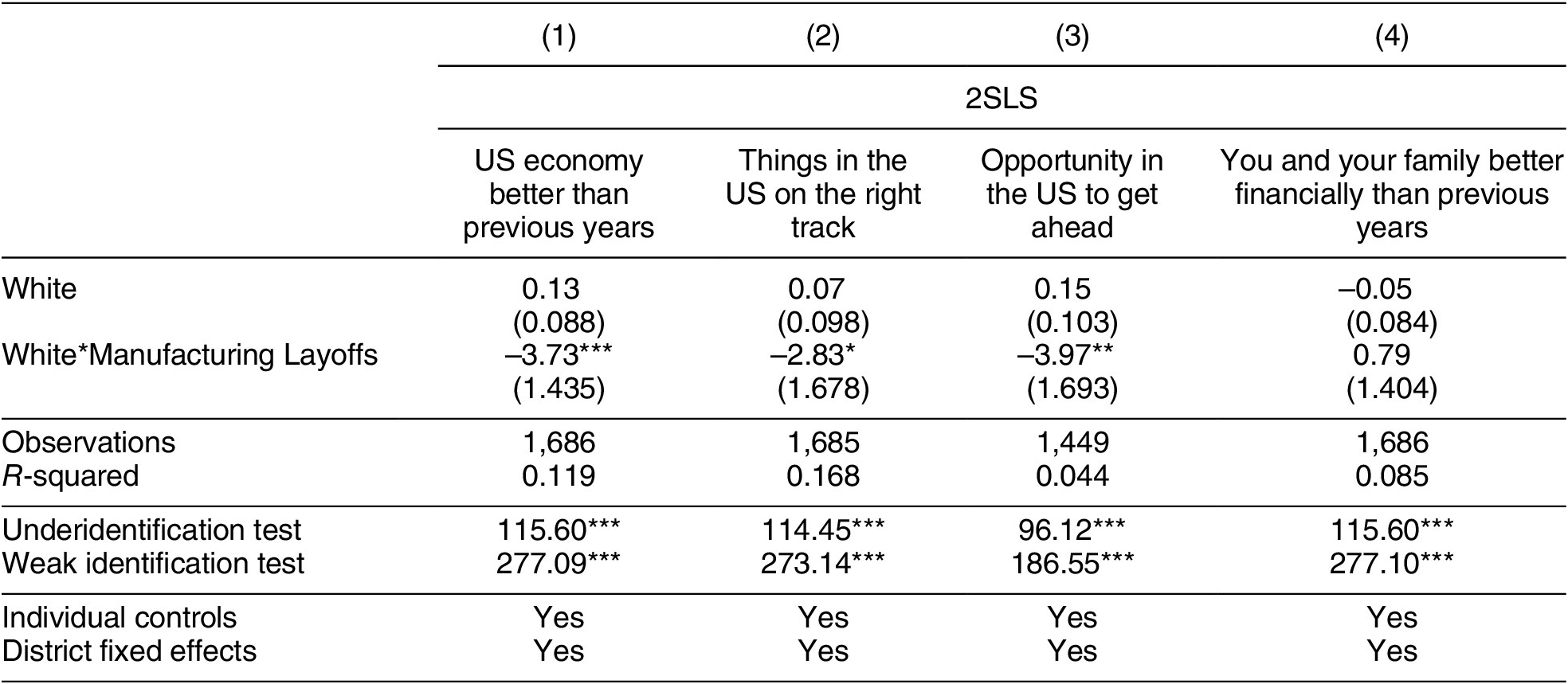
We have shown that manufacturing layoffs influenced the voting patterns of whites and non-whites differently in the 2016 election. In this section, we explore four possible mechanisms that may be driving this result. First, we focus on a question related to the status of the US: Is the US economy improving?Footnote 40 . Second, we explore a question on the status of the country more generally: Is the country on the “right track”?Footnote 41 Third, we include a question concerning individual upward mobility: How much opportunity is there to get ahead?Footnote 42 Fourth, we explore the pocketbook economic channel: Are you better off financially than you were a year ago?Footnote 43
We use data from the 2016 wave of the ANES survey, which was administered before the election. The respondents are geolocated at the congressional district level, so for congressional districts with more than one county, we use the average value of county-level layoffs.Footnote 44 We use the same estimation strategy as in Equation 5, but employ an additional set of individual-level controls following Jardina (Reference Jardina2019), including dummies for gender, unemployed, college degree, and trade union membership, as well as ordinal variables that capture the respondent’s ideology and social class.Footnote 45
Table 5 reports the results of the 2SLS regressions.Footnote 46 Model 1 demonstrates that white respondents who live in districts hit by greater job losses are significantly more likely to believe the economy is worsening. In model 2, the coefficient of the interaction between White and Layoffs is negative and significant, indicating that white respondents in districts affected by layoffs are more likely than non-white respondents to believe the country is on the wrong track. In model 3, white respondents in harder-hit districts report fewer opportunities to get ahead than non-white respondents living in the same districts. In model 4, we find no evidence that high layoffs operate strictly as a pocketbook economic issue for white respondents. Rather, the results suggest that white respondents in hard-hit districts have grimmer assessments of the US economic trajectory and individual opportunity than non-whites in the same districts regardless of personal economic circumstances.
Exploring the Mechanisms with Individual Survey Data

Note: Sources: QWI (2018), ANES (2018), LAUS (2018). 2SLS regressions with robust standard errors in parentheses. The unit of observation is individual-district-election. The outcome variables capture (1) Is the US economy worse than in previous years? (2) Is the US on the right track? (3) How much opportunity is there in the US to get ahead? (4) Are you better off financially? The key independent variable is manufacturing layoffs per worker interacted with a dummy scoring one if the respondent is white. Estimates are weighted on preelection weight (Web sample). Robust standard errors in parentheses; ***p < 0.01, **p < 0.05, *p < 0.01.
In sum, these results indicate that whites experience deindustrialization differently than do voters of color, as our theory anticipates. Localized manufacturing job losses appear to invoke concerns among white voters about American economic decline and the current course of the country. Job losses also appear to lead whites to question the prospects of upward mobility at the individual level, for the “average” American. These results suggest that localized manufacturing decline heightens economic anxiety among whites in particular. In conjunction with the voting results indicating a strong preference for Trump among white voters in localities with higher manufacturing job losses, one possible interpretation of the survey analysis is that some whites perceive deindustrialization as a status threat.
EVIDENCE FROM PREVIOUS PRESIDENTIAL ELECTIONS
Here we extend the analysis to previous US presidential elections, which allows us to explore some of the scope conditions of our argument. Data from the 2012 election allow us to examine the effects of manufacturing job losses on support for the Democratic incumbent against a challenger, Mitt Romney, whose campaign made fewer efforts to stoke white identity compared with the 2016 Trump campaign. Data from 2008 allow us to examine the response to layoffs when the incumbent party candidate is a Republican rather than a Democrat.
Model Specification
In line with the previous analysis, we use the following baseline model to estimate changes in Democratic candidate vote share:
 $$ {\displaystyle \begin{array}{ll}\varDelta Dem\hskip0.5em Vote\hskip0.5em {Share}_{c t}=& {\alpha}_0+{\beta}_1 Manufacturing\hskip0.5em {Layoffs}_{c\tau}+{\beta}_2 Manufacturing\hskip0.5em {Layoffs}_{c\tau}\times \\ {}& Dem\hskip0.5em {Inc}_t+{\beta}_3{Unemployment}_{c\tau}+{\beta}_4{Unemployment}_{c\tau}\times Dem\hskip0.5em {Inc}_t\\ {}& +{\beta}_5 White\hskip0.5em Population\hskip0.5em {Share}_{c\tau}+{\beta}_6 White\hskip0.5em Population\hskip0.5em {Share}_{c\tau}\times Dem\hskip0.5em {Inc}_t\\ {}& +\mathrm{Demography}\hskip0.5em {\mathrm{Controls}}_{\mathrm{c}}\times Dem\hskip0.5em In{c}_t^{\prime}\zeta +{\delta}_c+{\delta}_{st}+{\varepsilon}_{c t},\end{array}} $$
where all variables are as described in the previous section. Note that τ denotes the four years preceding the election.Footnote 47 Given that we have time-varying variables for different waves of elections, the model in Equation 6 uses a standard difference-in-differences (DID) design. Since county-level trends represent a threat to identification in a DID setup, we model Democratic Party vote share rather than incumbent party vote share. Our approach also allows us to test whether white voters punish Democrats more than Republicans for manufacturing layoffs.
Furthermore, δc and δst denote county fixed effects and state-election year fixed effects, respectively. County fixed effects net out time-invariant differences across counties, whereas state-election year fixed effects capture and control for any time-varying confounders at the state and national levels. Moreover, we include Unemploymentcτ and White Population Sharecτ and their interaction with Dem Inct . Furthermore, we use baseline values of demography controls (i.e., pre-2008 time-invariant values) interacted with Dem Inct . We use baseline values, since we are concerned that the demographic composition of counties is potentially a function of layoffs. The coefficient of these baseline controls can be estimated because they are interacted with a time-varying dummy. The value for α 0 is the constant, whereas β 1, β 2,…, β 6, and ζ are the coefficients. The error term εct accounts for all residual determinants of the outcome variable.
Four additional considerations are necessary. First, since we do not use first differences of the right-hand-side variables, we can include county fixed effects. Second, the constitutive term Dem Inct is omitted because its coefficient is absorbed by state-election fixed effects. Third, a key difference from standard DID methods is that Manufacturing Layoffscτ is a continuous rather than dichotomous variable, which implies that our “treated” units receive heterogeneous treatments of differing intensities. Fourth, since we are concerned about the possible endogeneity of layoffs, we rely on the same identification strategy as outlined in the previous section. Our approach is an instrumented DID design with the exogenous source of variation provided by the Bartik instrument, since layoffs are not randomly assigned.Footnote 48 Standard errors are clustered by county.
Results
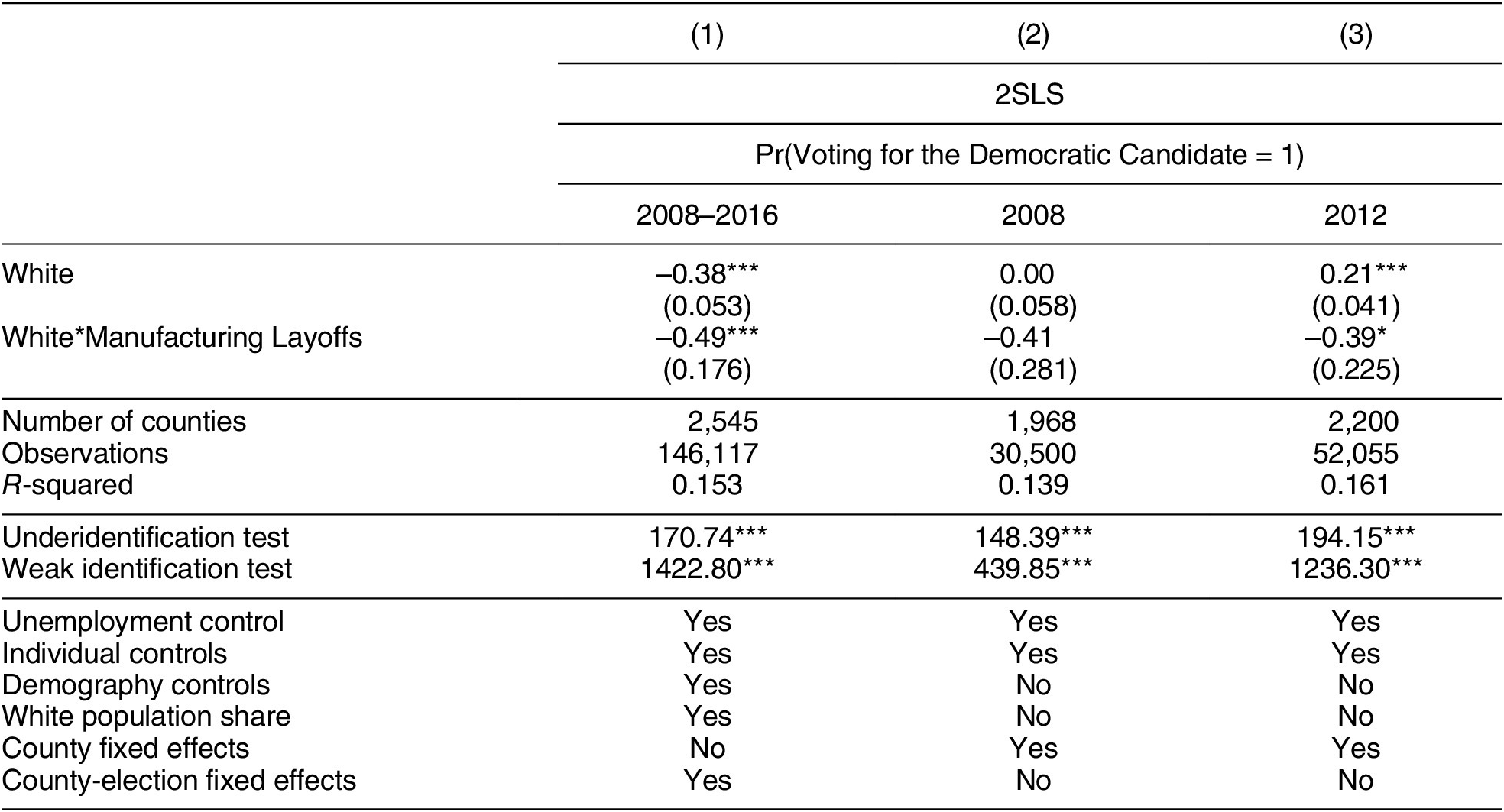
Table 6 reports the results of the pooled models, along with those from the 2008 and 2012 elections in isolation. The coefficient of the interaction between Manufacturing Layoffs and Dem Inc is negative and significant in model 1, indicating that counties hit by more layoffs are less likely to vote for the Democratic candidate when the president is a Democrat. In model 2, we investigate the effects of layoffs disaggregated by race. We include white and non-white layoff variables on the right-hand side of the model as well as their interaction with Dem Inc. The estimates show that while the interaction between White Manufacturing Layoffs and Dem Inc is negative and significant, the interaction between Non-white Manufacturing Layoffs and Dem Inc is not significant. Note that the coefficients of Manufacturing Layoffs and White Manufacturing Layoffs alone are both positive and significant, indicating greater support for Democrats in 2008 (when a Republican was the incumbent) in counties that had experienced more layoffs. Taken together, the results suggest that whites may respond to layoffs differently than non-whites, a proposition that we will probe further with the individual-level data.Footnote 49
Manufacturing Layoffs and Presidential Elections, County Level, 2008–2016

Note: Sources: QWI (2018), David Leip’s Atlas of US Presidential Elections (Reference David2018), LAUS (2018). 2SLS regressions with robust standard errors clustered by county (models 1 and 2) and robust standard errors (models 3 and 4) in parentheses. The unit of observation is county-election (models 1 and 2) and county (models 3 and 4). The outcome variable is the change in the Democratic candidate’s vote share in county c in the 2008–2016 presidential elections. The key independent variables are manufacturing layoffs per worker broken down by race interacted with a dummy that scores one if the incumbent is a Democrat. Robust standard errors in parentheses; ***p < 0.01, **p < 0.05, *p < 0.01.
Models 3 and 4 of Table 6 report the estimates from the 2008 and 2012 elections in isolation. The coefficient of white layoffs is negative but not significant in the 2008 election, whereas it is negative and significant in 2012. The estimated effect is less than half in 2012 than it is 2016 (see Table 2, model 4). The 2016 election stands out in our period of study in ways we would expect. White voters in deindustrializing localities favored Trump, who explicitly cultivated status threats related to white identity and promised to revive US manufacturing.
With the important caveat that we are examining a small number of elections, some notable inferences emerge when we compare the county-level results. First, while the pooled county-level analysis indicates that manufacturing layoffs induce anti-incumbent voting regardless of which party is in power, the 2008 results in isolation do not reveal a statistically significant decline in Republican support. Second, the anti-incumbent effects on manufacturing layoffs are stronger and more robust when Democrats are the incumbents.
A similar story emerges in the individual-level models reported in Table 7. In model 1, we show the results of the pooled analysis.Footnote 50 The estimated interaction between White and Manufacturing Layoffs is negative and significant, indicating lower support for Democratic incumbents among whites where manufacturing layoffs are high. Note that we include county-election year fixed effects in this model, which acount for time-varying characteristics at the county level. For this reason, we are unable to estimate Manufacturing Layoffs, whose coefficient gets absorbed by county-election year fixed effects.
Manufacturing Layoffs and Presidential Elections, Individual Level, 2008–2016

Note: Sources: QWI (2018), CCES (Ansolabehere, Schaffner, and Luks Reference Ansolabehere, Schaffner and Luks2018), LAUS (2018). OLS and 2SLS regressions with robust standard errors clustered by county in parentheses. The unit of observation is individual-election (model 1) and individual-county (models 2 and 3). The outcome variable is a dummy scored one if the respondent voted for the Democratic candidate in the 2008–2016 presidential elections. The key independent variable is manufacturing layoffs per worker interacted with a dummy that takes a value of one if the respondent is white. County-level controls are included in interaction with White. Robust standard errors in parentheses; ***p < 0.01, **p < 0.05, *p < 0.01.
Models 2 and 3 are similar to the results at the county level. There is no evidence that manufacturing layoffs affect the probability of voting for the Democratic candidate in 2008 (when the incumbent is a Republican) among white respondents, whereas the interaction between Manufacturing Layoffs and White is negative and significant in 2012 (when the incumbent is a Democrat). That is to say that anti-incumbent effects are not generic, but rather appear to depend on the party in power. In particular, we do not find robust evidence that manufacturing job losses contribute to increases in anti-incumbent voting among whites when the incumbent is a Republican. Consistent with our theoretical expectations, manufacturing job losses appear to harm Democratic incumbents more than Republican ones.Footnote 51 Finally, we note that the estimated effect of the interaction term is substantively smaller in 2012 than it is in 2016. We find that Trump’s reactionary campaign particularly appealed to white voters in deindustrializing localities.
As with the 2016 election analysis, we implement numerous robustness checks, which we detail in Appendix C. Our results remain unchanged.
CONCLUSION
Deindustrialization has profoundly altered the American economic and social landscape, yielding dramatic political effects. Manufacturing job losses cause changes in voting behavior for different groups in contrasting ways. We argue that deindustrialization threatens dominant group status, leading white voters in affected areas to favor candidates who they believe will address economic distress and defend racial hierarchy. Examining county- and individual-level data from three US presidential elections, we found that manufacturing layoffs weakened white voter support for Democratic incumbents, especially in 2016. In their responses to survey questions, whites associated local manufacturing job losses with obstacles to individual upward mobility and with broader American economic decline. In the US, deindustrialization appears to be central to the white voter backlash that culminated in the surprising election of Donald Trump. Whereas among Black voters, a very different dynamic played out: localized manufacturing job losses coincided with increased support for Democrats. Due to globalization and automation, most lost US manufacturing jobs are gone for good. But the influence of deindustrialization on US politics will resonate for years to come.
Our more general takeaway is that the political consequences of economic change are heterogeneous across places and people. Within nations, political reactions to economic shocks will vary, since they affect communities in different ways depending on localities’ industrial composition and consequent exposure (Rickard Reference Rickard2020). Yet such reactions also depend on how voters in affected communities interpret their local conditions. Individuals’ associations with particular groups provide one such interpretive lens. We have shown that localized shocks can roil politics: manufacturing job losses perpetuated status anxieties and produced a reactionary political response among some whites, defined in part by in-group solidarity and out-group negativity.
There is much more work to be done at the intersection of economic interests and group identity. One particularly fruitful area for future research concerns the role of gender in determining political responses to shocks such as public health crises or globalization. While our approach in this paper was not attuned to addressing gendered patterns, we note that the “status” aspect of manufacturing employment has historically been bound up in masculinity, in ways that could matter for electoral politics. More broadly, scholars should further explore how diverse groups interpret local economic conditions, and how those interpretations shape policy preferences and voting patterns. For instance, as technology and globalization continue to alter the future of work, the fact that many occupations remain segregated by gender, sexual orientation, and race is likely to shape political responses to labor market fluctuations. While often viewed as discrete, we conclude that economic interests and social identities may be more fruitfully understood as integrated sources of political behavior.
SUPPLEMENTARY MATERIALS
To view supplementary material for this article, please visit http://dx.doi.org/10.1017/S0003055421000022.
DATA AVAILABILITY STATEMENT
Replication files are available at the American Political Science Review Dataverse: https://doi.org/10.7910/DVN/UW8G4Y.
ACKNOWLEDGMENTS
We thank Ross Andersen, Andy Baker, Cameron Ballard-Rosa, Lawrence Broz, Bill Clark, Jeff Frieden, Judy Goldstein, Ashley Jardina, Dennis Quinn, Stephanie Rickard, Ron Rogowski, Peter Rosendorff, Nita Rudra, Thomas Sattler, Laura Sudulich, David Steinberg, Pavi Suryanarayan, Romain Wacziarg, and participants at the 2018 IPES annual conference and at seminars at IE Business School, NYU, and University of Geneva for helpful comments. Three anonymous referees, the editors, and the previous editorial team provided excellent suggestions for which we are grateful. Jeff Sauer provided superb research assistance. All errors are our own.
FUNDING STATEMENT
Funding for this research was provided by the SSHRC Insight Development Grant, Canada (grant agreement 430-2018-1145). Leonardo Baccini acknowledges the support of the Hoover Institution at Stanford University, where he is a national fellow for the 2020–21 academic year.







Comments
No Comments have been published for this article.