One of the main differences between globalization today and globalization before 1914 lies in the scope of international labor mobility: whereas mass migration characterized the half-century that preceded World War I, our world is marked by the existence of restrictive migration policies over the whole planet. But border controls do not provide a sufficient explanation for the current low levels of labor flows. Despite the free movement of people inside the European Union, the number of Europeans living in another member country barely represents 1.5 percent of the European population. Nor does the improvement in the standard of living in industrialized countries allow one to understand the phenomenon. Although income per capita is higher in the United States than in European countries, labor mobility between American States is greater than in Europe. And even though the existence of several languages in Europe might explain part of the difference, historic and contemporary experiences show that the appeal of migration can overcome language barriers. We therefore need to look for an alternative explanation for the relatively low levels of international migration prevailing today, particularly in Europe.
Here one possible factor—the impact of welfare states on emigration—has practically never been addressed. Yet, logically one would expect a link between social policies and labor outflows. Indeed, social insurance in sending countries would likely reduce the incentive to leave. It can be argued that social benefits represent a form of indirect wages that enter into the decision to migrate along with the wage gap between sending and receiving countries, employment opportunities in both countries, and transportation and settlement costs.
The implementation of Bismarck's social legislation in Germany at the end of the nineteenth century is a particularly interesting illustration of the effects of the welfare state on labor mobility. These social mechanisms supplied the vast majority of Germany's active population with insurance against major risks—sickness, industrial accidents, old age, and disability—and both the coverage and the received benefits grew rapidly. As the social benefits increased, the German emigration rate dropped, marking a striking exception in an era of mass migration. The question, then, is whether the social laws of the 1880s were responsible for the decline of German emigration before World War I.
THE RISE AND FALL OF GERMAN EMIGRATION BEFORE WORLD WAR I
A Brief History of Pre-1914 German Emigration
German emigration before World War I had three main characteristics. First, most departures from Germany took place before the worldwide mass migration. Along with Ireland, which was struck by famine, and Great Britain, which aimed to settle its colonies, Germany was thus one of Europe's main labor exporters before 1860. Between 1851 and 1860, more than one million Germans left their country. The second characteristic was that most German migrants (90.6 percent on average between 1871 and 1913) chose the United States as their destination country. As a result, Germany became the biggest source of migration to the United States before World War I. Between 1850 and 1914, 5 million Germans crossed the Atlantic to work in the United States, that is, more than Italians (4 million), Austro-Hungarians (4 million), Irishmen (3.5 million), Britons (3.5 million), or Russians (3.2 million). The third characteristic is that Germany was one of the few European countries that experienced a structural drop in the emigration rate before 1914.
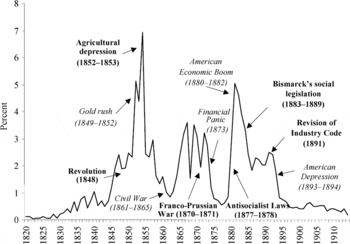
Figure 1 shows the evolution of the German emigration rate during the century that preceded World War I and the most important events that characterized the period. It is possible to distinguish three phases. The first one runs from 1820 to 1854 and is marked by a continuous increase in the number of German departures. Despite its strong development, German industry could not absorb the growing population (24.9 million inhabitants in 1820; 33.7 millions in 1850), and overseas emigration represented an important safety valve for the labor force. The peak years of German emigration were reached at the beginning of the 1850s, motivated by the twin events of an agricultural depression in Germany and the gold rush in California. It is also important to note the importance of chain migration in this process.Footnote 2
The second phase ran from 1854 to 1882 and was marked by a strong volatility in the emigration rate. The American Civil War (1861–1865) cut the German emigration rate (0.9 per thousand in 1862), but after 1865 emigration quickly returned to earlier levels (3.2 per thousand in 1866 and 3.6 per thousand in 1867). The Franco-Prussian War temporarily interrupted the transatlantic flow (76,000 emigrants in 1871 versus more than 120,000 in 1870 and 1872), although not in the same proportion as that of the Panic of 1873, which initiated a five year depression that brought about a sharp drop in the emigration rate (2.76 per thousand in 1873; 0.54 per thousand in 1877). Emigration from the German States surged in the late 1870s and early 1880s, in a small part due to Bismarck's Antisocialist Laws, and in a large part as a consequence of the American economic boom. As a result, between 1880 and 1882, about 540,000 Germans landed on American soil.
EVOLUTION OF THE GERMAN EMIGRATION RATE: 1820–1914

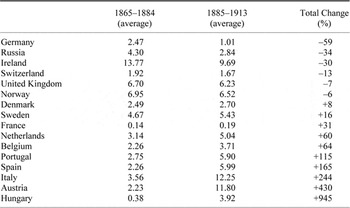
Finally, the years 1881–1882 were the last with high emigration rates (more than four per thousand) and were followed by a rapid decline in outflows. This third period continued to World War I, leaving Germany one of the few European countries with a diminishing emigration rate. Whereas most countries (in particular the southern and eastern European nations) experienced booming emigration in the 1890s and 1900s, Germany had one of the lowest emigration rates (one per thousand on average between 1885 and 1913) and the most rapid fall in migration between the periods 1865–1884 and 1885–1913 (Table 1).
The Limits of Traditional Explanations for the Decrease in German Emigration
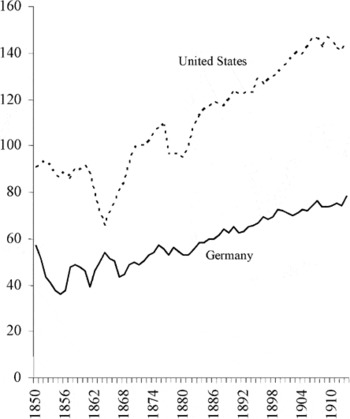
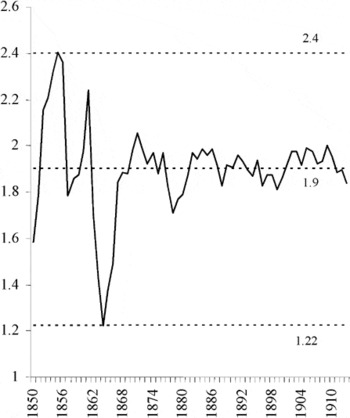
Traditional explanations for declining emigration emphasize the international wage convergence process.Footnote 3 As labor leaves a country, real wages should rise, while in receiving countries they should fall. The result should be a narrower wage gap between sending and receiving countries, which should reduce migration. Yet this analysis does not explain the German decline. As Figures 2 and 3 show, the wage ratio between the United States and Germany was remarkably stable before World War I. During the period 1867–1913, the variance of the wage ratio was equal to 0.005, and the wage ratio was exactly the same in 1913 as in 1867 (1.84). It is therefore unlikely that the decrease in German emigration between 1882 and 1914 was the result of wage convergence.
COMPARISON BETWEEN THE EUROPEAN EMIGRATION RATES: 1865–1913

Note:
The emigration rate corresponds to the annual number of emigrants per thousand resident population.
Source:
Author's calculations based on Ferenczi and Willcox, International Migrations.
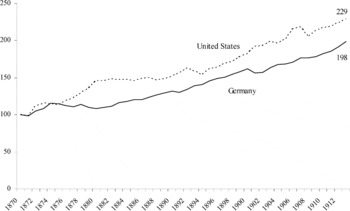
Another explanation for the fall in emigration rates lies in the rapid industrialization of the German economy in the second half of the nineteenth century. The growth of the German GDP was indeed impressive, and this new prosperity surely influenced the migration pattern of Germany. The need to go abroad to find a job was less pressing, and Germany became a labor-importing country at the end of the nineteenth century. Yet, industrialization cannot account for the drop in German emigration either. The GDP growth was much higher in the United States than in Germany (Figure 4), and the wage gap between both economies remained high, which means that there were still more opportunities to improve living conditions in America than in Germany.
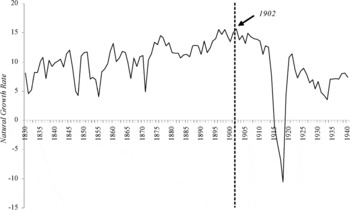
A complementary argument comes from demography: reduced migration could have stemmed from the decline in Germany's fertility at the end of the nineteenth century. However, as Figure 5 shows, the German demographic transition only began to make its mark at the turn of the twentieth century, when the natural growth rate of the population began to ebb, having peaked in 1902 at 15.7 per thousand. It is hence very unlikely that there was a direct link between the slowdown in the natural growth rate and the decrease in emigration, all the more so since demographic changes affect emigration movements with roughly a 20 year lag.Footnote 4
One final possibility is that German emigration slowed because of competition with migrants from other nations. According to Oliver Grant, more arrivals from eastern and southern European countries at the end of the nineteenth century heightened competition between “old” and “new” migrants in the U.S. labor market.Footnote 5 Grant argues that German workers were particularly affected because their skill endowments were roughly the same as those of immigrants from eastern and southern Europe, and because they tended to settle in the same states as the new migrants. Yet this argument overlooks the impact of chain migration. Unlike eastern and southern candidates for emigration, German nationals benefited from the advice and financing assistance from the relatives who already lived on the other side of the Atlantic, which should have given them a comparative advantage. International competition should have favored them instead of new migrants, who could not rely on the chain migration process.
AMERICAN AND GERMAN REAL WAGES: 1850–1913

REAL WAGE GAP: 1850–1913

COMPARISON BETWEEN GERMAN AND AMERICAN GDP PER CAPITA GROWTH: 1870–1913

It therefore appears that the traditional explanations (decrease in the wage gap, industrialization, fall in fertility, or international competition) may represent part of the reason why German migration declined, but they are not a complete answer. We have to look elsewhere, in particular at the social legislation of the 1880s. At the time, the combined effects of industrialization and the war against France had heightened a new sensitivity to the consequences of migration, both in economic and military terms:
With each swarm of emigrants, it is a large amount of labor and capital that goes away, impoverishing the State that suffers losses from taxes as well as from domestic product. . . . When the State cannot do anything to prevent emigration, it must at least try not to increase such an instinct. . . . The government has to do everything possible to eliminate all the reasons for discontent.Footnote 6
As a result, the attitudes of public authorities began to change. Social legislation, alongside other laws such as the broadening of land ownership, constituted part of their response.
THE ADVANCES OF BISMARCK'S SOCIAL LEGISLATION
The first German social insurance laws constituted Bismarck's answer to the growing demand for labor that accompanied rapid industrialization in late nineteenth-century Germany. In order to cut the ground out from under the Social Democrat Party's feet, the German chancellor decided to develop an active social policy that would bring together the State and the working class:
The policy of the state should cultivate the view also among the propertyless classes of the population, those who are the most numerous and the least educated, that the state is not only an institution of necessity but also one of welfare. By recognizable and direct advantages they must be led to look upon the state not as an agency devised solely for the protection of the better-situated classes of society but also as one serving their needs and interests.Footnote 7
To further this goal, Bismarck enacted three important laws that established a full compulsory insurance system for German workers with insurance against sickness, industrial accidents, old age, and disability.
The first of these laws, adopted on 15 June 1883, created health insurance that replaced a portion of income lost during illness and paid attendant medical expenses. All industrial workers who earned less than 2,000 marks per year benefited from the insurance, with two-thirds cost born by the workers (according to their income) and one-third by their employers. Sick workers were covered for medical treatment for up to 13 weeks and received financial support equivalent to three-quarters of the average wage. The second law, passed on 6 July 1884, dealt with industrial accidents. Employers were obligated to pay the full contribution. Accident victims did not have to prove that the employer was responsible. If workers were permanently disabled, they could receive a periodical pension equivalent to two-thirds of their annual earnings; and in the event that they died, their widow and orphans were paid compensation. In 1886 the law was extended to farm workers. The third law, adopted on 22 June 1889, dealt with old age and disability. It introduced a pension system that was financed partly by the government and partly by workers and employers. In 1911 the three compulsory insurance laws were consolidated in the so-called National Insurance Code, and the pension insurance was extended to salaried employees.
THE RATE OF NATURAL INCREASE OF THE GERMAN POPULATION: 1830–1940

This new legislation was in line with the Prussian social tradition, which had put several social policies into place long before Bismarck's laws. Coal-miners, for example, benefited from an advanced insurance system dating back to 1776, which gave them medical treatment and payments when they were ill, disabled, or injured on the job.Footnote 8 In the same way, in the 1840s the Prussian government had introduced new guilds for artisans, craftsmen, and factory workers that managed illness, disability, and old age pension funds for members. Workers not covered by the guild funds could rely on insurance implemented by a large number of local communities. Other workers derived similar benefits from paternalistic measures adopted by certain nineteenth-century employers.Footnote 9 Nevertheless, Bismarck's social legislation brought significant advances for German workers. Although poor relief did not reach large sectors of the population, Bismarck's social security system sought to cover it all, from the poorest to the richest.Footnote 10
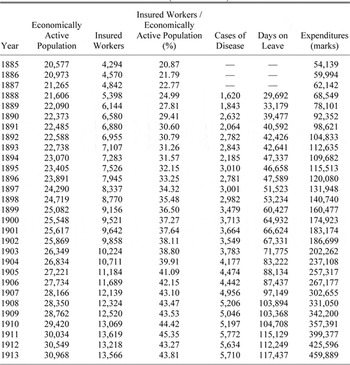
The main results were notably in terms of health insurance. Indeed, even though payments during illness did not match 100 percent of the normal daily wage, sick workers received more than they had under an older Poor Law. Between 1885 and 1913 the share of workers in the economically active population who had health insurance increased during the period from one-fifth to almost one-half (Appendix Table 1). By 1913 some 13.6 million German workers benefited from health insurance versus only 4.3 million in 1885. Expenditures rose from 54 million marks in 1885 to 460 million in 1913. Not only were more people covered, but the health insurance system became more generous: diseases lasted on average more time at the end of the period (20.6 days in 1913) than at the beginning (18.3 days in 1888), and the expenditures by case jumped 90 percent, from 42 marks in 1888 to 81 marks in 1913.
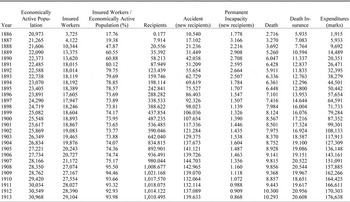
The new insurance against industrial accidents mechanism also contributed to the improvement in working conditions (Appendix Table 2). It was compulsory for all workers outside cottage industry and handicrafts, and firms had the responsibility of getting all employees below a certain income threshold insured. The threshold was 3,000 marks a year in most associations, 5,000 marks after 1913. By 1913 almost 30 million German workers—94 percent of the economically active population—were covered by the system versus only 3.7 million in 1886. The level of expenditures increased dramatically too, from 1.9 million marks in 1886 to 176.6 million in 1913. The level of annual expenditure per insured worker also grew in an auspicious way, from 0.51 marks in 1886 to 3.27 in 1896, and 6.06 marks in 1913.
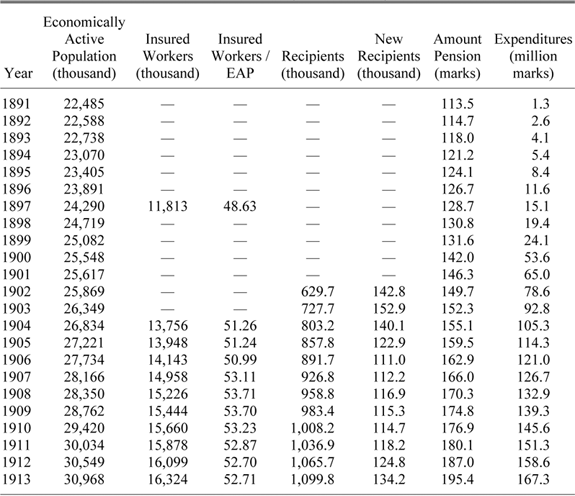
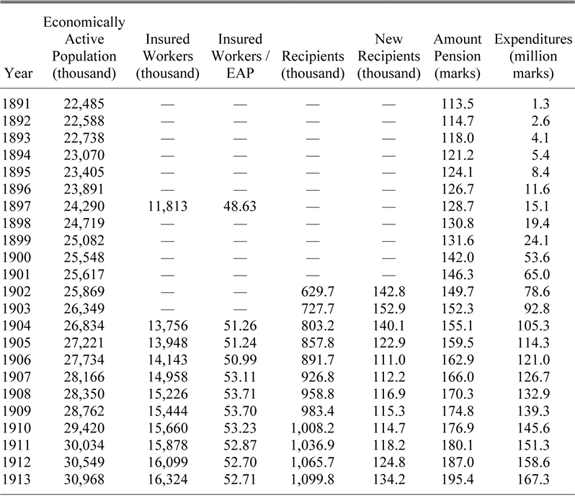
The disability system was for workers afflicted by a serious illness that removed them from the workforce permanently. Even though the level of pensions was low in comparison with wage earnings (about 18 percent of the average wage), it constituted a genuine means of support for people who otherwise would have had to beg to survive (Appendix Table 3). The number of recipients was higher than for the accident insurance, and it increased 75 percent between 1902 and 1913. The amount of the pension grew by 72 percent between 1891 and 1913, while the cost of living rose only 23 percent). Total spending on disability went up from 5.4 million marks in 1894 to 167.3 million in 1913.
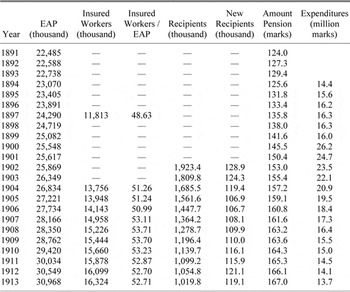
The old age insurance system was more limited than the other systems (Appendix Table 4). By 1901 the level of old age pensions was lower than for disability pensions, and widows and orphans received nothing once the recipient died. But the more severe limit was that workers did not receive an old age pension until they were 70 years old. Because life expectancy was low, very few people got old age pensions. The share of insured workers in the economically active population remained relatively stable (49 percent in 1897; 53 percent in 1913), and the amount of the pension did not rise significantly. The number of recipients actually decreased between 1902 and 1913. Notwithstanding all these imperfections, old age insurance did represent an improvement in German workers' situation.
Workers in Germany also benefited from other measures adopted after 1890 to protect labor and improve working conditions. In 1891 the Industry Code was revised: Sunday work was prohibited in industry and restrained to five hours in trade; the truck system, under which workers received part of their remuneration in kind, was banned; employers had to respect minimum sanitary conditions; working hours for women and youths were limited.Footnote 11 Child labor was severely restricted by a 1903 law. Although there was no national unemployment insurance until 1927, several German towns, following the example of Cologne in 1894, instituted a local system of unemployment benefits.Footnote 12 Finally, a system of labor exchanges was implemented at the beginning of the twentieth century in order to help unemployed workers to find jobs more easily.
Meanwhile, in the United States
Whereas European countries were inspired by Bismarck's scheme to set up their own social insurance system, the implementation of social programs in the United States was tardy. American authorities, in the name of both economic liberalism and social Darwinism, considered that their country did not need any social intervention because domestic and immigrant workers could benefit from a large number of jobs, as well as high wages. It was only when the Great Depression began that opinions changed and first social measures could be adopted. Before that it was the family and friends network or private charity institutions that took care of the poor.Footnote 13
For insurance, American workers had to organize, and from the 1870s they created mutual associations, which provided their members with health or life insurance. Although employers sometimes contributed to these mutual associations, the bulk of the costs fell on the employees, who generally lost their rights to benefits when they left a firm. Some trade unions, in particular railway unions, did pay sick benefits to their members, but they were a minority. In any case, benefits were low (on average, five dollars a week) and of limited duration (13 weeks at the most).Footnote 14 The voluntary system in America did not allow a significant expansion until the 1930s.
In fact, before the enactment of the Social Security Act in 1935, the only real organized insurance mechanisms were the workmen's compensation systems, which covered workers against industrial accidents. Yet their scope too was limited, particularly before World War I. The most significant measure was adopted in 1910 by the State of New York. It required employers in 12 dangerous occupations to pay compensation, at a rate set in law, in case of accidents. Twenty-two other states enacted similar workmen's compensation laws between 1911 and 1914, but it was only in the 1920s and 1930s that the system really expanded and the employers' “social responsibility” was widely recognized. Nonetheless the compensation laws did not immediately bring about a development of universal insurance against industrial accidents. Most employers could still chose not to insure and most did not adopt workmen's compensation insurance, which only became compulsory in the 1930s.
Old age insurance was another problem before the New Deal: people too old to work had no option except charity, either private or public. Wages were usually too low to permit workers to save in the long run, whereas pensions and insurance were costly or simply unavailable to industrial workers. Private pensions really only developed in the 1920s, and the only other private insurance mechanism before World War I was life insurance, which represented a small share of total personal savings—8.2 percent, on average, between 1897 and 1913.Footnote 15 As for public pensions, the first bill to create them was introduced in 1903 in Massachusetts, but it failed to pass, and other proposals for old age pension laws at the time met a similar fate.Footnote 16 In 1935 the Social Security Act eventually implemented a federal scheme of old age pensions.
In total, the level of protection of American workers against the main threats to workers was very low before the Great Depression and virtually nonexistent before World War I. By contrast, most German workers were covered by social insurance mechanisms by 1913. The difference made America less attractive, and that can explain why German emigration dramatically decreased.
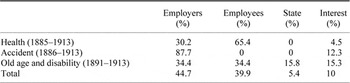
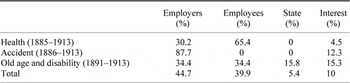
CONTRIBUTIONS TO THE SOCIAL INSURANCE SYSTEM
Note:
Contributions correspond to the share that the main agents had to pay on average during the whole period.
Source:
Author's calculations based on Statistisches Jahrbuch für das Deutsche Reich.
Was the German Social Legislation a “Free Lunch”?
Transfer mechanisms are supposed to reduce productivity and hence deter economic growth, yet as Peter Lindert has argued, it seems that the welfare state has had no major impact on long-term growth.Footnote 17 In that sense, it is possible to consider social spending as a “free lunch,” because social benefits do not have significant economic costs. But was that the case in late-nineteenth-century Germany? Did Bismarck's social legislation carry a cost in terms of slower economic growth that might have induced migrants to leave?
The main costs of the 1880s' social legislation were the contributions to the insurance system. Employers and employees were the main contributors (Table 2). Between 1885 and 1913 employers paid almost half the contributions (44.7 percent), the employees paid 39.9 percent, and the State only 5.4 percent. The remainder of the contributions (10 percent) corresponds to interest earned on previous years' surpluses. Employers paid for the industrial accident system, whereas the employees had to pay for most of the health insurance. The state shouldered little of the expense for any of the programs.
The state's minor financial contribution does not mean that its role was unimportant. It contributed to implementing the system and coordinating involved agents' actions:
The achievement of the Bismarck's famous innovations in social insurance consisted of his sweeping away most of the transactions costs of getting a settlement among hundreds of firms and millions of workers. Without his political maneuvering, there could have been long delays in setting up Germany's comprehensive insurance systems.Footnote 18
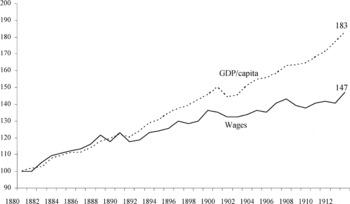
GDP PER CAPITA AND REAL WAGES IN GERMANY: 1880–1913

As a result, the impact of contributions on the German economy was limited because all the firms had to adopt the system at the same time. The risk of free riding was very low, and the repercussions in terms of competitiveness between German firms were virtually nil.
In any case, Bismarck's social legislation does not seem to have restrained economic activity, because the GDP grew at a rapid 3.1 percent annual pace between 1885 and 1913. That the social insurance did not hobble economic growth probably stemmed from its positive impact on workers' health, that is, on human capital and hence on productivity. As Figure 6 shows, GDP per capita rose faster than real wages between 1880 and 1913, which implies that firms kept the main part of value added. In a sense, there was an implicit contract between employers and employees, with firms agreeing to pay contributions to the insurance system knowing that their employees would be healthy and therefore more productive. Workers, for their part, accepted lower wage increases in return for social benefits. The upshot was that the insurance system's losses were relatively low, and as a result Bismarck's measures did not have a significant impact on long-term growth and the attractiveness of the German economy.
REPERCUSSIONS OF SOCIAL INSURANCE MECHANISMS ON GERMAN EMIGRATION
How Do Social Benefits Affect Emigration?
Most studies of international migration emphasize the wage gap between sending and receiving countries. As Jeffrey Williamson has shown, the wage convergence that accompanied mass migration phenomenon slowed migration from Europe to the New World.Footnote 19 Migration was also affected by the demographic structure and industrialization in Europe, by differences in employment opportunities, and by the chain migration process. Migration policies are also important, above all to explain why migration plummeted after World War I, and why it is lower than one would expect today given the difference in incomes between developing and industrialized countries.
But the literature on international migration rarely mentions the effect of social benefits in the emigration process. Dudley Kirk, whose study on the behavior patterns of the European population during the interwar period includes a chapter on the slowdown of labor mobility, does refer to social insurance.Footnote 20 In the same way, Henry Gemery tries to establish how social insurance in sending countries could have affected labor flows in the interwar years.Footnote 21 But Kirk and Gemery are an exception. And even for them, the question of social insurance is not a central issue.
One would certainly expect the welfare state to reduce the incentive to migrate, for the existence of social insurance raises the opportunity cost of moving. With a pension system, for example, workers do not need to save money for their old age, and it is therefore rational for them to agree to lower wages during their working lives in anticipation of the pensions they will receive when they retire, so long as they remain in their country. Programs such as health or accident insurance have a similar effect. Workers who are sick or injured will receive financial compensation, but if they move to a country where such measures do not exist, they run the risk of losing everything following an accident.
In that sense, social insurance constitutes a kind of indirect wage that candidates for migration will take into account in their income expectations: the higher the domestic indirect wage, the lower the emigration rate. What really matters in the wage gap is the sum of direct and indirect wages, that is, the combination of labor earnings and social benefits. Whether the social benefits are the product of private insurance or public subsidies is not really an issue, for in both cases the results for the workers are the same: their net wage earnings are lower than in the countries without the social programs (because they have to pay private insurance premiums or additional taxes), but they in turn benefit from the insurance mechanisms (either public or private) that workers in other countries do not have. However, it is important to know whether the system is compulsory or not. Indeed, compulsory insurance helps to avoid the adverse selection phenomena that affect virtually all insurance mechanisms. In general terms, insurance is more expensive when optional, and fewer people obtain insurance.
Eventually, the development of welfare benefits contributes to a reduction in emigration because it increases the opportunity cost of moving abroad. The underlying assumption is that potential migrants are risk adverse. They would therefore prefer to receive lower direct wages at home, along with broad insurance against the major risks, rather than earn higher wages in another country, but without the guarantee of a job and with less social insurance.
Calculation of German Indirect Wages
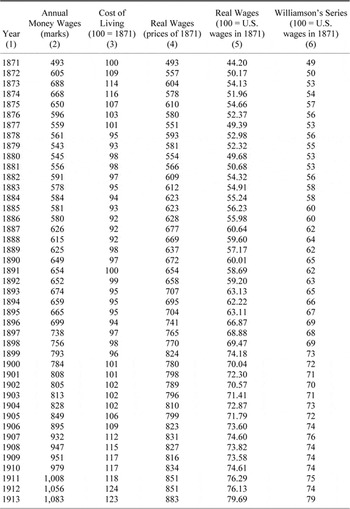
The calculation of the indirect wages that the German social insurance provided hinges on the way direct wages are estimated. My source for wages is Ashok Desai.Footnote 22 Between 1871 and 1886, Desai's annual money wages are a weighted average for six industries: printing, building, coal-mining, machines, cotton textiles, and steel. The employment in these industries in 1882 is used for weighting. From 1887 onwards, calculations are based on average earnings in industry, transport, and distribution. In total, 27 sectors are taken into account. Desai focuses on the wages of the workers who had accident insurance, but their benefits are not included in his wage measures. Insurance contributions were proportional to employees' earnings, and Desai derives average wages from 1887 to 1913 by dividing total earnings in each industry by the number of insured persons. Then, he calculates a weighted average by using the number of insured workers (Appendix Table 5, column 2).
In the same way, Desai estimates the cost of living before 1871 and 1913. Because nominal wages refer to industry, the cost of living is basically based on urban prices. It consists of an index of the average cost of consumer goods. The index is based on estimates of incomes and spending compiled from 852 families with incomes below 3,000 marks and with three to five children (Appendix Table 5, column 3).
Real wages are calculated from money earnings and cost of living and are given in 1871 prices (Appendix Table 5, column 4). In order to make a comparison, German real wages are then calculated in terms of American wages (100 = 1871), using Williamson's international benchmark (Appendix Table 5, column 5).Footnote 23 These can be compared with German international real wages, as calculated by Williamson (Appendix Table 5, column 6). The correlation between columns 5 and 6 is 0.984.
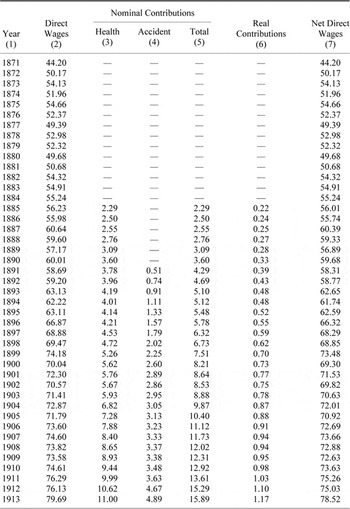
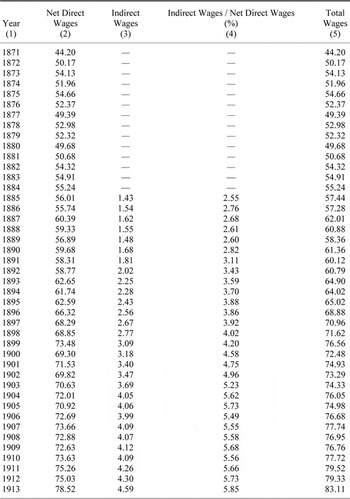
Appendix Table 6 shows the impact of workers' contributions on direct wages, with German remuneration measured relative to pay in the United States. Nominal contributions are calculated by dividing total contributions by the German economically active population. In that sense, total contributions represent the weighted average of contributions for health, disability, and old age insurance (again, employees did not contribute to the accident insurance system). Net direct wages are the difference between direct wages and contributions.
It is true that the value an individual places on social benefits will depend on personal circumstances, which will make it difficult to determine what the actual level of indirect wages is. Working in a coal mine, for instance, increases the probability of suffering an injury, which raises the benefits of accident insurance. But at the same time the likelihood of reaching retirement age diminishes. An office worker, by contrast, is less likely to have an accident, which lessens the benefits of accident insurance, but his probability of receiving an old age pension is higher than that of a miner. Indirect wages thus vary not only with the level of direct wages, but also with the occupation and location. In order to cope with this difficulty, my strategy was to set indirect wages equal to the average level of expenditures for insured workers. One could argue that value was zero for uninsured workers, but the new social insurance scheme probably influenced their decisions. Indeed, uninsured candidates for emigration, such as agricultural laborers, had the option to move either abroad or inside Germany, mainly to the industrial cities, where they would be eligible for insurance. Therefore, Bismarck's social legislation also had an effect on noninsured workers.
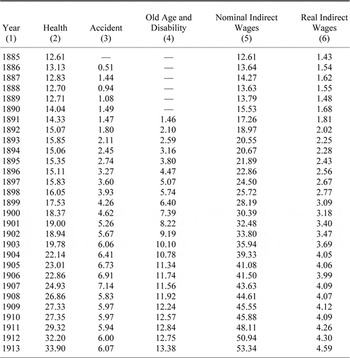
To be precise, I calculated German indirect wages Wiger as the sum of the ratio of expenditures by category of insurance to the number of insured workers in each category

where Exphealth, Expacc, and Expold.dis are the expenditures for health insurance, accident insurance, and the combined expenditures for old age and disability insurance, respectively, and Inshealth, Insacc, and Insold.dis the number of insured workers for each class of insurance. The results of these calculations are reported in Appendix Table 7. Appendix Table 8 presents German total wages, that is, the sum of direct and indirect wages.
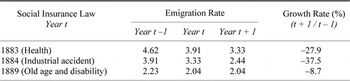
Was the social insurance in Germany before World War I enough to keep German workers from moving abroad? The overall weight of social benefits was admittedly relatively low. On average the share of indirect wages was only 4.3 percent of total wages and it reached a peak of only 5.9 percent in 1913. But beyond the figures of indirect wages, the fact remains that there was a strong and fast reaction to the new social legislation. Table 3 shows the evolution of German emigration rates after the adoption of the three 1880s social insurance laws. The strong drop in emigration that followed each law is striking, in particular following the health and industrial accident programs, which had direct effects on German workers' living conditions. Old age and disability insurance had less of an impact, because there were fewer potential beneficiaries. It is noteworthy that the 1880s were a period of relative prosperity in the United States, which reinforces the idea that social changes in Germany had an impact on labor flows.
Risk aversion can help explain why the legislation could have had such an impact, even though the indirect benefits were only a fraction of wages. Potential migrants, after all, could move to the United States, where the economy grew faster and direct wages were higher than in Germany. However, they had no guarantee of finding a job there, they faced tougher competition from other migrants and could lose everything in the event of sickness or accident. On the other hand, they could stay at home, where direct wages were lower but where they would receive social benefits that would give them insurance against sickness and accident. In addition, they would not have to cope with the psychological costs of moving to a foreign country. For risk-adverse individuals, the utility of this insurance would exceed the relatively small monetary value of the indirect wages, and that could explain why the German social legislation had such an impact on emigration patterns.Footnote 24
SOCIAL INSURANCE AND GERMAN EMIGRATION

Source:
Author's calculations based on Ferenczi and Willcox, International Migrations.
Social Legislation and German Emigration: The Econometric Evidence
In order to establish the role of Bismarck's social legislation on German emigration, I have estimated the legislation's impact using the Harris-Todaro model, which relies on the assumption that migration is the result of differences in expected rather than actual earnings. In the model, potential migrants consider the different labor market opportunities available and select the one that maximizes their expected gains from migration. Expected gains are measured by difference in real incomes between countries and by the probability that a new migrant finds a job abroad. The contribution of the current analysis is that it takes into account social insurance mechanisms, by introducing a distinction between direct and indirect wages.
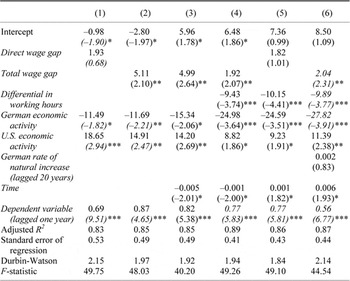
The results are reported in Table 4. The estimation method is ordinary least squares (OLS) using the German time series from 1872 to 1913. The dependent variable is the annual gross emigration rate. Emigration figures comes from Imre Ferenczi and Walter Willcox, and population from Angus Maddison.Footnote 25 There are no data on return migration, which explains why the figures are for gross migration. Around 90 percent of German migrants went to the United States between 1871 and 1913. Therefore, the analysis focuses on migration from Germany to America. The direct wage gap is the logarithm of the ratio of American to German real wages. American real wages are given by Williamson, and German real wages are derived from Desai.Footnote 26 For Germany, real wages are net direct wages, that is, the difference between direct wages and workers' contributions (Appendix Table 6, column 7). The total wage gap is the logarithm of the ratio of total wages in the United States to total wages in Germany, where total wages equal direct plus indirect wages. Given the lack of social insurance in the United States during the studied period, American indirect wages are considered to be equal to zero. German total wages are taken from Appendix Table 8, column 5. The total wage gap is then the logarithm of the ratio of direct wages in the United States to the sum of direct and indirect wages in Germany. Finally, employment opportunities are given by the evolution of economic activity, which is measured by the deviation of the logarithm of real GDP from a linear trend. GDP calculations are based on Christina Romer for the United States and Maddison for Germany.Footnote 27
REGRESSION RESULTS (dependent variable: German emigration rate)

* = Significant at the 10 percent level.
** = Significant at the 5 percent level.
*** = Significant at the 1 percent level
Notes:
Number of observations: 42. The t-statistics (in parentheses) are corrected for heteroskedasticity using the White procedure. Indeed, Breusch-Pagan tests indicated the presence of heteroscedasticity in the equations. Due to the inclusion of a lagged dependant variable in the regression, there is a risk that least squares estimates may be inconsistent if the error terms are correlated. Nevertheless, tests for autocorrelation rejected the hypothesis of autocorrelation in the residuals. In order to explore the issue of the stationarity of the variables, which is inherent in any time series analysis, unit root tests were performed on the dependent variables, using the augmented Dickey-Fuller test (ADF). The results show that there are no serious stationarity problems.
Source:
See the text.
All the equations show the importance of economic conditions in the decision to migrate: an improvement in the domestic economic activity was accompanied by a decreased in labor outflows, while a rise in the U.S. GDP meant more emigration.Footnote 28 Moreover, the coefficient of the lagged dependent variable (one year) is positive and significant at the 1 percent level in all six equations, which confirms the role of chain migration. But what is really interesting is the impact of the wage differential on migration.
Equation 1 measures the effect of the direct wage gap on German emigration. Although the coefficient has the expected sign (an increase in the American/German wage gap brings about a rise in the emigration rate), it is not significant, which is consistent with my argument that the gap in direct wages alone does not explain the decline in German emigration. Equation 2 takes into account indirect wages, by measuring the impact of the total wage gap. In this case, the coefficient of the wage ratio not only has the expected sign, but it also is significant at the 5 percent level, which confirms the role of social insurance in explaining German emigration. The increase in German indirect wages reduced the total wage gap between the United States and Germany, and that in turn led to less emigration.
Because indirect wages tended to rise over time, there is a risk that the total wage gap variable might pick up other time-related effects. I have added a time trend to all of the remaining equations to see if this is the case. This additional variable does not affect the previous result. In particular, the coefficient in regressions 2 and 3 are similar, and the level of significance is the same. The t-statistic for the total wage gap variable is higher, which strengthens the robustness of the results.
Bismarck's social legislation meant not only the adoption of a complete scheme of social insurance, but also an improvement in working conditions, including a reduction in working hours. To see if the shorter hours also affected emigration, I added the differential between the average number of working hours in the United States and in Germany to regression 4. Figures on average weekly working hours are taken from Brian Mitchell.Footnote 29 The coefficient of the differential in working hours is negative and significant at the 1 percent level, implying that an increase in the working-hour differential entailed a fall in German emigration. Thus, while German workers had to work 72 hours a week, on average, in 1872, American workers worked “only” 64 hours. But, at the end of the period (1913), the Germans worked 57 hours a week and American workers 55.5 hours. Even though average working hours in Germany were still higher than in the United States, the gap between the countries significantly decreased. It is important to note that although in equation 4 the coefficient of the total wage gap is lower than in equations 2 and 3, it is still significant at the 5 percent level. Therefore, not only indirect wages but also improvement in working conditions, proxied by the differential in working hours, played an important role in the decision of German workers to migrate or not.Footnote 30
To be sure that indirect wages were the determining factor in the migration decision, I removed the total wage gap from regression 4 and replaced it with the direct wage gap in regression 5. As in regression 1, the coefficient is positive but insignificant. Finally, equation 6 tests the demographic explanation for the drop in German emigration, by adding as an explanatory variable the German rate of natural increase, lagged 20 years to allow for entry into the adult labor force. The coefficient of this new variable has the expected sign (an increase in population brings about a rise in emigration), but the coefficient is not significant. Therefore the hypothesis that slower German population growth explains the decrease in emigration can be rejected.
The econometric results support my argument that social insurance reduced German emigration, but how could small variations in indirect wages have such a pronounced effect on the decisions of potential migrants? To begin with, the rise in indirect wages in Germany reflected not just an improvement in social benefits but also (and even more so) a rise in the number of insured workers. Therefore, the impact on emigration could result not from the increase in expenditures per worker but from the growing number of workers enrolled in the system. Another possible way for the social reforms to have affected German emigration is via their redistributive effect. The burden of the system was mainly on the employers' shoulders, in particular in the case of the industrial accident system, which covered most German workers (94 percent of the economically active population in 1913). In addition, the German State, that is, taxpayers, financed much of the old age and disability system. German workers (and notably the poorest among them, who did not pay taxes) were thus the net beneficiaries of the social system. It is in any case telling here that the German emigration rate did not pick up when the American economy revived in the second half of the 1890s, in contrast to what happened elsewhere in Europe. The conclusion that social insurance mechanisms mattered for potential migrants seems therefore inescapable.
CONCLUSION
As the German case demonstrates, social insurance mechanisms and labor mobility were strongly linked. Bismarck's legislation in the 1880s cut the German emigration rate, as candidates for migration considered not only the gap in direct wages, but also social benefits. This result could obviously be explored in other periods and other geographical areas. One might reasonably suppose, for example, that social intervention in European countries during the interwar years contributed to the decline in their emigration rates. Similarly, lower labor mobility in Western Europe today (relative to the United States) is probably due to higher social expenditures. In Europe, generous social security systems keep labor mobility low, despite the free movement of people within the European Union. By contrast, in the United States, the lack of job security coupled with low levels of unemployment benefits boost migration flows between American States. In the same way, emigration rates in developing countries result not only from low incomes, but also from the lack of social benefits.
Appendices
The following tables collect the main statistics related to Bismarck's social insurance and the calculations of direct, indirect, and total wages.
HEALTH INSURANCE (LAW OF 1883): 1885–1913

Notes:
All figures are in thousands. Expenditures exclude administrative costs.
Sources:
Economically active population: Hoffman, Wachstum; other statistics: Statistisches Jahrbuch für das Deutsche Reich.
ACCIDENT INSURANCE (LAW OF 1884): 1886–1913

Notes:
All figures are in thousands. The column “recipients” corresponds to the stock of recipients while “new recipients” refers to the annual flow. “Accidents” include all injuries that last at least thirteen weeks. Widows and orphans were the recipients of “death insurance”. Expenditures exclude administrative costs.
Sources:
As in Appendix Table 1.
DISABILITY INSURANCE (LAW OF 1889): 1891–1913
Sources and notes:
As in Appendix Table 1.
OLD AGE INSURANCE (LAW OF 1889): 1891–1913

Sources and notes:
As in Appendix Table 1.
GERMAN DIRECT WAGES: 1871–1913

Notes:
German real wages are measured relative to the 1871 wage level in the United States. Williamson's series are real wage rates adjusted for purchasing power.
Sources:
See the text.
GERMAN NET DIRECT WAGES: 1871–1913

Notes:
Details of calculation are given in the text. Real wages and contributions: 100 = U.S. real wages in 1871.
GERMAN INDIRECT WAGES: 1885–1913

Sources:
Author's calculations based on Statistisches Jahrbuch für das Deutsche Reich.
Notes:
 . Nominal indirect wages: Health + Accident + Old age and disability; Real indirect wages: 100 = U.S. real wages in 1871.
GERMAN TOTAL WAGES: 1871–1913

Notes:
100 = U.S. real wages in 1871. Total wages = net direct wages + indirect wages.
Sources:
Net direct wages: Appendix Table 6; indirect wages: Appendix Table 7.