Introduction
Spatangoids (heart urchins) constitute a biodiverse group of irregular echinoids that appeared in the Early Cretaceous (Barremian) (Villier and Navarro, Reference Villier and Navarro2004; Villier et al., Reference Villier, Néraudeau, Clavel, Neumann and David2004; Stockley et al., Reference Stockley, Smith, Littlewood, Lessios and Mackenzie-Dodds2005; Kroh and Smith, Reference Kroh and Smith2010), leaving a rich fossil record (Villier et al., Reference Villier, Néraudeau, Clavel, Neumann and David2004; David et al., Reference David, Mooi, Néraudeau, Saucede and Villier2009). Spatangoid-dominated assemblages are well documented and show a wide distribution (e.g., Néraudeau, Reference Néraudeau1991; Radwański and Wysocka, Reference Radwański and Wysocka2001; Kroh, Reference Kroh, Féral and David2003; Kroh and Nebelsick, Reference Kroh and Nebelsick2003; Zamora et al., Reference Zamora, Mayoral, Vintaned, Bajo and Espílez2008; Smith and Gale, Reference Smith and Gale2009; Stara et al., Reference Stara, Sanciu and Rizzo2012; Mancosu and Nebelsick, Reference Mancosu and Nebelsick2017a, Reference Mancosu and Nebelsick2019; Martínez and Del Rio, Reference Martínez and Del Rio2017; Caron et al., Reference Caron, Bailleul, Chanier and Mahieux2019; Palópolo et al., Reference Palópolo, Kroh, Harzhauser, Griffin, Casadio and Carmona2021 and references therein).
Spatangoids diversified extensively in the Cenozoic, with most extant families dating back to the Eocene (Smith, Reference Smith1984; Smith and Kroh, Reference Smith and Kroh2011). These sea urchins colonized a wide spectrum of marine environments from littoral to abyssal depths (Stockley et al., Reference Stockley, Smith, Littlewood, Lessios and Mackenzie-Dodds2005) and display a wide variety of test shapes and morphological features related to their mode of life and environmental conditions (e.g., Saitoh and Kanazawa, Reference Saitoh and Kanazawa2012, Reference Saitoh and Kanazawa2019). Spatangoids have a predominantly burrowing habit that is considered a key innovation explaining their success (Kier, Reference Kier1974), allowing access to unexploited food resources and escape from predators (Smith, Reference Smith1984). Their rich fossil record is the result of a combination of factors, including their habits and gregarious behavior, their wide distribution in different habitats, related energy and sedimentological conditions, and varying taphonomic pathways (see discussion in Mancosu and Nebelsick, Reference Mancosu and Nebelsick2017a and references therein).
In general, spatangoids have fragile tests that make them prone to breakage and disarticulation when subjected to transportation or reworking. Their burrowing habit prevents or minimizes destructive biostratinomic processes (Schäfer, Reference Schäfer1972; Kier, Reference Kier1977; Néraudeau, Reference Néraudeau1991) if the echinoid dies while below the surface of the sediments. These echinoids live within unconsolidated, mobile substrates in areas of active sedimentation, where rapid final burial under thick layers of sediments prevents the remains being reworked and destroyed, leading to a high fossilization potential (Ernst et al., Reference Ernst, Hähnel and Seibertz1973; Smith, Reference Smith1984; Greenstein, Reference Greenstein and White1993; Radwański and Wysocka, Reference Radwański and Wysocka2001; Mancosu et al., Reference Mancosu, Nebelsick, Kroh and Pillola2015; Mancosu and Nebelsick, Reference Mancosu and Nebelsick2017a).
Oxygen deficiency can play a role in preservation potential of spatangoid echinoids, inducing emergence onto the sediment surface and subsequent death of infaunal forms, as documented for Echinocardium cordatum (Pennant, Reference Pennant1777) (Nilsonn and Rosenberg, Reference Nilsonn and Rosenberg1994) and Ova canalifera (Lamarck, Reference Lamarck1816), tests of which can serve as a substratum for epigrowth (Stachowitsch, Reference Stachowitsch, Tyson and Pearson1991; Nebelsick et al., Reference Nebelsick, Schmid and Stachowitsch1997). Bioinfestation by encrusting organisms can also increase their chance for preservation on the seafloor (see Ernst et al., Reference Ernst, Hähnel and Seibertz1973; Nebelsick, Reference Nebelsick, Heinzeller and Nebelsick2004; Zamora et al., Reference Zamora, Mayoral, Vintaned, Bajo and Espílez2008). In addition, dysoxic or anoxic conditions and low water temperature can enhance echinoid preservation potential, delaying soft-tissue decay and test disarticulation (see Nebelsick et al., Reference Nebelsick, Schmid and Stachowitsch1997; Banno, Reference Banno2008; Mancosu et al., Reference Mancosu, Nebelsick, Kroh and Pillola2015; Palópolo et al., Reference Palópolo, Kroh, Harzhauser, Griffin, Casadio and Carmona2021).
Predation is also considered to be of primary importance in affecting the preservation potential of spatangoids (Tyler et al., Reference Tyler, Dexter, Portell and Kowalewski2018), shaping their ecological and evolutionary dynamic (McNamara, Reference McNamara, David, Guille, Féral and Roux1994; Kanazawa, Reference Kanazawa, Heinzeller and Nebelsick2004, Reference Kanazawa, Reich, Reitner, Roden and Thuy2010), and thereby influencing the nature of their fossil record. Many different organisms, such as turtles, birds, fishes, sea stars, and gastropods, prey on spatangoid echinoids today (e.g., Chesher, Reference Chesher1969; Hughes, Reference Hughes1986; Nebelsick, Reference Nebelsick, Carnevali and Bonasoro1999; Scheibling, Reference Scheibling and Lawrence2013; Sievers et al., Reference Sievers, Friedrich and Nebelsick2014; Grun, Reference Grun2016; Tyler et al., Reference Tyler, Dexter, Portell and Kowalewski2018 and references cited therein). Despite these investigations, spatangoids have been poorly studied with respect to predator–prey interaction from a paleoecological and taphonomic perspective. Durophagus predation can destroy the echinoid test while feeding, leaving few recognizable fragments of the prey. Such predation may be difficult to distinguish from damage caused by postmortem breakage. By contrast, gastropod predation produces discrete, small holes in the echinoid test. These may not only be common but allow for detailed investigations on size and site selectively, distribution among different facies within sedimentary environments, defense mechanisms, and the co-evolution of predator and prey (e.g., Nebelsick, Reference Nebelsick, Carnevali and Bonasoro1999; Kowalewski and Nebelsick, Reference Kowalewski, Nebelsick, Kelley, Kowalewski and Hansen2003; Farrar et al., Reference Farrar, Graves, Petsios, Portell, Grun, Kowalewski and Tyler2020; Petsios et al., Reference Petsios, Portell, Farrar, Tennakoon, Grun, Kowalewski and Tyler2021).
Drilling predation is documented on some extant spatangoid taxa (Moore, Reference Moore1956; Chesher, Reference Chesher1969; Hendler, Reference Hendler and Taylor1977; Hughes and Hughes, Reference Hughes and Hughes1981; Hughes, Reference Hughes1986; Gerace and Lindsay, Reference Gerace, Lindsay and Gerace1992; Lindsay, Reference Lindsay, Elliott, Craig Edwards and Godfrey1996; Dexter, Reference Dexter2011; Tewfik, Reference Tewfik, Acosta and LeRoy Creshwell2014; Belaústegui et al., Reference Belaústegui, Muñiz, Nebelsick, Domènech and Martinell2017; Tyler et al., Reference Tyler, Dexter, Portell and Kowalewski2018) and is attributed to present-day cassid gastropods (Tonnacea). Evidence of drilling predation attributed to gastropods has also been recognized in fossil spatangoids (e.g., Beu et al., Reference Beu, Henderson and Campbell1972; Kier, Reference Kier1981; Gibson and Watson, Reference Gibson and Watson1989; McKinney and McNamara, Reference McKinney and McNamara1991; Rose and Cross, Reference Rose and Cross1993; McNamara, Reference McNamara, David, Guille, Féral and Roux1994; Miller and Walker, Reference Miller and Walker2009; Mancosu and Nebelsick, Reference Mancosu and Nebelsick2017a).
Herein, a spatangoid-rich sedimentary succession from the early–middle Miocene of Punta Foghe (central-western Sardinia; western Mediterranean) is studied with the aim of reconstructing paleoecological and associated paleoenvironmental conditions and investigating abiotic and biotic factors, including predation, that influence the preservation potential of spatangoid echinoids. This is accomplished by: (1) logging sedimentary facies in detail, (2) applying the functional morphological reconstructions of echinoid skeletons and interpreting their behavior and life habits, (3) quantifying various taphonomic features of test preservation, and (4) investigating predatory patterns, such as drilling intensities, size, and site selectivity.
Geological setting
The Oligo–Miocene tectono-sedimentary framework of Sardinia is related to the complex geodynamic evolution of the Western Mediterranean area (Carmignani et al., Reference Carmignani, Oggiano, Barca, Conti, Salvadori, Eltrudis, Funedda and Pasci2001; Faccenna et al., Reference Faccenna, Speranza, D'Ajello Caracciolo, Mattei and Oggiano2002; Oggiano et al., Reference Oggiano, Funedda, Carmignani and Pasci2009; Carminati et al., Reference Carminati, Lustrino and Doglioni2012). Tectonic controls on sedimentation resulted in high facies variability ranging from continental to transitional and marine environments, and include synsedimentary volcanism (e.g., Guerrera et al., Reference Guerrera, Mattioli, Serrano, Tramontana and Raffaelli2004; Cherchi et al., Reference Cherchi, Mancin, Montadert, Murru, Putzu, Schiavinotto and Verrubbi2008).
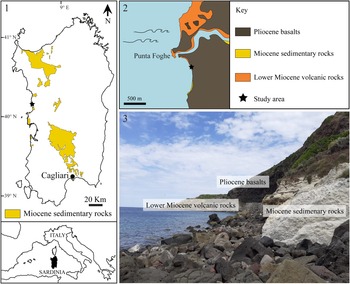
Three main sedimentary units were recognized, with the following ages: (1) Chattian to early Burdigalian, (2) late Burdigalian to early Serravallian, and (3) Serravallian to early Messinian (Assorgia et al., Reference Assorgia, Barca, Spano, Assorgia, Barca and Spano1997a, Reference Assorgia, Barca, Porcu, Spano, Assorgia, Barca and Spanoc). These sedimentary successions are present predominantly in the north/northwest–south/southeast oriented Sardinian Basin (Fig. 1.1), a tectonic trough extending from the Gulf of Sassari in the northwest to Cagliari in the south that originated during Oligo–Miocene tectonic movements of the Corsica–Sardinia microplate and is subdivided into a number of minor sub-basins (Cherchi and Montadert, Reference Cherchi and Montadert1982; Thomas and Gennesseaux, Reference Thomas and Gennesseaux1986; Funedda et al., Reference Funedda, Oggiano and Pasci2000; Carmignani et al., Reference Carmignani, Oggiano, Barca, Conti, Salvadori, Eltrudis, Funedda and Pasci2001; Faccenna et al., Reference Faccenna, Speranza, D'Ajello Caracciolo, Mattei and Oggiano2002; Speranza et al., Reference Speranza, Villa, Sagnotti, Florindo, Cosentino, Cipollari and Mattei2002; Oggiano et al., Reference Oggiano, Funedda, Carmignani and Pasci2009).
(1) Distribution of Miocene sedimentary rocks in Sardinia and location of study area. (2) Simplified geological map of study area (modified from Carboni et al., Reference Carboni, Lecca and Tilocca2010) with the location of stratigraphic measured section. (3) Panoramic view of studied volcano–sedimentary succession.

The studied sedimentary succession is in the central-western part of the Montiferru area (central-western Sardinia) (Fig. 1) along the coast between the village of Santa Caterina di Pittinuri and Punta Foghe (Cuglieri/Tresnuraghes) and represents the second main sedimentary unit (Assorgia et al., Reference Assorgia, Barca, Mighela, Muntoni, Murgia, Porcu, Rizzo, Rombi, Spano, Assorgia, Barca and Spano1997b; Carboni et al., Reference Carboni, Lecca and Tilocca2010). In the Montiferru area, the Miocene volcano–sedimentary sequence commences with andesitic lavas and pyroclastic deposits of rhyolitic and dacitic composition (Assorgia et al., Reference Assorgia, Barca, Mighela, Muntoni, Murgia, Porcu, Rizzo, Rombi, Spano, Assorgia, Barca and Spano1997b; Bottero et al., Reference Bottero, Carboni and Pala2002 and references cited therein) dated by the K–Ar method to 19–16 Ma and 17–13 Ma, respectively (Assorgia et al., Reference Assorgia, Barca, Spano, Assorgia, Barca and Spano1997a, Reference Assorgia, Barca, Mighela, Muntoni, Murgia, Porcu, Rizzo, Rombi, Spano, Assorgia, Barca and Spanob and references cited therein). These deposits are followed by heterometric conglomerates, epiclastites, and volcanoclastic deposits of fluvio-lacustrine origin (Assorgia et al., Reference Assorgia, Barca, Mighela, Muntoni, Murgia, Porcu, Rizzo, Rombi, Spano, Assorgia, Barca and Spano1997b and references cited therein; Mighela et al., Reference Mighela, Muntoni, Assorgia, Porcu, Spano, Assorgia, Barca and Spano1997). The succession continues with a thick marine carbonate sedimentary sequence ranging from late Burdigalian to early Serravallian according to its stratigraphic position and macrofossil content (Comaschi Caria, Reference Comaschi Caria1951; Assorgia et al., Reference Assorgia, Barca, Mighela, Muntoni, Murgia, Porcu, Rizzo, Rombi, Spano, Assorgia, Barca and Spano1997b; Carboni et al., Reference Carboni, Lecca and Tilocca2010). This succession consists of calcarenites and bioclastic limestones, passing upward to fine-grained lithologies dominated by bivalves and echinoids (see Mancosu and Nebelsick, Reference Mancosu and Nebelsick2019).
Miocene sedimentary deposits are unconformably overlain by subaerial, fluvio-deltaic sandstones and conglomerates intercalated with Pliocene to lower Pleistocene basanites as well as trachytic and phonolitic lava flows (Beccaluva et al., Reference Beccaluva, Macciotta and Venturelli1974; Assorgia et al., Reference Assorgia, Barca, Mighela, Muntoni, Murgia, Porcu, Rizzo, Rombi, Spano, Assorgia, Barca and Spano1997b; Carboni et al., Reference Carboni, Lecca and Tilocca2010). As noted by Mighela et al. (Reference Mighela, Muntoni, Assorgia, Porcu, Spano, Assorgia, Barca and Spano1997), the tectono–sedimentary development and the stratigraphic framework of the Montiferru area are comparable in part to that of the well-known Logudoro and Porto Torres Basins (Northern Sardinia) as described by Mazzei and Oggiano (Reference Mazzei and Oggiano1990) and Funedda et al. (Reference Funedda, Oggiano and Pasci2000, Reference Funedda, Oggiano, Pascucci and Pascucci2003).
The early–middle Miocene carbonate sedimentary sequence cropping out along the coast between S'Archittu-Santa Caterina di Pittinuri and Punta Foghe consists of grainstones, floatstone, and rudstones at its base and contains the echinoid assemblages studied herein, passing upward to fine-grained lithologies (calcareous sandstones, mudstone, wackestones, and packstones). Fossil content is dominated by echinoid remains that occur throughout the sedimentary sequence and have been described in part by Comaschi Caria (Reference Comaschi Caria1951, Reference Comaschi Caria1972) and Mancosu and Nebelsick (Reference Mancosu and Nebelsick2019).
Materials and methods
Paleontological, taphonomic, and sedimentological analyses were conducted in the field and laboratory. Complete and fragmented echinoid tests were observed and can be attributed to specific echinoid taxa at least to genus level due to the presence of specific morphological features. Taxonomy follows Mongiardino Koch and Thompson (Reference Mongiardino Koch and Thompson2021).
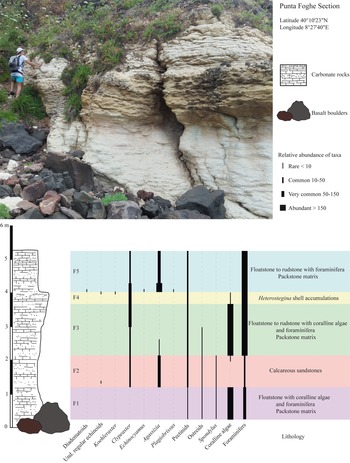
A stratigraphic section (Fig. 2) was measured in which echinoid remains are common throughout. The sedimentary succession was investigated in detail with respect to diversity and relative abundance of echinoids and accompanying paleontological content, fossil orientation, and packing fabric as well as taphonomic and sedimentological features. Relative abundance was semi-quantitatively evaluated as rare, common, very common, or abundant (Fig. 2). The orientation of complete specimens relative to the bedding was observed both in plan view and cross section and reported as concordant, oblique, or perpendicular as proposed by Kidwell et al. (Reference Kidwell, Fürsich and Aigner1986). The degree of close packing was determined by using the categories dense, loose, and dispersed following Kidwell and Holland (Reference Kidwell and Holland1991). Taphonomic signatures such as disarticulation, fragmentation, abrasion, encrustation, and bioerosion were semi-quantitatively estimated according to five categories: absent, rare, common, frequent, and total. Abrasion, encrustation, and bioerosion were evaluated on both fragments and complete specimens. Surface abrasion was distinguished by noting the presence or absence of tubercles on the test surface. The study of the sedimentary succession was based on field observations and microfacies analysis of thin sections cut in samples selectively collected from different levels recognized in the field, with the aim of assessing facies changes across the sedimentary sequence. Identification of carbonate rocks follows Lokier and Junaibi (Reference Lokier and Al Junaibi2016). Suggestions concerning life habit of the fossil echinoids are derived from functional morphological interpretation of skeletal features in Nichols (Reference Nichols1959), Smith (Reference Smith1980), and Kanazawa (Reference Kanazawa1992) and actualistic comparisons with closely related extant taxa. Terminology of the echinoid test follows Smith and Kroh (Reference Smith and Kroh2011). Spatangoid tests were obtained from the uppermost part of the section (Facies 5) by surface collecting and examined for evidence of predation. Only complete and undeformed specimens were considered for statistical analysis.
Stratigraphic section with distribution and relative abundance of echinoids and associated fauna and flora. Und. = undetermined; F1–F5 = Facies 1 to 5.

Drilled tests were analyzed for drilling intensity, drill-hole dimensions, drill-hole morphology, and size and site selectivity. Maximum and minimum drill-hole diameters were measured from photographs using ImageJ software. As the diameter of drill holes made by gastropods correlates with the size of the predator (Hughes and Hughes, Reference Hughes and Hughes1981), drill holes were analyzed for their maximum diameter with respect to the length of the drilled test in which they occur, thus testing for a possible size selection by the predator. The relationship between drill-hole minimum and maximum diameter and that between drill-hole size and prey size were estimated using Pearson's correlation.
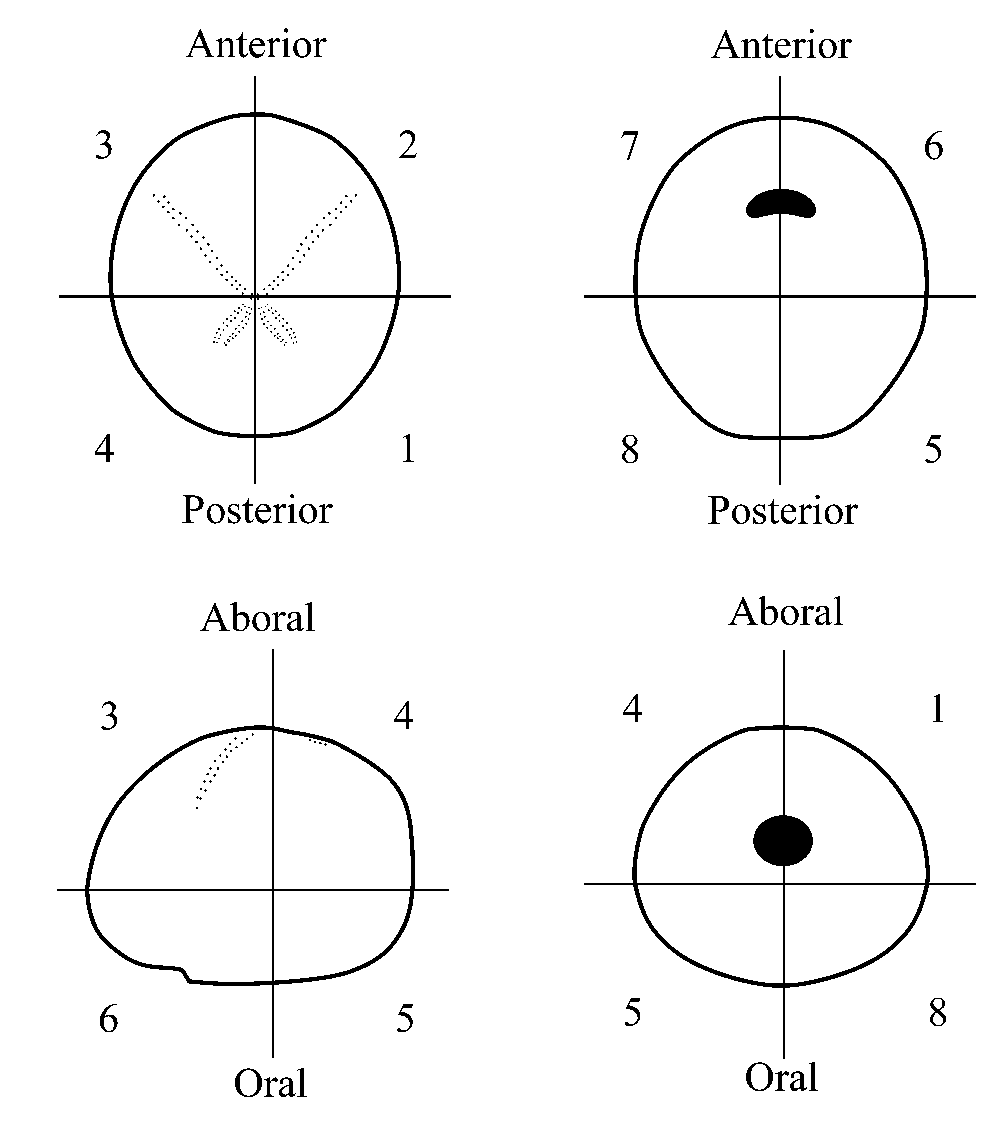
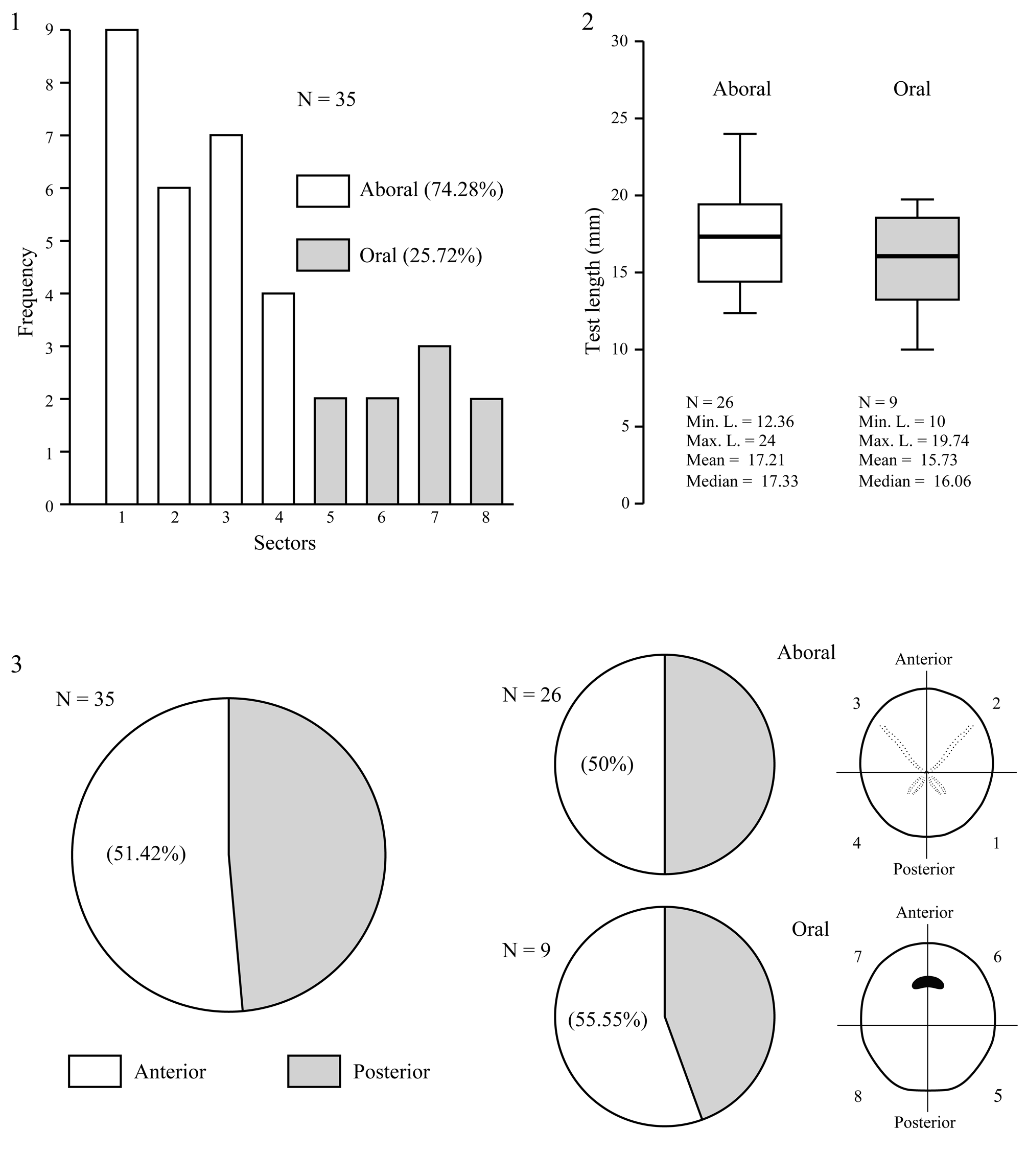
In addition, size selectivity was investigated by comparing drilled and undrilled test size distributions using a two-sample t-test. All linear measurements on the echinoid test were conducted using a caliper with an accuracy of 0.02 mm. To assess site selectivity, the position of drill-hole center was determined by dividing the test of Agassizia into eight sectors (1–8) by three perpendicular planes, dividing the test into right and left side, aboral and oral side, and anterior and posterior side, respectively (Fig. 3). Statistical analyses were performed with Past 4.03 (Hammer et al., Reference Hammer, Harper and Ryan2001).
Agassizia test (in aboral, oral, lateral, and posterior views) divided into eight sectors by three perpendicular planes.

Repository and institutional abbreviation
Specimens of Agassizia examined herein are stored in the Dipartimento di Scienze Chimiche e Geologiche (DSCG), Università degli studi di Cagliari.
Results
Facies description
The studied sedimentary succession is ~5 m thick and consists of carbonate lithologies with high fossiliferous content, including echinoids, bivalves, coralline algae, and larger benthic foraminifera (LBF). Five facies were recognized on the basis of lithology and fossil content (Fig. 2).
The sedimentary succession starts with coralline algae floatstones to rudstones (Facies 1) with the common occurrence of disarticulated valves of ostreids and Spondylus, followed by calcareous sandstones (Facies 2). The fossil content in Facies 2 is dominated by the spatangoid echinoid Agassizia, with subordinate amounts of the clypeasteroid Clypeaster showing different morphotypes. The LBF Heterostegina also occur commonly, along with rare Amphistegina and smaller benthic foraminifera, including rotaliids, elphidiids, and miliolids. Further macrofossils also include large ostreids, Spondylus, and small pectinid bivalves.
Calcareous sandstones pass gradually to floatstone/rudstone (Facies 3), which is composed of coralline algae and the benthic foraminifera Heterostegina in a packstone matrix. Echinoid remains are common and consist mainly of Clypeaster with rare Agassizia.
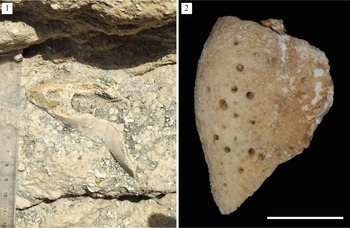
Coralline algae gradually decrease upward, passing to a rudstone with densely packed coquinas (Facies 4) consisting of densely packed, variously oriented and imbricated, mostly fragmented shell remains of Heterostegina, with rare Amphistegina and miliolids. Clypeaster remains (Fig. 4) are very common with the sporadic occurrence of small, complete, regular echinoids (possibly small Schizechinus). A single test remnant of the echinoneoid Koehleraster was also found.
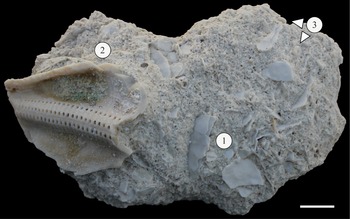
(1) Clypeaster test affected by fragmentation (Facies 3). (2) Test fragment of Clypeaster affected by multiple circular holes. Scale bar = 1 cm.

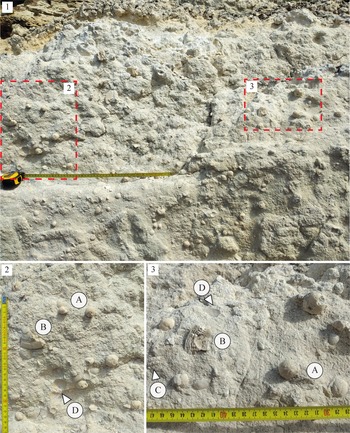
The sedimentary succession ends with floatstones to rudstones (Facies 5) in a bioclastic packstone matrix. The fossil content is dominated by echinoid remains (Fig. 5) and LBF, including Heterostegina (Fig. 6.1) and rare Amphistegina, which can be present as complete and fragmented shell remains. Very rare small benthic foraminifera (rotaliids and miliolids) are also present. The echinoid fauna is dominated by Agassizia, which occur abundantly, reaching a density of 60 individuals per m2. Clypeaster remnants also occur very commonly. Also present are test fragments of a large spatangoid, possibly Plagiobrissus (Fig. 6.2), regular echinoid remains, including a single fragmented diadematoid spine, a rotule, isolated interambulacral plates, and specimens of the minute clypeasteroid Echinocyamus (Fig. 6.3). Pectinid bivalves are represented by disarticulated and fragmented remains.
(1) Plan view of floatstone to rudstone composed of foraminifera (Heterostegina) in a bioclast packstone matrix (Facies 5) with abundant echinoid remains. (2, 3) Details showing accumulation of complete tests of Agassizia (A), test fragments of Clypeaster (B), regular echinoid interambulacral plates (C), and pectinid remains (D).

Remains of benthic foraminifera Heterostegina (1), spatangoid Plagiobrissus (2) and clypeasteroid Echinocyamus (3) (Facies 5). Scale bar = 1 cm.

Echinoid taphonomy
The echinoid remains occur abundantly throughout the succession and range from loosely packed to dispersed (sensu Kidwell and Holland, Reference Kidwell and Holland1991). The echinoid fauna shows a low diversity, being dominated mainly by Agassizia and Clypeaster.
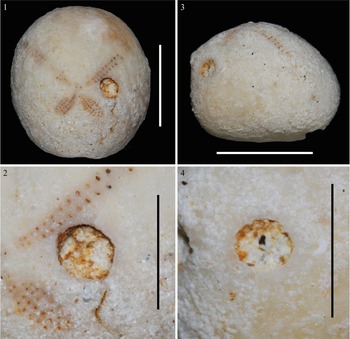
In facies 2 and 5, remnants of the spatangoid Agassizia consist of both complete specimens lacking spines (Fig. 5) and rare large test fragments. The orientation of complete tests ranges from concordant to perpendicular to the bedding plane (specimens lying on their sides). Evidence for abrasion is lacking as echinoid tests, and their fragments are very well preserved with respect to surface details. Tests commonly bear subcircular to slightly elongated holes (Fig. 7).
(1) Drilled specimen of Agassizia in aboral view. (2) Magnification of drill hole. (3) Drilled specimen of Agassizia in lateral view. (4) Magnification of drill hole. (1, 3) Scale bars = 1 cm; (2, 4) scale bars = 0.5 cm.

Clypeaster remains are present predominantly as test fragments (Fig. 4.1) ranging from up to half test sized to pie-shaped portions and smaller fragments. Both inter- and intraplate fragmentation are present. Rarely, complete specimens also occur. Both complete specimens and fragments show orientations ranging from concordant to perpendicular to the bedding plane. Small fragments can be readily recognized due to the small, evenly distributed, sunken tubercles on the surface as well as the presence of support structures within the test. Complete specimens are well preserved, displaying surface details, while the fragments range from well preserved to abraded. Encrustation by coralline algae occurs on test fragments. Bioerosion is present on Clypeaster test fragments as multiple, closely spaced, circular to subcircular holes affecting both oral and aboral sides (Fig. 4.2).
Minute, undetermined regular echinoids and the irregulars Koehleraster and Echinocyamus are present as complete tests. By contrast, the remains of diadematid echinoids and large spatangoids (possibly Plagiobrissus) occur exclusively as spine and test fragments, respectively. The sediment infilling the echinoid tests is identical to be that of the embedding rock.
Drill holes in Agassizia
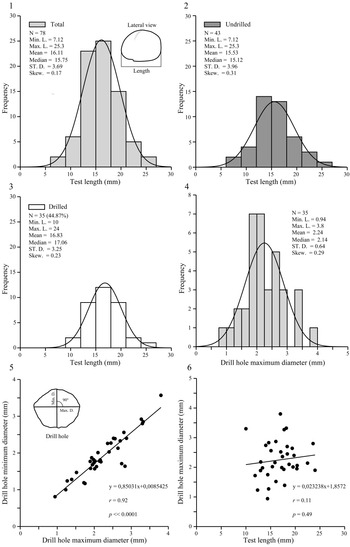
The spatangoid Agassizia, which at the study site ranges in test length from 7.12 to 25.3 mm with a mean of 16.12 mm (Fig. 8.1), is affected by drill holes in 35 out of 78 complete (44.87%) specimens selected for this study. The average test length is 15.53 mm and 16.83 mm for undrilled (Fig. 8.2) and drilled (Fig. 8.3) specimens, respectively (two-sample t-test, t = 1.54, p = 0.12).
Size selectivity analysis. (1) Test length distribution of Agassizia. (2) Test length distribution of undrilled specimens. (3) Test length distribution of drilled specimens. (4) Drill hole size distribution. (5) Plot of drill hole minimum versus maximum diameter. (6) Plot of drill hole maximum diameter versus test length. r = Pearson's correlation coefficient; p = p-value; Max. D. = maximum diameter; Min. D. = minimum diameter; Max. L. = maximum length; Min. L. = minimum length; ST. D. = standard deviation.

Drill holes range from 0.94 to 3.8 mm in maximum diameter, with a mean of 2.24 mm (Fig. 8.4). These holes are subcircular to slightly elongated in outline with smooth to fairly irregular margins and can be attributed to the trace fossil Oichnus simplex Bromley, Reference Bromley1981. There is a very strong correlation (Pearson's correlation, r = 0.92, p << 0.0001) between the maximum and minimum diameters of the drill holes (Fig. 8.5). There is a weak positive correlation (r = 0.11, p = 0.49) between test length and maximum drill-hole diameter (Fig. 8.6). All bored specimens bear single drill holes that completely penetrate the test. The drill holes are located predominantly (74.28%) on the aboral side (Fig. 9.1), with a slight difference in test length between aborally (mean 17.21 mm) and orally (mean 15.73 mm) drilled specimens (Fig. 9.2). There is no apparent preference of drill-hole location on either the anterior (51.42%) or the posterior side of the test (Fig. 9.3).
Site selectivity analysis. (1) Drill hole site distribution. (2) Difference in test length between aborally and orally drilled specimens. (3) Drill hole location on anterior/posterior side of test. Min. L. = minimum length; Max. L. = maximum length.

Discussion
Paleoenvironment and paleoecological interpretation
According to facies analysis and fossil content, the early–middle Miocene sedimentary succession of Punta Foghe was deposited in a shallow inner sublittoral environment with moderate energy conditions affected by high-energy events.
Agassiza is well represented in facies 2 and 5, indicating shallow settings with sandy sediments. Currently, this genus includes two extant species, both of which are restricted to tropical seas, Agassizia scobiculata Valenciennes, Reference Valenciennes and du Petit-Thouars1846 occurs from littoral to shallow sublittoral depths, while A. excentrica Agassiz, Reference Agassiz1869 is more common at greater depths, from sublittoral to bathyal zones (Mortensen, Reference Mortensen1951; Chesher, Reference Chesher1972; Serafy, Reference Serafy1979; Kier, Reference Kier1984; Lessios, Reference Lessios2005; Alvarado et al., Reference Alvarado, Solis-Marin and Ahearn2010; Galván-Villa et al., Reference Galván-Villa, Rubio-Barbosa and Martínez-Melo2018; Gondim et al., Reference Gondim, De Moura, Christoffersen and Pereira Dias2018). Agassizia are deposit feeders living infaunally in fine-grained sediments (Mortensen, Reference Mortensen1951; Chesher, Reference Chesher1972; Serafy, Reference Serafy1979; Galván-Villa et al., Reference Galván-Villa, Rubio-Barbosa and Martínez-Melo2018; Gondim et al., Reference Gondim, De Moura, Christoffersen and Pereira Dias2018). Agassizia from the Miocene of Punta Foghe are morphologically very similar to A. scrobiculata, the type species of the genus, which has a small to medium globular test, no anterior sulcus, and an anterior ambulacrum (III) that is narrow and weakly depressed adapically with uniserially arranged small pore pairs bearing small penicillate tube feet. The other ambulacra are petaloid and weakly sunken, with entirely rudimentary pores in the anterior column of the anterior petals. Peripetalous and lateroanal fascioles are present.
The Agassizia species from the Miocene deposits studied herein is interpreted as a shallow infaunal form. Since this echinoid lacked respiratory tube feet in the distal half of the anterior column of the anterior paired petals, it did not have the ability to develop a long respiratory funnel through the sediments to the surface and could not burrow deeply. Agassizia is not common in the Miocene sedimentary sequences of Sardinia. It is reported to occur in association with the scutellid Amphiope within conglomeratic levels of the lower Miocene Mores Formation, which represents littoral environments with moderate energy conditions (Mancosu and Nebelsick, Reference Mancosu and Nebelsick2013). A single test was also found in lower–middle Miocene fine-grained sandstones of Porto Torres associated with a spatangoid-dominated fauna reflecting deeper sublittoral environments (Mancosu and Nebelsick, Reference Mancosu and Nebelsick2017a).
Clypeaster is also common in the deposits at Punta Foghe (from facies 2 to 5). Extant representatives of the genus Clypeaster mostly inhabit soft-bottom areas of shallow continental shelves (e.g., Nebelsick, Reference Nebelsick and Lawrence2020 and references therein). In our study, Clypeaster is represented by different morphotypes similar to those exemplified by C. olisiponensis Michelin, Reference Michelin1861, C. latirostris Michelin, Reference Michelin1861, and C. marginatus Lamarck, Reference Lamarck1816. On the basis of morphological features and comparison with recent analogues (see discussion in Mancosu and Nebelsick, Reference Mancosu and Nebelsick2015, Reference Lokier and Al Junaibi2016, Reference Mancosu and Nebelsick2017b), the Clypeaster olisiponensis morphotype, with a highly domed test with thick and tumid margins and flat oral surface, and the Clypeaster latirostris morphotype, with a lower test and relatively thin margin, are interpreted as epibenthic and semi- to shallow infaunal forms, respectively. These morphotypes occur frequently in the Miocene sedimentary deposits of shallow-water settings (see Mancosu and Nebelsick, Reference Mancosu and Nebelsick2015, Reference Lokier and Al Junaibi2016, Reference Mancosu and Nebelsick2017b and discussion therein). The Clypeaster marginatus morphotype with a low, flattened test and thin margins, is interpreted as a shallowly buried to partially burrowed form. It is common as a minor component in spatangoid-dominated assemblages of moderately deep sublittoral environments (Mancosu and Nebelsick, Reference Mancosu and Nebelsick2015, Reference Mancosu and Nebelsick2017b, Reference Mancosu and Nebelsick2019).
In Facies 5, the echinoid assemblage also includes Echinocyamus, Koehleraster, and the brissid spatangoid Plagiobrissus. Modern representatives of Plagiobrissus, such as P. grandis (Gmelin, Reference Gmelin and Gmelin1791) are mainly shallow-water forms, although it has been recorded at a depth of 200 m or more (Mortensen, Reference Mortensen1951; Serafy, Reference Serafy1979). Plagiobrissus grandis lives buried in shallow-water sandy areas (Chesher, Reference Chesher1969; Serafy, Reference Serafy1979; Hendler et al., Reference Hendler, Miller, Pawson and Porter1995; Gondim et al., Reference Gondim, De Moura, Christoffersen and Pereira Dias2018 and references cited therein) and typically burrows to a depth of 50 mm (Kier and Grant, Reference Kier and Grant1965). Plagiobrissus is very rare in the sedimentary succession of Punta Foghe as well as in other Miocene fossil deposits of Sardinia. In the Montiferru area, it is found associated with the Clypeaster marginatus morphotype in fine-grained sandstones.
Extant representatives of the genus Echinocyamus, including E. pusillus (Müller, Reference Müller1776) from the Mediterranean and Atlantic Ocean, show a wide ecological distribution ranging from shallow waters down to 1,250 m depth (Mortensen, Reference Mortensen1948b; Ghiold, Reference Ghiold1982; Grun et al., Reference Grun, Sievers and Nebelsick2014). Echinocyamus pusillus commonly occurs nearshore at depths from 2 to 50 m (Tortonese, Reference Tortonese1965; Zavodnik, Reference Zavodnik2003). It inhabits coarse sandy to pebbly substrates in areas exposed to extensive wave and tidal current activity but is also in medium sands bordering seagrass meadows (Telford et al., Reference Telford, Harold and Mooi1983; Telford, Reference Telford, Keegan and O'Conner1985; Grun et al., Reference Grun, Sievers and Nebelsick2014). Another species, Echinocyamus crispus Mazzetti, Reference Mazzetti1893, lives in poorly sorted fine sands with seagrass in depths between 20 and 30 m in the Red Sea (Nebelsick, Reference Nebelsick1992a, Reference Nebelsickb; Nebelsick and Kowalewski, Reference Nebelsick and Kowalewski1999).
Echinocyamus is common if not locally abundant in the Miocene of Sardinia and occurs in littoral, shallow, and deep sublittoral settings, commonly co-occurring with spatangoid echinoids (Mancosu and Nebelsick, Reference Mancosu and Nebelsick2016, Reference Mancosu and Nebelsick2017a, Reference Mancosu and Nebelsick2019).
The single specimen of Koehleraster recognized herein shows morphological affinities to the recent echinoneoid Koehleraster abnormalis (De Loriol, Reference De Loriol1883), the ecology of which is poorly known. Koehleraster (previously considered synonymous with the genus Echinoneus) occurs in the Indo-Pacific (Ghiold, Reference Ghiold1989; Arachchige et al., Reference Arachchige, Jayakody, Mooi and Kroh2019) from the intertidal to 85 m (Mortensen, Reference Mortensen1948a; Lane et al., Reference Lane, Marsh, VandenSpiegel and Rowe2000). It is reported to inhabit sands under coral heads in lagoonal seagrass flats and under boulders in shallow sublittoral environments (Sloan et al., Reference Sloan, Clark and Taylor1979; Lane et al., Reference Lane, Marsh, VandenSpiegel and Rowe2000). Koehleraster occurs rarely within the Miocene sequences of Sardinia in shallow and moderately deep sublittoral settings (see Mancosu and Nebelsick, Reference Mancosu and Nebelsick2017a, Reference Mancosu and Nebelsickb).
The remains of large oysters and Spondylus, which are commonly associated with clypeasteroid echinoids, are consistent with other Miocene shallow-water depositional settings of Sardinia (Mancosu and Nebelsick, Reference Mancosu and Nebelsick2017b). Throughout the section, the presence of coralline algae points to the photic zone, as does the presence of the larger benthic foraminifera Heterostegina and Amphistegina, which are symbiotrophs and today occur in tropical and warm-temperate seas (e.g., Reiss and Hottinger, Reference Reiss and Hottinger1984; Betzler et al., Reference Betzler, Brachert and Nebelsick1997; Langer and Hottinger, Reference Langer and Hottinger2000; Eder et al., Reference Eder, Hohenegger, Torres-Silva, Briguglio, Birkeland, Coles and Spies2016). Heterostegina is found to prefer hard substrates in clear water (Reiss and Hottinger, Reference Reiss and Hottinger1984) and may reach >100 m depths, with the optimal range between 40 and 70 m (Hottinger, Reference Hottinger1983, Reference Hottinger1997; Hohenegger, Reference Hohenegger1994). In the Oligo–Miocene, it is reported to inhabit high-energy forereef environments (BouDagher-Fadel et al., Reference BouDagher-Fadel, Lord and Banner2000) at depths of 20–30 m (Banner and Hodgkinson, Reference Banner and Hodgkinson1991). Living Amphistegina is adapted to high-energy conditions, although this species also occurs in mud-free sands in areas of seagrass or coralline algae and in reefal areas to depths of 35 m (McKee et al., Reference McKee, Oriel, Ketner, MacLachlan, Goldsmith, MacLachlan and Mudge1959). Amphistegina is found in depths not exceeding 130 m (Hallock, Reference Hallock and Sen Gupta1999), but its main depth range is reported to be 5–20 m (Murray, Reference Murray1973).
The taphonomic and sedimentary signatures are consistent with a shallow-water setting with moderately energetic conditions, with sporadic high-energy events and related episodes of rapid sedimentation. Differences in the state of preservation between the spatangoid Agassizia and the clypeasteroid Clypeaster can be recognized. Agassizia remains occur almost exclusively as complete pristine tests, though lacking spines. By contrast, Clypeaster is present in a spectrum of preservation states ranging from well-preserved specimens to highly fragmented remains with evidence of encrustation and bioerosion. Multiple circular holes represent postmortem colonization by endolithic organisms.
During high-energy events, remnants of freshly dead spatangoids, as well as spatangoids living within their shallow burrows, could be scoured out and, after limited transport, be smothered by a thick layer of sediment. This led to excellent surface preservation on both complete tests and larger fragments. Agassizia remains lying on the surface for a prolonged time, being thin and fragile, were readily fragmented and destroyed. By contrast, Clypeaster specimens, with their thick and robust tests, experienced longer surface residence times and were exposed to biostratinomic processes, including fragmentation and bioinfestation. This resulted in the preservation of small, abraded, encrusted, and bioeroded fragments along with well-preserved, complete test remains. The accumulation of LBF, with densely packed complete and fragmented shells showing imbrication, is consistent with episodes of high-energy conditions.
The carbonate succession studied herein pertains to the lower portion of the thick sedimentary succession cropping out along the coast of the Montiferru area (see Mancosu and Nebelsick, Reference Mancosu and Nebelsick2019). The echinoid fauna represents somewhat shallower sublittoral environments than those described by Mancosu and Nebelsick (Reference Mancosu and Nebelsick2019), which are characterised by a more diversified echinoid fauna, including some spatangoid taxa, typical of the fine-grained facies of outer sublittoral environments.
Predation in spatangoid taphonomy and paleoecology
Drill holes on Agassizia tests are interpreted as the result of predation by cassid gastropods. The attribution is supported by the general shape and size of the bore holes and the well-documented gastropod–echinoid interactions as found in living populations of both regular and irregular echinoids, including spatangoids (e.g., Moore, Reference Moore1956; Hughes and Hughes, Reference Hughes and Hughes1971, Reference Hughes and Hughes1981; Hughes, Reference Hughes1986; Gerace and Lindsay, Reference Gerace, Lindsay and Gerace1992; Lindsay, Reference Lindsay, Elliott, Craig Edwards and Godfrey1996; Tewfik and Scheuer, Reference Tewfik and Scheuer2013; Grun, Reference Grun2017; Tyler et al., Reference Tyler, Dexter, Portell and Kowalewski2018).
Hughes (Reference Hughes1986) described in detail the hunting technique used by the cassid Galeodea echinophora (Linnaeus, Reference Linnaeus1758) to prey on the infaunal spatangoid Echinocardium cordatum. After detecting a buried urchin by olfaction, the gastropod attacks the infaunal prey, extending its proboscis down through the sediment. Although on some occasions the prey remains buried throughout the attack and is consumed entirely within the sediment, more often, an Echinocardium rises to the sediment surface by vigorously moving its spines and tube feet. The predator crawls upon its prey, engulfing the echinoid with its foot, partly removing the spines, and drilling into the test using its radula and sulfuric acid, whereby a circular puncture wound is produced. The remaining central disc is then pushed into the test's cavity to produce the bore hole. The gastropod extends its long proboscis throughout the interior of the test to consume the internal tissues (Hughes and Hughes, Reference Hughes and Hughes1981; Hughes, Reference Hughes1986). Cassids generally bore a single hole into the urchin test, although in some cases two or more gastropods attack the same urchin, either simultaneously or sequentially, thus producing several bore holes (Hughes, Reference Hughes1986). The cassids Cassis madagascariensis Lamarck, Reference Lamarck1822 and Semicassis granulata (Born, Reference Born1778) use a similar mode of attack while foraging for buried spatangoids (see Moore, Reference Moore1956; Hughes and Hughes, Reference Hughes and Hughes1981).
Statistical analyses performed herein indicate no evidence of size selection by predators. As discussed by Grun (Reference Grun2017), cassid predators rarely exhibit size preference, and where selection is present, a statistically distinguishable distribution of drilled and undrilled echinoid specimens is expected (Nebelsick and Kowalewski, Reference Nebelsick and Kowalewski1999).
Comparison of test length distributions between drilled (mean 16.83 mm; median 17.06 mm) and undrilled tests (mean 15.53 mm; median 15.12 mm) of Agassizia indicates a slight difference that is not statistically significant (t = 1.54; p = 0.12), suggesting that predators did not hunt a distinct size class of prey. Furthermore, as indicated by drill-hole dimensions, predator size is only weakly correlated with prey test size (r = 0.11; p = 0.49) (Fig. 8.6), indicating that distinct size ranges of cassid predators did not select for a specific prey size. Agassizia lived shallowly burrowed within the sediment and occurred in large numbers. It is thus likely that the cassid predator preyed upon randomly encountered echinoids.
In contrast to prey size, a clear drilling stereotypy is recognized, with the prey attacked mainly at the upper, aboral surface (74.28%) (Fig. 9.1). Handling by the predator in a preferred anterior–posterior orientation is, however, not present (Fig. 9.3). This is consistent with observations of the distribution of drill holes in the test of extant Echinocardium, as the holes are also found mainly on the aboral side of the test (Hughes, Reference Hughes1986).
Drilling predation by cassid gastropods may be an important factor influencing the preservation of spatangoid echinoid tests (see Tyler et al., Reference Tyler, Dexter, Portell and Kowalewski2018). Potential predation-related biases should be considered in estimating drilling frequency in relation to predation intensity and size and site selectivity. Cassid predators that prey on spatangoids within the sediment can enhance the preservation of the tests. In addition, cassids create an enlarged opening and remove internal soft tissue, including the peristomial and periproctal membranes, thus accelerating sediment infill and burial of the test (Tyler et al., Reference Tyler, Dexter, Portell and Kowalewski2018).
By contrast, if echinoid tests are weakened by drill holes, they would be more easily destroyed by mechanical, chemical, and biological processes, leading to the underestimation of drilling frequencies. In the case of Meoma ventricosa (Lamarck, Reference Lamarck1816), the high percentage of drilled tests (96.8%) suggests that drill holes did not weaken the test sufficiently to lead to preferential breakage of drilled specimens (Tyler et al., Reference Tyler, Dexter, Portell and Kowalewski2018). This was also observed by Nebelsick and Kowalewski (Reference Nebelsick and Kowalewski1999) for Echinocyamus and Fibularia from the Red Sea. Drilling predation may also introduce a size bias when large holes occur on small tests (Grun and Nebelsick, Reference Grun, Nebelsick, Zamora and Rabano2015), which are more easily destroyed, and when large predators destroy the test of a much smaller prey during the hunting process (Grun et al., Reference Grun, Sievers and Nebelsick2014).
The random orientation of complete, drilled tests of Agassizia, with respect to the bedding plane and their state of preservation, indicates that predated spatangoids suffered exhumation and limited reworking. The rapid infilling of small to medium tests by fine-grained sediments, that entered through the peristome and periproct as well as via the newly produced bore hole, after all internal soft tissues were fed upon by the gastropod predators, possibly enhanced the preservation potential. The subsequent overturning and redeposition by high-energy events and final burial under thick layers of sediment then led to the preservation of otherwise thin and fragile spatangoid tests.
Predation is considered one of the major selective forces in the evolution of morphological and behavioral characteristics in marine invertebrates, including species distributions, life habits, and population densities (Vermeij, Reference Vermeij1977; Bardhan and Chattopadhyay, Reference Bardhan and Chattopadhyay2003). Morphological innovations and diversification in spatangoids have been related to increasing predation pressure by cassid gastropods (Smith, Reference Smith1984; McNamara, Reference McNamara, David, Guille, Féral and Roux1994; Kanazawa, Reference Kanazawa, Heinzeller and Nebelsick2004, Reference Kanazawa, Reich, Reitner, Roden and Thuy2010; Saitoh and Kanazawa, Reference Saitoh and Kanazawa2019), which diversified during the Eocene (Farrar et al., Reference Farrar, Graves, Petsios, Portell, Grun, Kowalewski and Tyler2020; Petsios et al., Reference Petsios, Portell, Farrar, Tennakoon, Grun, Kowalewski and Tyler2021).
Cassids feed almost exclusively on echinoids (e.g., Hughes and Hughes, Reference Hughes and Hughes1971, Reference Hughes and Hughes1981; Tewfik, Reference Tewfik, Acosta and LeRoy Creshwell2014; Tyler et al., Reference Tyler, Dexter, Portell and Kowalewski2018), opportunistically preying on the locally most abundant species (see Tewfik and Scheuer, Reference Tewfik and Scheuer2013 and references therein) and exerting high predation pressures on echinoid populations (e.g., Gladfelter, Reference Gladfelter1978; Engstrom, Reference Engstrom1982; McClintock and Marion, Reference McClintock and Marion1993; Lindsay, Reference Lindsay, Elliott, Craig Edwards and Godfrey1996; Tyler et al., Reference Tyler, Dexter, Portell and Kowalewski2018).
Specialized morphology, increased size and test thickness, infaunalization, habitat selection, colonization of fine-grained sediments in both deeper-water settings and gravelly substrates in shallow unstable environments, and related functional and morphological adaptations are interpreted as antipredation strategies adopted by spatangoids (McKinney and McNamara, Reference McKinney and McNamara1991; McNamara, Reference McNamara, David, Guille, Féral and Roux1994; Kanazawa, Reference Kanazawa, Heinzeller and Nebelsick2004, Reference Kanazawa, Reich, Reitner, Roden and Thuy2010; Saitoh and Kanazawa, Reference Saitoh and Kanazawa2019).
An antipredator adaptation that depends on high-density populations is suggested for Agassizia. This echinoid does not appear to possess any specific morphological adaptations to minimize predation risk as it lacks the long and robust aboral defensive spines present, for example, in Lovenia elongata (Gray, Reference Gray and Eyre1845) and Plagiobrissus grandis (Lawrence and Ferber, Reference Lawrence and Ferber1971; Ferber and Lawrence, Reference Ferber and Lawrence1976; Hendler et al., Reference Hendler, Miller, Pawson and Porter1995). Agassizia also lacks the ability to burrow deeply into the sediment. A gregarious behavior for Agassizia is suggested by the high number of preserved tests. This potentially served to counter predation pressures on Agassizia populations by providing safety in numbers, thereby reducing the probability of lethal predatory attacks on each individual.
Safety in numbers, including the dilution effect of living in dense assemblages, is considered relevant in influencing the possibility of becoming prey, as the larger the group of prey animals, the lower the chance that any given individual will become prey (e.g., Foster and Treherne, Reference Foster and Treherne1981; Lehtonen and Jaatinen, Reference Lehtonen and Jaatinen2016). Defensive aggregating behavior in the regular sea urchins Strongylocentrotus and Echinometra reduces the intensity of predation by crabs, lobsters, and sea stars (Bernstein et al., Reference Bernstein, Schroeter and Mann1983; Morishita and Barreto, Reference Morishita and Barreto2011).
Conclusions
The sedimentary succession from the early–middle Miocene of Punta Foghe (Sardinia) consists of carbonate lithologies containing a diversified echinoid fauna dominated by the spatangoid Agassizia and, subordinately, the clypeasteroid Clypeaster. Minor components include the irregular echinoids Koehleraster, Plagiobrissus, and Echinocyamus and remains of regular echinoids, namely, diadematoids and small camarodont echinoids.
Echinoid diversity and accompanying fossil content (including large ostreids, Spondylus, LBF, and coralline algae), along with taphonomic and sedimentological signatures, support the interpretation of an inner sublittoral environment with moderate energy conditions affected by high-energy events.
Agassizia remains consist predominantly of intact and well-preserved tests commonly bearing subcircular drill holes that are interpreted as cassid gastropod predation. Frequency of drilling predation (44.87%) and behavior of predatory gastropods, with no echinoids featuring multiple drill holes, indicate a high drilling success for the cassids on these infaunal spatangoids. A slight, statistically nonsignificant difference in test length between drilled and undrilled specimens along with a weak, nonsignificant correlation between predator and prey dimensions indicate the lack of size selection by cassid predators. Attack-site selectivity is suggested, with drill holes occurring more frequently on the aboral side of the test (74.28%). Drilled tests underwent exhumation and rapid infilling by fine-grained sediments that pass through the periproct, peristome, and bore holes produced by gastropod predators. Subsequent overturning and resedimentation of the tests by high-energy events, with final burial under thick layers of sediments, promote the preservation of thin and fragile spatangoid tests.
The shallow infaunal spatangoid Agassizia flourished in inner sublittoral environments with reduced interspecific competition from other infaunal spatangoids and high predation rates by cassid gastropods. An antipredator behavior possibly relied on gregarism, rather than defense mechanisms and deep burial depths.
Acknowledgments
We are grateful to S. Zamora, R. Mooi, L. Villier, and an anonymous reviewer for their comments and suggestions, which helped to improve the manuscript.