Introduction
Health anxiety is a common human experience. While some degree of health anxiety is adaptive by motivating individuals to cope with health-threat, excessive health anxiety is associated with unnecessary use of healthcare resources such as hospital visits and thereby poses a considerable economic burden on healthcare systems (Asmundson & Taylor, Reference Asmundson and Taylor2020; Eilenberg, Fink, Jensen, Rief, & Frostholm, Reference Eilenberg, Fink, Jensen, Rief and Frostholm2016). Pathological health anxiety has long been regarded as identical to hypochondriasis and is now closely related to illness anxiety disorder (IAD) and somatic symptom disorder (SSD; Bailer et al., Reference Bailer, Kerstner, Witthöft, Diener, Mier and Rist2016; Tyrer et al., Reference Tyrer, Wang, Crawford, Dupont, Cooper, Nourmand and Tyrer2021). Cognitive-behavioral models of health anxiety (e.g. Abramowitz, Schwartz, & Whiteside, Reference Abramowitz, Schwartz and Whiteside2002; Leonidou & Panayiotou, Reference Leonidou and Panayiotou2018; Taylor, Reference Taylor2020; Warwick & Salkovskis, Reference Warwick and Salkovskis1990) emphasize the importance of attentional bias for the development and maintenance of health anxiety. A line of empirical research has also tried to confirm the attentional bias toward health-threat in people with elevated health anxiety. The results, however, have thus far been inconclusive. Therefore, this review attempts to enhance our understanding of health anxiety from the perspective of biased attention.
A qualitative review of the cognitive-behavioral model of health anxiety (Leonidou & Panayiotou, Reference Leonidou and Panayiotou2018) concluded that not all studies demonstrated attentional bias in high, compared to low, health-anxious participants. These mixed findings may be related to variations in a sample and experimental variables. For example, the group with self-reported high health anxiety in one modified emotional Stroop study (Karademas, Christopoulou, Dimostheni, & Pavlu, Reference Karademas, Christopoulou, Dimostheni and Pavlu2008) did not display larger health-threat color-naming latencies than the low health-anxious group, but other modified Stroop studies (Gropalis, Bleichhardt, Hiller, & Witthöft, Reference Gropalis, Bleichhardt, Hiller and Witthöft2013; Owens, Asmundson, Hadjistavropoulos, & Owens, Reference Owens, Asmundson, Hadjistavropoulos and Owens2004) demonstrated greater attentional bias for health-threat in participants with self-reported or clinically significant health anxiety. Similar contradictory results were obtained in studies using other paradigms; some revealed positive correlations of health anxiety with an attentional bias for illness pictures (e.g. Cannito et al., Reference Cannito, Di Crosta, Palumbo, Ceccato, Anzani, La Malva and Di Domenico2020; Leonidou and Panayiotou, Reference Leonidou and Panayiotou2020), while others (e.g. Albery, Spada, & Nikčević, Reference Albery, Spada and Nikčević2021; Lees, Mogg & Bradley, Reference Lees, Mogg and Bradley2005; Zhang et al., Reference Zhang, Wang, Ma, Yang, Meng, Broadley and Li2021) reported null findings with both pictures and words.
Additionally, the pattern of attentional bias in individuals with high health anxiety needs further investigation. To delineate the interaction of attentional processing and anxiety, three prominent models have been proposed: vigilance model (e.g. Beck & Clark, Reference Beck and Clark1997), vigilance-avoidance model (Mogg & Bradley, Reference Mogg and Bradley1998), and delayed disengagement (Fox, Russo, Bowles, & Dutton, Reference Fox, Russo, Bowles and Dutton2001) or attention maintenance model (Weierich, Treat, & Hollingworth, Reference Weierich, Treat and Hollingworth2008). In the context of health anxiety, the vigilance model predicts that health-anxious individuals, relative to non-health-anxious individuals, more easily detect health-threat and more quickly direct their attention to health-threat. The vigilance-avoidance model, while supporting hypervigilance toward health-threatening stimuli, adds a supposition of later attention processes that individuals with high health anxiety are more likely to avoid health-threat than those with low health anxiety. One dot-probe study (Jasper & Witthöft, Reference Jasper and Witthöft2011) supported this model by revealing positive correlations of health anxiety levels with the orienting and disengagement index, which was not replicated by another dot-probe study by Albery et al. (Reference Albery, Spada and Nikčević2021). By contrast, the attention maintenance model posits that health-anxious individuals' attention is not necessarily directed more efficiently to health-threatening stimuli, but that once captured by health-threat, their attention is more difficult to be disengaged from the stimulus, compared with non-health-anxious individuals. A recent eye-tracking study (Zhang et al., Reference Zhang, Wang, Ma, Yang, Meng, Broadley and Li2021) found greater early-stage attentional avoidance of and delayed disengagement from heath-threat related pictures in IAD patients than in healthy controls, providing evidence of the maintenance model. Overall, although researchers have explored different types of attentional bias in health anxiety, it is difficult to determine which model better explains the attentional bias pattern of health-anxious individuals.
In short, little is known about the effects of the sample, experimental procedure, and attentional bias type on attentional biases in health-anxious individuals, and the pattern of attentional bias across studies has yet to be clearly established. Moreover, to our knowledge, no quantitative review on this topic has been conducted. Accordingly, a systematic attempt is needed to elucidate the attentional bias toward health-threat in health-anxious individuals. Besides, a three-level meta-analytic approach would be used to maximize the use of effect sizes available in the literature and improve statistical power (Assink et al., Reference Assink, van der Put, Hoeve, de Vries, Stams and Oort2015), as it allows to include dependent effect sizes and accounts for within-study dependency (Assink & Wibbelink, Reference Assink and Wibbelink2016).
In summary, the current study aims to summarize and synthesize the findings on the attentional bias toward health-threat in health anxiety. In detail, we aim to (a) answer the following question: do individuals with high levels of health anxiety, compared to the controls, exhibit greater attentional bias toward health-threatening stimuli? (b) illuminate the conditions under which the attentional bias is evident for health-anxious individuals by investigating the effects of potential moderators, including attentional bias type (vigilance v. maintenance), sample type (non-clinical v. clinical) and experimental variables (e.g. paradigm, stimulus type), and (c) determine the theoretical model that better represents the pattern of attentional bias toward health-threat in health anxiety.
Method
The current study was conducted following the Preferred Reporting Items for Systematic Reviews and Meta-Analysis Protocols (PRISMA-P, Moher et al., Reference Moher, Shamseer, Clarke, Ghersi, Liberati, Petticrew and Stewart2015) and has been registered on the International Prospective Register of Systematic Reviews (PROSPERO) with the registration number of CRD42021******.
Search strategy
First, two authors (the fourth and fifth authors) searched four English databases (Web of Science, PubMed, PsycINFO, and Scopus) for relevant studies. This search was first performed on 8 March 2021 and later updated to 27 October 2021. Search terms were divided into two categories: (a) attentional bias: attent* bias OR selective attent* OR attent*, and (b) health anxiety: health anxiety OR illness anxiety OR hypochondri* OR somatic symptom disorder OR somatoform disorders OR somatization disorder. Examples of the full search string are shown in Online Supplementary File A. Second, Google Scholar (the first five pages) was searched for eligible studies (using the same terms). Third, the reference lists of selected papers and relevant review articles (Leonidou & Panayiotou, Reference Leonidou and Panayiotou2018; Maheu et al., Reference Maheu, Singh, Tock, Eyrenci, Galica, Hébert and Estapé2021; Vismara et al., Reference Vismara, Caricasole, Starcevic, Cinosi, Dell'Osso, Martinotti and Fineberg2020) were checked to identify additional studies.
Study selection
Two authors (the first and fourth authors) independently selected studies, and the whole process is shown in Fig. 1. Any disagreement was resolved through discussions with the corresponding author. Study inclusion criteria were: (a) original research published as a peer-reviewed journal article in English; (b) using either a clinical diagnosis (i.e. IAD, SSD, or hypochondriasis) or self-reported measures of health anxiety; (c) using an experimental paradigm to measure attentional bias; (d) assessing the difference between health-related threatening stimuli and neutral stimuli; (e) consisting of between-group comparisons (i.e. individuals with high health anxiety v. individuals with low health anxiety/healthy controls).
PRISMA flow outlining study selection.

Referring to the meta-analytic study by Bar-Haim, Lamy, Pergamin, Bakermans-Kranenburg, and van IJZendoorn (Reference Bar-Haim, Lamy, Pergamin, Bakermans-Kranenburg and van IJZendoorn2007), studies were excluded if they used an experimental manipulation to induce health anxiety in normative samples (e.g. Lecci & Cohen, Reference Lecci and Cohen2002), or if they used health stimuli (e.g. Kim, Kim, & Lee, Reference Kim, Kim and Lee2014), namely a combination of health-related threatening and non-threatening stimuli. Further, for the meta-analysis, we removed another study (Shields & Murphy, Reference Shields and Murphy2011) that did not provide adequate data for computing an effect size.
Study coding
Based on the meta-analytic study by Bar-Haim et al. (Reference Bar-Haim, Lamy, Pergamin, Bakermans-Kranenburg and van IJZendoorn2007) and Pool, Brosch, Delplanque, and Sander (Reference Pool, Brosch, Delplanque and Sander2016), we developed a standard coding system for each study and made some decisions to aid coding (see Online Supplementary File B).
To evaluate the reliability of the coding process, two authors (the fifth and sixth author) coded 11 randomly selected articles after the first author coded all 17 articles. The average Kappa (for categorical variables) and intraclass correlations (for continuous variables) values between any two coders were above 0.92, indicating high intercoder reliability. The discrepancies were discussed until a full agreement was reached.
Quality assessment
Based on the internal and external quality criteria (see Online Supplementary File C) outlined by Dudeney, Sharpe, and Hunt (Reference Dudeney, Sharpe and Hunt2015) and Todd, van Ryckeghem, Sharpe, and Crombez (Reference Todd, van Ryckeghem, Sharpe and Crombez2018), two authors (the first and fourth author) independently rated the quality of each article included in this study. The interrater correlation was significant at 0.884, p < 0.001.
Statistical analysis
The analyses were conducted using the metafor package (Viechtbauer, Reference Viechtbauer2010) and the esc package (Lüdecke, Reference Lüdecke2019) in R version 4.1.0 (R Core Team, 2021), following the instructions of Assink and Wibbelink (Reference Assink and Wibbelink2016) and Harrer, Cuijpers, Furukawa, and Ebert (Reference Harrer, Cuijpers, Furukawa and Ebert2021).
Effect size calculation
Hedge's g was used as the effect size in the current meta-analysis. The Value of 0.2, 0.5, and 0.8 is interpreted as small, medium, and large effect, respectively (Cohen, Reference Cohen1992). In most studies, we could extract the means and standard deviations of two groups or conditions to calculate the effect size. For some cases, we computed the g from other data (i.e. r, B) in R (Harrer et al., Reference Harrer, Cuijpers, Furukawa and Ebert2021). A positive g indicates a larger attentional bias toward health-threat for health-anxious individuals than for the controls, and a negative g indicates a greater attentional bias toward threat for the controls.
Three-level meta-analysis
To achieve maximum use of the available effect sizes and the improvement of statistical power, we performed a three-level meta-analysis to handle the dependency of effect sizes. This method models three levels of variances among effect sizes (i.e. sampling variance, the variance between effect sizes from the same study, the variance between studies). Detailed information about this method (including the procedure of heterogeneity and moderator analyses) is available in Online Supplementary File D.
Outlier and influence analyses
Studentized deleted residual (SDR) was used as the outlier index; Cook's distance (CD), and DFBETAS were used as the influence indexes. Effect size with the absolute value of SDR higher than 1.96 was regarded as an outlier (Schäfer, Becker, King, Horsch, & Michael, Reference Schäfer, Becker, King, Horsch and Michael2019; Viechtbauer & Cheung, Reference Viechtbauer and Cheung2010). Effect size with the CD value larger than 0.45 (Cook & Weisberg, Reference Cook and Weisberg1982) or the DFBETAS value above 1 (Viechtbauer & Cheung, Reference Viechtbauer and Cheung2010) was identified as an influential case.
Publication bias
Following the extant three-level meta-analytic studies (e.g. Shi, Ren, Zhao, Zhang, & Chan, Reference Shi, Ren, Zhao, Zhang and Chan2021; van Eldik et al., Reference van Eldik, de Haan, Parry, Davies, Luijk, Arends and Prinzie2020), we used two methods to assess the publication bias. First, we used rma.mv function instead of regtest function to conduct a modified Egger's test, and a significant slope represents the existence of bias (Assink et al., Reference Assink, van der Put, Meeuwsen, de Jong, Oort, Stams and Hoeve2019). Second, we computed Rosenthal's fail-safe N, and a value higher than 5*k + 10 (k is the number of effect sizes) indicates a negligible risk of bias (Rosenthal, Reference Rosenthal1991).
Results
Through literature search and selection (see Fig. 1), we identified 17 eligible articles for a qualitative review and 16 for a meta-analysis. The inclusion and exclusion criteria are specified in section 2.2. Overall, 48 effect sizes were computed from 18 studies (16 articles) included in the meta-analysis.
Study characteristics
Study characteristics are presented in Online Supplementary File E. The results of the quality assessment showed that, on average, studies fulfilled 89.95% of the external validity criteria and 70% of the internal validity criteria.
Nineteen studies (17 articles) that assessed attentional biases in health anxiety were included in the qualitative review, using the modified Stroop (n = 9), dot-probe (n = 6), eye tracking (n = 2), spatial cueing (n = 1), and visual search tasks (n = 1) with health-threat (i.e. illness or symptom words/pictures) compared to neutral stimuli.
The absence of differences in attentional bias toward health-threat words between high and low health-anxious participants was supported by a visual search study (Shields & Murphy, Reference Shields and Murphy2011). Nevertheless, in all modified Stroop studies but two (Karademas et al., Reference Karademas, Christopoulou, Dimostheni and Pavlu2008), individuals with self-reported or clinically diagnosed high health anxiety (i.e. IAD or hypochondriasis) showed greater attentional bias toward health-threat, compared to those with self-reported low health anxiety (Owens et al., Reference Owens, Asmundson, Hadjistavropoulos and Owens2004; Witthöft et al., Reference Witthöft, Mier, Ofer, Mueller, Rist, Kirsch and Diener2013; Witthöft, Rist, & Bailer, Reference Witthöft, Rist and Bailer2008) or healthy controls (Gropalis et al., Reference Gropalis, Bleichhardt, Hiller and Witthöft2013; Mier et al., Reference Mier, Bailer, Ofer, Kerstner, Zamoscik, Rist and Diener2017; Witthöft et al., Reference Witthöft, Kerstner, Ofer, Mier, Rist, Diener and Bailer2016).
Similarly, the results of dot-probe studies were mixed. For the traditional dot-probe task, one study using linguistic and pictorial stimuli did not find between-group differences in attentional bias toward health-threat (Lees et al., Reference Lees, Mogg and Bradley2005), while another recent study showed health anxiety level predicts attentional bias toward virus-related pictures (Cannito et al., Reference Cannito, Di Crosta, Palumbo, Ceccato, Anzani, La Malva and Di Domenico2020). For the modified dot-probe task, one study revealed a significantly positive association of health anxiety with attention vigilance at 175 ms toward and delayed disengagement at 500 ms from illness-related pictures (Jasper & Witthöft, Reference Jasper and Witthöft2011), but the other three studies revealed no significant associations of health anxiety levels with an early facilitated focus of and/or later delayed disengagement from health-threat (Albery et al., Reference Albery, Spada and Nikčević2021; Jacoby, Wheaton, & Abramowitz, Reference Jacoby, Wheaton and Abramowitz2016; Lee et al., Reference Lee, Turkel, Cotter, Milliken, Cougle, Goetz and Lesnick2013).
The different types of attentional bias in health anxiety were also explored by the spatial cueing and eye-tracking paradigm. One spatial cueing study revealed lower attentional facilitation scores for pictorial health-threat in IAD patients than in the controls, but the two groups did not differ in attentional disengagement and avoidance scores (Stefan, Zorila, & Brie, Reference Stefan, Zorila and Brie2020). In contrast, one study by Zhang et al. (Reference Zhang, Wang, Ma, Yang, Meng, Broadley and Li2021), combining the traditional dot-probe task and eye-tracking technique, focused on eye movements during stimulus presentation of different image pairs types (the image pair presented for 2000 ms) and demonstrated both smaller vigilance bias to and greater delayed disengagement from illness pictures (relative to neutral pictures) in IAD group compared with the controls. Another eye-tracking study found, however, that the level of health anxiety did not predict dwell time on illness or neutral picture of the illness-neutral pair in the free-viewing task (the image pair presented for 6500 ms) and cued viewing task (the cue presented for 150 ms and the image pair presented for 6500 ms; Leonidou & Panayiotou, Reference Leonidou and Panayiotou2020).
Overall effect of threat-related attentional bias
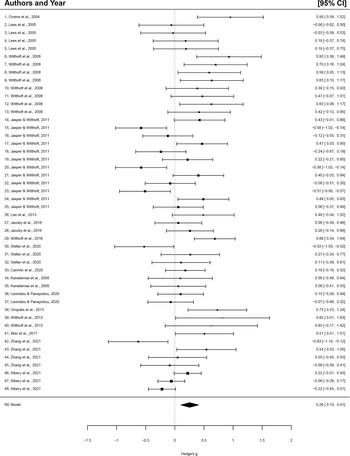
As shown in Table 1 and Fig. 2, the three-level meta-analysis yielded a significant small effect size for the difference in attentional biases toward health-threat between the health anxiety and control group [g = 0.256, 95% confidence interval (CI) 0.101–0.411]. Egger's regression test was not significant, F(1, 46) = 3.669, p = 0.062, and fail-safe N was 463, larger than 5*k + 10 (k = 48), indicating that the publication bias was unlikely to affect our result.
Forest plot of the between-group comparison of attentional bias toward health-threat.

The overall effect sizes for the between-group comparison of attentional bias toward health-threat

k, number of studies; #ES, number of effect sizes; HAG, health anxiety group; CG, control group; CI, confidence interval; Var. level 2, variance between effect sizes from the same study; Var. level 3, variance between studies; % Var. level 1, percentage of variance explained by sampling variance; % Var. level 2, percentage of variance explained by within-study variance; % Var. level 3, percentage of variance explained by between-study variance.
*p < 0.05. ** p < 0.01. *** p < 0.001.
In addition, as illustrated in Online Supplementary File F, four samples (i.e. 15, 20, 23, 42) were identified as outliers with absolute values of SDR higher than 1.96, but the CDs and DFBETASs of all samples were below the corresponding cut-off values. Hence, no samples were diagnosed as influential cases. To further evaluate the impact of the four outliers on the combined effect size, we conducted another meta-analysis without them and obtained a similar effect size (g = 0.293, 95% CI 0.151–0.436), suggesting that our result is robust against outliers.
Moderator analyses for between-group comparisons
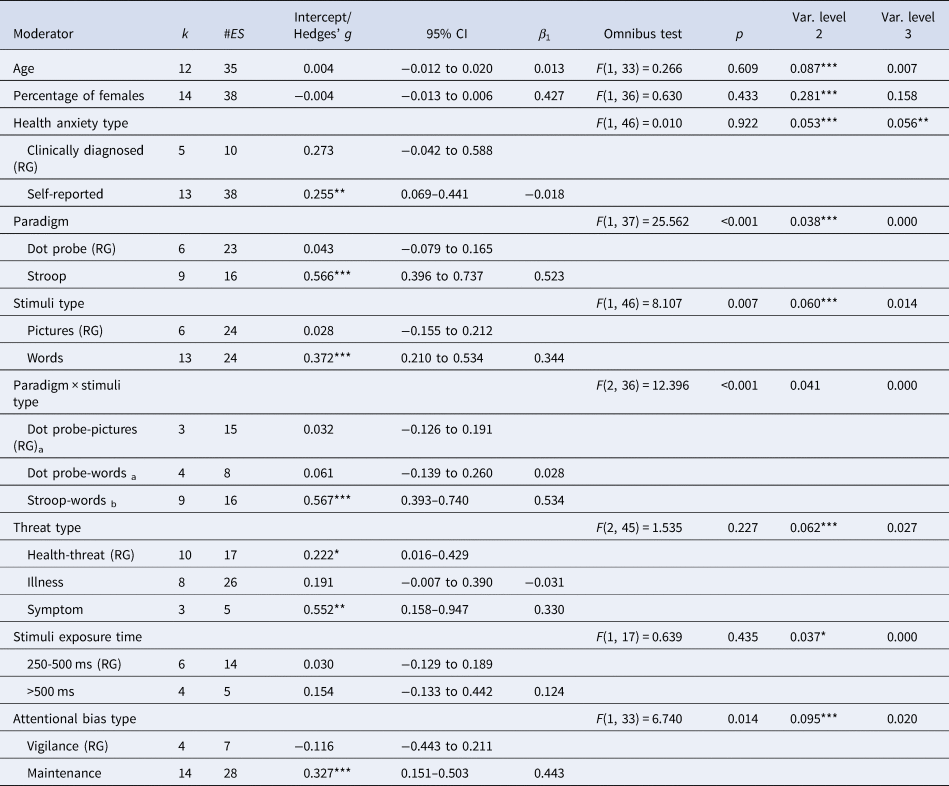
The significant within-study and between-study variances indicate the necessity of moderator analyses (see Table 1). The results of these analyses are displayed in Table 2.
Results of moderator analysis for the between-group comparison of attentional bias toward health-threat

k, number of studies; #ES, number of effect sizes; CI, confidence interval; β 1, estimated regression coefficient; Var. level 2, variance between effect sizes from the same study; Var. level 3, variance between studies; RG, reference group.
Different subscripts denote significant differences between groups, p < 0.001.
*p < 0.05. **p < 0.01. *** p < 0.001.
Effect of attentional bias type
There was a significant difference between the combined effect sizes of attention maintenance and attention vigilance, t(33) = 2.596, p = 0.014. Specifically, health-anxious individuals, compared with the controls, showed significantly greater attention maintenance to health-threat (g = 0.327, 95% CI 0.151–0.503), but did not show significant attention vigilance to health-threat (g = −0.116, 95% CI −0.443 to 0.211).
Effect of experimental procedure
Paradigm
The health-anxious individuals showed significant attentional bias to health-threat, compared to the controls, in the modified Stroop paradigm (g = 0.566, 95% CI 0.396–0.737), but not in the dot-probe paradigm (g = 0.043, 95% CI −0.079 to 0.165). Moreover, there was a significant difference between the effect sizes of the two paradigms, F(1, 37) = 25.562, p < 0.001.
Stimuli type
A significant between-group effect for attentional bias to health-threat existed when the stimuli were words (g = 0.372, 95% CI 0.210–0.534), but not for pictures (g = 0.028, 95% CI −0.155 to 0.212). Again, the difference between the effect sizes of words and pictures was significant, F(1, 46) = 8.107, p = 0.007.
Paradigm × stimuli type
The between-group effect of the modified Stroop studies using words (g = 0.567, 95% CI 0.393–0.740) was significantly larger than that of the dot-probe studies using words (g = 0.061, 95% CI −0.139 to 0.260) and pictures (g = 0.032, 95% CI −0.126 to 0.191), which did not differ from each other, t(36) = 0.224, p = 0.824.
Threat type
The studies using symptom stimuli had a medium combined between-group effect (g = 0.552, 95% CI 0.158, 0.947), which did not differ significantly from those using illness stimuli (g = 0.191, 95% CI −0.007 to 0.390), t(45) = 1.739, p = 0.089.
Stimuli exposure time
The pooled between-group effect size did not differ between the studies using a different length of stimulus presentation time (i.e. 250–500 ms, >500 ms).
Effect of sample characteristics
Both age and gender were not significant predictors of the combined between-group effect sizes. Also, the between-group effect size for clinically diagnosed samples relative to the healthy controls (g = 0.273, 95% CI −0.042 to 0.588) was not significantly different from the effect size for participants with self-reported high health anxiety relative to those with self-reported low health anxiety (g = 0.255, 95% CI 0.069–0.441).
Discussion
The current study provided an overview and the first meta-analysis of the extant research on attentional bias toward health-threat in health anxiety. The results showed that the health anxiety group relative to the control group exhibited greater biased attention toward health-threat. Also, we examined a range of potential moderators and found that attentional biases in health-anxious people were more likely to be observed under some conditions than others.
Support for the attention maintenance model
Our results showed that attention maintenance to health-threat was more pronounced in health-anxious individuals than in the controls (g = 0.327), but the two groups did not differ in attention vigilance (g = −0.116). This provides evidence for the attention maintenance model (Weierich et al., Reference Weierich, Treat and Hollingworth2008). Such attention maintenance bias may result from the activation of health-threat related schema within health-anxious individuals (Bailey & Wells, Reference Bailey and Wells2015). According to the attention schema theory (Graziano, Reference Graziano2020), threatening stimuli are more likely to be deeply processed if they are consistent with an individual's schematic contents. At the later stage of attentional processing, the activation of health-threat related schema allows more attentional resources to be allocated to health-threatening stimuli, manifesting as a higher frequency of selective attention and a longer processing period of such stimuli (Zhang et al., Reference Zhang, Wang, Ma, Yang, Meng, Broadley and Li2021).
Another noteworthy detail was that the combined between-group effect size of attentional vigilance toward health-threat was a negative value, though nonsignificant, indicating that the health-anxious individuals appeared to show a smaller vigilance bias compared to the controls. This tentatively accords with some previous observations (Stefan et al., Reference Stefan, Zorila and Brie2020; Zhang et al., Reference Zhang, Wang, Ma, Yang, Meng, Broadley and Li2021) that IAD patients had early-stage attentional avoidance bias toward health-threat. However, we did not assess whether there is a greater attentional bias toward health-threat compared to neutral stimuli within the health anxiety group, so the early avoidance component needs further exploration.
Additionally, initial attentional orienting bias toward threat in anxiety is supported by most research, while the later attentional processing of anxious individuals appears more variable (Gupta, Kujawa, & Vago, Reference Gupta, Kujawa and Vago2019; Mogg & Bradley, Reference Mogg and Bradley2016; Rosen, Price, & Silk, Reference Rosen, Price and Silk2019). Thus, the maintenance model identified in our study seems to provide preliminary evidence for the distinction between IAD and (other) anxiety disorders. Nonetheless, the current results fail to capture clinically relevant dynamic variability in biased attention (Dennis-Tiwary, Roy, Denefrio, & Myruski, Reference Dennis-Tiwary, Roy, Denefrio and Myruski2019) and need further validation.
Different effects of experimental procedure on attentional bias
The moderating effect of the paradigm was significant, which corresponds to the literature highlighting distinctive cognitive processes measured by different paradigms (Kruijt, Parsons, & Fox, Reference Kruijt, Parsons and Fox2019; Petersen & Posner, Reference Petersen and Posner2012). The traditional dot-probe task, accounting for about half of the dot-probe tasks in the currently analyzed effect sizes (13/23), cannot disentangle initial attentional orientation and delayed disengagement (Fox, Russo, & Dutton, Reference Fox, Russo and Dutton2002; Pool et al., Reference Pool, Brosch, Delplanque and Sander2016). By contrast, the Stroop effect reflects a relatively late, controlled process attributable to difficulty in disengagement (Bar-Haim et al., Reference Bar-Haim, Lamy, Pergamin, Bakermans-Kranenburg and van IJZendoorn2007; Pool et al., Reference Pool, Brosch, Delplanque and Sander2016) that, as discussed above, may characterize the attention bias of health-anxious individuals. It is of note that the current analysis only included Stroop and dot-probe, because the number of the studies using other paradigms (i.e. spatial cueing, visual search, eye-tracking) did not meet the minimum requirements, namely k = 3 (van Eldik et al., Reference van Eldik, de Haan, Parry, Davies, Luijk, Arends and Prinzie2020).
Another significant moderator was stimuli type, which is inconsistent with the meta-analytic findings reported by Dudeney et al. (Reference Dudeney, Sharpe and Hunt2015) and Bar-Haim et al. (Reference Bar-Haim, Lamy, Pergamin, Bakermans-Kranenburg and van IJZendoorn2007). Our result was probably informed by paradigm, because further analysis showed that the difference between the effect sizes of word and picture stimuli was nonsignificant in the dot-probe task and the effect size of word stimuli was only significant in the Stroop but not in the dot-probe.
In addition, the moderating effect of health-threat type did not reach significance. This fits the conceptualization of health anxiety that it may be maintained by selective attention toward external (information on illness) and internal (physical symptoms) threat cues (Warwick & Salkovskis, Reference Warwick and Salkovskis1990; Witthöft et al., Reference Witthöft, Rist and Bailer2008). That is, both symptom and illness information are variants of health-threat representations that might act as worry triggers and thus produce comparable attentional bias. On a descriptive level, it appears still noteworthy and partly counter-intuitive that symptom words (despite their objectively lower threat value) yielded a medium-sized between-group effect, whereas illness stimuli only showed a small between-group effect. Also highly speculative, this might be in line with clinical observations that symptom stimuli act as primary fear triggers with high personal relevance, whereas illness stimuli represent more distal negative consequences that rather affect later and more elaborative stages of information processing beyond attention allocation. Likewise, stimuli exposure time was not a significant moderator, which may be attributed to little variation in the range of this variable across studies (see Online Supplementary File E).
Similar attentional bias in heterogeneous samples
The result that age was not a significant predictor of attentional bias was also reported by an earlier meta-analysis of threat-related attentional bias in anxious adults and children (Bar-Haim et al., Reference Bar-Haim, Lamy, Pergamin, Bakermans-Kranenburg and van IJZendoorn2007), but was contrary to other meta-analytic findings with a larger sample of anxious children (Dudeney et al., Reference Dudeney, Sharpe and Hunt2015). The discrepancy may be related to a general lack of studies on attentional bias in children with health anxiety. Consistent with previous studies (Dudeney et al., Reference Dudeney, Sharpe and Hunt2015; Suslow, Hußlack, Kersting, & Bodenschatz, Reference Suslow, Hußlack, Kersting and Bodenschatz2020), gender was also not a significant moderator. In addition, the between-group effect size of attentional bias in individuals with high self-reported health anxiety relative to those with low self-reported health anxiety did not differ from clinical samples with the diagnoses of IAD or hypochondriasis relative to healthy controls. A possible explanation is that the differences in health concerns between the general population and clinically diagnosed patients are quantitative rather than qualitative (Ferguson, Reference Ferguson2009).
Implications
There are several implications of our findings. First, the pattern of attentional bias revealed in this meta-analysis (i.e. attention maintenance) indicates that, for excessive health anxiety, it may be more valuable to intervene the later attentional process than the initial orienting bias toward health-threat. Second, the heterogeneous effects of experimental paradigms identified in our study suggest that future meta-analyses could be conducted on the basis of each paradigm to explore in detail the temporal unfolding of attentional bias toward health-threat. While the meta-analysis based on the modified Stroop paradigm could capture a relatively late attentional process, the meta-analysis based on modified dot-probe task and eye-movement indices could elucidate both the early and late attentional bias. Third, in the context of coronavirus disease-2019 (COVID-19), an unprecedented infectious disease pandemic, it is natural and justified to feel anxious about health (Haig-Ferguson, Cooper, Cartwright, Loades, & Daniels, Reference Haig-Ferguson, Cooper, Cartwright, Loades and Daniels2021), but the pathological health anxiety related to COVID will occur because COVID-19 possibly extends over several years and the danger of infection will not suddenly disappear (Tyrer, Reference Tyrer2020). Therefore, our findings may provide a perspective of biased attention to help deepen our understanding of people's maladaptive responses to the virus, and indicate a possible intervention targeting attention maintenance to virus-related information to alleviate the adverse effects of COVID-19 on public mental health.
Limitations and future directions
The current study has several limitations. First, grey/unpublished literature was not included in our analyses. This exclusion ensured the presence of high-quality studies but could also lead to an overestimated bias in findings. It is encouraging to note, nevertheless, that no significant publication bias was revealed in our study. Second, the samples included in this meta-analysis were mainly college students and other samples' characteristics such as race, ethnicity, and medical condition were not reported in many of the included studies. The lack of sample diversity and some relevant information limits the generalization of our findings and precludes a full analysis of the potential moderating effects of these variables. Third, the small number of studies prevented adequate assessment of the planned moderators (e.g. paradigm, stimuli exposure time) and reduced statistical power to the extent that some minor effects may not be detected. Last, our results are mainly based on reaction-time measures which have been criticized for their lack of reliability and sensitivity (Fu & Pérez-Edgar, Reference Fu and Pérez-Edgar2019; Rodebaugh et al., Reference Rodebaugh, Scullin, Langer, Dixon, Huppert, Bernstein and Lenze2016). These findings therefore should be interpreted with caution.
Although some limitations exist, our results also provide directions for future research. First, because age is significantly correlated with health anxiety (Norbye, Abelsen, Førde, & Ringberg, Reference Norbye, Abelsen, Førde and Ringberg2020; Sunderland, Newby, & Andrews, Reference Sunderland, Newby and Andrews2013) and this meta-analysis has a limited age range, more studies using samples with a wider age range are needed to validate the current findings and to further explore the developmental mechanism of attentional bias in health-anxious individuals. In addition to expanding the age range, future research should examine our findings across diverse samples and report complete sample characteristics to help make clear to whom the findings apply. Second, as our study could not make conclusive inferences about the early attentional avoidance of health-threat in health-anxious individuals, further study into the temporal pattern of avoidance should be conducted in the future. Third, more temporally sensitive and reliable measures such as eye-tracking (Sears, Quigley, Fernandez, Newman, & Dobson, Reference Sears, Quigley, Fernandez, Newman and Dobson2019) and neural measures (Fu & Pérez-Edgar, Reference Fu and Pérez-Edgar2019) are needed to directly explore attentional biases in health-anxious individuals. Last, more empirical research should be conducted on the potential benefits of directly targeting biased attention toward health-threat in specific treatments to determine whether this bias actually causally contributes to the development and maintenance of health anxiety.
Conclusion
In conclusion, the current study indicates that individuals with high health anxiety, compared to those with low health anxiety or healthy controls, show significantly greater attentional bias toward health-related threatening stimuli. It is worthwhile to note however that this result is mainly driven by the modified Stroop task and lacks replications across task paradigms. Furthermore, the present analyses point to several important moderators (i.e. attentional bias type, paradigm, stimuli type) that should be considered in future research. More importantly, our results provide preliminary evidence for the attention maintenance model in health-anxious individuals. These results are informative for further research and treatment of individuals with elevated health anxiety.
Supplementary material
The supplementary material for this article can be found at https://doi.org/10.1017/S0033291721005432.
Financial support
Our work was supported by the National Natural Science Foundation of China (grant number: 32171086); the self-determined research funds of Central China Normal University from the colleges' basic research and operation of Ministry of Education of China (grant number: CCNU20TD001); the Key Program of Institute of Wuhan Studies of Jianghan University (grant number: IWHS20201007).
Conflicts of interest
None.