Introduction
Associations between cholesterol and cognitive function are not clearly understood. Understanding of this relationship is made difficult by the fact that cholesterol is vital for brain development and function (Dietschy & Turley, Reference Dietschy and Turley2004; Koudinov & Koudinova, Reference Koudinov and Koudinova2001); yet in excess some cholesterols are a risk factor for cardiovascular disease (CVD) (Hillbrand & Spitz, Reference Hillbrand and Spitz1997).
The liver produces 70 to 80% of the cholesterol and triglycerides in the body. Large lipoproteins, called very low density lipoproteins (VLDLs) carry cholesterol, triglycerides, and proteins called apolipoproteins. The density of the lipoproteins refers to the ratio of the lipid to protein, that is, a high ratio corresponds to low density (Hillbrand & Spitz, Reference Hillbrand and Spitz1997). The VLDLs travel through the blood stream releasing triglycerides that provide energy to body tissues and are consequently stored as fat. VLDLs become cholesterol-rich low-density lipoproteins (LDL) as triglycerides are released. This lipid subfraction is received by specialized LDL receptors throughout the body for the manufacture and repair of cell membranes and for the synthesis of steroid hormones and bile acids. However, when receptor activity fails to meet LDL concentrations, levels of the latter increase and are deposited in the arteries, the atherosclerotic process, which may lead to heart disease, myocardial infarction and stroke. Elevated blood triglycerides have a dose-dependent association with cardiovascular-related and all-cause mortality (Liu et al., Reference Liu, Zeng, Liu, Zhang, Ling and Chen2013). Thus LDL-cholesterol and triglycerides have been termed in lay terms as “bad cholesterol.”
In contrast, high-density lipoprotein cholesterol (HDL) is related to lower prevalence of cardiovascular mortality (Silbernagel et al., Reference Silbernagel, Schoettker, Appelbaum, Scharnagl, Kleber, Grammer and Maerz2013) and incidence of coronary heart disease (Tehrani et al., Reference Tehrani, Gardin, Yanez, Hirsch, Lloyd-Jones, Stein and Wong2013). HDL-cholesterol serves to remove excess cholesterol from the cells, and transports it back to the liver to be disposed through the bile, thereby preventing atherosclerosis and protecting the arteries (Felix-Redondo, Grau, & Fernandez-Berges, Reference Felix-Redondo, Grau and Fernandez-Berges2013), in addition to anti-inflammatory (Vaisar et al., Reference Vaisar, Pennathur, Green, Gharib, Hoofnagle, Cheung and Heinecke2007) and antioxidant effects (Elsoe et al., Reference Elsoe, Ahnstrom, Christoffersen, Hoofnagle, Plomgaard, Heinecke and Nielsen2012). Therefore, the balance of LDL and HDL levels determines the degree of atherosclerotic plaque formation and subsequent disease (Felix-Redondo et al., Reference Felix-Redondo, Grau and Fernandez-Berges2013). Low HDL has been associated with decreased hippocampal volume, a particularly vulnerable area of the brain associated with neurodegenerative disease (Wolf et al., Reference Wolf, Hensel, Arendt, Kivipelto, Winblad and Gertz2004). Hence HDL is referred to as “good cholesterol” (Hillbrand & Spitz, Reference Hillbrand and Spitz1997).
Based on these mechanisms, it could be predicted that total cholesterol (TC), LDL-cholesterol, and triglycerides (the “bad cholesterols”) would be associated with lower levels of cognitive performance given that risk factors that raise the risk of heart disease and stroke are generally bad for cognition (Waldstein & Elias, Reference Waldstein and Elias2001, Reference Waldstein and Elias2014). It may also be predicted that “good cholesterol,” HDL-cholesterol, given its anti-atherogenic properties (Nofer et al., Reference Nofer, Kehrel, Fobker, Levkau, Assmann and von Eckardstein2002), may be positively associated with cognitive performance. However, the neuropsychology literature indicates that these relations in the expected direction are not always observed.
A meta-analysis and review of 18 investigations examining cholesterol, dementia and cognitive decline, has indicated an association between high midlife TC and lower cognitive performance in late life (Anstey, Lipnicki, & Low, Reference Anstey, Lipnicki and Low2008). Of five studies examining TC in relation to cognitive decline, Anstey et al. (Reference Anstey, Lipnicki and Low2008) report that two found higher TC to be associated with a reduced risk of cognitive decline (Swan, Larue, Carmelli, Reed, & Fabsitz, Reference Swan, Larue, Carmelli, Reed and Fabsitz1992; Wada et al., Reference Wada, Matsubayashi, Okumiya, Kimura, Osaka, Doi and Ozawa1997), while the other three found no associations (Kalmijn, Feskens, Launer, & Kromhout, Reference Kalmijn, Feskens, Launer and Kromhout1996; Karlamangla, Singer, Reuben, & Seeman, Reference Karlamangla, Singer, Reuben and Seeman2004; Reitz, Luchsinger, Tang, Manly, & Mayeux, Reference Reitz, Luchsinger, Tang, Manly and Mayeux2005).
However, prospective studies with the Framingham Heart Study (Elias, Elias, D’Agostino, Sullivan, & Wolf, Reference Elias, Elias, D’Agostino, Sullivan and Wolf2005) and the National Heart, Lung, and Blood Institute Twin Study (Swan et al., Reference Swan, Larue, Carmelli, Reed and Fabsitz1992) have indicated associations between increasing levels of TC and better cognitive performance. Elias and colleagues (Reference Elias, Elias, D’Agostino, Sullivan and Wolf2005) studied nearly 1900 Framingham Heart Study participants, free of dementia or stroke (mean age of 67). TC measured four to 6 years previously was positively related to attention and concentration, word fluency, similarities and composite performance but not learning or memory. Following adjustment for age, gender, education, alcohol and CVD, having TC below 200 mg/dL was associated with significantly higher odds for poor performance on the cognitive composite measure. Other studies have supported the Framingham findings; higher TC has been associated with better performance on tests of processing speed and mental flexibility (Benton, Reference Benton1995; Muldoon, Ryan, Matthews, & Manuck, Reference Muldoon, Ryan, Matthews and Manuck1997; Swan et al., Reference Swan, Larue, Carmelli, Reed and Fabsitz1992). In analyses based on the third National Health and Nutrition Survey in over 4000 adults, higher TC was associated with faster reaction time in men (Zhang, Muldoon, & McKeown, Reference Zhang, Muldoon and McKeown2004). These findings indicate that higher serum cholesterol may be associated with greater processing speed or cognitive flexibility. Other studies have shown no association (Reitz et al., Reference Reitz, Luchsinger, Tang, Manly and Mayeux2005; Romas, Tang, Berglund, & Mayeux, Reference Romas, Tang, Berglund and Mayeux1999; Zimetbaum et al., Reference Zimetbaum, Frishman, Ooi, Derman, Aronson, Gidez and Eder1992) or shown TC to be risk factor for lower cognitive performance and dementia (Desmond, Tatemichi, Paik, & Stern, Reference Desmond, Tatemichi, Paik and Stern1993; Notkola et al., Reference Notkola, Sulkava, Pekkanen, Erkinjuntti, Ehnholm, Kivinen and Nissinen1998; Yaffe, Barrett-Connor, Lin, & Grady, Reference Yaffe, Barrett-Connor, Lin and Grady2002). Two recent reviews underscore the inconsistent findings in the literature (Muldoon & Conklin, Reference Muldoon and Conklin2014; Schreurs, Reference Schreurs2010).
One of the major issues in relating TC levels to cognitive performance, and a possible reason for conflicting results may be that examination of TC ignores the contributions of the cholesterol components, for example, LDL, HDL, and triglycerides. Fewer studies have related the individual cholesterols to cognitive performance, and fewer yet have used a comprehensive test battery.
When LDL and triglycerides have been related to cognitive performance, conflicting results have emerged. Studies have reported that high levels of LDL-cholesterol may be associated with poorer cognitive performance (van den Kommer, Dik, Comijs, Jonker, & Deeg, Reference van den Kommer, Dik, Comijs, Jonker and Deeg2012), while others have shown no association (Romas et al., Reference Romas, Tang, Berglund and Mayeux1999; Singh-Manoux, Gimeno, Kivimaki, Brunner, & Marmot, Reference Singh-Manoux, Gimeno, Kivimaki, Brunner and Marmot2008; Yoshitake et al., Reference Yoshitake, Kiyohara, Kato, Ohmura, Iwamoto and Nakayama1995). Anstey et al. (Reference Anstey, Lipnicki and Low2008) in their review, found no associations between LDL and cognitive performance, dementia or cognitive decline. Very few studies have specifically examined levels of triglycerides in relation to cognition (Reynolds, Gatz, Prince, Berg, & Pedersen, Reference Reynolds, Gatz, Prince, Berg and Pedersen2010; Singh-Manoux et al., Reference Singh-Manoux, Gimeno, Kivimaki, Brunner and Marmot2008). Singh-Manoux et al. (Reference Singh-Manoux, Gimeno, Kivimaki, Brunner and Marmot2008) found no association between triglycerides and verbal memory performance, while Reynolds et al. (Reference Reynolds, Gatz, Prince, Berg and Pedersen2010) showed that lower triglyceride levels predicted better verbal ability and perceptual speed.
Given the positive association between HDL and heart health, it seems highly plausible that higher levels of HDL may relate in a positive manner to global cognitive performance. In the Whitehall II study, Singh-Manoux and colleagues (Reference Singh-Manoux, Gimeno, Kivimaki, Brunner and Marmot2008) examined lipoprotein lipid levels in relation to short term verbal memory change over five years in middle-aged adults (mean age of 55 years at baseline). At two distinct time points, cross-sectional analyses showed positive associations between HDL and a single test of verbal memory, and furthermore, decline in HDL over the study period was associated with decline in verbal memory performance. As noted above, no significant associations were found between TC or triglycerides and verbal memory performance in this study (Singh-Manoux et al., Reference Singh-Manoux, Gimeno, Kivimaki, Brunner and Marmot2008). However, only one measure of cognition was used in the study, verbal memory (indexed by only one test), so it is unknown whether general cognitive performance or other cognitive domains may have been affected by low HDL-cholesterol. In support, three other studies have showed a positive association between HDL measured in older age (≥50 years) and cognition, including memory (van den Kommer et al., Reference van den Kommer, Dik, Comijs, Jonker and Deeg2012), motor speed (Mielke et al., Reference Mielke, Xue, Zhou, Chaves, Fried and Carlson2008), and verbal ability (Reynolds et al., 2008). In contrast, the review by Anstey et al. (Reference Anstey, Lipnicki and Low2008) concluded that HDL was not associated with cognitive decline or impairment. However, they point out that the small number of studies reporting relevant data on HDL prevent strong conclusions being drawn with respect to these relations (Anstey et al., Reference Anstey, Lipnicki and Low2008). More studies of HDL and cognitive function are necessary and the essence of neuropsychology investigation is that domains be defined by multiple indices of cognitive performance.
Adding to the complexity of the relations between cholesterol and cognition, reviews by Anstey et al. (Reference Anstey, Lipnicki and Low2008) and van Vliet (Reference van Vliet2012) indicate that associations between TC and cognitive decline or lowered cognitive performance may be age-dependent. The current literature suggests that high TC in mid-life is associated with elevated risk of poor memory and dementia late in life (Anstey et al., Reference Anstey, Lipnicki and Low2008), whereas when measured after age 60, high TC may not be associated with cognitive function or dementia risk, or may show a negative association (Anstey et al., Reference Anstey, Lipnicki and Low2008; van Vliet, Reference van Vliet2012; van Vliet, Westendorp, van Heemst, de Craen, & Oleksik, Reference van Vliet, Westendorp, van Heemst, de Craen and Oleksik2010). Despite the importance of relating mid-life cholesterol to late life cognitive performance, it is also important to know whether the individual cholesterols, and especially HDL, are related to cognitive performance after age 60, and to investigate whether this is a global influence on cognition or more specific.
The purpose of this study was to investigate the relationship between TC, HDL- and LDL-cholesterol, and triglycerides with multiple cognitive domains in stroke and dementia-free individuals, 60 to 98 years of age, and to do so with and without adjustment for cardiovascular risk factors. A cross-sectional community-based sample from the Maine-Syracuse Longitudinal Study (MSLS) was used, with extensive data collected on multiple cardiovascular, lifestyle, and health factors.
Given the conflicting results for TC, HDL-, and LDL-cholesterol, and relatively few studies of triglycerides in the literature, working hypotheses were generated based on hypothesized mechanisms rather than the literature. The study hypotheses were twofold: (1) higher LDL-cholesterol and triglycerides would be related to lower levels of cognitive performance; (2) higher HDL-cholesterol would be related to higher levels of cognitive performance. We also examined evidence for whether TC, LDL-, and HDL-cholesterol were simply proxies for absence of CVD. Thus we estimated two models, one with demographic risk factors and a second with added cardiovascular risk factors.
Methods
Participants
Community-living individuals participating in the Maine-Syracuse Longitudinal Study were recruited from central New York for studies of blood pressure, related risk factors, and cognitive performance with no exclusions other than institutionalization, diagnosed psychiatric disorder and alcoholism. Participants for the present study were those that returned for the sixth (2001–2006) study wave where extensive data on cardiovascular risk factors and diseases, including cholesterol values, were available for the first time (Elias et al., Reference Elias, Robbins, Budge, Elias, Brennan, Johnston and Bates2006; Robbins, Elias, Elias, & Budge, Reference Robbins, Elias, Elias and Budge2005). Details of initial study recruitment have been previously described (Dore, Elias, Robbins, Budge, & Elias, Reference Dore, Elias, Robbins, Budge and Elias2008; Elias et al., Reference Elias, Robbins, Budge, Abhayaratna, Dore and Elias2009, Reference Elias, Robbins, Budge, Elias, Brennan, Johnston and Bates2006; Robbins et al., Reference Robbins, Elias, Elias and Budge2005). Beginning with 574 individuals who met study criteria of at least 60 years of age, participants were excluded for the following reasons: acute stroke (n=20), probable dementia (n=9), and undertaking dialysis treatment (n=5), leaving 540 individuals included in the final analyses. Acute stroke was defined as a focal neurological deficit persisting for >24 hr and probable dementia was defined by cognitive measures, medical records and a multidisciplinary dementia review using the National Institute of Neurological Diseases and Communicative Diseases and Stroke/ Alzheimer’s Disease and Related Disorders (NINCDS-ADRDA) criteria (McKhann et al., Reference McKhann, Drachman, Folstein, Katzman, Price and Stadlan1984). Dementia cases were excluded as we were interested in examining relationships between cholesterol and cognitive performance, but not in those with severe cognitive impairment. This research was approved by the University of Maine Institutional Review Board and informed consent was obtained from all participants. All data in this study were obtained in compliance with the Helsinki Declaration.
Procedure
A blood sample was obtained following a fast from midnight with blood draw between approximately 8 and 9 am. Standard assay methods were used (Elias et al., Reference Elias, Robbins, Budge, Elias, Brennan, Johnston and Bates2006) to obtain TC, HDL, LDL, and triglycerides, in addition to fasting plasma glucose, at Centrex Clinical Laboratories, New York. The direct HDL-cholesterol method for the Poly-ChemTM System, enzymatic elimination assay for the in vitro determination of HDL-cholesterol in human serum and plasma was used: Cat NO HDL500 (3×245 tests) Enzyme Reagent R1 (3×50 mL); Enzyme Reagent R2 (3×20 mL). Participants underwent a brief medical examination and interview after a light breakfast. Body weight was measured with participants wearing light clothing to the nearest 0.1 kg, and height was measured with a vertical ruler to the nearest 0.1 cm. Body mass index (BMI) was calculated as weight in kilograms divided by height in meters squared (kg/m2). Automated blood pressure measures (GE DINAMAP 100DPC-120XEN, GE Healthcare) were taken five times each in reclining, sitting and standing positions after a supine rest for 15 min, and averaged for systolic and diastolic blood pressure. Smoking status (cigarettes smoked per week) was based on self-report from the Nutrition and Health Questionnaire (Kroke et al., Reference Kroke, Klipstein-Grobusch, Voss, Moseneder, Thielecke, Noack and Boeing1999), as was alcohol consumption. Prevalent CVD was based upon self-reported history of coronary artery disease, myocardial infarction, congestive heart failure, transient ischemic attack, or angina pectoris, confirmed by medical records. Diabetes was defined as fasting glucose level of ≥126 mg/dL, or being treated with anti-diabetic medication. Depressed mood was assessed using the Center for Epidemiologic Depression Scale (CES-D) (Radloff, Reference Radloff1977), and the raw score (number of symptoms) was used as a continuous variable. The foregoing measures were obtained during interview and physical examination during the morning visit, and cognitive measures were assed in the afternoon after at least a 1 hr separation of the medical data collection and cognitive testing.
Predictor variables: cholesterol
As triglycerides were skewed, this variable was log transformed. All other lipoprotein variables were normally distributed. The predictor variables of interest were therefore HDL-cholesterol, LDL-cholesterol, triglycerides (log), and TC (all mg/dL).
Outcome variables: cognitive function
The MSLS neuropsychological test battery comprises 20 individual tests designed to measure a wide range of cognitive abilities, and has been used in multiple studies examining cardiovascular risk factors and cognitive performance (Dore et al., Reference Dore, Elias, Robbins, Budge and Elias2008; Elias et al., Reference Elias, Robbins, Budge, Elias, Brennan, Johnston and Bates2006; Robbins et al., Reference Robbins, Elias, Elias and Budge2005). This battery features four index scores: Visual-Spatial Memory and Organization, Scanning and Tracking, Verbal Episodic Memory, and Working Memory, based on factor analysis (Elias et al., Reference Elias, Robbins, Budge, Elias, Brennan, Johnston and Bates2006). The Wechsler Adult Intelligence Scale (WAIS) Similarities Test (Lezak, Howieson, & Loring, Reference Lezak, Howieson and Loring2004), a measure of abstract reasoning, loaded on all composite scores (factors) (Elias et al., Reference Elias, Robbins, Budge, Elias, Brennan, Johnston and Bates2006) and was thus used separately. A Global Cognition Composite (index) score was derived by averaging the Z-scores for all individual tests. The tests used to define each composite are listed and described completely in Supplementary Table 1, which are available online. In addition, the Mini-Mental State Examination (MMSE) (Folstein, Folstein, & McHugh, Reference Folstein, Folstein and McHugh1975), a global measure of mental status widely used in the literature, was also used. All cognitive outcomes are expressed in the same unit of measurement, Z-scores.
Data Analysis
Independent sample t tests were performed to describe the demographic and health characteristics of the sample, comparing those with reduced HDL levels (<40 mg/dL for males and <50 mg/dL for females) to those with normal HDL levels (≥40 mg/dL for males and ≥50 mg/dL for females). This comparison was made as HDL is our main cholesterol variable of interest.
Levels of HDL, LDL, TC, and triglycerides were further classified into groups based on the National Public Health HDL guidelines (U.S. Department of Health and Human Services, 2001). These groups were as follows: for HDL: <40, 40–49, 50–59, ≥60 mg/dL; for LDL: <100, 100–129, 130–189, ≥190 mg/dL; for TC: <200, 200–239, ≥240 mg/dL; and for triglycerides: <150, 150–199, 200–499, ≥500 mg/dL.
Multivariate analysis of variance (MANOVA) (a step-down protection procedure) (van der Laan, Dudoit, & Pollard, Reference van der Laan, Dudoit and Pollard2004) was used to examine relationships between cholesterol concentrations (HDL, LDL, triglycerides, TC) and cognitive performance (Visual-Spatial Memory and Organization, Scanning and Tracking, Verbal Episodic Memory, Working Memory, Similarities, MMSE). All cognitive outcomes were entered into the analyses simultaneously as dependent variables except for the Global Composite score, as the Global Composite score is co-dependent on all the measures except for the MMSE. ANOVA was used to examine relationships between cholesterol concentrations and the Global Composite score. In addition to MANOVA, the Bonferroni procedure was used to protect against multiple comparisons, including the Global Composite, alpha/number of observations where alpha=0.05.
Two covariate sets were used: (1) Basic model: adjusted for age, gender, education (years), and ethnicity (African American/other); (2) Extended model: Basic model + BMI (kg/m2), smoking (cigarettes/week), alcohol consumption (ounces/week), systolic blood pressure (mmHg), diabetes (yes/no), CVD (yes/no), cholesterol medications (yes/no), physical activity (MET-minutes/week), depressed mood (CES-D raw score), and apolipoprotein E epsilon 4 (APOE ε4, yes/no). The covariates included in the extended model were selected based on two considerations: were clinically and theoretically relevant and also related to both the predictor (HDL-cholesterol) and outcome (Global Composite score) (alpha <0.05). Due to the potential importance of APOE ε4 (Bender & Raz, Reference Bender and Raz2012; Liu et al., Reference Liu, Pardo, Schuur, Sanchez-Juan, Isaacs, Sleegers and van Duijn2010; Notkola et al., Reference Notkola, Sulkava, Pekkanen, Erkinjuntti, Ehnholm, Kivinen and Nissinen1998) this was also included in the extended model. There were no analyses performed with all lipids in one model because these are co-dependent variables. It is important to present both the basic model and the extended model because the comparisons between the two models informs as to the mediating role of CVD on the cognitive outcomes. A failure to see results for the extended model may be interpreted as evidence that cholesterol is purely a proxy for CVD.
In a final step, logistic regression analyses was performed to obtain a measure of effect size, indicated by the categorical regression coefficient when comparing the highest HDL group (≥60 mg/dL) with the reference (lowest HDL group, <40 mg/dL).
All statistical analyses were performed with PASW for Windows® version 21.0 software (formerly SPSS Statistics Inc., Chicago, IL).
Results
Participant Characteristics
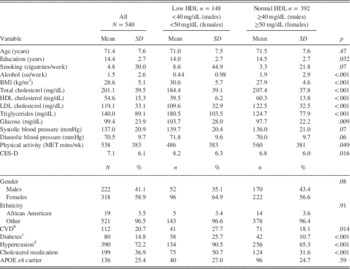
The sample comprised 222 males and 318 females, aged 60 to 98 years (mean, 71.4±7.6 years). Table 1 describes the demographic and heath variables of the sample, according to HDL level. Those with reduced HDL (27.4% of the sample) had slightly fewer years of education, had a higher BMI and fasting plasma glucose levels, and were more likely to have CVD, diabetes, or hypertension, and be on cholesterol medication (all p<.05).
Demographic and health characteristics of sample (N=540)

Note. APOE ε4=apolipoprotein E epsilon 4; BMI=body mass index; CES-D=Center for Epidemiologic Studies Depression Scale; CVD=cardiovascular disease; HDL=high density lipoprotein; LDL=low density lipoprotein; MET=metabolic equivalent; SD=standard deviation.
aHigher score indicates higher number of depressive symptoms.
b CVD was defined as present if there was self-reported history of coronary artery disease, myocardial infarction, congestive heart failure, transient ischemic attack, or angina pectoris.
c Diabetes was defined as fasting glucose level of ≥126 mg/dL, or being treated with anti-diabetic medication.
d Hypertension was defined as ≥140/90 mmHg.
HDL Levels and Cognition
The multivariate tests performed as protection against multiple contrasts for multiple outcome variables were statistically significant for both the basic model (F [Wilks’ lambda] =3.12; p<.001) and extended models (F=1.66; p=.041). Thus we report the results of the univariate analyses for each cognitive outcome.
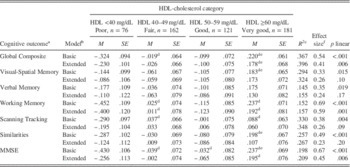
The covariate adjusted mean (Z-scores) (and SE) based on multivariable analyses for each cognitive outcome considered separately are presented in Table 2 (basic and extended models). P-values are adjusted via the Bonferroni procedure. HDL was significantly and positively associated with the Global Composite score, Visual-Spatial Memory and Organization, Verbal Episodic Memory, Working Memory, Scanning and Tracking, Similarities and the MMSE, with adjustment for age, education, gender, and ethnicity (p<.05). Those with “very good” levels of HDL (≥60 mg/dL) had significantly higher scores on the Global Composite, Visual-Spatial Memory and Organization, Working Memory, Scanning and Tracking, Similarities and the MMSE than those with “poor levels” of HDL (<40 mg/dL) (all p<.05).
Multivariate adjusted mean (z-scores) (and SE) for each cognitive outcome across increment levels of HDL-cholesterol (N=540)

Notes. HDL=high-density lipoprotein; MMSE=Mini-Mental State Examination.
a ANOVA performed for Global Composite score; MANOVA included: Visual-Spatial Memory, Verbal Memory, Working Memory, Scanning Tracking, Similarities, and MMSE.
b Basic model: adjusted for age, education, gender, ethnicity; Extended model: adjusted for Basic + BMI, smoking, alcohol, systolic blood pressure, diabetes, CVD, cholesterol medications, physical activity, CES-D and APOE ε4.
c Adjusted R2 for multiple comparisons (Bonferroni).
d significantly different from HDL <40 mg/dL group.
e significantly different from HDL 50–59 mg/dL group.
f effect size is the categorical regression coefficient obtained from logistic regression analyses, comparing the highest HDL group (≥60 mg/dL) with the reference (lowest HDL group, <40 mg/dL).
Positive relationships between HDL and the Global Composite, Working Memory, and the MMSE remained significant (all p<.01) with additional adjustment for BMI, smoking, alcohol consumption, systolic blood pressure, diabetes, CVD, cholesterol medications, physical activity, depressed mood, and APOE ε4 status. With full adjustment, those with HDL levels of 60 mg/dL or higher, performed significantly better on the Global score, tasks of Working Memory, and the MMSE, than those with HDL levels of less than 40 mg/dL (all p<.05). All p-values reported are based on the Bonferroni adjustment, p/the number of cognitive outcomes.
LDL, TC, Triglyceride Levels, and Cognition
LDL, TC, and triglyceride levels were unrelated to cognitive function in basic and extended models. The multivariate test results (extended model) were as follows: TC: F=0.63, p=.82; LDL: F=1.05, p=.40; and triglycerides: F=1.20, p=.26.
Sensitivity Analysis
Two sensitivity analyses were performed, examining the relationship between two interaction terms with cognitive function (Global Composite score): (1) HDL × age (in years), and (2) APOE ε4 (yes/no) × HDL. Neither of these interaction terms was associated with the Global cognitive composite score (HDL × age: p=0.35; APOE ε4×HDL: p=.40).
Discussion
High density lipoprotein was positively associated with multiple measures of cognitive performance in participants aged 60 years or more. With adjustment for all the basic covariates, cardiovascular risk factors and depressed mood, HDL levels were significantly related to higher levels of mean cognitive functioning in Working Memory, general global cognitive ability (Global Composite score) and general mental status (MMSE). There were no associations observed between concentrations of LDL, TC, or triglycerides and any measure of cognitive function for the basic model or the extended model with cardiovascular covariates.
Our interpretation of these findings is consistent with other studies of systemic risk factors (Waldstein & Elias, Reference Waldstein and Elias2014), whereby HDL is positively influencing general cognitive performance. However, working memory performance was, among the other cognitive abilities, of particular importance to overall cognitive function. The present findings with regard to HDL and memory function are consistent with other studies (Reynolds et al., Reference Reynolds, Gatz, Prince, Berg and Pedersen2010; Singh-Manoux et al., Reference Singh-Manoux, Gimeno, Kivimaki, Brunner and Marmot2008) in terms of a positive relation between HDL and memory. Singh-Manoux et al. (Reference Singh-Manoux, Gimeno, Kivimaki, Brunner and Marmot2008) only assessed short term verbal memory using one test, but found that low HDL-cholesterol levels were associated with higher odds of verbal memory deficit. Reynolds et al. (Reference Reynolds, Gatz, Prince, Berg and Pedersen2010) assessed verbal and spatial abilities, working memory, and perceptual speed and found that higher concentrations of HDL-cholesterol (and lower triglycerides) predicted better maintenance of verbal ability and perceptual speed, but in women only. In the present study, there was a significant positive association between HDL and the Verbal Memory composite in the basic model, but significance was lost after full adjustment for the cardiovascular risk factors and disease variables. In contrast to Singh-Manoux et al. (Reference Singh-Manoux, Gimeno, Kivimaki, Brunner and Marmot2008), we used a composite of scores measuring verbal ability, and the tests were not the same as those used in either investigation above (Reynolds et al., Reference Reynolds, Gatz, Prince, Berg and Pedersen2010; Singh-Manoux et al., Reference Singh-Manoux, Gimeno, Kivimaki, Brunner and Marmot2008). Differences in sample characteristics may also contribute to the disparate findings. For example, the mean age of participants in these two studies at baseline was slighter younger (50–55 years) than in the present study. Given issues of test purity (Rabbitt, Reference Rabbitt1997), further studies examining what kind of memory is influenced by HDL would be improved by indexing cognitive domains using more than one test measure (Elias, Goodell, & Dore, Reference Elias, Goodell and Dore2012).
Thus, with adjustment for basic covariates, several significant associations were seen, but many fewer remained statistically significant with additional adjustment for the cardiovascular risk factors and CVD. Based on these data, we infer that HDL is not just a proxy for the absence of cardiovascular risk or disease when the outcomes are global cognition, global MMSE and the Working Memory composite. For the extended (cardiovascular risk) model, R2 values for the Global Composite score, MMSE, and Working Memory were 0.40, 0.21, and 0.16, respectively; thus less of the variance in cognition was explained by a specific domain, Working Memory, as compared to global cognitive ability or the MMSE. Magnitude of effect is reflected in the differences between means for the highest and lowest HDL groups (shown in Table 2). Effect sizes for the Global Composite, MMSE, and Working Memory (extended models) were Z=0.41, 0.45, and 0.59, respectively. These are medium to large effect sizes, and have significant implications for cognitive functioning on a population level.
The positive relations between HDL and cognitive function are consistent with the mechanisms that relate lipids to brain and cerebrovascular disease. Thus it is biologically plausible that over 60 years of age, higher levels of HDL are related in a positive manner to global cognitive performance.
Our study did not find any associations between LDL and cognitive performance in persons over 60 years of age, with adjustment for demographic factors or with the addition of cardiovascular risk and disease variables. Previous studies conducted with the same age groups have shown no associations (Reitz et al., Reference Reitz, Luchsinger, Tang, Manly and Mayeux2005), positive associations (Henderson, Guthrie, & Dennerstein, Reference Henderson, Guthrie and Dennerstein2003), and negative associations (Muldoon et al., Reference Muldoon, Ryan, Matthews and Manuck1997; Yaffe et al., Reference Yaffe, Barrett-Connor, Lin and Grady2002). A more recent extensive, comprehensive review reflected the same pattern of inconsistencies among findings in the general literature (Muldoon & Conklin, Reference Muldoon and Conklin2014).
Our study did not find any associations between triglycerides and cognitive performance in persons over 60 years of age. No significant associations were found between triglycerides and verbal memory performance in the Whitehall II study (Singh-Manoux et al., Reference Singh-Manoux, Gimeno, Kivimaki, Brunner and Marmot2008), while lower triglycerides predicted better verbal ability and perceptual speed in women in the Swedish Adoption Twin Study of Aging (Reynolds et al., Reference Reynolds, Gatz, Prince, Berg and Pedersen2010), and better performance on WAIS scores in another (Muldoon et al., Reference Muldoon, Ryan, Matthews and Manuck1997). Differences in methods and samples may contribute to these discrepancies in findings. With regard to the null findings in the present study, it may be speculated that as persons become older they fall into the survivor category where any adverse effects of LDL or triglycerides may be less likely to be observed, and such “surviving” individuals may be less susceptible to disease and impairment.
Similarly, the null findings with regard to TC and cognition in persons 60 years and older in the present study supports the speculation that TC becomes less important to cognition once one survives to age 60. These null finding are consistent with the recent review by Anstey et al. (Reference Anstey, Lipnicki and Low2008), who concluded that little evidence supports an association between late-life TC and AD, or dementia. Furthermore, our data on HDL offer an explanation for earlier Framingham Heart Study findings (Elias et al., Reference Elias, Elias, D’Agostino, Sullivan and Wolf2005), in which positive associations between TC and multiple cognitive abilities were observed. Only TC data were available in the Framingham Study and, therefore, it is not possible to determine to what extent positive relations between HDL and cognitive functioning may have influenced this result.
Lifestyle and behavioral factors that influence cholesterol metabolism, as well as cognitive function and the risk of dementia, such as diet, may also help to explain the present findings. Those with normal HDL levels were leaner, smoked less and undertook more physical activity. Poor dietary habits, and high dietary fat intake in particular, have been associated with lower cognitive functioning in elderly samples (Kalmijn, Feskens, Launer, & Kromhout, Reference Kalmijn, Feskens, Launer and Kromhout1997; Ortega et al., Reference Ortega, Requejo, Andres, Lopez-Sobaler, Quintas, Redondo and Rivas1997), although other demographic or premorbid factors, such as intelligence or socioeconomic factors, may at least in part explain these findings.
Strengths and Limitations
The study was cross-sectional, which does not allow any conclusions regarding a causal relationship between cholesterol levels and cognitive performance. We elected to examine whether cholesterol levels were associated with cognitive performance in an older age range, which also precludes conclusions about such relationships in younger persons. The generalizabilty of the findings may also be limited as a function of the low proportion of ethnic minorities in the study sample.
Our study adds to the literature by examining other cognitive abilities in addition to memory, including a comprehensive number of potential confounders, and using a community-based and dementia-free sample. It is important to examine cognition in individuals without dementia, as the disease itself may modify cholesterol levels (Solomon et al., Reference Solomon, Kareholt, Ngandu, Winblad, Nissinen, Tuomilehto and Kivipelto2007). We excluded persons with prevalent stroke, dementia and on kidney dialysis. We also adjusted for multiple cardiovascular risk factors, and other potential confounders, including the use of cholesterol medications. Most importantly, and expanding upon previous research, we have measured cognitive performance using an extensive neuropsychological test battery, including multiple cognitive domains and the MMSE.
Conclusions and Implications
Higher concentrations of HDL-cholesterol were related to better Working Memory performance, global cognitive ability, and general mental status. While the adverse influence of “bad cholesterol” has received much attention, there has been much less research on “good cholesterol” and this study indicates that more is necessary. This study and others suggest a focus on HDL, LDL, and triglycerides is much more useful than a focus on TC alone.
Maintaining high levels of HDL are indicated to serve a protective effect against neurodegenerative and vascular diseases. Strategies such as the modification of lifestyle behaviors that may increase HDL levels, such as consuming a healthy, low fat diet and undertaking regular physical activity should continue to be recommended. Our understanding may be enhanced by future longitudinal studies examining relations between multiple cognitive abilities and the different cholesterols, especially with the identification of multiple domains of ability indexed by more than a single test (Elias et al., Reference Elias, Goodell and Dore2012).
Acknowledgments
This study was supported in part by National Heart, Lung, and Blood Institute (grant numbers R01HL67358, R01HL81290); by the National Institute on Aging (grant R01AG03055); and by a Sidney Sax Research Fellowship (National Health and Medical Research Council, Australia, G.E.C., grant number APP1054567). The authors declare no conflicts of interest.
Supplementary material
To view supplementary material for this article, please visit http://dx.doi.org/10.1017/S1355617714000885