Introduction
The clinical judgments and practice of health care providers are known to be affected by scientific knowledge, social pressure and beliefs (Blair et al., Reference Blair, Steiner and Havranek2011). Primary care physicians and midwives are the professionals who provide preconception and prenatal care in many communities, and they can play an important role in identifying risk for congenital disorders among the offspring of consanguineous couples (Modell & Darr, Reference Modell and Darr2002; Poppelaars et al., Reference Poppelaars, Cornel and Ten Kate2004). In a study assessing genetic education needs in the United States and Canada, primary care practitioners expressed their concerns about not being qualified to deal with genetic disease and consanguinity counselling, and fewer than 25% of health care providers felt confident to discuss genetic factors with their patients (Guttmacher et al., Reference Guttmacher, Porteous and McInerney2007).
In most Arab countries, consanguineous marriage rates range from 20% to more than 50%, favouring first cousin marriages (Tadmouri et al., Reference Tadmouri, Nair, Obeid, Al Ali, Al Khaja and Hamamy2009). In Saudi Arabia, 56% of all marriages are reported to be between consanguineous couples (El-Mouzan et al., Reference El-Mouzan, Al-Salloum, Al-Herbish, Qurachi and Al-Omar2007). Studies have drawn a strong correlation between consanguinity and genetic disorders, congenital malformations and reproductive health parameters in Arab populations (Abdulrazzaq et al., Reference Abdulrazzaq, Bener, Al-Gazali, Al-Khayat, Micallef and Gaber1997; Hamamy & Al-Hakkak, Reference Hamamy and Al-Hakkak1989; Khoury & Massad, Reference Khoury and Massad2000; El Mouzan et al., Reference El Mouzan, Al Salloum, Al Herbish, Qurachi and Al Omar2008). Consanguineous couples have a higher risk of having offspring with congenital anomalies than non-consanguineous couples. In a study among British Pakistanis, 6.24% of the offspring of first cousin couple parents had congenital anomalies compared with 2.58% of the offspring of non-consanguineous couples (Sheridan et al., Reference Sheridan, Wright and Small2013).
Genetic counselling usually requires taking a thorough family history, including a pedigree drawing, and asking specific questions, and is best done by qualified genetic counsellors who, in many Saudi communities, are not available in sufficient numbers (Julian-Reynier et al., Reference Julian-Reynier, Nippert and Calefato2008; Hamamy & Bittles, Reference Hamamy and Bittles2009).
Clearly, there is a dearth of published studies assessing consanguinity literacy among health care providers in Arab countries. The main aim of this study was to assess knowledge, attitude and practice towards consanguineous marriages among different disciplines of health care providers working at various institutional levels in the Kingdom of Saudi Arabia. These results could highlight the limitations of, and solutions to improving consanguinity counselling in the highly consanguineous communities in the region.
Methods
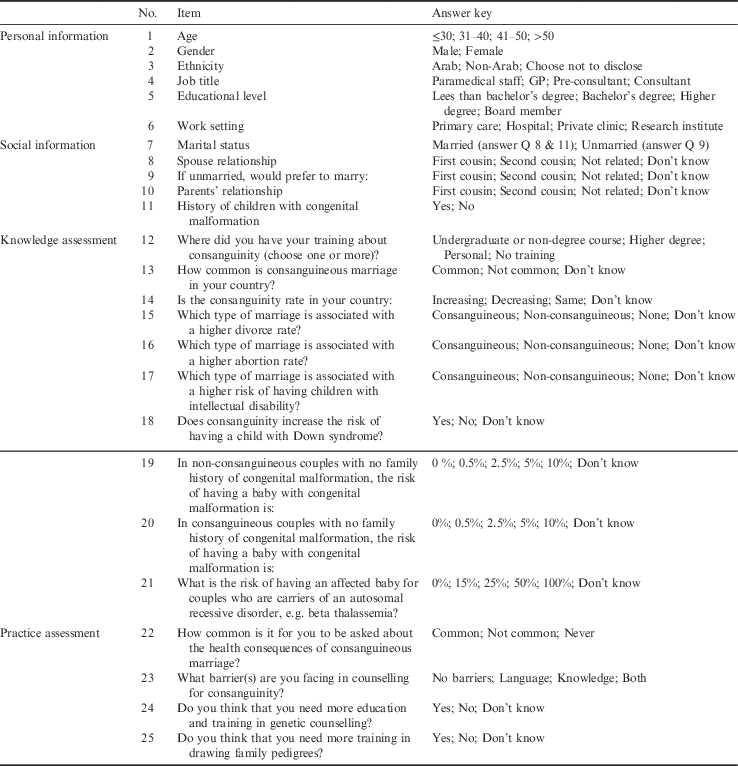
This cross-sectional study assessed the knowledge, attitude and practice of 1235 health care providers towards consanguineous marriage who were working in the Kingdom of Saudi Arabia during the period from 1st August 2012 to 31st July 2013. The study used a structured pre-designed self-administered questionnaire with close-ended questions that was developed based on knowledge available in the literature. The questionnaire included four sections. The first section addressed health care providers’ personal data such as age, gender, ethnicity, job title, educational level (academic degree) and work setting. The second section focused on the participant’s practice of, and attitude towards, consanguineous marriage and the marriage type of his/her parents, in addition to any history of children with congenital disorders. The third section was related to the health care providers’ knowledge about consanguinity and its consequences. The fourth section aimed to assess the health care providers’ common practices concerning counselling on consanguinity (Table 1). The questionnaire was validated using 407 participants in a pilot study during the year 2012 to define the final set of questions after clearing any ambiguity.
Questionnaire for the assessment of personal information and consanguinity literacy, knowledge and practice among health care providers

The questionnaire classified age into 10-year intervals and ethnicity into Arab and non-Arab. Arabs were defined those who were originally from one of the 22 states and territories of the Arab League and whose mother tongue was Arabic, while non-Arabs were mainly from Eastern India and the Philippines. The study participants were classified into paramedical staff (nurses, educators, nutritionists and pharmacists) and medical staff (general practitioner (GPs), pre-consultants and consultants), who were all randomly selected. Specialized geneticists and students were excluded. The educational level of participants was classified as ‘less than bachelor’s degree’, ‘bachelor’s degree’, ‘higher degree’ and ‘board member’ (graduate of a fellowship programme). The questionnaire was distributed to all eligible participants, including those who were involved in the pilot study.
A total of seven general hospitals and 21 primary health care centres from different health sectors in the Kingdom of Saudi Arabia and two research institutions were engaged in this study. The main objectives of the study and the components of the questionnaire were explained to each participant by the research team and consanguineous marriage was defined as the union between individuals who were second cousins or closer (Bittles, Reference Bittles2001).
Of 2000 distributed questionnaires, 1326 (66.3%) were completed and returned. Of these, 91 (6.9%) were excluded because of incomplete data, giving a final eligible number of participants of 1235.
The IBM statistical package for social sciences (SPSS Inc., Chicago, IL) version 21 was used for statistical analysis. Categorical variables are expressed as frequencies (n) and percentages. The chi-squared test was used to calculate p-values; p<0.05 was considered significant.
The study was approved by the Institutional Review Board (IRB) at the College of Medicine, King Saud University. Consent was not obtained from the participants because the study did not compromise identity or confidentiality or breach local data protection laws.
Results
Among the 1235 health care providers 70% were female and 30% male. Of the total cohort, 72% were paramedical staff, 19.7% were GPs, 5.5% were pre-consultants and 2.7% were consultants. Around 50% of the cohort were university graduates, and 10% held postgraduate degrees. The health care providers who were working at primary care level accounted for more than half of the study sample.
Consanguinity rates
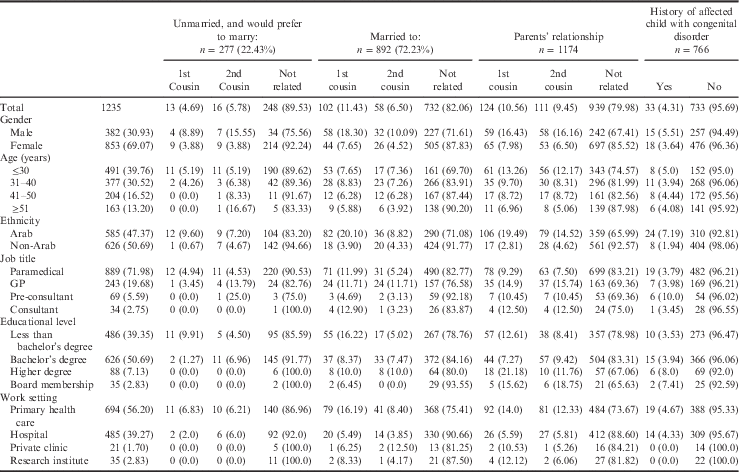
First and second cousin marriage rates were 11.43% and 6.5%, respectively, among the 892 married health care providers (p=0.013), with a total consanguinity rate of 17.9%. The total consanguinity rates were 28.9% and 8.2% among married Arab and non-Arab participants, respectively. The parents of ethnic Arab health care professionals also showed a higher consanguinity rate of 34.01% compared with 7.43% among the parents of the non-Arab participants. Among single Arab professionals, 16.8% preferred to get married to a consanguineous spouse compared with 5.34% of the non-Arab single participants. The rate of consanguineous marriages was higher among the male than among female participants and was preferred by unmarried males when compared with unmarried females. Rates of first cousin marriages were higher among the non-graduate health care providers than among other higher education groups, and consanguineous marriage was significantly more frequent among those who were less than 30 years of age (p<0.001) (Table 2).
Demographic characteristics (n (%)) of participating health care providers

The overall prevalence of congenital disorders among the 766 offspring of married health care providers was 4.31%, being significantly higher among the Arab (7.19%) than among non-Arab participants (1.94%) (p<0.001).
First cousin marriage was most frequent among paramedical staff, GPs and consultants, while second cousin marriage was more frequent among pre-consultants. First and second cousin marriages were observed more among undergraduate health care providers and were preferred among the unmarried group (Table 2).
Knowledge and consanguinity
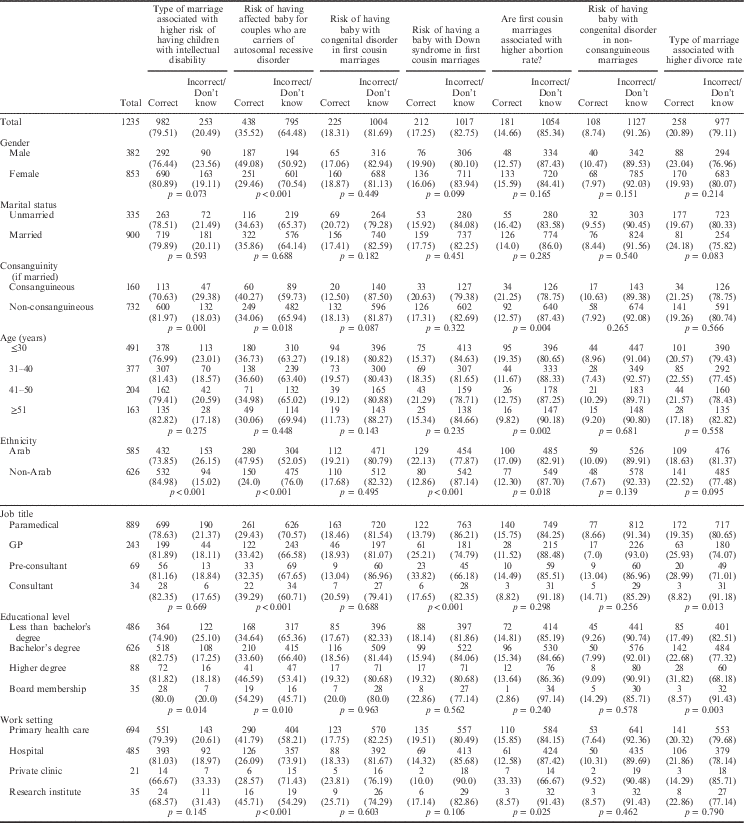
When assessing the health care providers’ knowledge about consanguineous marriage, more than 70% of the studied cohort thought that consanguinity among parents could increase the risk of having children with intellectual disability regardless of their demographic characteristics, though significantly lower correct answer rates were seen among consanguineously married health care providers, Arabs and non-graduate participants compared with their counterparts (Table 3).
Knowledge assessment for consanguineous marriage of health care providers by social, educational and professional status

The correct answer of a risk of 25% of having an affected child when a couple share the carrier status for an autosomal recessive pathogenic variant was given by 35.52% of the cohort and was significantly higher in males, Arabs, consultants, board certificate holders and researchers. Only 18.31% of the studied cohort indicated that first cousin couples with a negative family history had a risk of around 5% of having a baby with a congenital disorder. Answering that Down syndrome has no known association with consanguineous marriage was only reported by 17.25% of the studied cohort, and Arabs, pre-consultants and GPs had significantly higher rates of the right answers. Among all participants, 14.66% had the correct knowledge that abortion rate is comparable among consanguineous and non-consanguineous couples. A correct answer was significantly noted among consanguineously married health care providers, participants younger than 30 years and Arabs, in addition to those who worked in private clinics. The general population risk of about 2.5% of having a baby with a congenital disorder was only known by 8.74% of participants. When health care providers were asked about the type of marriages that they thought were more associated with higher divorce rates, 20.24% gave the expected answer of being higher in non-consanguineous marriages, and this answer was significantly higher in males, the consanguineously married, those of Arab ethnicity, consultants and those who worked in private clinics (Table 3).
Practice and consanguinity
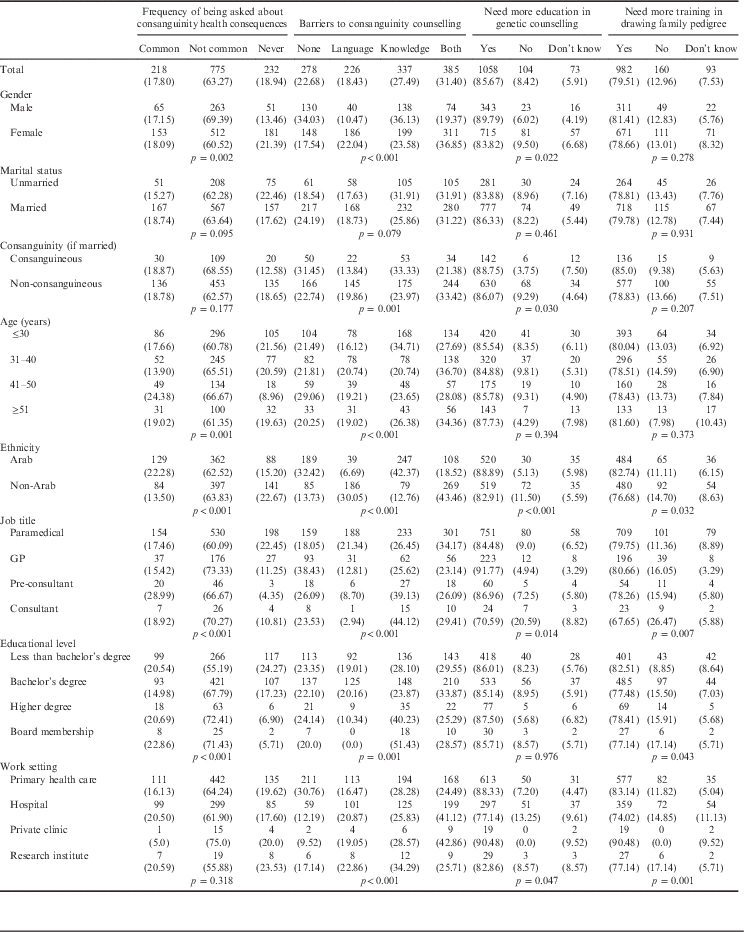
When assessing the frequency of their patients seeking knowledge on the health consequences of consanguinity, 17.80% of participants reported that this was a common question, 63.3% said that it was not common and 18.9% reported that they were never asked this question. The reply of ‘commonly asked’ was significantly higher among Arab health care workers. When looking at the barriers to consanguinity counselling, language, knowledge or both were reported in 18.43%, 27.49% and 31.40% of the cohort, respectively. Only 34% of the male cohort and 17.5% of the female cohort expressed their capability of offering counselling for consanguinity. Significant differences were seen in the distribution of reported barriers to counselling on consanguinity (Table 4).
Practice assessment for consanguineous marriage of health care providers by social, educational and job status

Knowledge barrier was significantly higher among males, among single participants and among participants with higher education levels. The lowest frequency of knowledge barrier related to consanguinity counselling was reported among health care providers aged 31–40 years, at 20.74%. Arabs had a significantly higher frequency of knowledge barrier, while non-Arabs had a significantly higher frequency of language barrier (Table 4).
Of the total health care providers involved in the study, 85.67% admitted that they needed more training and education on basic genetic counselling, specifically males, Arabs, consanguineously married health care providers, GPs and those who worked in private clinics. A total of 79.51% of health care providers confirmed that they needed more training in drawing a pedigree, with significantly higher demand among Arabs, GPs, non-graduates and those working in private clinics.
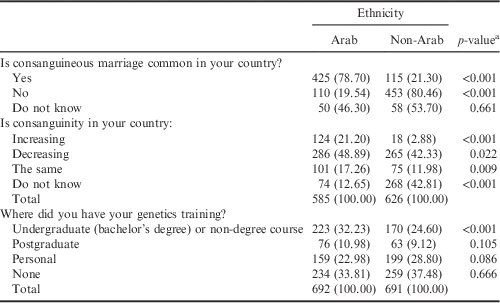
More than 70% of the Arab participants believed that consanguinity was common in their countries, whereas only 21.3% of non-Arabs believed the same (Table 5). Only 21.2% of Arabs and less than 3% of non-Arabs believed that this practice was increasing. Around a third of Arabs and non-Arabs did not have any training related to consanguinity counselling and another third had their training during their undergraduate or non-degree studies, while the rest had the training either during their postgraduate studies or through personal efforts.
Views of health care providers on national consanguinity trends and training by ethnicity

a The p-values were generated comparing the category versus the other categories grouped together.
Discussion
A consanguinity workshop held in Geneva in 2010 highlighted the importance of evidence-based counselling recommendations for consanguineous marriages (Hamamy et al., Reference Hamamy, Antonarakis and Cavalli-Sforza2011). This study was undertaken with the aim of assessing the knowledge, attitude and practice of health care providers in the Kingdom of Saudi Arabia towards consanguinity in order to underline the gaps in their consanguinity literacy.
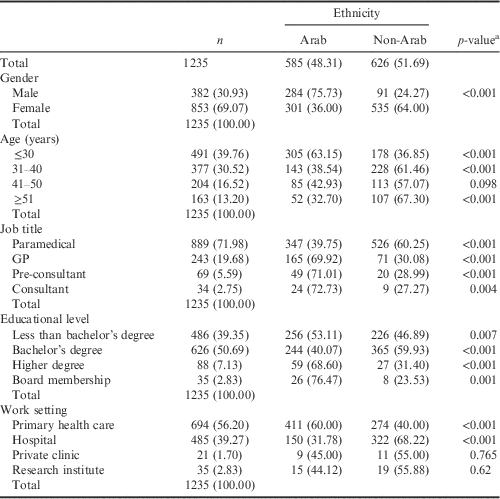
The survey, which included almost equal numbers of Arab and non-Arab participants (Table 6), revealed, as expected, that Arab health care providers and their parents had higher rates of consanguineous marriages when compared with non-Arab participants.
Demographic profile of health care providers by ethnicity

a The p-values were generated comparing the category versus the other categories grouped toether, e.g. Paramedical staff vs others.
Most of the Arab participants believed that consanguinity in their country was common, and 21.2% thought that the consanguinity rate was increasing. This could be due to deep-rooted cultural traditions that respect and favour consanguineous marriages among Arabs. Social factors that could play a role in favouring consanguineous marriages include the acquaintance of the spouse from the same family before marriage, strengthening family ties and keeping possessions within the family, improving the stability of the family, in addition to the lower cost and simplicity associated with such marriages (Hussain, Reference Hussain1999; Hamamy & Alwan, Reference Hamamy and Alwan2016). Additionally, this finding indicates that the medical knowledge gained by the health care providers during their graduate and undergraduate training did not affect their attitude towards marrying their first or second cousin spouse, which could point to the fact that respecting social and cultural attitudes could at times outweigh scientific knowledge.
The consanguinity rate among Arab health care providers in this study was not that far from the rate in the general Arab population. The consanguinity rate among non-Arab participants, mainly Indians and Filipinos, was 8.23%, falling within the range of the reported rates of 0.4% in the Philippines to the wide range in India reaching 42.5% (http://consang.net/images/c/cb/Asia.pdf). Single males had a more positive attitude towards consanguineous marriage compared with single females, which may be explained by the fact that financial considerations are more of a concern to males than females. Consanguineous marriage is known to be associated with lower dowries on the one hand, and keeping property and land within the family on the other (Hamamy & Alwan, Reference Hamamy and Alwan2016). Additionally, in some Arab societies, males depend on their female relatives to help them choose their spouses because women do not interact with non-related men in these communities. The finding that there was a three times higher rate of congenital disorders among the offspring of consanguineous couples in the Arab health care providers cohort did not affect their preferred attitude towards consanguineous marriage.
First cousin marriages among the health care providers were more common than second cousin marriages, similar to the findings of other reserchers in Arab communities (El-Hazmi et al., Reference El-Hazmi, Al-Swailem, Warsy, Al-Swailem, Sulaimani and Al-Meshari1995; El-Mouzan et al., Reference El-Mouzan, Al-Salloum, Al-Herbish, Qurachi and Al-Omar2007). Due to modernization and changes in socio-cultural beliefs, it is expected that the younger generation might shift away from consanguineous marriages. However, this study has shown that younger age groups had higher rates of affinity towards consanguinity, which is in accordance with the findings of Abbasi-Shavazi et al. (Reference Abbasi-Shavazi, McDonald and Hosseini-Chavoshi2008) among Iranian women, where the preference for consanguineous marriage was higher in younger and more educated women. One explanation for the preference for consanguineous marriage among the younger population might be the country’s rapid growth and development, which might have negatively affected their feeling of security and hence increased their sense of limited opportunities in acquaintance of suitable spouses outside their own families (Sandridge et al., Reference Sandridge, Takeddin, Al-Kaabi and Frances2010). Another explanation could be the persistent pressure that parents might exert on young adults to marry a close relative, because some young couples still need parental financial support. This pressure may be exerted more by parents who are themselves close relatives.
The vast majority of the surveyed heath care providers thought that consanguineous marriage increases the risk of having children with an intellectual disability, which is the general opinion of the population in this region (Alharbi et al., Reference Alharbi, Al-Shaia, Al-Hamam, Al-Marzoug, Ahmed and Bagha2015). Participants already in consanguineous marriages gave a lower score for this question, which may be explained by a denial attitude (Halpern & Jaber, Reference Halpern and Jaber2014). The score was also lower among Arab participants, who were mainly Muslim and had a strong belief that God determines fate in granting health or illness, and among non-graduate participants with probably limited knowledge on consanguinity health effects (Teeuw et al., Reference Teeuw, Hagelaar, Ten Kate, Cornel and Henneman2012).
The respondents’ knowledge about the well documented scientific facts related to the consequences of consanguineous marriages on reproductive parameters was inadequate. Such findings indicate that health care providers of different professional levels lack the basic concepts of medical genetics, which could affect their service in general and in premarital screening services in particular, since most of these services are provided by GPs and midwives (Julian-Reynier et al., Reference Julian-Reynier, Nippert and Calefato2008). Only a few studies have been done to assess the relation between consanguineous marriages and divorce rates and hence there is a lack of knowledge of participants on this issue (Saadat, Reference Saadat2015).
Higher educational level correlated positively with the knowledge of the respondents, where the majority of correct answers were among postgraduates and board members, which is as expected. The frequency of health care providers commonly being asked about the health consequences of consanguineous marriages was very low, which is an alarming finding indicating that the public are either unaware of such medical services or consider this topic to be sensitive and to be managed solely in the family domain (Teeuw et al., Reference Teeuw, Hagelaar, Ten Kate, Cornel and Henneman2012). As per the responses of the surveyed health care providers, knowledge was the main barrier for consanguinity counselling, giving a higher percentage among males, younger age groups and those of Arab ethnicity. The surprising findings that higher frequencies of senior and highly educated health care providers considered knowledge to be a barrier could be due to their beliefs that such counselling should be performed by specialist geneticists or genetic counsellors. Most participants demanded further training and education in basic genetic counselling and pedigree construction.
As expected, language barrier was more frequently reported among non-Arabs who were not native Arabic speakers, specifically among paramedics and GPs, since the majority of these were non-Arabs. This finding warrants encouraging non-Arabs to learn the Arabic language or to provide them with translation support.
Although both medical and paramedical schools continue to increase the genetics content of the undergraduate curriculum, it seems that this educational approach does not provide students with sufficient practical knowledge to address genetics related issues in clinical practice (Guttmacher et al., Reference Guttmacher, Porteous and McInerney2007). In this survey, the knowledge of pre-consultants and consultants was found to be better than that of GPs and paramedical staff; however, it was still unexpectedly low in more specific aspects of consanguinity related consequences, which indicates that the lack of consanguinity related knowledge is not limited to students or junior medical staff and is also frequent among senior medical staff. Therefore, it is highly recommended that consanguinity and its consequences should be included in the curriculum of continuous education courses, especially when such training and education have been proven to be effective in improving the knowledge of the general population (Teeuw et al., Reference Teeuw, Hagelaar, Ten Kate, Cornel and Henneman2012).
This study draws its strength from being the first study in the region to assess consanguinity literacy among health care professionals of different ethnicities. The second strength of this study is the large sample size and the involvement of different professional levels of health care providers from different institutions. Additionally, the study was preceded by a pilot study to assess the reliability and clarity of the questionnaire. The main limitation was the lack of an Arabic version of the questionnaire, which might have restricted the participation of non-English-speaking health care professionals. Another limitation was the lack of information about health care professionals’ religion, which is one of the factors that might have affected their attitude towards consanguineous marriage.
Consanguineous marriages, and favouring first cousin marriage, are socially and culturally respected and favoured, and the rates of consanguinity among Arab and non-Arab health care providers are not different from that of the general population, and the knowledge gained during education and training did not have any significant effect on this attitude. The lack of consanguinity related knowledge and practice indicates that training programmes at different educational levels need be more focused on consanguinity counselling. Health care providers at different levels should be equipped with the knowledge and communication skills to handle basic consanguinity counselling. Education could be included at the undergraduate level through a well designed curriculum with genetics courses and practical application and in the health care environment through continuous education. It is recommended that health authorities should consider consanguinity counselling as part of their mandatory premarital screening programmes.
Acknowledgments
The authors would like to acknowledge the research staff in the research unit at the University Diabetes Center for their support in the data collection. The authors would also like to acknowledge the University Diabetes Center for funding this study. The authors declare no conflicts of interest.