Introduction
Mucoepidermoid carcinoma (MEC) of the salivary gland is believed to arise from pluripotent reserve cells of the excretory ducts that are capable of differentiating into squamous, columnar and mucous cells.Reference Boahene, Olsen, Lewis, Pinheiro, Pankratz and Bagniewski1 Although MEC accounts for less than 10% of all tumours of the salivary gland, it constitutes approximately 30% of all malignant tumours of the salivary gland.Reference Otto2 Among the major salivary glands, MEC occurs most frequently in the parotid gland.Reference Boahene, Olsen, Lewis, Pinheiro, Pankratz and Bagniewski1
Radiotherapy is sometimes used alone or in combination with surgery and/or chemotherapy in the treatment of parotid tumours. Intensity-modulated radiotherapy (IMRT) is still an advanced external beam radiation therapy technique that has been implemented for routine clinical use for treating parotid tumours. IMRT involves the irradiation of target from different beam angles that are optimised to provide better dose coverage and reduce dose to healthy structures. Regardless of its effectiveness for tumour dose conformity, weaknesses of IMRT are as follows: increased delivery time, high marginal doses, increased monitor units (MUs) and difficult Quality Assurance procedures. OttoReference Otto2 developed the concept of planning and delivery of volumetric modulated arc therapy-based technique, called RapidArc (Varian Medical System, Palo Alto, CA). RapidArc is the major advancement in radiotherapy treatment that improves dose conformity while shortening treatment times. It deliver a precisely sculpted 3D dose distribution with 360-degree rotation of the gantry in a single or multi arc treatment typically in less than two minutes. Of the novel treatment technique, RapidArc therapy, initiated in 2007, permits simultaneous variation of gantry rotation speed, dose rate and dynamic multileaf collimator during treatment delivery.Reference Iqbal, Isa, Buzdar, Gifford and Afzal3,Reference Teoh, Clark, Wood, Whitaker and Nisbet4 It can deliver uniform intensity of radiations at a constant or variable dose rate. Single or multiple arcs can be delivered by this technique.Reference Ashamalla, Tejwani and Parameritis5 It plays a significant role for treatment of prostate, oesophageal, cervix and parotid tumours.Reference Mayo, Ding, Addesa, Kadish, Fitzgerald and Moser6,Reference Yin, Wu and Gong7 Dosimetric comparison of these techniques (IMRT and RapidArc) had previously been investigated for different types of cancer.Reference Rao, Yang and Chen8 Few studies suggest improved coverage of target and better sparing of organs at risk (OARs) by RapidArc technique over IMRT technique.Reference Cozzi, Dinshaw and Shrivastava9,Reference Otto, Milette and Wu10 However, the study of Zhai et al..Reference Zhai, Yin and Gong11 proved superiority of IMRT over arc therapy for the treatment of cervical cancer. It is important to look for superior plan quality for head and neck patient because organs involved are so critical and can cause permanent damage to the patient.
Treatment planning typically aims to fulfil the following objectives: (a) covering 100% of the tumour site with prescribed dose (PD), that is, attaining uniform coverage to the target. (b) Achieving high dose conformity to the target, (c) achieving homogenous dose distribution to the target and (d) minimizing the dose to normal tissues below their tolerance level.Reference Atiq, Atiq and Iqbal12 It is easier to achieve the first three objectives but the last one is difficult and can be achieved indirectly by quantifying the dose gradient.Reference Akpati, Kim, Kim, Park and Meek13
The present study is aimed to investigate both the techniques, IMRT and RapidArc, and compare which technique of these techniques yields better result for MEC of the salivary gland by studying the impact of coverage, conformity index (CI), homogeneity index (HI), gradient index (GI) and unified dosimetry index (UDI) on treatment plans, treatment time and OARs sparing of low grade MEC of the salivary gland cancer patients.
Materials and Methods
A total of 25 patients, with MEC of the salivary gland cancer, were randomly selected for the analysis. For each patient, dose was calculated by both techniques IMRT and RapidArc using Eclipse (Varian Medical Systems, Palo Alto, CA). For treatment planning, computed tomography (CT) scans for all the patients were obtained using CT simulator with a slice thickness of 3 mm. All contouring (organ at risk (OAR), planning target volume (PTV), clinical tumour volume (CTV) and gross tumour volume) is done and checked by the group of clinicians in treatment planning system. All macroscopic as well as potential microscopic disease was covered by CTV, and to determine PTV, a 2 mm margin was added all round to CTV for possible internal organ motion and patients setup. Patients were immobilised by using face mask with head rest. All treatment plans were planned by the physicist and approved by the clinician according to institutional protocol. The PD was 6000 cGy in 30 fractions. In IMRT, 6 MV photon beams with gantry angle of 0o, 510, 1020, 1510, 2050, 2550 and 3000 were used. In case of RapidArc, two half arcs of 6 MV photon beams were used. The OARs including spinal cord, brain stem, optic chiasm, opposite parotid, eyes and optic nerve were also contoured by the clinician.
Quality indices of treatment plans and doses of OARs were calculated by comparing the coverage, CI, HI, GI, UDI, dose volume histogram (DVH) and mean doses of each OAR for all IMRT and RapidArc plans.Reference Krishna, Srinivas, Ayyangar and Reddy14 The plan is acceptable if total volume (TV) covers 95% of PD. If 90% of PD covers TV then there is minor deviation. Major deviation will be observed if the coverage is less than 90% of TV.Reference Murphy, Chang, Gibbs, Le, Martin and Kim15 However, in most clinical practices, ±10% is considered as an acceptable deviation.Reference Krishna, Srinivas, Ayyangar and Reddy14 Coverage of dose is the ratio of Dmin to PD.
 $${\rm{Coverage = }}{{\rm{D}}_{{\rm{min}}}}{\rm{/ PD}}.$$
CI is defined as prescribed isodose volume that completely covers the tumour volume. CI was calculated by using the formula according to Radiation Therapy Oncology Group (RTOG) 90-05 protocol.Reference Das, Cheng, Chopra, Mitra, Srivastava and Glatstein16 From the RTOG guideline, if PTV values lie between 1 and 2, treatment plan (TP) is acceptable.
 $${\rm{CI = PIV / TV}}.$$
HI is defined as the ratio of maximum dose delivered to the target volume to PD as per RTOG protocol.Reference Das, Cheng, Chopra, Mitra, Srivastava and Glatstein16 TP is acceptable for HI values between 1 and 1·5.Reference Shaw, Kline and Gillin17.
 $${\rm{HI = }}{{\rm{D}}_{{\rm{max}}}}{\rm{/ PD}}.$$
GI is defined as volume of PD to the 50% isodose volume of PD.Reference Atiq, Atiq, Iqbal, Shamsi and Buzdar18,Reference Krishnan, Shetty, Rao, Hegde and Shambhavi19 The lower ratio of GI represents the greater dose falloff and better plan conformity.
 $${\rm{GI = PTV }}\left( {{\rm{PD}}} \right){\rm{ / PTV }}\left( {{\rm{PD 50\% }}} \right).$$
The above mentioned four dosimetric components were employed by Akapati et al.Reference Akpati, Kim, Kim, Park and Meek13 to propose UDI integrating contribution. It is used to define ideal tool. Ideal plan is the one with perfect coverage, homogeneity, conformity and dose gradient (stepwise falloff of dose to zero).Reference Paddick and Lippitz20 Low UDI values correspond to good plan, whereas high values indicate poor plan.Reference Weyh, Konski, Nalichowski, Maier and Lack21 For actual plan, UDI value is mostly less than 1. For ideal plan, its value is 1 whereas worsening of any of the four dosimetric components results in an increase in the value of UDI.
 $${\rm{UDI = Coverage * CI * HI* GI}}.$$
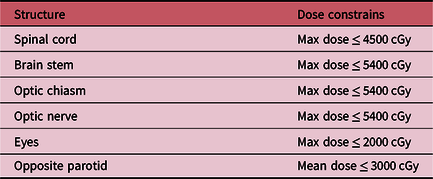
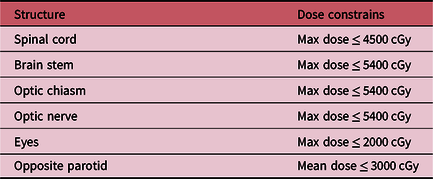
For OARs, tolerance doses and volumes are in accordance with the internal clinical treatment guidelines as shown in Table 1. Tolerance doses for each OAR were compared between two techniques.
Dose constrain for organ at risk while treating MEC tumours
Results
In the present study, plan quality of IMRT and RapidArc of 25 patients with MEC cancer were compared by using dosimetric evaluation indices (coverage, CI, HI, GI and UDI).
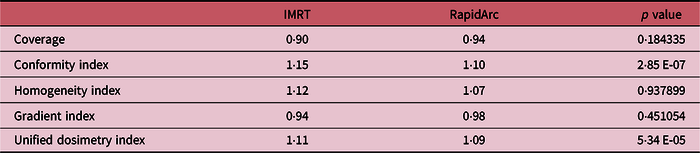
Table 2 shows the mean value of dosimetric evaluation indices of both treatment techniques. Statistical analysis is used to determine relationship between dosimetric indices. The effectiveness, whether significant or insignificant, of the treatment plans was described by p value by taking significance level ≤ 0·05. No significant difference in values of CI and UDI is observed between the two planning techniques.
Average and p values of IMRT and RapidArc
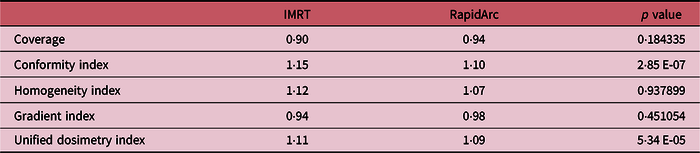
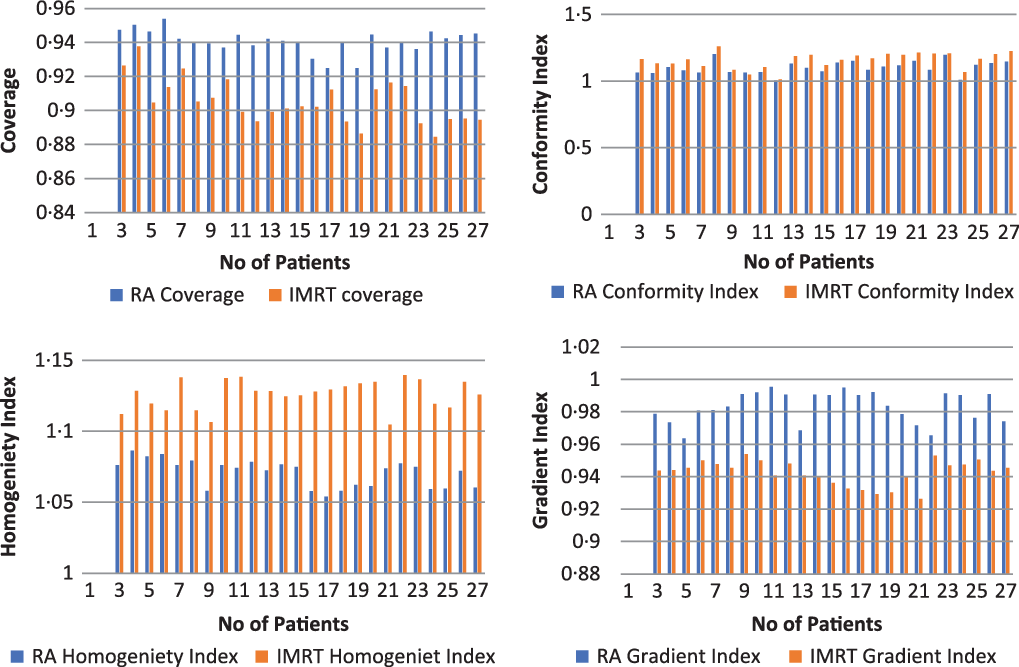
Table 2 and Figure 1 demonstrate that the dosimetry scores of IMRT and RapidArc patients are in range and clinically acceptable. It was also observed that objectives of the planning achieved such as coverage of the target, conformity of the dose target and dose distribution were in range. So, quality of all plans was acceptable. In general, there is no increasing or decreasing trend in all dosimetric indices of both techniques.
Coverage (upper left), conformity index (upper right), homogeneity index (lower left) and gradient index (lower right) of IMRT and RapidArc plans average values.

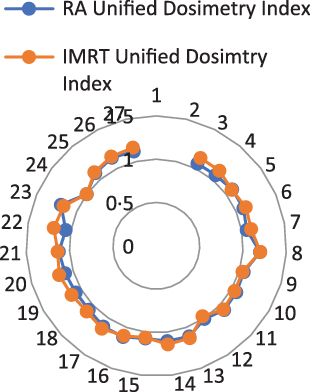
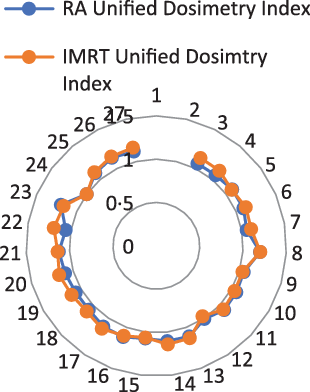
As UDI combines all four indices (coverage, CI, HI and GI) into a single score, mostly plans are ranked by UDI. Figure 2 shows the radar graph of UDI scores from RapidArc and IMRT plans. The lowest score denotes the minimum deviation, whereas the highest score denotes the maximum deviation from an ideal dosimetry plan. It illustrates that RapidArc plans are better than IMRT plans for this site.
UDI score of each patient of IMRT and RapidArc.
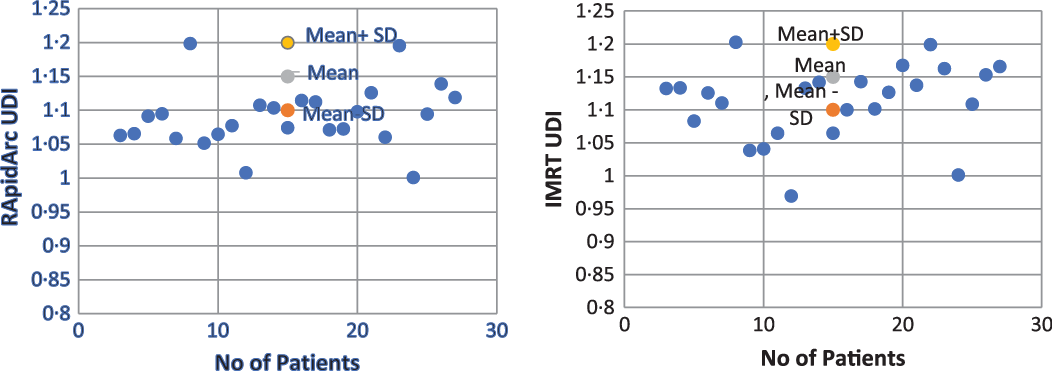
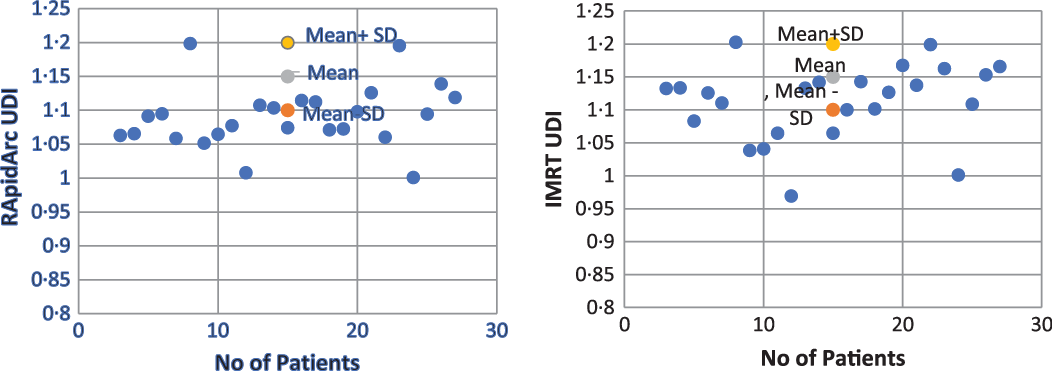
UDI was classified into different groups based on their mean value and SD. The plans with greater UDI values as compared to mean + SD are considered as poor. Plans with UDI values from mean to mean + SD are considered as average, from mean to mean-SD values are classified as good and UDI values less than mean-SD are considered as excellent.
A graph of ranking system of IMRT and RapidArc plans is illustrated in Figure 3. Of the 25 cases, 9 treatment plans were excellent, 11 were good, 4 were average and 1 was poor for IMRT cases while for RapidArc cases, 16 treatment plans were excellent, 7 were good and 2 were average. Lower UDI score represents minimum deviation, whereas higher score represents maximum deviation from ideal plans.
Plot of UDI for 25 cases for IMRT and RapidArc.
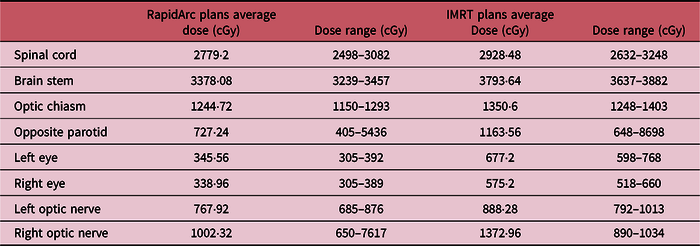
Average time to run IMRT plans was 7 to 8 minutes and average time to run RapidArc plans was 2 or 3 minutes. Hence, RapidArc delivers in shorter time as compared to IMRT. The average doses delivered to all OARs and their ranges in IMRT and RapidArc are mentioned in Table 3.
Average doses to all OAR and their ranges
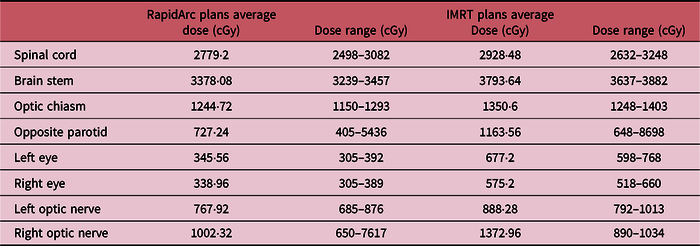
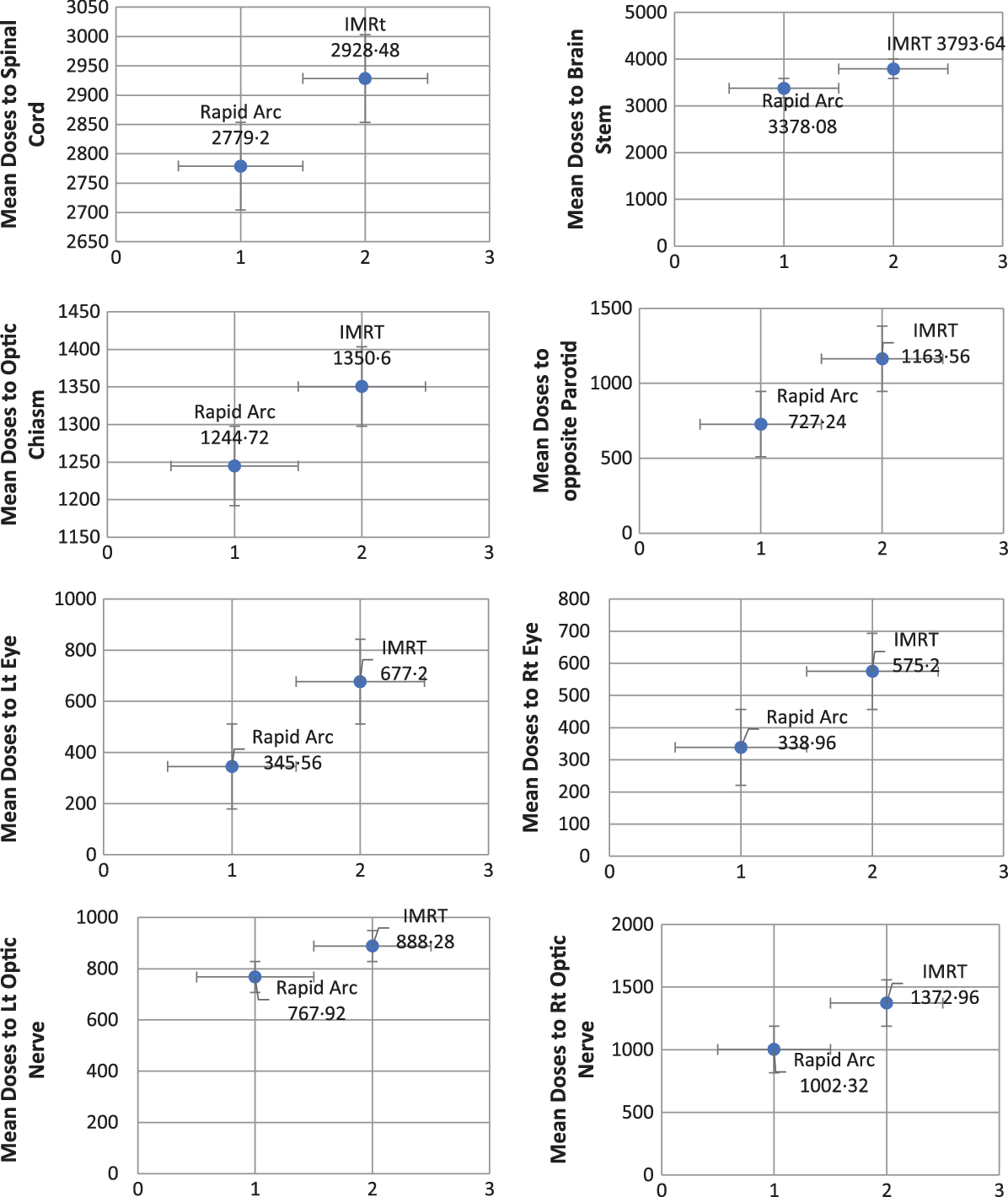
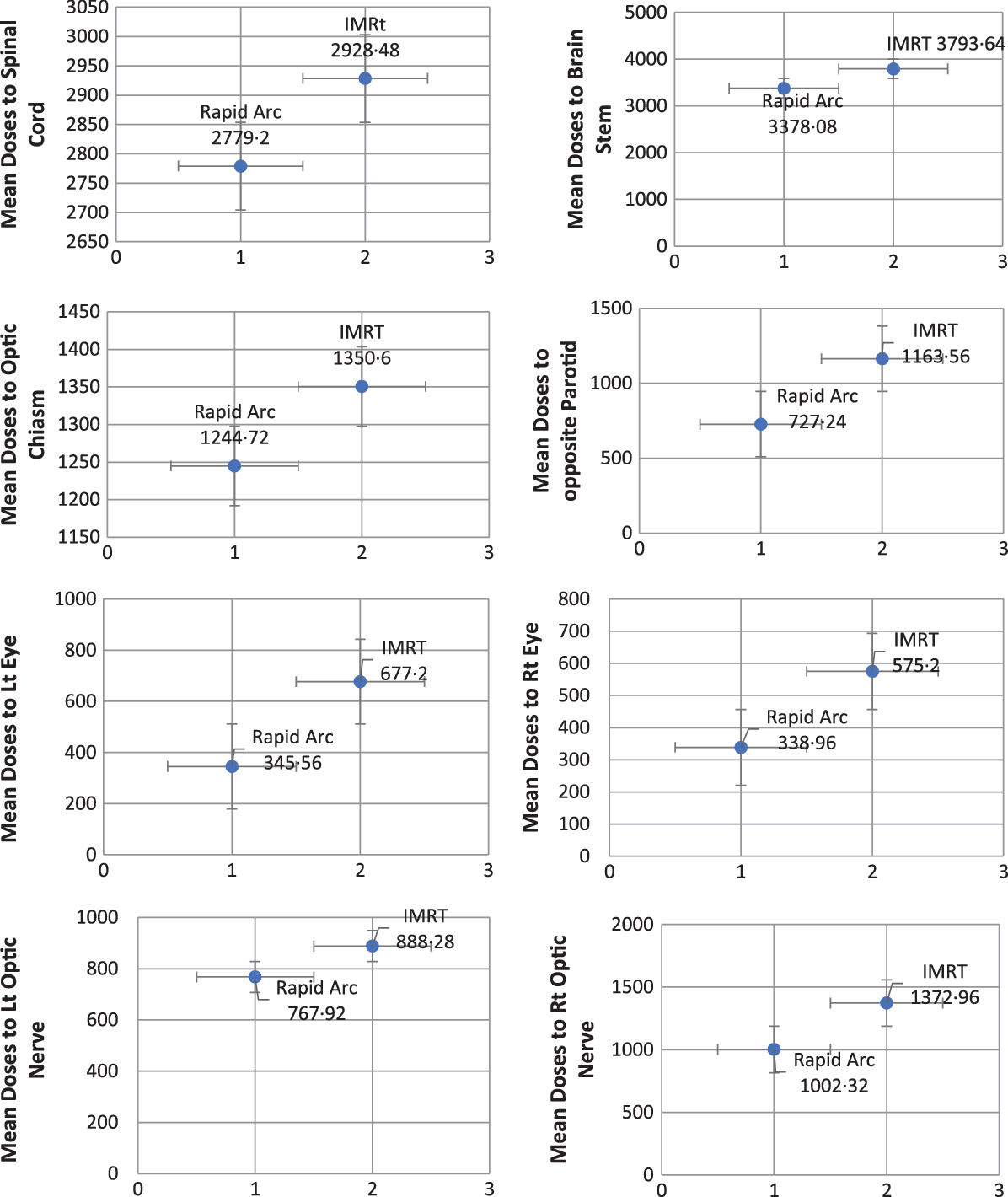
Figure 4 compares the integral doses (IDs) to all OARs in both plans. Doses to OAR by DVH, by comparison doses deliver to OAR in IMRT and RapidArc were acceptable. In RapidArc all OARs received fewer amount of radiations as compared to IMRT. ID to normal tissues decreases as the size of tumour increases for the same anatomical regions. If tumours are of same size, ID increases with increasing anatomical sizes.
Mean doses of IMRT and RapidArc to all organs at risk.
Discussion
Oliver et al.Reference Oliver, Ansbacher and Beckham22 and Nicolini et al.Reference Nicolini, Clivio, Fogliata, Vanetti and Cozzi23 reported that RapidArc provided better result than IMRT. Patients undergoing MEC cancer treatment also confirm that RapidArc gives better results than IMRT because of its inherent arc therapy nature of plans. Arc trajectory provides large number of radiation beam directions and dynamic dose delivery during gantry rotation (single or double). Fixed-field IMRT provides limited number of radiation beams, which results in some optimal beam angles being missed. RapidArc utilises all possible beam angles during optimization and hence it can produce optimal dose distribution resulting in better plans than IMRT. Moreover, using multiple arcs in RapidArc technique stringent dose objectives fulfil the requirement of steeper dose gradient around the PTV.Reference Pasciuti, Kuthpady, Anderson, Best, Waqar and Chowdhury24 So, the RapidArc shows better result with its double arc as compared to the beams of IMRT. This has also been reported by Poon et al.Reference Poon, Kam and Leung25 and Coozi et al.Reference Cozzi, Dinshaw and Shrivastava9
The method of UDI score-based plan evaluation and comparison of different techniques is significant to judge the plan quality. The UDI used here incorporates all four dosimetry indices into a single overall score.
In this study, the plans of different techniques were analysed and compared to find a better plan for patient treatment using this UDI score. Good dosimetry plans were indicated by low UDI score. The present study is focused on the comparison of the treatment plan of 25 patients with MEC and to calculate four dosimetric parameters. Dose coverage has less contribution to the UDI score as the most dominant component of UDI is CI because it has the highest score of values. Second and third dominant components of UDI score are GI and HI, respectively. GI and CI are interpreted such that high values of these indices are translated as high-dose gradient, that is, rapid dose falloff and good conformity. On the contrary, low HI values depict poor plans, that is, hotspots in and around the PTV.
Treatment plans of this study were ranked as excellent, good, average or poor. Better results of all dosimetric parameters are observed for RapidArc plans as compared to IMRT plans. However, plans using both techniques are clinically acceptable according to dosimetric criteria. There is one poor plan for IMRT while no poor plan is observed for RapidArc. Also, excellent and good plans for RapidArc are identified more than for IMRT plans. Average UDI value for RapidArc is 1·09 and for IMRT is 1·11, so RapidArc is slightly a better technique.
The ID received by all OARs has been calculated from DVH. Figure 3 indicates that RapidArc receives less amount of doses as compared to IMRT. Increased value of ID by the use of large number of MUs in IMRT is already reported in literature.Reference Hall and Wuu26,Reference D’Souza and Rosen27 It is often stated that ID to normal tissues decreases as the size of tumour increases for the same anatomical regions. For same tumour size ID increases with increasing anatomical sizes.Reference Aoyama, Westerly and Mackie28 Therefore, critical structure dose (especially PD region) has been controlled with RapidArc plan significantly than IMRT plan.
Conclusion
Evaluation and comparison between IMRT and RapidArc treatment plans for MEC of the salivary gland patients specifies better coverage, conformity, homogeneity of target and dose gradient in favour of RapidArc. For surrounding normal tissues such as spinal cord, optic nerve, optic chiasm, eyes, contralateral parotid and ID provide satisfactory results for both techniques. However, MU analysis reveals that RapidArc plans can be delivered in a short time about 45% in comparison to the IMRT plans. The risk of the patient movement during treatment delivery increases with the therapeutic time. The physical dose distribution combined with shorter delivery time can have influence on biological level. This makes the arc therapy a reliable method for treating patients with MEC cancer.