INTRODUCTION
Marine Protected Areas (MPAs) are increasingly used for conservation and management of fishes and other mobile species (Glazer & Delgado, Reference Glazer, Delgado and Taylor2006; Meyer et al., Reference Meyer, Holland and Papastamatiou2007). To provide effective protection, MPAs need to be large enough and contain appropriate habitat to retain targeted species within protected area boundaries. Additionally, MPAs should ideally benefit multispecies assemblages of fishes with a variety of space and habitat requirements (Meyer et al., Reference Meyer, Papastamatiou and Clark2010). However, in most cases we lack empirical fish movement data required to design effective MPAs (Sale et al., Reference Sale, Cowen, Danilowicz, Jones, Kritzer, Lindeman, Planes, Polunin, Russ, Yvonne, Sadovy and Steneck2005; Meyer et al., Reference Meyer, Papastamatiou and Clark2010). Such data are needed to help managers understand how adjusting MPA size and placement will benefit different species.
In addition to these biological criteria, MPA site selection also involves a variety of socioeconomic considerations, such as ease of access, aesthetics, value for tourism, ease of management and enforcement (see Roberts et al., Reference Roberts, Andelman, Branch, Bustamante, Castilla, Dugan, Halpern, Lafferty, Leslie, Lubchenco, Mcardle, Possingham, Ruckelshaus and Warner2003). A combination of these factors has made coastal bays popular sites for MPAs (e.g. Sobel & Dahlgren, Reference Sobel and Dahlgren2004; Meyer & Holland, Reference Meyer and Holland2009). We selected a small bay suggested as a potential future MPA site (Portelet Bay, Jersey, Channel Islands, 49°10.20N 002°10.60W), as the location for a comparative study of residency of temperate reef-associated ballan wrasse (Labrus bergylta Ascanius, 1767) and sand-dwelling small-eyed (Raja microocellata Montagu, 1818) and blonde ray (Raja brachyura Lafont, 1873). These species are common inhabitants of the study site and have very different biological characteristics which may influence their movement patterns, making them good candidates for a comparative study of residency. Ballan wrasse occur in coastal habitats from northern Norway to Morocco (Quero, Reference Quero1984), and are common in coastal waters around Jersey where they feed predominantly on molluscs and decapod crustaceans (Deady & Fives, Reference Deady and Fives1995). They are relatively long-lived (male: 29 years; female: 25 years), protogynous fishes, with a proportion becoming males at between 5 and 14 years (Dipper et al., Reference Dipper, Bridges and Menz1977). Although commercially harvested in some countries (Figueiredo et al., Reference Figueiredo, Morato, Barreiros, Afonso and Santos2005), ballan wrasse are primarily an important sport-angling species in Jersey, but are also sold for consumption in limited quantities and used to bait lobster and crab traps. Small-eyed and blonde rays occur in coastal sandy sediment habitats from northern Scotland to Morocco, with the blonde ray also extending into the Mediterranean (Quero, Reference Quero1984; Ellis et al., Reference Ellis, Cruz-Martinez, Rackham and Rogers2005). Both species are slow-growing and long-lived, late-maturing and have low fecundity (Holden, Reference Holden and Harden Jones1974; Ellis et al., Reference Ellis, Clarke, Cortés, Heessen, Apostolaki, Carlson, Kulka, Payne, Cotter and Potter2008). They are commercially exploited throughout their range and are also targeted by anglers.
We lack empirical information on ballan wrasse movements, but previous mark–recapture studies of ray movements suggest some degree of site fidelity, with many tagged fish recaptured close to original capture sites whilst others were recaptured up to 60 km away (Ellis et al., Reference Ellis, Morel, Burt and Bossy2011). However, mark–recapture techniques do not reveal whether fish recaptured close to their original capture sites are permanent residents or returning, occasional visitors. In contrast, acoustic monitoring is particularly well-suited to residency studies as this method continually monitors for the presence of identification transmitter-equipped individuals (e.g. Meyer et al., Reference Meyer, Holland, Wetherbee and Lowe2000; Parsons et al., Reference Parsons, Babcock, Hankin, Willis, Aitken, O'Dor and Jackson2003; Lindholm et al., Reference Lindholm, Auster and Knight2007). We used acoustic monitoring to compare residency and temporal patterns of behaviour of wrasse and rays captured in Portelet Bay in order to evaluate a null hypothesis of no difference in residency or behavioural rhythmicity between these species.
MATERIALS AND METHODS
Study area
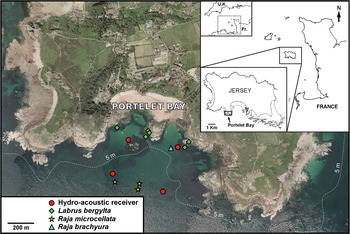
Portelet Bay is located on the south coast of Jersey, an island within the Normano-Breton Gulf area of the English Channel (Figure 1). The 0.32 km2 bay contains a mixture of kelp reef and sandy habitats, suitable for both wrasse and rays. The northern half of the bay is dominated by high reef covered with Fucus spp. and Laminaria spp., interspersed by gullies of coarse sand. The southern half of the bay is dominated by a wide expanse of coarse to medium sand substrate with occasional exposed low relief bedrock. The Normano-Breton Gulf is subject to rapid currents (4–5 knots on spring tides) and one of the largest tidal amplitudes (ca 12 m range) in the world (Pingree & Mardell, 1987). Receiver stations and fish capture sites were within 500 m of the coastline surrounding Portelet Bay in water depths ranging from 5 to 20 m chart datum.
Location of acoustic receivers (circles), and wrasse (diamonds) and ray (triangle, star) capture sites in Portelet Bay. Inset: location of Jersey in the Normano-Breton Gulf, English Channel. Box indicates location of Portelet Bay on Jersey.

Acoustic monitoring array
In October 2009, an array of 4 Vemco VR2W acoustic receivers was deployed in Portelet Bay (Figure 1) to listen for transmitter-equipped wrasse and rays. Receivers (340 mm long × 60 mm diameter, weight in water 300 g) were attached to sub-surface moorings consisting of heavy (approximately 50 kg) metal end weights connected to two hard floats via 3 m of metal cable. Receivers were attached to the cable, approximately 2 m above the seabed using circular clamps and cable ties. Moorings were deployed on soft sediment substrate among a heterogeneous matrix of coarse sand, boulder and exposed bedrock plateau. Receivers were positioned with detection ranges overlapping (250–400 m from neighbouring receivers), to ensure that there were no gaps in acoustic coverage of the study site where tagged animals could be present but not detected. In September 2010 and July 2011, receivers were recovered, data downloaded and receivers redeployed at the same locations.
Capture and tagging methods
In October and November 2009 six ballan wrasse, one blonde ray and three small-eyed rays were caught by angling (wrasse), trammel net (blonde ray) and beam trawl (small-eyed ray). Following capture and stabilization in a holding tank, each fish was briefly transferred to an anaesthetic bath containing MS-222 (0.2 g l−1). Once anaesthetized (1–3 minutes depending on size and species), each fish was removed from the anaesthetic bath, transferred to an operating table and covered with a damp towel, with the incision site exposed. This site was irrigated with Betadine solution prior to incision and each transmitter was also immersed in Betadine prior to insertion into the peritoneal cavity. For wrasse, a 20 mm incision was carefully made between adjacent scales just below the ventral midline and forward of the vent, with the scalpel blade almost parallel to the body wall. This ensured all scales remained intact and precluded the use of sutures to close the wound (Meyer et al., Reference Meyer, Papastamatiou and Clark2010). The shallow angle of the cut also helped to hold the wound closed. For ray, the incision point was a 20–30 mm dorsal incision into the peritoneal cavity and the incision was closed using 2–3 sterile sutures. Ballan wrasse were implanted with Vemco V9 (length 29 mm; diameter 9 mm; weight in water 2.9 g; battery life 419 days) and V13 transmitters (length 36 mm; diameter 13 mm; weight in water 6 g, battery life 618 days). Rays were equipped with Vemco V13 transmitters. Both V9 and V13 transmitters operated on the same duty cycle (minimum and maximum delay times between identification (ID) transmissions: 50–130 seconds; average 90 seconds). Each transmitter emits a unique ID code that is detected, decoded and stored by any VR2W receiver within detection range (approximately 400 m). Each fish was also tagged externally using t-bar type tags for wrasse and Petersen discs for ray. Following tagging fish were placed in a recovery tank to allow observation for a short period of time (3–5 minutes) to ensure recovery prior to release.
Data analysis
To evaluate residency, we first quantified number of detection days for each tagged wrasse and ray, defining a detection day as a sequence of at least three consecutive detections within a 24 hour period (midnight to midnight). We calculated pooled total number of presence and absence days for all wrasses and all rays respectively. An absence day was any day with no valid detections within a 24 hour period, and total absence days were calculated by subtracting number of days present from total number of possible detection days. The latter was independently calculated for each fish, adjusting for transmitter battery life and monitoring period. We used a Chi-squared test of independence to evaluate a null hypothesis of no difference in residency between wrasses and rays within Portelet Bay.
To identify patterns of wrasse and ray behaviour, we first examined diel scatter plots for visually obvious temporal patterns and then used fast Fourier transformations (FFTs) (with Hamming window smoothing) to search for cyclical patterns (diel, crepuscular and tidal) in fish detections at Portelet Bay (e.g. Meyer et al., Reference Meyer, Papastamatiou and Clark2010). Data from each individual were prepared for FFTs by: (1) selecting the receiver that most frequently detected that individual; and (2) pooling detections from that receiver into hourly bins. For ballan wrasse, we used an analysis of variance to evaluate the effect of season (summer versus winter) and lunar phase (full moon, first quarter, new moon and last quarter) on mean hourly detections (all receivers combined) in Portelet Bay. We used a broad, six month definition of summer (April through to September) and winter (October through to March). We hypothesized that lunar phase might influence detection patterns both through the brightness of the moon and also via the tidal regime (i.e. spring tides occur around full and new moons, neap tides around first and last quarters). We further hypothesized that a dominant moonlight effect would produce a significant difference in mean hourly detections between full moon and new moon, whereas a dominant tidal effect would yield a significant difference in detections between spring (full moon and new moon) and neap (first quarter and last quarter) tides.
RESULTS
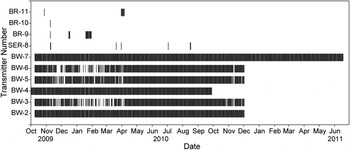
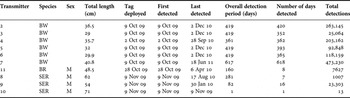
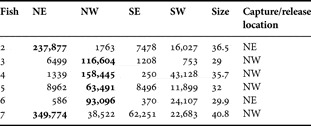
Between October 2009 and July 2011, four receivers stationed in Portelet Bay, Jersey detected six transmitter-equipped wrasses (mean size = 34.0 cm total length, standard deviation (SD) = 4.5 cm), and four transmitter-equipped rays (mean size = 54.8 cm total length, SD = 6.8 cm), over periods spanning from <1 to 618 days (overall median = 390 days) (Table 1). There were significant differences in residency between wrasses and rays (χ2 = 4286, df = 1, P < 0.0001), with detection patterns suggesting that reef-associated ballan wrasse were year-round residents of Portelet Bay, whereas sand-dwelling rays were occasional, repeat visitors (Figures 2 & 3). For example, all six wrasses were detected near continuously after their release (Figures 2 & 3), most frequently by the receivers closest to their location of capture (Table 2), and on two receivers in the northern part of the Bay among high reef and sandy gullies (Table 2). Detections of each wrasse spanned 86–100% (median = 100%) of anticipated transmitter battery lives, and the ratio of total days detected to total days monitored (corrected for anticipated transmitter battery lives) ranging among individual wrasse from 84 to 100% (median = 90.4%). In contrast, only three of four rays were detected after their initial release day, and in all cases detection spans were well below (<1 to 45.4%, median = 19.6%) anticipated transmitter battery lives (618 days) despite a total monitoring period of 653 days (Table 1). Long gaps between relatively brief visits to Portelet Bay by rays (Figure 2) were reflected in the percentage ratio of total days detected to total days monitored (corrected for anticipated transmitter battery lives) which ranged among individual rays from <1 to 2.6% (overall median = 1.2%).
Abacus plots showing detection dates (vertical lines) of transmitter-equipped wrasses and rays by the Portelet Bay receiver array. Note wrasses BW-2 to BW-6 were equipped with V9 transmitters (estimated battery life 419 days), wrasse BW-7 and all rays were equipped with V13 transmitters (estimated battery life 618 days).

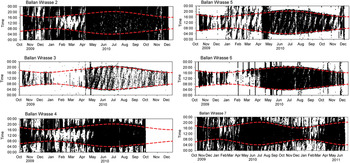
Diel detections (black points) of six ballan wrasse (Labrus bergylta) captured inside Portelet Bay in October 2009. Dashed red lines indicate sunrise (lower line) and sunset (upper line) times.

Summary of acoustic monitoring data for transmitter-equipped ballan wrasse (BW), blonde ray (BR) and small-eyed ray (SER) captured at Portelet Bay, Jersey.

M, male.
Detections of wrasse at each receiver (release location, shaded column; highest detection, bold type).

NE, north-east; NW, north-west; SE, south-east; SW, south-west.
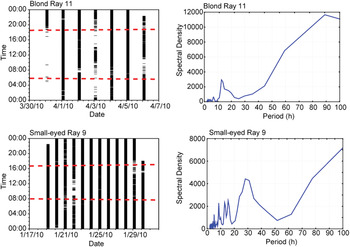
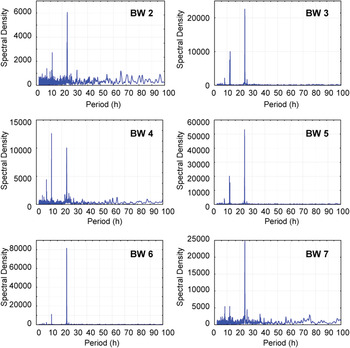
Clear diel and seasonal patterns were evident in diel scatterplots of detections of wrasse, but not in rays (Figures 3 & 4). All wrasse showed clear evidence of diel cycles in detections with either a dominant 24 or 12 hour peak in the power spectrum, whereas no detectable rhythms were evident for rays (Figures 4 & 5).
Diel detections (black points) and spectral analyses (fast Fourier transformations) of hourly detections of a blonde ray (top) and small-eyed ray (bottom) captured at Portelet Bay in October 2009.

Spectral analyses (fast Fourier transformations) of hourly ballan wrasse detections at Portelet Bay, Jersey.

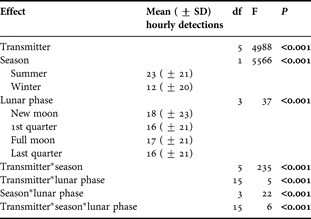
Analysis of variance revealed significant effects of both season (Table 3) and lunar phase (Table 3) on mean hourly detections of ballan wrasse in Portelet Bay, but also identified significant interactions among all factors (Table 3). In most cases significant interactions arose because of significant differences among individual detection rates and did not negate the main seasonal and lunar patterns. For example, every wrasse was detected more frequently during summer than winter, but the mean hourly number of winter detections of the most frequently detected wrasse was significantly higher than mean hourly number of summer detections of the least frequently detected individual. These results suggest that the same general seasonal pattern was exhibited by all individuals but the core areas of the most frequently detected wrasse were probably closer to a receiver than others.
Analysis of variance of mean hourly detections of ballan wrasse captured inside Portelet Bay, Jersey. Independent factors were transmitter identification, season (summer, April through to September; winter, October through to March) and lunar phase (full moon, new moon, first quarter, last quarter). Significant results are in bold.

SD, standard deviation.
Overall wrasse mean hourly detection rates were significantly higher during full and new moons than during the first and last quarters and also significantly higher during the new than full moon. These results imply a mixed effect of tide (higher detection rates on spring tides) and lunar brightness (higher detection rates on dark moons). Lunar phase interactions were less clear than seasonal interactions, but most individuals had higher mean hourly detection rates during lunar phases associated with spring tides than neaps, and higher mean hourly detections during new moon than full moons.
DISCUSSION
Although our sample size was small, this study provided important insights into long-term site fidelity of two ecologically different species to a small temperate embayment. Our data suggest reef-associated ballan wrasse were year-round residents of Portelet Bay, whereas sand-dwelling rays were occasional, repeat visitors. Long-term site attachment to relatively small home ranges is a common trait among reef-associated teleosts. For example, other similar-sized temperate wrasse including California sheephead, Semicossyphus pulcher (Topping et al., Reference Topping, Lowe and Castelle2005, Reference Topping, Lowe and Caselle2006) and tautog, Tautoga onitis (Arendt et al., Reference Arendt, Lucy and Munroe2001a) exhibit long-term site fidelity to small areas. In the case of California sheephead, high site fidelity was recorded in an area of 0.13 km2 (Topping et al., Reference Topping, Lowe and Caselle2006). Within Portelet Bay, ballan wrasse were typically detected most frequently by the receivers closest to their capture sites in the northern part of the Bay, suggesting they occupied small core home ranges located in preferred habitat of high reef and sandy gullies.
Correct interpretation of periods without transmitter detections is key to understanding residency patterns. We suggest that periods lacking detections of tagged wrasse (typically at night and during winter) probably resulted from signal loss associated with fish hiding in refuges on the reef within the acoustically monitored area, as was shown to be the case with both tautog and California sheephead (Arendt et al., Reference Arendt, Lucy and Munroe2001a, Topping et al., Reference Topping, Lowe and Caselle2006), rather than indicating our tagged fish left the study site. We note, for example, that some ballan wrasse were detected both day and night, presumably because their nocturnal refuges were within ‘line of sight’ of a receiver (i.e. no signal blocking occurred). Those ballan wrasse not detected at night were first detected around sunrise and last detected around sunset each day, with absolute times reflecting seasonal changes in sunrise and sunset times as was seen in tautog (Arendt et al., Reference Arendt, Lucy and Evans2001b).
Ballan wrasse also showed similar temporal rhythms of behaviour to their New World relatives. Both tautog (Arendt et al., Reference Arendt, Lucy and Evans2001b) and California sheephead (Topping et al., Reference Topping, Lowe and Caselle2006) exhibit strong diel and seasonal patterns of behaviour comparable to those shown by ballan wrasse. In all three wrasse species, detections of acoustically tagged individuals were typically highest during daytime and during spring or summer. We also found evidence of tidal rhythms in ballan wrasse behaviour, similar to those seen in tautog (Arendt et al., Reference Arendt, Lucy and Evans2001b). These patterns suggest ballan wrasse, like other temperate wrasse (e.g. Topping et al., Reference Topping, Lowe and Caselle2006), are diurnally active and nocturnally quiescent, may enter a state of reduced activity or torpor during winter at our study-site latitude (mean winter sea water temperature 8.2°C: Jersey Meteorological Department), and may vary their behaviour according to the tidal cycle.
A recent study (Payne et al., Reference Payne, Gillanders, Webber and Semmens2010) demonstrated how cyclical variations in environmental noise can produce rhythmic patterns in acoustic detections unrelated to behaviour of tagged animals. A lack of fixed reference transmitters in our study design prevented us from ruling out changing environmental conditions as a source of variation in ballan wrasse detections. However, our observations were both consistent with previously described behaviour of other temperate wrasse (Arendt et al., Reference Arendt, Lucy and Evans2001b; Topping et al., Reference Topping, Lowe and Caselle2006), and included simultaneous, opposing patterns of detections (e.g. some wrasse frequently, others rarely detected at night) which cannot be a product of general background noise. Any remaining uncertainty could be resolved in future by incorporating moored transmitters within the array to quantify background variation in detections (e.g. Payne et al., Reference Payne, Gillanders, Webber and Semmens2010), and by either using coded accelerometer tags to measure fish activity rates, or by actively tracking wrasse to observe real-time behaviour during different stages of the tidal and diel cycle.
Less is known about long-term residency and behavioural rhythms of sand-dwelling elasmobranchs, but previous telemetry studies of stingrays and skates provide some evidence of seasonal migrations and suggest generally wider-ranging, less predictable movements than reef-associated teleosts. For example, actively-tracked Hawaiian stingrays rarely return to the same daytime resting location after nocturnal foraging (Cartamil et al., 2003) and acoustically-tagged round stingrays dispersed from a southern California study site within a few weeks of tagging, with some individuals returning on a seasonal basis (Vaudo & Lowe, Reference Vaudo and Lowe2006). Satellite-tagged short-tailed stingrays in New Zealand remained within 25 km of their tagging site for up to 5 months and showed evidence of a seasonal shift to deeper waters (Le Port et al., Reference Le Port, Sippel and Montgomery2008). Hunter et al. (Reference Hunter, Buckley, Stewart and Metcalfe2005) found that the majority (96%) of tagged thornback rays stayed within the Thames estuary throughout the year, but increased their range and maximum depth in autumn–winter. These spatial dynamics are broadly comparable to our observations of tagged rays in Portelet Bay, where each individual exhibited a different detection pattern, variously consisting of either multiple short visits throughout the year or a longer (up to 12 days) single visit in winter or spring.
Return visits of our tagged rays to Portelet Bay are broadly consistent with earlier results from ID tagging studies conducted around Jersey (Ellis et al., Reference Ellis, Morel, Burt and Bossy2011) which revealed some site fidelity in ray species, with individuals recaptured at the same location after periods of liberty of up to 754 days. Overall, the sporadic, unpredictable and short duration of ray visits to Portelet Bay suggests they occasionally ventured into this area during movements over a wider range. At present we cannot determine the full extent of ray movements, nor are we able to rule out the presence of seasonal and tidal rhythms in ray behaviour which are simply not discernible from a sample of only three tagged individuals within the limited spatial coverage of our Portelet Bay array. Clearly additional study with a larger sample size of acoustically-tagged rays and a more extensive listening array will be required to resolve these questions.
Successful implementation of MPAs requires balancing ecological and social considerations to achieve clearly-defined goals such as protection of targeted fishes. Understanding fish spatial dynamics is a crucial component of this process, both to ensure that space and habitat requirements of targeted species are met, and to gain stakeholder acceptance of MPAs. Our results suggest highly-resident ballan wrasse are good candidates for protection in small MPAs containing suitable reef habitat, whereas rays may require much larger areas, encompassing a variety of habitats, for full protection. However, further telemetry work is required to gain a more comprehensive understanding of ray spatial dynamics and to address specific knowledge gaps such as size, location and habitat content of ray home ranges, and location of mating and spawning grounds. We also need to empirically quantify movements of other regionally important coastal species in order to better assess the likely efficacy of small MPAs as tools for managing multispecies assemblages of mobile organisms in the north-east Atlantic biome.
ACKNOWLEDGEMENTS
The authors thank the crew of FPV ‘Norman le Brocq’ for assistance in sample collection, L. Lowseck, States of Jersey Veterinary Officer, for veterinary assistance and the two anonymous referees for their constructive input.