In the past 30 years, the outcome for children with congenital cardiac disease has been transformed. Major improvements in surgical outcomes mean that most children now survive through childhood into adult life.1, Reference Mahle, Spray, Wernovsky, Gaynor and Clark2 For approximately 85% surgery is considered to be “corrective”, but in the remaining 15% with complex disease correction is not possible and surgical treatments are palliative.
Success of treatment cannot be measured by survival alone and the goal of care should be to allow those treated for congenital cardiac disease to have physical and psychological well-being as close to that of the normal population as possible. Physical outcome putatively depends on the nature and severity of the congenital cardiac lesion. Previous studies suggest that children with surgically correctable conditions, such as ventricular septal defects, can achieve exercise tolerance comparable to that of their healthy peers.Reference Binkhorst, van de Belt and de Hoog3 Those at the severe end of the spectrum of congenital cardiac disease, particularly those with conditions in which there is a single functional ventricle, are likely to have at least some limitation of physical capacity.Reference Joshi, Carey, Simpson and Paridon4, Reference Mahle, McBride and Paridon5 However, there is an increasing body of evidence that suggests that outcomes following congenital cardiac disease may not wholly, or even mainly, be due to the severity of the condition itself.Reference McCrindle, Williams and Mitchell6–Reference Casey, Sykes, Craig, Power and Mulholland9
Recent work at this centre has shown that neurodevelopmental, and especially behavioural adjustment outcomes in 4-year-old survivors of congenital cardiac disease, may be more associated with family characteristics, for example, maternal worry and mental health, than diagnostic or surgical variables per se.Reference McCusker, Doherty and Molloy10 For the majority of these children the mother is the main carer and maternal worry represents her cognitive appraisal of illness severity, future restrictions, and the degree to which she worries about this. Previous research has shown that such perceptions can be independent of illness severity and may be a more important predictor of end result.Reference McCusker, Doherty and Molloy10 The aim of this study was to test whether similar mediating mechanisms were operating – even with respect to physical health and activity factors, which might be expected to have a less equivocal relationship with diagnostic status as noted above. If so, implications for advice and psycho-education following medical and surgical interventions would occur.
This study assesses the outcomes across three main domains in 4- and 5-year-old survivors of congenital cardiac disease. First, symptoms directly associated with congenital cardiac disease, for example, breathlessness, cyanosis, palpitations, etc. – were assessed for frequency over a 30-day period. Second, parental health concerns for their child were indexed in two ways as described below. Finally, activity levels – walking, running, etc. – were assessed over the same period. Associations between these physical and activity outcomes and disease, sociodemographic and maternal factors were examined.
Methods
Participants
A total of 149 children who had required either cardiac surgery or an interventional catheter procedure for congenital cardiac disease in the first year of life were identified from the Heartsuite Database at the Regional Paediatric Cardiology Unit in The Royal Belfast Hospital for Sick Children. Children with developmental problems and syndromic conditions were excluded. Families were contacted by letter asking them to take part, and 91 children (61%) and their mothers gave informed consent. The study received prior approval from the regional ethics committee.
The children were subdivided into four groups according to whether they were cyanotic or acyanotic and what type of surgical treatment they had. Groups 1–3 consisted of children who had “corrective” operations. Those in group 4 had complex congenital cardiac disease, which was not amenable to surgical correction, all of whom had undergone a Fontan – total cavopulmonary connection – type operation with redirection of the systemic venous return to the pulmonary circulation. The four groups were:
• acyanotic – closed, for example, coarctation of aorta, patent ductus arteriosus (n = 34);
• acyanotic – open, for example, ventricular septal defect, atrial septal defect (n = 25);
• cyanotic – corrected, for example, transposition of great arteries, tetralogy of Fallot (n = 19); and
• cyanotic – complex, for example, single functional ventricle (n = 12).
Mean age at the time of assessment was 4.6 (SD = 0.3) years with a range from 4 to 5.1 years, and 67% of the sample were male children. The participants did not differ from non-participants in terms of age, cyanotic status, surgical procedure, correction or palliative status, or socioeconomic status (p > 0.05). The four groups did not differ, to any statistically significant degree, in terms of age, gender, weight, parental marital status, socioeconomic status – as indexed by Townsend scores, see below – parental qualifications, or family size (p > 0.05). As would be expected, however, the cyanotic-complex group had undergone a larger number of surgical procedures in infancy (mean = 3.5; SD = 1.2 – versus- mean range 1.1–2.3 in other groups; p < 0.001).
Outcome measures
The four groups were compared on a cardiac symptom checklist. Mothers were asked to report, over the previous 30 days, the number of days their child had complained of, or had shown, the following symptoms – chest pain, palpitations, dizzy spells, “blue” episodes, and/or breathlessness. The total number of symptoms and the total number of symptomatic days over the previous 30 days were recorded. This represents a cross-sectional snapshot of health-related behaviours and is short enough to facilitate accurate recall. Baseline assessments were conducted during May and September over a 3-year period and as the mean age was 4.6 years, all children were pre-school.
Health concerns were assessed in two ways: the number of unscheduled general practitioner or Accident and Emergency consultations made over the same 30-day period, that is, those visits that were not part of a routine review but were prompted by health concerns in parents and the number of days over the 30-day period on which the child was perceived to be generally “sick”.
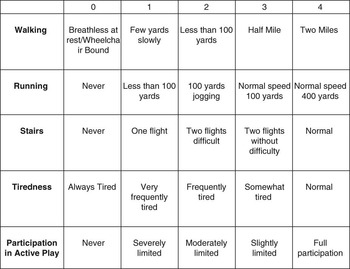
Finally, activity levels were assessed using the questionnaire summarised in Fig 1 and previously used in studies of activity levels of children with surgically palliated complex congenital cardiac disease.Reference DeVet and Ireys13 The questionnaire (Fig 1) asks parents to rate, on a Likert scale of 1–4, their child’s level of activity in relation to five parameters: walking, climbing stairs, running, fatigue, and participation in active play. Total activity score and scores for each parameter were recorded. Lower scores represent lower activity levels.
Activity questionnaire. Parents were asked to mark the statement on each line which best fitted their child in the last year.

Predictor variables
The effect of disease and surgical factors on the above outcomes was initially assessed through group comparisons as outlined above. The presence or absence of other chronic illnesses was also recorded – it was 42% across the groups – as these would likely exert independent effects on the above outcomes. The most common co-morbidity was asthma (30% across groups) other co-morbidities included allergy/skin condition (6%), sensory disability (4%), renal illness (6%), and digestive illness (2%). A small proportion of children had more than one co-morbidities. However, of additional interest was the relative contribution these factors made to outcomes when considered together with additional socioeconomic and maternal factors, which had proven to be significant predictors of outcome on neurodevelopmental and behavioural adjustment domains described in previously published research with this sample.Reference McCusker, Doherty and Molloy10 Socioeconomic status was assessed using postal code-determined Townsend scores.Reference Townsend, Phillimore and Beattie11 Maternal mental health was assessed using the composite “general severity index” score from the Brief Symptom Inventory,Reference Derogatis12 and maternal worry was indexed by the total score on the Maternal Worry Scale.Reference DeVet and Ireys13
Statistical analyses
The data satisfied normality assumptions for parametric analyses. Group differences were assessed using one-way analyses of variance, with four levels of the grouping variable as outlined above, followed by post hoc comparisons when the main effect was statistically significant. The relative contribution of diagnostic/surgical status and other illness factors, compared to the psychosocial factors, in predicting outcome on the physical and activity was assessed through multiple regression analyses. There were no statistically significant differences between the groups (p > 0.05) on the psychosocial factors, which were input to these regression analyses reducing concern about “nested” variables and the lack of independence of the effects.
Results
Cardiac-related symptoms and health concerns
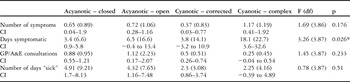
Table 1 summarises outcomes on cardiac-related symptoms and health concerns over the 30-day index period. The four groups differed significantly on one variable only – the number of days on which any of the cardiac-related symptoms noted above was reported. In this case the patterns were as expected – with the cyanotic-complex group manifesting a greater frequency of such symptoms than any of the other three groups (Table 1). There were no differences between the groups in terms of general practitioner or Accident and Emergency consultations and days “sick”. There was a trend for indices of perceived ill-health to be lower in the more complex, palliated, congenital cardiac disease group despite the greater prevalence of cardiac-related symptoms.
Mean total physical/health outcomes (SD) and confidence intervals (CI) across groups.

GP/A&E, general practitioner or Accident and Emergency
*p < 0.05.
As perhaps the more objective behavioural index of health concerns, the number of unscheduled general practitioner or Accident and Emergency visits undertaken in the previous 30 days was chosen as the outcome measure for regression analysis. Predictor variables entered included – diagnostic group, other illness, socioeconomic status (Townsend score), maternal mental health (brief symptom index score), and maternal worry (maternal worry scale score). Together these accounted for a statistically significant proportion of the variance (adjusted R 2 = 0.177; F = 3.15; p = 0.003). However, in terms of the unique variance explained, only three factors attained statistical significance at p < 0.05. These were:
• diagnostic group status – the cyanotic-complex group was likely to have made fewer unscheduled general practitioner or Accident and Emergency visits, standardised β-coefficient was −0.24 (p = 0.046);
• Socioeconomic status – higher scores related to greater socioeconomic deprivation and were associated with a higher number of unscheduled medical visits, standardised β-coefficient was 0.34 (p = 0.002); and
• Maternal worry – higher maternal worry scores were associated with a higher number of visits, standardised β-coefficient was 0.28 (p = 0.015).
Activity levels
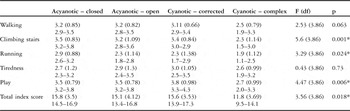
Table 2 summarises mean activity levels across the five domains outlined in Appendix 1, together with a total index score. Group differences here were as anticipated with the cyanotic-complex score showing generally reduced activity levels in comparison with the other groups, with statistical significance obtained on three of the five domains – climbing stairs, running, and active play. Although the scores for this group are lower, they are not indicative of severe physical limitations for this group. The mean scores for the various parameters indicate an ability to walk between 100 yards and 0.5 miles, to jog close to 100 yards, and to have only a slight limitation in active play. The cyanotic-corrected group manifested activity levels comparable to the acyanotic groups and no post hoc comparison here reached statistical significance (p > 0.05).
Mean activity levels (SD) and confidence intervals (CI) across groups.

*p < 0.05.
Although disease status was clearly important, activity levels were also shown to be influenced by a psychosocial factor – maternal worry. Total activity index scores were regressed against the same predictor variables as outlined above. The adjusted R 2 for the equation (0.33) reached statistical significance (F = 6.89; p < 0.001), but only two variables were independently significant. Lower activity levels were associated with having a complex cyanotic disease, standardised β-coefficient was 0.23 (p = 0.034) and with a higher maternal worry scale score with a standardised β-coefficient of 0.52 (p < 0.001).
Discussion
In this study, we have attempted to assess the well-being of a group of children with congenital cardiac disease following surgical or catheter intervention, by assessing their levels of physical activity, the prevalence of residual symptoms, and the frequency with which they access general practitioner or accident and emergency care. The reported frequency of cardiac-related symptoms in those who are considered to have had “corrective” surgery is low. Those with complex cyanotic disease, as might be expected, have more days when they are blue and breathless with exertion. Moreover, activity levels, although not necessarily severely restricted, are reduced in this group compared to the other children with severe congenital cardiac disease, but of a corrected nature. The data suggest, however, that parents have accepted these symptoms as being part of the condition and they do not result in more unscheduled medical consultations compared to other groups. In fact, those patients in the complex cyanotic group access these services significantly less often than those less severely affected. Such information is reassuring in terms of the ability of parents to cope with potentially serious illnesses in these children.
This finding, together with the results of the regression analyses reported above, suggests some important conclusions and implications for clinical practice. First, the demands on health services, which are undoubtedly reflective of health concerns, were not here shown to be related to the severity of the congenital cardiac disease, and the associated greater prevalence of cardiac-related symptoms and functional activity restrictions, or indeed having another chronic illness or disability. Indeed, an inverse relationship between congenital cardiac disease severity and health concerns is suggested. Second, both health service demands and activity levels in the child have been shown to have strong associations with psychosocial factors, irrespective of severity of illness – namely socioeconomic status and maternal worry.
Hospital admissions, and especially multiple admissions in young children, are more common in lower socioeconomic groups.Reference Spencer, Lewis and Logan14 It is well recognised that children from areas of high deprivation make more use of Accident and Emergency departments, across all triage levels and may reflect different levels of coping.Reference Beattie, Gorman and Walker15 Studies of hospital admissions following self referral to Accident and Emergency services have found higher rates in more deprived children, even though the spectrum of illness, age distribution, and time of presentation were similar. Irrespective of the well-recognised increased morbidity associated with deprivation, there is evidence of higher usage of health service resources.Reference Stewart, Werneke, MacFaul, Taylor-Meek, Smith and Smith16
Interpretation of the trend to lower rates of health concerns and health service demands in the cyanotic-complex group must remain speculative at present. There are a number of possible contributing factors. It could be the case that dealing with symptoms of an objectively severe nature puts more everyday minor ailments into perspective and parents of these children worry less about these than parents of children in the other groups. Parents of children with complex cardiac disease may feel that family doctors or Accident and Emergency staff do not have the specialised expertise to treat their child and therefore may make direct contact with the Paediatric Cardiology team when problems arise. However, unscheduled paediatric cardiology outpatient visits were not found to be higher in this group. It may be the case that these parents, who have had greater experience of medical services over the years, are better able to interpret and respond to their children’s everyday health needs. If the latter can be explored, and shown to be the case in future research, it may be that promotion of active and collaborative health care between parents of children with chronic disease and health professionals, in the early stages, accrues future benefits.
The relevance of socioeconomic factors, and especially maternal worry, in predicting the outcome on the variables of health concern and activity levels was striking. These associations suggest simple associations between severity of congenital cardiac disease and long-term outcomes, even on the most physical of parameters, are not likely to exist. Rather, a more holistic view of the child in social, and especially maternal, context must be taken, and early psychological interventions – which challenge the myths and beliefs that contribute to worry, and that engender more independence in promoting parenting skills, may produce health benefits in later years.Reference Goldbeck and Melches17
Acknowledgements
This study was supported by a grant from the National Lottery Charities Board.