Introduction
A study of specimens of the genus Rinodina (Ach.) Gray collected during several field trips in the Canary Islands by A. M. Brand, J. Etayo and P. P. G. van den Boom, revealed an interesting and very unusual saxicolous species, which is described here as new to science. The new species has been found only at inland localities on the two eastern, subdesertic islands, Fuerteventura and Lanzarote, growing in open situations, on well-lit volcanic rocks, in communities where the fruticose lichen genera Ramalina Ach. and Seirophora Poelt are particularly abundant. Although much Rinodina material has been collected from all the other Canary Islands (except El Hierro), the three lichenologists mentioned above had never collected this new species before in the Canarian Archipelago.
Material and Methods
The study is based on specimens stored in the private herbaria of J. Etayo and P. P. G. van den Boom. Specimens were examined by standard techniques using stereoscopic and compound microscopes. The mycological terminology generally follows Kirk et al. (Reference Kirk, Cannon, David and Stalpers2001). Measurements of ascospores were made at ×1000 magnification from specimens at least 4 years old mounted in tap water; only free ascospores lying outside the asci were measured. Mean value (M) and standard deviation (SD) were calculated and the results are recorded as (minimum value observed) M−SD − M+SD (maximum value observed). M, SD and n (the total number of ascospores measured) are given within parentheses.
The terminology used for the apothecia follows Dughi (Reference Dughi1952), for the asci Rambold et al. (Reference Rambold, Mayrhofer and Matzer1994) and for the ascospore types and ontogenies, Giralt (Reference Giralt2001).
Chemical constituents were identified by the standard methods of thin-layer chromatography (TLC) (e.g. Culberson & Ammann 1970; Culberson et al. Reference Culberson, Culberson and Johnson1981; Culberson & Johnson Reference Culberson and Johnson1982).
The Species
Rinodina etayoi Giralt & van den Boom sp. nov
Thallus crustaceus, rimoso-areolatus vel areolatus, albidus, substantias atranorinum, zeorinum, chloratranorinum et acidum sticticum continens. Apothecia lecanorina, mox pseudolecanorina ad hemisphaerica, usque ad 0·8 mm diametro, atra. Discus plerumque paulo pruinosus. Excipulum proprium rufum, dense guttulatum, guttulis oleosis, (5–)7–12 μm diametro. Excipulum proprium et epihymenium crystallis pannarini (PD+ aurantiacis) inspersa. Ascosporae typo Mischoblastia, (15–)16·3–19·3(−21) × (6·5–)7·4–8·6(−10) μm. Conidia bacilliformia, 3·5–5 × 1 μm.
Typus: Canary Islands, Fuerteventura, Carretera de Antigua a Betancuria, Mirador de Morrovelosa, 585 m, 17 July 2004, J. Etayo & E. Ros 22059 (LG—holotypus; hb. Etayo, hb van den Boom—isotypi).
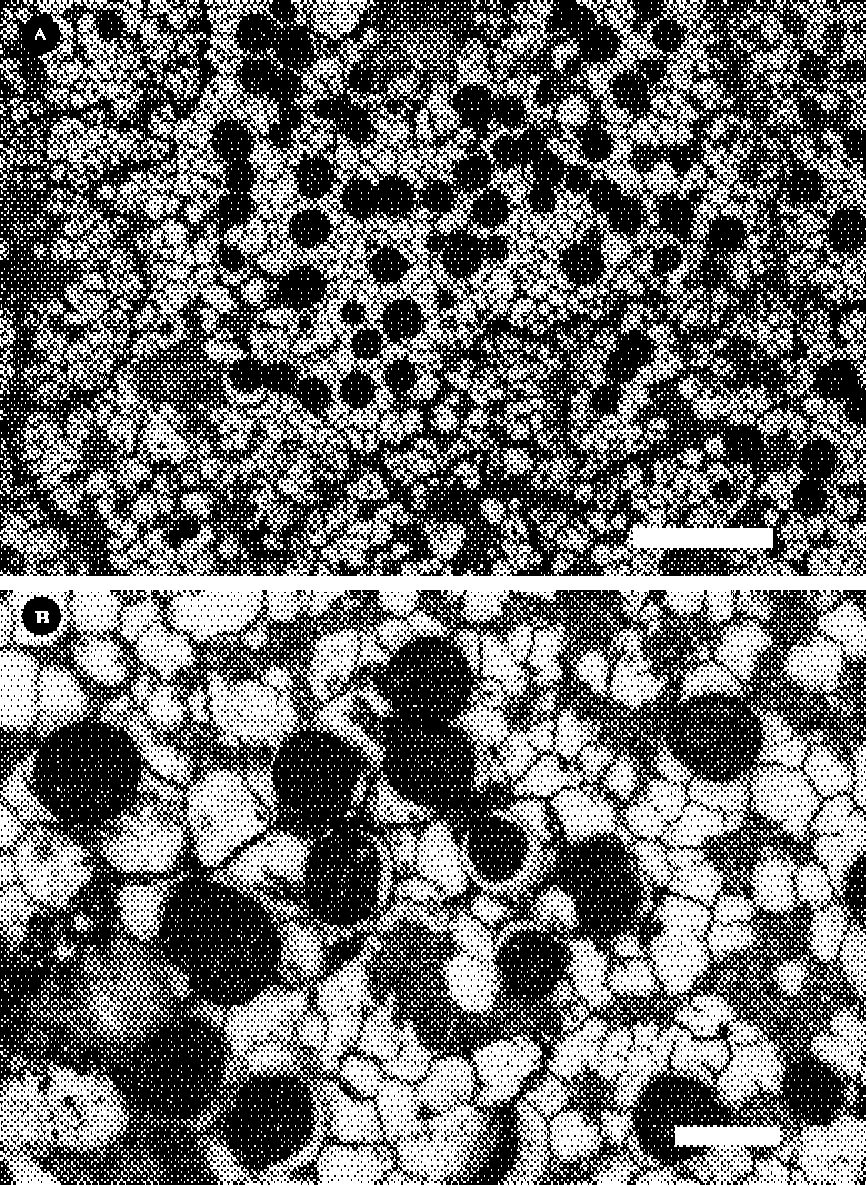
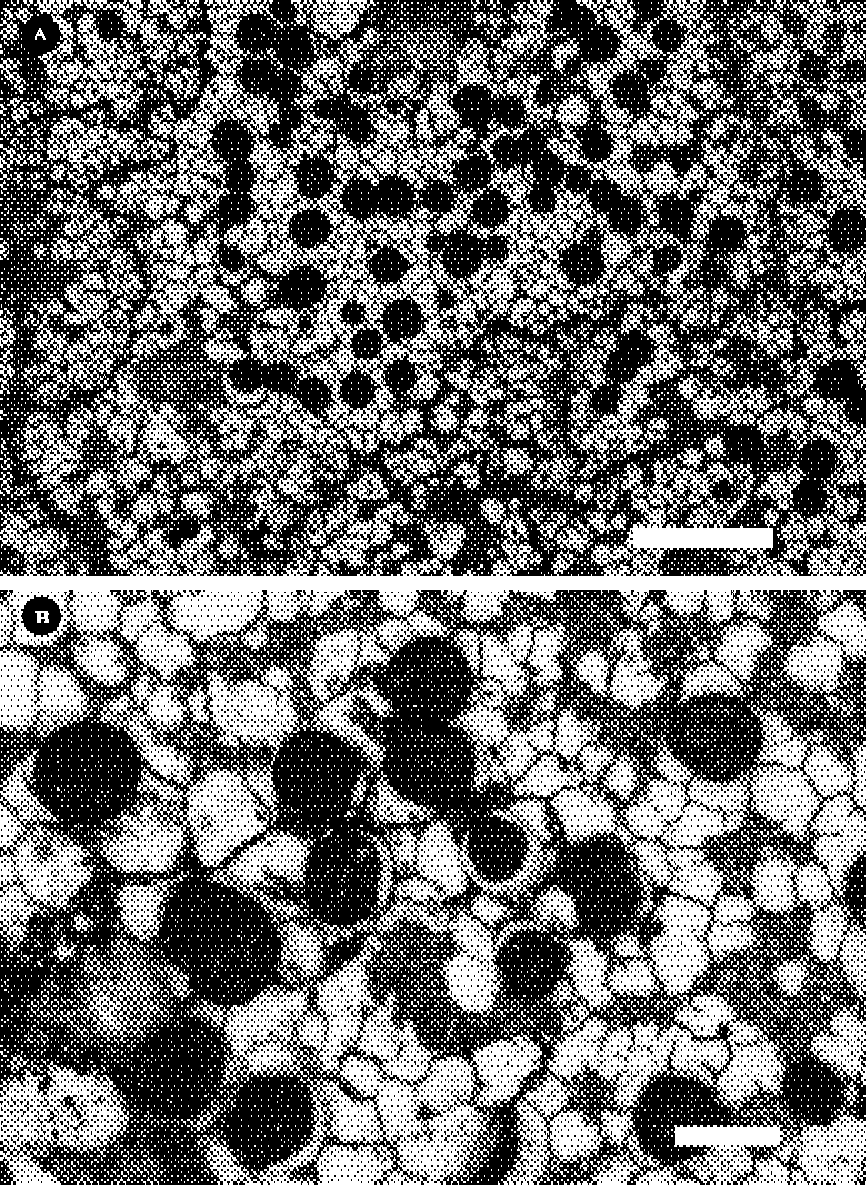
Rinodina etayoi, habitus (holotypus). A, thallus composed of flat to subconvex areolae which often possess a central pycnidium, delimited by a black hypothalline line; B, young lecanorine apothecia losing the thalline margin and becoming pseudolecanorine. Scales: A = 2000 μm; B = 500 μm.
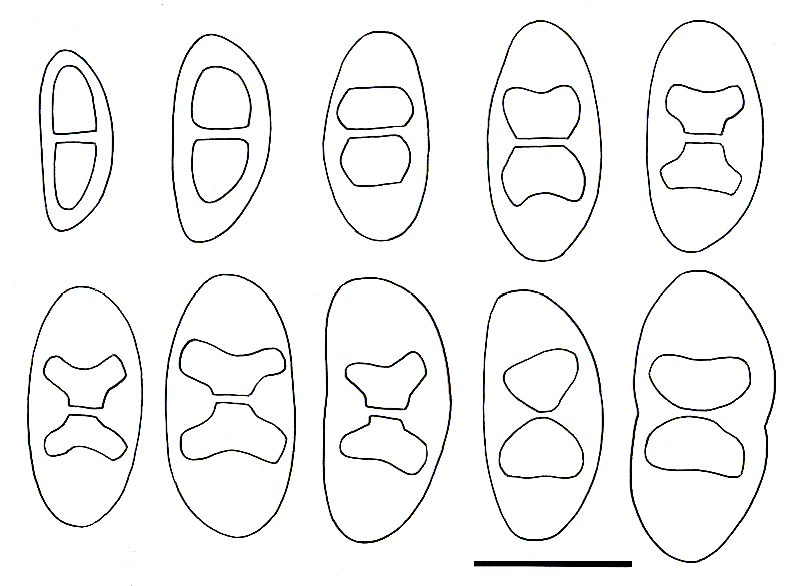
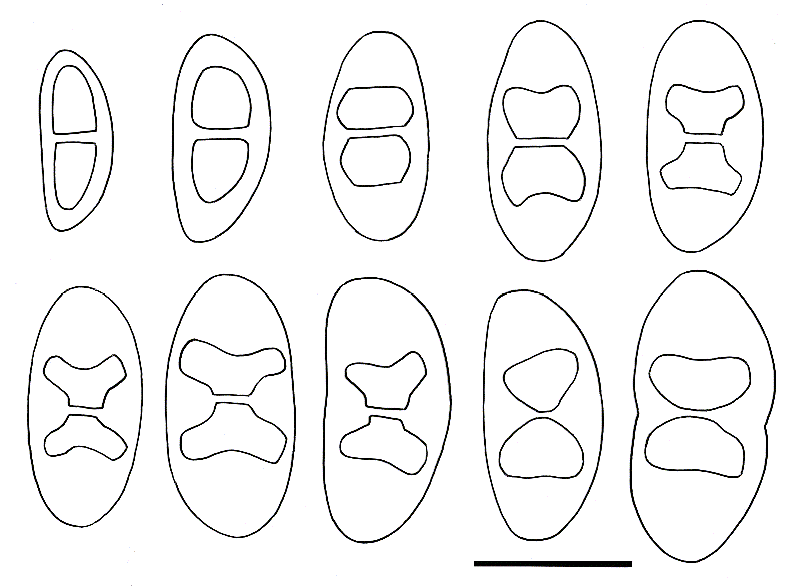
Rinodina etayoi, ascospore ontogeny and variability (the torus is not illustrated) (hb. van den Boom 30175). Scale = 10 μm.
(Figs 1 & 2)
Thallus epilithic, crustose, rimose-areolate to areolate, whitish, delimited or not by a black hypothalline line. Areoles discrete to contiguous, thin, smooth, plane to subconvex, rarely becoming rather thick to bullate, often including a central pycnidium. Cortical layer 30–40 μm thick; algal layer 50–70 μm thick; algal cells 7–12 μm diam.; medulla up to 200 μm thick, I–.
Apothecia (0·2–)0·4–0·6(−0·8) mm diam., lecanorine when young with a very thin and almost excluded thalline margin concolorous with the thallus, rapidly becoming pseudolecanorine (= lacking a thalline exciple but having a proper exciple which contains algal cells) and hemispheric, abundant, usually dispersed, sessile, and constricted at base. Proper margin nearly indistinct except in young pseudolecanorine apothecia, rapidly excluded, black. Disc black, plane at first, becoming strongly convex, epruinose to thinly covered by a whitish grey pruina (more obvious when wet), PD+ orange. Hymenium 70–110 μm tall, clear. Epihymenium brown, interspersed with crystals of pannarin reacting PD+ orange (microscope slide!) Hypothecium colourless, up to 150 μm deep. Proper exciple reddish brown, 50–90 μm wide, interspersed with crystals reacting PD+ orange (pannarin) and, especially in the inner part, filled with abundant and large oil drops of (5–)7–12 μm diam. Paraphyses 1·5–1·8 μm wide; apical cells (3–)4–6(−7) μm diam., dark brown pigmented. Asci 8-spored, of Lecanora-type, very often retaining overmature ascospores. Ascospores of Mischoblastia-type, (15–)16·3–19·3(−21) × (6·5–)7·4–8·6(−10) μm (M = 17·8; 8·1; SD = 1·5; 0·7 μm; n= 64), smooth to hardly ornamented at ×1000 magnification; torus very well developed, when mature slightly constricted and with an intense brown pigmentation in the septal region; ascospore ontogeny of type A, with septum in young ascospores inserted before internal wall thickenings become distinct.
Pycnidia abundant. Conidia bacilliform, 3·5–4(−5) × 0·9–1 μm.
Chemistry. Thallus K+ strong yellow, C–, KC–, PD+ yellow-orange: atranorin, zeorin, chloroatranorin and stictic acid by TLC; pruina, proper exciple and epihymenium PD+ orange: pannarin by TLC.
Etymology. The species is named in honour of Dr Javier Etayo (Pamplona, Spain), who has collected some of the specimens and contributed substantially to the knowledge of the lichen flora in south-western Europe and, in particular, of the Canary Islands.
Distribution and ecology. Rinodina etayoi is known only from two of the Canary Islands, Fuerteventura and Lanzarote, at elevations between 140 to 585 m. It was found only in the central and northern areas of Fuerteventura and the central area of Lanzarote. In the holotype specimen there are no associated species. However, the mountain ridge where it was collected was rich in shrubs, and populations of Ramalina, Seirophora and Tornabea Østh. were growing abundantly on both rocks and shrubs. In the second locality on north Fuerteventura, it was found in a rockier habitat with a few shrubs and several terricolous lichen species such as Cladonia foliacea (Huds.) Willd., Psora crenata (Tayl.) Reinke, Squamarina cartilaginea (With.) P. James, Toninia tristis (Th.Fr.) Th. Fr. ssp. pseudotabacina Timdal and abundant Ramalina and Seirophora on the rocks.
On Lanzarote, R. etayoi was found in a community with Aspicilia calcarea (L.) Mudd, Caloplaca sp., Coscinocladium gaditanum (Clemente) Crespo, Llimona & D. Hawksw. and Xanthoria isidioidea (Beltr.) Szatala.
Observations. Rinodina etayoi is characterized by its rimose to areolate, whitish thallus, its hemispheric, pseudolecanorine apothecia, its Mischoblastia-type ascospores and, especially, by its unique proper exciple and chemistry. According to the various revisions of the genus Rinodina (e.g. Malme Reference Malme1902; Magnusson Reference Magnusson1953; Sheard Reference Sheard1967; Reference Sheard2004; Mayrhofer & Poelt Reference Mayrhofer and Poelt1979; Mayrhofer Reference Mayrhofer1983, Reference Mayrhofer1984a, Reference Mayrhofer1984b, Mayrhofer et al. Reference Mayrhofer, Matzer, Sattler and Egea1993; Giralt et al. Reference Giralt, Mayrhofer and Obermayer1994, Reference Giralt, van den Boom and Matzer1997; Matzer & Mayrhofer Reference Matzer and Mayrhofer1994, Reference Matzer and Mayrhofer1996; Giralt Reference Giralt2001; Mayrhofer & Moberg Reference Mayrhofer and Moberg2002; Sheard & Mayrhofer Reference Sheard and Mayrhofer2002; Kaschik Reference Kaschik2006), R. etayoi seems to occupy an isolated position within the genus, since it is the only species hitherto described containing abundant and large oil drops in the proper excipulum and stictic acid in the thallus (in addition to atranorin, zeorin and chloroatranorin) in combination with pannarin in the proper exciple and epihymenium.
Apart from R. algarvensis Giralt, Barbero & van den Boom, R. stictica Sheard & Tønsberg and R. verruciformis Sheard, R. etayoi is the fourth Rinodina species known to contain stictic acid. Among other discriminating characters, in contrast to R. etayoi, the other three species all have Pachysporaria-type ascospores and lack pannarin in the exciple and epihymenium. Further information on these taxa is given in Giralt et al. (Reference Giralt and van den Boom1996), Sheard & Tønsberg (Reference Sheard and Tonsberg1995) and Sheard & Mayrhofer (Reference Sheard2004), respectively.
Taking into account the checklist of lichens and lichenicolous fungi of insular Laurimacaronesia (Hafellner Reference Hafellner1995) and our own data, Rinodina etayoi could be mistaken for the following sympatric species: a) R. beccariana Bagl. var. lavicola (M. Steiner) Matzer & H. Mayrhofer, R. oxydata (A. Massal.) A. Massal. and R. rinodinoides (Anzi) H. Mayrhofer & Scheid. because of its pseudolecanorine apothecia; b) R. oxydata, R. teichophila (Nyl.) Arnold and R. trachytica (A. Massal.) Bagl because of its Mischoblastia-type ascospores; c) for R. santorinensis J. Steiner because it contains pannarin. However, none of these taxa possesses the combination of characters that is diagnostic for R. etayoi.
Differences between R. etayoi and other saxicolous Rinodina species containing pannarin not present in the study area (e.g. R. brandii Giralt & van den Boom and R. murrayii H. Mayrhofer) can be inferred from Giralt & van den Boom (Reference Giralt and van den Boom1996), Giralt et al. (Reference Giralt, Mayrhofer and Obermayer1994) and Kaschik (Reference Kaschik2006).
The only lichenicolous fungus found on Rinodina etayoi is Lichenodiplis lecanorae (Vouaux) Dyko & D. Hawksw. It is abundantly present in the Lanzarote specimen (P. & B. van den Boom 30175) and in one of the Fuerteventura specimens (P. & B. van den Boom 25703).
Additional specimens examined. Canary Islands: Fuerteventura: Parque Natural de El Cardón, camino de El Cardón a Pájara, 400 m, 2004, J. Etayo & E. Ros 22023 (hb. Etayo); Road from Lajares to playa Majamano, malpaís, 140 m, 2004, J. Etayo & E. Ros 21977 (hb. Etayo); 3 km NNW of La Oliva, along road to Lajares, W slope of volcano Arena, open field with lava blocks, 13°6.8′W, 28°37.9′N, 150 m, 2001, P. & B. van den Boom 25683 & 25703 (hb. v.d. Boom). Lanzarote: W of Tahiche, road to San Bartolomé, W of volcano Montaña de Maneje, small hill with volcanic outcrops, 13°34.2′W, 29°00.7′N, 205 m, 2003, P. & B. van den Boom 30175 (hb. v.d. Boom).
We are grateful to Dr H. Sipman for his help with the latin diagnosis and for reviewing the manuscript, to Prof. Dr E. Sérusiaux for preparing the photographs and to Dr M. Barbero for carrying out the TLC analyses. The first author thanks the ‘Comissionat per a la Recerca’ (Catalan Government) for support.