

In the last two decades, prominent evangelical leaders have released a number of statements urging action on climate change. Coming from the National Association of Evangelicals (NAE), an umbrella group of many evangelical denominations, and then from a collection of ad hoc organizations, action on climate change was just one of a parcel of new issue concerns that would disrupt the connection of evangelicals to the Republican Party (e.g., Fitzgerald, Reference Fitzgerald2008). While the statements by the NAE, Evangelical Climate Initiative, the Sandy Cove Covenant, and others were firmly grounded in biblical mandates, the larger public debate took a different tack. Even religious leaders stated their opposition to climate change with reasons devoid of theology. For example, during a sermon in 2006 Rev. Jerry Falwell made the argument that, “‘scientists who are not on the payroll of the government’ believe that ‘the jury's still out’” on climate change (Media Matters Staff, 2006). Rather than focus on the values motivating environmental action, much opposition to climate change action attacked the science and scientists behind climate change claims (Dunlap and McCright, Reference Dunlap, McCright, Dryzek, Norgaard and Schlosberg2011; Elsasser and Dunlap, Reference Elsasser and Dunlap2013). Why?
One answer why is grounded in public opinion dynamics regarding religion that are not yet well understood. We focus on beliefs—assertions about how the world works—and differentiate between religious and secular. Religious beliefs, such as God is everpresent, hell is real, and the “end times” are nigh, function in the same way for people as do secular beliefs about the world, such as the crime rate is falling, the world is warming, and it is hot outside. In this case, secular beliefs refer to forces of this world, while religious beliefs reference the presence and influence of supernatural powers (e.g., Casanova, Reference Casanova2009). In either case, beliefs provide a functionally factual basis for decision making. In particular, we know very little about how secular beliefs, such as the causes of climate change, interact with religious beliefs. For instance, acknowledging environmental collapse may be a sign that the end times are near and that humans are polluting the environment at too high a rate. A religious belief that humans were given dominion over nature (Genesis 1:26) has long been thought to shape concern over environmental devastation. We suspect that secular beliefs are more proximate and influential than religious beliefs, such that adoption of salient, secular beliefs eliminates variation by religious beliefs.
Moreover, most work on religion and public opinion treats religious beliefs as fixed—long socialized (Kellstedt et al., Reference Kellstedt, Green, Guth, Smidt, Green, Guth, Smidt and Kellstedt1996; but see McClendon and Riedl, Reference McClendon and Riedl2015). However, it is very likely that elites (like clergy) remind people about relevant beliefs while communicating policy stances (see, e.g., Wallsten and Nteta, Reference Wallsten and Nteta2016), which suggests that the effect of religious beliefs can be more mutable than previously thought in this area of research (e.g., Djupe and Calfano, Reference Djupe and Calfano2013a). This line of argument is consistent with a broader literature that underlines the “ambivalence of the sacred,” in which religion can be found supportive of war and peace (Appleby, Reference Appleby1999), repressive regimes and advanced industrial democracies (Toft et al., Reference Toft, Philpott and Shah2011), and expanded immigration as well as border walls (Bloom et al., Reference Bloom, Arikan and Courtemanche2015).
We offer two arguments that challenge the premises of existing work on the influence of religion on public opinion and the religion and environment link in particular. First, religious beliefs are not rock-solid predispositions for many Americans and, second, religious beliefs do not function independently of scientific beliefs about the environment (which are also referred to as “perceptions” about such things as climate change in other literatures). These arguments do not necessarily deny religious influence, but they do help explain why the fight for religious influence appears to be fought through the proxy of scientific arguments.
Specifically, we test for the contingent nature of religious influence on support for climate change action by the U.S. government, arguing that religious influence is only apparent when individuals reject human attribution. Moreover, the influence of some religious beliefs, such as the imminence of the end times, hinges on secular beliefs about extreme weather. We draw on data that remedies many of the defects of the prior literature—they are representative of American adults, include a wide, inclusive range of religious and scientific beliefs, and employ a survey experiment that allows us to assess the stability of at least one core religious belief that is relevant to environment policy.
1. Previous literature
The impetus for the majority of the work in the area of religion and environmentalism centers around an argument by Lynn White, a professor of medieval history, published in Science in 1967. Briefly stated, the Christian belief system contends that God gave human beings “dominion over the fish of the sea, over the birds of the air, and over the cattle, over all the earth and over every creeping thing that creeps on the earth” (Genesis 1:26—New King James Version). This belief has long guided Christians to the understanding that there is no need for environmental stewardship or conservation. Subsequent empirical work has tried to ferret out to what degree Christians embrace dominion beliefs and how this view shapes attitudes on the environment. Since White's seminal essay, researchers have arrived at a variety of conclusions about the relationship between religiosity and environmental concern and behavior (for a review, see Pudlo, Reference Pudlo, Djupe, Rozell and Jelen2019).
From the earliest pieces, researchers homed in quickly on prime candidates for the sources of religious variation, sensibly focusing on individuals' mastery-over-nature (“dominionism”) beliefs and their commitment to various religious organizations (e.g., Hand and Van Liere, Reference Hand and Van Liere1984). Most explanatory power is vested in dominionism, though of course such beliefs vary dramatically across Christian denominations. Subsequent work in this field has attempted to tighten the connection between religion and the environment through more, if not always better, measures of religion, utilizing measures of belief such as biblical literalism (Eckberg and Blocker, Reference Eckberg and Blocker1989; Greeley, Reference Greeley1993; Guth et al., Reference Guth, Kellstedt, Smidt and Green1993, Reference Guth, Green, Kellstedt and Smidt1995; Woodrum and Hoban, Reference Woodrum and Hoban1994; Schultz et al., Reference Schultz, Zelezny and Dalrymple2000; Sherkat and Ellison, Reference Sherkat and Ellison2007), measures of religious behavior including church attendance (Kanagy and Willits, Reference Kanagy and Willits1993; Sherkat and Ellison, Reference Sherkat and Ellison2007; Hand and Crowe, Reference Hand and Crowe2012), and frequency of prayer (Boyd, Reference Boyd1999; Hand and Crowe, Reference Hand and Crowe2012), while other studies have focused on measures of religious tradition (Eckberg and Blocker, Reference Eckberg and Blocker1989; Greeley, Reference Greeley1993; Woodrum and Hoban, Reference Woodrum and Hoban1994; Kanagy and Nelsen, Reference Kanagy and Nelsen1995; Wolkomir et al., Reference Wolkomir, Futreal, Woodrum and Hoban1997).
The results of these varied approaches to measuring religion, not surprisingly, have led to a wide variety of findings concerning the relationship between religiosity and environmentalism. Some research has concluded that there is a positive relationship between religion and environmental protection (Shaiko, Reference Shaiko1987; Kanagy and Willits, Reference Kanagy and Willits1993; Wolkomir et al., Reference Wolkomir, Futreal, Woodrum and Hoban1997; Sherkat and Ellison, Reference Sherkat and Ellison2007), others have found a negative relationship (Hand and Van Liere, Reference Hand and Van Liere1984; Eckberg and Blocker, Reference Eckberg and Blocker1989, Reference Eckberg and Blocker1996; Guth et al., Reference Guth, Green, Kellstedt and Smidt1995; Schultz et al., Reference Schultz, Zelezny and Dalrymple2000; Biel and Nilsson, Reference Biel and Nilsson2005; Ecklund et al., Reference Ecklund, Scheitle, Peifer and Bolger2016; Schwadel and Johnson, Reference Schwadel and Johnson2017), while still other studies have concluded that there is no relationship (or mixed relationships) between the two (Greeley, Reference Greeley1993; Kanagy and Nelsen, Reference Kanagy and Nelsen1995; Boyd, Reference Boyd1999; Djupe and Hunt, Reference Djupe and Hunt2009; Danielsen, Reference Danielsen2013; Clements et al., Reference Clements, Xiao and McCright2014; Carlisle and Clark, Reference Carlisle and Clark2018).
This is not to say that progress has not been made. Research that has not had access to explicit measures of dominionism or stewardship often used biblical literalism as a proxy (Eckberg and Blocker, Reference Eckberg and Blocker1989; Greeley, Reference Greeley1993; Guth et al., Reference Guth, Kellstedt, Smidt and Green1993; Schultz et al., Reference Schultz, Zelezny and Dalrymple2000; Djupe and Hunt, Reference Djupe and Hunt2009; Schwadel and Johnson, 2017). However, efforts that had access to both found little to no relationship between literalism and a dominion belief (Woodrum and Hoban, Reference Woodrum and Hoban1994; Wolkomir et al., Reference Wolkomir, Futreal, Woodrum and Hoban1997), while others found literalism immaterial once dominion beliefs were included (Eckberg and Blocker, Reference Eckberg and Blocker1996; Boyd, Reference Boyd1999; Sherkat and Ellison, Reference Sherkat and Ellison2007). One conclusion of this work is that it is essential to employ direct measures of dominionism, or, more generally, that specific beliefs reflecting interpretation of sacred texts are essential to consider (e.g., Barker and Carman, Reference Barker and Carman2000).
Moreover, environmentalism is shaped by the degree to which time horizons are short motivated by the belief that the end is near as laid out in several books of the Bible, especially in Revelation. “End times” is part of a broader Biblical prophecy concerning “the ultimate resolution of the entire creation” (Walls, Reference Walls and Walls2007), when Jesus Christ will come again and establish a new order. There are many versions of end times theology among Christians. One variation is called a “dispensationalist theology,” which sees Biblical history broken into periods (dispensations) that represent new tests that end in judgment of human failure. Another related variant is “pre-millennialism,” which anticipates the return of Christ to defeat the forces of evil and reign for a millennium. This view reached early prominence in the Millerite movement of the 1840s (linked to the subsequent Seventh-Day Adventists and Jehovah's Witnesses denominations), but is still prominent today among conservative evangelicals in their thinking about the environment (see Veldman, Reference Veldman2019). Some have argued that those who hold to a dispensational/pre-millenial theology, “have to purposely set (that belief) aside in order to justify ecologically responsible action” (Curry-Roper, Reference Curry-Roper1990, 162). The available empirical work suggests just how difficult that is, showing that those who believe the biblical end times are near tend to devalue environmental action (Guth et al., Reference Guth, Green, Kellstedt and Smidt1995; Barker and Bearce, Reference Barker and Bearce2012; Veldman, Reference Veldman2019). In one report, few (13%) explicitly link global warming as a sign of the end times (Roser-Renouf et al., Reference Roser-Renouf, Maibach, Leiserowitz, Feinberg and Rosenthal2016a), however Public Religion Research Institute (PRRI) reported that while more Americans attributed the cause of recent natural disasters to climate change (62%), a near majority attributed them to the biblical “end times” (49%; Cox et al., Reference Cox, Navarro-Rivera and Jones2014).
2. Belief variability
Utilizing ideal survey questions to capture religious concepts does not settle the matter of belief effects since this literature tends to treat religious beliefs as fixed, or at least stable over the long term. In the “fixed” approach, understanding religious influence is a function of recording salient religious beliefs and measuring their correlation to political objects. A large and growing body of work questions the appropriateness of this assumption, including sociological work that shows how the nature and salience of particular beliefs are shaped by social contexts that also impart relevant political information (e.g., Welch, Reference Welch1981; Welch and Baltzell, Reference Welch and Baltzell1984; Cornwall, Reference Cornwall1987; Cavendish et al., Reference Cavendish, Welch and Leege1998; Djupe and Hunt, Reference Djupe and Hunt2009; McClendon and Riedl, Reference McClendon and Riedl2015). Without accounting for the flow of political information within religious contexts, relationships between religious beliefs and political attitudes are likely to be spurious or at least endogenous (Djupe and Gilbert, Reference Djupe and Gilbert2009). Further, the link between religion and political attitudes is subject to priming—where, for instance, question ordering in a survey environment makes attitudes more accessible to a respondent as they answer subsequent questions (e.g., Fazio et al., Reference Fazio, Powell and Herr1983). The simple reminder of religious beliefs, values, and behaviors has been found to lead to different expressions of support for public policies (Bloom and Arikan, Reference Bloom and Arikan2013; Djupe and Calfano, Reference Djupe and Calfano2013a, Reference Djupe and Calfano2013b; McClendon, Reference McClendon, Djupe, Rozell and Jelen2019) and pro-social attitudes and behaviors (e.g., Pichon et al., Reference Pichon, Boccato and Saroglou2007; Shariff and Norenzayan, Reference Shariff and Norenzayan2007).
This evidence suggests that religious beliefs are not necessarily stable predispositions, but subject to social influence and environmental priming. Priming may be a methodological critique showing easily-induced variability, but it may also show the mechanism connecting religion to attitudes. Priming may be thought of as the essence of a sermon, which asks individuals to use particular criteria as they go about their week and evaluate choices in daily life (Djupe and Calfano, Reference Djupe and Calfano2013a; McClendon and Riedl, Reference McClendon and Riedl2015). At least some work on the religion-environment connection has arrived at this point. As Biel and Nillsson (Reference Biel and Nilsson2005) argue, one reason for the variety of findings in the religion-environment literature is that religious beliefs may be variably activated and accessible when respondents are asked their environmental attitudes. Therefore, the issue attention cycle generated by sermons and other agenda setting functions of churches and society (e.g., Goidel and Nisbet, Reference Goidel and Nisbet2006; Danielsen, Reference Danielsen2013) may induce a variable connection between religious beliefs and environmental attitudes.
What complicates matters further in this field is the important and often unmeasured impact of non-religious beliefs about the environment on an individual's support for environment policies. These beliefs might include the degree to which the environment is threatened, the source of the threats, and the ability to remediate problems. Many of the studies mentioned previously have included political ideology as a control variable in statistical modeling, but beyond ideology is the constant flow of new information that reaches believers and that may interact with their religious beliefs and values. Indeed, there is a long literature proposing that information can at least color and perhaps trump the influence of values on attitudes (e.g., Zaller, Reference Zaller1992; Pollock et al., Reference Pollock, Lilie and Elliot Vittes1993). And there is another line of inquiry demonstrating patterns of motivated reasoning in which values (and other dispositions) drive what information is acquired to support desirable attitudes (e.g., Berelson et al., Reference Berelson, Lazarsfeld and McPhee1954; Bartels, Reference Bartels2002; Jerit and Barabas, Reference Jerit and Barabas2012). Clearly, both are possibilities here (see, e.g., Howe and Leiserowitz, Reference Howe and Leiserowitz2013).
There have been notable exceptions in the religion-environment literature, however, with scholars thinking critically about how a number of religious variables interact with each other to affect environmental attitudes (Greeley, Reference Greeley1993; Sherkat and Ellison, Reference Sherkat and Ellison2007; Wang and Kim, Reference Wang and Kim2018). Still, these controls, such as political ideology or partisanship (Schwadel and Johnson, 2017), do not serve as adequate proxies for secular beliefs about environmental problems that are central to the attitudes under study. To be fair, Sherkat and Ellison (Reference Sherkat and Ellison2007) included measures of “problem seriousness” and other pieces have explored the link between religious variables and perceptions of a changing climate, such as human attribution (Morrison et al., Reference Morrison, Duncan and Parton2015; Roser-Renouf et al., Reference Roser-Renouf, Maibach, Leiserowitz, Feinberg and Rosenthal2016b).
When considering climate change, perhaps the most important determinants of whether we should attempt to address it are views about human culpability, which draw a sharp partisan divide (Pew Research Center, 2014). The arguments that link human behavior to climate change are well known—greater human activity in burning fossil fuels and deforestation have produced higher concentrations of CO2 leading to climate change. The arguments against action on climate change may be less well known, but include the long cycles of atmospheric CO2 (e.g., Soon and Baliunas, Reference Soon and Baliunas2003Footnote 1) and the inverse causal relationship between CO2 and warming (Callion et al., Reference Callion, Severinghaus, Jouzel, Barnola, Kang and Lipenkov2003), among other arguments that climate science is “junk science” (Dunlap and McCright, Reference Dunlap, McCright, Dryzek, Norgaard and Schlosberg2011). The potential power of these beliefs is clear. If human behavior is causing global climate change, there are a number of solutions available and government action is necessary; if climate change is the result of natural (or even divine) processes, then government action is superfluous.
This debate draws on the tensions, supposed and real, between religion and science. There are a number of candidate forces driving this tension (see Evans, Reference Evans2011), including religious believers being less likely to pursue learning about science (e.g., Sherkat, Reference Sherkat2011) or become scientists (e.g., Ecklund, Reference Ecklund2010), opposition to science when it reaches conclusions that contradict Christian scripture (Ecklund and Scheitle, Reference Ecklund and Scheitle2007; Sherkat, Reference Sherkat2017), and opposition to the supposed political agenda of scientists (Evans and Evans, Reference Evans and Evans2008; Evans, Reference Evans2011). An alternate view largely unexplored in that literature is the question of the credibility of religious commentary on such scientific issues as environmental problems and policy (but see Djupe and Calfano, Reference Djupe and Calfano2009). From this perspective, acceptance of scientific consensus essentially dictates a particular attitude and therefore only by denial of that scientific consensus is the variation in religious belief relevant to reaching a conclusion.
3. Hypotheses
Out of this wide-ranging discussion can be distilled three basic hypotheses. First, we expect that the religious attributes identified in prior analyses should work as expected—religious beliefs and affiliations (especially evangelicalism) that attribute causation to the divine rather than to humans should undermine support for government action on climate change. This leaves room for non-religious beliefs about human culpability and weather extremity and we expect that these beliefs will interact with religious beliefs—holding the belief that human activity has caused climate change will reduce the variation generated by religious attributes to levels indistinguishable from zero, meaning the interaction will be significant and negative. Lastly, we expect that religious beliefs—our test case will be dominionism—are actually quite malleable, in contrast to their general portrayal in the literature. If they are malleable then there are several mechanisms available to explain the greening of American religion over time, including shifts in religious as well as non-religious beliefs regarding the environment that accords with other, long-term analyses of religion and environmental opinion change (Clements et al., Reference Clements, Xiao and McCright2014; Schwadel and Johnson, 2017; Carlisle and Clark, Reference Carlisle and Clark2018).
4. Data and description
The results of this analysis are based on a nationally representative telephone survey conducted by PRRI in late 2012.Footnote 2 The study included a RDD sample of 1,018 adults 18 years of age or older living in the continental United States and was conducted in both Spanish and English by professionally trained interviewers by phone. Roughly 30% of respondents included in the survey (N = 311) were interviewed on cellular telephones to ensure the sample reflected the growing presence of cell phone only households at that time.Footnote 3 Sample statistics are available in Appendix Table A1, which shows that the data are representative of the national adult population on multiple demographic items like race and gender. To be clear, the sample does not exclude any religious groups. It is also important to recognize that this is just one study and future research will need to assess whether these findings are time and measurement bound.
The dependent variable is, “The U.S. government needs to do more to address the issue of climate change.” The response options ranged from completely agree (1) to completely disagree (4). Given the structure of the response, we used ordered logit models.Footnote 4
To capture the salient dimensions of religion to environmentalism, we include measures of whether the end times are imminent (Guth et al., Reference Guth, Green, Kellstedt and Smidt1995; Barker and Bearce, Reference Barker and Bearce2012), a providential view of God (Greeley, Reference Greeley1993; Glazier, Reference Glazier2013), and an evangelical identity (see the Appendix for full variable coding). We expect each to help drive attitudes in opposition to the government taking action on climate change. The first two support the idea that events are out of human control, either because there is too little time to take action or because God is responsible for the course of things. Evangelicals have long been less supportive of environmental protection (Guth et al., Reference Guth, Green, Kellstedt and Smidt1995).
There are multiple ways to measure evangelicals, but two are the most prominent—one asks whether the individual identifies as “evangelical or born-again,” while the other asks about their denominational home and then codes them into religious traditions, one of which is evangelical Protestant (Steensland et al., Reference Steensland, Park, Regnerus, Robinson, Bradford Wilcox and Woodberry2000). The evangelical group sizes in the population are equivalent based on the two measures, though they capture different portions of it. That is, all evangelical identifiers are not attending congregations in evangelical denominations and not all evangelical attenders identify as such. Based on one analysis, Burge and Lewis (Reference Burge and Lewis2018) find that though the two capture different portions of the population, they are essentially interchangeable in data analysis uses—they return similar relationships. PRRI parses Protestant and Christian identifiers into evangelical and non-evangelical using the identification item.
Given the centrality of dominion and stewardship beliefs in the literature, the survey asked respondents, “As I read a pair of statements, please tell me whether the FIRST statement or the SECOND statement comes closer to your own views, even if neither is exactly right.” The statements were:
(1) God gave human beings the right to use animals, plants, and all the resources of the planet for human benefit. [what we refer to as “Dominion”]
(2) God gave human beings the task of living responsibly with the animals, plants, and the resources of the planet, which are not just for human benefit. [“Stewardship”]
As argued above, we suspect that commitment to dominion and stewardship are actually more elastic than previously assumed and the survey included a simple experiment to assess that. Respondents were randomly given either statement 1 first (n = 516) or statement 2 first (n = 502). When the dominion statement (1 above) was read first, 21% adopted it. When it was presented second, 55% adopted it (p < 0.01).Footnote 5 The treatment effect was not constant in the sample but varied by important indicators. The results of this analysis are presented in Appendix Table A2 and summarized in Figure 1. One might suspect that evangelicals have more stable beliefs in this matter and that others who place less emphasis on “being right with doctrine” would experience more fluidity. The results confirm that presumption here. Seen in Figure 1, while non-evangelicals demonstrated a 42 percentage point shift in adopting a dominion belief when the statement was read second (p < 0.01), evangelical support jumped by roughly 10 percentage points from 28.5 to 38.4% (p < 0.10).Footnote 6
Contingent dominion: question order effects on dominion beliefs by evangelical identification.
Source: Public Religion Research Institute, PRRI/RNS Religion News Survey, December 2012.
Note: Comparing any two confidence intervals is the equivalent of a 90% (p = 0.10) test at the point of overlap.

We assessed whether any of the other indicators in the model encouraged conditional response to the treatment and only found one. Tea Party identifiers do not change their commitment to dominion beliefs in response to the statement order experiment. There appears to be an increase, but it is not significant. The evangelical interaction holds whether or not the Tea Party interaction is included in the model.
It is important to note that a substantial majority of evangelicals hold stewardship beliefs. On average, between 60 and 70% (given the question order effect) of evangelicals believe in stewardship responsibilities (care for the environment) compared to between 39 and 82% of non-evangelicals. A longitudinal view proves that this is not an inconsequential finding. Although no direct comparisons are available due to question wording variation, these results suggest dominion beliefs have declined considerably. A generation ago just one-third of Baptists held a stewardship belief (Hand and Van Liere, Reference Hand and Van Liere1984), while more recent findings showed 61% of NC respondents affirming dominion beliefs (Woodrum and Hoban, Reference Woodrum and Hoban1994). What is more, there appear to be no differences in dominion belief by age among evangelicals in the 2012 PRRI data—older evangelicals are just as likely to be stewards as younger evangelicals. That older evangelicals appear to have changed along with the young helps confirm the validity of the argument we are making here—evangelicals also shift their understanding of religious beliefs over time, which may track the evolution in elite evangelical commitments over the last generation (e.g., Danielsen, Reference Danielsen2013; Schwadel and Johnson, 2017).
Beyond religious variables, we also include several key non-religious beliefs about the environment that are central to the analysis. The first assesses whether the respondent thinks that humans are responsible for climate change. We suspect that this will be the dominant effect in the model and that it will interact with religion in a way that indicates that religious influence is conditional on rejecting the scientific consensus. We also include a measure assessing the belief that the weather has been getting more or less extreme. We expect that those who think the weather has been getting more extreme will be more likely to support the government taking action. We also interact this with a religious belief, expecting that a belief in the “end times” is only linked to less support for climate change action when the weather is becoming more extreme—often construed as a sign that the end is near.
As we have argued above, a significant omission in the studies of religion and the environment is the overlap with non-religious beliefs about the environment. Perhaps the most important belief is whether humans are responsible for climate change. Belief that climate change is real and that it can be attributed to human activity was held by just under half of the population in 2012. About a quarter believed that there is no solid evidence for climate change and the other quarter was willing to say the climate has changed but were unwilling to attribute it to humans.
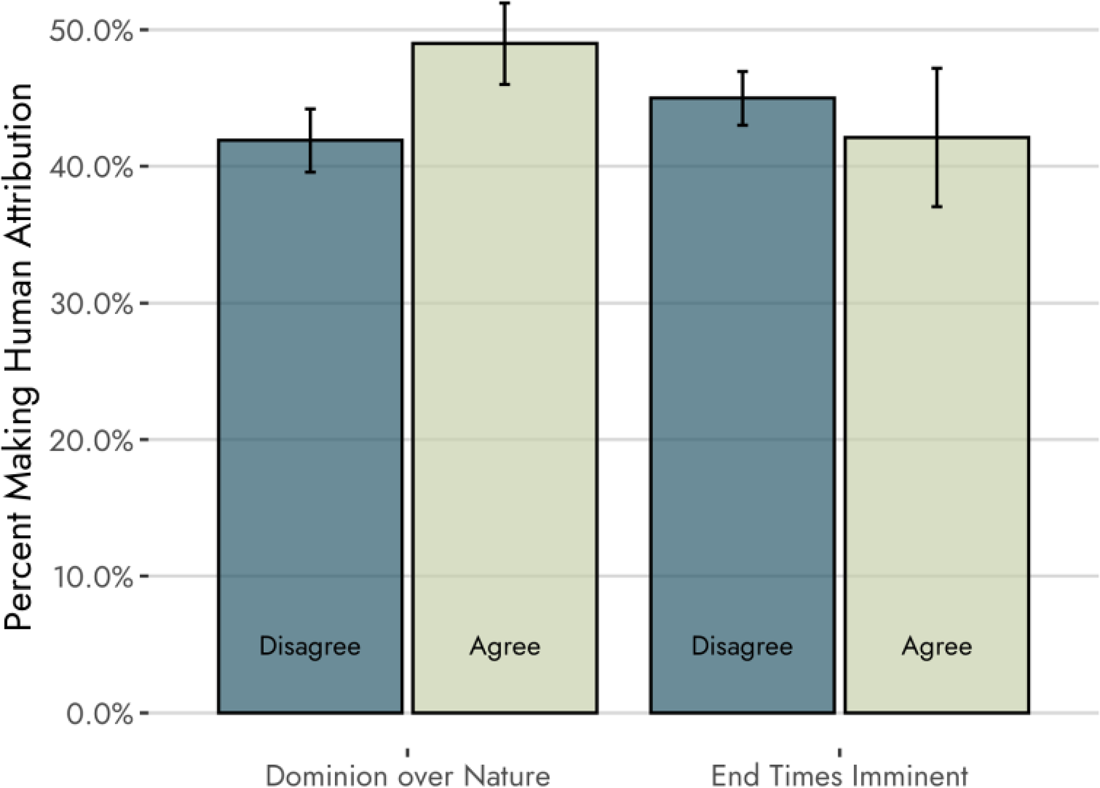
That willingness to attribute climate change to humans (“human attribution”) varies only slightly in conjunction with other religious beliefs. As Figure 2 shows, those who believe in the imminence of the end times (13% of the sampleFootnote 7) are no less likely to believe in human attribution as others (difference of 0.03, p = 0.54). Human attribution belief is actually slightly higher among those with dominion beliefs (by 7%), though the difference is entirely located among non-evangelicals. While believing that God granted dominion over nature to people and then denying human culpability is not necessarily illogical because there could still be natural climate fluctuation, it is hard to sustain credulity when dominionism has such strong links to opposition to environmental regulation. Perhaps the more important point is that this pattern raises doubts about the effectiveness of dominion beliefs when they are connected to a proximate, non-religious belief about climate change.
Agreement with human attribution for climate change by belief in an imminent end times and human dominion over nature.
Source: Public Religion Research Institute, PRRI/RNS Religion News Survey, December 2012.
Note: Comparing any two confidence intervals is the equivalent of a 90% (p = 0.10) test at the point of overlap.
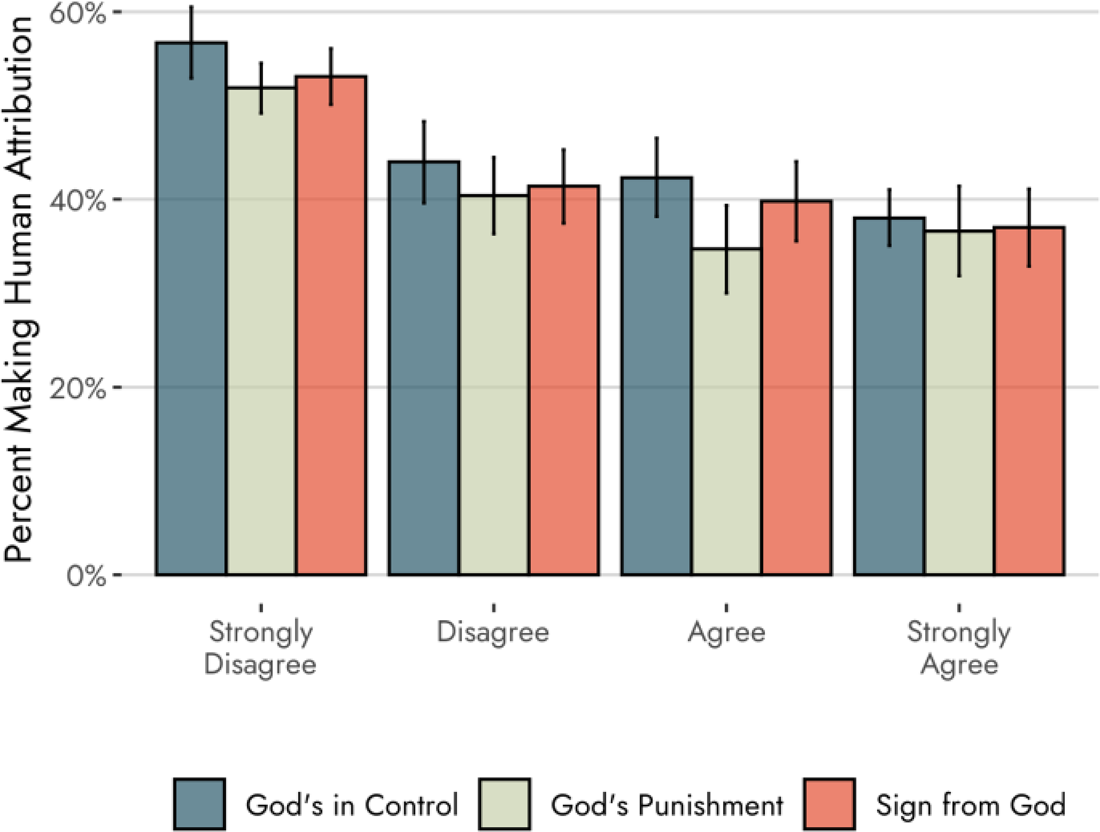
That view is reinforced in Figure 3, which shows how human attribution for climate change varies by beliefs about God's influence in earthly affairs. Human attribution declines modestly with agreement that God is in control of everything that happens in the world, that God punishes nations for their political decisions, and that natural disasters are a sign from God. Put another way, only those who strongly disagree with those providential beliefs about God show majority support for human attribution. It almost goes without saying that those who believe in divine providence and control are more likely to have dominion beliefs. For further analyses, these three providential belief variables are combined (α = 0.77). Going forward, our models will also include a number of controls, including gender, education, race, region, and political party identification.
Human attribution for climate change by beliefs about god's relationship with humans.
Source: Public Religion Research Institute, PRRI/RNS Religion News Survey, December 2012.
Note: Comparing any two confidence intervals is the equivalent of a 90% (p = 0.10) test at the point of overlap.
5. Results—models
The correlations between non-religious and religious beliefs, as well as among religious beliefs, demand that statistical controls be employed to sort out the relationship structure. Again, our dependent variable is whether the respondent agrees or disagrees that “The U.S. government needs to do more to address the issue of climate change.” The high value (4) represent “completely disagree” and the low value (1) represents “completely agree,” so we expect positive relationships with the religious beliefs investigated (end times, providential views of God, and dominion all predict more disagreement) and a negative relationship with human attribution (more agreement).Footnote 8
The ordered logit results are available in Table A3. The first model includes the religious variables and leaves out the non-religious beliefs about the climate. By itself, belief in the imminence of the end times is significant and positive (not shown), affirming past research that a short “time horizon” undercuts the willingness to combat climate change (Guth et al., Reference Guth, Green, Kellstedt and Smidt1995; Barker and Bearce, Reference Barker and Bearce2012). However, end times belief effects drop away once other religious beliefs are included in the model. Without the secular beliefs, only providential beliefs and being evangelical are significant predictors. Once the non-religious beliefs are added in the second, “full model,” the only significant religious effect (evangelical, which boosts opposition to government action on climate by 0.05)Footnote 9 has about one-third the effect of human attribution (0.15) or belief that the weather has become more extreme (0.17).Footnote 10 Those who believe in human culpability and the weather's growing extremity are more likely to agree that the United States needs to do more on climate change. A number of statistics that measure statistical fit indicate that the addition of secular beliefs generates a more well-specified model than those that rely on religious variables alone. Essentially, the fit statistics add to the pattern of significance to help to show the dominance of non-religious beliefs.Footnote 11
There is evidence, seen in the final model with interactions, that religious beliefs are only effective when certain secular beliefs are held.Footnote 12 Figure 4 presents the marginal effects of being evangelical on the probability of selecting each option in the dependent variable conditional on whether they believe in human attribution for climate change. Among those who do not ascribe to human culpability, being evangelical makes one less likely (by 0.08) to completely agree and more likely to completely disagree (by 0.11) that the United States should do more on climate change. Among those who subscribe to human attribution, accepting the scientific consensus, evangelicals are not distinguishable from others. That is, the interaction indicates that believing in human attribution for climate change radically attenuates differences religion (in this case being evangelical) might otherwise encourage.Footnote 13
Marginal effects of being evangelical given beliefs about human attribution for climate change on attitudes that the U.S. government should do more on climate change.
Source: Public Religion Research Institute, PRRI/RNS Religion News Survey, December 2012.
Note: 90% confidence intervals. This shows the marginal effect of being evangelical on the probability of choosing each response in the “United States should do more” scale. So, for example, evangelicals are less likely to completely agree with the United States doing more about climate change when they do not believe that humans are responsible.

There is also evidence that the effect of end times beliefs is contingent on their views of growing weather extremity. While the interaction term in the model appears to lack statistical significance, this is a summary statistic and does not reveal if any portions of the range host significant effects (Franzese and Kam, Reference Franzese and Kam2009). We show the contingent effects of end times beliefs on weather extremity in Figure 5. The effects are very small, but do show that end times beliefs produce statistically discernible effects only among those who believe the weather is getting more extreme (3 on the x axis). End times believers are less likely to “completely agree” with climate action and more likely to “completely disagree” when the weather is perceived to be getting more extreme. It is instructive to know that end times believers are somewhat more likely to agree that the weather is getting more extreme (71% versus 61% of others), but a substantial minority (29%) does not. No other religious belief interacts with the secular beliefs used here.
Marginal effects of end times beliefs on support for action on climate change contingent on beliefs in growing weather extremity.
Source: Public Religion Research Institute, PRRI/RNS Religion News Survey, December 2012.
Note: 90% confidence intervals. This shows the marginal effect of end times belief on the probability of choosing each level of the United States needing to take action on climate change variable given beliefs in weather extremity. For example, end times believers who believe that the weather is more extreme are less likely to completely agree that the United States should take action on climate change (upper left panel).

The remainder of the model suggests little additional explanatory power from the controls. Only party affiliation helps explain climate change attitudes. Democrats are more likely to agree that the United States should do more, while Tea Party and Republican identifiers are more likely to disagree (more the former than the latter).Footnote 14
6. Discussion
In this paper, we revisited the link between religion and environmental attitudes, traveling a well-worn path by social scientists over the past 40 years. Most researchers following Lynn White's Science article supposed that religious beliefs are fixed and drive attitudes on the environment. In particular, a belief in dominionism implies that humans may do as they wish with creation without concern for its long-term health. Of course, numerous scholars have documented the variability in commitment to dominion and other facets of religion that may shape environmental concern. Moreover, those looking over time, while they tend not to have detailed religious measures, have found relationships that suggest the opinion change by religious groups is endogenous to the broader political context (Clements et al., Reference Clements, Xiao and McCright2014; Schwadel and Johnson, 2017; Carlisle and Clark, Reference Carlisle and Clark2018).
We issued a critique of prior cross-sectional work that challenges its foundation and accords with these over-time analyses. While religious beliefs are not unimportant, they cannot be considered fixed and they do not work in isolation from contemporary secular information about how the world is believed to work. We demonstrated a substantial order effect in the adoption of dominion versus stewardship beliefs; a smaller effect still maintains for the portion of the population that typically demonstrates the highest commitment to their faith—evangelicals. The results suggest that these religious beliefs are generally unstable, especially outside of the most committed believers, and therefore finding a correlation between a particular religious belief and an attitude may reflect a sort of state of the campaign, akin to election polling (“if the election were held today…”). That is, especially in an area of public concern where religious elites are actively trying to change the content of religious beliefs, we should regard the religion-environment connection as being in a substantial state of flux for many religious people.
Secular beliefs regarding the environment (regarding climate change in this article) are essential to consider for two reasons. First, the inclusion of secular beliefs helps to isolate the true effects of religious beliefs and affiliations. When secular beliefs are included, the estimated effects of religion drop considerably or drop out entirely. Second, secular beliefs interact with religious beliefs such that some religious variables matter only under particular secular belief conditions. Specifically, in this case, only when people deny that humans cause climate change do religious affiliations induce variation in attitudes. And only when people believe that the weather is becoming more extreme do beliefs about the end times become relevant.
One read on these results is that they deny religious influence. That is a reasonable interpretation since the results show that religious beliefs that have been shown to structure environmental attitudes are malleable and their effects are conditioned by secular beliefs about the environment. However, this interpretation is not the only one. An alternate view is that this is what religious influence looks like when religious institutions engage issues of public concern. Religious people are wrestling with the implications of propositions written long ago, attempting to make them relevant to current human problems. Such a process may induce new understandings of what those religious propositions mean, but their application may also change depending on the nature of the issue. This is the problem of seeking relevance. Acknowledging new facts about the world may entail substantial feedback that raises uncomfortable questions about religious worldviews (or any kind of worldview, for that matter) or may make religious perspectives indistinguishable from others. The latter is surely more likely since many religious organizations have been arguing for decades that humans are responsible for pollution and climate change (Fowler, Reference Fowler1995), showing that secular beliefs may not develop independently of religious attachments.
This might help to explain why the public debate concerning climate change does not focus on the content of religious beliefs, but has directed attacks instead on science, scientists, and scientific claims, such as human culpability for climate change. For instance, the environmental movement has been attacked as the “green dragon” which favors “death” above any human dominion over nature (Wanliss, Reference Wanliss2011) and wants to “take over all of the plants and the manufacturing of the world….[and] to see a billion people die” (Abrams, Reference Abrams2014). A common syllogism in evangelicalism is that since scientists believe in evolution, then they cannot be trusted, including on climate change (Warner, Reference Warner2020). Setting such stark divides between us and them appears essential to maintaining opposition to environmental protection efforts, but this framing sets up a number of possible pathways for future research. Environmental opposition may be less about a specific logic connecting beliefs directly to the environment and more about intergroup tensions boosted by an embattled mentality and embedded in a subculture (see Veldman, Reference Veldman2019) that is resistant to epistemologies, like science, that are not set in advance.
Supplementary material
The supplementary material for this article can be found at https://doi.org/10.1017/S1755048322000293.
Paul A. Djupe directs the Data for Political Research program at Denison University in Granville, OH. An affiliated scholar with Public Religion Research Institute (PRRI), coeditor of “An Epidemic Among My People:” Religion, Politics, and COVID-19 in the United States (Temple), and the editor of the Religious Engagement in Democratic Politics series with Temple University Press.
Ryan P. Burge is an assistant professor of political science at Eastern Illinois University. He is the author of The Nones: Where They Came From, Who They Are, and Where They Are Going (Fortress Press, 2021) and 20 Myths About Religion and Politics in America (Fortress Press, 2022).


 Open access

