Nearly 30 years ago, Douglas Wilder became the first African American to win statewide office in Virginia when he was elected lieutenant governor. In the fall of 2013, Earl Walker Jackson, Sr., was attempting to become the second African American to win statewide office in Virginia in, coincidentally, another campaign for the office of lieutenant governor.
Other than this electoral similarity, the political careers of Wilder and Jackson have little in common. Wilder was a lifelong Democrat and Jackson is a conservative Republican. Wilder spent many years in political life; Jackson had never held political office. Whereas Wilder ran in the wake of a popular governor (and fellow partisan), Chuck Robb, Jackson ran during the troubled administration of Bob McDonnell.
Whereas Wilder succeeded in striking fashion—and then went on to become the first post-Reconstruction African American governor in any of the 50 states—Jackson fell short. The differences between the two candidates and their circumstances provide ample explanation for the disparate outcomes. That said, we are not interested in why Wilder won statewide office and Jackson did not. Rather, we are interested in understanding the gap in support between gubernatorial candidate Ken Cuccinelli and Earl Walker Jackson, Sr.Footnote 1
Jackson’s candidacy provides a unique opportunity to expand our understanding of the Tea Party movement and its adherents. During the 2013 state elections in Virginia, the Republican candidates for the two highest offices in the state—governor and lieutenant governor—were both avowed members of the Tea Party movement. Ken Cuccinelli had made his name as the Commonwealth’s attorney general by being the first to challenge Barack Obama’s Affordable Health Care Act in court; for several years, he also had pursued an investigation against a University of Virginia climate scientist before losing in court. Earl Walker Jackson, Sr., had become a favorite of the Tea Party movement in 2010, speaking at events around the country. In 2012, he ran for the US Senate in Virginia but lost the Republican primary to former Senator George Allen. Then he mounted a campaign for lieutenant governor of Virginia. As Tea Party Republicans, both Cuccinelli and Jackson were quite conservative but they differed in two significant respects: (1) Cuccinelli was the incumbent attorney general and Jackson was a minister with no elected political experience; and (2) Cuccinelli is white and Jackson is black.
This racial distinction is potentially one of significance for the Tea Party. Although there are various perspectives on the foundation of the Tea Party movement, research on mass-level support for it increasingly focuses on the concept of racial conservatism or racial resentment. More specifically, an increasing number of scholars argue that racial resentment drives support for the Tea Party (Abramowitz Reference Abramowitz2011; Barreto et al. Reference Barreto, Cooper, Gonzalez, Parker and Towler2011; Parker Reference Parker2010; Parker and Barreto Reference Parker and Barreto2013). A complementary branch of research on the Tea Party identifies aversion to President Obama (and his policies) as the primary source of support for the movement (Maxwell and Parent Reference Maxwell and Parent2012; Reference Maxwell and T. Wayne2013).
Assuming that racial resentment is an important contributor to the growth of the Tea Party movement, we would expect Tea Party supporters—all else being equal—to support white candidates at higher levels than African American candidates. With the unique character of the 2013 Virginia elections, we are in a position to assess this contention in what might be broadly viewed as a quasi-experimental setting. Simply stated, we tested the hypothesis that Tea Party adherents were significantly more likely to support Cuccinelli than Jackson (i.e., split their ticket between Cuccinelli and Ralph Northam, the Democratic candidate for lieutenant governor). We also assessed the direct relationship between racial resentment and support for Jackson.
The article begins with the state of current research on the connection between racial resentment and Tea Party support. The discussion continues with an overview of the literature on white support for black candidates, particularly those competing for statewide office. The subsequent section describes the background of and specific details about the 2013 statewide elections in Virginia. We then describe our data and the methods used for analysis, followed by a presentation of results related to our primary hypotheses. The article concludes with a discussion of the results and their significance for our understanding of the Tea Party movement and racial politics in contemporary America.
BACKGROUND ON THE TEA PARTY MOVEMENT
The Tea Party movement dates to at least the February 19, 2009, on-air “rant” by CNBC reporter Rick Santelli (who also introduced the tea bag as the symbol of the movement) in Chicago; the first Tea Party rally occurred fewer than 10 days later in Washington, DC.Footnote 2 During the summer of the following year, Representative Michelle Bachman created the Tea Party Caucus in the US House of Representatives; this was the first institutional manifestation of the movement at the federal level (Gervais and Morris Reference Gervais and Morris2012). The Tea Party movement had a surprisingly major effect on Republican primary elections in 2010 and, to a lesser extent, in 2012; the effect on general-election results (at all levels and in both years) was somewhat less significant. Nevertheless, no grassroots movement has had a larger impact than the Tea Party on state and national elections since the election of Barack Obama in 2008.
Nevertheless, no grassroots movement has had a larger impact than the Tea Party on state and national elections since the election of Barack Obama in 2008.
Although there was a staunch libertarian slant to the language and orientation of the most vocal early leaders and supporters of the Tea Party movement, the extent to which it is solely (or even primarily) a libertarian movement today is an open question.Footnote 3 Scholars (and some politicians) have argued that the Tea Party movement is simply a “rebranding of conservative Republicanism” (Arceneaux and Nicholson Reference Arceneaux and Nicholson2012; see also Skocpol and Williamson Reference Skocpol and Williamson2012; Williamson, Skocpol, and Coggin Reference Williamson, Skocpol and Coggin2011). Others view the movement as a distinctive political phenomenon both inside and outside of the Republican Party (Foley Reference Foley2012).
Other scholars argue that the Tea Party movement is a modern variation on the “angry white male” phenomenon of the mid-1980s and that the impetus for it flows from a deep racial resentment and a sense that the government—particularly the national government—has treated whites unfairly (Barreto et al. Reference Barreto, Cooper, Gonzalez, Parker and Towler2011; Williamson, Skocpol, and Coggin Reference Williamson, Skocpol and Coggin2011). This research claims that Tea Party members are more racially conservative than non–Tea Party supporters (Abramowitz Reference Abramowitz2011; Barreto et al. Reference Barreto, Cooper, Gonzalez, Parker and Towler2011; Parker Reference Parker2010; Parker and Barreto Reference Parker and Barreto2013); however, the evidence is mixed (Arcenaux and Nicholson Reference Arceneaux and Nicholson2012; Foley Reference Foley2012).
More recently, preliminary work suggests that the Tea Party movement has a substantial evangelical core, attracting conservative Christians far more effectively than atheists, agnostics, and followers of other faith traditions (Abramowitz Reference Abramowitz2011; Clement and Green Reference Clement and Green2011).Footnote 4 This is another controversial point. Foley (Reference Foley2012) cites data from a 2011 poll released by the Pew Research Center as evidence that well more than half of Tea Party supporters disagreed with conservative Christianity, had not heard of the movement, or had no opinion of it. Other prominent work on the Tea Party (e.g., Williamson, Skocpol, and Coggin Reference Williamson, Skocpol and Coggin2011) does not portray Tea Party supporters as particularly evangelical; neither is the role of evangelicalism in the development of the movement viewed as significant. There certainly is no evidence that evangelical support for the Tea Party is “monolithic” (Formisano Reference Formisano2012, 56).
Because of the ideological and evangelical comparability of the two candidates, the Cuccinelli–Jackson case study provides an excellent opportunity to assess the distinctive significance of the racial resentment subdivision of Tea Party support on actual voting behavior. If anything, Jackson was the more ideologically conservative candidate and, as a minister in an evangelical church, his spiritual bona fides are at least comparable to those of Cuccinelli—who is well known as a conservative Roman Catholic. The major distinction between the candidates—at least as it relates to research on the Tea Party movement—was race.
EXPLAINING WHITE SUPPORT FOR AFRICAN AMERICAN CANDIDATES
The focal point for research on white support for African American candidates has been sub-state elections (particularly US House and mayoral elections). The election of President Obama led to a spike in research on white support for his candidacy; however, research on white support for African American candidates in statewide elections is limited. Research focusing on sub-state elections suggests that white voters may “discriminate” against black voters’ candidates (Highton Reference Highton2004). The extraordinarily small number of African American legislators from majority white districts often is taken as prima facie evidence for this perspective. Experimental work also suggests some level of white discrimination (Moskowitz and Stroh Reference Moskowitz and Stroh1994; Terkildsen Reference Terkildsen1993); however, other work finds little evidence of this effect (Reeves Reference Reeves1997; Sigelman et al. Reference Sigelman, Sigelman, Walkosz and Nitz1995). Research based on observational data—particularly from the South—also has produced mixed results (Bullock and Dunn Reference Bullock and Dunn1999; Gay Reference Gay1999; Voss and Lublin Reference Voss and Lublin2001). Highton’s (Reference Highton2004) effort to resolve this inconsistency in the literature failed to find strong evidence of a discriminatory effect.
However, recent research on white support for Obama—primarily in 2008 and 2012 but also a study of his 2004 senatorial campaign (Anderson and Junn Reference Andersen and Junn2010)—has reinvigorated the claims of white aversion to black candidates. A number of studies found evidence that Obama suffered from some level of discrimination during the 2008 election (Benson, Merolla, and Geer Reference Benson, Merolla and Geer2011; Erigha and Charles Reference Erigha and Charles2012; Kam and Kinder Reference Kam and Kinder2012; Piston Reference Piston2010; Schaffner Reference Schaffner2011; see also Highton Reference Highton2011). Tesler and Sears (Reference Tesler and Sears2010) contend that white partisanship and vote choice following Obama’s election in 2008 are increasingly racialized and that racial resentment depresses white support for black candidates (see also Kinder and Sanders Reference Kinder and Sanders1996; Berinsky et al. Reference Berinsky, Hutchings, Mendelberg, Shaker and Valentino2011).Footnote 5
In certain respects, research on white support (or lack thereof) in statewide elections is both the most interesting (Kristofer and Jeffries Reference Kristofer and Jeffries2009) and the most limited. Context is clearly important in determining whether African American candidates in statewide elections are likely to be successful. Following popular incumbents can foster support for statewide candidates, and candidates in races that are not highly racialized also appear to be advantaged (Sonenshein Reference Sonenshein1990). However, the sample size is still relatively small; therefore, we have much to learn about the factors associated with the success of minority candidates in statewide races.
The thrust of the existing research—although not unqualified—leads us to expect that racial resentment should result in relatively lower levels of white support for African American candidates, all else being equal. From the standpoint of the current political context, to what extent is it reasonable to equate the candidacies of Cuccinelli and Jackson in Virginia in 2013? It is to that question that we now turn.
The thrust of the existing research—although not unqualified—leads us to expect that racial resentment should result in relatively lower levels of white support for African American candidates, all else being equal.
THE 2013 VIRGINIA ELECTIONS
The 2013 Republican campaign for governor and lieutenant governor of Virginia began almost as soon as the three Republicans who had swept the statewide races in 2009 were sworn into office. Newly reelected Lieutenant Governor Bill Bolling, an establishment business-minded Republican, had agreed to support Bob McDonnell for governor in 2009; in return, McDonnell had agreed to support Bolling as the party’s nominee for governor in 2013. Newly elected Attorney General Ken Cuccinelli, a social conservative and Tea Party favorite, considered the idea of challenging first-term senator Mark Warner. However, he ultimately decided to run for governor instead, ignoring the agreement between Bolling and McDonnell and thereby setting up an intraparty contest.Footnote 6 In June 2012, Cuccinelli supporters on the Republican State Central Committee engineered a change in the nominating process from an open primary to a closed convention, which assured an easier nomination fight for Cuccinelli and a more difficult one for Bolling.Footnote 7 A few months later, Bolling bowed out of the race, leaving Cuccinelli as the de facto nominee but the party divided.Footnote 8
Although the contest for who would be the Republican gubernatorial nominee was a foregone conclusion by the time of the convention, as many as 10 people considered running for the office of lieutenant governor. Ultimately, seven ran and, after four rounds of balloting, Earl Walker Jackson, Sr., rode a surge of Tea Party support and emerged as the surprise winner with 58% of the vote.Footnote 9 Thus, Virginia Republicans had nominated two Tea Party favorites as candidates for governor and lieutenant governor.Footnote 10 Robert C. Sarvis, a Libertarian candidate, also entered the race.Footnote 11 During the course of the general-election campaign, Democratic gubernatorial candidate Terry McAuliffe and lieutenant governor candidate Ralph Northam consistently portrayed both Cuccinelli and Jackson as “out of the mainstream” for Virginia. Both the Cuccinelli and Jackson campaigns were underfunded compared to the McAuliffe and Northam campaigns. The Democrats won both races, with McAuliffe defeating Cuccinelli 48% to 45%Footnote 12 and Northam defeating Jackson 55% to 45%.
DATA AND METHODS
The data for this study were compiled from two live-call surveys of likely general-election voters in Virginia. The surveys were conducted by the Wason Center for Public Policy at Christopher Newport University October 1–6 and October 8–13. The response rates, defined by the American Association of Public Opinion Research as RR2, were 7.8% and 6.9%, respectively.Footnote 13 For the analyses presented, the data were weighted with iterative proportional fitting on age, sex, race, and region of residents, using the 2013 Virginia exit polls to account for nonresponse.Footnote 14 The combined surveys provided a sample size of 1,948 likely voters.Footnote 15
This section presents two vote-choice models: (1) one based solely on the lieutenant governor’s race, and (2) one that simultaneously considers vote choice for both the gubernatorial and lieutenant governor’s races. The dependent variable for models that analyze choice in the lieutenant governor’s race is dichotomous, in which a preference for the GOP candidate Jackson equals 1 and a vote for the Democrat candidate Northam equals zero. These models were analyzed using logistic regression.
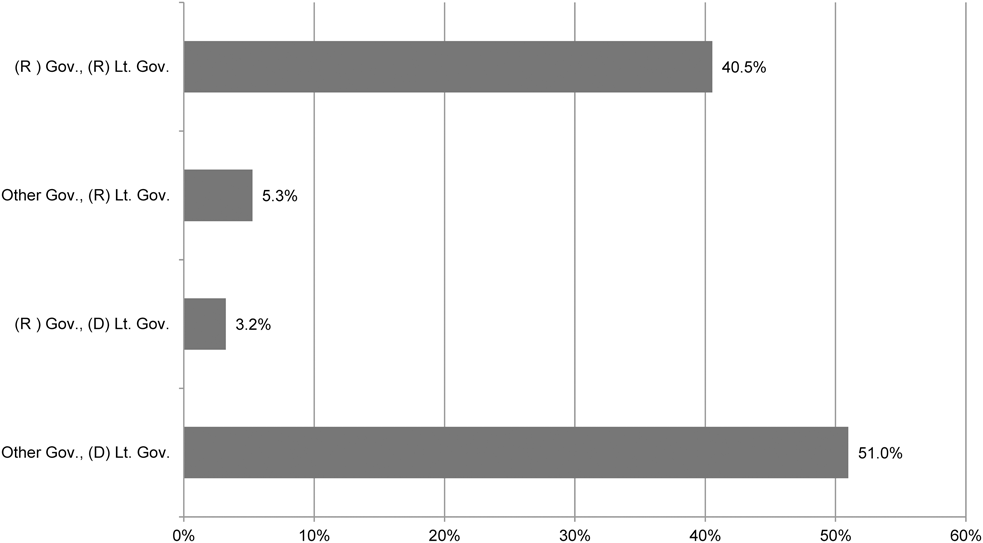
The dependent variable for the second set of models was operationalized as a four-category indicator of vote choice. The four categories are (1) voted for both the Republican gubernatorial and lieutenant governor candidates; (2) voted for the Republican gubernatorial candidate and the Democratic lieutenant governor candidate; (3) voted for the Republican lieutenant governor candidate but another gubernatorial candidate; and (4) voted for another gubernatorial candidate and the Democratic lieutenant governor candidate.Footnote 16 The frequency breakdown for this dependent variable is shown in figure 1, which indicates that 40.5% of the sample voted for both Cuccinelli and Jackson; 5.3% voted for Jackson but another candidate for governor; 3.2% voted for Cuccinelli but not Jackson; and 51.0% voted for neither Cuccinelli nor Jackson. Models using this dependent-variable configuration were estimated using multinomial logit; the category representing those respondents not casting a ballot for either GOP candidate served as our baseline, to which the other choice categories were compared.
Vote-Category Distribution

We included the following sociodemographic variables in our vote-choice models: Age; Sex (0 = male; 1 = female); Education (1 = high school or less; 2 = some college, vocational, or technical training; 3 = a BS; 4 = postgraduate work); and Income (1 = less than $25,000; 2 = $25,000–$35,000; 3 = $35,000–$50,000; 4 = $50,000–$75,000; 5 = $75,000–$100,000; 6 = more than $100,000). In addition, we included two dummy variables, Black and Other Minority, to denote black respondents and respondents from another racial or ethnic group, respectively. Another binary indicator, Native Southerner, was used to designate those respondents born in one of the 11 Southern states.
One of our primary variables of interest, Tea Party, is a dummy variable coded 1 for those who supported the Tea Party versus those who were indifferent or expressed opposition. Of the survey respondents, 27% indicated that they supported the Tea Party, 46% opposed, and 26% had no view either way. Other political indicators included dummy variables for Independent and Republican identifiers; those who self-classified as Democrats were used as the excluded comparison category. In addition, we included a six-point ideological self-placement scale on which higher values represented increasing conservatism. We also included another variable, Evangelical, to indicate those respondents that self-classified as born-again Christians.
For each dependent variable, a second set of models was estimated in which a Racial Resentment indicator was included. This item asked respondents to denote their level of agreement with the following statement: Over the past few years, blacks have gotten less than they deserve (i.e., strongly agree = 1; agree = 2; neutral = 3; disagree = 4; strongly disagree = 5). Separate models with this indicator were estimated because it was asked only of respondents in one of the two polls referenced previously.Footnote 17
FINDINGS
The results of our models that explain vote choice in the lieutenant governor’s race are listed in table 1. Model 1 shows that age and educational attainment are negatively related to support for Jackson. Conversely, Tea Party support, ideological conservatism, Republican Party or Independent affiliation, and evangelicalism are all significant and positive predictors of a vote for Jackson. Black respondents were significantly less likely to support the black candidate for lieutenant governor as compared to whites (i.e., the excluded comparison group). In model 2, the racial-resentment measure is positively related to support for Jackson. Except for education level and the indicator for black respondents, the statistically significant findings from model 1 are identical. Even controlling for racial resentment, then, Tea Party support continues to be strongly related to voting for Jackson.
Explaining Vote Choice in the 2013 Virginia Lieutenant Governor’s Election
Notes: Entries are logit coefficients with standard errors in parentheses.
* p < 0.05; **p < 0.01; ***p < 0.001.
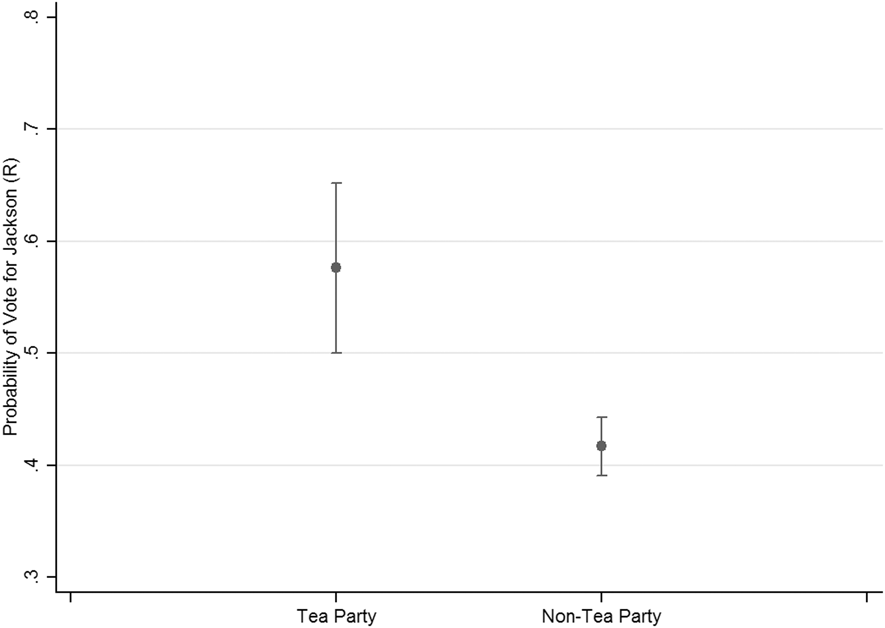
To better understand the effects Tea Party support and racial resentment as they relate to a preference for Jackson, we present two predicted-probability plots. To produce these estimates, we used the observed-value approach outlined in Hanmer and Kalkan (Reference Hanmer and Kalkan2013), which relies on the observed values for each case, manipulates particular covariates of interest, and then calculates a simulated probability measure by averaging across all cases in the analysis.Footnote 18Figure 2 shows the likelihood of a vote for Jackson based on Tea Party support. Figure 2 indicates that the probability of Tea Party supporters voting for Jackson is 0.58, compared with 0.42 for those with neutral or negative views of the movement. This 16-point difference is statistically significant, as indicated by the fact that the plotted 95% confidence intervals between the two estimates do not overlap.
Vote Choice by Tea Party Association
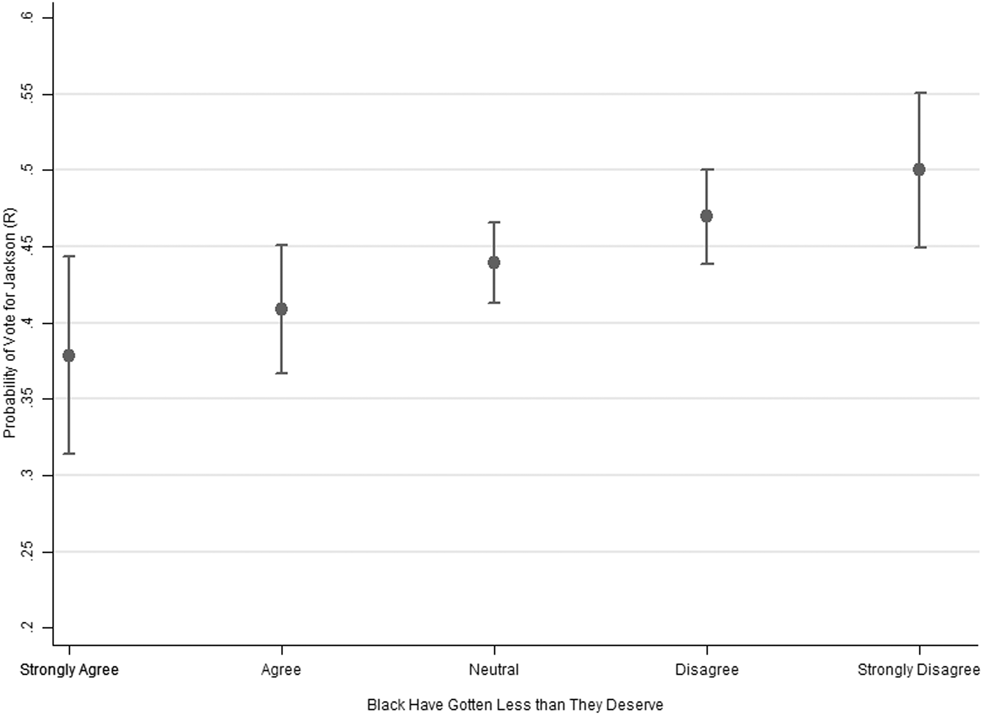
Figure 3 plots the probability of support for Jackson across varying levels of racial resentment. Respondents strongly agreeing that blacks have received less than they deserve had a 0.38 probability of voting for Jackson, whereas those in the strongly disagree category had a 0.50 probability of support. Therefore, movement from one end of the continuum on this variable represents a 12-point probability shift in favor of support for Jackson.
Vote Choice by Level of Racial Resentment
The results of our second set of vote-choice models based on preferences for both the gubernatorial and lieutenant-governor contests are listed in table 2. The probability of falling into any of the three categories in table 2 should be compared to the excluded outcome, which is a respondent who expressed a preference for neither GOP candidate. Table 2 shows that Tea Party support is positively and significantly related to the probability of a respondent falling into the other three vote-choice categories, as compared to the base category. Other variables associated with a higher likelihood of voting for various combinations of GOP candidates include conservatism, identification as a Republican or an Independent, and evangelical status. Conversely, older respondents, women, blacks, and native Southerners were less likely to vote for one or both Republican candidates.
Multinomial Logit Model Predicting Vote Choice in the 2013 Virginia General Election
Notes: Entries are multinomial logit coefficients with standard errors in parentheses. Respondents indicating that they did not prefer either the Republican gubernatorial or Republican lieutenant governor candidate comprise the base or comparison category.
* p < 0.05; **p < 0.01; ***p < 0.001.
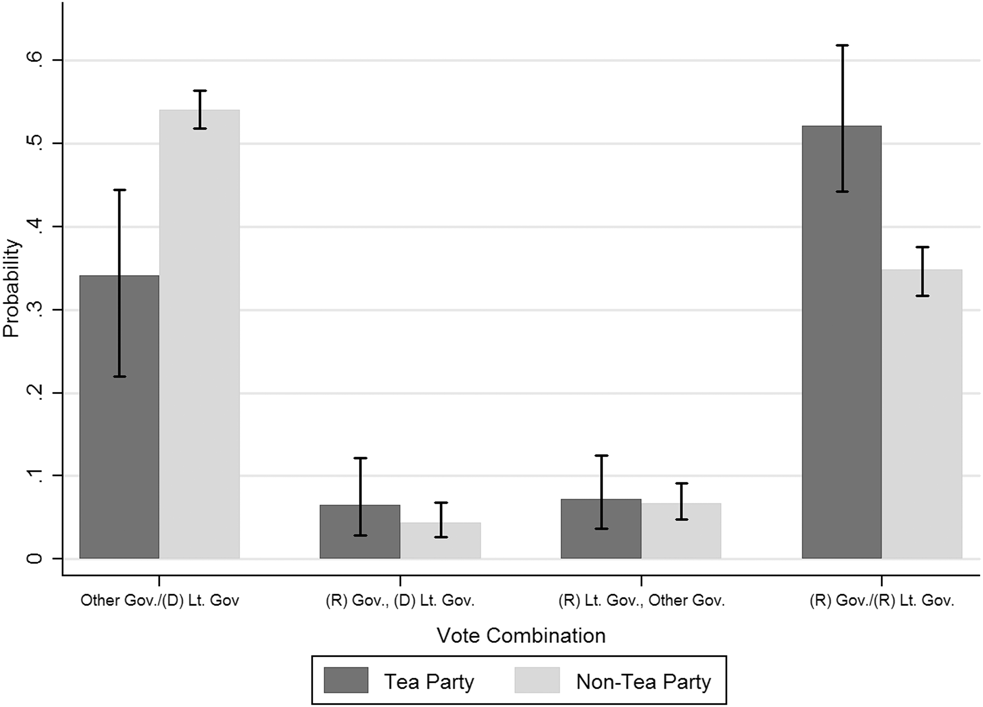
To better understand the manner in which support for the Tea Party affects the distribution of respondents across vote categories, we plotted a series of simulated probabilities (figure 4). Tea Party supporters were far more likely to vote a unified Republican ticket than any other alternative. In comparison to other voters, Tea Party supporters were 1.5 times more likely to vote for both Cuccinelli and Jackson (p = 0.52 versus p = 0.35). Conversely, non–Tea Party supporters were most likely to be located in the category that supports neither GOP candidate. The probability differential between these two groups, at 0.20, essentially mirrors the category comprising unified support for both Cuccinelli and Jackson, at 0.17. For each category, the probability differences are statistically significant, as noted by the plotted confidence intervals, which do not overlap. The results in table 2 also indicate that only a small residual of respondents is located in the two remaining split-ticket categories of Republican support. Within these two categories, the probability differences for Tea Party supporters and other voters are both negligible and statistically insignificant. For example, the probability of a Tea Party supporter voting for Cuccinelli and the Democrat Northam is 0.06, compared to 0.04 for other voters’ candidates.Footnote 19
Vote Choice by Tea Party Status
DISCUSSION AND CONCLUSION
The primary focus of this research was to determine the extent to which Tea Party attachment influenced the voting patterns of Virginians in recent state elections. More specifically, we examined the relationship between Tea Party attachment and the variation in support for white Republican gubernatorial candidate Ken Cuccinelli and Earl Walker Jackson, Sr., the black Republican candidate for lieutenant governor. A growing body of research attributes support for the Tea Party to racial resentment; therefore, we posited that, all else being equal, attachment to the Tea Party movement should be negatively associated with support for Jackson. If racial resentment is the primary driving force behind Tea Party attachment, we also should observe Tea Party supporters voting for Cuccinelli, a candidate with ideological leanings and policy positions clearly consistent with the Tea Party. However, we also should witness evidence of a defection of Tea Party support away from Jackson—even though as a candidate, he is ideologically in line with Tea Party goals.
In summary, we found little evidence of voting patterns consistent with racial animus or prejudice among Tea Party supporters. To the contrary, support for the Tea Party was consistently and positively related to support for Jackson.
In summary, we found little evidence of voting patterns consistent with racial animus or prejudice among Tea Party supporters. To the contrary, support for the Tea Party was consistently and positively related to support for Jackson. When simultaneously considering voting patterns for both offices, Tea Party supporters were most likely to vote a unified Republican ticket. Additional evidence reveals that the hypothesized gap in Tea Party support for Cuccinelli and Jackson failed to materialize because few Virginians chose to split their ballot across parties. Independent of Tea Party support, we also found increasing racial-resentment levels to be positively associated with voting for Jackson. Conversely, Jackson was able to secure little in the way of crossover support from black Virginians.
It is obvious that this was only a single-state study encompassing one election cycle, but our results raise several key questions. The case of the 2013 Virginia lieutenant governor’s race provides researchers with a unique opportunity to study a candidate who is both black and a conservative Republican, as opposed to the typical scenario of a black candidate who is a liberal Democrat. In this way, it is possible to empirically separate the race of a candidate from party and ideology. The fact that racial resentment is positively associated with support for a black candidate raises questions about whether such indicators actually are tapping into subtle or hidden racial prejudice or are simply a specific component of ideological conservatism. Clearly, those Virginians who were ideologically congruent with Jackson were more than willing to vote for him, despite the fact that he is black. Although it is beyond the scope of this work, it may be necessary to reevaluate exactly what racial-resentment indicators are measuring in the contemporary political world.
Furthermore, the presumption that racial resentment has driven Tea Party support may need to be reconsidered, especially in the South. Although this point is obviously related to the preceding discussion, it is also distinct because the direct empirical effect of Tea Party support is positively related to voting for Jackson. Again, if racial resentment is the main determinant of Tea Party association, why would such a group exhibit extremely high levels of support for a black candidate? This raises legitimate questions about the motivations behind Tea Party association. If not racial resentment, then perhaps other political factors (e.g., ideological purity) are more salient. It is possible that attachment is even less about ideological congruence than a disinclination to compromise with those on the other side of the ideological divide or a preference for action over the perception of “politics as usual” regarding particular issues (e.g., the national debt). To the extent that racial resentment drives Tea Party support elsewhere, our results suggest that it was not the case in the Old Dominion.
Finally, it is interesting that whereas support for Jackson was strongly related to ideology and partisanship, his candidacy did little to attract any crossover support from black Democrats. Following yet another defeat in the 2012 presidential contest, the national Republican Party engaged in a soul-searching exercise in an effort to positively alter future elections in its favor. One conclusion concerned the fact that the Republican Party must do more to attract the ever-growing number of racial and ethnic minority voters. Although comprising only a solitary example, our results suggest that running very conservative minority candidates may not be the best strategy to accomplish this goal for the GOP.
ACKNOWLEDGMENTS
The authors thank the Wason Center for Public Policy at Christopher Newport University, which funded the survey on which this article is based. A previous version of this article was presented at the Citadel Symposium on Southern Politics in 2014.