Contact precautions comprise a transmission-based infection control method recommended by the Centers for Disease Control and Prevention (CDC). Contact precautions require donning gowns and gloves prior to contact with the patient or patient’s environment for patients known to be colonized or infected with antibiotic resistant organisms, in addition to cohorting or placing the patient in a single room.Reference Siegel, Rhinehart, Jackson and Chiarello 1
Adverse events are unintentional injuries related to medical or surgical care not due to an underlying condition.Reference Griffin and Resar 2 Adverse events include healthcare-associated infections (HAIs) as well as delirium, falls, renal injury, and other noninfectious adverse events.Reference Landrigan, Parry, Bones, Hackbarth, Goldmann and Sharek 3 As many as 2.4 million hospital adverse events are estimated to occur each year in the United States,Reference Goodman, Villarreal and Jones 4 and these events contribute to 98,000 inpatient deaths annually.Reference Kohn, Corrigan and Donaldson 5 In the United States, preventable adverse events are estimated to cost between $17 billion and $29 billion per year.Reference Kohn, Corrigan and Donaldson 5
Contact precautions may have unintended consequences, however. For example, healthcare personnel have consistently been shown to visit patients on contact precautions significantly less often than patients not on contact precautions.Reference Kirkland and Weinstein 6 – Reference Morgan, Diekema, Sepkowitz and Perencevich 8 In addition, adverse events may occur more frequently among patients on contact precautions. Stelfox et alReference Stelfox, Bates and Redelmeier 9 reported that patients on contact precautions experienced more than twice the rate of adverse events of patients not on contact precautions and 7 times more preventable adverse events. However, a case-crossover studyReference Karki, Leder and Cheng 10 found no significant difference in adverse events when patients on contact precautions were compared with the same patients in an earlier time period when contact precautions were not used. Other studies have reported significant associations only between contact precautions and very specific subtypes of adverse events such as hyperglycemia.Reference Zahar, Garrouste-Orgeas and Vesin 11
Comparisons of past studies regarding adverse effects associated with contact precautions have been limited by the use of nonstandard definitions of adverse events (eg, electrolyte imbalances or very specific subtypes of events).Reference Stelfox, Bates and Redelmeier 9 , Reference Zahar, Garrouste-Orgeas and Vesin 11 Whether contact precautions are associated with the occurrence of any adverse events remains unresolved.
To investigate whether contact precautions are associated with the occurrence of adverse events, we conducted a prospective cohort study of patients on contact precautions matched with patients not on contact precautions using a standard evaluation tool.
METHODS
Study Design
For this study, we recruited a prospective cohort of general medical and surgical patients at the University of Maryland Medical Center, an academic tertiary care hospital. The patients in this study were initially recruited between January 2010 and November 2010 for a prospective study of the relationship between contact precautions and depression, anxiety, and patient satisfaction.Reference Day, Perencevich and Harris 12 , Reference Mehrotra, Croft, Day, Perencevich, Pineles, Harris, Weingart and Morgan 13 Patients on contact precautions were individually matched with patients not on contact precautions by a minimum 3-day hospital length of stay and by admission service (ie, to limit bias related to patients on contact precautions having longer length of stay and more severe illness). Study participants on contact precautions remained on contact precautions for the duration of their hospital stay, and patients not on contact precautions also did not change contact precautions status during the study period. This study was approved by the Institutional Review Board of the University of Maryland, Baltimore.
Measurements and Outcomes
Demographic data such as age, gender, education, minority status (Hispanic and/or non-white race), and marital status were collected at study enrollment; Charlson comorbidity score and length of stay were obtained from the hospital central data repository. We defined adverse events as “unintended physical injury resulting from or contributed to by medical care that requires additional monitoring, treatment, or hospitalization or that results in death” as used by the Institute for Healthcare Improvement (IHI) Global Trigger Tool.Reference Griffin and Resar 2 We did not consider events due to the patient’s underlying condition as adverse events. Adverse events were identified using the IHI Global Trigger Tool, which is a standardized method for completion of structured medical record reviews within approximately 20 minutes.Reference Griffin and Resar 2 The trigger tool detects more adverse events than approaches such as the Agency for Healthcare Research and Quality (AHRQ) Patient Safety Indicators or hospital reporting systems.Reference Naessens, O’Byrne, Johnson, Vansuch, McGlone and Huddleston 14 , Reference Classen, Resar, Griffin and Federico 15 Three initial reviewers used the trigger tool to review the patient charts of all members of the cohort for adverse events. One initial reviewer (LDC) reviewed the records of all 296 cohort members, and 2 initial physician reviewers (ML and JL) each reviewed half (N=148) of the cohort. A final physician reviewer (DJM) adjudicated any disagreements on adverse event occurrence between initial reviewers, per the IHI Global Trigger Tool method.Reference Griffin and Resar 2 All reviewers received training on using the IHI Global Trigger Tool and practiced with standardized sample charts, following the training approach used by the tool developers.Reference Harris, Pineles and Belton 16 Reviewers determined whether each adverse event initially began before, during, or after the admission of interest. Analysis was restricted to adverse events that began during the index admission only, as events that began prior to or after admission may not have been the result of the use of contact precautions.
Our primary outcomes were noninfectious and infectious adverse event rates considered separately, and the secondary study outcomes were preventable and severe noninfectious adverse events. Infectious adverse events were defined as infections that occurred in the hospital that were not present or incubating on admission; noninfectious adverse events that occurred in the hospital were all adverse events with infectious events excluded. Examples of infectious adverse events include catheter-related bloodstream infections, ventilator-associated pneumonia, and urinary tract infections, while noninfectious adverse events included events such as acute respiratory failure, acute renal failure, or oversedation. We rated adverse-event severity using a 5-point Likert scale (ie, minimal, clinically significant, serious, life-threatening, or fatal) using a severity index modified from the National Coordinating Council for Medication Error Reporting and Prevention.Reference Griffin and Resar 2 , 17 Adverse events that were serious (eg, organ dysfunction), life-threatening (ie, death possible within a few hours without intervention), or fatal were classified as severe events. Similarly, preventability was measured on a 4-point Likert scale (ie, definitely, probably, probably not, or definitely not preventable) as has been used previously.Reference Landrigan, Parry, Bones, Hackbarth, Goldmann and Sharek 3 , Reference Rothschild, Landrigan and Cronin 18 , Reference Sharek, Parry and Goldmann 19 Preventability was determined based on whether the event was considered preventable by current knowledge, practice standards, or technology.Reference Rothschild, Landrigan and Cronin 18 Finally, adverse events were also categorized by the primary physiological system affected (eg, cardiovascular, respiratory, renal or endocrine, hematologic, gastrointestinal, neurologic), as hospital-acquired infection, or as surgically related.Reference Landrigan, Parry, Bones, Hackbarth, Goldmann and Sharek 3 Rates of adverse events were calculated as the number of a specific adverse event type divided by total person-time at risk (ie, patient-specific hospital length of stay in days).
Statistical Analysis
Distribution of demographic variables, such as age or gender, by the use of contact precautions was analyzed using Student t tests for continuous variables and χ2 tests for categorical variables. An initial multivariable, scaled-deviance Poisson regression model for noninfectious adverse events was constructed by including contact precaution status and adjusting for the matching variable of admission service (grouped as oncology, general medicine, or surgery). More than 1 adverse event during an admission was allowed per patient, but only the first eligible admission was reviewed for event occurrence; multiple admissions during the study period were not included. The model offset was the log of patient length of stay. An adjusted model for all noninfectious adverse events was constructed by adding covariates 1 at a time to the initial model in order of the greatest magnitude change produced in the log rate ratio of the contact precautions estimate until no meaningful change (<10%) occurred with the addition of new covariates. As no covariates meaningfully changed the coefficient, we included biologically plausible variables such as age and Charlson comorbidity score. Model building for preventable noninfectious adverse events followed the same approach used for the model of all noninfectious adverse events. Models of severe and preventable adverse events were constructed using noninfectious adverse events only. Due to the low number of severe noninfectious adverse events, we constructed a model for severe adverse events adjusted only for matching. For each physiological system, counts of adverse events by contact precaution status were recorded, and bivariate analysis was conducted using χ2 or Fisher’s exact test, as appropriate. All analyses were conducted using SAS version 9.3 (SAS Institute, Cary, NC).
Power Calculation
Applying a previously reported frequency of adverse events among general medical inpatients (25 adverse events per 100 admissions)Reference Landrigan, Parry, Bones, Hackbarth, Goldmann and Sharek 3 to the average length of stay among the current study’s patients with whom contact precautions were not used, the expected rate of adverse events among these patients was 53.2 adverse events per 1,000 patient days. For a 2-sided test and α=0.05, we had 84% power to detect an 80% increase in adverse event rate among patients on contact precautions compared to patients not on contact precautions.
RESULTS
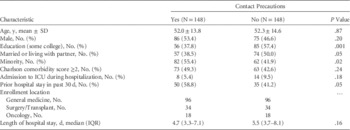
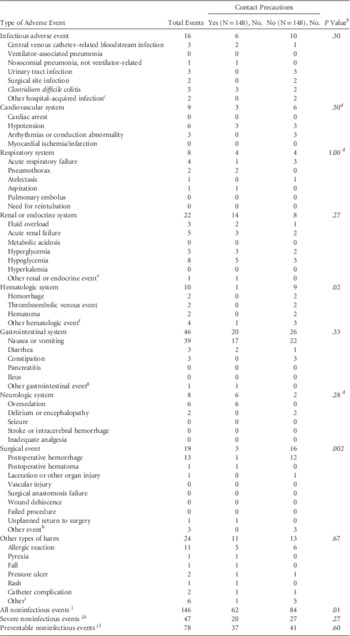
Of the 296 patients in the cohort, 35.1% (104 of 296) experienced at least 1 adverse event. Of these 104 patients, 49 patients were on contact precautions and 55 patients were not. Among the entire cohort, 77.3 adverse events occurred per 1,000 patient days; 62.8 events per 1,000 patient days occurred among patients on contact precautions, and 92.8 per 1,000 patient days occurred among patients that were not on contact precautions. Patients on contact precautions did not significantly differ from patients not on contact precautions with respect to age, gender, or Charlson comorbidity score (Table 1). However, patients on contact precautions were less likely to have at least some college education (37.8%) compared with patients not on contact precautions (57.4%), P <.001. In descriptive analysis, we observed a trend toward fewer adverse events among patients on contact precautions for all physiological systems except respiratory, neurologic, and renal or endocrine (Table 2). We examined the trigger tool reviews of the 13 patients with postoperative hemorrhage in depth, as this event type drove a significant reduction in surgical adverse events among patients on contact precautions. There was an even distribution of patients experiencing postoperative hemorrhage by enrollment location (6 general medicine locations and 7 surgery or transplant locations). The majority of these adverse events were decreases in hemoglobin or hematocrit values (during or immediately following surgery) that required transfusion, rather than harms caused during postoperative care.
Demographic Characteristics for Patients on Contact Precautions vs Patients Not on Contact Precautions

NOTE. SD, standard deviation; IQR, interquartile range; ICU, intensive care unit.
Frequency of Specific Adverse Events in Patients on Contact Precautions vs Patients Not on Contact PrecautionsFootnote a

a 162 total adverse events occurred (68 among patients on contact precautions; 94 among patients not on contact precautions); events occurring in 1 physiologic system are mutually exclusive and do not appear elsewhere within other types of adverse events/harms unless otherwise indicated.
b Pearson χ2 test unless otherwise indicated.
c Other hospital-acquired infection events include bronchitis; oral Candida albicans.
d Fisher’s exact test.
e Other renal or endocrine events include hyponatremia and hypovolemia due to diuresis.
f Other hematologic events include chemotherapy-induced thrombocytopenia, chemotherapy- related decrease in white blood cell count, thrombophlebitis from i.v. requiring vein excision, and postoperative thrombophlebitis.
g Other gastrointestinal events include medication-related gastrointestinal upset.
h Other surgical events include postoperative itching and insomnia, intraoperative anesthesia- induced increases in transaminases and bilirubin, and acute on chronic pancreatitis secondary to ERCP.
i Other events include graft vs host disease and nausea/vomiting; medication-induced restless leg; chemotherapy related mucositis, nausea/vomiting, and acute renal failure; itching due to pain medication; and itching at the patch site.
j Not included in total event count for the rest of the table because these events are not mutually exclusive of physiological system affected.
k Severe events include serious adverse events (eg, organ dysfunction), life-threatening (ie, death possible without therapy within a few hours), and death.
l Preventable events are adverse events considered probably or definitely preventable by current practice standards, knowledge, and/or technology.
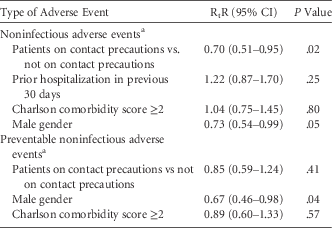
In unadjusted analyses, contact precautions were significantly associated with a lower rate of noninfectious adverse events (rate ratio [RtR], 0.69; 95% confidence interval [CI], 0.51–0.94; P=.02) and a lower rate of infectious adverse events (RtR, 0.56; 95% CI, 0.34–0.94; P=.03). A trend toward fewer severe noninfectious adverse events was also noted (RtR, 0.69; 95% CI, 0.46–1.03; P=.07). Unadjusted results did not differ when adjusted for matching. Adjusting for gender, prior hospitalization, and Charlson comorbidity score, we noted a significant 30% relative reduction in the rate of noninfectious adverse events with use of contact precautions (RtR, 0.70; 95% CI, 0.51–0.95; P=.02; Table 3). There was no significant association between contact precautions and preventable noninfectious adverse events after adjusting for gender and Charlson comorbidity score (RtR, 0.85; 95% CI, 0.59–1.24; P=.41). Males were 27% less likely to experience an adverse event than females (RtR, 0.73; 95% CI, 0.54–0.99).
Adjusted Rates of Noninfectious Adverse Events Among Patients on Contact Precautions vs Patients Not on Contact Precautions

NOTE. RtR, rate ratio; CI, confidence interval.
a Adjusted for matching by unit of enrollment (surgery/transplant; oncology; general medicine).
DISCUSSION
In our prospective cohort study, we found significantly fewer noninfectious adverse events for patients on contact precautions compared with patients not on contact precautions. Our findings should be interpreted relative to past studies. Stelfox et alReference Stelfox, Bates and Redelmeier 9 conducted a prospective cohort study of adverse events and contact precautions in general medicine and congestive heart failure patients.Reference Stelfox, Bates and Redelmeier 9 They reported that the rate of adverse events among patients on contact precautions was more than twice that of patients not on contact precautions, and for preventable adverse events the rate was 7 times as high for patients on contact precautions. However, in that study, a nonstandard definition of adverse events was used that included abnormal laboratory values without requirement for harm (the majority of adverse events observed by Stelfox et al belonged to this adverse event subtype) and the study likely had confounding by inappropriate matching. We identified an opposite effect.
A smaller impact of contact precautions has been reported in more recent studies. A case-crossover study by Karki et alReference Karki, Leder and Cheng 10 compared patients on contact precautions for vancomycin-resistant enterococci to earlier time periods when each patient was not on contact precautions. They observed no increase in adverse events during the periods of contact precautions (RtR 1.04; P=.70). Another study of patients matched on admission diagnosis found no significant difference in the mean number of complications per patient when patients on contact precautions were compared with patients that were not on contact precautions.Reference Masse, Louis and Boukhoudmi 20 Similarly, the safety analysis for a cluster randomized trial of universal glove and gown use in intensive care units (ie, universal use of contact precautions for all patient contact) found no significant association with adverse events, although there was a consistent trend toward fewer adverse events with universal contact precautions.Reference Harris, Pineles and Belton 16 This randomized trial also used the same definition of adverse events and the same data collection tool, the IHI Global Trigger Tool, used in the current study.
We are aware of several limitations pertaining to this study. Patients on contact precautions had lower educational attainment than patients not on contact precautions, which may be an indicator of lower socioeconomic status among patients on contact precautions. However, lower socioeconomic status is not known to affect a patient’s risk of experiencing adverse events and would not explain the study findings. Chart reviews using the IHI Global Trigger Tool may fail to identify less severe adverse events. However, each patient chart was reviewed by 2 trained reviewers to ensure that all possible adverse events were identified. The IHI Global Trigger Tool has also been shown to identify more adverse events than other methods for measuring adverse events.Reference Classen, Resar, Griffin and Federico 15 , Reference Naessens, Campbell and Huddleston 21 We had limited ability to control for severity of illness because measures such as the Acute Physiology and Chronic Health Evaluation tool were unavailable for these patients outside of the intensive care setting. However, we did match study participants on admission service, and we used Charlson scores to control for comorbidities. Furthermore, residual confounding from severity of illness would be expected to inflate risk estimates of the association between contact precautions and adverse events rather than result in a lower rate of adverse events, as was observed in this study, because patients indicated for contact precautions are more severely illReference Ho 22 and more severely ill patients are more likely to experience adverse events.Reference Dequito, Mol and van Doormaal 23 , Reference Baines, Langelaan and de Bruijne 24
The observed effect of contact precautions was unexpected and in the opposite direction of our hypothesized increase in risk. It remains unclear why hematologic and surgical adverse events, as well as noninfectious adverse events overall, were lower in patients on contact precautions. Patients on contact precautions appear to consistently receive fewer healthcare personnel visits.Reference Kirkland and Weinstein 6 , Reference Morgan, Pineles and Shardell 7 Fewer adverse events in this isolated group may reflect a protective effect from fewer healthcare personnel visits. Less healthcare personnel contact has been proposed to improve patient care and satisfaction.Reference Kolata 25 Alternatively, the cognitive process required for considering room entry with contact precautions may have prompted more thoughtful assessment of patient needs, resulting in the observed reduction in noninfectious adverse events. Finally, unmeasured confounding factors may have been introduced through matching, for example, if patients on contact precautions were healthier than patients not on contact precautions. This disparity could have occurred due to the increase of community-associated MRSA as an indication for contact precautions or if contact precautions caused patients to be more likely to have 3-day length of stay.
In our study of a sizeable matched cohort with 148 patients in each group, the use of contact precaution was shown to precede the occurrence of adverse events. Additionally, our study used a standard definition of adverse event,Reference Griffin and Resar 2 which aided in interpretation of our results and in comparisons with other studies. Finally, we identified adverse events using a standardized and validated data collection tool.Reference Naessens, O’Byrne, Johnson, Vansuch, McGlone and Huddleston 14 , Reference Sharek, Parry and Goldmann 19 , Reference Classen, Lloyd, Provost, Griffin and Resar 26
Hospital ward patients on contact precautions for antibiotic-resistant organisms were less likely to experience noninfectious adverse events than patients not on contact precautions, and no significant changes in preventable or severe noninfectious adverse events were detected for the cohort of patients on contact precautions compared with the cohort of patients not on contact precautions. Concerns that use of contact precautions may result in adverse events should not limit their implementation.
ACKNOWLEDGMENTS
Financial support. ADH received grant support from the National Institutes of Health (5K24AI079040-05). DJM is funded by the Department of Veterans Affairs (grant no. HSR&D CRE 12-307) and Agency for Healthcare Research on Quality (grant no. K08 HS18111).
Potential conflicts of interest. DJM has served as a consultant for Welch Allyn. All other authors report no conflicts of interest.