Introduction
Climate change can alter numerous aspects of parasite biology. Disruptions to environmental conditions can directly affect parasite life cycles and transmission dynamics (Bordes and Morand Reference Bordes and Morand2009; Daszak et al. Reference Daszak, Cunningham and Hyatt2000; Dunn et al. Reference Dunn, Harris, Colwell, Koh and Sodhi2009). These alterations can, in turn, rearrange the geographic distributions of parasite species, with significant consequences for the conservation of both their current and potential new hosts (Krkošek Reference Krkošek2010; Poulin et al. Reference Poulin, Salloum and Bennett2024). For instance, shifts in parasite community composition can influence host competitive ability (e.g., Schall, Reference Schall1992) and susceptibility to predation (Fenton and Rands Reference Fenton and Rands2006; Lopez and Duffy Reference Lopez and Duffy2021). Such effects can unbalance ecological food webs and ultimately lead to species declines (Carlson et al. Reference Carlson, Hopkins, Bell, Doña, Godfrey, Kwak, Lafferty, Moir, Speer, Strona, Torchin and Wood2020; Gardner et al. Reference Gardner, Barlow, Parry and Peres2007; Lafferty Reference Lafferty2012; Lafferty and Morris Reference Lafferty and Morris1996; Newbold et al. Reference Newbold, Hudson, Phillips, Hill, Contu, Lysenko, Blandon, Butchart, Booth, Day, De Palma, Harrison, Kirkpatrick, Pynegar, Robinson, Simpson, Mace, Scharlemann and Purvis2014).
Climatic conditions are a key factor influencing parasite distributions (Caldwell et al. Reference Caldwell, LaBeaud, Lambin, Stewart-Ibarra, Ndenga, Mutuku, Krystosik, Beltrán Ayala, Anyamba, Borbor-Cordova, Damoah, Grossi-Soyster, Heras Heras, Ngugi, Ryan, Shah, Sippy and Mordecai2021; Rohr and Cohen Reference Rohr and Cohen2020; Wu et al. Reference Wu, Miles, Richard, Rutschmann and Clobert2022). For example, rainfall seasonality affects the prevalence of helminths in lizards (Padilla et al. Reference Padilla, Illera, Gonzalez-Quevedo, Villalba and Richardson2017; Václav et al. Reference Václav, Anjos, Queiróz, Nascimento and Galdino2017). Furthermore, infection by Adeleorina blood parasites increases in warmer environments (Megía-Palma et al. Reference Megía-Palma, Palomar, Martínez, Antunes, Dudek, Žagar, Serén, Carretero, Babik and Merino2024), and spatiotemporal analyses have shown that higher temperatures lead to increased mite infestation in Zootoca vivipara lizards (Wu et al. Reference Wu, Miles, Richard, Rutschmann and Clobert2022). Similar climate-parasite relationships are observed in human systems; increases in Leishmania infection have been linked to specific climatic events (Casimiro et al. Reference Casimiro, Calheiros, Santos and Kovats2006; Franke et al. Reference Franke, Ziller, Staubach and Latif2002; Peterson and Shaw Reference Peterson and Shaw2003), and predictive models indicate a higher risk of Trypanosoma cruzi infection associated with elevated temperature and precipitation (Lambert et al. Reference Lambert, Kolivras, Resler, Brewster and Paulson2008). These climate-driven changes operate through several key mechanisms, including shifts in vector geographic ranges and seasonal activity patterns (Semenza and Suk Reference Semenza and Suk2018), accelerated parasite development rates under elevated temperatures (Tidman et al. Reference Tidman, Abela-Ridder and de Castañeda2021), and altered transmission dynamics driven by increased breeding habitat availability for disease vectors associated with changing precipitation patterns (Liu et al. Reference Liu, Liu and Liu2025).
Furthermore, the development and survival of parasite eggs and larvae are influenced by temperature (Cooper and Hollingsworth Reference Cooper and Hollingsworth2018; Morley and Lewis Reference Morley and Lewis2017; Studer and Poullin Reference Studer and Poulin2014). For the trematode Maritrema novaezealandensis, increased temperature was positively related to cercarial (i.e., the free-swimming larval stage of trematodes) production and activity (Berkhout et al. Reference Berkhout, Lloyd, Poulin and Studer2014). Conversely, temperature can also cause higher parasite mortality and reduce transmission rates (Studer et al. Reference Studer, Thieltges and Poulin2010). In terrestrial environments, higher temperatures combined with dry conditions can reduce the availability of suitable microhabitats for parasite egg survival, increasing the risk of dehydration and decreasing embryo viability (Cizauskas et al. Reference Cizauskas, Carlson, Burgio, Clements, Dougherty, Harris and Phillips2017). Although the effects of climate change on host-parasite relationships are complex and context-dependent, it is evident that climatic factors are key drivers of these systems (Morales-Castilla et al. Reference Morales-Castilla, Pappalardo, Farrell, Aguirre, Huang, Gehman, Dallas, Gravel and Davies2021).
Nevertheless, parasite responses to environmental conditions are often dependent on their life cycles (Lafferty Reference Lafferty1997). For heteroxenous parasites (those with multi-host life cycles), the ‘shelter effect’ hypothesis proposes reduced susceptibility to external conditions, as intermediate hosts provide a buffered environment that protects parasites from direct environmental stressors (Molnar et al. Reference Molnár, Dobson and Kutz2013). However, this buffering does not extend to free-living infectious stages of heteroxenous parasites, which remain vulnerable to environmental conditions (Pietrock and Marcogliese Reference Pietrock and Marcogliese2003). In contrast, monoxenic parasites (those with single-host life cycle) have an obligatory extra-host phase during which they are directly exposed to climatic factors. This exposure is particularly critical for eggs and larval stages, whose survival depends heavily on temperature and humidity (Wood et al. Reference Wood, Welicky, Preisser, Leslie, Mastick, Greene, Maslenikov, Tornabene, Kinsella and Essington2023). Therefore, monoxenic parasites, which experience direct climatic influences during critical life stages, represent particularly suitable candidates for ecological niche modelling and for predicting species distribution shifts under climate change.
Ecological niche models are frequently employed to infer parasite distributions without the need to model their hosts explicitly or to fully understand the underlying transmission mechanisms (Peterson et al. Reference Peterson, Papes and Eaton2007). In this context, studies focused on disease control often target parasite species of medical interest to determine how climatic factors affect their spatial distribution (Simoonga et al. Reference Simoonga, Utzinger, Brooker, Vounatsou, Appleton, Stensgaard, Olsen and Kristensen2009; Soares et al. Reference Soares Magalhães, Clements, Patil, Gething and Brooker2011). Chammartin et al. (Reference Chammartin, Scholte, Malone, Bavia, Nieto, Utzinger and Vounatsou2013) demonstrated that three distinct climatic factors are associated with the spatial distribution of three soil-transmitted helminths. Similarly, temperature is the primary driver of the spatial distribution of the nematode Strongyloides stercoralis (Fleitas et al. Reference Fleitas, Kehl, Lopez, Travacio, Nieves, Gil, Cimino and Krolewiecki2022). However, little is known about the impact of climate change on the ranges of wild helminths (e.g., Pickles et al. Reference Pickles, Thornton, Feldman, Marques and Murray2013). For ectoparasites, geographical distribution models have predicted that rising global temperatures will significantly impact their distribution (Cumming and Van Vuuren Reference Cumming and Van Vuuren2006; Olwoch et al. Reference Olwoch, Van Jaarsveld, Scholtz and Horak2007; Patz et al. Reference Patz, Epstein, Burke and Balbus1996; York et al. Reference York, Butler and Lord2014). This highlights the practicality and value of using ecological niche models to predict parasite distributions independently of host modelling, particularly for generalist monoxenic species.
The scarcity of spatial information for most wild helminth parasite species (Lafferty Reference Lafferty2009) hinders our understanding of how climate change will affect their geographic ranges. Monoxenic helminths are ideal models for studying the direct effects of changing climatic conditions on the spatial distribution of wild parasites, as they spend at least one life stage exposed to the external environment. Consequently, even with established host populations, these parasites can be locally absent if climatic conditions are unsuitable for their eggs. Parapharyngodon sceleratus is a generalist, monoxenic nematode (Avila and Silva Reference Ávila and Silva2010) infecting 29 species of lizards (Acipreste and Galdino, in prep.). Its transmission involves the release of eggs in the lizard’s faeces and their subsequent ingestion by a new host (Anderson Reference Anderson2000). In the present study, we used P. sceleratus as a model to evaluate the effects of climate change on lizard parasites. Our aims were to: (i) evaluate the relationship between bioclimatic variables and the current geographical distribution of P. sceleratus, and (ii) project its future distribution under different scenarios of global temperature increase.
Materials and methods
Data acquisition and preparation
To model the potential distribution of the helminth parasite Parapharyngodon sceleratus, we obtained georeferenced occurrence data through a bibliographic search of publications from 1990 to 2023, a period that comprehends much of publications on neotropical parasites’ biology/ecology, across five platforms: Web of Science, Scopus, SciELO, Periódicos Capes, and Google Scholar. The search used the keywords ‘Helminths Infecting Lizards in South America’, ‘P. sceleratus infecting Lizards’, and ‘lizards and P. sceleratus’ within article titles, abstracts, and keywords. As a supplementary source, we also queried the speciesLink and Global Biodiversity Information Facility (GBIF) databases. Our database on spatial location of the parasite was built using geographical coordinates given in degrees, minutes, and seconds (DMS), by authors in the main body of the text or tables. The resulting dataset was processed and filtered using the tidyverse package (Wickham et al. Reference Wickham, Averick, Bryan, Chang, McGowan, François, Grolemund, Hayes, Henry, Hester, Kuhn, Pedersen, Miller, Bache, Müller, Ooms, Robinson, Seidel, Spinu, Takahashi, Vaughan, Wilke, Woo and Yutani2019) in R (R Core Team, 2025) to remove duplicate records and occurrences with imprecise coordinates.
The geographical occurrence data for Parapharyngodon sceleratus were screened to construct a final matrix containing 21 unique points. Following data cleaning, the spThin package (Aiello-Lammens et al. Reference Aiello-Lammens, Boria, Radosavljevic, Vilela and Anderson2015) was applied to mitigate spatial sampling bias. This bias is a recurring problem in species distribution modelling, where records tend to cluster in more accessible areas or regions of higher sampling effort, resulting in a pattern that is neither random nor representative of the study area (Kramer-Schadt et al. Reference Kramer-Schadt, Niedballa, Pilgrim, Schröder, Lindenborn, Reinfelder, Stillfried, Heckmann, Scharf, Augeri, Cheyne, Hearn, Ross, Macdonald, Mathai, Eaton, Marshall, Semiadi, Rustam, Bernard, Alfred, Samejima, Duckworth, Breitenmoser-Wuersten, Belant, Hofer and Wilting2013; Beck et al. Reference Beck, Böller, Erhardt and Schwanghart2014; Dias et al. Reference Dias, Zuanon, Couto, Carvalho, Carvalho, Espírito-Santo, Frederico, Leitão, Mortati, Pires, Torrente-Vilara, do Vale, dos Anjos, Mendonça and Tedesco2016). Such bias can artificially inflate model performance and environmental suitability in oversampled regions, compromising predictive accuracy (Fourcade et al. Reference Fourcade, Engler, Rödder and Secondi2014). To reduce this effect, we implemented a spatial rarefaction, retaining only one occurrence record within a 10 km radius to ensure greater geographic independence. This process was replicated 100 times, and the replicate with the highest number of spatially independent occurrences was selected for the final modelling.
Bioclimatic variables
We used 19 global bioclimatic layers from WorldClim 2.1 (Fick and Hijmans Reference Fick and Hijmans2017) as environmental predictors, at a resolution of 5 arc-minutes (~10 km). These variables, derived from monthly temperature and precipitation records, represent key climatic conditions for the survival and development of the parasite and its hosts (Carvalho Ximenes et al. Reference Carvalho Ximenes, Amaral, Arcoverde and Monteiro2009). To reduce the influence of collinearity and ensure the selection of a subset of environmentally relevant and statistically independent variables, we subjected the variables to a Variance Inflation Factor (VIF) analysis using the usdm R package (Naimi et al. Reference Naimi, Hamm, Groen, Skidmore and Toxopeus2014), applying a cutoff value of 10. The VIF quantifies collinearity for each variable, where values exceeding 10 indicate a high correlation between explanatory variables, leading to information redundancy (O’Brien Reference O’Brien2007). This collinearity can compromise a model’s ability to distinguish the individual effect of each predictor, potentially resulting in unstable parameter estimates, erroneous ecological interpretations, and reduced predictive performance, particularly for future projections (Dormann et al. Reference Dormann, Elith, Bacher, Buchmann, Carl, Carré, Marquéz, Gruber, Lafourcade, Leitão, Münkemüller, McClean, Osborne, Reineking, Schröder, Skidmore, Zurell and Lautenbach2013).
Following this process, a final set of nine variables with a low degree of collinearity (VIF <10) was selected for modelling: BIO2 (Mean Diurnal Range), BIO3 (Isothermality), BIO8 (Mean Temperature of Wettest Quarter), BIO9 (Mean Temperature of Driest Quarter), BIO13 (Precipitation of Wettest Month), BIO14 (Precipitation of Driest Month), BIO15 (Precipitation Seasonality), BIO18 (Precipitation of Warmest Quarter), and BIO19 (Precipitation of Coldest Quarter).
Ecological niche model and projection scenarios
The potential distribution of Parapharyngodon sceleratus was modelled using the maximum entropy algorithm (MaxEnt). This presence-only method estimates the most environmentally plausible distribution by comparing the conditions at occurrence localities with those across the broader study area (Dai et al. Reference Dai, Wu, Ji, Tian, Yang, Guan and Wu2022; Phillips et al. Reference Phillips, Anderson and Schapire2006). MaxEnt was selected for its reliable performance with small sample sizes, such as the 21 occurrence records available for this study (Guillera-Arroita et al. Reference Guillera-Arroita, Lahoz-Monfort and Elith2014; Li and Ding Reference Li and Ding2016). The modelling was implemented in the R environment (R Core Team, 2025) using the sdm package, which facilitates automated model replication, evaluation, and projection under different scenarios (Naimi and Araújo Reference Naimi and Araújo2016).
For model calibration, we employed a subsampling replication method with 100 iterations. In each iteration, the occurrence data were randomly partitioned, with 70% used for model training and 30% for internal model testing. This approach provides a statistically robust means of evaluation for datasets with limited sample sizes (Araújo and New Reference Araújo and New2007). The models were trained using the previously selected, uncorrelated bioclimatic variables, with all predictors included as independent features. The MaxEnt algorithm was configured with settings recommended for studies with a small number of occurrences (Phillips and Dudík Reference Phillips and Dudík2008). The model was calibrated within a defined accessible area (M) for the species and was subsequently projected across the South American continent.
To ensure the stability and reliability of the results, the performance of each model replica was evaluated using two metrics: the Area Under the Receiver Operating Characteristic Curve (AUC) and the True Skill Statistic (TSS). Both were automatically calculated for each replica by the sdm package. AUC measures a model’s discriminatory power, ranging from 0.5 (random performance) to 1.0 (perfect discrimination). TSS values range from –1 to +1, with scores above 0.6 indicating a model with reliable performance (Allouche et al. Reference Allouche, Tsoar and Kadmon2006). Following the completion of all replicas, a consensus model (ensemble) was created from the weighted average of the individual models, using their TSS values as weights. This approach minimises stochastic variations between replicas and increases the predictive robustness of the final output (Marmion et al. Reference Marmion, Parviainen, Luoto, Heikkinen and Thuiller2009). For the binarisation of the continuous model output, the threshold that simultaneously maximised sensitivity (true positive rate) and specificity (true negative rate) was selected. Final predictions were exported as a raster of continuous environmental suitability, which was subsequently categorised for visualisation. This calibrated model served as the baseline for projecting the potential distribution under different future climate scenarios in subsequent stages of the analysis.
Following the training and validation of the current distribution model for P. sceleratus, we projected its potential distribution under future climate scenarios to identify possible shifts in environmental suitability driven by global climate change. The model, calibrated within the accessible area (M) defined by the species’ known occurrences, was projected across South America. For these projections, we used the MIROC6 General Circulation Model (GCM). This model incorporates significant improvements in simulating atmospheric convection, cloud cover, and ocean dynamics (Wu et al. Reference Wu, Lu, Fang, Xin, Li, Li, Jie, Zhang, Liu, Zhang, Zhang, Zhang, Wu, Li, Chu, Wang, Shi, Liu, Wei, Huang, Zhang and Liu2019). It performs well within the Coupled Model Intercomparison Project Phase 6 (CMIP6) framework and is widely used to project future climates under different greenhouse gas emission scenarios, particularly for tropical and subtropical regions like South America with seasonal temperature and precipitation regimes (Bazzanela et al. Reference Bazzanela, Dereczynski, Luiz-Silva and Regoto2024; Tatebe et al. Reference Tatebe, Ogura, Nitta, Komuro, Ogochi, Takemura, Sudo, Sekiguchi, Abe, Saito, Chikira, Watanabe, Mori, Hirota, Kawatani, Mochizuki, Yoshimura, Takata, O’ishi, Yamazaki, Suzuki, Kurogi, Kataoka, Watanabe and Kimoto2019). Furthermore, its stability in projecting bioclimatic variables and its high spatial resolution (up to 2.5 arc-minutes) help ensure greater robustness and lower regional bias in environmental suitability projections (Fick and Hijmans Reference Fick and Hijmans2017; Rivera and Arnold Reference Rivera and Arnould2020).
To enhance the robustness of our analysis, future projections were based on the MIROC6 GCM coupled with Shared Socioeconomic Pathways (SSPs). SSPs represent plausible trajectories of future socioeconomic development used to project how different societal choices may influence the climate system (O’Neill et al. Reference O’Neill, Kriegler, Riahi, Ebi, Hallegatte, Carter, Mathur and van Vuuren2014). We adopted three distinct SSPs: SSP2-4.5, an optimistic scenario where emissions peak mid-century, leading to approximately 2.5°C of warming by 2100; SSP3-7.0, an intermediate scenario with warming of around 4.1°C; and SSP5-8.5, a high-emissions pessimistic scenario with fossil-fuelled development resulting in warming of approximately 5°C by 2100 (Riahi et al. Reference Riahi, van Vuuren, Kriegler, Edmonds, O’Neill, Fujimori, Bauer, Calvin, Dellink, Fricko, Lutz, Popp, Cuaresma, Kram, Kriegler, Luderer, Riahi and Tavoni2017). For each of these scenarios, we generated projections for three future time intervals: 2021–2040, 2041–2060, and 2081–2100.
Projections were conducted using the sdm package (Naimi and Araújo Reference Naimi and Araújo2016), applying the previously calibrated model to future bioclimatic data. As in the calibration stage, an ensemble approach was used to integrate predictions from the 100 model replicas, creating a weighted average based on their TSS values. The threshold that simultaneously maximised sensitivity and specificity was applied. This methodology reduces uncertainty and improves the model’s generalisation capacity under novel environmental conditions (Marmion et al. Reference Marmion, Parviainen, Luoto, Heikkinen and Thuiller2009; Thuiller et al. Reference Thuiller, Lafourcade, Engler and Araújo2009). The final output was a continuous raster of environmental suitability for P. sceleratus under future climates, with values ranging from 0 (unsuitable) to 1 (highly suitable). This raster was converted to a data frame containing geographic coordinates and visualised using the ggplot2 package (Wickham Reference Wickham and Wickham2016), with the predicted suitability overlaid onto the geopolitical map of South America.
The resulting maps provide a visualisation of the potential expansion, retraction, or shift in the species’ suitable habitat in response to projected climate change. This approach is fundamental for anticipating ecological vulnerability, informing conservation strategies, and understanding the environmental plasticity of organisms facing global warming (Elith and Leathwick Reference Elith and Leathwick2009).
Results
Model evaluation
The trained ecological niche model (MaxEnt) demonstrated acceptable predictive performance, with an AUC value of 0.74 and a TSS of 0.58. These values are above the common benchmarks of 0.7 and 0.4, respectively, indicating a good predictive response for modelling the potential distribution of P. sceleratus. The continuous environmental suitability values (0–1) were classified into four discrete classes for interpretation: Low (0.00–0.25), Medium Low (0.25–0.50), Medium High (0.50–0.75), and High (0.75–1.00). This classification is a widely adopted convention in ecological modelling to facilitate the spatial interpretation and communication of results (e.g., Phillips et al. Reference Phillips, Anderson and Schapire2006; Araújo and New Reference Araújo and New2007).
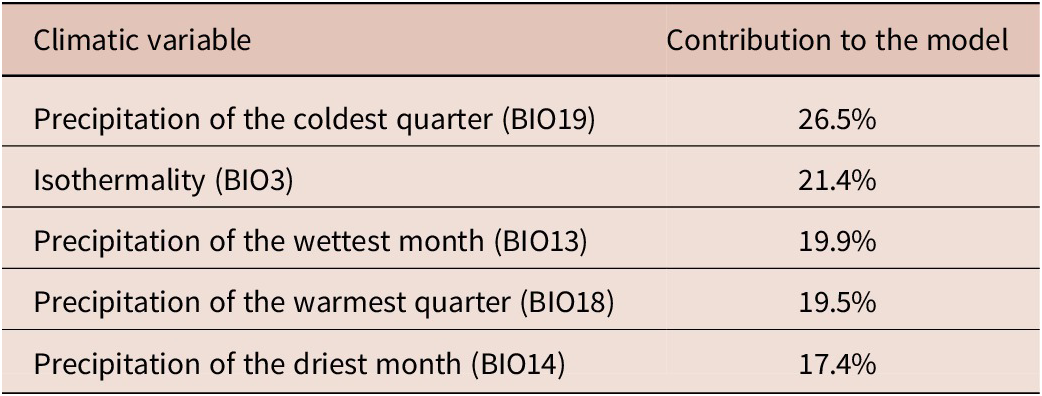
The climatic variables that contributed most to the model were precipitation of the coldest quarter (BIO19), followed by isothermality (BIO3), precipitation of the wettest month (BIO13), precipitation of the warmest quarter (BIO18), and precipitation of the driest month (BIO14) (Table 1, Supplementary Figure S1). Collectively, these variables accounted for the model’s total contribution, as measured by the accumulated informational gain in the MaxEnt algorithm. The model indicates that areas of medium to high environmental suitability for P. sceleratus encompass the eastern South American coast, the Caatinga, the Atlantic Forest, the Cerrado, the Chaco in Paraguay, Bolivia, and northern Argentina, as well as the open ombrophilous forest of the Amazon. These regions form a nearly contiguous arch across the species’ potential distribution. Additional areas of medium to high suitability were identified in the open formations of Chile (Figure 1).
Contribution of bioclimatic variables to the ecological niche model of Parapharyngodon sceleratus

Modelled current environmental suitability for Parapharyngodon sceleratus in South America. Suitability classes: Low (0.00–0.25), Medium Low (0.25–0.50), Medium High (0.50–0.75), and High (0.75–1.00).

Future scenarios projections
Under all three IPCC emission scenarios, we observed a progressive reduction in areas of high suitability (above the 0.67 threshold – Araújo and New Reference Araújo and New2007) and an increase in areas of medium and low suitability over time (Figures 2, 3, 4). These shifts were most pronounced in northern and central South America.
Projected environmental suitability for Parapharyngodon sceleratus under the optimistic climate scenario (SSP2-4.5) for three time periods: (a) 2021–2040, (b) 2041–2060, and (c) 2081–2100. Suitability classes: Low (0.00–0.25), Medium Low (0.25–0.50), Medium High (0.50–0.75), and High (0.75–1.00).

Projected environmental suitability for Parapharyngodon sceleratus under the intermediate climate scenario (SSP3-7.0) for three time periods: (a) 2021–2040, (b) 2041–2060, and (c) 2081–2100. Suitability classes: Low (0.00–0.25), Medium Low (0.25–0.50), Medium High (0.50–0.75), and High (0.75–1.00).

Projected environmental suitability for Parapharyngodon sceleratus under the pessimistic climate scenario (SSP5-8.5) for three time periods: (a) 2021–2040, (b) 2041–2060, and (c) 2081–2100. Suitability classes: Low (0.00–0.25), Medium Low (0.25–0.50), Medium High (0.50–0.75), and High (0.75–1.00).

In the optimistic scenario (SSP2-4.5, ~2.5°C warming), the model projects a decrease of approximately 25% in the area suitable for the species over time (Figure 2, Supplementary Figure S2). By the 2021–2040 period, regions of medium suitability in northern South America are projected to decline to low suitability, corresponding to a 25–50% loss (Figure 2a), with a further expansion of these low-suitability areas by 2081–2100 (Figure 2c). Areas currently classified as highly suitable in west-central Brazil, Bolivia, Paraguay, and Argentina transitioned to medium suitability, a change that was most pronounced in the 2081–2100 period (Figure 2). Suitable areas along the Brazilian coast showed relative stability, though some habitat suitability fragmentation is projected by the end of the century (Figure 2c). Additionally, small, fragmented areas of mild suitability gain were projected to emerge in Venezuela, the Brazilian Amazon, and the northern coastal region of Brazil over time (Figure 2).
The intermediate scenario (SSP3-7.0, ~4.1°C warming) showed a similar pattern of suitability loss and gain to the optimistic scenario, but with changes occurring earlier and more intensely (Figure 3, Supplementary Figure S3). A 45% loss of suitable areas was already evident by 2041–2060 in northern South America, the Brazilian Amazon, and the northern coast of Brazil (Figure 3b) – a pattern consistent with optimistic scenario projections for the end of the century. The model also predicted an expansion of low-suitability areas at the expense of medium-suitability areas by the 2081–2100 period (Figure 3c). While some suitability gains were similar to the optimistic scenario, the intermediate scenario projected a more notable increase in suitable areas within the Brazilian Amazon by 2081–2100 (Figure 3c).
Under the pessimistic scenario (SSP5-8.5, ~5°C warming), a slight decrease in suitable area is projected in the short term (2021–2040) (Figure 4a, Supplementary Figure S4). However, a more pronounced reduction in the overall availability of medium and high-suitability areas (35% of loss) is expected by 2081–2100, particularly across northern South America, west-central Brazil, Bolivia, Paraguay, and Argentina (Figure 4c). Over the long term, this level of warming may cause a marked shift from medium and high to low suitability in these regions (Figure 4, Supplementary Figure S4). Similarly, the projected gains in suitable areas within the Brazilian Amazon are also more pronounced under this scenario (Figure 4).
A notable finding across all future projections was the persistence of high habitat suitability in specific regions, regardless of the scenario or time period. These climatically stable areas include the northern coastal region of Brazil, the Atlantic Forest, and the open vegetation formations in Chile.
Discussion
We found that the current distribution of the nematode P. sceleratus is primarily influenced by precipitation variables, specifically those of the coldest quarter, wettest month, warmest quarter, and driest month, alongside isothermality. This underscores the importance of both rainfall regimes and temperature stability for the species’ occurrence. Our projections indicate that climate change is likely to reduce the species’ potential range (approximately 30–35% overall loss), predominantly through a decrease in climatic suitability across central Brazil and the southern Amazon.
Areas of high suitability (≥0.67) for Parapharyngodon sceleratus predominate in regions with seasonal tropical warm climates, but also extend into temperate zones characterised by dry summers and mild winters (see Tamayo-Ruiz et al. Reference Tamayo-Ruíz, García-Ramírez, Lucio-Ruiz, do Bonfim, Garcia and Charão2025). Although drier, these temperate regions appear to provide the minimum humidity and temperature conditions tolerated by the parasite. The primary contiguous area of high to medium suitability forms an arch that overlaps with the Aw (Tropical savanna), BSh (Arid, steppe, hot), Csa (Temperate, dry summer, hot summer), and Csb (Temperate, dry summer, warm summer) Köppen-Geiger climate categories. These categories are unified by a strongly seasonal climate with a distinct dry-rainy pattern (Beck et al. Reference Beck, Zimmermann, McVicar, Vergopolan, Berg and Wood2018). Consequently, our results associate the occurrence of P. sceleratus with specific precipitation regimes, suggesting an adaptation to climates with a pronounced dry season. Projected alterations to these regimes could therefore increase the vulnerability of this parasite to local extinctions.
Worms of the order Oxyurida are strictly monoxenous (Adamson Reference Adamson1990), and the development of their eggs in the environment is contingent upon favourable conditions of humidity and temperature (Anderson Reference Anderson2000). Consequently, climatic conditions are strongly linked to parasite loads, with rainfall identified as a key factor driving variation in parasite burden (e.g., Turner and Getz Reference Turner and Getz2010). For example, in ungulates, high parasite burdens are typically associated with the rainy season. In this case, however, rainfall may indirectly moderate transmission and host susceptibility by diluting parasite density through increased vegetation growth (Shearer and Ezenwa Reference Shearer and Ezenwa2020). In lizard-helminth systems, infection patterns also vary seasonally. Overall helminth loads were higher during the dry season in the lizards Tropidurus montanus (Václav et al., Reference Václav, Anjos, Queiróz, Nascimento and Galdino2017) and T. hispidus (Araujo-Filho et al., Reference Araujo-Filho, Brito, Lima, Pereira, Mesquita, Albuquerque and Almeida2017). Also, Pereira et al. (Reference Pereira, Sousa and Lima2012) proposed a mechanism where intense rainfall leaches eggs of Parapharyngodon bainae from the substrate surface, leading to low parasite prevalence and intensity during the rainy season. Our finding that low precipitation levels are a key component of highly suitable areas for P. sceleratus suggests a similar negative effect of rainfall on its transmission, potentially through egg leaching. This interpretation is corroborated by the low environmental suitability predicted for the perennially rainy/humid climates of the northern Amazon (Af Köppen-Geiger) and the consistently humid regions of southern Brazil and Uruguay (Cfa Köppen-Geiger).
Moreover, many neotropical lizards that host helminth parasites, from seasonal habitats, exhibit annual activity cycles with distinct periods of high and low activity (e.g., Filogonio et al. Reference Filogonio, Galdino, Cabral, Righi, Lopes and Nascimento2009). Consequently, parasite burden often fluctuates accordingly, typically increasing when lizards are more active (Lee et al. Reference Lee, Whiting and Leu2022). During these peaks in host activity, lizards more frequently engage in substrate licking and cloacal licking during intraspecific interactions (Watkins Reference Watkins1997), behaviours that enhance transmission (see Anderson Reference Anderson2000; Weaver Reference Weaver, Gardner and Gardner2024). Therefore, if heavy rainfall occurs during periods of low lizard activity (i.e., cold and/or dry conditions), the resulting leaching of P. sceleratus eggs would coincide with diminished chemical exploration of the substrate. This would reduce both the ingestion of eggs by hosts and the rate of direct transmission via cloacal licking. Hence, low precipitation during these colder or drier periods likely supports the persistence of P. sceleratus by enabling continued transmission when host behaviour would otherwise suppress it.
Isothermality (BIO3) was also an important predictor of habitat suitability for P. sceleratus, with intermediate values contributing most to the model. These intermediate values are characteristic of intertropical zones with moderate daily temperature variation relative to the annual range. Pharyngodonid worms release unembryonated eggs (Santos et al. Reference Santos, Argolo, Santos, Rodrigues, Gonzalez, Santos and Melo2019) that are passed into the external environment within the host’s faeces (e.g., Goldberg and Bursey Reference Goldberg and Bursey1992), where their subsequent development and viability depend upon favourable conditions (Anderson Reference Anderson2000). Temperature is a critical factor for the development and viability of helminth eggs (Lee et al. Reference Lee, Whiting and Leu2022; Maya et al. Reference Maya, Torner-Morales, Lucario, Hernández and Jiménez2012). For instance, eggs of the oxyurid Passalurus ambiguus showed low viability at lower temperatures (20–30°C), while exposure to a higher temperature (35°C) resulted in the development of a viable, motile larva (Yevstafieva et al. Reference Yevstafieva, Khorolskyi, Kravchenko, Melnychuk, Nikiforova and Reshetylo2022). We suggest that intermediate isothermality may represent more stable and optimal thermal conditions for the survival of P. sceleratus eggs. However, we cannot discount the covariation between isothermality and precipitation regimes, nor the potential synergistic effects of both variables on egg survival.
Alternatively, we cannot disregard the effect of isothermality on host distribution, as this variable is a known determinant of habitat suitability for lizards (Ceron et al. Reference Ceron, Mângia, Guedes, Alvares, Neves, Moroti, Torello, Borges-Martins, Ferreira and Santana2021; Oliveira et al. Reference Oliveira, Souza, de Sousa, Albano de Mello, Maia and de Andrade Lima2025; Sanchooli Reference Sanchooli2017). For the scincid lizard Notomabuya frenata, which inhabits central Brazil, isothermality was the most crucial factor defining its range. It was suggested that thermal stability influences N. frenata’s thermoregulation, life-history traits, and phenotypic plasticity (Pio Caetano Machado et al. Reference Pio Caetano Machado, de Oliveira Caetano, VHB, Miles and Rinaldi Colli2023). Furthermore, thermal stability can affect host immune competence (Bower et al. Reference Bower, Brannelly, McDonald, Webb, Greenspan, Vickers, Gardner and Greenlees2019). Thus, isothermality may influence the distribution of P. sceleratus indirectly through its effects on the abundance and physiological condition of its lizard hosts.
We found that the potential distribution of P. sceleratus is projected to contract under global warming, with the magnitude of this effect being dependent on the severity of warming and the time frame considered. Habitat suitability losses intensified with higher emission scenarios and over longer time periods, with the most severe contractions occurring under the combination of high warming levels and long-term projections. Under the optimistic SSP2-4.5 scenario (~2.5°C warming), the species’ range remained relatively stable until 2060 but faced a major contraction by the 2081–2100 period. This pattern of late-century range retraction was more pronounced under the intermediate SSP3-7.0 scenario (~4.1°C warming). The most extensive spatial loss occurred under the pessimistic SSP5-8.5 scenario (~5.0°C warming) by the end of the century (2081–2100).
The projected range contraction for P. sceleratus contrasts with forecasts for many other parasites. Climate warming has been linked to the range expansion of two nematode parasites in the Arctic (Kutz et al. Reference Kutz, Checkley, Verocai, Dumond, Hoberg, Peacock, Wu, Orsel, Seegers, Warren and Abrams2013). In other systems, projections indicate that future temperature increases may expand highly suitable areas for malaria occurrence (Van Der Deure et al. Reference Van der Deure, Nogués-Bravo, Njotto and Stensgaard2025). A key distinction is that these parasites’ transmission depends on an intermediate host or vector, whose populations may be positively affected by a warming climate, facilitating a range expansion. This mechanism does not apply to a monoxenous parasite like P. sceleratus, whose eggs are directly exposed to the external environment and its extremes. Therefore, our findings underscore that the direct exposure of monoxenic parasites to climatic variables may make them more vulnerable to range contraction under climate change compared to heteroxenic parasites.
Our results demonstrate a clear trend of progressive habitat loss with increasing severity of climate scenarios, with the most substantial range reductions consistently projected for the late-century period (2081–2100). The most severe contraction occurs under the high-emission scenario SSP5-8.5 during this period. The Fifth Assessment Report of the Intergovernmental Panel on Climate Change (IPCC) projected a global average temperature increase of up to 4.8°C by 2100 under a high-emission pathway (IPCC 2014). If P. sceleratus is representative of other monoxenic helminths with similar life-history constraints, our models suggest a high probability of numerous local extinctions among these lizard parasites. This, in turn, would lead to a significant loss of parasite biodiversity and a consequent impoverishment of helminth supracommunity composition across South American ecosystems if global temperatures reach the projected 4.8°C increase by 2100. In addition, studies have pointed out the vulnerability of lizard species to climate change, resulting in geographic range reductions (e.g., Diele-Viegas et al. Reference Diele-Viegas, Werneck and Rocha2019). Therefore, the reduction of P. sceleratus range could be magnified by the synergistic effects of both direct climate impacts on the parasite and indirect effects stemming from range restrictions of its lizard hosts. This creates a compounding extinction risk that may substantially exceed projections based on climatic suitability alone.
The geographical distribution of a species is determined by its physiological tolerance limits, which can be compromised by changes in temperature and precipitation (Walther et al. Reference Walther, Post, Convey, Menzel, Parmesan, Beebee, Fromentin, Hoegh-Guldberg and Bairlein2002). When stressed by such climatic shifts, species may adapt to new local conditions, face local extinction, or migrate to newly suitable areas (Hill et al. Reference Hill, Griffiths and Thomas2011). Rising temperatures, in particular, have driven significant distributional shifts for species globally (Becker-Scarpitta et al. Reference Becker-Scarpitta, Vissault and Vellend2019; Boisvert-Marsh et al. Reference Boisvert-Marsh, Périé and de Blois2019), including hosts and parasites. We have shown that the spatial distribution of P. sceleratus is strongly associated with precipitation regimes and temperature stability (isothermality), and that projected changes to these factors under climate change are likely to negatively impact this parasite species, causing range losses that intensify over time. If this monoxenic parasite is representative of others with similar environmental sensitivities, our findings signal a broader risk of range contraction and local extinctions for a suite of parasites directly exposed to climatic extremes, potentially simplifying parasite communities and disrupting existing host-parasite dynamics.
Supplementary material
The supplementary material for this article can be found at http://doi.org/10.1017/S0022149X2610131X.
Financial support
This work was carried out with financial support from the Coordenação de Aperfeiçoamento de Pessoal de Nível Superior (CAPES – 88887.708956/2022-00).