Introduction
Licorice (Glycyrrhiza spp.) is one of the most frequently used herbs, which contains about 30 recognized species being widely distributed around the world. Generally, the dried roots and rhizomes of Glycyrrhiza species have been used in various digestive complaints including stomach ulcers, heartburn, colic and chronic gastritis (Raveendra et al., Reference Raveendra, Jayachandra, Srinivasa, Sushma, Allan, Goudar, Shivaprasad, Venkateshwarlu, Geetharani, Sushma and Agarwal2012). Glycyrrhizic acid or glycyrrhizin is one of the main bioactive substance present in the Glycyrrhiza species, which mostly ranges from 1 to 9% depending on the species and geographical growth conditions (Fiore et al., Reference Fiore, Eisenhut, Krausse, Ragazzi, Pellati, Armanini and Bielenberg2008).
In general, the licorice species were identified by morphological characteristics of roots. Glycyrrhizin, a marker component of licorice, has also been used to identify the species but the component variations appear depending on the growth environment. Ashurmetov (Reference Ashurmetov1996) reported that G. lepidota occupies an intermediate position between glycyrrhizin-producing species (G. glabra and G. uralensis) and macedonoside C-producing species (G. echinata and G. pallidiflora). Several researches have also been performed for diversity assessment in which the molecular markers have been considered as efficient for phylogenetic studies in above-species level (Powell et al., Reference Powell, Morgante, McDevitt, Vendramin and Rafalski1995).
Chloroplast microsatellite (cpSSR) markers were mostly distributed throughout non-coding regions, which showed high sequence variation (Powell et al., Reference Powell, Morgante, McDevitt, Vendramin and Rafalski1995). In addition, cpSSR markers developed from a species can be used to amplify homologous regions across related taxa (Diekmann et al., Reference Diekmann, Hodkinson and Barth2012). In the present study, we report the development and characterization of cpSSR markers for the molecular classification among Glycyrrhiza species to facilitate their identification for conservation.
Experimental
A total of 27 accessions from Glycyrrhiza species [G. uralensis (11), G. lepidota (7), G. glabra (5), G. echinata (2) and unclassified G. spp. (2)] were obtained from the Ginseng Research Division of National Institute of Horticultural and Herbal Science, RDA, South Korea and USDA-ARS.
The cpSSR loci of G. lepidota were obtained from the cp genome (NCBI Accessions No.: NC_034229) according to the method mentioned in the previous study (Raveendar et al., Reference Raveendar, So, Lee, Lee, Sung and Chung2017). Among them, 25 cpSSRs for proper PCR conditions were selected. The primer design parameters were set as follows: length range, 18–23 nucleotides with 21 as the optimum; PCR product size range, 200–300 bp; optimum annealing temperature (T a), 55°C; and GC content 50–60%, with 51% as the optimum.
To determine the variability of the cpSSRs, genomic DNA of the 27 Glycyrrhiza accessions was extracted from leaves using a GenEX Plant Kit (Geneall, Seoul, Korea) following the manufacturer's instructions. Amplification reactions were performed in 20 µl total volume using 40 ng of template DNA, 1× reaction buffer containing 1.5 mM MgCl2, 0.25 uM each primer, 0.05 uM dNTP and 0.1 U Taq DNA polymerase. DNA was amplified with the following thermal profile: one denaturation cycle of 3 min at 94°C, followed by 25 cycles each consisting of 94°C for 30 s, 55°C for 45 s, 72°C for 60 s with a final extension step at 72°C for 15 min. Fragment lengths were determined using Fragment Analyzer (Advanced Analytical Technologies, Ankeny, IA, USA).
The number of observed alleles (N A) for each SSR locus was counted for all Glycyrrhiza accessions. The effective number of alleles (N E = 1/(ΣPi2)), the Shannon index (I = –ΣPi ln Pi, Pi: the frequency of the i allele), diversity index (h = 1–ΣPi2) and unbiased diversity (uh = N/(N–1) h) were calculated using GenAlEx 6.5 (Peakall and Smouse, Reference Peakall and Smouse2006). An unweighted pair group method with an arithmetic mean (UPGMA) dendrogram was constructed by PowerMarker version 3.25 (Liu and Muse, Reference Liu and Muse2005) and visualized the phylogenetic distribution of accessions using MEGA version 5.03 software (Tamura et al., Reference Tamura, Dudley, Nei and Kumar2007).
Discussion
A total of 25 cpSSR markers amplified on 27 Glycyrrhiza accessions were shown in online Supplementary Table S1. Among them, 20 primers exhibited polymorphic amplification of fragments in all accessions. In total, 88 alleles were detected in 20 cpSSR markers among the 27 samples. Number of alleles (N A) ranged from two to eight, and the effective number of alleles (N E) was calculated from 1.163 to 4.829. Shannon's index (I) for each cpSSR ranged from 0.315 to 1.694, while the diversity indices (h) and unbiased diversity (uh) ranged from 0.140 to 0.793 and 0.145 to 0.825, respectively.
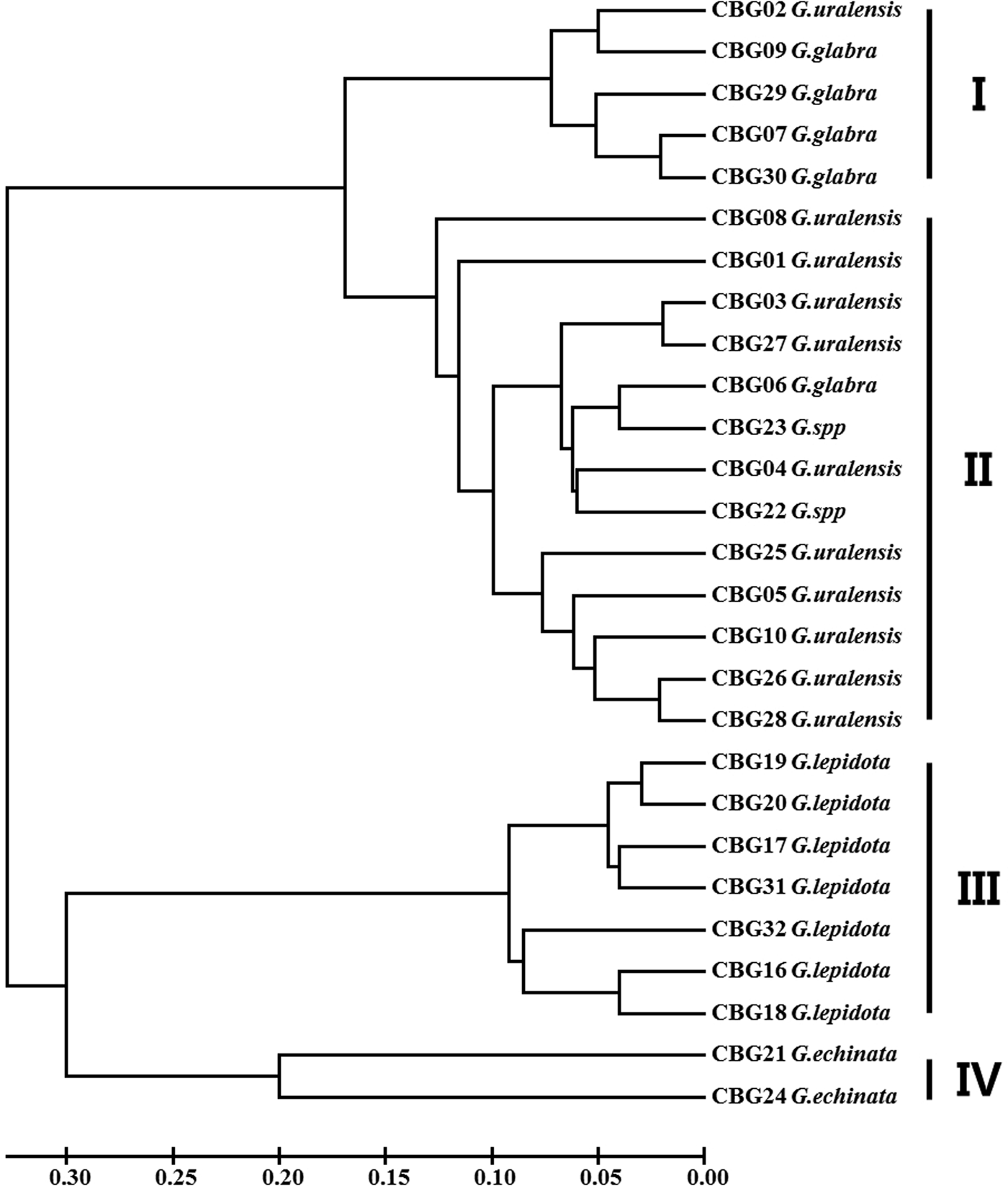
The genetic relationship assessment and classification of Glycyrrhiza species based on the cpSSR markers were shown in Fig. 1. The resulting dendrogram divided the 27 Glycyrrhiza accessions into four groups as mostly expected based on the passport data. The Cluster I consists of four G. glabra accessions with a G. uralensis accession, whereas Cluster II consists of 10 G. uralensis accessions and two unclassified G. spp accessions with a G. glabra accession. The inclusion of G. uralensis accession (CBG02) in Cluster I and G. glabra accession (CBG06) in Cluster II might be misclassified, since based on the records, they were classified clearly to be with G. uralensis and G. glabra accessions, respectively. On the other hand, Clusters III and IV consisted of G. lepidota and G. echinata accessions, respectively, which makes them individual clusters. The dendrogram also revealed four groups which can be further divided into two subgroups. G. glabra and G. uralensis accessions were more closely related; whereas G. lepidota and G. echinata accessions showed much closer than the other two species.
UPGMA dendrogram of Glycyrrhiza species based on 21 cpSSR marker data.

DNA sequence-based markers have practical advantages for the authentication of plant species (Jung et al., Reference Jung, Kim, Yang, Bang and Yang2014). They can be used efficiently to differentiate similar medicinal plants or their products using small amounts of sample in a time and cost-effective manner. The cpSSR markers developed in this study successfully classified 27 Glycyrrhiza accessions into four clusters in the UPGMA dendrogram. The clustering analysis have also coincided with the previous research, in which four Glycyrrhiza species (G. lepidota, G. glabra, G. uralensis and G. echinata) were classified according to their chemical constituents (Ashurmetov, Reference Ashurmetov1996).
In general, organellar DNA markers were considered more reliable for taxonomic identification because of their conserved nature (Green et al., Reference Green, Vardi and Galun1986; Cheng et al., Reference Cheng, de Vicente, Meng, Guo, Tao and Deng2005). The polymorphic cpSSR markers developed in this study based on G. lepidota chloroplast genome could be used for identification of Glycyrrhiza species, which will facilitate the conservation strategy within the Glycyrrhiza genus.
Supplementary material
The supplementary material for this article can be found at https://doi.org/10.1017/S1479262118000308.
Acknowledgement
This work was carried out with the support of ‘Cooperative Research Program for Agriculture Science & Technology Development (Project No. PJ01028801)’ Rural Development Administration, Republic of Korea.