


Introduction
The experience of hearing a voice with a compelling sense of reality in the absence of an appropriate external stimulus, formally termed an auditory verbal hallucination (AVH), can often be a highly distressing experience. Although around 70% of people diagnosed with schizophrenia will experience AVHs (Slade and Bentall, Reference Slade and Bentall1988; Baethge et al., Reference Baethge, Baldessarini, Freudenthal, Streeruwitz, Bauer and Bschor2005), and their occurrence has been documented for millennia (McCarthy-Jones, Reference McCarthy-Jones2012), their causes still remain poorly understood and clinical interventions remain incompletely effective (Shergill, Murray and McGuire, Reference Shergill, Murray and McGuire1998; Sommer et al., Reference Sommer, Slotema, Daskalakis, Derks, Blom and van der Gaag2012). One particular challenge for the development of causal models of AVHs, and auditory hallucinations (AHs) more generally (i.e. including hearing non-verbal sounds such as clicks, bangs and laughter) is the phenomenological diversity of the experience (Jones, Reference Jones2010; Larøi, Reference Larøi2006). Existing cognitive models are typically able to account for the phenomenology of a subset of AHs, but not all of them (Jones, Reference Jones2010). Whilst it is possible that a single unified model of AHs may be possible, an alternative is that there are distinct AH-subtypes that require different models to account for them. For example, Jones’ (Reference Jones2010) review notes the possibility that some AVHs may be grounded in inner speech, whilst others may be the result of intrusive memories (potentially due to traumatic life-events). The existence of such subtypes would have important implications for treatment specificity, and would reinforce the importance of AH theories and therapies sharing a mutually enhancing relationship (Garety, Kuipers, Fowler, Freeman and Bebbington, Reference Garety, Kuipers, Fowler, Freeman and Bebbington2001).
To date only two studies have empirically tested for the existence of AH-subtypes (McCarthy-Jones et al., Reference McCarthy-Jones, Trauer, Mackinnon, Sims, Thomas and Copolov2012; Stephane, Thuras, Nasrallah and Georgopoulos, Reference Stephane, Thuras, Nasrallah and Georgopoulos2003). Stephane et al.'s exploratory study, which was significantly underpowered, identified two AVH-subtypes. The first was characterized by having repetitive content, low linguistic complexity (hearing single words), an outer space location, clear acoustics, being accompanied by other hallucinations, and being attributed to the self. The second had systematized (i.e. non-repetitive) content, high and intermediate linguistic complexity (hearing sentences and conversations), an inner space location, involved multiple voices, were episodic (i.e. were not constant), spontaneous (i.e. did not have clear triggers), and were attributed to another person. A more recent study by McCarthy-Jones et al. (Reference McCarthy-Jones, Trauer, Mackinnon, Sims, Thomas and Copolov2012) found evidence for four subtypes of auditory hallucinations: constant commanding and commenting AVHs; replay AVHs (those identified by the hearer as being identical to previously heard words/conversations); own thought AVHs (which did not address the hearer, spoke in the first person, being like one's own inner voice/thoughts and similar to a memory); and non-verbal AHs (sounds, voices that sound like gibberish). However, neither of these studies entered variables into their cluster analysis that would have allowed them to empirically test a recently proposed AH-subtype, those that Dodgson and Gordon (Reference Dodgson and Gordon2009) have termed as hypervigilance hallucinations (HV-AHs).
HV-AHs are proposed to result from an exaggeration of the normally adaptive perceptual bias humans evolved to detect threat (Dodgson and Gordon, Reference Dodgson and Gordon2009). In Dodgson and Gordon's model, an immediate precipitator, such as a stressful life-event or drug use, triggers an emotionally distressing, aroused state in an individual. The individual then becomes hypervigilant for threat stimuli, reducing their threshold for detecting threats in the environment and increasing the chance of auditory “false-positives”, i.e. hearing things that confirm current beliefs around fears of persecution or public exposure of shaming information. This can then lead to the experience of HV-AHs that are characterized phenomenologically by hearing either a voice or sounds (e.g. laughter) with threatening content, which is perceived as coming from the external environment. Given the role of hypervigilance, the theory makes the key prediction that HV-AHs will only occur in situations where the individual's attention is externally-focused. It also makes the further postulate that noisy, arousing social environments containing ambiguous noise will encourage the occurrence of HV-AHs. This theory does not predict that other AH-subtypes could not also be experienced in noisy, arousing social environments, nor that HV-AHs could not be heard in a quiet context (e.g. at night in a quiet environment, when one's attention is focused externally) but rather that a specific combination of personal (external focus of attention) and environmental factors (noisy environment) will be more likely to result in HV-AHs.
Dodgson and Gordon (Reference Dodgson and Gordon2009) proposed the existence of HV-AHs based on clinical observations and individual case studies. Although there has been supportive, unpublished analogue research into the effects of arousal on auditory threat detection (Bolas, Dodgson and Dudley, Reference Bolas, Dodgson and Dudley2010) there has yet to be any formal empirical investigation of the existence of HV-AHs. However, the cognitive mechanisms proposed to underpin HV-AHs lead to a specific prediction, which existing empirical work already supports, namely that many patients with schizophrenia with AHs should have specific attentional biases for auditory stimuli, and furthermore offers a meaningful explanation for the presence of such biases that other studies have not provided. The proposal that attentional changes may be specifically associated with the symptom of AHs has previously been made by Dolgov and McBeath (Reference Dolgov and McBeath2005). They suggested that attentional processes may shift the decision criteria in patients with AVHs in order to create a decrease in misses (the stimulus not being detected when it is actually there) as well as a corresponding increase in false alarms (hallucinations). This was empirically tested by Vercammen, de Haan and Aleman (Reference Vercammen, de Haan and Aleman2008), using a speech-based signal detection task. Vercammen et al. found that although patients with schizophrenia with AVHs (SZ:AVH+) had worse perceptual sensitivity than healthy controls, they performed better than patients with schizophrenia without AVHs. Vercammen et al. explained this finding by arguing that patients with AVHs may scan their environment for auditory stimuli more than patients without AVHs, but did not suggest why this may be the case. Here, Dodgson and Gordon's (Reference Dodgson and Gordon2009) proposal that patients with AVHs are scanning the environment for threats due to previous negative life-events may provide an answer. Indeed, the association between AVHs and stressful/traumatic life events is well established (Read, Agar, Argyle and Aderhold, Reference Read, Agar, Argyle and Aderhold2003; Bentall, Wickham, Shevlin and Varese, Reference Bentall, Wickham, Shevlin and Varese2012).
A second explanation offered by Vercammen and colleagues for their finding was that it resulted from an increased imagery–perception interaction in SZ:AVH+. Imagery-perception interaction refers to the increased likelihood that a perception of x will take place after x has just been imagined. In a previous study Aleman, Böcker, Hijman, de Haan and Kahn (Reference Aleman, Böcker, Hijman, de Haan and Kahn2003) had investigated this using an signal detection task with SZ:AVH+, finding that severity of AVHs in patients correlated with their levels of imagery-perception interaction. Specifically, patients with more severe AVHs were more likely to perceive an auditory stimulus in white noise after they had been imagining it. As has been previously noted (McCarthy-Jones, Reference McCarthy-Jones2012), this result can be used to expand Dodgson and Gordon's (Reference Dodgson and Gordon2009) HV-AH model. If a person is monitoring for the occurrence of threatening words/phrases then representations of these words/phrases are likely to be more highly activated, more accessible, and more likely to enter consciousness (Wegner and Wenzlaff, Reference Wegner, Wenzlaff, Higgins and Kruglanski1996). In people with an increased imagery-perception interaction, this may make the (mis-)detection of these word/phrases in the external environment more likely, potentially leading to HV-AHs. Furthermore, as a recent meta-analysis by Brookwell, Bentall and Varese (Reference Brookwell, Bentall and Varese2012) found a consistent bias in the ability to discriminate between internally and externally generated perceptions in hallucination-prone individuals, this source-monitoring bias may also play a role in highly activated internal representation of threatening words/phrases being experienced as externally generated perceptions.
Given the cogent theoretical underpinnings of the HV-AH hypothesis, support for their existence already garnered from clinicians’ experience (Dodgson and Gordon, Reference Dodgson and Gordon2009), and the failure of previous cluster analytic studies to include variables relevant to this AVH-subtype, there is thus now the need for an exploratory empirical study of their existence. The present study aimed to undertake this. We hypothesized that if a cluster analysis were performed on four specific properties of individual AHs and the context in which they occur, namely their location (internal, external), their threat-based nature (threatening, non-threatening), their context (noisy background sounds, quiet background sounds), and the individual's locus of attention (external, internal), then a cluster would be found that would be characterized by externally-located, threatening AHs occurring in the context of a noisy background and when the person's attention was externally-located. As such a cluster would characterize a HV-AH, the presence of such a cluster would offer support for the HV-AH model. Conversely, a failure to find such a cluster would offer a falsification of the model.
Method
Participants
Fifteen participants (12 male), with a mean age of 27.69 years (SD = 10.39, range 16–48), were recruited from Early Intervention in Psychosis services and secondary care community mental health teams. Twelve were experiencing AHs at the time of the interview, with the remaining three having heard voices within the past 3 months. The mean number of weeks since the AHs that the participants chose to describe in detail was 99.72 (SD = 231.92, range 0–1040 weeks). Thirteen of the participants were currently taking antipsychotic medication.
Procedure and measures
Owing to the absence of a pre-existing assessment tool that specifically addressed all the dimensions of the phenomenology of auditory hallucinations (AHs) relevant to HV-AHs, a bespoke semi-structured interview (available on request) was developed. For example, neither the structured interview developed by Nayani and David (Reference Nayani and David1996), nor the comprehensive 365-item Mental Health Research Institute Unusual Perceptions Schedule (MUPS; Carter, Mackinnon, Howard, Zeegers and Copolov, Reference Carter, Mackinnon, Howard, Zeegers and Copolov1995) assesses all the key variables relevant to HV-AHs. This is understandable, because only now is the theory underpinning HV-AHs informing phenomenological investigations of AVHs.
Our measure was piloted to develop validity in relation to the main objectives and usability with participants, including consultation with a service-user led organization. The first section of the semi-structured interview was concerned with general questions about frequency of, and belief about, AHs, experience of services, drug use, and coping mechanisms. The second section asked participants to generate specific examples of incidents of AHs, such as the first or the most recent experience. They were then asked to describe this incident and were prompted by the lead researcher for additional information if needed. The second section was repeated to gather multiple experiences from each participant. The four variables relevant to this study were conceptualized as binary variables and assessed through discussions with patients, beginning with the following probe questions: Focus of attention (internal, external): “Were you paying attention to things around you or your own thoughts?”; Context (quiet, noisy): “What was happening?”; Level of voice-threat (threatening, non-threatening): “What did the voice say?”, “What did the voice sound like” and “How did you feel during the experience?”; Location of voice: “Where did it sound like the voice was coming from?”.
The lead researcher met with participants for a one-off session, either at home or at a service-base, to undertake the interview, which usually lasted around 90 minutes. Written consent was gained before starting the interview and sessions were audio-recorded with participant consent.
Data analysis
Individual instances of AHs were the “objects” subjected to cluster analysis using ClustanGraphics (Wishart, Reference Wishart2006). We clustered events, rather than people, because it was possible that the same person may have a number of different subtypes of AHs, as noted by McCarthy-Jones et al. (Reference McCarthy-Jones, Trauer, Mackinnon, Sims, Thomas and Copolov2012). As the data were binary, Jaccard's co-efficient was used as the proximity coefficient, and Ward's method as our hierarchical clustering method. The number of clusters to be extracted was to be informed by both inspection of the dendogram as well as the objective criterion offered by ClustanGraphics, namely Mojena's upper tail rule.
Results
A total of 32 individual AH-events were collected from the 15 participants, with 9 participants generating 2 events, 4 generating 3 events, and 2 generating 1 event. The events recalled ranged in recency from the same day as the interview to a first experience of AH that had occurred approximately 20 years earlier.
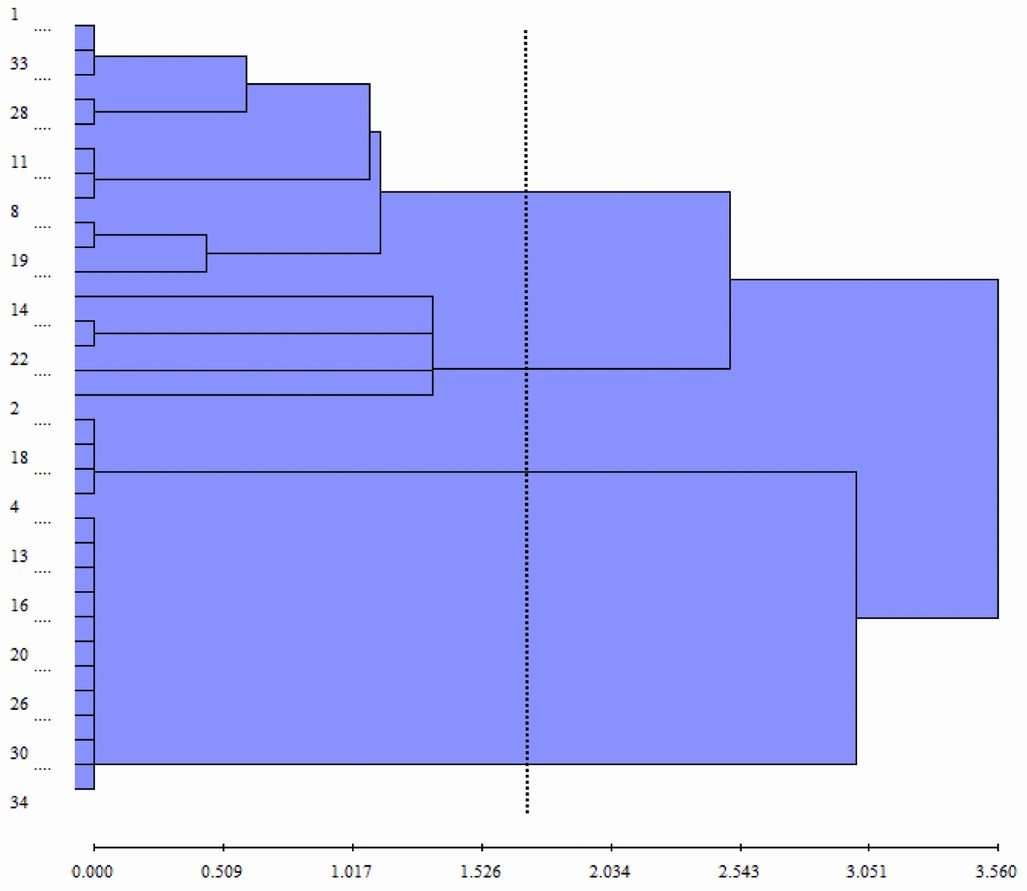
Data from the 32 events were subjected to cluster analysis across responses to the four variables, as predicted by the hypervigilance model: focus of attention (internal, external), context (noisy, quiet), location of voice (internal, external), and content (threatening, not-threatening). The resultant dendogram is presented in Figure 1. Inspection of the dendogram suggested that four clusters should be extracted, but Mojena's upper tail rule suggested that nine clusters should be extracted, t(30) = 3.25, p<.05. Given the small sample size, the existence of four clusters appeared to be more likely to result in meaningfully interpretable clusters, and hence four clusters were extracted.
Dendogram of cluster analysis Note: Vertical dashed line represents the subjective point at which we segmented the dendogram into distinct clusters

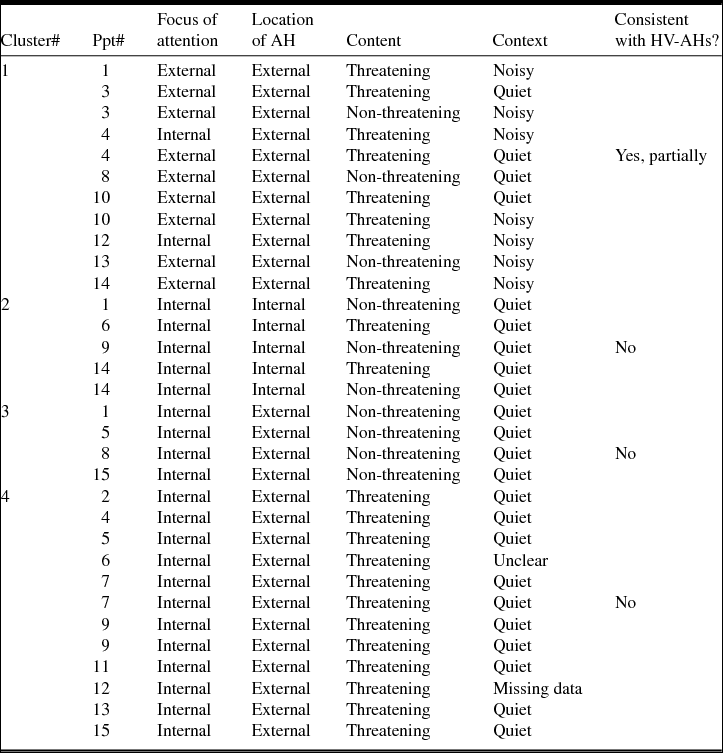
The distribution of the four properties entered into the cluster analysis for the 32 AH-events across the four clusters is shown in Table 1. As can be seen from Table 1, Cluster 1 was characterized by externally located voices or sounds, which were typically threatening, occurring during a range of environment noise levels (both noisy and quiet) when the person's attention was externally focused. Thus, although there was some variance within this group, this cluster appears to approximate the predicted HV-AH cluster.
Clusters of individual auditory hallucination events

Notes: AH = Auditory hallucination; HV-AH = Hypervigilance auditory hallucination
Cluster 2 was characterized by internally located voices with a mix of threatening and non-threatening voices, occurring when attention was internally focused, in a quiet environment. Cluster 3 comprised externally located, non-threatening voices occurring during an internal focus of attention in a quiet environmental context. Cluster 4 comprised externally located, threatening voices occurring during an internal focus of attention in a quiet environmental context. Cluster 1 contained 34% of the 32 AH-events; Clusters 2, 16%; Cluster 3, 13%; Cluster 4, 37%. Five participants had AHs in only one cluster, nine had AHs in two clusters, and one participant had AHs in three clusters. Of the eight people who had HV-AHs, six (75%) also reported AHs that fell into other clusters.
Discussion
The aim of the current study was to test for the proposed existence of HV-AHs using cluster analysis. The first cluster we identified was partially consistent with the proposed phenomenology of HV-AHs. AHs in this cluster were consistent with HV-AHs in that they typically consisted of externally-located, threatening voices, occurring when the person's attention was externally focused. Although Dodgson and Gordon's (Reference Dodgson and Gordon2009) published theory of HV-AHs predicts that they should predominantly occur in a noisy context, 36% of the AHs in this cluster occurred in a quiet context. One interpretation of this finding is that there may be the need to extend the model of HV-AHs to acknowledge that they may occur in both quiet and noisy contexts. Hypervigilance processes, although likely to more often result in false positives in noisy contexts, may be sufficient, in conjunction with active threat-detection (especially if the individual has an increased imagery–perception interaction), to result in false positives in quiet settings with minimal external stimulation. Indeed, this is consistent with our clinical experience in which AHs that can be conceptualized as HV-AHs can be seen to occur when clients are in a quiet situation at home, but actively looking for threat (e.g. hearing voices when monitoring people walking past the house at pub closing, and listening out for what neighbours are saying through thin walls pertaining to your salient concerns, such as, to take an example from clinical practice, that one is not the real father of one's child). However, an alternative interpretation is that this heterogeneity argues against the existence of a clear HV-AH subtype. Even if such an interpretation were correct, given the predominance of externally-located attention in this cluster, it is possible that hypervigilance processes may play a role in a subset of AHs, even if not in association with the other pattern of variables (threat, noise, externally located AHs) predicted by Dodgson and Gordon's (Reference Dodgson and Gordon2009) hypervigilance model. Experimental work into the role of hypervigilance and anxiety processes in creating false positives on signal detection tasks would hence be a direction for fruitful further research (e.g. Dudley, Dodgson, Sarll, Halhead and McCarthy-Jones, Reference Dudley, Dodgson, Sarll, Halhead and McCarthy-Jones2013).
It is also worth noting the other clusters we found, and how these can be theoretically accounted for. Given that Dodgson and Gordon's (Reference Dodgson and Gordon2009) model of HV-AHs primarily characterizes them as occurring when the person has an external locus of attention in a noisy environment, it is notable that the three other clusters found were all characterized by occurring when the participant's attention was internally focused, in a quiet context. The differences between these three other clusters lay at the level of content (Cluster 4 was only differentiated from Cluster 3 by the threatening nature of the AH), and the location of the voice (Cluster 2 was primarily differentiated from Clusters 3 and 4 by the voices being heard internally, as opposed to externally). Given the common internal focus of attention and quiet environment characterizing these three clusters of AHs, it appears possible that they may share common underlying cognitive processes, which differ from those involved in HV-AHs. These may be better modelled by traditional inner speech models of AHs (e.g. Seal, Aleman and McGuire, Reference Seal, Aleman and McGuire2004; Jones and Fernyhough, Reference Jones and Fernyhough2007), with processes associated with internal attention, such as hyper-reflexivity, also potentially playing a role (Sass, Reference Sass1992).
These findings may be used to tentatively suggest an extension of a recent model of AHs proposed by Waters et al. (Reference Waters, Allen, Aleman, Fernyhough, Woodward and Badcock2012). This model argues that specific types of mentation (e.g. inner speech, intrusive memories) create an initial auditory signal, and that hypervigilance and other temporally-downstream processes lead to the person accepting these signals as real, resulting in an AH. In contrast, our findings suggest rather than being a temporally downstream process, hypervigilance may actually be one of two ways in which the initial auditory signal could be created. In HV-AHs, hypervigilance processes may create the initial auditory signal, whereas in our three non HV-AH clusters (which shared the properties of occurring during an internal focus of attention and quiet environment) spontaneous inner mentation resulting from inner speech and memory may form the basis of the initial auditory signal. In this sense, these two broad classes of AH (HV-AH and non HV-AH) would have unique features (how the initial auditory signal is created) but also extensive shared features in terms of how this signal is transformed into an AH. A given individual who possesses the neurocognitive factors that can transform either form of such initial auditory input into AHs, should hence be at risk of both HV-AHs and non HV-AHs (as either form of input could be transformed into AHs). This would be consistent with our finding that 75% of patients with HV-AHs also reported non HV-AHs.
This exploratory study had a number of limitations. First, the study had a small sample size, potentially impacting upon the reliability of our cluster analysis. Although there are no formal rules as to what the ratio of events to variables should be, a general rule of thumb would be at least 10:1, and possibly greater when using binary data including items with low endorsement rates. Our study, which clustered four variables over 32 AH-events, only had a ratio of 8:1, and hence the results of this study are tentative and in need of replication in a larger sample. Second, primary reliance upon the dendogram rather than Mojena's upper tail rule increased the subjectivity of the decision regarding how many clusters to extract, potentially introducing bias into the study. However, this was felt justified by the need to have an interpretable set of clusters in order for the results to be useful. A third limitation was a technical issue; it could be argued that HV-AHs are not strictly hallucinations, and that instead as they are misperceptions of background noise, they are actually illusions. However, the definition of a hallucination is a perception in the absence of an appropriate external stimulus. In the example of an HV-AH given by Dodgson and Gordon (Reference Dodgson and Gordon2009) in which a patient heard the word “nonce” (slang for “paedophile”) in background noise, such noise could not be said to be the “appropriate external stimulus” to result in hearing such a voice. Even if one did wish to classify such experiences as illusion, they are still clinically relevant and it is important to both understand them and offer patients a way to cope with them, irrespective of nomenclature. Fourth, the AHs the participants were reporting on were on average almost 2 years old. Participants’ descriptions of their AHs were hence open to bias and may have lacked accuracy. There is therefore the need to replicate this study using patients’ report of more contemporaneous AHs. Fifth, whereas we classified locus of attention as a binary variable, it is possible that participants may not have had their attention entirely either solely internally or externally focused. Experience sampling methods may be needed to get a more accurate assessment of momentary locus of attention. A sixth limitation of the study is that there are difficulties in defining criteria for establishing a subtype of an essentially subjective phenomenon. However, the theory for HV-AHs arose from clinical observations (Dodgson and Gordon, Reference Dodgson and Gordon2009), meaning that the criteria selected emerged from a collaborative interaction between clinician and client. A final limitation to our approach was that cluster analysis will always yield solutions, and this raises the problem of “rubbish in, rubbish out”. However, our study attempted to avoid this problem by picking specific variables based on pre-existing theory. As it was also possible that nothing approximating the predicted pattern of variables representing HV-AH would emerge from the analyses, the study was testing a falsifiable hypothesis.
In conclusion, this study found tentative support for the existence of HV-AHs, but suggested that this model may need extending to allow that such AHs can occur in both quiet and noisy contexts. Although the study was exploratory, and had a number of limitations and requires replication in a further study with an improved design, it offers impetus for future study into this subtype of AHs. If the existence of HV-AHs is also supported by future studies, this will have important implications for clinical practice, particularly for assessment and treatment. As the underlying cognitive mechanism of HV-AHs is the perceptual error made when under threat, the proposed treatment for this AH-subtype would be to seek to reduce arousal and reduce the likelihood of making that perceptual error. A treatment package for HV-AHs could involve idiosyncratic formulation that includes psychoeducation about the proposed explanation for HV-AHs as a way of normalizing and challenging beliefs about the experiences.



Comments
No Comments have been published for this article.