1. Introduction
Northeastern China is well known for its widespread Mesozoic igneous rocks, commonly known as a super-giant granitic province (Şengör & Natal'in, Reference Şengör, Natal'in, Yin and Harrison1996; Wu et al. Reference Wu, Jahn, Wilde, Lo, Yui, Lin, Ge and Sun2003a , b). This super-giant granitic province extends from NE China, through the Da Xingan Range to eastern Mongolia (Shatkov et al. Reference Shatkov, Solovyev, Shatkova, Yakobson and Marinov1980; Filippova, Suetenko & Khasin Reference Filippova, Suetenko, Khasin and Marinov1984; Kovalenko & Yarmolyuk, Reference Kovalenko and Yarmolyuk1990; Yarmolyuk, Kovalenko & Ivanov, Reference Yarmolyuk, Kovalenko and Ivanov1995; Li, Reference Li2000; Wu et al. Reference Wu, Lin, Wilde, Zhang and Yang2005, Reference Wu, Sun, Ge, Zhang, Grant, Wilde and Jahn2011a ; Dash et al. Reference Dash, Yin, Neng Jiang, Tseveendorj and Han2015). The evolution history of the Central Asian Orogenic Belt, circum-Pacific and Mongol–Okhotsk tectonic systems in NE China was documented by these igneous rocks closely associated with mineralization, which has become a research hotspot over the past two decades (Han et al. Reference Han, Wang, Jahn, Hong, Kagami and Sun1997; Wu et al. Reference Wu, Jahn and Lin1998, Reference Wu, Jahn, Wilde and Sun2000, Reference Wu, Sun, Li, Jahn and Wilde2002, Reference Wu, Jahn, Wilde, Lo, Yui, Lin, Ge and Sun2003a , b, Reference Wu, Jiang, Liu and Liu2014, Reference Wu, Jiang, Liu, Zhang and Zhou2015; Chen et al. Reference Chen, Jahn, Wilde and Xu2000, Reference Chen, Zhang, Wan, Wu and Cleven2011; Hu et al. Reference Hu, Jahn, Zhang, Chen and Zhang2000; Jahn, Wu & Chen, Reference Jahn, Wu and Chen2000; Jahn, Wu & Hong, Reference Jahn, Wu and Hong2000; Jahn et al. Reference Jahn, Wu, Capdevila, Martineau, Wang and Zhao2001, Reference Jahn, Capdevila, Liu, Vernov and Badarch2004, Reference Jahn, Litvinovsky, Zanvilevich and Reichow2009; Ge et al. Reference Ge, Wu, Zhou and Zhang2005; Li et al. Reference Li, Gao, Sun, Li and Wang2007; Dai et al. Reference Dai, Mao, Zhao, Li, Wang, Xie and Yang2008; Zhai et al. Reference Zhai, Liu, Wang, Peng, Wang, Li and Chang2009, Reference Zhai, Wang, Liu, Wu, Mao, Wang and Li2010; Zhou, Ge & Wang, Reference Zhou, Ge and Wang2011; Mao et al. Reference Mao, Pirajno, Lehmann, Luo and Berzina2014). However, the origin and tectonic setting of the granitoids remains poorly understood. Four possible explanations have been proposed to account for the tectonic setting of the granitic province: (1) a westwards subduction of the Pacific plate (eg. Jiang & Quan, Reference Jiang and Quan1988; Wu et al. Reference Wu, Jahn, Wilde and Sun2000; Zhang et al. Reference Zhang, Ge, Wu, Wilde, Yang and Liu2008a ; Zeng et al. Reference Zeng, Liu, Qin and Zhang2010, Reference Zeng, Liu, Zhang, Chen and Zhang2011a ; Wu et al. Reference Wu, Jiang, Liu and Liu2014, Reference Wu, Jiang, Liu, Zhang and Zhou2015); (2) a southwards subduction of the northern Mongolia–Okhotsk ocean plate (eg.Wang et al. Reference Wang, Liu, Wang and Song2002, Reference Wang, Zhou, Zhang, Ying, Zhang, Wu and Zhu2006a ; Meng Reference Meng2003; Yang et al. Reference Yang, Guo, Wang, Zeng, Zhang, Tong, Shi and Zhang2014); (3) a post-orogenic extensional collapse of the Central Asian orogenic belt (Fan et al. Reference Fan, Guo, Wang and Lin2003; Wu et al. Reference Wu, Jahn, Wilde, Lo, Yui, Lin, Ge and Sun2003b ; Lin et al. Reference Lin, Ge, Wu, Sun and Cao2004); or (4) an anorogenic setting (Dobretsov & Vernikovsky, Reference Dobretsov and Vernikovsky2001; Shao et al. Reference Shao, Mu, Zhu and Zhang2010). All of those explanations are based on the viewpoint that delamination (Wang et al. Reference Wang, Zhou, Zhang, Ying, Zhang, Wu and Zhu2006a ), recycling of continental crust (Zhang et al. Reference Zhang, Han, Chen and Xu2012) and regional extension (Wu et al. Reference Wu, Lin, Wilde, Zhang and Yang2005) together gave rise to the widespread Jurassic–Cretaceous granitoid.
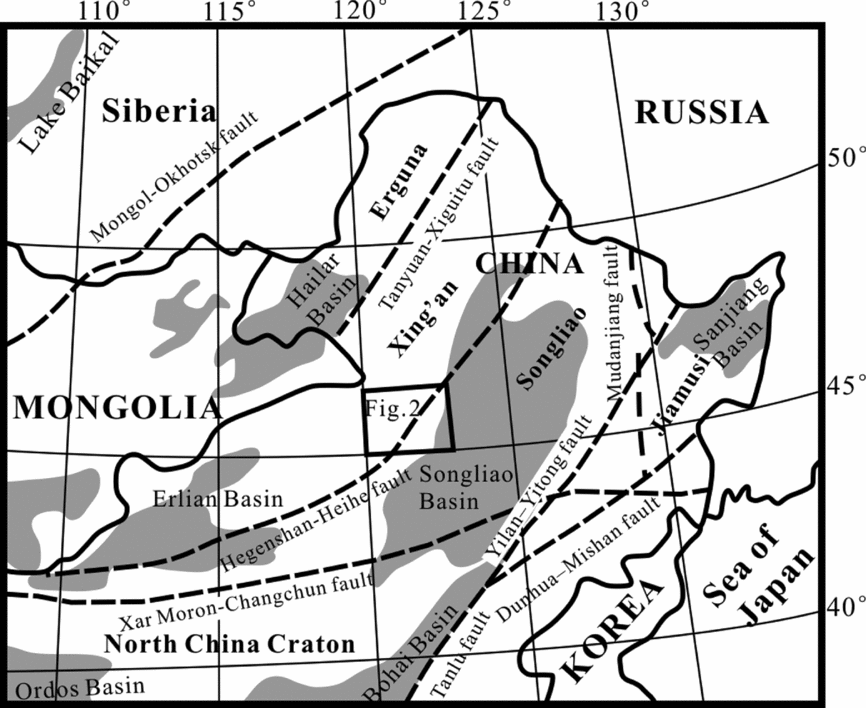
The Ulanhot area (120–123°E, 45–46°N) is located in the central-southern part of the Da Xingan Range, close to the Songliao Basin (Fig. 1), and it is an ideal place to study the Mesozoic tectonic evolution of NE China as it has been the focus of systematic investigations and is stratigraphically well constrained. In this paper, newly acquired U–Pb zircon ages and geochemical data are presented for intrusive rocks samples collected from the Ulanhot area. Our study aims to characterize the magma source and to constrain the nature of granite petrogenesis and the tectonic setting.
Tectonic subdivisions and main topographical units in NE China (after Meng Reference Meng2003; Wu et al. Reference Wu, Sun, Ge, Zhang, Grant, Wilde and Jahn2011a ; Xu et al. Reference Xu, Zhao, Bao, Zhou, Wang and Luo2014).

2. Geological background and sample descriptions
NE China is composed of four blocks/terranes, namely the Erguna, Xing'an, Songnen and Jiamusi blocks from west to east (Fig. 1). During Palaeozoic – early Mesozoic time, tectonic evolution was controlled by the subduction and closure of the Palaeo-Asia oceans (e.g. Şengör & Natal'in, Reference Şengör, Natal'in, Yin and Harrison1996; Yin & Nie, Reference Yin, Nie, Yin and Harrison1996; Zhang et al. Reference Zhang, Han, Chen and Xu2012) and the Erguna and Xing'an blocks came together to collide during earliest Palaeozoic time along the Derbugan Fault Zone (Ge et al. Reference Ge, Sui, Wu, Zhang, Xu and Cheng2007). The amalgamation of the Songnen and Jiamusi blocks occurred during middle Silurian (Wang et al. Reference Wang, Xu, Meng, Gao and Cao2012a ) or Late Triassic – Early Jurassic (Wu et al. Reference Wu, Zhao, Sun, Wilde and Yang2007, Reference Wu, Sun, Ge, Zhang, Grant, Wilde and Jahn2011a ; Wilde, Wu & Zhao, Reference Wilde, Wu, Zhao, Kusky, Zhai and Xiao2010; Zhou et al. Reference Zhou, Lü, Yang and Li2010) time. The collision between the Xing'an and Songnen blocks was probably completed during Late Carboniferous time along the Hegenshan–Nenjiang–Heihe Fault Zone (Wu et al. Reference Wu, Sun, Ge, Zhang, Grant, Wilde and Jahn2011a ). Those blocks were amalgamated to form a unified Jia–Meng Continental Block, and then amalgamated with the North China Craton along the Solonker–Xra Moron–Changchun–Yanji Suture Zone during late Permian – Middle Triassic time (Xiao et al. Reference Xiao, Windley, Hao and Zhai2003; Jia et al. Reference Jia, Hu, Lu and Qiu2004; Sun et al. Reference Sun, Wu, Zhang and Gao2004; Zhang et al. Reference Zhang, Wu, Wilde, Zhai, Lu and Sun2004; Li, Reference Li2006; Yang et al. Reference Yang, Wu, Shao, Wilde, Xie and Liu2006; Li et al. Reference Li, Gao, Sun, Li and Wang2007; Chen, Jahn & Tian, Reference Chen, Jahn and Tian2009; Wu et al. Reference Wu, Sun, Ge, Zhang, Grant, Wilde and Jahn2011a ; Liu et al. Reference Liu, Mao, Wu, Luo, Wang, Zhou and Hu2013, Reference Liu, Xu, Wang, Tang, Pei and Wang2014). From the Mesozoic, the tectonic evolution of NE China was controlled by the Mongol-Okhotsk and circle-Pacific tectonic systems (Wu et al. Reference Wu, Sun, Jahn and Wilde2004, Reference Wu, Zhao, Sun, Wilde and Yang2007, Reference Wu, Sun, Ge, Zhang, Grant, Wilde and Jahn2011a ; Xu et al. Reference Xu, Ji, Pei, Meng, Yu, Yang and Zhang2009, Reference Xu, Pei, Wang, Meng, Ji, Yang and Wang2013; Meng et al. Reference Meng, Xu, Pei, Yang, Yu and Zhang2010, Reference Meng, Xu, Yang, Qiu, Li and Zhu2011). The Mongol–Okhotsk tectonic system experienced Early Mesozoic subduction and Middle Jurassic and early Early Cretaceous thrusting events, and available data suggest that the closure of the ocean took place during Middle–Late Jurassic time (Kravchinsky et al. Reference Kravchinsky, Cogne, Harbert and Kuzmin2002; Tomurtogoo et al. Reference Tomurtogoo, Windley, Kroner, Badarch and Liu2005). Multiple-orientation subduction of the circum-Pacific tectonic system beneath the Eurasian continent is thought to have taken place, but this is still under debate (Sun et al. Reference Sun, Wu, Gao and Lu2005; Wu et al. Reference Wu, Zhao, Sun, Wilde and Yang2007; Pei et al. Reference Pei, Xu, Yang, Zhao, Liu and Hu2007; Zhou et al. Reference Zhou, Wilde, Zhang, Zhao, Zheng, Wang and Zhang2009; Xu et al. Reference Xu, Pei, Wang, Meng, Ji, Yang and Wang2013).
The study area covers the Xing'an and Songnen blocks (Figs 1, 2). Late Palaeozoic tectonic mélange exposed in the study area, with fine-grained clastic rocks and argillaceous siliceous rocks as its matrix and ultrabasic rocks and chromite lenses, foliated gabbros (300 Ma, unpublished data) and plagiogranites (296 Ma, unpublished data) as encased blocks. The mélange shows fault contact with both arc-related andesite and dacite of the Dashizhai Formation and clastic rocks of the Shoushangou Formation that were deposited in continental marginal sea, and is overlaid uncomformably by neritic deposition ofmiddle Permian Zhesi Formation. Mesozoic volcanic rocks are divided into the Tamulangou, Manketouebo, Manitu, Baiyingaolao and Meiletu formations (Bureau of Geology and Mineral Resources of Inner Mongolia Autonomous Region, 1996) and include basalt, andesite, dacite, rhyolite and volcanic breccias. The intrusive rocks are divided into four stages: late Carboniferous – middle Permian; Middle–Late Triassic; Early–Middle Jurassic; and Late Jurassic – Early Cretaceous (Institute of Geological Survey of China University of Geosciences (Beijing) 2012; Ge et al. Reference Ge, Wu, Zhou and Zhang2005; Zhou, Ge & Wang, Reference Zhou, Ge and Wang2011).
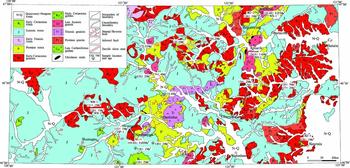
Simplified geological map of the study area, based on 1:250000 regional geological survey showing sample localities. Data from: (1) BGMRN (1965); (2) Ge et al. (Reference Ge, Wu, Zhou and Zhang2005); (3) J. H. Zhang (unpub. Ph.D. thesis, Wuhan: China University of Geoscience, 2009); and (4) this study.

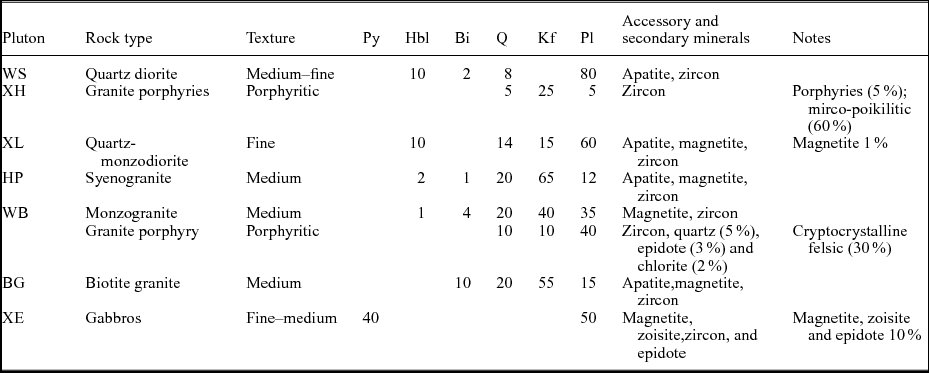
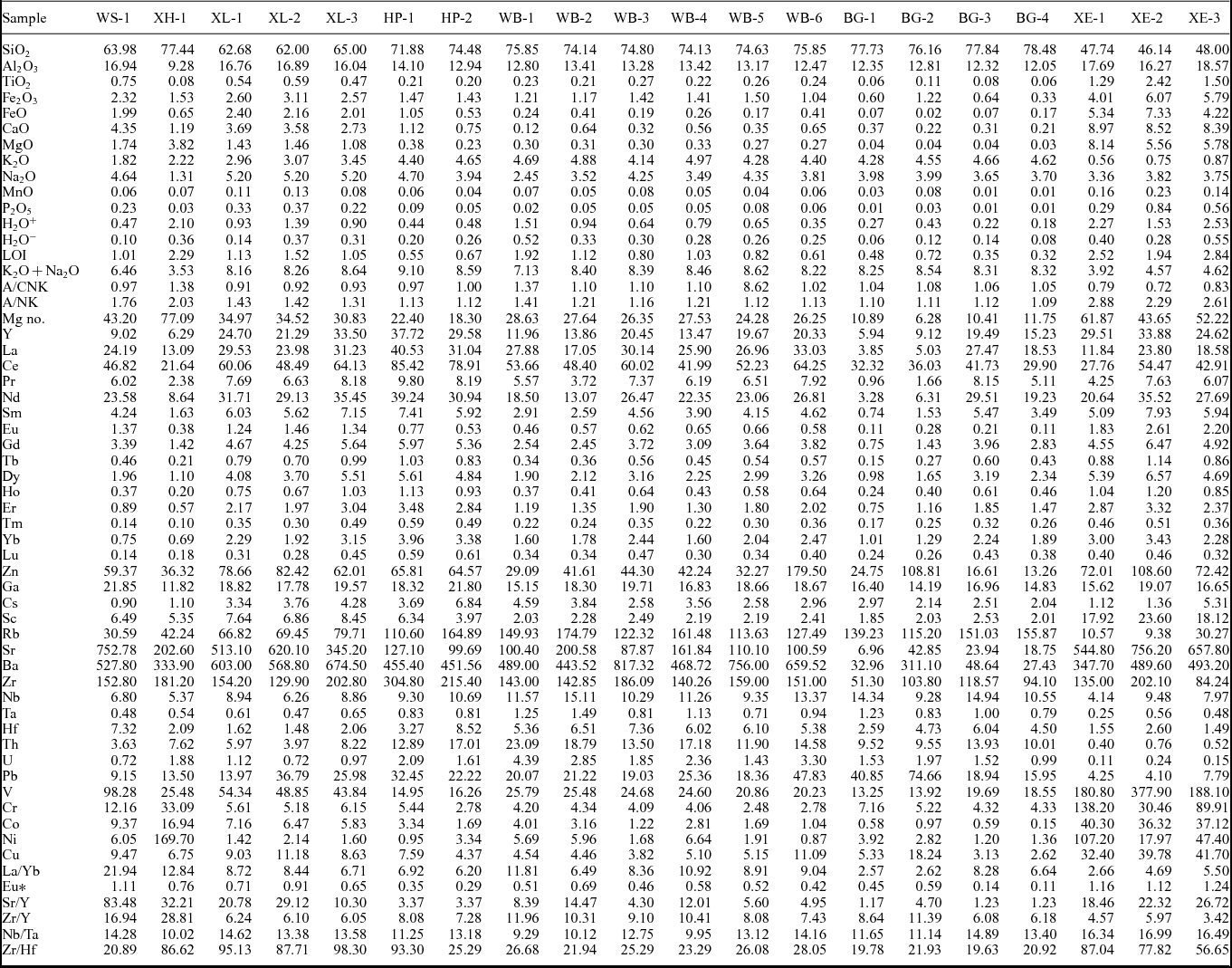
Representative rocks were selected from seven plutons (Wushitun, Xihuerle, Xinglongtun, Hepingtun, Wubulin, Bagexincang and Xieertala) for geochemical and geochronological studies (Fig. 2). These plutons were previously considered to be Late Cretaceous and Permian intrusive rocks, but no precise age data are available (Bureau of Geology and Mineral Resources of Inner Mongolia Autonomous Region, 1996). It is a necessary to verify their emplacement ages and to study their petrology and petrogenesis. The samples were taken from fresh outcrops at each locality. Lithologic classification of the analysed samples is based on the visually estimated models in hand specimens, thin-sections (Table 1) and chemical analyses (Table 2).
Description of representative samples in the study area

Major and trace elements for samples analysed in this study

2.a. Wushitun pluton (samples prefixed WS-)
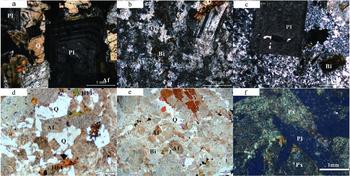
The Wushitun pluton is located about 60 km to the west of Zhalaiteqi, and has an exposed area of c. 40 km2 (Fig. 2). It intruded into Permian strata, and is intruded by Early Cretaceous granite. The pluton is made up of medium- to fine-grained quartz diorite (Fig. 3a).
Representative cross-polarized photographs of the Late Jurassic – Early Cretaceous Ulanhot intrusive rocks. (a) Quartz diorite (WS-1); (b) granite-porphyry (XH-1); (c) quartz monzodiorite (XL-1); (d) syenogranite (HP-1); (e) biotite monzogranite (WB-2); (f) gabbro (XE-1).

2.b. Xihuerle pluton (samples prefixed XH-)
Xihuerle pluton is situated 50 km west of Zhailaiteqi with an exposed area of 80 km2, comprising granite porphyries (Fig. 3b). It intruded into late Palaeozoic Zhesi and Linxi formations.
2.c. Xilongtun pluton (samples prefixed XL-)
Xilongtun Pluton covers an area of 70 km2 and is 70 km from the NW of Ulanhot. This pluton is mainly composed of quartz-monzodiorite (Fig. 3c), intruding into lower Carboniferous Dashizhai and Upper Jurassic Manketouebo formations.
2.d. Hepingtun pluton (samples prefixed HP-)
Hepingtun pluton is located to the north of Xinglongtun pluton and intruded into the latter. This pluton is largely composed of syenogranite. The syenogranite is flesh-yellow or light-grey in colour, with fine- to medium-grained subhedral granular, graphic texture and massive structure (Fig. 3d).
2.e. Wubulin pluton (samples prefixed WB-)
Wubulin pluton is located along Wubulinzhalage–Haoteala in Suolun, aligned east–west (Fig. 2) and covering an area of 440 km2. It is composed of granite porphyry and monzogranite (Fig. 3e). This pluton intruded into the Upper Jurassic Manitu and Lower Cretaceous Baiyingaolao formations.
2.f. Bagecangxin pluton (samples prefixed BG-)
Bagecangxin pluton crops out 10 km from the west of Wushilitun pluton and intrudes into Permian granite and sedimentary rocks (Fig. 2). Covering an area of 150 km2, it is mainly composed of biotite granite.
3. Analytical methods
3.a. Zircon U–Pb dating
Samples were first crushed using conventional crushing and then separated using heavy liquids and a magnetic separator at the Langfang Mineral Separation Laboratory of the Bureau of Geology and Mineral Resources of Hebei Province. Zircon grains were separated through conventional magnetic and density techniques. The grains were hand-picked under a binocular microscope. Internal structures of the zircon grains were examined using transmitted electron microscope, and imaged by backscattered electron (BSE) and cathode luminescence (CL) prior to U–Pb isotopic analyses. The BSE and CL imaging was carried out using a LEO1450VP scanning electron microscope with a MiniCL detector at the Institute of Geology, Chinese Academy of Geological Sciences. Zircon analyses were performed on the Neptune multiple-collector inductively coupled plasma mass spectrometer (Thermo Fisher Ltd.) with a 193 nm FX ArF excimer laser-ablation system (ESI Ltd.) at the Isotopic Laboratory, Tianjin Institute of Geology and Mineral Resources. NIST610 glass was used as an external standard to calculate U, Th and Pb concentrations of zircons, common Pb correction utilized the 208Pb method (Stacey & Kramers, Reference Stacey and Kramers1975) and TEMORA zircon was used as an external standard to normalize isotopic fractionation during the analysis. Uncertainties of individual analyses are reported with 1σ errors; weighted-mean ages are reported at the 2σ confidence level. The age calculations and plotting of Concordia diagrams were performed using Isoplot (Ludwig, Reference Ludwig2003). The detailed analytical technique is described in Li et al. (Reference Li, Geng, Hao, Zhang and Li2009).
3.b. Major- and trace-element determinations
Major elements were analysed by X-ray fluorescence (XRF; Philips PW1480) using fused glass discs at the Langfang Regional Geological Survey, Hebei Province, China. The content of oxide was analysed by the wet chemical method and the loss of ignition was determined by gravity method; analysis accuracy was better than 1%. Trace element and rare Earth element (REE) abundances were measured using inductively coupled plasma mass spectrometry (ICP-MS) following the technique of Liang & Grégoire (Reference Liang and Grégoire2000) and Gao et al. (Reference Gao, Rudnick, Xu, Yuan, Liu, Walker, Puchtel, Liu, Huang, Wang and Yang2008) with analytical precisions for most elements better than 5% for Zr, Hf, Nb and Ta. Values were within 10% of certified values.
4. Analytical results
4.a. Zircon U–Pb geochronology
Zircons from plutons were analysed using LA-ICP-MS. Results are given in Supplementary Table S1 (available at http://journals.cambridge.org/geo) and depicted in Figure 4.
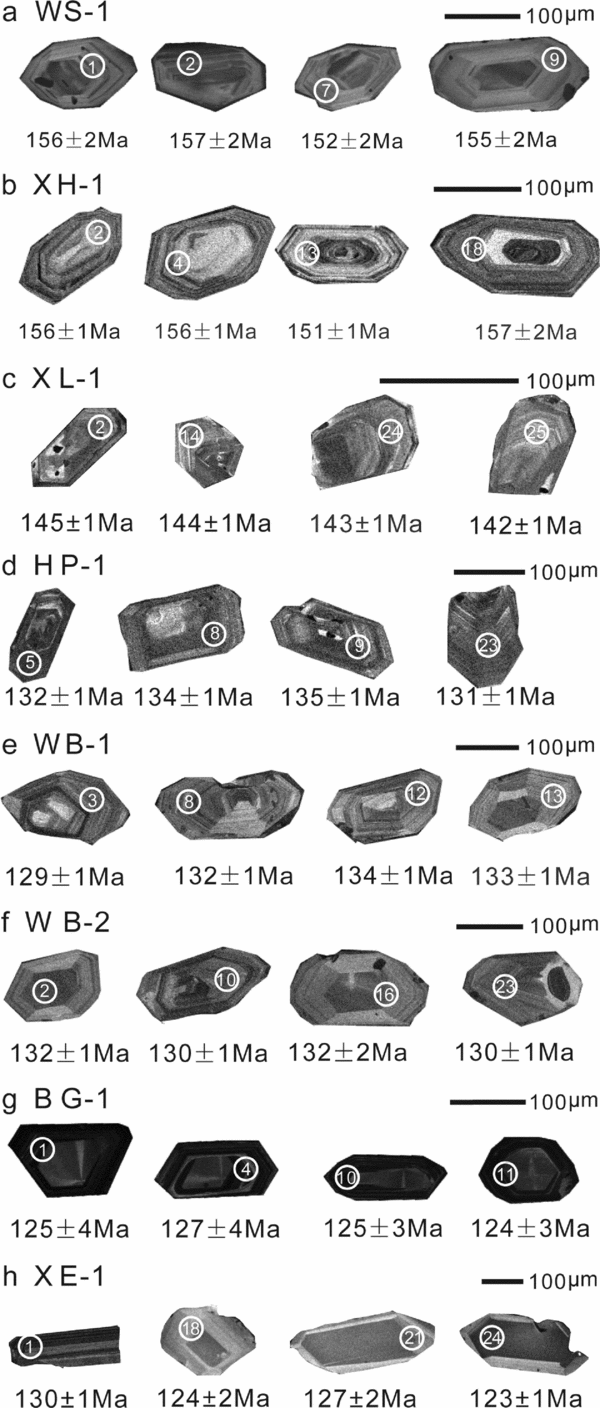
Cathodoluminescence (CL) images of selected zircons from the Late Jurassic – Early Cretaceous Ulanhot intrusive rocks: (a) WS-1; (b) XH-1; (c) XL-1; (d) HP-1; (e) WB-1; (f) WB-2; (g) BG-1; and (h) XE-1.

4.a.1. The Wushitun pluton
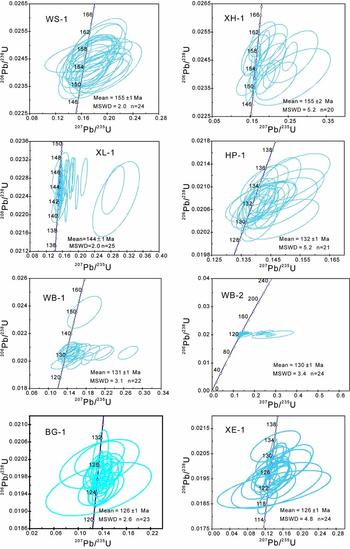
Sample WS-1, a quartz diorite, was collected from the WS pluton. Zircon mostly appears as elongated columns, with a small portion as short columns. The size of the zircon grains ranges over 100–150 µm. The zircons are mostly colourless, with a few yellowish brown. The CL images indicate that most zircons possess clear growth zoning. The Th/U ratios of the 24 zircons are 0.44–1.15, typical of magmatic zircons (Fig. 4a; Pupin, Reference Pupin1980; Koschek, Reference Koschek1993). In the 206Pb/238U–207Pb/235U Concordia diagram (Fig. 5), 24 analysis points are on the Concordia and nearby and average weighted age of the 206Pb/238U is 155±1 Ma (mean square of weighted deviates or MSWD = 2.0, n = 24; Fig. 5; Supplementary Table S1), representing the crystallization age.
Zircon 207Pb/235U – 206Pb/238U concordia diagrams of the Late Jurassic – Early Cretaceous Ulanhot intrusive rocks samples from this study.

4.a.2. The Xihuerle pluton
Sample XH-1, a granite-porphyry, was collected from the XH pluton. The majority of zircons from this sample are euhedral–subhedral with oscillatory growth zoning, typical of magmatic zircons (Fig. 4b), although a few zircons have core–rim texture. With the exception of one spot that yielded an age of 297±2 Ma, a total of 20 analyses yielded a weighted mean 206Pb/238U age of 155±2 Ma (MSWD =5.2, n = 20; Fig. 5; Supplementary Table S1), representing the emplacement age of the pluton; the older age represent the age of inherited or captured zircons entrained by the granite-porphyry.
4.a.3. The Xilongtun pluton
Quartz monzodiorite sample XL-1 was collected from the XL pluton and contains subhedral zircons with oscillatory zoning (Fig. 4c) that have Th/U ratios of 0.35–1.79, indicating a magmatic origin. 206Pb/238U ages for 25 analyses vary over the range 141–146 Ma, yielding a weighted mean 206Pb/238U age of 144±1 Ma (MSWD =2.0, n = 25; Fig. 5; Supplementary Table S1), interpreted to be the crystallization age of the quartz monzodiorite.
4.a.4. The Hepingtun pluton
Sample HP-1 is a syenogranite collected from the HP pluton. Zircons are euhedral–subhedral with oscillatory growth zoning (Fig. 4d) and have Th/U ratios of 0.32–0.82, indicative of an igneous origin. 206Pb/238U ages for 21 zircon analyses range over 130–134 Ma, yielding a weighted mean 206Pb/238U age of 132±1 Ma (MSWD =1.7, n = 21; Fig. 5; Supplementary Table S1), interpreted to be the crystallization age of the quartz monzodiorite.
4.a.5. The Wubulin pluton
Sample WB-1, a granite-porphyry, was collected from the WB pluton. The majority of zircons from this sample are euhedral–subhedral with oscillatory growth zoning (Fig. 4e). All of these zircons have Th/U ratios of 0.32–1.38 except for one zircon (WB-1-20, Th/U = 0.06; Supllementary Table S1), indicative of a magmatic origin. A total of 22 analyses yielded a weighted mean 206Pb/238U age of 131±1 Ma (MSWD =3.1, n = 22; Fig. 5; Supplementary Table S1), In addition, one analysis yielded a 206Pb/238U age of 150±3 Ma (WB-1-16). This indicates that the Wubulin pluton was emplaced at 131±1 Ma, the older age representing the ages of inherited or captured zircons entrained by the granite-porphyry.
Sample WB-2 is a biotite monzogranite collected from the WB pluton. Zircons from this sample are euhedral–subhedral with oscillatory growth zoning (Fig. 4f) and have high Th/U ratios (0.61–1.21) with the exception of one zircon (CG-1-19, Th/U = 0.06; Supplementary Table S1), suggesting their magmatic origin. 206Pb/238U ages for 24 analyses range over 124–135 Ma, yielding a weighted mean 206Pb/238U age of 130±1 Ma (MSWD =3.4, n = 24; Fig. 5; Supplementary Table S1), interpreted to be the crystallization age of this biotite monzogranite.
4.a.6. The Bagexincang pluton
Sample BG-1, a biotite granite, was collected from the BG pluton. Zircons from this sample are euhedral–subhedral with oscillatory growth zoning (Fig. 4g) and have high Th/U ratios (0.44–1.43), suggesting their magmatic origin. 206Pb/238U ages for 23 zircon analyses range over 124–129 Ma, yielding a weighted mean 206Pb/238U age of 126±1 Ma (MSWD =2.6, n = 23; Fig. 5; Supplementary Table S1), interpreted to be the crystallization age of the biotite granite.
4.a.7. The Xieertala pluton
Sample XE-1 is a gabbro collected from the XE pluton. The majority of zircons from this sample are euhedral–subhedral with oscillatory growth zoning (Fig. 4h). All of these zircons have Th/U ratios of 0.32–1.72 with the exception of one zircon (XE-1-19, Th/U = 0.06; Supplementary Table S1), indicative of a magmatic origin. A total of 24 analyses yielded a weighted mean 206Pb/238U age of 126±1 Ma (MSWD = 4.8, n = 24; Fig. 5; Supplementary Table S1), interpreted to be the crystallization age of the gabbro.
4.b. Major and trace elements
The results of chemical analyses are listed in Table 2.
4.b.1. c. 155 Ma granitoids
The c. 155 Ma granitoids in the study area consist of quartz diorites and granite-porphyry units.
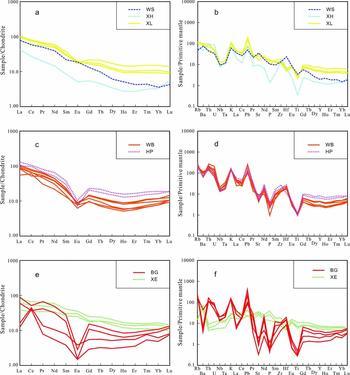
The WS quartz diorite have SiO2 = 63.98%, TiO2 = 0.75%, Al2O3 = 16.94%, σ (= ω(K2O+ Na2O)²/ω(SiO2–43)) = 1.99, Na2O = 4.64%, K2O =1.82% and Na2O+K2O = 6.46% (Table 2), belonging to sub-alkaline (Fig. 6a) and medium-K calc-alkaline series (Fig. 6b). The A/CNK (molar Al2O3/ (CaO+K2O+Na2O)) value is 0.97, indicative of metaluminous granite (Fig. 6c). The sample is enriched with light rare Earth elements (LREEs) and large-ion lithophile elements (LILEs), and depleted in heavy rare Earth elements (HREEs) and high-field-strength elements (HFSEs) (Fig. 7a, b) with (La/Yb)N ratio and δEu value 21.9 and 1.11, respectively. In addition, the samples have high Sr (752.78 ppm) and low Y (9.02 ppm) and Yb (0.75 ppm) concentrations, and are classified as adakites.
Geochemistry diagrams for the granites from the study area. (a) SiO2–(K2O+Na2O) (TAS) diagram for the Late Jurassic – Early Cretaceous Ulanhot intrusive rocks. Normalization values are from Middlemost (Reference Middlemost1994). (b) K2O versus SiO2 diagram for intrusive rocks. Normalization values are from Le Maitre (Reference Le Maitre1984) and Rickwood (Reference Rickwood1989). (c) A/NK (molar/molar) versus A/CNK (molar/molar) diagram for these rocks. Normalization values are from Le Maitre (Reference Le Maitre1984) and Rickwood (Reference Rickwood1989).

(a, c, e) Chondrite-normalized REE patterns and (b, d, f) primitive mantle-normalized trace-element spidergrams for the Late Jurassic – Early Cretaceous Ulanhot intrusive rocks. Chondrite-normalized and primitive mantle-normalized values are from Boynton (Reference Boynton and Henderson1984) and McDonough & Sun (Reference McDonough and Sun1995), respectively.

The Late Jurassic granite-porphyry from the XH pluton have SiO2 = 77.44%, TiO2 = 0.08%, Al2O3 = 9.28%, σ = 0.36, Na2O = 1.31%, K2O =2.22% and Na2O+K2O = 3.53% (Table 2), belonging to sub-alkaline (Fig. 6a) and medium-K calc-alkaline series (Fig. 6b). The A/CNK value is 1.38, indicative of strong peraluminous granites (Fig. 6c). The sample is enriched with LREEs and LILEs (such as Rb and K) as well as Pb, and depleted in HREEs and HFSEs (Fig. 7a, b; e.g. Nb, Ta and Ti), with (La/Yb)N ratio and δEu value 12.8 and 0.76, respectively, and low total REE abundances (ΣREE = 58.51 ppm).
4.b.2. c. 144 Ma granitoids
The c. 144 Ma granitoids in the study area are dominated by quartz monzodiorites of the XL pluton. They have SiO2 = 62.00–65.00%, TiO2 = 0.47–0.59%, Al2O3 = 16.04–16.89%, MgO = 1.08–1.46%, σ = 3.38–3.59, K2O = 2.96–3.45% and Na2O+K2O = 8.16–8.64% (Table 2), indicative of alkaline series magmas (Fig. 6a). Additionally, these rocks from the XL pluton are characterized by enrichment with LREEs and LILEs as well as Pb, and depletion in HREEs and HFSEs (Fig. 7a, b; e.g. Nb, Ta and Ti) with negative Eu anomalies (δEu = 0.65–0.91; Fig. 7a, b). They also have REE abundances and (La/Yb)N ratios that vary over the ranges 150.38–201.27 ppm and 6.71–8.72, respectively.
4.b.3. 135–130 Ma granites
The 135–130 Ma granites in the study area are dominated by granite porphyry, monzogranite and syenogranite. Those samples have SiO2 = 71.88–75.85%, Al2O3 = 12.47–14.10%, σ = 2.06–3.18, K2O = 4.14–4.97% and Na2O+K2O = 8.22–9.10% (Table 2), belonging to sub-alkaline (Fig. 6a) and high-K calc-alkaline series (Fig. 6b). The A/CNK values range from 0.97 to 1.10, indicative of metaluminous to peraluminous granites (Fig. 6c). The samples are enriched with LREEs and LILEs (such as Rb and K) as well as Pb, and depleted in HREEs and HFSEs (Fig. 7c, d; e.g. Nb, Ta, P and Ti) with negative Eu anomalies, with (La/Yb)N ratio and δEu value 6.20–10.92 and 0.29–0.69, respectively, and middle total REE abundances (ΣREE = 108.30–243.24 ppm).
4.b.4. c. 126 Ma intrusive rocks
The c. 126 Ma intrusive rocks in the study area consist of gabbros and biotite granites units.
The XE gabbros have SiO2 = 46.14–48.00%, TiO2 = 1.29–2.42%, Fe2O3 = 4.01–6.07%, MgO = 5.56–8.14%, Mg no. (= 100 Mg/(Mg+TFe2+)) = 43.65–61.87, K2O = 0.56–0.87%, Na2O+K2O = 3.92–4.62% and σ = 3.23–6.65(Table 2), belonging to alkaline series magmas (Fig. 6a). These gabbros have flat REE patterns ((La/Yb)N = 2.66–5.50) with positive Eu anomalies (δEu = 1.12–1.24), LILEs and Pb enrichments, and HFSEs depletions (Fig. 7e, f).
The BG biotite granites have SiO2 = 77.84–78.48%, Al2O3 = 12.05–12.32%, MgO = 0.03–0.04%, σ = 1.95–1.98, K2O = 4.62–4.66% and Na2O+K2O = 8.31–8.32% (Table 2), and are classified as sub-alkaline (Fig. 6a) and high-K calc-alkaline series (Fig. 6b). The A/CNK (molar Al2O3/(CaO+K2O+Na2O)) values range over 1.05–1.06, indicative of metaluminous to peraluminous granites (Fig. 6c). The samples are also LREEs and LILEs enriched and HREEs and HFSEs depleted (Fig. 7e, f). Their (La/Yb)N ratio and δEu values are 6.6–8.3 and 0.11–0.14, respectively, and they have low total REE abundances (ΣREE =101.64–145.22 ppm).
5. Discussion
5.a. Late Jurassic – Early Cretaceous magmatism in the study area
Most intrusive rocks in the study area were previously considered as late Palaeozoic (BGMRN, 1959, 1965, 1990) due to lack of precise geochronological data. The zircon U–Pb ages from our work, together with published geochronological data (e.g. Ge et al. Reference Ge, Wu, Zhou and Zhang2005; Shi et al. Reference Shi, Zheng, Yao, Li, Xu, Gao and Cui2013; Yang et al. Reference Yang, Guo, Wang, Zeng, Zhang, Tong, Shi and Zhang2014) in the study area and the adjacent areas, suggest that the Late Jurassic – Early Cretaceous magmatism in the region can be subdivided into four stages: c. 155 Ma; c. 144 Ma; 135–130 Ma; and c. 126 Ma.
The Late Jurassic – Early Cretaceous granitoids widely occur in the Da Xingan Range. The granites in the Ganzhuermiao region can be subdivided into three stages (Yang et al. Reference Yang, Guo, Wang, Zeng, Zhang, Tong, Shi and Zhang2014): Late Jurassic (154 Ma); early Early Cretaceous (139–137 Ma); and late Early Cretaceous (125 Ma). Lots (146) of zircon ages from this paper and other published articles in recent years show one major peak at 138–130 Ma and one weak peak at 165–155 Ma (Fig. 8). Likewise, the Late Jurassic – Early Cretaceous volcanism in NE China can be subdivided into three stages (Xu et al. Reference Xu, Pei, Wang, Meng, Ji, Yang and Wang2013): Middle–Late Jurassic (166–155 Ma); early Early Cretaceous (145–138 Ma); and late Early Cretaceous (133–106 Ma). The times of emplacement in the study area are coeval with the eruption time of volcanic rocks and peak time of the late Mesozoic granitoids in NE Asia.
Zircon age for Late Jurassic – Early Cretaceous granitoid map in the Da Xingan Range areas (age data from Miao et al. Reference Miao, Fan, Zhai, Qiu, Mcnaughton and Groves2003; Wu et al. Reference Wu, Jahn, Wilde, Lo, Yui, Lin, Ge and Sun2003b , Reference Wu, Sun, Ge, Zhang, Grant, Wilde and Jahn2011a , Reference Wu, Zhang, Wan, Chen, Zhang and Xiang b , Reference Wu, Jiang, Liu and Liu2014, Reference Wang, Guo, Zhang, Yang, Zhang, Tong and Ye2015; Wang et al. Reference Wang, Zheng, Li and Gao2004, Reference Wang, Wang, Zhang, Qi, Wu, Zhao, Yang and Liu2009; Ge et al. Reference Ge, Wu, Zhou and Zhang2005, Reference Ge, Sui, Wu, Zhang, Xu and Cheng2007; Liu et al. Reference Liu, Sieble, Li and Pan2005, Reference Liu, Pan, Xie and Li2007, Reference Liu, Ni, Zhai, Shi, Yan and Lu2010, Reference Liu, Wang, Wang, Wang and Dai2011, Reference Liu, Mao, Wu, Luo, Wang, Zhou and Hu2013; Zhao et al. Reference Zhao, Mo, Ren, Han, Yi and Li2005; Zhang et al. Reference Zhang, Ge, Wu and Liu2006a , Reference Zhang, Jin, Li and Wang b , Reference Zhang, Jin, Li and Wang2010b , Reference Zhang, Zhang, Jiang and Wilde c , Reference Zhang, Zhang, Jiang, Zhai and Zhang d , Reference Zhang, Zhang, Wilde, Yang and Chen e , Reference Zhang, Zhang, Jin, Wu, Xiang and Chen f , Reference Zhang, Ge, Gao, Chen and Zhao g , Reference Zhang, Li, Chen and Zhao2013; Sui et al. Reference Sui, Ge, Wu, Zhang, Xu and Cheng2007; Ma et al. Reference Ma, Chen, Lai and Lu2009; Nie et al. Reference Nie, Xu, Jiang and Hu2009; Kong et al. Reference Kong, Liu, Deng, Xu and Zhao2010; Tong et al. Reference Tong, Hong, Wang, Shi, Zhang and Zeng2010; Zhou et al. Reference Zhou, Lü, Yang and Li2010; Jiang et al. Reference Jiang, Nie, Bai, Liu and Liu2011a , Reference Jiang, Nie, Liu, Huo, Bai, Liu and Liang b , Reference Jiang, Liang, Liu and Liu2012; She et al. Reference She, Liang, Li, Guan, Zhang, Yang, Xiang, Jin and Zhang2011; Xie et al. Reference Xie, Tian, Wu, Zhu, Wu, Shen, Gu and Zhang2011; Xu et al. Reference Xu, Li, Zhao, Cheng and Wang2011; Yan et al. Reference Yan, Sun, Lai and Ma2011; Zeng et al. Reference Zeng, Liu, Zhang, Chen and Zhang2011b ; Jian et al. Reference Jian, Kröner, Windley, Shi, Zhang, Zhang and Yang2012; Zhai et al. Reference Zhai, Liu, Yang, Wang, Ding, Liu, Zhang, Yao, Su and Zhang2012; Daoudene et al. Reference Daoudene, Ruffet, Cocherie, Ledru and Gapais2013; Gao et al. Reference Gao, Zheng, Yao, Wang, Li, Shi, Cui, Gao and Zhang2013; Shi et al. Reference Shi, Zheng, Yao, Li, Xu, Gao and Cui2013).

5.b. Petrogenesis of Late Jurassic – Early Cretaceous intrusives
5.b.1. c. 155 Ma granitoids
The WS quartz diorite contains high Al2O3 (>15%), Na2O (>3.5%) and Sr (>400 ppm) and low Y (<18 ppm) and Yb (<1.9 ppm), indicative of adakitic magmas (Defant & Drummond, Reference Defant and Drummond1990). Although few papers emphasize the fact, the variations in source composition have a profound influence on the origin of ‘adakitic’ magmas (Ma et al. Reference Ma, Zheng, Xu, Griffin and Zhang2015); a common view is that adakite forms under high pressure. Models for the production of adakitic magmas include: (1) partial melting of subducting oceanic slab (Defant & Drummond, Reference Defant and Drummond1990; Martin, Reference Martin1999; Martin et al. Reference Martin, Smith, Rapp, Moyen and Champion2005); (2) fractional crystallization from parental basaltic magma (Castillo, Janney & Solidum, Reference Castillo, Janney and Solidum1999; Macpherson, Dreher & Thirwall, Reference Macpherson, Dreher and Thirwall2006; Zhu et al. Reference Zhu, Zhao, Pan, Lee, Kang, Liao, Wang, Li, Dong and Liu2008); (3) partial melting of delaminated lower continental crust (Xu et al. Reference Xu, Shinjo, Defant, Wang and Rapp2002; Wang et al. Reference Wang, Zhou, Zhang, Ying, Zhang, Wu and Zhu2006a ) or thickened mafic lower continental crust (Atherton & Petford, Reference Atherton and Petford1993; Xiong et al. Reference Xiong, Li, Xu, Li, Zhao and Wang2003; Huang et al. Reference Huang, Xu, Lan, Yang and Luo2009).
The geochemical characteristics of the WS pluton can be used to rule out a number of the above hypotheses. The magma cannot have originated by partial melting of subducting oceanic slab, as this scenario would predict low-Si and high Mg no. (Martin et al. Reference Martin, Smith, Rapp, Moyen and Champion2005). Likewise, the magma cannot have originated by fractional crystallization from parental basaltic magma, as the high Th/U ratios (5.0) and low Cr (12.2 ppm) and Ni (6.1 ppm) of the quartz diorite are inconsistent with melts derived from normal mid-ocean-ridge basalt (N-MORB) or delaminated lower crust (Martin, Reference Martin1999; Smithies, Reference Smithies2000; Wang et al. Reference Wang, Zhou, Zhang, Ying, Zhang, Wu and Zhu2006b ). Adakitic rocks originated by partial melting of thickened mafic lower continental crust are characterized by low MgO or Mg no. values and low Cr and Ni contents (Atherton & Petford, Reference Atherton and Petford1993; Xiong et al. Reference Xiong, Li, Xu, Li, Zhao and Wang2003; Huang et al. Reference Huang, Xu, Lan, Yang and Luo2009). The WS quartz diorites have low MgO content (1.74 wt%), intermediate Mg no. value (43.20) and low Cr (12.2 ppm) and Ni (6.1 ppm) content, comparable to those of the lower crust-derived adakitic rocks. This is also supported by the discernable concave-upwards Dy–Ho–Er–Tm-depleted patterns (Fig. 7a). In addition, the WS quartz diorite show relatively high K2O contents and high (La/Yb)N (21.9) and Sr/Y (83.5) ratios, consistent with magma originating from the lower crust rather than from slab melting (Martin et al. Reference Martin, Smith, Rapp, Moyen and Champion2005).We therefore suggest that the WS quartz diorites were most likely generated by partial melting of a mafic lower continental crust.
Barbarin (Reference Barbarin1996) suggested the majority of peraluminous granitoids are produced by partial melting of crustal rocks, and the two-mica granites are generated where thickened crust is affected by major crustal shears or thrust. Sylvester (Reference Sylvester1989) proposed that strongly peraluminous granites formed as a result of post-collisional processes in various orogens and were emplaced after the climax of crustal thickening. The XH granitic-porphyry contains high A/CNK (1.38), belonging to strongly peraluminous granites. The striking Th, U and Pb peaks and Nb, Ta and Ti troughs in Figure 7b are a direct reflection of the fact that the parental magma of the XH granitic-porphyry is characteristic of melts derived from crust (Rudnick & Gao, Reference Rudnick, Gao, Holland and Turekian2003). The sample is also characterized by depletion in medium rare Earth elements (MREEs) relative to HREEs, indicating that hornblende remained in the residue rather than garnet and that the rocks originated by partial melting of thickened mafic lower continental crust.
These data allow us to suggest that the magmas that formed these c. 155 Ma granites were derived from partial melting of a thickened mafic lower crust (Atherton & Petford, Reference Atherton and Petford1993; Petford & Atherton, Reference Petford and Atherton1996; Martin, Reference Martin1999; Xiong et al. Reference Xiong, Li, Xu, Li, Zhao and Wang2003; Huang et al. Reference Huang, Xu, Lan, Yang and Luo2009).
5.b.2. c. 144 Ma granitoid
The XL quartz monzodiorites (c. 144 Ma) have high σ = 3.38–3.59, K2O = 2.96–3.45% and Na2O+K2O = 8.16–8.64% (Table 1), belonging to alkaline series (Fig. 6a) and indicating an extensional geological setting. Models for the alkaline magmas include: (1) produced by the magmatic mixing between mafic magma derived from enriched mantle and felsic magma derived from partial melting of ancient metamorphic rocks of the middle–lower crust (Barker et al. Reference Barker, Wonea, Sharp and Deaborough1975; Sheppard, Reference Sheppard1995; Litvinovsky et al. Reference Litvinovsky, Iahn, Zanvilevich, Sounders, Poulein, Kuzmin, Reichow and Titov2002); (2) fractional crystallization from parental alkaline basaltic magma (Brown & Becker, Reference Brown and Becker1986; Sutcliffe et al. Reference Sutcliffe, Smith, Dohery and Barnett1990; Yang et al. Reference Yang, Chung, Wilde, Wu, Chu, Lo and Fan2005); and (3) the product of partial melting of felsic crust at high pressure (Huang & Wyllie, Reference Huang and Wyllie1981).
The samples from the XL pluton have minor negative Eu anomalies, implying the magma cannot have originated by fractional crystallization from parental alkaline basaltic magma. Also, the magma cannot have originated by magmatic mixing as there were no obvious characteristics of magmas mixing from field observations. Considering there was thickened crust in c. 155 Ma, we suggest the XL pluton was generated by the partial melting of thickened crust.
5.b.3. 135–130 Ma granites
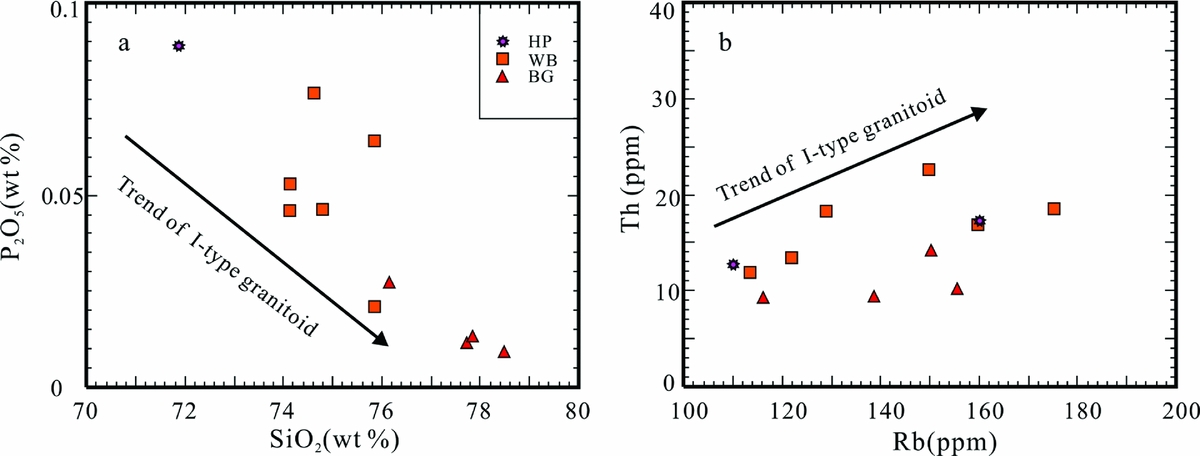
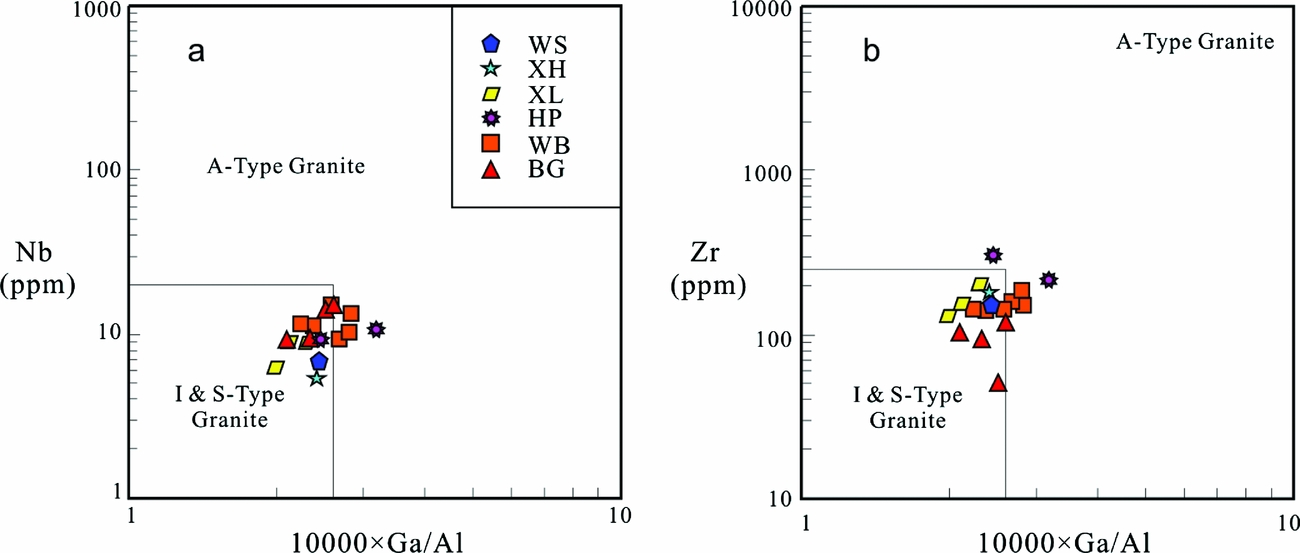
The granites from the HP pluton and WB pluton are peraluminous, and most of them show hallmarks of A/CNK≤1.1, normative corundum <1% and A/NK>1.0. P2O5 shows negative correlation with the increase of SiO2 (Fig. 9a), while Th shows positive correlation with Rb (Fig. 9b). It is clear that the granites under study are not S-type but are I- or A-types (Chappell & White, Reference Chappell and White1992). The relatively low contents of Zr, Nb, Y, La, Ce, Zn and Ga strongly suggest that they belong to I-type. But the trace-element compositions also show characteristics of A-type granites, such as enrichment in HFSEs (e.g. Zr, Nb and Y) and REEs, and extreme depletion in Ba, Sr, P, Ti and Eu. Other trace-element ratios such as Nb/Ta (9.29–14.16) and Zr/Hf (21.94–28.05) are also consistent with those in typical A-type granites (e.g. Eby, Reference Eby1992; Charvet, Lapierre & Yu, Reference Charvet, Lapierre and Yu1994; Martin et al. Reference Martin, Bonin, Capdevila, Jahn, Lameyre and Wang1994; King et al. Reference King, White, Chappell and Allen1997). Samples from the HP pluton and WB pluton were plotted in the field of I-Type Granite and A-Type Granite in Nb and Zr versus Ga/Al diagrams (Fig. 10a, b). We therefore concluded that the granites described in this study are of both I-type and A-type granites.
Plots of (a) P2O5 versus SiO2 and (b) Th versus Rb for tor the Late Jurassic – Early Cretaceous Ulanhot intrusive rocks.

(a) (10000×Ga/Al) versus Nb diagram for A-type granitoids (Whalen, Currie & Chappell, Reference Whalen, Currie and Chappell1987); and (b) (10,000*Ga/Zr) versus Zr diagram for A-type granitoids (Whalen, Currie & Chappell, Reference Whalen, Currie and Chappell1987) for the Late Jurassic – Early Cretaceous Ulanhot intrusive rocks.

5.b.4. c. 126 Ma intrusive rocks
The c. 126 Ma magmatic events involved both mafic and granitic magmatism. Field observations indicate that granitic and mafic magmas were intruded independently, with the granitic intrusions cropping out over a much larger area than the coeval mafic–ultramafic intrusions. The gabbros have higher total REE abundances than the granitoids, strongly suggesting that the c. 126 Ma granitic and mafic rocks have independent origins.
The BG pluton is characterized by high SiO2 and low total Fe2O3, MgO and CaO contents. We also find that the P2O5 concentration decreases with increasing SiO2 (Fig. 9a) and Th shows a positive correlation with Rb (Fig. 9b). It is suggested that the BG pluton is I-type or A-type granitoid rather than S-type leucogranitoid (Chappell & White, Reference Chappell and White1992). Samples are plotted in the field of I- and S-Type Granite in the Nb and Zr versus Ga/Al diagrams (Fig. 10a, b). In addition, the samples from BG pluton have: high SiO2 (up to 78.48 wt%) and remarkable Eu negative anomalies; low CaO and Na2O ratios; and high A/CNK ratios. We therefore infer that the BG pluton comprises highly fractionated I-type granites rocks.
The XE gabbros have relatively high Mg no. (43.65–61.87), La/Nb (2.33–2.86>1.5) and La/Ta (38.5–46.8>22), low SiO2 and TiO2 concentrations and positive Eu and Sr anomalies, suggesting that their primary magmas were derived from partial melting of the lithospheric mantle and did not undergo crustal contamination during magma ascent. However, these gabbros are relatively LILE enriched and HFSE depleted (Fig. 7f), implying that the magma source had been modified by subducted slab-derived fluids (Turner, Sandiford & Foden, Reference Turner, Sandiford and Foden1992; Turner et al. Reference Turner, Arnaud, Liu, Rogers, Hawkesworth, Harris, Kelly, Van Calsteren and Deng1996; Zhang et al. Reference Zhang, Ge, Wu, Wilde, Yang and Liu2008b ).
5.c. Late Jurassic – Early Cretaceous tectonic evolution in the Ulanhot area
Which mechanism was responsible for triggering the widespread Mesozoic igneous rocks in NE China is still an open question. Studies showed that the Da Xingan Range is not only characterized by widespread NE-trending late Mesozoic igneous rocks, but also distributed in a NNE-aligned direction, parallel to the NNE-oriented Asian continental margin (Wu et al. Reference Wu, Lin, Wilde, Zhang and Yang2005, Reference Wu, Sun, Ge, Zhang, Grant, Wilde and Jahn2011a ; Wang et al. Reference Wang, Zhou, Zhang, Ying, Zhang, Wu and Zhu2006b , Reference Wang, Guo, Zhang, Yang, Zhang, Tong and Ye2015; Zhang et al. Reference Zhang, Ge, Wu, Wilde, Yang and Liu2008a , Reference Zhang, Gao, Ge, Wu, Yang, Wilde and Li2010a ; Xu et al. Reference Xu, Pei, Wang, Meng, Ji, Yang and Wang2013; Zhu et al. Reference Zhu, Zheng, Xu and Wilde2014). For example, the ages of the Tamulangou Formation from the Manzhouli area are 164–161 Ma (Zhao et al. Reference Zhao, Sun, Gou, Ren, Fu, Zhang, Wang and Liu2011), from the Genhe area 151 Ma and from the Zhalantun area 147 Ma (Li et al. Reference Li, Liu, Xu, Li and Zhang2014), which exhibit a significant subduction polarity from NW to SE. The Cretaceous magmatic rocks become younger from the Great Xing'an Range to the eastern part of northeastern China (Zhang et al. Reference Zhang, Ge, Wu, Wilde, Yang and Liu2008b , Reference Zhang, Ge, Gao, Chen and Zhao2010g ). Ouyang et al. (Reference Ouyang, Mao, Zhou and Su2015) suggested the magmatism and mineralization events occurred as a result by break-off of the Mongol– Okhotsk oceanic slab at depth (Late Jurassic) and the closure of Mongol–Okhotsk Ocean (Early Cretaceous), which prevented the westwards movement and led to rollback of the Palaeo-Pacific oceanic plate.
The c. 155 Ma and c. 144 Ma intrusive rocks in the study area formed in a crustal-thickening-related tectonic setting. Gao et al. (Reference Gao, Rudnick, Yuan, Liu, Liu, Xu, Ling, Ayers, Wang and Wang2004) also reported that the volcanic rocks from the Manitu Formation (159 Ma) in the Great Xing'an Range have geochemical affinities to adakites and high-Mg andesite, indicating a thickened crust existing in the Great Xing'an Range during Late Jurassic – early Early Cretaceous time. We suggested that the c. 155 Ma intrusive rocks formed in a compressing collisional tectonic setting, which is related to the closure of the Mongol–Okhotsk Ocean according to the following reasons.
1. The ages of the WS pluton and XH pluton associated with Mongol–Okhotsk tectonic system. It is commonly accepted that the Mongol–Okhotsk Ocean closed in a scissor-like fashion from west to east (Zhao et al. Reference Zhao, Coe, Zhou, Wu and Wang1990; Zonenshain, Kuzmin & Natapov, Reference Zonenshain, Kuzmin and Natapov1990) during Late Jurassic time (Zonenshain, Kuzmin & Natapov, Reference Zonenshain, Kuzmin and Natapov1990; Şengör & Natal'in, Reference Şengör, Natal'in, Yin and Harrison1996) or during post-early Cretaceous time (Halim et al. Reference Halim, Kravchinsky, Gilder, Cogné, Alexyutin, Sorokin, Courtillot and Chen1998; Kravchinsky et al. Reference Kravchinsky, Cogne, Harbert and Kuzmin2002). However, the subduction direction is still controversial (Zorin, Reference Zorin1999; Wu et al. Reference Wu, Sun, Ge, Zhang, Grant, Wilde and Jahn2011a ). Available data suggest that Triassic–Jurassic granitoids and porphyry deposits in the Erguna Massif resulted from southwards subduction of the Mongol–Okhotsk Ocean (Qin, Li & Li, Reference Qin, Li and Li1999; Chen et al. Reference Chen, Zhang, Lu, Li, Wu, Xiang and Huang2010; Wu et al. Reference Wu, Sun, Ge, Zhang, Grant, Wilde and Jahn2011a ; Wang et al. Reference Wang, Xu, Meng, Gao and Cao2012b ). In addition, the subduction of the Palaeo-Pacific Oceanic plate occurred during Late Jurassic – early Early Cretaceous time (166–138 Ma) (Zhao et al. Reference Zhao, Deng, Chen, Hu and Zhao1996; Cheng et al. Reference Cheng, Wu, Ge, Sun and Yang2006; Xu et al. Reference Xu, Pei, Wang, Meng, Ji, Yang and Wang2013; Li et al. Reference Li, Ding, Xu, Wang, Tang, Zhao and Wang2015).
2. The influencing spatial extent of the Mongol–Okhotsk tectonic system includes the west of the Songliao Basin and northern margin of the North China Craton, and the influencing spatial extent of the circum-Pacific tectonic system mainly includes the Songliao basin and to its east before late Early Cretaceous time (Zhao, Yang & Ma, Reference Zhao, Yang and Ma1994; Zhao et al. Reference Zhao, Xu, Zhang, Yang, Zhang and Hu2004, Reference Zhang, Ge, Wu and Liu2006; Xu et al. Reference Xu, Pei, Wang, Meng, Ji, Yang and Wang2013; Li et al. Reference Li, Ding, Xu, Wang, Tang, Zhao and Wang2015). The Ulanhot area across the Xingan and Songnen blocks was under the control of the Mongol–Okhotsk tectonic system during Late Jurassic – Early Cretaceous time.
3. Only minor intrusive occurred at c. 155 Ma in NE China, and has to date only been documented in the southwestern Songnen Block (Wu et al. Reference Wu, Sun, Ge, Zhang, Grant, Wilde and Jahn2011b ; Yang et al. Reference Yang, Guo, Wang, Zeng, Zhang, Tong, Shi and Zhang2014), but the volcanic rocks during this period are widespread to the west of the Songliao Basin. Middle–Late Jurassic volcanic rocks consist of basaltic trachy-andesites, trachy-andesites and trachytes belonging to the high-K calc-alkaline series, which related to the post-collisional setting (Wang et al. Reference Wang, Zhou, Zhang, Ying, Zhang, Wu and Zhu2006b ; Zhang et al. Reference Zhang, Ge, Wu, Wilde, Yang and Liu2008a ; Meng et al. Reference Meng, Xu, Yang, Qiu, Li and Zhu2011; Gou et al. Reference Gou, Sun, Liu, Ren, Zhao and Liu2013; Xu et al. Reference Xu, Pei, Wang, Meng, Ji, Yang and Wang2013; Li et al. Reference Li, Liu, Xu, Li and Zhang2014).
The XL pluton (c. 144 Ma) has the geochemistry characteristic of alkaline series and the samples have high Sr (345.20–620.10 ppm) and Ba (568.80-674.50 ppm), similar to the characteristics of alkaline rocks formed in a post-collisional extensional geological setting (Sylvester, Reference Sylvester1989; Bonin, Reference Bonin1990). Likewise, the volcanism in Da Xingan Range during early Early Cretaceous time (145–138 Ma) produced A-type rhyolites and alkali rhyolites, which formed from the collapse or delamination of the thickened lower crust (Xu et al. Reference Xu, Li, Zhao, Cheng and Wang2011, Reference Xu, Pei, Wang, Meng, Ji, Yang and Wang2013; Meng et al. Reference Meng, Xu, Yang, Qiu, Li and Zhu2011; Gou et al. Reference Gou, Sun, Liu, Ren, Zhao and Liu2013).
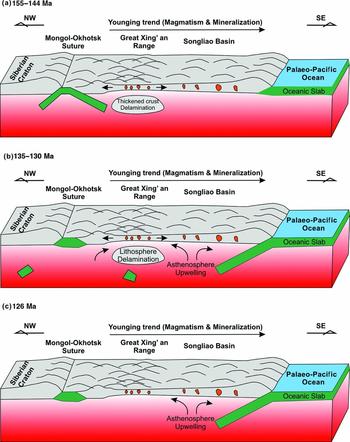
In summary, we suggest that the c. 155 Ma granites with the geochemistry characteristic of high Sr and Sr/Y or high A/CNK (1.38) in the study area were created by the closure of the Mongol–Okhotsk Ocean, and the c. 144 Ma alkaline rocks indicate the delamination of a thickened crust (Fig. 11a).
Simplified cartoon depicting the geodynamic scenario of NE China during 155–126 Ma.

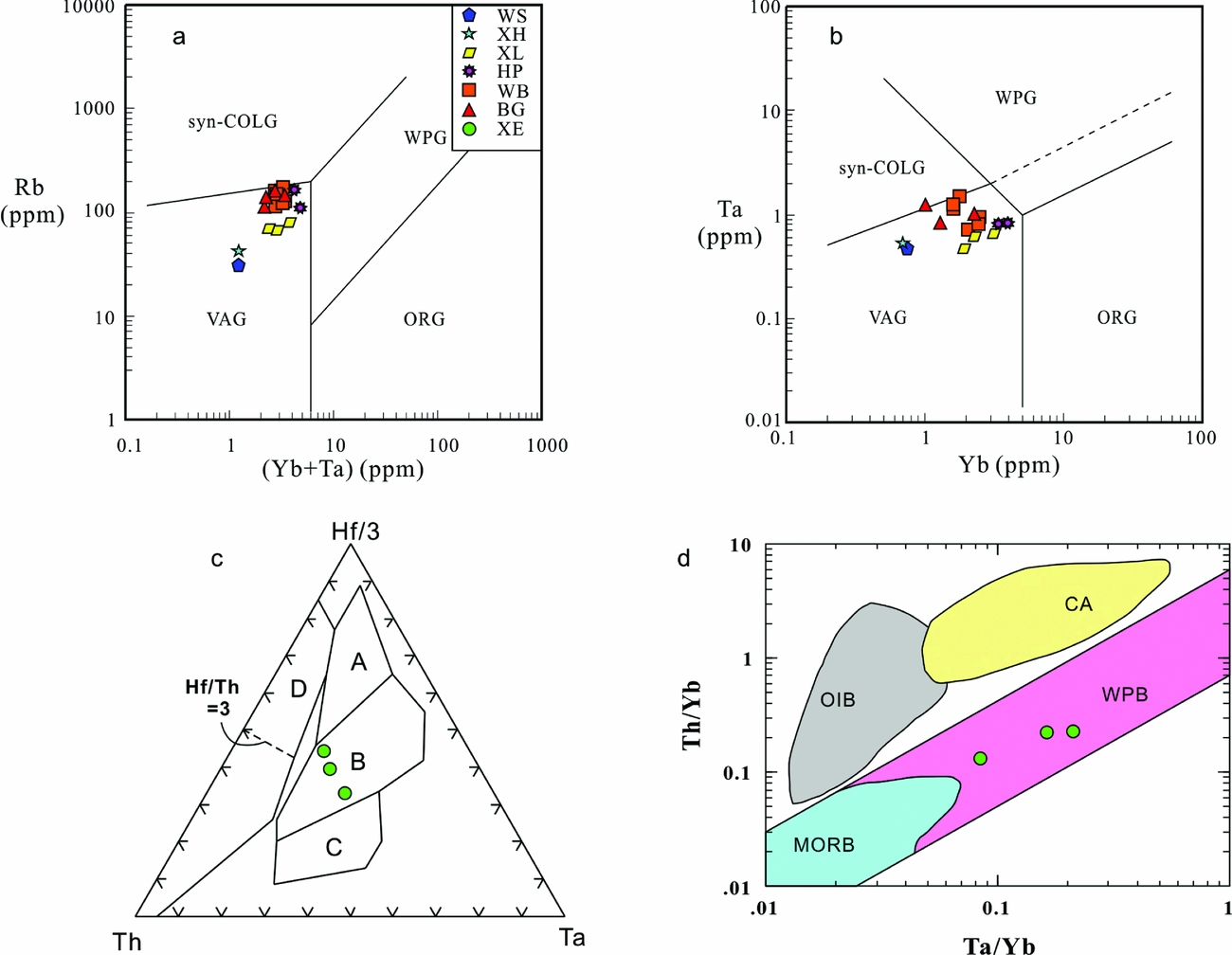
The 135–130 Ma granites are widespread in NE China (Wang et al. Reference Wang, Guo, Zhang, Yang, Zhang, Tong and Ye2015), forming intrusions such as the Xinlinzhen granodiorite (131 Ma) in the Erguna Massif (Zhang et al. Reference Zhang, Ge, Wu, Wilde, Yang and Liu2008b ), Taolaituo porphyry granite (133 Ma) in the Xingan blocks (Wu et al. Reference Wu, Jiang, Liu and Liu2014) and Qingshan granodiorite (134 Ma) in the Southern Da Xingan Range (Ge et al. Reference Ge, Wu, Zhou and Zhang2005). Those granites being genetically I- and A-type granites. The volcanic rocks were also composed of A-type rhyolite and high-K calc-alkaline series rhyolite at 135–130 Ma (Zhang et al. Reference Zhang, Ge, Wu, Wilde, Yang and Liu2008a , Reference Zhang, Gao, Ge, Wu, Yang, Wilde and Li2010a ; Xu et al. Reference Xu, Pei, Wang, Meng, Ji, Yang and Wang2013; Dong et al. Reference Dong, Ge, Yang, Zhao, Wang, Zhang and Li2014). In this study, we obtain crystallization ages of the HP syenogranite and WB granite-porphyry of 132±1 Ma and 131±1 Ma, characteristic of both I-type and A-type granites. All samples are located in the boundary areas among arc, post-collisional and within-plate fields in tectonic setting discrimination diagrams (Fig. 12a, b), suggesting that the 135–130 Ma granites were generated by the combined processes of the subduction of the Palaeo-Pacific Ocean and the post-orogenic extension of the Mongol–Okhotsk Orogenic Belt. During this stage, the Mongol–Okhotsk oceanic slab tear resulted in rapid asthenosphere upwelling and lithospheric thinning. The continuous subduction of the Palaeo-Pacific slab also triggered large-scale upwelling of the asthenosphere, lithospheric thinning and delamination, and back-arc spreading (Fig. 11b).
(a) Rb versus (Yb+Ta) diagram (Pearce, Harris & Tindle, Reference Pearce, Harris and Tindle1984); (b) Ta versus Yb diagram (Pearce, Harris & Tindle, Reference Pearce, Harris and Tindle1984); (c) Th-Hf-Ta diagram (Wood, Reference Wood1980); and (d) Th/Yb versus Ta/Yb diagram (Pearce et al. Reference Pearce, Harris and Tindle1984) for the Late Jurassic – Early Cretaceous Ulanhot intrusive rocks. VAG – volcanic arc granites; ORG – ocean ridge granites; WPG – within-plate granites; Syn-COLG – syn-collision granites; post-COLG – post-collision granites; MORB – mid-oceanic ridge basalt; OIB – oceanic island basalt; WPB – within-plate basalts; CA – continental arc; N-MORB – normal mid-ocean-ridge basalt; E-MORB – enriched mid-ocean-ridge basalt; A-WPB – alkaline within-plate basalt; IAB – island-arc basalt (Hf/Th>3, tholeiitic basalt; Hf/Th<3, calc-alkaline basalt).

The study area developed into the extension within-plate phase from 126 Ma according to the alkaline series XE gabbros and the highly fractionated I-type BG granites in this study. This is confirmed by the presence of widespread coeval A-type granites (Li & Yu, Reference Li and Yu1993; Gou et al. Reference Gou, Sun, Zhao, Ren, Zhang, Fu, Wang and Wei2010) and the large number of bimodal mafic and felsic dykes (Shao et al. Reference Shao, Li, Zhang, Mou and Liu2001a , Reference Shao, Liu, Chen and Han b , Reference Shao, Zhang, Wei and Han c ; Zhang et al. Reference Zhang, Ge, Wu and Liu2006a , Reference Zhang, Zhang, Ying and Zhou b ). During this stage, the volcanic rocks in the east of the Songliao Basin belonging to a low- to medium-K calc-alkaline series formed in an active continental margin setting, and the volcanic rocks in the Songliao Basin and Da Xingan Range, comprising bimodal volcanic rocks, related either to a back-arc setting or to delamination of a thickened crust (or both; Xu et al. Reference Xu, Pei, Wang, Meng, Ji, Yang and Wang2013). Samples from the XE pluton are plotted in the field of enriched mid-ocean-ridge basalt (E-MORB) and within-plate basalt (WPB) in the Th–Hf–Ta diagram (Fig. 12c). In the Th/Yb versus Ta/Yb diagram (Fig. 12d) proposed by Pearce et al. (Reference Pearce, Harris and Tindle1984), all the samples are plotted in the field of WPB. It is worth noting that the alkaline series XE gabbros are depleted in Nb, Ta, P and Ti, affected by the ocean plate subduction. This implies that the XE gabbros were generated by a combined process involving mantle sources generated by both oceanic crust subduction and under a within-plate setting, such as back-arc basin. We therefore suggest that the XE pluton marks the end of the Mongol–Okhotsk Orogen, and the study area (NE China) was controlled by the circum-Pacific tectonic system (Fig. 11c).
6. Conclusions
Based on new zircon ages and geochemical data, we suggest that the Late Jurassic – Early Cretaceous magmatism in the study area can be subdivided into four stages: c. 155 Ma; c. 144 Ma; 135–130 Ma; and c. 126 Ma.
(1) The crystallization ages of WS quartz diorite and XH granite-porphyry are 155±1 Ma and 155±2 Ma, with the geochemical characteristics of high Sr and Sr/Y or high A/CNK (1.38). This implies that the primary magma was derived from partial melting of a thickened lower crust, induced by the closure of the Mongol–Okhotsk Ocean. The XL quartz monzodiorite formed at c. 144±1 Ma and had the geochemical characteristics of alkaline series, indicating the delamination of a thickened crust.
(2) The crystallization age of the HP syenogranite and WB granite-porphyry are 132±1 Ma and 131±1 Ma with characteristics of both I-type and A-type granites, indicating that these were generated by the combined processes of subduction of the Palaeo-Pacific Ocean and the post-orogenic extension of the Mongol–Okhotsk Orogenic Belt.
(3) The highly fractionated I-type BG biotite granite and alkaline series XE gabbro were emplaced at 126±1 Ma, marking the end of the Mongol–Okhotsk Orogen. This implies that the study area (NE China) was controlled by the circum-Pacific tectonic system during this age.
Acknowledgements
We are grateful to Zhang Tao for her constructive comments. This work was financially supported by the China Geological Survey Program (1212011120700).
Supplementary material
To view supplementary material for this article, please visit http://dx.doi.org/10.1017/S0016756816000418.