… it is as hard to capture the essence of the palm fruit as it is to describe the hues of sunset to a blind person. The fruit has a colour like paprika or glowing coals, with the softness of red velvet, the silkiness of a fine sari, and the richness of fresh cream.Footnote 1
… the only oil, what we can get from teng kee [personal food ration cards], is this palm oil, red palm oil [exhales loudly]. Horrible! … It was not processed, simply grind and raw. Like red tomato. So what can you do? We look at it only, cannot eat. I understand from many people, they say this is very nutritious. Good. But by the look of it we got so frightened already.Footnote 2
Consider these two contemporary depictions of freshly squeezed palm oil, exuded from the fleshy drupe of the oil palm, Elaies guineensis. The first comes from Fran Osseo-Asare, a food historian and connoisseur of Ghanaian cooking, the second from Soh Wah Seng, a Chinese resident of Malaya, who endured wartime deprivations during Japanese rule in the mid 1940s. Although both views stress palm oil’s intense colour and viscous texture, the imagined associations leading from these features could not be more different. One lovingly portrays palm oil as a familiar ingredient ripe with sensuous promise, while the other sees an uncooked substance bordering on the obscene, despite its known ability to provide sustenance. Situated within Lucy Long’s schematic division between palatable and unpalatable edibles, these views of fresh palm oil easily straddle opposite ends of the spectrum.Footnote 3
These contrasting perspectives – the first encountered among societies living on both sides of the Atlantic Basin, the second enunciated within Southeast Asia, where oil palms had been cultivated since the 1840s – are all the more puzzling, given that many Malayans had already heard of the palm and its fruits as the result of the Japanese Occupation. Three decades after Malaya’s first commercial oil palm estates were established in the 1910s, the peninsula was already contributing enough oil to account for over a tenth of all international palm oil trade, faring favourably compared to exports from West Africa (just under a third of world share), where the oil palm was indigenous.Footnote 4 This divergence has only grown with time. Together with Indonesia, Malaysia now accounts for nearly nine-tenths of all global palm oil exports, without any noticeable increase in freshly squeezed palm oil as a local food ingredient.Footnote 5 As Soh’s testimonial suggests, locals were generally well aware of both fresh palm oil and its innate edibility, but they did not know how to make the substance palatable. How might we make sense of this paradox?
I contend that fresh palm oil’s unpalatability rested chiefly upon the inability of West African culinary influences to penetrate the Malay Peninsula during the first half of the twentieth century. This failed transfer stemmed from four intersecting phenomena: first, the social milieu in which colonial cuisine was constructed and disseminated among Malayan planter households by the early twentieth century; second, the British Malayan agricultural establishment’s increasing antagonism towards labour-intensive palm oil preparation techniques; third, over-simplistic provisioning policies in Malaya that highlighted palm oil’s vitamin-bearing features, ignored previous social meanings, and undermined palm oil’s gastronomic appeal; and fourth, conflicts with pre-existing dietary preferences held by migrant Tamil estate labourers and other Asian Malayans. Local aversion to fresh palm oil ultimately reinforced the large-scale, export-oriented character of Malaysia’s oil palm industry. Indeed, reconstructing historical linkages between subsistence cultures and cash crop exports helps reposition the Southeast Asian oil palm industry’s ascent as a drama filled with missed opportunities, conflicting interests, and overt favouritism, rather than merely a progressive realization of plantation-centric agriculture.
Historicizing failed culinary transfers also highlights the socio-cultural processes limiting globalization. As Rachel Laudan and other food scholars have pointed out, long-distance plant transfers usually flourished when empires expanded. Demanding skills, time, and energy for their successful organization and execution, botanical relocations were profoundly social processes, involving large numbers of people and institutions, and driven by formidable political, religious, and economic motives. Because intentional transplantations of living matter required significant resources, it was usually essential for knowledge regarding a plant’s numerous uses, including food, to accompany physical resettlement, so as to justify investments. Successful plant and culinary transfers were thus typically fronted by migrants – cooks, drudges, missionaries, merchants, colonists, and soldiers – who brought with them the cultural values, tools, and practical knowledge needed to restart agricultural techniques and food habits abroad.Footnote 6
Laudan is nevertheless sensitive to crops whose physical relocations were known to have outpaced culinary know-how for at least several centuries. These include wheat and barley from the Fertile Crescent to China; millet from China to India’s Indus valley; and manioc, peanuts, tomatoes, and potatoes from the Americas to Mughal India.Footnote 7 Many of these partial transfers stemmed from the item’s relatively low prestige in its new environment, and the absence of migrants with necessary expertise and preparation technologies (such as crop-specific grindstones). These dynamics are documented in ample detail elsewhere, from the Philippines’ sluggish adoption of maize as a staple, to Londa Schiebinger’s discussion of the peacock flower’s journey from the West Indies to western Europe, bereft of its traditional uses as an abortifacient.Footnote 8 Indeed, two of Schiebinger’s principal contentions – that pre-existing social structures in receiving regions can cause information to reach the ‘wrong’ people instead of the ‘right’ ones, and that knowledge flows sometimes run counter to the mercantile interests of states – resonate strongly with this study of palm oil in Malaya.Footnote 9
Food, together with clothing and housing, constitutes an elementary building block of material life. Asserting personal control over food choice is fundamental to mediating one’s social identity and bodily dignity. It might thus seem blasé to suggest that food preferences vary with social context. Yet extant scholarship generally treats culinary lack of interest in unrefined Malayan palm oil as a self-evident fact.Footnote 10 Part of the problem stems from the fact that Malaya’s culinary history has only recently become an acceptable field for research, and remains largely unexplored. Moreover, historical sources discussing what Malayans ate are extremely fragmentary, especially for rural areas, and those covering the modern period tend to privilege British colonial perspectives. All known evidence nonetheless indicates that palm oil’s dissemination in Malaya was largely controlled by colonial elites to begin with – evidence drawn from a wide range of archival correspondence, government reports, periodicals, memoirs, and grey literature in Malaysia and the United Kingdom, as well as oral testimonials from resident Asians deposited with the National Archives of Singapore.
Just as importantly, the Malayan context has been misunderstood because cases where successful transfers of West African palm oil-based cuisine did occur have been overlooked. Understanding the culinary paradox more rigorously therefore requires us to ground the Malayan situation within a framework spanning four continents and two oceans. The next section, focusing on the transatlantic slave trade’s rise since the 1500s, traces two general cases of successful palm oil-based culinary diffusion: one from West and West Central Africa to Brazil, the other from West Africans to Europeans living within West Africa itself. The article’s third section compares the oil palm’s transatlantic transfer to Latin America with its journey across the Indian Ocean to Southeast Asia, noting similarities and differences in the primary actors involved, as well as their underlying motives for facilitating plant and knowledge transfers. Section four contrasts successful culinary diffusions with West African cuisine’s failure to attract local adherents within Malaya. The shift from indifference to hostility is historicized through the activities of four clusters of Malayans: European planter households and their servant cooks, state authorities, nutritional scientists, and estate labourers. Section five outlines the dietary and agricultural consequences of Malaya’s culinary paradox, before closing with remarks on what failed culinary transfers can tell us about globalization’s limits, especially with regard to historical connections between Southeast Asia, West Africa, and Latin America.
West African culinary change and expansion
In contrast to Malaya, West Africans have spent several millennia developing an extensive subsistence culture revolving around the indigenous oil palm.Footnote 11 While the earliest-known sites of subsistence oil palm cultivation are located in Kintampo sites in Ghana during the late Holocene period, culinary uses for palm oil were widespread across the West and West Central African regions.Footnote 12 These areas, extending from Senegal to Angola, were grounded in a mixture of savanna and forest-based produce.Footnote 13 Savanna ecologies in West Africa’s northern areas were more conducive to cereal cultivation (millet, sorghum, and later on maize), whereas tuber farming (yams, plantains, and later on cassava) permeated the humid tropical forest zones of what are now central Ghana, southern Nigeria, coastal Cameroon, and western Congo.Footnote 14 Mirroring these ecological variations was the availability of oils, vegetables, and animal flesh used to create tasty relishes accompanying bland starches. Thus, among the major oils used for cooking, flavouring, and mouthfeel, West and West Central Africans tended to exploit fresh palm oil in forested zones, peanut oil in savanna spaces, and shea butter in ecotone areas.Footnote 15 Oil palms were thus frequently intercropped with yams and other forest crops.Footnote 16
Travellers’ accounts from the fourteenth to seventeenth centuries sometimes alluded to the distinct cuisines that arose from these ecologies, invariably mediated by female cooks.Footnote 17 Made from pounded tubers, sticky spheres of fufu were typically accompanied by stews made from palm or groundnut oil, mucilaginous vegetables like okra, spices, and some meat or fish; the amount of ingredients used varying according to availability, household budgets, and individual preference.Footnote 18 Similarly, popular snack foods, such as fried plantains, roasted tubers, and deep-fried fritters, would typically be dressed in red palm oil from forested areas.Footnote 19
From the sixteenth century onwards, long-distance trade along the Atlantic Rim reshaped the composition and distribution of transatlantic food preferences in an unprecedented fashion. Of an estimated ten million slaves conveyed alive to the Neotropics over three and a half centuries (most of whom were from West and West Central Africa), more than 80% landed in Brazil and the Caribbean.Footnote 20 In these tropical regions, enslaved migrants relocated West African plants, animals, and dietary preferences, underlining their struggle to survive and subsist on familiar foods that could restore a modicum of personal autonomy. Slavers and European planters condoned these transfers out of economic convenience, believing that the mortality of their human cargo would be reduced if enslaved Africans consumed familiar foods during the Middle Passage, and cultivated them later in the Americas. Traditional foods including millet, rice, sorghum, tubers, beans, groundnuts, oil palm fruit bunches, and palm oil were brought on board – as well as mortars, pestles, and African women skilled in the use of these essential food-processing technologies – with excess seeds and other planting materials offloaded in Latin America.Footnote 21
Oil palms were subsequently cultivated in subsistence plots by enslaved Africans on sugar plantations in Jamaica, Trinidad, Antigua, and Barbados.Footnote 22 Female African cooks used palm oil – whose redness was associated with vitality and long life – in tasty, viscous communal pottages across the circum-Caribbean region. For the enslaved, severed from their West and Central African homelands, sharing such meals and re-establishing culinary traditions provided essential physical, social, and spiritual nourishment.Footnote 23
In north-east Brazil, particularly Bahia – where approximately 1,500,000 enslaved Africans disembarked during the plantation era – West and West Central African migrants left one of their heaviest culinary imprints since the mid seventeenth century.Footnote 24 Even today, unrefined palm oil, known locally as dendê (from the Kimbundu word ndende), remains beloved in Bahia for both profane and sacred purposes. Acarajé, a popular deep-fried street food with strong Yorùbá origins, is still prepared by Afro-Brazilian female market vendors (baianas) using dendê, not unlike their counterparts in West Africa.Footnote 25 Together with another dish made from black-eyed peas (abará), acarajé features heavily in food offerings made during Afro-Brazilian candomblé religious ceremonies.Footnote 26 The red palm oil used to prepare these foods comes from artisanal vendors, who in turn source much of their produce from peri-coastal Bahia’s oil palm smallholdings, established and maintained through agricultural techniques rooted in West and West Central African polycultures.Footnote 27
Transatlantic trade also helped reconfigure dietary patterns within West Africa itself, including areas where hundreds of new European trading posts were concentrated. In ascendant polities such as Asante, Oyo, Benin, and Dahomey, rulers sought to control not just the flow of enslaved peoples, but also the provisions needed to feed captives, militias, raiders, traders, priests, and resident European officials.Footnote 28 Regional trading diasporas helped introduce new crops like maize, chillies, and cassava, as well as know-how surrounding their cultivation and cooking.Footnote 29 The cuisine of nineteenth- and twentieth-century West and West Central Africa nonetheless continued to display core similarities in taste, cultural significance, and preparation methods. Offerings such as palm stew persisted, drawing on older ingredients, not least palm oil, and newer ones, including cassava for fufu.Footnote 30
Like other regions entangled with Western imperialism, centuries of Afro-European interactions in West Africa, bolstered by growing socioeconomic differentiation, eventually fostered new urban dishes of increasing refinement and complexity, prepared mostly by African women.Footnote 31 Palm chop – a dish that would eventually appear repeatedly in Malaya – seems to have been frequently consumed by European migrants residing within West African territories with a heavy British presence by the nineteenth century. It was supposedly a fancier version of palm stew, boosted by larger helpings of protein and garnishes, prepared by West African cooks specifically for domiciled Europeans.Footnote 32 Travellers sometimes compared palm chop favourably with curry, a British-influenced dish from South Asia, counting on both dishes’ ubiquity among Europeans residing abroad. Moreover, like curry, palm chop’s most enthusiastic European adherents apparently brought its ingredients back to Europe in attempts to re-create variants of the dish.Footnote 33
Amid West Africa’s palm oil-heavy cuisine, the nineteenth century saw mounting sales of peasant-produced West African oil palm products, as well as a search for new tropical zones for oil palm cultivation outside West Africa. A prime instigator of this double shift was western Europe’s increasing hunger for tropical commodities, driven by industrialization. By the mid nineteenth century, West African-sourced palm oil – now part of the ‘legitimate’ commerce that was replacing the slave trade – had become a major industrial raw material for soap, candles, railway lubricants, and tin-plating.Footnote 34 Following the communications revolution of the 1870s and 1880s, European interest in cultivating Elaeis guineensis in Southeast Asia for exportable palm oil and kernels began to grow significantly.Footnote 35 The general difficulties that Europeans had in establishing mechanized palm-fruit-processing arrangements in British West Africa, coupled with perceived limits to exportable supplies from West African peasant producers, fuelled interest in having the oil palm’s habitat range expanded to regions that Europeans could assert greater control over.Footnote 36
Oil palms come to Malaya
At first glance, the circumstances surrounding the oil palm’s introduction to Malaya and its neighbouring territories could not have been more different from Elaeis’ relocations to the Neotropics. There is no known evidence of West African labourers propagating oil palms in Southeast Asia for subsistence, as they did in Bahia and the Caribbean. The crop’s nineteenth-century journey to Southeast Asia was instead primarily facilitated by overlapping imperial networks of experimental gardens and estates spanning Europe and the Indian Ocean. Underwritten by colonial expansion and the institutionalization of the natural sciences, networks were sustained by travelling botanists and planters, for whom the oil palm and other cultivars, excised from their original abodes, represented new frontiers for profit, science, and professional advancement.Footnote 37
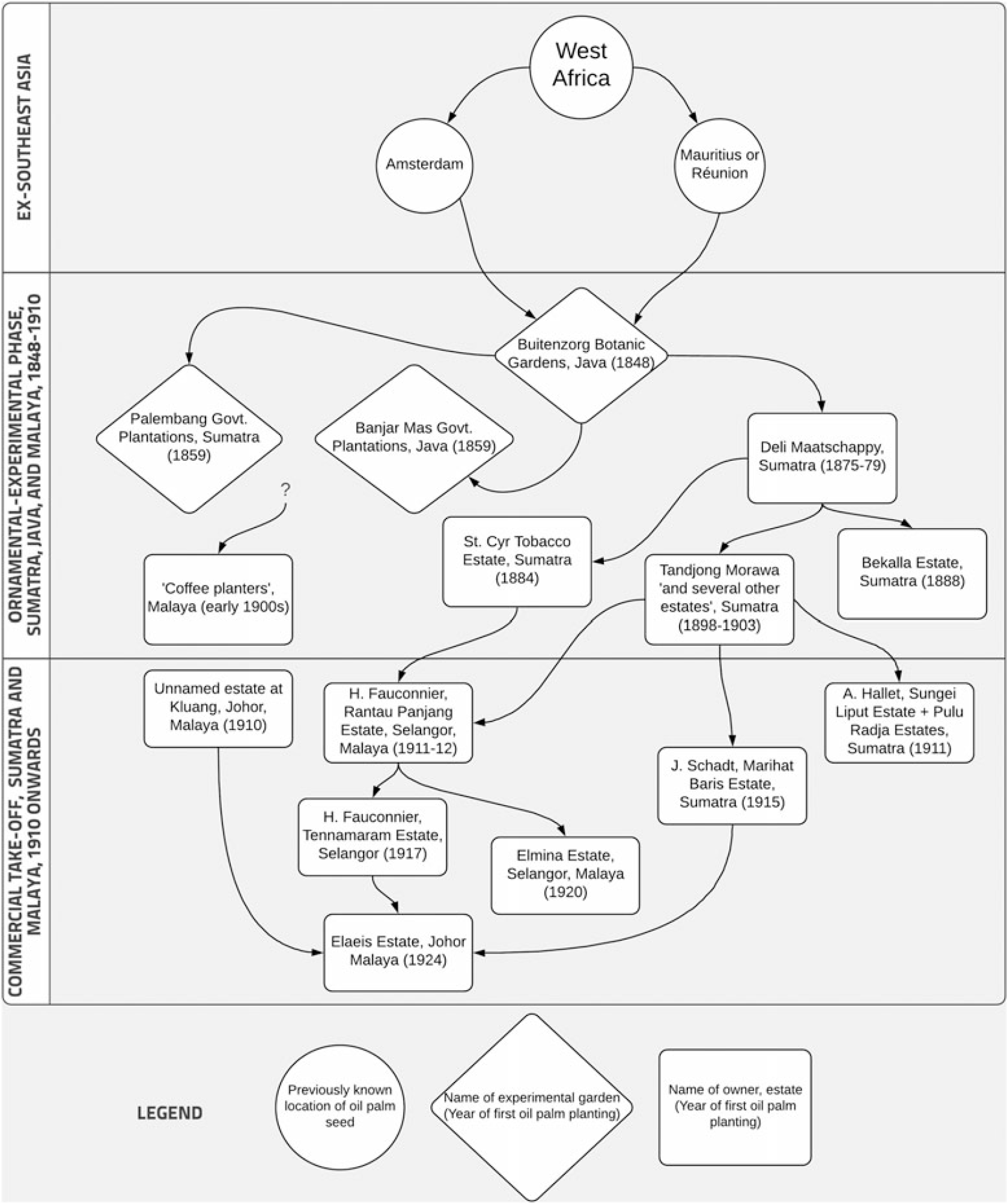
That being said, the circumstances surrounding Elaeis guineensis’ travels to Southeast Asia remain very hazy. Hartley seems to suggest that Amsterdam, Mauritius, and Réunion were mere transhipment stations for four unusually high-yielding West African oil palm seedlings, which arrived at the Dutch Indies’ Buitenzorg Botanic Gardens in 1848, or that, at best, any Mauritian transfer was facilitated using West African stocks previously planted at Mauritius’ Botanical Gardens.Footnote 38 Other botanists, however, note that West African oil palms were reportedly being grown in ‘European conservatories’ by at least 1730; it would be odd if Amsterdam or nearby Leiden had been left out of this ongoing process.Footnote 39 It would be even odder if West Africans themselves had not participated in the selection of these vigorous dura palm breeds prior to their cultivation in Europe, given how little Europeans knew about oil palm agriculture as late as the mid nineteenth century, relative to generations of West Africans who had undertaken in situ palm selection work themselves.Footnote 40 Finally, while the majority of enslaved Africans exported to the Indian Ocean region in the centuries following the Portuguese entry were from East Africa and Madagascar, a minority sent to the Mascarene Islands from the 1670s to the 1760s were of West African provenance, including men, women, and children from Dahomey, an oil palm-growing polity.Footnote 41 The enslaved, furthermore, had to be fed en route. These points raise questions about possible links between the Indian Ocean World slave trade and eastward (though probably not trans-oceanic) transfers of oil palms that could benefit from further research.
In any case, once planted at Buitenzorg, the four newly arrived oil palm seedlings grew into four adult palms, and from these four parents came all known progeny used to kick-start virtually all of Sumatra and Malaya’s earliest oil palm plantations (see figure 1). These seedlings were disseminated through collaboration between government botanists and Western planters, and between planters themselves.Footnote 42
The origins of Malaya and Sumatra’s first commercial oil palm planting materials. Sources: R. B. Jagoe, ‘Deli oil palms and early introductions of Elaeis guineensis to Malaya’, Malayan Agricultural Journal, 35, 1, 1952, pp. 4–8; Hartley, Oil palm, pp. 19–21; R. H. V. Corley and P. B. H. Tinker, The oil palm, 5th edition, Hoboken, NJ: Wiley, 2016, p. 140; Burkill, Dictionary of the economic products, pp. 911–12; Kabul Pamin, ‘A hundred and fifty years of oil palm development in Indonesia: from the Bogor Botanical Garden to the industry’, in Angga Jatmika et al., eds., Proceedings of the 1998 International Oil Palm Conference, 23–25 September 1998, Sheraton Nusa Indah Hotel, Bali, Indonesia, Medan: Indonesian Oil Palm Research Institute, 1998, p. 6; Tate, RGA history of the plantation industry, pp. 453–5 and 466, n. 6; Susan M. Martin, The UP saga, Copenhagen: NIAS Press, 2003, pp. 50–2; Sjovald Cunyngham-Brown, The traders: a story of Britain’s South-East Asian commercial adventure, London: Newman-Neave, 1971, pp. 252 and 320.

All known historical evidence on the oil palm indicates that its initial diffusion within the Malay archipelago rested upon on its perceived value as a bulk commodity destined for Western fats and oils industries. Ironically, this very same industrialist stance created numerous challenges to crop diffusion. Drawing on produce from experimental gardens in Java, Sumatra, and Malaya, British and Dutch botanists sought to publicize the palm fruit’s utility – including its value as soap stock – to local investors.Footnote 43 Planters themselves also experimented with oil palm cultivation in East Sumatra, West Java, and Malaya before the 1910s. But they still considered coffee, coconuts, rubber, and other cash crops as better commercial bets during this period.Footnote 44
In a time when planter interest in oil palm cultivation was still nascent in Southeast Asia, botanists and government officials were prompted to seek more creative ways to popularize the crop. By the early twentieth century, colonial officials and botanists occupying different nodes within the British empire repeatedly advocated having peasants outside Africa take on the pioneering risks of farming a new crop like Elaeis. Doing so, they argued, would pave the way for new sources of palm oil from Britain’s tropical colonies. As in the Neotropics, subsistence cultivation once again dovetailed with imperial strategies to buttress economic expansion.
Appealing in mid 1908 to Britain’s Secretary of State for the Colonies for a more concerted effort to cultivate oil palms outside West Africa, Walter Egerton, then Governor of South Nigeria, noted that palm oil was ‘the staple ingredient in the food of the West African and would probably become an almost equally popular ingredient in the diet of the other Dependencies of the Crown in which it may thereafter be extensively cultivated’.Footnote 45 Kew Gardens’ assistant director, Arthur Hill, broadly concurred with this view, noting that ‘As an article of food the oil is no doubt of great value in West Africa and from this point of view the cultivation of the palm [outside West Africa] might prove to be a wise undertaking.’Footnote 46 Responding to both, Malaya’s inaugural Director of Agriculture, J. B. Carruthers, suggested that his own office could eventually promote oil palm cultivation among smallholders in the Federated Malay States, using seeds sourced from the Federal Government’s Experimental Garden in Kuala Lumpur.Footnote 47 None of these respondents seemed to have been aware of prior developments in Latin America; if anything, their primary concern was whether oil palms would elicit sufficient smallholder interest, in the light of competing sources of local oil for cooking, particularly that of the coconut palm, indigenous to Southeast Asia.Footnote 48 A contemporaneous botanical report highlighted fourteen different known varieties of coconuts already cultivated in Singapore alone. Indistinguishable to outsiders, locals classified the breeds according to their individual properties, making some more suitable for dessert preparations, delicacies, medicines, or just everyday cooking.Footnote 49
Into the early 1920s, while Malayan plantations continued to vacillate on whether to diversify into oil palms, local administrators sought new ways to entice investment by enhancing the oil palm’s subsistence value, even to the extent of displacing other food sources. Between 1923 and 1924, the Perak and Selangor state authorities advocated waiving special conditions on oil palm estates to set aside one-tenth of their lands for food cultivation, on the grounds that the oil palm’s products ‘were largely foodstuffs’.Footnote 50 These recommendations were partly motivated by the Federated Malay States’ ongoing policy to diversify export agriculture beyond Hevea rubber, as well as common knowledge that coconut palms were usually grown on most European estates for the subsistence requirements of their migrant Indian and Javanese labour forces.Footnote 51
In pursuing their crop diversification strategies, estates themselves helped labourers in Malaya and neighbouring regions acquire palm fruit cooking skills. During the interwar years, fruit volumes on many recently planted estates started out relatively low, prompting plantations to use manual palm oil extraction methods to save on the costs of large-scale palm fruit processing machinery. These labour-intensive techniques were essentially augmented versions of West African native palm oil processing practices prior to final meal preparations. They were reportedly pioneered within German-owned enterprises in Cameroon before the First World War, before being transferred to plantations in East Sumatra, whose techniques were in turn copied by Malayan estates.Footnote 52 In ways uncannily similar to the ‘soft oil’ extraction methods practised by contemporaneous West African households, groups of Malayan labourers learnt to boil and soften palm fruits promptly once ripe, pound them with wooden pestles in mortars, manually separate the fibrous mass containing the remaining palm oil from the palm kernels, and purify palm oil by heating it to remove moisture and surface matter.Footnote 53 Although details of how these traditional cooking skills were passed from workers in West Africa to Malaya via Sumatra are still lacking, in all probability such processing know-how was circulated through the same inter-imperial networks that brought oil palms to Southeast Asia.
Finally, West African dietary preferences were introduced to Malaya not long after estates established oil palms. Malaya’s expanding economy drew an influx of migrants and visitors, including Europeans whose previous stints in West Africa had exposed them to regional food habits. One such visitor during the mid 1920s, a former planter who had already spent ‘four terms of service’ in the Gold Coast, was inspired to share recollections of West African meals with Malaya’s planter community after visiting an old planter friend in Malaya. Between 1925 and 1938, this individual – who signed off as ‘B.O.W.K.’ – was sufficiently moved by an unexpected sighting of oil palms in Malaya to pen three separate articles for The Planter, Malaya’s prime trade journal among planters (with nearly a thousand subscribers by 1922).Footnote 54 In his first article, B.O.W.K. contrasted his former ‘dreary’ daily routine on the Gold Coast with the weekly highlight of ‘the Sunday palm oil “chop”’.Footnote 55 Extolling palm chop’s virtues, B.O.W.K. later claimed that it was a dish ‘highly esteemed by Europeans’, ‘eaten by everyone, rich and poor, native and European’.Footnote 56 He then proposed that palm chop would be ‘a useful addition to [Malaya’s] indigenous food supplies’, especially given Malaya’s heavy dependence on imported food staples.Footnote 57
B.O.W.K.’s fondness for palm chop, as his writings quickly made clear, was primarily gastronomic in nature. With each successive contribution to The Planter, he provided recipes for palm chop in increasing detail and variety. To render his concoctions more comprehensible to his Malayan reading audience, B.O.W.K. likened palm chop, like other European travellers before him, to curry, including the popular British-influenced Sunday curry-rice tiffin. But his comparisons went beyond simply trying to translate an unfamiliar dish into more familiar colonial meal aesthetics, to suggesting that palm chop was actually gastronomically superior to curry. It would be far more pleasurable to have palm chop than curry, B.O.W.K. argued, if only because the former went much better with beer than the latter.Footnote 58 Taking the curry analogy further, he envisioned such preparations to be eventually enjoyed by all Malayans to varying degrees, based on their supposed ethno-cultural preferences for curries: ‘Tamils would almost certainly take to it; Malays might, and Chinese most likely not. Europeans would very likely welcome it as an alternative to curry.’Footnote 59 In making such culinary comparisons, B.O.W.K.’s early writings followed an older pattern of colonial cuisine-writing that paired an unfamiliar dish with a more familiar one.
B.O.W.K. nevertheless soon realized that Malayans generally continued to hold little interest in red palm oil-based cuisine. Four years after his initial missive, he admitted that ‘there [were] no visible signs of [palm chop] having received consideration’ by ‘Government and employer of labour alike’.Footnote 60 In fact, the only recorded instance of palm chop being consumed in Malaya stemmed from another itinerant planter’s endeavour, four decades later. Leslie Davidson, a Scotsman who had spent several years on estates in Cameroon and eastern Nigeria during the 1950s, brought his fondness for West African food culture to Malaysia in the 1960s.Footnote 61 In 1969 (and now chairman of Unilever’s plantation subsidiary in Malaysia), he decided to share his affection for palm chop with the heads of other major plantation companies at their monthly meetings in Kuala Lumpur. Prior to hosting the customary pre-meeting lunch, Davidson instructed his Chinese cook to concoct a serving of palm chop, before carrying the stew to Kuala Lumpur in a plastic bag. At the hotel where the planters were to dine, Davidson had the preparation reheated and served to his associates with rice and ‘the appropriate side-dishes’.Footnote 62 Recalling the episode some four decades later in his memoirs, Davidson noted that ‘None of my colleagues seemed to enjoy it. It was, in fact, a culinary disaster.’Footnote 63 That such an incident could occur in Malaysia, despite infusions of West African know-how surrounding palm-oil-based culinary practices over several decades, makes the failed culinary transfer more puzzling.
Resistance from Malayans
B.O.W.K’s pioneering recipes would have been given initial consideration by The Planter’s main subscribers, namely the hundreds of European planters and botanists strewn across the Malayan countryside. As the so-called ‘voice of established planter opinion’, The Planter published many articles on palm oil and oil palms during the interwar period. These pieces were primarily concerned with ways to squeeze more profit from the crop through efficiency gains, better product quality, and larger export volumes.Footnote 64 Under the journal’s founder Charles, Ward-Jackson – an ex-journalist and a ‘man of letters’Footnote 65 – The Planter also frequently ran pieces from other genres, including travel dispatches, amateur poetry, columns on women’s issues, and recipes using locally available ingredients. From this perspective, B.O.W.K’s printed contributions were hardly unusual.
The Planter’s loosely defined ambit contrasts with the relatively rigid social structures permeating many European-owned estates by the early twentieth century. Planters and their households played critical roles in perpetuating hierarchical societies across swathes of rural Malaya, thus complicating the way in which knowledge was circulated, restricted, and operationalized within European-owned estates. At the top of this social order sat European managerial staff and their families, tailed by several Asian servants. A middle rung was occupied by multilingual male Asian intermediaries: independent contractors, clerks, and field supervisors. Migrant wage labourers, mostly of South Asian provenance, filled the bottom ranks of estate social structures, taking on the tedious and dirty tasks of weeding, drainage maintenance, and crop harvesting and handling.Footnote 66
Nevertheless, class, ethnic, and gender distinctions did not in themselves hinder food diffusion. As we saw earlier, in Latin America – where social inequalities were, if anything, felt far more harshly under plantation slavery – inequity helped perpetuate oil palm cultivation for subsistence among low-class migrants. Here, palm oil consumption met the interests of both the powerful and the powerless. The crucial difference underpinning Malaya’s resistance to palm oil-based cuisine – even as oil palms proliferated across rural Malaya – lay in the specific socio-cultural norms practised, in different ways, by European Malayan planter households and Asian Malayans of various backgrounds. And, as we will see, underlying prejudices in both groups against fresh palm oil were aggravated by elite interventions in the realms of production and consumption of Malayan palm oil.
Let us first turn to the interwar culinary practices of European Malayan planter households, The Planter’s primary audience. Cecilia Leong-Salobir has recently contended that social distance between British Malayan households and their Asian servants did not prevent the latter from heavily influencing the former’s food habits, particularly before the twentieth century. Servant cooks were hired for their intimate familiarity with domestic foodstuffs, their access to local ingredients, and their ability to prepare dishes using rudimentary kitchen facilities. Many British Malayans thus learnt to accommodate and even appreciate a spread of dishes drawing on local Asian culinary repertoires, including ‘Chinese’ noodles and ‘Malay’ fried rice, accompanied by strongly flavoured local condiments like fermented shrimp paste (belachan), and a wide assortment of locally grown tropical fruits.Footnote 67 Chilled food imports gradually penetrated Malaya from 1905 onwards, but access to these Western comfort foods remained limited by household income and proximity to urban centres for several decades afterwards.Footnote 68 Furthermore, trade slumps after the First World War and during the early 1930s undercut both the job security and salaries of Malayan planters, pressuring households to economize on luxuries.Footnote 69
In contrast to West Africa, the form of colonial cuisine that developed in Malaya was thus heavily Asian-influenced, and did not take kindly to exotic ingredients perceived as West African. One botanical official, while assessing the oil palm’s commercial potential at Singapore’s Botanic Gardens during the early 1920s, tried consuming unrefined palm oil by having his eggs fried in it. Already accustomed to having his meals prepared by Asian servants using locally available pale-coloured cooking fats, he was repulsed by the encounter, commenting that his eggs ‘came to the table with a deep orange film, suggestive of varnish or floor polish – and the flavour, to a palate accustomed to fresh coconut oil or [sesame oil], was not quite pleasant’.Footnote 70
European women also became increasingly influential within Malayan planter societies, not least once improvements in local living conditions after the First World War had created more conducive conditions for them to settle in Malaya. Between 1911 and 1921, the sex ratio of European women to men on estates had more than doubled to 38 : 100.Footnote 71 These women – who generally retained some power over household meal choices, if only to uphold contemporary middle-class notions of respectable domesticity, like other European housewives abroadFootnote 72 – often consulted each other for culinary advice. Through The Planter, they discussed ways to manage domestic servants, exchanged personal recipes for items like orange jelly and pies, and sought clarification on kitchen preparations drawn from popular locally penned cookbooks such as Mrs W. E. Kinsey’s The mem’s own cookery book: 420 tried and economical recipes for Malaya.Footnote 73
Planters’ wives had also undoubtedly read B.O.W.K.’s recipes in The Planter, and would have found them troubling. Perhaps their most problematic aspect was their insensitivity to prevailing gender and corporeal norms in Malaya. For instance, while lauding palm chop’s nourishing effects on West African consumers in his 1929 article, B.O.W.K. entered awkward territory when commenting that the dish ‘is very fattening, if one may judge by the Fanti “mammies” of the [Gold] Coast towns, who belong to a country where a really plump figure, “fore and aft”, is synonymous with feminine beauty’.Footnote 74 Such a graphic attribution, however well intentioned, clashed directly with contemporaneous pressures on European women to remain slender and comely,Footnote 75 expectations that The Planter’s own readers would have been acutely aware of, as reflected in articles penned by Malayan women themselves. One anonymously authored piece, published during the Great Depression’s later years, reminded audiences of frugality’s benefits for feminine well-being:
The fact that money has not been so plentiful has had the good effect of reducing our too generous meals; that and of course the slimming habit! But the slender woman who has no need to slim also finds herself in much better health for the simple meals we go in for to-day. We have found out that the less rich foods that we consume are far more suited to the tropics, and we have no desire to go back to the bad old days of too plentiful and too heavy a diet.Footnote 76
In Atlantic World societies where female corporeal expansiveness was linked to fertility, generosity, and respect, preparing and consuming much-loved palm chop (or palm stew) helped maintain an individual’s dignity and bodily autonomy (especially for enslaved West Africans).Footnote 77 In interwar Malaya, however, the notion of ingesting fattening palm stews did the opposite for middle-class European women, threatening to harm one’s social esteem. Fresh palm oil thus became better known among Malaya’s British cooks, but for the wrong reasons.
Ironically for Malayan palm oil, ‘big’ was increasingly associated with ‘beautiful’ in a different fashion. During the early twentieth century, large-scale plantation monocultures, bolstered by tropical agronomy’s rising scientific status, became not just standard bearers for agricultural productivity, but physical emblems of European power and prestige across the globe.Footnote 78 For oil palms, as we saw earlier, such tendencies were kept in check by the risks of pioneering the crop outside sub-Saharan Africa. Smallholder oil palm cultivation was thus actually tolerated, if not condoned by British agronomists in the earliest phases of oil palm expansion in Malaya. By the late 1920s, however, this arrangement of convenience had given way to an official Malayan policy designed to restrict oil palm cultivation to plantation-centric systems.
Underpinning this shift were three interconnected developments. Having established some 8,300 acres of young oil palms in the states of Perak, Selangor, and Johor by the mid 1920s, Malayan planters were now seeking ways to ensure the oil palm’s long-term commercial success. Chief of these was a territory-wide quest to distinguish their palm oil exports from those of West Africa’s, as the latter were destined for less lucrative, lower-grade inedible uses, such as laundry soap.Footnote 79 Seeking a higher price for Malaya’s home-grown produce meant trying to break into western Europe’s and North America’s premium margarine markets, where palm oil’s marketability still lagged behind edible oils with fewer pigments and higher plasticity, like those from coconuts, groundnuts, and whales.Footnote 80 The immediate problem was not with Malayan palm oil’s production quality per se, as technically excellent palm oil of less than 4% free fatty acid content was already being manufactured on estates, using labour-intensive techniques.Footnote 81 Rather, Western edible oil buyers were reluctant to award Malayan palm oil with a premium because of the commodity’s relatively small presence in global palm oil exports at the time, effectively penalizing sellers who tried hawking individual consignments below preferred volumes.Footnote 82
Fortunately for Malayan planters, large-scale centrifugal presses, launched by the British manufacturer Manlove Alliott & Co. Ltd. and their competitors since 1924, now made scaling up palm oil production more commercially feasible. They were able to handle rising volumes of harvested fruit, with high palm oil extraction rates of 90%, while enabling estates to substitute machinery for the repetitive labour needed to separate and sterilize fruits, extract palm oil, and remove palm kernels for drying and shelling. Such machinery also helped estates pare down the number of European managers needed to supervise field workers, a process which became especially pronounced during the Great Depression.Footnote 83 By 1929, eight large-scale presses, of both the centrifugal and hydraulic varieties, had been installed on estates in the Malayan territories of Johor, Perak, and Selangor, with more in various stages of construction.Footnote 84
Finally, Malayan government scientists and agricultural specialists remained mindful that European-owned Malayan estates had already invested three decades of time and energy in coconut palm cultivation, with mixed results. Authorities were particularly concerned that bulk exports of Malayan copra (oil-rich coconut kernel) had consistently failed to meet premium-quality standards set by European, North American, and Japanese chemical industries for the past two decades.Footnote 85 European-owned coconut estates, despite their careful attention to harvesting and copra manufacture, constituted a small proportion of overall Malayan coconut production; roughly four-fifths of all recorded Malayan coconut acreage consisted of smallholdings in the 1920s.Footnote 86 Although Malaya’s coconut quality problem was rooted in intractable issues, such as Malaya’s habitually rainy climate, the low global premium fetched by first-class copra, and competing demands from an even older regional market for coconut produce, government agriculturalists and planters alike found it easiest to blame smallholders for dragging down Malaya’s reputation for quality copra.Footnote 87 Accordingly, any future smallholder participation in Malaya’s growing palm oil trade needed to be policed tightly.
In September 1929, Malaya’s recently arrived Director of Agriculture, Harold Augustin Tempany, circulated a memorandum among the senior administrators of Johor and the Federated Malay States, seeking to streamline official policies towards future oil palm smallholders for the first time. Tempany’s despatch aimed to prevent smallholders from cultivating oil palms for domestic use, and advocated restricting oil palm agriculture to avenues supporting plantation development. The alienation of ‘small’ areas of land for oil palms – later clarified as plots below 150 acres – was no longer permitted, unless applicants could show proof of future palm fruit sales to a nearby estate factory.Footnote 88
Tempany justified the Malaya-wide restrictions on three grounds. First, the Malayan planting community was ‘trying to specialise in the production of a high grade oil for export’, dovetailing with ongoing government efforts to diversify Malaya’s export economy away from excessive dependence on rubber and tin.Footnote 89 More debatable was Tempany’s assumption that ‘palm oil [was] not the oil of the country’; in other words, the oil palm had little subsistence use in Malaya, and could thus be restricted from peasant cultivation without serious political repercussions, unlike the coconut palm.Footnote 90 Lastly, and most controversially, Tempany argued that any incipient West African-style manual palm oil extraction techniques in Malaya needed to be eradicated in favour of large-scale mechanical presses, claiming that hand methods might produce low-grade oil that ‘would have a most detrimental effect on the industry as a whole and might severely prejudice large scale developments’.Footnote 91 Such statements ignored the fact that high-quality low-acid palm oil was, in the first instance, the result of careful attention to crop handling, transport, and sterilization prior to oil extraction, all of which were already in play during the most labour-intensive phase of the Malayan oil palm industry’s establishment. State land authorities were emboldened by the memorandum’s underlying recommendations, and began denying oil palm land applications to small-scale growers almost immediately afterwards.Footnote 92 By sanctioning the hegemony of large-scale mills, Tempany’s missive confirmed technological prejudices already held by many local planters and officials.
Moreover, the new official consensus clashed directly with West African palm chop recipes still being disseminated within The Planter for Malayan audiences as late as 1938. These culinary guidelines explicitly warned against using factory-made oil in palm stews, insisting that fresh oil from hand methods would improve palm chop’s taste significantly.Footnote 93 With contempt for manual oil extraction techniques officially formalized, it is not implausible to suggest that a dish like palm chop would be viewed as something primitive and backward, to be cooked and eaten by socially inferior groups. The same 1938 article admitted as much, having given up persuading European Malayan households to consume the dish themselves. Instead, the author of the recipes hoped that doctors and estate managers would use their newly acquired West African culinary knowledge to create ‘suitable palatable dishes for labourers [in Malaya], who may be in need of … fats or oils’.Footnote 94 Even in this constricted format, however, West African recipes were ignored, and unrefined palm oil was instead disseminated primarily as a standalone substance known mainly for its alleged nutritional benefits and revolting aesthetics. How did this situation come to be?
Answering this puzzle means turning to the activities spearheaded by a third set of local actors, namely biochemical scientists stationed within Malayan academia and government service during the interwar years. Broadly speaking, shifts in Western notions of sustenance towards chemically derived attributes like vitamins and amino acids had already helped elevate West African unrefined palm oil’s status as a concentrated source of carotene (a precursor to vitamin A) among nutritionists in the United Kingdom by the late 1910s.Footnote 95 Moreover, Malaya’s biochemists would not have managed to acquire their outsized influence on food provisioning policies by the late 1930s, if not for imperial-level efforts to improve workforce health and productivity in Britain’s colonies, and ultimately uphold British Malaya’s imperial prestige and economic competitiveness after the First World War.Footnote 96 Such initiatives even translated into direct financial support for Malayan nutritional science, including a massive academic endowment from the USA-based Rockefeller Foundation in 1925, and money from the Colonial Development Funding for vitamin research in Malaya from 1929 onwards.Footnote 97 But Malayan red palm oil’s packaging as a quasi-medicine, rather than a core ingredient of West African-derived cuisine, still rested largely on the individual decisions made by Malaya’s resident chemists. The most influential of these was John Lewis Rosedale, who arrived in Malaya during the second half of the 1920s to become the inaugural Professor of Biochemistry at Singapore’s King Edward VII School of Medicine, holding the post until the eve of the Japanese Occupation.
Malaya’s expanding public health services provided both the pretext and the means through which chemists could promote palm oil to local Asians. By the second half of the 1920s, resident medical officers were regularly identifying vitamin A deficiencies among plantation labourers. Malnourishment symptoms were underlined by an inability to shed tears, eventually ushering in night blindness (nyctalopia), xerophthalmia, Bitot’s spots, and keratomalacia. The last condition, characterized by opaque or perforated corneas, was irreversible. Medical practitioners knew little about local foods that could alleviate these deficiency diseases, prompting calls for scientific investigations that could assist the cause of preventive medicine.Footnote 98 Rosedale, who had already begun mobilizing Malayan laboratory staff and resources to investigate thousands of local food ingredients from 1928, was finally able to declare in 1934 that unrefined Malayan palm oil was more effective in addressing vitamin A deficiencies than any other locally available vegetable oil, including that from coconuts, sesame seeds, and groundnuts.Footnote 99 That same year, unrefined palm oil began to be deployed in child welfare centres across Malaya.Footnote 100 As a cheap substitute for imported cod liver oil, palm oil provisioning dovetailed with ongoing public health initiatives targeting children from poorer backgrounds.Footnote 101
For Rosedale and his colleagues, however, unrefined palm oil’s market potential went well beyond its deployment in medicalized settings. Since it could be used as a cooking oil without significant vitamin loss (unlike animal-derived fats such as lard or gheeFootnote 102), ‘red palm oil offers an excellent opportunity of improving the health of all communities in [Malaya], and is a most economical and valuable asset to the daily diet in tropical countries … any attempt to purify it by decolorising [sic] is detrimental to the vitamin and the decolorised product should always be refused.’Footnote 103 The crucial challenge facing Rosedale and his colleagues was how to persuade Malayans to consume unfamiliar foods. While insisting that unrefined palm oil’s ‘odour and taste … are negligible’, both Rosedale and his colleague Christopher Oliveiro deliberately ignored evidence that Malay and Chinese consumers were already objecting to the oil’s lurid colour, as well as its apparent ability to cause indigestion.Footnote 104 Trained in United Kingdom and US-based chemical laboratories, Rosedale lacked the cross-disciplinary background needed to understand the organizing socio-cultural principles that made palm oil a key ingredient in a meaningful, satisfying meal.Footnote 105
Here, Rosedale’s initial investigations into local nutritional issues can be contrasted with those of a contemporary, Margaret Field, who spent the late 1920s and early 1930s studying Gold Coast food items, including palm oil. Combining a doctorate in anthropology, an honours degree in chemistry, and qualifications as a medical doctor and psychiatrist, Field’s approach to malnourishment was to first record and understand Gold Coast food habits first-hand, before suggesting incremental adjustments to existing recipes that might improve nutritional uptake.Footnote 106 In short, she worked with people, then food. To be fair, Rosedale himself did eventually co-author two path-breaking dietary surveys published in 1940, one on Singapore’s street foods, and the other concerning lesser-known vegetables consumed by Asian Malayans.Footnote 107 But neither study recorded any use of red palm oil in local food preparations, nor does Rosedale appear to have acquired knowledge of West African palm oil recipes from other sources, including The Planter’s ungainly offerings. Instead, the problem, as understood in rigid essentialist terms by a contemporary government-employed Malayan chemist, was that ‘local races prefer the oils to which they are accustomed, coconut, groundnut, or gingelly [sesame] as the case may be’.Footnote 108 Typical of the ethnic pigeonholing associated with British colonial policies worldwide at the time,Footnote 109 such stereotypes precluded any notion that Asians would find a meal of African origin attractive.
From the late 1930s onwards, the Malayan establishment – chemists, medical practitioners, bureaucrats, planters, and teachers – tried to resolve this perceived impasse by adopting Rosedale’s initial paternalistic approach to dietary reform. Whereas commercial calculations, survival skills, and pre-existing food habits had facilitated a bottom-up re-establishment of palm oil-based culinary repertoires among African migrants in the Neotropics, colonial Malaya’s own social disparities paved the way for a top-down dissemination of fresh palm oil among those deemed in greatest need of its nutritional benefits.
Although scientists and officials initially sought to distribute palm oil to different groups of Asian Malayans – including rural Malay households, Chinese mining communities, and military personnel – migrant Tamil plantation labourers and their families were targeted particularly vigorously.Footnote 110 Easily corralled, Tamil estate households were fortuitously located on oil palm and rubber estates, where planters had direct access to both palm oil supplies and their recipients.Footnote 111 Responses from the new palm oil consumers were underwhelming. In 1938, one unidentified oil palm estate in Johor was reported to be pressuring its Indian labourers into accepting unrefined palm oil as a cod liver oil substitute. In response, workers alleged that palm oil was responsible for causing skin disease and stomach pains, and many complained about its aesthetic unattractiveness.Footnote 112 In answer to these grievances, an assistant estate manager had begun consuming the oil himself regularly, attempting to prove his workers wrong.Footnote 113 On other estates, labourers had to be paid to ingest palm oil, suggesting that most either refused the supplement outright, or else consumed it with great reluctance.Footnote 114
Tamil labourers had their own food preferences, but, like migrant labourers elsewhere, they were also capable of adapting to new influences. All over the world, sojourning labourers experimented with new food ingredients and preparation methods out of practicality, even as they sought to re-enact their home cuisines in new environments. In the Neotropics, enslaved Africans took on Amerindian staples such as manioc and maize, in the absence of more traditional staples, forming new fusion foods in the process.Footnote 115 In British Guiana, Indian estate workers adjusted to ingredient scarcities by flavouring their dishes with more locally available coconut oil, and accepting the use of pre-mixed curry powder in their daily cooking, rather than freshly ground spices.Footnote 116 In interwar Malaya, Tamil labourers were similarly open to using curry powder and tinned milk in their cooking, both of which were relatively recent introductions.Footnote 117
Migrant Tamil labourers were reluctant to accept palm oil for the same underlying reasons that migrant Africans in the Neotropics embraced it: as a way of securing dignity and power over one’s body through dietary choices. Tamil workers already had their own methods of countering vitamin A deficiencies, rooted in Ayurvedic practices. Labourers typically consumed vitamin A-rich goat’s liver as an effective cure for night blindness.Footnote 118 Accessibility, however, was problematic. Labourers found it increasingly difficult to raise their own livestock from the turn of the century onwards, especially on rubber estates, whose grounds were often smothered with toxic weedkillers, and where prohibitions were enacted against animal husbandry so as to avoid damage to rubber saplings.Footnote 119 Despite these restrictions, workers on some estates in the late 1930s were still managing to fund a weekly communal feast, where goats purchased from external vendors could be eaten with family and friends.Footnote 120 Given these circumstances, especially when planters were already using food provisioning ‘as a vehicle of manipulation and the exercise of power’ on Malayan estates in general, worker aversion to red palm oil was probably as much a form of social resistance as it was an enactment of dietary distaste.Footnote 121
Consequences of the failed culinary transfer
Controversial as these episodes were, they paved the way for far more extensive palm oil provisioning schemes during the Japanese Occupation of Malaya (1942–45). Despite many British Malayan nationals ending up either in exile, or interned in Malayan gaols, the Occupation inaugurated a transfer of local expertise and Asian civil servants to the newly formed Japanese Malayan authorities, one where extant knowledge of red palm oil’s uses was already concentrated in various local institutions. These included Singapore’s Medical College, as well as the Federal Department of Agriculture’s Research Branch, home to experiments with fractionated palm oil since the mid 1930s. Gunn Lay Teik, the sole remaining Research Branch staffer with graduate qualifications, had an extensive background in palm oil chemistry.Footnote 122 Research Branch staff were reorganized by April 1942 under the direction of T. Mitani, the department’s new Japanese Chief Officer, and, together with estates, resumed producing red palm oil for nutritional and industrial purposes.Footnote 123 Red palm oil provisioning gave the new Japanese administrators hope that they could address three major governance problems simultaneously: Malaya’s abrupt severance from traditional markets for food supplies and exports (now mostly enemy territory), accumulating palm oil stockpiles, and fears that worsening food shortages would escalate into widespread social instability and internal resistance to Japanese rule.Footnote 124
From the outset, palm oil’s vitamin-bearing chemical properties were emphasized in marketing material. The language used by a Singapore dispensary in a newspaper advertisement in August 1942 was typically technical: ‘In these times when the choice of diets is limited, it is especially important to supplement one’s food with Vitamin concentrates. REFINED RED PALM OIL (Sincere Brand) is guaranteed to contain 1000 International Units of Vitamin A per cc.’Footnote 125 The marketing model being followed by advertisers was that of cod liver oil, bereft of the brand recognition and polished marketing techniques exercised by cod liver oil retailers in Malaya since the late nineteenth century.Footnote 126
Growing awareness of palm oil’s nutritional benefits was matched by a dramatic spike in palm oil consumption. By 1943, red palm oil rations had become a regular feature of life in urban areas, being issued to households as a state-controlled cooking ration, alongside rice, salt, soap, and kerosene, paid out in lieu of wages, and substituted for cod liver oil in schools.Footnote 127 Nearly half of 369 Kuala Lumpur households quizzed in a post-war survey admitted to having consumed red palm oil in one form or another during the Occupation, with the less well-off being palm oil’s most frequent consumers.Footnote 128
Consumer reactions to red palm oil rations varied mostly in the degree of their negativity. Some Singapore-based households shunned its edible uses, turning their ration into lighting fuel, or soap feedstock.Footnote 129 Among those compelled to inject red palm oil into their cooking, some tried stripping away its apparently objectionable smell by heating it with baking soda.Footnote 130 Many reported great discomfort with palm oil’s intense hue, which lent an unmistakable orange-red tinge to everything it was cooked with, including char kway teow, a fried soya-sauce noodle dish normally coloured dark brown.Footnote 131 Underlying displeasure, however, did not rest with redness per se – an attribute that could be found in many brightly coloured local preparations, including ang ku kueh (an auspicious tortoise-shaped Chinese glutinous rice pastry), mee goreng mamak (noodles fried with spices and tomato sauce, often by Indian Muslim vendors), and ayam masak merah (fried chicken braised in spicy tomato sauce, ‘Malay-style’) – but with the oil’s high-handed introduction to households, whose capacity to sustain daily routines and familiar meals was already under significant stress.
Palm oil distribution in schools led to even more unpleasant encounters. Without the presence of intervening family members, Malayan students were left at the mercy of Japanese and Malayan school teachers. Students were typically compelled to consume red palm oil straight from the bottle, with threats of caning and slaps hanging over their heads.Footnote 132 More fortunate children were given a sweet or a peanut as compensation. The remainder ended up holding their noses while a spoon brimming with oil was shoved into their mouths each morning.Footnote 133
Widespread disgust was heightened by the inconsistent character of palm oil preparations, as well as wartime’s psychological effects. Unrefined palm oil’s solid and liquid layers took many days to separate naturally. Some highly objectionable samples retained large quantities of the oil’s sludge-like solid fraction (tripalmitine), tedious to remove in full using prevalent filtering techniques.Footnote 134 Problems were heightened by rancid stocks and contamination from leftover kerosene in poorly scrubbed metal containers.Footnote 135 Worsening wartime deprivation also intensified the meanings that locals ascribed to food and meals, with widespread longing for the period preceding the Japanese Occupation. In one historian’s words, ‘Cooking and eating meals that were commonplace before the war became a way of maintaining a sense of normalcy in everyday lives.’Footnote 136 To Malayans, more used to pale-coloured oils tinged with coconut, sesame, and groundnut flavours, there was nothing at all familiar about red palm oil, particularly as a medicinal supplement.
Following the end of Japanese rule, palm oil provisioning continued into the 1950s under successive British administrations in both urban and rural Malaya, but few households – even visibly malnourished ones – were interested.Footnote 137 As late as 1964, a team of visiting nutritionists reported that red palm oil was still strongly associated by Malaysian residents with the events of the Japanese Occupation. The scientists concluded that red palm oil was generally unacceptable as a local dietary supplement.Footnote 138
Fresh palm oil’s unsuccessful culinary transfer and concurrent unpalatability helped consolidate two longer-term developments within the Malay Peninsula. The first was palm oil’s rise as an ‘invisible ingredient’ within Malaysia’s domestic manufacturing sector. Following the Second World War, global technological advances in edible oil refining made it cheaper to strip palm oil of its complex pigments and odours, improving its attractiveness as a raw material for margarine-making in the West.Footnote 139 Once Malaysian food manufacturers were able to acquire similar processing technologies in the 1960s and 1970s, they too began replacing refined coconut oil with lower-priced refined palm oil in their offerings, subsuming palm oil’s underlying identity within the final product. One leading domestic manufacturer recalled taking pains not to advertise the switchover: ‘We just did it quietly, replaced [coconut oil with refined palm oil], and the consumer not only had no objection, but as a matter of fact, grew to like it.’Footnote 140 By the early 1970s, more than 95% of locally consumed palm oil was in the form of manufactured retail goods, including margarine, shortening, and toilet soap.Footnote 141
Fresh palm oil’s unpopularity also contributed to the continued marginalization of smallholder oil palm cultivation in the peninsula, and the triumph of plantation-centric oil palm cultivation arrangements in Malaysia, if not insular Southeast Asia in general. Although smallholders in Indonesia and Malaysia respectively farmed about 40% and 14% of all known oil palm lands in 2010–11, most farmers remain dependent on sales to a single large-scale palm-fruit-processing factory, curtailing their capacities to negotiate fairer prices and manage lands according to their own preferences.Footnote 142 The role that fresh palm oil’s lack of a home market in Malaya plays in supporting this bias has long been acknowledged by agriculturalists with prior experience in sub-Saharan Africa. Several years after the Japanese Occupation, O. J. Voelcker, Malaya’s then Director of Agriculture and former head of the West African Cacao Research Institute, ruefully observed that Malayan smallholders would probably be motivated to extract palm oil themselves, rather than sell fruit to a mill, ‘if palm oil were consumed locally, as happens in West Africa, but unfortunately, the smallholders regard palm oil as unpalatable’.Footnote 143 We can also extend Voelcker’s comparison to northeast Brazil, where dendê’s high value in Afro-Brazilian food and cultural life has helped uphold peasant oil palm cultivation and small-scale fruit-processing operations until the present day.Footnote 144
Conclusion
It would do a disservice to Southeast Asia’s renowned history of cultural adaptation and assimilation not to acknowledge that palm oil stews have recently been recognized, lauded, and even canonized within the region. Since 2009, palm chop has become part of Singapore’s national heritage repertoire, underlining ongoing efforts to recover a shared sense of popular history. A monograph entitled Wartime kitchen: food and eating in Singapore, 1942–1950 was published to engage with growing public interest in Singapore’s lived heritage. Its concluding chapter featured a selection of ‘original wartime recipes’, altered by the local food writer and chef Christopher Tan, to make them ‘easier to follow and more appealing to the 21st-century palate’.Footnote 145 The selection included a sumptuous recipe for ‘Palm oil chop’, featuring red palm oil, chicken, oysters, prawns, okra, and chillies, alongside a lush, full-colour photograph of the dish. Tan’s recipe was derived from the scribblings of a British Sarawakian planter incarcerated in Singapore during the Japanese Occupation, P. C. B. Newington. Although Newington never actually had the opportunity to prepare and consume palm chop during the Occupation, the very act of imagining such a dish and others helped him and his fellow inmates stave off physical and mental collapse.Footnote 146
Tan’s incorporation of palm chop into Singapore’s culinary sphere was remarkable, not least because it relied on a double act of creative nostalgia, recycling a 1940s Malayan imagining for a contemporary Singaporean audience. The new recipe, given a detailed backstory by the historian Wong Hong Suen, had been situated within a shared history of socioeconomic hardship under Japanese Malayan rule, imbuing it with more locally appropriate meaning than B.O.W.K.’s and Leslie Davidson’s own previous culinary introductions. The recipe thus constituted a clear example of what the anthropologist Richard Wilk identifies as a tendency for food items to leap upwards in status, chiefly through nostalgia, nationalism, and, in this case, sufficient distance from wartime trauma.Footnote 147
At the same time, ten years on, there is still little evidence that such interventions have sparked any further interest in preparing and consuming palm chop in Singapore, let alone the surrounding region. Local audiences have expressed more interest in other recycled ‘wartime’ recipes, attempting to re-create hybrid European–Asian offerings such as sweet potato pudding, pineapple cake, fish molee, and gula Malacca blancmange (the latter two infused with traditional coconut cream).Footnote 148 Meanwhile, the only unrefined palm oil currently available in Singapore comes from Ecuador, via the organic food brand Nutiva, and is limited to online procurement.
It has sometimes been suggested to me that racism towards sub-Saharan Africans in Singapore and Malaysia, itself a partial legacy of British colonial stereotyping, has helped retard local interest in palm chop and other West African dishes.Footnote 149 Certainly, Africans living in Singapore and urban Malaysia today frequently contend with subtle and overt racist behaviour from local Asians, reinforced by national ideologies rendering African migrants invisible in public historical narratives.Footnote 150 But racism alone does not prevent people from trying – and enjoying – foods from cultures deemed marginal.Footnote 151 The under-explored nature of West African dishes probably has more to do with the still-miniscule demographic presence of West Africans actively practising West African culinary traditions in Southeast Asia today.
Palm chop’s lack of culinary traction in Southeast Asia over the past century thus helps flesh out an under-appreciated aspect of globalization’s historical limits, namely the relatively piecemeal transfers of people and ideas from West Africa to Southeast Asia over the last three centuries. To paraphrase Felipe Fernández-Armesto, European-run empires in Latin America, West Africa, and Southeast Asia were powerful enough to create ‘cuisines of miscegenation’ in their respective imperial peripheries.Footnote 152 But these same globalizing forces were neither sufficiently accommodating nor commanding enough, to create a situation where the cuisines of West Africa could blend with Southeast Asia’s, even where territories within both regions fell under the same imperial power. This case study reinforces the view that nineteenth- and twentieth-century Southeast Asia’s densest inter-regional connections were with East Asia, South Asia, and western Europe. Western imperialism did enable West African influences to penetrate Malaya and the Dutch Indies, but chiefly in terms of botanical material and specific production knowledge, shorn of the labour and commensality that enabled Latin American societies to be culturally transformed by the oil palm and its migrant African growers.
Geoffrey K. Pakiam is a Fellow at the ISEAS – Yusof Ishak Institute in Singapore. He focuses on histories of commodities, environment, agriculture, food, and health, with special attention to the Malay Peninsula.