Since 1918, Poland, whenever free and sovereign, has implemented economic policies based on the concept of limited government and free markets. Low taxation and a very weak central government were the hallmarks of the Polish-Lithuanian Commonwealth (1569–1795), factors that greatly contributed to the partition of the country. Neo-liberal views profoundly influenced the economic thinking of policy-makers during the inter-war period.Footnote 1 The outcome was dismal as Poland suffered during the Great Depression more than any other nation.Footnote 2
Following the demise of communism, Poland adopted ‘shock therapy’ – a programme of rapid and radical change founded on a neo-liberal model.Footnote 3 This approach to transition was, perhaps, not only a strong reaction to forty-five years of heavy government planning and control under communism, but also the nation's restoration of its traditions of very limited government. This approach, however, failed to produce a fast economic catch-up, and the country remains significantly underdeveloped today.
The only period of brisk economic growth that free and sovereign Poland experienced during the past ninety years is associated with significant government investment in 1936–9. Present-day Poland seems to be in great need of a modern version of such a strategy and the decision-makers may want to revisit the events that took place during those years.
Poland's libertarian traditions
Poland's tradition has been par excellence libertarian, if not anarchistic.Footnote 4 The liberties (or the ‘Golden Freedom’ as they were once called) that the dominant societal class, the nobility (szlachta), enjoyed in the Polish-Lithuanian Commonwealth had few contemporary parallels. By the mid-seventeenth century, the Crown enjoyed very limited power, a single deputy had the right to block any bill in the parliament (the Liberum Veto) and nobles enjoyed a constitutional right to rebel against the King.Footnote 5 The legislative power devolved to provincial dietines (sejmiki) rendering the national parliament (Sejm) critically dependent on, if not subordinate to them.Footnote 6 The nobility was so distrustful of the central power of the state that the Crown was deprived of the means to execute law and the administration of justice became ‘extremely haphazard’.Footnote 7 As a result, unlike in the rest of Europe, central bureaucracy did not develop.Footnote 8 By the late seventeenth century Golden Freedom had left Poland in a state of ‘paralysis punctuated by anarchy’.Footnote 9
Because the nobility completely controlled the legislative and the Crown was weak, the szlachta ‘monopolised the wealth, the power and the administration, secular and spiritual, social and political of the whole countryside’.Footnote 10 The nobility extended its liberties to the economic sphere: nobles paid exceptionally low taxes and were free from import duties, fees and tolls.Footnote 11 Consequently, the central government had very little revenue.Footnote 12
The szlachta considered liberty the greatest gift from God, and therefore considered the Polish political system part of the divine order of the universe and, as such, one that should never be changed. Consequently, ‘the state was static. Its only purpose and justification resided in the preservation of liberty and liberties’ of the nobility.Footnote 13 Although, in the last quarter of the eighteenth century the ideas of the Enlightenment were embraced by a segment of the elites, which in 1791 led to the enactment of the Constitution of 3 May, the demise of the Polish-Lithuanian Commonwealth that took place just four years later brought such changes to an abrupt halt.
Poland's underdevelopment in the wake of the First World War
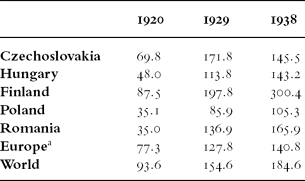
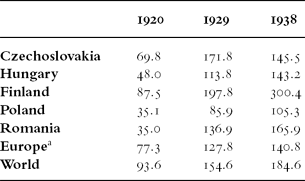
In 1918 Poland regained independence and found itself in a very difficult economic situation. The partitions had lasted over a century and Poland's territory had been effectively divided into three distinct economic regions, each connected to its former centre.Footnote 14 The occupying empires, at best, provided little encouragement to economic development and, at worst, directly discriminated against the Poles.Footnote 15 Moreover, the region was among the most devastated in the First World War, and the following wars of independence ravaged Poland for two more years. As a consequence, the country was devastated and manufacturing output dropped precipitously.Footnote 16 Among East-Central European nations only Romania suffered a comparable decline (Table 1).
Manufacturing production (1913 = 100)
a 18 countries
Source: Svennilson, Growth and Stagnation, 304–5.
Poland in the 1920s
In the pre-1795 Polish-Lithuanian Commonwealth, the nobility had comprised up to 10% of the total population, a relatively large proportion.Footnote 17 After the partitions many landless nobles moved to towns and joined the free professions and civil service. Consequently, in 1918 the ruling class of the reborn Poland ‘comprised a landowning aristocracy and a mainly non-commercial middle class of aristocratic origin . . . [which] kept the mentality of the aristocracy, and [remained] different in character from the bourgeoisies of either Western or South-Eastern Europe’.Footnote 18
Poland successfully overcame enormous challenges after November 1918, to a large degree because Marshal Joseph Pilsudski exercised strong executive powers independently of the Diet.Footnote 19 A provisional constitution was adopted, a parliament was elected, a single currency replaced the six that were in circulation and the war against Soviet Russia was won. The transition period came to an end with the adoption of the Constitution of March 1921 and elections to a new Diet in the following year. The Constitution called for a parliamentary democracy with a weak executive. The main reason behind this choice, apart from personal animosities, was an effort to prevent tyranny, this time in the form of Pilsudski, the man who had successfully led the war effort.
In a nation with numerous ethnic minorities and a very stratified society the system produced a fragmented electorate.Footnote 20 As a result, forming governments and passing new legislation became difficult and the pace of reform slowed down. Currency unification was not followed with the establishment of a central bank. A common fiscal system did not emerge until the autumn of 1925 and a single land tax was not introduced until 1936.Footnote 21 The process of unification of business law took equally long. For instance, a Code of Civil Procedure appeared in 1933 and a Commercial Code a year later.Footnote 22 Courts were not immune to the overall paralysis and contracts were enforced less forcefully than before the First World War.Footnote 23
However, the slow unification of government finances proved to be the delay that was the most detrimental to the economic health of the new state. In 1921 the budget deficit exceeded 55% of expenditure. The deficit was reduced to less than 7% in the following year, but in 1923 it swelled back to the 1921 level.Footnote 24 This took place in spite of rapid economic recovery.Footnote 25 Wages and salaries of government employees were adjusted for inflation but taxes were not and the situation got progressively worse. Moreover, ‘tax evasion had historically seemed a patriotic duty to Poles, who did not much alter their habits now that the nation was independent’.Footnote 26 To bridge the shortfall the government resorted to the printing of money.
Inflation turned into hyperinflation as the amount of notes in circulation skyrocketed from 793 billion Polish marks in 1922 to 125,372 billion in 1923.Footnote 27 Real wages of workers plunged and in the autumn of 1923 a wave of strikes and riots swept throughout the nation. In several cities bloody fighting erupted and dozens were killed.Footnote 28 The situation became critical. To stabilise the economy, the Sejm agreed to revalue taxes, impose a tax on wealth and cut government expenditure.Footnote 29 A government of experts headed by Władysław Grabski obtained from the Diet significant freedom in implementing the program. These steps brought about a quick turn for the better, and in early 1924 the budget was in balance and the currency stopped depreciating.Footnote 30 The following year, however, problems emerged because tax revenues fell short of the goal. Grabski believed that the Parliament's prescribed 333 million per year in wealth taxes were too onerous and aimed at collecting only 200 million; he therefore did not enforce the law vigorously.Footnote 31 In 1924 he accomplished his goal, but the following year this tax yielded only 61.4 million, a budget gap emerged again and the plan collapsed. In 1926 a new government increased taxes by 10% and balanced the budget.Footnote 32 As a result, by the middle of 1926 the economy was stabilised and growth was restored. But on 12 May Pilsudski staged a coup d'état and, as a result, the executive branch was strengthened.Footnote 33 Political stability and economic prosperity in the late 1920s enabled the government to record fiscal surpluses – sometimes substantial – up until 1931.Footnote 34
The surpluses were by no means a result of onerous taxation; as in the Polish-Lithuanian Commonwealth, taxes were low. In 1929 the total revenue of the central government amounted to 9.3% of national income, compared to 12.0, 15.0, 15.4, 19.2 and 22.8% in, respectively, Bulgaria, Yugoslavia, Czechoslovakia, France and Hungary.Footnote 35 Similarly, national debt was held at a relatively very low level.
The concept of limited government perfectly meshed with the economic views of the classical school. In Poland the main proponents of this position belonged to the very influential ‘Cracow school’ headed by Professor Adam Krzyżanowski.Footnote 36 The Parliament was dominated by the pro-business Right and activist policies found no support there. The Pilsudski regime espoused equally conservative economic views.Footnote 37 In sum, the nation adopted an economic model characterised by the minimal role of central government in economic affairs, a focus on a balanced budget, and price and exchange-rate stability.Footnote 38
Such policies could hardly work in a society in which about 70% of the population active in the labour force were employed in agriculture. Moreover, agriculture was dominated by very small, subsistence landholdings. A significant number of those living in the villages had no land at all and there were as many as 4.8 million redundant people of working age living in the countryside.Footnote 39 In 1925 land reform was finally enacted, but the law made sure to minimise government's involvement and, consequently, progress was very slow.
In sum, the country was poor – probably as much as a quarter of its population was living close to starvation.Footnote 40 The difference in real GDP per capita between Poland and developed countries was huge (Table 2).
Real GDP per capita (Poland = 100)

Note: 12-WEC (Western European Countries) includes Austria, Belgium, Denmark, Finland, France, Germany, Italy, Netherlands, Norway, Sweden, Switzerland and the United Kingdom.
Source: Maddison, Historical Statistics.
The experiences of the early 1920s show that some 120 years after the demise of the Polish-Lithuanian Commonwealth the traditions of the Nobles’ Democracy were not entirely forgotten.Footnote 41 Small, weak government, and a powerful, but badly split legislative, as well as low taxation produced similar results – considerable periods of political chaos and economic dislocation.Footnote 42 The May 1926 coup brought about stability, but the new regime (called Sanacja, or Regeneration) failed to address fundamental economic problems, in particular land reform, industrial underdevelopment, backward infrastructure and low competitiveness. Poland paid a tremendous price for this omission during the Great Depression.
International competitiveness of the economy
Foreign trade data illustrate the relative underdevelopment of the country. Although between 1923 and 1929 Polish exports grew from 2.06 to 2.81 billion constant 1927 zlotys, the rise was entirely due to an increase in exports of live animals, foodstuffs, raw materials and semi-finished goods. On the other hand, exports of finished goods recorded a decline in both absolute and relative terms: from 744 million zlotys (36.2% of the total) to 552 million (19.6%).Footnote 43 In comparison to other nations, the share of finished goods in total exports was very low; for instance, in 1929 it was equal to 31.2, 33.0, 67.9 and 71.6% in, respectively, Estonia, Latvia, France and Czechoslovakia.Footnote 44
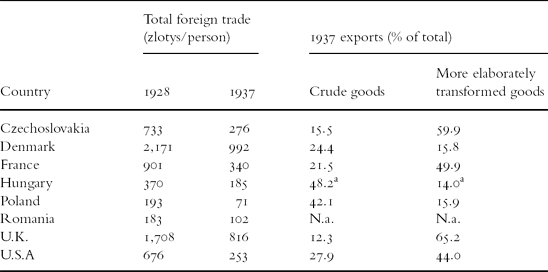
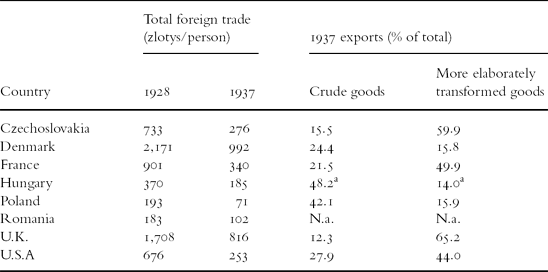
The situation did not change much in the first half of the 1930s. Table 3 demonstrates that both in terms of the volume of exports per capita and the composition of exports, Poland lagged behind not only the most developed nations, but also its East-Central European competitors. The table also shows that in 1937 exports of ‘more elaborately transformed goods’ made less than 16% of the total. But highly processed animal- and plant-based products made 81 million of the total of 190 million zlotys. On the other hand, the value of exported machinery and electro-technical products, pharmaceuticals and chemicals (including rubber), and means of transportation was only 8, 11 and 1 million zlotys, respectively.Footnote 45
Foreign trade and exports structure
a 1938
N.a. – not available
Sources: GUS, Rocznik, 1939, 162; League, Year-book, 1938–9, 217.
Poland was suffering from a shortage of capital and, as a result, the economy was dominated by foreign interests that controlled key sectors of the economy. In 1933 foreigners controlled as much as 45.4% of equity capital of all publicly held corporations.Footnote 46 The international investment position was very negative throughout the inter-war period and foreign capital ‘was often of speculative kind’ and played a ‘significant, if not always a beneficial role’.Footnote 47 Nevertheless, the Polish government strove to attract more of it. To accomplish this goal, from 1927 on Poland kept the value of its currency tied to gold at a fixed rate. The exchange rate was kept constant despite significant trade deficits in 1927–9 (Table 4).
Balance on trade (goods and services), capital (capital and gold) and income flows (in mil. zlotys)

Sources: GUS, Rocznik, 1936, 158; GUS, Rocznik 1939, 244.
The current account problems arose from the overvaluation of the exchange rate set in 1927.Footnote 48 The situation turned dramatic during the Great Depression, when an overwhelming majority of nations resorted to devaluations (sometimes drastic) and foreign exchange restrictions (Table 5). On the other hand, Poland adhered to the gold standard and suffered a debilitating outflow of official reserves: between 1927 and 1936 its value declined from 1,412 to 423 million zlotys.Footnote 49
Nominal change in the value of currencies against the Polish zloty (between December 1928 and March 1938) and dates (month and year) on which foreign exchange restrictions were imposed

a Only between 6 March 1933 and 12 November 1934.
Source: GUS, Rocznik, 1938, 218.
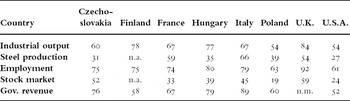
Changes from the peak (1928 or 1929 = 100) to the trough

n.a. – not available
n.m. – not meaningful, government revenue was declining until 1929 and rose afterwards.
Sources: GUS, Rocznik, 1938, 3, 7; League, Year-book, 1935–6, 68; League, Year-book, 1936–7, 164, 250.
Initially, Poland refrained from increasing tariffs and imposing quotas.Footnote 50 Instead, the country addressed trade imbalances with heavy export subsidies at an estimated annual cost of up to 500 million zlotys.Footnote 51 Nevertheless, in 1938 Polish exports per capita exceeded only those of Albania, compared to 1929 when Poland was also ahead of Yugoslavia, Romania and Bulgaria.Footnote 52
The Great Depression
The Great Depression had a profound impact on the economic activity and standard of living in Poland. Between 1929 and 1933 nominal national income fell by 43%, while, for instance, GDP in Great Britain, France and in both Bulgaria and Romania declined by 9, 27 and 40%, respectively.Footnote 53 Also in Poland a very low level of economic activity persisted much longer.Footnote 54Table 6 illustrates changes in industrial output, production of steel, employment in big and medium-size enterprises, stock market level (industrial firms), and government revenue from taxes, duties and monopolies from the peak level attained in 1928 or 1929 (= 100) to the trough of the Depression in a number of nations. The table shows that Poland experienced an appalling decline in the level of economic activity.
In the 1920s the United States imposed restrictions on immigration; a step that adversely affected nations with a labour surplus.Footnote 55 An excess supply of primary commodities depressed prices and made it difficult for agriculture-based economies to borrow and service existing debts.Footnote 56 The Fed adopted contractionary monetary policy in early 1928. This step was particularly ominous for Central and Eastern European countries, because a very significant part of their borrowing was short-term.Footnote 57 Poland relied on workers’ remittances, foodstuffs and coal made up most of its exports, capital inflows were very important for investment and commerce and, consequently, the nation started on a downward path even before economic crisis erupted in America.Footnote 58 The policy response of strict adherence to the gold standard and the resulting deflation only made things worse.
Agriculture, the most important segment of the economy, was ruined. Between 1927–8 and 1931–2 the average net income of smaller farms declined from 210 zlotys to 11 zlotys per hectare.Footnote 59 Likewise, between 1929 and the trough of the Depression the wages of agricultural workers were halved, while incomes of those employed in industry dropped by only a quarter.Footnote 60
A by-product of the laissez faire policy was a steady growth in the degree of monopolisation. In 1923 there were only 31 cartels, but by 1928 the number grew to 133, and it expanded to 274 by the end of 1935.Footnote 61 During the years 1928–6 the price index of products charged by cartels declined only by 25%.Footnote 62 This development hindered the goal of regaining international competitiveness through deflation. On the other hand, it depressed real incomes of peasants who over the same period saw the prices of goods they sold drop by two thirds.
Moreover, to attract foreign capital the Bank of Poland kept interest rates at a very high level throughout the 1930s. In addition, Poland refrained from devaluing its currency and in 1933 joined the Gold Bloc.Footnote 63 But all this was to no avail. Poland was perceived to be a risky investment and foreign firms transferred out interest and dividend incomes. Over the period of 1930–7 total net capital outflows were equal to 3.1 billion zlotys (Table 4).Footnote 64
Poland maintained a fixed exchange rate even after the Bloc disintegrated in 1936. The government only introduced foreign exchange controls, suspended servicing foreign debts and imposed import quotas.Footnote 65
Despite the exceptionally strong deflationary policy the real value of the zloty increased by 9.8, 18.9 and 28.0% against, respectively, the British pound, American dollar and French franc between 1929 and 1938. This depressed exports and caused a tremendous drop in the level of economic activity, especially in investment. By 1932 the index of real investment plunged to 36 (1928 = 100) and by 1937 it recovered only to 61.Footnote 66 As a result of insufficient investment, in 1936 total productivity was equal to one fifth of the European average, while for instance in Czechoslovakia it stood at two-thirds.Footnote 67
In sum, Poland paid an extraordinary price for sticking to the gold standard. Fixed exchange rates especially depressed the incomes of farmers who were not getting higher prices for exports. On the other hand, the monopolisation of industry prevented a comparable decline in the prices of goods farmers bought and subsequently the price scissors widened. As a result, peasants lost whatever little purchasing power they had and the countryside reverted to the state of natural economy.Footnote 68
The Kwiatkowski Plan
The situation became unbearable and Poland entered a period of unprecedented social unrest. In 1930 there were only 312 strikes involving a total of 48,000 workers, but by 1936 the numbers increased to, respectively, 2,056 and 675,000.Footnote 69 Even more serious was the situation in the countryside, where a small-scale guerilla war erupted and dozens were killed.Footnote 70 As in 1923, the situation became dire and the Sanacja was forced to act.
In July 1936, Deputy Prime Minister Eugeniusz Kwiatkowski introduced the Four-Year Plan, which envisaged a modest increase in government spending.Footnote 71 The private sector failed to take advantage of this effort.Footnote 72 Nevertheless, the programme turned out to be a great success; by the end of 1938 the index of industrial production rose by 40% from the 1935 level.Footnote 73 This compared very favourably with both industrial powers and developing nations. For instance, over the same period industrial output rose by 6, 10, 17, 20 and 35% in, respectively, Italy, Great Britain, Finland, Hungary and Germany, and it declined by 5% in the United States. Over the same period real GDP grew by a stunning 40.9 per cent.Footnote 74 Nevertheless, this leap was not sufficient to recover the lost ground to many regional competitors and developed nations (Table 2).
This impressive reversal in Poland's economic performance resulted almost exclusively from the government's surge in investment spending on infrastructure and heavy industry, including arms manufacturing. By the outset of the Second World War the index of production of investment goods had increased by over 78% and that of consumer goods by only 29%.Footnote 75
Although fiscal policy was instrumental in this rapid economic expansion, the effort was financed by a massive increase in money supply.Footnote 76 The amount of notes in circulation rose by almost 33% in 1938 and by another 37% in the first eight months of 1939.Footnote 77 Yet, this tremendous increase in money in circulation had no impact on the overall price level. At the end of 1937, the index of wholesale prices stood at 60.3 and by July of 1939 it had actually declined to 58.0 (1929 = 100).Footnote 78 This development was not surprising given that in the middle of 1939 the number of registered unemployed (414,500) was 3.3 times larger than the level recorded in 1928.Footnote 79 Poland also had an enormous number of people underemployed in agriculture, so the vast increase in money supply had no impact on wages and the overall price level.
The immense growth in money supply also did not affect the total value of deposits in commercial banks; at the end of 1938 it stood at 1,393 million zlotys, an increase of 34 million (2.5%) from the year before.Footnote 80 This miniscule expansion reflected weak demand for loans resulting from widespread pessimism among private investors. Because commercial banks had little incentive to attract more deposits, there was no multiplier effect and, consequently, there was no upward pressure on prices. The government also imposed higher taxes, primarily on salaries, wages and pensions. But by the end of 1938 real GDP per capita was about 36.6% higher than in 1935, limiting the tax's negative effect.Footnote 81
A modest increase in internal borrowing provided another source of funding. This source of funds was neglected throughout the inter-war period despite the fact that the level of national debt was very modest by international standards at the time. In 1936 it stood at 136 zlotys per capita while, for instance, in Romania, Denmark, Czechoslovakia and France it was equal to, respectively, 286, 425, 652 and 4,248 zlotys.Footnote 82 Poland had practically no external funding – only a 2.6 billion franc loan obtained from France in January 1937.Footnote 83
The Kwiatkowski plan was significantly different in character from, for instance, the contemporaneous effort in Nazi Germany. The latter was focused above all on war preparation. Kwiatkowski, however, understood that Poland needed investments that could foster economic growth during times of peace.Footnote 84 For example, he boasted that in 1937 the state built ‘11 granaries, 67 creameries, 36 fruit warehouses, 2 oil expelling plants, etc.’Footnote 85 Only about a third of all funds were allocated to the arms industry.Footnote 86
Grabski's earlier reforms had been met with sharp criticism; there had been no end to the complaints of fiscal oppression.Footnote 87 The Kwiatkowski plan was met with similar protests, and proponents of small government produced volumes of research showing how inefficient state-run firms were. But most of their claims were unfounded.Footnote 88 Nevertheless, the government was criticised for pursuing statism to such an extent that Kwiatkowski felt obliged to keep defending his policies.Footnote 89 These accusations were also not accurate, because the government was filling a void rather than displacing the private sector.
The Grabski and Kwiatkowski reforms had another thing in common, both were introduced when the executive branch was strengthened. Grabski operated largely beyond the Sejm's control. Kwiatkowski's programme was initiated after the new Constitution of 1935 invested the president with very extensive powers.Footnote 90
The great achievements of the Four-Year Plan laid the groundwork for a fifteen-year programme, divided into five three-year plans, of far-reaching modernisation of the Polish economy.Footnote 91 Unfortunately, the outbreak of the Second World War brought a sudden end to this enterprise.
The 1936–9 period showed that Poland had the capacity to fund its own progress and did not need to rely on foreign investment. It also indicated that Poland's earlier inter-war economic policy of attracting foreign capital, budget discipline, price and exchange-rate stability, and an exceedingly limited government engagement in economic affairs was probably misguided. The Four-Year Plan showed that there was an alternative, a government-led effort to modernise the economy.Footnote 92
Poland after 1989 – the shock therapy
Nevertheless, experiences of the eighteenth century and the inter-war period seem to be forgotten in present-day Poland. In 1989, after forty-five years of rapid, but frequently misguided industrialisation, the country implemented a radical reform founded on a neo-liberal economic model – ‘shock therapy’.
The programme was based on the so-called Washington Consensus, a concept that by now has lost most of its former glamour.Footnote 93 The details of the plan were prepared by Leszek Balcerowicz's team in haste and without any consultations with other economists, except for experts from the International Monetary Fund (IMF).Footnote 94 No attention was paid to foreign independent research which, for instance, forewarned that ‘it is impractical – indeed suicidal – to make such a transition “overnight”’.Footnote 95 Also, a call for the erection of import tariffs to protect local industries against superior foreign competitors during the transition period was ignored.Footnote 96 A prediction that a complete lack of competition in all markets could result in a Great-Depression-like economic collapse was equally disregarded.Footnote 97
The most important features of the programme included rapid deregulation of the economy, in particular the ending of most price controls, balancing the budget, quick privatisation of state-owned enterprises, dismantling of trade barriers, and attracting foreign portfolio and direct investment.Footnote 98 Consequently, the role of the government in the economy was drastically reduced. The quick loosening of government shackles was supposed to bring about a robust growth rate.Footnote 99 Unfortunately, just the opposite happened. Between 1989 and 1991, GDP nose-dived by 18.3% and the index of industrial production plunged to 63 (1989 = 100).Footnote 100 Other nations that emulated Poland performed as badly, or worse.Footnote 101
In Poland, initial reactions to the Balcerowicz programme were mixed.Footnote 102 Since then, foreign independent research has been less kind in the evaluation of the programme. For instance, Joseph E. Stieglitz observed that ‘the shock therapy approach to changing institutions is associated . . . (ironically) with Bolshevism in the Russian Revolution’ and concluded that the present-day ‘shock therapy approach tried to use many of the same principles for the reverse transition’.Footnote 103 Robert A. Mundell called the plan ‘a bungle of economic policy on an unprecedented scale’.Footnote 104 Mundell also dismissed the hypothesis that the decreases in the level of economic activity in nations that adopted shock therapy were the result of poor national statistics.Footnote 105 A comparison of the economic performance of countries that implemented a form of shock therapy to that of China and Vietnam showed that neither the speed of liberalisation nor its degree played a significant and positive role in a successful transformation to a market system, though a gradual reform did.Footnote 106 However, these views are not necessarily uniformly accepted.Footnote 107
The momentous decline in the level of economic activity produced a backlash. In September 1993, the Alliance of the Democratic Left (SLD in Polish), the rebranded former Communist party, won the elections and reversed many excesses of the Balcerowicz program. The heavy, discriminatory taxation of state-owned enterprises was lessened, large sums were spent on the restructuring of struggling firms and aid to agriculture was restored.Footnote 108
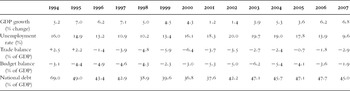
As a result, the growth rate jumped from 3.8% in 1993 to 5.2% in the following year, and remained very strong for the following three years (Table 7).Footnote 109 But the SLD rule was marred by corruption and political scandals and the 1997 elections returned Balcerowicz to power. As a result, neo-liberal reforms were pursued with new enthusiasm.Footnote 110 By 2001 the rate of economic growth had come to a standstill and unemployment grew drastically (Table 7) and the SLD again won a decisive victory. However, history did not repeat itself; this time around, there was no economic upswing, although corruption and political scandals did reach new heights. The state of affairs during the second SLD government approached chaos.Footnote 111
Poland, main economic indicators (1994–2007)

Sources: Eurostat, Statistics; European Bank for Reconstruction and Development, Transition Report: Ten Years of Transition (London: European Bank for Reconstruction and Development, 1999), 253.
Constitutional reforms
Notwithstanding the calamity that shock therapy brought upon the country, neo-liberal views continue to dominate economic discourse in Poland. Numerous think tanks and networks, generously supported by Western sources, have disseminated these beliefs.Footnote 112 As a result, the political programmes of the ‘liberal’ and ‘conservative’ parties in Poland continued to conform to these positions. Before the 2007 elections both major political parties, Civic Platform (PO) and Law and Justice (PiS), propagated low taxation and free markets.Footnote 113
The current situation resembles the 1920s in many other respects. The 1997 Constitution, like that of March 1921, again gives the Sejm huge powers and greatly limits those of the President.Footnote 114 Until the 2007 elections, the Diet had been very fragmented. As a result, reforms, especially of the legal system, had progressed very slowly. To aggravate matters, the quality of new legislation is wanting and, as a result, the legal system lacks consistency, functionality, stability and transparency. It is complex and allows government bureaucrats to make arbitrary decisions regarding important issues.Footnote 115 The tax system violates some fundamental principles, specifically those of efficiency, stability, consistency and equity,Footnote 116 so it hinders entrepreneurship.Footnote 117 Courts work sluggishly and prosecutors are slow to investigate corruption.Footnote 118
In sum, Poland is a very weak state because power and responsibility are decentralised. Indeed, power is often located outside formal democratic institutions and the executive is sometimes commercialised. Jadwiga Staniszkis has therefore concluded that ‘the state appears to be a loosely co-ordinated federation of bureaucrats’.Footnote 119
International competitiveness of the economy – revisited
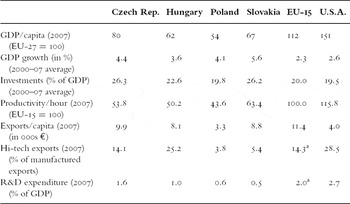
The gap between Poland and the developed world is still very significant and there are few indications that the country will soon catch up (Table 8). The levels of spending on investment and research and development are well below those recorded by other European emerging market competitors. Poland ranks twenty-second in the European Union in terms of innovation performance and progress in this area is slow.Footnote 120
Poland's relative performance

a Euro-area
EU-15 includes Austria, Belgium, Denmark, Finland, France, Germany, Greece, Holland, Ireland, Italy, Luxembourg, Portugal, Spain, Sweden and the United Kingdom.
Source: Eurostat, Statistics; The World Bank, World Development Indicators, available at http://data.worldbank.org (last visited 4 Nov. 2010).
Throughout the transition period, Poland has eschewed any sort of industrial policy.Footnote 121 The neo-liberal bias is one factor, but the weakness of the state is certainly another major issue. A weak executive lacks the necessary muscle to overcome powerful interests, fight corruption, change ineffective procedures, reform the legal system, and, in general, protect the national interest.Footnote 122
As a result, even the development of basic infrastructure has been neglected. In 2004 the density of motorways in Poland was only 1.8 km per 1,000 km2 or slightly more than a quarter of what the Czech Republic, Slovakia and Hungary enjoyed and a tiny fraction of Germany's (33.7 km per 1,000 km2).Footnote 123 The underdevelopment of infrastructure hurts the nation's competitiveness. The 2010–11 Global Competitiveness Report ranks Poland overall thirty-ninth, but in terms of the quality of infrastructure the nation is rated a distant seventy-second.Footnote 124
As in the inter-war period, the state has substantial borrowing capacity, and the level of national debt is relatively low.Footnote 125 But the 1997 Constitution sets a limit on Poland's indebtedness at 60% of GDP.Footnote 126 This, in turn, results in inefficient outcomes. For instance, constructing motorways is much cheaper if the task is performed by a state agency rather than by the private sector: 2.3–4.1 million versus 5.6–6.1 million euros per kilometre.Footnote 127 But the laissez faire attitude and the limit on national debt force the adoption of the more expensive option.
The relative underdevelopment is by no means limited to infrastructure; the IMF estimates that the amount of capital per worker in Poland is equal to a tenth of that in Germany.Footnote 128 Agriculture is still a very important industry; yet, in some ways, it is as backward today as it was before the Second World War. In 2007 almost 15% of the labour force was employed in this sector, 68.5% of farms had holdings of less than five hectares and only 1% had more than fifty hectares.Footnote 129
Poland refrained even from the implementation of a pro-export strategy, an aspect of the Asian model strongly recommended by the World Bank.Footnote 130 Furthermore, the central bank is totally independent of both the Sejm and the Executive.Footnote 131 It is preoccupied only with price stability and pays no attention to employment.Footnote 132 As it did during the inter-war period, it now keeps interest rates at a relatively high level. This policy assures an overvalued zloty which, in turn, hinders exports.Footnote 133 Poland lags behind its European peers in terms of both high-end exports and exports per inhabitant (Table 8). Significant trade deficits (Table 7), in turn, have contributed to an increase in total foreign debt from $69.5 billion at the end of 2000 to $245.5 billion in 2008.Footnote 134
Privatisation has also resulted in an increase in foreign control over the economy. Consequently, Poland's international investment position has greatly deteriorated. In 1994, liabilities exceeded assets by $29.6 billion, but by 2008 the difference had grown to $243.4 billion.Footnote 135 This increase in debt has caused huge capital outflows. The value of repatriated investment income during the years 2000–8 amounted to over $83 billion. The rapid opening of the economy to foreign investment has had an important, and deleterious, side-effect: because small businesses lacked sufficient time to grow, today local capital in Poland finds itself in a position similar to the one it enjoyed during the inter-war years.Footnote 136
Finally, economic policies adopted after 1989 failed to lift the nation's standard of living to a European average. By 2002, five regions in Poland were rated the poorest among the then European Union, with GDP per capita (at purchasing power standard) equal to only about a third of the region's average.Footnote 137 The unemployment rate was among the highest and the proportion of employed to total labour force (employment rate) among the lowest in the European Union during 1999–2008.Footnote 138 Not surprisingly, Poland and Estonia were the only OECD countries that showed significant net emigration during 1990–2008.Footnote 139
Conclusions
Unchecked liberty for the nobility guaranteed weak, limited and static government in the Polish-Lithuanian Commonwealth. Yet, similar principles were adopted in Poland after the nation regained independence in both 1918 and 1989. Consequently, economic policies in the 1920s and after 1989 have been based on government non-intervention, low taxation and free markets. The government has embraced budget discipline and sought to stabilise prices and the exchange rate rather than modernise the economy as a whole. Little effort has therefore been made to restructure agriculture, foster economic growth and lower unemployment.
The outcome after 1989 has been similar to that after 1918: Poland lags behind Western countries and is not catching up fast enough. The nation is in great need of massive investment to upgrade infrastructure and to promote innovation and exports. So far, the private sector has shown an inability to accomplish these goals. The 1936–9 experience and contemporary examples of the successful use of industrial policy, especially in Asia, show that the state can play an important role in economic development.Footnote 140
Following an extended period of wars in the seventeenth century, Poland experienced a long period of substantial decline in its level of economic activity. Lack of a national economic policy greatly contributed to this development.Footnote 141 Economic deterioration, in turn, contributed markedly to the demise of the Polish-Lithuanian Commonwealth. A similar dislike for national economic policy during the inter-war years resulted in significant economic underdevelopment, a factor that contributed to the country's crushing defeat in September 1939.
Although it seems unlikely that Poland will again face challenges similar to those of the late eighteenth century or the late 1930s, the nation's economic underdevelopment and the relative weakness of the state make it more difficult for Warsaw to defend and further Poland's economic and political interests. The importance of finding a viable economic policy is therefore not a theoretical question, but one of vital national interest.