Introduction
It is well known that criticisms of European integration and the European Union (EU) often come from the left and right poles, whereas centre parties suspend normal hostilities advocating a generally pro-European line. At face value, this suggests that the parties’ behaviour over Europe is exceptional and atypical. In recent years, however, the meaning and form of this relationship between party alignments over Europe and traditional ones, and its consequences for party politics, has become disputed. Questions arise over whether Europe is business as usual or transformative for party politics. For some, party contestation over Europe remains largely issue-specific, with few ‘spill over’ effects and limited impacts for national party politics (see especially, Mair (Reference Mair2000)). Whereas, for others, it constitutes part of an emerging cleavage, in the Rokkanian sense, that is transforming the political space in Western Europe (see especially, Kriesi et al. (Reference Kriesi, Grande, Lachat, Dolezal, Bornschier and Frey2008)). Still, others have made influential contributions standing between these poles.Footnote 1 This controversy has brought a renewed interest in political parties’ stances over Europe, especially critical ones. It raises important questions over where parties’ mobilization over Europe fits within the alignments in national party systems. Specifically, we need to know more about the degree and form of party contestation over Europe, its sources among party families, and whether patterns hold cross-nationally. Regarding parties’ mobilizations we need to know about their substantive issue contents, whether these are more strategic/tactical or ideological, whether their claims construct a cleavage, and if they hold a potential for transforming party politics. Here we address these questions empirically, by presenting the findings of a seven-country study of parties’ statements over Europe that appeared in the mass media.
There are sound theoretical reasons for focussing on how political parties compete over Europe by engaging in public debates carried by the mass media. In an era, where voters depend heavily on the mass media for access to political communication (Swanson and Mancini, Reference Swanson and Mancini1996), news is a key location for party contestation. It is through the news that issues are made publicly visible to citizens, and this is the forum where parties attempt to mobilize their campaigns and get their message across to voters.Footnote 2 Methodologically, this makes newspaper coverage a good potential data source for examining party contestation. This is because it retrieves data on parties’ stances from mediated political discourse, which is the actual ‘output’ that is produced by all the different parties’ efforts to communicate with voters, competitively, and shape opinions in response to events. Indeed, Peter Mair (Reference Mair2006: 13, 14) has identified precisely the type of public discourse analysis method that we have applied as a necessary development to move beyond some limitations he sees in party manifesto and expert opinion analyses: ‘(I)n addition to the imputed location of a party’s core identity, and in addition to the evidence provided by formal policies which it adopts or is obliged to adopt, we need to know more about how Europe actually plays in national political discourse, as well as about the way in which it is conceived… . What is really needed…is a much more systematic, inductive, and largely bottom-up comparison of political discussions at the national level’.Footnote 3
Taking up this challenge, we study political parties’ stances that are publicly visible in national media discourses. Given that supranational ‘Euro-parties’ seem highly unlikely to replace the predominance of national parties, and that public spheres carrying political information remain predominantly nationally structured (Schlesinger, Reference Schlesinger1999; Statham, Reference Statham2007), we study national and regional parties’ claims made in national media. We apply the claims-making approach (Koopmans and Statham, Reference Koopmans and Statham1999; Koopmans et al., Reference Koopmans, Statham, Giugni and Passy2005). Public claims-making acts, ‘claims’, are defined as intentional public speech acts which articulate political demands, calls to action, proposals, and criticisms, which, actually or potentially, affect the interests or integrity of claimants and/or other collective actors in an issue field. In this instance, the issue field is claims over European integration, or the EU, and its policies. Our starting point for examining party contestation is parties’ negative evaluations of European integration, or the EU’s actors, policies, or issues. We call these as ‘Euro-criticisms’. Since party politics has traditionally supported European integration, especially at the core of party systems, these negative evaluations are the most likely source of evidence for changes in party politics, including, for example, the possibility of mainstream Euroscepticism.
The study covers parties from seven European democracies: Britain, France, Germany, the Netherlands, Italy, Spain, and Switzerland. This selection includes six countries with longstanding participation in the European project, plus Switzerland, which remains outside the Union, but has held referendums over joining. Thus we have six countries whose parties have been contesting Europe from within the project for decades, and one whose parties are contesting entry. We chose older rather than newer democracies because their party systems and contestation over Europe are more established. The analysis uses a large original dataset of public claims-making acts by political parties retrieved from newspapers. The data is drawn from three time points, 1990, 1995, and 2000–02, to assess whether parties’ Euro-criticisms have increased along with advancing European integration. Our design allows for cross-party and cross-national comparisons and combined quantitative and qualitative analyses.
In the next section, we unpack the main competing theoretical hypotheses over European party contestation, before describing the claims-making method. Then, we undertake descriptive and multivariate quantitative analyses of parties’ mobilized Euro-criticisms to build a general picture of their patterns and determinants: across party families and countries, whether parties are in government, between sub-national and national party organizations, and across time. From this, we select the most Euro-critical parties and undertake a detailed qualitative analysis of their claims’ substantive contents to determine whether, and if so, on what basis, they produce a coherent critique placing Europe in a cleavage. Finally, we conclude by drawing on key findings to discuss the transformative impact of party contestation over Europe and the potential for emergent Euroscepticism.
European partisanship: beyond an ‘inverted U’?
A starting point for debates over European partisanship is the common observation of an ‘inverted U’ pattern of support for Europe. Here parties’ stances cross-cut left/right divisions, so that centre parties are largely pro-European, with opposition to Europe confined to the marginal poles of extreme left and right. Although many observe this pattern for European contestation, there are several hypotheses about the substance of parties’ mobilizations that produce the inverted U, the way it relates to the left/right cleavage, and its transformative prospects for re-aligning relationships within party systems. Here we outline the leading positions and different expectations they hold for the distribution of Euro-criticisms across the political system (core/periphery), party types (families), and for its substantive contents (claims).
A first set of explanations emphasizes the strategic or tactical dimension of parties’ European mobilizations. Here a first position is represented by Steenbergen and Scott, who argue that (Reference Steenbergen and Scott2004: 166), ‘(the) issue salience of European integration across parties can be attributed to a considerable extent to the strategic behavior of those parties…parties that stand to gain from the issue, in whatever sense, try to emphasise the issue, while parties that stand to lose try to de-emphasise it’. This ‘nothing new’ view is supported by Mair’s (Reference Mair2000) general stance that Europe offers little as a new dimension for party contestation. For him, Eurosceptic parties cannot be reduced to their anti-European appeal. Europe constitutes only one element of their general oppositional stance. Like Taggart’s (Reference Taggart1998) study of Euroscepticism which calls European integration a ‘touchstone of domestic dissent’, Europe is considered relatively ‘contentless’ as a potential cleavage. It is a centre-party pro-European consensus at the core that offers a mobilization potential for a ‘politics of opposition’ by the usual malcontents from the periphery. This produces an inverted U. Hix and Lord (Reference Hix and Lord1997) complement this idea by adding that mainstream parties have interests in maintaining the ‘status quo’ by pursuing a strategy that incorporates European integration issues into the left/right cleavage. They see European politics as increasingly two-dimensional, whereby parties’ left/right contestation over economic and socio-political issues (functional interests), in the domestic arena, is largely independent from their contestation over national sovereignty (territorial interests). For them, major parties avoid contestation over European integration and adopt pro-European stances.
We can derive similar hypotheses about parties’ strategic mobilization from a political opportunity approach (e.g. Kriesi et al., Reference Kriesi, Koopmans, Duyvendak and Guigni1995), which shows that closed political institutions provoke confrontational challenges, whereas open opportunity structures invite more consensual and cooperative strategies from collective actors. This view emphasizes that political actors’ strategic choices depend on their degree and type of access to decision-making processes. European integration adds new channels of access, but access to these new channels is not equally distributed and favours, in particular, national governments, who have privileged access to decision-making in the various European Councils, especially compared to national oppositions, regional political actors, and civil society actors (Koopmans, Reference Koopmans2007). This leads to the expectation that party actors with relatively limited access to European-level governance, such as opposition compared to governing parties, regional compared to national party branches, and marginal and excluded parties compared to mainstream ones, would be more critical of European integration and institutions.Footnote 4
A second set of explanations places more weight on ideological contents as the basis for determining how parties compete over Europe. Theories are advanced for how European issues constitute an ideological basis for party contention that cross-cuts the traditional left/right cleavage. This transformation of the ideological space leads to new opportunities for mobilization and alignments among parties. However, there are important disagreements about the degree and nature of this transformation of the political space.
First, Hooghe et al. (Reference Hooghe, Marks and Wilson2004) and Marks (Reference Marks2004) argue that specific aspects of parties’ European contestation are absorbed into their left/right contestation, whereas others are not. This is partly because EU competences relative to nation-states do not penetrate all policy fields equally. For them, the basis for party contestation is over a regulated capitalism vs. neo-liberalism cleavage. This means that the two dimensions (more/less European integration; left/right) are not, as Hix and Lord claim, independent, and lead to hypotheses about variations of centre-parties’ positioning over Europe. Hooghe and Marks argue that the more the European integration focuses on market-regulation as opposed to market-making, then the more centre-left social democratic parties, as supporters of regulated capitalism, become favourably disposed. By contrast, when economic and monetary union is largely completed, those on the political right become more opposed to European integration and pursue neo-liberalism. Importantly, this explains opposition as a strategy defined by ideological commitment: ‘Euroscepticism of extreme parties arises…not only from their opposition to the EU’s policies, but also because they reject the ideology of the EU’s construction’ (Hooghe et al., Reference Hooghe, Marks and Wilson2004: 125).
It is to the credit of Hooghe and Marks that unexpected findings when testing their main thesis, led to insights bringing the ‘new politics’ cleavage dimension to the fore. Placing parties on a green-alternative-libertarian (GAL) vs. a traditional-authoritarian-nationalist (TAN) cleavage, they conclude that (Marks, Reference Marks2004: 244) ‘a party’s position on the new politics dimension is considerably more powerful than its position on the left/right dimension in predicting its support for integration’. Here, the GAL parties are pro-EU, but the correlation is much stronger on the TAN Eurosceptic side, which drives the overall relationship, whereby the radical right and some traditional authoritarian Conservative parties defend national sovereignty on an ideological rather than a strategic/tactical basis.
Kriesi (Reference Kriesi2005, Reference Kriesi2007) and Kriesi et al. (Reference Kriesi, Grande, Lachat, Dolezal, Bornschier and Frey2008), take this further. They advance a view where European contestation restructures party politics by transforming its traditional left/right basis. Here, defence of national sovereignty is considered a response to globalization. According to Kriesi (Reference Kriesi2005: 1), ‘The mobilization of the potential winners and losers of this new structural conflict between ‘integration’ (into the European or global community) and ‘demarcation’ (of the national community) by the political parties is expected to have a profound impact on the national party systems’. Here party alignments are shaped by a new structural conflict whereby the winners and losers of globalization compete over its consequences in politics (a supra-national authority challenge), economics (a market liberalization challenge) and culture (an immigration challenge). In contrast to Hooghe and Marks, Kriesi emphasizes the cultural and identity basis for Eurosceptic potentials: ‘I expect the cultural aspects of the opening up of the borders to be more important for the mobilization of the ‘losers’ than the defence of their economic interests’ (2005: 5). This brings a cultural defence of national sovereignty as a collective identity to the explanatory forefront. Importantly, opposition to Europe also comes from mainstream right parties who have redefined themselves in response to de-nationalization pressures. As a result, Kriesi’s ‘inverted U’ becomes significantly asymmetrical, with conservative and radical right parties making more efforts to mobilize against Europe, than parties dissenting against Europe on economic interests, namely, the classical ‘old’ or radical left. Thus, Kriesi sees (2005: 5), ‘conservative and new populist right parties, who most successfully appeal to the fears of the ‘losers’ to be the driving force of the current transformation of the Western European party systems’. Lastly, Kriesi hypothesizes about the overall degree and direction of European party mobilization, ‘I expect that the issue of European integration has generally become more salient for Western European parties and that the mobilization concerning this issue has mainly been carried by the Eurosceptics who defend the losers’ point of view’ (2005: 2).
From these competing positions, it is possible to draw hypotheses about the distribution and contents of Euro-criticism across national party systems. Generally, those emphasizing the strategic/tactical dimension and ‘nothing new’ substantially would expect Euro-criticism to be an eclectic and inconsistent critique mobilized at contingent times in response to specific opportunities. The ‘inverted U’ would remain intact with anti-European challenges mobilized opportunistically from the radical poles as an anti-systemic challenge to pro-European centre-parties. The political opportunity approach adds to this the expectation that parties will be more inclined to make Euro-critical claims when they are further away from access to European decision-making than governing parties and national party organizations, that is, when they are in opposition, or operate on the regional level.
Compared to this, Marks/Hooghe and Kriesi predict a more ideologically structured pattern, with a skewed ‘inverted U’ on the right resulting from mobilized ideological critiques over Europe. If this view holds, one would expect to find evidence for these transformations across different national contexts. For Marks/Hooghe, this is produced by parties’ mobilization over a modified left/right cleavage (regulated capitalism vs. neo-liberalism), where after the completion of the common market, one would expect opposition to EU regulation from the right. For Kriesi, the skewed ‘inverted U’ results from increasing party mobilization from the right based on traditional, authoritarian, and nationalist ideologies against Europe, especially about the cultural (immigration) consequences of globalization. This would be demonstrated by increasing European contestation as part of a ‘new politics’ cleavage and by anti-Europeanism cutting across the core of the political system. Before analysing our dataset for evidence to support these competing hypotheses, we first outline the method.
Method
We use claims-making analysis (Koopmans and Statham, Reference Koopmans and Statham1999; Koopmans et al., Reference Koopmans, Statham, Giugni and Passy2005), an established method for examining the public dimension of politics from newspaper sources.Footnote 5 In contrast to media contents, studies that focus on journalists’ representations of actors and events, this method filters out journalists’ own claims and takes news as a source for reported claims by collective actors, in this case political parties. The approach takes news as a record of events and mobilized political opinions that are visible in the public domain. The unit of analysis for retrieving and coding relevant information is not an article, but a reported act of claims-making.
Claims-making acts, ‘claims’, include intentional public speech acts which articulate political demands, calls to action, proposals, and criticisms, which, actually or potentially, affect the interests or integrity of claimants and/or other collective actors in an issue-field. Important variables which are coded at different aggregated levels, ranging from general to highly detailed, include the actor making the claim, the action form of the claim, the substantive issue of the claim, the addressee of the claim, and the time and place of the claim (see codebook http://europub.wzb.eu/codebooks.en.htm).
It was not logistically possible to code claims from all issue fields, days and newspapers. Our sample includes all claims referring to the European level, either as an actor, issue, or addressee, in a European integration field plus six strategically selected policy fields: monetary, agriculture, immigration, troop deployment, pensions, and education. Cases were retrieved from pre-selected days at regular time intervals within each year. Thus, the findings are not based on exceptional or intense periods driven by key events (e.g. EU Summits, Haider controversy), or by elections. The sample covers 52 days for 1990 and 1995, and 104 days for 2000, 2001, and 2002. We coded four newspapers (rotated as sources) in each of our seven countries. Where possible, we selected two broadsheets with different (centre-left/centre-right) political affiliations, a popular/tabloid newspaper, and a regional newspaper per country, though this was adapted to account for differences in national media landscape (see Statham, Reference Statham2008a).Footnote 6 For pre-selected days, all articles in newspapers’ home news sections were checked for relevant claims, that is, the search was not limited to articles containing certain keywords. Lexis-nexis or hard copies were coded by trained researchers using a standardized codebook. Conventional inter-coder tests for article selection and coding produced high reliability results (see website http://europub.wzb.eu/).
For this article, the key variables we use are the actor making the claim and the substance of the claim. First, the sample was constructed by selecting all claims by actors coded with a political party identity. Each claim is coded at the general level for how it evaluates European integration or EU institutions, actors, and policies: for (+1), against (−1), or neutral (0). Second, we restricted the sample further to cases where political parties took a clear stance over Europe by selecting only ‘evaluative claims’ (i.e. +1 or −1). This allowed us to produce a general picture by examining the location of negative claims-making over Europe, that is, Euro-criticisms, across party families, countries, and time, by statistical analyses. Then, we were also able to select the actual language used in claims, and information on the event where it was mobilized, to conduct a qualitative analysis of the most negative parties’ critiques and framing of Europe.
Possible determinants for Euro-criticisms
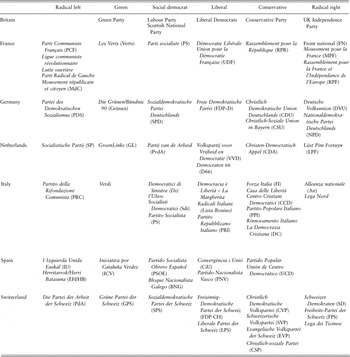
There are many attempts to group parties into families (see e.g., Taggart, Reference Taggart1998). Here we distinguish between six families: three traditional party families which have representatives in all western European countries, social democrats, liberals and conservatives (often Christian-democrats), a more recent competitor, the greens, a radical right family including the old extreme right and newer populist right, and lastly the radical left, comprising the old and new radical left (often parties with communist/Marxist heritages). This effectively superimposes the ‘new politics’ (green-alternative-libertarian versus traditional-authoritarian-nationalist) over the traditional ‘left-right’ cleavage. Table 1 places all parties appearing in our sample within these six party families.
Political parties from our sample within party families

At the radical left pole, we find unreconstructed Marxist and ‘old’ far-left parties, including the French Ligue communiste révolutionnaire, along with ‘new’ left-wing parties retaining communist heritages, the German Partei des Demokratischen Sozialismus and Italian Rifondazione. Next come the green parties at the green-alternative-libertarian pole of the new politics axis. Back on the left-right continuum, the social democrat family covers the territory from the classical socialist left advancing labour interests to a Third Way emphasis on social justice whilst accepting neo-liberal free-trade ideas. This spans parties from the French Parti socialiste to British New Labour. At the centre, liberals traditionally share an acceptance of free markets and social tolerance, but to differing degrees, which produces more-leftist and more-rightist parties. The distinction between Dutch liberal parties, the social-liberal Democraten 66 and the free-market Volkspartij voor Vrijheid en Democratie, captures this. The conservative family includes the Christian democratic tradition plus parties that have adopted neo-liberalism, including the British Conservative Party, and a strong national conservatism, sometimes with a populist orientation, like Schweizerische Volkspartei (SVP).Footnote 7 At the radical right pole, we find the unreconstructed extreme-right, for example, the French Front national, and their postfascist associates, including the Italian Alleanza nationale, along with anti-immigration and populist parties, from the right of the new politics axis, including the Pim Fortuyn List. Finally, we placed regionalist parties according to their ideological proximity within the families, rather than as a separate family. To examine the impact of the regional dimension in the analysis, we aggregate all regional-level actors from all parties. Like all categorizations, there is some arbitrariness in our placements. However, Table 1 makes our choices, made in consultation with national experts, transparent.
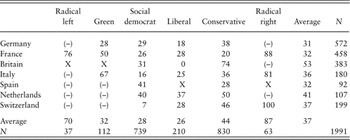
First, we analyse claims by party actors referring in someway to the European level (‘Europeanized’ claims) and containing a positive or negative evaluation of the integration process or of European-level actors, policies, or institutions. Table 2 shows the share among these Europeanized claims expressing negative evaluations of European integration or the EU, that is, Euro-criticisms.
Share of Euro-critical claims within a party family’s evaluative claims-making (percentage figures), by Country

X denotes no party from family in country’s sample.
(–) denotes less than five cases.
First, the second-to-last column shows that measured across all seven countries, Euro-criticisms formed a minority 37% of evaluative claims. The only country where Euro-criticism predominates in the party system is Britain (53%). The other countries range from 41% Euro-criticisms among Dutch to 31% among German parties. Second, the second-to-last row shows that criticism over Europe is unevenly distributed across the various party families, conforming roughly to the inverted-U hypothesis. Euro-criticism is relatively low between the two party families situated at the political system’s centre, Social Democrats (28%) and Liberals (27%). The same is true to a lesser extent for Greens (32%), but this is mainly due to the pro-European German Greens, who make up most of these cases. Greens in other countries tend to be more Euro-critical. Euro-criticism is more widespread among Conservatives (44%) than Social Democrats and Liberals, as Hooghe/Marks and Kriesi broadly suggest. However, closer inspection shows this to be largely due to two parties, the British Conservatives and Swiss SVP (both 74%). We discuss them in detail below. Other conservatives display similar levels of Euro-criticism as most Social Democrats and Liberals. In line with the inverted U-hypothesis, radical left (70%) and radical right (88%) parties display high levels of Euro-criticism.
Closer inspection of differences across party families per country reveals a number of patterns, which conform only partly to the inverted U-hypothesis. In Germany, we find a combination of relatively low overall Euro-criticism with very little variation among parties across families. Germany seems to be the country where a broad pro-European consensus still holds. In the Netherlands, parties’ positions also diverge very little, but Euro-criticism is clearly higher, on average, among Dutch than German parties. We examine this Dutch Euro-criticism below. In Switzerland, we find a clear left-right divide with strong opposition to Europe among conservative (SVP) and radical right (mainly Schweizer Demokraten) parties, and a much more pro-European stance across the rest of the political spectrum, and especially the Social Democrats (7%). Left-wing Euro-criticism does not seem to be a force in Switzerland. In Britain, contestation over Europe extends to the political system’s core, even more so, than in Switzerland, pitching Labour (31%) and the Liberal Democrats (0%) against the strongly Euro-critical Conservatives (74%). Spain also shows left-right opposition, but is much less polarized, and, notably, this goes in a different direction than Britain and Switzerland. Spanish Social Democrats made more (41%) Euro-criticisms than Conservative parties (28%) – we examine this below. Finally, two countries display a full inverted U-pattern, France and, to a lesser extent, (given the radical left’s low Euro-criticisms) Italy. In these countries, Euro-criticism is strong among radical left and/or Green parties, and among radical right parties.
The low Euro-criticism among virtually all mainstream parties – except for the British Conservatives and Swiss SVP – may be due to such parties participating on a regular basis in government and profiting from the privileged access that national governments have to the European policy process. It is, therefore, important to control for whether a party is in government or opposition when criticizing Europe. Our hypothesis is that party representatives will be more likely to make Euro-criticisms in opposition than in government. For similar reasons, we need to control for whether a party actor is from the national level, or speaks on behalf of a regional or local organization. Here, we hypothesize on the basis of the political opportunity perspective that sub-national party actors will be more Euro-critical because they have less access to European policy circles than national ones.
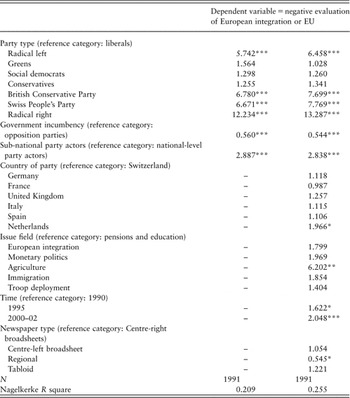
Table 3 presents a multivariate logistic regression with the dependent variable, whether, or not, a claim evaluates European integration or EU institutions negatively. The first regression includes party families, government incumbency, and whether a claim is made by a sub-national party actor as the independent variables. Because of their deviant position within the conservative family, we include separate variables for the British Conservatives and Swiss SVP. Liberals are the omitted reference category, because they produce the lowest Euro-criticism among party families. The results confirm Table 2’s descriptive findings: there are no significant differences in degrees of Euro-criticism between Greens, Social democrats, and Liberals. Conservative parties in Italy, Spain, Germany, the Netherlands, and France do not vary from this pro-European mainstream, but the British Conservatives and Swiss SVP stand out by their very strong Eurocritical voices. For Britain and Switzerland, contestation over Europe cuts right through the political system’s core, pitching an anti-European right against a pro-European left, whereas elsewhere polarization over European integration is characterized by a Euro-critical periphery vs. a pro-European centre. As expected, the radical left, and even more so the radical right, are highly significant Euro-critics. These effects persist when controlling for government incumbency, and sub-national vs. national party actors, which means that Eurocriticism from the political margins is not just explained by these parties seldom participating in governments, nor by some being more weakly represented on national than sub-national levels.
Possible determinants for Euro-critical claims-making (odds ratios, only claims with European scope)

*P < 0.05; **P < 0.01; ***P < 0.001.
Government incumbency has the predicted effect.Footnote 8 When parties are part of the government they are significantly less likely to make Euro-criticisms than when they are in opposition. This finding suggests that the often-heard complaint that Euroscepticism thrives because national governments claim all the good work for themselves, and blame all things bad on the EU, has little empirical support. Table 3 shows that in fact national governments are the main political bulwarks for pro-Europeanism. We also find the effect predicted by the political opportunity structure perspective for sub-national party actors, who are much more likely to be Euro-critical than their national counterparts. This result is remarkable given the emphasis, in parts of the multi-level governance literature (e.g. Marks et al., Reference Marks and McAdam1996), on the supposedly beneficial effects of European integration for the political leverage of regional actors. We therefore investigated it in more detail by adding interaction terms that allow to investigate whether the finding holds in all countries (results available from the authors on request). In the three most centralized countries – France, the United Kingdom, and the Netherlands – there are so few claims by regional party organizations that nothing meaningful can be said about their stances towards European integration. In the four countries where we have sufficient cases, regional party representatives are consistently more euro-critical than national party organizations. However, in line with the political opportunity structure argument, the effect is strongest and statistically significant in the two most strongly federalized countries, Germany and Switzerland, where regional actors have most to fear from a shift of decision-making power to Brussels where many crucial decisions are negotiated among national government representatives.
In the second regression, reported in the last column, we introduce further control variables. First, we include the countries of origin of party actors, with Swiss parties as the reference category. As we saw earlier, there are important cross-national differences in the distribution of Euro-criticism across the party spectrum. Moreover, not all party families are represented in all countries, or they are more strongly represented in some than others. By introducing the country of origin of claims-makers, we are able to establish whether differences across party families are robust when we control for cross-national differences. In addition, we can investigate whether there are significant cross-national differences net of the differences in the composition of party systems. The results show that our findings for party families, government incumbency, and sub-national actors hardly change when we control for national origin. Regarding cross-national differences, we find that when controlling for differences in the composition of the party system, only the Netherlands deviates significantly from the reference category Switzerland. This results from Dutch mainstream parties displaying comparatively high Euro-criticism (Table 2), which we investigate more in detail below. Our results also show that taking into account the deviant British Conservatives and Swiss SVP within the conservative family, other British and Swiss parties do not differ significantly from members of the same party family in other countries.
Regarding differences across issue fields, Table 3 shows that only parties’ claims on agriculture are significantly more Euro-critical than those in the reference issue-fields pensions and education.Footnote 9 Given that 50% of the EU’s budget is on agriculture, this is one field where the supranational level attracts criticism from governmental and mainstream parties. However, we find no significant link for immigration as a source for Euro-criticism, although Kriesi sees this as such. Nor is monetary politics significant, again perhaps surprising, given the centrality that Hooghe/Marks attribute to neo-liberalism vs. regulated capitalism contestation.
Regarding variations across time, our data shows that parties’ have become more Euro-critical over the period 1990–02, which on the surface supports a thesis for emergent Euroscepticism (Kriesi), or alternatively, the normalization of an increased party contestation over Europe.
Finally, we control for the type of newspaper reporting a claim. Here there are no significant differences between centre-left and centre-right broadsheets, or between broadsheets and popular/tabloid papers. Only regionals tend to less frequently report parties’ Euro-criticisms. Overall, this shows methodological robustness across newspaper types as a data source for retrieving claims.
In further quantitative analyses (not reported in the table, but available on request), we investigated whether these patterns differed across two basic types of Euro-criticism. As we will elaborate in the qualitative section below, one can distinguish truly Eurosceptic claims that reject or criticize the European integration process, from constructive criticisms that endorse the European integration process as such, while criticizing concrete steps or specific European institutions. Because we separately coded a claimant’s stance with regard to the integration process (e.g. enlargement, institutional reform) and its evaluation of concrete European institutions (e.g. the European Commission, European Councils), we are able to distinguish these two types of Euro-criticism.Footnote 10 It turns out that the patterns underlying both types of Euro-criticism when analysed separately are broadly similar to the ones reported in Table 3, and we therefore only report the deviations. Unlike the British Conservatives, the Swiss SVP is only distinguished by strong Euroscepticism and not by significant levels of constructive Euro-criticism. Swiss party actors generally make significantly fewer constructive Euro-criticisms than those in any of the other countries, which is simply due to the fact that the Swiss debate is largely not about the concrete workings of European institutions or the implementation of particular policies, but about the pros and cons of European integration writ large. Further, we find that parties of government are especially less likely to make Eurosceptic claims, while they are only marginally significantly (at the 0.10 level) less likely to make constructively Euro-critical claims. Finally, we find that Euro-criticism in the agriculture issue field is only significantly pronounced when we consider its constructive variant, implying much criticism of the role of European institutions and their concrete actions in the field, without calling into question the principal role of the EU in agricultural policy-making.
To better understand the substance of their critiques, we now move to a detailed analysis of the most Euro-critical parties’ claims.
The substance of Euro-criticism
Generally, following those who emphasize the strategic/tactical dimension and predict ‘nothing new’ in the ideological contents of Europe as a basis for party contestation (e.g. Mair), one would broadly expect Euro-criticism to be a set of somewhat eclectic and inconsistent beliefs mobilized at contingent times in response to opportunities for challenging the consensus. Against this, others emphasize that European integration is a substantive part of the ideological terrain that political parties contest in liberal democracies (e.g. Hooghe and Marks, Kriesi). In this view, parties’ claims would define a more consistent, coherent and identifiable ideological stance that places Europe within a cleavage. A first aim of our qualitative study is descriptive. We simply want to know how different parties criticize Europe, according to claims that they have successfully mobilized in the public domain. There is virtually no systematic evidence available about how parties criticize Europe through the mass media, although this is the main source of political information which confronts voters, and through which politicians gauge public opinion (Entman, Reference Entman2004). Second, by examining their mobilized Euro-criticisms, we try to assess whether parties’ critiques are more ideologically motivated or tactical interventions.
It is important to move beyond the linear pro- vs. anti-European axis and examine claims’ substantive contents and the political events (context) that triggered their mobilization. This allows us to see what a party’s Euro-criticisms consist of and whether they frame a coherent and consistent critique. First, criticism either dismisses or rejects something, or it is constructive. Thus critical claims may be against, or for, European integration or the EU. Second, their mobilization may be more strategic/tactical, using Europe to challenge other parties, or more ideological, defining values and interests that place Europe within a cleavage. By combining these analytic dimensions, we identify four ideal types for Euro-criticism: committed Euroscepticism, opportunistic Euroscepticism, critical Europeanism, and constructive Europeanism.
First, committed Eurosceptic claims reject the value and substance of Europe, ideologically, by mobilizing an anti-European critique that substantively politicizes a cleavage over advancing European integration. Second, opportunistic Eurosceptic claims also reject Europe but without building a coherent anti-European critique that constructs a cleavage over the EU. Instead they are primarily tactical responses to perceived political opportunities to challenge other parties. Third, on the pro-European side, we find critical Europeanist claims. These build a critique that rejects the existing value and substance of Europe, but from a commitment to a different pro-European belief, for example, ‘federalism’, thereby politicizing a cleavage over the EU. Lastly, constructive Europeanist claims do not mobilize a new ideological pro-European critique; they criticize aspects, or specify alternatives within the existing EU project. Such constructive claims-making is largely pragmatic, treating the current European Union as normal, then making criticisms within it, rather than further politicizing its basis by mobilizing through a challenge.
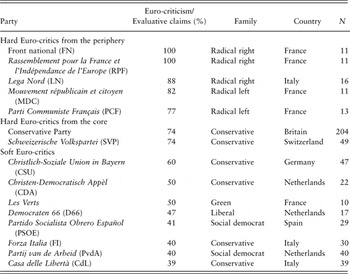
Our qualitative study uses these ideal types to examine the claims of the most ‘Euro-critical’ parties revealed by the quantitative analyses. Table 4 lists our sample of 15 parties for which we have at least 10 claims in our sample, and which have shares of negative evaluative claims that exceed the overall mean of 37%. It includes parties from each family and each country. Table 4’s ranking divides the sample into three groups. At the top, we find the strongest Euro-critics from radical right and left poles, we call these hard Euro-critics from the periphery (between 77% and 100% negative claims). In the middle, we have the two conservative parties who are hard Euro-critics from the core (74% negative claims). At the bottom, we find soft Euro-critics who make some criticisms but also have positive things to say about Europe (between 39% and 60% negative claims). Our analysis is based on the actual language and contents of the claims and descriptions of their mobilizations coded from newspapers. All quotations come directly from the source material (translated into English).
Euro-critical parties

Hard Euro-critics from the periphery
Starting with the Front national (FN), all its evaluative claims-making is against Europe. The FN’s claims build a coherent and consistently mobilized critique that characterizes it as a committed Eurosceptic. The party defines itself as France’s defender against a loss of sovereign national autonomy imposed by the EU and collaborating French governments. This advocacy against the European Union constructs a territorial cleavage of France vs. the EU: ‘European integration is bad for France’. It opposes European enlargement, calling for treaty renegotiations ‘to improve national independence’. Likewise the Euro is criticized for being ‘against national, economic, social, and political independence’. Instead of Europe, the FN proposes strong sovereign independent nations. As Marine Le Pen puts it, ‘We want a Europe of sovereign nations. France can’t be like Nebraska in the US’. French governments are criticized for ‘selling France and its sovereignty cheaply to the EU’. In addition, the EU is criticized for its ‘totalitarian’ treatment of Austria over the Haider affair and for wanting to ‘integrate millions of immigrants over the next 20 years’. However, the FN’s Euroscepticism addresses the national consequences of globalization in the economic and political terms, much more than mobilizing a cultural threat of immigration.
Charles Pasqua’s Rassemblement pour la France et l’Indépendance de l’Europe’s (RPF) is also entirely against Europe. Its critique has similarities to the FN, being territorial, but its nationalism criticizes the substance of ‘Europeanization’ processes even more. Pasqua calls on the French government to organize a referendum on the Euro, arguing in populist tones that ‘France will sacrifice its destiny, and that the French people has a different ambition’. He asks President Chirac ‘not to sacrifice national cohesion for Europe’s sake’. The Euro is depicted as potentially ‘weak’, leading to a doomsday scenario of inflation, unemployment, social crisis, and ‘national identity’ problems. Monetary union is dismissed as a ‘federalist vocation’, leading to the European Central Bank being able to ‘dominate democratic states’. The RPF’s nationalist critique is consistently committed Eurosceptic, however, in contrast to the FN, it also takes pragmatic policy stances in response to political opportunities, for example, demanding the Euro’s postponement, or to avoid the convergence criteria. This indicates also a more strategic engagement within the party system over Europe.
The Italian regionalist Lega Nord exhibits a different form of Euroscepticism. Its critique of Europe mobilizes anti-statist claims, but is eclectic and superficial in addressing the political and economic substance of European integration. Thus Umberto Bossi considers the European Union as a source of ‘supercentralist philosophy’ and a ‘new form of Statism’. However, the Lega mobilizes virtually no economic or political arguments against Europe. Instead, it depicts the consequences of an advancing EU as cultural threats. Thus, the EU Charter of Rights is criticized for being ‘communist, a little bit Nazi, a little bit Jacobin, and a little bit Social Democratic’, whereas Bossi argues, ‘we want a Europe of the people against the superstate of freemasons’. It describes EU intervention in the Haider Affair as a plot by ‘big businessmen, who are often Jewish, wanting to impose immigration’. This high eclecticism defines the Lega as an opportunistic Eurosceptic. The Lega uses Europe’s salience as an opportunity for mobilizing its populist anti-statist worldview within its anti-systemic opposition. It does not engage in substantive politics over European integration.
Turning to the left, Jean Pierre Chevènement’s Mouvement républicain et citoyen (MDC) has strong similarities with the RPF. It actually has little to say about the social consequences of European integration and its critique is basically a territorial nationalist defence of sovereignty. Like the RPF, its committed Euroscepticism coherently focuses on the substance and perceived consequences of Europeanization processes. Monetary union is criticized for its technical unfeasibility: ‘a strong Euro will bring high interest rates, deflation, a tight national budget and tight salaries’. The European Central Bank is depicted as incapable of serving France’s economic needs. Politically, the MDC opposes the loss of national sovereignty implied by ‘the idea of a European Constitution that would turn France into a German “Land” ’. This anti-federalism becomes anti-German when Chevènement claims that Joschka Fischer’s federalist propositions ‘were the sign that Germany wasn’t cured from its Nazi past’. Like the FN and RPF, the main cleavage it constructs over Europe is territorial, a political and economic, and occasionally cultural, nationalism against Europe.
By contrast, the cornerstone of the Parti Communiste Français’ (PCF) critique of Europe is not nationalism but emphasizes the EU’s social deficits. The PCF defends national social welfare and labour interests against the EU’s perceived neo-liberalism. Its General Secretary criticizes the French EU Presidency ‘for having done nothing on social policy at the European level’. Likewise, the PCF sees the attempt to make the Euro rival the Dollar as ‘dropping the European social model and promoting financial markets’. The party also criticizes the EU’s immigration policies for their ‘repressive and restrictive’ consequences for Third country nationals. Overall, the PCF’s committed Euroscepticism constructs a critique that fits within the modified left/right cleavage over Europe identified by Hooghe and Marks, regulated capitalism vs. neo-liberalism: it defends France’s national social model against the EU’s neo-liberal market-making. Here the territorial nationalist dimension is not decisive which is demonstrated by the PCF’s support for non-nationals in France in its criticisms of EU immigration policies.
Hard Euro-critics from the core
The British Conservative party is the only mainstream EU member state party that is strongly critical of Europe. Its mobilization produced four times as many negative evaluations of European than its nearest rival in any of the other countries. The Conservatives use the regular opportunities presented by EU summits, proposals and treaties to politicize European integration and the EU, thereby carrying the cleavage over Europe to the core of the British political system. The Conservatives are committed Eurosceptics par excellence and their substantive rejection of Europe is a coherent ideological critique. Like the radical right, they emphasize the territorial dimension by advocating national sovereignty and independence over political Union, but at the core of Conservative Euroscepticism is a strong commitment to the free market against any possible regulation or intervention by the EU. Politically, advancing Union is seen as a threat to the Westminster Parliament’s sovereignty. Economically, the EU is depicted as potentially re-introducing state-interventionism into a deregulated economy. Conservatives oppose the EU’s political substance, which is depicted as an interventionist ‘Federal EU superstate’, a ‘United States of Europe’, ‘anti-American, big government Europe’, and criticized for fraud, mismanagement, high cost, and incompetence. All EU regulatory intervention is firmly rejected. However, this vision is not reducible to anti-globalist nationalism, but specifies an alternative international world order: economically, the Conservatives propose Europe as a ‘free-trade area’, and politically, they advocate international relations between strong sovereign nation-states, promoting Britain within North Atlantic Treaty Organization (NATO) and the Commonwealth. For the Conservatives, it is not clear why internationalism stops at the EU’s borders; they want free markets between sovereign states everywhere. We find a few cases where Euroscepticism drifts into ‘little Englander’ xenophobia, for example, Minister Nicholas Ridley claiming Monetary Union was a ‘German trick to gain power’, or giving sovereignty to Brussels was ‘tantamount to giving it to Adolf Hitler’. However, the vast majority of Eurosceptic claims are reasoned arguments against the perceived threats of declining political sovereignty and increasing market regulation. Conservative Euroscepticism is only to a limited extent populist/cultural (xenophobia/ethnic nationalism/parochialism). Mostly, it addresses core political (pro-sovereignty/civic nationalist) and economic (pro-free market) substantive issues with reasoned alternatives. The driving force of Conservative Euroscepticism is a commitment to market-oriented neo-liberalism and defence of national sovereignty, much more than cultural opposition to Europe.Footnote 11 However, it is not just reducible to opposition to ‘regulated capitalism’ a la Hooghe/Marks; the nationalist component is also salient in its strong defence of political sovereignty, but mostly this is an expression of civic-nationalism, that is, ‘conservatism’ in the face of change, not xenophobia.
Since Switzerland is not an EU member, many of the SVP claims are mobilized within the specific political opportunity presented by referendums over EU entry and bi-lateral agreements. The SVP campaigns strongly against the ‘Oui à l’Europe’ initiative. Faced by opportunities to politicize Europe, the SVP mobilizes a committed Eurosceptic critique. It galvanizes a populist appeal to a loss of the individual Swiss citizen’s power with a defence of national interests, while rejecting ‘super-statist’ EU interventionism. Interventionist EU statism is presented as a substantive threat to the political and economic freedoms and liberties of Swiss citizens. The party’s leader, Christoph Blocher, argues ‘one should search for one’s national salvation in oneself not within a bigger supranational building’. The threat to national independence is symbolically depicted by potential consequences for farmers: ‘EU agriculture regulations will corner small Swiss farmers and hinder the independence of the food supply’. According to the SVP, the EU will remove Swiss direct democracy, demonstrated its anti-democratic credentials in the Haider Affair, and joining monetary union will make the Swiss (especially farmers) poorer. Nor does the continental security argument resonate with the SVP, for whom, ‘Europe can live in peace without the EU’. Overall, the SVP’s nationalist critique emphasizes the territorial cleavage over Europe. It is more populist than the Conservatives and lacks their strong commitment to neo-liberalism, which places it closer to the RPF, MDC, and FN parties.
Soft Euro-critics
The remaining parties in Table 4 are above average Euro-critics. However, except for the German CSU, negative evaluations form a minority of their claims. Nonetheless, if criticizing Europe is an emergent phenomenon – Table 3 showed significant increases over time – then these parties are its likeliest source. It is, therefore, important to know what type of critiques they present. To gauge this potential for Euroscepticism, we start on the right, where it is most present, and move across the political spectrum.
The Christlich-Soziale Union in Bayern (CSU), the junior partner of Germany’s Christian democracy, mobilizes against Europe almost exclusively around one issue: the EU’s sanctions against Austria over Haider. The CSU’s criticism is not a coherent critique over the substance of European integration, but a single-issue campaign. It argues, ‘the EU may not interfere in the government of a member state’. A few additional cases criticize the EU’s weakness, and oppose Turkey’s proposed membership, however, the CSU has no consistent substantive political or economic stance against the EU. It is basically a one-issue opportunistic Eurosceptic.
The Italian conservatives in Berlusconi’s Casa delle Libertà (CdL) coalition, led by his Forza Italia (FI), show more evidence than the CSU of critiques similar to the Conservatives. The CdL’s opposition to the EU focuses on neo-liberal, anti-regulatory, anti-state elements. Berlusconi ‘dreams of a more free market-oriented Europe’ arguing for less centralized government and regulation, and praising Mrs Thatcher’s approach to Europe. The EU’s growth and stability pact is presented as ‘against the interests of Italian citizens’ and the Euro criticized for raising prices. The CdL is sceptical of EU enlargement on grounds of national interest, arguing that Southern Italy’s development ought to take precedence. However, the CdL advocates neo-liberalism within Europe, not as an ideology against it. Its stances are pragmatic and not consistently pitched against Europe’s political substance. Euro-criticisms appear on an ‘ad hoc’ basis, depending on whether Italy stands to benefit or lose from a proposed integration measure. Such eclecticism combining market rhetoric and nationalist populism is perhaps the hallmark of Berlusconi politics, leading to opportunistic Euroscepticism.
The Dutch conservative Christen-Democratisch Appèl (CDA) criticizes aspects of the EU’s performance and efficiency, but without politicizing or questioning its value and substance. For example, the CDA demands that the European Commission sticks to the stability and growth pact rather than make concessions to other states, because ‘the credibility of the Euro is at stake’. Likewise, a CDA Minister says adjusting market policies for special categories of farmers ‘is a threat to the foundations of the common agricultural politics’. Such criticisms are made from an acceptance of the Netherlands’ inclusion within a European framework. There is no nationalist challenge. They support the European project and carry no ideological opposition to it. The CDA’s Euro-criticisms are constructive Europeanism that aims to keep common European standards high by specifying pragmatic alternatives within the existing project.
This type of Euro-criticism seems prominent at the Dutch centre, because constructive Europeanism also characterizes the claims-making of the liberal Democraten 66 (D66) and social democratic Partij van de Arbeid (PvdA). For example, on immigration, D66 wants a ‘charitable and open position’ on asylum so that it is ‘first of all a matter for the EU’, while demanding that the EU makes other member states do their duty for Bosnian refugees too. The PvdA’s criticisms defend the Netherlands’ status within the EU. Thus the Prime Minister demands that the Netherlands receives a greater share of EU votes than Belgium, Greece, and Portugal and the Secretary of State for European Affairs intends to protest over any proposed reduction of EU ‘official languages’ to the detriment of Dutch. This is pro-European nationalism. Far from Euroscepticism, this strong constructive Europeanism is evidence for a Dutch party politics that sees Europeanized governance as normalized. It explains the high level of Dutch Euro-criticism (see Table 3) to actually be the product of an impatiently Europhile party politics.Footnote 12
The Spanish social democratic Partido Socialista Obrero Español (PSOE) demonstrates that constructive Europeanism is not just Dutch. On German Unification, the PSOE criticizes ‘certain members of the European Community for using these events as an excuse for not progressing with the European Union’. There is even a protest against the Euro for not being sufficiently included: San Sebastián de la Gomera’s Mayor launches his own currency, the ‘Gomeuro’, against the exclusion of small Canaries islands from the currency’s distribution. Again this supports, not challenges, the existing context of European governance.
Finally, the French greens Les Verts are pro-European, but unlike the Dutch centre parties and PSOE, their claims reject the existing European Union for not advancing far enough. The party is against the Nice Treaty, because ‘it does not stand for political responsibility and tends to re-nationalise common policies’. Its leaders demand that Laeken ‘must be the occasion to re-launch European integration’ and promote sustainable development. Les Verts’ radical federalism advocates a social, political, and federal Europe to replace the current EU. Opposing the nationalist Eurosceptic challenge from the right, Les Verts present a post-nationalist challenge on the territorial dimension, by rejecting nation-states’ dominance over the EU through a commitment to federalism. In addition, they want a greening and more emphasis on social aspects within the EU’s substance. This critical Europeanism politicizes the EU’s substance and value by demanding a more radical Europeanization.
Whither Euro-criticism: towards normalization?
This article examined Euro-criticism across seven party systems to test hypotheses about the degree and nature of European party contestation. Our multivariate analysis showed that, generally, a party’s country of origin has little explanatory power, once differences between the compositions of party systems are taken into account. Even British parties are not significantly more Euro-critical than similar ones elsewhere, when the great exception of the Conservative party is taken into account. This implies an ideological dimension to European mobilization. However, there was support also for the strategic/tactical dimension. First, regardless of differences between party families, we found that all parties are more pro-European when they are government incumbents. Second, we found that sub-national party representatives take up more Euro-critical stances. This was particularly the case in the two most strongly federalized countries, Switzerland, and Germany, where regional actors stand to lose most from transfers of power to the EU level, where national actors have privileged access to core decision-making forums. These findings confirm expectations from the political opportunity approach that those more excluded from participating within European-level governance – opposition parties, regional actors – are significantly more critical regardless of their political colours.
Another important general point is that party contestation in the public domain remains strongly pro-European (cross-country average: 63% pro-European evaluative claims), especially at the core among Liberals and Social Democrats. In contrast, the radical right and radical left are clear opponents. The Conservatives (56% pro-European) come in between. They are divided between the statistically significant exceptions of the Euro-critical British Conservatives and the Swiss SVP (both 74% Euro-critical), and the remaining parties, who do not vary significantly from the pro-European centre consensus. Thus, overall we find a lop-sided inverted U on the right of the political spectrum, but this is generated almost entirely by the mobilization of the British Conservatives and the Swiss SVP.
Our detailed qualitative study put flesh on the bones of this pattern. On the Euro-critical periphery, the French radical right were ‘committed Eurosceptics’ contesting an ideological cleavage over Europe that is territorial, constructing different brands of mostly political/economic nationalism in opposition to the advancing EU. In contrast, the French Communists mobilized against neo-liberal Europe by defending social welfare and labour interests. The Italian Lega was different again, an ‘opportunistic Eurosceptic’ mobilizing little meaningful critique over Europe’s substance within its anti-systemic opposition. Among Europe’s soft critics, we witnessed little evidence for latent ideological Euroscepticism at the party system’s core. The CSU and Berlusconi parties used Europe tactically – ‘opportunistic Euroscepticism’ – to oppose Europe, whereas the Dutch parties’ criticisms and those of the PSOE were actually evidence for Europhilia, ‘constructive Europeanism’. In addition, the French greens mobilized a ‘critical Europeanist’ case, opposing the existing Europe through an ideological commitment to a greener federal one. The most developed ‘committed Eurosceptic’ critiques came from the British Conservative and Swiss SVP cases: For them, Europe is a new threat of statist interventionism, against national political sovereignty and neo-liberal market and individual freedoms.
First, from this, it is clear that mobilized opposition to Europe is not reducible to ‘contentless’ anti-systemic challenges (Taggart). Only the Lega at the periphery were ‘opportunistic Eurosceptics’ in this pure sense. Against those emphasizing parties’ tactical positioning (Steenbergen/Scott) and a broadly ‘no change’ thesis (Mair), we found that most criticism from core and periphery actually constructed critiques over the substance of Europe. When parties make the effort to take a clear stance against Europe they mostly have something to say politically and economically about Europeanization. Nonetheless, it is worth repeating that party contestation is for the most part still dominated by parties saying positive things about Europe, especially those in government. Thus, we are still some considerable way from an ‘all change’ thesis (Kriesi). Even if we found a significant increase in Euro-criticism over time, our evidence showed that committed Euroscepticism at the core of party systems is basically limited to two conservative parties in Britain and Switzerland. Thus, it remains questionable to what extent there is a transformation of party politics driven by an anti-European right, especially if this is conceived as a new cleavage in a fundamental sense (Kriesi). As an emergent trend, Euroscepticism still has a lot of emerging to do to reach that status, especially considering the overall prominence of pro-Europeanism among parties.
What we are perhaps witnessing is the beginning of a process where criticism of Europe becomes normalized within national party politics. Europe is a key issue in the transformation of a national politics dealing with the consequences of globalization, and the repositioning of parties over this. We could be at the stage where there are clear but smallish groups of ‘winners’ and ‘losers’ of Europeanization, who politically see themselves as such, whereas the rest of the population remain increasingly aware of the issues but undecided (Fligstein, Reference Fligstein2008). Parties increasingly step forward to test the water over Europe with the majority of the population, as the field is increasingly publicly visible and politicized by those who have clear stakes. Parties are saying more about Europe, and critiques and ideological divisions are emerging over the benefits and disadvantages of Europeanization, so Europe is becoming part of the way that parties address the challenges of globalization and translate this into political choices. When it is normal to have something to say about Europeanization, purely tactical opposition to Europe has relatively little to offer, because to enter a debate, even tactically, one has to say something of substance. So Europe is part of a changing national party politics, but whether it will become central to transforming party politics remains an open question.
Second, regarding the nature of mobilized cleavages over Europe, our findings are also mixed. We consider that party contestation over Europe is, as Hooghe/Marks suggest, linked within a modified left/right cleavage (regulated capitalism vs. neo-liberalism). However, not all party critiques of Europe can be placed within this framework. It fits the French Communists from the radical left and the neo-liberalism of the British Conservatives. But Eurosceptic nationalism, including that of the Conservatives, SVP, RPF, MDC, and FN opposes most reductions in the political sovereignty of the nation-state, not just those relating to market-regulation. It is also difficult to place the Greens’ critical Europeanism or the SVP’s populism. Superimposed over a modified left/right cleavage, we consider, like Kriesi, ‘new politics’ themes (TAN vs. GAL) important. However, in contrast to Kriesi, we see the key sources of rightist TAN Euroscepticism to be grounded in civic-political rather than cultural responses to Europeanization, especially when they are expressed at the core of the political system. For Kriesi, the cultural aspect of TAN is fundamental and explanatory: ‘the relevance of Euroscepticism for the restructuring of the national political space depends on the deep cultural roots referred to by Díez Medrano (Reference Díez Medrano2003). It is only in countries where Euroscepticism, as in Britain and Switzerland, resonates with deep-seated national anxieties that it serves as the key for the restructuring of the party system – with conservatives or new populist right becoming the decisive restructuring force’ (2005: 13).
However, Kriesi’s thesis misses important elements. First, this brand of Eurosceptic nationalism cannot be reduced to cultural nationalism, that is, ‘deep cultural’ threats and xenophobia. It is highly questionable, and not empirically proven, that the British and Swiss are more beset by ‘deep seated national anxieties’ over globalization issues, such as immigration, than others, such as the French and Dutch. We found only limited cases of populist cultural nationalist and xenophobic Euroscepticism, even among the radical right. Actually, most Eurosceptic nationalism finds expression as civic-nationalist claims about sovereignty. Defence of sovereignty is not necessarily a product of ‘deep-seated national anxieties’, nor is it logically linked to ‘immigration threats’ and ‘fear of foreigners’. Instead nationalism can be a form of ‘constitutional patriotism’ (Habermas’ Verfassungspatriotismus) located in advancing interests of the national community of citizens and belief in core political institutions. This stands for more than addressing a constituency of de-nationalization ‘losers’. Civic-nationalism can also appeal across internal divides (e.g. class, sectoral interests) standing for a cohesive national civic community, sharing common values. This is literally ‘conservatism’ and need not drift into xenophobia. Indeed, the more Euroscepticism exists at the political mainstream, the less likely it is to be based on the appeal of ethnic nationalism. To succeed at the core, Euroscepticism has to be made appealing to the ‘political classes’, which is more likely on the basis of civic nationalism and sovereignty than xenophobia.
Overall then, it is clear that there are ideological positions over Europe being mobilized within national party systems, but core Euroscepticism is limited to non-member Switzerland, where it is an issue for competition in referendum campaigns, and an EU member, Britain, which is exceptional in retaining elite divisions and competition over Europe since entry. However, the possibility of the British experience transferring across the Channel remains unlikely, even if Euro-criticism is increasing. First, growing criticism of Europe is not coterminous with emerging Euroscepticism. Significantly high Euro-criticisms among Dutch centre parties in our sample were actually indicative of a ‘normalized’ Europhile party politics. Criticizing Europe can be part of its normalization and integration within national politics. And second, few European conservative parties have the same degree of commitment to neo-liberalism as the British, who more often than not draw inspiration from across the Atlantic. In this sense, perhaps Britain’s party elites’ ‘deep cultural roots’ are rooted in different political soil than those of continental Europe, which goes some way to explaining their exceptional behaviour.
Acknowledgement
This research is from the Europub.com collaboration (http://europub.wzb.eu/), funded by the European 5th Framework programme (HPSE-CT2000-00046). The authors’ acknowledge the input and hard work of all colleagues on this project, whose collective results will be published in The Making of a European Public Sphere. Political Communication and Collective Action in an Era of European Governance edited by Ruud Koopmans and Paul Statham, to be published by Cambridge University Press.