After a breathtaking buffet of action sequences, Hong Kong martial artist Hahou Mo (played by the local action hero Donnie Yen) faces his death at the hands of Fung Yu-sau (played by the Chinese actor Wang Baoqiang), a maniac from the mainland looking to prove his supremacy in the kung fu world. In the prior weeks, the mainlander had stalked the streets of the city, killing seven champions previously defeated by Hahou. Now that he has cornered his last nemesis in a narrow alley created by semi trucks in the middle of a highway, Fung is ready to deliver the knockout blow, underscoring his invincible skills. Hahou, apparently refusing to accept it as a fait accompli, springs into a flying kick, smashing Fung's makeshift bamboo weapon and thwacking him down to the ground. The camera zooms in on Hahou's sweating face, framing him in a medium close-up as he sets up his vengeance. His fist poised for its lethal punch, Hahou suddenly halts in the air as the camera flashes over his contorted countenance, which betrays a boiling internal struggle. Seizing the brief hiatus, Fung drags Hahou back into the potholed road and rolls him under a passing truck. As the two combatants duke it out beneath the undercarriages flying overhead, Hahou is losing ground and the duel. At this point, a policewoman who released him from prison to help with the investigation fires a shot into Fung's head. Now safe, Hahou recounts the critical moment, explicating the struggle that almost cost his life. Unlike the mainlander, for Hahou, Chinese martial arts are not intended to overpower opponents to verify one's superiority, but to release people from frenzied competition, which he sees as the root cause of endless violent vengeance.
For veteran fans of Hong Kong movies, Hahou's noble yet fundamentally self-defeating act in Kung Fu Killer (2014), sketched here, will surely register a sense of déjà vu. Comparable scenes can be identified across several action/martial arts productions, including A Battle of Wits (2006), Invisible Target (2007), and Ip Man 2 (2010). Despite their divergent story lines, each of these films culminates with a similar ending, in which the justice-seeking male protagonist, like Hahou, stops short of acting upon his vengeful will and releases his murderous adversaries to pursue justice in his own right. The endpoints of the films depart from the yanggang (staunch masculinity) tradition, known for using “violence to cover up violence” (Pang Reference Pang, Pang and Wong2005, 45), that has characterized Hong Kong kung fu cinema since the late 1960s (Desser Reference Desser, Pang and Wong2005b). By disrupting cycles of vicious rivalries and releasing hypermasculinity from the logic of domination and suppression that justifies brutal vengeance, these endings offer a new entry point for us to rethink the relationship between masculinity, violence, and justice.
In stark contrast with the celluloid bubble produced to mitigate the antagonism between Hong Kongers and mainlanders, the tension has continued to rise in real life and reached a point of no return after the colony's handover from British rule back to Chinese sovereignty in 1997. In October 2014, as Kung Fu Killer was enjoying its status as a box-office hit, Hong Kongers took to the streets in droves to express their outrage about the Chinese government encroaching upon the “supposedly semi-independent status of the SAR [Special Administrative Region]” (Abbas Reference Abbas1997, 9–10). After weeks of futile peaceful engagements, the protest escalated into an array of violent confrontations that left the activists forcibly suppressed by the police (Whiteaker Reference Whiteaker2019). The protesters, however, did not lose their momentum: they returned in the summer of 2019 with a stronger existential quest. Building upon previous experience and through months-long engagements, the protesters developed a leaderless, hyperflexible new strategy. Borrowing Bruce Lee's term, they named this improvised strategy “Be Water” and utilized it as their motto to stage a series of “peaceful, rational, and nonviolent” (和理非, the Cantonese shorthand pronounced woh leih fei) marches with millions of participants,Footnote 1 debunking the impression that Hong Kong people are indifferent to politics and only mindful of their personal life (Leung Reference Leung, Ku and Pun2004). More importantly, in the milieu of entrenched ethnoracial hierarchies and antagonisms that subtend the city-state's urban sprawl (Yam Reference Yam2019), the protesters created an inclusive platform that welcomed minority groups, such as South Asian and Muslim immigrants, to join their collective resistance (Lew Reference Lew2019), subverting the SAR government's sabotage and setting up a remarkable model for other grassroots movements across the world (Yang Reference Yang2019).
Reexamining Martial Arts Masculinity through a Situated Feminist Lens
Martial arts have long been deemed a specifically Chinese knowledge and a privileged source of national pride, and scholars often see kung fu cinema as a propaganda tool serving nationalistic interests (Desser Reference Desser, Lu and Yeh2005a). Deriving his aura primarily from the masculinist yanggang aesthetics of graphic violence, Bruce Lee, in particular, encapsulates “a discourse of macho Chinese nationalism” that has been co-opted to promulgate patriotic sentiment (Tasker Reference Tasker, Stecopoulos and Uebel1997, 316). Because of his empowering political agency, Lee's influence has extended well beyond the Sinophone world, appealing to countless disenfranchised groups and underclasses across the globe as they seek to further their struggles for justice (Brown Reference Brown1997; Kato Reference Kato2007). However, the violence-for-violence tenor embodied by Lee's filmic persona reproduces, tacitly or not, the “mastery” logic that underlies and integrates nationalistic and colonialist domination by recreating “an inverted binary that [aims] to defeat colonial mastery through other masterful forms” (Singh Reference Singh2018, 3). The Hong Kong protesters’ creative reincarnation of Lee's legacy, on this account, challenges the nationalistic impingement by the Chinese state and simultaneously repudiates the violent masculinist root of neo/colonialist subjugation, a striking move that calls for more in-depth analysis.
Certainly, there has been an intricate correlation between violent masculinity, colonialization, and nationalistic demarcation. In the essay “Globalization, Imperialism, and Masculinities,” Raewyn Connell (Reference Connell, Kimmel, Hearn and Connell2004) traces the history of colonial conquest and imperial order, noting that the shifting terrains of geophysical borders are accommodated by reformulations of virulent forms of masculinities. The process combines “the occupational culture of [the colonizing] groups with an unusual level of violence and egocentric individualism” (Connell Reference Connell, Kimmel, Hearn and Connell2004, 74) and is defined by a contested relationship “between bodies that has been of great importance in the history of masculinities” (82). In “Masculinity and Nationalism,” Joane Nagel (Reference Nagel1998, 248) maps the intimate connection between manhood and nationhood, illustrating how the tasks “of setting boundaries and of articulating national character, history, and a vision for the future” emphasize both unity and “otherness” hinging upon violent articulations of hypermasculinity. She argues that nationalism took shape “as a movement that began and evolved parallel to modern masculinity” generated in the nineteenth century in the West (249). Using two decolonial thinkers and nationalist leaders, Mohandas Gandhi and Frantz Fanon, as examples, Julietta Singh (Reference Singh2018, 9) unpacks the “mastery” logic that interlinks imperial/colonial and anticolonial/nationalist endeavors as the shared epistemic basis. “A colonial master,” she posits, “understands his superiority over others by virtue of his ability to have conquered them materially and by his insistence on the supremacy of his practices and worldviews over theirs, which renders ‘legitimate’ the forceful imposition of his worldviews.” These forms of mastery cannot be easily parsed in that “[t]he conscious and unconscious choices we make in relation to language . . . begin to reveal to and for us the ways that . . . we remain bound to structures of violence we wish to disavow” (9). Thus, Singh calls for “unthinking mastery” to repudiate the violent basis of colonialist and nationalist domination to envision a peaceful world.
In “Beyond Nuremberg,” Mahmood Mamdani (Reference Mamdani2015) offers a concrete example of how to unlearn the violent logic of mastery to build an inclusive platform of justice in a context in which the structural reform pivotal to broad-scale social justice is not available. Beginning in the 1970s, global neoliberal restructuring rendered the individualistic ethos of justice, fueled by a finding-perpetrator-and-revenging mantra, the dominant paragon of justice. Noting that this criminalizing model has spawned more atrocities rather than eradicated their root cause, he draws upon the postapartheid transition in South Africa and proposes what he calls “political justice” as a feasible alternative. As the leaders of the liberation movements and apartheid regime recognized, there was little prospect of ending the conflict through revolution or military victory, they shifted from “criminalizing or demonizing the other side to treating it as a political adversary” (Mamdani Reference Mamdani2015, 67). This cognitive change, he argues, lays the groundwork for a reform-based perspective of justice that helped secure a peaceful transition when the redistribution of apartheid-induced private properties was impossible.
Having moved from the hands of one group of colonizers to another with no respite in between for structural change (Chow Reference Chow1992), Hong Kong bears notable similarities with South Africa in terms of their postcolonial transitions. The inimical implication in the stretched Cold War makes it a perfect example of what Gloria Anzaldúa (Reference Anzaldúa2012) calls “the borderland” that paves the way for transformative change. A global city that “grew up in the state of being abandoned, struggling for a compromised survival in the gap between East and West” (Chow Reference Chow1992, 158), Hong Kong is replete with incongruities and leaves ample room of resilience for residents to “cross the border into a wholly new and separate territory” and change “the way we perceive reality, the way we see ourselves, and the ways we behave” (Anzaldúa Reference Anzaldúa2012, 101–2). For Hong Kong residents, the question of national and cultural affiliation “has been the most problematic and of the foremost importance, for they have lived a life without a proper nationality, being neither Chinese nor British” (Lu Reference Lu, Fu and Desser2000, 275). This in-between status, as my analysis unfolds, is instrumental for them to develop new perspectives of justice as crystalized in a flexible and elastic “Be Water” worldview.
Instead of adding more evidentiary munitions to film critics’ arsenal about kung fu cinema, this article provides a situated feminist reading of the biographically based action series featuring Ip Man, the Wing Chun grand master lionized for mentoring Bruce Lee, as a set of culturally inflected practices of complex dynamics in order to probe the sociohistorical structure that embeds and overdetermines these productions and yet allows for new, subversive potentialities. A wildly successful kung fu franchise featuring a group of transnational antagonists, the four-installment Ip Man series (directed by Wilson Yip) is loaded with acute nationalistic sensibilities. Building on a coproduction model, the films epitomize “the China-leaning nature of Hong Kong-Chinese collaborations that cater to Chinese audience's taste at the expense of the Hong Kong audience” (Chu Reference Chu2019). Moreover, the pronounced defense of police violence by Donnie Yen, who plays the eponymous character in the series, prompted wide-ranging boycotts of its final installment (Chu Reference Chu2019), rendering the case even more complicated. As Walter Benjamin (Reference Benjamin1969, 253) put it, all images of the world are “thoroughly colored by the time to which the course of our existence has assigned us to.”
Pushing this argument further, feminist scholars suggest that our physical being provides a situated “vision” with which to engage the world (Haraway Reference Haraway1988), and its intensified impacts on our body provide a jumping-off point as embodied “seeds for a worlding” that release new potential (Berlant and Stuart Reference Berlant and Stuart2019, 17). My inquiry follows this situated approach, focusing on the Ip Man series as an optic to probe the contingent contradiction of Hong Kong's culture that “both exaggerates and negates Chineseness in the vicissitudes of its sociopolitical milieu” (Lo Reference Lo2005, 4). I ask how these cultural productions, as a form of filmic embodiment, open up and retain discursive space that allows alternative gendered practices to unsettle the violent masculinist form of nationalism while such articulation becomes growingly difficult in other public channels.
Indeed, the hypermasculine yanggang style, which came to prominence in the 1960s and 1970s as “a metonymic symbol of [Hong Kong's] rapid and successful modernization” (Yip Reference Yip2017b, 1), is a cinematic embodiment of the city's full-blown industrializing ethos during the postwar era. Since the mid-1960s, the yanggang aesthetic, characterized by sensationalist gory violence, has generated a craze for the “real” as the quintessential feature of kung fu cinema. In practice, the “real” is validated through the embracing of “real kung fu”—authentic hand-to-hand combat with “vivid sensory spectacles involving not only violent bloodshed but also thrilling displays of physical action” rather than technologically assisted swordplay with special effects (Yip Reference Yip2017b, 58). This masculinist tradition was carved out by and attributed to the legendary director Chang Cheh, who cultivated a cohort of martial artists with stunning kinetic skills and unbridled athleticism, such as Wang Yu, David Chiang, Ti Lung, Chen Kuan-tai, and, of course, Bruce Lee (Desser Reference Desser, Pang and Wong2005b). These virile men's chiseled, half-naked bodies attracted numerous female filmgoers, who became the backbone of Hong Kong's industrialization at the time (Yip Reference Yip2017b), paving the way for a “golden age” of the kung fu genre. The men's rippled bodies, developed through rigorous training and self-regimentation, were viewed not just as instruments for overcoming adversity and achieving success, but also as embodied indexes of the capitalist tenets of hard work, competition and conquest, and ascetic perseverance that were widely considered to be essential for the city-state's phenomenal development in the 1960s and 1970s (Yip Reference Yip2017b).
Like other yanggang action heroes, Yen started practicing martial arts at the age of nine with his mother, Bow-sim Mark, a Tai Chi master with many accolades and accomplishments (Luo Reference Luo2016), and he developed ferocious skills and a hard-edged body second to none. Since his debut in Drunken Tai Chi (1984), Yen has played a number of renowned martial artists, including Chen Zhen, who was first portrayed by Bruce Lee, but he cemented his international stardom with his breakout role in the Ip Man franchise. Unlike his performances in other movies, Yen's muscled body is never shown in the series, constituting an alternative signifying economy of masculinity that warrants a situated scrutiny.
My inquiry proceeds along three avenues in this article. First, by showing how the filmic reconstruction of Ip's life trajectory is inflected by the Chinese state's nationalist/anti-imperialist agenda, I untangle the complicated relationship between Hong Kong and the mainland in general, and the Wing Chun grand master and China's shifting governing practices in particular. Drawing upon Benjamin's (Reference Benjamin1969, 263) concept of “the time of the now,” I shed light on the structure that both predetermines the warped historiographies and allows for new resistant possibilities. My analysis, then, zeroes in on the symbolic tropes employed to represent the “patriotic” hero in order to explicate how the yanggang tradition takes on new life by reclaiming women's voices within the feminine-leaning Wing Chun tradition. Finally, I demonstrate the ways in which the remaking of Ip's life story builds an alternative embodiment that unsettles musculature as the reified ground of colonialist/nationalist dominance, showing how Hong Kong's pivotal role in China's reintegration into the global neoliberal economy has enabled the creative revival of Lee's legacy, thereby laying the basis for a new perception of justice. Together, these analytical lines foreground the city-state's chronic status of inbetweenness (Chow Reference Chow1992)—as the “Berlin Wall in the East” during the high Cold War, the ethnic enclave sandwiched between two Chinas, and the embattled front line in the new Cold War (Yam and Wasserstrom Reference Yam and Wasserstrom2020)—and delineate the alternative directions opened up in the interstices between these conflicting forces and struggles to release masculinity from the “mastery” logic for new horizons of justice.
Reinventing the Grand Master amid Masculinized Nationalism for Sale
“Empty your mind, be formless. Shapeless, like water. If you put water into a cup, it becomes the cup. You put water into a bottle and it becomes the bottle. You put it in a teapot, it becomes the teapot. Now, water can flow or it can crash. Be water, my friend.”
Lee first made this “Be Water” statement in 1971, on Pierre Berton's talk show discussing the American television series Longstreet (see South China Morning Post 2018), and it became the cornerstone of his martial philosophy. This idea was indebted, to no small extent, to Lee's training by Ip Man in the Wing Chun style of martial arts, which is inspired by the Chinese philosophical tradition and “a means by which one learns to understand, trust, and act in accordance with ways of nature” (Xuan and Little Reference Xuan and Little2015, vi). But compared with his enormously esteemed disciple, Ip remained obscure until he was “rediscovered” in the wake of the successful eponymous film in 2008.
Admittedly, the Wing Chun grand master's obscurity is partially fated and partially self-chosen. He was born into a wealthy family in Foshan, Guangdong Province, in 1893, and at the age of fifteen, he went to Hong Kong to attend high school at St. Stephen's College. After finishing school, he returned to Foshan and took a job as a police chief. Before the Communist takeover in 1949, Ip moved back to the British colony to avoid Communist rule. He started a Wing Chun academy and spent the rest of his life there until he died from cancer in 1972. As his son Ip Ching recalled, “[Ip Man] never once advertised his school,” and “was just against the pathological comparisons and improper motivations that came with it” (Ip and Heimberger Reference Ip and Heimberger2001, 68). In Ip Man's eyes, Wing Chun was to be used for the benefit of the downtrodden and defenseless rather than “self-aggrandizement or as a means for getting rich” (Ip and Heimberger Reference Ip and Heimberger2001, 22). Unsurprisingly, Ip's reclusive penchant and escapist experiences left him out of the public's view for decades.
The grand master's Hong Kong exile overlapped with many pivotal moments in the city. He witnessed its transformation from a colonial outpost at the periphery of the “Middle Kingdom” into a center of geostrategic competition, as well as its miraculous postwar boom, buttressed by the influx of refugees as a source of low-cost labor (Wasserstrom Reference Wasserstrom2020). Although the colony had served as a haven for Chinese refugees since the Taiping Rebellion during the Qing dynasty (1851–64), the border that cordoned it off from the mainland only started to be stringently policed after the outbreak of the Korean War in 1950 (Welsh Reference Welsh1993). As Cold War tensions escalated, the United States increased investment in Hong Kong and turned it into the “Berlin Wall in the East.” Hong Kong became useful “as a listening post on China, a base for anti-Communist propaganda, and a popular destination for rest and recreation for American servicemen during the Korean War and the Vietnam War” (Carroll Reference Carroll2007, 5). Meanwhile, Britain downplayed its role as a colonial master as decolonizing movements swept across its territories, decreasing the declining empire's clout in the area. The city became “a sort of Cold War gray zone, where certain communist activities were tolerated but rigidly confined by the colonial legal frame” (Yan Reference Yan, Zheng, Liu and Szonyi2010, 95). Thereafter, the influx of refugees escaping the Communist regime and famine in the 1950s, along with those fleeing the Cultural Revolution of the 1960s to 1970s, became major sources of labor, turning the colony into a bustling industrial center at the heart of Cold War contestation (Hung Reference Hung, Fu and Desser2000).
As a former officer of the Kuomintang government seeking refuge in Hong Kong, Ip's marginalized experience also indexed the widening rift between Nationalist and Communist China that has turned the British colony into a battleground for contesting “national” identities since the 1950s. Eschewing the nationalist competition between two Chinas (Liu Reference Liu2015) to be “authentic Chinese,” the colonial government tried to maintain Hong Kong's “isolation from the national culture invoked on both sides of the straits,” allowing for “a peculiar sense of Chineseness to emerge that radically differed from the assumed synonymity of one family, one people, one civilization, and one polity” (Chun Reference Chun1997, 121–22).
Heroic martial artists soon appeared on the big screen to capitalize on the brewing patriotic sensibilities while sidestepping their political ramifications. In the late 1940s, “the introduction of the Wong Fei-hung series, which featured unarmed combat and was based on the exploits of an actual historical figure who was a martial artist and doctor, lent specificity to the Hong Kong cinema and in its own way planted the seeds for the kung fu craze” (Desser Reference Desser, Fu and Desser2000, 31).Footnote 2 Thereafter, legendary martial artists, including Ma Yongzhen (Boxer from Shantung, 1972), Chen Zhen (Fist of Fury, 1972, starring Bruce Lee), and Huo Yuanjia (Legend of a Fighter, 1982), became household names in Hong Kong. Ip Man, undoubtedly, was excluded for his “problematic” status.
It should be noted that the Hong Kong film industry was never truly spared from the Cold War contestations. Because of the small size of the local market, it was almost exclusively export oriented (Yip Reference Yip and Fang2017a), functioning “as [a comprador] not just between Western colonizers and native consumers . . . but also between Chinese leftist and right wing groups” (Lo Reference Lo, Cheung, Marchetti and Yau2015, 80). Until the early 1970s, its products “appealed mainly to the Cantonese speaking communities along the southern coast of China and in Vietnam, the Philippines, Singapore, and the Americas” (Fu and Desser Reference Fu, Desser, Fu and Desser2000, 1), and in the mid-1960s, “the powerful Shaw Brothers studio began to assert itself with the production of Mandarin-language films” (Desser Reference Fu, Desser, Fu and Desser2000, 32). The artistic flow between Cantonese-speaking and Mandarin-speaking filmmaking contributed to an “ethnic borderland” that “serve[d] more as a place of mediation and of border-crossing than a place of absolute sovereignty and border enforcement” (Lo Reference Lo, Cheung, Marchetti and Yau2015, 72). When the Chinese economy embarked on rapid development after the state fully embraced neoliberalism as a governing rationale, establishing the market as the major mechanism for managing and organizing Chinese society in the early 1990s (Ong Reference Ong2006; Rofel Reference Rofel2007), Hong Kong cinema shifted its focus to the mainland market, especially after the financial crisis in 1998 and China's entry into the World Trade Organization (WTO) in 2001 (Teo Reference Teo2008). As stipulated by the WTO deal, China increased “the number of imported films from ten titles per year at the outset to 34 titles in 2012” (Yau Reference Yau, Cheung, Marchetti and Yau2015, 24). In 2003, it signed the Close Economic Partnership Arrangement with the SAR government, providing “strong economic incentives for many Hong Kong service sectors and producers to place themselves under a different business culture in the Chinese mainland market” (Yau Reference Yau, Cheung, Marchetti and Yau2015, 18).
Part and parcel of China's globalizing agenda, the relocation of creative talent and the genre filmmaking experience away from Hong Kong “played a substantial part in state-managed cultural globalization through a rapid expansion of China's commercial cinema” (Yau Reference Yau, Cheung, Marchetti and Yau2015, 17), making it possible for the Wing Chun grand master to be rediscovered in the new century. Mandarin Film Distribution, the company that produced the Ip Man series, was established in Hong Kong in 1991. It later started a postproduction laboratory in Hendian, Zhejiang Province, and a publicity company in Beijing. Building upon the personnel and cast from both Hong Kong and the mainland, the company could claim “coproduction” status for its films in order to sidestep the annual import quota and receive higher share of the box-office income in China. To access the Chinese market and maximize privileges through the coproduction platform, film scripts “must pass [China's] State Administration of Radio, Film and Television . . . censorship before shooting,” and “final cuts must pass censorship again for screening permission” (Szeto and Chen Reference Szeto, Chen, Cheung, Marchetti and Yau2015, 94). As a result, the filmic approximation of Ip's story turned out to be manipulative at best, if not sheer fabrication, and the diegesis centered on the choreographed fights with a group of transnational rivals who were used “to evoke the nationalist feelings of the viewers through a structured opposition between self and other” (Yip Reference Yip2017b, 43).
The first installment, for instance, recounts Ip's early life yet devotes the most screen time to his anti-Japanese heroism. The sequel (2011) focuses on his resettlement in Hong Kong, highlighting his face-off with the corrupt colonial police. The third film (2015) features boxing world champion Mike Tyson, who plays a US housing developer with connections to local gangsters who are attempting to push out Ip's school and embezzle the properties. The finale was released in Hong Kong amid an intensified pro-democracy movement at the end of 2019, spotlighting Ip's trip to San Francisco to find a school for his rebellious son. In the film, Ip defeats a white supremacist Marine, once again demonstrating the power of Chinese kung fu and clearing the way for its incorporation into combat training routine in the US military.
According to Benjamin (Reference Benjamin1969), all forms of historical narrative can be seen as inflected by the hegemony that prevails at the time of narration. Underneath the warped story line of Ip and the repurposed historiographies wrought from it, we can identify the masculinist craze simmering at the heart of China today. In the early 1990s, when the Chinese state shifted to neoliberal governmentality, its Marxist/Leninist/Maoist ideological system went bankrupt as a result of skyrocketing class inequalities, and nationalism became a new source of legitimacy, with hypermasculine spectacles of athletic virility and militant prowess creating a convenient and crucial venue. Subsequently, “[t]he Chinese screen [was] flooded with wartime male heroes, and anti-Japanese [and anti-imperialist] warfare has become a favorite and enduring theme for many producers” (Song and Hird Reference Song and Hird2014, 46). Meanwhile, as a coherent type of governmentality, the raison d’être of neoliberalism is the creation and maintenance of market competition to maximize benefits for the entire society. The pivot for this relationship is the production of capable market subjects (Homo Economicus) (Foucault Reference Foucault and Burchell2008). Athletic hypermasculinity developed through stringent self-regimentation and rigorous daily training thus comes to the fore as a governing tool of the state for cultivating self-serving market subjectivity (Zhang Reference Zhang2014).
With his impressive martial skills, Ip was an ideal candidate for these tasks, but his “problematic” past needed to be straightened out to fit into the statist agenda. The first installment of the series, for instance, proposes that after defeating the Japanese in Foshan, Ip “chooses to leave China for Hong Kong in order to escape Japanese occupation and persecution” (Bowman Reference Bowman, Cheung, Marchetti and Yau2015, 314–15), sharply contradicting his real-life trajectory. The finale fabricates his adventures in the United States. Many protesters deemed this a blatant attempt to reproduce the racialized nationalist agenda that smears Hong Kongers’ existential quest as sponsored by “black hands” from the West (see Higgins Reference Higgins2019). Above all, Ip's robust opium habit is left out of the story line so as not to provoke the dire memory of the “Opium War,” an eventful moment in China's colonized history.
Unarguably, the masculinist spectacle of nationalism is not just a weaponized tool of propaganda by the state, but also an efficacious profiteering vehicle for capital. In 2017, Wolf Warrior 2, a typical Hollywood-style action film that embraces a macho Chinese solider “venturing into an African warzone and saving hundreds of lives from Western baddies,” raked in a record 238 million USD in just one week, topping the global box office worldwide (see BBC News 2017). With the violent tagline “Anyone who offends China will be killed no matter how far the target is,” it attracted countless filmgoers and became the highest-grossing Chinese film, storming the country with testosterone-fueled nationalism and inspiring a wave of similar blockbusters, including Operation Red Sea (2018), The Wandering Earth (2019), and The Captain (2019). Since debuting in 2008, the Ip Man franchise has brought in more than 367 million USD, making it the best-selling kung fu series in Hong Kong film history. In 2012, the Foshan government rebuilt Ip's old house as a memorial stadium, riding the wave of the newly minted national hero with the eponymous film series.
Retrieving Women's Voices through the Wing Chun Fad
The office box success of Ip Man soon ushered in a transnational Wing Chun fad with a surfeit of productions featuring it, including Sherlock Holmes (2009), The Legend Is Born: Ip Man (2010), Bruce Lee, My Brother (2010), Mugamoodi (2012), and The Final Master (2015). Meanwhile, hundreds of new Wing Chun schools opened up across China and other parts of Asia, appealing to more people to practice the trendy martial style.
Peculiarly, though, the co-optation of Ip's life story and masculinity by the state has proved conducive to retrieving women's long-subdued voices in the kung fu genre. After the Communists took full control of the mainland in 1949, many film professionals left Shanghai and resumed their business in Hong Kong. Together with them, features and elements of classical Chinese aesthetics and painting techniques were relocated and transplanted to reshape the city's film industry. A new style of action choreography deriving from acrobatic stagecraft in the style of the Peking Opera emerged and eventually prevailed, redefining martial movies by foregrounding women as marvelous martial artists. Different from the unarmed, hand-to-hand combat model popularized by the Wong Fei-hung series in the late 1940s, this paradigmatic shift led to “strong suppression of wu (武; the martial) in the genre's action esthetics due to the elevation of wen (文; the literary and the artistic) in traditional Chinese culture” (Wong Reference Wong2017, 72) and inspired a new trend of “female centrism” that characterizes King Hu's massively popular swordplay movies (Desser Reference Desser, Pang and Wong2005b). The rise of yanggang aesthetics “that stressed ultraviolence and fashioned a new cult of virile masculinity” amid Hong Kong's industrialization in the 1960s not only marked a return to the realist tradition, but also resulted in “increasing male dominance thereafter” (Yip Reference Yip2017b, 84). Compared with the rekindled quest for violent “real” fights between men, as “the only martial art in all of martial arts history that was created by women and/or was developed from a woman's perspective,” Wing Chun is “more conformed to a woman's structure and mindset than to that of a man's” (Xuan and Little Reference Xuan and Little2015, 1, 38). Its women-centered style reflects the influence of the more egalitarian gender imaginary in Daoist and Buddhist thought and undercuts the mode of mastery thinking at the core of patriarchal systems (Vojković Reference Vojković2009). For some, Wing Chun provides opportunities to learn about ancient Chinese culture and traditional Chinese medicine. For others, it creates a means to acquire flexibility, coordination, and stamina, as well as to enhance one's physical and mental fitness (Xuan and Little Reference Xuan and Little2015). In this regard, “many Hong Kong and Chinese martial arts traditionalists do not even regard [Wing Chun] . . . as a ‘proper’ martial art at all” (Bowman Reference Bowman, Cheung, Marchetti and Yau2015, 314).
For practitioners, the most important value of Wing Chun is its critical means to construct a flexible, pliant, and nonconfrontational approach to the natural environment and others, as exemplified by Lee's “Be Water” philosophy. On August 2, 1964, at the invitation of Ed Parker, known as the “Father of American Karate,” Lee elaborated his thoughts about kung fu for Western audiences.Footnote 3 Using “a glass of water” as an analogy, he calmly remarked, “water is the softest substance in the world, yet it can penetrate the hardest rock, or anything, granite, you name it. Water also is insubstantial. By that I mean you cannot grasp hold of it. You cannot punch it and hurt it. So every kung fu manages to try doing that, to be soft like water and flexible and adapt itself to the opponent.” Before his ascension to international superstardom, this vintage video registered Lee's first public articulation of his “Be Water” thought, although he did not use the term to define it. These inspiring lines, however, had heretofore been overshadowed by his meticulously crafted persona of violent masculinity as the embodiment of the zeitgeist.
In the face of China's hardening infiltration, Hong Kong residents have developed an acute local awareness that has spawned the retrieval of this feminine-leaning martial tradition. In the hands of new generations, cultural politics has taken a decisive turn, and resistance to Beijing's increased hegemony has converged into resounding outcries for the repudiation of “mainlandization” of Hong Kong films (Szeto and Chen Reference Szeto, Chen, Cheung, Marchetti and Yau2015). As those who came of age after the 1997 reversion have entered the film industry, they have started to push back against China's influence and focus more on local issues, challenging “vertical, binary identity politics against colonial and national centers” (Szeto and Chen Reference Szeto, Chen, Cheung, Marchetti and Yau2015, 99). From Bruce Lee, My Brother to Ip Man 2, the portrayal of the old colony manifests “a shared intent to reconstruct Hong Kong as a place through cinematic nostalgia” (Cheung Reference Cheung, Cheung, Marchetti and Yau2015, 53). In 2013, the renowned director Wong Kar-wai released The Grandmaster as part of his decade-long quest to spread knowledge about kung fu “that has survived a century of historical traumas through taking root in Hong Kong” (Szeto and Chen Reference Szeto, Chen, Cheung, Marchetti and Yau2015, 108). In the film, Wong shows “how Hong Kong, and the Cantonese grand master Ip Man, both have the ability to see beyond the essentialist North–South, local—national, Chinese—foreign binary impasses towards the survival of the culture and world of martial arts” (Szeto and Chen Reference Szeto, Chen, Cheung, Marchetti and Yau2015, 98), encapsulating the soul-searching efforts by Hong Kongers to reposition themselves in the face of China as an imposing neocolonialist figure.
The fierce fight scenes between Ip and a string of combatant powerhouses (including the Japanese karate master General Miura in Ip Man, the British boxing champion “Twister” in the sequel, the US boxer Frank in the third installment, and the US Marine gunnery sergeant Barton Geddes in the finale) proffer a lens that renders Wing Chun's feminine-induced martial style enthrallingly real.
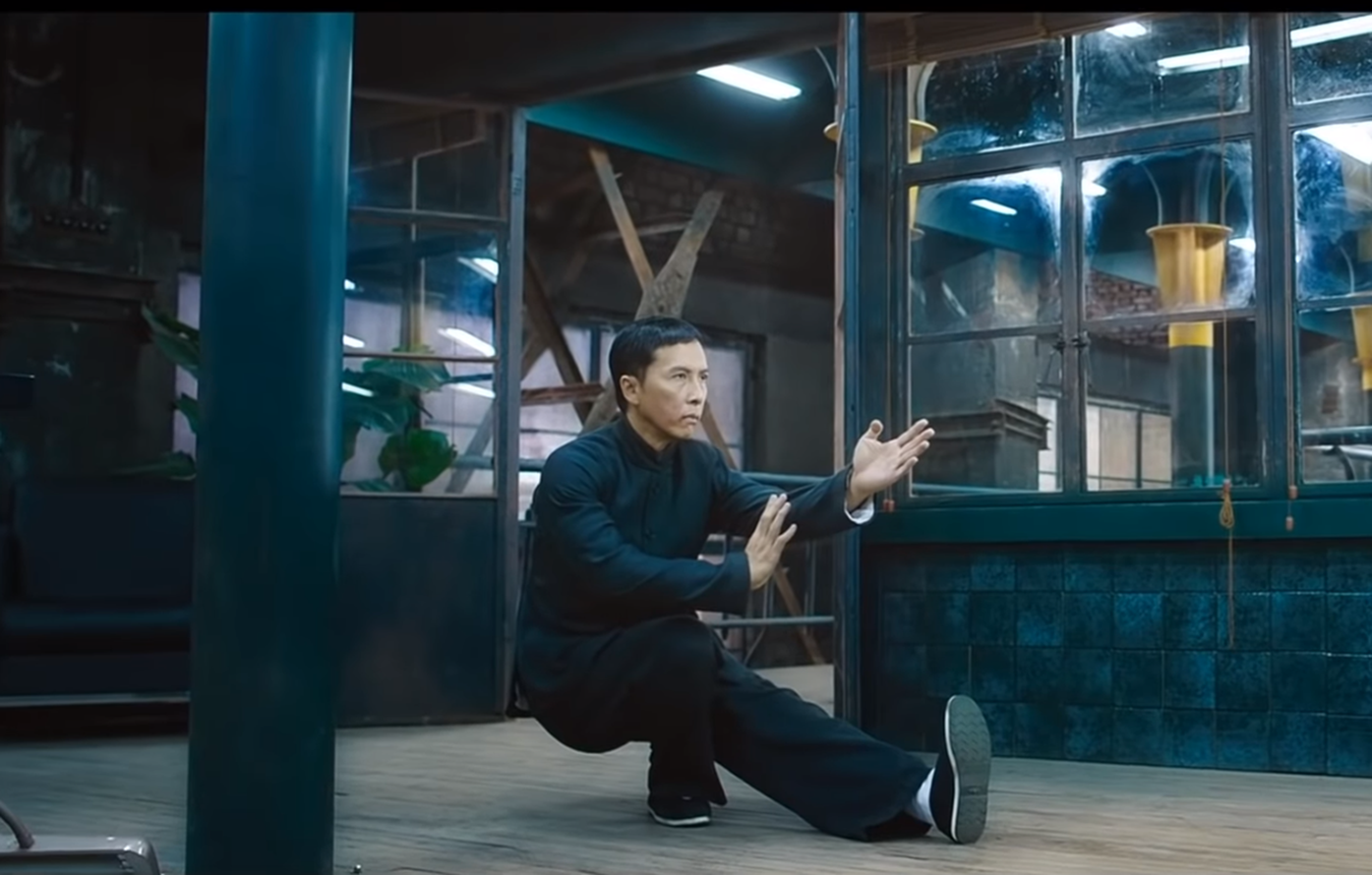
Yen's head-to-head battle with Mike Tyson in Ip Man 3 offers a prime example. Although Wilson Yip deliberately pits the ascetic protagonist against a flock of gangsters to drive the flow of the action sequences, the film reaches a boiling point when the Hong Kong action hero steps into the ring to tangle with the American boxing king one-on-one. Setting the timer for a three-minute round, Tyson promises to let go of Yen if he can survive the brawl. The timer starts ticking as Tyson storms forward in his signature “beast” gesture, chin down, hands up, and moving deadly circles around Yen with a barrage of fists, almost knocking him out. Taking the traditional stance of Wing Chun fighters, Yen dodges Tyson's punches while retreating to find room to fight back. The boxer finally lands a short hook to Yen's body that sends him flying. After regaining his strength, Yen sinks down into a balanced stance, shifting his weight onto his heels to get ready for “Chum Kiu” (尋橋), or “Seeking the Bridge,” the second form of Wing Chun, which consists of a variety of techniques and movements to destroy the opponent's ability to bridge the gap (see figure 1).Footnote 4 This allows him to get underneath Tyson's punching and knock the boxer off balance. Tyson is annoyed by the move and tries to crush Yen with a left-right punching pattern. To counter this ferocity, Yen intercepts the punches with his elbows. After dodging another bone-breaking hit by Tyson, he throws out a finger jab, “Biu Gee” (鏢指), or “Darting Fingers,” that builds on the energy developed in Chum Kiu to muster strength in short distance to recover from being trapped.Footnote 5 Yen almost pushes it into Tyson's eyes. As he tries for a kick to the boxer's crotch, his opponent throws out an uppercut as the last-ditch counterattack. The bell rings.
Ip Man gets ready for “Chum Kiu,” the intermediate level of Wing Chun, in Ip Man 3.

Fictionalized for entrainment purposes as they are, these action sequences offer a glimpse into Wing Chun's intriguing microcosmic world. The fateful encounter between Yen and Tyson that ends in a stalemate sparked an online debate over “who would win in a real-world non-choreographed fight.”Footnote 6 Answers varied from individual to individual, but the discussants all noticed the striking differences between the two fighters—lightning speed versus overpowering weight, agile defenses versus bulldozing offenses, small packed body versus heavyweight build, as well as hard-learned skills versus naturally inherited strength. The observations acutely capture the feminine-oriented nature of Wing Chun. Taking pride in being efficient with minimalistic techniques suited for a woman's physique, Wing Chun “trains its practitioners to read an opponent's action through tactile sense, and to react intuitively and intelligently against any action or change within a given combative situation” (Xuan and Little Reference Xuan and Little2015, 2). In actuality, although Ip began training in Wing Chun at age twelve under Chan Wah-shun, he “became even more skillful in his senior years when he had lost muscle mass and his testosterone levels naturally declined” (Xuan and Little Reference Xuan and Little2015, 38).
Overall, women are nearly invisible in the Ip Man series, but the franchise does set the stage for the Wing Chun master's wife, Cheung Wing-sing (played by Lynn Hung), a thoughtful yet resolute housewife following her husband loyally throughout the bumpy journey. The series’ almost comical emphasis on the patriarch makes the “impressionistic infatuation with the importance of the household even more impressive” (Lanthier Reference Lanthier2011). As Ip Man 3 shows, the couple's committed relationship can only be defeated by death. Learning that Cheung has been diagnosed with cancer, Ip decides to skip the battle with a fellow Wing Chun expert to determine who is the real grand master and goes to a party to dance with his wife and accompany her until the end of her life. Despite the dearth of on-screen affection between the couple, these warming scenes send a clear message about how the action hero values devotion to his family over his manly reputation. Yet the reality is markedly different. Facing the imminent victory of the Communists, Cheung left Foshan and moved to Hong Kong with her husband. She and their daughter soon returned to China to retrieve their identity cards. Because of the closure of the border in 1951, she was then separated from her husband for good.Footnote 7 The reordered story line, however different from the lived reality, is vital to reconstructing Ip's manhood and undoing the violent hypermasculine spectacles that seem to know no bounds in the kung fu genre, which I will elaborate on in the last section.
Undoing Violent Hypermasculinity toward New Horizons of Justice
Yen has garnered consistent attention for his glamorous fighting skills and stunning musculature throughout his career. However, as mentioned earlier, his muscled body is never shown in the Ip Man series. Taking into consideration Susan Brownell's argument (Reference Brownell1995) that the hard body of the male protagonist is the central signifier of the well-being of the national body in the martial arts genre, we need to scrutinize these alternative representations of the patriotic Wing Chun master for a more robust, situated understanding.
Ip Man 2 provides a meaningful site to revisit the genre-bending tropes invoked in the representation of the grand master. Shifting the stage from Japanese-occupied Foshan to British-ruled Hong Kong, the film highlights Ip's struggles with the colonial bureaucracy. With the family's second son on the way, the penniless master decides to start a makeshift martial arts academy on the roof of their apartment, but he soon meets his first obstacle in the colony. To get the endorsement of the coalition of Hong Kong martial arts clubs and continue teaching Wing Chun, he must survive challenges from masters of all martial arts styles within the time of burning a joss stick. After squaring off against a handful of masters from rival schools on a wobbly table balanced at the center of dozens of wooden stools turned upside down, Ip meets his last challenger, master Hung Chun-nam (played by the legendary Sammo Hung, who is also the choreographer of the Ip Man series), who controls the syndicate. The battle ends in a draw, and Ip is able to keep running his academy.
Akin to other nationalist films, the tension with Westerners subtends the story line of Ip Man 2. As the leader of the shady consortium, master Hung also plays a go-between role, attempting to appease the colonizers in return for space for the survival of all Chinese martial arts academies. He has to use a big chunk of the protection fees that he collects to bribe his boss, Superintendent Wallace, a corrupt white police officer, in order to get the green light from him. To satisfy Wallace's ever-increasing greed, Hung organizes a for-profit boxing competition. During the demonstration session, “Twister” (played by Darren Shahlavi), a cartoonish British boxing champion, openly insults all martial artists, pushing Hung into a fight to defend the dignity of the Chinese kung fu and culture. With his considerable skills, he is able to overcome Twister's sheer power and maintain a slight advantage. However, as the fight progresses, he is hindered by asthma and loses ground. Refusing Ip's request to quit, Hung continues to fight until he is beaten to death by the merciless boxer. The Chinese community is outraged. Wallace is pressured to hold a press conference, explicating Hung's appalling death, which, ironically, turns into another colonizing vehicle. While suppressing public opinion, the conference host announces another competition in order to “give Twister justice.” The white boxer pledges that he will accept challenges from “any Chinese person” as long as “this thing burns,” pressing a joss stick into an incense burner in front of him as he makes the pronouncement. Ip Man steps forward.
The ultimate showdown catches the whole city's attention. The film audience is introduced to it in an odd scene that carries multilayered meanings embodied by the rivaling combatants. Ip is first shown to be standing still at the corner of a boxing arena, waiting quietly for his opponent. The lengthy scene, shot from a slightly low angle, focuses tightly on his usual black costume-clad body and then pulls steadily closer, followed by a quick zoom-in that draws the viewer's attention to the somber expression on his face. Simultaneously, cheering messages from Ip's compatriots are brought into the picture, spurring him to defeat his adversary and defend kung fu. After announcing the start of the boxing tournament, the British judge, in a hyperbolic tone and gesture, incites the audience, predominantly white, to welcome “the champion of the world.” Twister, wavering a British national flag over his head with both hands in gloves, walks proudly into the site amid a roomful of clapping fellow white expats. Shifting between long shots, lateral and high-angle medium shots, and then close front shots, the camera skillfully captures the unperturbed Ip, the smug face of the white boxer, and the agitated Chinese community, as well as the complacent Westerners that they represent, respectively. The director wraps up these affectively registered divergent pictures into a symbolic dead-knot, woven by the vying nationalism-colonialism dyad, to which an inevitable brutal fight seems the only answer.
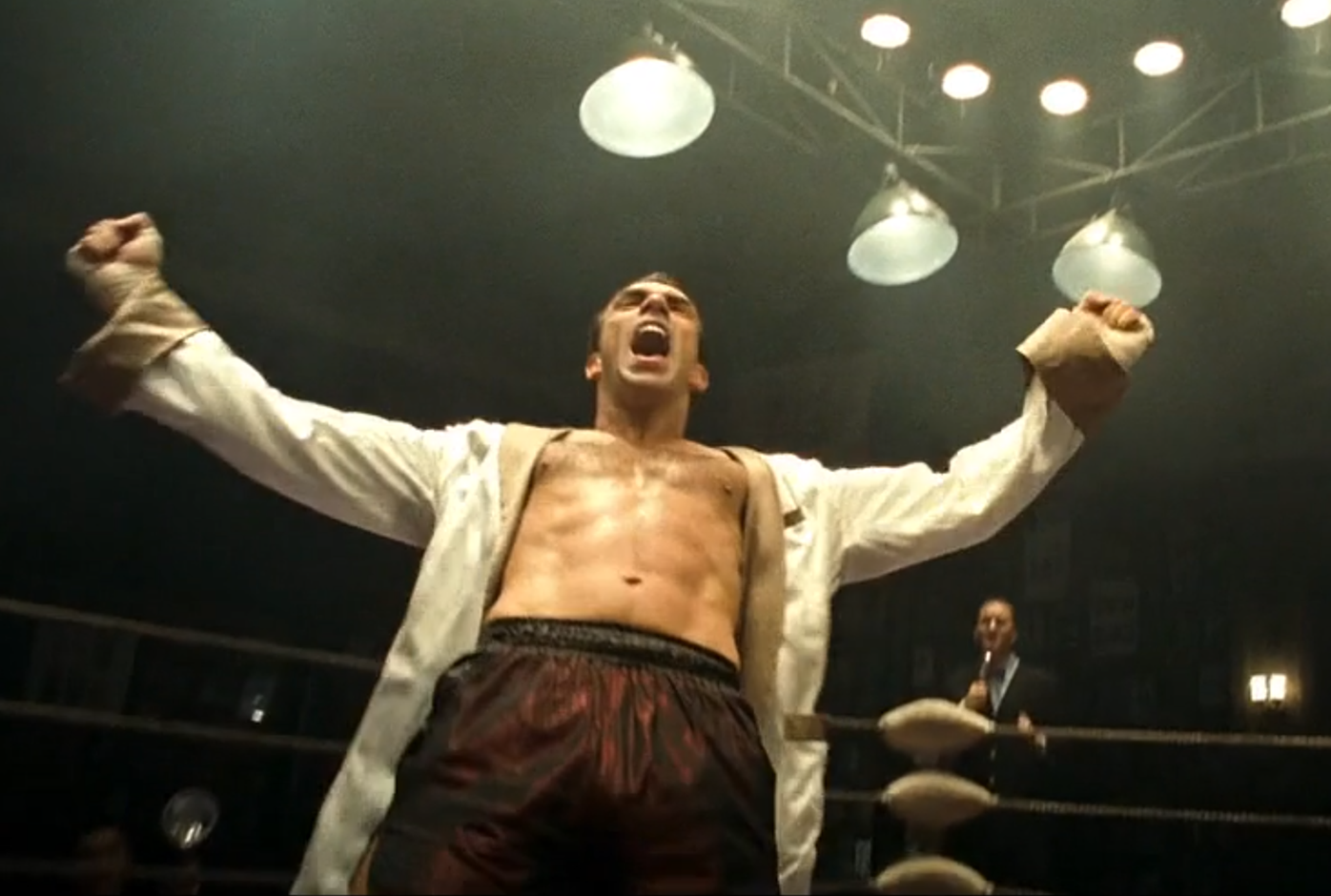
Undoubtedly, the combatants’ bodies are framed at the center of the fight ensembles, indexing that symbolic dead-knot. Except for the brief press conference, the camera traces arduously and spotlights Twister's rugged body, which serves as a sure basis of his superiority to the “weak” Chinese body. During the demonstration session of the boxing competition organized by master Hung, the arrogant boxer notices that the Chinese martial artists use yelling as a strategy for practicing, and he decides to jump onto the stage to “give them something to scream about.” Wearing a gown and a pair of boxing shorts, and with hands on hips, Twister exposes his sculpted six-pack fully in front of the camera, a move that surely reminds audiences of yanggang action movies (see figure 2). By provoking one of Hung's disciples to punch him on his hard-edged chest and knocking him down to the ground, the boxer is embroiled in a fight with a group of Chinese. After knocking each of them out, Twister touts his overblown, racist ego in a winner's gesture as a series of low-angle camerawork punctuates the Chinese group's agonized faces and pans across his flat abdominal plateaus, giving the scene an abstract discursiveness open to allegorical interpretations. As discussed earlier, Hung joins the fight but loses in blood. A legendary veteran from Chang's yanggang cohort, Sammo Hung is easily distinguished from his fellow action heroes’ super-lean bodies and elliptical muscles by his signature Buddha belly, which still shows the same level of agility and resilience. On this account, it might be seen as a calculated move to conceal Hung's potbelly, which can by no means match the boxer's musculature-armored colonial body.
Twister touts his overblown ego in a winner's gesture in Ip Man 2.

But Yen is different. On-screen, he has been unabashed in displaying his bulging pectoral ellipses, smooth, tight abdominal plateaus, and triceps powerful enough to hold up anyone who needs protection. As Jack Halberstam ([Reference Halberstam1998] 2018) points out, masculinity is still seen by many academics as an attribute solely linked with men's bodies, despite persistent critiques by feminists. Therefore, instead of a faithful filmic approximation of the low-key Wing Chun master, this cinematographic design steps up to dismantle the hypermasculine spectacles that have long been associated with violent male bodies in kung fu cinema.
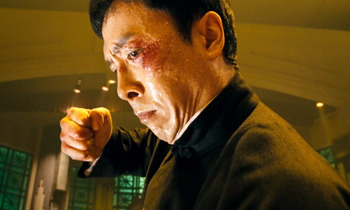
As usual, Ip sets into the Wing Chun dexterity, avoiding direct confrontation and dodging flexibly to find ways to counterattack his opponent of forceful prowess, turning the finale into another enthralling juxtaposition of two vastly different fight disciplines. Through a combination of fast fists and kicks, Ip manages to take the advantage, gradually pushing Twister into the corner. Yet the referee abruptly announces that kicking is no longer allowed, creating a plot twist that refills the nationalist sentiment that is supposed to emanate unendingly from the fight scenes. The narrative line, then, falls into a clichéd direction with an almost predictable endpoint—with his flying kicks banned, Ip starts to falter and struggles to remain in the fight. At this critical moment, master Hung's death-defying defense of Chinese kung fu swings back into view, infusing Ip with the energy to reverse course. Knocking Twister to the ground, Ip starts to deliver a barrage of hits to the face of the defenseless boxer. Quickly, a series of flashbacks spotlighting Twister's merciless punches on Hung's bloodied, lifeless face are interspersed with the fired-up scenes, driving the narrative almost to its culmination—indeed, it is time to take revenge! Yet the diegesis takes another sharp turn with Ip's fist halted suddenly in the midair (see figure 3). The Wing Chun master's last-minute release, akin to that by Hahou, disrupts “a near repetition of events [in the kung fu genre] in which the hero or heroine, in an effort to seek vengeance for a slain master, friend, or family member, duels with a string of increasingly powerful opponents” (Yip Reference Yip2017b, 78).
The releasing moment in Ip Man 2.

As in Kung Fu Killer, Ip's post-fight statement condenses his rethinking of the martial arts for the audience, both on-site and on-screen. After the judge declares him the winner, Ip walks back to the stage for a speech. “With my victory today,” he states tranquilly, “I do not try to prove that Chinese kung fu is superior to Western boxing. I want to make it clear that despite people's disparate social status, we are all equal in terms of personal integrity.” Ip's simple words and perspicuous perception of justice win the hearts of the arrogant white audience members, sending them into a standing ovation to express their respect.
By and large, the new filmic sensibility of vengeance-repudiating masculinity and justice as embodied by Ip and other action heroes is embedded in and informed by Hong Kong's inimical implication in the maelstrom of the stretched Cold War. Under the doctrine of laissez-faire and the “social noninterventionism” of colonial policy, the city-state enjoyed much freedom of speech and trade that secured its prosperity in the 1980s and the 1990s, and its economy was transformed once again—this time from a manufacturing hub into an international center of finance and commerce, which has both benefited and garnered momentum from China's economic reform (Hung Reference Hung, Fu and Desser2000). Since the late 1970s, consistent financial investments from Hong Kong have played a key role in safeguarding China's state-run neoliberalization (Ong Reference Ong2006). To ensure a smooth post-1997 transition, Beijing took sides with the wealthy echelons as its ruling basis, further reinforcing Hong Kong's status as a casino playground for global financial capital and the mainland's primary gateway to attract foreign investments. By August 2019, China had received 62.9 billion USD in foreign direct investment via Hong Kong, accounting for 70 percent of total inflows in the first eight months of that year (Xin and Wang Reference Xin and Wang2019). In December 2019, the US Congress passed the Hong Kong Human Rights and Democracy Act,Footnote 8 reinforcing the metropolis as a key battlefield of the new Cold War that the Donald Trump administration started with China (Coughlin Reference Coughlin2019). Both inside and outside China, Hong Kong's porous borders to capital and information recreate a liminal space where “all boundaries, whether they are territorial, political, linguistic, ethnic, or sheer cultural–conceptual, can be negotiated in Hong Kong cinema while performing the function of division” (Lo Reference Lo, Cheung, Marchetti and Yau2015, 74). As such, its cinematic production “eschews a conception of itself as bounded entity, with all its connotations of a fixed and well-delineated identity” and seeks to create a more fluid space for itself, a space porous to the infiltrations of alien elements . . . and thus conducive to the formation of a ‘trans-subjectivity’ capable of crossing boundaries” that cannot be fully suppressed by either white colonizers or relentless nationalist dominators (Yip Reference Yip2017b, 150).
Fatso (played by Kent Cheng), the chubby and nerdy deputy of Wallace who represents underdog masculinity as the characteristic laughing stock in martial arts/action films but turns out to be an unsung hero in Ip Man 2, represents a telling example of Hong Kong residents’ border-crossing “inter-subjectivity” that is crystalized in the flexible, nonconfrontational, and nonviolent “Be Water” spirit. Akin to Partha Chatterjee's (Reference Chatterjee1993) characterization of the colonial situation of India, the public sector in British-ruled Hong Kong was dominated by whites, such that the colonized subjects could never be equal members, as their racial differences made them not “fit subjects for responsible government” (Fu Reference Fu, Fu and Desser2000, 74). The lack of representative democracy and the glaring inequality of wealth in Hong Kong during the 1950s and 1960s created a political climate that was as oppressive as it was disquieting, resulting in rampant corruption in the colonial bureaucracy, as duly represented in the film. Fatso is introduced as a stereotypical colonized subject who always appears subordinate to his white boss. In the face of Wallace's ruthless exploitation of fellow Chinese, he keeps counseling them to endure for survival—a self-deprecating act that makes him an easy target of attacks by filmgoers seeking to garner and relish triumphalist nationalistic sentiments. Yet if it is Ip Man who seals a victory over the colonizers on the stage, it is Fatso who takes them further down for justice off the stage. Behind the scenes, he has reported Wallace to his supervisor, resulting in the arrest of the corrupt official who has been the champion of Twister. As the film's ending reveals, a meek subject living in the silent shadow underneath the colonizing/colonized dyad, Fatso symbolizes a bustling and noisy zone of interactions and crossings that contributes to “a third space between the colonizer and the dominant native culture, a space that cannot simply be collapsed into the latter even as resistance to the former remains foremost” (Chow Reference Chow1992, 158). Ultimately, the never-to-be-collapsed symbolic space disrupts the hypermasculine spectacle defined by violence, subjugation, and mastery, thereby making full the new horizon of justice that is built upon inclusivity, flexibility, and elasticity—just as Lee has already shown us with a cup of water.
Conclusion
I want to conclude this essay with the closing scenes of Invisible Target (2007), a refined flashback to the sensuous yanggang style that promotes the justice-redefining significance of multiple releasing moments of masculinity from unending virulent vengeance to new levels. With its superhuman action heroes falling off roofs, getting hit by rumbling vehicles, flying through glass, and rolling in fire, but still emerging with only a few bruises out of variant fight scenes, this film fits nicely with the classic action films of the 1980s and 1990s made by John Woo, who began his career as an assistant director to Chang Cheh and is hailed as the best heir to his masculinist legacy. What makes this film particularly relevant to my central argument in this article is its focus on multiplied revenge. On one side, a gang of cold-blooded killers led by Tien Yeng-seng (played by Wu Jing) returns to Hong Kong to find and eradicate whoever thwarted their last mission; on the other, a vengeance-seeking police team hunts them, including Chan Chun (played by Nicholas Tse), a detective of the Criminal Investigation Department who lost his fiancé in an armed robbery organized by Tien, Fong Yik-wai (starring Shawn Yue), a trainee inspector seeking a rematch after losing a battle to the gangsters, and Wai King-ho (starring Jaycee Chan), a junior policeman trying to find out what happened to his brother working as an undercover cop infiltrating the gang. In the big finale at the police headquarters, Wai identifies the murderer of his brother. Instead of shooting the man down, Wai puts away the gun and persuades him to surrender. Yet, unlike the lucky Hahou and Ip, Wai's good-intentioned releasing act is fatally returned—he sacrifices himself and saves Chan and Fong by handcuffing his arm to Tien's leg so that they can arrest the gang boss for justice. Chan and Fong almost kill Tien but drop the steel stick that they hold together at the last minute. They realize that their job is to arrest, not to kill—the sacrosanct duty for all the police that Wai demonstrated at the cost of his life.
Outside this touching celluloid bubble, brutal violence continues. As the activists carried their protests into 2020, the Hong Kong police escalated their suppressive acts in response, resulting in thousands of arrests (Li, Leigh, and Marlow Reference Li, Leigh and Marlow2020). In early July 2020, the Chinese state pressed through a sweeping new national security law and imposed it on the Hong Kong people, provoking widespread fear about more violent suppression by the state (Hernández Reference Hernández2020). Facing these incremental threats of horrific revenge by the state, the protesters nevertheless persisted. Putting the “Be Water” sensibilities into full practice and daily engagement, they demonstrated to the world what an alternative view of justice looks like and where it can lead us.
Taking cues from feminism, this article has developed a situated approach that allows me to identify how Hong Kong filmmakers capture and motivate the contingencies and contradictions afforded by the city's status as “the borderland” to release the embodied hypermasculine legacy from the violent tenor and remake it into a new source of resistance and substantive social change. As human beings are currently facing the common threat posed by prevailing toxic masculinity, the lessons that they have learned and shown to us seem more important and relevant than ever. Hopefully, the new horizon of justice that they have portrayed can help us find a path through the turbulent present and build a more peaceful world.
Acknowledgments
The original idea for this project was developed during a graduate seminar on masculinities that I took with Dr. Karen J. Leong at Arizona State University, and I am very grateful for her inspiration. I also want to thank Noah J. Springer, whose professional editorial support was instrumental for me to complete this project, and two anonymous reviewers for their insightful comments and suggestions. This research is supported by the Research and Creative Activities Support Program Grant of the University of Kentucky.