In recent decades, the study of gender stereotypes in social categorization has become an important topic for social cognition researchers (e.g., Banaji, Hardin, & Rothman, 1993; Fiske, Lin, & Neuberg, 1999; Fiske & Neuberg, 1990; Greenwald et al., 2002; Heredia & Blumentritt, 2002). Recently, social psychologists Banaji and Hardin (Banaji & Hardin, 1996; Blair & Banaji, 1996) claimed that specific gender-oriented stereotypes (i.e., gender-oriented beliefs about the attributes of social groups) are associated with many English words, especially role nouns, and are activated whenever such stereotyped role nouns crop up in discourse. The priming paradigm used by Banaji and Hardin to support this claim is as follows: participants are shown prime words characterized by a semantic gender (e.g., mother, king), or by a stereotypical gender (e.g., doctor, usually associated with a male referent, nurse with a female one). Words without any gender characterization (e.g., person) form the control condition. Three hundred milliseconds after the visual presentation of the prime, a male or female personal pronoun target (e.g., he, she) is flashed up and participants are asked to decide whether the pronoun is grammatically masculine or feminine. According to Banaji and Hardin (1996), the presence of a gender stereotype priming effect is demonstrated by the finding of faster gender decisions on target pronouns that were preceded by gender-congruent as opposed to gender-incongruent stereotyped primes. These authors found that participants decide the gender of the pronoun significantly more quickly when the gender of the prime matches that of the pronoun. This priming effect applies not only to natural gender primes (e.g., mother-she) but also, although to a much lesser extent than was claimed by these authors (see below), to stereotyped gender primes. According to Banaji and Hardin (1996), these results show that upon reading a word like doctor or lawyer an individual calls to mind or “automatically” activates an association with a male individual, because of gender stereotyping in society. Banaji and Hardin (1996) defined this phenomenon “automatic gender priming.” However, that a task like the one used by Banaji and Hardin might detect an “automatic” priming effect is debatable (Oakhill, Garnham, & Reynolds, 2005) if one accepts the standard concept of automaticity proposed by the information processing literature (e.g., Posner & Snyder, 1975; Schiffrin & Schneider, 1977). Banaji and Hardin's notion of “automatic” activation of gender stereotypes is, in fact, based on the idea that stereotypical information is activated “without subjects' conscious awareness of the source or use of stereotypes” (Banaji & Hardin, 1996, p. 36). However, this is only one of the defining characteristics of automatic spreading activation mechanisms: the process is also required to be fast-acting and primarily to facilitate related targets and to produce little inhibition for unrelated targets compared to an appropriate baseline (for a discussion, see Balota, 1994; Neely, 1977). In any case, the evidence for the activation of gender stereotypes provided by Banaji and Hardin's results was not as compelling as these authors claimed; for instance, in Experiment 1, their gender priming effect was, in fact, larger for primes related to “gender by definition” (e.g., mother, father) than for primes related to “gender on normative base” (e.g., nurse, doctor), even when the latter included terms explicitly conveying gender-related information (e.g., feminist). In Experiment 2, the participants were asked to make a “pronoun/not pronoun” decision (instead of a gender decision) on target pronouns preceded by a subset of the primes used in Experiment 1. The results again showed faster responses to targets that matched rather than mismatched the gender of the prime, especially when the primes belonged to the “gender by definition” category.
The effects of gender stereotypes on language processing have been investigated in a number of psycholinguistic studies as well. These studies documented that gender stereotypes intervene in English, Spanish, and German during anaphor resolution (e.g., Carreiras, Garnham, Oakhill, & Cain, 1996; Duffy & Keir, 2004; Garnham, Oakhill, & Reynolds, 2002; Irmen & Roßberg, 2004; Kennison & Trofe, 2003; Oakhill et al., 2005; Osterhout, Bersick, & McLaughlin, 1997; Sturt, 2003). In one of the first psycholinguistic studies of the role of stereotypical gender in pronominal assignment, Carreiras et al. (1996) showed that the information related to the conceptual gender of a noun is incorporated in the representation of a character conveyed by a role noun (e.g., footballer). This information is used for pronoun resolution, especially in Spanish, a gender-marked language, and to a lesser extent in English. In particular, the masculine pronoun he was read more quickly than the female one she when the antecedent had a stereotypically male occupation (e.g., engineer), and the feminine pronoun she was read faster than he when preceded by an antecedent with a gender-congruent stereotype (e.g., secretary). Other studies provided converging evidence: in a self-paced reading time study, Kennison and Trofe (2003) observed that the reading times of the region immediately following the pronoun were significantly longer in English when the gender of the pronoun mismatched the gender stereotype associated with the antecedent. This suggests that the pronoun resolution was sensitive to the conceptual gender mismatch. Sturt (2003) showed that the first fixations and the first- and second-pass reading times were influenced by a gender mismatch between an anaphor (e.g., himself, herself) and the gender stereotype associated with the antecedent (e.g., surgeon). In an event-related brain potentials (ERPs) study, Osterhout et al. (1997) found that stereotypical gender agreement violations were perceived in the same way as grammatical gender violations: both types of violation elicited a wave form associated with syntactic errors (P600, Syntactic Positive Shift). In Garnham et al. (2002), gender information was activated when participants were presented with a sentence that implied a person's gender without explicitly mentioning it, that is, by mentioning a role noun (e.g., surgeon), or a characteristic of the individual (which could be biologically based, as in giving birth, or related to gender-typical clothes, as in wearing a bikini). The reading of the sentence was slower in the presence of a mismatch between the two different sources of stereotypical gender information (e.g., The soldier was rushed to hospital, taken to a private ward, and gave birth half an hour later). Irmen and Roßberg (2004) conducted a self-paced reading time study in German, a gender-marked language. In their Experiment 1, for instance, a first sentence was presented whose subject was a social or occupational group. A second sentence followed, which contained an anaphoric reference to that subject, and clarified whether the antecedent of the anaphor was neutral, masculine, or feminine (e.g., gender-neutral antecedent: Artists can be very moody. That can at times be difficult for their wives. Stereotypically female antecedent: Telephonists work exclusively in a sitting position. That is why they do aerobics to stay in shape. Stereotypically male antecedent: Foresters enjoy walking in the forest. While doing so they occasionally smoke a pipe). The increase in reading speed in the second sentence, with respect to a baseline condition, depended on the fit between the gender conveyed by the anaphor in the second sentence and the grammatical and stereotypical gender of the antecedent, especially when this was male. Additional support for the activation of gender stereotypes was provided in a study conducted by Duffy and Keir (2004) that investigated the extent to which violations of gender stereotypes caused disruption of the reading process in sentences such as The babysitter found herself/himself humming while walking up to the door. The eye-tracking results showed interference in the processing of a reflexive pronoun when this mismatched the stereotype (babysitter-he), both when participants first read the pronoun and immediately afterward. However, when longer paragraphs were used in which the gender of the role character was stated at the beginning (as in The electrician was a woman who …), the gender stereotype effect on a mismatching reflexive pronoun (herself) disappeared.
Overall, these reading time studies provide evidence of gender stereotype effects in anaphor resolution. However, as recently claimed by Oakhill et al. (2005, p. 973), it is difficult to draw definitive conclusions regarding the time course of the activation of stereotypical information from reading time studies. According to these authors, other paradigms, notably those in which participants are asked to respond to single words, provide a more direct test of the extent to which readers indeed activate gender stereotypes upon reading a role noun. In fact, when English participants were instructed to make a decision about whether or not two terms could possibly refer to the same person (Oakhill et al., 2005), a clear interference of gender stereotypes emerged if the noun pair included a stereotyped role noun (e.g., nurse-aunt vs. nurse-uncle).
The aim of the present study was to investigate gender stereotypes using a single word presentation paradigm, as in the studies of Banaji and Hardin (1996) and Oakhill et al. (2005; although these authors' methodology differed from Banaji and Hardin's one in important respects), to assess whether stereotypical gender is indeed activated upon reading a word, specifically a role noun, in a Romance language like Italian. Hardin and Banaji (1993) hypothesized that gender-stereotyping effects occur independently of the language of reference, and might best be observed in languages that have extensive coding of gender in their grammar and semantics. Italian is particularly well suited for the investigation of gender stereotype effects, and their cross-language generality, because Italian is a gender-marked language in which gender agreement between nouns and determiners, nouns and adjectives, nouns and past participles, and so forth, is mandatory (for overviews on different gender systems, see Cacciari & Cubelli, 2003, Comrie, 1999; Corbett, 1991; Foundalis, 2002).
In Italian there is a conceptual criterion for assigning gender to human beings (based on the biological gender of the referent) and an arbitrary criterion for assigning gender to objects, roles, and abstract entities (and to some animals as well). The grammatical gender of a noun has almost nothing to do with its meaning, and is only partially related to its phonological and orthographical form (Cacciari & Cubelli, 2003). The Italian words used as experimental primes in the present study are role nouns that do not have any gender-related formal marker, and that can be used to refer to individuals of both genders (e.g., insegnante, teacher). In other words, when these role nouns are presented in their bare form (singular and plural), there is no way of knowing the gender of the referent: these role nouns, in fact, acquire the gender of the individual to which they refer.1
The determiner can disambiguate the gender of the referent, as in un insegnante versus una insegnante (TheMASCteacher vs. TheFEMteacher), or Gli insegnanti versus Le insegnanti (TheMASCteachers vs. TheFEMteachers). All the primes were presented in their singular form and without any determiner in the present study.
As shown by an analysis we conducted on a corpus of almost 50,000 Italian singular nouns (CNR, Institute of Computational Linguistics of Pisa, 1989, to which we express our thanks), 67.9% of the grammatically feminine nouns suffix in -a and 20.4% in -e, whereas 71% of the masculine nouns suffix in -o and 16.8% in -e.
The linguistic stimuli employed in the present study were controlled for a number of psycholinguistic variables that are known to influence word recognition processes and to affect the time it takes to encode a word (i.e., lexical frequency, age of acquisition, familiarity, length, word form). Note that these variables were not taken into consideration in the original study by Banaji and Hardin (1996). Furthermore, and again in contrast with their study, we did not use nouns that are related to biological gender by definition (e.g., mother) or marked for gender in the suffix (e.g., waitress).
EXPERIMENT 1
The experimental paradigm used in our experiments was modeled on the one employed by Banaji and Hardin (1996): participants were shown pairs of stimuli formed by a prime word followed by a target gender-marked pronoun (he or she). The participants' task was to decide the grammatical gender of the pronoun, ignoring the prime word. The primes were Italian role nouns with or without an associated gender stereotype.
For each prime in Experiment 1 (and in Experiment 2) we had a prime-target pair in which the pronoun was congruent with the stereotypical gender bias conveyed by the role noun (henceforth, gender-congruent prime) and a prime-target pair in which the pronoun was incongruent with the stereotypical gender bias (henceforth, gender-incongruent prime). The facilitation and/or inhibition effects of the gender-congruent and gender-incongruent conditions were measured in relation to a neutral control condition formed by prime-target trials in which a gender-neutral prime was first coupled with a female (or male) pronoun, and then with the other pronoun.
If it is indeed true that gender-stereotyping effects occur independently of the language of reference and that they are best observed in languages that have extensive coding of gender, as claimed by Hardin and Banaji (1993), then the gender decision in response to the target pronoun should be facilitated by a gender-congruent prime and presumably inhibited by a gender-incongruent prime with respect to the control condition in which the prime has no associated gender stereotype.
Method
Participants
One hundred and six students from the University of Modena and Reggio Emilia (58 females, 48 males) were involved in the norming phase and 30 (14 females, 16 males) in the experimental phase. All the students volunteered to participate in the norming phase or in the experimental phase, and all were native Italian speakers unaware of the aim of the study.
Materials
Thirty-six role nouns, indeterminate as to the gender of the intended referent, were used as primes: when presented in isolation, these role nouns do not convey any information about the gender of the referent, because they acquire the gender of the individual they refer to (see Appendix A). Twelve of them had an associated male stereotype (e.g., ingegnere, engineer, henceforth male stereotypes); 12 an associated female stereotype (e.g., insegnante, teacher; henceforth female stereotypes), and 12 had no associated stereotype (e.g., emigrante, emigrant) and were used as the control condition.3
Some of these primes are nominalized present participles or nominalized adjectives that in Italian are commonly used as nouns (e.g., emigrante, emigrant, occidentale, westerner; Aprile, 2005).
Norming phase
To select the experimental role nouns, a written questionnaire listing one hundred and six role nouns was given to 31 undergraduates from the University of Modena and Reggio Emilia (not the students involved in Experiments 1 and 2). The participants were asked to decide whether each noun was used only in reference to a male, only in reference to a female, or whether it could be used equally to refer to males and females. For each noun, they had to tick one of three possible answers: noun used only for a female referent, noun used only for a male referent, noun used for both female and male referents. All the role nouns included in the list suffixed in -e to avoid the word form correlates of gender marking that exist in Italian (see Note 2). Unlike Banaji and Hardin (1996), we did not use role nouns that have distinct forms for males and females but where the feminine form of the noun is a morphological derivation of the masculine one (e.g., dottore-dottoressa for a male doctor and a female doctor, respectively). Nor did we use kinship nouns (e.g., mother, aunt) that are, by definition, gender related. A role noun was considered to convey a gender stereotype when at least 70% of the students answered that it was used only for a male or only for a female referent. The male and female gender stereotyped role nouns used in this study were defined as such by 76 and 82% of the students, respectively. A role noun was considered to convey no gender stereotype when at least 80% of the participants ticked the answer noun used for both female and male referents. Each of the gender-neutral role nouns that served as our controls had been defined, in 85% of the students' completed questionnaires, as a noun used for both female and male referents. The targets were formed by the common form of the third-person masculine (lui, he) and feminine (lei, she) pronoun, which in Italian have the same written lexical frequency (Laudanna, Thornton, Brown, Burani, & Marconi, 1995).
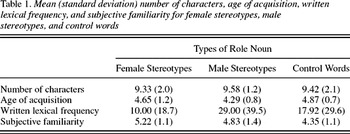
Female stereotypes, male stereotypes, and gender-neutral controls were balanced for the following variables (Table 1 reports the mean ratings and standard deviations for each category):
- Number of characters: the three types of words had a similar mean number of characters (F<1).
- Age of acquisition (AoA): 41 participants (18 males, 23 females), who did not take part in Experiments 1 and 2, were given a booklet listing 266 nouns, including the ones used as experimental stimuli in the present study. Each participant was asked to estimate on a 7-point rating scale the age at which they had acquired each noun (estimated AoA: 1 = between 0 and 2 years old, 7 = 13 years old or later). No time limit was imposed. An Italian version of the AoA rating scale was used (Barca, Burani, & Arduino, 2002). The results showed that the AoA of the three types of role noun did not significantly differ, F(2, 33)=1.18, p=.32.
- Written lexical frequency: the lexical frequency was controlled on a corpus of 3,000,000 nouns (Laudanna et al., 1995) and was similar for the three categories of role noun, F(2, 33)=1.18, p=.32.
- Subjective familiarity: because objective frequency counts do not always correspond to the subjective sense of the familiarity of a noun (especially in the case of low-frequency nouns; Gernsbacher, 1984), 34 participants (20 males, 14 females, average age = 27.5 years) were given a booklet containing 162 nouns, including those used as the experimental stimuli in the present study. Using the 7-point rating scale (1 = not at all familiar, 7 = extremely familiar) set out under each noun, the participant was required to rate how familiar he or she felt that noun to be. The subjective familiarity of female stereotypes, male stereotypes, and control nouns was not found to differ, F(2, 33)=1.52, p=.23
.

Forty-eight fillers were also included so that the participants were not alerted specifically to the presence of the role nouns and thus did not pay undue attention to them: 24 nouns referred to individuals with a natural gender (e.g., ragazzo, boy, ragazza, girl; 12 grammatically masculine, 12 grammatically feminine) and 24 words denoted common objects (e.g., tavolo, table) that have an arbitrary grammatical gender in Italian (12 masculine, 12 feminine).
Procedure
The experiment was carried out using MEL2 Professional software. Each participant was tested individually in a sound-attenuated room. The instructions were explained by the experimenter and then repeated in a written form on the computer screen before the experiment started. The task was to decide, as quickly and accurately as possible, the grammatical gender of the personal pronoun, ignoring the prime. The procedure was identical to the one employed in Banaji and Hardin's study: a fixation point (+) appeared for 500 ms; then the prime, in uppercase,4
Although all the experimental items were written in uppercase in the experiment, we use lowercase in this text.
Results and discussion
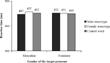
The results of two participants were excluded from the statistical analysis because their mean reaction time exceeded 1000 ms, and the standard deviation exceeded 400 ms. To reduce data variability, each participant's decision time exceeding ±2 SD were eliminated (2.8%). The mean error rate was less than 1%, so no further analysis was conducted. Figure 1 shows the mean times taken to decide the gender of the target pronouns in each condition.

Mean times (ms) taken to decide the gender of the target pronoun(masculine vs. feminine) when this was preceded by a female stereotype, amale stereotype, or a control word in Experiment 1
Two analyses of variance (ANOVAs) were conducted in which both participants (F1) and items (F2) were treated as random effects (Clark, 1973). Two analyses of variance (by participant and by item) were carried out on the mean times taken to decide correctly the gender of the pronoun. We had the following main factors: prime category (female stereotypes vs. male stereotypes vs. control words) and gender of the target (masculine vs. feminine). In the by-participant analysis, both these factors were within subject. In the by-item analysis, the prime category was a between-subject factor whereas the gender of the target factor was a within-subject factor.
The crucial comparisons in the present study are those that show whether the gender decision in response to the target pronoun was influenced by the gender stereotype conveyed by the prime, with respect to the control that did not convey any stereotype. To our surprise, the ANOVAs showed no significant main effect, prime category: F1(2, 54)=1.44, MSe = 835, p=.13; F2(2, 33)<1; gender of the target: F1(1, 27) and F2(1, 33)<1, nor any significant interaction (F1 and F2<1). Because one might wonder whether these null results could be due to a lack of statistical power, we carried out a power analysis (Lenth, 2006) that showed a large power effect (.85) for both the main factors (prime category, gender of the target) and a medium to large power effect (.72) for the interaction. Hence, we can exclude the hypothesis that the results of Experiment 1 were due to a lack of statistical power.
However, before attempting to draw any conclusions, some further factors should be considered. First, the gender of the participants in the experiment may have influenced the gender decision times, as in Banaji and Hardin's study (1996). Univariate analyses of variance showed that this was not the case: the mean gender decision times of the male (M=451 ms, SD = 63 ms) and female (M=452 ms, SD = 60 ms) participants were, in fact, similar (F1 and F2<1). Second, we noticed that the Italian prime nouns were, on average, longer (mean number of characters = 9.4, SD = 1.8) than the primes used by Banaji and Hardin (mean number of characters = 7.6, SD = 2.2), which suggests that the Italian participants may not have had enough time to process the prime nouns. Experiment 2 was designed to address this problem by increasing both the stimulus presentation time and the time elapsing between the presentation of the prime and the presentation of the target. To verify that the participants had indeed read the prime words, a word recognition test was also included at the end of Experiment 2.
EXPERIMENT 2
Were the longer length of the Italian role nouns we used in our study the reason for the absence of a gender stereotype priming effect in Experiment 1, then we might reasonably expect this effect to be present in Experiment 2, in which both the stimulus presentation time and the interval between the prime and the target were prolonged. Specifically, if gender stereotypes are activated upon coding the prime, then the gender decision response to male and female personal pronouns should vary, depending on the congruence or incongruence between the grammatical gender of the target pronoun and the gender stereotype associated with the prime noun. Hence, a significant interaction between the prime category and the gender of the target factors should be obtained with longer gender decision times for mismatching pronouns than matching pronouns, with respect to the control condition.
Method
Participants
Thirty-three students from the University of Modena and Reggio Emilia volunteered to participate. They were all native Italian speakers unaware of the aim of the experiment; none of them had participated in Experiment 1.
Materials and procedure
The materials were the same ones used in Experiment 1. The stimulus presentation time and the interval between the prime and the target were both increased from 200 to 300 ms and from 100 to 200 ms, respectively. To test whether participants had actually read the primes, a list of 24 words was given to each participant at the end of the experiment: 12 of the words were taken from the list of experimental stimuli and the other 12 were not, but had similar characteristics to the experimental words. The task was to decide whether each of the listed words had been presented during the experiment. Participants with a correct recognition rate of under 70% were excluded from subsequent analyses (n=3).
Results and discussion
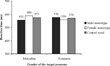
The data of two participants were eliminated because their mean standard deviations exceeded 1000 ms. To reduce data variability, each participant's decision time exceeding ±2 SD were eliminated (2.5%). The mean error rate was less than 1%, so no further analysis was conducted. Figure 2 shows the mean times taken to decide the gender of the target pronouns in each condition.

Mean times (ms) taken to decide the gender of the target pronoun(masculine vs. feminine) when this was preceded by a female stereotype, amale stereotype, or a control word in Experiment 2
ANOVAs like those conducted in Experiment 1 were carried out using the following factors: prime category (female vs. male stereotypes vs. control nouns) and gender of the target (masculine vs. feminine). In the analyses that used the t tests, we estimated the size of the effect by means of Cohen's d (1988, 1992), according to which an effect size is considered to be small when its value ranges from .0 to .2, medium when its value is around .5, and large when it is higher than .8 (Cohen, 1992).
As in Experiment 1, the gender of the participants did not influence the gender decision latencies (M=565 ms, SD = 149 for female participants and 577 ms, SD = 160 for male participants, F1 and F2<1).
The results of Experiment 2 showed no main effects of the prime category factor, F1(2, 54)=2.8, MSe = 1345, p=.08; F2<1, or of the gender of the target factor (F1 and F2<1). However, the interaction between the two factors was statistically significant, F1(2, 56)=9.5, MSe = 7246, p<.01, η2=.53; F2(2, 33)=7.3, MSe = 13.853, p<.01, η2=.48, and showed that the gender decision on the pronoun was indeed influenced by the type of prime. Specifically, the gender of feminine pronouns was decided more quickly when they had been preceded by role nouns with a gender-congruent (female) stereotype (e.g., teacher-she; M=559 ms, SD = 166) than by a gender-incongruent (male) stereotype (e.g., engineer-she, 576 ms, SD = 144), t1(29)=2.9, p=.01, d=1.08; t2(22)=2.1, p<.05, d=.89, or by a gender-neutral control (e.g., emigrant-she, 570 ms, SD = 152), t1(29)=2.1, p<.05, d=.78; t2(22)=1.7, p<.05, d=.72. Overall, the effect size ranged from medium–large to large (Cohen, 1992). No inhibition effect on the feminine pronoun was found when the prime conveyed a male stereotype or no stereotype at all,5
When the primes were gender-neutral role nouns, the gender of the feminine and masculine pronouns was decided equally fast (M=570 ms, SD = 152 and M=575 ms, SD = 157, respectively; t1 and t2<1), confirming that these words did not convey any gender stereotype.
To summarize the results of Experiment 2, we observed a gender stereotype priming effect that extends Banaji and Hardin's hypothesis (1996) to Italian, a gender-marked language. Specifically, the gender decision on the pronoun was facilitated when the prime conveyed a gender-congruent stereotype, with respect to the control condition. However, our results go beyond the findings of Banaji and Hardin's study (1996), and indeed of most of the literature on the effects of gender stereotypes, because we observed an inhibitory effect that has been previously reported only by Oakhill et al. (2005) in the English language6
In the six experiments reported in the study by Oakhill et al. (2005), the responses to gender-congruent pairs where one term was stereotyped by gender (e.g., nurse-aunt) were never facilitated compared to those obtained with gender-neutral occupation terms.
Why is this? One reason can be that in Italian, like in other languages, masculine is the unmarked gender: it is common practice, in situations in which biological gender is irrelevant, to use the masculine form to refer to both females and males (we return to this point in the General Discussion). According to Corbett (1991), the unmarked gender in a language is the one that has the largest number of nouns. In fact, masculine nouns are more frequent than feminine nouns in written Italian (CNR, Institute of Computational Linguistics of Pisa, 1989; De Mauro, Mancini, Vedovelli, & Voghera, 1993). This “universalistic” use of the masculine has given rise to much debate (for an early and interesting analysis of the “generic he” in English, see Bendix, 1979; for an overview, see Corbett, 1991). However, alternative explanations for our results should be considered. The imbalance between masculine and feminine pronouns might be due to social changes that have occurred in the industrialized world in recent decades, notably the general trend for women to enter traditionally male professions, combined with the fact that men have not entered traditionally female professions at a comparable rate.7
We thank an anonymous reviewer for this observation.
GENERAL DISCUSSION
The aim of this study was to investigate the role of word-specific gender stereotype information in word knowledge activation in Italian. Specifically, we tested the extent to which, in Italian, gender stereotypes associated with role nouns exerted the priming effect suggested by the findings of Banaji and Hardin (1996), and clearly demonstrated by Oakhill et al. (2005) in the English language. The results we obtained in Experiment 1 did not show a gender stereotype priming effect, in that our Italian participants decided the gender of masculine or feminine target pronouns regardless of the stereotypical gender of the preceding primes. To investigate the extent to which the longer length of the Italian role nouns serving as primes contributed to the results of Experiment 1, we devised Experiment 2, in which both the prime presentation time and the prime-target interval were prolonged. The results of Experiment 2 showed that when participants were allowed enough time to process the prime, the gender stereotype priming effect did, in fact, emerge. The gender decision on the pronoun was, in fact, faster when the grammatical gender of the pronoun matched the gender stereotype associated with the prime. When the gender stereotype conveyed by the prime was female, an inhibition effect emerged in the response (gender decision) to a stereotype-violating (masculine) pronoun (e.g., teacher-he). On the contrary, compared to the control condition, no inhibition was found when participants were presented with a masculine stereotyped role noun (e.g., engineer-she) as a prime followed by a stereotype-violating (female) target pronoun.
These results provide additional support for the idea that, as a result of gender stereotyping in society, participants reading a word like ingegnere (engineer) or insegnante (teacher) will activate an association with, respectively, a male and a female individual. When a role noun is read or encountered in discourse, the stereotypical gender associated with it, if any, is activated together with other lexical-semantic information and might prime gender-congruent nodes. Our results, together with those reported by Oakhill et al. (2005) in relation to the English language, provide evidence more compelling than that originally advanced by Banaji and Hardin that the stereotypical gender associated with a role noun is typically incorporated and rapidly activated as soon as these nouns are read. To account for the imbalance we found between male and female stereotypes, we can hypothesize that, in Italian, Italian masculine stereotyped role nouns spread activation to conceptually masculine and feminine units, due to the unmarked nature of masculine in Italian. In contrast, female stereotypes might send activation only to gender-congruent units, due to the marked nature of the feminine gender, and inhibit gender-incongruent units. This imbalance perhaps goes some way toward answering the question raised by Corbett (1991) “… in English he/his is said to be used ‘generically’ in examples like Everyone loves his mother … . The question then is whether the convention actually works: whether hearers consistently understand the pronoun generically” (p. 221). Evidence reported in Corbett's book exists that this is not the case: McKay and Fulkerson (1979), for instance, showed that the use of the generic he led to a male-referent interpretation of antecedents such as student, dancer, and musician (see Irmen & Roßberg, 2004, for related evidence in relation to German). Our results showed the other side of the coin: whereas a role noun like ingegnere that is associated with a male stereotype primed a masculine pronoun and did not inhibit a feminine pronoun, a role noun like insegnante associated with a female stereotype not only primed a feminine pronoun but also disrupted the gender decision response to a masculine pronoun compared to the control condition. As we mentioned when discussing the results of Experiment 2, another plausible reason for the weaker priming we obtained for feminine pronouns may have something to do with the changing structure of industrialized nations that is allowing more women to enter traditionally male-oriented professions, but not the reverse. This hypothesis needs further investigation.
Alternatively, one might posit that stereotype information is not activated at all when the role noun is read, but is instead activated only when a gender-marked pronoun is met, at which point the participant tries to link it to the prime. This would correspond to the backward priming mechanism extensively discussed in the word recognition literature (e.g., Smith & Besner, 2001). However, had this been the case, we should have obtained similar target response latencies, regardless of whether the primes were associated with a gender-congruent stereotype or indeed had no associated stereotype because both were equally appropriate. It should also be noted that converging evidence on pronominal assignment in English and Spanish obtained with a variety of paradigms (e.g., semantic priming, reading times, coherence judgments, eye tracking, ERPs) showed that gender stereotypes are activated whenever they are met in discourse, as part of the information associated with a role noun, and are not activated after reading the pronoun (e.g., Carreiras et al., 1996; Garnham et al., 2002; Kennison & Trofe, 2003; Osterhout et al., 1997; Sturt, 2003). One of the most compelling pieces of evidence of the direct activation of the gender stereotype associated with a noun is provided by an electrophysiological study that showed that violations of gender-related social stereotypes elicited P600 ERP responses typically obtained when grammatical gender violations occurred (Osterhout et al., 1997).
As Orasanu, Slater, and Loeb Adler (1979) wrote almost 30 years ago in the Proceedings of a workshop organized by the New York Academy of Sciences on “Language, Sex and Gender,” “When people already have beliefs/knowledge about the distribution of gender roles among statuses, language usages may only be a symptom and a reminder, as in such phrases as the doctor … he, or the secretary … she” (p. 22). Our results help to show that language users have mental representations of words that include information about the word's gender stereotype, and that these representations are activated upon reading such words. Stereotypical gender, although a less stable feature than grammatical gender, can be considered part of a noun's mental representation, as several studies in English, German, and Spanish, and our study in Italian, have shown.
APPENDIX A: EXPERIMENTAL STIMULI WITH ENGLISH TRANSLATIONS
Following is a list of experimental stimuli with the English translation in brackets.

We thank Elisabetta Preti for her help in collecting the data and three anonymous reviewers for their comments.