INTRODUCTION
As deliberation rapidly took over political theory,Footnote 1 critics soon began asking: Is it truly a democratic ideal? For some, deliberative democrats’ exhortations for more reasoned communication in matters of political disagreement are problematic due to theoretical blindness and empirical naïveté. In the critics’ view, in a world of gross structural inequalities and power differentials, such a focus on talking is at best a waste of time and at worst conducive to cooptation of the marginalized. These admonitions have become more pressing as the deliberative wave stormed not only theory but also advocacy for real-world institutional reform: under persistent suspicions of professional politicians and claims that participation can make policies both more legitimate and effective, the past few years have seen growing attention toward citizen involvement in government decision-makingFootnote 2—a jump from deliberative theory to deliberative governance.
The normative controversies around the relationship between reasoned communication and power differentials have piled up to the point of spilling into empirical scholarship. While their existence is nothing new at this point, empirical studies on deliberation have tended not to directly engage with normative concerns. Because of that, Thompson (Reference Thompson2008, 498) argues, theorists and researchers often talk past each other. Recently, however, more empirically minded scholars have turned to investigating how deliberative governance functions in the context of power (Hendriks Reference Hendriks2009): How do inequalities structure the actual interaction dynamics around these institutions, and what distributional consequences arise out of them? These efforts are resulting in relevant findings and a more complex view of the role of power in deliberation (Curato et al. Reference Curato, Dryzek, Ercan, Hendriks and Niemeyer2017).
Despite its merits, I contend that existing sociolegal scholarship has yet to follow this turn to power but that it should. As components of the State’s formal structure, deliberative governance institutions are regulated by numerous legal provisions that affect how participants are selected, how talks are conducted, and how these organs relate to the rest of the administrative apparatus. Their proliferation has thus meant change in the legal framework of the State. Socio-scholars have not failed to realize this, and as such there exists some important work on how such changes have impacted (or failed to impact) real-world public governance patterns (Coglianese Reference Coglianese2006; Bingham Reference Bingham2010; Faria and Ribeiro Reference Faria and Ribeiro2010; Nabatchi, Ertinger, and Leighninger Reference Nabatchi, Ertinger and Leighninger2015; D. R. Coutinho et al. Reference Coutinho, Kira, Lessa and de Castro2017). All in all, it is fair to say that we already understand that “law is an often overlooked, and yet pervasive and perhaps distinctive, element of deliberative democracy’s institutional backdrop” (Levy Reference Levy2013, 357).
Despite showcasing some richly detailed case studies, however, the sociolegal literature has not advanced much beyond the vague proposition that law somehow affects deliberative governance. In saying that, I mean to point out two different but interrelated omissions: we have yet to satisfyingly specify how legal arrangements causally connect to deliberative dynamics (positive-theory problem), and how such connections may matter normatively (normative-theory problem). As such, we still lack any shared theoretical framework to compare and build upon case studies and fail to connect our findings to the issues of legitimacy that drive deliberative theory. My argument is that speaking the language of power—broadly understood as actors’ capacity to act against one another’s interestsFootnote 3—allows us to remedy both failures.
This article discusses the legal construction of power in deliberative governance. Put succinctly, I argue that the formal and State-enforced rules within which actors interact (the legal environment) causally affect deliberative dynamics by distributing opportunities for the exercise of power between potential participants, actual participants, and participants and government. The argument is illustrated through a case study of the city of São Paulo’s health councils. Ever since its return to democracy in the late 1980s, Brazil has become home to many of the world’s most ambitious experiments in institutionalized participation. Political scientist Adrian Lavalle (Reference Lavalle2011, 13) has labelled them part of the “legal language of the State.”Footnote 4 São Paulo’s health councils represent one of the largest of such experiments, and the case study discusses the role of law in shaping its trajectory and current functioning.
Following this introduction, the article is divided into three parts and a conclusion. The first part reviews the debate regarding the tensions between the deliberative ideals and the realities of power. The second part seeks to specify the causal relevance of the legal environment in deliberative dynamics. The third part presents the case study of São Paulo’s health councils. Finally, the conclusion returns to the argument that sociolegal scholars should join the empirical debate on the role of power in deliberation.
THE UNEASY RELATIONSHIP BETWEEN REASON AND POWER
Does the ubiquity of power differentials in real-world political settings doom deliberative theory to irrelevance—or worse, to a role in fortifying the structural inequalities it hopes to tackle? The uneasy relationship between reason and power has haunted deliberative theory for some time, and this part reviews the controversies around it. It starts with an account of the deliberative democratic ideal and its dependence on participants’ intentions, then moves on to denouncements of the theory’s alleged blindness to the realities of power and ends by considering deliberative democrats’ retorts and the challenges for future empirical research. It argues, following much of the current literature, that the debate can best be advanced by sustained inquiry into how contextual conditions shape deliberation.
The Deliberative Democratic Ideal
As an explicitly normative political theory, deliberative democracy seeks to clarify what should count as legitimate behavior in matters of political conflict and disagreement. Under the banner of “deliberation,” numerous authors have proposed answers that vary considerably, making it impossible to review all relevant accounts in detail here.Footnote 5 However, in its many forms, deliberative theories share a unique concern with how people communicate with each other in purportedly democratic settings. Their cornerstone is a focus on mutual justification: proponents of deliberation claim that for the resolution of political problems, people should exchange relevant considerations justifying their normative and practical claims (Bohman Reference Bohman1998, 406; Chambers Reference Chambers2003, 308; Gutmann and Thompson Reference Gutmann and Thompson2004, 3).
Deliberative democrats decry aggregative procedures (such as voting) as insufficient on the grounds that such procedures are limited to tallying preformed preferences: for deliberative democrats, it is also necessary to consider how people come to favor certain options in the first place. This is where mutual justification comes in to play: in the theory’s account, citizens make better-informed decisions when they engage with others not only by declaring their claims but also by presenting relevant considerations justifying them.Footnote 6 In turn, they should also listen and take into account what others have to say. Decisions made through this kind of communication are purportedly less arbitrary because those involved become better instructed and more sensitive to perspectives that they did not previously know or had not seriously considered and are thus able to adjust their preferences.
While consensus may result from deliberation, most theorists today agree that it should not be held as a value in itself: in our radically plural world, it is not reasonable to assume that clashing perspectives could (or should) converge through reasoned communication.Footnote 7 Because of this, while decision-making processes should include moments of deliberation, theorists accept that they usually must come to an end through aggregative procedures. This fact, however, does not spell the end for the deliberative ideal. Reasoned communication still matters because it clarifies persistent sources of disagreement and generates a stock of reasonable solutions to a given problem (many which may never have come to light without communication), while the chosen aggregation method singles out one of them (Araújo Reference Araújo, Nobre and Coelho2004).
As its proponents recognize, the kind of communication deliberative theory advances is fragile and rare in political reality. This is partly due to the fact that for mutual justification and will-formation to occur as intended, participants must see each other as equals engaged in exchange, “as if to reaching a particular shared political judgement” (Owen and Smith Reference Owen and Smith2015, 228). Thus, in such a perspective, democratic legitimacy does not hinge simply on formal institutions such as free elections but also on participants’ intentions: they must ideally adopt what Owen and Smith (Reference Owen and Smith2015) term a “deliberative stance” toward each other, which is incompatible with dismissal, manipulation, or unjustified coercion. However rare, proponents of deliberation also argue that insisting on it is important precisely because it is so uncommon in politics. It is a transformative project.
A Theoretically Blind and Empirically Harmful Ideal?
While few would disagree that deliberation sounds nice, several critics assert that it tends to backfire spectacularly. Their claim is that in contexts of gross inequalities of power, adopting a “deliberative stance” becomes normatively counterproductive. This is because attempting to reason with actors radically more capable of influencing conversations, imposing their will, or simply avoiding the effects of decisions generally leads to outcomes that deliberative democrats themselves would find undesirable. For its critics, the theory fails because of its naïve view of conflict: by being blind to the fact that “politics is about interests and power” (Shapiro Reference Shapiro and Macedo1999), it advances ideals empirically harmful to democratic practice.Footnote 8
Because power sources come in various forms, the manners in which they distort communication equally vary. Some originate directly from inequalities in material resources. In this regard, actors with more money, time, and connections should be expected to organize and overcome obstacles to collective action more effectively, making them disproportionately present in participatory arenas (Vita Reference Vita, Coelho and Nobre2004, 118). Actors may also be unequally bound to agreed-upon decisions because some can bear the exit costs to avoid their jurisdictional reach, while others have little choice other than to comply (Shapiro Reference Shapiro and Macedo1999, 34). Think, as in Cohen and Rogers’ (Reference Cohen, Rogers, Fung and Wright2003, 249) example, of multinational companies capable of transferring their operations in order to avoid rising taxation or labor standards, as compared to the relative lack of power of low-skill workers.
Some power sources can be even more insidious because of how difficult they are to notice. In deliberative settings, for instance, minorities (be they sexual, gendered, or ethnic) tend to be more regularly silenced—and, even when advancing strongly justified claims, may not be taken as seriously as dominant groups (Sanders Reference Sanders1997, 11). Further yet, because the discourses that participants adopt are themselves the product of structural inequalities, the marginalized might reproduce hegemonic discourses that are actually against their self-interest (Young Reference Young, Fishkin and Laslett2003, 115–18). Or, even worse, deliberation may afford powerful actors the chance to trick initially conscientious participants into accepting solutions that, while individually rational, fortify inequality at aggregate levels (Przeworski Reference Przeworski and Elster1998).
If these criticisms hit the mark, we should expect deliberation to at best produce innocuous decisions, at worst to distort the processes of will-formation that it should perfect and bring discontents closer in line with hegemonic interests. Because behaving according to the prescriptions of deliberative theory may leave disempowered players even worse off, they might do better to mobilize and compete under the rules of aggregative democracy. To this challenge, it is not enough for deliberative democrats to counter that communication ideally happens under conditions of equality: since it never really does, adopting a “deliberative stance” in politics will not make those with the least amount of power morally justified, it will only make them suckers.
Deliberative Democrats’ Retorts and the Challenges for Future Research
Proponents of deliberation are a progressive group; thus the charge that their ideas could fortify inequalities spurned much debate. Some of the discussion naturally remains normative. However, more interestingly for sociolegal scholars, it has also grown to include a sizable empirical literature.
First, deliberative democrats faced the problem of theoretical blindness to power by recognizing as valid that the disadvantaged may exercise coercion instead of reason-giving under certain conditions. In their view, the extent to which people who have the least amount of power should adopt a deliberative stance depends on how adverse to its requirements the real-world circumstances are: activists may be justified in resorting to nondeliberative acts when overwhelmingly powerful actors are present and unwilling to cooperate, much like someone committed to the ideal of the “rule of law” might act in civil disobedience when facing unfair laws (Fung Reference Fung2005). Consequently, while ideally absent, the use of coercion is justified when necessary to create minimal conditions for reason-giving (Mansbridge et al. Reference Mansbridge, Bohman, Chambers, Føllesdal, Fung, Lafont, Manin and Martí2010, 82–83).
Since they involve claims about real-world effects, however, the criticisms could not be properly addressed only on the theoretical level. Thus, a different challenge forced itself upon the growing empirical literature regarding deliberation: what happens when people communicate in the context of nontrivial power differentials? Is the reason-giving ideal truly as empirically harmful as many of its critics make it out to be? While some causal mechanisms proposed by critics are difficult to falsify directly,Footnote 9 much evidence indicates that unflinching cynicism may be unwarranted, even as caution remains necessary: while facing circumstances under which there would be reason to expect failure and cooptation, some deliberative experiments produced outcomes that do not line up with the most pessimistic expectations—but others did.
Existing empirical research indicates that reasoned political talk can induce trust and cooperation even in contexts of social divisions (Öberg Reference Öberg2002; Luskin et al. Reference Luskin, O’Flynn, Fishkin and Russell2014) and move opinions away from vitiated elite influence (Druckman and Nelson Reference Druckman and Nelson2003; Niemeyer Reference Niemeyer2011). Moreover, increasing citizen participation through deliberative governance has in some cases resulted in progressive resource redistribution, an outcome that would not be expected if inclusion necessarily resulted in cooptation (Fung and Wright Reference Fung and Wright2003; Pires and Vaz Reference Pires, Vaz and Avritzer2010; Heller and Rao Reference Heller and Rao2015). However, such success stories often do not occur, and noting that they sometimes do cannot wish away all the failed experiments: from lowering corporate tax to defending for-profit education, Lee, McGuire, and Walker’s (Reference Walker, Lee, McQuarrie, Lee, McQuarrie and Edward2015) edited volume Democratizing Inequalities chronicles numerous cases in which participation reinforced existing and highly unequal authority and distributional patterns.
Broad literature reviews demonstrate how mixed the results of real-world deliberation and participation are (Mendelberg Reference Mendelberg, Michael, Carpini, Huddy and Robert2002; Carpini, Cook, and Jacobs Reference Carpini, Cook and Jacobs2004; Ryfe Reference Ryfe2005; Pires Reference Pires2011) While such open-ended findings complicate the search for definite answers, they also point to a way forward: as most researchers agree by now, we should move from broad theorizing to investigating under which sets of contextual conditions communication can best approach deliberative ideals. As Carpini, Cook, and Jacobs (Reference Carpini, Cook and Jacobs2004, 336) write in their review,
the impact of deliberation and other forms of discursive politics is highly context dependent. It varies with the purpose of the deliberation, the subject under discussion, who participates, the connection to authoritative decision makers, the rules governing interactions, the information provided, prior beliefs, substantive outcomes, and real-world conditions.
Thanks to recent developments, deliberative theory can no longer be accused of conceptual blindness or one-sided empirical failure. Normative theorists do not currently wish away power; however, they should continue to develop more nuanced perspectives of its role. Meanwhile, empirical scholars have shown that deliberation can work, but still need to better specify when it does and when it does not. Thus, the way forward for empirical research, as Thompson (Reference Thompson2008) contends, is to investigate the complex sets of contextual conditions that affect deliberative practices. Which are relevant for what outcomes? Which simply do not matter? How do they interact with one another? When it comes to deliberative governance, this problem involves law more often than not.
POWER AND THE CAUSAL ROLE OF LAW IN DELIBERATIVE GOVERNANCE
Mutual justification can happen at all levels of political talk—in fact, some argue that for a democracy to truly earn the “deliberative” qualification, it must feature several interconnected sites of formal and informal deliberation (Parkinson and Mansbridge Reference Parkinson and Mansbridge2012). The preceding discussion on reason and power applies to them all. However, going forward, this article will focus solely on the small sites of formal deliberative governance. These are State institutions in which citizens join officials in discussions over concrete policy problems (as opposed to broad moral disagreements),Footnote 10 and they are very much in vogue as a reform strategy. A few widely known cases include Porto Alegre’s participatory budgeting, Kerala’s decentralized planning, and Chicago’s community policing (Fung and Wright Reference Fung and Wright2003).
The next section examines the legal-institutional conditions that affect deliberative dynamics. First, it highlights discussions regarding the relevance of institutional design, noting that they carry nontrivial analytical imprecisions. Then, it seeks to resolve this problem by elaborating on the causal impact of the legal environment. Lastly, it considers the legally structured power relations present in deliberative governance.
Visions on the Institutional Character of Deliberative Governance
Among the conditions that potentially affect deliberative dynamics, institutional design has in recent years received considerable attention. Institutions are here defined as clusters of effectively established and recognized rules (whether written or unwritten) that both constrict and enable behavior.Footnote 11 The “design” qualifier restricts the concept to purposively created clusters (e.g., designed), excluding those that spontaneously arise out of disorganized social interactions (Alexander Reference Alexander2005). As previously mentioned, since deliberative governance happens within the formal administrative apparatus, it is usually partially legally designed—meaning that a widely recognized authority in principle backs the enforcement of its constitutive rules (Deakin et al. Reference Deakin, Gindis, Hodgson, Huang, Pistor and Geoffrey2017, 190).
Institutional design likely receives such attention because it can be actively assessed and remade, which is an enticing feature for reform-minded academics. Moreover, it provides a natural entry-point for studying the legal construction of deliberative governance (Levy Reference Levy2013, 368). But how exactly is design connected to deliberative dynamics?
Existing sociolegal literature generally supports the claim that design matters,Footnote 12 but provides no theoretical propositions as to how. The literature has not yet shown much concern in such abstractions, as it mostly focuses on investigating individual cases and narrating the operational difficulties created by extant laws. As examples: Bingham (Reference Bingham2010) argue that US agencies’ ambiguously defined authority makes them insecure about acting to broaden participation; Nabatchi, Ertinger, and Leighninger (Reference Nabatchi, Ertinger and Leighninger2015) demonstrate that local, state, and federal laws regarding participation in the United States often conflict with one another; and along with some colleagues, I previously suggested that the procedures employed for the formulation of São Paulo’s urban planning law give the government so much discretion that their continuity hinges too much on political goodwill (D. R. Coutinho et al. Reference Coutinho, Kira, Lessa and de Castro2017, 240). One can find many interesting examples in this body of literature but not any one answer to the problem.
While not actively speaking about law, institutionalists from various areas have advanced further in theorizing how rules matter in deliberation. By employing the language of power, they manage to draw abstract causal propositions and connect their empirical material with normative concerns. Case in point, for a good portion of the literature, rules have the potential to nullify power (Kadlec and Friedman Reference Kadlec and Friedman2007, 9; Hendriks Reference Hendriks2009, 117; Curato, et al. Reference Curato, Dryzek, Ercan, Hendriks and Niemeyer2017, 31). Further still, because power asymmetries distorts communication, it is normatively desirable to “design it out” of deliberative governance. For instance, if some groups are expected to dominate participatory arenas due to their high capacity to mobilize collectively, public authorities could prevent the exclusion of less organized groups by taking actions such as formally reserving seats for their representatives.
Incorporating power strengthens theorization, but I argue that, while intuitive and normatively appealing, the idea of “nullification” suffers from analytical imprecisions that impair its utility. Most importantly, it fails to properly explain how institutions shape politics because it implies that rules directly counteract the power resources that make disruptive behavior possible. That, however, is not necessarily the case, as these resources often originate from noninstitutional factors. This is visible in the selection bias example: if, as in Olson (Reference Olson1965), a certain group mobilizes easily because of its small size and intense preferences of its members over a policy domain, no participant selection procedure will change that. Equally, no set of rules can directly “nullify” power resources such as education levels, deep social prejudices, or hegemonic discourses.
I do not mean to say that rules do not matter, but simply that they do in a different way. After all, even if selection procedures do not directly affect the capacity to mobilize, it is plausible that they may condition which groups get represented. That is so because they might change the causal connection between that capacity and entry into deliberative arenas. When seats get reserved, no power resource is nullified; rather, a new resource becomes mobilizable by otherwise weaker actors, allowing them the chance to gain access in the place of their opponents. Rules create opportunities of action for some to the detriment of others, an effect that, under certain conditions, affects outcomes in a manner that makes them more normatively justifiable than potential alternatives. Power cannot be “designed out,” but it may be constituted in differing ways.
Law’s Causal Role in Politics and Deliberation
In order to construct a sociolegal perspective on deliberative governance, it is useful to turn to more general conceptual advances on the relationship between law and politics. More specifically, Loughlin has insistently argued that law does not really control power from the outside but rather constitutes it from the inside (Loughlin 2010; Reference Loughlin2017).Footnote 13 This proposition runs counter to visions of a legal realm separate from politics, hovering outside of conflict, waiting to strike those who overstep boundaries and commit illegal deeds. Rather, law is always there, internal to politics in the sense that behavior itself often cannot be explained without reference to the way rules constrain or enable opportunities for the exercise of power.Footnote 14 Because of this, all things equal, differently designed institutions can lead political interactions to take on different patterns.
As a power-distributional element, law shapes the terms under which concrete political interactions play out. However, it does not do so actively, as if it were an entity gifted with agency. It is more accurately conceptualized as one of the contextual elements that affect interactions by partially defining the moves available to each player. In other words, struggles play out not in a vacuum but amid a legal environment (Edelman and Stryker Reference Edelman, Stryker, Smelser and Swedberg2005), the rules of which actors did not necessarily choose and cannot freely alter. This vision demands that analysts go beyond formal rules and take agency seriously. Further still, a focus on interactions is unavoidable because power is a relational concept. This means that no political actor, when considered in isolation, possesses a certain amount of it; power only exists when it can be exercised over someone (Dahl Reference Dahl1957; Bachrach and Baratz Reference Bachrach and Baratz1963; Lukes Reference Lukes2005).
This power-distributional effect is readily noticeable when law assigns actors different entitlements by delineating mutually discriminating categories, such as “employer and employee, ratepayer and utility, and taxpayer and municipality” (Gordon Reference Gordon1984, 103). In the case of deliberative governance, one common differentiation comes in the form of moderators endowed with procedural steering and sanctioning powers that other participants lack. Moderators are supposed to ensure that everyone communicates on equal ground and may perform such function in numerous ways (like clarifying technical jargon or setting procedures that prevent any one actor from monopolizing speech). While their powers often prove beneficial (Pierce, Neeley, and Budziak Reference Pierce, Neeley and Budziak2008, 16–24; Knobloch, et al. Reference Knobloch, Gastil, Reedy and Walsh2013, 122), Spada and Vreeland (Reference Spada and Vreeland2013) show that they also allow nonneutral moderators to exert disproportionate influence over decisions.
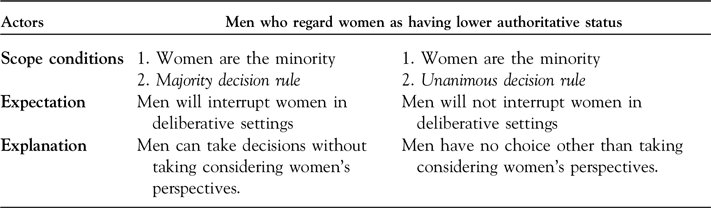
Moreover, because rules interact with other environmental elements, they may distribute power unequally, even in the absence of formal discriminations. For example, Mendelberg, Karpowitz, and Oliphant (Reference Mendelberg, Karpowitz and Oliphant2014) found that different decision rules vary in how they impact women’s capacity to communicate in deliberative settings, depending on groups’ numerical compositions. According to their experimental data, women suffer from interruptions most constantly when they are the minority and decisions are made under a majority rule, an outcome that the authors ascribe to women’s lower authoritative status in social interactions. When they are the numerical majority or under an unanimity rule, however, men interrupt far less. The authors theorize that this happens because, despite differences in status, the unanimity requirement makes women necessary for any sort of decision, forcing men to consider their positions. Thus, the rules, while apparently neutral for not discriminating between participants, interact with gender status and group composition to structure power differentials.
The study on gender inequality illustrates how, even when the legal environment matters decisively, it is not everything: other contextual elements similarly shape opportunities for the exercise of power, and outcomes still depend on how actors choose to employ such opportunities. No wonder that, as we have long known, law’s causal effects are underdetermined (Trubek and Galanter Reference Trubek and Galanter1974, 1083; Gordon Reference Gordon1984, 101; Macaulay Reference Macaulay1984, 155). In order to avoid formalism, rather than expecting certain arrangements to cause specific outcomes, explanations should operationalize the legal environment as simply one scope condition that affects what causal mechanisms operate or not (Falleti and Lynch Reference Falleti and Lynch2009). This implies a counterfactual in which causal chains and outcomes differ when conditions change (Goertz and Levy Reference Goertz and Levy2005; Mahoney and Barrenechea Reference Mahoney and Barrenechea2019). In keeping with the example, a mechanism that predicts whether men will interrupt women in deliberative settings could be structured as in Table 1. Note that if we change the legal environment, the outcomes change as well.
Varying Conditions and Outcomes – Women in Deliberative Settings

Legally Structured Power Relations in Deliberative Governance

This explanation structure is useful because it does not imply that law somehow nullifies other power resources. It also does not imply that law overdetermines outcomes because it considers both how the legal environment interacts with other conditions (it is not blind to context) and explanations for why actors behave in certain ways (it is not blind to agency). Moreover, it explains only one mechanism, leaving open the possibility that legal determinants are simply irrelevant to others. This structure can, consequently, operationalize law’s power-distributional effects without assuming that it always matters (it often does not).Footnote 15
The Legal Construction of Power in Deliberative Governance
At first glance, it may seem contradictory to empirically engage with a normative theory centered around reasoned communication by focusing on power differentials. However, we cannot a priori expect actors—including the disadvantaged ones—to willingly take up the very demanding “deliberative stance,” especially when they have strong preformed preferences that they could plausibly achieve through less costly means. Such self-constraint should only happen to the extent that actors perceive deliberative procedures as the appropriate guides to behavior regardless of ensuing consequences.Footnote 16 The problem is that, as Warren (Reference Warren and Shawn2007, 278) argues, many issues are politically sensitive precisely because people disagree and want to have it their way without engaging in reason-giving. Ideal deliberation may hinge on participants’ intentions, but if actual democratic institutions crumbled whenever they discarded mutual justification, there would be none left.
As previously stated, the problem for empirical research is understanding under which sets of conditions fruitful deliberation can (or cannot) happen. A power-distributional approach is useful precisely in illuminating how legal conditions interact with one another and with other contextual conditions to shape incentives and disincentives to deliberate in a world where strategic behavior is pervasive. Certain patterns of power distribution may allow some actors to disregard reasoned communication altogether, while others may make it advantageous—and, in the long run, even foster a deliberative culture by changing actors’ dispositions.Footnote 17 In Warren’s (Reference Warren and Shawn2007, 278) words: “Institutions should be designed to channel strategic intent into talk, with the hope that when participants can only get their way through talk, they will seek to persuade.”
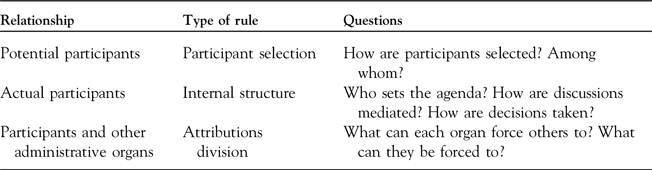
When looking at deliberative institutions, then, we should focus on how actors interact within a legal environment that structures power differentials. In deliberative governance, three types of relations matter: between potential participants, actual participants, and participants and government.Footnote 18 We will go through them one by one.
Between Potential Participants
Despite the common “participatory” label, access to most deliberative institutions is in fact not direct, as not everyone can gain entry automatically. Instead, there are usually participant selection criteria in place. That happens because deliberation faces a “scale problem,”Footnote 19 meaning that inclusion in the hundreds cannot happen without interactions, which are ideally reciprocal, degenerating into one-sided speeches. Consequently, institutionalized deliberation takes place between a relatively small number of actors. As Lavalle and Vera (Reference Lavalle and Vera2011) argue, this makes it more useful to frame deliberative institutions as stages of nonparliamentary representation: since they cannot include all, their existence must be justified by reference to whom those present represent.
Not unlike what happens in traditional parliamentary institutions, the existence of selection criteria introduces a mismatch between potential and actual participants. This means that each potential participant’s capacity to gain access affects some other’s chances—and that selection criteria, among other conditions, structure these opportunities. For example, as previously discussed, election mechanisms may bias entry toward actors who mobilize easily, while reserving seats biases entry toward whomever seats are reserved for. All options have normative consequences, and the choice between them is quite debatable. In keeping with the example, while reserving seats may ensure the presence of marginalized perspectives (Young Reference Young2000, 121–53) it also severs the connection between representation and electoral authorization and accountability (Miguel Reference Miguel2011).
Between Actual Participants
As the preceding discussions on moderators and gender inequality indicate, being there does not necessarily mean effectively taking part in communicative processes. A second type of relationship, then, is established between actual participants. The problem becomes each one’s capacity to affect discussions from the moment an issue is recognized as a political problem to its potential conversion into an actual decision. This capacity is affected by a myriad of noninstitutional conditions, from education levels to membership composition. The relevant legal-institutional conditions, however, are the internal structures that shape opportunities to communicate or to prevent others from doing so, all the way from agenda-setting powers to decision rules.
Let us take, for the purpose of illustration, the problem of agenda-setting. It is one thing for any one participant to be able to introduce proposals directly into plenary discussions, and an entirely different one when that power is reserved for a class of participants (like government representatives or a moderator). Even if a matter is formally proposed, that matter being subjected to actual discussion may still depend on some sort of approval procedure by others. Alternatively, there may not exist overt differentiations between participant classes, but agenda-setting attributions may be reserved for a separate group (like a commission), to which access depends once again on participant selection procedures. As Tatagiba and Teixeira (Reference Tatagiba, Teixeira, Kayano, Tatagiba and Teixeira2007) demonstrate, deciding on what to decide can be a long and conflictual step, but it is only the first in a longer process.
Between Participants and other Administrative Organs
As part of the administrative apparatus, deliberative governance organs do not operate separately from the rest of government. A third sort of relationship, then, relates to what sort of authority participants possess in relation to other organs: What can they force government to do—and, alternatively, be forced to do? Here, the legal environment matters insofar as it divides attributions between the various collective entities that compose the State’s structure.
The authority of deliberative organs over the rest of government (and vice versa) can vary considerably both in manner and degree. In a first dimension, attribution divisions relate to power over policy domains: Which policies and to what extent can they impact policies? Decision-making powers are the most obvious institutional condition here. At one end of the spectrum, some deliberative organs’ decisions directly bind government, and must be implemented as they are. Others are limited to a consultative role, meaning that their decisions can be entirely ignored. There are, however, nuances to the binding/consultative distinction. For example, participatory budgeting initiatives in Brazil draft annual budget bills that must be considered by their respective town halls, but that can still be amended or entirely rejected.
In a second dimension, attribution divisions relate to power over the deliberative governance institutions themselves: Who gets to decide how and when they function? The same institution may, in its various aspects, be regulated through a variety of different legal instruments, each of which distributes decision points for change differently. Consider the following hypothetical division: decision-making powers regulated in parliamentary laws (wherein change demands parliamentary approval), membership composition in decrees (wherein change depends on the executive), and deliberation procedures in internal regulations (which are defined by participants themselves). Variations along such divisions affect deliberative organs’ control over their own rules, as well as who controls those rules that fall outside their jurisdiction (Table 2).
We can advance knowledge regarding such relationships by either elaborating and testing generalizable mechanisms, or by explaining specific cases. The first option involves examining types of interaction and isolating their legal determinants, which can then be formulated so as to make them identifiable in similar cases—Przeworski and Teune’s expression, substituting proper names for variables (Reference Przeworski and Teune1970, 25). This allows for the construction of generalizations, which can then be tested). An already mentioned example is Mendelberg, Karpowitz, and Oliphant’s use of experimental methods to infer how decision rules and membership composition interact to affect women’s participation, an inference that can be subjected to confirmation or disconfirmation through further studies.
The second option involves deeply and holistically examining specific cases. Because such cases usually involve complex interactions between various systematic and nonsystematic (i.e., nonportable) mechanisms, these studies do not necessarily involve generalizations (Beach and Petersen Reference Beach and Petersen2013, 65) They can, however, greatly contribute to the critical examination of the role of law in shaping existing institutions. We may be interested, for instance, in identifying how particular legal arrangements interact with other conditions in order to structure normatively problematic institutional arrangements, termed by Coutinho as “legal bottlenecks” (D. R. Coutinho Reference Coutinho2016). No one objective is right or wrong, and the following case study opts for the second option.
AN ILLUSTRATION THROUGH A CASE STUDY: SÃO PAULO’S HEALTH COUNCILS
With a power-distributional perspective to deliberation in legally constituted environments now articulated, this part’s purpose is to illustrate its utility through a case study: I demonstrate how the legal environment shaped the trajectory and current functioning of São Paulo’s participatory health councils, arguably one of the largest experiments in deliberative governance worldwide. Correspondingly, they are also extensively regulated.
The next section details the contemporary structure of participation in the city’s healthcare policies, highlighting its formally decentralized character. After that follows a periodization that traces how rules of change mediated the disputes around the councils’ existence and structure at each step of their institutional trajectory. Finally, the last section exposes two of the councils’ current legal bottlenecks.Footnote 20
São Paulo’s Participatory System in Healthcare Policy
As mentioned in this article’s introduction, ever since the country’s return to democracy in the 1980s, participatory institutions have multiplied in Brazil. The best-known example is the participatory budgeting, which enjoys the honor of being one of the few institutional innovations to have been transplanted from (and not to) an underdeveloped country (Wampler and Hartz-karp Reference Wampler and Hartz-karp2012). However, in terms of their reach, much more impressive are the policy councils: while participatory budgeting flourished only in a few Brazilian municipalities, councils became ubiquitous due to federal provisions mandating their implementation as part of the structure of a number of policy systems, such as social assistance and healthcare. At this point, more than 99 percent of Brazilian municipalities have social assistance councils and health councils (IBGE 2013; 2014).
Policy councils, however, did not come out of nowhere. Whereas most were structured after democratization and had their designs conceived by federal authorities,Footnote 21 the original health councils were created from scratch in the city of São Paulo during the late 1970s, while Brazil was still under a military dictatorship. The neighborhood of Jardim Nordeste obtained the first one in 1979 (which was in charge of overseeing local public healthcare facilities) after intense pressure from local housewives, public health workers, and members of the Catholic Church (Sader Reference Sader1988, 261; Jacobi Reference Jacobi1993, 42–45). This became a springboard for the organization of a city-wide health movement, which would in the following years demand further institutional inclusion.
Councils proliferated in later years, forming a participatory structure that remains to this day a component of the city’s formally decentralized Serviço Único de Saúde (SUS) administration. The SUS is a national healthcare policy system financed by public resources. The system’s governance rests on a complex legal organization that divides attributions between the federal, state, and municipal levels—all of which have their own health councils. For example, in the city of São Paulo, in addition to the federally mandated municipal council, there are currently an additional twenty-four regional councils, one for each of the city’s regional administrative authorities. This is possible because the city’s gargantuan size led authorities to decentralize the administration of the SUSFootnote 22 (although decentralization has been more formal than real—I will return to that soon).
Representation in health councils of all levels is divided between SUS users (half of the participants), managers (one fourth of the participants), and workers (one fourth of the participants). Among their formal attributions, each council can create its own internal regulations (as long as they do not conflict with hierarchically superior laws), oversee the functioning of healthcare facilities, and make binding policy decisions that fall within the attributions of the administrative level it integrates (thus, federal-level councils can decide within the federal government’s competencies, but may not invade municipalities’ decision-making sphere, and so on). Although the municipal council supervises the regional councils, they operate independently.
The health councils’ functioning and effects have been extensively examined by Political Scientist Vera Schattan Coelho, who reports ambivalent findings. On the one hand, by including more women, racial minorities, and poor people, the councils come much closer to reflecting Brazil’s demographic profile than traditional representative institutions do (Coelho 2004; Reference Coelho2007). Additionally, Coelho associates their existence to reductions in the inequality of service provision between rich and poor regions, as councils located in the periphery more intensively argued for devoting funds to the expansion of healthcare facilities, such as Health Units and hospitals (Coelho Reference Coelho2013; Coelho, Szabzon, and Dias Reference Coelho, Szabzon and Dias2014). However, she also finds that the health councils’ existence is associated with a slight increase in inequality between poorer regions, which she ascribes to differences in the capacity to mobilize for funding (such as informal access to relevant governmental authorities).
How We Got Here: The Role of Law in Shaping the Councils’ Trajectory
The problem with such a brief characterization of the participatory structure’s current design is the obfuscation of a tumultuous history embedded in the city administrations’ drastically differing views of the public health service and its participatory components—a history in which legally constructed power relations played a crucial role. At each successive mayoral change, then existing legal arrangements shaped disputes over the councils’ organization—including their very existence—by determining who could control them. Because choices made during each administration would go on to affect struggles in the next, the way rules of change construct veto points matter in explaining the trajectory that resulted in today’s design.
Between 1979 (the creation of the first council) and 1988 (the enactment of the 1988 Constitution), the city’s administrations yielded to the popular health movement’s pressures for institutional inclusion (while the administrations were not radical proponents of participatory institutions, the mayors and secretaries of health did not actively oppose them) (Neder Reference Neder2001, 147–51; Palma Reference Palma2013, 48–80; Tótora and Chaia Reference Tótora, Chaia, Junior, Ribeiro and de Azevedo2004). Councils were then created in an unsystematic manner, as the activists in the city’s different regions mobilized to varying degrees. Most importantly for our purposes, councils were regulated exclusively through legal instruments called portarias, which could be unilaterally enacted and revoked by the Municipal Secretariat of Health. This made rules easy to change, a fact reflected in the councils’ then constantly adjusting design.Footnote 23
Boosts to the organization of the city’s participatory system came with the election of then Mayor Luiza Erundina in 1989 and the SUS federal laws of the early 1990s. Erundina was then affiliated with the Worker’s Party (PT), which had been pushing for the institutionalization of participation in Brazil (Abers Reference Abers1996). PT’s orientation at the time was visible in her administration, which created councils in many policy areas (Tatagiba Reference Tatagiba and Avritzer2004). Simultaneously, Federal Law 8.142/90 introduced the requirement that each municipality have a municipal level health council, with failure to comply leading to the federal government interrupting SUS funding transfers. The municipal council’s existence then came to be stipulated in an ordinary law (which must be approved by the city hall), but all its regulatory details, as well as the very existence of the regional councils, remained in portarias.Footnote 24
Institutionalization proceeded quickly, but things came to a dramatic halt when Fernando Maluf was elected mayor in 1993. Among his projects was a massive reform of the city’s health services,Footnote 25 which the popular movements that filled councils radically opposed. Upon election, Maluf thus immediately pulled a bill that would have fixed all councils in ordinary law (Municipal Bill 211/92). He then went on to unilaterally dissolve all regional councils, a move possible due to their portaria regulation. The same did not happen to the municipal level council, whose dissolution depended on parliamentary approval. The dissolutions led to revolt among the popular health movement and members of the municipal council (Neder Reference Neder2001, 158–62; Palma Reference Palma2013, 97–112; J. A. Coutinho Reference Coutinho1997). In response, Maluf’s successor, Celso Pitta, issued a decree (Municipal Decree 37.330/98) changing the municipal council’s composition and excluding users’ representatives, a unilateral move yet again possible because these details were regulated in portarias, which are hierarchically lower than decrees. Popular health movements remained active during the period, but again forced to pressure for inclusion from the outside.
Thankfully for the movements, the next elected mayor, Marta Suplicy, was again a PT member. Her administration, which had closer ties to participatory movements’ demands,Footnote 26 reestablished the regional councils and reregulated the municipal council—this time, through bills that became ordinary laws (Municipal Laws 13.325/02 and 13.716/04). From this point on, relevant regulatory changes could only happen in two ways: at the aggregate level, through new laws; and at each individual councils’ level, through internally defined regulations. This greatly altered councils’ relationship with subsequent administrations: even though former Mayors José Serra and Gilberto Kassab again proposed reforms that faced unflinching opposition, they did not tamper with the participatory structures. They were as unwilling to cooperate as Maluf or Pitta, but outright dissolution was not part of their disruptive tactics.Footnote 27
Legal arrangements played an important role in shaping the relationship between each administration and the councils. This becomes clear when comparing situations of open conflict: Serra and Kassab could not rearrange councils as easily because they would have had to deal with city hall as a veto point. Similarly, while Maluf and Pitta had no difficulty with dissolving the regional councils overnight due to their portaria regulation, they did not do the same with the municipal council (which was already fixed in ordinary law)—Pitta did, however, change the municipal council’s composition, which was regulated through portarias. Moreover, ever since the councils were formalized in law during the Suplicy administration, they have had their longest period of stability yet, with design changes occurring gradually at each individual councils’ level through adjustments in their internal regulations. This legal modification thus marks the moment when councils went from weakly to strongly institutionalized organs.Footnote 28
Where We Are Today: Two Legal Bottlenecks
Legally constituted power-differentials are part of the councils’ trajectory, but how do they affect deliberative dynamics today? In order to assess law’s relevance, I studied two regional councils, those of Campo Limpo and Cidade Tiradentes. Among the twenty-four regional councils, those were chosen because their internal regulations greatly differed: while Campo Limpo’s regulations are highly detailed regarding selection procedures and internal structures, Cidade Tiradentes’ regulations leave considerable room for informal definition of such matters. The results point to at least two legal bottlenecks—that is, arrangements with problematic normative consequences—generalizable to the system.
Workers Versus Managers: Why Workers Will Not Talk
One persistent problem identified by interviewed participants is that most of the workers hardly ever talk during meetings. The reason for their silence was widely shared: the labor law regime under which workers of privately managed health facilities are hired.
While the SUS remains fully publicly funded, since 2007, São Paulo has seen a considerable rise in the privatization of the management of healthcare facilities due to the reforms introduced by Serra and Kassab.Footnote 29 The city’s administrations have relied on contracting arrangements to transfer management to private entities (such as private hospitals), who keep services free in exchange for payment by the government (Matta and Contreiras Reference Matta and Contreiras2015). By 2015, most (68 percent) of the over one thousand healthcare facilities had been transferred.Footnote 30 These private entities bring in their own workers, who participate in council meetings in the same manner as the workers of publicly managed healthcare facilities. In fact, they both share the chairs reserved for the SUS’s workers.
The thing is, these workers are hired under a legal regime different from that of the government. Those hired by the government are generally under a special regime that makes removal possible only under very specific circumstances, such as engaging in crimes against the public administration. On the other hand, those hired by private entities remain under the standard labor regime, which greatly facilitates removals. Without the same kind of guarantees, privately hired workers (the majority in regional councils today) speak far less than the publicly hired ones: they share the same room as their managers during council meetings, but managers are the ones who get to decide over their jobs. In some of the councilors’ words:
I’m going to talk as a worker. Some feel inhibited by being close to their managers. Others really do suffer, because they have the courage to talk. There are managers who apply measures against the workers, and that happens a lot in privately managed facilities. We’ve had one worker who was transferred from his working place, where he was a great councilor. (SUS Worker, Interview by Henrique A. Castro, June 6, 2016, Transcript)
We can’t exactly say managers actively coerce workers, but we do see some insecurity from workers. This insecurity is because of their instability. A lot of the times, I noticed that these councilors didn’t participate the way they wanted because they were afraid of losing their jobs. (SUS User, Interview by Henrique A. Castro, May 30, 2016, Transcript)
In this case, the legal environment disincentivizes private workers’ communication by making it easy for managers to fire or transfer them. This is a real problem because councils often discuss the state of each region’s healthcare facilities, as supervising the provision of health services is part of council attributions. Workers should be expected to possess relevant information regarding the service’s problems, but it is unlikely that anyone would share negative evaluations under such circumstances. It is reasonable to attribute this effect to legal conditions because they vary along with the observed outcomes between publicly and privately hired workers. Moreover, Almeida (Reference Almeida and Avritzer2010, 155), who researched deliberative dynamics in the health councils of eight municipalities where management privatization is less prevalent, reported that “compared to other segments, workers are active in most cities.”
Participants Versus the Health Secretariat: How Decisions Are Really Made
A second problem relates to how decisions made by the regional councils become actual policies. Formally speaking, regional councils have binding powers—that is, their decisions should be implemented regardless of the whims of other government organs, as long as they do not conflict with hierarchically superior regulations. In practice, however, participants must consistently bargain for resources with the Municipal Health Secretariat.
Created in 2001, regional administrations were part of Marta Suplicy’s overarching scheme to decentralize planning and provision of public healthcare services in São Paulo. Years after the fact, however, most of the planning capacity remains in the hands of the Municipal Health Secretariat. Comparatively, regional administrations have little available personnel and unclear legal attributions. Even more important, regional administrations lack an autonomous budget provision. Thus, Pinto, Tanaka, and Spedo (Reference Pinto, Tanaka and Spedo2009; Spedo, Pinto, and Tanaka Reference Spedo, Pinto and Tanaka2010) have found that regional administrations tend to limit their actions to cheaper supervisory activities. Sometimes regional managers do engage in more proactive planning, but that usually results from informal coordination with the Secretariat or the managers of healthcare facilities. Informal coordination, however, is better explained by mobilizable personal networks (“who is a friend of whom”) than by the exercise of formally structured attributions.
Since the councils are part of the regions’ administrative structure, the lack of an independent budget provision renders their formally binding powers moot—if the Municipal Health Secretariat does not buy into decisions, nothing can get done. Councils cannot directly force the Secretariat to implement decisions either, because they have no recognized legal personality, and thus cannot directly resort to the judiciary. Moreover, their decisions do not get published in the Municipalities’ Government Gazette (although they should), which makes them less likely to be unenforced in court. These difficulties were also documented among interviewed actors, who commented on the difficulties involved in accessing resources and implementing decisions:
One of the user councilors once told me: “We thought you dealt directly with money here, but now I understand that you are beggars like us.” I thought his comment was very interesting, and said, “yeah, that is the point, we are also beggars … we ask the Secretariat for things all of the time.” We have to present our needs, justify them, and send something consistent, … so that they may help us. (SUS Manager, Interview by Henrique A. Castro, April 8, 2016, Transcript)
I think the council should have its own resources, the resources should be decentralized, so that the council could have more autonomy. Finance is too centralized, and accessing these resources is hard. We don’t know how it works. … It’s the Secretariat, it’s closed. (SUS User, Interview by Henrique A. Castro, April 6, 2016, Transcript)
When regional managers want to push their agenda, they use the councils’ decisions as evidence of popular support in order to convince the Secretariat; when users want to push their agenda, they organize and personally pressure Secretariat officials. In other words, being legally disempowered vis-à-vis the Secretariat, participants must resort to other power resources, such as social networks (Marques Reference Marques2012) and collective mobilization. This helps explain why, as Coelho (Reference Coelho2013, 9) demonstrates, councils’ decisions are more likely to be implemented when councilors are strongly connected to Secretariat authorities and to active popular health movements. It also helps explain the puzzling increase in inequality between peripheric regions as, unlike formal decision-making powers, networks and mobilization capacity are unequally distributed.
CONCLUSION
Deliberative democracy is currently a buzzword in academic and reformist discourses alike, but deliberative governance institutions will not deliver on legitimacy and effectiveness simply because they are different from parliaments: after decades of debate, no one would deny that sometimes these spaces simply reproduce long-known power differentials in novel (and not so novel) ways. However, we also know that, depending on the conditions, they do have the potential to involve previously excluded actors in reasoned political discussions and achieve the normatively intended outcomes. That said, we still lack knowledge as to how contextual conditions, especially those that create power differentials, empirically shape deliberative dynamics. This challenge currently drives a burgeoning field of empirical studies, one in which sociolegal scholars would do well to involve themselves deeper.
The currently available sociolegal literature already shows that State-backed rules often affect deliberation but lacks theoretical propositions as to how. Inspired by recent public law scholarship, I argued that one path to solving this deficiency is probing the role of law in internally constituting power relations. We can advance by recognizing that the legal environment unequally distributes opportunities for actors to act against one another’s interests—consequently, in a world where strategic behavior is pervasive, changes to legal conditions may result in corresponding changes to deliberative outcomes. Considering that power is a relational concept, I further contended that three types of relationships matter in deliberative governance: between potential participants, actual participants, and participants and government.
A focus on the legal construction of power in deliberative governance has two desirable characteristics. First, so long as law is kept in its proper analytical place as one among other potentially relevant contextual elements, the approach can sharpen causal inference. Second, speaking the language of power allows us to connect empirical work to the normative concerns of deliberative theory. The article illustrated these propositions through a case study of the city of São Paulo’s health councils, one of the world’s largest experiments in deliberative governance. Though brief, the study demonstrated that legal arrangements shaped the councils’ stability in time, the unequal relationship between SUS managers and privately hired workers, and the bargaining patterns between the Health Secretariat and the council participants.
Controversies over the role of power in deliberative governance are bound to continue regardless of the involvement of sociolegal scholars. Likewise, as theoretical and practical problems often involve legal conditions, scholars and reformists will continue debating the law of deliberative democracy. Not delving deeper into such an academically enticing and politically relevant discussion means missing out on too big of an opportunity. This article is meant as a step for us to continue tilling this ground.