Introduction
Tonsillectomy is one of the most commonly performed operations,Reference Millington and Phillips 1 especially in the paediatric population. The post-tonsillectomy period carries significant morbidity in terms of pain and complications, the most common being haemorrhage.Reference Lowe, van der Meulen, Cromwell, Lewsey, Copley and Browne 2 Socioeconomic status, operative methodology, peri-operative medication regimes and many other factors have been studied in great detail for many years to identify tonsillectomy morbidity risk factors.Reference Lowe, van der Meulen, Cromwell, Lewsey, Copley and Browne 2 – Reference Bhattacharyya and Shapiro 5
Anecdotally, one of the most commonly posed questions peri-operatively regards the optimal post-operative diet. Historically, there has been a schism amongst ENT surgeons regarding which foodstuffs should be avoided, or indeed encouraged, post-operatively. Traditionalists have proposed a diet of soft foods such as jelly and ice cream because of their cooling and soothing effects on the post-operative field, allowing for maintenance of hydration and nutrition and having high patient satisfaction. Contemporary views recommend the avoidance of dairy products or citrus, and advocate the consumption of rougher textured foodstuffs such as toast or crisps.
Given the frequency of patient enquiry, the discordance of opinions and the health burden of post-operative symptoms in patients undergoing tonsillectomy, the authors of this review undertook a formal appraisal of the world literature.
Materials and methods
A systematic literature search was performed using the following databases: Embase (1980 to November 2014), Medline (1946 to November 2014), the Cumulative Index to Nursing and Allied Health Literature (‘CINAHL’) (1981 to November 2014) and PsycInfo (1806 to November 2014). There were no limits imposed regarding language. The literature search was performed using the Medical Subject Heading search terms ‘tonsillectomy’ together with ‘post-operative care’ or ‘post-operative period’ and ‘diet’. Further searches were performed using the terms ‘tonsillectomy’ together with ‘jelly’, ‘jello’, ‘jell-o’, ‘crisps’, ‘toast’, ‘gelato’, ‘potato chips’ or ‘ice cream’.
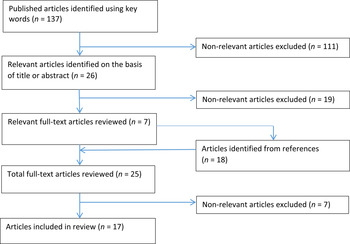
Initially, 137 articles were identified from the database searches. A process of reference reduction was independently undertaken by two of the authors (AM and JP). The reference sections of all original articles were searched to identify other potentially relevant articles. The process undertaken is schematically presented in Figure 1.
Flow chart of systematic search and review process, conducted in accordance with the Preferred Reporting Items for Systematic Reviews and Meta-Analyses (‘PRISMA’).

A total of 17 original articles were ultimately identified, with no disagreement between the authors during the process of reference reduction.
Results
Meta-analysis was not possible given the heterogeneity of the types of studies identified and the nature of the data gleaned from the literature search. Therefore, the outcome of the literature review is presented in a narrative format.
Fox in 1952,Reference Fox 6 amongst others,Reference Preston 7 is very specific in his post-dietary advice. He recommends that only cold food and fluid are consumed post-tonsillectomy, for two weeks. He proposes that only liquids are consumed on day 1 post-operatively, followed by a soft diet from day 2. Patients can return to a normal diet by day 4, but he states that ‘dry toast, crackers and other foods should be avoided’. Highly seasoned food must be avoided, as must all alcohol excluding beer which ‘may be taken in small quantities after week one’.
Harry Talbot wrote an extremely informative article some years later, in 1965, opposing the use of cold, soft foods and a delay in restarting a normal diet – a regimen which he believed was based on a physiological ‘misconception’.Reference Talbot 8 His argument pivots around the opinion that post-operative pain originates from trauma-induced pharyngeal muscle spasm, and that relief will be achieved by chewing, thus stretching the affected muscles. He therefore proposes an immediate return to a normal diet; otherwise, ‘pain persists for maybe seven to ten days’.
A letter by Bulteau, published in the Medical Journal of Australia in 1976, highlights patient testimony that ‘very cold food…such as ice-cream…is unbearable’.Reference Bulteau 9 He suggests that the ‘ice-cream myth…has been picked up by textbooks, promoted by columnists and been absorbed in to family folklore’. He proposes eating ‘whatever one chooses’, as ‘there is little else to brighten the days after an operation’.
A response to that letter by Gray agrees that the cold temperature of ice cream can cause discomfort.Reference Gray 10 He, however, suggests that the ‘strain-swallow’ of ‘considerable movement of the palate and tongue’ with small, compressible food boluses, which one finds with jelly and ice cream, worsens pain, leading to more discomfort.
In 1987, Schaler and Parkin stated that ‘citrus fruits and acidic vegetables can cause discomfort, and chocolate and dairy products produce mucus in some patients and may complicate swallowing’.Reference Schaler and Parkin 11 A soft diet was recommended as it avoids ‘pharyngeal trauma’. This concept was rebuffed 25 years earlier by Talbot,Reference Talbot 8 who says that the ‘serofibrinous layer’, commonly known as ‘slough’ in the UK, acts as a protective mechanism.
Cook et al., having found no previous experimental evidence, performed a small, randomised, controlled study in 1992.Reference Cook, Murrant, Evans and Lavelle 12 They investigated 150 patients randomised to a soft diet, a crunchy diet or no dietary restrictions post-tonsillectomy. A total of 137 patients completed the dietary diary for 2 weeks. No statistical difference was found between the groups in terms of pain, analgesia requirements, healing or bleeding at one and two weeks post-operatively.
Brodsky et al. investigated restricting diet and activity in 92 children after tonsillectomy.Reference Brodsky, Radomski and Gendler 13 The patients were randomised either to a restricted group (n = 45), who were given instructions to limit activity and stay at home, and adhere to a liquid or soft diet only, for 7–10 days, or a non-restricted group (n = 47) who were advised to return to normal activity and diet. There was no significant difference between either group in terms of complications, pain levels or analgesic use.
Thomas et al. examined the dietary preferences of 50 post-tonsillectomy children and found that the majority chose soft, cool foods if given the choice.Reference Thomas, Moore and Reilly 14 They limited a further 50 children to only soft, cool foods, and found increased food consumption. The authors concluded that a soft or liquid diet should be advised as it increased food intake, which was hypothesised to reduce morbidity.
In 1995, Hall and Brodsky performed a non-randomised study of 100 children, focusing only on the first 12 hours post-operatively.Reference Hall and Brodsky 15 They found no statistical difference in pain, nausea or general wellbeing between ‘restricted’ diets of soft foods (n = 59) and ‘non-restricted’ diets (n = 41), although a positive trend towards improved general wellbeing and a slight decrease in nausea was observed in the non-restricted group.
The results of a study published in 1999, which focused on encouraging mastication, suggest that chewing gum immediately post-operatively leads to increased pain and a delayed return to a normal diet.Reference Hanif and Frosh 16 Several studies conducted in the 1960s had investigated using medicated chewing troches, which contained either analgesics, antibiotics or both, and found improvements in pain, dysphagia and ‘malodorous breath’.Reference Ehrenreich 17 , Reference Pavelic 18 Aspergum®, an aspirin-containing chewing gum, was commonly used during the post-tonsillectomy period, until it was reported in the 1950s, by Craven, to precipitate post-tonsillectomy haemorrhage. This finding, coupled with other epidemiological observations, led to the initiation of aspirin in the treatment and prevention of myocardial infarction.Reference Miner and Hoffhines 19
A retrospective questionnaire-based study investigating diet and physical activity in 800 Polish children after adenoidectomy (n = 413) or adenotonsillectomy (n = 387) found an increased bleeding rate in the restricted groups, and low pain scores in the non-restricted cohorts.Reference Zagólski 20
In 2011, a small-scale, randomised trial investigated ice-lolly consumption immediately post-operatively in 92 children who underwent tonsillectomy.Reference Sylvester, Rafferty, Bew and Knight 21 Its findings suggested that this practice reduced post-operative pain in the first 4 hours; however, there was no statistical difference in pain scores after this time.
A 2016 meta-analysis found evidence for using honey as an adjunct to reduce post-tonsillectomy pain and analgesic use.Reference Hwang, Song, Jeong, Lee and Kang 22 However, the studies included focused on the honey's intrinsic healing effects, rather than the effects of its consistency or temperature. The most recent Cochrane review of honey use in wound healing reported that ‘evidence for differences in the effects of honey and comparators is of low or very low quality and does not form a robust basis for decision making’.Reference Jull, Cullum, Dumville, Westby, Deshpande and Walker 23
Renowned nursing textbook Wong's Nursing Care of Infants and Children espouses the idea of avoiding irritating foodstuffs, citrus juice and milk products that ‘coat the mouth and throat, causing the child to clear the throat, which may initiate bleeding’.Reference Hockenberry and Wilson 24 They also promote a soft diet for the first few post-operative days. Eminent otolaryngology tome Scott-Brown's Otorhinolaryngology, Head and Neck Surgery, however, has stated that any particular dietary advice has no impact on morbidity or recovery.Reference Gleeson and Clarke 25
Discussion
Many other surgical disciplines advise post-operative dietary restrictions in an aim to reduce complications. Examples include avoiding tomato skins and celery after ileostomy, and encouraging soft foods after fundoplication. 26 , 27 As food passes directly over the operative tonsillectomy site, it seems logical that food may have an effect on post-operative recovery.
A simple Google® search for ‘post-tonsillectomy diet’ will elicit information from many healthcare providers advocating post-tonsillectomy dietary restrictions to improve rehabilitation and reduce morbidity. The avoidance of citrus or spicy food, and encouragement of soft, sludgy and cool food, or alternatively crunchy and hard food, are all proffered. Many declare ‘evidence shows’ that their individual claim is correct and improves recovery.
The healthcare burden of post-tonsillectomy complications is difficult to assess, but with nearly 50 000 tonsillectomies being performed in the UK per annum,Reference Millington and Phillips 1 approximately 1500–2000 post-tonsillectomy haemorrhages will occur per year, with some 500 requiring surgical intervention. Studies in the USA have shown post-tonsillectomy re-attendance rates of 7.6 per cent and 11.1 per cent for paediatric and adult populations respectively.Reference Shay, Shapiro and Bhattacharyya 28 , Reference Bhattacharyya and Kepnes 29 These attendances are associated with additional burdens on emergency services, primary care, in-patient beds, surgical staff and operating theatre time. Both patient and carer socioeconomic contributions may be affected by the prolonged recovery time associated with co-morbidity. Any advantage gained in recovery and reduced complications, including those achieved by dietary modification, should be encouraged.
Our formal appraisal of the evidence has demonstrated a significant amount of poor quality and conflicting evidence. Studies employing good quality research methodology, however, have failed to demonstrate that one post-tonsillectomy diet trumps another. Despite the UK National Prospective Tonsillectomy Audit showing a statistical difference between ‘hot’ and ‘cold’ tonsillectomies in terms of post-operative haemorrhage,Reference Lowe, van der Meulen, Cromwell, Lewsey, Copley and Browne 2 it seems that recommendations regarding post-operative diets of hot or cold foods, or indeed crunchy or soft foods, do not statistically affect recovery.
There is limited high-quality evidence, which could affect the power of this review. We feel, however, that the review has a justifiable mandate: post-tonsillectomy patients and their families require robust evidence to make appropriate choices to ensure adequate intake, no matter the consistency. Promoting an unrestricted diet to children, who may otherwise be fussy, is a sensible approach; pushing children to eat things they would not normally eat, or do not like, is counterproductive when encouraging oral intake during the recovery period post-tonsillectomy.
Conclusion
Most post-tonsillectomy dietary advice is based on historical anecdotes and not rigorous scientific testing. The small-scale, randomised studies discussed above show no statistical difference in morbidity between non-restricted and restricted diets.
The current best advice using the evidence above suggests the use of ice-pops in the immediate post-operative period (4 hours), followed by a return to a diet that the patient finds acceptable and that will facilitate nutrition and hydration.
The post-tonsillectomy period still carries significant health and economic burdens. We should continue to explore means to minimise these, as even a small reduction will ultimately benefit patients and their carers, the health service, and the economy.
Acknowledgement
The authors would like to thank John Losasso of the Norfolk and Norwich University Hospital Library for his assistance in performing the literature searches.