Kawasaki disease is an acute febrile illness associated with self-limited vasculitis of unknown aetiology. It is characterised by fever lasting for more than 5 days, bilateral non-exudative conjunctivitis, erythema of the lips and oral mucosa, changes in the extremities, rash, and cervical lymphadenopathy. Coronary artery aneurysm or ectasia develops in approximately 15–25 % of untreated children. Other cardiac manifestations of Kawasaki disease include myocarditis, valvular insufficiency, ischemic heart disease, or sudden death.Reference Dajani, Taubert and Gerber 1 , Reference Kato, Sugimura and Akagi 2 Kawasaki disease is now the most common cause of acquired heart disease in children in the developed countries.Reference McCrindle, Rowley and Newburger 3 The goals of therapy include reduction of inflammation in the coronary arteries and the myocardium by intravenous immunoglobulin (IVIG) administration, and prevention of thrombosis through inhibition of platelet aggregation by aspirin administration. IVIG has reduced the incidence of coronary artery aneurysm, defined by absolute luminal dimension, from 25 % to 4 % in a recent report.Reference McCrindle, Rowley and Newburger 3 The epidemiology of Kawasaki disease in the United States has not been updated since previous small- and medium-sized studies.Reference Uehara and Belay 4 , Reference Burns, Herzog and Fabri 5 In this report, we provide updated information on Kawasaki disease epidemiology. Additionally, by using a database consisting of more than 12 million children discharges from US hospitals, this report also provides information on variables contributing to Kawasaki disease hospitalisation including season and region, as well as variables contributing to length of stay (LOS) and hospital charge, which have not been reported previously.
Materials and methods
Study population and variables
We analysed data from hospital discharge records on patients under 18 years of age using the national representative Kids Inpatient Database (KID) for years 2009 and 2012. The data were compiled by the Agency for Healthcare Research and Quality (AHRQ) and generated by the Healthcare Cost and Utilization Project (HCUP) in collaboration with public and private state-wide data organisations.
Hospitalisations due to Kawasaki disease were identified using International Classification of Diseases, Ninth Revision, Clinical Modification (ICD-9CM) code (446.1: mucocutaneous lymph node disease) in the primary or secondary diagnosis field, and they were weighted with DISCWT to estimate the number of hospitalisations in the entire USA. ICD-9CM codes (414.11: aneurysm of coronary vessels) were used to identify patients who developed coronary artery aneurysm. Patient characteristics collected for this study included age, gender (male or female), and ethnicity (black, Hispanic, white, Asian or Pacific Islanders, native American). Hospital characteristics included hospital regions (Northeast, Midwest, South, or West).
Outcome variables
The outcomes of interest were trends in the annual hospitalisation rates of Kawasaki disease with respect to age, gender, and race. Annual Kawasaki disease-associated hospitalisation rates were calculated by using the number of hospitalisations as the numerator and the corresponding population derived from the US census for 2009 and 2012 as denominator. The number of hospitalisations by months, hospital regions, weekend, and ethnicity were also obtained. Additionally, we investigated LOS and total charges for hospitalisation for Kawasaki disease by ethnicity groups, weekday/weekend admissions, and insurance. In addition, we also identified patients who developed coronary artery aneurysms and categorised them according to age and ethnic groups. We also identified the contribution of several independent variables on LOS.
Statistical analysis
Descriptive statistics including mean, standard deviation, frequency, and percentage were computed. Chi-squared test and independent sample t-test were used for categorical and continuous variable comparisons, respectively. Linear regression analysis was used to calculate the effects of independent variables on outcome variables. The level of significance was chosen at 0.05, and all p-values were two-sided. Statistical analysis was performed using STATA software version 15.1 (StataCorp LP, TX, USA).
Results
Seasonal, regional, ethnicity group, and age variation
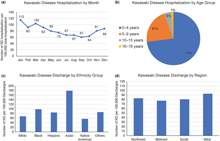
There were a total of 12,678,005 children hospitalisations during the study period, out of which 10,486 were from Kawasaki disease. Incidence of Kawasaki disease was calculated at 6.35 per 100,000 children. There were significant seasonal variations in Kawasaki disease hospitalisation, with highest during the month of January (115 cases per 100,000 discharges) compared to lowest during the month of September (61 cases per 100,000 discharges). The odds ratio (OR) was 1.9, with a p < 0.001 (Fig 1a). Similarly, the January–March quarter had the highest rate and the July–September quarter had the lowest (OR=1.62, p < 0.001).
Kawasaki disease hospitalisation by month (a), age group (b), ethnicity group per 100,000 discharges (c), and region per 100,000 discharges (d). Data obtained from the national Kids Inpatient Database (KID) for years 2009 and 2012.

Kawasaki disease was most common among children between 0 and 4 years old, comprising 73 % of total Kawasaki disease cases (Fig 1b). Hospitalisation was more common in male, with a male-to-female ratio of 1.4.
With regard to variations in Kawasaki disease hospitalisation according to ethnicity groups, Asian and pacific islanders were significantly higher as compared to whites (OR=2.64, p < 0.001) and other groups (Fig 1c). In terms of regional variation, West had the higher rate of hospitalisation compared to the rest of the country (Fig 1d). The regional variation may partly be explained by the highest density of the Asian population in the West.
Coronary artery aneurysm
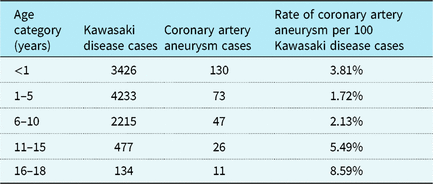
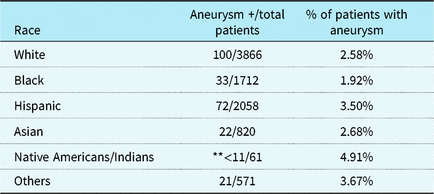
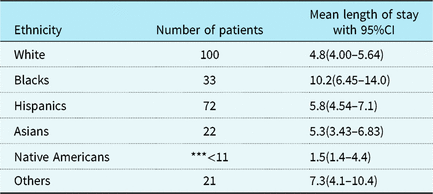
A total of 287 cases of coronary artery aneurysm were identified in children diagnosed with Kawasaki disease (2.7 %). On further analysis, we found variations in the incidence of coronary artery aneurysm according to the age groups. Children less than 1 year of age and more than 10 years of age were at increased risk of coronary artery aneurysm (Table 1). Among children younger than 1 year of age, the rate of coronary artery aneurysm was 3.81 % in comparison to 2.7 % in the entire paediatric population (OR=1.40, p = 0.001). We found that Hispanic children had higher coronary artery aneurysm followed by Asian population compared to white children (Table 2). In the subset of patients with coronary artery aneurysm, blacks had the longest stay compared with other ethnicity groups (Table 3).
Total Kawasaki disease cases and percentages of coronary artery aneurysm according to age category.

Coronary artery aneurysm according to ethnicity.*

* Because of some patients not reporting races, the total number in races does not equal to the total sample size.
** The number of Native Americans/Indians who developed coronary aneurysms were <11, the value not reported due to HCUP guidelines for the KID.
Length of stay according to ethnicity in coronary artery aneurysm subpopulation.

*** The number of Native Americans/Indians who developed coronary aneurysms were <11, the value not reported due to HCUP guidelines for the KID.
Length of stay
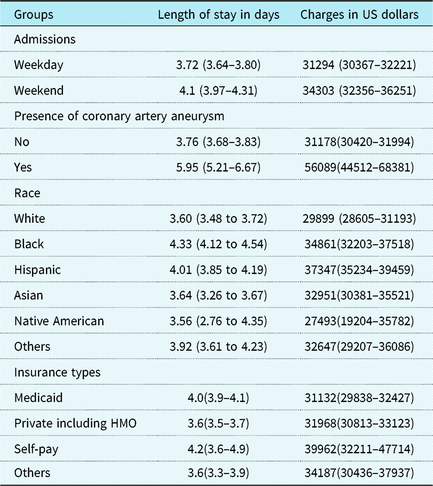
There was a weekend effect for the total length of Kawasaki disease hospitalisation, with children admitted during weekend staying longer than when the admissions were during a weekday [4.1 days (95 % CI: 3.97–4.31) versus 3.72 days (95 % CI: 3.64–3.80), p < 0.001].
When comparing LOS among different ethnicity groups, blacks had the longest LOS and whites had the shortest [4.33 days (95 % CI: 4.12–4.54 days) versus 3.60 days (95 % CI: 3.48–3.72 days), p < 0.001].
We further subcategorised LOS according to insurance types, and found that patients without insurance (self-pay) had the longest stay. In addition, we found that patients with government insurance stayed longer than those who had private insurance [4.0 days (95 % CI: 3.9–4.1) versus 3.6 days (95 % CI: 3.5–3.7), p < 0.001] (Table 4).
Comparison of total length of stay and charge between timing of admission, presence of coronary artery aneurysm, ethnicity groups and insurance types.

Data presented as mean (95% CI).
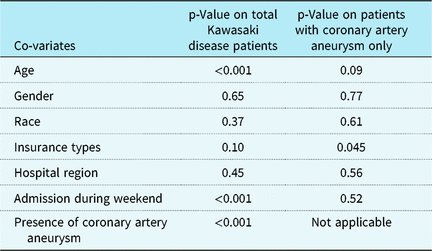
We performed linear regression analysis to assess the effect of co-variates on LOS. Co-variates in the model included age, admission during weekend, hospital region, ethnicity group, insurance type, coronary artery aneurysm, and gender. We found that age, admissions during weekend, and the presence of coronary artery aneurysm each significantly affected LOS after adjusting for other co-variates (Table 5). On the other hand, ethnicity group, gender, and insurance types did not have significant association with LOS (Table 5).
Relationship between co-variates on the length of stay of children with Kawasaki disease and the subpopulation with coronary artery aneurysm.

We applied the same model to a subset of Kawasaki disease patients who developed coronary artery aneurysm, and found that only the insurance type was significantly associated with LOS (p = 0.045) (Table 5).
Hospitalisation charge
Total hospitalisation charge was also significantly higher in patients who were admitted on the weekend as compared to those admitted during weekdays (Table 4). The total charge was highest among Hispanic children, reaching statistical significance as compared to charges for white and Asian children (Table 4). Children with coronary artery aneurysm were hospitalised longer with higher hospital charge as compared to those without coronary aneurysm (Table 4). As expected, hospital charges were highest among self-pay patients compared to either government or private insurance.
Discussion
This report provides the most updated Kawasaki disease hospitalisation rate by using the HCUP hospitalisation data derived from the Kids Inpatient Database national database. The rate of Kawasaki disease hospitalisation in children <5 years old is 18.5 per 100,000 which is higher than the reported rate of 17.6 per 100,000 in 2000.Reference Holman, Curns, Belay, Steiner and Schonberger 6 However, the hospitalisation rate due to Kawasaki disease has been continuing to decline since 2003.Reference Okubo, Nochioka, Sakakibara, Testa and Sundel 7 Other epidemiological parameters such as variation in race, sex and age were very similar.Reference Holman, Curns, Belay, Steiner and Schonberger 6 , Reference Okubo, Nochioka, Sakakibara, Testa and Sundel 7
Previous studies reported increased incidence of Kawasaki disease during the winter and spring seasons, which our findings confirmed.Reference Holman, Curns, Belay, Steiner and Schonberger 6 Furthermore, our study again showed that the Asian population is at the highest risk for hospitalisation due to Kawasaki disease, similar to findings from a prior report.Reference Kitano, Suzuki and Takeuchi 8 Recently, a genome-wide association study found that human leukocyte antigen determinant was associated with increased susceptibility to Kawasaki disease in Asian children but not in Europeans, which may explain our findings.Reference Onouchi 9
Coronary artery aneurysm
The coronary artery aneurysm rate in our analysis was 2.7 %, similar to but lower than a recent study reporting a rate of 4 % following treatment with IVIG, further emphasising the benefit of IVIG and the time-sensitive nature of this treatment.Reference McCrindle, Rowley and Newburger 3 We further found that the risk of coronary artery aneurysm formed an U-shape distribution, with higher rates observed among children who were less than 1 year and older than 10 years of age similar to the findings from previous studies.Reference Belay, Maddox and Holman 10 , Reference Callinan, Tabnak and Holman 11
Compared to children without coronary artery aneurysm, those with coronary artery aneurysm had longer hospital stay, implying a sicker subpopulation requiring longer monitoring and management in the hospital setting.
It is possible that the rate of coronary artery aneurysm is underestimated due to miscoding or misclassification. Another possible cause of underestimation would be delayed appearance and diagnosis after the patient has already been discharged from the hospital. In this case, the diagnosis would have been made outpatient, and would therefore have not been included in this dataset.
Ethnicity, insurance type, and length of stay
In our study population, we found that LOS varied significantly among ethnicity groups, with Hispanics and black children staying significantly longer than white children. This finding applied to the total population as well as the subpopulation with coronary artery aneurysm. However, in a linear regression model, we did not find significant contribution of ethnicity to LOS. Similarly, ethnicity also did not significantly contribute to LOS in children with coronary artery aneurysm.
Insurance type also affected LOS. Generally speaking, the United States has a multi-payer system, which can be broadly divided into three groups: the first group consists of those who rely on government insurance and the second group are those who purchase private insurance either through their employer at work or directly from the insurance companies. The third group consists of those patients who do not have any type of health insurance, either voluntarily or unwillingly. Patients in the third group are required to pay out of pocket. We found that self-pay and Medicaid patients stayed longer than those patients who have private insurance. It is possible that healthcare providers are more conscious about LOS when their patients have private insurance to avoid refusal of reimbursement by their insurance companies. Nonetheless, in our regression model, the contribution of insurance type to overall LOS was not significant in the study population.
Finally, it has been suggested that an association between ethnicity groups and insurance type exists. 12 Therefore, we further analysed whether insurance type mediates LOS among different ethnicity groups. Interestingly, we found that LOS in whites remained significantly shorter as compared to that in blacks and Hispanics even after adjusting for insurance types.
Weekend effect
Weekend effect is an interesting finding in our report. The patients who were admitted over the weekend tend to stay longer. This is likely due to the lack of proper diagnostic resources such as echocardiography on the weekend. Correspondingly, hospitalisation charge was also higher on the weekend. Although LOS contributed to the total charge, with an adjusted R2 of 0.46, additional hidden factors seemed to exist. Due to the limitations of the dataset, we were not able to further investigate.
Limitation
The main strength of our study is a large sample size available through a national database. However, like any administrative database, it is prone to coding errors. Coding practice also differs between different hospitals and regions. Other limitation may include variations in hospital charge across different states, which may have also contributed to differences in hospital charges among different ethnic groups. It merits further analysis with state-specific dataset which is not available in the dataset used for this study.
Conclusion
In conclusion, our study provides an update on the epidemiology of Kawasaki disease hospitalisation by using a large national database. The rate of Kawasaki disease remains high among Asian children, as well as during winter and spring months, suggesting an interaction between environment and genetic pre-disposition in Kawasaki disease pathogenesis. Age, admission during weekend, and the presence of coronary artery aneurysm significantly affect LOS, while race, gender, insurance types did not meet statistical significance.
Author ORCIDs
Laxmi Ghimire 0000-0001-5880-3496
Acknowledgements
None.
Financial Support
This research received no specific grant from any funding agency, commercial or not-for-profit sectors.
Conflicts of Interest
None.